
When the development community talks of people living in poverty (or ‘the poor’) they almost always talk about somebody else — it is not ‘us’ but a remote, often nameless ‘them’.
And when the humanitarian community talks of people affected by crises — disasters or conflict — that too almost always is about somebody else, typically in a poor country.
The well-meaning, do-good people in development and humanitarian communities are fond of talking about the information needs of the poor or crisis affected. These ‘needs’ are usually defined in terms of survival, sustenance or relief.
It’s as if people in poverty or crisis situations only have a simple set of information needs, but none of the information ‘wants’ that we, the privileged, have in abundance.
In Geneva this week, I have argued that everyone has a right to not only information needs, but also information ‘wants’. Development or emergency relief would become truly meaningful only when both these are met.
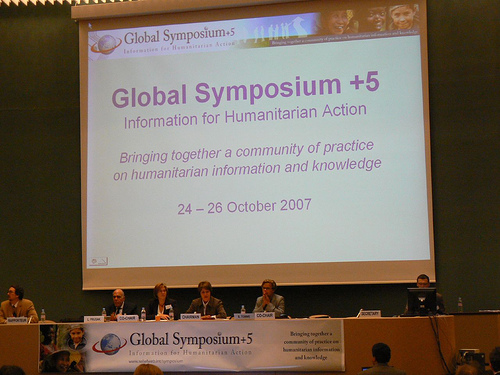
I’m participating in the Global Symposium+5 on ‘Information for Humanitarian Action’ organised by the United Nations Office for the Coordination of Humanitarian Affairs (UN-OCHA). The meeting, held from 22 – 26 October 2007 at the Palais des Nations, UN headquarters in Europe, brought together over 200 persons involved or interested in information and communication aspects of humanitarian work.
I was invited to be part of working group 5 on ‘Communicating with affected communities in crisis’. Members of this group were drawn from national and international humanitarian aid agencies, UN system, governments and the media.
Our brief was to ‘look at the information needs of affected populations both during emergencies and in longer term recovery efforts’. We were to ‘evaluate the nature of these needs, to identify actions necessary to achieve operational reality, and to consider the strategies required to integrate beneficiary communications into the humanitarian response framework, particularly through the opportunities offered by the current reform process’.
Now that’s all well and good, and we did that part of our work in earnestly and seriously. The outcome was presented on Oct 25 to the plenary stimulating discussion and debate.
But I kept reminding our working group that we really have to think beyond the mere information needs of people, and address their information wants as well.
This basically means information related to cultural and social aspects. Humans don’t live on bread, water, clothing and shelter alone. We are complex and nuanced beings with a vast array of interests — and that’s equally true for the city stockbroker, village farmer and the aid worker wearing a UN cap.
Evidence of this is all around us if we only care to notice. For example:
* Tens of thousands of people driven to temporary shelters by disasters or wars followed the 2006 Football World Cup in Germany from their make-shift homes. Football mania didn’t stop at the periphery of a camp.
* Every time there is an important cricket match in South Asia, it unites the rich and poor, the sheltered and homeless, and those living normal or crisis disrupted lives.
The sooner we in the development and humanitarian sectors recognise this reality, the better.
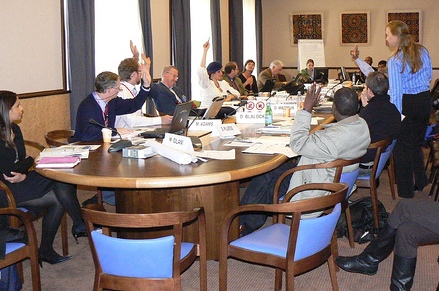
Photo shows working group 5 in session: photo courtesy UN OCHA.
I made a similar point in an essay written in mid 2004 on using information and communication technologies (ICTs) for poverty reduction:
“I cringe every time I hear remarks about the poor just needing survival or sustenance related information. The information needs and wants of the poor can be as diverse as everybody else’s. Sarvodaya – Sri Lanka’s largest development NGO — once surveyed the information needs of poor people in rural and semi-urban areas. Their findings included: health and nutrition information, as well as details on bank loans, foreign jobs and insurance policies. There was also interest in world affairs, national politics and cultural affairs…”
Read my full essay in GKP Partners Newsletter (My essay is the last one, so keep scrolling down, down, down.)
Three years later I found myself making the same point to a different group, many of who are information specialists working in crisis and emergency situations.
This kind of perception will continue as long as we harbour the us-and-them divide.

 Open Minds!
Us and Them is far easier to understand and accept then the reality that “them” is us. (sorry for the poor english as it is the only way to describe this)
Once we understand…there truly is not a “them” we will undersand wants and needs at a higher level. As Nlaka says…we think of helping as food and shelter only…clean water safe food. It is only a temporary need filled. People in need are people in need…they need mental and physical health assistance…nutrition/ financial aid….the human spirit is not just daily bread…it is much more complicated…and once we accept that we are the “them” true needs and wants can be established.
Thank you.
David Damario Canada
We are them…they are us. David Damario has hit the nail on the head.
Robert Kirkson