Some are urging national governments to ‘regulate’ social media in ways similar to how newspapers, television and radio are regulated. This is easier said than done where globalized social media platforms like Facebook, Twitter and Instagram are concerned, because national governments don’t have jurisdiction over them.
But does this mean that globalized media companies are above the law? Short of blocking entire platforms from being accessed within their territories, what other options do governments have? Do ‘user community standards’ that some social media platforms have adopted offer a sufficient defence against hate speech, cyber bullying and other excesses?
In this conversation, Lankan science writer Nalaka Gunawardene discusses these and related issues with Toby Mendel, a human rights lawyer specialising in freedom of expression, the right to information and democracy rights.
Mendel is the executive director of the Center for Law and Democracy (CLD) in Canada. Prior to founding CLD in 2010, Mendel was for over 12 years Senior Director for Law at ARTICLE 19, a human rights NGO focusing on freedom of expression and the right to information.
The interview was recorded in Colombo, Sri Lanka, on 5 July 2017.
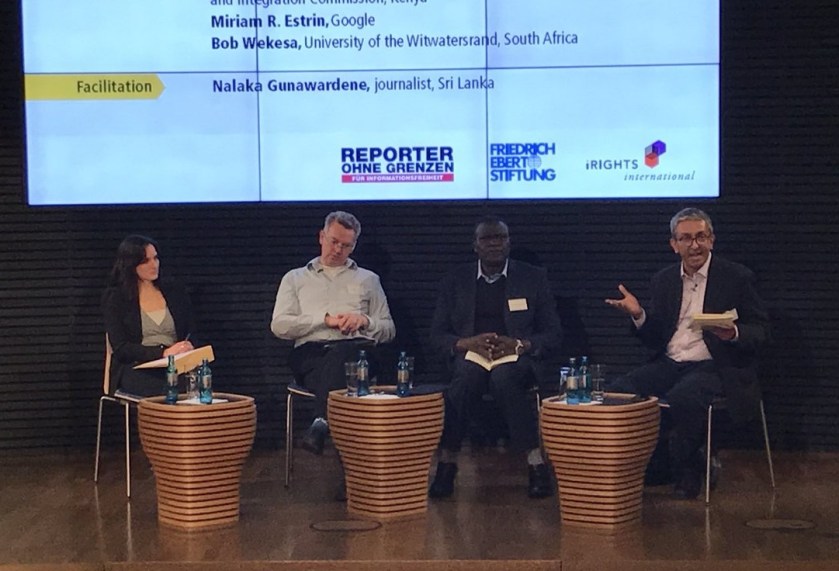
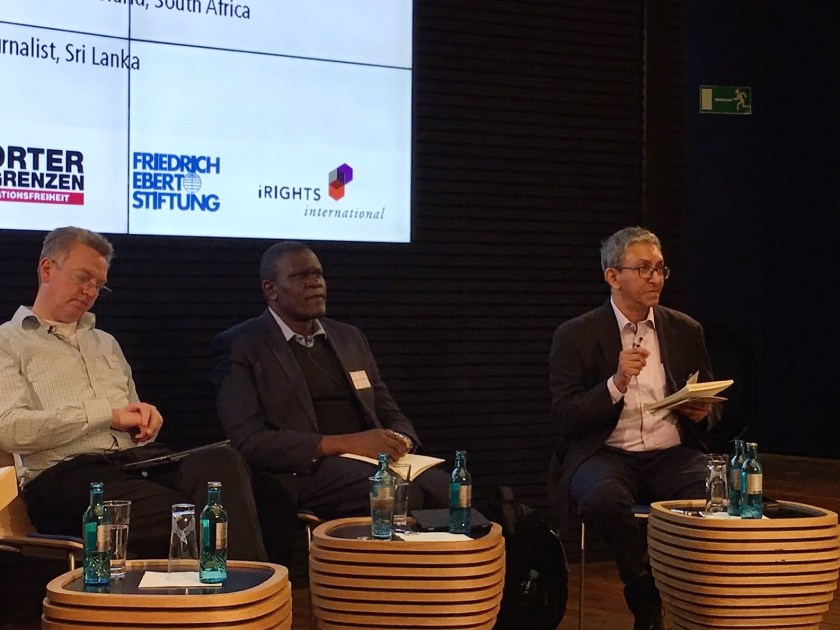
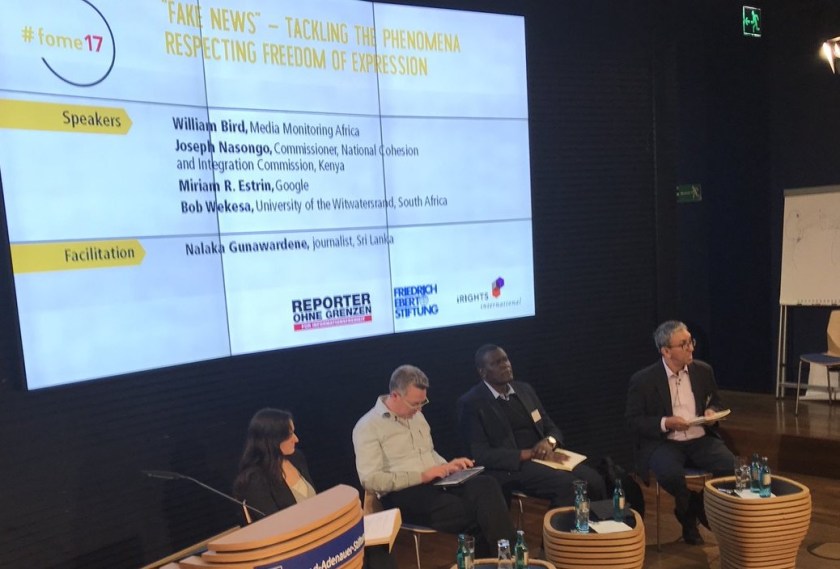
Nalaka Gunawardene (extreme right) moderates FoME 2017 session on “Fake News: Tackling the phenomenon while respecting freedom of expression”, Berlin, 17 Nov 2017
The German “Forum on Media and Development” (Forum Medien und Entwicklung, FOME) is a network of institutions and individuals active in the field of media development cooperation. I was invited to participate in, and moderate a panel at FoME Symposium 2017 held in Berlin on 16 – 17 November 2017.
This year’s symposium theme was Power Shifts – Media Freedom and the Internet. It explored how Internet governance issues are becoming more and more important for those who want to develop media (both mainstream media and social media) as democratic platforms.
On 17 November 2017, I moderated an international panel on Fake News: Tackling the phenomena respecting freedom of expression. It brought together representatives from government, civil society and a global media platform to discuss their roles and how they can interact to tackle the issue – all within the framework of Freedom of Expression (FOE).
Miriam Estrin, Public Policy Manager for Europe, Middle East and Africa, Google
Nalaka Gunawardene speaks on Fake News and Freedom of Expression at FoME 2017 Symposium in Berlin, 17 Nov 2017 – Photo courtesy Helani Galpaya
Here are my opening remarks that set the context for our discussion:
Just as there are many definitions of Fake News, there can also be many perspectives on the topic. We all recognise Fake News as a problem, so let’s focus on how it can be countered. What are the local, national and global level strategies? What alliances, tools and resources are needed for such countering? What cautions and alarms can we raise?
To respond to any problem, we need to understand its contours.
Fake News is not new. The phenomenon has been around, in one form or another, for decades! Many of us in the global South have grown up amidst intentionally fake news stories in our media, some of it coming from governments, no less. And the developing world governments don’t have a monopoly over Fake News either: for over half a century, the erstwhile Soviet Union and Eastern Bloc countries manufactured a vast amount of disinformation (i.e. deliberately wrong information) that was fed to their own citizens and spread overseas in sustained propaganda efforts.
Sitting here, within a few kilometres from where the Berlin Wall once stood, we need to acknowledge that veritable factory of lies that operated on the other side!
So what’s new? During the past decade, as broadband Internet spread worldwide, fake news peddlers found an easy and fast medium online. From websites to social media accounts (many hiding behind pseudonyms), the web has provided a globalised playing field where dubious content could go ‘viral’.
Yesterday at this Symposium, Mark Nelson from CIMA said “We live in a world where lies are very cheap, and much easier to disseminate than the truth.”
Which reminded me of one of my favourite quotes: ““A lie can travel halfway around the world while the truth is putting on its shoes!”
Variations of this quote have been attributed to several persons including Jonathan Swift and Mark Twain. Whoever said it first, these words neatly sum up a long standing challenge to modern societies: how to cope with the spread of deliberate falsehoods.
As Mark Nelson asked us yesterday, how can we “make the Internet a place where truth is valued and spread – instead of disinformation?” This is the crux of our challenge.
So what is to be done? Among the options available, which ones are most desirable?
In searching for solutions to the Fake News crisis, we must recognise it is a nuanced, complex and variable phenomenon. There cannot be one global solution or quick fix.
Indeed, any ‘medicine’ prescribed for the malady of Fake News should not be worse than the ailment itself! We must proceed with caution, safeguarding the principles of Freedom of Expression and applying its reasonable limitations.
As human rights defenders caution, there is a danger that governments in their zeal to counter fake news could impose direct or indirect censorships, suppress critical thinking, or take other steps that violate international human rights law. This is NOT the way to deal with Fake News.
In my view, Fake News is a symptom of a wider and deeper crisis. It is a crisis of public trust in journalism and the media that has been building up over the years in many countries. Some call this a ‘Journalism Deficit’, or a gulf between what journalism ought be, and what it has (mostly) become today.
In my view, a free press is not an automatic guarantee against Fake News. In other words, media freedom is necessary — but not sufficient — to ensure that media content is trusted by the public. We need to better measure public trust in media and what the current trust levels mean for those producing media content professionally.
I would argue that the medium to long term response to Fake News is to narrow and bridge the Journalism Deficit by nurturing quality journalism and critical consumption of media. If you agree with this premise, what specific measures can we recommend and advocate?
Let us explore how media development can counter Fake News by exposing it, undermining it, and equipping media consumers with the knowledge and skills to spot it – and not spread it inadvertently.
For this, we need everyone’s cooperation.
We need global social media platforms and digital gatekeepers like Google to join with all their might (and what might!).
We need governments to be thoughtfully, carefully evaluate the optimum responses.
We need civil society to go beyond mere hand waving and finger pointing to help enhance media and information literacy.
We need researchers to keep studying and discerning trends that can influence policy and regulation (where appropriate).
We are not going to solve the problem in an hour. But we can at least ask the right questions, and clarify the issues in our minds. Onward!
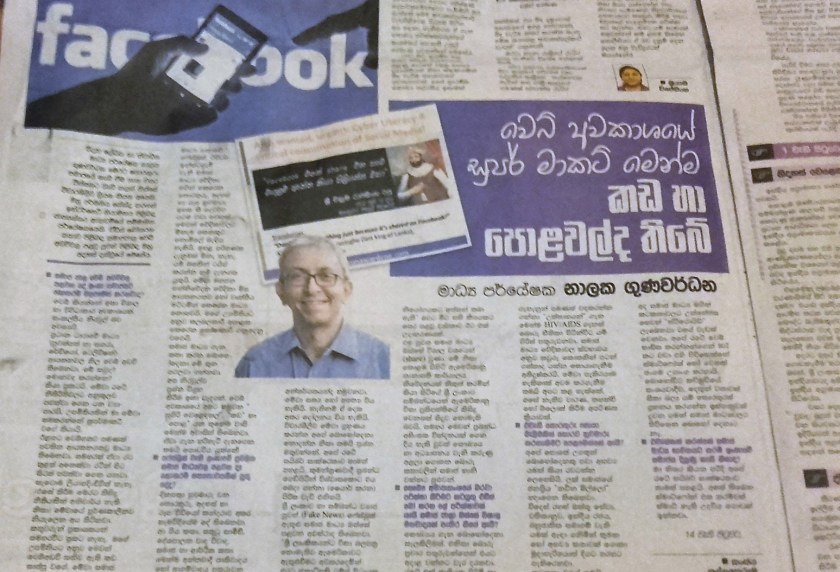
I have just given an interview to Sunday Lakbima, a broadsheet newspaper in Sri Lanka (in Sinhala) on social media in Sri Lanka – what should be the optimum regulatory and societal responses. The interviewer, young and digitally savvy journalist Sanjaya Nallaperuma, asked intelligent questions which enabled me to explore the topic well.
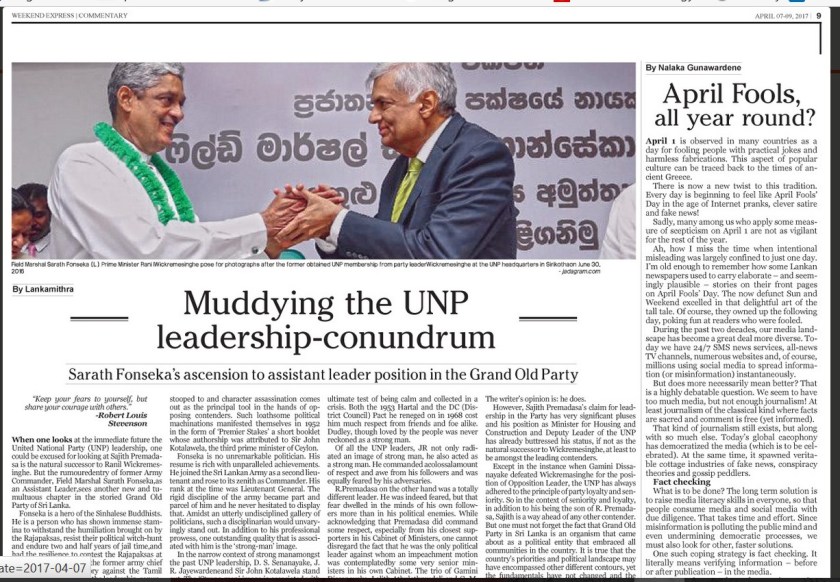
April Fools All Year Round? Op-ed by Nalaka Gunawardene, Weekend Express, 7 April 2017
April Fools, All Year Round?
By Nalaka Gunawardene
April 1 is observed in many countries as a day for fooling people with practical jokes and harmless fabrications. This aspect of popular culture can be traced back to the times of ancient Greece.
There is now a new twist to this tradition. Every day is beginning to feel like April Fools’ Day in the age of Internet pranks, clever satire and fake news!
Sadly, many among us who apply some measure of skepticism on April 1 are not as vigilant for the rest of the year.
Ah, how I miss the time when intentional misleading was largely confined to just one day. I’m old enough to remember how some Lankan newspapers used to carry elaborate – and seemingly plausible – stories on their front pages on April Fools’ day. The now defunct Sun and Weekend excelled in that delightful art of the tall tale. Of course, they owned up the following day, poking fun at readers who were fooled.
During the past two decades, our media landscape has become a great deal more diverse. Today we have 24/7 SMS news services, all-news TV channels, numerous websites and, of course, millions using social media to spread information (or misinformation) instantaneously.
But does more necessarily mean better? That is a highly debatable question. We seem to have too much media, but not enough journalism! At least journalism of the classical kind where facts are sacred and comment is free (yet informed).
That kind of journalism still exists, but along with so much else. Today’s global cacophony has democratized the media (which is to be celebrated). At the same time, it spawned veritable cottage industries of fake news, conspiracy theories and gossip peddlers.
Image source – American Journalism Review, 21 April 2015
Fact checking
What is to be done? The long term solution is to raise media literacy skills in everyone, so that people consume media and social media with due diligence.
That takes time and effort. Since misinformation is polluting the public mind and even undermining democratic processes, we must also look for other, faster solutions.
One such coping strategy is fact checking. It literally means verifying information – before or after publication – in the media.
In a growing number of countries, mainstream media outlets practise fact checking as an integral part of their commitment to professionalism. They seek to balance accuracy with speed, which has been made more challenging by the never-ending news cycle.
In other cases, independent researchers or civil society groups are keeping track of news media content after publication. In the United States, where the practice is well developed, several groups are devoted to such post-hoc fact checking. These include FactCheck, PolitiFact, and NewsTrust’s Truth Squad. They fact check the media as well as statements by politicians and other public figures.
In 2015, fact checking organisations formed a world network and this year, they observed the inaugural International Fact Checking Day.
The initiative is a collaboration by fact checkers and journalism organisations from around the world, “with a goal to enlist the public in the fight against misinformation in all its forms.”
“International Fact Checking Day is not a single event but a rallying cry for more facts — and fact checking — in politics, journalism and everyday life,” says Alexios Mantzarlis, director of the International Fact-Checking Network at the Poynter Institute for Media Studies in the US.
Oops!
Pinocchios
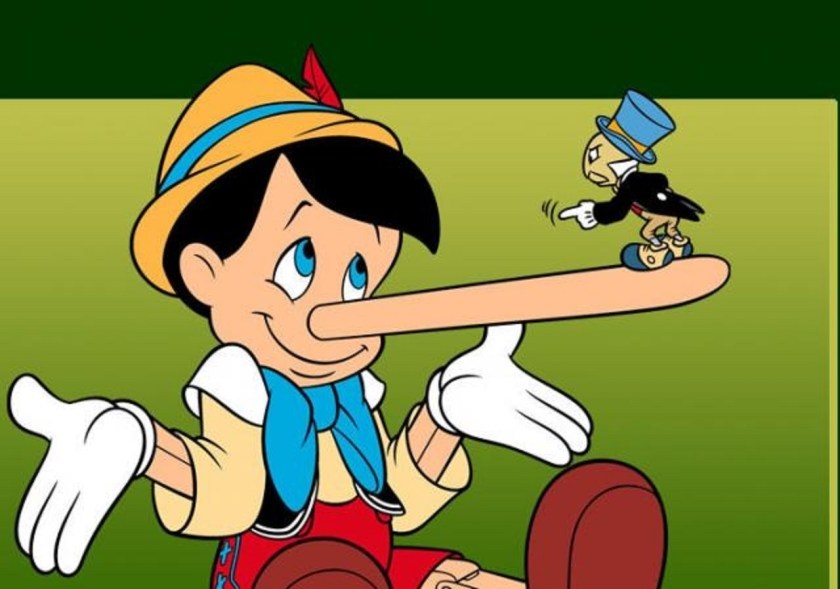
One visual icon for the Fact-Checking Day is Pinocchio, the fictional puppet character whose nose grew long each time he uttered a lie.
We in Sri Lanka urgently need a professional, non-partisan fact checking service to save us from the alarming proliferation of Pinocchios in public life. Not just our politicians, but also many academics and activists who peddle outdated statistics, outlandish claims or outright conspiracy theories.
Take, for example, the recent claim by a retired professor of political science that 94 Members of Parliament had not even passed the GCE Ordinary Level exam. Apparently no one asked for his source at the press conference (maybe because it fed a preconceived notion). Later, when a (rare?) skeptical journalist checked with him, he said he’d “read it in a newspaper some time ago” — and couldn’t name the publication.
A simple Google search shows that an MP (Buddhika Pathirana) had cited this exact number in September 2014 – about the last Parliament!
Given the state of our media, which often takes down dictation rather than asks hard questions, fact checking is best done by a research group outside the media industry.
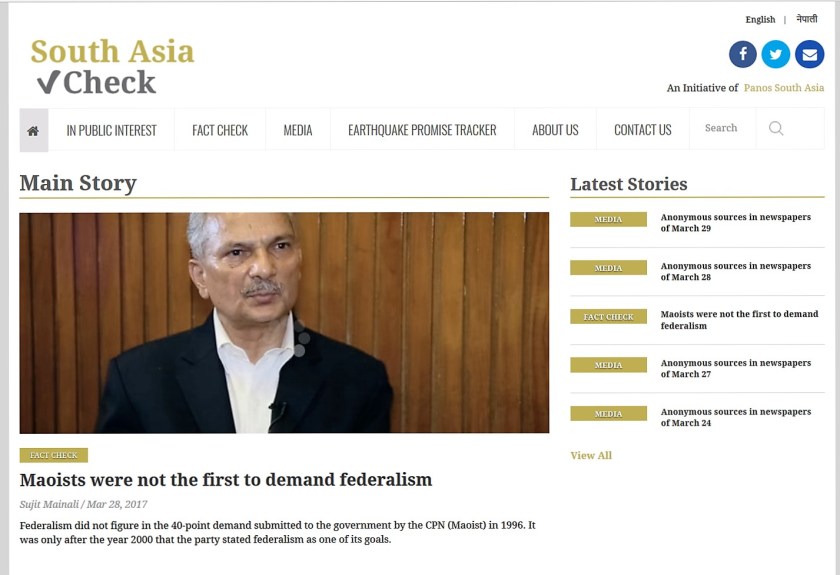
A useful model could be South Asia Check, an independent, non-partisan initiative by Panos South Asia anchored in Kathmandu. It “aims to promote accuracy and accountability in public debate” by examining statements and claims made by public figures in Nepal and occasionally, across South Asia (http://southasiacheck.org).
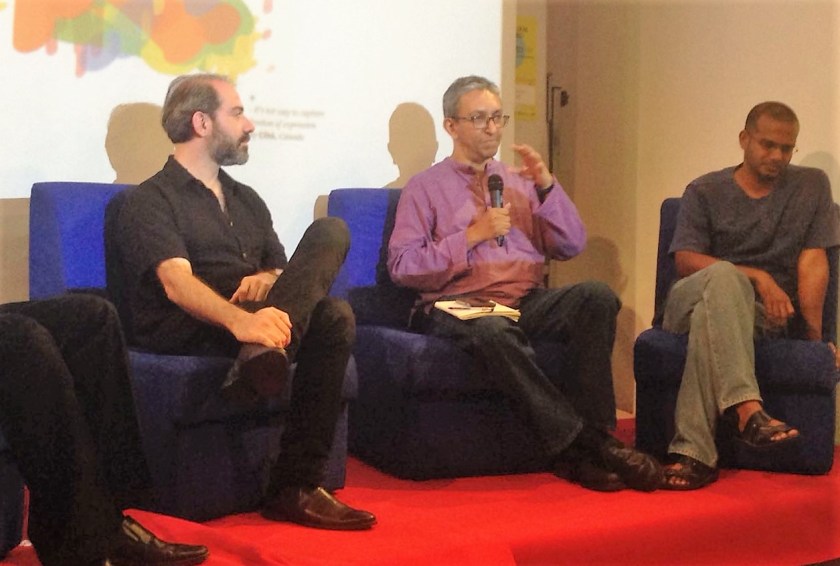
L to R – Kianoush Ramezani, Nalaka Gunawardene, Gihan de Chickera at Night of Ideas in Colombo, 26 January 2017
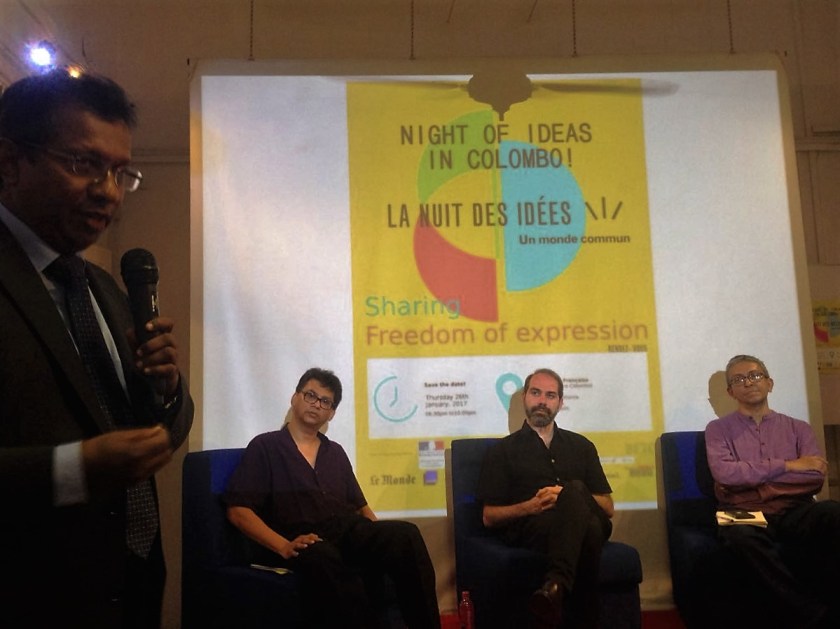
On 26 January 2017, the Alliance Française de Kotte with the Embassy of France in Sri Lanka presented the first ever “Night of Ideas” held in Colombo. During that event, participants were invited to engage in discussions on ‘‘A World in common – Freedom of Expression (FOE)” in the presence of French and Sri Lankan cartoonists, journalists and intellectuals.
I was part of the panel that also included: Kianoush Ramezani, Founder and President of United Sketches (Paris), an Iranian artist and activist living and working in Paris since 2009 as a political refugee; and Gihan de Chickera, Political cartoonist at the Daily Mirror newspaper in Sri Lanka. The panel was moderated by Amal Jayasinghe, bureau chief of Agence France Presse (AFP) news agency.
Human Rights Lawyer and activist J C Weliamuna opens the Night of Ideas in Colombo, 26 January 2017
In my opening remarks, I paid a special tribute to Sri Lanka’s cartoonists and satirists who provided a rare outlet for political expression during the Rajapaksa regime’s Decade of Darkness (2005-2014).
I referred to my 2010 essay, titled ‘When making fun is no laughing matter’ where I had highlighted this vital aspect of FOE. Here is the gist of it:
A useful barometer of FOE and media freedom in a given society is the level of satire that prevails. Satire and parody are important forms of political commentary that rely on blurring the line between factual reporting and creative license to scorn and ridicule public figures.
Political satire is nothing new: it has been around for centuries, making fun of kings, emperors, popes and generals. Over time, satire has manifested in many oral, literary and theatrical traditions. In recent decades, satire has evolved into its own distinctive genre in print, on the airwaves and online.
Satire offers an effective – though not always fail-safe – cover for taking on authoritarian regimes that are intolerant of criticism, leave alone any dissent. No wonder the former Soviet Union and Eastern Bloc inspired so much black humour.
This particular dimension to political satire and caricature that isn’t widely appreciated in liberal democracies where freedom of expression is constitutionally guaranteed.
In immature democracies and autocracies, critical journalists and their editors take many risks in the line of work. When direct criticism becomes highly hazardous, satire and parody become important — and sometimes the only – ways for journalists get around draconian laws, stifling media regulations or trigger-happy goon squads…
Little wonder, then, that some of Sri Lanka’s sharpest political commentary is found in satire columns and cartoons. Much of what passes for political analysis in the media is actually gossip.
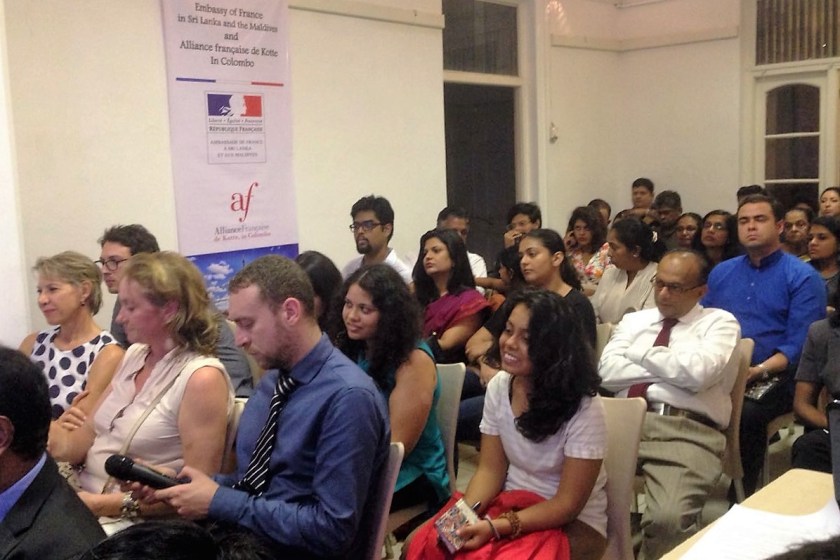
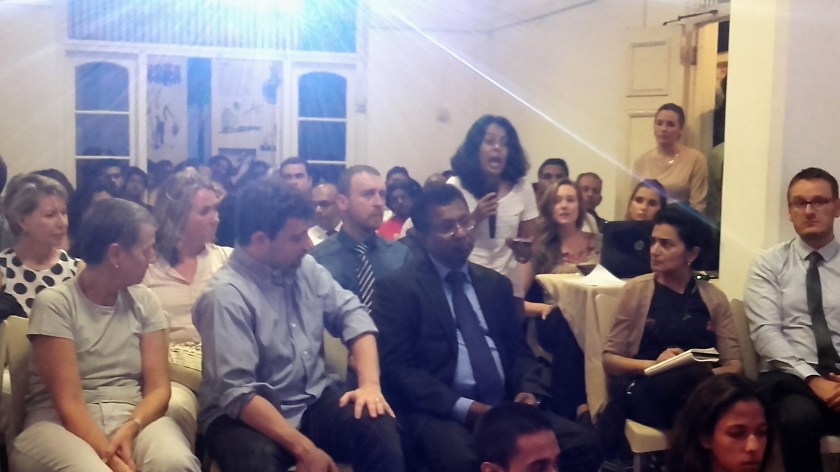
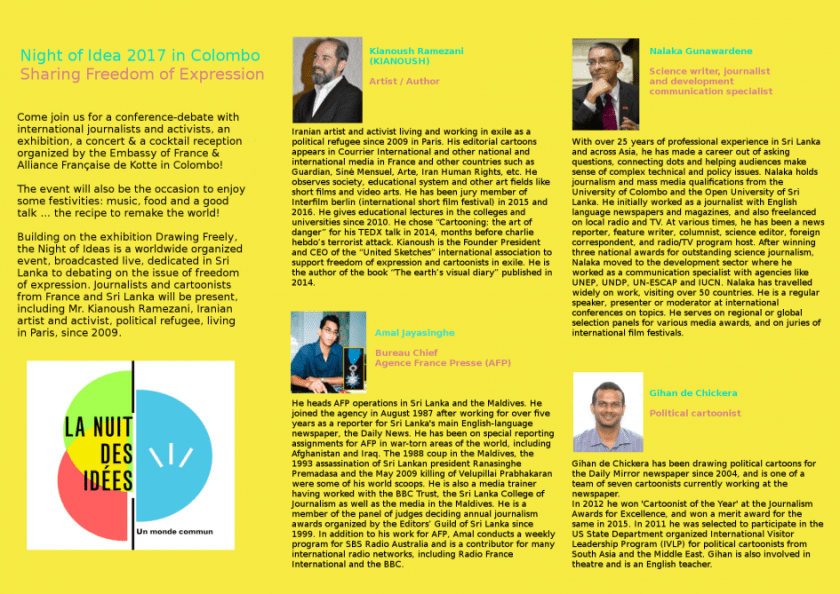
Part of the audience for Night of Ideas at Alliance Française de Kotte, 26 Jan 2017Audience engages the panel during Night of Ideas at Alliance Française de Kotte, 26 Jan 2017Night of Ideas in Colombo – promotional brochure
Brief comment provided to Daily Mirror newspaper, Sri Lanka, on 20 January 2017:
‘Eyes in the Sky’ need ethical and careful ‘pilots’
By Nalaka Gunawardene
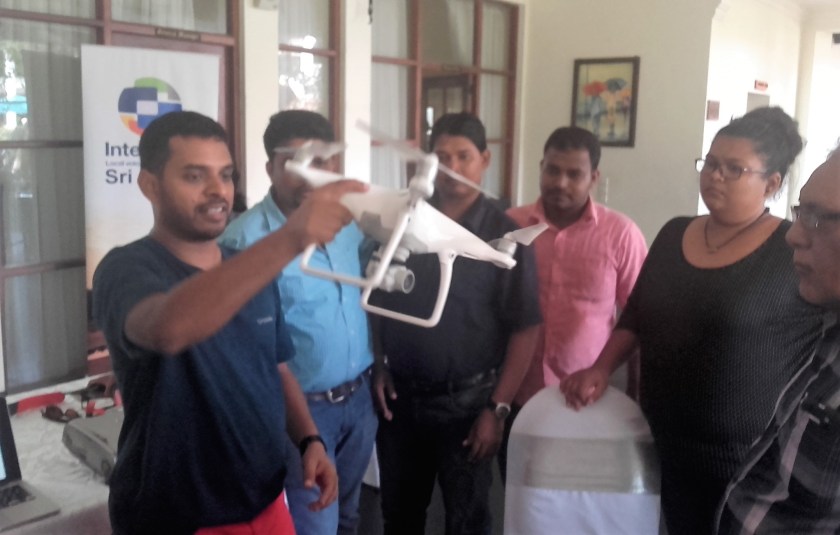
Bird’s eye view provides a new, useful perspective in journalistic story telling. Image courtesy InterNews Sri Lanka
For some, drones conjure images of death and destruction – military applications have been their most widely reported application. But unmanned aerial vehicles or UAVs are increasingly being used for many peaceful purposes. That poses a host of ethical and legal challenges we must confront to get the best of this new technology while minimizing potential harms.
In the past few years, the cost of drones came down (an entry level unit sells for around LKR 35,000 in Colombo) as their versatility increased. This spurred many uses from newsgathering and post-disaster assessments to goods delivery and smart farming.
In Sri Lanka, surveyors, photographers, TV journalists and political parties were among the early civilian users of drones. They all grasped the value of the ‘bigger picture’ perspective such aerial photos or videos can provide. Until recently, accessing that vantage point was possible only through helicopters or fixed wing aircraft – a facility few could afford.
Having the bird’s eye view helps journalists and their audiences to make sense of complex situations like climate change impacts, conflicts over resources or political agitations. We certainly need more field-based and investigative reporting that goes beyond press releases and press conferences. Drones are fast joining the journalists’ toolkit — but what matters is their imaginative and responsible use.
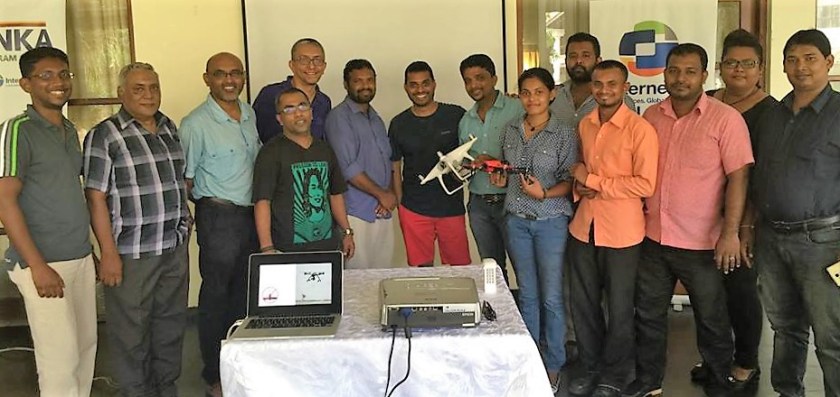
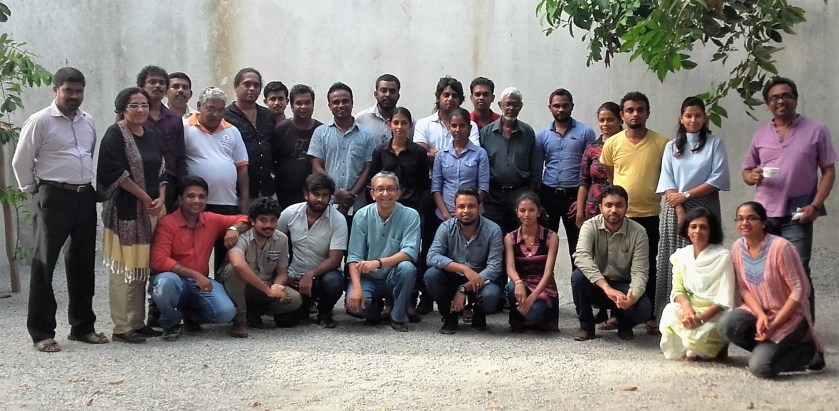
Participants and trainers at Sri Lanka’s first workshop on drone assisted journalism, Aug 2016 in Mt Lavinia
Here, we have both good news and bad news. On the positive side, over two dozen journalists and photojournalists have been trained in drone-assisted journalism during 2016 by drone journalism enthusiast (and drone pilot) Sanjana Hattotuwa and journalist Amantha Perera. Some trainees have since done good stories with drone-gathered images. Examples include probing the drought’s impacts in the dry zone, rising garbage crisis in Kattankudy on the east coast, and taking a close look at land use patterns in Hambantota.
Internews Sri Lanka: Drone gathered footage supporting journalism
The downside is that some news organisations are deploying drones without due regard for public safety or existing codes of media ethics. A drone hovered over the Colombo general cemetery as slain editor Lasantha Wickremetunge’s body was exhumed in September 2016. That disregarded a family request for privacy.
The end never justifies the means in good journalism. If some media groups continue to operate drones in such reckless manner, they risk discrediting the new technology and attracting excessive regulations.
Drones or any other new technologies need to be anchored in the basic ethics of journalism. Each new tool would also bring along its own layer of ethics. Where drone use is concerned, respecting privacy and considering the safety of others is far more important than, say, when using a handheld camera.
In February 2016, the Civil Aviation Authority of Sri Lanka (CAASL) published regulations for drone operation which apply to all users including journalists. This has been updated in January 2017. The Information Department, in a recent release, says it is working with CAASL to simplify these rules and streamline approval processes. That is a welcome move.
For now, Lankan journalists can follow the Code of Ethics for Drone Journalists already formulated by practitioners and researchers in the United States. It is available at: http://www.dronejournalism.org/code-of-ethics/
Nalaka Gunawardene is a columnist and independent media researcher. He tweets from @NalakaG
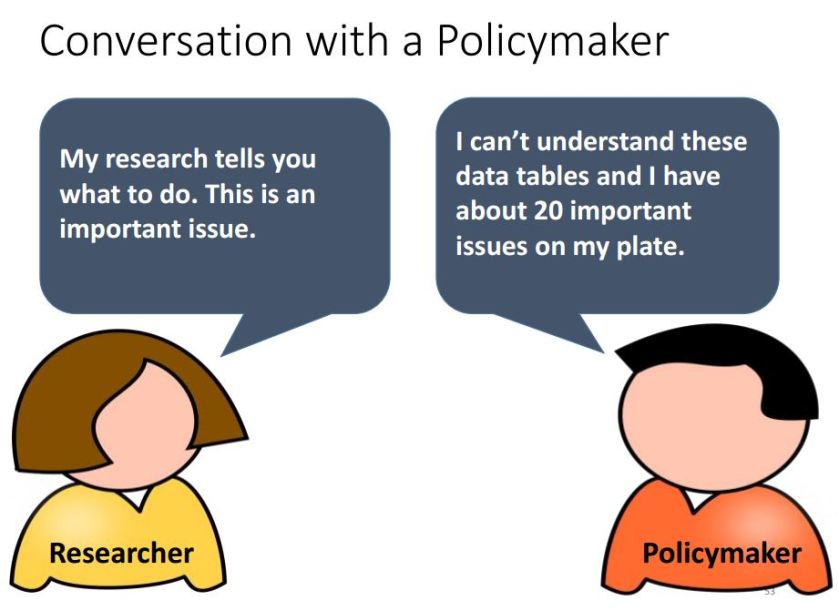
It’s a question without easy or simple answers. Policy makers come in different forms and types, and gaining their attention depends on many variables — such as a country’s political system, governance processes, level of bureaucracy and also timing.
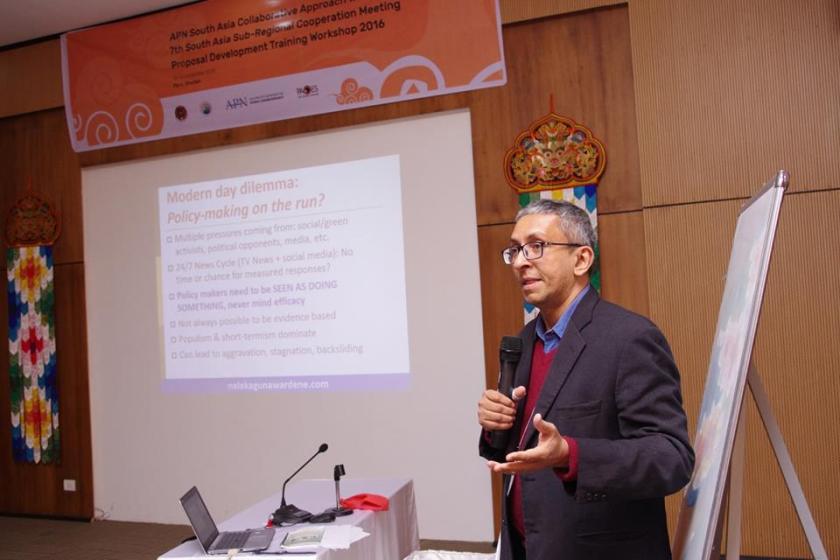
I revisited this question this week when speaking to a group of young (early to mid-career) researchers from across South Asia who want to study many facets of global change. They were brought together at a regional workshop held in in Paro, Bhutan, by the Asia-Pacific Network for Global Change Research (APN) and the National Environment Commission of the Royal Government of Bhutan.
Nalaka Gunawardene speaks at APN South Asian Proposal Development Training Workshop in Paro, Bhutan, 14-16 Dec 2016. Photo Xiaojun Deng, APN
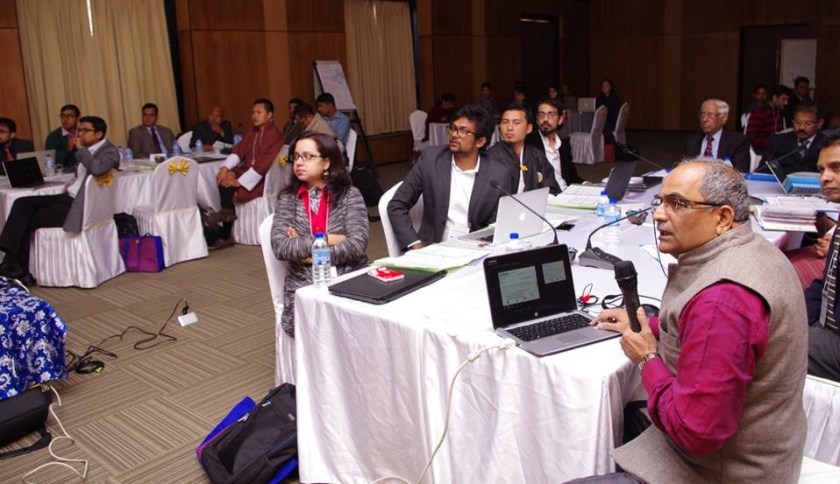
Titled as the ‘Proposal Development Training Workshop (PDTW)’ and held from 14 to 16 December 2016, PDTW aimed “to raise awareness of APN among early career scientists and practitioners, and to increase the capacity to develop competitive proposals for submission to APN”.
The workshop involved two dozen researchers and half a dozen mentors. I was the sole mentor covering the important aspect of communicating research.
I urged researchers to try and better understand the imperfect, often unpredictable conditions in which South Asia’s policy makers operate.
Researchers and activists who would like to influence various public policies. Everyone is looking for strategies and engagement methods. The policy cycle cannot run according to text book ideals when governments have to regularly cope with economic uncertainties, political upheavals and social unrest, etc.
Asia-Pacific Network for Global Change Research (APN): Proposal Development Training Workshop 2016 — in Paro, Bhutan. Photo by Xiaojun Deng, APN
Imagine what keeps your policy makers awake at night, I suggested. Are they worried about balance of payment, disaster responses or a Parliamentary majority? How can research findings, while being evidence based, help solve problems of economic development and governance?
I also suggested that researchers should map out the information behaviour of their policy makers: where do they get info to act on? Is there a way research findings can be channeled to policy makers through some of these sources – such as the media, professional bodies and international development partners?
I suggested two approaches to communicating research outcomes to policy makers: directly, using own publications and/or social media; and indirectly by working with and through the media.
Finally, I shared some key findings of a global study in 2012 by SciDev.Net (where I was an honorary trustee for nearly a decade) which looked at the different contextual settings within which policy makers, the private sector, NGOs, media organisations and the research community operate to better understand how to mainstream more science and technology evidence for development and poverty reduction purposes.
Sri Lankan Media Fellows on Poverty and Development with their mentors and CEPA coordinators at orientation workshop in Colombo, 24 Sep 2016
“For me as an editor, there is a compelling case for engaging with poverty. Increasing education and literacy is related to increasing the size of my readership. Our main audiences are indeed drawn from the middle classes, business and policymakers. But these groups cannot live in isolation. The welfare of the many is in the interests of the people who read the Daily Star.”
So says Mahfuz Anam, Editor and Publisher of The Daily Star newspaper in Bangladesh. I quoted him in my presentation to the orientation workshop for Media Fellows on Poverty and Development, held in Colombo on 24 September 2016.
Alas, many media gatekeepers in Sri Lanka and across South Asia don’t share Anam’s broad view. I can still remember talking to a Singaporean manager of one of Sri Lanka’s first private TV stations in the late 1990s. He was interested in international development related TV content, he told me, “but not depressing and miserable stuff about poverty – our viewers don’t want that!”
Most media, in Sri Lanka and elsewhere, have narrowly defined poverty negatively. Those media that occasionally allows some coverage of poverty mostly skim a few selected issues, doing fleeting reporting on obvious topics like street children, beggars or poverty reduction assistance from the government. The complexity of poverty and under-development is hardly investigated or captured in the media.
Even when an exceptional journalist ventures into exploring these issues in some depth and detail, their media products also often inadvertently contain society’s widespread stereotyping on poverty and inequality. For example:
Black and white images are used when colour is easily available (as if the poor live in B&W).
Focus is mostly or entirely on the rural poor (never mind many poor people now live in cities and towns).
The Centre for Poverty Analysis (CEPA), a non-profit think tank has launched the Media Fellowship Programme on Poverty and Development to inspire and support better media coverage of these issues. The programme is co-funded by UNESCO and CEPA.
Under this, 20 competitively selected journalists – drawn from print, broadcast and web media outlets in Sinhala, Tamil and English languages – are to be given a better understanding of the many dimensions of poverty.
These Media Fellows will have the opportunity to research and produce a story of their choice in depth and detail, but on the understanding that their media outlet will carry their story. Along the way, they will benefit from face-to-face interactions with senior journalists and development researchers, and also receive a grant to cover their field visit costs.
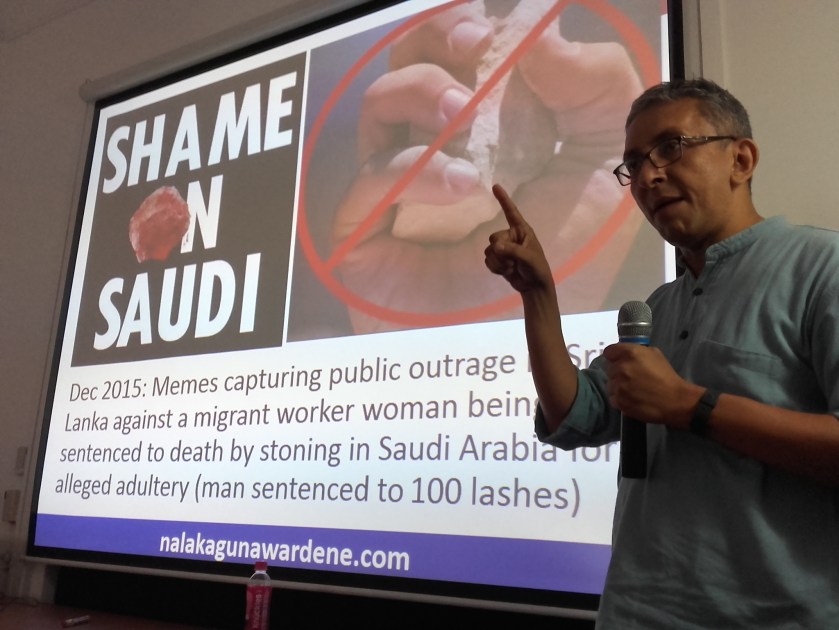
Nalaka Gunawardene speaks at orientation workshop for Media Fellows on Poverty and Development at CEPA, 24 Sep 2016
I am part of the five member expert panel guiding these Media Fellows. Others on the panel are senior journalist and political commentator Kusal Perera; Chief Editor of Daily Express newspaper Hana Ibrahim; Chief Editor of Echelon biz magazine Shamindra Kulamannage; and Consultant Editor of Sudar Oli newspaper, Arun Arokianathan.
At the orientation workshop, Shamindra Kulamannage and I both made presentations on media coverage of poverty. Mine was a broad-sweep exploration of the topic, with many examples and insights from having been in media and development spheres for over 25 years.
Here is my PPT:
More photos from the orientation workshop:
Nalaka Gunawardene speaks at orientation workshop for Media Fellows on Poverty and Development at CEPA, 24 Sep 2016
Workshop for Media Fellows on Poverty & Development, Colombo, 24 Sep 2016
Workshop for Media Fellows on Poverty & Development, Colombo, 24 Sep 2016
Workshop for Media Fellows on Poverty & Development, Colombo, 24 Sep 2016
Workshop for Media Fellows on Poverty & Development, Colombo, 24 Sep 2016
Shamindra Kulamannage at Workshop for Media Fellows on Poverty & Development, Colombo, 24 Sep 2016
Workshop for Media Fellows on Poverty & Development, Colombo, 24 Sep 2016
Workshop for Media Fellows on Poverty & Development, Colombo, 24 Sep 2016
Krishan Siriwardhana opens Workshop for Media Fellows on Poverty & Development, Colombo, 24 Sep 2016
For some, drones still conjure images of death and destruction – that has been their most widely reported use. But that reality is fast changing. Unmanned aerial vehicles (UAVs) are being used for many peaceful purposes, from newsgathering and post-disaster assessments to goods delivery and smart farming.
Drones come in various shapes and sizes: as miniature fixed-wing airplanes or, more commonly, quadcopters and other multi-bladed small helicopters. All types are getting simpler, cheaper and more versatile.
Unlike radio-controlled model aircraft, which aviation hobbyists have used for decades, UAVs are equipped with an autopilot using GPS and a camera controlled by the autopilot. These battery operated flying machines can be manually controlled or pre-programmed for an entire, low altitude flight.
In this week’s Ravaya column (in Sinhala, appearing in the print issue of 25 Sep 2016), I survey the many civilian applications of drones – and the legal, ethical and technical challenges they pose.
Drones are already being used in Sri Lanka by photographers, TV journalists and political parties but few seem to respect public safety or privacy of individuals.
I quote Sanjana Hattotuwa, a researcher and activist on ICTs, who in August 2016 conducted Sri Lanka’s first workshop on drone journalism which I attended. I agree with his view: drones are here to stay, and are going to be used in many applications. So the sooner we sort out public safety and privacy concerns, the better for all.