India’s Down to Earth magazine was presented with the first Greenaccord International Media Award at an international conference held in Naples, Italy, last week.
The award, newly established by the Rome-based non-profit group Greenaccord, recognises outstanding media contributions to covering issues of environment and sustainable development.
Tommaso Sodano, deputy mayor of the City of Naples, presented the award at the conclusion of the 10th Greenaccord International Media Forum held from 6 to 9 November 2013.
Darryl D’Monte (centre) receives Greenaccord International Media Award on behalf of Down to Earth magazine, India – Naples, 9 Nov 2013 – Photo courtesy Greenaccord Press Office
“We asked all our Asian colleagues for nominations for this inaugural award, and many of them recommended Down to Earth magazine that has covered sustainability issues from a developing country perspective for 21 years,” said Alfonso Cauteruccio, President of Greenaccord.
Down to Earth is a fortnightly magazine focusing on issues of science and environment. It is published by the Centre for Science and Environment (CSE), a leading research and advocacy group in India. Founded by leading journalist and activist Anil Agarwal in May 1992, it provides reportage, analysis and commentary on a broad range of issues related to environment and development.
From the beginning, the magazine has challenged its readers to think about sustainable development. It inspires and encourages its readers to become more environment-friendly.
Darryl D’Monte, senior Indian journalist and a former editor of the Times of India, accepted the award on behalf of Down to Earth editors and publishers.
“Anil Agarwal was a trail-blazing journalist who combined knowledge and advocacy. Down to Earth, launched just before the Earth Summit in Rio in mid 1992, reflects that vision,” D’Monte said in his acceptance speech.
D’Monte recalled how Agarwal and CSE played a key role in the early days of global climate negotiations, especially in focusing global attention on per capita emissions of global warming greenhouse gases.
“Climate change is as much politics as it is science, and Anil was well aware of that. He approached all debates well armed with statistics, analysis and a southern perspective, which is also the Down to Earth magazine’s approach to issues,” he added.
Darryl D’Monte talks about Down to Earth magazine at Greenaccord Forum in Naples – Photo courtesy Greenaccord Press Office
Down to Earth presents accessible content intended for interested non-specialists including policy makers. Articles are often investigative, in-depth, all presented in well edited and designed form. In recent years, it has developed an extensive website at www.downtoearth.org.in.
The magazine has been an important vehicle for many CSE campaigns in the public interest, including its exposes on pesticide residues in popular soft drinks and bottled water brands, and agitation for cleaner air in Delhi and other metropolitan areas in India.
CSE’s right to clean air campaign resulted in New Delhi becoming the world’s first city to introduce compressed natural gas (CNG) for all public transport vehicles, D’Monte said.
Greenaccord is a non-profit association, headquartered in Rome, and founded to be of service to the world of information and training that deals with environmental issues. The association is made up of journalists and professionals who volunteer their time to provide training to their colleagues.
Since 2003, Greenaccord organises an annual gathering of journalists and scientists concerned about sustainability – which has become one of the largest such gatherings taking place on a regular basis.
Long before Malala, there was another spirited young girl named Meena.
Like Malala Yousafzai does today, Meena too spoke out for and on behalf of girls — their right to education, good health, nutrition and, most important, to be treated the same way as boys.
Like Malala, young Meena too spoke passionately yet courteously. While Malala challenged the ferocious Taliban, Meena took on the equally formidable adversary named tradition.
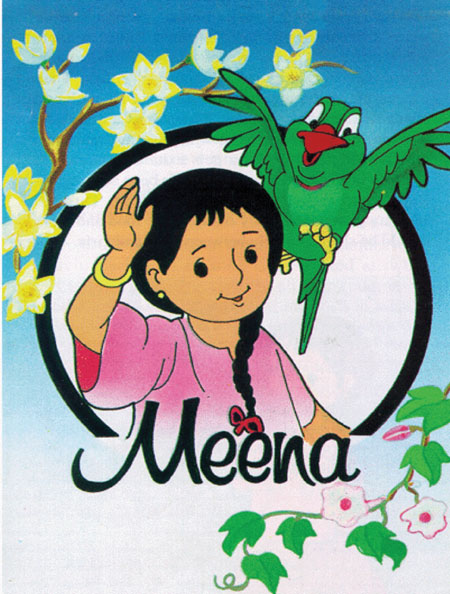
Malala and Meena could well have been sisters in arms — except that the latter isn’t quite real. She is a cartoon character imagined and developed by some of South Asia’s most talented animators and development communicators two decades ago.
UNICEF developed the Meena Communication Initiative (MCI) as a mass communication project aimed at changing perceptions and behaviour that hamper the survival, protection and development of girls in South Asia.
Here’s how their website describes Meena:
“Meena is a cartoon character from South Asia. She is a spirited, nine-year-old girl who braves the world – whether in her efforts to go to school or in fighting the stigma surrounding HIV/AIDS in her village.”
UNICEF launched Meena in September 1998 after eight years of extensive research in the region since the initial conceptualization. The name Meena was carefully chosen as it was found to span the different cultures in the region: people in Bangladesh, Bhutan, India, Maldives, Nepal, Pakistan and Sri Lanka could relate to the name.
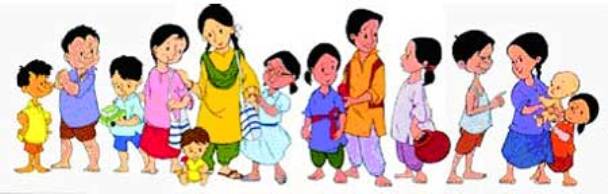
A cast of carefully researched characters was created for Meena’s family and community. It included Meena’s talkative pet parrot Mithu, brother Raju, mom and dad, grandma and village school teacher.
There was no fundamentalist group threatening Meena’s village. Instead, it was grappling with poverty, ignorance and orthodoxy.
The Meena stories are entertaining and fun, but also reflect the realities of girls’ lives in South Asia. Through story-telling, important social messages are conveyed, such as the value of educating girls, freedom from exploitation and abuse, need for hygiene and proper sanitation, and the right of girls to a proper childhood not marred by under-age marriages.
In total, 13 Meena episodes were produced through a collaboration that involved Ram Mohan Studios of Mumbai and Hanna-Barbera affiliate Fil Cartoons of Manila.
Three examples:
Meena: Will Meena Leave School?
Meena: Count Your Chickens
Meena: Too Young to Marry
Meena is widely recognised and appreciated in most South Asian countries, and is a successful advocacy and teaching tool for girls’ and children’s rights. The Meena figure has achieved remarkable popularity as she tackles the key issues affecting children, and the threats to the rights of millions of girls in South Asia.
In the early 1990s, I had the privilege of working with the late Anil Agarwal, the outstanding environmentalist and journalist. He founded the Centre for Science and Environment (CSE), which continues his mission of articulating science-based, southern perspectives in issues of sustainable development and social justice.
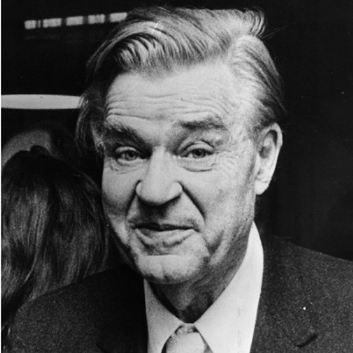
In this week’s Ravaya column (in Sinhala), I invoke one of Anil’s favourite quotes, about books being akin to time bombs — which he attributed to the Swedish economist and Nobel laureate Gunnar Myrdal. I extend the metaphor to media products — in print, audio and video — and ask: what can we do to shorten their fuse?
This is also a commentary on the lack of adequate public discussion and debate on matters of public interest in Sri Lanka, and what we can learn from the more argumentative Indians.
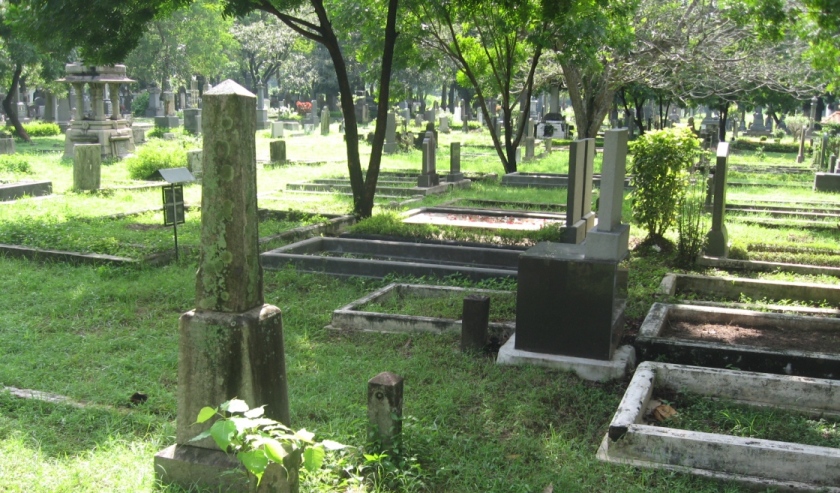
Colombo General Cemetery: No discussion or debate…
ශ්රී ලංකාවේ මීට ඉහත පරම්පරාවක ප්රතිපත්තිගරුක වාමාංශික නායකයකු වූ බර්නාඞ් සොයිසා වරක් කොළඹ කනත්ත සුසාන භූමිය හඳුන්වා දුන්නේ ‘වාද විවාද – තර්ක විතර්ක කිසිවක් නොමැති වූ කොළඹ එක ම ස්ථානය’ හැටියටයි (“The only place in Colombo where there is no discussion or debate”).
“Books are like time bombs. If they contain ideas that are correct, then one day they will explode. And if they don’t, they will be consigned to the dustbin of history.”
I look at general knowledge quizzing in Sri Lanka in this week’s Ravaya column (in Sinhala).
It’s a mind sport where I have played all the roles possible — as a participant, Sri Lanka’s national quiz champion, quiz compiler, quizmater, quiz programme designer for radio and TV, and chronicler of the game.
In this weekend’s Ravaya column (in Sinhala), I ask: are there real cities in Sri Lanka that embody liberal values and distinctive identities that cities – both in the East and West – have. If not, what are our urban areas? Over-built neighbourhoods to which residents have transplanted their village mindsets — including feudalism that is rampant in our villages?
Feature article published in Ceylon Today broadsheet newspaper on 14 March 2013.
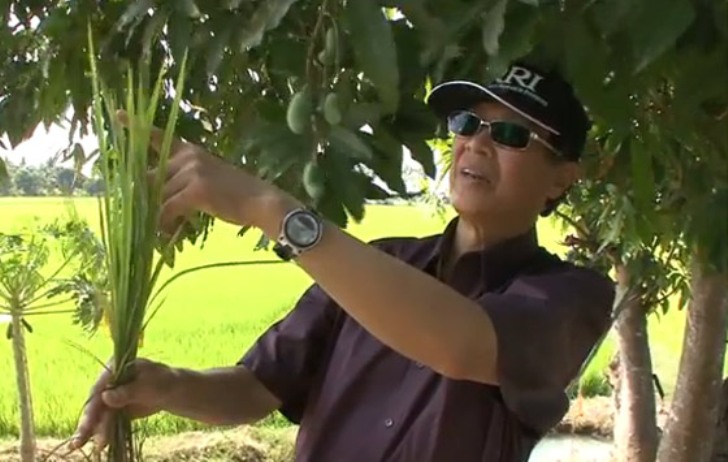
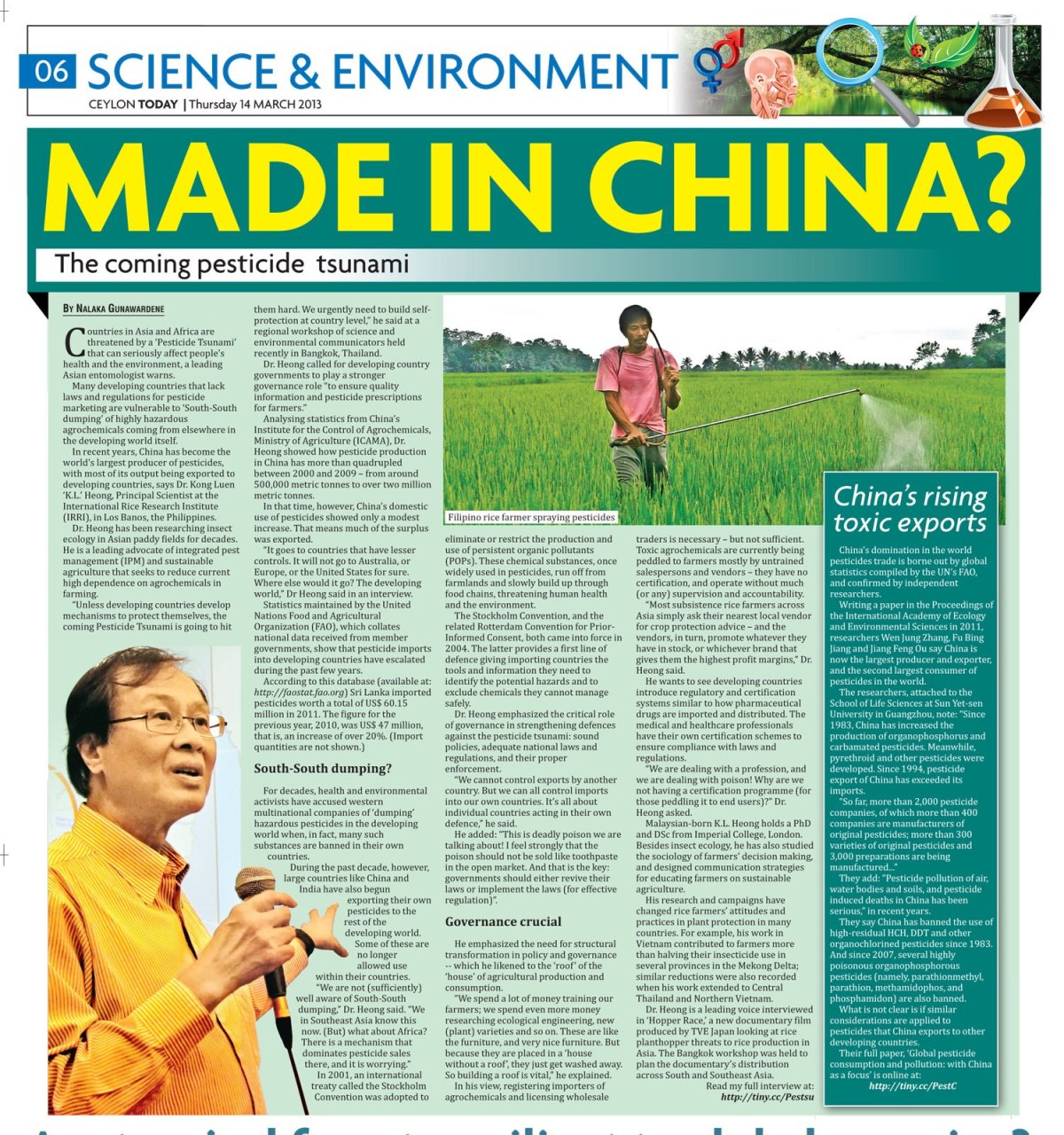
Dr K L Heong: Beware of South-South dumping of hazardous pesticides!
The Coming Pesticide Tsunami: Made in China?
By Nalaka Gunawardene
Countries in Asia and Africa are threatened by a ‘Pesticide Tsunami’ that can seriously affect people’s health and the environment, a leading Asian entomologist warns.
Many developing countries that lack laws and regulations for pesticide marketing are vulnerable to ‘South-South dumping’ of highly hazardous agrochemicals coming from elsewhere in the developing world itself.
In recent years, China has become the world’s largest producer of pesticides, with most of its output being exported to developing countries, says Dr Kong Luen “K.L.” Heong, Principal Scientist at the International Rice Research Institute (IRRI), in Los Banos, the Philippines.
Dr Heong has been researching insect ecology in Asian paddy fields for decades. He is a leading advocate of integrated pest management (IPM) and sustainable agriculture that seeks to reduce current high dependence on agrochemicals in farming.
“Unless developing countries develop mechanisms to protect themselves, the coming Pesticide Tsunami is going to hit them hard. We urgently need to build self-protection at country level,” he said at a regional workshop of science and environmental communicators held recently in Bangkok, Thailand.
Dr Heong called for developing country governments to play a stronger governance role “to ensure quality information and pesticide prescriptions for farmers”.
In that time, however, China’s domestic use of pesticides showed only a modest increase. That means much of the surplus was exported.
“It goes to countries that have lesser controls. It will not go to Australia, or Europe, or the United States for sure. Where else would it go? The developing world,” Dr Heong said in an interview.
Statistics maintained by the United Nations Food and Agricultural Organisation (FAO), which collates national data received from member governments, show that pesticide imports into developing countries have escalated during the past few years.
According to this database (available at: http://faostat.fao.org) Sri Lanka imported pesticides worth a total of USD 60.15 million in 2011. The figure for the previous year, 2010, was USD 47 million, i.e. an increase of over 20%. (Import quantities are not shown.)
South-South Dumping?
For decades, health and environmental activists have accused western multinational companies of ‘dumping’ hazardous pesticides in the developing world when, in fact, many such substances are banned in their own countries.
During the past decade, however, countries like China and India have also begun exporting their pesticides to the rest of the developing world. Some of these are no longer allowed use within their countries. (See box below: China’s Rising Toxic Exports).
“We are not (sufficiently) well aware of South-South dumping,” Dr Heong said. “We in Southeast Asia know this now. (But) what about Africa? There is a mechanism that dominates pesticide sales there, and it is worrying.”
In 2001, an international treaty called the Stockholm Convention was adopted to eliminate or restrict the production and use of persistent organic pollutants (POPs). These chemical substances, once widely used in pesticides, run off from farmlands and slowly build up through food chains, threatening human health and the environment.
The Stockholm Convention, and the related Rotterdam Convention for Prior-Informed Consent, both came into force in 2004. The latter provides a first line of defence giving importing countries the tools and information they need to identify the potential hazards and to exclude chemicals they cannot manage safely.
Dr Heong emphasized the critical role of governance in strengthening defences against the pesticide tsunami: sound policies, adequate national laws and regulations, and their proper enforcement.
“We cannot control exports by another country. But we can all control imports into our own countries. It’s all about individual countries acting in their own defence,” he said.
He added: “This is deadly poison we are talking about! I feel strongly that the poison should not be sold like toothpaste in the open market. And that is the key: governments should either revive their laws or implement the laws (for effective regulation)”.
Filipino rice farmer spraying pesticides
Governance crucial
He emphasized the need for structural transformation in policy and governance — which he likened to the ‘roof’ of the ‘house’ of agricultural production and consumption.
“We spend a lot of money training our farmers; we spend even more money researching ecological engineering, new (plant) varieties and so on. These are like the furniture, and very nice furniture. But because they are placed in a ‘house without a roof’, they just get washed away. So building a roof is vital,” he explained.
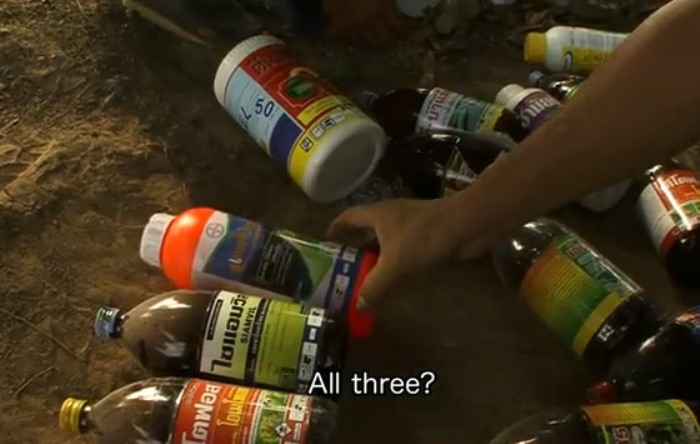
In his view, registering importers of agrochemicals and licensing wholesale traders is necessary – but not sufficient. Toxic agrochemicals are currently being peddled to farmers mostly by untrained salespersons and vendors – they have no certification, and operate without much (or any) supervision and accountability.
“Most subsistence rice farmers across Asia simply ask their nearest local vendor for crop protection advice – and the vendors, in turn, promote whatever they have in stock, or whichever brand that gives them the highest profit margins,” Dr Heong said.
He wants to see developing countries introduce regulatory and certification systems similar to how pharmaceutical drugs are imported and distributed. The medical and healthcare professionals have their own certification schemes to ensure compliance with laws and regulations.
“We are dealing with a profession, and we are dealing with poison! Why are we not having a certification programme (for those peddling it to end users)?” Dr Heong asked.
Malaysian-born K L Heong holds a PhD and DSc from Imperial College, London. Besides insect ecology, he has also studied the sociology of farmers’ decision making, and designed communication strategies for educating farmers on sustainable agriculture.
His research and campaigns have changed rice farmers’ attitudes and practices in plant protection in many countries. For example, his work in Vietnam contributed to farmers more than halving their insecticide use in several provinces in the Mekong Delta; similar reductions were also recorded when his work extended to Central Thailand and Northern Vietnam.
Dr Heong is a leading voice interviewed in ‘Hopper Race’, a new documentary film produced by TVE Japan looking at rice planthopper threats to rice production in Asia. The Bangkok workshop was held to plan the documentary’s distribution across South and Southeast Asia.
China’s domination in the world pesticides trade is borne out by global statistics compiled by the UN’s FAO, and confirmed by independent researchers.
Writing a paper in the Proceedings of the International Academy of Ecology and Environmental Sciences in 2011, researchers Wen Jung Zhang, Fu Bing Jiang and Jiang Feng Ou say China is now the largest producer and exporter, and the second largest consumer of pesticides in the world.
The researchers, attached to the School of Life Sciences at Sun Yet-sen University in Guangzhou, note: “Since 1983, China has increased the production of organophosphorus and carbamated pesticides. Meanwhile, pyrethroid and other pesticides were developed. Since 1994, pesticide export of China has exceeded its imports.
“So far, more than 2,000 pesticide companies, of which more than 400 companies are manufacturers of original pesticides; more than 300 varieties of original pesticides and 3,000 preparations are being manufactured…”
They add: “Pesticide pollution of air, water bodies and soils, and pesticide induced deaths in China has been serious” in recent years.
They say China has banned the use of high-residual HCH, DDT and other organochlorined pesticides since 1983. And since 2007, several highly poisonous organophosphorous pesticides (namely, parathionmethyl, parathion, methamidophos, and phosphamidon) are also banned.
What is not clear is if similar considerations are applied to pesticides that China exports to other developing countries.
Their full paper, “Global pesticide consumption and pollution: with China as a focus” is online at: http://tiny.cc/PestC
Ceylon Today, 14 March 2013 – The Coming Pesticide Tsunami – Made in China
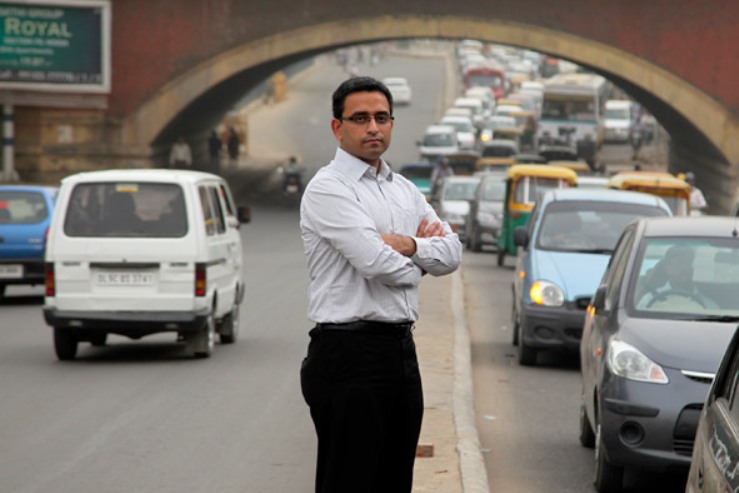
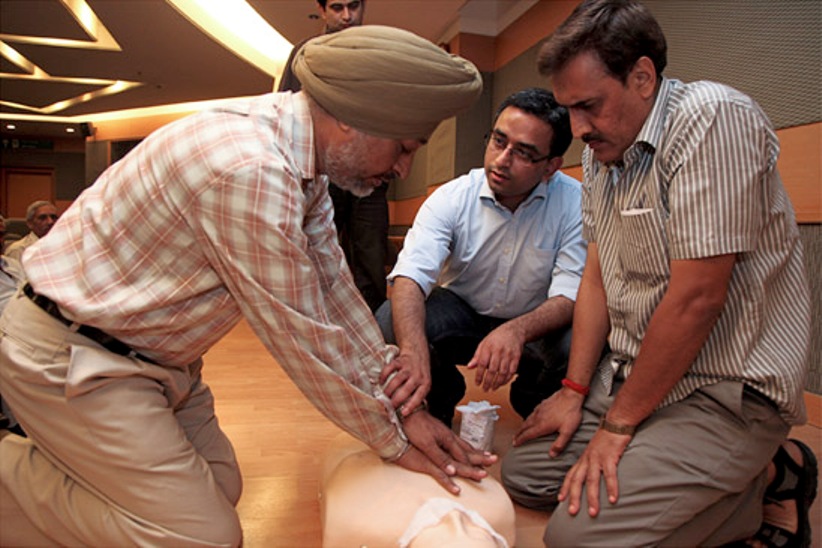
India has the highest number of road accidents in the world: 15 people die every hour from road accidents, and 60 more are seriously injured. Yet, 80% of accident victims don’t receive any medical care within the crucial ‘Golden Hour’ — the immediate period following a traumatic injury when there is the greatest chance to prevent death with prompt treatment.
Piyush Tewari, a young entrepreneur, set up the SaveLIFE Foundation in 2008 to enable bystander care, or community driven emergency response, until more professional help arrives.
In this week’s Ravaya column, in Sinhala, I describe how one determined young man is making a difference for hundreds of people injured on the mean streets of India. Last week, I also wrote an English column covering the same topic.
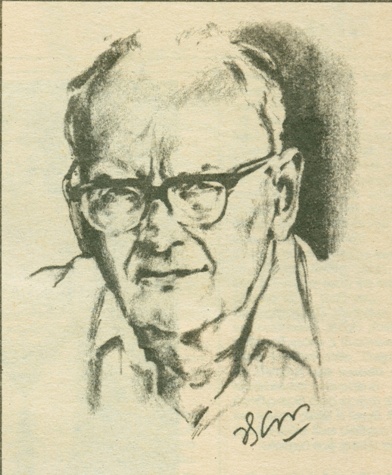
This week, my Ravaya column (in Sinhala) is about why we in Sri Lanka should re-read Arthur C Clarke, author of 100 books and over 1,000 essays of both fiction and non-fiction. This marks his 95th birth anniversary that falls on 16 Dec 2012.
As a science writer, Sir Arthur wrote on many and varied topics. Here, I single out two aspects: human violence and human gullibility, both of which continue to affect societies around the world.
Sir Arthur Clarke revisits Hikkaduwa beach in souther Sri Lanka in his custom-made Dune Roller, circa 2005 ශ්රීමත් ආතර් සී. ක්ලාක්ගේ 95 වන ජන්ම සංවත්සරය අදට යෙදෙනවා.
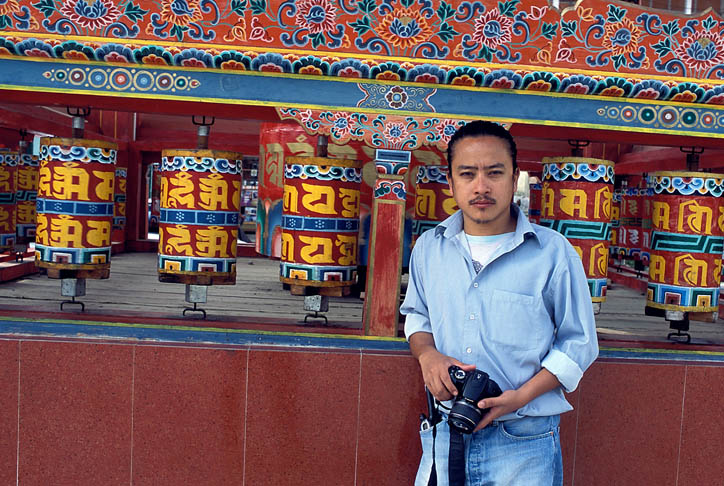
In this week’s Ravaya column (in Sinhala), I write about an Indian friend of mine: Moji Riba, filmmaker and cultural anthropologist, who lives and works in India’s north-eastern Arunachal Pradesh.
It’s an isolated remote and sparsely populated part of the country that is home to 26 major tribal communities,. Each one has its own distinctive dialect, lifestyle, faith, traditional practices and social mores. They live side by side with about 30 smaller communities.
A combination of economic development, improved communications, the exodus of the young and the gradual renunciation of animist beliefs for mainstream religions threatens Arunachal’s colourful traditions. “It is not my place to denounce this change or to counter it,” says Moji. “But, as the older generation holds the last link to the storehouse of indigenous knowledge systems, we are at risk of losing out on an entire value system, and very soon.”
For the past 15 years, he has been documenting it on video and photos. Read my English blogposts about him in Nov 2008 and Jan 2009.
I caught up with him in Delhi last week, which inspired this column.
Moji Riba has been working since 1997 to document Arunachal Pradesh's rich cultural heritage. Image courtesy Rolex Awards
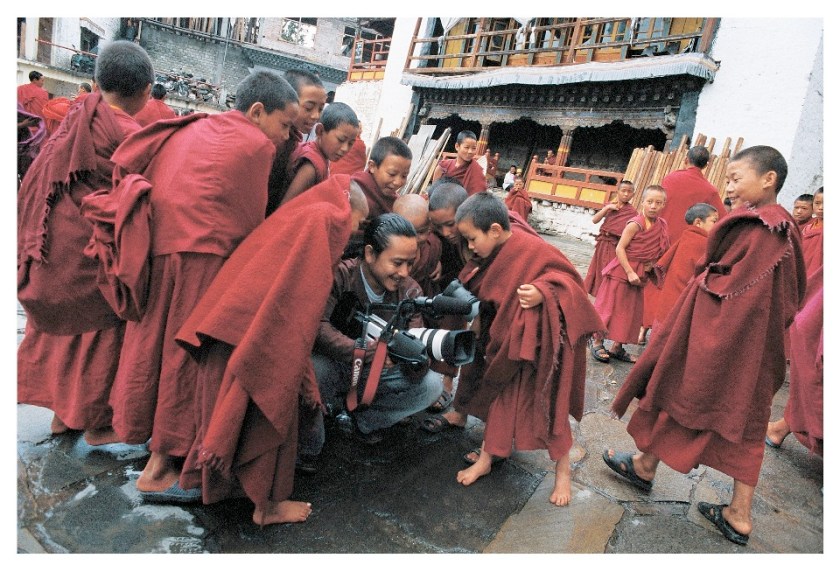
Surrounded by young monks, Moji Riba films rituals celebrating Buddha’s birth at Galden Namgyal Lhatse monastery. Tawang, Arunachal Pradesh, India, 2008 (Photo courtesy Rolex Awards)
සංස්කෘතික පර්යේෂණ හා ලේඛනගත කිරීමේ කේන්ද්රය (Centre for Cultural Research and Documentation, CCRD) අරඹමින් තවත් ඔහු වැනි ම කිහිප දෙනෙකු සමඟ ප්රාන්තයේ ජන සංස්කෘතිය ගැන වීඩියෝ වාර්තා චිත්රපට නිපදවීම ඇරඹුවා.
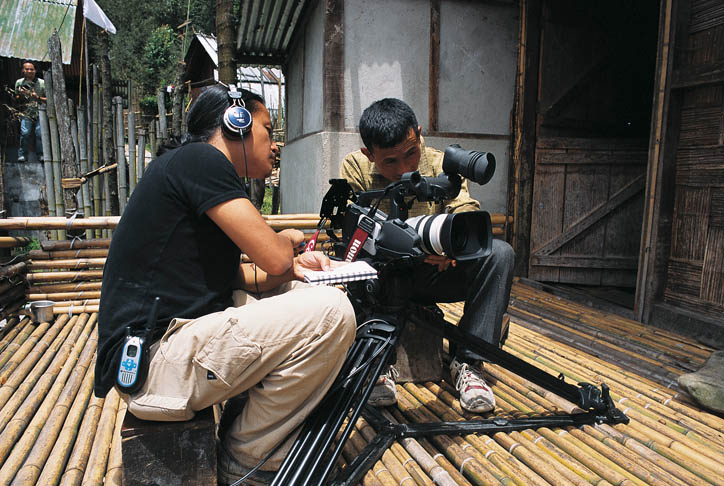
Riba teaches Hage Komo the basic camera skills that will allow the young Apatani to film an interview with his father and an animist priest, thus recording his tribe's oral history (Photo courtesy Rolex Awards)
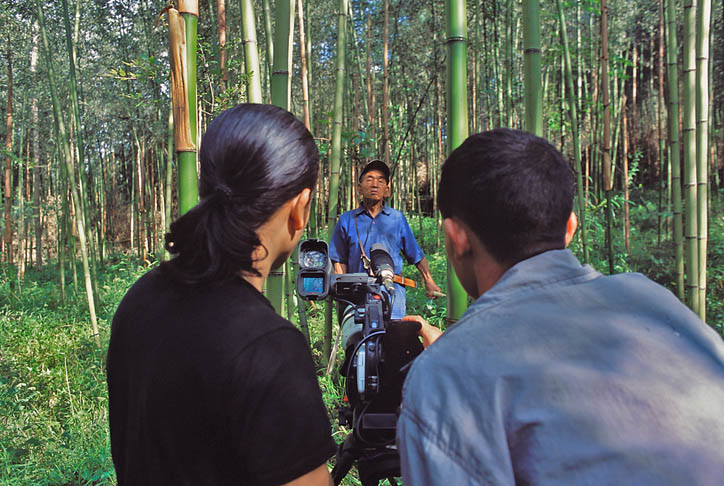
Hage Komo gets video instructions from Moji Riba, who is enlisting local young people to capture the oral histories, languages and rituals of their tribes for his project. Komo films his father gathering bamboo in a grove outside Hari Village. (Photo courtesy Rolex Awards)