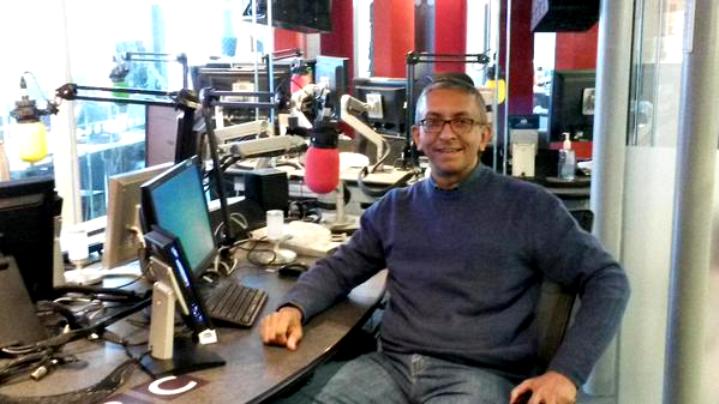
On 13 Feb 2015, while briefly in London, I visited BBC’s new Media Centre and recorded brief interviews with BBC Sinhala and BBC Tamil services (radio) on the role of social media during the Sri Lanka Presidential Election 2015 – the topic of my talk at University of London the previous day.
BBC Sinhala published the story online on 22 Feb 2015, along with an edited down audio track.
In this week’s Ravaya column (in Sinhala), I discuss the history and current state of play in relation to right to information (RTI). This is in the context of the new Lankan government planning to introduce an RTI law.
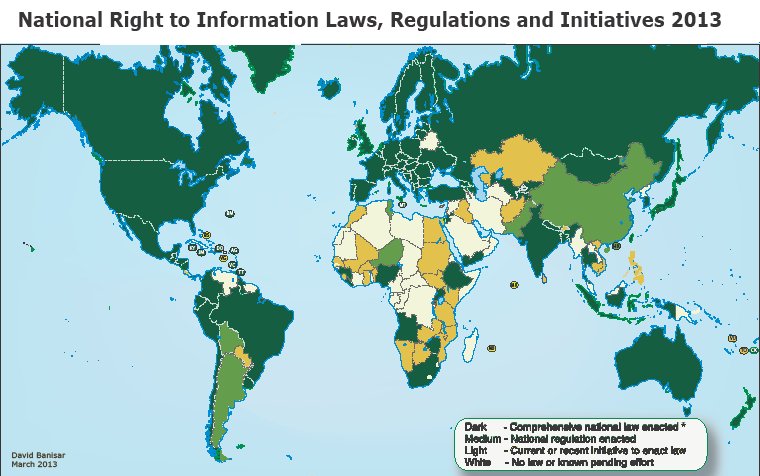
To review the work of government at all levels, citizens/voters need to access public sector information – about decisions, proceedings, budgets, expenditures, problems and performance. Close to 100 countries now have laws guaranteeing people’s RTI.
Sadly, Sri Lanka is lagging behind all other SAARC countries, five of which have already enacted RTI laws and two (Afghanistan and Bhutan) have draft bills under consideration. Attempts to introduce RTI in Sri Lanka were repeatedly thwarted by the previous government, which cited various excuses for avoding such a progressive law.
In this column, I also argue that RTI’s effectiveness depends on imagination, innovation and persistence on the part of all citizens. Its best results will accrue in a society and political culture where evidence and analysis are respected. Sri Lanka is not there yet.
RTI will be a significant milestone in a long journey that must continue.
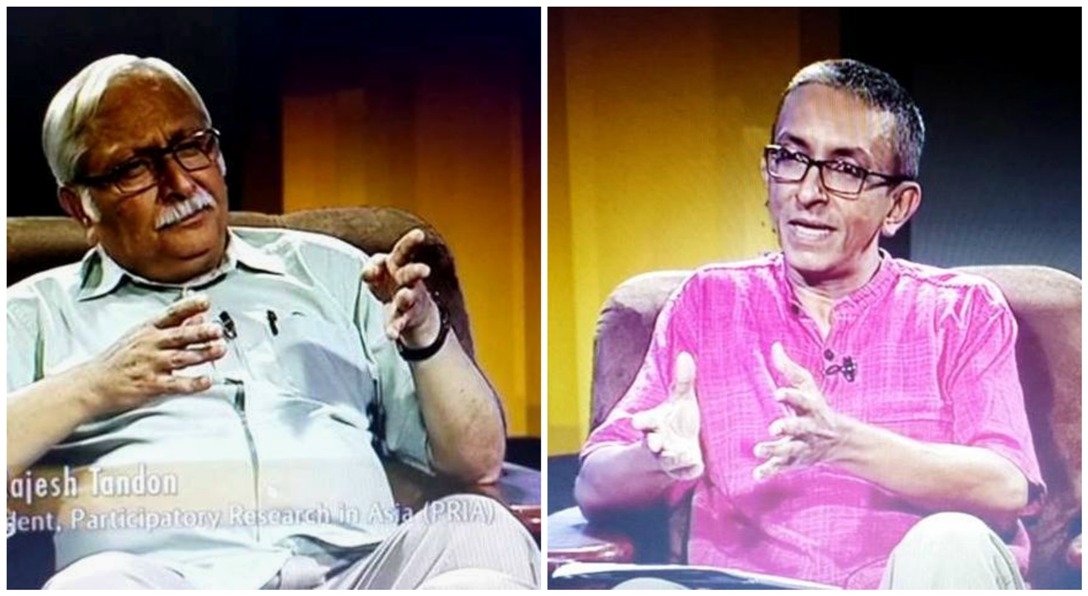
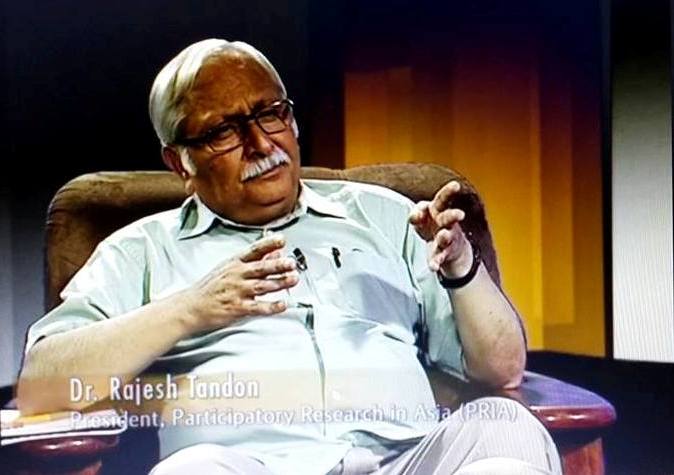
In this week’s Ravaya column (in Sinhala), I continue the Sinhala adaptation of my June 2014 TV interview with Dr Rajesh Tandon of India, an internationally acclaimed leader and practitioner of participatory research and development.
Last week, we discussed the civil space and political space available for advocacy and activism – and how far civil society activists have been able to engage the formal political process in India.
Today, we discuss how anti-corruption movement evolved into the Aam Aadmi Party, AAP, and the relevance of India’s experiences to Sri Lanka. We also discuss India’s Right to Information Act and how that has empowered citizens to seek a more open and accountable government at national, state and local levels. Dr Tandon ends by emphasizing that democracy is a work in progress that needs constant engagement and vigilance.
තොරතුරුදැනගැනීමේඅයිතිය(Right to Information Act) නීතියෙන්තහවුරුවීඉන්දියාවේදැන්දශකයක්පමණකල්ගතවීතිබෙනවා. පුරවැසිහාසිවිල්සමාජක්රියාකාරීත්වයටහායහපාලනයටමෙයදායකවීඇත්තේකෙසේද?
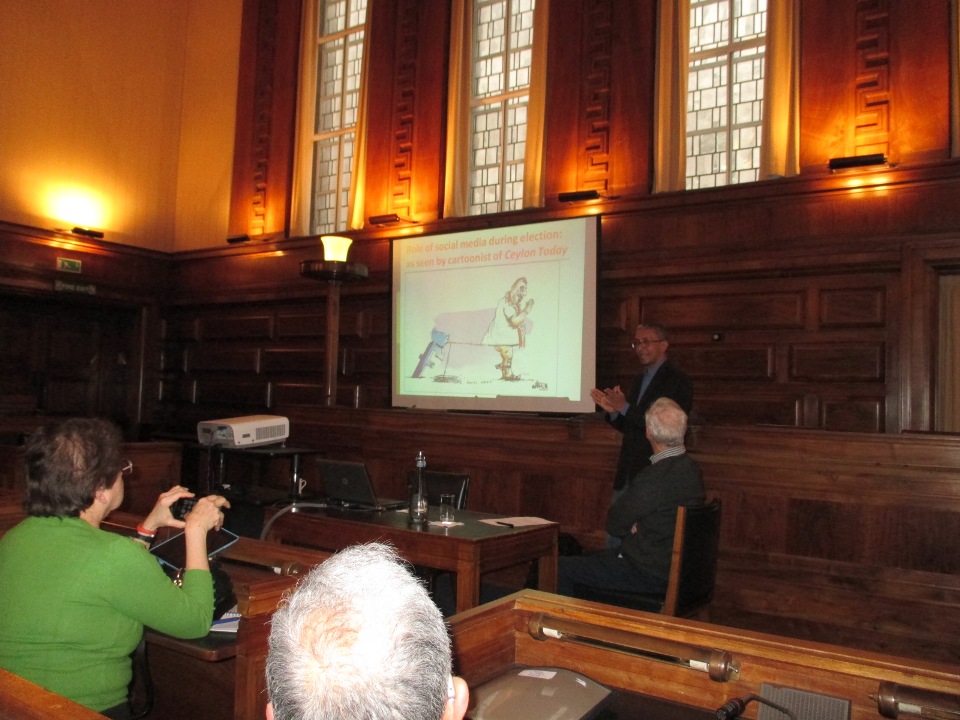
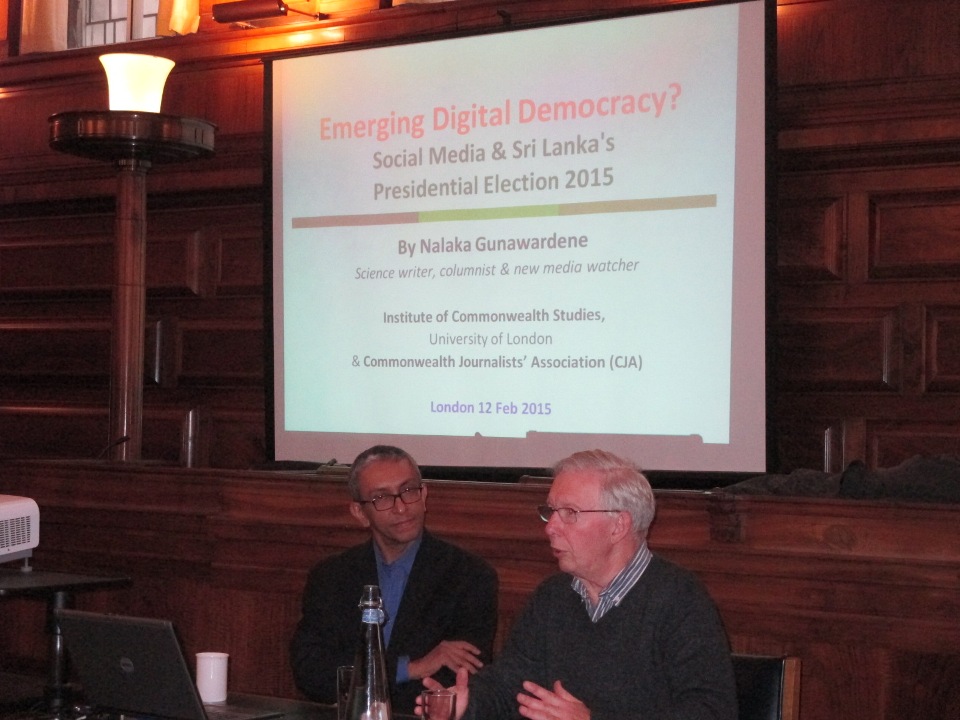
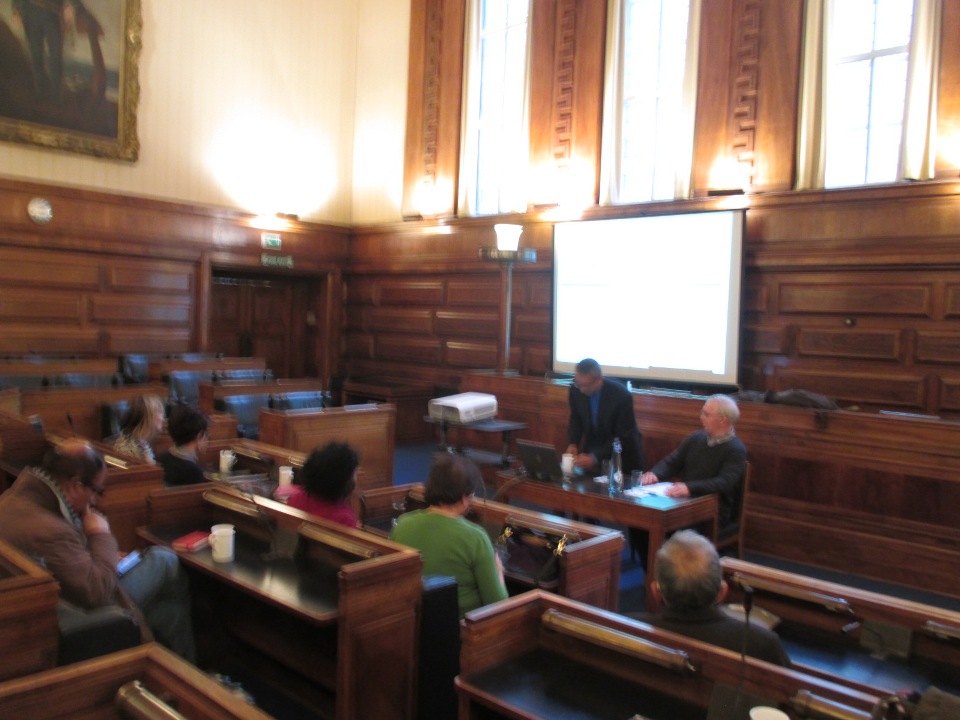
Nalaka Gunawardene talking at London University on 12 Feb 2015 on “Social Media and Sri Lanka’s Presidential Election 2015” Photo by Prasanna Ratnayake
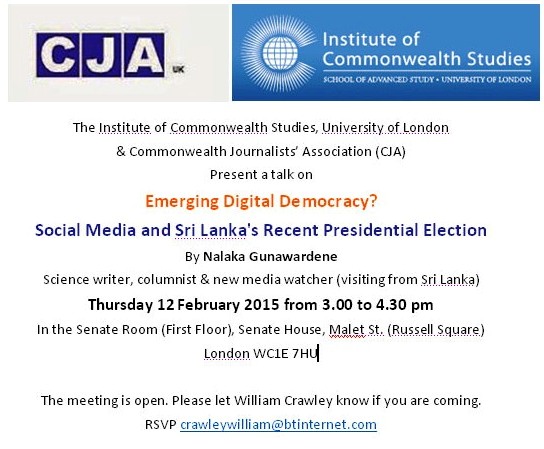
Emerging Digital Democracy? Social Media and Sri Lanka’s Presidential Election 2015
This was the topic of a public talk I gave at the University of London on 12 Feb 2015.
It was organised and hosted by the Institute of Commonwealth Studies, University of London in collaboration with the Commonwealth Journalists’ Association (CJA).
They lined up the University’s Senate Room for the talk, which was attended by a South Asian audience who engaged me in a lively discussion.
Emerging Digital Democracy? Social Media and Sri Lanka’s Presidential Election 2015
Synopsis of the talk:
A record 81.5% of registered voters took part in Sri Lanka’s presidential election on 8 January 2015 in which incumbent Mahinda Rajapaksa was defeated by his former health minister Maithripala Sirisena. The peaceful regime change has been widely acclaimed as a triumph of democracy and a mandate for political reform, improved governance and national reconciliation.
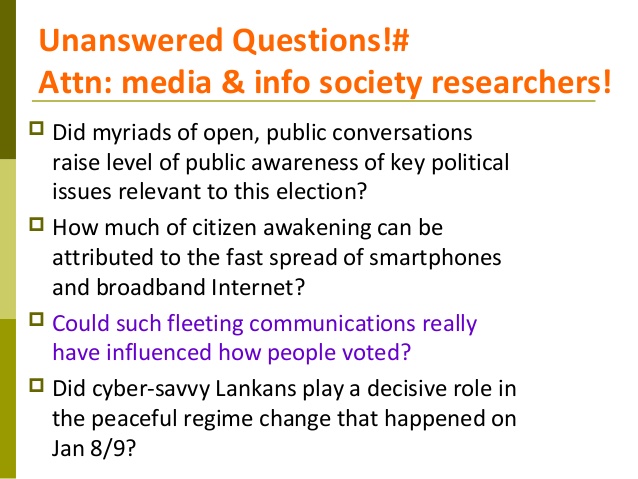
The election saw unprecedented use of social media by both candidates as well as by politically charged yet unaffiliated youth. How much of this citizen awakening can be attributed to the fast spread of smartphones and broadband? Did it really influence how people voted? What does this mean for future politics and governance in Sri Lanka?
In this illustrated talk, science journalist and new media watcher (and practitioner) Nalaka Gunawardene shares his insights and views.
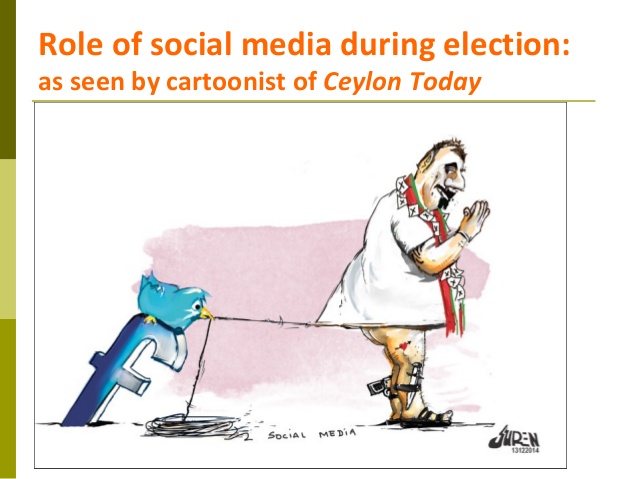
Who’s afraid of social media? Many Lankan politicians, for sure…
My PowerPoint slides:
Key questions that need more research to answer:
This is why we need better research on new media and society in Sri Lanka!
Photos by Prasanna Ratnayake
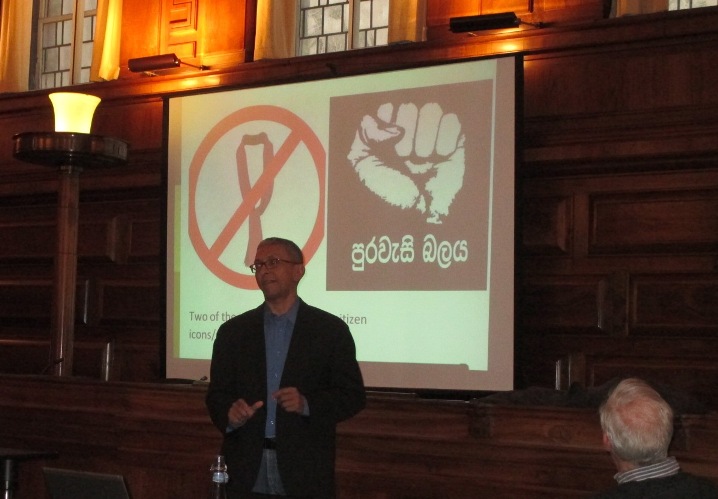
William Crawley (right), Fellow of the Institute of Commonwealth Studies, introduces Nalaka GunawardeneNalaka Gunawardene on Social Media and Sri Lanka’s Presidential Election 2015 at University of London, 12 Feb 2015A section of the audience at Senate Room, University of London, listening to Nalaka Gunawardene: 12 Feb 2015
I am not a public health or environmental expert, but have long covered related topics as a science journalist.
Among my long-standing interests are the downstream health and environmental effects agrochemicals – both chemical fertilizers and farm chemicals applied against pests and weeds. Parallel to this, I have also been covering chronic kidney disease of uncertain aetiology (CKDu), a mysterious illness that has been affecting thousands of Lankan farmers for nearly 25 years.
A link between agrochemicals and CKDu is suspected, but not yet scientifically proven (even though environmentalists ask us to believe so). It is a current yet contentious topic, which I chose for my presentation to an international workshop on “Pesticides and Global Health: Research, Collaboration and Impact” held at the Department of Anthropology, University of Durham, UK, on 10 – 11 February 2015.
In my presentation, I explore the topic from the angle of public perceptions, which are largely shaped by what appears in the media. This has been problematic since mass kidney failure in Sri Lanka has been compounded by what I call a ‘mass media failure’.
Most of our media have failed to understand, analyse and report adequately on this public health emergency. Instead of helping affected people and policy makers to work out solutions, some journalists have become amplifiers of extreme activist positions. This has led to alarmism and policy confusion.
What is to be done? There are no short-cuts to the scientific investigation process which must follow – that means further research is needed to find definitive evidence for causative factors. That could take a while, given how people are exposed to multiple environmental, lifestyle and genetic factors.
But meanwhile, the welfare of those already affected by the disease and their families needs to receive greater public support. Environmentalists trying to score points from this tragedy overlook this vital humanitarian aspect.
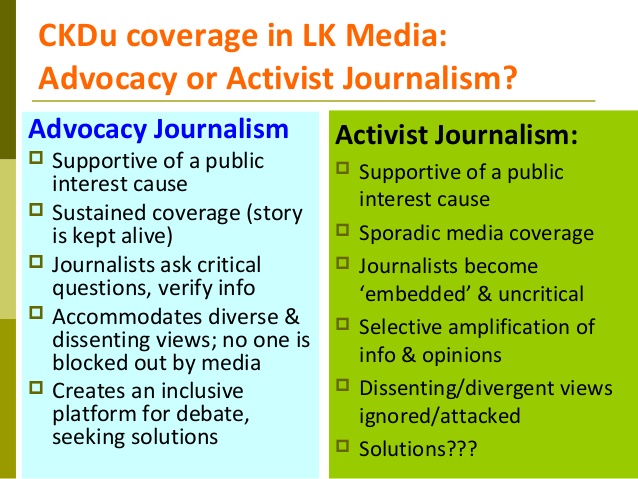
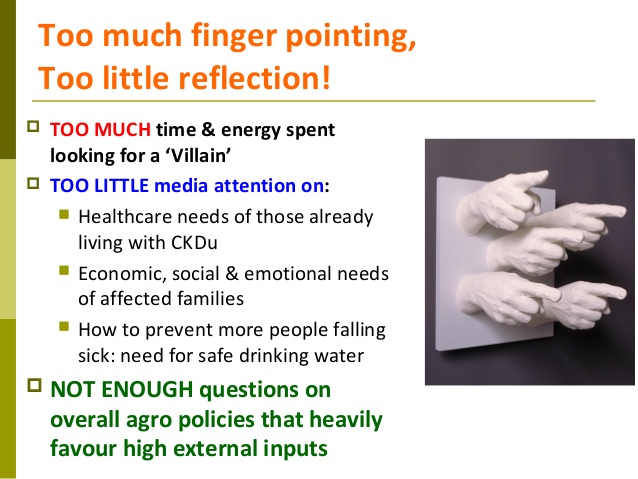
A few excerpts from the presentation below. See full presentation above.
Advocacy journalism is fine; activist journalism is questionableWe need Lankan media to be more reflective, less accusatorySpare a thought for today’s policy-makers who must think and act on the run…
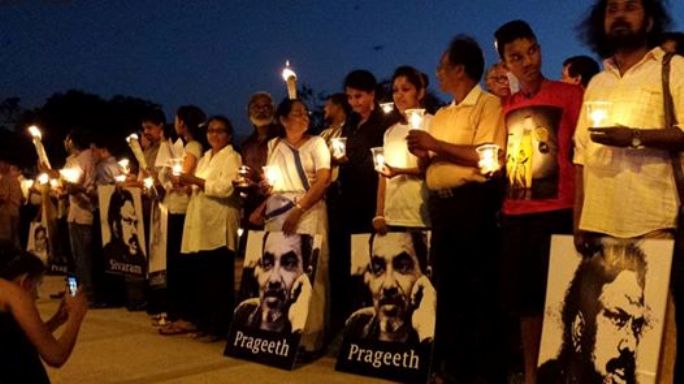
Citizens’ vigil for murdered and disappeared Lankan journalists: 5 January 2015 at Vihara Maha Devi Park, Colombo.
Civil society – in its widest sense – played a key role in the recent peaceful change of government in Sri Lanka. It was civil society advocacy – for ending corruption, ensuring independence of judiciary, and increasing democratic checks and balances on the executive presidency – that inspired a larger citizen demand for better governance. The parliamentary opposition was pushed into belated action by these citizen demands.
What is the role of civil society in the political process? How and where does the civil space intersect with the political space? How can civil society engage formal political parties without being subsumed or co-opted?
In June 2014, I posed these questions to Dr Rajesh Tandon of India, an internationally acclaimed leader and practitioner of participatory research and development, when I interviewed him for Young Asia Television (YATV) – I was just ‘standing in’ for the regular host Sanjana Hattotuwa.
That interview’s contents are now more relevant to Sri Lanka than 8 months ago. So I have just rendered it into Sinhala. In this week’s Ravaya column (in Sinhala), I share the first half of the interview. To be continued next week…
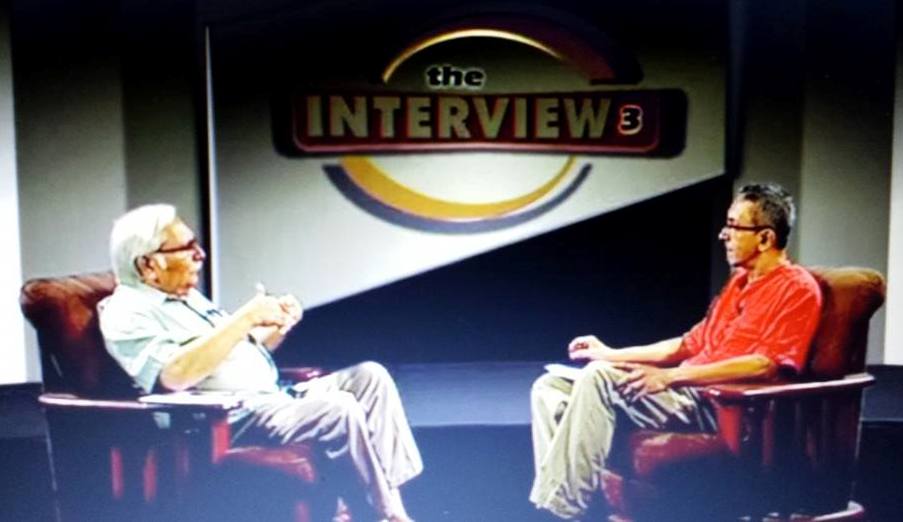
Dr Rajesh Tandon (left) in conversation with Nalaka Gunawardene: Young Asia Television – The Interview, June 2014
As a science journalist, I have been covering scientific aspects of the public health emergency of mass kidney failure that has killed an estimated 20,000 persons in Sri Lanka over the past two decades.
It emerged in the early 1990s, when hundreds of people in Sri Lanka’s Dry Zone – heartland of its farming — developed kidney failure without having the common causative factors of diabetes or high blood pressure.
Most affected were men aged between 30 and 60 years who worked as farmers. The disease built up inside the body without tell-tale signs or symptoms, manifesting only in advanced stages.
Over the years, many scientific studies have been carried out on what causes this mysterious disease, now called Chronic Kidney Disease of unknown aetiology, or CKDu. Various environmental, geochemical and lifestyle related factors have been probed. Researchers now suspect environmental and genetic factors as causes – but a definitive link to a specific factor has yet to be found.
On 23 January 2015, I answered a few questions posed by BBC World Service (radio) on CKDu, to feed a news report they were producing for global broadcast.
My full answers are shared here in the public interest.
Science writer Nalaka Gunawardene responds to questions from BBC World Service on the mysterious mass kidney failure in Sri Lanka: 23 January 2015
Question 1: What are the various theories that scientists have put forward as a possible cause for this disease which has been studied for 20 years?
Question 2: As a science journalist, you’ve been tracking the research on this public health concern for some years. What do you think is most likely cause?
Question 3: The World Health Organisation supported research has suggested a link with agrochemical use. Don’t you think that such a link is likely?
Question 4: The new government of Sri Lanka has just pledged to give high priority to the kidney disease. What are the challenges faced by the government in dealing with this crisis?
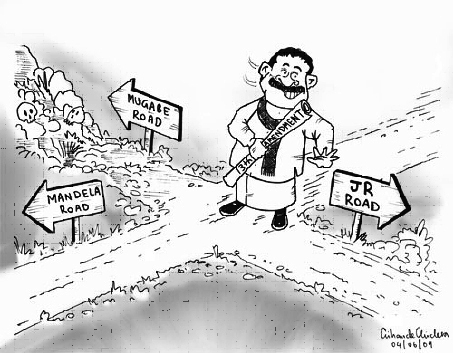
Which road to take, ponders Mahinda Rajapaksa after war victory – Cartoon by Gihan de Chickera, published in Daily Mirror, 4 June 2009 (2 weeks after Sri Lanka’s civil war ended)
In this week’s Ravaya column (in Sinhala), published in the issue dated 11 January 2015, I offer an initial analysis of media-based political campaign communications during the run-up to Sri Lanka’s 7th Presidential Election on 8 January 2015. The column was written on 5 January, as physical campaigning (meetings and outdoor promotion) came to an end. The Ravaya issue carrying this hit the newsstands on election day.
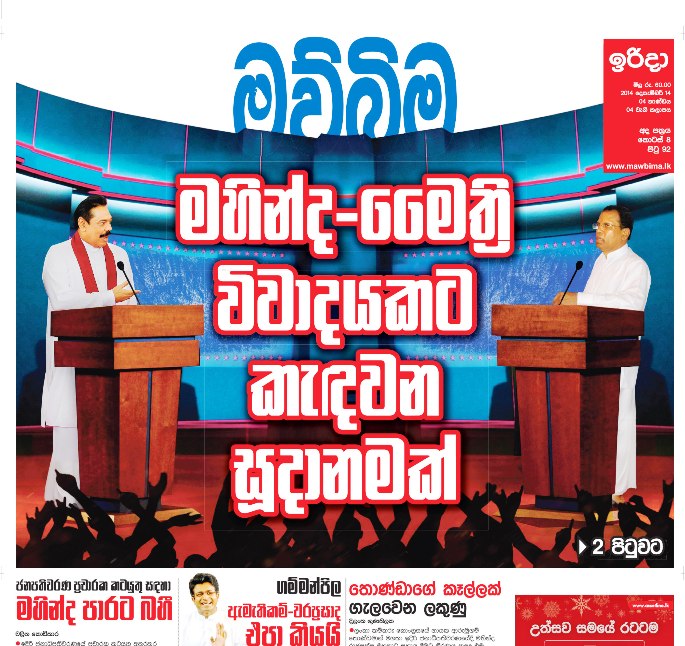
In this, I pay particular attention to the use of social media by political parties as well as independent citizens and civil society groups. I also discuss the missed opportunity of holding a televised live debate between the two main candidates – to which opposition’s common candidate Maithripala Sirisena agreed, but was declined by incumbent president Mahinda Rajapaksa.
See also my recent other columns on elections, digital democracy and social media:









 Open Minds!