Media innovation in Sri Lanka: Responding then to tyranny, and now to opportunity

East-West Center 2016 International Media Conference in New Delhi, India, from September 8 to 11, 2016

The Hawaii-based East-West Center held its 2016 International Media Conference in New Delhi, India, from September 8 to 11, 2016. Themed “South Asia Looking East”, it drew over 350 participants from across Asia and the United States.

On September 11, I took part in a breakout session that discussed media innovation in Asia and the United States. While my fellow panelists spoke mainly about digital media innovation of their media outlet or media sector, I opted to survey the bigger picture: what does innovation really mean when media is under siege, and how can the media sector switch from such ‘innovation under duress’ to regular market or product innovation?

Here are my remarks, cleaned up and somewhat expanded:
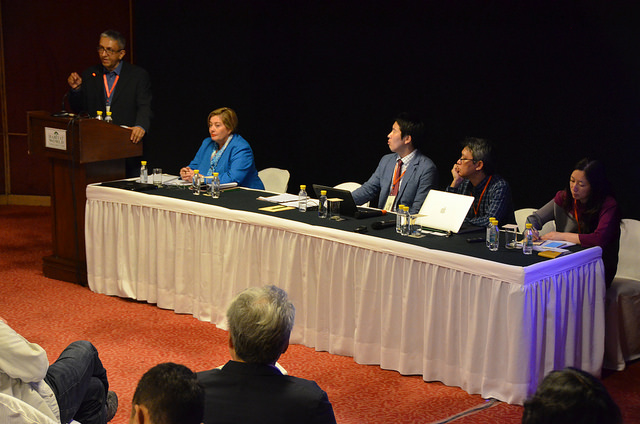
Nalaka Gunawardene speaks on media innovation under duress

Innovation has been going on in media from the beginning. Faced with major challenges from advancing technologies and changing demography, innovation is now an imperative for market survival.

We can discuss this at different levels: product innovation, process innovation and systemic innovation. I like to add another kind for our discussion: innovation for physical survival.

With forces social and market Darwinism constantly at work, you might ask, shouldn’t the most adaptable and nimble players survive – while others perish?

Yes and No. Sometimes the odds against independent and progressive media organisations are disproportionately high – they should not be left to fend for themselves. This is where media consumers and public spirited groups need to step in.

Let me explain with a couple of examples from South Asia.

They say necessity is the mother of invention or innovation. I would argue that tyranny – from the state and/or extremist groups – provides another strong impetus for innovation in the media.

In Nepal, all media came under strict control when King Gyanendra assumed total control in February 2005. Among other draconian measures, he suspended press freedom, imposing a blanket ban on private or community broadcasters carrying news, thus making it a monopoly of state broadcasters.

The army told broadcasters that the stations were free to carry music, but not news or current affairs. Soldiers were sent to radio and TV stations to ensure compliance.

When the king’s siege of democracy continued for weeks and months, some media started defying censorship – they joined human rights activists and civil society groups in a mass movement for political reforms, including the restoration of parliamentary democracy.

Some of Nepal’s many community radio stations found creative ways of defying censorship. One station started singing the news – after all, there was no state control over music and entertainment! Another one in central Nepal went outside their studio, set up an impromptu news desk on the roadside, and read the news to passers-by every evening at 6 pm.
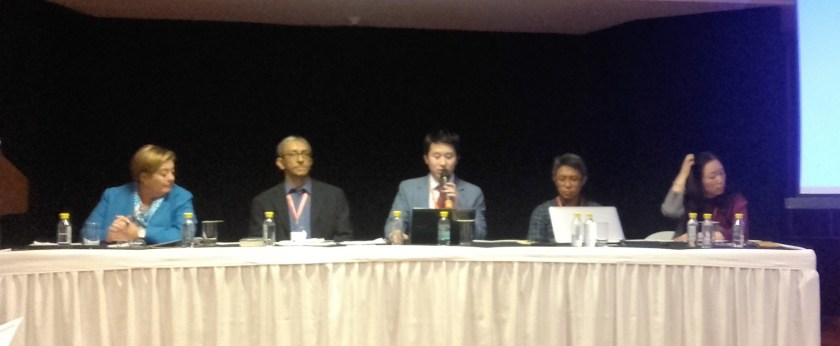
Panel on Media innovation at East-West Center Media Conference, Delhi, 11 Sep 2016: L to R - Philippa McDonald, Nalaka Gunawardene, LEE Doo Won, Fernando (Jun) SEPE, Jr. and ZHONG Xin
Panel on Media innovation at East-West Center Media Conference, Delhi, 11 Sep 2016: L to R – Philippa McDonald, Nalaka Gunawardene, LEE Doo Won, Fernando (Jun) SEPE, Jr. and ZHONG Xin

The unwavering resolve of these and other media groups and pro-democracy activists led to the restoration of parliamentary democracy in April 2006 and the subsequent abolition of the Nepali monarchy.

My second example is from Sri Lanka where I live and work.

We are recovering from almost a decade of authoritarian rule that we ended in January 2015 by changing that government in an election. The years preceding that change were the darkest for freedom of expression and media freedom in Sri Lanka – the country, then nominally a democracy, was ranked 165th among 183 countries in the World Press Freedom Index for 2014.

In June 2012, Sri Lanka was one of 16 countries named by the UN Special Rapporteur on the promotion and protection of the right to freedom of opinion and expression for “attacks against journalists during coverage of street protests and demonstrations, such as arbitrary arrests and detention, verbal and physical attacks, confiscation or destruction of equipment, as well as killings.”

Threats of attacks and actual incidents of physical violence in recent years led to a climate of fear and widespread self-censorship among journalists in Sri Lanka. This is slowly changing now, but old habits die hard.

At the height of media repression by the former regime, we saw some of our media innovating simply for physical survival. One strategy was using satire and parody – which became important forms of political commentary, sometimes the only ones that were possible without evoking violent reprisals.

Three years ago, I wrote a column about this phenomenon which I titled ‘When making fun is no laughing matter (Ceylon Today, 5 May 2013).
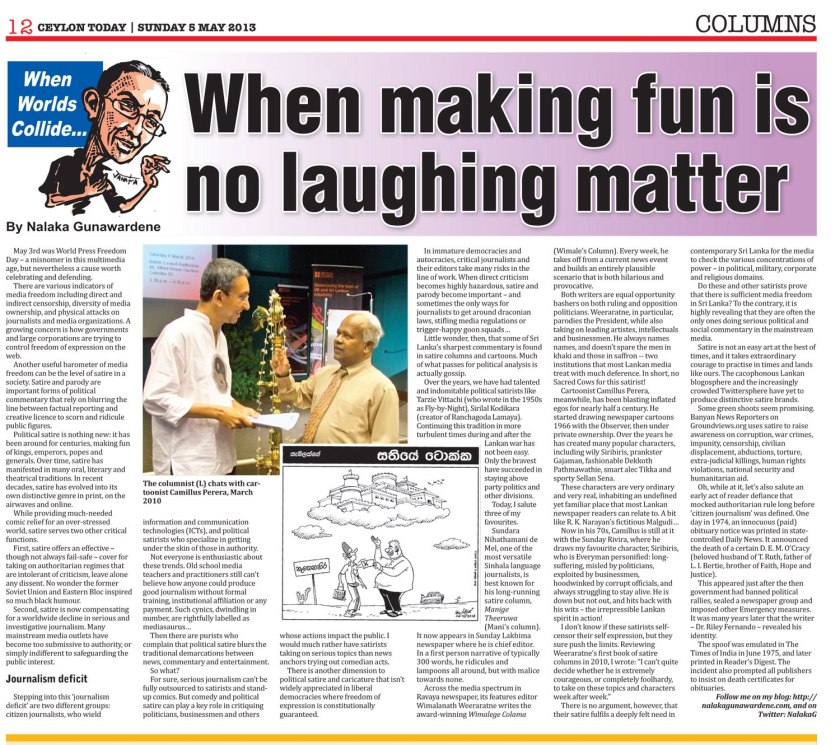
Full text: https://collidecolumn.wordpress.com/2013/05/05/when-worlds-collide-65-when-making-fun-is-no-laughing-matter/

What I wrote then, while still in the thick of crackdown, is worth recalling:

“For sure, serious journalism can’t be fully outsourced to satirists and stand-up comics. But comedy and political satire can play a key role in critiquing politicians, businessmen and others whose actions impact the public.

“There is another dimension to political satire and caricature that isn’t widely appreciated in liberal democracies where freedom of expression is constitutionally guaranteed.

“In immature democracies and autocracies, critical journalists and their editors take many risks in the line of work. When direct criticism becomes highly hazardous, satire and parody become important — and sometimes the only – ways for journalists get around draconian laws, stifling media regulations or trigger-happy goon squads…

“Little wonder, then, that some of Sri Lanka’s sharpest commentary is found in satire columns and cartoons. Much of what passes for political analysis is actually gossip.”

For years, cartoonists and political satirists fulfilled a deeply felt need in Sri Lanka for the media to check the various concentrations of power — in political, military, corporate and religious domains.

They still continue to perform an important role, but there is more space today for journalists and editors to report things as they are, and to comment on the key stories of the day.

During the past decade, we have also seen the rise of citizen journalism and vibrant blogospheres in the local languages of Sinhala and Tamil. Their advantage during the dark years was that they were too numerous and scattered for the repressive state to go after each one (We do know, however, that electronic surveillance was attempted with Chinese technical assistance.)

Of course, Sri Lanka’s media still face formidable challenges that threaten their market survival.
Rebuilding Public Trust: An Assessment of the Media Industry and Profession in Sri Lanka (May 2016)

A new assessment of Sri Lanka’s media, which I edited earlier this year, noted: “The economic sustainability of media houses and businesses remains a major challenge. The mainstream media as a whole is struggling to retain its consumer base. Several factors have contributed to this. Many media houses have been slow in integrating digital tools and web-based platforms. As a result, there is a growing gulf between media’s production models and their audiences’ consumption patterns.”

Innovation and imagination are essential for our media to break out of 20th century mindsets and evolve new ways of content generation and consumption. There are some promising new initiatives to watch, even as much of the mainstream continues business as usual – albeit with diminishing circulations and shrinking audience shares.

Innovate or perish still applies to our media. We are glad, however, that we no longer have to innovate just to stay safe from goon squads.

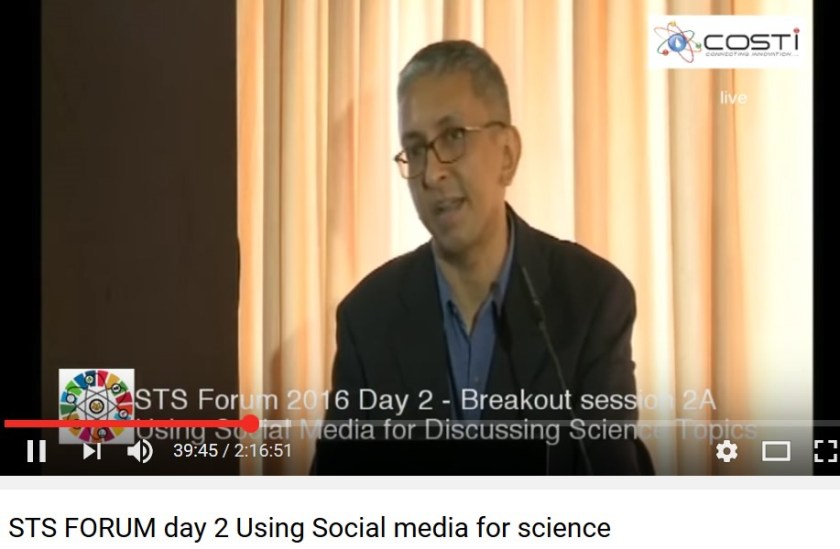
 

Social Media in Sri Lanka: Do Science and Reason Stand a Chance?

Nalaka Gunawardene speaks on "Using Social Media for Discussing Science" at the Science, Technology & Society Forum in Colombo, Sri Lanka, 9 Sep 2016. Photo by Smriti Daniel
Nalaka Gunawardene speaks on “Using Social Media for Discussing Science” at the Science, Technology & Society Forum in Colombo, Sri Lanka, 9 Sep 2016. Photo by Smriti Daniel

Sri Lanka’s first Science and Technology for Society (STS) Forum took place from 7 to 10 September in Colombo. Organized by the Prime Minister’s Office and the Ministry of Science, Technology and Research, it was one of the largest gatherings of its kind to be hosted by Sri Lanka.

Modelled on Japan’s well known annual STS forums, the event was attended by over 750 participants coming from 24 countries – among them local and foreign scientists, inventors, science managers, science communicators and students.

I was keynote speaker during the session on ‘Using Social Media for Discussing Science Topics’. I used it to highlight how social media have become both a boon and bane for scientific information and thinking in Sri Lanka. This is due to peddlers of pseudo-science, anti-science and superstition being faster and better to adopt social media platforms than actual scientists, science educators and science communicators.

Social Media in #LKA:Do Science & Reason stand a chance? Asks Nalaka Gunawardene

Sri Lanka takes justified pride in its high literacy levels and equally high coverage of vaccination against infectious diseases. But we cannot claim to have a high level of scientific literacy. If we did, it would not be so easy for far-fetched conspiracy theories to spread rapidly even among educated persons. Social media tools have ‘turbo-charged’ the spread of associated myths, superstitions and conspiracy theories!

I cautioned: “Unless we make scientific literacy an integral part of everyone’s lives, ambitious state policies and programmes to modernize the nation could well be jeopardized. Progress can be undermined — or even reversed — by extremist forces of tribalism, feudalism and ultra-nationalism that thrive in a society that lacks the ability to think critically.”

It is not a case of all doom and gloom. I cited examples of private individuals creatively using social media to bust myths and critique all ‘sacred cows’ in Lankan society – including religions and military. These voluntary efforts contrast with much of the mainstream media cynically making money from substantial advertising from black magic industries that hoodwink and swindle the public.

My PowerPoint presentation:


Video recording of our full session:


The scoping note I wrote for our session:

Sri Lanka STS Forum panel on Using Social Media for Discussing Science Topics. 9 Sep 2016. L to R - Asanga Abeygunasekera, Nalaka Gunawardene, Dr Piyal Ariyananda, Dr Ananda Galappatti & Smriti Daniel
Sri Lanka STS Forum panel on Using Social Media for Discussing Science Topics. 9 Sep 2016.
L to R – Asanga Abeygunasekera, Nalaka Gunawardene, Dr Piyal Ariyananda, Dr Ananda Galappatti &
Smriti Daniel

Session: Using Social Media for Discussing Science Topics

With 30 per cent of Sri Lanka’s 21 million people regularly using the Internet, web-based social media platforms have become an important part of the public sphere where myriad conversations are unfolding on all sorts of topics and issues. Facebook is the most popular social media outlet in Sri Lanka, with 3.5 million users, but other niche platforms like Twitter, YouTube and Instagram are also gaining ground. Meanwhile, the Sinhala and Tamil blogospheres continue to provide space for discussions ranging from prosaic to profound. Marketers, political parties and activist groups have discovered that being active in social media is to their advantage.

Some science and technology related topics also get discussed in this cacophony, but given the scattered nature of conversations, it is impossible to grasp the full, bigger picture. For example, some individuals or entities involved in water management, climate advocacy, mental health support groups and data-driven development (SDG framework) are active in Sri Lanka’s social media platforms. But who is listening, and what influence – if any – are these often fleeting conservations having on individual lifestyles or public policies?

Is there a danger that self-selecting thematic groups using social media are creating for themselves ‘echo chambers’ – a metaphorical description of a situation in which information, ideas, or beliefs are amplified or reinforced by transmission and repetition inside an “enclosed” system, where different or competing views are dismissed, disallowed, or under-represented?

Even if this is sometimes the case, can scientists and science communicators afford to ignore social media altogether? For now, it appears that pseudo-science and anti-science sentiments – some of it rooted in ultra-nationalism or conspiracy theories — dominate many Lankan social media exchanges. The keynote speaker once described this as Lankan society permanently suspending disbelief. How and where can the counter-narratives be promoted on behalf of evidenced based, rational discussions? Is this a hopeless task in the face of irrationality engulfing wider Lankan society? Or can progressive and creative use of social media help turn the tide in favour of reason?

This panel would explore these questions with local examples drawn from various fields of science and skeptical enquiry.


සිවුමංසල කොලුගැටයා #283: ලක් සමාජය වංචනිකයන්ගෙන් බේරා ගැනීමට බුද්ධිමය ප්‍රතිශක්තිකරණයක් ඕනෑ!

STS Forum Sri Lanka
STS Forum Sri Lanka

Sri Lanka’s first Science and Technology for Society (STS) Forum took place from 7 to 10 September in Colombo. Organized by the Prime Minister’s Office and the Ministry of Science, Technology and Research, it is one of the largest gatherings of its kind to be hosted by Sri Lanka.

What sets STS Forums apart is that they are not merely events where scientists talk to each other.  That surely will happen, but there will be many more voices and, hopefully, much broader conversations.
In this week’s Ravaya column (in Sinhala, appearing in the print issue of 11 Sep 2016), I look at Sri Lanka’s appalling lack of scientific literacy.

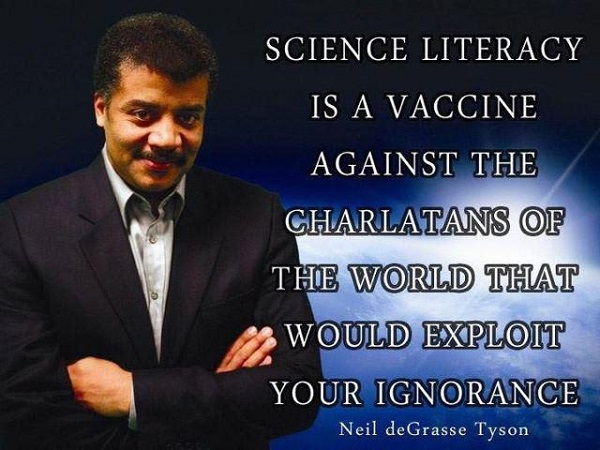
As Dr Neil deGrasse Tyson, American astrophysicist, cosmologist and science communicator, says, “Scientific literacy is an intellectual vaccine against the claims of charlatans who would exploit ignorance.”

Sri Lanka takes justified pride in its high literacy levels and equally high coverage of vaccination against infectious diseases. But we cannot claim to have a high level of scientific literacy.

A healthy dose of scepticism is essential to safeguard ourselves from superstitions, political claims and increasingly sophisticated – but often dishonest – product advertising. That’s what scientific literacy builds inside our minds.

I argue that unless we make scientific literacy an integral part of everyone’s lives, ambitious state policies and programmes to modernize the nation could well be jeopardized. Progress can be undermined — or even reversed — by extremist forces of tribalism, feudalism and ultra-nationalism that thrive in a society that lacks the ability to think critically.

See also my English op-ed: Scientific Literacy: ‘Mind Vaccine’ Sri Lanka Urgently Needs

Dr Neil deGrasse Tyson: One man worth cloning if that were feasible...
Dr Neil deGrasse Tyson: One man worth cloning if that were feasible…

විද්‍යාව, තාක්ෂණය හා සමාජය ගැන ජාත්‍යන්තර සමුළුවක් සැප්තැම්බර් 7 – 10 වකවානුව තුළ කොළඹදී පැවැත්වෙනවා.

”විද්‍යාව හා තාක්ෂණය තිරසාර සංවර්ධනයට නිසි ලෙස යොදා ගැනීම” මෙහි ප්‍රධාන තේමාවයි. ඒ යටතේ අනුතේමා හා මාතෘකා රැසක් වටා සැසිවාර පැවැත්වෙනවා.

අග්‍රාමාත්‍ය කාර්යාලය හා විද්‍යා – තාක්ෂණ අමාත්‍යාංශය සංවිධානය කරන මේ සමුළුව හුදෙක් විද්‍යාඥයන් හා තාක්ෂණවේදීන් එක් රැස් කරන තවත් අවස්ථාවක් පමණක් නොවෙයි.

මේ අයට අමතරව ප්‍රතිපත්ති සම්පාදකයන්, නව නිපැයුම්කරුවන්, විද්‍යා සන්නිවේදකයන්, විද්‍යා ගුරුවරුන්  හා ශිෂ්‍යයන් ද මෙයට සම්බන්ධ වනවා. ඇතැම් සැසිවාරවල අදහස් දක්වන්නේද මේ වඩාත් පුළුල් පිරිසෙන් තෝරා ගත් කථීකයන්.

මහජනයා සඳහා විද්‍යාව (citizen science) යන තේමාව යටතේ සැසිවාර කිහිපයක් සැළසුම් කිරීමට සංවිධායකවරුන් මට ඇරැයුම් කළා.

සාමාන්‍යයෙන් විද්‍යාත්මක සමුළුවලදී විද්‍යාව හා සෙසු සමාජය අතර සබඳතා ගැන එතරම් අවධානයක් යොමු කරන්නේ නැහැ. විද්වතුන් අතර කෙරෙන කථාබහ මාධ්‍ය වාර්තාකරණයට හසු වන්නේ ද සීමිතවයි.

එසේ බලන විට මේ සමුළුව අන් බොහෝ ඒවාට වඩා ඉදිරියෙන් සිටිනවා.

සාකච්ඡා කැරෙන අභ්‍යාවකාශ තාක්ෂණය, පරිගණ තාක්ෂණය, නැනෝ තාක්ෂණය, ජාතික නවොත්පාදන ප්‍රතිපත්තිරාමුව ආදී තේමා සියල්ල රටේ ආර්ථීක හා සමාජ සංවර්ධනයට දායක කරගත හැකි ක්ෂේත්‍රයන්.

එහෙත් විද්‍යාත්මක චින්තනය හා විවෘත මනසක් රටේ ස්ථාපිත නොවන තාක් කල් මේ කුමන තාක්ෂණයක් ප්‍රවර්ධනය කළත් එතරම් වැඩක් නැහැ. මන්ද තර්කානුකූලව සිතීමට හා ක්‍රියාකිරීමට නොහැකි සමාජයක් ලෙහෙසියෙන් වංචනිකයන් හා දේශපාලන අවස්ථාවාදීන්ට රවටා ගත හැකි නිසා.

වත්මන් සංකීර්ණ සමාජයේ ප්‍රවේශමින් දිවි ගෙවීමට බාල මහලු කොයි කාටත් යම් අවම විද්‍යාත්මක දැනුමක් හා චින්තනයක් අවශ්‍යයි.

එය පාසලේ හෝ සරසවියේ විෂ්‍ය නිර්දේශ අනුව උගන්වන විද්‍යාවන් නොවෙයි. එසේ විධිමත් ලෙස විද්‍යා විෂයයන් ඉගෙනීමට අවස්ථාවක් ලැබෙන්නේ අපේ ජනගහනයෙන් සාපේක්ෂව සීමිත පිරිසකට පමණයි.

එහෙත් මිලියන 21ක සියලු ලාංකිකයන්ට මූලික මට්ටමේ විද්‍යාත්මක අවබෝධයක් ලබා දීම වැදගත්.

මෙහිදී අවශ්‍ය වන්නේ විශේෂඥ දැනුම නොව විද්‍යාත්මකව සිතීම හා  එය එදිනෙදා ජීවිතයට අදාළ කර ගැනීමයි. ”විද්‍යාත්මක සාක්ෂරතාවය” (scientific literacy) ලෙස හඳුන්වන්නේ එයයි.

එහි නිර්වචනය නම් විද්‍යාත්මක සංකල්ප හා ක්‍රියාදාමයන් ගැන මූලික දැනුමක් හා අවබෝධයක් ලැබීම හා එය පෞද්ගලික ජීවිතයේ තීරණ ගැනීමට මෙන්ම වෘත්තීය හා සංස්කෘතික ක්‍රියාකාරකම්වලට පාදක කර ගැනීමයි.

අද ලොව සිටින දක්ෂතම හා වඩාත් ප්‍රකට විද්‍යා සන්නිවේදකයකු වන අමෙරිකානු තාරකා භෞතික විද්‍යාඥ ආචාර්ය නීල්ඩිග්‍රාස් ටයිසන් (Dr Neil deGrasse Tyson) එය වඩාත් සිත් කාවදින ලෙසින් මෙසේ කියනවා.

”විද්‍යාත්මක සාක්ෂරතාවය හරියට මනසට ලබා දෙන බුද්ධිමය එන්නතකට සමානයි. අපේ නොදැනුවත්කම හරහා අප රවටන්නට බලා සිටින සටකපට තක්කඩියන්ගෙන් බේරීමට හොඳම උපක්‍රමයයි.”

ආසියාවේම ඉහළ සාක්ෂරතාවයක් ගැහැණු, පිරිමි දෙපිරිසටම ලබා ගැනීම ගැන සමාජයක් ලෙස අප ආඩම්බර වනවා. එසේම බෝවන රෝග වළක්වා ගැනීමට එන්නත් හරහා ප්‍රතිශක්තිකරණය ලබා දීම අතින්ද රටේ මුළු ජනගහනයම පාහේ ආවරණය කිරීමට අපේ සෞඛ්‍ය සේවාව සමත්ව සිටිනවා.

untitled-614

එහෙත් අපේ විද්‍යාත්මක සාක්ෂරතාව ගැන නම් කිසිසේත්ම සෑහීමකට පත් වන්නට බැහැ. උගත්කම, වත්කම, සමාජ තරාතිරම හා වෘත්තිමය පසුබිම කුමක් වෙතත් තර්කානුකූලව සිතීමට හැකියාව ඇත්තේ අප අතර ටික දෙනකුට පමණයි.

මෙහි රෝග ලක්ෂණ හෙවත් විපාක  ඕනෑ තරම් අප සමාජයේ දැකිය හැකියි.

22 Jan 2012: සිවුමංසල කොලූගැටයා #50: අවිචාරයේ සැඩ සුළගට මැදි වුණු හේතුවාදී පහන් සිළුව

29 Jan 2012: සිවුමංසල කොලූගැටයා #51: ඔබේ විචාර බුද්ධිය දැන් අක‍්‍රීය කරන්න!

එක් පසෙකින් ජ්‍යොතිෂවේදීන්, දේවාල කපුවන්, විශ්ව ශක්තිකාරයන්, බලිතොවිල් කාරයන් හා වෙනත් ගුප්ත ශාස්ත්‍ර අලෙවි කරන්නන් පසුපස යමින් පෞද්ගලික ජීවිතයේ අවශ්‍යතා සඳහා ඉක්මනින්, කෙටික්‍රම (ෂෝට් කට්) සොයන්නෝ එමටයි. ඒ අතර ඕනෑතරම් පොතේ උගතුන්ද සිටිනවා.

විශ්වාස හා ඇදහිලි මත පදනම් වු වංචනික ක්‍රියා කෙතරම් අප සමාජයේ එළිපිට සිදු කැරෙනවා ද? විභාග ජය, රැකියා ජය, විවාහයන් හා ව්‍යාපාර සාර්ථකත්වය වැනි විවිධාකාර ජීවන අභියෝගවලට උපකාර ලබා දෙන බවට පොරොන්දු වන දැන්වීම් ඉරිදා පුවත්පත්වලත්, ඇතැම් ටෙලිවිෂන් නාලිකා තීරයේ පහළිනුත් ප්‍රසිද්ධියේ පළ කරනවා.

ඊටත් එහා යන ප්‍රබල ගුරුකම්ල අණවින හා කොඩිවින ද තිබෙනවා. මේවායේ සේවය ලබා ගන්නට විශාල වශයෙන් මුදල් ගෙවන බොහෝ දෙනෙකු සිටියත්, ඒ ගැන කථා කරන්නට ඉදිරිපත් වන්නේ ඉතා ටික දෙනයි.

මේවාට යොමු වන්නෝ මොහොතක් සිතා බැලුවොත් තමන් කරන දෙයෙහි නිශ්ඵල බව පෙනී යාවි. උදාහරණයකට දේව අනුග්‍රහයෙන් විභාග සමත් විය හැකි නම් කපුවන්ගේ දරුවන් ප්‍රසිද්ධ විභාග සියල්ලෙන් උසස්ම ප්‍රතිඵල ගත යුතුයි නේද? ගුප්ත ශාස්ත්‍රකරුවන් ඉතා ඉසුරුමත් විය යුතුයි නේද?

මීට අමතරව රටේ රාජ්‍ය නායකයා තම ග්‍රහණයට හසු කර ගෙන, රාජ්‍යයේ සියලු වැදගත් තීරණවලට ජ්‍යොතිෂවේදීන් බලපෑම් කළ සැටිත්, අන්තිමේදී ඔවුන්ගේ උපදෙස් මත කලින් ජනපතිවරණයක් පවත්වා හිටපු නායකයා සිය ධූර කාලයෙන් වසර දෙකක් අහිමි කර ගත් සැටිත් අප දන්නවා.

23 Nov 2014: සිවුමංසල කොලූගැටයා #195: අපේ රටේ බලවත්ම පුද්ගලයෝ ජ්‍යොතිර් ඇදුරන්ද?

අනෙක් පසෙකින් ඕනෑම  කුමන්ත්‍රණවාදී තර්කයන් කිසිදු විමර්ශනයකින් තොරව විශ්වාස කරන ලාංකිකයන් සංඛ්‍යාව අති විශාලයි. මෙයට උදාහරණ ඕනෑ තරම් තිබෙනවා.

රටේ බහුතර ජන කොටස වඳ බවට පත් කිරීමේ උත්සාහයන් ගැන, නැතිනම්  සමස්ත ශ්‍රී ලංකාවටම කර ඇතැයි කියන සාපයන් ගැන ප්‍රබන්ධ කථා පැතිර යන්නේ අධිවේගයෙන්.

එයට සමාන්තරව රටේ ආරක්ෂාවට, ආර්ථීකය හා රජයට එරෙහිව විවිධ ජාත්‍යන්තර කුමන්ත්‍රණ දිග හැරෙනවාය යන්න අපේ බොහෝ දෙනා විශ්වාස කරනවා. මේ කිසිවක් සඳහා සාක්ෂි ඉල්ලා සිටින්නේ නැහැ.

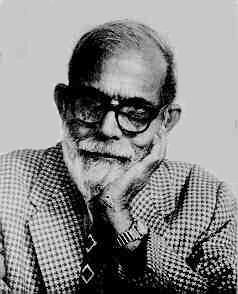
Words of Dr Abraham Thomas Kovoor (1898 – 1978), rationalist

හැම තරාතිරමකම ලාංකිකයන් නොමඟ යැවීම මෙතරම් පහසු වී ඇත්තේ ඇයි? පොතේ උගතුන් මුලා කිරීම මින් පර නොවූ විරූ ලෙස අද පසහු වී ඇත්තේ ඇයි?

තාක්ෂණය ප්‍රචලිත වීම හරහා අද ඉන්ටර්නෙට් භාවිතය, ස්මාට්ෆෝන් භාවිතය පුළුල් වුවත්  ඒ නව මාධ්‍ය හරහා ද අපේ බොහෝ දෙනා තොරතුරු හා අදහස් හුවමාරු කර ගන්නේ කිසිදු විචාර බුද්ධියකින් තොරවයි.

අතේ තිබෙන ස්මාට්ෆෝන් එක තරම්වත් ස්මාට් නැති අය එමට හමු වනවා! තම තමන්ගේ මෝඩකම්වල ආදීනව ඔවුන්ටම විඳින්නට ඉඩ දී අප බලා සිටිමුද?

එහෙත් තනි පුද්ගලයන්ට එහා යන බිහිසුණු යථාර්ථයක් මෙහි තිබෙනවා. එනම් සමාජයක් ලෙස අයාලේ යැවීමට, රවටවා ගැනීමට සටකපට ඕනැම අයකුට හැකි වීමයි.

මිථ්‍යාව හා අවිචාරය විසින් වෙලා ගත් සමාජයක් දිගටම පවතිනු දැක්මට අවස්ථාවාදී දේශපාලකයන් හා තන්හාධික ව්‍යාපාරිකයන් යන දෙපිරිසම කැමතියි.

please-turn-off-your-brain-cells

කියන ඕනෑම ප්‍රලාපයක්, ගෙඩි පිටින් අදහන ජනතාවක් ගෝත්‍රවාදය, වැඩවසම්වාදය හා ජාතිකවාදය වැනි අන්තවාදී සංකල්ප වෙත හරවා ගැනීම ඉතා පහසුයි.

එක් පසෙකින් එවන් ජනතාවක් රවටා දේශපාලකයන් ඔවුන්ගේ ඡන්දය (හා අනාගතය) ඩැහැ ගන්නා අතර අනෙක් පසින් මෝඩ ජනතාව මුලා කර වංචනික වෙළඳෙ ප්‍රචාරණ හරහා ව්‍යාපාරිකයන් ඔවුන්ගේ මිළමුදල් හීන්සීරුවේ ලබා ගන්නවා. (සුදු වෙන්න, ස්මාට් වෙන්න, ඇඟ නොවෙහෙසා ෆිට් වෙන්න, කඩිනම් ප්‍රතිකර්ම කෙතරම් අද දවසේ මාධ්‍ය හරහා ප්‍රසිද්ධියේම අලෙවිකරණය කරනවාද?)

විද්‍යාත්මක සාක්ෂරතාවය අවශ්‍ය වන්නේ මේ සැමගෙන් බේරී, අපේ ඡන්දය, මිළ මුදල්, පණ කෙන්ද හා ආත්ම ගරුත්වය රැක ගැනීමටයි.

විද්‍යාත්මක  සාක්ෂරතාවය අනවශ්‍ය ලෙස සංකීර්ණ කර ගත යුතු නැහැ. එයට තුඩු දෙන ඔවදන් අපේ ජන විඥානයේම තිබෙනවා. ”කියන්නා කෙසේ කීවත් අසන්නා සිහි බුද්ධියෙන් ඇසිය යුතුයි’ යන්න එවැන්නක්.

විද්‍යාත්මක චින්තනය ප්‍රගුණ කර ගත්තෝ කිසිවක් එකවර පිළි ගන්නේ නැහැ. ප්‍රශ්න කරනවා. සාක්ෂි සොයනවා. භෞතික සිද්ධියක් නම් එය හොඳින් නිරීක්ෂණය කරනවා. අත්හදා බැලිය හැකි නම් එසේ කරනවා. හැම දෙයක්ම සංශයවාදීව (skeptically) විමර්ශනය කරනවා.

එසේ කොට යමක් තේරුම් ගෙන පිළිගත්තද නව දැනුමට හා නව විග්‍රහයන්ට ඔවුන් විවෘතයි. ඔවුන්ගේ මනස එක තැන පල් වෙන්නේ නෑ.

විද්‍යාත්මක සාක්ෂරතාව හෙවත් චින්තනයට පෙරදිග, බටහිර ක්‍රියා වෙනසක් නැහැ. පෙරදිගින් බිහි වූ බුදුදහම වැනි සාමයික චින්තන ක්‍රමවලත්, බටහිර තර්ක ශාස්ත්‍රඥයන්ගේ ඉගැන්වීම්වලත් අවධාරණය කරන්නේ ඕනෑම දෙයක් ඉතා හොඳින් විමර්ශනය කිරීමේ අවශ්‍යතාවයයි.

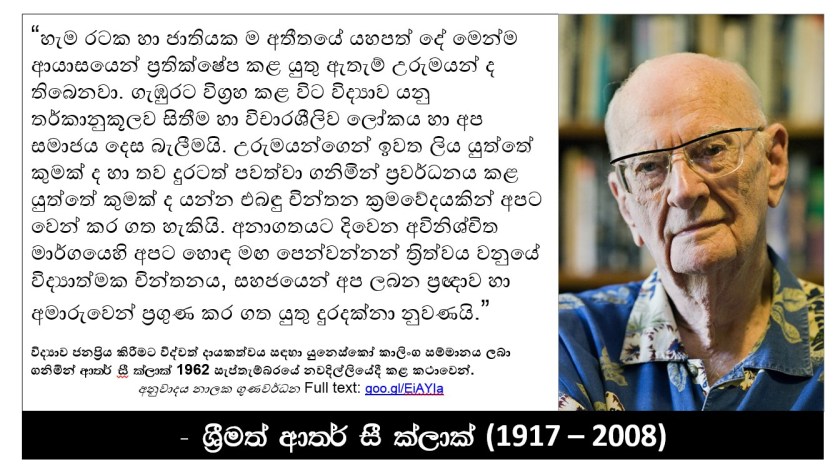
Arthur C Clarke quote on balancing traditions and modernity (Sinhala translation from UNESCO Kalinga Award acceptance speech, 1962)

ශ‍්‍රීමත් ආතර් සී. ක්ලාක් අඩ සියවසක් පුරා මෙරට වාසය කරමින් නිතර ලක් සමාජයට අවවාද කළේත් මෙයයි.

විද්‍යාව ජනප්‍රිය කිරීමට ලෝක මට්ටමින් කරන විද්වත් දායකත්වය සඳහා යුනෙස්කෝ පිරිනමන කාලිංග සම්මානය 1961දී හිමි වූයේ ක්ලාක්ටයි. එය ලබා ගනිමින් ඔහු 1962 සැප්තැම්බරයේ නවදිල්ලියේදී කළ කථාවේ අවසාන වැකි කිහිපය අඩසියවසක් ගත වී තවමත් අපට අදාල කර ගත හැකියි.

“තර්කානුකූලව හා සාක්ෂි මත පදනම් වූ චින්තනයක් පෙර අපර දෙදිග සියලු රටවලට අවශ්‍යයි. එය වඩාත් හදිසි අවශ්‍යතාවක් වන්නේ දියුණු වෙමින් පවතින රටවලයි. ආසියාවේ හා අප්‍රිකාවේ බොහෝ රටවල මිලියන් ගණනක් ජනයා භෞතික, මානසික හා ආධ්‍යාත්මික දරිද්‍රතාවයේ ඇද බැඳ තබන ප්‍රබල සාධක දෙකක් තිබෙනවා. එනම් අන්ධ භක්තිය හා මිථ්‍යා විශ්වාසයි.

 “විද්‍යාව එහි සාංස්කෘතිකමය හා තාක්ෂ‚ක යන මුහුණුවර දෙකෙන් ම මේ පසුගාමී සාධකවලට එරෙහි වනවා. ගතානුගතිකත්වයේ යදම් බිඳ දමා මුළු මහත් ජාතීන් වඩා යහපත් ජීවන තත්ත්වයන් වෙත කැඳවා ගෙන යන්නට විද්‍යාත්මක චින්තනය මඟ පෙන්වනවා.

 “විවෘත මනසින් යුතුව හා විචාරශීලිව හැම දෙයක් ම ප්‍රශ්න කිරීම විද්‍යාවේ ක්‍රමවේදයයි. ඉන්ද්‍රිය ගෝචර ප්‍රත්‍යක්ෂ හරහා මතු වන දේ අපේ එල්බ ගත් විශ්වාසවලට පටහැනි වන විට දී පවා එය පිළිගැනීම විද්‍යාවේ විනයයි.

 “එහෙත් අන්තවාදියාගේ ආදර්ශ පාඨය වන්නේ කරුණු හා තර්ක ඉදිරිපත් කරන්නට එපා – මගේ තීරණය අවසාන විනිශ්චයයියන්නයි. එබඳු අධිපතිවාදයක් විද්‍යාවේ නැති නිසා අන්තවාදීන්ට විද්‍යාවේ තැනක් ද නැහැ.

 “මිථ්‍යා විශ්වාස හා ඇදහිලි ඕනෑ තරම් පෙරදිග රටවල හමු වනවා. සමහරක් ඒවා අහිංසක නොමඟ යාම් වූවත් ඇතැම් ඒවා පුද්ගලයන්ට හා ජන සමාජයන්ට ඉතා අහිතකරයි…හැම රටක හා ජාතියක ම අතීතයේ ආයාසයෙන් ප්‍රතිකේෂප කළ යුතු ඇතැම් උරුමයන් ද තිබෙනවා.

 “ගැඹුරට විග්‍රහ කළ විට විද්‍යාව යනු තර්කානුකූලව සිතීම හා විචාරශීලිව ලෝකය හා සමාජය දෙස බැලීමයි. අප ඉවත ලිය යුත්තේ කුමක් ද හා තව දුරටත් පවත්වා ගනිමින් ප්‍රවර්ධනය කළ යුත්තේ කුමක් ද යන්න එබඳු චින්තන ක්‍රමවේදයකින් අපට වෙන් කර ගත හැකියි. අනාගතයට දිවෙන අවිනිශ්චිත මාර්ගයෙහි අපට හොඳම මඟ පෙන්වන්නන් ත්‍රිත්වය වනුයේ විද්‍යාත්මක චින්තනය, සහජයෙන් අප ලබන ප්‍රඥාව හා අමාරුවෙන් ප්‍රගුණ කර ගත යුතු දුරදක්නා නුවණයි.”

ශ්‍රී ලංකාවේ විද්‍යාත්මක  සාක්ෂරතාවය ප්‍රවර්ධනය කිරීමේ වගකීම විධිමත් අවධ්‍යාපන ක්ෂේත්‍රයට (පාසල් හා සරසවි) සීමා කළ නොහැකියි. ඒ සඳහා සිවිල් සමාජ පෙළගැස්මක්, මාධ්‍ය ප්‍රබුද්ධයන්ගේ දායකත්වයක් හා වෘත්තිකයන්ගේ සහභාගිත්වයක් අවශ්‍යයි.

පරම්පරාවකට පෙර ජාතික ප්‍රතිශක්තිකරණ වැඩසටහන සමාජගත කරන්නට කලාකරුවන්ල විද්වතුන් හා වෙනත් බොහෝ අය හවුල් වුණා. බුද්ධි ප්‍රතිශක්තිකරණයටත් එවන් ප්‍රයත්නයක් ඕනෑ!

Read also: සිවුමංසල කොලූගැටයා #96: ආතර් සී. ක්ලාක් නැවත කියවමු!

Changing Climate and Changing Minds: Challenges of Communicating Climate Change

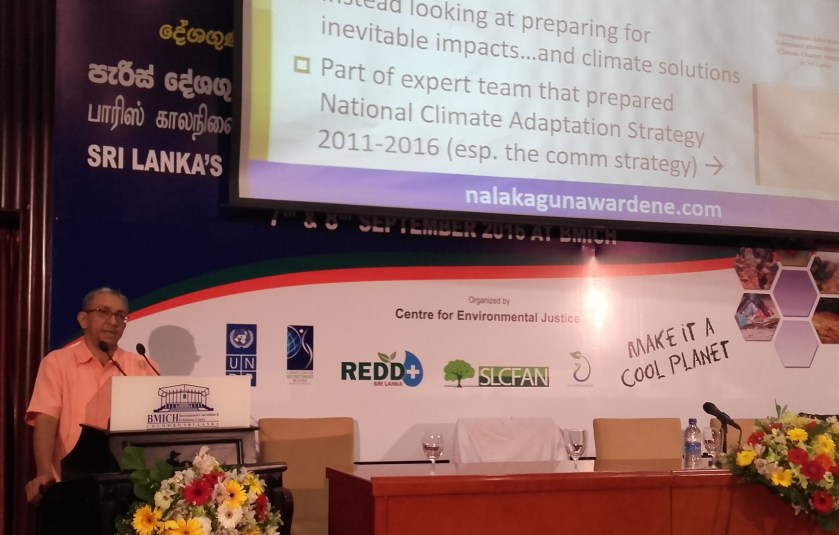
Nalaka Gunawardene speaks at national conference on Sri Lanka's readiness for implementing the Paris Agreement. BMICH Colombo, 8 September 2016
Nalaka Gunawardene speaks at national conference on Sri Lanka’s readiness for implementing the Paris Agreement. BMICH Colombo, 8 September 2016

Climate change COP21 in December 2015 adopted the Paris Agreement to avoid, mitigate and adapt to climate change. Among many other solutions, Sri Lanka’s “intended nationally determined contribution” (INDC) has agreed to reduce 7% emissions from energy and transport and 23% conditional reductions by 2030.

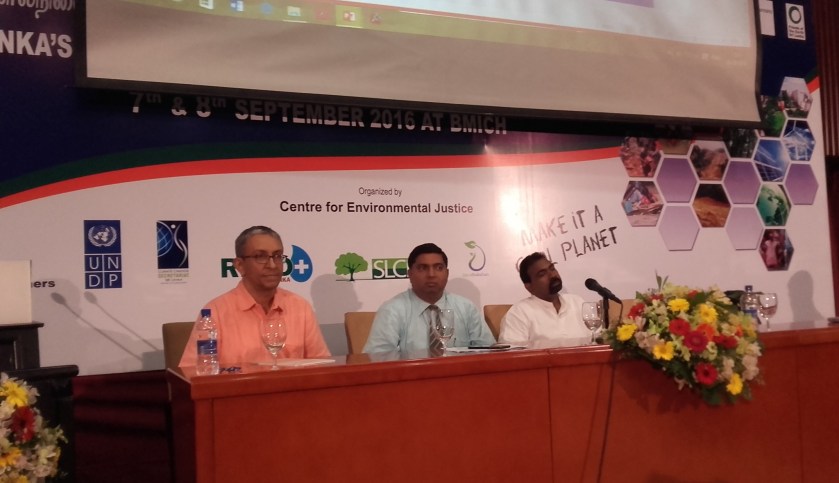
Sri Lanka’s Centre for Environmental Justice in collaboration with the government’s Climate Change Secretariat, UNDP and Janathakshan held a national conference on “SRI LANKA’S READINESS FOR IMPLEMENTING PARIS CLIMATE AGREEMENT” on 7 and 8 September 2016 in Colombo. It was attended by over 200 representatives from government, civil society and corporate sectors.

I was asked to speak in Session 5: Climate Solutions, on “Climate communication and Behaviour changes”. This is a summary of what I said, and the PowerPoint presentation used.

L to R: Nalaka Gunawardene; Nalin Munasinghe, National Programme Manager at Sri Lanka UN-REDD Programme, and Uchita de Zoysa

As climate change impacts are felt more widely, the imperative for action is greater than ever. Telling the climate story in accurate and accessible ways should be an essential part of our climate response.

That response is currently organised around two ‘planks’: mitigation and adaptation. Climate communication can be the ‘third plank’ that strengthens the first two.

Encouragingly, more journalists, broadcasters, researchers and advocacy groups are taking up this challenge. They urgently need more media and public spaces — as well as greater resources — to sustain public engagement.

Sri Lanka’s Information, Education and Communication (IEC) Strategy for Climate Change Adaptation, which I was principally involved in preparing in 2010-11, has recognized how “IEC action can lead to better informed decisions and enlightened choices in both climate change mitigation and adaptation”.

The United Nations Framework Convention on Climate Change (UNFCCC), which Sri Lanka has signed and ratified, recognizes the importance of IEC. It calls for “improving awareness and understanding of climate change, and creating solutions to facilitate access to information on a changing climate” to winning public support for climate related policies.

The UNFCCC, through its Article 6, and its Kyoto Protocol, through its Article 10 (e), call on governments “to educate, empower and engage all stakeholders and major groups on policies relating to climate change”.

When strategically carried out, IEC can be a powerful force for change on both the ‘supply’ and ‘demand’ sides of climate adaptation and climate related public information. In this analogy:

  • ‘supply’ involves providing authentic, relevant and timely information to all those who need it, in languages and formats they can readily use; and
  • ‘demand’ means inspiring more individuals and entities to look for specific knowledge and skills that can help make themselves more climate resilient.

These two sides of the equation can positively reinforce each other, contributing significantly to Sri Lanka’s fight against climate change.

To be effective, climate communication also needs to strike a balance between alarmism and complacence. We have to place climate concerns within wider development and social justice debates. We must also localise and personalise as much as possible.

Dr M Sanjayan, vice president of development and communications strategy at Conservation International, a leading advocacy group, says environmentalists and scientists have failed to build sufficient urgency for action on climate change. He feels we need new communication approaches.

The Lankan-born science communicator wrote in 2013: “By focusing on strong narratives about peoples’ lives in the present rather than the future; by keeping stories local and action-oriented (solvable); and by harnessing the power of narrative and emotion, we have a better chance to build widespread public support for solutions.”

[Op-ed] Scientific Literacy: ‘Mind Vaccine’ Sri Lanka Urgently Needs

This op-ed essay was published in Daily FT newspaper, Sri Lanka, on 7 September 2016.

Scientific Literacy: ‘Mind Vaccine’ Sri Lanka Urgently Needs

By Nalaka Gunawardene


STS Forum Sri Lanka
STS Forum Sri Lanka

Sri Lanka’s first Science and Technology for Society (STS) Forum will take place from 7 to 10 September in Colombo. Organized by the Prime Minister’s Office and the Ministry of Science, Technology and Research, it is one of the largest gatherings of its kind to be hosted by Sri Lanka.

Modelled on Japan’s well known annual STS forums, this event will be attended by over 750 participants coming from 24 countries – among them will be local and foreign scientists, inventors, science managers, science communicators and students.

untitled-614What sets STS Forums apart is that they are not merely events where scientists talk to each other.  That surely will happen, but there will be many more voices and, hopefully, much broader conversations.

As a member of the content planning team for this event, my particular focus has been on the strand called “citizen science” – interpreted, in this instance, as activities that enhance the public understanding of science and technology.

Under this strand, there will be four sessions that explore: community involvement in science and research; informal science education for the 21st century; communicating science, technology and innovation; and using social media for discussing science.

At first glance, these topics don’t seem as exciting as nanotechnology, robotics and space technology that are being covered in other sessions. But I would argue that public engagement is the most decisive factor if science and technology are to play a significant role in the economic development and future prosperity of Sri Lanka.

Wanted: Mind Vaccines!

Public engagement of science goes well beyond teaching science and technology subjects in schools or universities. It is also bigger than (state or private sector driven) science centres, exhibitions or science content in the media. All these elements help, but at its most basic, what we need to promote is a way of thinking known as scientific literacy.

Scientific literacy is defined as “the knowledge and understanding of scientific concepts and processes required for personal decision making, participation in civic and cultural affairs, and economic productivity”.

Indeed, some basic scientific knowledge and technical skills have become essential for survival in the 21st century. But scientific literacy provides more than just utility benefits.

As Dr Neil deGrasse Tyson, American astrophysicist, cosmologist and science communicator, says, “Scientific literacy is an intellectual vaccine against the claims of charlatans who would exploit ignorance.”

Dr Neil deGrasse Tyson: One man worth cloning if that were feasible...
Dr Neil deGrasse Tyson: One man worth cloning if that were feasible…

Sri Lanka takes justified pride in its high literacy levels and equally high coverage of vaccination against infectious diseases. But we cannot claim to have a high level of scientific literacy.

If we did, it would not be so easy for far-fetched conspiracy theories to spread rapidly even among educated persons. For example, claims of an ‘infertility plot’ to make majority ethnic group lose its ability to reproduce. Or tales of miracle waters and ‘cosmic forces’ healing those terminally ill. Or alien spacecraft (allegedly) threatening national security…

It is customary to temporarily suspend our disbelief to enjoy films, novels and other creative art forms. But most of us don’t confuse fiction with fact, even with highly plausible scenarios.

Yet when it comes to real life, as opposed to art, has ‘suspended disbelief’ become a permanent, default setting for many Lankans today? Is our society more gullible and paranoid now than it was a generation or two ago? If so, how come?

These inconvenient questions are worth asking, if only to make us pause and think.

Sleepwalking Nation?

Dr Abraham Thomas Kovoor (1898 – 1978): Myth-buster who feared none

Half a century ago, a Kerala-born science teacher named Dr Abraham Thomas Kovoor (1898 – 1978) settled down in newly independent Ceylon. After retirement, he took to investigating so-called supernatural phenomena and paranormal practices. He found adequate physical or psychological explanations for almost all of them. In that process, he exposed many ‘god men’ who were thriving on people’s ignorance, gullibility and insecurities.

Dr Kovoor, who founded Ceylon Rationalist Association in 1960, summed it up in these words: “He who does not allow his miracles to be investigated is a crook; he who does not have the courage to investigate a miracle is gullible; and he who is prepared to believe without verification is a fool.”

Most Lankans would fall into one of these three categories – and the minority with open minds are under ‘peer pressure’ to assimilate!

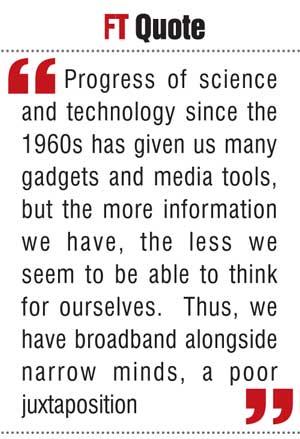
Progress of science and technology since the 1960s has given us many gadgets and media tools, but the more information we have, the less we seem to be able to think for ourselves.  Thus, we have broadband alongside narrow minds, a poor juxtaposition!

This has been building up for some years. In an op-ed titled ‘Can Rationalists Awaken the Sleep-walking Lankan Nation?’ published in Groundviews.org in January 2012, I wrote: “Paradoxically, we now have far more communication channels and technologies yet decidedly fewer opportunities and platforms for dispassionate public debate. Today’s Lankan society welcomes and blindly follows Malayalis who claim to know more about our personal pasts and futures than we’d ever know ourselves. And when we see how our political and business elite patronize Sai Baba, Sri Chinmoy and other gurus so uncritically, we must wonder if there is any intelligent life in Colombo…”

Not every source of mass hallucination is imported, of course. As I noted four years ago, “Sacred cows, it seems, have multiplied faster than humans in the past half century. Our cacophonous airwaves and multi-colour Sunday newspapers are bustling with an embarrassment of choice for salvation, wealth, matrimony, retribution and various other ‘quick fixes’ for this life and (imagined) next ones. Embarrassment, indeed!”

Science for All

So what is to be done?

The proliferation of smartphones and other digital tools have not necessarily opened our minds, or made us Lankans any less gullible to charlatans or zealots. This is a huge conundrum of our times.

stiThat is because mastery over gadgets does not necessarily give us scientific literacy. It involves a rational thought process that entails questioning, observing physical reality, testing, hypothesizing, analyzing and then discussing (not always in that order).
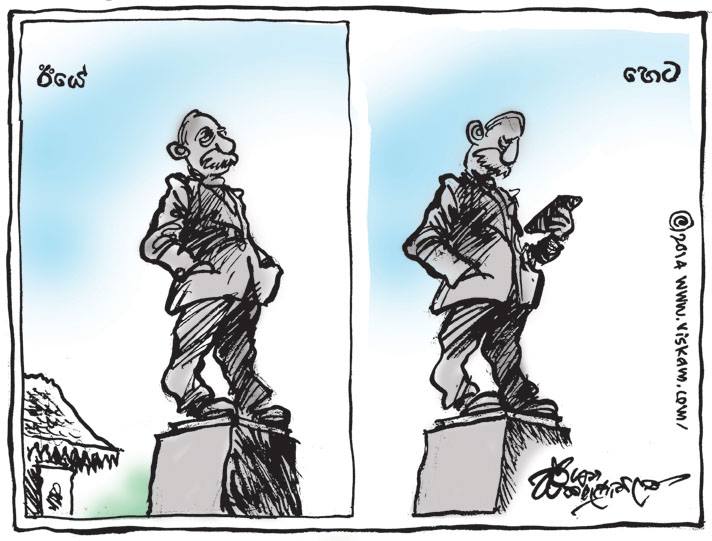
A healthy dose of scepticism is essential to safeguard ourselves from superstitions, political claims and increasingly sophisticated – but often dishonest – product advertising. That’s what scientific literacy builds inside our minds.

Unless we make scientific literacy an integral part of everyone’s lives, ambitious state policies and programmes to modernize the nation could well be jeopardized. Progress can be undermined — or even reversed — by extremist forces of tribalism, feudalism and ultra-nationalism that thrive in a society that lacks the ability to think critically.

A sporting analogy can illustrate what is needed. Cricket is undisputedly our national passion. It is played professionally only by a handful of men (and even fewer women) who make up the national teams and pools. But most of the 21 million Lankans know enough about cricket to follow and appreciate this very English game.

Similarly, there are only a few thousand Lankans engaged in researching or teaching different branches of science and technology – they are the ‘professionals’ who do it for a living. But in today’s world, the rest of society also needs to know at least the basic concepts of science.

Cricket didn’t has become part of our socio-cultural landscape overnight. It took years of innovation and persistence, especially by trail-blazing radio cricket commentators in Sinhala and Tamil. By the time we achieved Test status in 1981, all levels of our society were familiar with cricket’s rules and nuances.

Giving everyone a minimum dose of scientific literacy requires a similar marshalling of forces – including civil society mobilization, media collaboration, creative innovation and social marketing.

‘Science for All’ acquires true meaning only when every citizen – irrespective of education, profession or income level – gets enough skepticism to avoid being exploited by various scams or misled by conspiracy theorists.

Are we ready to embark on this intellectual vaccination process?

Award-winning science writer Nalaka Gunawardene counts over 25 years of national and international media experience. He blogs at https://nalakagunawardene.com and is active on Twitter as @NalakaG

Right to Information (RTI): Sri Lanka can learn much from South Asian Experiences

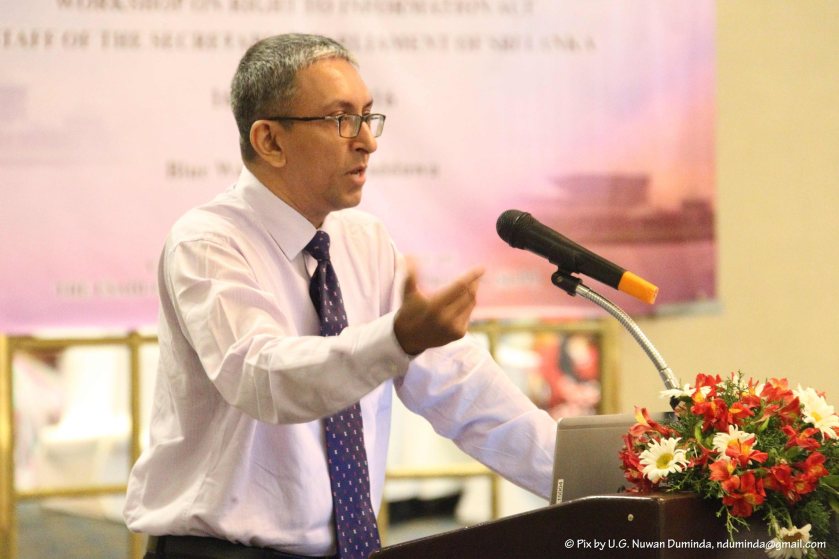
Nalaka Gunawardene speaks at RTI Seminar for Sri Lanka Parliament staff, 16 Aug 2016


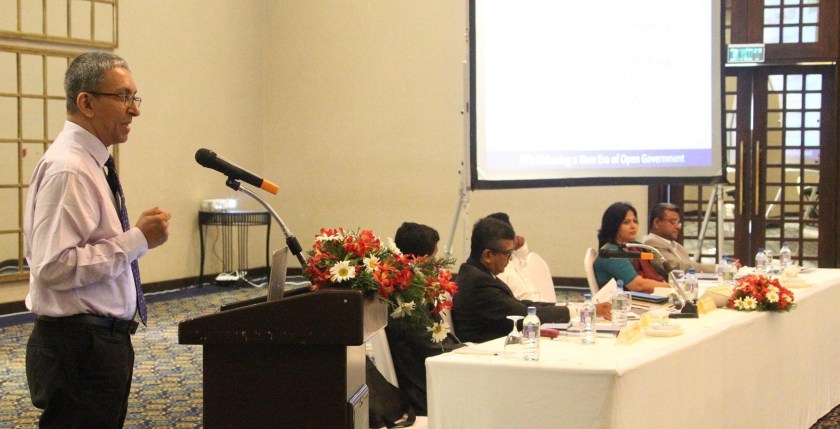
On 16 August 2016, I was invited to speak to the entire senior staff of the Parliament of Sri Lanka on Right to Information (RTI) – South Asian experiences.

Sri Lanka’s Parliament passed the Right to Information (RTI) law on 24 June 2016. Over 15 years in the making, the RTI law represents a potential transformation across the whole government by opening up hitherto closed public information (with certain clearly specified exceptions related to national security, trade secrets, privacy and intellectual property, etc.).

This presentation introduces the concept of citizens’ right to demand and access public information held by the government, and traces the evolution of the concept from historical time. In fact, Indian Emperor Ashoka (who reigned from c. 268 to 232 Before Christ) was the first to grant his subjects the Right to Information, according to Indian RTI activist Venkatesh Nayak, Coordinator, Commonwealth Human Rights Initiative (CHRI). Ashoka had inscribed on rocks all over the Indian subcontinent his government’s policies, development programmes and his ideas on various social, economic and political issues — including how religious co-existence.

Nalaka Gunawardene speaks at RTI Seminar for Parliament staff, Sri Lanka - 16 Aug 2016
Nalaka Gunawardene speaks at RTI Seminar for Parliament staff, Sri Lanka – 16 Aug 2016

Therefore, adopting an RTI law signifies upholding a great Ashokan tradition in Sri Lanka. The presentation looks at RTI good practices and implementation experiences in India, Nepal, Bangladesh, Pakistan and Maldives – all these South Asian countries passed an RTI law before Sri Lanka, and there is much that Sri Lanka can learn from them.

The presentation ends acknowledging the big challenges in implementing RTI in Sri Lanka – reorienting the entire public sector to change its mindset and practices to promote a culture of information sharing and transparent government.


[Echelon column] Balancing Broadband and Narrow Minds

This column originally appeared in Echelon business magazine, March 2014 issue. It is being republished here (without change) as part of a process to archive all my recent writing in one place – on this blog.

Image courtesy Echelon magazine

Balancing Broadband and Narrow Minds

By Nalaka Gunawardene

Are we cyber-stunted?

I posed this question some weeks ago at Sri Lanka Innovation Summit 2013 organised by Echelon and News 1st. We were talking about how to harness the web’s potential for spurring innovation.

We cannot innovate much as a society when our broadband is stymied by narrow minds. How many among the (at least) 3.5 million Lankans who regularly access the web have the right mindset for making the best use of the medium, I asked.

We didn’t get to discuss it much there, but this bothers me. Sri Lanka has now had 19 years of commercial Internet connectivity (the first ISP, Lanka Internet Services, started in April 1995). That’s a long time online: we have gone past toddler years and childhood (remember dial-up, anyone?) and been through turbulent ‘teen years’ as well.

Technology and regulation have moved on, imperfect though the latter maybe. But psychologically, as a nation we have yet to find our comfort level with the not-so-new medium.

There are various indicators for this. Consider, for example, the widespread societal apprehensions about social media, frequent web-bashing by editorialists in the mainstream media, and the apparent lack of public trust in e-commerce services. These and other trends are worth further study by social scientists and anthropologists.

Another barometer of cyber maturity is how we engage each other online, i.e. the tone of comments and interactions. This phenomenon is increasingly common on news and commentary websites; it forms the very basis of social media.

Agree to disagree?

‘Facts are sacred, comment is free’ is a cherished tenet in journalism and public debates. But expressing unfashionable opinions or questioning the status quo in Lankan cyber discussions can attract unpleasant reactions. Agreeing to disagree rarely seems an option.

Over the years, I have had my share of online engagement – some rewarding, others neutral and a few decidedly depressing. These have come mostly at the multi-author opinion platforms where I contribute, but sometimes also through my own blogs and twitterfeed.

One trend seems clear. In many discussions, the ‘singer’ is probed more than the ‘song’. I have been called unkind names, my credentials and patriotism questioned, my publishers’ bona fides doubted, and my (usually moderate) positions attributed to personality disorders or genetic defects! There have been a few threats too (“You just wait – we’ll deal with traitors soon!”).

I know those who comment on mainstream political issues receive far more invective. Most of this is done under the cover of anonymity or pseudonymity. These useful web facilities – which protect those criticising the state or other powerful interests – are widely abused in Lankan cyberspace to malign individuals expressing uncommon views.

There are some practical reasons, too, why our readers may misunderstand what we write, or take offence needlessly.

Poor English comprehension must account for a good share of web arguments. Many fail to grasp (or appreciate) subtlety, intentional rhetoric and certain metaphors. Increasingly, readers react to a few key words or phrases in longer piece — without absorbing its totality.

A recent example is my reflective essay ‘Who Really Killed Mel Gunasekera?’. I wrote it in early February shortly after a highly respected journalist friend was murdered in her suburban home by a burglar.

I argued that we were all responsible, collectively, for this and other rising incidents of violence. I saw it as the residual product of Lankan society’s brutalisation during war years, made worse by economic marginalisation. Rather than barricading ourselves and living in constant fear, we should tackle the root causes of this decay, I urged.

The plea resonated well beyond Mel’s many friends and admirers. But some readers were more than miffed. They (wrongly) reduced my 1,100 words to a mere comparison of crime statistics among nations.

I aim to write clearly, and also probe beyond headlines and statistics. But is such nuance a lost art when many online readers merely scan or speed-read what we labour on? In today’s fast-tracked world, can reflective writing draw discerning readers and thoughtful engagement any longer? I wonder.

Too serious

Then there is the humour factor – or the lack of it. Many among us don’t get textual satire, as Groundviews.org discovered with its sub-brand called Banyan News Reporters (BNR). Their mock news items and spoofs were frequently taken literally – and roundly condemned.

The web is a noisy place, but some stand out in that cacophony because of their one-tracked minds. They are those who perceive and react to everything through a pet topic or peeve. That ‘lens’ may be girls vs boys, or lions vs tigers, or capitalism vs socialism or something else. No matter what the topic, such people will always sing same old tune!

Tribal divisions are among the most entrenched positions, and questioning matters of faith assures a backlash. It seems impossible to discuss secularism in Sri Lanka without seemingly offending all competing brands of salvation! (The last time I tried, they were bickering among themselves long after I quietly left the platform…)

Oh sure, everybody is entitled to a bee or two in her bonnet. But what to do with those harbouring an entire bee colony — which they unleash at the slightest provocation?

I just let them be (well, most of the time). I used to get affected by online abuse from cloaked detractors but have learnt to take it with equanimity. This is what economist and public intellectual W A Wijewardena also recommends.

“You must treat commentators as your own teachers; some make even the most stupid comment in the eyes of an intelligent person, but that comment teaches us more than anything else,” he wrote in a recent Facebook discussion.

He added: “Individual wisdom and opinions are varied and one cannot expect the same type of intervention by all. I always respect even the most damaging comment made by some on what I have written!”

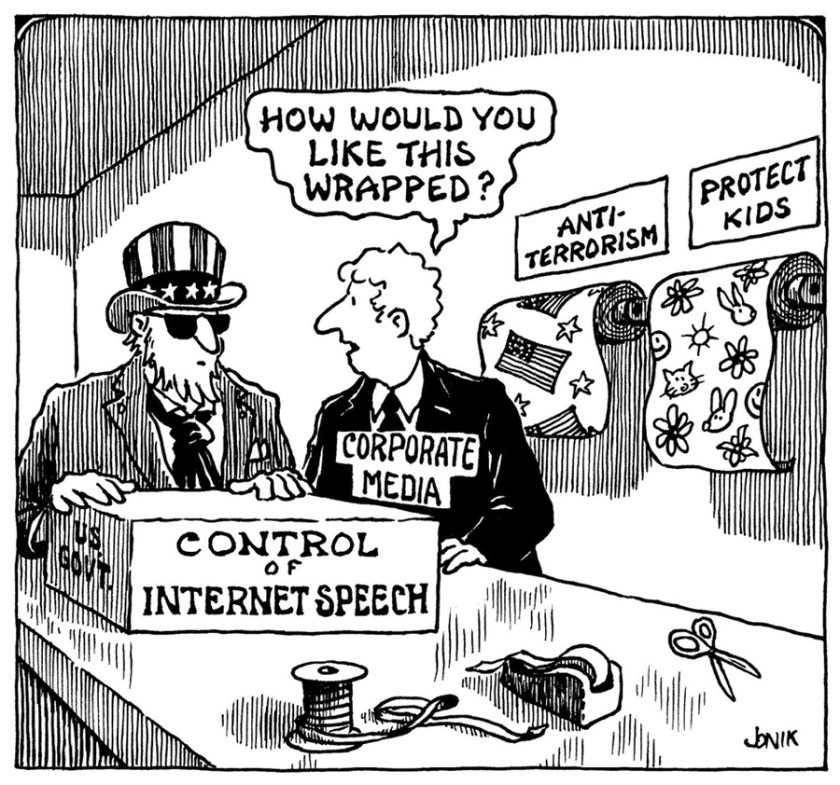
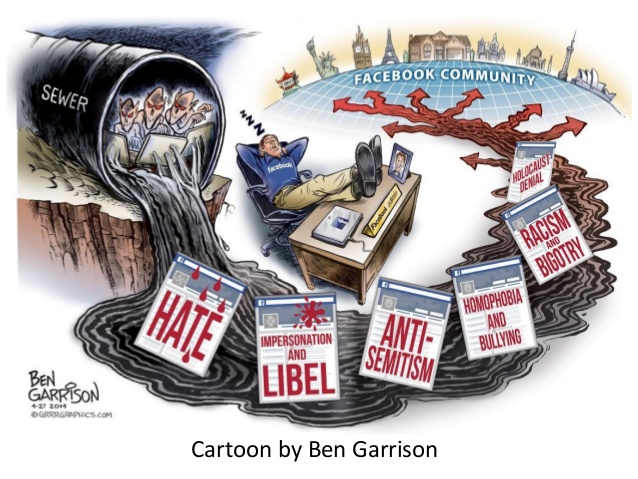
Moderating extreme comments is a thankless and challenging job for those operating opinion platforms. If they are too strict or cautious, they risk diluting worthwhile public debates for which space is shrinking in the mainstream media. At the same time, hate speech peddlers cannot be allowed free license in the name of free speech.

Where to draw the line? Each publisher must evolve own guidelines.

Groundviews.org, whose vision is to “enable civil, progressive and inclusive discussions on democracy, rights, governance and peace in Sri Lanka” encourages “a collegial, non-insulting tone” in all contributors. It also reminds readers that “comments containing hate speech, obscenity and personal attacks will not be approved.”

Colombo Telegraph, another popular opinion and reporting website, “offers a right to reply for any individual or organisation who feels they have been misreported”. Sadly, this courtesy is not available in many online news and commentary websites carrying Lankan content.

In the end, even the most discerning publishers and editors can do only so much. As more Lankans get online and cyber chatter increases, we have to evolve more tolerant and pluralistic ways of engagement.

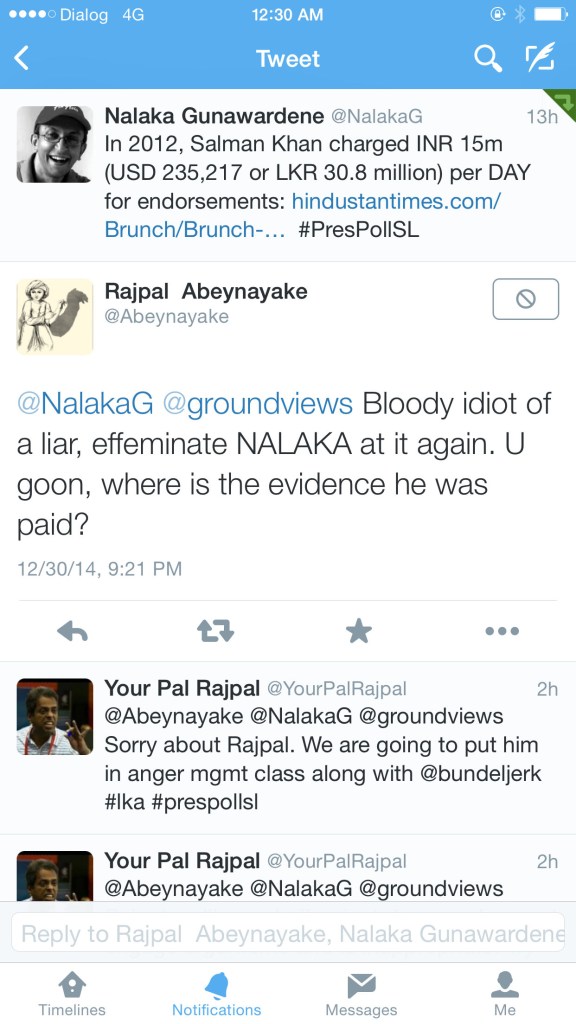
An example of cyber intolerance and name-calling: one of many...
An example of cyber intolerance and name-calling from December 2014, during the campaign for Sri Lanka’s Presidential Election (when Bollywood’s Salman Khan was brought to Sri Lanka to promote then incumbent Mahinda Rajapalksa’s election campaign)


සිවුමංසල කොලූගැටයා #276: අසාර්ථක වූ තුර්කි කුමන්ත්‍රණයෙන් මතු වන නවීන සන්නිවේදන පාඩම්

In this week’s Ravaya column (appearing in the print issue of 24 July 2016), I discuss the role of new communications technologies and social media during the coup d’état that was attempted in Turkey against the government on the night of on 15 July 2016.

The attempt was carried out by a faction within the Turkish Armed Forces that organized themselves under a council called the Peace at Home Council. Reasons for its failure have been widely discussed.

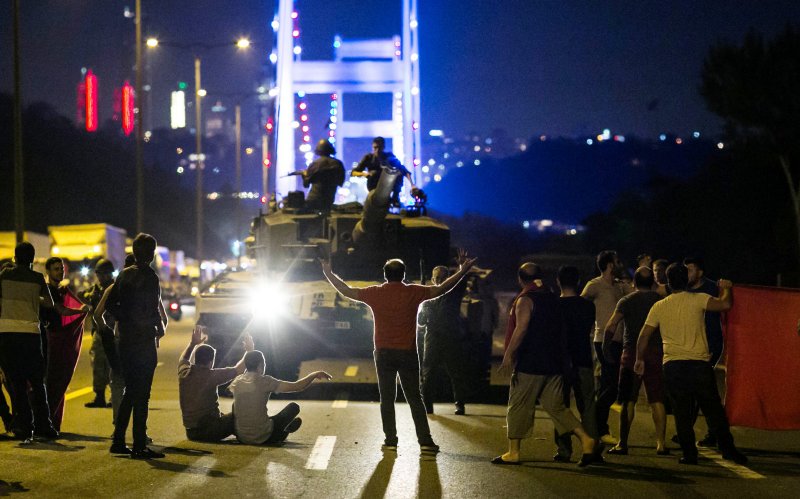
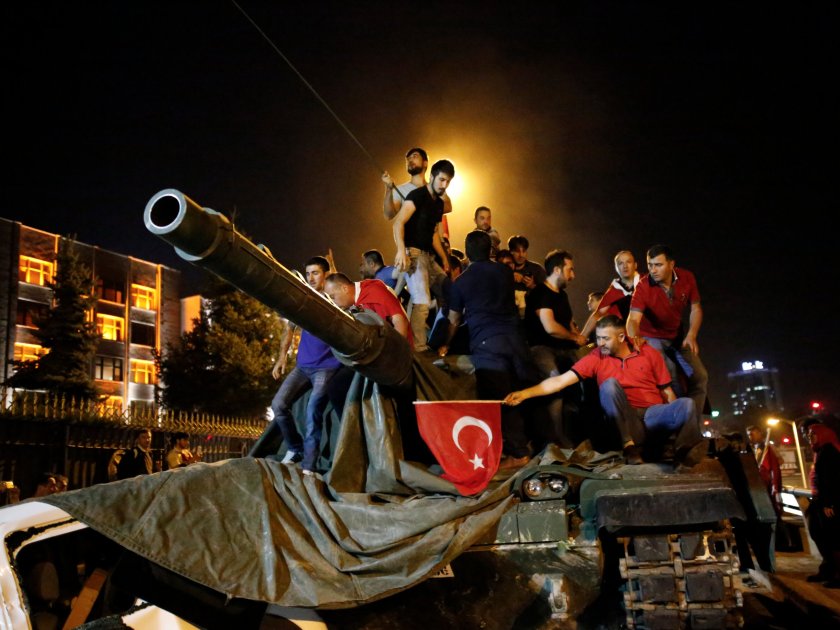
Citizen resistance to Turkey coup on 16 July 2016 - wire service photos
Citizen resistance to Turkey coup on 16 July 2016 – wire service photos

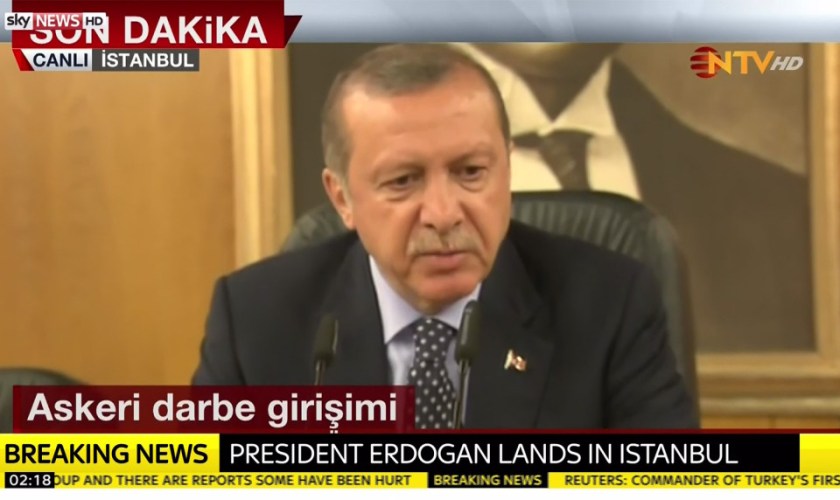
As Zeynep Tufekci, an assistant professor at the University of North Carolina School of Information and Library Science, described in a New York Times op-ed on 20 July 2016: “In the confusing hours after the coup attempt began, the country had heard from President Recep Tayyip Erdogan — and even learned that he was alive — when he called a television station via FaceTime, an easy-to-use video chat app. As the camera focused on the iPhone in the anchor’s hand, the president called on the people of Turkey to take to the streets and guard the airports. But this couldn’t happen by itself. People would need WhatsApp, Twitter and other tools on their phones to mobilize. The president also tweeted out the call to his more than eight million followers to resist the coup.”

She added: “The journalist Erhan Celik later tweeted that the public’s response had deterred potential coup supporters, especially within the military, from taking a side…Meanwhile, the immediacy of the president’s on-air appeal via FaceTime was an impetus for people to take to the streets. The video link protected the government from charges that it was using fraud or doctoring — both common in the Turkish news media — to assure the public that the president was safe. A phone call would not have worked the same way.”

I discuss the irony of a leader like Erdogan, who has been cracking down on independent media practitioners and social media users, had to rely on these very outlets in his crucial hour of need.

I echo the views of Zeynep Tufekci for not just Turkey but other countries where autocratic rulers are trying to censor the web and control the media: “The role of internet and press freedoms in defeating the coup presents a significant opportunity. Rather than further polarization and painting of all dissent as illegitimate, the government should embrace real reforms and reverse its censorship policies.”

See also: How the Internet Saved Turkey’s Internet-Hating President

Photo from The Daily Beast

කුමන හෝ හේතුවක් නිසා රටක දේශපාලන බලය බලහත්කාරයෙන් අත්කර ගැනීමට එරට හමුදාවට නීතිමය හෝ සදාචාරාත්මක අයිතියක් නැහැ.

එහෙත් විටින් විට ලෝකයේ විවිධ රටවල හමුදා කුමන්ත්‍රණ සිදුවනවා. දකුණු ආසියානු කලාපයේ බංග්ලාදේශය හා පාකිස්ථානය මේ අමිහිරි අත්දැකීම් රැසක් ලබා තිබෙනවා.

යුරෝපය හා ආසියාව හමු වන තැන පිහිටි තුර්කියේ මීට දින කීපයකට පෙර අසාර්ථක වූ හමුදා කුමන්ත්‍රණයට මා අවධානය යොමු කළේ නවීන සන්නිවේදන තාක්ෂණයන් එහි වැදගත් භූමිකාවක් ඉටු කළ නිසායි.

නව මාධ්‍යයන් හරහා කුමන්ත්‍රණයට එරෙහිව මහජනයා පෙළ ගැස්වීමට එරට නායකයා සමත් වුණා. විශාල අවි හා සෙබල බල පරාක්‍රමයක් සතු හමුදාවක් ජන බලය හා සන්නිවේදන හැකියාව හරහා ආපසු බැරැක්කවලට යැවීමට හැකි වීම විමසා බැලිය යුතු සංසිද්ධියක්.

කුමන්ත්‍රණය මාස ගණනක් සිට සූක්ෂ්ම ලෙසින් සැලසුම් කරන ලද බව හෙළි වී තිබෙනවා. රටට සාමය සඳහා සභාව (Peace at Home Council) ලෙසින් සංවිධානය වූ තුර්කි හමුදාවේ කොටසක් තමයි මේ උත්සාහයේ යෙදුණේ.

එහි අක්මුල් තවමත් හරිහැටි පැහැදිලි නැහැ. එහෙත් 2016 ජූලි 15-16 දෙදින තුළ ඔවුන් රටේ බලය අල්ලා ගන්නට ප්‍රචණ්ඩව තැත් කළා.

තුර්කි ජනාධිපති රෙචෙප් ටයිප් අර්ඩොගන් (Recep Tayyip Erdoğan) කෙටි නිවාඩුවකට අගනුවරින් බැහැරව, මර්මාරිස් නම් පිටිසර නිවාඩු නිකේතනයේ සිිටියා. ජූලි 15-16 මධ්‍යම රාත්‍රියට ආසන්නව යුද්ධ ටැංකි එරට අගනුවර අන්කාරා, විශාලතම නගරය වන ඉස්තාන්බුල් හා තවත් ප්‍රධාන නගරවලට ඇතුළු වුණා. ප්‍රහාරක ගුවන් යානා පහළින් පියාසර කළා.

තම බලය පෙන්වීමට හමුදා කුමන්ත්‍රණකරුවෝ කිහිප පොළක ප්‍රහාර දියත් කළා. රටේ පාර්ලිමේන්තු මන්දිරයට හා ජනාධිපති මැදුරට හානි සිදු කෙරුණා.

කුමන්ත්‍රණකරුවන්ගේ එක් ඉලක්කයක් වූයේ ජනාධිපතිවරයා අත්අඩංගුවට ගැනීම හෝ මරා දැමීමයි. එහෙත් කුමන්ත්‍රණය ගැන දැන ගත් වහාම ඔහුගේ ආරක්ෂක පිරිස ඔහු නැවතී සිටි නිවාඩු නිකේතනයෙන් රහසිගත තැනකට ගෙන ගියා.

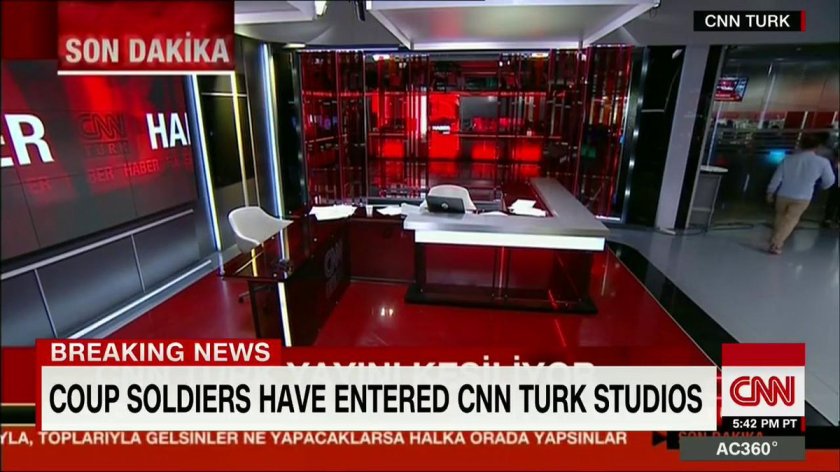
මැදියම් රැය පසු වූ විගස රාජ්‍ය රේඩියෝ හා ටෙලිවිෂන් (TRT) ආයතනයට ඇතුලු වූ හමුදා පිරිසක්, එහි සිටි නිවේදකයන්ට ප්‍රකාශයක් කියවන මෙන් බලකර සිටියා. ප්‍රජාතන්ත්‍රවාදය හා නිර්ආගමික පාලනය රටේ යළි ස්ථාපිත කිරීමට හමුදාව බලය පවරා ගන්නා බව එහි සඳහන් වුණා. තාවකාලිකව මාෂල් නීතිය ක්‍රියාත්මක කරන බවත්, නව ව්‍යවස්ථාවක් ළඟදීම හඳුන්වා දෙන බවත් හමුදා කුමන්ත්‍රණකරුවෝ රටට ප්‍රකාශ කළා.

The Turkish president spoke to local television with his office unwilling to confirm his location, simply saying he is safe

පාන්දර 3.10 වනවිට තමන් රටේ සමස්ත පාලන බලය සියතට ගෙන ඇති බව කුමන්ත්‍රණකරුවන් ලොවට කීවත් එය එසේ වූයේ නැහැ. ජනාධිපති අර්ඩොගන් හා අගමැති බිනාලි යිල්දිරිම් (Binali Yıldırım) ඒ තීරණාත්මක අලුයම පැය කිහිපයේ තීක්ෂණ ලෙසින් සිය ප්‍රතිරෝධය දියත් කළා.

හමුදා කුමන්ත්‍රණකරුවන් දේශපාලනික හා සම්ප්‍රදායික රාජ්‍ය මාධ්‍ය මර්මස්ථාන මුලින් ඉලක්ක කළ නමුත් නව සන්නිවේදන තාක්ෂණයන් හා නව මාධ්‍ය ගැන අවධානයක් යොමු කළේ නැහැ. පළපුරුදු හා සටකපට දේශපාලකයකු වන තුර්කි ජනාධිපතිවරයා මේ දුර්වලතාව සැනෙකින් වටහා ගත්තා.

තුර්කිය විශාල රටක්. ලෝක බැංකු දත්තවලට අනුව එරට මිලියන 80කට ආසන්න ජනගහනයෙන් බාගයකට වඩා (58%) ඉන්ටනෙට් භාවිත කරනවා. මෙයින් බහුතරයක් ස්මාට්ෆෝන් හිමිකරුවන්. 2015 අග වනවිට එරට ජංගම දුරකථන සක්‍රීය ගිණුම් මිලියන 73ක් තිබුණා.

හමුදා කුමන්ත්‍රණය ගැන දැන ගත් වහාම ජනාධිපතිවරයා තමාට හිතවත් හමුදා ජ්‍යෙෂ්ඨ නිලධාරීන් ගැන තක්සේරු කරන අතරම සන්නිවේදන ජාල හරහා තුර්කි ජනයා වෙත ආයාචනා කිරීමට තීරණය කළා. මේ සඳහා අවශ්‍ය වූ ව්‍යාපාරික සබඳතා හා තාක්ෂණික දැනුම ඔහුගේ කාර්ය මණ්ඩලය සතුව තිබුණා.

සියල්ල පාන්දර යාමයේ සිදු වුණත් ඉක්මනින් ක්‍රියාත්මක වීමේ වැදගත්කම ජනාධිපතිගේ හිතවත් පිරිස දැන සිටියා.

කුමන්ත්‍රණකරුවන් පෞද්ගලික ටෙලිවිෂන් නාලිකා, ටෙලිකොම් සමාගම් හෝ සමාජ මාධ්‍ය ජාල සියතට ගැනීමට මුල් වටයේ කිසිදු උත්සාහයක් ගත්තේ නැහැ. මහජන ඡන්දයෙන් පත්වූ තම රජය රැක ගන්නට වීදි බසින්න යැයි ජනාධිපතිවරයා මේ මාධ්‍ය හරහා යළි යළිත් ඉල්ලා සිටියා.

මුලින්ම රටේ සියලුම ජංගම දුරකථන ග්‍රාහකයන් වෙත කෙටි පණ්වුඩයක් යවමින් ජනපති අර්ඩොගන් කීවේ හැකි සෑම අයුරකින්ම කුමන්ත්‍රණයට විරෝධය දක්වන්න කියායි.

NINTCHDBPICT000252431176

ඒ අනුව ඉස්ලාම් බහුතර (96.5%) එරටෙහි ආගමික ස්ථාන ලවුඩ්ස්පීකර් හරහා විශේෂ යාඥා විසුරු වන්නට පටන් ගත්තා. අවේලාව නොබලා බොහෝ ජනයා වීදි බැස්සා.

ප්‍රධාන නගරවල වීදිවලට පිරුණු ජනයා බහුතරයක් පාලක පක්ෂයේ අනුගාමිකයන් වුවද සියලු දෙනා එසේ වූයේ නැහැ. කොතරම් අඩුපාඩු හා අත්තනෝමතික හැසිරීම් තිබුණද බහුතර ඡන්දයකින් පත් වූ රජයක් පෙරළීමට හමුදාවට කිසිදු වරමක් හෝ අවසරයක් නැතැයි විශ්වාස කළ අයද එහි සිටියා.

තුර්කියේ හමුදාව යනු බලගතු ආයතනයක්ග එම හමුදාව රාජ්‍ය පාලනයට මැදිහත් වීමේ කූප්‍රකට ඉතිහාසයක් තිබෙනවා. 1960 මැයි මාසයේ, 1971 මාර්තුවේ හා 1980 සැප්තැම්බරයේ හමුදා කුමන්ත්‍රණ සාර්ථක වී මිලිටරි පාලන බිහි වුණා. 1995දී ඡන්දයෙන් පත් වූ හවුල් රජයට 1977දී හමුදාව ‘නිර්දේශ’ ගණනක් ඉදිරිපත් කොට ඒවා පිළි ගන්නට බලපෑම් කළා. මේ මෑත ඉතිහාසය ජනතාවට මතකයිග

තුර්කි රාජ්‍යය නිර්ආගමිකයි (secular state). එහෙත් මෑත කාලයේ ඉස්ලාමීය දේශපාලන පක්ෂ වඩාත් ජනප්‍රිය වීම හරහා රාජ්‍ය පාලනයේ ඉස්ලාමීය නැඹුරුවක් හට ගෙන තිබෙනවා.

හමුදාව මෙයට කැමති නැහැ. ව්‍යවස්ථාවෙන්ම ප්‍රකාශිත පරිදි රාජ්‍යය තව දුරටත්  නිර්ආගමික විය යුතු බවත්, ඉස්ලාම්වාදීන් බලගතු වීම සීමා කළ යුතු බවත් හමුදාවේ මතයයි. මෙය මතවාදී අරගලයකට සීමා නොවී දේශපාලන බල අරගලයකට තුඩු දී තිබෙනවා. 2016 කුමන්ත්‍රණයේ පසුබිම සංකීර්ණ වුවද ආගමික-නිර්ආගමික ගැටුමද එහි එක් වැදගත් සාධකයක්.

කුමන්ත්‍රණකරුවන් නිවාඩු නිකේතනයට පහර දීමට කලින් එතැනින් පලා ගිය ජනාධිපති අර්ඩොගන්, සැඟවී නොසිට  හිරු උදා වන විට එරට විශාලතම ජාත්‍යන්තර ගුවන් තොටුපළ වන ඉස්තාන්බූල් ගුවන් තොටුපළට සිය නිල ගුවන් යානයෙන් පැමිණියා. මැදියම් රැයේ ටික වේලාවකට කුමන්ත්‍රණකාරීන් අත්පත් කර ගත් ගුවන් තොටුපළ ඒ වන විට යළිත් හිතවත් හමුදා අතට පත්ව තිබුණා.

ගුවන් තොටුපළේ සිට මාධ්‍යවේදියකුගේ ස්මාට්ෆෝන් එකක් හරහා ජනාධිපතිවරයා එරට පෞද්ගලික ටෙලිවිෂන් නාලිකාවක් වූ CNN Turkට සජීව ලෙසින් සම්බන්ධ වුණා.

‘ප්‍රජාතන්ත්‍රවාදය රැක ගන්න නගරවල වීදි හා චතුරස්‍රවලට එක් රොක් වන්න. මේ කුමන්ත්‍රණකරුවන් අපට ඉක්මනින් ඉවත් කළ හැකි වේවි. ඔවුන්ට නිසි පිළිතුර දෙන්න ඕනෑ අපේ මහජනතාවයි’ ඔහු ආයාචනා කළා.

කුමන්ත්‍රණකරුවන් නොසිතූ විලසින් මේ පණිවුඩ ඉතා ඉක්මනින් එරට ජනයා අතර පැතිර ගියා. ෆේස්බුක්, ට්විටර් හා අනෙක් සමාජ මාධ්‍ය ජාල මෙයට මහත් සේ දායක වුණා.

මේ අතර ජනපති කාර්ය මණ්ඩලය සමාජ මාධ්‍ය යොදා ගනිමින් ජනපතිවරයා ආරක්ෂිත බවත්, ඔහු කුමන්ත්‍රණකරුවන්ට එරෙහිව කරන අරගලයට ඍජුව නායකත්වය දෙන බවත්, ජාත්‍යන්තර මාධ්‍යවලට හා විදෙස් රටවලට දැනුම් දුන්නා.

හමුදාව බලය ඇල්ලීමට තැත් කිරීම කෙතරම් තුර්කි වැසියන් කුපිත කළාද කිවහොත් සමහර ස්ථානවල යටත් වූ කුමන්ත්‍රණකාමී හමුදා සෙබලුන් හා නිලධාරීන්ට සාමාන්‍ය ජනයා වට කර ගෙන පහර දෙනු ලැබුවා. ඔවුන් ප්‍රසිද්ධ නිග්‍රහවලට ලක් වුණා.

CncnmhQXEAApKN0

යම් අවස්ථාවක කුමන්ත්‍රණකරුවන් CNN Turk පෞද්ගලික නාලිකාව නිහඬ කිරීමට ද තැත් කළා. ඇමරිකානු CNN මාධ්‍ය ජාලය හා තුර්කි සමාගමක් හවුලේ කරන මේ නාලිකාව හමුදා බලපෑම් ප්‍රතික්ෂේප කළා. දිගටම සිය සජීව විකාශයන් කර ගෙන ගියා.

කුමන්ත්‍රණය දියත් කොට පැය 24ක් ගතවීමට පෙර රටේ පාලන බලය යළිත් ඡන්දයෙන් පත් වූ රජය යටතට මුළුමනින්ම ගැනීමට ජනපති-අගමැති දෙපළ සමත් වුණා.

ඉන් පසුව කුමන්ත්‍රණයට සම්බන්ධ දහස් ගණනක් හමුදා නිලධාරීන් හා සිවිල් වැසියන් අත්අඩංගුවට ගනු ලැබුවා. මේ අය අධිකරණ ක්‍රියාදාමයකට ලක්වනු ඇති. මේ බොහෝ දෙනකු නොමඟ ගිය හමුදා නිලධාරීන් හා ඔවුන්ගේ හිතවත් පරිපාලන නිලධාරීන් බව පසුව හඳුනාගනු ලැබුවා.

කුමන්ත්‍රණය අසාර්ථක වීමට හේතු දේශපාලන විචාරකයෝ තවමත් සමීපව අධ්‍යයනය කරනවා. ඔවුන් පිළිගන්නා එක් දෙයක් තිබෙනවා. 20 වන සියවසේ බොහෝ අවස්ථාවල විවිධ රටවල සාර්ථක වූ බලය ඇල්ලීමේ ආකෘතියක් මෙවර තුර්කියේදී ව්‍යර්ථ වූයේ 21 වන සියවසේ සන්නිවේදන තාක්ෂණයන් නිසා බවයි.

‘කුමන්ත්‍රණකරුවන් පොතේ හැටියට සියල්ල සැලසුම් කොට ක්‍රියාත්මක වුණා. රාජ්‍ය නායකයා අගනුවරින් බැහැරව සිටි, සිකුරාදා රැයකයි ඔවුන් බලය අල්ලන්න තැත් කළේ. ඒත් ඔවුන්ගේ අවාසියට ඔවුන් භාවිත කළ වට්ටටෝරුව යල් පැන ගිහින්.’ යයි ඉස්තාන්බුල් නුවර පර්යේෂකයකු වන ගැරත් ජෙන්කින්ස් කියනවා.

මේ සමස්ත සිදුවීම් දාමයේ ඉතාම උත්ප්‍රාසජනක පැතිකඩ මෙයයි. සමාජ මාධ්‍ය ජාතික ආරක්ෂාවට තර්ජනයක් යයි කියමින් ඒවා හෙළි දැකීමට හා විටින් විට ඒවා බ්ලොක් කිරීමට පුරුදුව සිටි අර්ඩොගන් ජනපතිවරයාට තීරණාත්මක මොහොතේ ඒවා ඉමහත් ලෙස ප්‍රයෝජනවත් වීමයි.

මේක ඇත්තටම කන්නට ඕනෑ වූ විට කබරගොයාත් තලගොයා වීමේ කතාවක්.

A man stands in front of a Turkish army tank at Ataturk airport in Istanbul, Turkey July 16, 2016. REUTERS/IHLAS News Agency

2003-2014 කාලයේ තුර්කි අගමැතිව සිටි අර්ඩොගන් 2014දී ජනාධිපතිවරණයට ඉදිරිපත් වී ප්‍රකාශිත ඡන්දවලින් 51.79%ක් ලබමින් ජය ගත්තා. ඔහු තමා වටා විධායක බලය කේන්ද්‍ර කර ගනිමින්, විපක්ෂවලට හිරිහැර කරමින් ඒකාධිපති පාලනයක් ගෙන යන බවට චෝදනා නැගෙනවා. මාධ්‍ය නිදහසට හා පුරවැසියන්ට ප්‍රකාශන නිදහසටත් ඔහුගේ රජයෙන් නිතර බාධා පැමිණෙනවා.

නිල මාධ්‍ය වාරණයක් හා නොනිල මාධ්‍ය මර්දනයක් පවත්වා ගෙන යාම නිසා තුර්කිය ජාත්‍යන්තර ප්‍රජාවේ හා මාධ්‍ය නිදහස පිළිබඳ ක්‍රියාකාරිකයන්ගේ දැඩි දෝෂ දර්ශනයට ලක්ව සිටින රටක්.

තමන්ගේ අධිපතිවාදය ප්‍රශ්න කරන, විකල්ප මතවලට ඉඩ දෙන දෙස් විදෙස් මාධ්‍ය අර්ඩොගන් සලකන්නේ සතුරන් ලෙසයි. එහෙත් රාජ්‍ය මාධ්‍ය පැය කිහිපයකට ඔහුගේ පාලනයෙන් ගිලිහී ගිය විට ඔහුගේ උදව්වට ආවේ ඔහු නිතර දෙස් තබන පෞද්ගලික විද්‍යුත් මාධ්‍ය හා විදෙස් මාධ්‍යයි.

2014දී ඔහු නව නීතියක් හඳුන්වා දුන්නේ ඕනෑම මොහොතක වෙබ් අඩවි බ්ලොක් කිරීමේ බලය රජයට පවරා ගනිමින්.

එසේම අර්ඩොගන් දෙබිඩි පිළිවෙතක් අනුගමනය කරන්නෙක්. සමාජ මාධ්‍යවලට නිතර දෙවේලේ බැණ වදින ඔහු තමාගේ ට්විටර් හා ෆේස්බුක් ගිණුම් පවත්වා ගෙන යනවා. ට්විටර් නිල ගිණුමට මේ වන විට මිලියන 8කට වඩා අනුගාමිකයන් සිටිනවා. කුමන්ත්‍රණය දිග හැරෙන අතර සිය ජනයාට හා ලෝකයට කතා කරන්නට ඔහු ට්විටර් ගිණුමද යොදා ගත්තා.

මේ දෙබිඩි හැසිරීම අපේත් එක්තරා හිටපු පාලකයෙක් සිිහිපත් කරනවා!

කුමන්ත්‍රණයට එරෙහිව අර්ඩොගන් රජයට උපකාර වූ තවත් සාධකයක් පසුව හෙළි වුණා. කුමන්ත්‍රණය ඇරඹී ටික වේලාවකින් එරට ප්‍රධානම ජංගම දුරකථන ජාලය සියලුම ග්‍රාහකයන්ට නොමිලයේ දත්ත සම්ප්‍රේෂණ පහසුකම් ලබා දුන්නා. නූතන දේශපාලන ක්‍රියාකාරකම්වලදී ටෙලිවිෂන් හා රේඩියෝවලට වඩා ටෙලිකොම් සේවාවන් වැදගත් වන බව මේ හරහා අපට පෙනී යනවා.

කුමන්ත්‍රණයේ සන්නිවේදන සාධකය විග්‍රහ කරමින් නිව්යෝර්ක් ටයිම්ස් පත්‍රයට ජූලි 20 වනදා ලිපියක් ලියූ තුර්කි සම්භවය සහිත ඇමරිකානු සරසවි ඇදුරු සෙයිනප් ටුෆෙකි (Zeynep Tufekci) මෙසේ කියනවා.

‘කුමන්ත්‍රණය පරදවන්න ස්වාධීන මාධ්‍ය හා වෙබ්ගත නව මාධ්‍ය ලබා දුන් දායකත්වය ජනපති අර්ඩොගන් අගය කළ යුතුයි. දැන්වත් මාධ්‍ය වාරණය, මර්දනය හා නවමාධ්‍ය හෙළා දැකීම නතර කොට ප්‍රකාශන නිදහසට ගරු කරන දේශපාලන ප්‍රතිසංස්කරණවලට යොමු විය යුතුයි… ස්වාධීන මාධ්‍යයන් හා විවෘත ඉන්ටර්නෙට් සංස්කෘතියක් පැවතීම රටක ප්‍රජාතන්ත්‍රවාදයට මහත් සවියක් බව මේ අත්දැකීමෙන් අපට හොඳටම පෙනී යනවා.’

How the Internet Saved Turkey’s Internet-Hating President

People stand on a Turkish army tank in Ankara on July 16 - Reuters
People stand on a Turkish army tank in Ankara on July 16 – Reuters

සිවුමංසල කොලූගැටයා #275: විද්‍යුත් හැඳුනුම්පත (eNIC) ගැන විවෘත සංවාදයක් ඕනෑ!

In this week’s Ravaya column (appearing in the print issue of 17 July 2016), I discuss Sri Lanka govermment’s recently announced plans to introduce an electronic National Identity Card (e-NIC) replacing the current, mandatory NIC based on a system that was launched in 1971.

The Department of Registration of Persons (the ID card office) is to start collecting fingerprints to issue 16.5 million electronic identity cards (eNICs) in 2016 that will contain biometric security features such as fingerprints. According to media reports, fingerprints are to be collected manually at 331 district and divisional level units and scanned and entered into a national register.

But we should be asking some critical questions about this initiative that collects biometric data of all citizens. Is the government capable of ensuring data security of this massive database? Can it be misused for citizen surveillance in the hands of an authoritarian regime?

Deploying modern technology is fine, but that must be accompanied by adequate human rights safeguards and a political culture that treats citizen data with respect. And there needs to be judicial oversight.

What about a similar, but much larger scale, biometrics-driven ID project in neighbouring India? In recent years, India’s unique identification number project (Aadhaar) has been criticised by privacy activists for its inadequate safeguards. Considered to be the world’s largest national identification number project, it aims to collect biometric and demographic data of all residents, store them in a centralised database and issue a 12-digit unique number.

As SciDev.Net reported on 3 June 2016: “Aadhaar…received statutory backing in March 2016 after five years of political wrangling. Finally the present government moved it as a money bill to prevent it being stopped in the Rajya Sabha (upper house of parliament). Opposition leaders have challenged the move as unconstitutional in the Supreme Court.

“The court’s existing view on Aadhaar is that biometric identification should be voluntary. On 23 September 2013, the court ordered that ‘no person should suffer for not getting Aadhaar’.  Yet, since introduction, Aadhaar has been creeping up on India’s 1.3 billion population with service after service being made unavailable to citizens who are not enrolled.”

SciDev.Net added that the main objections to Aadhaar are no different from objections that have come up in other countries and they have to do with privacy. In the UK, plans to issue biometric national identity cards were dropped in January 2011 and there has been opposition enough in the US to slow down implementation of the ‘Real ID’ scheme.

See my English column in SciDev.Net 31 July 2015: Reality Checks on South Asia’s Digital Drive

See also: Analyis by Centre for Internet and Socoiety in Jan 2011: Analysing the Right to Privacy and Dignity with Respect to the UID

March 2016: Commissioner-General of Dept of Registratoion of Persons, R.M.S. Sarath Kumara, holds up an old NIC and one with computerised features which he says is the steppingstone to the eNIC Image source: http://www.sundaytimes.lk/140316/news/fingerprint-collection-to-begin-for-enics-89424.html
March 2016: Commissioner-General of Dept of Registratoion of Persons, R.M.S. Sarath Kumara, holds up an old NIC and one with computerised features which he says is the steppingstone to the eNIC
Image source: http://www.sundaytimes.lk/140316/news/fingerprint-collection-to-begin-for-enics-89424.html

යුද්ධය හමාර වී වසර හතක් ගියත්, හැම දේටම ජාතික හැඳුනුම්පත ඉල්ලා සිටීමේ පුරුද්ද රාජ්‍ය හා පෞද්ගලික දෙඅංශයේම ආයතනවල තවමත් දැකිය හැකියි.

එසේම අමුත්තන්ගේ හැඳුනුම්පත් අංක හා අන් තොරතුරු ලියමින් කෙතරම් පොත් ප්‍රමාණයක් මේ ආයතනවල පුරවනවාද? මේ හරහා කිසිවකුගේ ආරක්ෂාව වැඩි වනවාද?

මෙරට අඩ සියවසකට ආසන්න කාලයක් තිස්සේ හැඳුනුම්පත් භාවිත කැරෙනවා. පුද්ගලයන් ලියාපදිංචි කිරීමේ පනත 1968දී සම්මත කෙරුණත්, හැඳුනුම්පත් අනිවාර්ය වූයේ 1971 කැරැල්ලෙන් පසුවයි. මෑතදී වියෝ වූ ඩී. බී. නිහාල්සිංහ සූරීන්ගේ අධීක්ෂණය යටතේ රජයේ චිත්‍රපට අංශයේ චිත්‍ර ශිල්පී ජී. රත්නායක විසින් 1971දී කරන ලද රූප සැලසුම මේ වන තුරුත් යොදා ගන්නවා.

එහෙත් ළඟදීම මෙය වෙනස්වීමට නියමිතයි. වැඩි තොරතුරු ගබඩා කළ විද්‍යුත් හැඳුනුම්පතක් (e-NIC) නිකුත් කිරීමට රජය තීරණය කොට තිබෙනවා.

වසර කිහිපයක් තිස්සේ කතාබහ කෙරුණු මෙය රුපියල් බිලියන 8ක වියදමින් එළැඹෙන මාසවල ක්‍රියාත්මක වනු ඇතැයි පුද්ගලයන් ලියාපදිංචි කිරීමේ දෙපාර්තමේන්තුවේ කොමසාරිස් ජනරාල්වරයා මෑතදී මාධ්‍යවලට ප්‍රකාශ කර තිබුණා.

දැනට පවතින පුද්ගල තොරතුරුවලට (නම, ලිපිනය, උපන් දිනය ආදිය) අමතරව පවුලේ විස්තරත්, ජෛවමිතික දත්තත් (biometric data) අලුත් හැඳුනුම්පත්වල ගබඩා කැරෙන බවත්, එම අමතර හොරතුරු කියවිය හැක්කේ අවසරලත් ආයතනවල සුවිශේෂී යන්ත්‍රවලට පමණක් බවත් දෙපාර්තමේන්තුව කියනවා.

මාධ්‍ය වාර්තාවලට අනුව මේ නව ස්මාට් කාඩ්පතෙහි යම් තොරතුරු ප්‍රමාණයක් බැංකුවලට කියවීමට හැකි ලෙසත්, සම්පූර්ණ තොරතුරු රහසිගතව පවතින ලෙසත් විධිවිධාන යෙදෙනු ඇති. එම මුළු තොරතුරු කියවිය හැක්කේ අදාළ පුද්ගලයාගේ අනුමැතිය ඇතිව හෝ අධිකරණ නියෝගයක් මත හෝ පමණයි.

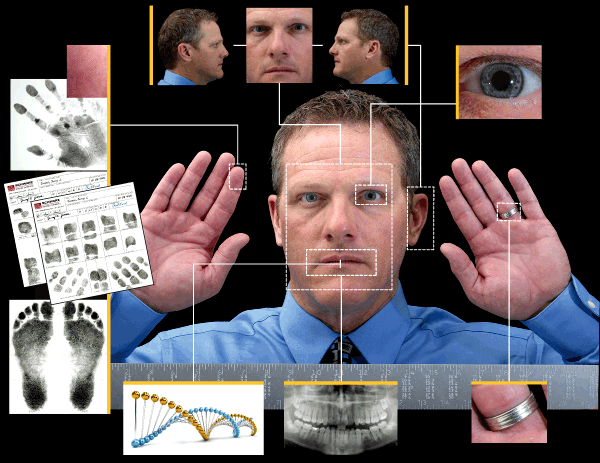
ජෛවමිතිය (biometrics) කියන්නේ මිනිස් සිරුරේ ලක්ෂණ හසු කර ගැනීමයි. ඇතැම් ලක්ෂණ මානවයන් දෙදෙනකුගේ එක සමාන වන්නේ නැහැ (පෙනුමෙන් සමාන නිවුන් දරුවන්ගේ වුවත්). මේ නිසා අනන්‍යතාව තහවුරු කර ගැනීමට ජෛවමිතිය යොදා ගත හැකියි.

වඩාත් ප්‍රකට ජෛවමිතික අනන්‍යතා සාධකය නම් ඇඟිලි සලකුණුයි. දැනට සියවසක් පමණ කාලයක් තිස්සේ අපරාධ විමර්ශනයට හා අත්සන් කිරීමට නොහැකි අයට විකල්පයක් ලෙසට ඇඟිලි සලකුණු යොදා ගන්නවා.

මෙයට අමතරව වඩා මෑත කාලයේ අනන්‍යතා සාධක ලෙස ඇසේ කළු ඉංගිරියාවේ හෙවත් තාරා මණ්ඩලයේ රටාව (iris pattern)” සමස්ත හස්තයේ මුද්‍රාව, ඇසේ දෘෂ්ටි විතානයේ (retina pattern) රටාවන්, මුහුුණු හඳුනාගැනීම (face recognition) හා රුධිරයේ DNA පරීක්ෂාවද යොදා ගන්නවා.

Modern biometric identification modes. Image source: http://www.schwarzforensic.com/bi.php?pageid=245
Modern biometric identification modes.
Image source: http://www.schwarzforensic.com/bi.php?pageid=245

දැනටමත් අලුත් පාස්පෝට්වලට ජෛවමිතික දත්ත ඇතුලු කරන අතර සමහර රටවලට යාමට වීසා නිකුත් කිරීමට පෙරද ඒවා වාර්තා කර ගන්නවා.

ජෛවමිතික දත්ත ලබා ගැනීම, ගබඩා කිරීම හා භාවිතය සීරුවෙන් කළ යුත්තක්. හේතුව මේ දත්ත හරහා අදාළ පුද්ගලයාගේ ජානමය හා සෞඛ්‍යමය පසුබිම අනාවරණය වීමයි.

එසේම අනවසරයෙන් ඇතැම් පුද්ගලයන්ව හොර රහසේ ආවේක්ෂණයට ලක් කිරීමටද මේ දත්ත යොදා ගත හැකියි.

මේ නිසා ජෛවමිතික දත්ත ලබා ගන්නා සෑම විටම එය පැහැදිලි නීතිමය හා නියාමන රාමුවක් තුළ සිදු කිරීමට පරිණත ප්‍රජාත්ත්‍රවාදයක් පවතින රටවල ක්‍රියා කරනවා.

විද්‍යුත් හැඳුනුම්පත තුළින් ලැබෙන ප්‍රයෝජන ලෙස දෙපාර්තමේන්තු වෙබ් අඩවිය කියන්නේ අනන්‍යතාව ඉතා පහසුවෙන් තහවුරු කළ හැකි වීම, රජය මගින් සපයන සේවාවන් කඩිනමින් හා පහසුවෙන් ලබා ගැනීමට ඉවහල් වීම, ආරක්ෂාව තහවුරු කිරීමට උපකාරී වීම, පවුලේ තොරතුරු සනාථ කිරීමට අවශ්‍ය වූ විට හැඳුනුම්පත හරහා එය කළ හැකි වීම ආදියයි.

මේ ප්‍රතිලාභ ගැන තර්කයක් නැහැ. එහෙත් මෙයට අදාළ වෙබ් පිටුවේ ජාතික ආරක්ෂාව යළි යළිත් අවධාරණය කර තිබෙනවා.

නවීකරණය අවශ්‍ය බවට විවාදයක් නැහැ. එහෙත් අපේ සියලු තොරතුරු හා ජෛවමිතික දත්ත මෙසේ එක් තැන් වීමේදී දත්ත ආරක්ෂාව (data protection) ගැන රජයට මුළුමනින් සහතික විය හැකිද? මේවා හැකර්ලා (පරිගණකවලට අනවසරයෙන් පිවිසෙන්නන්) හරහා පිට ගියොත් කුමක් විය හැකිද?

e-NIC කාඩ් එකට රේඩියෝ සංඛ්‍යාත හරහා හඳුනා ගැනීමේ කුඩා උපාංගයක්ද (Radio-frequency identification, RFID) ඇතුළු කරනවාද යන්න තවම පැහැදිලි නැහැ.  එසේ කළොත් එය දරන්නා යන එන තැන් අවශ්‍ය නම් රජයට ට්‍රැක් කළ හැකියි.

ජාතික ආරක්ෂාවේ මුවාවෙන් දරුණු ලෙස විරුද්ධවාදීන් ආවේක්ෂණය කළ රාජපක්ෂ රජය වැනි මර්දනකාරී තන්ත්‍රයක් අතට මෙරට ජනයාගේ ජෛවමිතික දත්ත පත් වීමේ අවදානම කෙතරම්ද?

මෙහිදී ඉන්දියාවේ වසර කිහිපයක් තිස්සේ ක්‍රියාත්මක වන ආන්දෝලනාත්මක හඳුනා ගැනීමේ දැවැන්ත ව්‍යාපෘතිය ගැන කරුණු විමසීම වැදගත්. එරට ක්‍රියාකාරිකයින් හා අධිකරණය මෙයට මැදිහත්ව සිටින ආකාරය අපට ආදර්ශයක්.

ආධාර් (Aadhaar) ව්‍යාපෘතිය යටතේ හැම ඉන්දියානු පුරවැසියකුටම නොම්මර 12කින් සමන්විත අනන්‍ය අංකයක් (unique identification number) නිකුත් කිරීමට නියමිතයි.

Aadhaar Logo
Aadhaar Logo

මෙය ජීවිත කාලය පුරා පවතින, රජය සමග කරන සියලු ගනුදෙනුවලට අවශ්‍ය වන අංකයක්. එයට අමතරව බැංකු සේවා, දුරකථන සේවා ආදිය ලබා ගැනීමේදීත් ඉදිරියේදී මෙය හැඳුනුම්පත් අංකයක් මෙන් යොදා ගත හැකියි.

ආධාර ව්‍යාපෘතිය ඇරඹුණේ 2009 ජනවාරියේ. එහි ඉලක්කය බිලියන 1.2කට වැඩි ඉන්දියානුවන් ආවරණය කිරීම නිසා මෙය ලෝකයේ විශාලතම හැඳුනුම්පත් ව්‍යාපෘතිය වනවා.

මේ යටතේ හැම පුරවැසියකුගේම ඡායාරූපය, අතේ ඇඟිලි දහයේම සලකුණු හා ඇස් දෙකෙහිම තාරා මණ්ඩලයේ පරිලෝකනයක් (ස්කෑන් එකක්) වාර්තාගත කරනවා. රට පුරා සිය ගණනක් ඒකක හරහා හසු කර ගන්නා මේ දත්ත රාජ්‍ය පරිගණක ජාලයක ආරක්ෂිතව තැන්පත් කරන බව ආධාර් පාලකයෝ කියනවා.

ආධාර් ව්‍යාපෘතියට පෙරද ජාතික හැඳුනුම්පත් නිකුත් කිරීමට විවිධ ඉන්දිය රජයන් තැත් කළත් ඒවා සාර්ථක වූයේ නැහැ.

කිසිදු ආකාරය හඳුනා ගැනීමේ නිල ලියවිල්ලක් නොමැති මිලියන් සිය ගණනක් ඉන්දියානුවන් සිටිනවා. ඔවුන්ට බැංකු ගිණුම් ඇරඹීමට, වෙනත් නූතන සේවා හා පහසුකම් ලබා ගැනීමට මෙය බාධකයක්.

Nandan Nilekani - photo courtesy India Today
Nandan Nilekani – photo courtesy India Today

එසේම අනන්‍යතාව නිශ්චිත නොවීම නිසා දුගී ජනයාට ලැබෙන සහනාධාර බොහෝ විට වංචනික අතරමැදියන් විසින් සොරාගනු ලබනවා. මාස්පතා කෝටි ගණනක් රාජ්‍ය මුදල් බිම් මට්ටමේදී වංචනිකව අපතේ යනවා.

ආධාර් අංකයක් ලබන අයකුට එය භාවිත කරමින් බැංකු ගිණුමක් ඇරඹීමටත්, එම ගිණුමට රජයේ වැටුප්, විශ්‍රාම වැටුප් හෝ (තමාට හිමි) සහනාධාර ඍජුව ලැබීමට සැලසීම මේ ව්‍යාපෘතියේ අරමුණයි.

ආධාර් අරඹමින් පසුගිය ඉන්දීය රජය කීවේ මේ අනන්‍ය අංකය හරහා සියලු රාජ්‍ය සේවා හා ඇතැම් වෙළඳපොළ සේවාද සංවිධානය වනු ඇති බවයි. රාජ්‍ය මුදල් ගසා කෑම අවම වනු ඇති බවයිග

තාක්ෂණය පෙරටු කරගත් ආධාර් ව්‍යාපෘතිය මෙහෙයවීමට එහි සභාපති ලෙස ලෝ ප්‍රකට ඉන්දියානු තොරතුරු තාක්ෂණවේදී හා ව්‍යාපාරික නන්දන් නිලේකානි (Nandan Nilekani)  පත් කෙරුණේ 2009 ජුනි මාසයේ. එතැන් සිට 2014 මාර්තු දක්වා ඔහු එම තනතුර දරමින් ක්‍රියා කළ අතර කළමනාකාරීත්වය අතින් දක්ෂ වුවද හිතුමතේ ක්‍රියාකරන බවට චෝදනා එල්ල වුණා.

ආධාර් ව්‍යාපෘතියට නිසි නීතිමය ආවරණයක් නොතිබීම ඔහුට ප්‍රශ්නයක් වූයේ නැහැ. එය ගැසට් ප්‍රකාශනයකින් පිහිටුවන ලද ආයතනයක් මිස පනතකින් ස්ථාපිත කළ එකක් නොවෙයි. දේශපාලන අනුග්‍රහය ලද සුපිරි ව්‍යාපෘතියක් ලෙස විරෝධතා නොතකා එය ඉදිරියට ගියා.

ආධාර් ව්‍යාපෘතියේ පරිපාලන ආයතනය වන අනන්‍ය හඳුනා ගැනීමේ අධිකාරිය (Unique Identification Authority of India, UIDAI) නම් ආයතනය නීතිගත කිරීමට පනතක් ටික කලක සිට ඉන්දීය පාර්ලිමේන්තුව හමුවේ තිබුණා. 2016 මාර්තු 11දා එය මුදල් පනතක ස්වරූපයෙන් සම්මත කරගනු ලැබුවා. මුඛ්‍ය අරමුණ රජයේ මුදල් ගෙවීම හා සහනාධාර ඉලක්කගතව බෙදාහැරීමයි.

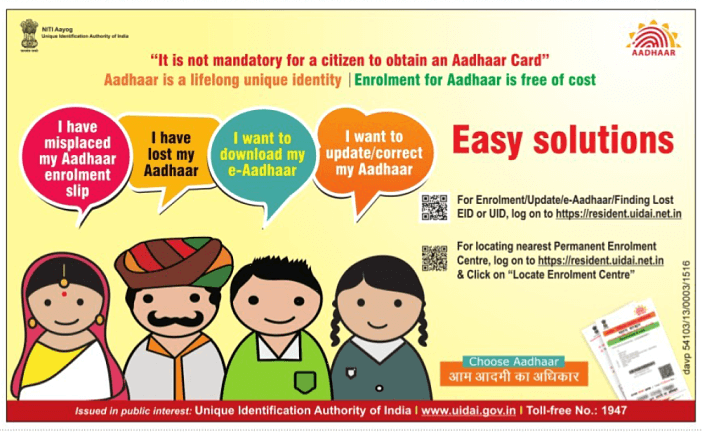
Aadhaar is heavily promoted in India using advertisements like this one. Image source: www.aadharcard.info
Aadhaar is heavily promoted in India using advertisements like this one. Image source: http://www.aadharcard.info

ජෛවමිතික දත්ත ලබාගැනීම හරහා පුරවැසියන්ගේ පෞද්ගලිකත්වයට (privacy) හානි විය හැකිය යන්න ආධාර් ව්‍යාපෘතිය ගැන එරට සිවිල් සමාජ ක්‍රියාකාරිකයන්ට තිබෙන ලොකුම විවේචනයයි. 2014 අප්‍රේල් මැයි මැතිවරණයෙන් ආණ්ඩු මාරුවක් සිදු වුවත් ව්‍යාපෘතිය දිගටම ඉදිරියට යනවා.

ඉන්දියාවේ පවතින යල් පැන ගිය නීති මගින් පුරවැසියන්ගේ පෞද්ගලිකත්වය නොරැකෙන බවත්, එවන් පසුබිමක අනන්‍ය වූ ජෛවමිතික දත්ත රැසක් ගබඩා කිරීම එම තොරතුරු අවභාවිතයට මඟ පාදන ක්‍රියාකාරිකයන් කියනවා.

සිදු විය හැකි අවභාවිතයන් කොටස් දෙකකට වර්ග කළ හැකියි. එකක් නම් ආධාර් දත්ත ගබඩාවේ ඇති පෞද්ගලික තොරතුරු, රජයේම වෙනත් ආයතන හා හමුදාව විසින් ලබා ගෙන රහසිගතව පුරවැසි ආවේක්ෂණය සිදු කිරීමයි. දේශපාලන විරුද්ධවාදීන් හා රජය විවේචනය කරන නිර්දේශපාලනික ක්‍රියාකාරිකයන් ට්‍රැක් කිරීමටත්, ඔවුන්ගේ සෞඛ්‍ය තත්ත්වය හාරා අවුස්සා දුර්වල තැන් සොයා ගැනීමටත් හැකි වීමේ අවදානමක් තිබෙනවා.

දෙවැනි අවදානම නම් මේ තොරතුරු වාණිජ සමාගම්  හෝ අන්තවාදී සන්විධාන අතට හොරෙන්ම පත් වීමයි.

2013 සැප්තැම්බරයේ සිට කිහිප වතාවක්ම ඉන්දියානු ශ්‍රේෂ්ඨාධිකරණය අවධාරණය කර ඇත්තේ රාජ්‍ය වැටුප්, විශ්‍රාම වැටුප් හා වෙනත් සහනාධාර හිමි අයට ඒවා ලැබීමට ආධාර් අංකය අත්‍යවශ්‍ය නොවිය යුතු බවයි.

කිසිදු පුරවැසියකුගේ ජෛවමිතික තොරතුරු ඔහු/ඇයගේ කැමැත්තෙන් තොරව හසු කර නොගත යුතු බවට හා ‘ආධාර් ව්‍යාපෘතියට සම්බන්ධ නොවූ පමණට තමන්ට ලැබිය යුතු ගෙවීම් කිසිවකුට නොගෙවා සිටීමට බැරි බවට’ ද ශ්‍රේෂ්ඨාධිකරණය කියා සිටියා.

ආධාර් කාඩ් නොමැතිව වුවද ඡන්දය ප්‍රකාශ කළ හැකි බවට (ඡන්දදායක ලේඛනයේ සිටින සියලු අයට) ඉන්දීය මැතිවරණ කොමිසම පැහැදිලි නිල ප්‍රකාශයක් කර තිබෙනවා.

එහෙත් අනෙක් රාජ්‍ය ආයතන ශ්‍රේෂ්ඨාධිකරණ නියෝග නොතකමින් ආධාර් අංක දිගටම ඉල්ලීම් කරනවා. ආධාර් කාඩ්පතක් නැතිනම් රජයේ රෝහලකින් හදිසි ප්‍රතිකාරයක්වත් ලබන්නට නොහැකි වන තරමට එය පරිපාලකයන් ඉල්ලීමට පටන්ගෙන ඇති බවයි ක්‍රියාකාරිකයෝ කියන්නේ. මෙය මානව හිමිකම් ප්‍රශ්නයක් වෙලා.

ආර්ථීක විද්‍යාඥ රීතිකා සෝරා කියන්නේ ආධාර් කාඩ්පත් නොමැතිව වුවද වඩාත් කාර්යක්ෂම පරිපාලනයක් හරහා වංචා අවම කිරීමට හැකි බවයි. ආධාර් කාඩ් නැති දුගී ජනයාට ලැබිය යුතු දීමනා නොදීම බරපතළ අසාධාරණයක් බවත්, ඇති හැකි අයට තිබෙන සියලු අයිතිවාසිකම් නැති බැරි අයටද තිබිය යුතු බවත් ඇය කියනවා.

Aadhaar citizen awareness efforts

මා දන්නා හඳුනන මධ්‍යම පාංතික නාගරික ඉන්දියානුවන් සමහරෙක් තමන් ආධාර් කාඩ්පත් ලැබීමට සියලු ජීවමිතික දත්ත රජයට දීමට සූදානම් නැතැයි යන ස්ථාවරයේ සිටිනවා.

ආධාර් ව්‍යාපෘතියට එරෙහිව අධිකරණයට ගිය සමාජ ක්‍රියාකාරිකයන් අතර හිටපු ජ්‍යෙෂ්ඨ පරිපාලක නිලධාරිනී හා තොරතුරු අයිතිය පිළිබඳ ඉන්දියානු පුරෝගාමී අරුණා රෝයි (Aruna Roy) ද සිටිනවා.

ඇගේ පෙත්සමේ එක් ප්‍රධාන තර්කයක් වූයේ ජෛවමිතික දත්ත එකතු කිරීමට පුද්ගලික අංශයේ ආයතනවලට කොන්ත්‍රාත් දීමයි.

‘ලොව පුරාම සමාගම් මිනිසුන්ගේ පෞද්ගලික තොරතුරු එකතු කර ඒවා අලෙවිකරණ හා වෙනත් වාණිජ අරමුණුවලට අවභාවිත කරන්න තැත් කරනවා. නිසි අධීක්ෂණයක් නැති ඉන්දියාව වැනි රටක මේ ජෛවමිතික දත්ත පිට යාමට ලොකු ඉඩක් තිබෙනවා. රහසිගතභාවය රජය විසින් සුරකින බවට දෙන සහතිකය අපට විශ්වාස නැහැ.’ ඇය 2013දී කියා සිටියා.

නව තාක්ෂණයට එරෙහි වෙලා වැඩක් නෑ. නමුත් ප්‍රවේශමින් පාවිච්චි කල යුතුයි.