Crying Wolf in the Global Village? Managing Disaster Early Warnings in the Age of Social Media

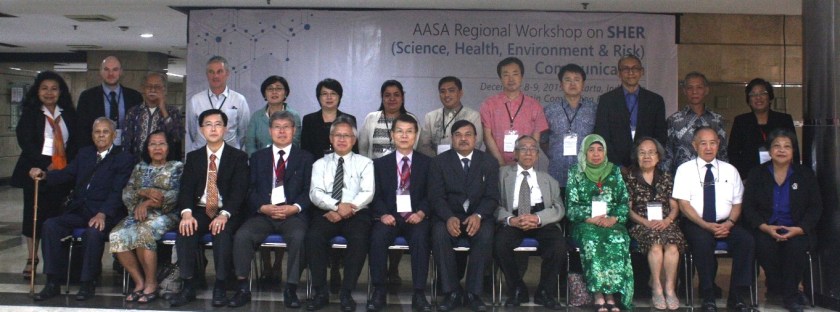
Participants of SHER (Science, Health, Environment & Risk) Communication - Role of S&T Communication in Disaster Management and Community Preparedness held in Jakarta, Indonesia, on 8-9 Dec 2015
Participants of SHER (Science, Health, Environment & Risk) Communication – Role of S&T Communication in Disaster Management and Community Preparedness held in Jakarta, Indonesia, on 8-9 Dec 2015

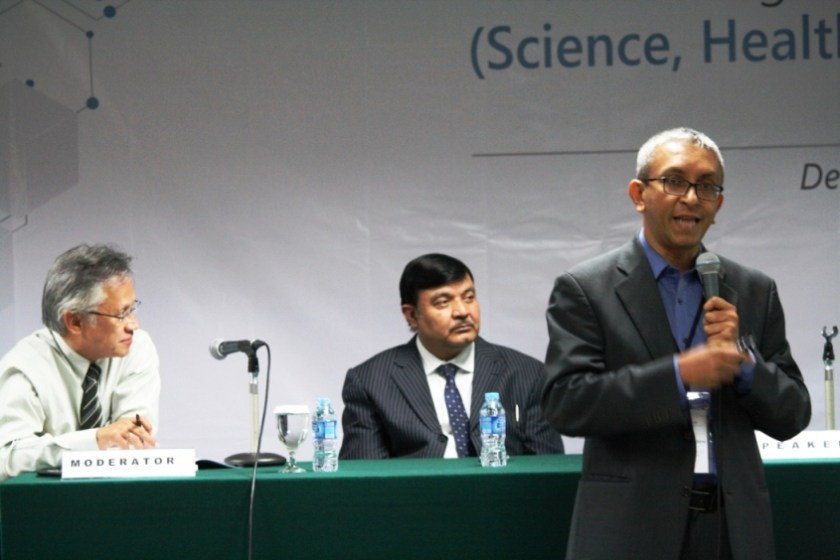
On 8 – 9 December 2015, I attended and spoke at the Asian Regional Workshop on “SHER (Science, Health, Environment & Risk) Communication: Role of S&T Communication in Disaster Management and Community Preparedness” held in Jakarta, Indonesia.

It was organised by the Association of Academies and Societies of Sciences in Asia (AASSA) in collaboration with the Indonesian Academy of Sciences (AIPI), Korean Academy of Science and Technology (KAST) and the Agency for Assessment and Application of Technology (BPPT) in Indonesia.

The workshop brought together around 25 participants, most of them scientists researching or engaged in publication communication of science, technology and health related topics. I was one of two journalists in that gathering, having been nominated by the National Academy of Sciences of Sri Lanka (NAASL).

I drew on over 25 years of journalistic and science communication experience, during which time I have worked with disaster managers and researchers, and also co-edited a book, Communicating Disasters: An Asian Regional Handbook (2007).

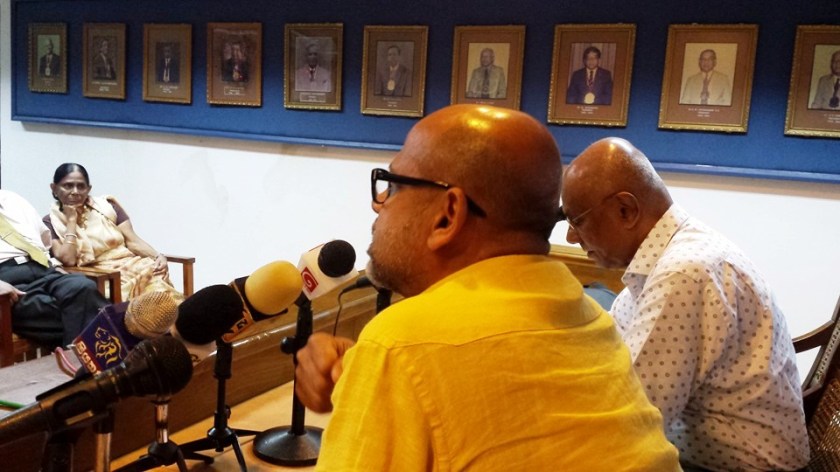
Nalaka Gunawardene speaking at Science, Health, Environment & Risk Communication Asian regional workshop held in Jakarta, Indonesia, 8-9 Dec 2015

The challenge in disaster early warnings is to make the best possible decisions quickly using imperfect information. With lives and livelihoods at stake, there is much pressure to get it right. But one can’t be timely and perfectly accurate at the same time.

We have come a long way since the devastating Boxing Day tsunami of December 2004 caught Indian Ocean countries by surprise. Many of the over 230,000 people killed that day could have been saved by timely coastal evacuations.

The good news is that advances in science and communications technology, greater international cooperation, and revamped national systems have vastly improved tsunami early warnings during the past decade. However, some critical gaps and challenges remain.

The Indian Ocean Tsunami Warning and Mitigation System (IOTWS) was set up in 2005 under UNESCO’s Intergovernmental Oceanographic Commission. Over USD 400 million has been invested in state of the art equipment for rapid detection and assessment. However, the system’s overall effectiveness is limited by poor local infrastructure and lack of preparedness. Some countries also lack efficient decision-making for issuing national level warnings based on regionally provided rapid assessments.

Warnings must reach communities at risk early enough for action. False warnings can cause major economic losses and reduce compliance with future evacuation orders. Only governments can balance these factors. It is important that there be clearer protocols within governments to consider the best available information and make the necessary decisions quickly.

Now, the proliferation of information and communication technologies (ICTs) is making this delicate balance even more difficult. To remain effective in the always-connected and chattering Global Village, disaster managers have to rethink their engagement strategies.

Controlled release of information is no longer an option for governments. In the age of 24/7 news channels and social media, many people will learn of breaking disasters independently of official sources. Some social media users will also express their views instantly – and not always accurately.

How can this multiplicity of information sources and peddlers be harnessed in the best public interest? What are the policy options for governments, and responsibilities for technical experts? How to nurture public trust, the ‘lubricant’ that helps move the wheels of law and order – as well as public safety – in the right direction?

As a case study, I looked at what happened on 11 April 2012, when an 8.6-magnitude quake occurred beneath the ocean floor southwest of Banda Aceh, Indonesia. Several Asian countries issued quick warnings and some also ordered coastal evacuations. For example, Thai authorities shut down the Phuket International Airport, while Chennai port in southern India was closed for a few hours. In Sri Lanka, panic and chaos ensued.

In the end, the quake did not generate a tsunami (not all such quakes do) – but it highlighted weaknesses in the covering the ‘last mile’ in disseminating early warnings clearly and efficiently.

Speakers on ‘ICT Applications for Disaster Prevention and Treatment’ in Jakarta, Indonesia, 8-9 Dec 2015

See also: Nurturing Public Trust in Times of Crisis: Reflections on April 11 Tsunami Warning. Groundviews.org 26 April 2012

I concluded: Unless governments communicate in a timely and authoritative manner during crises, that vacuum will be filled by multiple voices. Some of these may be speculative, or mischievously false, causing confusion and panic.

My full PowerPoint:


සිවුමංසල කොලූගැටයා #247: නාගරීකරණයේ ඇත්ත ඇති සැටියෙන් දැන්වත් පිළි ගනිමුද?

Sri Lanka’s 2012 Census of Population and Housing categorised only 18.2% of the Lankan population as being urban. However, that figure is highly misleading because we currently use a narrow definition.

Currently, only those living in Municipal Council (MC) or Urban Council (UC) areas are considered urban. However, some Pradeshiya Sabha areas (the next local government unit) are just as urbanised.

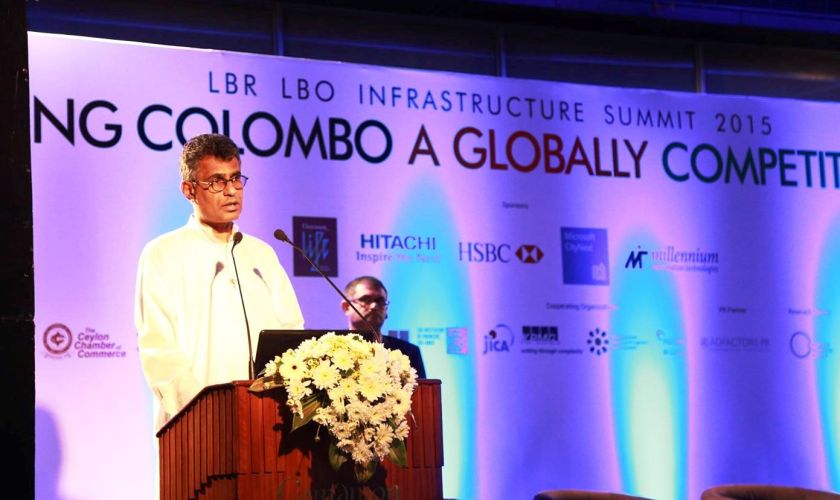
At the recent LBR/LBO Infrastructure Summit 2015 held in Colombo in early November, Minister of Megapolis and Western Development Champika Ranawaka took on this myth head on. He argued that Sri Lanka’s urban population share is probably as high as 48% — which is two and a half times higher than the current figure.

His concern: misconceptions such as this distort the country’s policy decisions on infrastructure planning and urban development.

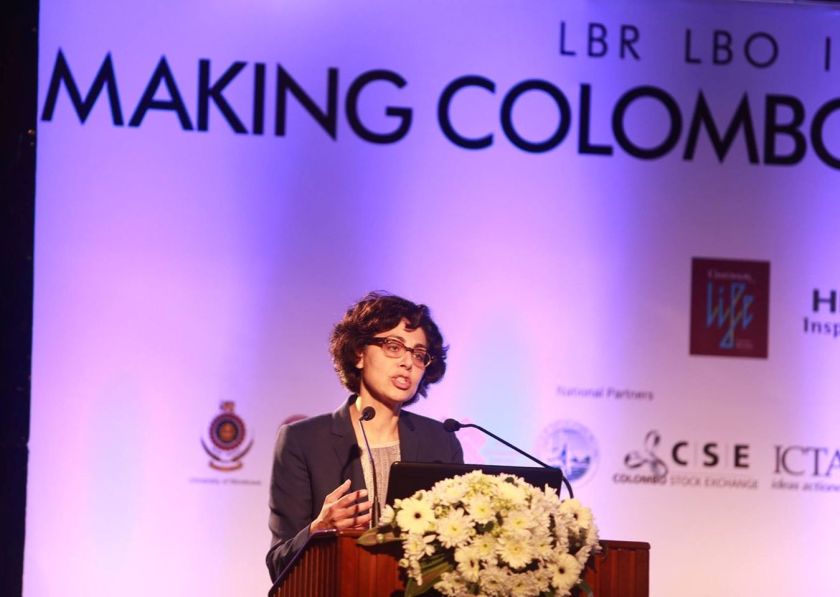
The World Bank’s global lead for urban development strategies, Sumila Gulyani, who spoke during the opening session, agreed with the Minister’s contention of nearly half of Sri Lanka’s population having already become urban.

I discuss the matter in this week’s Ravaya column, (appearing in issue of 29 Nov 2015).

I covered similar ground in an English Op Ed published in Daily Mirror on 12 Nov 2015: Let’s Get Real about Sri Lanka’s Urbanization!

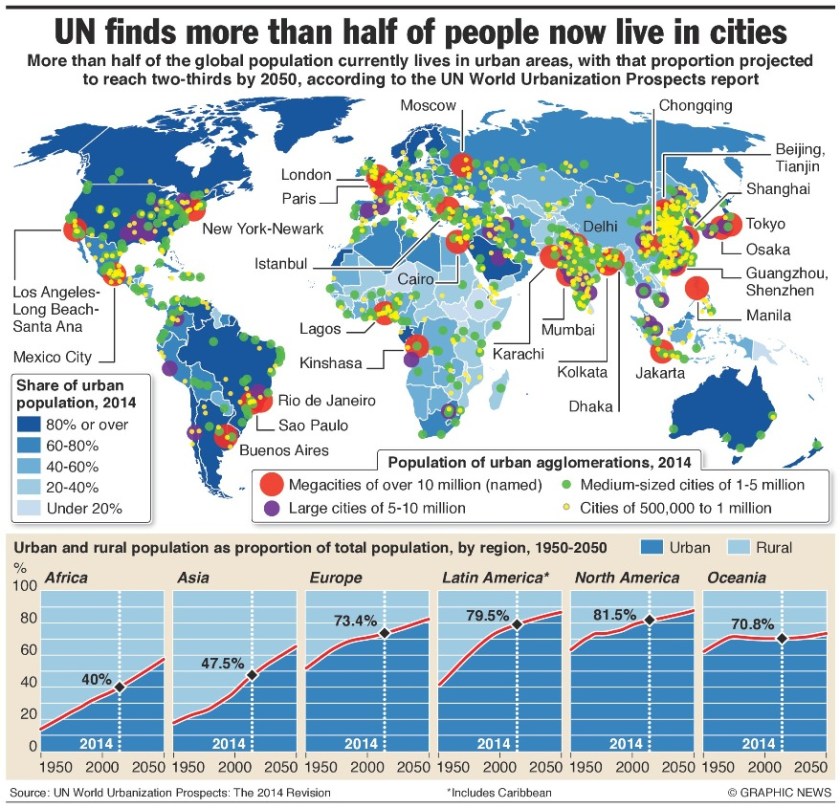
Global urban population, accordimg to the United Nations. Infographic courtesy Graphic News


නගර යන සංකල්පය ඉතිහාසයේ මතුව ආයේ පහසුකම් හා අවස්ථාවල සංකේන්ද්‍රනයක් හැටියටයි. එසේම වඩාත් වාණිජ සබඳතා හා සංස්කෘතික කටයුතු සිදු වන ප‍්‍රදේශ ලෙස ද අප නගර දකිනවා. භෞතික ගොඩනැගිලි හා මහාමාර්ගවලට වඩා නගරවල වැදගත් සාධක වන්නේ මේවායි.

නගර බිහි වීම ශිෂ්ටාචාර පරිනාමයේ එක් අවස්ථාවක්. එයට උදාහරණ මොහන්ජොදාරෝ, ඇතන්ස්, රෝමය මෙන් ම සහස‍්‍රයක් මෙරට රාජධානියව පැවැති අනුරාධපුරයත් දැක්විය හැකියි. කලාකරුවන්, චින්තකයන්, විද්‍යාඥයන් බොහෝ විට බිහි වන්නේ නගරවල සමාජ-ආර්ථික තෝතැන්න හරහා.

මුලදි ග‍්‍රාමීය ලක්ෂණ පවතින ප‍්‍රදේශවල යටිතල පහසුකම් ටිකෙන් ටික දියුණු වී, නාගරික පෙදෙස් බවට පෙරැළීම නාගරීකරණය (Urbanisation) යයි හැඳින්වෙනවා.

බහුතර පිළිගැනීම නම් මෙය රටක් දියුණු වීමේ ලක්ෂණයක් බවයි. එයින් අදහස් කැරෙන්නේ ගම් නොදියුණුය යන්න නොවෙයි. නූතන පහසුකම් සහිතව, ආයාසය අඩු කර ගෙන ජීවත්වීමට අද කාලේ බොහෝ දෙනකු කැමතියි.

ශ‍්‍රී ලංකාවේ නාගරික ප‍්‍රදේශ කොපමණක් ඇත්ද? ජනගහනයෙන් කිනම් ප‍්‍රතිශතයක් නාගරික ප‍්‍රදේශවල වාසය කරනවාද?

මේ ගැන යම් ව්‍යාකූලතාවක් හා විවාදයක් තිබෙනවා. මෙගාපොලිස් හෙවත් මෙගා පුරවර වෙත රට යොමු වන මේ මොහොතේ මෙය නිරවුල් කර ගැනීම ඉතා වැදගත්.

2012 අවසන් වරට කළ ජන සංගණනයට අනුව මෙරට ජනගහනය 20,359,439ක් (මිලියන 20.36) වුණා. එයින් නාගරික යයි සැළකෙන ප‍්‍රදේශවල වාසය කළේ 18.2%ක් පමණයි.

එහෙත් මෙය මුලා කරවන සුළු තරම් කුඩා ප‍්‍රතිශතයක් බව සංගනනය කළ ජනලේඛන හා සංඛ්‍යාලේඛන දෙපාර්තමේන්තුවම ප‍්‍රසිද්ධියේ කියනවා.

2012 සංගණනයේ ප‍්‍රතිඵල කැටි කැරෙන හා විග‍්‍රහ කැරෙන නිල ප‍්‍රකාශනයක දෙපාර්තමේන්තුව මෙසේ කියනවා. ‘දැනට මෙරට නාගරික ප‍්‍රදේශ ලෙස සැලකෙන්නේ මහනගර සභා (Municipal Councils) හා නගර සභා (Urban Council) බල ප‍්‍රදේශ පමණයි.

එහෙත් 1987 වන තුරු සුළු නගර සභා (Town Councils) බල ප‍්‍රදේශ ද නාගරික ලෙස සළකනු ලැබුවා. 1987දී ප‍්‍රාදේශීය සභා පිහිටුවීමත් සමග ඒවා අහෝසි වූ අතර, සියලූම ප‍්‍රාදේශීය සභාවල බල ප‍්‍රදේශ ග‍්‍රාමීය යයි පරිපාලන වශයෙන් පිළි ගැනීම ඇරැඹුණා.’

මේ අනුව එතෙක් නාගරික යයි සැලකූ සමහර ප‍්‍රදේශ එක රැයින් ග‍්‍රාමීය ලෙස නැවත වර්ගීකරණය වූ බවත්, එතැන් පටන් මෙරට නාගරික ප‍්‍රදේශ හා නාගරික ජනගහන ප‍්‍රතිශතය අඩුවෙන් තක්සේරු කිරීම දිගටම සිදු වන බවත් දෙපාර්තමේන්තුව කියනවා.

මේ විසමතාව සමහර විද්වතුන් කලෙක සිටම පෙන්වා දෙනවා. මොරටුව සරසවියේ නගර සැලසුම් පිළිබඳ මහාචාර්ය ඈෂ්ලි එල්.එස්. පෙරේරා එයින් ප‍්‍රමුඛයි.

‘1981දී පළාත් පාලන ආයතනවල සීමා නිර්ණය කිරීම් සංශෝධනය කරද්දී ප‍්‍රාදේශීය සභා බල ප‍්‍රදේශ ලෙස වර්ග කරනු ලැබුවේ විද්‍යාත්මක පදනමක් මත නොව මුළුමනින්ම දේශපාලන අවශ්‍යතා සඳහායි. එවක් පටන් සියලූ ප‍්‍රාදේශීය සභා ග‍්‍රාමීය ප‍්‍රදේශ යයි විග‍්‍රහ කිරීමේ රාජ්‍ය පරිපාලන සම්ප‍්‍රදාය නිසා මෙරට නාගරික ප‍්‍රදේශ පිළිබඳ සැබෑ චිත‍්‍රයක් ලබා ගැනීම අපහසු වී, ප‍්‍රතිපත්ති සම්පාදනයට බාධා වී තිබෙනවා’ යයි ඔහු වරෙක පුවත්පත් ලිපියක කියා සිටියා.

2012 සංගණනය වන විට මෙරට මහ නගර සභා 23ක්, නගර සභා 41ක් හා ප‍්‍රාදේශීය සභා 271ක් තිබුණා. ජන සංගණනයට පෙර, 2011දී අලූතෙන් මහ නගර සභා බල ප‍්‍රදේශ හතරක් ප‍්‍රකාශයට පත් කළා (කඩුවෙල, දඹුල්ල, බණ්ඩාරවෙල හා අක්කරෙයිපත්තු).

2011 වන තුරු ප‍්‍රාදේශීය සභා බල ප‍්‍රදේශයක් ලෙස පැවති කඩුවෙල එක් වරම මහනගර සභාවක් බවට පත් වුණා. එම ප‍්‍රදේශය කලෙක පටන්ම නාගරික ලක්ෂණ සහිත වුවත් නාගරික මට්ටමට පිළිගැනුනේ මෙසේ ඉතා මෑතදියි.

එසේ තවමත් පිළිගැනුනේ නැති, එහෙත් භෞතිකව බොහෝ නාගරික ලක්ෂණ දියුණු වී ඇති තව ප‍්‍රදේශ දිවයිනේ විසිර පවතිනවා. උදාහරණයකට මහරගම නගර සභා ප‍්‍රදේශය පසු කර ගෙන හයිලෙවල් පාර දිගේ ගිය විට හෝමාගම හමු වනවා. මේ ප‍්‍රදේශ දෙකෙහි දැන් ලොකු වෙනසක් නැතත් හෝමාගම ප‍්‍රාදේශීය සභාවක් පවතින නිසා සැලකෙන්නේ මුළුමනින්ම ග‍්‍රාමීය ප‍්‍රදේශයක් ලෙසයි.

මෙබඳු විෂමතා තවත් පළාත් හා දිස්ත‍්‍රික්ක ගණනාවක අපට හමු වනවා. මෙසේ පරිපාලනමය වශයෙන් අවතක්සේරු නොකළා නම් අපේ රටේ නාගරික ජනගහන ප‍්‍රතිිශතය සැබැවින්ම කොපමණ විය හැකිද? මෙය කලෙක සිට මට තිබුණු ප‍්‍රශ්නයක්.

නොවැම්බර් 3-4 දිනවල කොළඹ පැවති නාගරික යටිතල පහසුකම් පිළිබඳ සමුළුව (LBR/LBO Infrastructure Summit 2015) අමතමින් මෙගාපොලිස් හා බස්නාහිර සංවර්ධන භාර අමාත්‍ය චම්පික රණවක මේ ගැන කතා කළා.

ඔහු කීවේ මෙරට නාගරික ජන ප‍්‍රතිශතය සැබැවින්ම 48%ක් පමණ විය යුතු බවයි. මෙය 2012 ජනසංගණනයේ ප‍්‍රතිශතය මෙන් දෙක හමාරක් පමණ වැඩියි.

රටක යටිතල පහසුකම් සැලසුම් කිරීම හා ඉදිකිරීම ජනගහන වර්ධනය හා ව්‍යාප්තිය සැලකිල්ලට ගෙන, එයට ඉදිරියෙන් සිටීමට කළ යුත්තක්. ඒ සඳහා තාත්ත්වික සංඛ්‍යා ලේඛන මෙන්ම ප‍්‍රක්ෂේපන ද අවශ්‍යයි.

මෙරට නාගරික ජනගහනය 18%ක් යයි වැරදි විගරහයක පිහිටා නිවැරදි ඉදිරි සැලසුම් කළ නොහැකියි. එසේම අපේ රට තවමත් බහුතර රාමීය ජනතාවක් වෙසෙන රටක් යයි කියමින් උදම් ඇනීම හෝ රොමෑන්ටික් මෝහනයකට පත්වීම රායෝගිකව සම්පත් කළමනාකරණයට හා රතිපත්ති සම්පාදනයට බාධාවක්.

ඉංජිනේරුවකු ලෙස උගත් අමාත්‍යවරයා මෙය වටහා ගෙන තිබීම ඉදිරියේදී මේ අවුල ලිහා ගැනීමට උපකාර වනු ඇති. රටේ පුළුල්ව පැතිර ගිය දුර්මතයකට එරෙහි වීම දේශපාලකයකුට ලෙහෙසි නැහැ!

එම සමුළුව අමතා කතා කළ ලෝක බැංකුවේ නාගරික සංවර්ධන ක‍්‍රමෝපායයන් පිළිබඳ විශේෂඥ සුමිලා ගුල්යානි (Sumila Gulyani) ද අමාත්‍යවරයාගේ අනුමානය පිළිගත්තා.

‘ශ‍්‍රී ලංකාව නිල වශයෙන් නාගරික ජනගහනය 14 – 18% ලෙස දශක ගණනක සිට ප‍්‍රකාශ කළත් අපේ අධ්‍යයනවලින් පෙනී යන්නේ එය ඊට වඩා සැලකිය යුතු තරම් වැඩි බවයි. නාගරික ඒකරාශී වීම (urban agglomeration) හරහා මෙය දැන් 47%ක් තරම් වන බව අපේ ගණන් බැලීමයි’ ඇය ප‍්‍රකාශ කළා.

නගර යනු ගතික ප‍්‍රපංචයක්. එනම් නාගරික කේන්ද්‍රයක් මුල් කර ගෙන නාගරික ගති ලක්ෂණ ඇති ප‍්‍රදේශ ටිකෙන් ටික පුළුල් වනවා. නගර ලියලා වැඩෙනවා කියන්නේ මෙයටයි.

ගුල්යානි කී හැටියට දකුණු ආසියානු රටවල් හැම එකක්ම පාහේ නාගරික ප‍්‍රදේශ හා ජන ප‍්‍රතිශතය අඩුවෙන් ඇස්තමේන්තු කරනවා. මෙයට හේතුව ලෙස ඇය දකින්නේ ඓතිහාසිකව ග‍්‍රාමීය ප‍්‍රදේශවලට පමණක් වෙන් වූ රාජ්‍ය සහනාධාර තිබීමයි. මේ සහනාධාර තම බල ප‍්‍රදේශවට ලබනු රිසි පරිපාලකයෝ හා ජනතා නියෝජිතයෝ, යථාර්ථය කුමක් වුවත් තම ප‍්‍රදේශ හැකි තාක් කල් ග‍්‍රාමීය යයි වර්ග කැරෙනවාට කැමතියි.

දකුණු ආසියාව සමස්තයක් ලෙස ගත් විට, එහි ජනගහනයෙන් 30%ක් පමණ නාගරික ප‍්‍රදේශවල වෙසෙනවා. ක‍්‍රි.ව. 2030 වනවිට මෙය 50% ඉක්මවා යා හැකි බවයි ජනගහන ප‍්‍රක්ෂේපන කියන්නේ. අපේ රටට පමණක් මේ ප්‍රවනතාවෙන් අත් මිදීමට නොහැකියිග

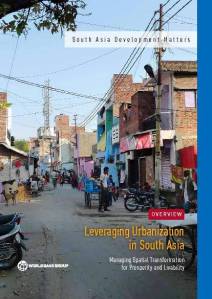
Leveraging Urbanization in South Asia - new World Bank Report
Leveraging Urbanization in South Asia – new World Bank Report

දකුණු ආසියාවේ බොහෝ තැන්වල සැඟවුණු නාගරීකරණයක් (Hidden Urbanization) සිදුවන බව මෑතදී නිකුත් කළ ලෝක බැංකුවේ විද්වත් වාර්තාවක් කියනවා.

නිල වශයෙන් නාගරික යයි වර්ගීකරණය නොවුවද සැබැවින්ම නාගරික පෙදෙසක සියලූ ගතිසොබා රැගත් ප‍්‍රදේශ බිහි වීම මේ ප‍්‍රවණතාවයි.

එසේම සාම්ප‍්‍රදායික සංගණන දත්තවල තිබෙන විශ්ලේෂණාත්මක සීමා ඉක්මවා යන්නට නව දත්ත ප‍්‍රභවයන් සොයා ගත හැකි බව ද මේ වාර්තාව කියනවා.

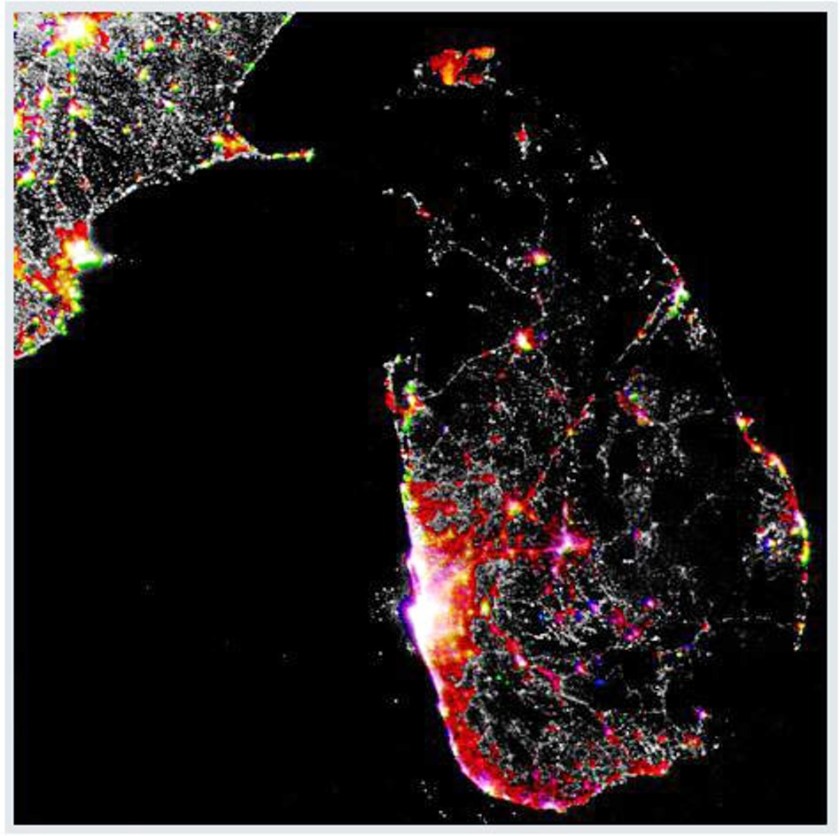
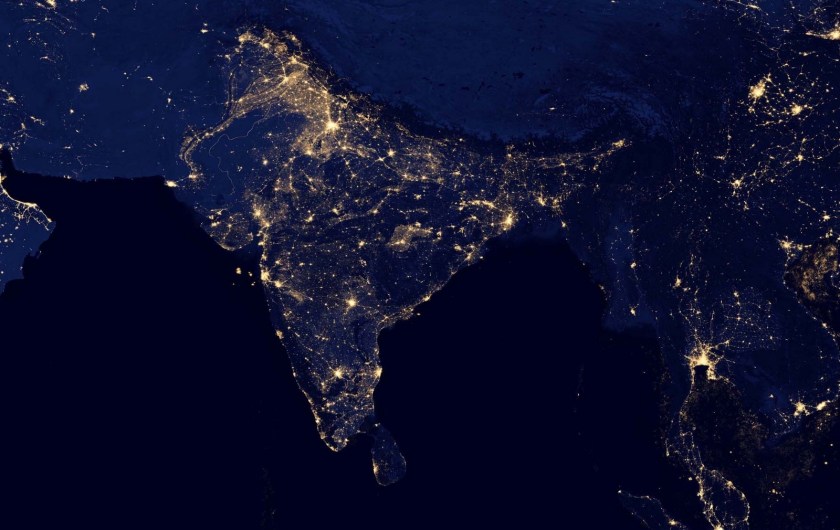
එයින් එකක් නම් පෘථිවි කක්ෂයේ ඇති භූ නිරීක්ෂණ හා කාලගුණ චන්ද්‍රිකා මගින් ගන්නා රාත‍්‍රී එළිවල ඡායාරූප සියුම්ව අධ්‍යයනය කිරීමයි. මිහිතලයේ මානව ව්‍යාප්තිය හා සාපේක්ෂ සංකේන්ද්‍රනය ගැන දළ හැඟීමක් මේ රාත‍්‍රී රූප දෙස බලා අපට ලද හැකියි.

මෑත කාලයේ යවන ලද චන්ද්‍රිකා හරහා රාත‍්‍රී එළි දැක්වෙන විස්තරාත්මක රූප නාසා (NASA) ආයතනය ලබා ගන්නවා. මේවා (වෙනත් රටවල අභ්‍යවකාශ ඒජන්සි මෙන් බදා ගෙන ඉන්නේ නැතිව) නාසා ආයතනය ඉන්ටර්නෙට් හරහා ලෝකය සමග බෙදා ගන්නවා.

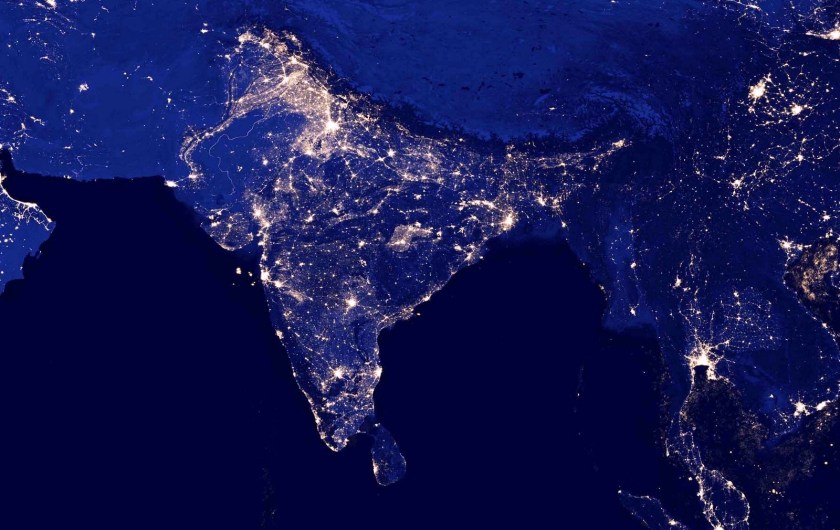
South Asia at night - composite satellite image acquired by NASA between April 18 - October 23, 2012 This new image of the Earth at night is a composite assembled from data acquired by the Suomi National Polar-orbiting Partnership (Suomi NPP) satellite over nine days in April 2012 and thirteen days in October 2012. It took 312 orbits and 2.5 terabytes of data to get a clear shot of every parcel of Earth’s land surface and islands.
South Asia at night – composite satellite image acquired by NASA between April 18 – October 23, 2012
This new image of the Earth at night is a composite assembled from data acquired by the Suomi National Polar-orbiting Partnership (Suomi NPP) satellite over nine days in April 2012 and thirteen days in October 2012. It took 312 orbits and 2.5 terabytes of data to get a clear shot of every parcel of Earth’s land surface and islands.

දකුණු ආසියාවට ඉහළින් චන්ද්‍රිකා ගමන් කරද්දී 2012දී ගත් රාත‍්‍රි එළි චන්ද්‍රිකා ඡායාරූප ලෝක බැංකු පර්යේෂකයෝ සමීපව අධ්‍යයනය කර තිබෙනවා. මේ අනුව ඔවුන් සොයා ගත්තේ ප‍්‍රධාන හා අතුරු මාර්ග ඔස්සේ තීරු ලෙස ඒ දෙපසින් ටිකෙන් ටික නගර විහිද යන සැටියි (‘ribbon development’).

1999දී රාත‍්‍රී එළි අධ්‍යයනයෙන් පෙනී ගිය නාගරික ඒකරාශී වීම් 37ක් දකුණු ආසියාවේ තිබුණා. 2010 වනවිට එය 45 දක්වා වැඩිවී තිබෙනවා.

ශ‍්‍රී ලංකාවේ රාත‍්‍රී එළි අධ්‍යයනයෙන් පෙනී යන්නේ කොළඹ සිට සෙසු ප‍්‍රධාන නගරවලට විහිදෙන මාර්ග රැසක්ම දෙපස බෙහෙවින් නාගරීකරණය වී ඇති බවයි.

ශ‍්‍රී ලංකාවේ රාත‍්‍රී එළි කොළඹ හා තදාසන්න ප‍්‍රදේශවල වඩාත් ම ප‍්‍රබල අතර ඊළඟට වැඩියෙන් ම දීප්තියෙන් පෙනෙන්නේ යාපනය අර්ධද්වීපයයි. කොළඹට අමතරව මහනුවර, ගාල්ල, කුරුණෑගල වැනි ප‍්‍රධාන නගරවලත් රාත‍්‍රී ආලෝක පැහැදිලිව තිබෙනවා.

යාපනයට අමතරව වවුනියා, අනුරාධපුරය හා ත‍්‍රිකුණාමලය නගර මුල් කර ගෙන ආලෝක සංකේන්ද්‍රනයක් පෙනෙනවා. එසේ ම මඩකළපුව හා ආරුගම් බොක්ක ප‍්‍රදේශයේත් පැහැදිලි එළි රැසක් තිබෙනවා.

මහනුවර සිට යාපනයට දිවෙන කිමී 321ක් දිග A9 මහා මාර්ගයේ කොටස් රාත‍්‍රී එළි නිසා අභ්‍යවකාශයේ සිට හඳුනාගත හැකියි. අවට දෙපස අඳුරේ තිබියදී මහා මාර්ගය දෙපස පමණක් එළි පෙනෙනවා. මෙබඳු ප‍්‍රධාන මාර්ගවල විහිදීම දිවයිනේ වෙනත් ප‍්‍රදේශවලත් දිස් වනවා.

නගර කෙමෙන් පැතිරෙන්නේ මහාමාර්ග ඔස්සේයි. පෞද්ගලික දේපල හිමිකාරිත්වයට අවසර ඇති ඕනැම රටක මෙය සිදුවනවා.

Urbanisation in Sri Lanka as shown by night lights captured by satellites

6 January 2013: සිවුමංසල කොලූගැටයා #99: ලෝකෙට ම පෙනෙන අපේ රාත‍්‍රි එළි

චන්ද්‍රිකා දත්ත විග‍්‍රහයෙන් යා හැකි දුර සීමිතයි. නිසි නාගරික කළමනාකරණයට විස්තරාත්මක භූමි පරිභෝජන දත්ත මෙන්ම ජන චල්‍යතා දත්තද අවශ්‍යයි.

ශ‍්‍රී ලංකාවේ දැනට නාගරික යයි නිල වශයෙන් පිළිගන්නා ජනගහනයෙන් 48%ක්ම සිටින්නේ බස්නාහිර පළාතේ මහ නගර සභා බල ප‍්‍රදේශ අටකයි. ඒවා නම් කොළඹ, කඩුවෙල, දෙහිවල-ගල්කිස්ස, මොරටුව, කෝට්ටේ, කැස්බෑව, මහරගම හා මීගමුවයි. මේ අතරින් මීගමුව හැරුණු කොට අන් හතම අයත් කොළඹ දිස්ත‍්‍රික්කයටයි.

කොළඹ දිස්ත‍්‍රික්කයට මෙතරම් නාගරික ජන ප‍්‍රතිශතයක් හිමි වීමට හේතුව දැනට භාවිත කරන නිර්වචනයේ දෝෂයයි. එසේ නොමැතිව නාගරික ගතිගුණ ඇති ප‍්‍රදේශ අනෙක් දිස්ත‍්‍රික්කවල යහමින් නැතිවාට නොවේ.

See also:

28 April 2013: සිවුමංසල කොලූගැටයා #115: ගම හා නගරය අතර අතරමං වූ ලක් සමාජය

Census of Population and Housing 2012: Key Findings: http://goo.gl/Dij22Y

Leveraging Urbanization in South Asia: Managing Spatial Transformation for Prosperity and Livability (September 2015)

සිවුමංසල කොලූගැටයා #246: තොරතුරු අයිතිය විවෘත ආණ්ඩුකරණයට මුල් පියවරයි

Illustration by Echelon magazine, http://www.echelon.lk

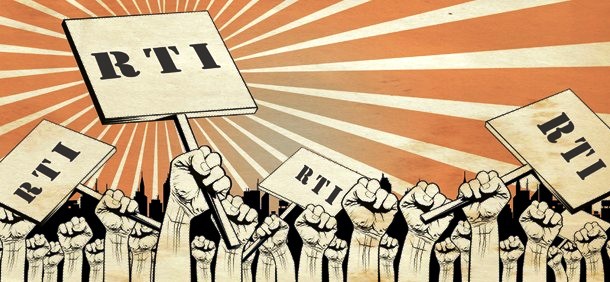
After many years of advocacy by civil society groups and journalists, Sri Lanka is set to soon adopt a law guaranteeing citizens’ Right to Information (RTI, also known as freedom of information laws in some countries). With that, we will join over 100 other countries that have introduced such progressive laws.

The first step is already taken. The 19th Amendment to the Constitution, passed in Parliament in April 2015, made the right to information a fundamental right. The Right to Information Act is meant to institutionalize the arrangement – i.e. put in place the administrative arrangement where a citizen can seek and receive public information.

RTI signifies unleashing a new potential, and a major change in status quo. First, we need to shake off a long historical legacy of governments not being open or accountable to citizens.

In this week’s Ravaya column, (appearing in issue of 22 Nov 2015), I explore how RTI can gradually lead to open government. I also introduce the 9 key principles of RTI.

I have covered the same ground in English here:

20 Nov 2015: Right to Information should be a step towards Open Government

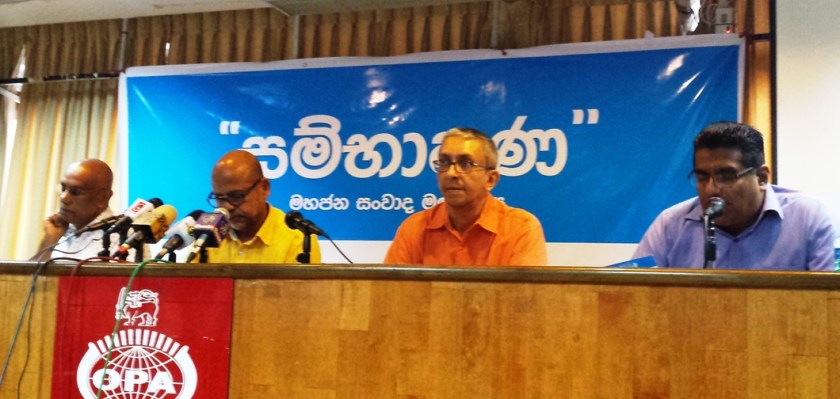
L to R - Wijayananda Jayaweera, Gamini Viyangoda, Nalaka Gunawardene, Shan Wijetunge. At Right to Information public forum on 17 Nov 2015 in Colombo. Photo by Sampath Samarakoon
L to R – Wijayananda Jayaweera, Gamini Viyangoda, Nalaka Gunawardene, Shan Wijetunge. At Right to Information public forum on 17 Nov 2015 in Colombo. Photo by Sampath Samarakoon

තොරතුරු දැනගැනීමේ අයිතිය තහවුරු කැරෙන නීතිය සම්මත වන තුරු මේ වසර පුරාම අපි බලා සිටිනවා. ‘අද නෑ හෙට’ වගේ වැඩක්!

යහපාලනයේ එක් ප‍්‍රධාන පොරොන්දුවක් වූයේද තොරතුරු අයිතියයි. එක් අඩක් ඉටු වී තිබෙනවා කිව හැකියි. මන්ද 2015 අපේ‍්‍රල් 28දා පාර්ලිමේන්තුවේ සම්මත වූ 19 වන ව්‍යවස්ථා සංශෝධනයේ තොරතුරු අයිතිය මූලික අයිතිවාසිකමක් ලෙස පැහැදිලිවම පිළිගෙන තිබෙනවා.

මේ අයිතිය ප‍්‍රායෝගිකව ක‍්‍රියාත්මක කිරීමට තොරතුරු නීතිය අවශ්‍යයි. ඒ හරහා සමස්ත රාජ්‍ය පරිපාලන තන්ත‍්‍රයේම වෙනසක් සිදු කැරෙනවා. හැකි තාක් මහජනයාට රහසිගතව කටයුතු කිරීමේ ඓතිහාසික සම්ප‍්‍රදායෙන් මිදී වඩාත් විවෘත හා තොරතුරු බෙදා ගන්නා රාජ්‍ය පාලනයකට යොමුවීමේ ක‍්‍රමවේදයක් මේ නීතිය හරහා හඳුන්වා දීමට නියමිතයි.

තොරතුරු නීති කෙටුම්පත් හරිහැටි හදා ගන්නට මෙතරම් කල් ගත වන්නේ ඇයි?

මනා නීති සම්පාදනය සඳහා ආදර්ශයට ගත හැකි තොරතුරු නීති දකුණු ආසියාවේත්, ඉන් පිටතත් රටවල් 100ක තිබෙනවා. මේ නිසා හැම නීති වැකියක්ම අලූතෙන්ම වචන ගැලපිය යුතු නැහැ. තොරතුරු අයිතිය පිළිබඳ ජාත්‍යන්තර යහ සම්ප‍්‍රදායන් ගැන බොහෝ ලේඛනද තිබෙනවා. යුනෙස්කෝ ආයතනය මේ ගැන විශේෂ අවධානය යොමු කොට තිබෙනවා.

මෙතැන ඇත්තේ නීති හැකියාවන් පිළිබඳ ගැටලූවක් නොව ආකල්පමය එල්බ ගැනීම් බවයි දැන ගන්නට තිබෙන්නේ. අපේ නීතිපති දෙපාර්තමේන්තුව හා නීති කෙටුම්පත් දෙපාර්තමේන්තුව බෙහෙවින් ගතානුගතික පදනමක පිහිටා ක‍්‍රියාකිරීම නිසා තොරතුරු බෙදා ගන්නවාට වඩා බදා ගන්නට නැඹුරු වූ නීතියක් බිහි වීමේ අවදානම තිබෙනවා. මේ අවසාන අදියරේදී ස්වාධීන නීති විශාරදයන් හා සිවිල් සමාජ ක‍්‍රියාකාරිකයන් අවදියෙන් හා අවධානයෙන් සිටීම අත්‍යවශ්‍යයි. නැතිනම් එතරම් ප‍්‍රයෝජනයක් ගත නොහැකි නාමමාත‍්‍රික තොරතුරු නීතියක් සම්මත විය හැකියි.

රාජ්‍ය දෙපාර්තමේන්තු දෙකක පටු මානසිකත්වයට වඩා පුළුල් අභියෝගයක්ද මෙහිදී මා දකිනවා. එනම් අපේ ඉතා වැඩවසම් ඓතිහාසික උරුමය හා නූතනත්වය අතර අරගලයයි.

සියවස් 25ක ලිඛිත ඉතිහාසයක් ඇති අපේ රටේ විවෘත හා මහජනතාවට වගකියන ආණ්ඩුකරණයක් ඉතා මෑතක් වන තුරු කිසි දිනෙක පැවතියේ නැහැ. මැග්නා කාර්ටා (Magna Carta) වැනි සම්මුතියක් හරහා අපේ රජුන්ගේ බලතල කිසි ලෙසකින් හෝ සමනය වූයේ ද නැහැ.

1 May 2015: සිවුමංසල කොලූගැටයා #217: වසර 800කට පෙර යහපාලන අඩිතාලම දැමූ මැග්නා කාටාව

සීමාන්තික බලතල සහිත රජවරුන් අපේ රට පාලනය කළ වසර 2,000ක පමණ කාලයක් තුළ රටේ කිසිදු පරිපාලන තොරතුරක් (හෝ වෙනත් කිසිම අයිතිවාසිකමක්) ඉල්ලීමේ වරම ජනතාවට තිබුණේ නැහැ. අපේ පැරැන්නෝ යටත් වැසියන් මිස කිසි දිනෙක පුරවැසියන් වූයේ නැහැ.

ඉන්පසු එළැඹුණු යටත් විජිත පාලන යුගවලත් එම පාලකයන් කිසි විටෙක තොරතුරු හෙළි කිරීමට බැඳී සිටියේ නැහැ. බි‍්‍රතාන්‍ය පාලන තන්ත‍්‍රය තුළ ලේඛන පවත්වා ගැනීම ඉතා හොඳින් සිදු කළත්, ඒ ලේඛන ඔවුන්ගේ ලන්ඩනයේ යටත් විජිත පරිපාලකයන්ට මිස මෙරට සාමාන්‍ය ජනයාට පරිශීලනය කළ හැකි වූයේ නැහැ. (මේ වාර්තා දැන් නම් බි‍්‍රතාන්‍ය කෞතුකාගාරයේ ඕනෑම කෙනෙකුට කියවිය හැකියි. බි‍්‍රතාන්‍ය පාලන යුගය දැඩි ලෙස විවේචනය කරන හැම දෙනෙකුම පාහේ තම මූලාශ‍්‍ර යොදා ගන්නේ එම වාර්තායි.)

නිදහසින් පසුව රට පාලනය කළ අපේම ආණ්ඩුත් බොහෝ දුරට රටවැසියන්ට තොරතුරු කැමැත්තෙන් දෙනවා වෙනුවට හැකි තාක් වසන් කිරීමේ සම්ප‍්‍රදාය දිගටම ගෙන ගියා. යටත් විජිත සමයේ ආභාෂය මෙන්ම ඉතිහාසයේ කිසි දිනෙක රටවැසියාට විවෘත වූ ආණ්ඩුකරණයක් (Open Government) නොතිබීම ද එයට හේතු වූවා විය හැකියි.

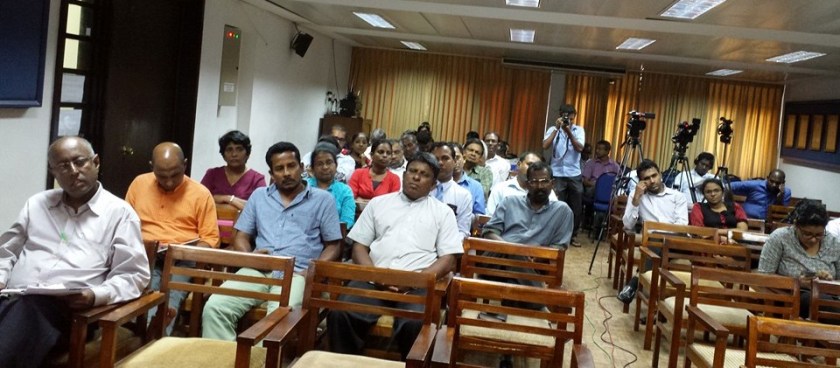
Part of the audience at RTI Public Forum on 17 Nov 2015 in Colombo

මෙයින් අදහස් කැරෙන්නේ නිදහසින් පසු අපට තිබූ සියලූ රජයන් දුර්දාන්ත හෝ දරදඬු පාලනයන් වීය කියා නොවෙයි. ඇතැම් ප‍්‍රජාතන්ත‍්‍රවාදී නායකයන් පවා රට වැසියන්ට සැලකුවේ හරියට දෙමවුපියන් ළමයින් දෙස බලන ආකල්පයට සමාන මානසිකත්වයකින්. වැසියන් රැක බලා ගෙන ඔවුන්ට අවශ්‍ය සම්පාදන කර දීම විනා ඔවුන් ස්වාධීනව සිතන පතන “වැඩිහිටියන්” වීම අවශ්‍ය යැයි ඩී එස් හා ඩඩ්ලි වැනි නායකයන්ට නොසිතෙන්නට ඇති.

සමාජ ක‍්‍රියාකාරික හා ලේඛක ගාමිණී වියන්ගොඩගේ මතය නම් තොරතුරු උවමනාවෙන්ම රටවැසියන්ට නොදී සිටින්නේ තොරතුරු හරහා රටවැසියන් බලාත්මක වන නිසායි. වසන් කළ යුතු අමිහිරි හා අශෝබන බොහෝ දේ හැම රාජ්‍ය පාලනයකම තිබෙන බවත්, මේ තොරතුරු පිට වීම හා ගලා යාම පවතින බල සංකේන්ද්‍රයන්ට බරපතල ප‍්‍රශ්නයක් බවත් ඔහු කියනවා.

Writer and activist Gamini Viyangoda speaks at RTI Public Forum on 17 Nov 2015

කාලානුරූපව වෙනස් වෙන්නට කාලය ඇවිත්! අපේ ඓතිහාසික උරුමය කිසි දිනෙක විවෘත ආණ්ඩුකරණයකට නැඹුරු නොවූවත්, 21 වන සියවසේ යහපාලනයට හා ප‍්‍රජාතන්ත‍්‍රවාදයට එය අත්‍යවශ්‍ය ගුණයක් ලෙස දැන් සැලකෙනවා.

විවෘත ආණ්ඩුකරණයේ සංකල්පය 18 වන සියවසේ බටහිර යුරෝපයේ පුනරුදය (Age of Enlightenment) වෙත දිවෙනවා. සීමාන්තික බලතල සහිත රාජාණ්ඩු වඩාත් බල තුලනයකට යටත් කළ යුතු බවටත්, මහජන මතයට සංවේදී ආණ්ඩුකරණයක් බිහි විය යුතු බවටත් ප‍්‍රංශ හා ජර්මන් දාර්ශනිකයන් තර්ක කිරීම ඇරඹුණේ ඒ සමයේයි.

මෙය නීතිගත කරමින් ලොව මුල්ම තොරතුරු නීතිය 1766දී හඳුන්වා දුන්නේ ස්වීඩනයයි. මාධ්‍ය නිදහස හා තොරතුරු අයිතිය නීතියෙන් තහවුරු කිරීම ඉන් පසු එළැඹි දශකවල බොහෝ බටහිර රටවල සිදු කෙරුණා. රාජ්‍ය පාලනයේ රහසිගත බව වඩ වඩාත් පටු පරාසයකට සීමා කිරීමෙන්, විවෘත බව සාමාන්‍යකරණය කිරීමට 20 වන සියවස පුරා පරිණත ප‍්‍රජාතන්ත‍්‍රවාදී රටවල නීතිමය, ප‍්‍රතිපත්තිමය මෙන්ම යහ සම්ප‍්‍රදායික පියවර ගෙන තිබෙනවා.

මේ ගෝලීය ඓතිහාසික පසුබිම තුළ මා තොරතුරු නීතිය දකින්නේ මෙරට සමස්ත ආණ්ඩුකරණය වඩාත් විවෘත හා මහජනතාවට වගකියන තත්ත්වයට පත් කරන්නට දායක වන එක් පියවරක් හැටියටයි.

මෙයට සමාන්තරව සමාලෝචනයට ලක් විය යුතු හා සංශෝධනය කළ යුතු තවත් නීති තිබෙනවා. 1955 අංක 32 දරණ රාජ්‍ය රහස් පනත එයින් ප‍්‍රමුඛයි. 1911දී බි‍්‍රතාන්‍යයේ සම්මත වූ නීතියක් ආශ‍්‍රයෙන් සම්පාදිත අපේ 1955 රාජ්‍ය රහස් නීතිය යල්පැන ගිය, නූතන ප‍්‍රජාතන්ත‍්‍රවාදී සම්ප‍්‍රදායන්ට කිසිසේත් නොගැළපෙන එකක්.

එහි රාජ්‍ය රහස් යන්න අනවශ්‍ය තරම් පුළුල්ව නිර්වචනය කැරෙන බවත්, එය නිදහසට කාරණයක් ලෙස දක්වමින් දශක ගණනාවක් පුරා රාජ්‍ය නිලධාරීන් සැබැවින්ම රහසිගත නොවිය යුතු බොහෝ තොරතුරු ද වසන් කරන බවත් නීති පර්යේෂකයන් කියනවා.

‘1911 රාජ්‍ය රහස් නීතිය 1989දී බි‍්‍රතාන්‍යය සංශෝධනය කළා. එය වඩාත් ජන සම්මතවාදී ප‍්‍රමිතියකට ඔවුන් දැන් ගෙනැවිත් තිබෙනවා. අප තවමත් 1911 බි‍්‍රතාන්‍ය නීතියට සමාන වන නීතියක එල්බ ගෙන සිටීම ඛෙදජනකයි.’ නීතිඥ හා පර්යේෂිකා කිෂාලි පින්ටෝ ජයවර්ධන කියනවා.

තොරතුරු නීතිය ගැන මෑතදී පොතක් ලියා ඇති නීති පර්යේෂක ගිහාන් ගුණතිලක කියන්නේ හොඳ තොරතුරු නීතියක ගැබ් විය යුතු මූලධර්ම 9ක් තිබෙන බවයි. ඒවා සැකෙවින් මෙසේයි.

  1. රජයක් හැම විටම හැකි තාක් තොරතුරු හෙළි කිරීමට නැඹුරු විය යුතුයි (Maximum Disclosure). බදා ගෙන සිටිනවා වෙනුවට බෙදා ගැනීමට මුල් තැන දිය යුතුයි.
  2. යම් කෙනකු තොරතුරක් ඉල්ලන තුරු නොසිට, ස්වේච්ඡුාවෙන්ම මහජන තොරතුරු පළ කිරීම කළ යුතුයි (Obligation to Publish). මෙයට පරිපාලන මෙන්ම මූල්‍ය තොරතුරු හා වෙනත් දත්තද ඇතුළත් විය හැකියි. (තම වෙබ් අඩවි හරහා මෙසේ කරන රාජ්‍ය ආයතන ගණනාවක් තිබෙනවා.)
  3. මහජන ආයතන සියල්ලම විවෘත ආණ්ඩුකරණය ^Open Government& සංකල්පයට අනුගත විය යුතුයි. රහසිගතභාවය පෙරටු කොට ගත් පරිපාලන සම්ප‍්‍රදායන් ඉවත දමා විවෘත භාවය මුල් කර ගත් ක‍්‍රමවේදයන් හඳුන්වා දිය යුතුයි.
  4. නිශ්චිත හේතු නිසා මහජනයාට තොරතුරු දිය නොහැකි අවස්ථා හෙවත් ව්‍යතිරේක (Exceptions) හැකි තාක් සීමා කළ යුතුයි. එසේ නොදී සිටීමට පැහැදිලි සාධාරණීකරණයක් තිබිය යුතුයි.
  5. තොරතුරු අයිතිය ප‍්‍රායෝගිකව ක‍්‍රියාත්මක වීමට නිශ්චිත පරිපාලන ක‍්‍රමවේදයක් බිහි කළ යුතුයි. තොරතුරු සොයා එන මහජනයා රස්තියාදු නොකර කාර්යක්ෂමව හා ආචාරශීලීව තොරතුරු ලබාදෙන ක‍්‍රමයක් මේ නීතිය හරහා ස්ථාපිත විය යුතුයි. එසේම තොරතුරු සම්පාදනය කොට ලබාදීමට නීතියෙන් සීමිත කාලයක් නිශ්චය කළ යුතුයි. එසේම හරිහැටි ඉටු නොකෙරෙන තොරතුරු ඉල්ලීම් ගැන විමර්ශනය කළ හැකි ස්වාධීන ආයතනයක් පිහිටුවිය යුතුයි. (තොරතුරු කොමිසම නම් වන්නේ එයයි.)
  6. තොරතුරු ලබා ගැනීමේදී එයට යම් ගෙවීමක් කළ යුතු වුවත්, එම අය කිරීම සාධාරණ හා මහජනයාට දරා ගත හැකි එකක් විය යුතුයි. එහිදී මූලික සංකල්පය විය යුත්තේ තොරතුරුවලින් සන්නද්ධ වන ජන සමාජයේ වටිනාකම, එම තොරතුරු සම්පාදනය කිරීමට වැය වන මුදලට වඩා බෙහෙවින් වැඩි බවයි.
  7.  සියලූ රාජ්‍ය ආයතනවල සියලූ රැස්වීම් මහජනතාවට විවෘත විය යුතුයි (Open Meetings). මන්ද තමන්ගේ නාමයෙන් නිලධාරීන් කුමක් කරන්නේද යන්න දැන ගැනීමට ජනතාවට අයිතියක් ඇති නිසා. ඉඳහිට ඇතැම් රැස්වීම් මහජනයාට විවෘත නොවුවත්, ඒවා පැවැත් වූ බව ප‍්‍රසිද්ධියේ ප‍්‍රකාශ කළ යුතුයි. සංවෘත රැස්වීම් පැවැත්වීම සාධාරණීකරණය කළ හැකි විය යුතුයි.
  8. තොරතුරු නීතිය සම්මත කර ගත් පසුව, රටේ පවතින අන් සියලූ නීති එයට අනුගත වන පරිදි නැවත විග‍්‍රහ කළ යුතුයි. ඉදිරියේදී සම්මත වන කිසිදු නීතියක් මගින් තොරතුරු හෙළි කිරීම සීමා නොකළ යුතුයි. එසේම යහ චේතනාවෙන් තොරතුරු මහජනයාට ලබා දෙන රාජ්‍ය නිලධාරීන්ට නිසි ආරක්ෂාව ලැබිය යුතුයි. නොබියව තම රාජකාරිය නීති ගරුකව කිරීමට රාජ්‍ය සේවකයන් සැමට හැකි වන පරිසරයක් තිබිය යුතුයි.
  9. රාජ්‍ය තන්ත‍්‍රයේ සේවය කිරීම නිසා තමන් අතට පත් වන, පොදු උන්නතියට වැදගත් තොරතුරු හෙළිදරවු කරන පුද්ගලයන්ට නීතිමය රැකවරණ ලැබිය යුතුයි (Protection for Whistle-blowers). රජයේ ආයතන තුළ කැරෙන අකටයුතුකම් ගැන තොරතුරු මාධ්‍යවලට හෝ වෙනත් පිරිසකට හෝ ලබා දීම අපරාධයක් හෝ විනය විරෝධී ක‍්‍රියාවක් ලෙස නොව පොදු උන්නතියට උදව් කිරීමක් ලෙස සැලකිය යුතුයි. එහිදී ආයතන සංග‍්‍රහයේ විධිවිධාන උල්ලංඝනය වුවත් එයට ඔබ්බට යන විනිශ්චයක් හරහා අදාළ තොරතුරු මුදා හරින පුද්ගලයන් එසේ කිරීමේ පොදු වැදගත්කම සැලකිල්ලට ගත යුතුයි.

තොරතුරු නීතිය පිළිබඳව නොවැම්බර් 17 වැනිදා කොළඹදී පැවති මහජන සංවාදයකදී මා කීවේ මෙයයි:

තොරතුරු අයිතිය දිනා ගැනීම දශක එක හමාරක පමණ සිවිල් ක‍්‍රියාකාරීත්වයේ මංසළකුණක්. එහෙත් නීතිය සම්මත කර ගත් පමණීන් අභියෝග හමාර වන්නේ නැහැ.

වඩාත් විවෘත වුත්, මහජනයාට වග වන්නා වුත් ආණ්ඩුකරණයකට දේශපාලකයන් හා රාජ්‍ය නිලධාරීන් සැවොම ආකල්පමය වශයෙන් ප‍්‍රවේශ විය යුතුයි.

තොරතුරු සොයා යන, තොරතුරු ලද විට ඒවා නිසි ලෙස විග‍්‍රහ කොට නිගමනවලට එළැඹීමේ හැකියාව හෙවත් තොරතුරු සාක්ෂරතාව (information literacy) සමාජයේ ප‍්‍රවර්ධනය කිරීම අප කාගේත් වගකීමක්.

ආවේග, අනුමාන, කුමන්ත‍්‍රණ තර්ක හෝ විශ්වාස මත පදනම් වනවා වෙනුවට දත්ත හා විග‍්‍රහයන් මත පදනම් වී නිගමනවලට එළඹීමටත්, ඒ හරහා අපේ ප‍්‍රජාතන්ත‍්‍රවාදය වඩාත් සවිබල ගැනීවීමටත් ලොකු වගකීමක් පුරවැසි හැමට තිබෙනවා.

See also:

15 October 2015: Exploring Open Data and Open Government in Sri Lanka

23 July 2015: සිවුමංසල කොලූගැටයා #227: භාෂණයේ නිදහසට හා ප‍්‍රශස්ත මාධ්‍යකරණයට දේශපාලන කැපවීමක් ඕනෑ!

21 Feb 2015: සිවුමංසල කොලූගැටයා #208: තොරතුරු අයිතිය තහවුරු කරන්නට තොරතුරු සාක්ෂරතාව අත්‍යවශ්‍යයි!

17 Feb 2015: සිවුමංසල කොලූගැටයා #207: “තොරතුරු නීතිය ලැබුණාට මදි. එයින් නිසි ඵල නෙළා ගත යුතුයි!”


Diplomacy and Foreign Relations in the Social Media Age: Presentation to RCSS Course on Creative Diplomacy

“The key to successful foreign policy in today’s world is networked diplomacy. Managing international crises requires mobilizing international networks of public and private actors,” says Anne-Marie Slaughter, an international lawyer and political scientist who is a former Princeton academic and ex-Director of Policy Planning at the US State Department under U.S. Secretary of State Hillary Clinton.

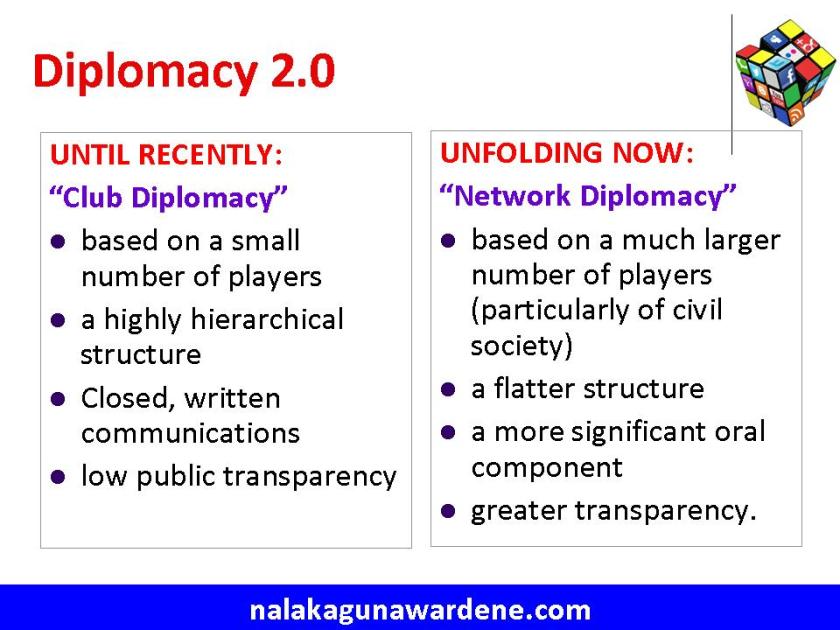
Diplomacy then...and now
Diplomacy then…and now

The nature of this ‘networked diplomacy’ is still being documented and studied. Some governments are not even convinced of its value, but meanwhile, others are encouraging it perhaps as a way of ‘exploiting the inevitable’.

I am neither diplomat nor scholar, but sometimes dabble as a writer and researcher on how new media – including social media – impact our society, economy and governance. So I welcomed an opportunity to engage a group of mid-career professionals on the topic Diplomacy & Foreign Relations in the Social Media Age.

I made this presentation on 14 November 2015 as part of the Certificate Course in Creative Diplomacy, conducted by the Regional Centre for Strategic Studies (RCSS) in Colombo, Sri Lanka – a think tank on international relations.

In this, I introduce and briefly explore the new kind of real-time, public diplomacy that is being ushered in with the spreading of social media. I show how diplomats and other government officials can no longer ignore this mass medium, but at the same time their traditional ways of communications need to be reoriented to suit the realities of this new information ecosystem that is informal, irreverent and fleeting.

As I spoke on the day after the ISIS terrorist attacks in France, I used (among others) the latest examples of how Gérard Araud, France’s Ambassador to the US, tweeted live as multiple terror attacks unfolded in Paris on Nov 13 night.

Real time tweeting by French Ambassador to the US while Paris attack was underway on 13 Nov 2015...
Real time tweeting by French Ambassador to the US while Paris attack was underway on 13 Nov 2015…
More tweets from Ambassador Gérard Araud
More tweets from Ambassador Gérard Araud on 13 Nov 2015…


To see the bigger picture, I’ve distilled some wisdom of key researchers in this area including: Anne-Marie Slaughter, former Princeton Academic and ex-Director of Policy Planning, US State Department; Philip Seib, Professor of Journalism and Public Diplomacy, University of Southern California; and Ramesh Thakur, Professor, Crawford School of Public Policy, Australian National University (ANU).

I also used the case study of Indian Ministry of External Affairs using social media for crisis management when 18,000 Indian nationals were stranded in Libya in Feb – March 2011 who had to be evacuated urgently.

As Ramesh Thakur has written, it is “a useful case study in the utility of social media tools in connecting the government with people who are normally well outside their range, but who can be a useful channel to send out time-urgent critical information and to receive equally valuable information from sources on the ground.”

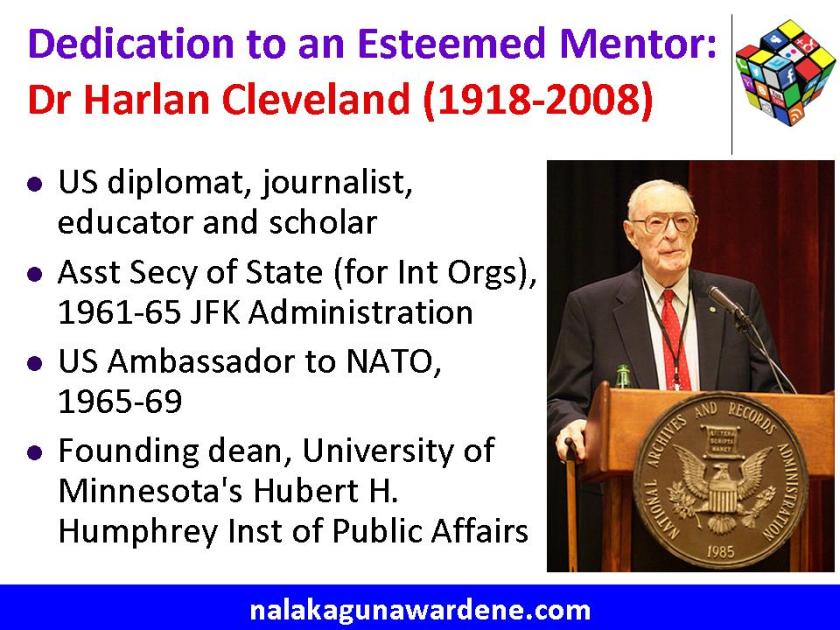
Dedication to a remarkable diplomat-scholar who spent a few days in the Summer of 1995 mentoring a group of youth leaders from around the world, including myself, who were brought to the UN Headquarters in New York...
Dedication to a remarkable diplomat-scholar who spent a few days in the Summer of 1995 mentoring a group of youth leaders from around the world, including myself, who were brought to the UN Headquarters in New York…

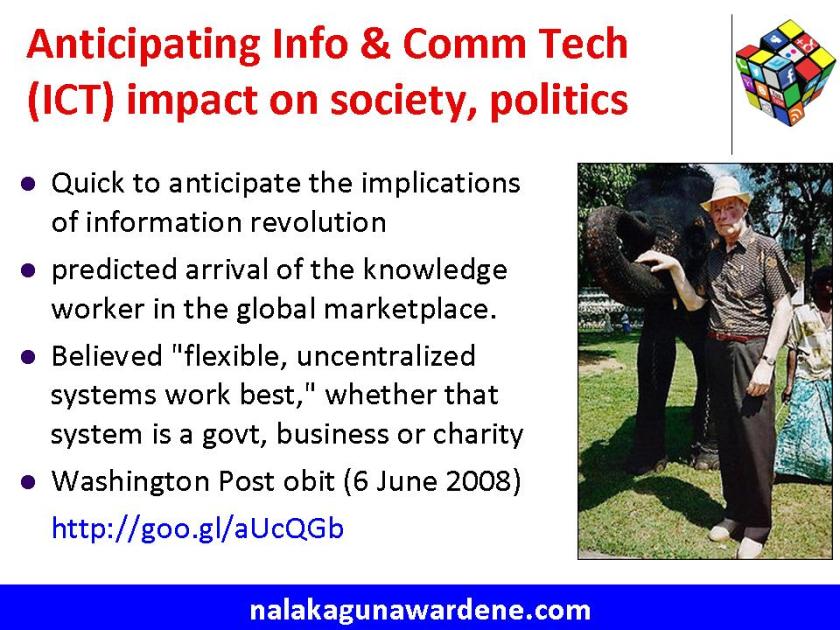
I dedicated this presentation to a diplomat and scholar whose mentoring I was privileged to receive 20 years ago: Dr Harlan Cleveland (1918 – 2008) who served as US Ambassador to NATO, 1965–1969 (Johnson Administration), and earlier as US Assistant Secretary of State for International Organization Affairs, 1961–1965 (Kennedy Administration).

Harlan Cleveland, among the first 'philosophers' of the Information Age
Harlan Cleveland, among the first ‘philosophers’ of the Information Age

According to RCSS, their Course in Creative Diplomacy “provides theoretical and practical insights into the various facets of Creative Diplomacy. The course will expand participants’ understanding of the concept of diplomacy and expose them to new skills and alternative perspectives to engage with stakeholders. It is further envisioned that this post-disciplinary approach, which will be followed by the course, will explore a whole host of new mediums through which mediation, cooperation and negotiation can be carried out.”

Right to Information should be a step towards Open Government

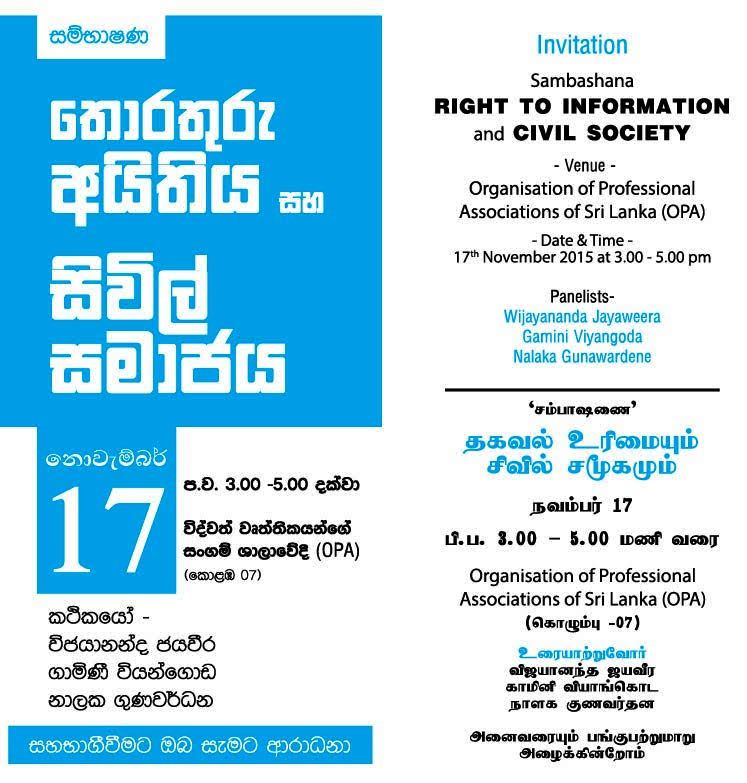
Transparency International Sri Lanka (TISL) held a Public Forum on the Right to Information in Colombo on 17 November 2015. I was one of three panelists, along with Wijayananda Jayaweera and Gamini Viyangoda. The panel was moderated by TISL’s Shan Wijetunge.

RTI Public Forum on 17 Nov 2015

The meeting was conducted in Sinhala. After the event, a journalist from an English language newspaper asked for a summary of my remarks in English, so I wrote this up.

L to R - Wijayananda Jayaweera, Gamini Viyangoda, Nalaka Gunawardene, Shan Wijetunge. At Right to Information public forum on 17 Nov 2015 in Colombo. Photo by Sampath Samarakoon
L to R – Wijayananda Jayaweera, Gamini Viyangoda, Nalaka Gunawardene, Shan Wijetunge. At Right to Information public forum on 17 Nov 2015 in Colombo. Photo by Sampath Samarakoon

Summary of remarks made at Right to Information Public Forum held in Colombo on 17 Nov 2015

 By Nalaka Gunawardene

Science writer, columnist and new media researcher

After many years of advocacy by civil society groups and journalists, Sri Lanka is set to soon adopt a law guaranteeing citizens’ Right to Information (RTI, also known as freedom of information laws in some countries). With that, we will join over 100 other countries that have introduced such progressive laws.

The first step is already taken. The 19th Amendment to the Constitution, passed in Parliament in April 2015, made the right to information a fundamental right.

The Right to Information Act is meant to institutionalize the arrangement – i.e. put in place the administrative arrangement where a citizen can seek and receive public information.

Some have been critical of the current draft of the RTI Bill as it falls short of the ideal. But in my view, adopting even an imperfect RTI law would be progress.

But we need to see the law’s adoption as only the beginning of a long journey. Proper implementation will require adequate political will, administrative support and sufficient public funds. We would also need sustained monitoring by civil society groups and media to guard against the whole process becoming mired in too much red tape.

RTI signifies unleashing a new potential, and a major change in status quo. First, we need to shake off a long historical legacy of governments not being open or accountable to citizens.

For over 2,000 years of monarchy, over 400 years of colonial rule and 67 years of self-rule since independence, all our governments have restricted public information – even mundane ones unrelated to any security or sensitive issues.

Thus, the ‘default setting’ in most government agencies seems to be to deny and restrict information. When this finally changes, both public servants and citizens will need to adjust.

Information custodians can no longer release selectively, or demand petty bribes for doing so. Citizens, on their part, must find purpose and focus in information they can demand and receive. RTI is not a mere political slogan.

To draw an analogy from water management, opening sluice gates of a water reservoir can benefit only if the downstream systems are in place and the users are ready. With both water and information, recipients need to know how to make the best use of what comes through.

As long-standing champions of RTI, Lankan media and civil society must now switch roles. While benefiting from RTI themselves, they can nurture the newly promised openness in every sphere of public life. They can show, inspire and equip other citizens how best to make use of it.

However, RTI is not just a piece of law or changing how governments share public information. At its most basic, RTI is a collective state of mind. With its adoption, a society can start moving along a more open, informed and inquisitive pathway.

Better management of public information – which covers its proper gathering, storing, analysing and disseminating – should come into sharper focus with RTI.

In a related development, Sri Lanka has just joined an international, multilateral initiative called the Open Government Partnership (OGP). It is the first country in South Asia to do so.

OGP is a global effort “to make governments better”. It aims to secure firm commitments from governments to promote transparency, empower citizens, fight corruption, and harness new technologies to strengthen governance. OGP was launched in September 2011, and since then, the partnership has grown to 69 countries representing over a third of the world’s population.

To join OGP, a country must meet minimum eligibility criteria. These cover the timely publication of essential budget documents forms the basic building blocks of budget accountability; RTI guaranteed by law; rules that require public disclosure of income and assets for elected and senior public officials; and openness to citizen participation and engagement in policymaking and governance, including basic protections for civil liberties.

With its impending RTI law, Sri Lanka became eligible to join OGP. Its membership was confirmed at the recent OGP Conference held in Mexico City in late October 2015, where Sri Lanka endorsed the Open Government Declaration committing “to foster a global culture of open government that empowers and delivers for citizens, and advances the ideals of open and participatory 21st century government.”

Sri Lanka was represented at this event by Justice Minister Wijeyadasa Rajapakshe, Deputy Minister of Foreign Affairs Dr Harsha de Silva, and Sri Lanka’s Ambassador to the United States Prasad Kariyawasam. (Embassy press release: http://slembassyusa.org/embassy_press_releases/sri-lanka-joins-the-open-government-partnership/)

In his speech in Mexico City, Minister Wijeyadasa Rajapakshe said: “Our people have proven that citizens will and should be at the heart of the destiny of any country. Importantly, the events this year reaffirm the resilience of our democracy and make it apparent that it is the people that demand an ‘open government’ for my country.”

Now the Yahapalana Government must walk this lofty talk.

OGP member countries are required to prepare a National Action Plan (NAP) which should be done collaboratively by the government and civil society. Such plans should cover a two-year period and consist of a set of commitments that advance transparency, accountability, participation and/or technological innovation.

The bottomline with Right to Information is this. RTI is not simply a legal or technocratic solution. It is not a quick fix to all problems that affect our society. But it heralds a new way of thinking – a paradigm shift, if you like – that would make our government more open, and our society more focused on using information and data to make our lives better.

Part of the audience at RTI Public Forum on 17 Nov 2015 in Colombo
Writer and activist Gamini Viyangoda speaks at RTI Public Forum on 17 Nov 2015

Op Ed: Let’s Get Real about Sri Lanka’s Urbanization!

On 12 November 2015, Daily Mirror broadsheet newspaper in Sri Lanka published my op-ed essay on the need to take a new look at urbanization in Sri Lanka.

It is reproduced here in full:

Let’s Get Real about Sri Lanka’s Urbanization!

By Nalaka Gunawardene

The level of urbanization is an indicator of a country’s economic development and the living standards of its people.

Some purists might disagree, but it is universally agreed that urban areas – cities and towns of various size and shape – offer better facilities and opportunities for their residents.

So how urbanized is Sri Lanka? Many among us keep repeating a notion that ‘we are predominantly rural’, but is it really so?

The 2012 Census of Population and Housing categorised only 18.2% of the Lankan population as being urban. However, that figure is highly misleading because we currently use a narrow definition.

Currently, only those living in Municipal Council (MC) or Urban Council (UC) areas are considered urban. However, some Pradeshiya Sabha areas (the next local government unit) are just as urbanised.

Minister of Megapolis and Western Development Champika Ranawaka speaks at LBO-LBR Infrastructure Summit 2015 (Image courtesy LBO)

At the recent LBR/LBO Infrastructure Summit 2015 held in Colombo in early November, Minister of Megapolis and Western Development Champika Ranawaka took on this myth head on. He argued that Sri Lanka’s urban population share is probably as high as 48% — which is two and a half times higher than the current figure.

He mentioned as examples Pradeshiya Sabha areas like Homagama, Beruwala and Weligama that are administratively classified as ‘rural’ despite having many urban characteristics.

His concern: misconceptions such as this distort the country’s policy decisions on infrastructure planning and urban development.

The World Bank’s global lead for urban development strategies, Sumila Gulyani, who spoke during the opening session, agreed with the Minister’s contention of nearly half of Sri Lanka’s population having already become urban.

The Bank’s own estimates are roughly the same, she said. “The official statistics of urban population in Sri Lanka is from 14% to 18% — but if you look at the agglomeration, it is (actually) around 47%”.

World Bank's Sumila Gulyani speaks in Colombo, 3 Nov 2015. (Image courtesy LBO)
World Bank’s Sumila Gulyani speaks in Colombo, 3 Nov 2015. (Image courtesy LBO)

She added: “All South Asia countries under-state their urbanization level relative to, say, Latin America. In India it’s the same story. The reason has traditionally been that the rural areas got more national subsidy programmes — and no administration wanted to be called urban!”

Taking South Asia as a whole, 30% of its combined population now lives in cities. A massive rise in this urban share is expected in the coming decades. Sri Lanka cannot buck this trend.

Despite this, old myths linger on for years. The problem, as Gulyani highlighted, is in the mismatch of capabilities: “If the (local government) council that is managing an urban area is a rural council, you are not going to see the kind of planning and urban management you need to see for productive urban growth.”

 Hidden Urbanization

Copy of Leveraging Urbanization in South Asia - new World Bank ReportMeanwhile, a new World Bank report on urban trends in South Asia reminds us that Sri Lanka’s share of the population officially classified as living in urban areas actually fell slightly between 2000 and 2010.

“These official statistics, however, miss considerable ‘hidden’ urbanization,” says the report, titled Leveraging Urbanization in South Asia: Managing Spatial Transformation for Prosperity and Livability (September 2015).

The report suggests that as much as one-third of Sri Lanka’s population may be living in areas that, while not officially classified as urban, “nevertheless possess strong urban characteristics”.

This report tries to overcome our region’s data deficiencies by drawing on some unconventional data sources — such as nighttime lights and other forms of remotely sensed earth observation data.

Analysis of night lights has also revealed a more general growth of multi-city agglomerations – continuously lit belts of urbanization containing two or more sizeable cities – across South Asia. Their number has risen from 37 in 1999 to 45 in 2010.

In Sri Lanka, the report says, such ‘ribbon development’ radiates out from Colombo along major transport arteries to link it with both Kandy and Galle/Matara, revealing a dynamic urbanization process.

A general conclusion of the report is that South Asian countries urgent need to increase higher quality and more comprehensive data on urban trends and conditions.

South Asia at night - composite satellite image taken in April & Oct 2012 (Image courtesy NASA)
South Asia at night – composite satellite image taken in April & Oct 2012 (Image courtesy NASA)

Anomaly of 1987

 In Sri Lanka, the low figure for urban population is the direct result of an administrative decision to count all Pradeshiya Sabha areas as being rural. This has long been critiqued by experts such as town planner Prof Ashley L S Perera of the University of Moratuwa.

When the new local government unit was created in 1987 for political expediency, their demarcations totally ignored the existing ground realities, he says. That has led to much confusion about ‘urban areas’ in Sri Lanka for the past quarter century.

Statisticians in Sri Lanka’s government are also well aware of this. Analysing the key findings of the 2012 head count, the Department of Census and Statistics says that the country’s urban percentage “would have been much higher if the definitional issues were resolved”.

In its Census of Population and Housing 2012: Key Findings, the Department notes: “Areas coming under all Municipal Coun­cils (MC) and Urban Councils (UC) are currently considered as urban sector in Sri Lanka. Prior to 1987, Town Councils were also included in the definition of urban areas. With the setting up of Provincial Councils in 1987, these Town Councils were absorbed into Pradeshiya Sabhas which fall into the rural sector since then.”

After 1987, some towns lost their urban status and overnight became ‘officially rural’. The Department acknowledges that there are many areas outside MCs and UCs that “have urban outlook but still classified as rural”.

This leads to underestimation of the degree of urban­ization and comparison becomes difficult over the years, it says.

The Department highlights the need to “introduce a realistic definition of urban areas taking into account of the characteristics of the population rather than based on pure administrative considerations.”

It says that Sri Lanka’s urban percentage “would have been much higher if the definitional issues were resolved”.

At the time of the 2012 Census, Sri Lanka had a total of 23 MCs and 41 UCs. According to the Census findings, the country’s eight largest cities – Colombo, Kaduwela, Dehiwala-Mount Lavinia, Moratuwa, Negombo, Kotte, Kesbewa and Maharagama – made up nearly half (48%) of what is officially considered the ‘urban’ population. All these are located in the Western Province.

The balance 56 urban areas include 26 small cities with population below 25,000. “This shows the uneven distribution of the urbanization” says the Department.

The Census found that in the Colombo district, three out of four people (77.6%) already live in urban ar­eas. Batticaloa (28.7%), Ampara (23.6%), Trincomalee (22.4%) districts in Eastern province and Mannar (24.5%), Vavuniya (20.2%), Jaffna (20.1%) districts in Northern province all have urbaniza­tion levels higher than the current national average of 18.2%.

Misleading the world

Adopting a more pragmatic and realistic definition of ‘urban’ is thus a policy priority for Sri Lanka. That can help better planning of our rapidly urbanising human habitats.

Such a move can, hopefully, also awaken those Lankans who insist about their ‘very rural island’ contrary to what the evidence suggests.

It would also stop international organisations and researchers from mistakenly labelling Sri Lanka as a country with only a small urban population.

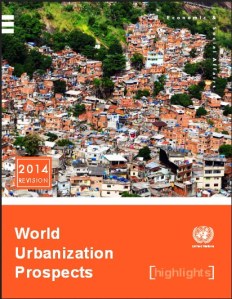
World Urbanization Prospects 2014For example, World Urbanization Prospects 2014, a global overview published by the UN Department of Economic and Social Affairs, has listed Sri Lanka as one of 16 countries worldwide that “still have low levels of urbanization, i.e. below 20 per cent”. (As an inter-governmental body, the UN goes by national governmental data.)

The largest (by population) among these ‘low urbanized countries’, were listed as Burundi, Ethiopia, Malawi, Niger, South Sudan, Uganda, Nepal and Sri Lanka. “By 2050, all of these countries are expected to become significantly more urbanized, with as much as twice their respective proportions urban in 2014,” the UN report noted.

However, as minister Ranawaka just publicly declared, that doubling has already happened in Sri Lanka! Now if only official data custodians can change definitions, we can finally move away from the illusion of being a rural country…

Census of Population and Housing 2012: Key Findings can be accessed online at: http://countryoffice.unfpa.org/srilanka/?publications=12333

Science writer Nalaka Gunawardene writes regularly on science, development and media issues. He blogs at http://nalakagunawardene.com

Exploring Open Data and Open Government in Sri Lanka

An Open Dialogue about Open Data

Today, I gave the opening speech at an introductory seminar on ‘open data’ held at the Sri Lanka Press Institute, Colombo, on 15 Oct 2015.

Organised by InterNews and Transparency International Sri Lanka, the seminar explored the concepts of ‘open data’ and ‘big data’ and discussed that role civil society, media and technologists can play in advocating to government to open up its data, enabling a culture of transparency and open government.

An Open Dialogue on Open Data - 15 Oct 2015 Coloombo - L to R - Sriganesh Lokanathan, Nalaka Gunawardene, Sanjana Hattotuwa [Photo by Sam de Silva]
An Open Dialogue on Open Data – 15 Oct 2015 Coloombo – L to R – Sriganesh Lokanathan, Nalaka Gunawardene, Sanjana Hattotuwa [Photo by Sam de Silva]
My premise was that while the proliferation of digital tools and growth of web-based data storage (the cloud) opens up new possibilities for information generation and sharing, South Asian societies need to tackle institutional and cultural factors before democratised and digital data can really transform governance and development. Our countries must adopt more inclusive policies and practices for public sharing of scientific and other public data.

This resonates with a call by the United Nations for a ‘data revolution for development’. I cited the UN Secretary-General’s Independent Expert Advisory Group on a Data Revolution for Sustainable Development (IEAG) highlighted this in a report titled  A World That Counts: Mobilising The Data Revolution for Sustainable Development (Nov 2014).

A World that Counts...
A World that Counts…

I also referred to the Sustainable Development Goals (SDGs) that were adopted by member states of the UN at a heads of state level summit in New York on 25-27 September 2015. Underpinning all 17 SDGs is an explicit recognition of the value of data for development — to better inform decisions, and to better monitor progress.

Sri Lanka’s President Maithripala Sirisena addressed the Summit, and officially committed Sri Lanka to the SDGs. I argue that implicit in that commitment is a recognition of data for development and open data policies. We now need to ask our government to introduce a government-wide policy on data collection, storage and sharing. In short, it must open up!

This was my open call to the President to open up:

Open Your Govt's Data, Mr President! Hope you don't give us HAL's famous answer...
Open Your Govt’s Data, Mr President! Hope you don’t give us HAL’s famous answer…

Sri Lanka has taken tentative steps towards open data. In 2013, the Open Data initiative of Government started making some official datasets freely available online. It focuses on machine-readable (well-structured and open) datasets.

I quoted from my own recent op-ed published in Daily Mirror broadsheet newspaper:

Daily Mirror, 14 Sep 2015: Beyond RTI: Moving to Open Data and Open Govt. by Nalaka Gunawardene

After many years of advocacy by civil society, Sri Lanka will soon adopt a law that guarantees citizens’ Right to Information (RTI). It has recently been added to the Constitution as a fundamental right.

Passing the RTI law is only a beginning — institutionalising it requires much effort, considerable funds, and continued vigilance on civil society’s part.

RTI is Coming: Are We Ready? My question to Lankan civil society and media

As champions of RTI, media and civil society must now switch roles, I said. While benefiting from RTI themselves, they can nurture the newly promised openness in every sphere, showing citizens how best to make use of it. Reorienting our public institutions to a new culture of openness and information sharing will be an essential step.

Here is my full PPT:


සිවුමංසල කොලූගැටයා #240: සියවසක් පැරණි පුවත් ආකෘතියෙන් ඔබ්බට අපේ මාධ්‍ය පරිනාමය වේද?

On 2 October 2015, I gave a talk to a group of provincial level provincial journalists in Sri Lanka who had just completed a training course in investigative journalism.

I looked at the larger news media industry in Sri Lanka to which provincial journalists supply ground level news, images and video materials. These are used on a discretionary basis by media companies mostly based in the capital Colombo (and some based in the northern provincial capital of Jaffna). Suppliers have no control over whether or how their material is processed. They work without employment benefits, are poorly paid, and also exposed to various pressures and coercion.

I drew an analogy with the nearly 150-year old Ceylon Tea industry, which in 2014 earned USD 1.67 billion through exports. For much of its history, Ceylon tea producers were supplying high quality tea leaves in bulk form to London based tea distributors and marketers like Lipton. Then, in the 1970s, a former tea taster called Merrill J Fernando established Dilmah brand – the first producer owned tea brand that did product innovation at source, and entered direct retail.

He wanted to “change the exploitation of his country’s crop by big global traders” – Dilmah has today become one of the top 10 tea brands in the world.

The media industry also started during British colonial times, and in fact dates back to 1832. But I questioned why, after 180+ years, our media industry broadly follows the same production model: material sourced is centrally processed and distributed, without much adaptation to new digital media realities.

In this week’s Ravaya column, (appearing in issue of 11 Oct 2015), I have adapted my talk into Sinhala.

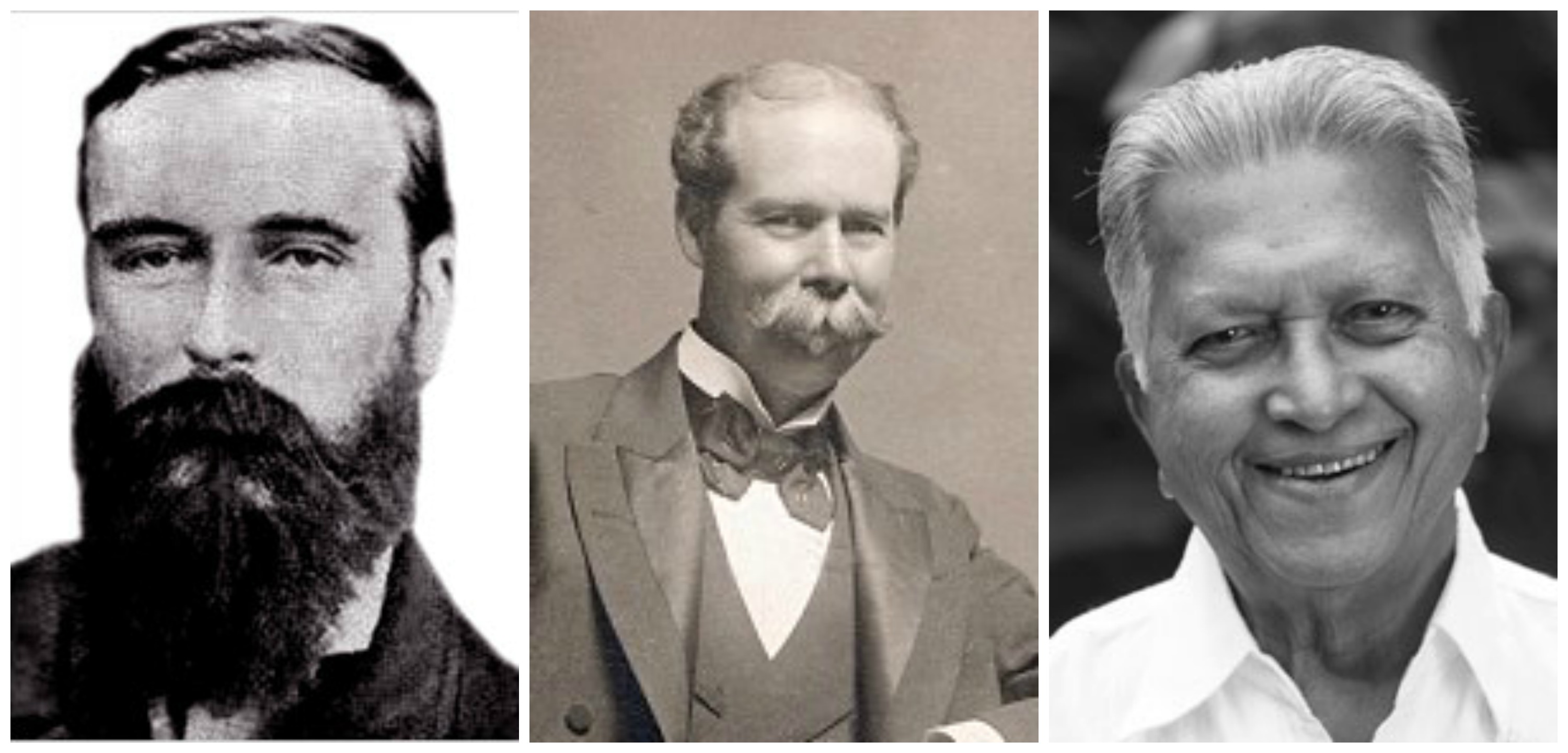
Ceylon Tea industry pioneers and innovator: L to R - James Taylor, Thomas Lipton, Merril Fernando
Ceylon Tea industry pioneers and innovator: L to R – James Taylor, Thomas Lipton, Merrill Fernando

ප‍්‍රාදේශීය මාධ්‍යවේදීන් සිය ගණනක් අපේ දිවයිනේ නන් දෙස විසිර සිටිනවා. තම ගමේ, නගරයේ හා අවට ප‍්‍රදේශවල සිදුවීම් ගැන තොරතුරු හා රූප/වීඩියෝ දර්ශන පුවත්පත් ආයතන හා විද්‍යුත් මාධ්‍ය ආයතනවලට නිරතුරුව ලබා දෙන්නේ මේ අයයි.

මේ නිසා ප‍්‍රාදේශීය මාධ්‍යවේදීන් බිම් මට්ටමින් සක‍්‍රීය හා සංවේදී පිරිසක්. ඔවුන් බහුතරයක් කොළඹ පිහිටි මාධ්‍ය ආයතනවලටත්, සෙසු අය යාපනයේ පිහිටි මාධ්‍ය ආයතනවලටත් වාර්තා කරනවා.

මේ කේන්ද්‍ර ද්විත්වයේදී ඔවුන්ගේ දායකත්වය නිසි තක්සේරුවකට හෝ සැලකීමකට හෝ ලක් වන්නේ නැහැ. ඇත්තටම ප‍්‍රාදේශීය මාධ්‍යවේදීන් ඉතා අඩු ගෙවීම්වලට ලොකු අවදානම් ගනිමින් සේවයේ නිරත වනවා යයි කිව හැකියි.

ප‍්‍රාදේශීය මාධ්‍යවේදීන් 75 දෙනකුට ගවේෂණාත්මක වාර්තාකරණය පිළිබඳ පුහුණුවක් අවසානයේ සහතික ප‍්‍රදාන උත්සවයක් පසුගිය සතියේ කොළඹදී පැවැත්වුණා. එය සංවිධානය කළේ ට‍්‍රාන්ස්පේරන්සි ඉන්ටර්නැෂනල් ශ‍්‍රී ලංකා කාර්යාලය හා ශ‍්‍රී ලංකා පුවත්පත් ආයතනයයි. එහිදී දේශන පැවැත්වීමට මහාචාර්ය රොහාන් සමරජීවටත්, මටත් ඇරයුම් කර තිබුණා.

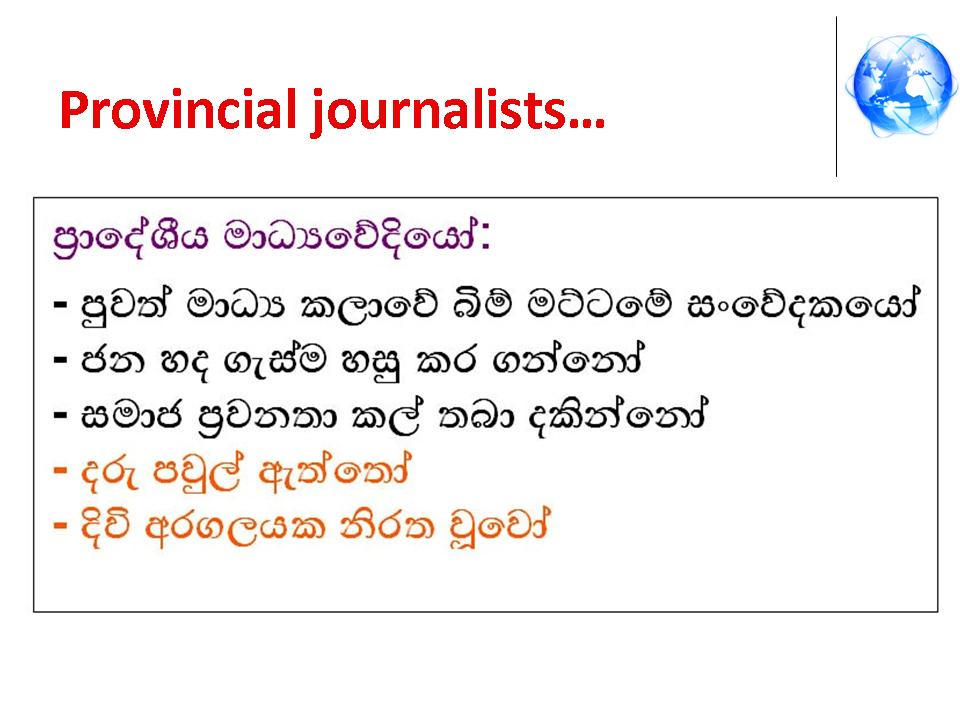
ප‍්‍රාදේශීය මාධ්‍යවේදීන් විවිධාකාරයෙන් හඳුන්වා දිය හැකියි. ප‍්‍රවෘත්ති මාධ්‍ය කලාවේ බිම් මට්ටමේ සංවේදකයෝ, ජන හද ගැස්ම හඳුනන්නෝ හා සමාජ ප‍්‍රවණතා කල් තබා දකින්නෝ ආදී වශයෙන්. මගේ කතාවේ මා මීට අමතරව ඔවුන් දරු පවුල් ඇත්තෝ හා දිවි අරගලයක නිරත වූවෝ කියා ද හැඳින් වූවා.

2015 සැප්තැම්බර් මුලදී මින්නේරිය සමඟිපුරදී වල් අලි ප‍්‍රහාරයකට ලක්ව ඉතා අවාසනාවන්ත ලෙසින් මිය ගිය කේ. එච්. ප‍්‍රියන්ත රත්නායක නම් ප‍්‍රාදේශීය මාධ්‍යවේදියා මා සිහිපත් කළා. එම අනතුර ගැන සටහනක් ලියූ සමාජ විචාරක හා බ්ලොග් රචක අජිත් පැරකුම් ජයසිංහ කීවේ මෙයයි.

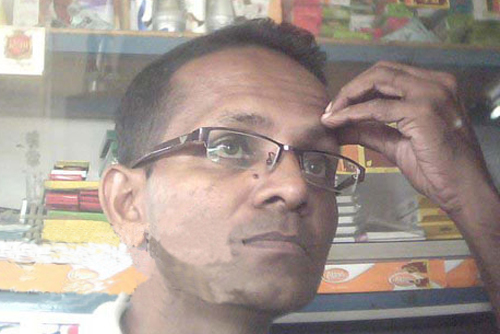
Priyantha Ratnayake, Sri Lanka provincial journalist who died of an elephant attack in September 2015

“සාමාන්‍යයෙන් ප්‍රාදේශීය මාධ්‍යකරුවෝ විවිධ ආකාරයෙන් මාධ්‍ය ආයතන ගණනාවකට එක වර සේවය සපයති. සපයනු ලබන ප්‍රවෘත්තිවලට පමණක් සුළු ගෙවීමක් ලබන ඔවුන්ට පැවැත්මක් තිබෙන්නේ එවිටය. අඩු තරමේ ඔවුන්ගේ නම හෝ ප්‍රචාරය වන්නේ දේශපාලකයකුගෙන් ගුටි කෑම වැනි අනතුරුදායක කටයුත්තකදී පමණි.

“ප්‍රාදේශීය මාධ්‍යකරුවන් යනු මාධ්‍ය ආයතනවල සූරාකෑමට දරුණු ලෙස ගොදුරු වන පිරිසකි. ඔවුන්ට සාමාන්‍යයෙන් ගත් කල කිසිදු පුහුණුවක් නැත. මාධ්‍යකරුවන්ට ලබා දෙන විධිමත් ආරක්ෂක පුහුණුවකදී නම් වාර්තාකරණයේදී ආත්මාරක්ෂාව සපයා ගන්නා ආකාරය පුහුණු කරනු ලැබේ. එහෙත් ලංකාවේ බහුතරයක් ප්‍රාදේශීය මාධ්‍යකරුවන්ට ප්‍රවෘත්ති පිළිබඳ මූලික අවබෝධය පවා නැත. බොහොමයක් මාධ්‍යකරුවන් එවන ප්‍රවෘත්ති නැවත ලියන්නට සිදු වේ.

“මාධ්‍ය ආයතනවලට ප්‍රාදේශීය මාධ්‍යකරුවා තවත් එක් උපකරණයක් පමණි. මොන යම් ආකාරයකින් හෝ ප්‍රාදේශීය ප්‍රවෘත්ති ලැබෙනවා නම් මාධ්‍ය ආයතනවලට ඇතිය. රටේම මිනිසුන්ට වන අසාධාරණකම් විවේචනය කරන මාධ්‍ය ආයතනවල ප්‍රාදේශීය මාධ්‍යකරුවන් සූරාකෑම නැවැත්වීමට කටයුතු කළ යුතුය.”

Full text: ප්‍රාදේශීය මාධ්‍යකරුවන්ගේ ජීවිත සූරා කන මාධ්‍ය ආයතන

මේ විග‍්‍රහයට මා එකඟයි. මාධ්‍යවේදීන්ට “මාධ්‍ය කම්කරුවන්’’ මට්ටමින් සැලකීම හුදෙක් ප‍්‍රාදේශීය වාර්තාකරුවන්ට පමණක් සීමා වී නැතත්, එය වඩාත් බරපතළ වන්නේ ඔවුන් සම්බන්ධයෙනුයි.

හොඳින් ලාභ ලබන මුද්‍රිත හා විද්‍යුත් මාධ්‍ය ආයතන පවා ප‍්‍රාදේශීය මාධ්‍යවේදීන්ට ගෙවන්නේ ඉතා අඩුවෙන්. එය ද ඔවුන් සපයන තොරතුරක් හෝ රූපයක් හෝ භාවිත වූවොත් පමණයි. එයට අමතරව නිවාඩු, රක්ෂණ ආවරණ ආදී කිසිවක් ඔවුන්ට හිමි නැහැ.

මේ අසාධාරණයට ලක් වන රාදේශීය මාධ්යවේදීන්ට සිය මාධ්යකරණයේ නියැලීමට විකල්ප රමවේද හා අවකාශයන් තිබේද? ඒවා විවර කර ගැනීමට කුමක් කළ යුතුද?

මේ ගැන මගේ කතාවේදී මා මෙනෙහි කළා. එහිදී මාධ්‍ය කර්මාන්තයේ පුවත් සම්පාදන ආකෘතිය සමීපව විමර්ෂනය කළ යුතු බව මගේ අදහසයි.

Colombo Journal, first newspaper in Ceylon, founded in January 1832

(1802 දී ආරම්භ කළ ගැසට් පත‍්‍රය මාධ්‍ය අංගයක් ලෙස නොසැළකුවොත්) ශ‍්‍රී ලංකාවේ නූතන මාධ්‍යකරණය ඇරැඹුණේ 1832 ජනවාරියේදී. කලම්බු ජර්නල් (Colombo Journal) නම් සති දෙකකට වරක් පළ වූ ඉංග‍්‍රීසි සඟරාව මෙරට මුල්ම වාරික ප‍්‍රකාශනයයි. එවකට බි‍්‍රතාන්‍ය යටත් විජිත රජයේ මුද්‍රණාලයාධිපතිව සිටි ජෝර්ජ් ලී එහි කතුවරයා වූවා. එකල ආණ්ඩුකාරයා වූ රොබට් විල්මට් හෝට්න් ද එයට ලිපි සැපයුවා.

මෙබඳු රාජ්‍ය සබඳතා තිබුණත් පෞද්ගලික මට්ටමින් පවත්වා ගෙන ගිය කලම්බු ජර්නල් සඟරාව පැවති රජය විවේචනය කිරීම නිසා ටික කලකින් පාලකයන්ගේ උදහසට ලක් වූවා. (රජය හා මාධ්‍ය අතර මත අරගලය මාධ්‍ය ඉතිහාසය තරම්ම පැරණියි!) මේ නිසා 1833 දෙසැම්බර් මස සඟරාව නවතා දමනු ලැබුවා.

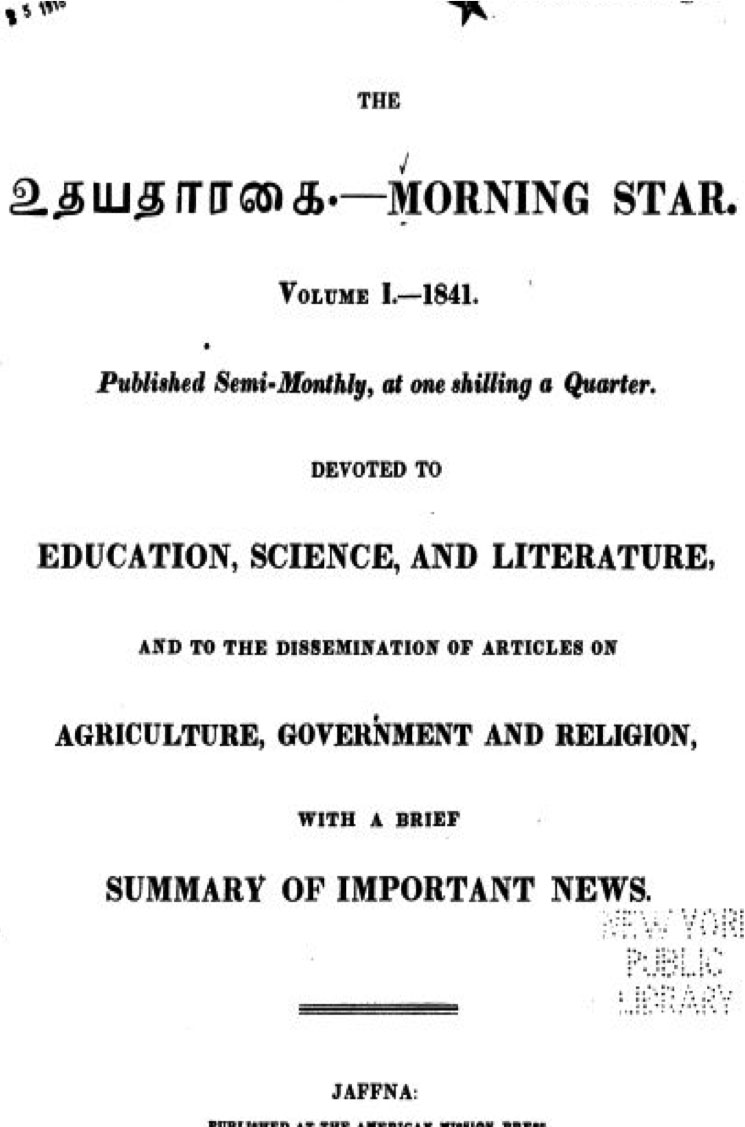
දෙමළ බසින් මුල්ම වාරික ප‍්‍රකාශනය වූ “උදය තාරකායි’’ 1841දී යාපනයෙන්ද, මුල්ම සිංහල පුවත්පත ලෙස සැලකෙන “ලංකාලෝක’’ 1860දී ගාල්ලෙන්ද අරඹනු ලැබුවා. (මෙයින් පෙනෙන්නේ මුල් යුගයේ මාධ්‍ය ප‍්‍රකාශනය කොළඹට පමණක් කේන්ද්‍ර නොවූ බවයි.)

The first Tamil newspaper in Sri Lanka, Udaya Tharakai, was started in 1841 from Jaffna
The first Tamil newspaper in Sri Lanka, Udaya Tharakai (=Morning Star), was started in 1841 from Jaffna

1832 ආරම්භය ලෙස ගත් විට වසර 180කට වඩා දිග ඉතිහාසයක් අපේ මාධ්‍ය කර්මාන්තයට තිබෙනවා. එය වඩාත් සංවිධානාත්මක කර්මාන්තයක් බවට පත් වූයේ 20 වන සියවසේදී. 1925දී රේඩියෝ මාධ්‍යයත්, 1979දී ටෙලිවිෂන් මාධ්‍යයත්, 1995දී ඉන්ටර්නෙට් සබඳතාවත් මෙරටට හඳුන්වා දෙනු ලැබුවා.

මුද්‍රිත හා විද්‍යුත් මාධ්‍යවලට දශක ගණනක ඉතිහාසයක් ඇතත් එහි පුවත් එකතු කිරීමේ ආකෘතිය තවමත් වෙනස් වී නැහැ. එහි සැපයුම්දාමය ප‍්‍රාදේශීය මාධ්‍යවේදීන්ගේ සිට කොළඹ/යාපනය ප‍්‍රධාන කාර්යාලවලට එනවා. එතැනදී තේරීමකට හා ප‍්‍රතිනිර්මාණයට ලක් වනවා. ඉන් පසු රටටම බෙදා හරිනවා.

එම ක‍්‍රියාවලියේදී ප‍්‍රාදේශීය මාධ්‍යවේදීන්ට තීරක බලයක් නැහැ. කලකට පෙර නම් ඔවුන්ගේ නම පවා පත්තරවල පළ කළේ කලාතුරකින්. පුවත් ප‍්‍රමුඛතාව හා කුමන ආකාරයේ පුවත් පළ කරනවා ද යන්න ගැන න්‍යාය පත‍්‍රය මුළුමනින්ම තීරණය කරන්නේ කේන්ද්‍රීය කාර්යාල විසින්. ගතානුගතිකත්වය හා වැඩවසම් ආකල්ප තවමත් අපේ මාධ්‍ය කර්මාන්තයේ බහුලයි.

මෙය කෙසේ වෙනස් කළ හැකිද? මාධ්‍ය කර්මාන්ත ආකෘති කෙසේ නවෝත්පාදනයට ලක් කළ හැකිද? වෙනත් කර්මාන්තවලින් ආදර්ශයක් ගත හැකි දැයි මා ටිකක් විපරම් කළා.

තේ කර්මාන්තය ද බි‍්‍රතාන්‍ය පාලන සමයේ ඇරැඹි මේ වන විට ඉතා සංවිධානාත්මකව ක‍්‍රියාත්මක වන දැවැන්ත කර්මාන්තයක්. 2014දී ඇමෙරිකානු ඩොලර් බිලියන 1.67ක් (රුපියල් බිලියන 231) ආදායම් ලද මේ කර්මාන්තය ඍජුව ලක්ෂ හත හමාරකට ජීවිකාව සපයනවා.

චීනයේ සිට මුලින්ම තේ පැළයක් මෙරටට ගෙනාවේ 1824දී වුවත්, වැවිලි කර්මාන්තයක් ලෙස තේ වැවීම පටන් ගත්තේ කෝපි වගාව දිලීර රෝගයකින් විනාශ වූ විටයි. මුල්ම තේ වත්ත 1867දී මහනුවර දිස්ත‍්‍රික්කයේ අරඹන ලද ලූල්කඳුර වත්තයි. එය ඇරැඹු ජේම්ස් ටේලර් (James Taylor: 1835-1892) තේ වගාවෙ පුරෝගාමියා ලෙස සැලකෙනවා.

සුළුවෙන් පටන් ගත් තේ වගාව ටිකෙන් ටික උඩරට හා පහතරට වෙනත් ප‍්‍රදේශවලට ව්‍යාප්ත වුණා. මෙරට භාවිතයට මෙන්ම පිටරට යැවීමටත් තේ කොළ නිෂ්පාදනය කරනු ලැබුවා.

සන්ධිස්ථානයකත් වූයේ තොමස් ලිප්ටන් (Thomas Lipton: 1841-1931) නම් බි‍්‍රතාන්‍ය ව්‍යාපාරිකයා 1890දී මෙරටට පැමිණ ජේම්ස් ටේලර් ඇතුළු තේ වැවිලිකරුවන් මුණ ගැසීමයි. තොග වශයෙන් ලංකා තේ මිලට ගෙන ලන්ඩනයට ගෙන ගොස් එහිදී පැකට් කර ලොව පුරා බෙදාහැරීම හා අලෙවිකරණය ඔහු ආරම්භ කළා. ලිප්ටන් තේ ලොව ප‍්‍රමුඛතම වෙළඳ සන්නාමයක් වූ අතර අපේ තේවලින් වැඩිපුරම මුදල් උපයා ගත්තේ එබඳු සමාගම්.

Lipton Advertisement for Ceylon Tea in 1892

මේ තත්ත්වය නිදහසෙන් පසුද දිගටම පැවතියා. ගෝලීය මට්ටමෙන් තේ බෙදා හැරීමේ හැකියාව හා අත්දැකීම් තිබුණේ යුරෝපීය සමාගම් කිහිපයකට පමණයි.

තේ රස බලන්නකු ලෙස වෘත්තීය ජීවිතය ඇරැඹු මෙරිල් J ප‍්‍රනාන්දු නම් ලාංකික තරුණයා ලන්ඩනයේ 1950 ගණන්වල පුහුණුව ලබද්දී මේ විසමතාව ඉතා සමීපව දුටුවා. යළි සිය රට පැමිණ තේ කර්මාන්තයේ සියලූ අංශවල අත්දැකීම් ලත් ඔහු 1988දී ගෝලීය දැවැන්තයන්ට අභියෝග කිරීමට තමාගේම සමාගමක් ඇරැඹුවා. එහි නම ඩිල්මා (Dilmah Tea: www.dilmah.com)

ඩිල්මා සමාගම කළේ මෙරට නිපදවන තේ කොළ මෙහිදීම අගය එකතු කොට, තේ බෑග් එකක් ඇසුරුම් කොට ඔවුන්ගේ වෙළඳනාමයෙන් ගෝලීය වෙළඳපොළට යැවීමයි. මුලදී දැවැන්ත බහුජාතික සමාගම් සමග තරග කිරීමට ඉතා දුෂ්කර වුවත් නවෝත්පාදනය හා නිර්මාණශීලී අලෙවිකරණය හරහා ලෝක වෙළඳපොළ ජය ගන්නට ඩිල්මා සමත්ව සිටිනවා.

අද ලොව රටවල් 100කට ආසන්න ගණනක සුපර්මාර්කට්වල ලිප්ටන් වැනි තේ අතර ඩිල්මා ද අලෙවි කැරෙනවා.

ඩිල්මා යනු මෙරටින් බිහි වූ විශිෂ්ටතම වෙළඳ සන්නාමයන්ගෙන් එකක්. එහි සාර්ථකත්වයට මුල දශක ගණනක් පැවැති තේ කර්මාන්ත ආකෘතිය අභියෝගයට ලක් කිරීමයි.

Image courtesy Dilmah.com website

තේ කර්මාන්තය මෙසේ නවෝත්පාදනයට ලක් වෙමින් විවිධාංගීකරණය වෙද්දී අපේ මාධ් කර්මාන්ත ආකෘතිය සියවසක් තිස්සේ එතරම් වෙනස් වී නැහැ. මුද්රණ තාක්ෂණය හා ඩිජිටල් උපාංග අතින් නවීකරණය වුවද රාදේශී් පුවත් කේන්ද්රයකට ලබා ගෙන, පෙරහන් කොට රටටම එතැනින් බදීම එදත් අදත් එසේම කර ගෙන යනවා.

මේ ක‍්‍රියාදාමය තුළ ප‍්‍රාදේශීය මාධ්‍යවේදීන් මා සම කළේ කුඩා තේ වතු හිමිකරුවන්ටයි. අක්කර 10ට වඩා අඩු බිම්වල තේ වවන මොවුන් ලක්ෂ 4ක් පමණ සිටිනවා. 2013 මෙරට සමස්ත තේ නිපැයුමෙන් 60%ක් වගා කළේ ඔවුන්.

තමන්ගේ තේ දළු අවට තිබෙන ලොකු තේ වත්තකට විකිණීම ඔවුන්ගේ ක‍්‍රමයයි. එතැනින් ඔබ්බට තම ඵලදාව ගැන පාලනයක් ඔවුන්ට නැහැ.

මේ උපමිතිය මා සඳහන් කළ විට මගේ සභාවේ සිටි එක් ප‍්‍රාදේශීය මාධ්‍යවේදියෙක් කීවේ තමන් සුළු තේ වතු හිිමියන්ටත් වඩා අසරණ බවයි. තේ දළු විකුණා ගැනීම සාමාන්‍යයෙන් ප‍්‍රශ්නයක් නොවෙතත්, තමන් සම්පාදනය කරන පුවත් හා රූපවලින් භාවිතයට ගැනෙන්නේ (හා ගෙවීම් ලබන්නේ) සමහරකට පමණක් බව ඔහු කියා සිටියා.

මෙරට මාධ්‍ය කර්මාන්තය සමස්තයක් ලෙස පර්යේණාත්මකව හදාරමින් සිටින මා මතු කළ ඊළඟ ප‍්‍රශ්නය මෙයයි. තේ කර්මාන්තයේ පිළිගත් ආකෘතියට අභියෝග කළ මෙරිල් ප‍්‍රනාන්දුට සමාන්තරව මාධ්‍ය කර්මාන්තයේ මුල් බැස ගත් ආකෘතිය අභියෝගයට ලක් කරන්නේ කවුද?

යම් තාක් දුරට මෙය පුරවැසි මාධ්‍යවේදීන් කරනවා. බ්ලොග් ලේඛකයන්, සමාජ ජාල මාධ්‍ය භාවිත කරන්නන් ප‍්‍රධාන ප‍්‍රවාහයේ මාධ්‍ය ගැන නොතකා කෙලින්ම තම තොරතුරු, අදහස් හා රූප ලොවට මුදා හරිනවා. රටේ ජනගහනයෙන් 20%ක් ඉන්ටර්නෙට් භාවිත කරන නිසා මෙය තරමක් දුරට සීමිත වූවත් (මා මීට පෙර විග‍්‍රහ කර ඇති පරිදි) එසේ සම්බන්ධිත වූවන් හරහා සමාජයේ තව විශාල සංඛ්‍යාවකට එම තොරතුරු ගලා යනවා.

මෙය දිගු කාලීනව ප‍්‍රධාන ප‍්‍රවාහයේ මාධ්‍යවලට අභියෝගයක්. එහෙත් අපේ බොහෝ මාධ්‍ය එය හරිහැටි වටහාගෙන නැහැ. ඔවුන් තවමත් සිටින්නේ ලිප්ටන් ආකෘතියේ මානසිකත්වයකයි.

හැකි පමණට වෙබ් හරහා තම තොරතුරු හා රූප මුදාහැරීම සමහර ප‍්‍රාදේශීය මාධ්‍යවේදීන් ආරම්භ කොට තිබෙනවා. උදාහරණ ලෙස මා ගෙන හැර දැක්වූයේ ගාල්ලේ බෙහෙවින් සක‍්‍රීය හා උද්‍යෝගීමත් මාධ්‍යවේදී සජීව විජේවීරයි. ඔහු ෆේස්බුක් හරහා බොහෝ දේ බෙදා ගන්නා අතර Ning.com නම් සමාජ මාධ්‍ය වේදිකාව හරහා ගාලූ පුරවැසියෝ නම් එකමුතුවක්ද කලක් කර ගෙන ගියා.

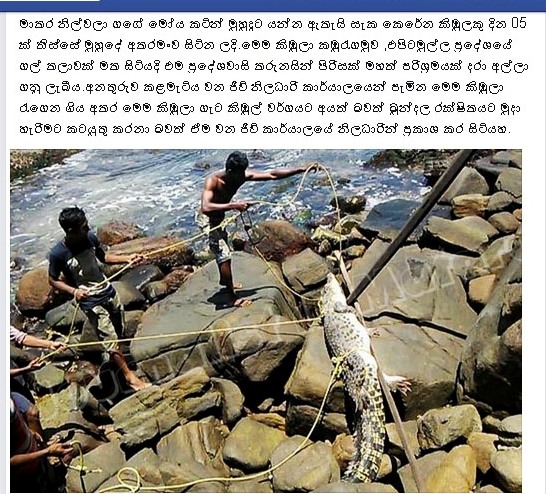
Example from journalist in Matara Facebook group: Catching a crocodile in Kamburugamuwa, Matara, 23 Sep 2015

මේ අතර මාතර දිස්ත‍්‍රික්කයේ ප‍්‍රාදේශීය මාධ්‍යවේදීන් 70 දෙනෙකු එක් වී Journalist in Matara නම් විවෘත ෆේස්බුක් පිටුවක් කරනවා. ඒ හරහා තමන් එකතු කරන තොරතුරු හා රූප බෙදා ගන්නවා. ප‍්‍රාදේශීය වශයෙන් වැදගත් එහෙත් සැම විටම ජාතික මාධ්‍යවලට අදාළ නොවන බොහෝ දේ එහි හමු වනවා.

මෙබඳු තවත් උදාහරණ වෙනත් ප‍්‍රදේශවලද සිංහලෙන් හා දෙමළෙන් තිබෙනවා. එහෙත් මේ කිසිවකුට තවම ඒ හරහා ජීවිකාව උපයා ගන්නට බැහැ. හොඳ මාධ්‍ය අංග සඳහා පාඨකයන් කැමති ගානක් ගෙවා නඩත්තු කරන ආකාරයේ සමූහ සම්මාදම් නැතිනම් ජනතා ආයෝජන ක්‍රමවේදයන් (crowd-funding) වඩාත් දියුණු රටවල දැන් තිබෙනවා. එම ආකෘති අප අධ්‍යයනය කොට හැකි නම් අදාළ කර ගත යුතුයි.

මේ කිසිවක් ප‍්‍රධාන ප‍්‍රවාහයේ මාධ්‍යවලට ඍජුව අභියෝග කිරීමක් නොවේ. එහෙත් නිසි පිළි ගැනීමකට හෝ සාධාරණ ගෙවීමකට ලක් නොවී සිටින ප‍්‍රාදේශීය මාධ්‍යවේදීන් තාක්ෂණය හරහාවත් බලාත්මක කොට ඒ හරහා අපේ තොරතුරු සමාජය වඩාත් සවිමත් කළ හැකි නම් කොතරම් අපූරුද?

A tale of two industries:  one that evolved, and the other that hasn't quite done so...
A tale of two industries: one that evolved, and the other that hasn’t quite done so…

සිවුමංසල කොලූගැටයා #239: ශ‍්‍රී ලංකාවේ ස්මාට් නගර බිහි කරන්නට අප සූදානම්ද?

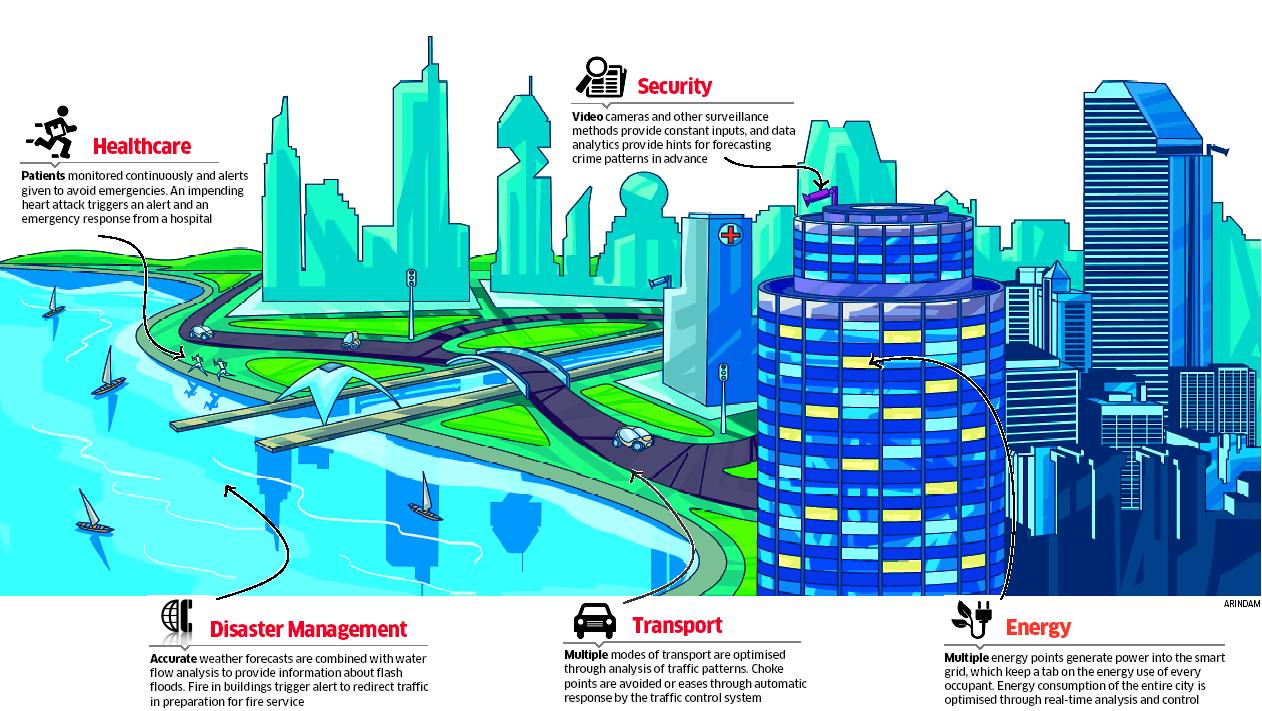
Smart city visualisation

The term ‘smart city’ refers to urban systems, and not to the smartness of residents. In fact, there is no universal definition of smart cities: it can mean smart utilities, smart housing, smart mobility or smart design.

Smart cities use information and communications technologies (ICTs) as their principal infrastructure. These become the basis for improving the quality and performance of urban services, reducing costs and resource consumption, and for engaging citizens more effectively.

ICTs – ranging from automatic sensors to data centres — would create ‘feedback loops’ within the complex city systems. If processed properly, this flow of data in real time can vastly improve the design of “hard” physical environment and the provision of “soft” services to citizens.

In this week’s Ravaya column, (in Sinhala, appearing in issue of 4 Oct 2015), I explore the concept of smart cities, which the new government of Sri Lanka wants to develop.

It is a formidable task. India in 2014 announced an ambitious programme to create 100 smart cities. Under this, state capitals, as well as many tourist and heritage cities are to receive funding for upgrading their infrastructure. But Prime Minister Modi and his technocrats have been struggling since then to explain just what they mean by smart cities.

I argue that smart cities need empowered people and engaged city administrators. I have argued in earlier in this column, concrete and steel do not a city make. Likewise, ICT enabled smart infrastructure alone will not create smart cities – unless the human factor is well integrated.

Smart City illustration by Times of India

ස්මාට් නගර ගැන කතාබහක් මතුවෙමින් තිබෙනවා. යෝජිත බස්නාහිර මෙගා නගරය (Western Regional Megapolis) ස්මාට් නගර ආකෘතියේ එකක් වනු ඇතැයි ද කියනවා.

ඒ අතර නගර සැලසුම් අමාත්‍ය රවුෆ් හකීම් සැප්තැම්බර් මුලදී කීවේ මහනුවර මෙරට මුල්ම ස්මාට් නගරය කිරීමට තමන්ට ඕනෑ බවයි.

ස්මාට් නගර යනු මොනවාදැයි හරිහැටි දැනගෙන මේ සංවාද කිරීම වැදගත්.

ඉංග‍්‍රීසියෙන් Smart Cities කියන්නේ ඩිජිටල් තාක්ෂණය හෙවත් තොරතුරු හා සන්නිවේදන තාක්ෂණ (ICT) සූක්ෂම ලෙස යොදා ගනිමින් නාගරික සේවාවල තත්ත්වය හා ප‍්‍රමිතිය උසස් කරන නාගරික ප‍්‍රදේශවලටයි.

ඒ හරහා සම්පත් හා බලශක්ති පරිභෝජනය කාර්යක්ෂම කර ගන්නා අතර වියදම් අඩු කර ගන්නවා. නාගරික කළමනාකරණය විද්වත් පදනමක් මත කරන ගමන් ජනතා සහභාගීත්වය ද වැඩි කරනවා. අප කවුරුත් පතන්නේ මෙවැනි නගර තමයි!

Smart Cities යන්නට වඩා සුදුසු සිංහල යෙදුම කුමක්ද?

මීට සති කිහිපයකට පෙර මේ ප‍්‍රශ්නය මා ෆේස්බුක් ජාලයේ මතු කළා. යෝජනා ගණනාවක් ලැබුණා. සූක්ෂ්ම නගර, බුද්ධිමත් නගර හා සවිඥානික නගර ආදී වශයෙන්.

ආචාර්ය සුනිල් විජේසිරිවර්ධන නුවණැති නගර යන්නත්, ආචාර්ය සුමනසිරි ලියනගේ දැනුමැති නගර යන යෙදුමත් යෝජනා කළා. මේ අතර රෙන්ටන් ද අල්විස් කීවේ උදාර නගර හෝ නැණැති නගර උචිත බවයි. ආචාර්ය හර්ෂණ රඹුක්වැල්ල සිතන්නේ ප‍්‍රබුද්ධ නගර වඩා හොඳ බවයි.

බ්ලොග් ලේඛක අජිත් පැරකුම් ජයසිංහ සංවාදයට එක් වෙමින් කීවේ මෙයයි: ‘‘ස්මාට් කියන වචනය දැන් බොහෝ දුරට සිංහල වෙලා නිසා මෙයට වෙනත් වචනයක් හදන්න උත්සාහ නොකර ස්මාට් පුරවර කියන යෙදුම හොඳයි.’’

ස්මාට් නගර ගැන පුළුල්ව සංවාද කිරීම අවශ්‍යයි. පණ්ඩිත යෙදුමක් වෙනුවට කාටත් පහසුවෙන් තේරුම් ගත හැකි සම්මත සිංහල වචනයක් එකඟ විය හැකි නම් හොඳයි. එතෙක් ස්මාට් නගර හා ස්මාට් පුරවර යන්න මා යොදා ගන්නවා.

Smart Cities image

ස්මාට් නගරවලට තනි නිර්වචනයක් නැහැ. නගරයක් ‘ස්මාට්’ වන්නේ යටිතල සැලසුම් පහසුකම්, ප‍්‍රවාහන සේවාවන් හෝ සැලසුම්කරණය අතින් විය හැකියි. පොදු සාධකය වන්නේ සංකීර්ණ පද්ධතිවල ක‍්‍රියාකාරීත්වය නිරතුරුව හා සජීවී ලෙසින් නිරික්සමින් නඩත්තු කිරීමේ තීරණ හා පියවර ක්ෂණිකව ගනිමින් සිටීමයි.

මෙයට ඉංග‍්‍රීසියෙන් feedback loop යයි කියනවා. නිරතුරු ප‍්‍රතිශෝෂණය හරහා ප‍්‍රමිතීන්ට අනුකූලව සේවා ප‍්‍රශස්තව පවත්වා ගැනීම යයි අපට සිංහලෙන් කිව හැකියි.

තාක්ෂණික හෝ පාරිභාෂික යෙදුම්වලට වඩා වැදගත් වන්නේ සංකල්පීය නිරවුල් බවයි. කොන්ක‍්‍රීට් හා වානේ ගොඩක් එක් තැන් කළ පමණට කිසිදිනෙක ස්මාට් නගර බිහි වන්නේ නැහැ. ප‍්‍රවේශම් විය යුතු තැනත් එතැනයි. ජනතා සිතුම් පැතුම් නොතකා තැනූ හම්බන්තොට වැනි නගර ස්මාට් නගරවල විරුද්ධ පදය වැනියි.

ස්මාට් නගරවල මුඛ්‍ය අරමුණ එහි සියලූ නේවාසික වැසියන්ට හා එයට පිටතින් පැමිණෙන අයට ආයාසය හා වියදම් අඩු කාර්යක්ෂම සේවා සපයාදීමයි. නගරයක විසීම හෝ නගරයකට යම් කාරියක් සඳහා යාම වදයක් නොවී ප‍්‍රමෝදයක් බවට පත් කිරීමයි.

නාගරීකරණය නොනැවතී ඉදිරියට යන ලෝක ව්‍යාප්ත සංසිද්ධියක්. 2010දී අප වැදගත් කඩඉමක් පසු කළා. ලෝක ඉතිහාසයේ මුල් වතාවට ලොව ජනගහනයෙන් අඩක් (50%) නගරවල වෙසෙන බව සංඛ්‍යා ලේඛන තහවුරු කළා.

කලාපීය වශයෙන් ගත් විට දකුණු ආසියාවේ දැනට නාගරික ජන ප‍්‍රතිශතය 30%යි. එහෙත් එය සීග‍්‍රයෙන් ඉහළ යමින් තිබෙනවා. ඉදිරි දශකවල (2050 වනවිට) ඉන්දියාවේ පමණක් නාගරික ජනගහනය තවත් මිලියන 404ක් එකතු වෙතැයි ගණන් බලා තිබෙනවා.

මේ සඳහා වැඩිපුර දායක වන්නේ ග‍්‍රාමීය පෙදෙස්වලින් නගරවලට ඇදී එන ජන සංක‍්‍රමණයයි. පහසුකම් හා අවස්ථා සොයාගෙන එසේ පැමිණීම තහනම් කරන්නට ප‍්‍රජාතන්ත‍්‍රවාදී රටවලට බැහැ. කළ හැකි එකම දෙය එය දරාගන්නට සැලසුම් හා ආයෝජන කිරීමයි.

14 Sep 2015: World Bank Report on Leveraging Urbanization in South Asia

ස්මාට් නගර සන්නිවේදන තාක්ෂණය යොදා ගන්නේ දත්ත මත පදනම් වී සජීව ලෙසින් තීරණ ගන්නටග ඉන්ටර්නෙට් පරිනාමයේ ඊළඟ අදියර නම් ස්වයංක‍්‍රීයව අවට පරිසරය නිරීක්ෂණය කරමින්, දත්ත රැස් කරමින්, ඒවා එසැනින් හා නිරතුරුව ඉන්ටර්නෙට් හරහා යම් නිශ්චිත කේන්ද්‍රයකට සපයන සංවේදක (Sensors) ප‍්‍රචලිත වීමයි. මෙය දැනටමත් ඇරැඹී තිබෙනවා.

ඉදිරි වසර කිහිපයේ මේ ප‍්‍රවණතාව අධිවේගීව වර්ධනය වනු ඇති. ඉන්ටර්නෙට් මාධ්‍යය ස්වයංක‍්‍රීයව අපේ ලෝකය ගැන සංවේදී වීම හඳුන්වන්නේ Internet of Things (IOT) කියායි. මෙහි මූලික පදනම මුළුමනින් යන්ත‍්‍ර අතර කැරෙන සන්නිවේදනය හෙවත් තොරතුරු හුවමාරුවයි. (Machine-to-machine communications, M2M).

මේ හැම සංවේදකයටම එයට ආවේණික වූ අංකයක් (IP Address) තිබෙන නිසා එය නිශ්චිතව හඳුනා ගත හැකියි. සංවේදක ප‍්‍රමාදයකින් තොරව සජීවී ලෙසින් සපයන දත්ත හරහා යම් තැනෙක, යම් ප‍්‍රවාහයක අලූත්ම තත්ත්වය දුර සිට නිරීක්ෂණය කළ හැකියි. (මේ සංවේදක CCTV කැමරා සමග පටලවා නොගන්න. අප මෙහිදී කතා කරන්නේ ක්ෂුද්‍ර පරිපථ මට්ටමේ සියුම් උපාංග ගැනයි.)

මෙබදු සංවේදක දැනටමත් විශාල පරිමාණයෙන් දකුණු කොරියාව, ඩෙන්මාර්කය, ස්විට්සර්ලන්තය, ඇමරිකා එක්සත් ජනපදය හා ජර්මනිය වැනි රටවල නවීන නගරවල හා සමහර කර්මාන්තවල භාවිත වනවා.

සංවේදකවලට අමතරව හැම වස්තුවකටම එයට ආවේණික අනන්‍යතාවක් ලබාදීම ද තාක්ෂණික ප‍්‍රගමනයේ තවත් අරමුණක්. මේ සඳහා බාර්කෝඞ්, QR කෝඞ් ආදී තාක්ෂණ දැනටමත් බහුලව යොදා ගන්නවා.

නගරයක පොදු අවකාශයේ ඇති හැම ලයිට් කණුවක්, ටෙලිෆෝන් කනුවක්, කසල බාල්දියක්, පොදු දුරකතනයක් ආදිය මෙසේ සංවේදක හරහා අනන්‍යතාවට ලක් කළ විට ඒවායේ තත්ත්වය දුර සිට විමර්ෂනය කළ හැකියි. ක‍්‍රියාකාරීත්වයේ ගැටලූවක් මතු වූ විට හරියටම ප‍්‍රශ්නකාරී තැන ඉක්මනින් හඳුනා ගත හැකියි. ඉලක්කගතව ප‍්‍රශ්න කඩිනමින් විසඳිය හැකියි.

බලශක්ති අරපිරිමැසුම, පාරිසරික තත්ත්වය නිරීක්ෂණය, කසල කළමනාකරණය, ප‍්‍රවාහන පද්ධති ප‍්‍රශස්තිකරණය ආදී බොහෝ භාවිතයන්ට මේ තාක්ෂණය දැනටමත් සමහර දියුණු රටවල නගර යොදා ගන්නවා. අලූතෙන් බිහි වන ස්මාට් නගර මුල පටන්ම නිර්මාණය කැරෙන්නේ මේ තාක්ෂණය පදනම් කර ගෙනයි.

South Korea's Songdo is one of the world's first smart cities
South Korea’s Songdo is one of the world’s first smart cities

උදාහරණයක් නම් දකුණු කොරියාවේ සොංඩෝ (Songdo) ස්මාට් නගරය. අගනුවර සෝල් සිට කි.මි. 65ක් නිරිතදිගින් හෙක්ටාර් 600ක විසිරුණු මේ නගරය මුළුමනින්ම ස්වයං-සංවේදක මගින් නිරීක්ෂණය කැරෙන හා කළමනාකරණය කැරෙන ස්ථානයක්. තවමත් ඉදි වෙමින් පවතින මෙය ව්‍යාපාරික, නේවාසික හා පොදු පහසුකම් රැසකින් සමන්විත වනු ඇති.

එය මතු වන්නේ ඉන්චොන් (Incheon) නුවරට ආසන්නව මුහුද ගොඩ කර තනා ගත් බිම් පෙදෙසකයි. 2015 අගවන විට නිම කිරීමට නියමිත මෙහි වියදම ඩොලර් බිලියන 40ක්. තනිකරම පෞද්ගලික අංශයේ ආයෝජනයක්.

මෙසේ මුල සිටම සැලසුම් කොට අලූතෙන් ගොඩ නගන නගර ‘ස්මාට්’ කිරීම සාපේක්ෂව වඩා පහසුයි. එහෙත් ඓතිහාසිකව අක‍්‍රමිකවත් ලෙස වර්ධනය වූ හා අවුල් සහගතව පවතින නගරවලටත් නව තාක්ෂණයන් නැණවත්ව යොදා ගෙන ස්මාට් වීමට හැකියි.

පවතින නගර ස්මාට් නගර බවට පරිවර්තනය කිරීමේ දැවැන්ත ප‍්‍රතිසැලසුම්කරණ ව්‍යාපෘති අරඹා තිබෙනවාට උදාහරණ ගණනාවක් තිබෙනවා. නෙදර්ලන්තයේ ඇම්ස්ටර්ඩෑම්, ස්පාඤ්ඤයේ බාසෙලෝනා, ස්වීඩනයේ ස්ටොකෝම්, ඇමෙරිකාවේ කැලිෆෝනියා ජනපදයේ සැන්ටා කෲස් ඒ අතර වනවා.

ඉන්දියාව මුහුණ දි සිටින දැවැන්ත නාගරිකකරණ අභියෝගයට ප‍්‍රතිචාර දක්වමින් 2014 මැදදී අගමැති නරේන්ද්‍ර මෝඩිගේ රජය ප‍්‍රකාශ කළේ එළැඹෙන වසර කිහිපයේදී ස්මාට් නගර 100ක් ඇති කිරීමට ඉන්දියාව පියවර ගන්නා බවයි. ප‍්‍රාන්තවල අගනගර, සංචාරකයන්ට වැදගත් ඓතිහාසික නගර ආදිය මේ ලැයිස්තුවට අයත්. ඒ අතර අලූතින්ම සැලසුම් කොට මුල සිටම බිහි කරන නගරත් කිහිපයක් තිබෙනවා. http://smartcities.gov.in/

එහෙත් වසරකට පසුව මේ ස්මාට් නගර සඳහා නිශ්චිත ඉදිරි දැක්මක් ප‍්‍රකාශ කිරීම ඉන්දීය නිලධාරීන්ට අපහසු වී තිබෙනවා. අතිශයින් සංකීර්ණ නාගරික කළමනාකරණ ගැටලූවලට තනිකර තාක්ෂණික විසඳුම් නැහැ. සමාජ විද්‍යාත්මක උපදෙස් මත, ජනතා සිතුම් පැතුම්වලට සංවේදීවෙමින් ක‍්‍රමයෙන් කළ යුතු වෙනස්කම් රැසක් තිබෙනවා.

India's proposed smart cities
India’s proposed smart cities

හරිහැටි මූලික පහසුකම් පවා නොමැතිව ජීවත්වන මිලියන ගණන් ජනයා ඉන්දියානු නගරවල සිටිනවා. ස්මාට් නගර බිහි කිරීමේ අරමුණ සාර්ථක වන්නේ සානුකම්පිතව හා සංවේදීව නාගරික සංවර්ධනය කළ හොත් පමණයි. ඉන්දියාවේ සබුද්ධික හා සක‍්‍රීය සිවිල් සමාජ ක‍්‍රියාකාරිකයන් නිසා රජයකට හිතුමතේ ක‍්‍රියා කරන්නට බැහැ.

ස්මාට් නගරයක මූලිකම ගුණාංගය නම් ඉහළ කාර්යක්ෂමතාවයි. කාර්යක්ෂම නගර සැලසුම් කරන්නට හා කළමනාකරණය කරන්නට නම් නේවාසික ජනයා සහ දිනපතා නගරයට ඇදී එන ජනයාගේ චර්යා රටා සමීපව හඳුනාගත යුතුයි.

නගරයක වැඩිපුර ජනයා ගැවසෙන්නේ කුමන ස්ථානවල කිනම් වේලාවකද? සතියේ දිනවල හා සති අන්ත දිනවල වෙනස්කම් මොනවාද? මහාමාර්ග, බස් හා දුම්රිය නැවතුම් පොළවල්, කඩපිල් හා සාප්පු සංකීර්ණ මෙන්ම උද්‍යාන හා වෙනත් විවෘත ස්ථානවල දවසේ පැය 24 ගෙවී යන්නේ කුමන ජන රාශිගත වීම් අනුවද?

මෙකී නොකී තොරතුරු හැකිතාක් දැන ගැනීම සැලසුම්කරණයට උපකාර වනවා. මේවා ගැන දළ හැගීමක් නාගරික ජනයාට ඇතත් සැලසුම්කරණයට නිශ්චිත දත්ත හා ඒවායේ විචල්‍ය පරාසය (වෙනස් වන සැටි) දැනගැනීම අවශ්‍යයි.

මේ සඳහා මෙතෙක් යොදාගත්තේ විටින් විට කරන සමීක්ෂණයි. එහෙත් සමීක්ෂණවලට සංකීර්ණ පද්ධතියක සියලූ විස්තර හසු කර ගන්න බැහැ. මේ නිසා පරිගණක හා සන්නිවේදන තාක්ෂණ යොදාගනිමින් දැන් නව දත්ත විශ්ලේෂණ ක්ෂේත‍්‍රයක් බිහිවී තිබෙනවා.

ඉංග‍්‍රීසියෙන් Big Data යයි කියන මෙයට මහා දත්ත විශ්ලේෂණය යයි අපට කිව හැකියි. මේ ගැන වෙනම කොලමකින් ඉදිරි සතියක කතා කරමු.

ස්මාට්, සංවේදී හා සානුකම්පිත යන ගුණාංග සියල්ල කැටිකරගත් විට තමයි සැබෑ ස්මාට් නගර බිහිවන්නේ.


Grassroots Journalism in the Digital Age: Innovate or Perish!

Grassroots Journalism in the Digital Age - by Nalaka Gunawardene
Grassroots Journalism in the Digital Age – by Nalaka Gunawardene

I just spoke to a group of 75 provincial level provincial journalists in Sri Lanka who were drawn from around the island. They had completed a training course in investigative journalism conducted by Transparency International Sri Lanka (TISL), with support from InterNews.

The certificate award ceremony was held at Sri Lanka Press Institute (SLPI), Colombo, on 2 October 2015.

In this talk, I look at the larger news media industry in Sri Lanka to which provincial journalists supply ground level news, images and video materials. These are used on a discretionary basis by media companies mostly based in the capital Colombo (and some based in the northern provincial capital of Jaffna). Suppliers have no control over whether or how their material is processed. They work without employment benefits, are poorly paid, and also exposed to various pressures and coercion.

A tale of two industries: one that evolved, and the other that hasn't quite done so...
A tale of two industries: one that evolved, and the other that hasn’t quite done so…

I draw a rough analogy with the nearly 150-year old Ceylon Tea industry, which directly employs around 750,000 people, sustains an estimated 2 million (10% of the population) and in 2014 earned USD 1.67 billion through exports. For much of its history, the Ceylon tea producers were supplying high quality tea leaves in bulk form to London based tea distributors and marketers like Lipton.

Then, in the 1970s, a former tea taster called Merrill J Fernando established Dilmah brand – the first producer owned tea brand that did product innovation at source, and entered direct retail. He wanted to “change the exploitation of his country’s crop by big global traders” – Dilmah has today become one of the top 10 tea brands in the world.

The media industry also started during British colonial times, and in fact dates back to 1832. But I question why, after 180+ years, our media industry broadly follows the same production model: material sourced is centrally processed and distributed, without much adaptation to new digital media realities.

I draw a parallel between tea small holders – those growing on lands less than 10 acres (4 ha) who account for 60% of Sri Lanka’s annual tea production – and the provincial journalists. Both are supplies at the beginning of a chain. Neither has much or any say in how their material is processed and marketed.

Provincial Journalists - Ground level ‘eyes and ears’ of media industry, unsung & often unknown
Provincial Journalists – Ground level ‘eyes and ears’ of media industry, unsung & often unknown

As usual, I don’t have all the answers, but I ask some pertinent questions:

Where are the Merrill Fernandos of our media industry?

Who can disrupt these old models and innovate?

Can disruptive innovators emerge from among provincial journalists?

How can they leverage digital tools and web based platforms?

What if they start value-adding at source and direct distribution via the web?

But since they have families to feed, how to make an honest living doing that?
PPT on SLIDEShare:

http://www.slideshare.net/NalakaG/grassroots-journalism-in-the-digital-age-by-nalaka-gunawardene