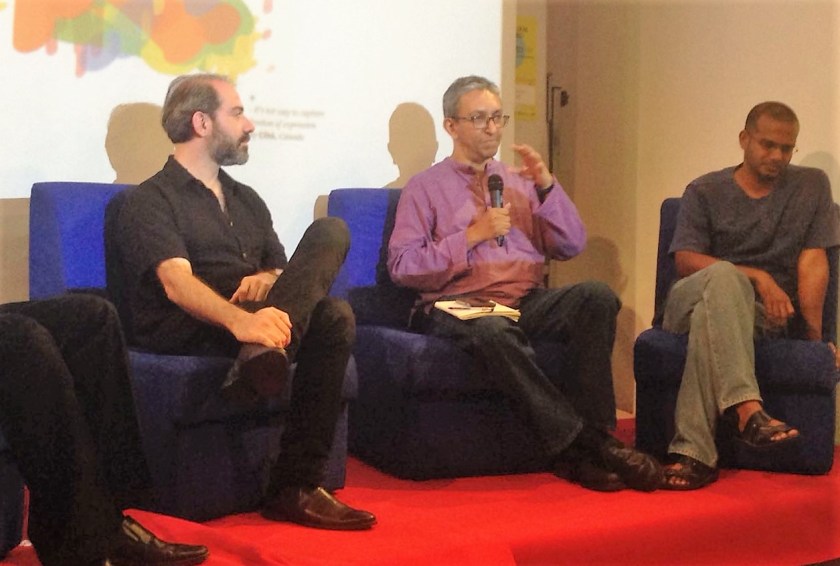
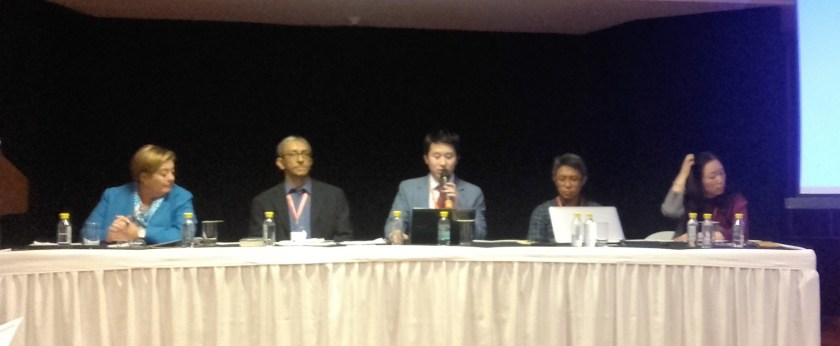
L to R – Kianoush Ramezani, Nalaka Gunawardene, Gihan de Chickera at Night of Ideas in Colombo, 26 January 2017
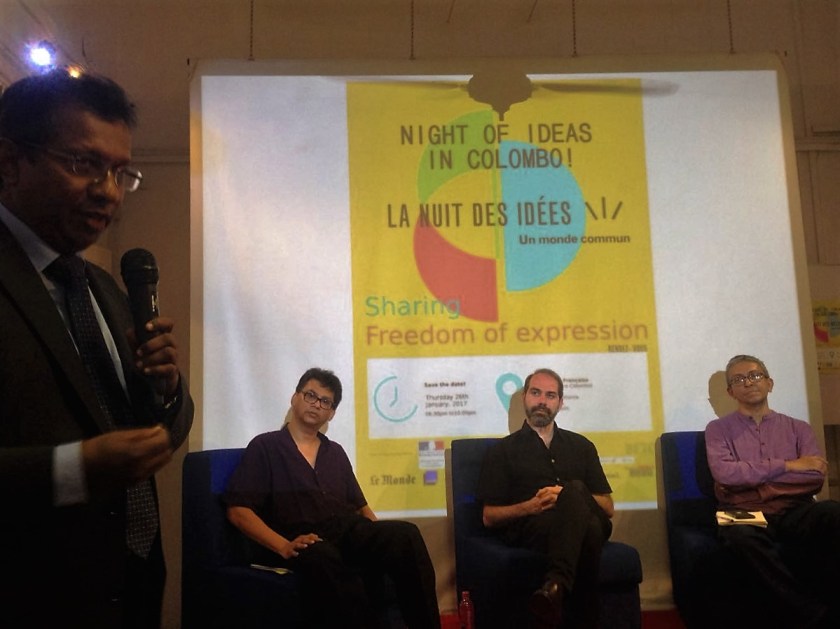
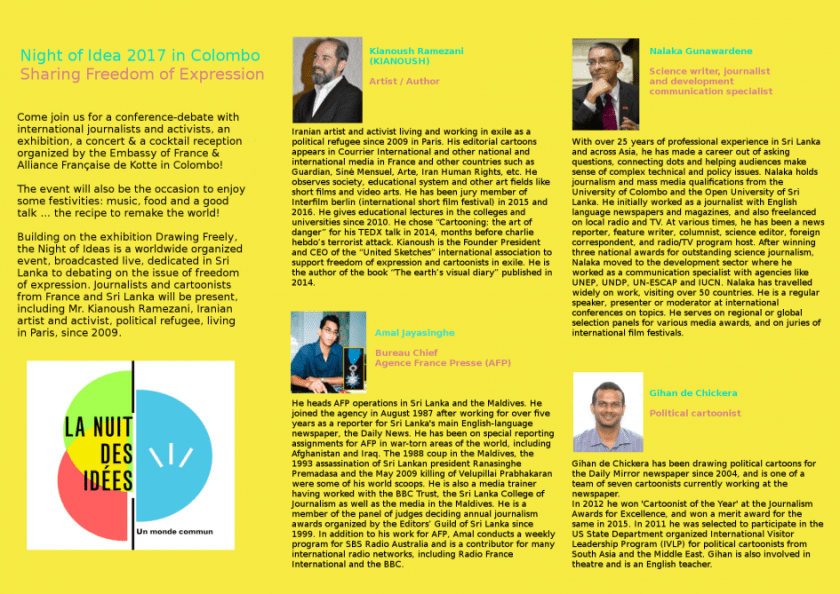
On 26 January 2017, the Alliance Française de Kotte with the Embassy of France in Sri Lanka presented the first ever “Night of Ideas” held in Colombo. During that event, participants were invited to engage in discussions on ‘‘A World in common – Freedom of Expression (FOE)” in the presence of French and Sri Lankan cartoonists, journalists and intellectuals.
I was part of the panel that also included: Kianoush Ramezani, Founder and President of United Sketches (Paris), an Iranian artist and activist living and working in Paris since 2009 as a political refugee; and Gihan de Chickera, Political cartoonist at the Daily Mirror newspaper in Sri Lanka. The panel was moderated by Amal Jayasinghe, bureau chief of Agence France Presse (AFP) news agency.
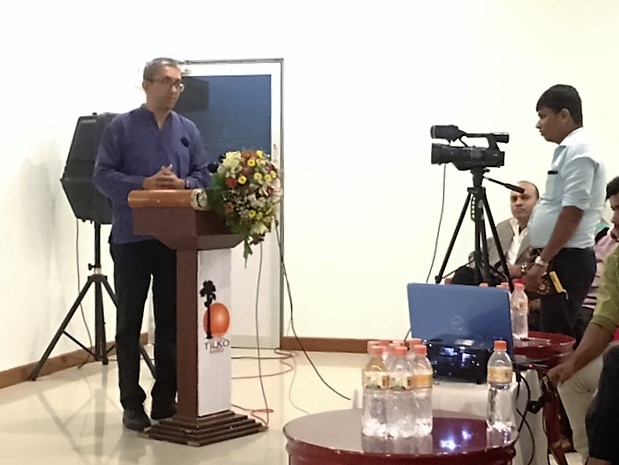
Human Rights Lawyer and activist J C Weliamuna opens the Night of Ideas in Colombo, 26 January 2017
In my opening remarks, I paid a special tribute to Sri Lanka’s cartoonists and satirists who provided a rare outlet for political expression during the Rajapaksa regime’s Decade of Darkness (2005-2014).
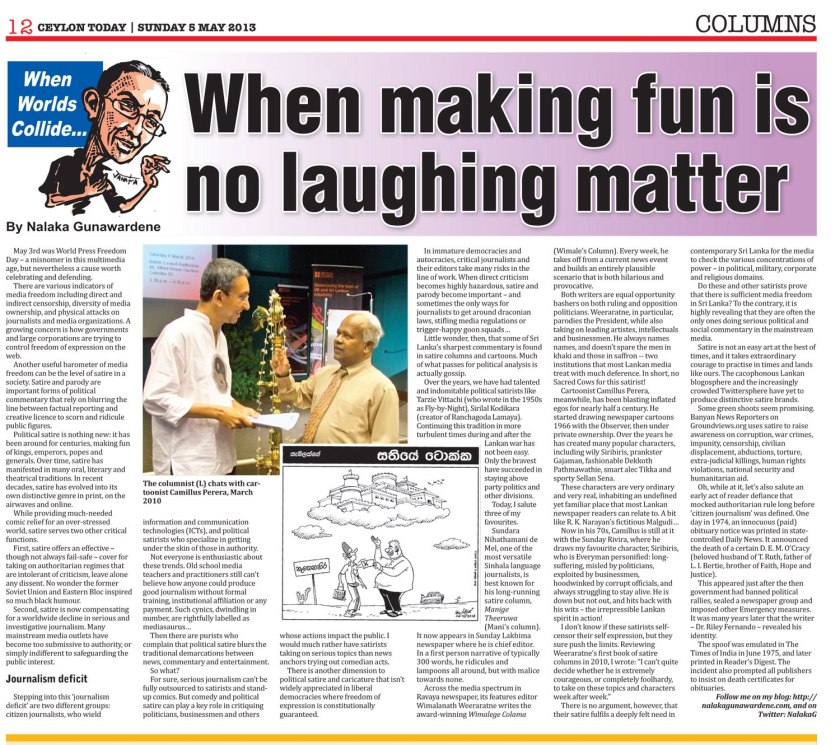
I referred to my 2010 essay, titled ‘When making fun is no laughing matter’ where I had highlighted this vital aspect of FOE. Here is the gist of it:
A useful barometer of FOE and media freedom in a given society is the level of satire that prevails. Satire and parody are important forms of political commentary that rely on blurring the line between factual reporting and creative license to scorn and ridicule public figures.
Political satire is nothing new: it has been around for centuries, making fun of kings, emperors, popes and generals. Over time, satire has manifested in many oral, literary and theatrical traditions. In recent decades, satire has evolved into its own distinctive genre in print, on the airwaves and online.
Satire offers an effective – though not always fail-safe – cover for taking on authoritarian regimes that are intolerant of criticism, leave alone any dissent. No wonder the former Soviet Union and Eastern Bloc inspired so much black humour.
This particular dimension to political satire and caricature that isn’t widely appreciated in liberal democracies where freedom of expression is constitutionally guaranteed.
In immature democracies and autocracies, critical journalists and their editors take many risks in the line of work. When direct criticism becomes highly hazardous, satire and parody become important — and sometimes the only – ways for journalists get around draconian laws, stifling media regulations or trigger-happy goon squads…
Little wonder, then, that some of Sri Lanka’s sharpest political commentary is found in satire columns and cartoons. Much of what passes for political analysis in the media is actually gossip.
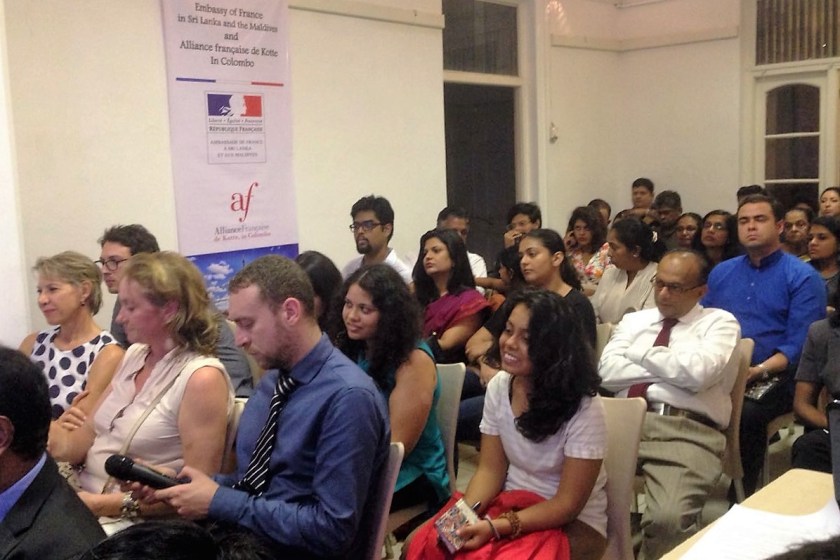
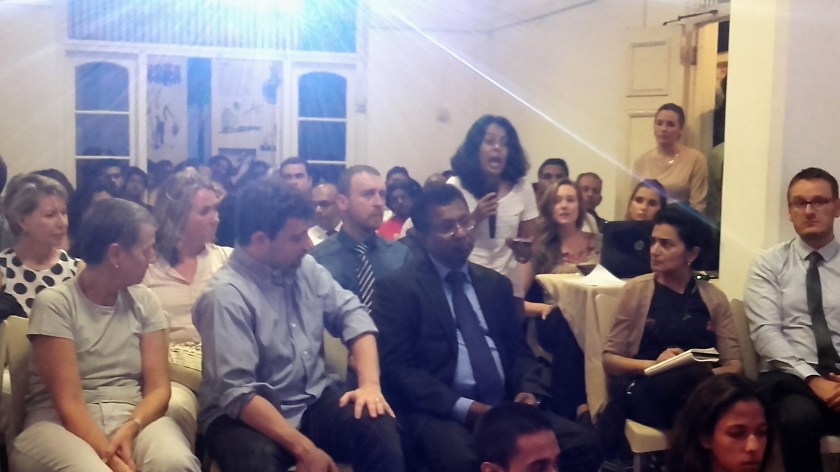
Part of the audience for Night of Ideas at Alliance Française de Kotte, 26 Jan 2017Audience engages the panel during Night of Ideas at Alliance Française de Kotte, 26 Jan 2017Night of Ideas in Colombo – promotional brochure
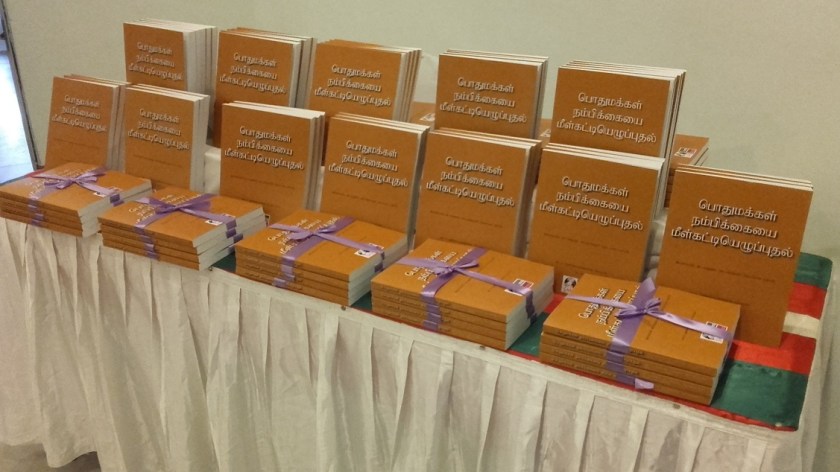
Rebuilding Public Trust: Tamil version copies displayed at the launch in Jaffna, 24 Jan 2017
Journalists, academics, politicians and civil society representatives joined the launch of Tamil language version of Sri Lanka’s Media Development Indicators (MDI) Report in Jaffna on 24 January 2017.
The report, for which I served as overall editor, is the outcome of a 14-month-long consultative process that involved media professionals, owners, managers, academics and relevant government officials. It offers a timely analysis, accompanied by policy directions and practical recommendations.
Students of Jaffna University Media Studies programme with its head, Dr S Raguram, at the launch of MDI Sri Lanka Tamil version, Jaffna, 24 January 2017
Reginald Cooray, Governor of the Northern Province, in a message said: “I am sure that the elected leaders and the policy makers of this government of Good governance will seize the opportunity to make a professionally ethical media environment in Sri Lanka which will strengthen the democracy and good governance.”
He added: “The research work should be studied, appreciated and utilised by the leaders and the policy makers. Everyone who was involved in the work should be greatly thanked for their research presentation with clarity.”
Lars Bestle of International Media Support (IMS) speaks at Sri Lanka MDI Report’s Tamil version launch in Jaffna, 24 January 2017
Speaking at the event, Sinnadurai Thavarajah, Leader of the Opposition of the Northern Provincial Council, urged journalists to separate facts from their opinions. “Media freedom is important, but so is unbiased and balanced reporting,” he said.
Lars Bestle, Head of Department for Asia and Latin America at International Media Support (IMS), which co-published the report, said: “Creating a healthy environment for the media that is inclusive of the whole country is an essential part of ensuring democratic transition.”
He added: “This assessment points the way forward. It is now up to the local actors – government, civil society, media, businesses and academia – with support from international community, to implement its recommendations.”
Nalaka Gunawardene, Consultant Editor of Sri Lanka Media Development Indicators (MDI) Report, speaks at the launch of Tamil version in Jaffna on 24 Jan 2017
I introduced the report’s key findings and recommendations. In doing so, I noted how the government has welcomed those recommendations applicable to state policies, laws and regulations and already embarked on law review and regulatory reforms. In sharp contrast, there has been no reaction whatsoever from the media owners and media gatekeepers (editors).
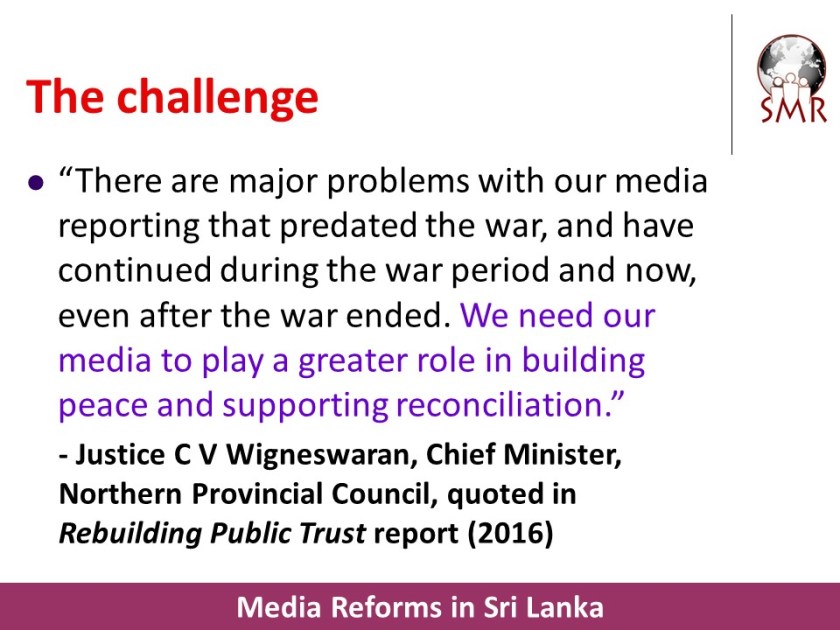
Quote from ‘Rebuilding Public Trust’ – State of Sri Lanka’s media report
Dr S Raguram, Head of Media Studies at the University of Jaffna (who edited the Tamil version) and Jaffna Press Club president Ratnam Thayaparan also spoke.
The report comes out at a time when the country’s media industry and profession face multiple crises stemming from an overbearing state, unpredictable market forces and rapid technological advancements.
Balancing the public interest and commercial viability is one of the media sector’s biggest challenges today. The report says: “As the existing business models no longer generate sufficient income, some media have turned to peddling gossip and excessive sensationalism in the place of quality journalism. At another level, most journalists and other media workers are paid low wages which leaves them open to coercion and manipulation by persons of authority or power with an interest in swaying media coverage.”
Notwithstanding these negative trends, the report notes that there still are editors and journalists who produce professional content in the public interest while also abiding by media ethics. Unfortunately, their work is eclipsed by media content that is politically partisan and/or ethnically divisive.
The result: public trust in media has been eroded, and younger Lankans are increasingly turning to entirely web-based media products and social media platforms for information and self-expression. A major overhaul of media’s professional standards and ethics is needed to reverse these trends.
MDI Sri Lanka – Tamil version being presented to stakeholders in Jaffna, 24 Jan 2017MDI Sri Lanka – Tamil version being presented to stakeholders in Jaffna, 24 Jan 2017
The Tamil report is available for free download at:
The question has come up again after Dr Ranga Kalansooriya, Director General of the Lankan government’s Department of Information, wanted the media to give preeminence to its watchdog function and pull back from supplying relief in the aftermath of disasters.
As Dr Rohan Samarajiva, who was present at the event, noted, “Some of his comments could even be interpreted as suggestive of a need to prohibit aid caravans being organized by the media. But I do not think this will happen. The risks of being seen as stifling the natural charitable urges of the people and delaying supplies to those who need help are too high…”
Ranga raised a valid concern. In the aftermath of recent disasters in Sri Lanka, private broadcast media houses have been competing with each other to raise and deliver disaster relief. All well and good – except that coverage for their own relief work often eclipsed the journalistic coverage of the disaster response in general. In such a situation, where does corporate social responsibility and charity work end and opportunistic brand promotion begin?
For simply raising this concern in public, some broadcast houses have started attacking Ranga personally. In my latest Ravaya column (in Sinhala, appearing in the print issue of 2 October 2016), I discuss the role and priorities of media at times of disaster. I also remind Sirasa TV (the most vocal critic of Ranga Kalansooriya) that ‘shooting the messenger’ carrying unpalatable truths is not in anybody’s interest.
Dr Ranga Kalansooriya, journalist turned government official, still speaks his mind
In May 2016, the major new study on the media sector I edited titled Rebuilding Public Trust:An Assessment of the Media Industry and Profession in Sri Lanka, noted:
“The new government faces the daunting task of healing the wounds of a civil war which lasted over a quarter of a century and left a deep rift in the Lankan media that is now highly polarised along ethnic, religious and political lines. At the same time, the country’s media industry and profession face their own internal crises arising from an overbearing state, unpredictable market forces, rapid technological advancements and a gradual erosion of public trust.”
The report quoted Dr Ranga Kalansooriya, who worked in the print media (Sinhala and English) and later served as Director General of Sri Lanka Press Institute, as saying:
“The ethnically non-diverse newsrooms of both sides have further fuelled the polarisation of society on ethnic lines, and this phenomenon has led the media in serving its own clientele with ‘what it wants to know’ than ‘what it needs to know’.”
This is precisely what the One Sri Lanka Journalism Fellowship Program (OSLJF) has addressed, in its own small way. An initiative of InterNews, an international media development organisation, OSLJF was a platform which has brought together Sinhala, Tamil and Muslim working journalists from across the country to conceptualize and produce stories that explored issues affecting all ordinary Lankans.
From December 2015 to September 2016, some 30 full-time or freelance journalists reporting for the country’s mainstream media were supported to engage in field-based, multi-sourced stories on social, economic and political topics of public interest. They worked in multi-ethnic teams, mentored by senior Lankan journalists drawn from the media industry who gave training sessions to strengthen the skills and broaden the horizons of this group of early and mid-career journalists.
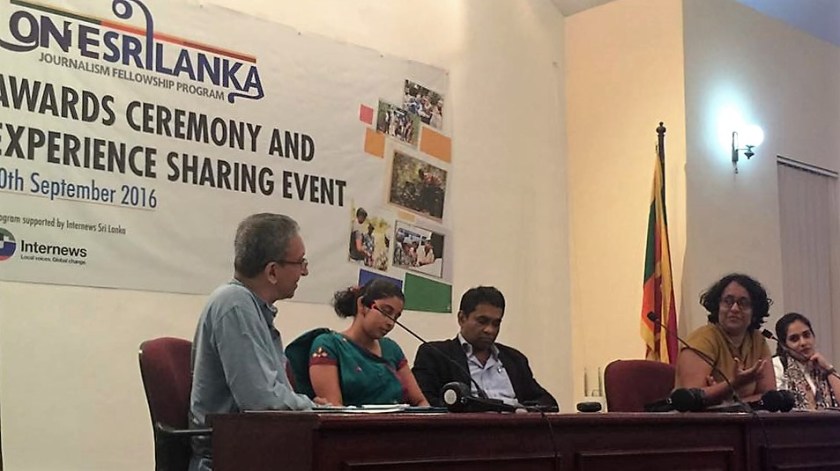
As the project ends, the participating journalists, mentors and administrators came together at an event in Colombo on 20 September 2016 to share experiences and impressions. This was more than a mere award ceremony – it also sought to explore how the learnings can be institutionalized within the country’s mainstream and new media outlets.
I was asked to host the event, and also to moderate a panel of key media stakeholders. As a former journalist who remains a columnist, blogger and media researcher, I was happy to accept this as I am committed to building a BETTER MEDIA in Sri Lanka.
Panel on Future of Sri Lankan Journalism in the Digital Age. L to R – Nalaka Gunawardene (moderator); Deepanjali Abeywardena; Dr Ranga Kalansooriya; Dr Harini Amarasuriya; and Gazala Anver
Here are my opening remarks for the panel:
“If you don’t like the news … go out and make some of your own!” So said Wes (‘Scoop’) Nisker, the US author, radio commentator and comedian who used that line as the title of a 1994 book.
Instead of just grumbling about imperfections in the media, more and more people are using digital technologies and the web to become their own reporters, commentators and publishers.
Rise of citizen journalism and digital media start-ups are evidence of this.
BUT we cannot ignore mainstream media (MSM) in our part of the world. MSM – especially and radio broadcasters — still have vast reach and they influence public perceptions and opinions. It is VITAL to improve their professionalism and ethical conduct.
In discussing the Future of Journalism in the Digital Age today, we want to look at BOTH the mainstream media AND new media initiatives using web/digital technologies.
BOTTOMLINE: How to uphold timeless values in journalism: Accuracy, Balance, Credibility and promotion of PUBLIC INTEREST?
I posed five broad questions to get our panelists thinking:
What can be done to revitalize declining quality and outreach of mainstream media?
Why do we have so little innovation in our media? What are the limiting factors?
What is the ideal mix and balance of mainstream and new media for Lanka?
Can media with accuracy, balance and ethics survive in our limited market? If so, how?
What can government, professionals and civil society to do to nurture a better media?
Panel on Future of Sri Lankan Journalism in the Digital Age. L to R – Nalaka Gunawardene (moderator); Deepanjali Abeywardena; Dr Ranga Kalansooriya; Dr Harini Amarasuriya; and Gazala Anver
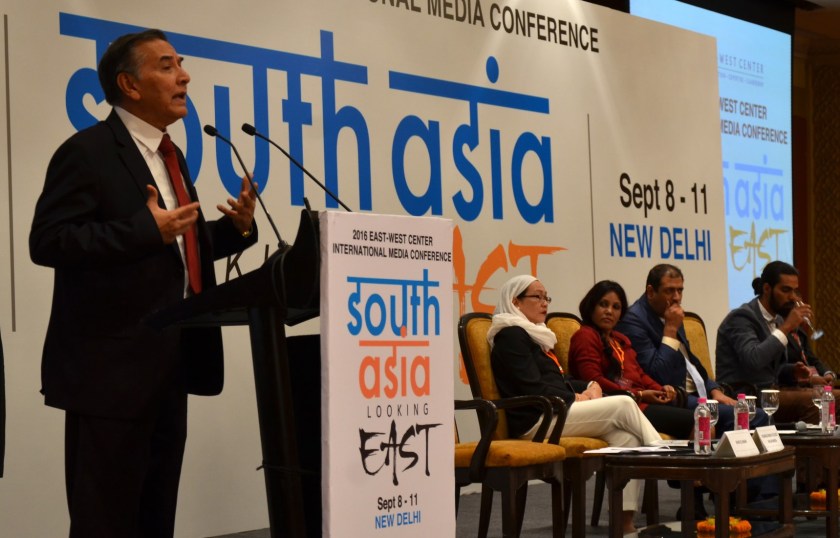
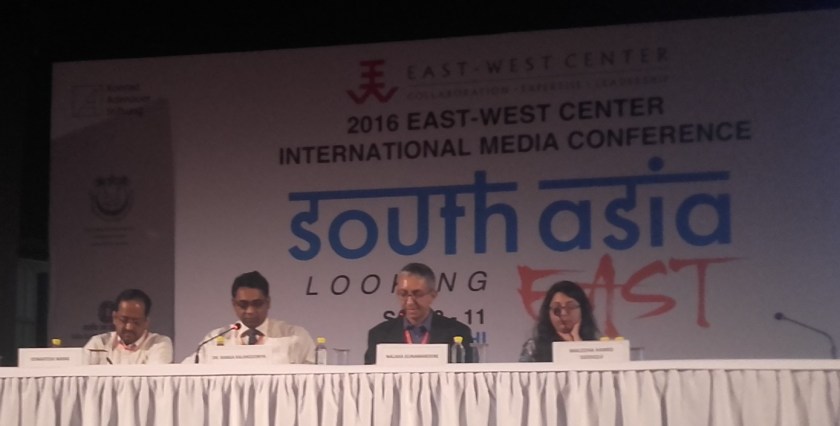
East-West Center 2016 International Media Conference in New Delhi, India, from September 8 to 11, 2016
In this week’s Ravaya column (in Sinhala, appearing in the print issue of 18 Sep 2016), I discuss new forms of media repression being practised by governments in South Asia.
The inspiration comes from my participation in the Asia Media Conference organized by the Hawaii-based East-West Center in New Delhi, India, from September 8 to 11, 2016. Themed “South Asia Looking East”, it drew over 350 participants from across Asia and the United States.
Speeches and discussions showed how governments are more concerned about international media rights watch groups tracking the imprisonment and physical harassment of media and journalists. So their tactics of repression have changed to unleash bureaucratic and legal harassment on untamed and unbowed journalists. And also to pressurising advertisers to withdraw.
Basically this is governments trying to break the spirit and commercial viability of free media instead of breaking the bones of outspoken journalists. And it does have a chilling effect…
In this column, I focus on two glaring examples that were widely discussed at the Delhi conference.
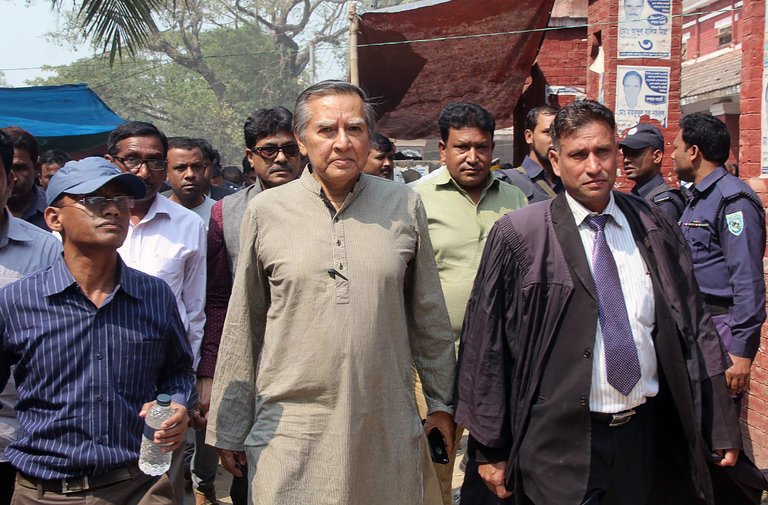
In recent months, leading Bangladeshi editor Mahfuz Anam has been sued simultaneously across the country in 68 cases of defamation and 18 cases of sedition – all by supporters of the ruling party. Anam was one of six exceptional journalists honoured during the Delhi conference “for their personal courage in the face of threats, violence and harassment”.
In August, an announcement was made on the impending suspension of regional publication of Himal Southasian, a pioneering magazine promoting ‘cross-border journalism’ in the South Asian region. The reason was given as “due to non-cooperation by regulatory state agencies in Nepal that has made it impossible to continue operations after 29 years of publication”.
Bureaucracy is pervasive across South Asia, and when they implement commands of their political masters, they become formidable threats to media freedom and freedom of expression. Media rights watch groups, please note.
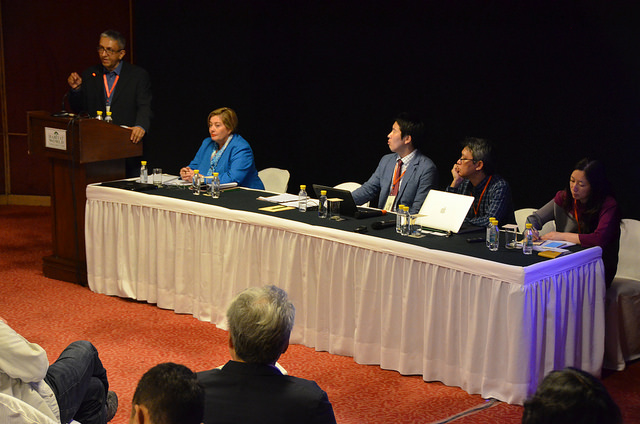
On September 11, I took part in a breakout session that discussed media innovation in Asia and the United States. While my fellow panelists spoke mainly about digital media innovation of their media outlet or media sector, I opted to survey the bigger picture: what does innovation really mean when media is under siege, and how can the media sector switch from such ‘innovation under duress’ to regular market or product innovation?
Here are my remarks, cleaned up and somewhat expanded:
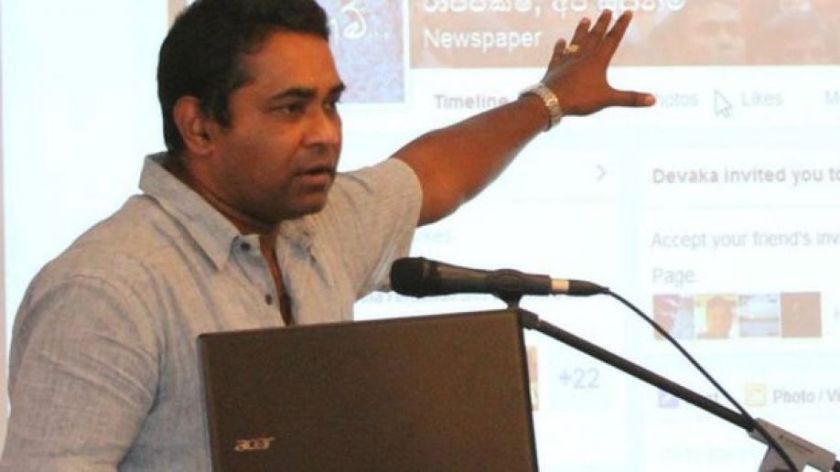
Nalaka Gunawardene speaks on media innovation under duress
Innovation has been going on in media from the beginning. Faced with major challenges from advancing technologies and changing demography, innovation is now an imperative for market survival.
We can discuss this at different levels: product innovation, process innovation and systemic innovation. I like to add another kind for our discussion: innovation for physical survival.
With forces social and market Darwinism constantly at work, you might ask, shouldn’t the most adaptable and nimble players survive – while others perish?
Yes and No. Sometimes the odds against independent and progressive media organisations are disproportionately high – they should not be left to fend for themselves. This is where media consumers and public spirited groups need to step in.
Let me explain with a couple of examples from South Asia.
They say necessity is the mother of invention or innovation. I would argue that tyranny – from the state and/or extremist groups – provides another strong impetus for innovation in the media.
In Nepal, all media came under strict control when King Gyanendra assumed total control in February 2005. Among other draconian measures, he suspended press freedom, imposing a blanket ban on private or community broadcasters carrying news, thus making it a monopoly of state broadcasters.
The army told broadcasters that the stations were free to carry music, but not news or current affairs. Soldiers were sent to radio and TV stations to ensure compliance.
When the king’s siege of democracy continued for weeks and months, some media started defying censorship – they joined human rights activists and civil society groups in a mass movement for political reforms, including the restoration of parliamentary democracy.
Some of Nepal’s many community radio stations found creative ways of defying censorship. One station started singing the news – after all, there was no state control over music and entertainment! Another one in central Nepal went outside their studio, set up an impromptu news desk on the roadside, and read the news to passers-by every evening at 6 pm.
Panel on Media innovation at East-West Center Media Conference, Delhi, 11 Sep 2016: L to R – Philippa McDonald, Nalaka Gunawardene, LEE Doo Won, Fernando (Jun) SEPE, Jr. and ZHONG Xin
The unwavering resolve of these and other media groups and pro-democracy activists led to the restoration of parliamentary democracy in April 2006 and the subsequent abolition of the Nepali monarchy.
My second example is from Sri Lanka where I live and work.
We are recovering from almost a decade of authoritarian rule that we ended in January 2015 by changing that government in an election. The years preceding that change were the darkest for freedom of expression and media freedom in Sri Lanka – the country, then nominally a democracy, was ranked 165th among 183 countries in the World Press Freedom Index for 2014.
In June 2012, Sri Lanka was one of 16 countries named by the UN Special Rapporteur on the promotion and protection of the right to freedom of opinion and expression for “attacks against journalists during coverage of street protests and demonstrations, such as arbitrary arrests and detention, verbal and physical attacks, confiscation or destruction of equipment, as well as killings.”
Threats of attacks and actual incidents of physical violence in recent years led to a climate of fear and widespread self-censorship among journalists in Sri Lanka. This is slowly changing now, but old habits die hard.
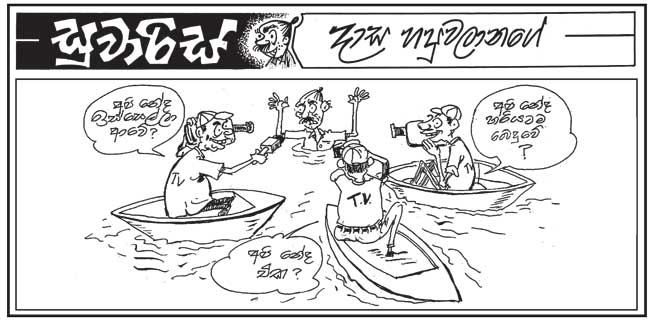
At the height of media repression by the former regime, we saw some of our media innovating simply for physical survival. One strategy was using satire and parody – which became important forms of political commentary, sometimes the only ones that were possible without evoking violent reprisals.
What I wrote then, while still in the thick of crackdown, is worth recalling:
“For sure, serious journalism can’t be fully outsourced to satirists and stand-up comics. But comedy and political satire can play a key role in critiquing politicians, businessmen and others whose actions impact the public.
“There is another dimension to political satire and caricature that isn’t widely appreciated in liberal democracies where freedom of expression is constitutionally guaranteed.
“In immature democracies and autocracies, critical journalists and their editors take many risks in the line of work. When direct criticism becomes highly hazardous, satire and parody become important — and sometimes the only – ways for journalists get around draconian laws, stifling media regulations or trigger-happy goon squads…
“Little wonder, then, that some of Sri Lanka’s sharpest commentary is found in satire columns and cartoons. Much of what passes for political analysis is actually gossip.”
For years, cartoonists and political satirists fulfilled a deeply felt need in Sri Lanka for the media to check the various concentrations of power — in political, military, corporate and religious domains.
They still continue to perform an important role, but there is more space today for journalists and editors to report things as they are, and to comment on the key stories of the day.
During the past decade, we have also seen the rise of citizen journalism and vibrant blogospheres in the local languages of Sinhala and Tamil. Their advantage during the dark years was that they were too numerous and scattered for the repressive state to go after each one (We do know, however, that electronic surveillance was attempted with Chinese technical assistance.)
Of course, Sri Lanka’s media still face formidable challenges that threaten their market survival.
Rebuilding Public Trust: An Assessment of the Media Industry and Profession in Sri Lanka (May 2016)
A new assessment of Sri Lanka’s media, which I edited earlier this year, noted: “The economic sustainability of media houses and businesses remains a major challenge. The mainstream media as a whole is struggling to retain its consumer base. Several factors have contributed to this. Many media houses have been slow in integrating digital tools and web-based platforms. As a result, there is a growing gulf between media’s production models and their audiences’ consumption patterns.”
Innovation and imagination are essential for our media to break out of 20th century mindsets and evolve new ways of content generation and consumption. There are some promising new initiatives to watch, even as much of the mainstream continues business as usual – albeit with diminishing circulations and shrinking audience shares.
Innovate or perish still applies to our media. We are glad, however, that we no longer have to innovate just to stay safe from goon squads.
On September 11, I moderated a plenary session on Right to Information (RTI) in South Asia: Staying the Course on a Bumpy Road.
It tried to distill key lessons in RTI implementation from India and Pakistan, especially for the benefit of Sri Lanka that has recently adopted its RTI law. Such lessons could also benefit other countries currently advocating their own RTI laws.
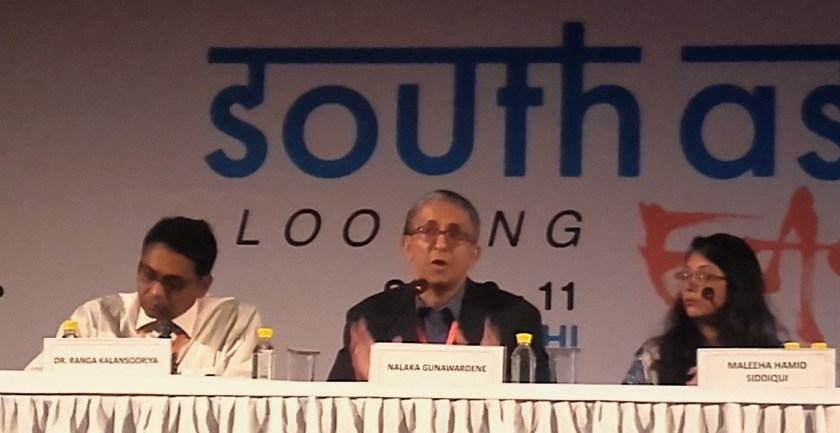
Panel on Right to Information in South Asia, 11 Sep 2016 in New Delhi. L to R – Venkatesh Nayak, Dr Ranga Kalansooriya, Nalaka Gunawardene & Maleeha Hamid Siddiqui
Here is the synopsis I wrote for the panel:
Right to Information (RTI) in South Asia:
Staying the Course on a Bumpy Road
In June 2016, Sri Lanka’s Parliament unanimously passed a Right to Information (RTI) Act, making the island nation the 108th country to have a RTI or freedom of information (FOI) law. That leaves only Bhutan in South Asia without such a law, according to the Commonwealth Human Rights Initiative (CHRI) in New Delhi.
Sri Lanka’s RTI law was preceded by over two decades of sustained advocacy by journalists, social activists and progressive lawyers. But the struggle is far from over. The island nation now faces the daunting task of ‘walking the talk’ on RTI, which involves a total reorientation of government and active engagement by citizens. As other South Asian countries know only too well, proper RTI implementation requires political will, administrative support and sufficient funds.
This panel is an attempt to address the following key questions:
How do India and Pakistan fare in terms of implementing their RTI laws?
What challenges did they face in the early days of RTI implementation?
What roles did government, civil society and media play in RTI process?
What key lessons and cautions can their experiences offer to Sri Lanka?
Can South Asia’s RTI experience offer hope for other countries pursuing RTI laws of their own?
In this session, experienced RTI activists from India and Pakistan will join a Sri Lankan policymaker in surveying the challenges of openness and transparency through RTI.
Panel:
Dr Ranga Kalansooriya, Director General, Department of Information, Ministry of Parliamentary Reforms and Mass Media, Government of Sri Lanka
Mr Venkatesh Nayak, RTI activist; Programme Coordinator, Commonwealth Human Rights Initiative (CHRI), New Delhi
Ms Maleeha Hamid SIDDIQUI, Senior Sub-Editor and Reporter, Dawn, Karachi, Pakistan
Moderator: Mr Nalaka Gunawardene, Science writer and media researcher who is secretary of the RTI Advisory Task Force of Ministry of Mass Media, Sri Lanka
L to R – Ranga Kalansooriya, Nalaka Gunawardene & Maleeha Hamid Siddiqui
Drawing from my recent interactions with the IGF Academy, as well as several academic and civil society groups, I position the current public debates on web’s socio-cultural impacts in the context of freedom of expression.
With 30 per cent of our population now using the Internet, it is no longer a peripheral pursuit. Neither is it limited to cities or rich people. So we urgently need more accurate insights into how society and economy are being transformed by these modern tools.
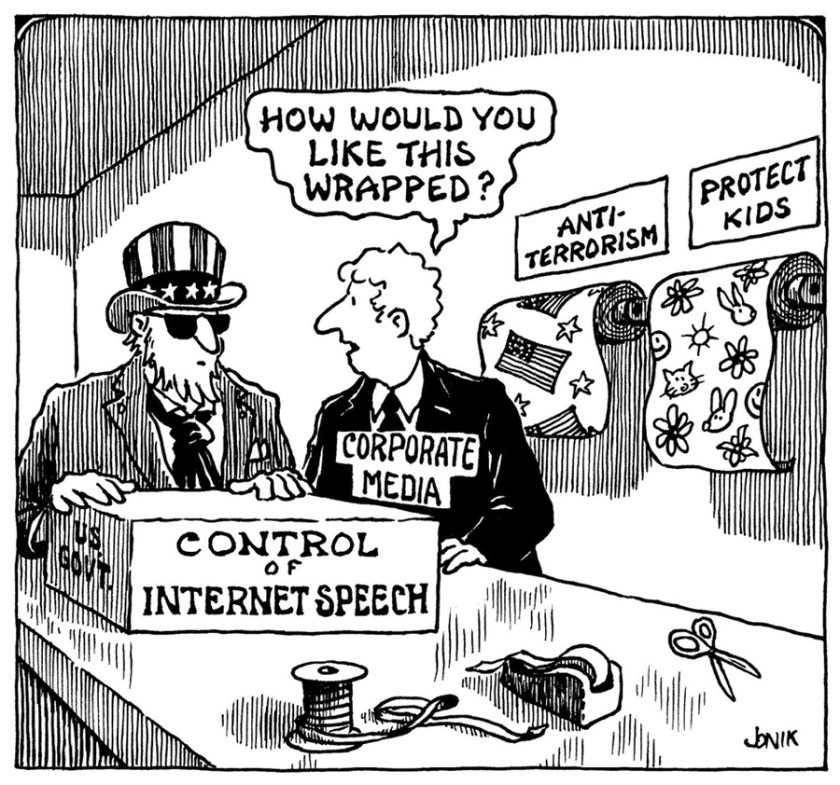
My basic premise: many well-meaning persons who urge for greater regulation of the web and social media overlook that governments in Sri Lanka have a terrible track record in stifling dissent in the name of safeguarding the public.
Cartoon by John Jonik
I argue: “As a democracy recovering from a decade of authoritarianism, we need to be especially careful how public sentiments based on fear or populism can push policymakers to restrict freedom of expression online. The web has become the last frontier for free speech when it is under pressure elsewhere.
“When our politicians look up to academics and researchers for policy guidance, the advice they often get is control or block these new media. Instead, what we need is more study, deeper reflection and – after that, if really required – some light-touch regulation.”
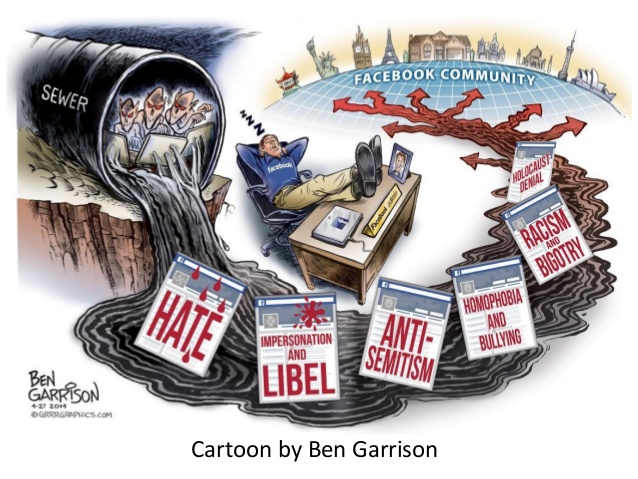
I acknowledge that there indeed are problems arising from these new technologies – some predictable, and others not. They include cyber-bullying, hate speech, identity theft through account hijacking, trolling (deliberately offensive or provocative online postings) and sexting (sending and receiving sexually explicit messages, primarily via mobile phones).
I cite some research findings from the work done by non-profit groups or media activists. These findings are not pretty, and some of them outright damning. But bans, blocks and penalties alone cannot deal with these or other abuses, I argue.
I end with these words: “We can and must shape the new cyber frontier to be safer and more inclusive. But a safer web experience would lose its meaning if the heavy hand of government or social orthodoxy tries to make it a sanitized, lame or sycophantic environment at the same time. We sure don’t need a cyber nanny state.”
This column originally appeared in Echelon business magazine, March 2014 issue. It is being republished here (without change) as part of a process to archive all my recent writing in one place – on this blog.
Image courtesy Echelon magazine
Balancing Broadband and Narrow Minds
By Nalaka Gunawardene
Are we cyber-stunted?
I posed this question some weeks ago at Sri Lanka Innovation Summit 2013 organised by Echelon and News 1st. We were talking about how to harness the web’s potential for spurring innovation.
We cannot innovate much as a society when our broadband is stymied by narrow minds. How many among the (at least) 3.5 million Lankans who regularly access the web have the right mindset for making the best use of the medium, I asked.
We didn’t get to discuss it much there, but this bothers me. Sri Lanka has now had 19 years of commercial Internet connectivity (the first ISP, Lanka Internet Services, started in April 1995). That’s a long time online: we have gone past toddler years and childhood (remember dial-up, anyone?) and been through turbulent ‘teen years’ as well.
Technology and regulation have moved on, imperfect though the latter maybe. But psychologically, as a nation we have yet to find our comfort level with the not-so-new medium.
There are various indicators for this. Consider, for example, the widespread societal apprehensions about social media, frequent web-bashing by editorialists in the mainstream media, and the apparent lack of public trust in e-commerce services. These and other trends are worth further study by social scientists and anthropologists.
Another barometer of cyber maturity is how we engage each other online, i.e. the tone of comments and interactions. This phenomenon is increasingly common on news and commentary websites; it forms the very basis of social media.
Agree to disagree?
‘Facts are sacred, comment is free’ is a cherished tenet in journalism and public debates. But expressing unfashionable opinions or questioning the status quo in Lankan cyber discussions can attract unpleasant reactions. Agreeing to disagree rarely seems an option.
Over the years, I have had my share of online engagement – some rewarding, others neutral and a few decidedly depressing. These have come mostly at the multi-author opinion platforms where I contribute, but sometimes also through my own blogs and twitterfeed.
One trend seems clear. In many discussions, the ‘singer’ is probed more than the ‘song’. I have been called unkind names, my credentials and patriotism questioned, my publishers’ bona fides doubted, and my (usually moderate) positions attributed to personality disorders or genetic defects! There have been a few threats too (“You just wait – we’ll deal with traitors soon!”).
I know those who comment on mainstream political issues receive far more invective. Most of this is done under the cover of anonymity or pseudonymity. These useful web facilities – which protect those criticising the state or other powerful interests – are widely abused in Lankan cyberspace to malign individuals expressing uncommon views.
There are some practical reasons, too, why our readers may misunderstand what we write, or take offence needlessly.
Poor English comprehension must account for a good share of web arguments. Many fail to grasp (or appreciate) subtlety, intentional rhetoric and certain metaphors. Increasingly, readers react to a few key words or phrases in longer piece — without absorbing its totality.
A recent example is my reflective essay ‘Who Really Killed Mel Gunasekera?’. I wrote it in early February shortly after a highly respected journalist friend was murdered in her suburban home by a burglar.
I argued that we were all responsible, collectively, for this and other rising incidents of violence. I saw it as the residual product of Lankan society’s brutalisation during war years, made worse by economic marginalisation. Rather than barricading ourselves and living in constant fear, we should tackle the root causes of this decay, I urged.
The plea resonated well beyond Mel’s many friends and admirers. But some readers were more than miffed. They (wrongly) reduced my 1,100 words to a mere comparison of crime statistics among nations.
I aim to write clearly, and also probe beyond headlines and statistics. But is such nuance a lost art when many online readers merely scan or speed-read what we labour on? In today’s fast-tracked world, can reflective writing draw discerning readers and thoughtful engagement any longer? I wonder.
Too serious
Then there is the humour factor – or the lack of it. Many among us don’t get textual satire, as Groundviews.org discovered with its sub-brand called Banyan News Reporters (BNR). Their mock news items and spoofs were frequently taken literally – and roundly condemned.
The web is a noisy place, but some stand out in that cacophony because of their one-tracked minds. They are those who perceive and react to everything through a pet topic or peeve. That ‘lens’ may be girls vs boys, or lions vs tigers, or capitalism vs socialism or something else. No matter what the topic, such people will always sing same old tune!
Tribal divisions are among the most entrenched positions, and questioning matters of faith assures a backlash. It seems impossible to discuss secularism in Sri Lanka without seemingly offending all competing brands of salvation! (The last time I tried, they were bickering among themselves long after I quietly left the platform…)
Oh sure, everybody is entitled to a bee or two in her bonnet. But what to do with those harbouring an entire bee colony — which they unleash at the slightest provocation?
I just let them be (well, most of the time). I used to get affected by online abuse from cloaked detractors but have learnt to take it with equanimity. This is what economist and public intellectual W A Wijewardena also recommends.
“You must treat commentators as your own teachers; some make even the most stupid comment in the eyes of an intelligent person, but that comment teaches us more than anything else,” he wrote in a recent Facebook discussion.
He added: “Individual wisdom and opinions are varied and one cannot expect the same type of intervention by all. I always respect even the most damaging comment made by some on what I have written!”
Moderating extreme comments is a thankless and challenging job for those operating opinion platforms. If they are too strict or cautious, they risk diluting worthwhile public debates for which space is shrinking in the mainstream media. At the same time, hate speech peddlers cannot be allowed free license in the name of free speech.
Where to draw the line? Each publisher must evolve own guidelines.
Groundviews.org, whose vision is to “enable civil, progressive and inclusive discussions on democracy, rights, governance and peace in Sri Lanka” encourages “a collegial, non-insulting tone” in all contributors. It also reminds readers that “comments containing hate speech, obscenity and personal attacks will not be approved.”
Colombo Telegraph, another popular opinion and reporting website, “offers a right to reply for any individual or organisation who feels they have been misreported”. Sadly, this courtesy is not available in many online news and commentary websites carrying Lankan content.
In the end, even the most discerning publishers and editors can do only so much. As more Lankans get online and cyber chatter increases, we have to evolve more tolerant and pluralistic ways of engagement.
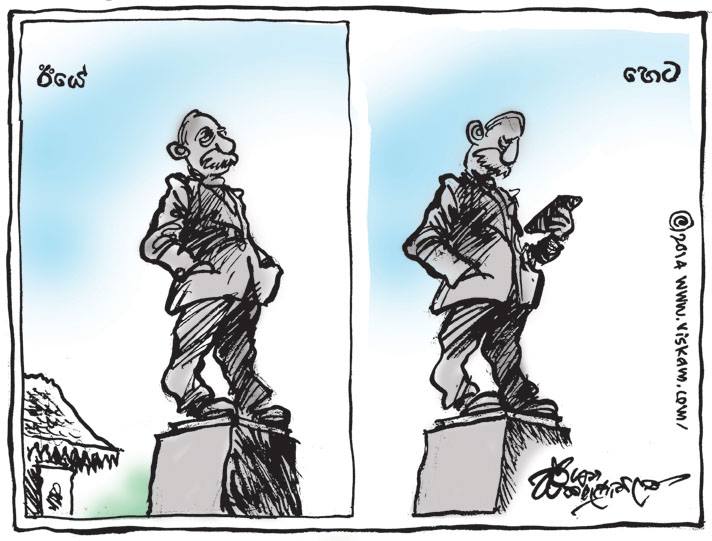
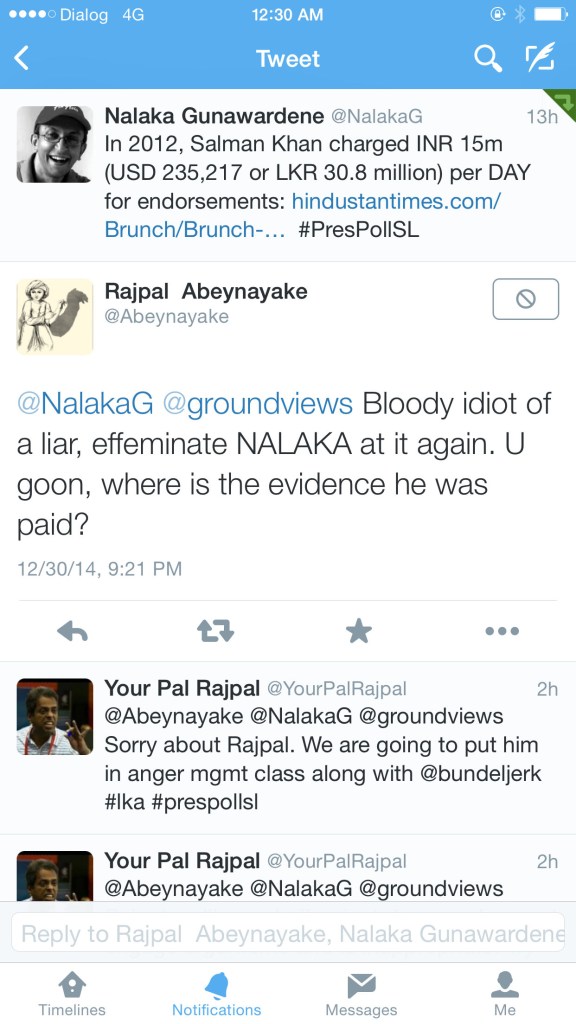
An example of cyber intolerance and name-calling from December 2014, during the campaign for Sri Lanka’s Presidential Election (when Bollywood’s Salman Khan was brought to Sri Lanka to promote then incumbent Mahinda Rajapalksa’s election campaign)









 Open Minds!