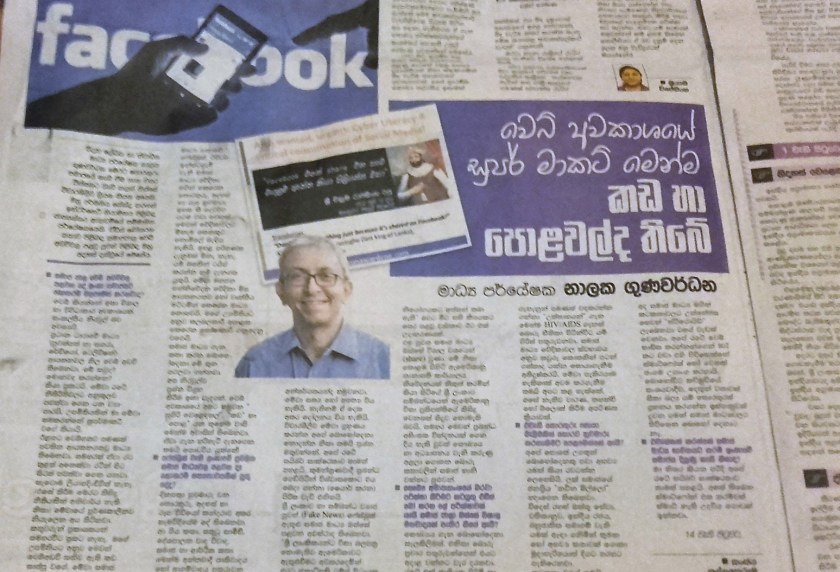
This comment on Sri Lanka’s social media blocking that commenced on 7 March 2018, was written on 8 March 2018 at the request of Irida Lakbima Sunday broadsheet newspaper, which carried excerpts from it in their issue of 11 March 2018. The full text is shared here, for the record.
On 1 March 2018, Facebook announced that it was ending its six-nation experiment known as ‘Explore Feed’. The idea was to create a version of Facebook with two different News Feeds: one as a dedicated place with posts from friends and family and another as a dedicated place for posts from Pages.
Adam Mosseri, Head of News Feed at Facebook wrote: “People don’t want two separate feeds. In surveys, people told us they were less satisfied with the posts they were seeing, and having two separate feeds didn’t actually help them connect more with friends and family.”
An international news agency asked me to write a comment on this from Sri Lanka, one of the six countries where the Explore feed was tried out from October 2017 to February 2018. Here is my full text, for the record:
Did Facebook’s “Explore” experiment increase
our exposure to fake news?
Comment by Nalaka Gunawardene, researcher and commentator on online and digital media; Fellow, Internet Governance Academy in Germany
Despite its mammoth size and reach, Facebook is still a young company only 14 years old this year. As it evolves, it keeps experimenting – mistakes and missteps are all part of that learning process.
But given how large the company’s reach is – with over 2 billion users worldwide – there can be far reaching and unintended consequences.
Last October, Facebook split its News Feed into two automatically sorted streams: one for non-promoted posts from FB Pages and publishers (which was called “Explore”), and the other for contents posted by each user’s friends and family.
Sri Lanka was one of six countries where this trial was conducted, without much notice to users. (The other countries were Bolivia, Cambodia, Guatemala, Serbia, Slovakia.)
Five months on, Facebook company has found that such a separation did not increase connections with friends and family as it had hoped. So the separation will end — in my view, not a moment too soon!
What can we make of this experiment and its outcome?
Humans are complex creatures when it comes to how we consume information and how we relate to online content. While many among us like to look up what our social media ‘friends’ have recommended or shared, we remain curious of, and open to, content coming from other sources too.
I personally found it tiresome to keep switching back and forth between my main news feed and what FB’s algorithms sorted under the ‘Explore’ feed. Especially on mobile devices – through which 80% of Lankan web users go online – most people simply overlooked or forgot to look up Explore feed. As a result, they missed out a great deal of interesting and diverse content.
For me as an individual user, a key part of the social media user experience is what is known as Serendipity – accidentally making happy discoveries. The Explore feed reduced my chances of Serendipity on Facebook, and as a result, in recent months I found myself using Facebook less often and for shorter periods of time.
For publishers of online newspapers, magazines and blogs, Facebook’s unilateral decision to cluster their content in the Explore feed meant significantly less visibility and click-through traffic. Fewer Facebook users were looking at Explore feed and then going on to such publishers’ content.
I am aware of mainstream media houses as well as bloggers in Sri Lanka who suffered as a result. Publishers in the other five countries reported similar experiences.
For the overall information landscape too, the Explore feed separation was bad news. When updates or posts from mainstream news media and socially engaged organisations were coming through on a single, consolidated news feed, our eyes and ears were kept more open. We were less prone to being confined to the chatter of our friends or family, or being trapped in ‘eco chambers’ of the likeminded.
Content from reputed news media outlets and bloggers sometimes comes with their own biases, for sure, but these act as a useful ‘bulwark’ against fake news and mind-rotting nonsense that is increasing in Sri Lanka’s social media.
It was thus ill-advised of Facebook to have taken such content away and tucked it in a place called Explore that few of us bothered to visit regularly.
The Explore experiment may have failed, but I hope Facebook administrators learn from it to fine-tune their platform to be a more responsive and responsible place for global cacophony to evolve.
Indeed, the entire Facebook is an on-going, planetary level experiment in which all its 2 billion plus members are participating. Our common challenge is to balance our urge for self-expression and sharing with responsibility and restraint. The justified limitations on free speech continue to apply on new media too.
Some are urging national governments to ‘regulate’ social media in ways similar to how newspapers, television and radio are regulated. This is easier said than done where globalized social media platforms like Facebook, Twitter and Instagram are concerned, because national governments don’t have jurisdiction over them.
But does this mean that globalized media companies are above the law? Short of blocking entire platforms from being accessed within their territories, what other options do governments have? Do ‘user community standards’ that some social media platforms have adopted offer a sufficient defence against hate speech, cyber bullying and other excesses?
In this conversation, Lankan science writer Nalaka Gunawardene discusses these and related issues with Toby Mendel, a human rights lawyer specialising in freedom of expression, the right to information and democracy rights.
Mendel is the executive director of the Center for Law and Democracy (CLD) in Canada. Prior to founding CLD in 2010, Mendel was for over 12 years Senior Director for Law at ARTICLE 19, a human rights NGO focusing on freedom of expression and the right to information.
The interview was recorded in Colombo, Sri Lanka, on 5 July 2017.
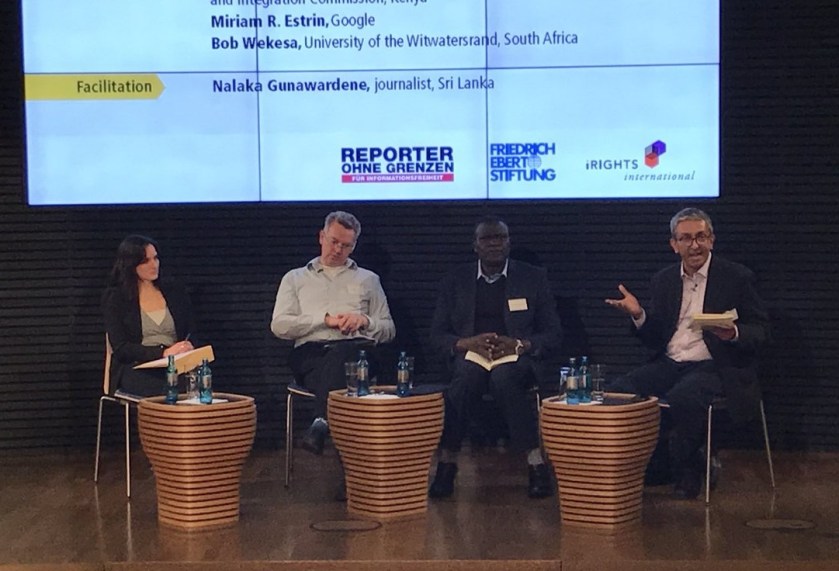
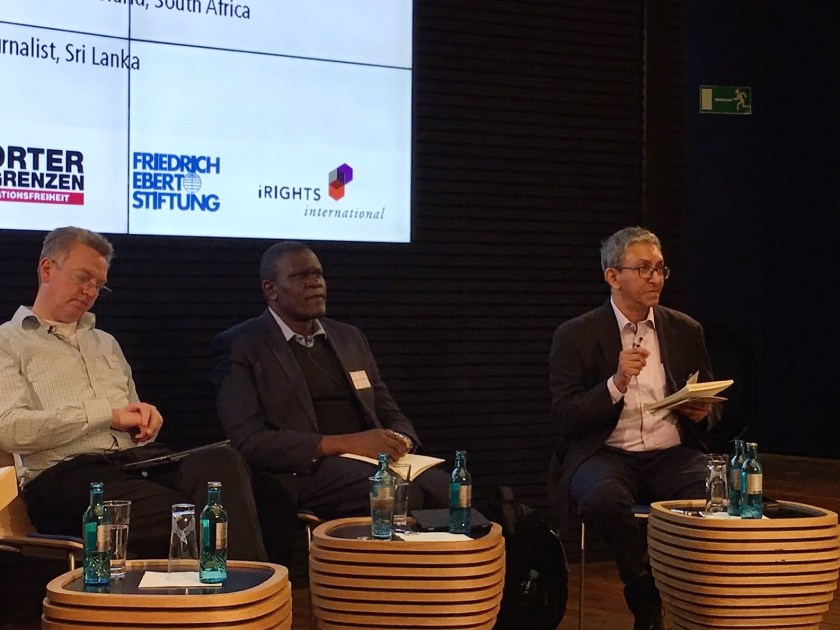
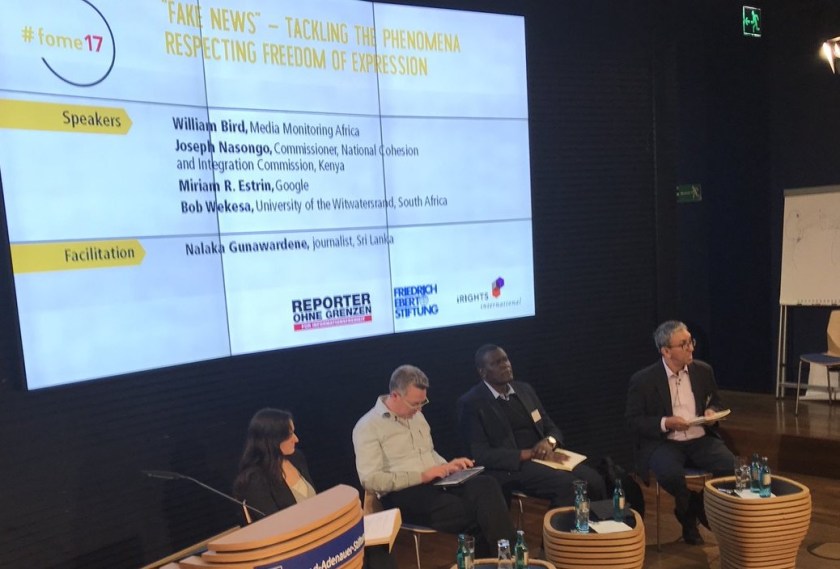
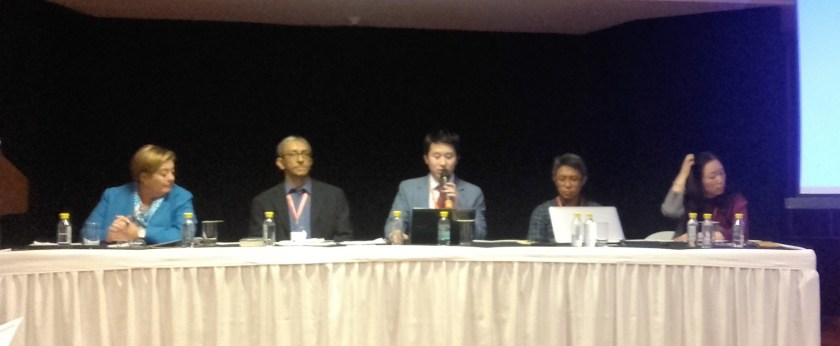
Nalaka Gunawardene (extreme right) moderates FoME 2017 session on “Fake News: Tackling the phenomenon while respecting freedom of expression”, Berlin, 17 Nov 2017
The German “Forum on Media and Development” (Forum Medien und Entwicklung, FOME) is a network of institutions and individuals active in the field of media development cooperation. I was invited to participate in, and moderate a panel at FoME Symposium 2017 held in Berlin on 16 – 17 November 2017.
This year’s symposium theme was Power Shifts – Media Freedom and the Internet. It explored how Internet governance issues are becoming more and more important for those who want to develop media (both mainstream media and social media) as democratic platforms.
On 17 November 2017, I moderated an international panel on Fake News: Tackling the phenomena respecting freedom of expression. It brought together representatives from government, civil society and a global media platform to discuss their roles and how they can interact to tackle the issue – all within the framework of Freedom of Expression (FOE).
Miriam Estrin, Public Policy Manager for Europe, Middle East and Africa, Google
Nalaka Gunawardene speaks on Fake News and Freedom of Expression at FoME 2017 Symposium in Berlin, 17 Nov 2017 – Photo courtesy Helani Galpaya
Here are my opening remarks that set the context for our discussion:
Just as there are many definitions of Fake News, there can also be many perspectives on the topic. We all recognise Fake News as a problem, so let’s focus on how it can be countered. What are the local, national and global level strategies? What alliances, tools and resources are needed for such countering? What cautions and alarms can we raise?
To respond to any problem, we need to understand its contours.
Fake News is not new. The phenomenon has been around, in one form or another, for decades! Many of us in the global South have grown up amidst intentionally fake news stories in our media, some of it coming from governments, no less. And the developing world governments don’t have a monopoly over Fake News either: for over half a century, the erstwhile Soviet Union and Eastern Bloc countries manufactured a vast amount of disinformation (i.e. deliberately wrong information) that was fed to their own citizens and spread overseas in sustained propaganda efforts.
Sitting here, within a few kilometres from where the Berlin Wall once stood, we need to acknowledge that veritable factory of lies that operated on the other side!
So what’s new? During the past decade, as broadband Internet spread worldwide, fake news peddlers found an easy and fast medium online. From websites to social media accounts (many hiding behind pseudonyms), the web has provided a globalised playing field where dubious content could go ‘viral’.
Yesterday at this Symposium, Mark Nelson from CIMA said “We live in a world where lies are very cheap, and much easier to disseminate than the truth.”
Which reminded me of one of my favourite quotes: ““A lie can travel halfway around the world while the truth is putting on its shoes!”
Variations of this quote have been attributed to several persons including Jonathan Swift and Mark Twain. Whoever said it first, these words neatly sum up a long standing challenge to modern societies: how to cope with the spread of deliberate falsehoods.
As Mark Nelson asked us yesterday, how can we “make the Internet a place where truth is valued and spread – instead of disinformation?” This is the crux of our challenge.
So what is to be done? Among the options available, which ones are most desirable?
In searching for solutions to the Fake News crisis, we must recognise it is a nuanced, complex and variable phenomenon. There cannot be one global solution or quick fix.
Indeed, any ‘medicine’ prescribed for the malady of Fake News should not be worse than the ailment itself! We must proceed with caution, safeguarding the principles of Freedom of Expression and applying its reasonable limitations.
As human rights defenders caution, there is a danger that governments in their zeal to counter fake news could impose direct or indirect censorships, suppress critical thinking, or take other steps that violate international human rights law. This is NOT the way to deal with Fake News.
In my view, Fake News is a symptom of a wider and deeper crisis. It is a crisis of public trust in journalism and the media that has been building up over the years in many countries. Some call this a ‘Journalism Deficit’, or a gulf between what journalism ought be, and what it has (mostly) become today.
In my view, a free press is not an automatic guarantee against Fake News. In other words, media freedom is necessary — but not sufficient — to ensure that media content is trusted by the public. We need to better measure public trust in media and what the current trust levels mean for those producing media content professionally.
I would argue that the medium to long term response to Fake News is to narrow and bridge the Journalism Deficit by nurturing quality journalism and critical consumption of media. If you agree with this premise, what specific measures can we recommend and advocate?
Let us explore how media development can counter Fake News by exposing it, undermining it, and equipping media consumers with the knowledge and skills to spot it – and not spread it inadvertently.
For this, we need everyone’s cooperation.
We need global social media platforms and digital gatekeepers like Google to join with all their might (and what might!).
We need governments to be thoughtfully, carefully evaluate the optimum responses.
We need civil society to go beyond mere hand waving and finger pointing to help enhance media and information literacy.
We need researchers to keep studying and discerning trends that can influence policy and regulation (where appropriate).
We are not going to solve the problem in an hour. But we can at least ask the right questions, and clarify the issues in our minds. Onward!
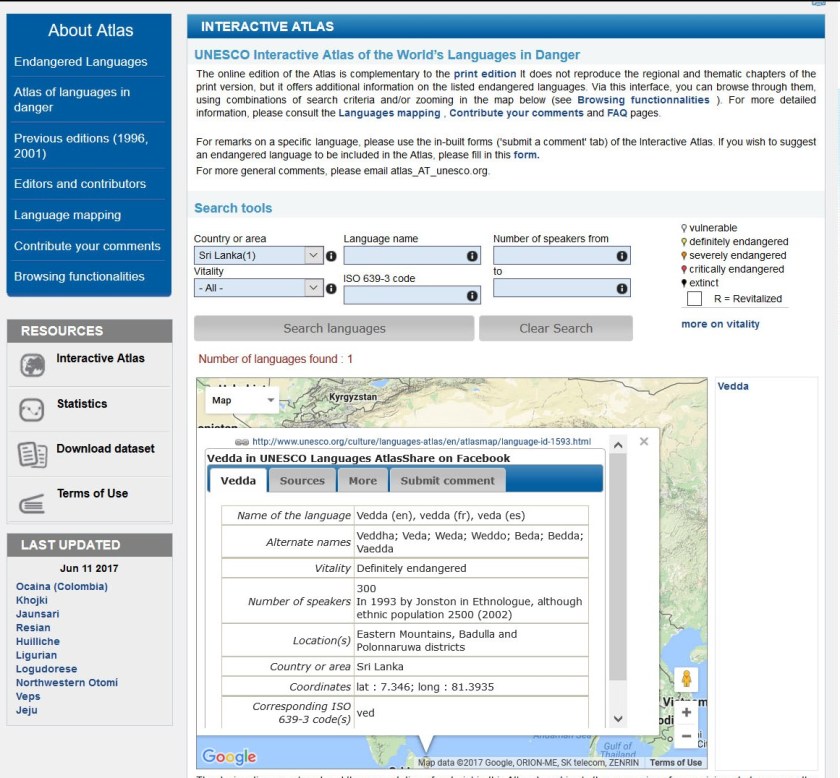
From time to time, certain Lankan academics make unsupported claims that the Sinhala language – spoken as native tongue by about 70% of Sri Lanka’s 21 million people – is in danger of ‘going extinct’. These claims are peddled without question by some journalists and on social media. I have been countering this for some time, going to authoritative global references that track the status of languages worldwide.
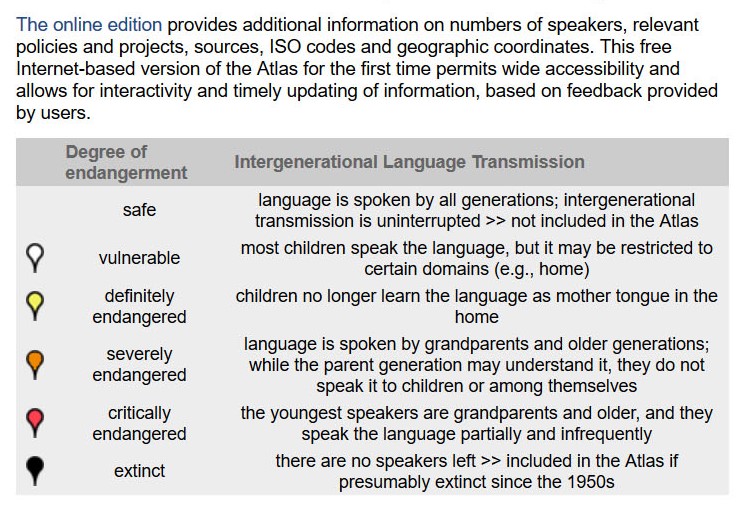
Key among them is the UNESCO Atlas of the World’s Languages in Danger. The latest edition of the Atlas (2010) lists about 2,500 languages (among which 230 languages extinct since 1950), approaching the generally-accepted estimate of some 3,000 endangered languages worldwide. Sinhala language is NOT among them. However, Sri Lanka does have one endangered language: spoken by the indigenous Veddah people, whose numbers are dwindling (below 500) due to cultural assimilation.
World Atlas of Languages in Danger, image captured on 11 June 2017
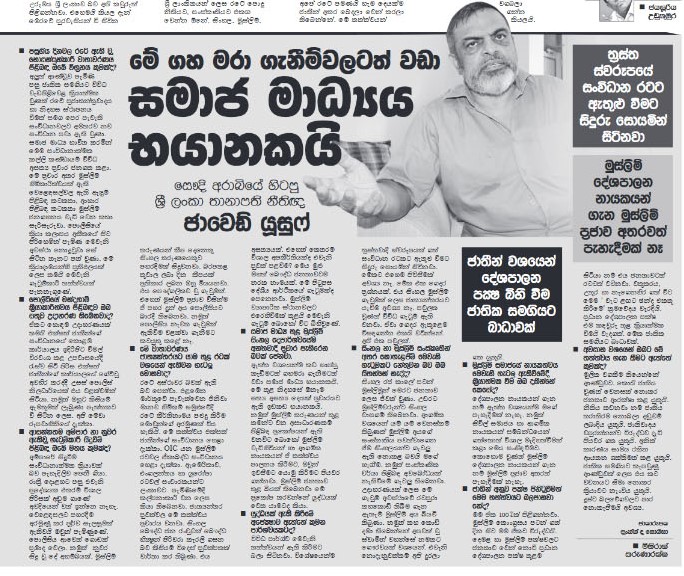
I have just given an interview to Sunday Lakbima, a broadsheet newspaper in Sri Lanka (in Sinhala) on social media in Sri Lanka – what should be the optimum regulatory and societal responses. The interviewer, young and digitally savvy journalist Sanjaya Nallaperuma, asked intelligent questions which enabled me to explore the topic well.
Brief comment provided to Daily Mirror newspaper, Sri Lanka, on 20 January 2017:
‘Eyes in the Sky’ need ethical and careful ‘pilots’
By Nalaka Gunawardene
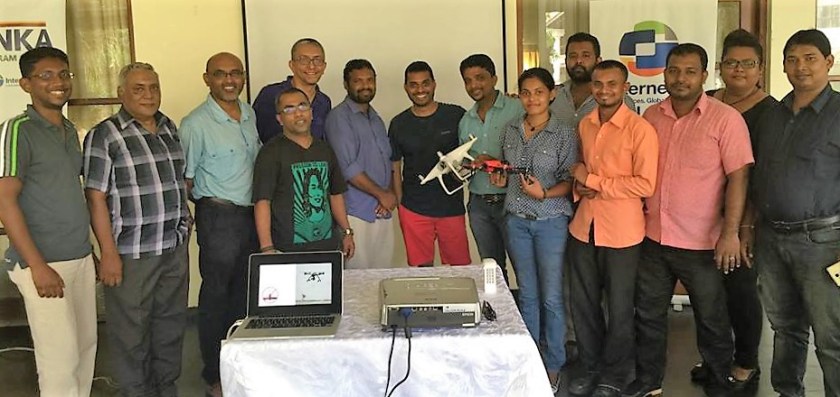
Bird’s eye view provides a new, useful perspective in journalistic story telling. Image courtesy InterNews Sri Lanka
For some, drones conjure images of death and destruction – military applications have been their most widely reported application. But unmanned aerial vehicles or UAVs are increasingly being used for many peaceful purposes. That poses a host of ethical and legal challenges we must confront to get the best of this new technology while minimizing potential harms.
In the past few years, the cost of drones came down (an entry level unit sells for around LKR 35,000 in Colombo) as their versatility increased. This spurred many uses from newsgathering and post-disaster assessments to goods delivery and smart farming.
In Sri Lanka, surveyors, photographers, TV journalists and political parties were among the early civilian users of drones. They all grasped the value of the ‘bigger picture’ perspective such aerial photos or videos can provide. Until recently, accessing that vantage point was possible only through helicopters or fixed wing aircraft – a facility few could afford.
Having the bird’s eye view helps journalists and their audiences to make sense of complex situations like climate change impacts, conflicts over resources or political agitations. We certainly need more field-based and investigative reporting that goes beyond press releases and press conferences. Drones are fast joining the journalists’ toolkit — but what matters is their imaginative and responsible use.
Participants and trainers at Sri Lanka’s first workshop on drone assisted journalism, Aug 2016 in Mt Lavinia
Here, we have both good news and bad news. On the positive side, over two dozen journalists and photojournalists have been trained in drone-assisted journalism during 2016 by drone journalism enthusiast (and drone pilot) Sanjana Hattotuwa and journalist Amantha Perera. Some trainees have since done good stories with drone-gathered images. Examples include probing the drought’s impacts in the dry zone, rising garbage crisis in Kattankudy on the east coast, and taking a close look at land use patterns in Hambantota.
Internews Sri Lanka: Drone gathered footage supporting journalism
The downside is that some news organisations are deploying drones without due regard for public safety or existing codes of media ethics. A drone hovered over the Colombo general cemetery as slain editor Lasantha Wickremetunge’s body was exhumed in September 2016. That disregarded a family request for privacy.
The end never justifies the means in good journalism. If some media groups continue to operate drones in such reckless manner, they risk discrediting the new technology and attracting excessive regulations.
Drones or any other new technologies need to be anchored in the basic ethics of journalism. Each new tool would also bring along its own layer of ethics. Where drone use is concerned, respecting privacy and considering the safety of others is far more important than, say, when using a handheld camera.
In February 2016, the Civil Aviation Authority of Sri Lanka (CAASL) published regulations for drone operation which apply to all users including journalists. This has been updated in January 2017. The Information Department, in a recent release, says it is working with CAASL to simplify these rules and streamline approval processes. That is a welcome move.
For now, Lankan journalists can follow the Code of Ethics for Drone Journalists already formulated by practitioners and researchers in the United States. It is available at: http://www.dronejournalism.org/code-of-ethics/
Nalaka Gunawardene is a columnist and independent media researcher. He tweets from @NalakaG
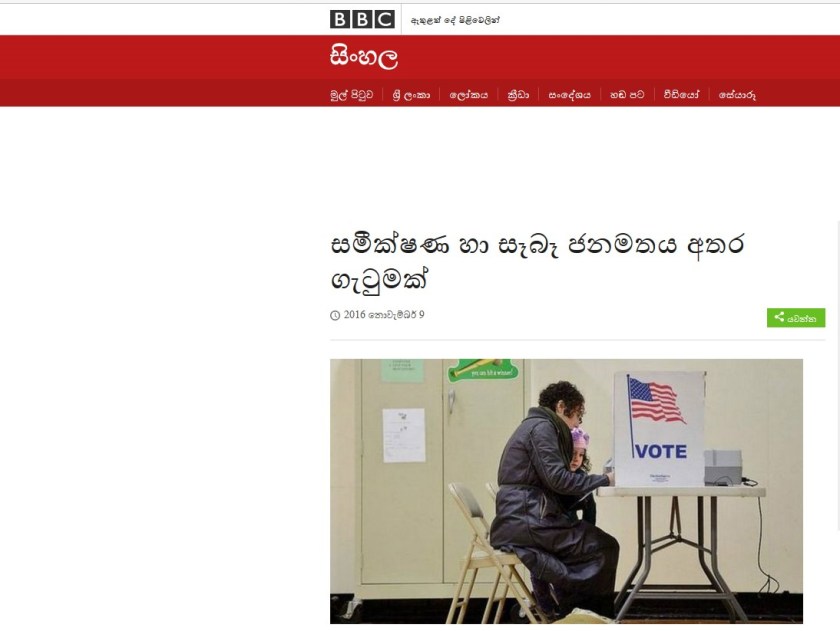
Within hours of the US Presidential Election’s results becoming known on 9 November 2016, I gave a telephone interview to BBC Sinhala service. They asked me how almost all the opinion polls did not see Donald Trump winning the election, even though many polls said it was going to be a close contest.
On September 11, I took part in a breakout session that discussed media innovation in Asia and the United States. While my fellow panelists spoke mainly about digital media innovation of their media outlet or media sector, I opted to survey the bigger picture: what does innovation really mean when media is under siege, and how can the media sector switch from such ‘innovation under duress’ to regular market or product innovation?
Here are my remarks, cleaned up and somewhat expanded:
Nalaka Gunawardene speaks on media innovation under duress
Innovation has been going on in media from the beginning. Faced with major challenges from advancing technologies and changing demography, innovation is now an imperative for market survival.
We can discuss this at different levels: product innovation, process innovation and systemic innovation. I like to add another kind for our discussion: innovation for physical survival.
With forces social and market Darwinism constantly at work, you might ask, shouldn’t the most adaptable and nimble players survive – while others perish?
Yes and No. Sometimes the odds against independent and progressive media organisations are disproportionately high – they should not be left to fend for themselves. This is where media consumers and public spirited groups need to step in.
Let me explain with a couple of examples from South Asia.
They say necessity is the mother of invention or innovation. I would argue that tyranny – from the state and/or extremist groups – provides another strong impetus for innovation in the media.
In Nepal, all media came under strict control when King Gyanendra assumed total control in February 2005. Among other draconian measures, he suspended press freedom, imposing a blanket ban on private or community broadcasters carrying news, thus making it a monopoly of state broadcasters.
The army told broadcasters that the stations were free to carry music, but not news or current affairs. Soldiers were sent to radio and TV stations to ensure compliance.
When the king’s siege of democracy continued for weeks and months, some media started defying censorship – they joined human rights activists and civil society groups in a mass movement for political reforms, including the restoration of parliamentary democracy.
Some of Nepal’s many community radio stations found creative ways of defying censorship. One station started singing the news – after all, there was no state control over music and entertainment! Another one in central Nepal went outside their studio, set up an impromptu news desk on the roadside, and read the news to passers-by every evening at 6 pm.
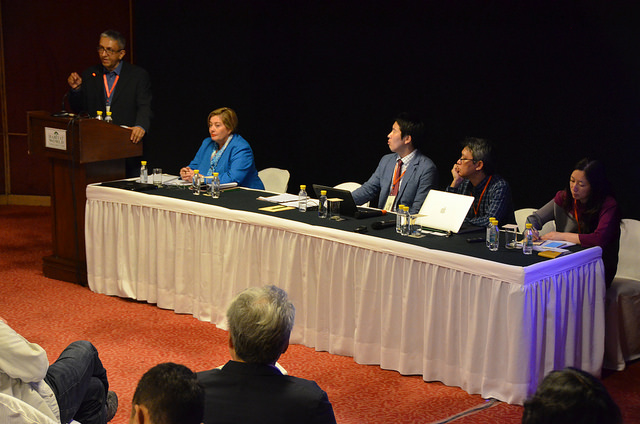
Panel on Media innovation at East-West Center Media Conference, Delhi, 11 Sep 2016: L to R – Philippa McDonald, Nalaka Gunawardene, LEE Doo Won, Fernando (Jun) SEPE, Jr. and ZHONG Xin
The unwavering resolve of these and other media groups and pro-democracy activists led to the restoration of parliamentary democracy in April 2006 and the subsequent abolition of the Nepali monarchy.
My second example is from Sri Lanka where I live and work.
We are recovering from almost a decade of authoritarian rule that we ended in January 2015 by changing that government in an election. The years preceding that change were the darkest for freedom of expression and media freedom in Sri Lanka – the country, then nominally a democracy, was ranked 165th among 183 countries in the World Press Freedom Index for 2014.
In June 2012, Sri Lanka was one of 16 countries named by the UN Special Rapporteur on the promotion and protection of the right to freedom of opinion and expression for “attacks against journalists during coverage of street protests and demonstrations, such as arbitrary arrests and detention, verbal and physical attacks, confiscation or destruction of equipment, as well as killings.”
Threats of attacks and actual incidents of physical violence in recent years led to a climate of fear and widespread self-censorship among journalists in Sri Lanka. This is slowly changing now, but old habits die hard.
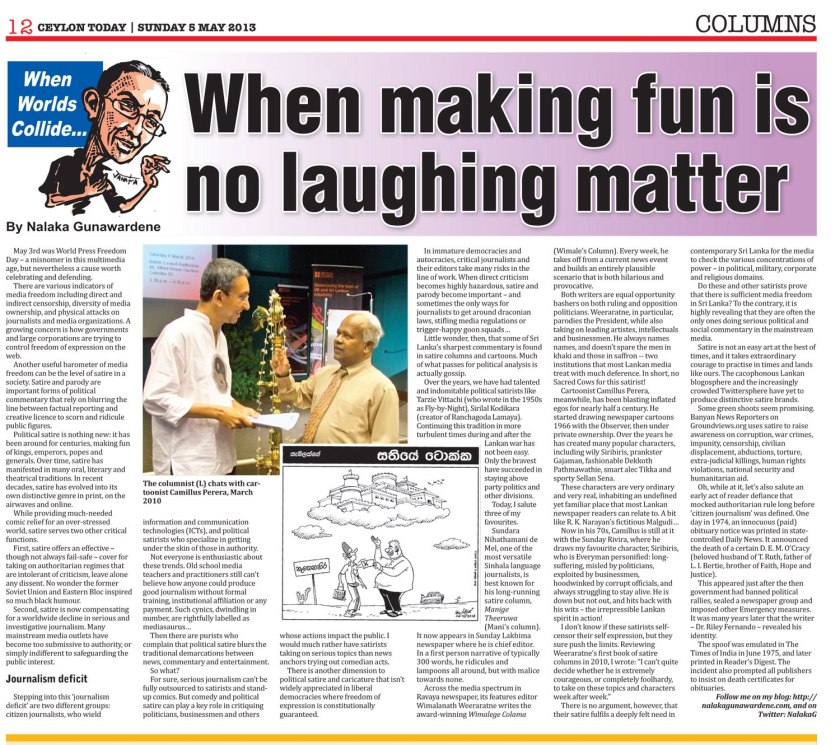
At the height of media repression by the former regime, we saw some of our media innovating simply for physical survival. One strategy was using satire and parody – which became important forms of political commentary, sometimes the only ones that were possible without evoking violent reprisals.
What I wrote then, while still in the thick of crackdown, is worth recalling:
“For sure, serious journalism can’t be fully outsourced to satirists and stand-up comics. But comedy and political satire can play a key role in critiquing politicians, businessmen and others whose actions impact the public.
“There is another dimension to political satire and caricature that isn’t widely appreciated in liberal democracies where freedom of expression is constitutionally guaranteed.
“In immature democracies and autocracies, critical journalists and their editors take many risks in the line of work. When direct criticism becomes highly hazardous, satire and parody become important — and sometimes the only – ways for journalists get around draconian laws, stifling media regulations or trigger-happy goon squads…
“Little wonder, then, that some of Sri Lanka’s sharpest commentary is found in satire columns and cartoons. Much of what passes for political analysis is actually gossip.”
For years, cartoonists and political satirists fulfilled a deeply felt need in Sri Lanka for the media to check the various concentrations of power — in political, military, corporate and religious domains.
They still continue to perform an important role, but there is more space today for journalists and editors to report things as they are, and to comment on the key stories of the day.
During the past decade, we have also seen the rise of citizen journalism and vibrant blogospheres in the local languages of Sinhala and Tamil. Their advantage during the dark years was that they were too numerous and scattered for the repressive state to go after each one (We do know, however, that electronic surveillance was attempted with Chinese technical assistance.)
Of course, Sri Lanka’s media still face formidable challenges that threaten their market survival.
Rebuilding Public Trust: An Assessment of the Media Industry and Profession in Sri Lanka (May 2016)
A new assessment of Sri Lanka’s media, which I edited earlier this year, noted: “The economic sustainability of media houses and businesses remains a major challenge. The mainstream media as a whole is struggling to retain its consumer base. Several factors have contributed to this. Many media houses have been slow in integrating digital tools and web-based platforms. As a result, there is a growing gulf between media’s production models and their audiences’ consumption patterns.”
Innovation and imagination are essential for our media to break out of 20th century mindsets and evolve new ways of content generation and consumption. There are some promising new initiatives to watch, even as much of the mainstream continues business as usual – albeit with diminishing circulations and shrinking audience shares.
Innovate or perish still applies to our media. We are glad, however, that we no longer have to innovate just to stay safe from goon squads.
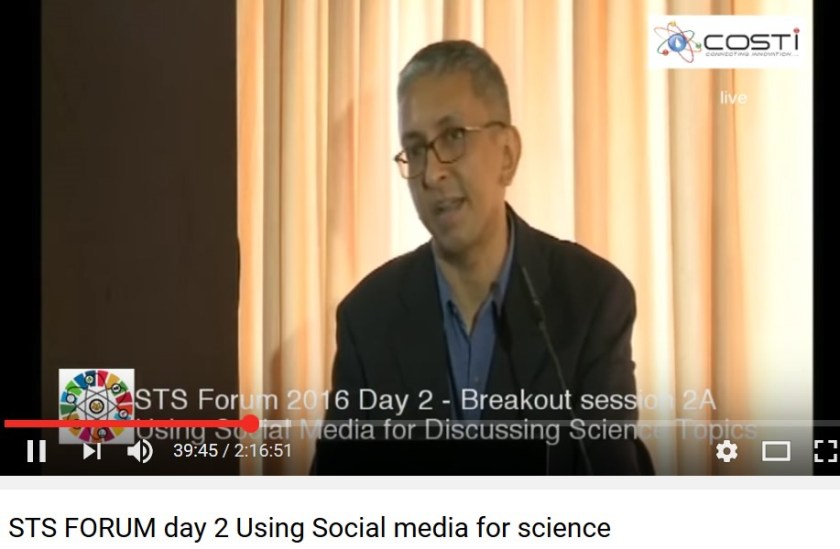
Nalaka Gunawardene speaks on “Using Social Media for Discussing Science” at the Science, Technology & Society Forum in Colombo, Sri Lanka, 9 Sep 2016. Photo by Smriti Daniel
Sri Lanka’s first Science and Technology for Society (STS) Forum took place from 7 to 10 September in Colombo. Organized by the Prime Minister’s Office and the Ministry of Science, Technology and Research, it was one of the largest gatherings of its kind to be hosted by Sri Lanka.
Modelled on Japan’s well known annual STS forums, the event was attended by over 750 participants coming from 24 countries – among them local and foreign scientists, inventors, science managers, science communicators and students.
I was keynote speaker during the session on ‘Using Social Media for Discussing Science Topics’. I used it to highlight how social media have become both a boon and bane for scientific information and thinking in Sri Lanka. This is due to peddlers of pseudo-science, anti-science and superstition being faster and better to adopt social media platforms than actual scientists, science educators and science communicators.
Social Media in #LKA:Do Science & Reason stand a chance? Asks Nalaka Gunawardene
Sri Lanka takes justified pride in its high literacy levels and equally high coverage of vaccination against infectious diseases. But we cannot claim to have a high level of scientific literacy. If we did, it would not be so easy for far-fetched conspiracy theories to spread rapidly even among educated persons. Social media tools have ‘turbo-charged’ the spread of associated myths, superstitions and conspiracy theories!
I cautioned: “Unless we make scientific literacy an integral part of everyone’s lives, ambitious state policies and programmes to modernize the nation could well be jeopardized. Progress can be undermined — or even reversed — by extremist forces of tribalism, feudalism and ultra-nationalism that thrive in a society that lacks the ability to think critically.”
It is not a case of all doom and gloom. I cited examples of private individuals creatively using social media to bust myths and critique all ‘sacred cows’ in Lankan society – including religions and military. These voluntary efforts contrast with much of the mainstream media cynically making money from substantial advertising from black magic industries that hoodwink and swindle the public.
My PowerPoint presentation:
Video recording of our full session:
The scoping note I wrote for our session:
Sri Lanka STS Forum panel on Using Social Media for Discussing Science Topics. 9 Sep 2016. L to R – Asanga Abeygunasekera, Nalaka Gunawardene, Dr Piyal Ariyananda, Dr Ananda Galappatti & Smriti Daniel
Session: Using Social Media for Discussing Science Topics
With 30 per cent of Sri Lanka’s 21 million people regularly using the Internet, web-based social media platforms have become an important part of the public sphere where myriad conversations are unfolding on all sorts of topics and issues. Facebook is the most popular social media outlet in Sri Lanka, with 3.5 million users, but other niche platforms like Twitter, YouTube and Instagram are also gaining ground. Meanwhile, the Sinhala and Tamil blogospheres continue to provide space for discussions ranging from prosaic to profound. Marketers, political parties and activist groups have discovered that being active in social media is to their advantage.
Some science and technology related topics also get discussed in this cacophony, but given the scattered nature of conversations, it is impossible to grasp the full, bigger picture. For example, some individuals or entities involved in water management, climate advocacy, mental health support groups and data-driven development (SDG framework) are active in Sri Lanka’s social media platforms. But who is listening, and what influence – if any – are these often fleeting conservations having on individual lifestyles or public policies?
Is there a danger that self-selecting thematic groups using social media are creating for themselves ‘echo chambers’ – a metaphorical description of a situation in which information, ideas, or beliefs are amplified or reinforced by transmission and repetition inside an “enclosed” system, where different or competing views are dismissed, disallowed, or under-represented?
Even if this is sometimes the case, can scientists and science communicators afford to ignore social media altogether? For now, it appears that pseudo-science and anti-science sentiments – some of it rooted in ultra-nationalism or conspiracy theories — dominate many Lankan social media exchanges. The keynote speaker once described this as Lankan society permanently suspending disbelief. How and where can the counter-narratives be promoted on behalf of evidenced based, rational discussions? Is this a hopeless task in the face of irrationality engulfing wider Lankan society? Or can progressive and creative use of social media help turn the tide in favour of reason?
This panel would explore these questions with local examples drawn from various fields of science and skeptical enquiry.