Tharu Atharata Giya Daruwa – Childhood of Arthur C Clarke – by Nalaka Gunawardene
A new Sinhala language book, being released this week, traces the formative years of Sir Arthur C Clarke (1917 – 2008), author, undersea explorer and futurist.
Titled ‘Tharu Atharata Giya Daruwa: Childhood of Arthur C Clarke’, the book is written by Lankan science writer Nalaka Gunawardene who worked with Clarke for 21 years as research associate at his personal office in Colombo.
The book, in story-telling style in conversational Sinhala, is suitable for readers of all ages, and especially for parents, teachers and children.
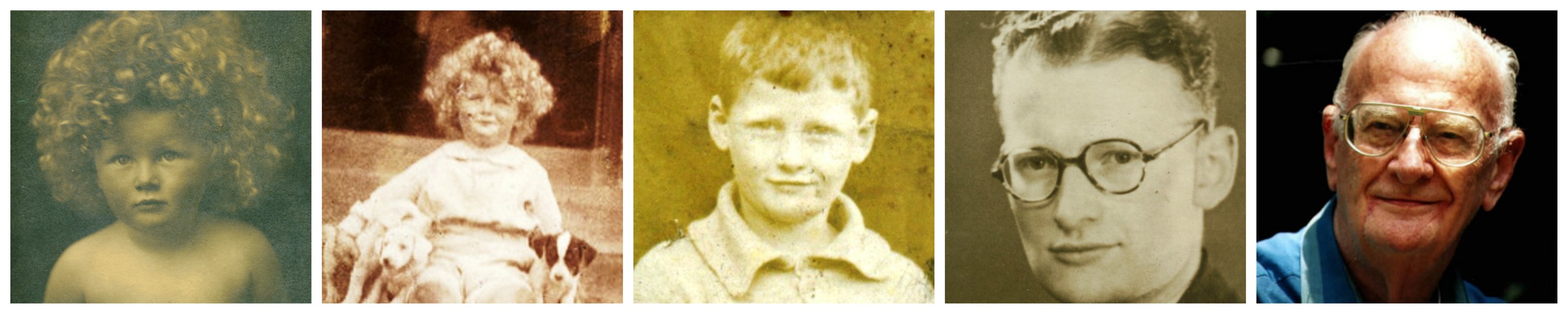
Clarke’s accomplishments are known much more than his humble origins and early inspirations in life. He was born in rural England as the First World War was ending, and spent his childhood years in Minehead, Somerset, close to the sea. His experiences were shaped largely by growing up on the family farm, exploring the local beach, and working part-time at the village post office.
Arthur was the eldest in a family of four, who were raised by their dynamic mother, widowed at a young age. Despite cycling 20 km to school and back and helping on the farm, he excelled in studies and pursued serious hobbies — star gazing, mechanical experiments and nature observations.
“Early on, he cultivated habits like good time management, thrift, careful storage of everything and multi-tasking – all of which lasted a lifetime,” says Nalaka Gunawardene. “He knew the value and limits of money, respected the dignity of labour, and appreciated honesty and hard work in everyone.”
The book is widely illustrated with 74 photographs including many drawn from family albums preserved by the Arthur C Clarke Trust that now manages the Clarke Literary Estate. It also carries some original caricatures drawn by cartoonist and artist Dharshana Karunathilake who designed the book.
Chapters are devoted to facets of young Arthur Clarke, covering pursuits like avid reading, fiction writing, rocket building, movie watching and his elaborate yet harmless pranks. Throughout the book, readers discover less known facets of the global figure – such as his fondness for animals, dinosaurs and comics.
While confining mostly to his first 20 years, the book connects Clarke’s childhood exploits with his later feats in science fiction, undersea diving, space exploration and telecommunications.
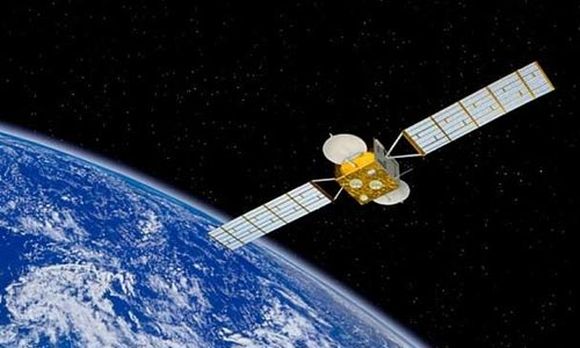
In a career spanning over six decades, he wrote some 100 books and more than 1,000 short stories and essays covering both science fiction and science fact. He was the first to propose geostationary communications satellites, and one of his stories later inspired the World Wide Web.
Arthur C Clarke (1917-2008): “He never grew up, but he never stopped growing”
“Sir Arthur used to joke that one secret of his success was his careful choice of parents,” says Nalaka. “More seriously, what roles did family, education, peers, travel and social interactions play in producing the distinctively his combination of sharp wit, irreverence, playful humour and, above all, vivid yet realistic imagination? My book goes in search of some answers from his childhood.”
The book collates information, images and insights Nalaka has accumulated over the years working closely with Clarke on the latter’s literary and scientific projects. Nalaka twice visited Clarke’s home town of Minehead, family farm Ballifants and town of Taunton where he schooled. Photos from these travels enrich the book which quotes Clarke’s biological and Lankan family members.
In 2012, Nalaka was a collaborator to the extensively revised and expanded edition of Clarke’s authorized biography, titled Visionary: The Odyssey of Sir Arthur C. Clarke. It was written by Neil McAleer, who also wrote the original 1992 biography.
Nalaka reiterates that the best way for Sri Lanka to celebrate the legacy of Arthur C Clarke is to adapt his ideas for a better world based on knowledge, ethics, compassion and imagination.
The 120-page large format book, published by Suratha Books, is priced at LKR 600. It will be on sale at several booths the Colombo International Book Fair from 10 to 16 September 2014, with significant discounts. A book launch event is to be held later.
Although it has been discussed for centuries, there is no universally accepted definition of basic human needs. During the 1970s, basic needs emerged as a key topic in development debates. Various studies – catalysed by UN agencies and the Club of Rome – tried to define it.
In 1976, the International Labour Organization (ILO) prepared a report that identified basic needs as food, clothing, housing, education and public transportation. It partially drew on ILO’s country reports on Columbia, Kenya and Sri Lanka. Since then, different development agencies have adopted variations of the original ILO list. National planners have used the concept to benchmark economic growth.
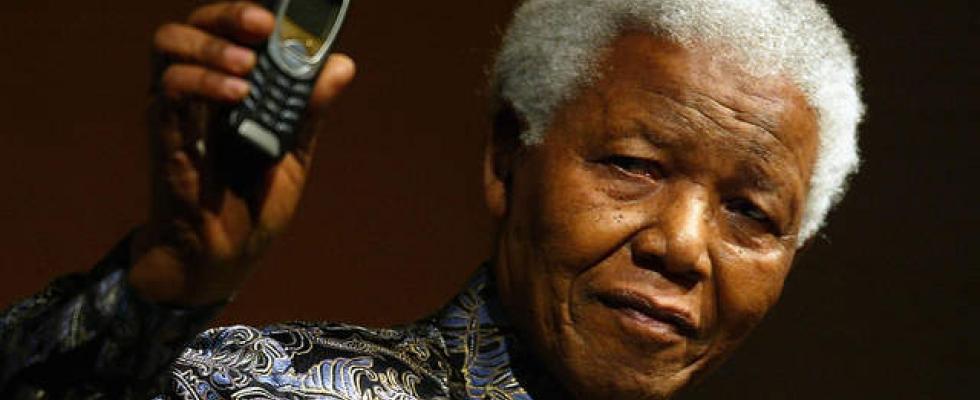
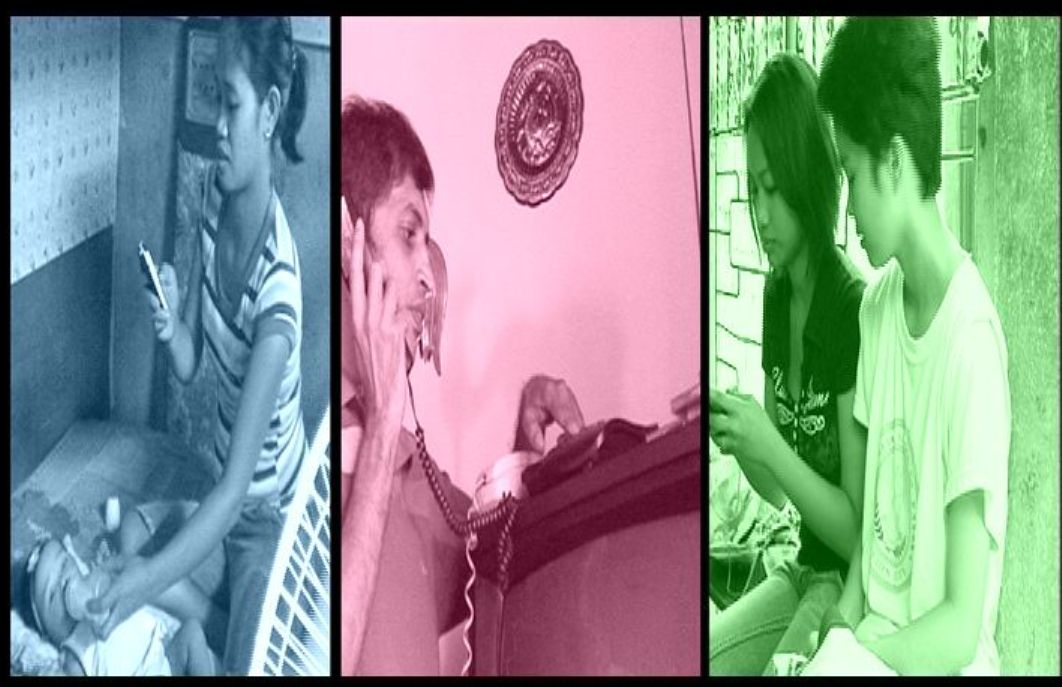
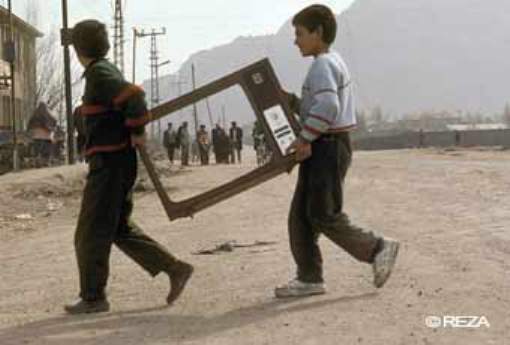
The ground reality has changed drastically since those heady days. In view of the rapid evolution of information society, communication should be considered a basic human need. This is the basic thrust in my latest Ravaya column (in Sinhala).
See also my related writing on revisiting basic needs:
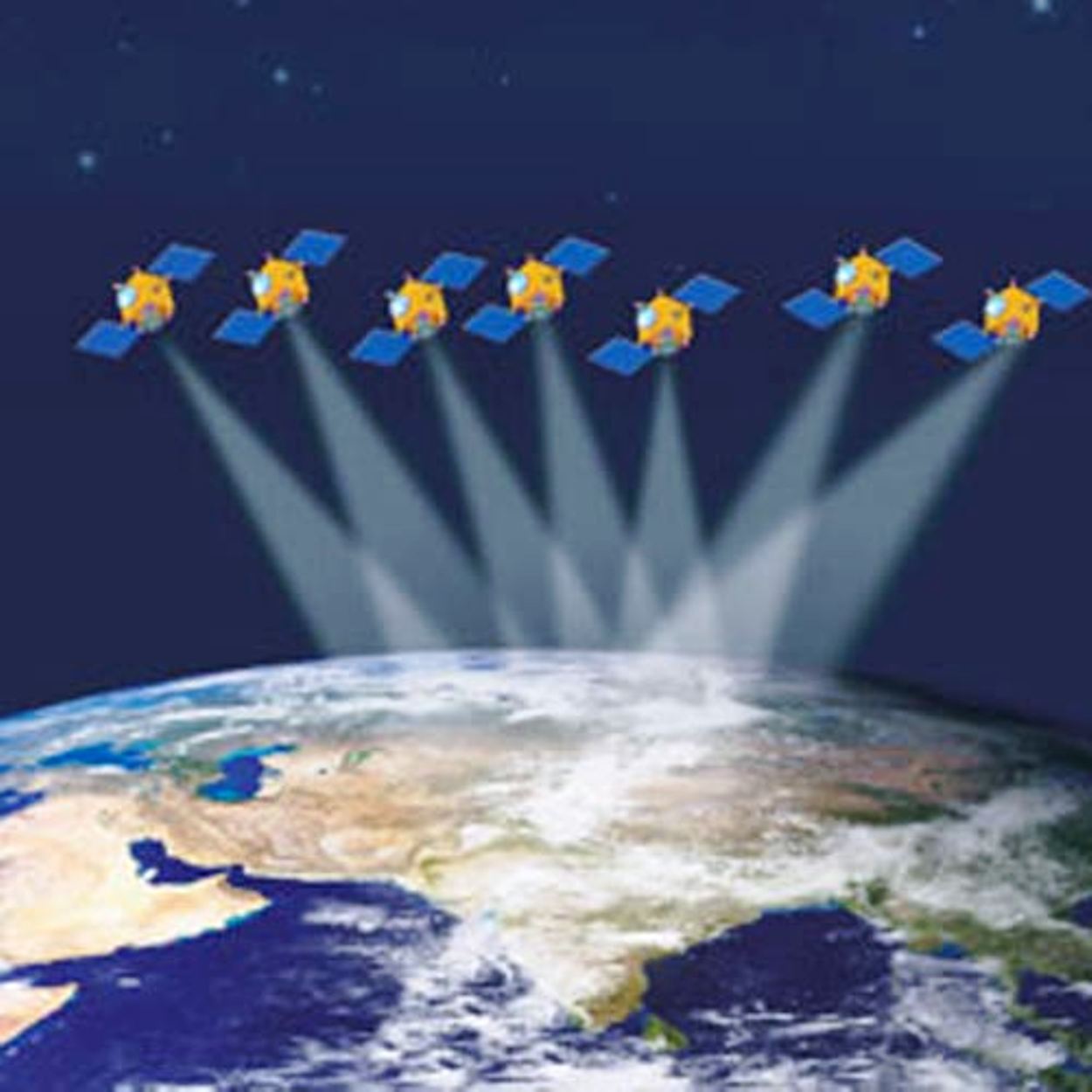
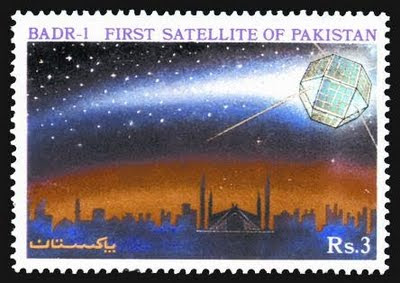
Both China and India are keen to enhance links with smaller Asian countries in using satellites as part of their ‘space diplomacy’ strategies.
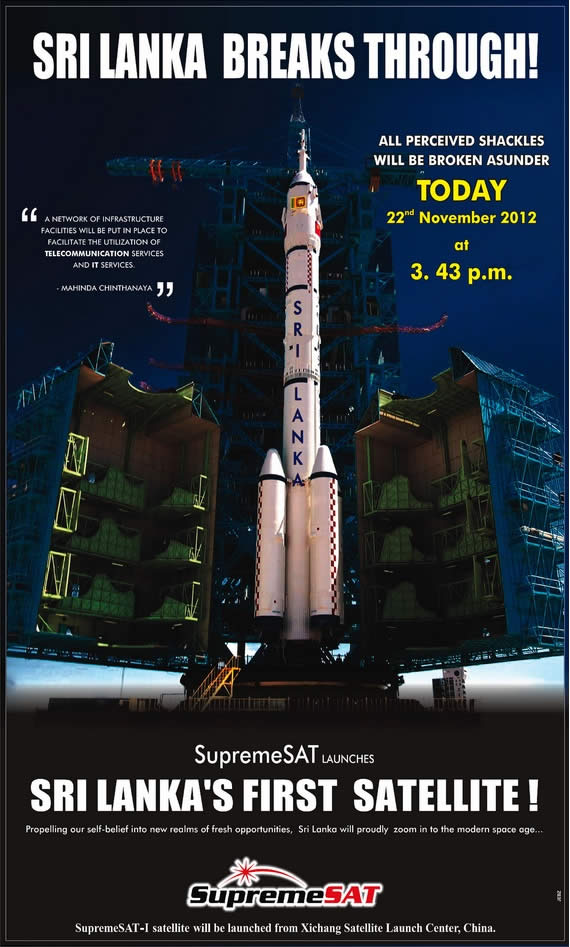
Last week in my Ravaya column (in Sinhala), I wrote about space technology capabilities of South Asian countries. This week’s column probes whether or not Sri Lanka needs its own satellite.
New opportunities for South Asian collaboration in space technologies can help reduce poverty and promote sustainable development.
Both China and India are keen to enhance links with smaller Asian countries in using satellites for communications, weather services, land use monitoring and navigation. They have also realised the value of ‘space diplomacy’, or using space related technical cooperation for strengthening foreign relations.
In this week’s Ravaya column (in Sinhala), I look at South Asian countries investing in space technologies, and discuss the prospects for a common South Asian satellite, an idea recently revived by the Indian Prime Minister.
In this week’s Ravaya column (in Sinhala), I revisit the on-going debate on social media and social accountability, this time from the perspective of freedom of expression.
Unless a user takes consistent precautions, everything published online is ultimately traceable to the point of origin. However, for most practical purposes, options of anonymity and pseudonymity are still available on the web – and widely used by users, for a variety of reasons. Contrary to what some misinformed people say, there is nothing legally or morally wrong with this practice.
Of course, the facilities can be misused, most notably in spreading hate speech and deliberate falsehoods. But this reality, by itself, is not a sufficient argument against online anonymity or pseudonymity. Indeed, as I argue in this column, being able to conceal one’s real identity is a safe way for social activists and public intellectuals to express their views living in countries with repressive regimes and/or intolerant societies.
While I myself have always expressed my views online under my own name — and sometimes received vitriol and threats as a result — I defend the right for anyone to remain anonymous or use pseudonyms.
In this week’s Ravaya column (in Sinhala), I return to the oft-discussed topic of social media in today’s Lankan society.
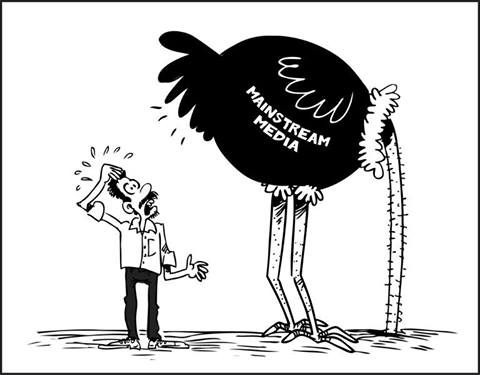
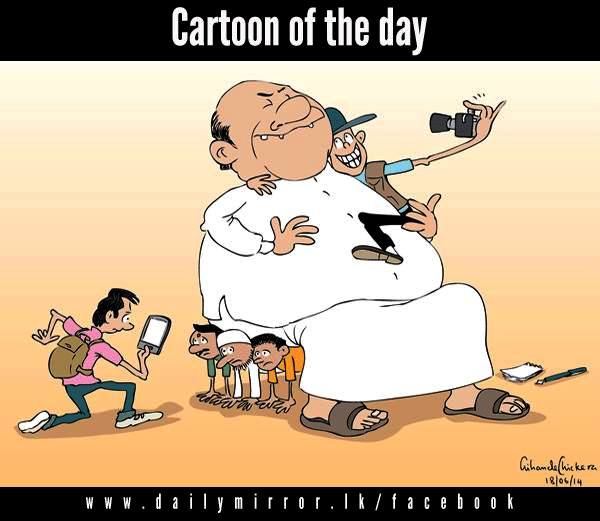
If media mirror the realities of its land and times, don’t social media reflect its society as well? And if some among us don’t like what is expressed by fellow citizens using social media platforms, could it be that many inconvenient issues and questions – excluded in the mainstream media – are being raised?
Yes, we need to discuss the social, cultural and political implications of growing social media use. However, that debate will not be served by insular and insecure mindsets that see every aspect of globalization as a threat or conspiracy.
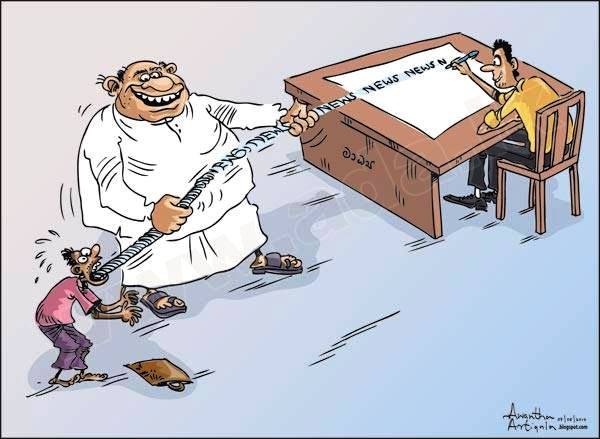
For over 48 hours, there was little coverage of the incidents in newspapers, or on radio and TV. This gap was partly filled by social media and international media reports – but only to the extent they have outreach in the island. Those who rely on local newspapers, radio and TV had to settle for ‘radio silence’ while media gatekeepers hesitated and held back.
In his last published short story, written only a few months before his death, Sir Arthur C Clarke envisioned a world without religions by the year 2500.
Yes, ALL organised, institutionalised religions (i.e. those with holy scripture, priests and places of worship) will gradually go into oblivion! No exceptions.
In it, Sir Arthur described the development of reliable psychological probes, using which any suspected individual could be ‘painlessly and accurately interrogated, by being asked to answer a series of questions’. While its original purpose is to keep the world safe from criminals and terrorists, the “Psi-probe” soon proves to be useful on another front: to weed out religious fanaticism – and all religions themselves – which is a greater threat to humanity.
A few weeks ago, with the concurrence of the Arthur C Clarke Estate, I invited S M Banduseela, the most prolific translator of Clarke’s work in Sri Lanka, to render this last story into Sinhala. Here it is, being published for the first time here:
Feature published in Ceylon Today Sunday newspaper, 30 March 2014
To Go Where No Lankan Movie has Gone Before…
By Nalaka Gunawardene
Photos courtesy Dreams & Magic Entertainment
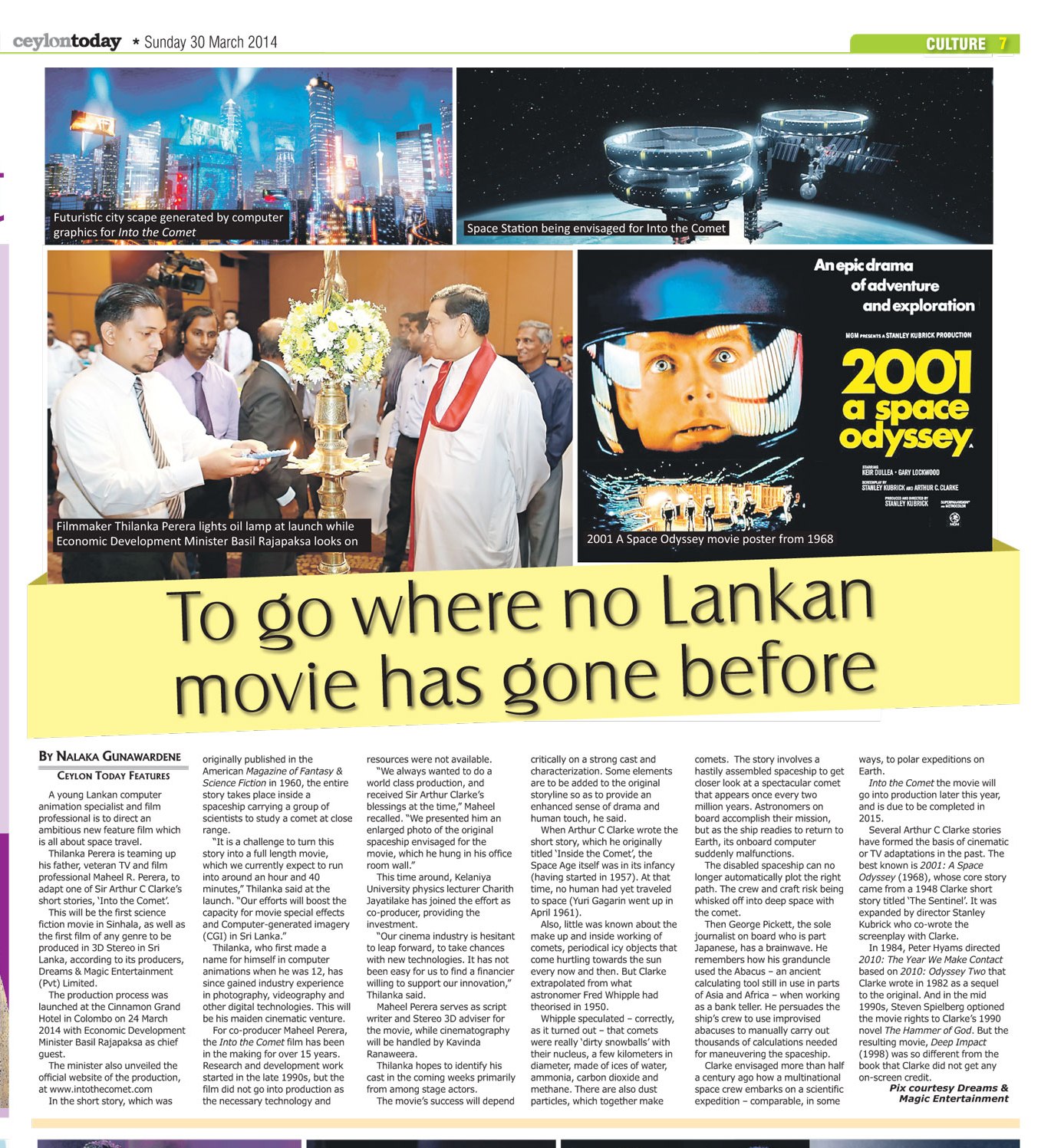
Space Station being envisaged for ‘Into the Comet’ Sinhala science fiction feature film by Thilanka Perera
A young Lankan computer animation specialist and film professional is to direct an ambitious new feature film which is all about space travel.
Thilanka Perera is teaming up his father, veteran TV and film professional Maheel R Perera, to adapt one of Sir Arthur C Clarke’s short stories, “Into the Comet”.
This will be the first science fiction movie in Sinhala, as well as the first film of any genre to be produced in 3D Stereo in Sri Lanka, according to its producers, Dreams & Magic Entertainment (Pvt) Limited.
The production process was launched at the Cinnamon Grand Hotel in Colombo on 24 March 2014 with Economic Development Minister Basil Rajapaksa as chief guest.
In the short story, which was originally published in the American Magazine of Fantasy & Science Fiction in 1960, the entire story takes place inside a spaceship carrying a group of scientists to study a comet at close range.
“It is a challenge to turn this story into a full length movie, which we currently expect to run into around an hour and 40 minutes,” Thilanka said at the launch. “Our efforts will boost the capacity for movie special effects and Computer-generated imagery (CGI) in Sri Lanka.”
Thilanka, who first made a name for himself in computer animations when he was 12, has since gained industry experience in photography, videography and other digital technologies. This will be his maiden cinematic venture.
For co-producer Maheel Perera, ‘Into the Comet’ film has been in the making for over 15 years. Research and development work started in the late 1990s, but the film did not go into production as the necessary technology and resources were not available.
“We always wanted to do a world class production, and received Sir Arthur Clarke’s blessings at the time,” Maheel recalled. “We presented him an enlarged photo of the original spaceship envisaged for the movie, which he hung in his office room wall.”
This time around, Kelaniya University physics lecturer Charith Jayatilake has joined the effort as co-producer, providing the investment.
“Our cinema industry is hesitant to leap forward, to take chances with new technologies. It has not been easy for us to find a financier willing to support our innovation,” Thilanka said.
Maheel Perera serves as script writer and Stereo 3D adviser for the movie, while cinematography will be handled by Kavinda Ranaweera.
Thilanka hopes to identify his cast in the coming weeks primarily from among stage actors.
The movie’s success will depend critically on a strong cast and characterization. Some elements are to be added to the original storyline so as to provide an enhanced sense of drama and human touch, he said.
When Arthur C Clarke wrote the short story, which he originally titled “Inside the Comet”, the Space Age itself was in its infancy (having started in 1957). At that time, no human had yet traveled to space (Yuri Gagarin went up in April 1961).
Also, little was known about the make up and inside working of comets, periodical icy objects that come hurtling towards the sun every now and then. But Clarke extrapolated from what astronomer Fred Whipple had theorised in 1950.
Whipple speculated — correctly, as it turned out — that comets were really ‘dirty snowballs’ with their nucleus, a few kilometers in diameter, made of ices of water, ammonia, carbon dioxide and methane. There are also dust particles, which together make comets spectacular phenomena when they approach the sun.
The story involves a hastily assembled spaceship to get closer look at a spectacular comet that appears once every two million years. Astronomers on board accomplish their mission, but as the ship readies to return to Earth, its onboard computer suddenly malfunctions.
The disabled spaceship can no longer automatically plot the right path. The crew and craft risk being whisked off into deep space with the comet.
Then George Pickett, the sole journalist on board who is part Japanese, has a brainwave. He remembers how his granduncle used the Abacus – an ancient calculating tool still in use in parts of Asia and Africa – when working as a bank teller. He persuades the ship’s crew to use improvised abacuses to manually carry out thousands of calculations needed for maneuvering the spaceship…
Futuristic city scape generated by computer graphics for movie Into the Comet
Clarke envisaged more than half a century ago how a multinational space crew embarks on a scientific expedition – comparable, in some ways, to polar expeditions on Earth.
“Into the Comet” the movie will go into production later this year, and is due to be completed in 2015.
Several Arthur C Clarke stories have formed the basis of cinematic or TV adaptations in the past. The best known is 2001: A Space Odyssey (1968), whose core story came from a 1948 Clarke short story titled ‘The Sentinel’. It was expanded by director Stanley Kubrick who co-wrote the screenplay with Clarke.
In 1984, Peter Hyams directed 2010: The Year We Make Contact based on 2010: Odyssey Two that Clarke wrote in 1982 as a sequel to the original. And in the mid 1990s, Steven Spielberg optioned the movie rights to Clarke’s 1990 novel The Hammer of God. But the resulting movie, Deep Impact (1998) was so different from the book that Clarke did not get any on-screen credit.







 Open Minds!