Samabima monthly magazine, published by Rights Now human rights advocacy group in Sri Lanka, has carried an interview with me in its December 2015 issue.
In this, I discuss the societal implications of a Right to Information law, which is to be adopted by Sri Lanka’s Parliament in early 2016. I reiterate that we need to see the new law as only the beginning of a long journey. Proper implementation will require adequate political will, administrative support and sufficient public funds. We would also need sustained monitoring by civil society groups and media to guard against the whole process becoming mired in too much red tape.
I also touch on serious inadequacies in our mainstream media that often fail to serve the public interest because of incompetence, arrogance or indifference. In this interview, I coin a phrase ‘Mass Media Brutality’ meted out to victims of crime or discrimination in Sri Lanka — when the media pack descends on an individual or family and unethical, sensational coverage follows.
Nalaka Gunawardene interview in Samabima magazine, Dec 2015 issue
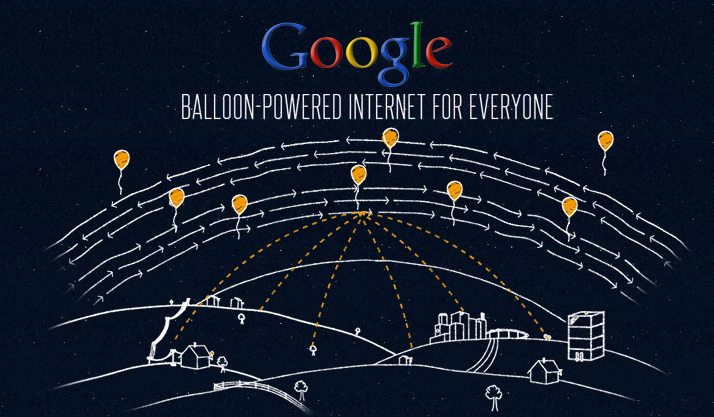
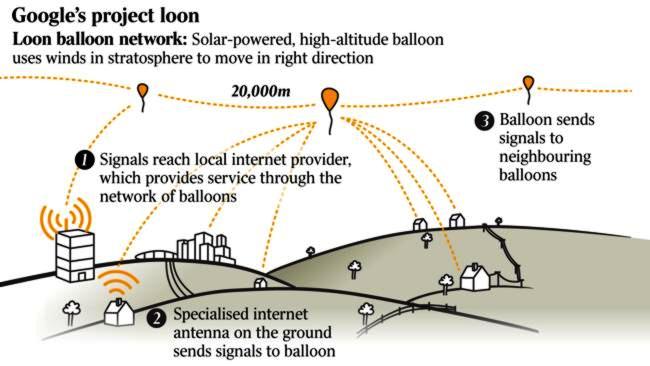
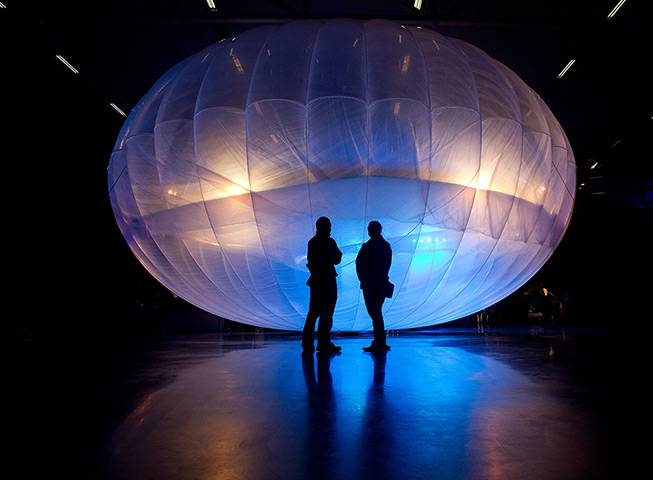
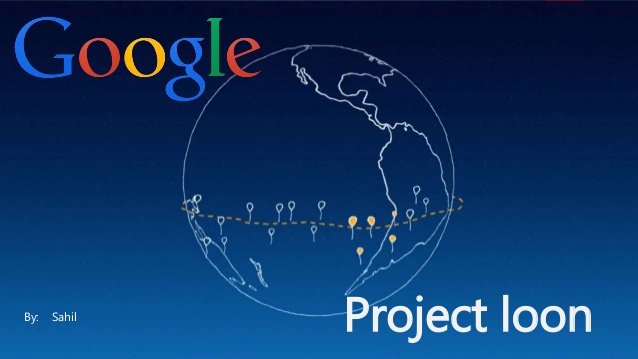
The partnership with Google Project Loon is for setting up a network of 13 high-tech balloons strategically positioned some 20 km above the island. These helium-filled and solar-powered balloons will act as ‘floating cell towers’ that distribute 3G mobile signals wider than ground-based towers can.
When commissioned in early 2016, this system would “make Sri Lanka potentially the first country in the world to have universal Internet access”, according to news reports.
This deal with Google was brokered by Lankan-born Silicon Valley venture capitalist Chamath Palihapitiya. The government’s Information and Communications Technology Agency (ICTA) hailed it as a major accomplishment.
Is it really so? What exactly does this deal bring us, and at what apparent or hidden costs? How will the average Internet user benefit?
Simplified diagram of how Google Loon system would work
Going by generic information available online, Loon partnership seems a useful first step forward in enhancing Internet access in Sri Lanka. But it cannot work by itself. Other factors must fall into place.
According to Google, Project Loon (www.google.com/loon/) is “a network of balloons traveling on the edge of space, designed to connect people in rural and remote areas, help fill coverage gaps, and bring people back online after disasters”.
Sri Lanka’s Project Loon partnership promises to substantially extend the mobile broadband signal coverage of our existing Internet Service Providers, or ISPs.
Airtel, Dialog, Etisalat, Hutch and Mobitel all use what is popularly known as Third Generation (3G) mobile broadband technologies. Some have also ventured into 4G.
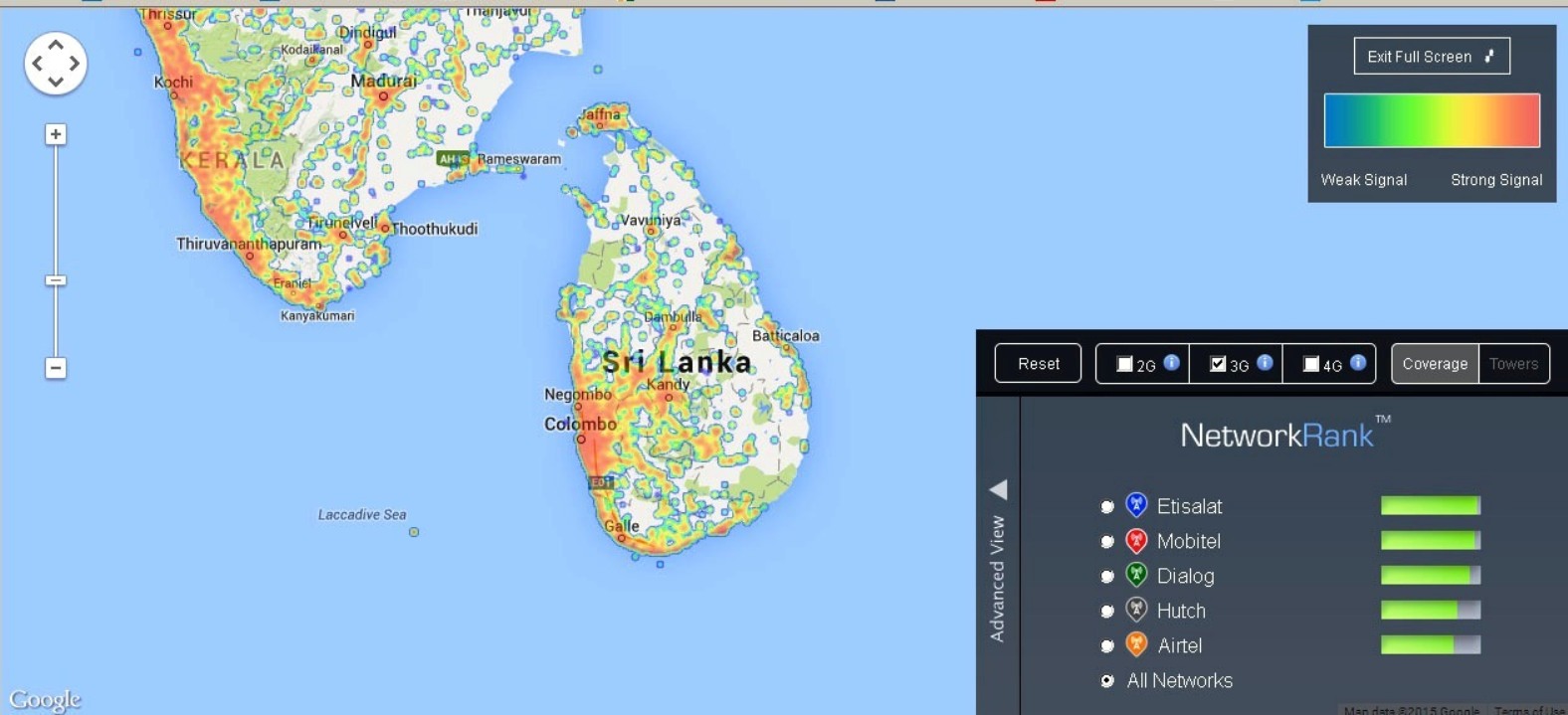
Right now operators rely on their own networks of terrestrial towers for signal coverage. This naturally concentrates on where more people, businesses and offices are located. Thus, the south-western quadrant of the island enjoys much better signal coverage than many other areas. There are gaps that the market alone would probably never fill.
If we look at publicly available signal coverage maps on http://opensignal.com, for example, we see plenty of areas in Sri Lanka not yet covered by 3G from any telecom network.
All networks’ 3G signal coverage – on 30 July 2015
In theory, Google Loon’s 13 balloons over Lanka should extend our ISPs’ mobile broadband coverage to the whole land area of 65,610 sq km (25,332 square miles). Each balloon can provide connectivity to a ground area about 40 km in diameter using a wireless communications technology called LTE.
“To use LTE, Project Loon partners with telecommunications companies to share cellular spectrum so that people will be able to access the Internet everywhere directly from their phones and other LTE-enabled devices. Balloons relay wireless traffic from cell phones and other devices back to the global Internet using high-speed links,” says the project’s website.
There is one clear benefit of extra-terrestrial telecom towers: they are beyond the reach of geological and hydro-meteorological disasters that can knock out terrestrial ones. As a back-up system in the sky, well above most atmospheric turbulence, Loon can be invaluable in disaster communications.
Universal access?
But it’s important to remember that universal signal coverage does not necessarily mean universal access or universal use.
It is now two decades since Sri Lanka became the first in South Asia to introduce commercial Internet services. By end 2014, there were some 3.3 million Internet subscriptions in Sri Lanka, most of them (82%) were mobile subscriptions, says the Telecom Regulatory Commission (TRC).
Internet subscriptions are often shared among family members or co-workers so the number of users is higher. The Internet Society – a global association of technical professionals – estimated last year that 22% of Sri Lanka’s population regularly uses the Internet. So almost one in four Lankans gets online.
What about the rest? There can be different reasons why the rest is not connected – such as the lack of need, non-availability of service, affordability, and absence of skill.
I can think of three other important factors for successful Internet use:
COST: Contrary to some media reports, Project Loon by itself does not provide free wireless Internet or WiFi. Existing rates and packages of mobile operators would continue to apply. We already have some of the lowest data communication rates in Asia, so how much lower can these drop?
QUALITY of service: Mobile companies must ensure that broadband speeds don’t drop drastically as more users sign up. Such increase of backhaul capacity hasn’t always happened, leading to complaints that we get FRAUDBAND in the name of broadband!
USER CAPACITY: The Census and Statistics Department’s latest (2014) survey found basic computer literacy in Sri Lanka has reached 25%. Since the survey covered only desk top computers and laptops, this figure could be under-estimating the digital skills of our young people who quickly master smartphones and other digital devices. But then, most are not careful with privacy and data protection.
So beyond Project Loon, we have much more to do on the ground to reach a knowledge based economy and inclusive information society.
Google Project Loon balloon on display at Airforce Museum in Christchurch, New Zealand
Google’s Benefits
Finally, what is in it for Google? Why are they giving this facility to our telecom companies apparently for free?
The information and media giant is investing millions of US Dollars for research, development and launching the service. Yes Google has deep pockets, but it is not a charity. So what do they gain?
For one thing, the Sri Lanka experience will produce proof of concept for Loon in a relatively small sized market. To operate, Google Loon balloons need permission to hover over Lankan airspace – this concession can inspire confidence in other governments to also agree.
In the long term, more people going online will generate more users for Google, which already dominates search engines globally (over 85%) and offers a growing range of other services. The company can then market its myriad eyeballs to advertisers…
There is no such thing as a free lunch. But as long as we engage Google without illusions, it can be a win-win partnership.
Science writer Nalaka Gunawardene has been chronicling and analysing the rise of new media in Sri Lanka since the early 1990s. He is active on Twitter @NalakaG and blogs at http://nalakagunawardene.com
In this week’s Ravaya column (in Sinhala, published in issue of 26 April 2015), I question the wisdom of a new project by the Lankan government’s Information and Communication Technology Agency (ICTA) on “ICT for Citizen’s Journalism”.
ICTA’s CEO was recently quoted in the media as saying: “For this programme, what we are planning to show people is that every person can become a journalist and contribute towards media organisations. First, taking photographs and videos and sending it to a reporter which will enable him/her to have more information in order to analyse an incident further and report on it…”
If he has been quoted correction (no denial so far), the apex ICT institution of the Lankan government shows a shocking ignorance in its limited understanding of citizen journalism: must they be limited to gatherers of raw material for mainstream media? What about bearing witness, self-publication and countervailing functions of citizen media?
In today’s column, I call it particularly shocking as ICTA now comes under the purview of Ministry of Foreign Affairs — whose deputy minister, Ajith P Perera, was an active blogger for some years and became the first blogger to be elected to Lankan Parliament in 2010. If only this technical agency were to ask its own minister for some clarity before formulating such misguided national programmes…
Yaha-paalanaya (good governance) is not just ensuring a clean and efficient government but also having clarity of purpose and making well reasoned and evidence based interventions to societal needs. ICTA fails once again on this count.
In this week’s Ravaya column (in Sinhala, published in issue of 15 March 2015), I discuss what policy and regulatory measures can help promote information society in Sri Lanka. In that process, I critique the Telecommunications Regulatory Commission (TRCSL) and the ICT Agency (ICTA), two state institutions with relevant mandates that they have mismanaged, and sometimes squandered, during the past decade.
I argue that, for the most part, ICTA has been dabbling in ‘retail’ level (and politically driven) projects such as setting up rural tele-centres and designing government websites, while neglecting ‘wholesale’ level needs – such as resolving local font standardization, supporting ICT innovation, and being a facilitator of meaningful e-government. Similarly, TRC has been engaging in indiscriminate blocking of political websites critical of the former government, without creating an enabling environment in which pluralistic web content could thrive.
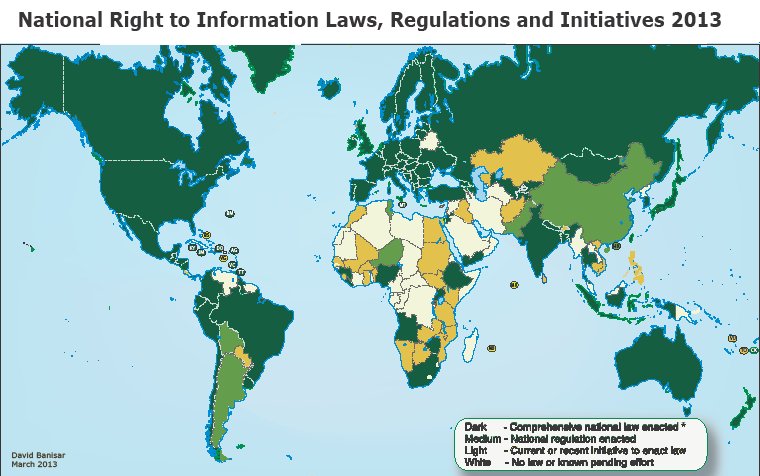
In this week’s Ravaya column (in Sinhala), I discuss the history and current state of play in relation to right to information (RTI). This is in the context of the new Lankan government planning to introduce an RTI law.
To review the work of government at all levels, citizens/voters need to access public sector information – about decisions, proceedings, budgets, expenditures, problems and performance. Close to 100 countries now have laws guaranteeing people’s RTI.
Sadly, Sri Lanka is lagging behind all other SAARC countries, five of which have already enacted RTI laws and two (Afghanistan and Bhutan) have draft bills under consideration. Attempts to introduce RTI in Sri Lanka were repeatedly thwarted by the previous government, which cited various excuses for avoding such a progressive law.
In this column, I also argue that RTI’s effectiveness depends on imagination, innovation and persistence on the part of all citizens. Its best results will accrue in a society and political culture where evidence and analysis are respected. Sri Lanka is not there yet.
RTI will be a significant milestone in a long journey that must continue.
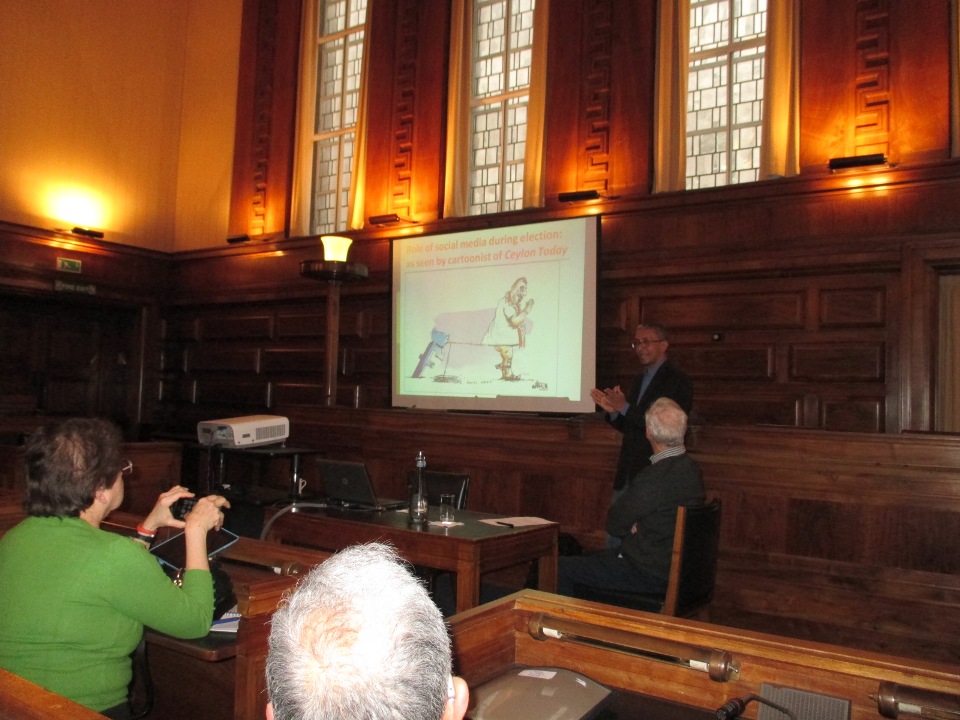
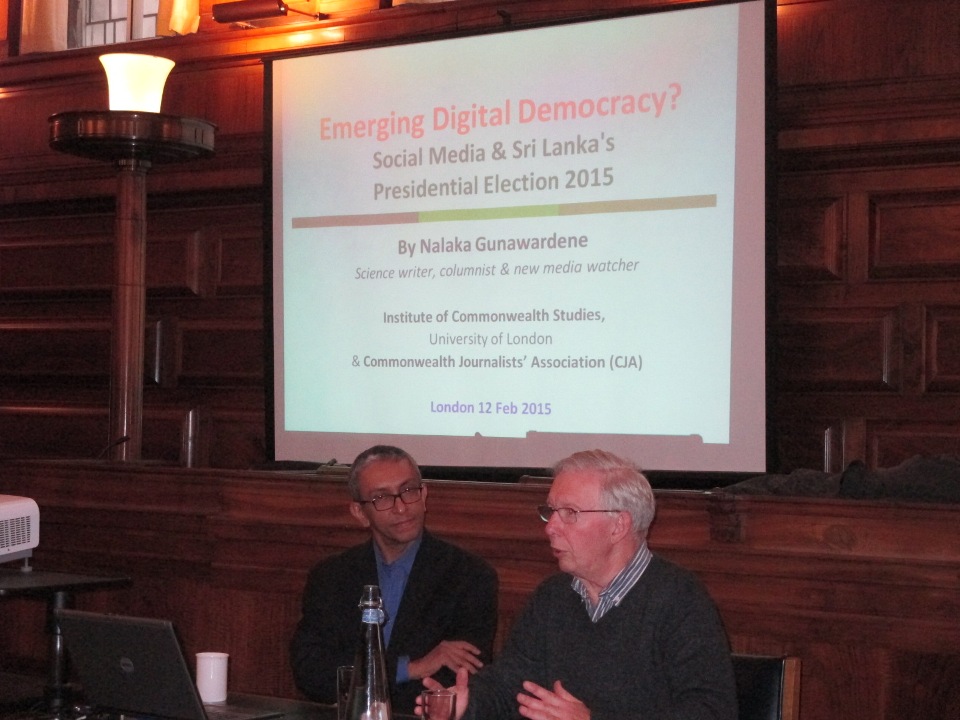
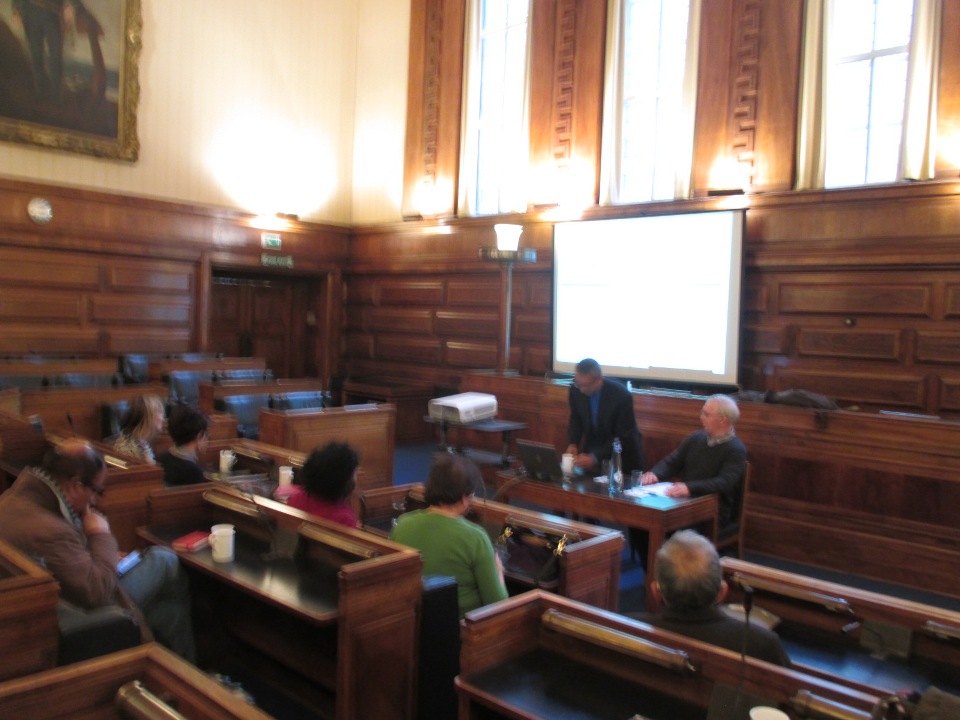
Nalaka Gunawardene talking at London University on 12 Feb 2015 on “Social Media and Sri Lanka’s Presidential Election 2015” Photo by Prasanna Ratnayake
Emerging Digital Democracy? Social Media and Sri Lanka’s Presidential Election 2015
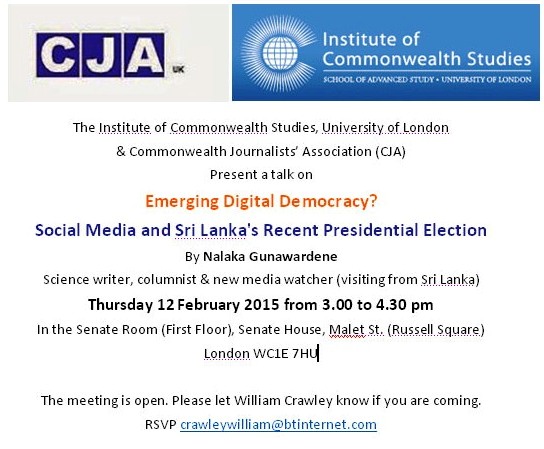
This was the topic of a public talk I gave at the University of London on 12 Feb 2015.
It was organised and hosted by the Institute of Commonwealth Studies, University of London in collaboration with the Commonwealth Journalists’ Association (CJA).
They lined up the University’s Senate Room for the talk, which was attended by a South Asian audience who engaged me in a lively discussion.
Emerging Digital Democracy? Social Media and Sri Lanka’s Presidential Election 2015
Synopsis of the talk:
A record 81.5% of registered voters took part in Sri Lanka’s presidential election on 8 January 2015 in which incumbent Mahinda Rajapaksa was defeated by his former health minister Maithripala Sirisena. The peaceful regime change has been widely acclaimed as a triumph of democracy and a mandate for political reform, improved governance and national reconciliation.
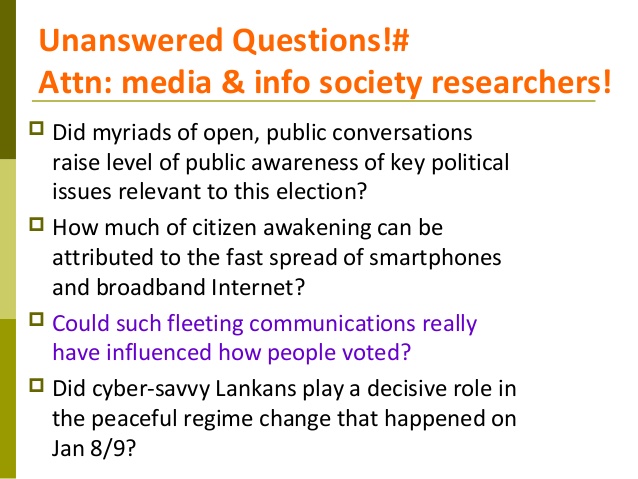
The election saw unprecedented use of social media by both candidates as well as by politically charged yet unaffiliated youth. How much of this citizen awakening can be attributed to the fast spread of smartphones and broadband? Did it really influence how people voted? What does this mean for future politics and governance in Sri Lanka?
In this illustrated talk, science journalist and new media watcher (and practitioner) Nalaka Gunawardene shares his insights and views.
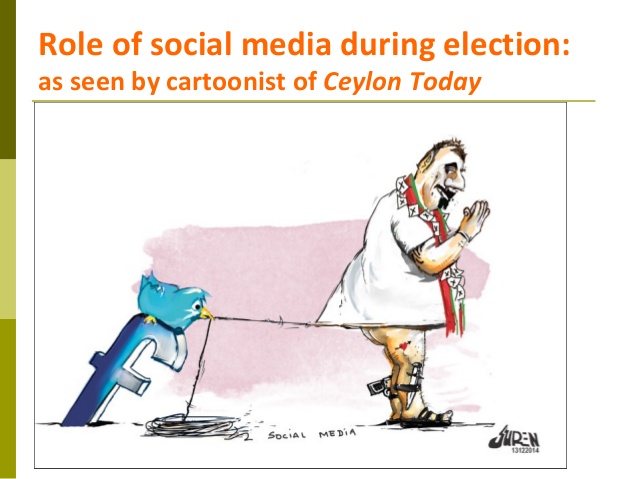
Who’s afraid of social media? Many Lankan politicians, for sure…
My PowerPoint slides:
Key questions that need more research to answer:
This is why we need better research on new media and society in Sri Lanka!
Photos by Prasanna Ratnayake
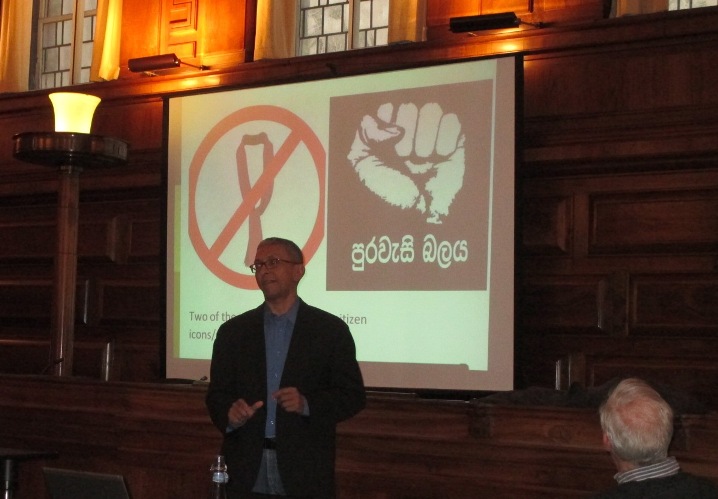
William Crawley (right), Fellow of the Institute of Commonwealth Studies, introduces Nalaka GunawardeneNalaka Gunawardene on Social Media and Sri Lanka’s Presidential Election 2015 at University of London, 12 Feb 2015A section of the audience at Senate Room, University of London, listening to Nalaka Gunawardene: 12 Feb 2015
Although it has been discussed for centuries, there is no universally accepted definition of basic human needs. During the 1970s, basic needs emerged as a key topic in development debates. Various studies – catalysed by UN agencies and the Club of Rome – tried to define it.
In 1976, the International Labour Organization (ILO) prepared a report that identified basic needs as food, clothing, housing, education and public transportation. It partially drew on ILO’s country reports on Columbia, Kenya and Sri Lanka. Since then, different development agencies have adopted variations of the original ILO list. National planners have used the concept to benchmark economic growth.
The ground reality has changed drastically since those heady days. In view of the rapid evolution of information society, communication should be considered a basic human need. This is the basic thrust in my latest Ravaya column (in Sinhala).
See also my related writing on revisiting basic needs:
“The mobile phone is the biggest social leveller in Sri Lankan society since the trouser became ubiquitous (initially for men, and belatedly for women). Our elders can probably recall various arguments heard 30 or 40 years ago on who should be allowed to wear the western garb: it was okay for the educated and/or wealthy mahattayas, but not for the rest. Absurd and hilarious as these debates might seem today, they were taken very seriously at the time.
“Make no mistake: the mobile is the trouser of our times –- and thus becomes the lightning rod for class tensions, petty jealousies and accumulated frustrations of an elite that sees the last vestiges of control slipping away.”
Six years on, pockets of resistance and cynicism still prevail. I was taken aback by a recent Sinhala-language commentary appearing in the official magazine of a respected Lankan development organisation that reiterated many such prejudices. In this week’s Ravaya column (in Sinhala), I look at how Lankans in lower socio-economic groups perceive benefits from their mobile phones. I draw from LIRNEasia’s research on teleuse at bottom of the pyramid.
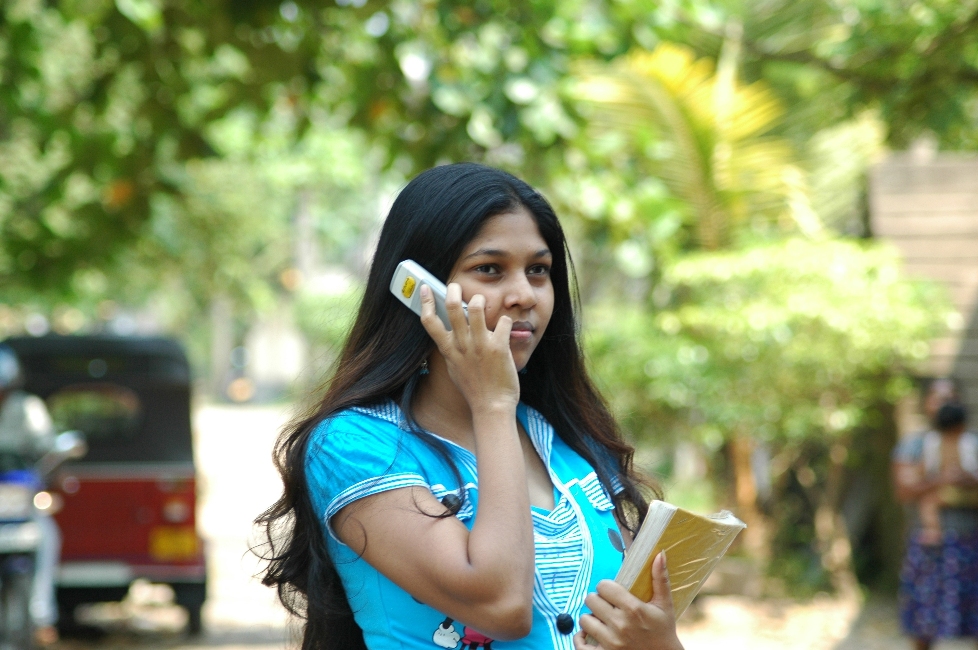
Young woman uses her mobile phone on the road – Photo by Niroshan Fernando
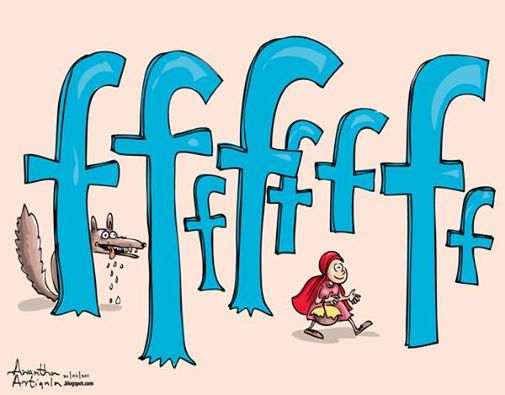
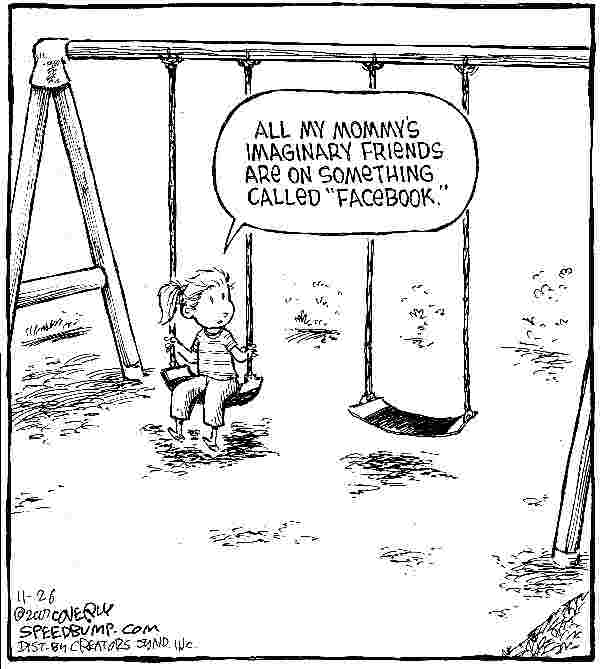
In this week’s Ravaya column (in Sinhala language), I probe why sections of Lankan society are habouring growing fears of social media, especially Facebook.
A few have called for a blanket ban of Facebook, which the secretary to the Ministry of Media has assured (in his Twitter feed) would not happen. There is an urgent need, however, to enhance public understanding in Sri Lanka of social media use, with particular attention on safety precautions, privacy protection and cyber civility.










 Open Minds!