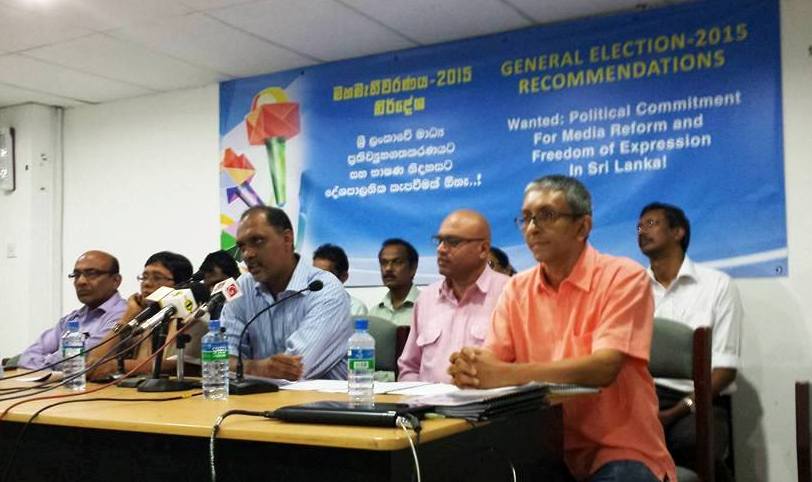
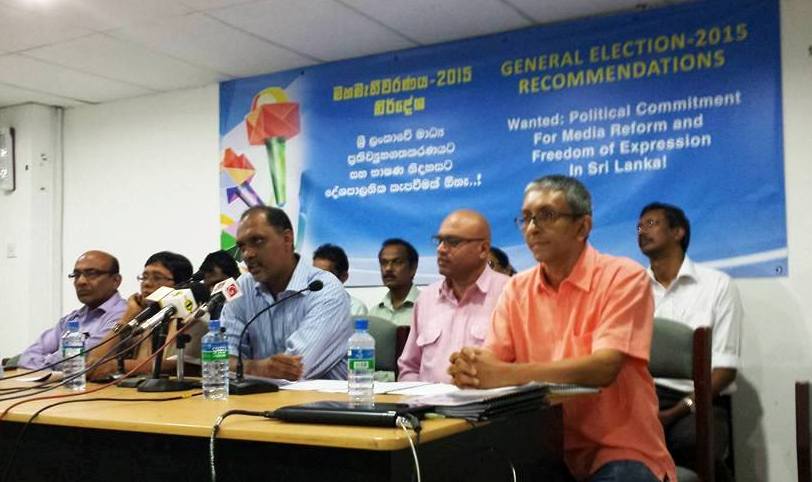
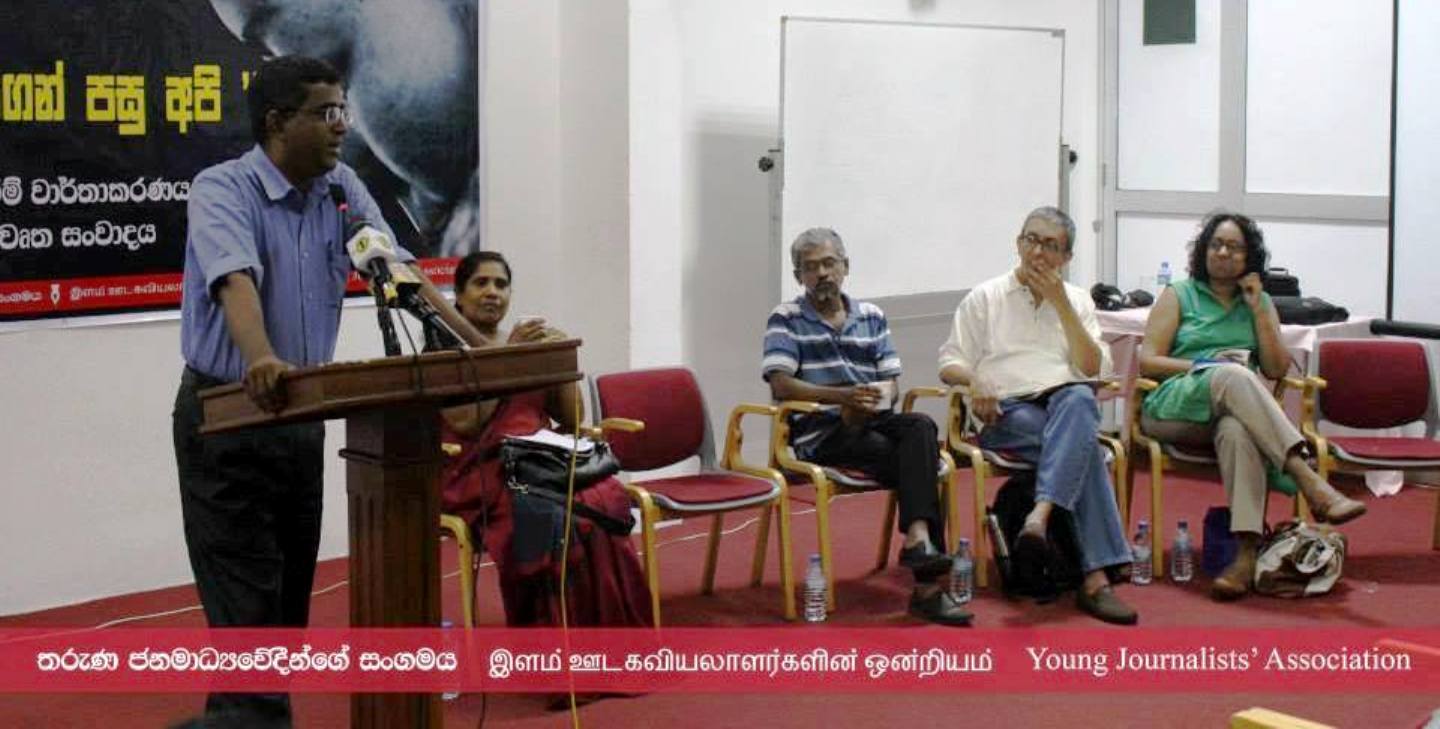
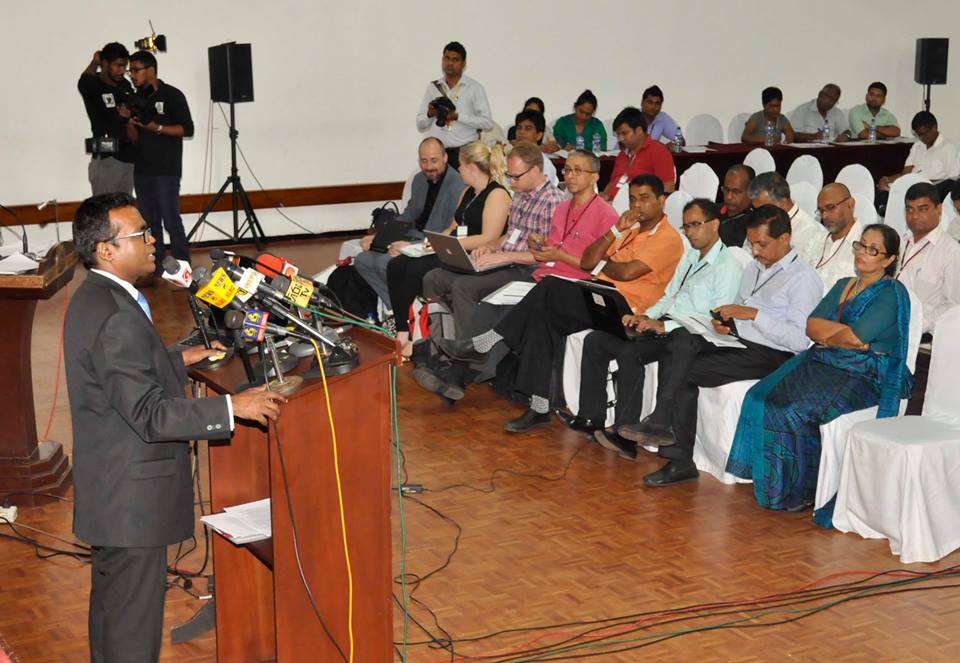
Lasantha Ruhunage, President of Sri Lanka Working Journalists’ Association, speaks at press conference at SLPI, Colombo, 21 July 2015
Since the Presidential Election on 8 January 2015, some progress has been made with regards to freedom of expression (FOE) and media freedom in Sri Lanka.
These include: steps being taken to end threats against and pressure on media organisations and journalists; the unblocking of political websites that were arbitrarily blocked; the 19th Amendment to the Constitution recognizing the right of access to information as a fundamental right; and the government extending an open invitation to exiled journalists to return to Sri Lanka.
But much more remains to be done to improve FOE and media freedom situation in Sri Lanka, and to ensure a more conducive environment for the media. Such policy, legal and structural reforms would require the political will of all political parties in the next Parliament of Sri Lanka.
In view of this, we urge the political parties contesting in the General Election to be held on 17 August 2015 to give a firm commitment to the following specific measures for meaningful media freedom and reforms.
These are not listed in any order of priority.
Right to Information: A right to information law, which gives individuals the right to access information held by public authorities, should be adopted. The new Parliament should pass, on a priority basis, the Right to Information Bill that was finalised in May 2015 with inputs from media stakeholders.
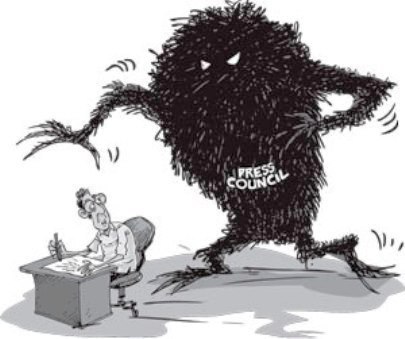
Media Self-Regulation: The Press Council Act 5 of 1973 should be repealed, and the government-controlled Press Council should be abolished. The self-regulatory body established in 2003 by the media industry, known as the Press Complaints Commission of Sri Lanka (PCCSL), should be strengthened and ideally its scope should be expanded to cover the broadcast media as well.
Law Review and Revision: Civil and criminal laws that pose various restrictions on media freedom should be reviewed and revised to bring them into line with international standards regarding freedom of expression. Such laws include the Prevention of Terrorism Act, the Official Secrets Act, sedition laws, and the rules on contempt of court and Parliamentary privileges.
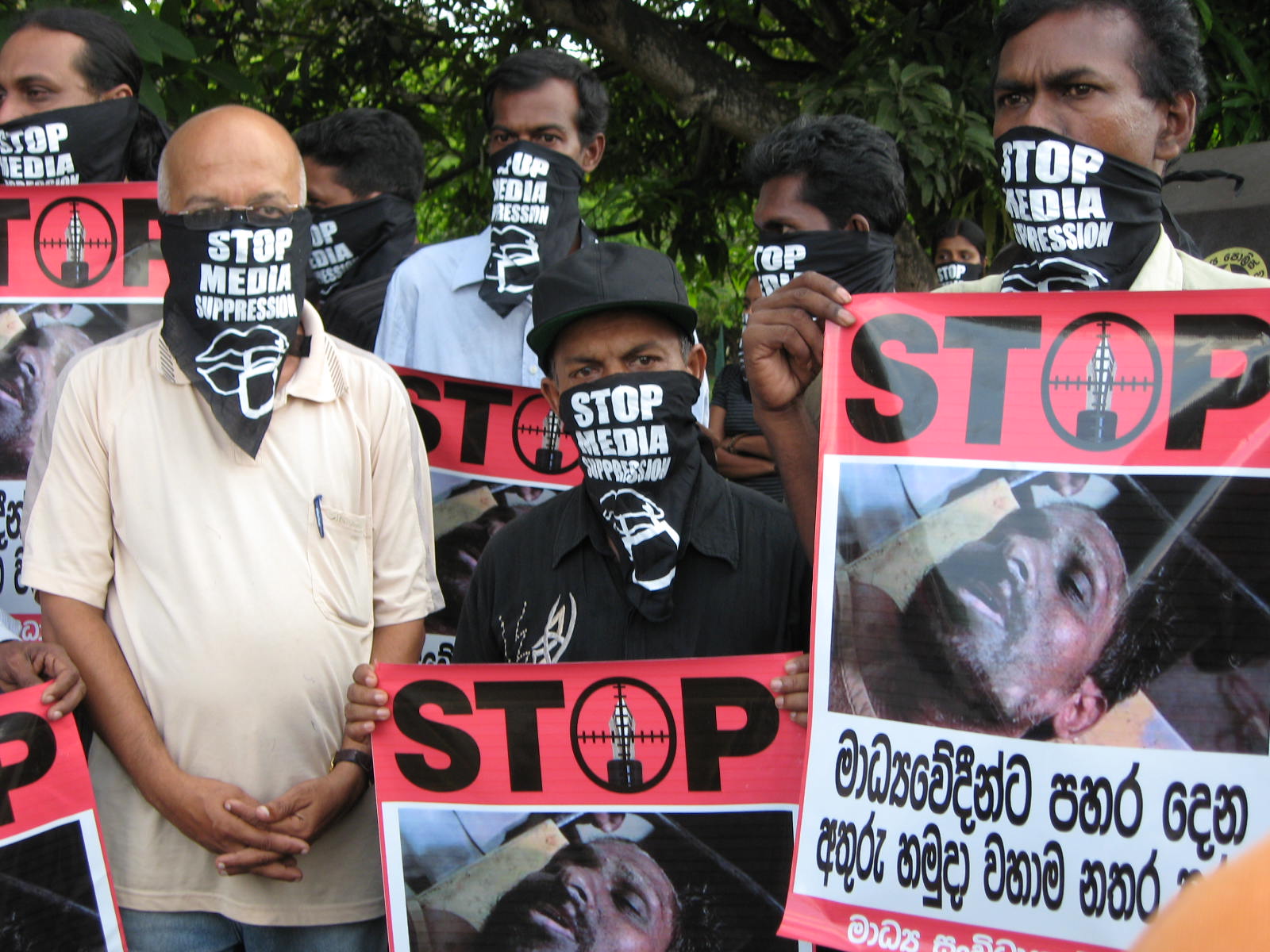
Crimes Against Journalists: An independent Commission of Inquiry should be created with a mandate and adequate powers to investigate past killings of, threats to, disappearances of and other attacks on journalists, media workers and media outlets, with a view to ensuring that those responsible are prosecuted and that appropriate compensation is paid to the victims and their families.
Broadcast Regulation: Comprehensive legislation on broadcasting should be adopted in line with international guarantees of freedom of expression. This should provide for, among other things, proper planning in relation to the frequencies allocated to broadcasting, including through the digital transition, a three-tier system of broadcasting which recognises public, commercial and community broadcasters, and obligations on broadcasters to be balanced and impartial in their coverage of politics and other matters of public concern. An independent Broadcasting Authority should be set up to regulate the entire broadcasting sector in the public interest. This regulator should ensure a fair, pluralistic and efficient broadcasting system.
Nalaka Gunawardene, Consultant to the Secretariat for Sri Lanka Media Reforms, speaks at the press conference at SLPI, Colombo, 21 July 2015
Community Broadcasting: The broadcasting regulation to be introduced should support the development of community broadcasting services owned and operated by communities through clear definitions of what constitutes a community broadcaster, a tailored licensing process, and lower fees for frequency allocation and other concessions.
Restructuring State Media: The three State broadcasters – the Sri Lanka Rupavahini Corporation (SLRC), the Sri Lanka Broadcasting Corporation (SLBC) and the Independent Television Network (ITN) – should be transformed into independent public service broadcasters which enjoy editorial independence, have a clear mandate to serve the public and benefit from public funding which does not compromise their independence. Measures should also be taken to ensure that Associated Newspapers of Ceylon Limited (ANCL or Lake House) can operate independently of government and enjoy editorial freedom. A public consultation should determine the most appropriate way forward.
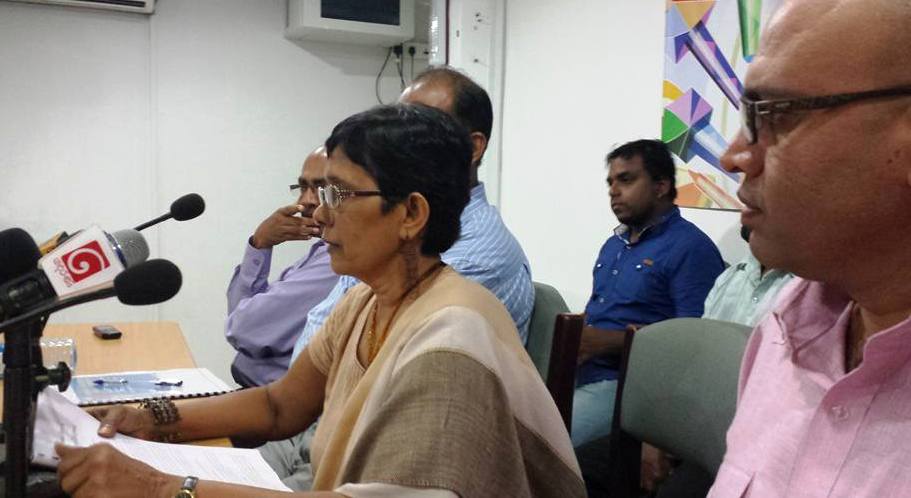
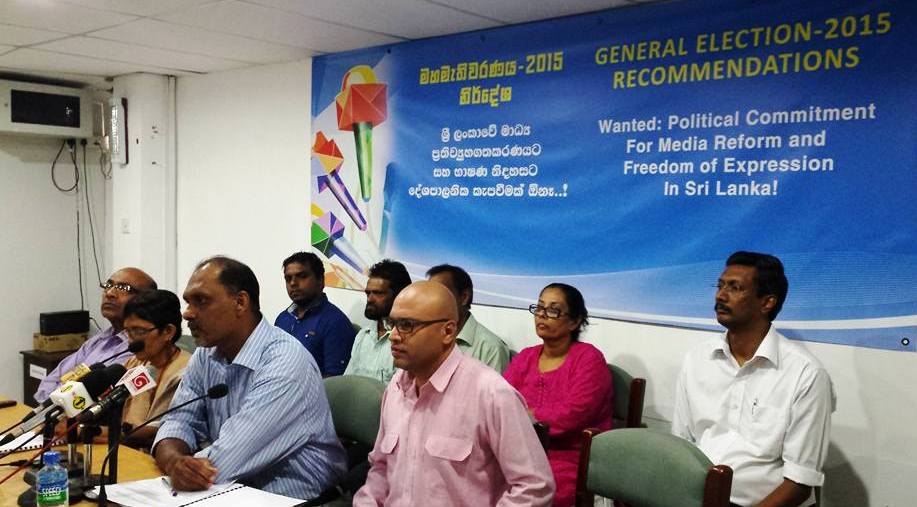
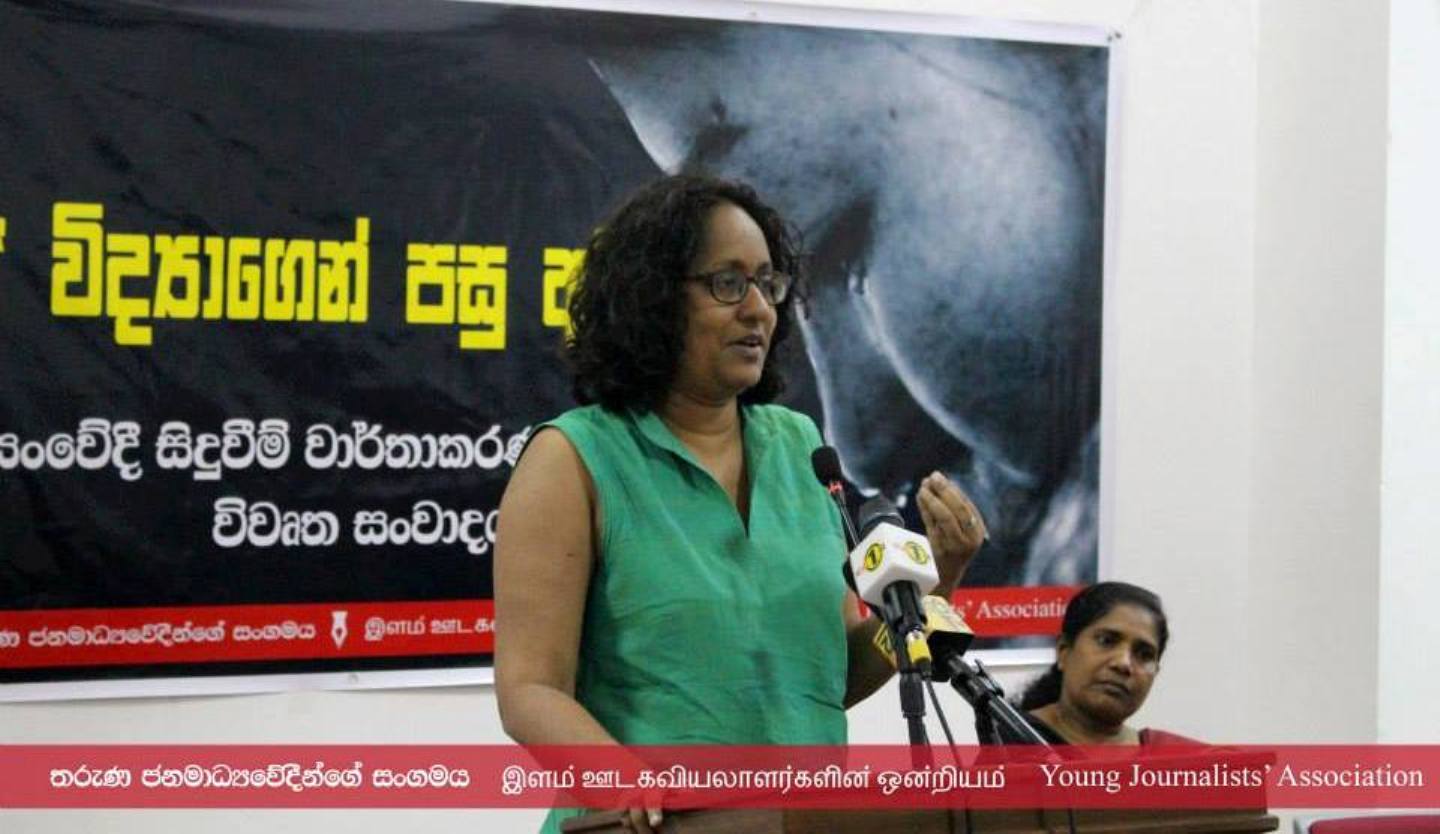
Seetha Ranjanee, Convenor of Free Media Movement of Sri Lanka, speaks at press conference on media reforms: Sri Lanka Press Institute, Colombo. 21 July 2015
Preventing Censorship: No prior censorship should be imposed on the media. Where necessary, courts can review media content for legality after publication on an urgent basis. Laws and regulations that permit censorship – including the Public Performance Ordinance – should be reviewed and amended to bring them into line with international standards.
No Blocking Political Websites: There should be no attempts to limit online content or social media activities contravening fundamental freedoms guaranteed by the Constitution and international conventions. Restrictions on illegal content may be imposed only through an independent judicial process which ensures that fundamental rights to access information and freedom of expression are not hindered.
Privacy and Surveillance: The state should respect and protect the privacy of all citizens. There should be strict limits to the state surveillance of private individuals’ and entities’ telephone conversations and electronic communications. In exceptional situations, such surveillance should only be permitted with judicial oversight and according to a clear set of guidelines.
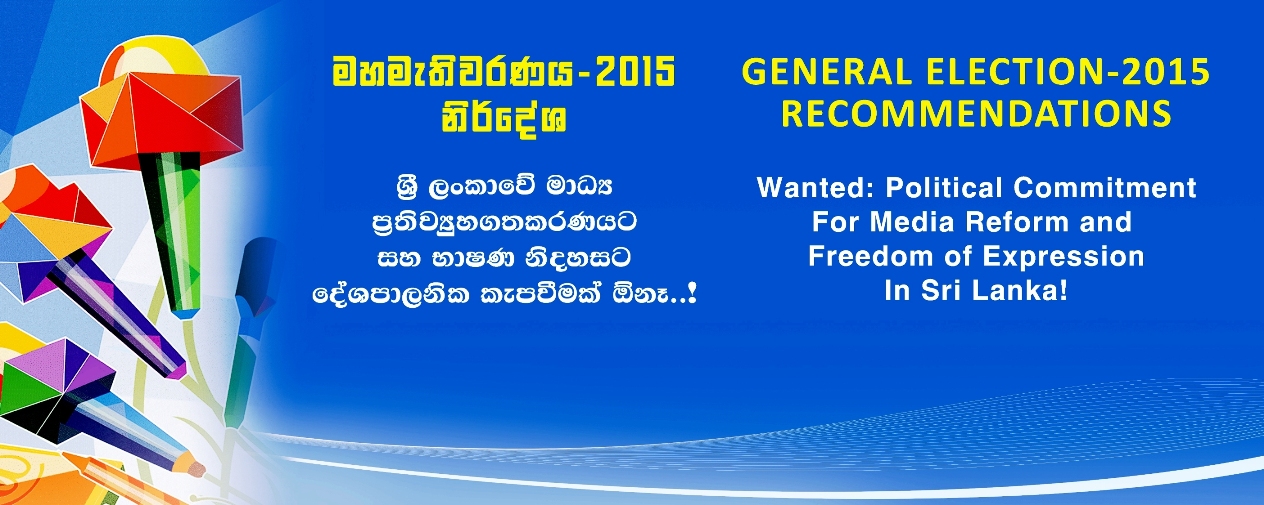
Media Reform Agenda for Lankan Political Parties – 21 July 2015
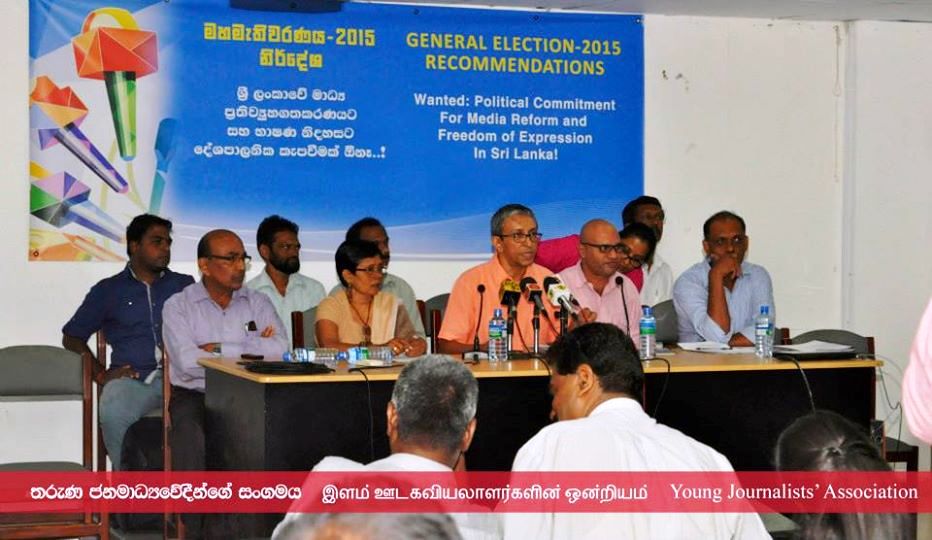
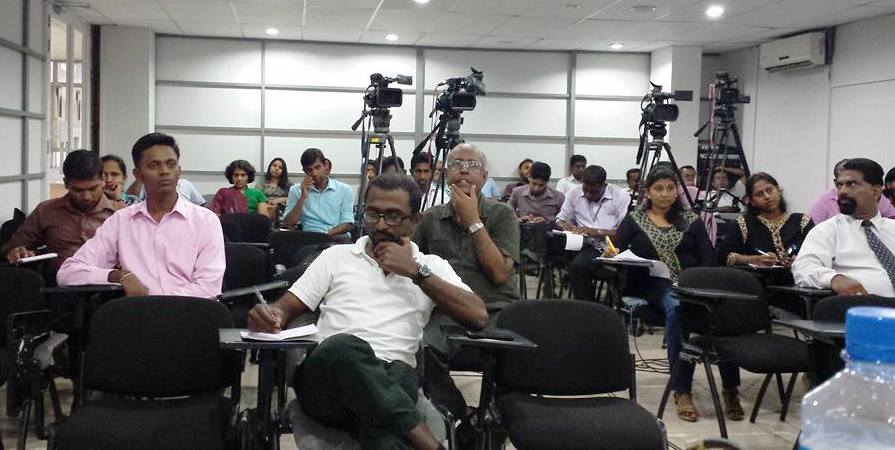
Media Reform Recommendations for Political Party Commitment prior to Sri Lanka General Election 2015. Press Conference at Sri Lanka Press Institute, 21 July 2015
Seetha Ranjanee, Convenor of Free Media Movement of Sri Lanka, speaks at press conference on media reforms: Sri Lanka Press Institute, Colombo. 21 July 2015
Speech of the President Maithripala Sirisena – 14 July 2015 (in Sinhala)
Sirisena’s speech outlined his key actions and accomplishments since being elected less than 200 days ago in one of the biggest election surprises in Lankan political history. He was mildly defensive of his low-key style of governance, which includes extended periods of silence.
I’ll leave it for political scientists and activists to analyse the substance of the President’s Bastille Day speech. My concern here is why he waited this long.
If a week is a long time in politics, 10 days is close to an eon in today’s information society driven by 24/7 broadcast news and social media. An issue can evolve fast, and a person can get judged and written off in half that time.
For sure, there is a time to keep silence, and a time to speak – and the President must have had some good reasons keep mum. But in this instance, he paid a heavy price for it: he was questioned, ridiculed and maligned by many of us who had heartily cheered him only six months ago. (Full disclosure: I joined this chorus, creating several easy-to-share ‘memes’ and introducing an unkind twitter hashtag: #අයියෝසිරිසේන.)
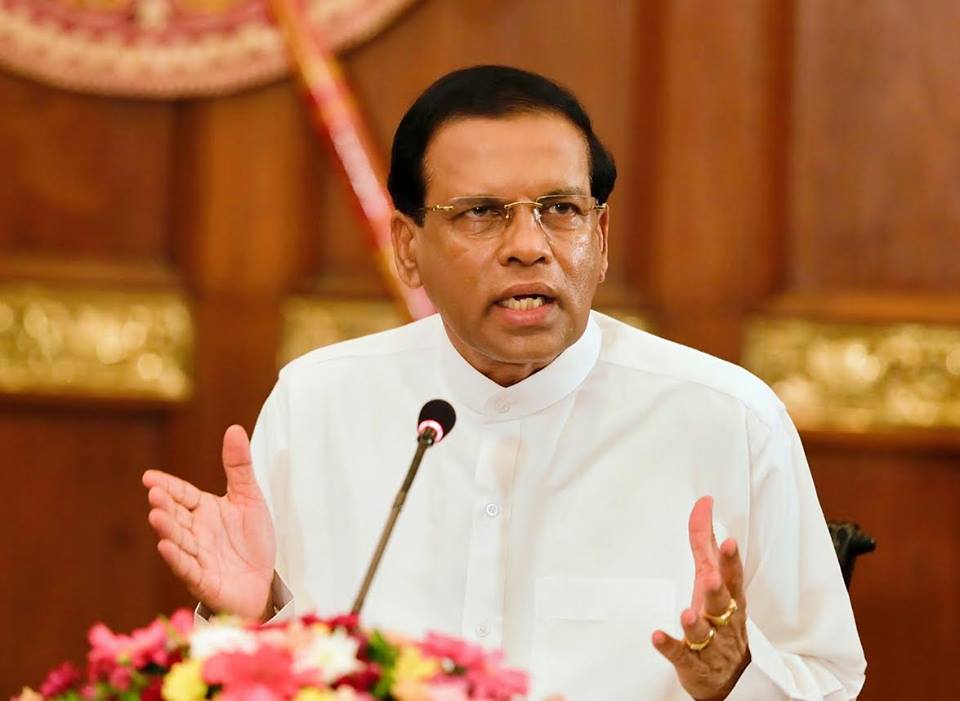
President Maithripala Sirisena
Sri Lanka’s democratic recovery can’t afford too much of this uncertainty and distraction created by strategic presidential silences. Zen-like long pauses don’t sit well with impatient citizen expectations.
And the President himself must reconsider this strategy (if it is indeed one) — his political opponents are hyperactive in both mainstream and social media, spinning an endless array of stories that discredit him.
Until a generation ago, we used to say that a lie can travel half way around the world while the truth is still putting on its shoes. In today’s networked society, when information travels at the speed of light, fabrications and half-truths spread faster than ever.
Public trust in leaders and institutions is also being redefined. Transparent governance needs political leaders to keep talking with their citizens, ideally in ways that enrich public conversations.
President Sirisena is not the only Lankan leader who needs to catch up with this new communications reality. When a controversy erupted over how the Central Bank of Sri Lanka handled Treasury Bond issue on February 27, the government took more than two weeks to respond properly.
In a strict legalistic or technocratic sense, Wickremesinghe was probably right (as he usually is). But in the meantime, too many speculations had circulated, some questioning the new administration’s commitment to transparency and accountability. Political detractors had had a field day.
Could it have been handled differently? Should the government spokespersons have turned more defensive or even combative?
More generically, is maintaining a stoic silence until full clarity emerges realistic when governments no longer have a monopoly over information dissemination? Is it ever wise, in today’s context, to stay quiet hoping things would eventually blow away? How does this lack of engagement affect public trust in governments and governance?
These are serious questions that modern day politicians and elected officials must address. In my view, we need a President and Prime Minister who are engaged with citizens — so that we are not left guessing wildly or speculating endlessly on what is going on.
No, this is not a call for political propaganda, which has also been sidelined by the increasingly vocal social media voices and debates.
What we need is what I outlined in an open letter to President Sirisena in January: “As head of state, we expect you to strive for accuracy, balance and credibility in all communications. The last government relied so heavily on spin doctors and costly lobbyists both at home and abroad. Instead, we want you to be honest with us and the outside world. Please don’t airbrush the truth.”
Science writer Nalaka Gunawardene has been chronicling and analysing the rise of new media in Sri Lanka since the early 1990s. He is active on Twitter @NalakaG and blogs at http://nalakagunawardene.com
Media sector reforms in Sri Lanka have become both urgent and important. Media freedom cannot be consolidated without other reforms that create a more professional and responsible media.
Some progress has been made since the Presidential election. The new government has taken steps to end threats against media organisations and journalists, and started or resumed criminal investigations on some past atrocities. Political websites that were arbitrarily blocked from are once again accessible. Journalists who went into exile to save their lives have started returning.
On the law-making front, meanwhile, the 19th Amendment to the Constitution recognized the right to information as a fundamental right. But the long-awaited Right to Information Bill could not be adopted before Parliament’s dissolution.
Thus much more remains to be done. For this, a clear set of priorities has been identified through recent consultative processes that involved media owners, practitioners, researchers, advocacy groups and trainers. These discussions culminated with the National Summit on Media Reforms organised by the Ministry of Media, the University of Colombo, Sri Lanka Press Institute (SLPI) and International Media Support (IMS), and held in Colombo on 13 and 14 May.
In my latest Ravaya column (in Sinhala language, published on 12 July 2015), I list the priorities for media policy and law reforms that require political commitment by all political parties in Sri Lanka.
Sri Lanka’s mainstream media – especially in the Sinhala language (and perhaps in Tamil too?) – lacks sensitivity and restraint when reporting and/or commenting on incidents of violence – covering suicide, homicide, rape and child abuse – as well as on topics like mental illness and HIV/AIDS.
This is my cumulative impression having closely watched different print and broadcast media outlets for over a quarter century. It is good that some younger professionals recognise the need to improve in this respect – to correct the ways of industry seniors who have set bad precedents for long.
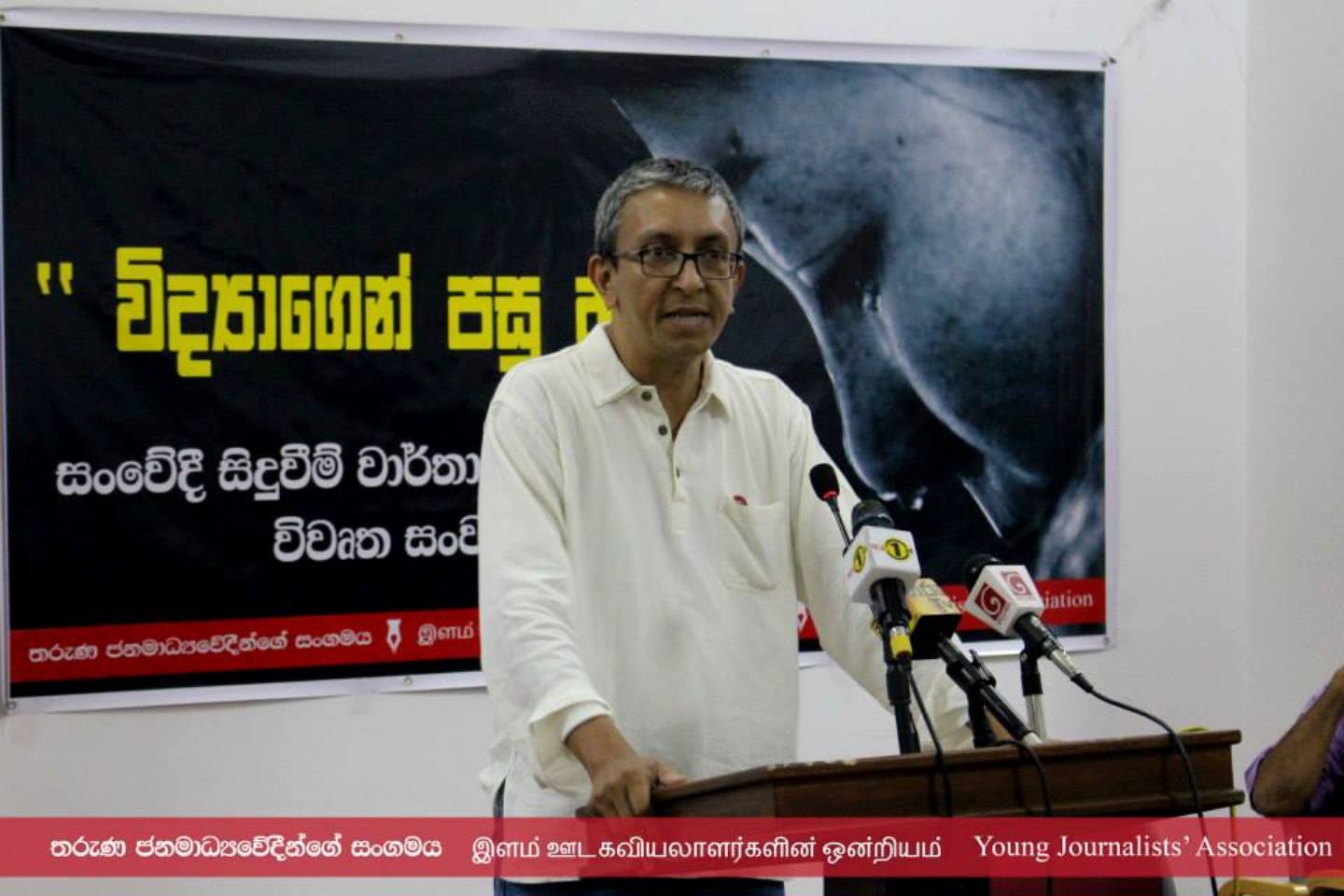
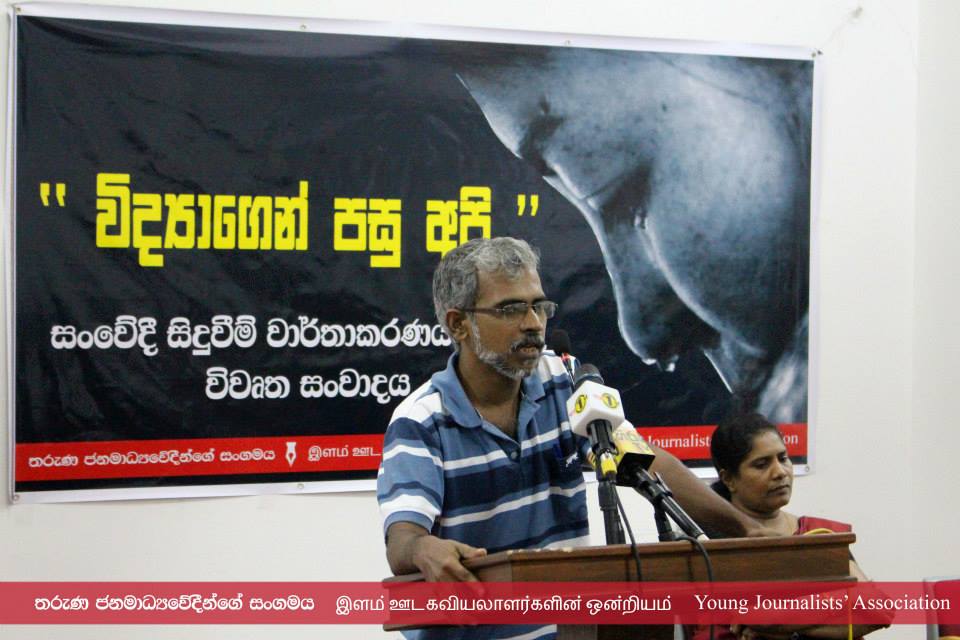
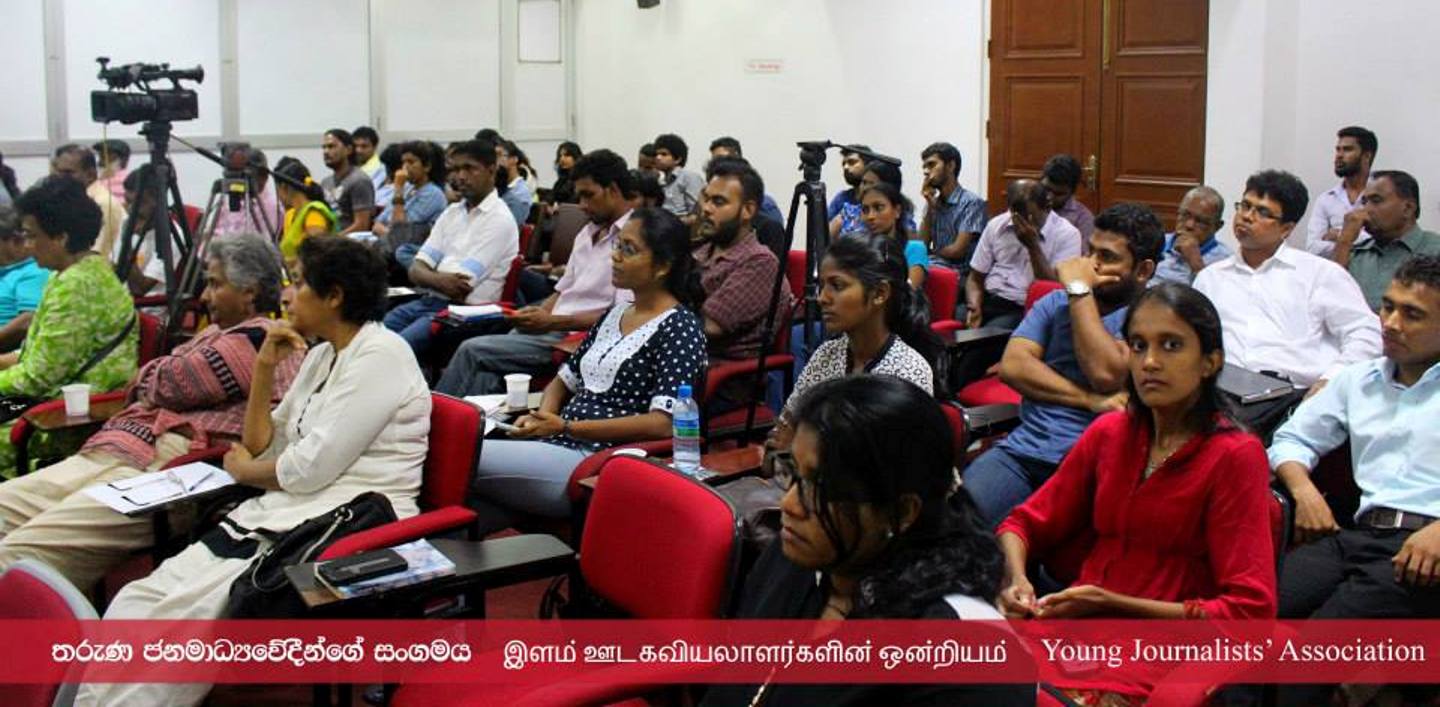
I was thus happy to speak at a recent public forum on sensitive media reporting, organised by Sri Lanka Young Journalists Association and held in Colombo on 9 June 2015. In my remarks, I tried to understand why large sections of Lankan media so lacks sensitivity, respect for privacy and respect for societal diversity. This is a complex sociological situation that I cannot fully explain, but among the reasons I cited are: cultural orthodoxy, gender insensitivity, heightened competition among media groups for market share; and an overall lack of professionalism.
I sum up my remarks, and some discussion points, in this week’s Ravaya column (published on 28 June 2015).
Ravaya Chief Editor K W Janaranjana speaks at Public Forum
The National Summit for Media Reform in Sri Lanka was organised by the Ministry of Mass Media and Information, University of Colombo, Sri Lanka Press Institute (SLPI) and International Media Support (IMS) and held on 13 – 14 May 2015 at the Sri Lanka Foundation Institute, Colombo 7.
Its aim was “to maximise the contribution of all stakeholders in initiating and sustaining the process facilitating media structural reforms that will foster democracy, good governance and sustainable development in Sri Lanka”. It brought together high level reps from government, media industry, academia and civil society groups concerned with the state of our media.
Ahead of this, I was commissioned by the organisers to carry out a rapid assessment of the state of media in Sri Lanka using UNESCO’s Media Development Indicator framework – a globally used methodology adopted by the inter-governmental body in 2009. At the Summit opening plenary, I presented highlights of this study which was based on literature review and interviews.
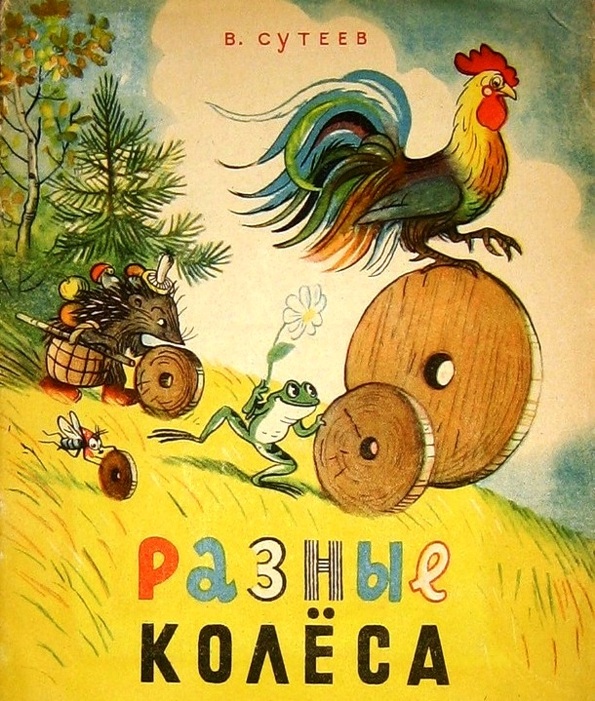
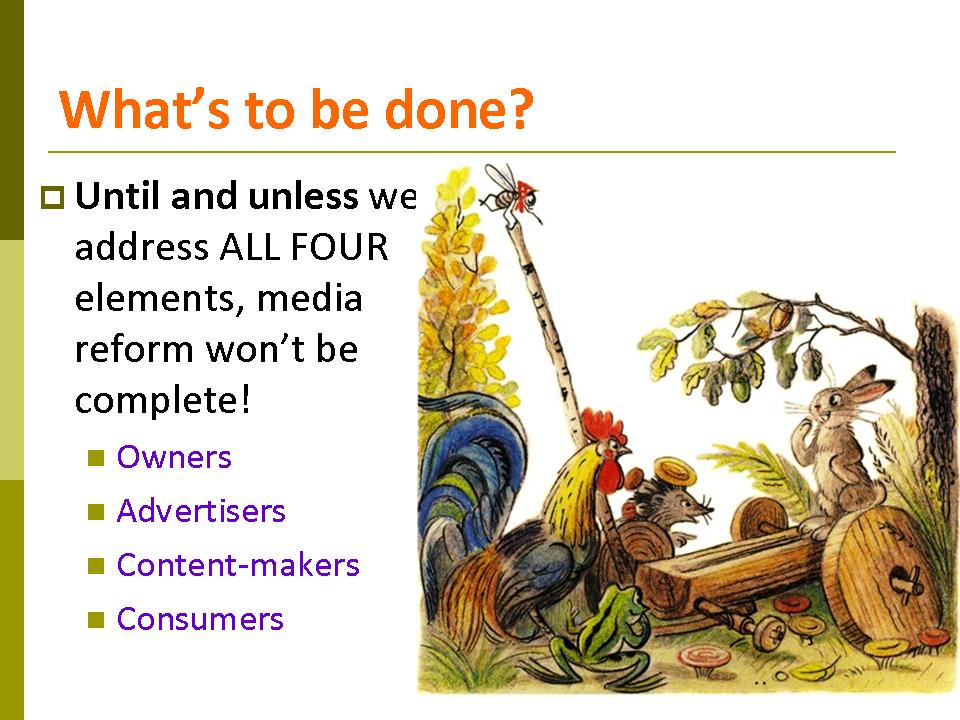
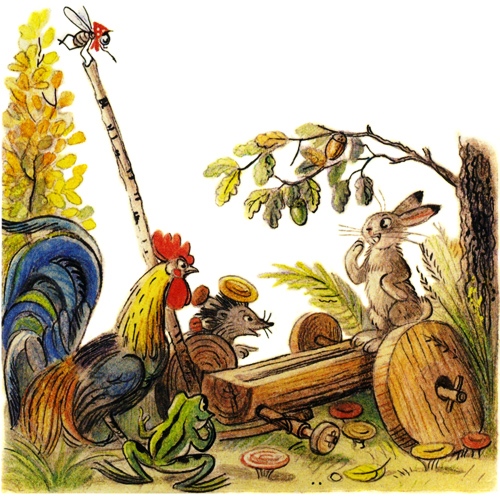
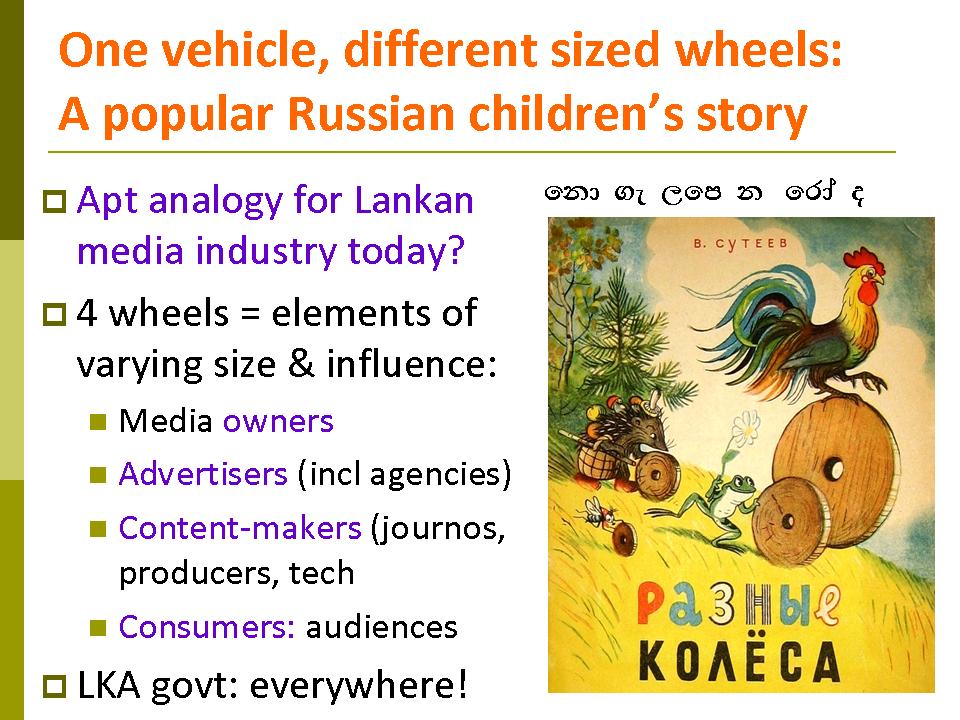
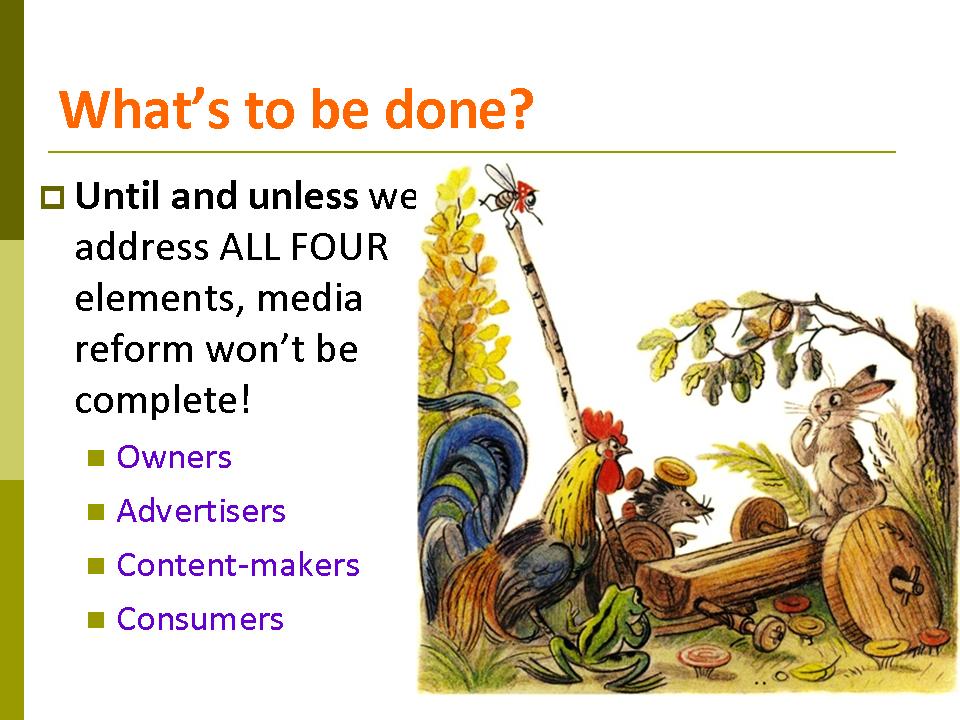
To capture the diversity and disparities in the media sector,I used a well-loved Russian children’s story that was known in Sinhala translation as නොගැලපෙන රෝද — the story of one vehicle with different sized wheels, and how animal friends tried to make it move and when it proved impossible, how they put each wheel to a unique use…
This week’s Ravaya column (published on 17 May 2015) captures some of these highlights. I plan to write another one, with specific focus on the broadcast sector, in the coming weeks.
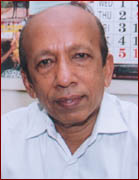
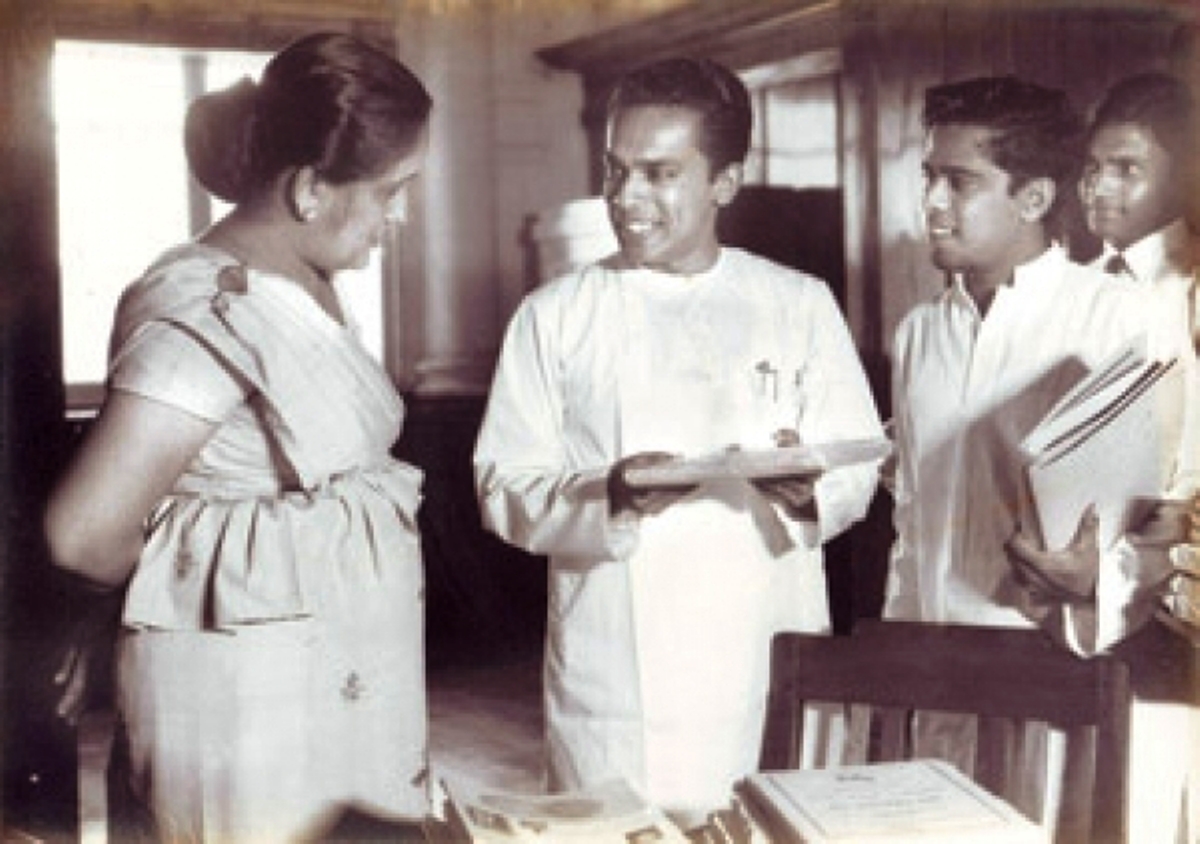
Dr Buddhadasa Bodhinayake – Science communication trail-blazer in Sri Lanka
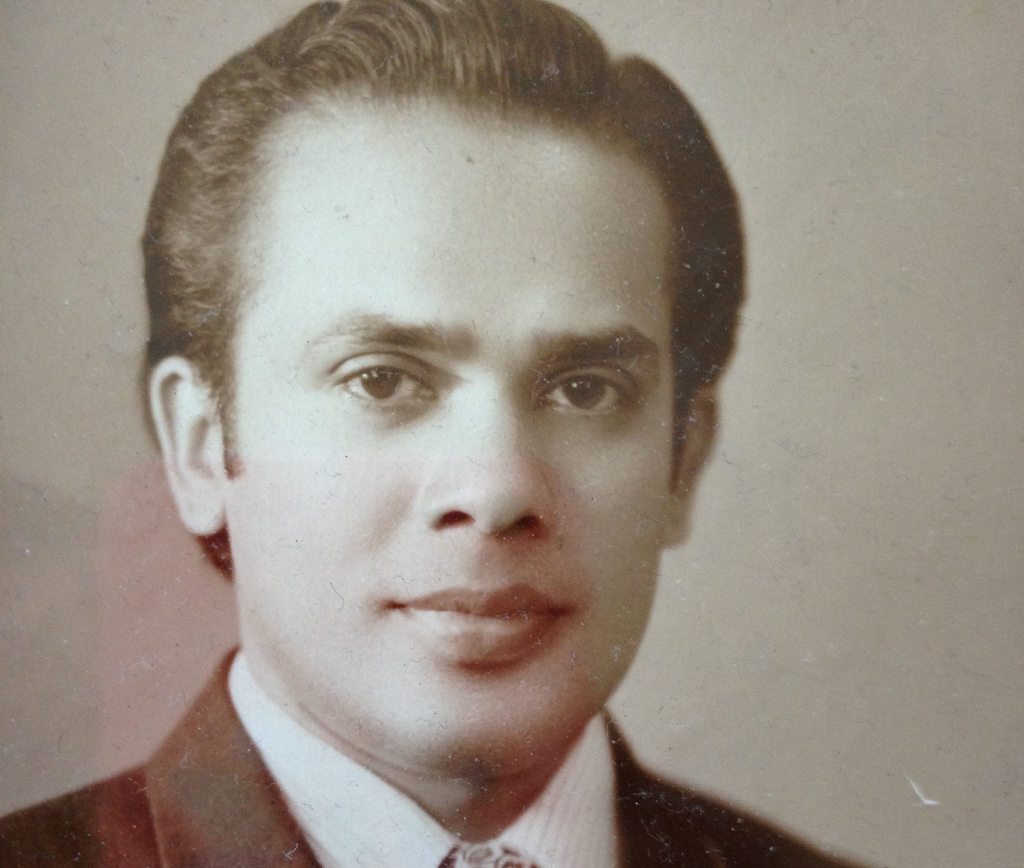
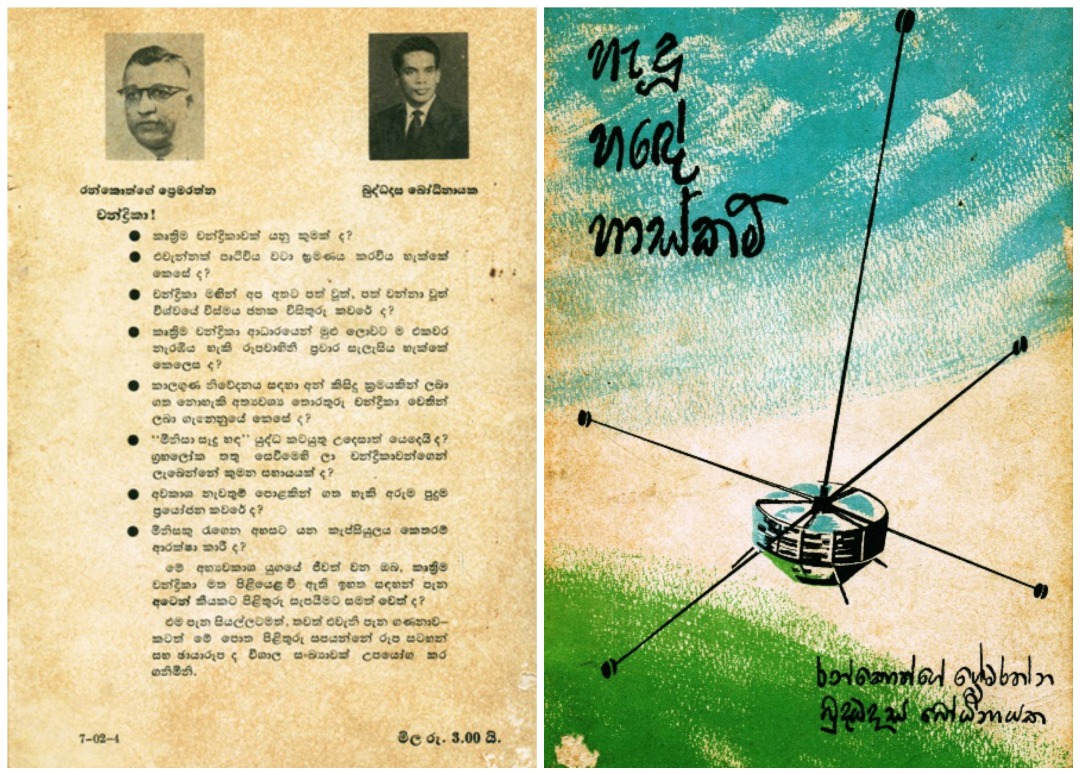
Dr Buddhadasa Bodhinayake, who died on 4 March 2015 in the UK, was a trail-blazing science and health communicator in Sri Lanka in the 1960s and 1970s. While still a schoolboy, he wrote the first Sinhala language book on space travel in 1961, which he co-authored with Arthur C Clarke. In the early 1970s, he also wrote the first local book on child psychology.
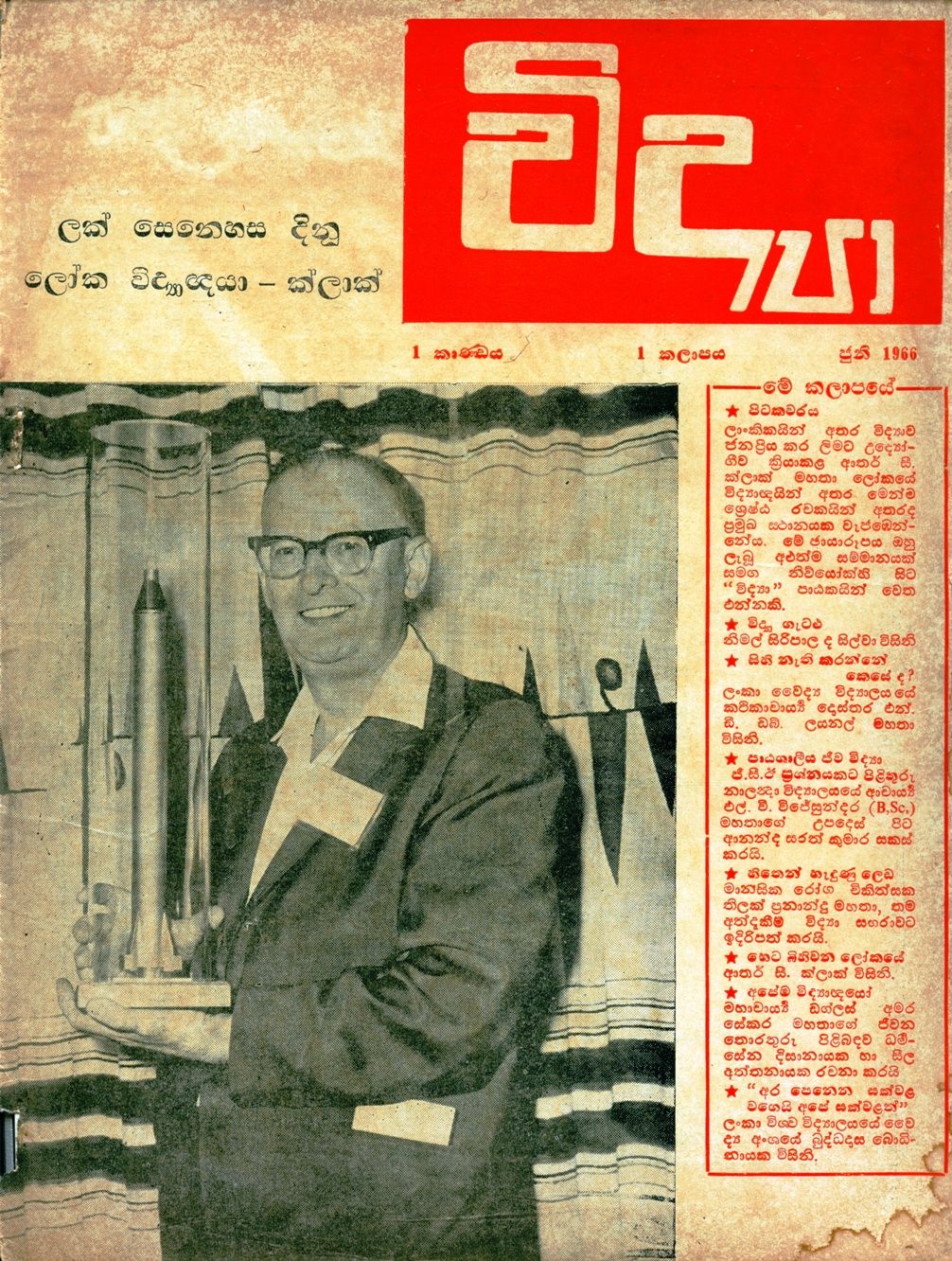
While being a high school student, medical student and after becoming a medical doctor, Bodhinayake continued writing to newspapers and presenting science programmes on radio. In June 1966, he launched Vidya monthly science magazine, which had a long and illustrious innings until 2006.
In this week’s Ravaya column (in Sinhala, published on 22 March 2015), I recall highlights of Dr Bodhi’s science communication work, and capture memories of some of his teachers and contemporaries. I also acknowledge the inspiration I derived from his work while growing up in the 1970s.
I’m a story teller at heart. I sometimes moonlight as a media researcher or commentator but have no pretensions of being academic. I always try to make my points as interesting as possible — using analogies, metaphors, examples, etc.
This is the approach I used when asked to talk to the working group on Sri Lanka Media Reforms, convened by the Media Ministry, Sri Lanka Press Institute, International Media Support (IMS) and the University of Colombo.
I used a well-loved Russian children’s story that was known in Sinhala translation as නොගැලපෙන රෝද — the story of one vehicle with different sized wheels, and how animal friends tried to make it move and when it proved impossible, how they put each wheel to a unique use…
A framework for media reform in Sri Lanka…by Nalaka GunawardeneA framework for media reform in Sri Lanka…by Nalaka Gunawardene
Well, in the case of media reforms, we can’t go off in different directions. We must make the vehicle work, somehow.
In this week’s Ravaya column (in Sinhala, published in issue of 15 March 2015), I discuss what policy and regulatory measures can help promote information society in Sri Lanka. In that process, I critique the Telecommunications Regulatory Commission (TRCSL) and the ICT Agency (ICTA), two state institutions with relevant mandates that they have mismanaged, and sometimes squandered, during the past decade.
I argue that, for the most part, ICTA has been dabbling in ‘retail’ level (and politically driven) projects such as setting up rural tele-centres and designing government websites, while neglecting ‘wholesale’ level needs – such as resolving local font standardization, supporting ICT innovation, and being a facilitator of meaningful e-government. Similarly, TRC has been engaging in indiscriminate blocking of political websites critical of the former government, without creating an enabling environment in which pluralistic web content could thrive.
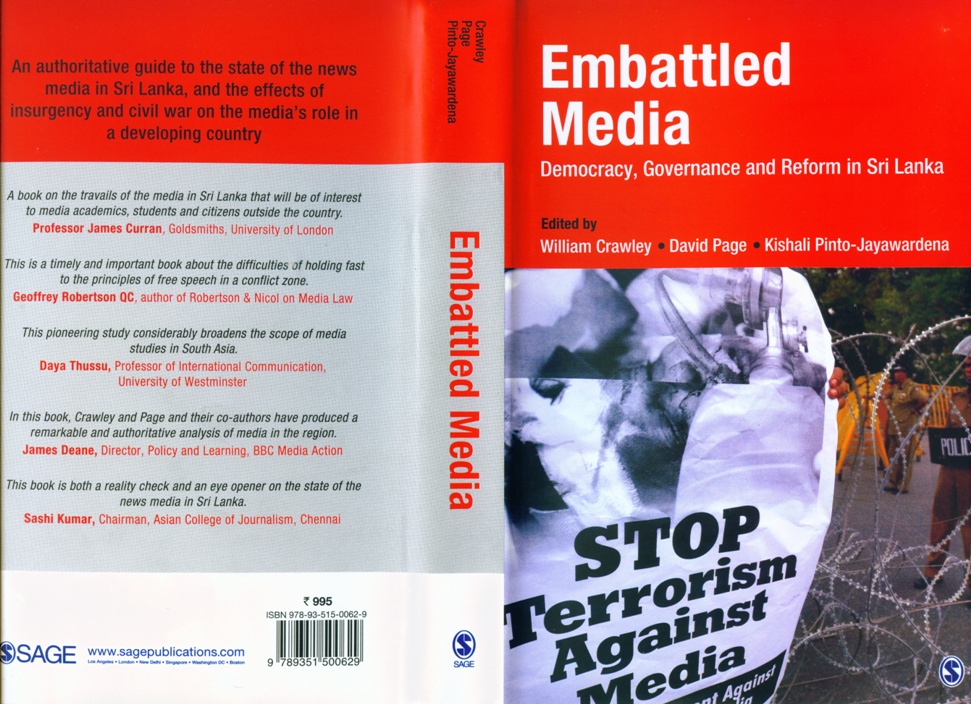
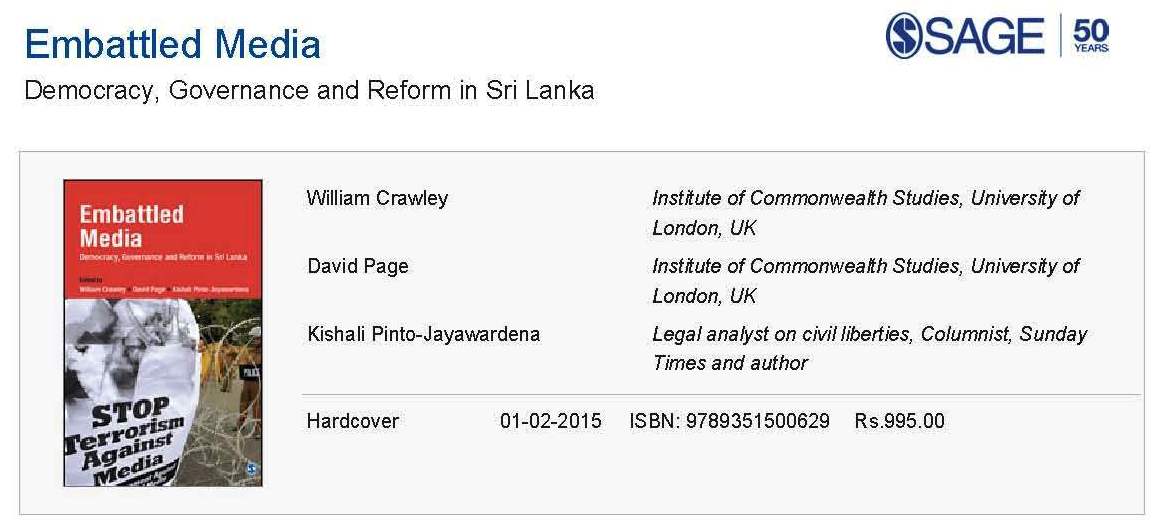
Embattled Media – Democracy, Governance and Reform in Sri Lanka (Sage, Feb 2015; 416 pages)
A new multi-author book offers valuable insights into the importance of independent media for democratic governance in the wider South Asian region.
Titled Embattled Media: Democracy, Governance and Reform in Sri Lanka(Sage, Feb 2015; 416 pages), the book examines the role of the media in a state committed to democracy and the rule of law which had suffered extraordinary stresses as a result of ethnic strife, insurrection and civil war.
According to its publishers, Sage Publications in India and the UK, the book is an ‘authoritative guide to the state of the news media in Sri Lanka, and the effects of insurgency and civil war on the media’s role in a developing country’.
This is the first book to look comprehensively at the evolution of news media in post-colonial Sri Lanka, with a focus on media policy, law and education. The book reviews the role of new media platforms in widening the scope for public debate.
Further, it provides a detailed analysis of the existing media laws and policies and of campaigns to reform them. It also focuses on the role of institutions in media education by providing a comprehensive analysis of existing media curricula and underlining the importance of improved media literacy and introduction of Right to Information Act for a healthy democracy.
The book is dedicated to the memory of the late Tilak Jayaratne (1943-2013), who ‘ably represented a generation of honourable and committed broadcasters’. Having contributed significantly to the book, he did not live to see its publication.
Embattled Media – Publishing Information
In their preface to the book, the co-editors write: “Media liberalisation from the 1990s onwards had extended the range of choice for viewers and listeners and created a more diverse media landscape. But the war in the north and insurrections in the south had taken their toll of media freedoms. The island had lived under a permanent state of emergency for nearly three decades. The balance of power between government, judiciary, the media and the public had been put under immense strain.
“In 2009, with the end of the war in the north, all this seemed about to change, increasing the relevance of our enquiries and raising hopes of media reform and greater freedom of expression. But progress towards a different sort of normality has been slow. The war and its aftermath have continued to cast a long shadow, which has limited the scope of our research…
“Over the past few years, universities have been closed for long periods. University teachers have been engaged in disputes with the government, which has affected their teaching and their research. The NGO sector has been heavily criticised by the government for pursuing foreign-funded agendas and finds itself under fire and on the defensive. Many media proprietors and journalists have maintained their long-established habit of self-censorship, for fear of inviting reprisals of one sort or another. Though not on the same scale as previously, there have been killings and disappearances of journalists since 2009 and the memory of past abuses still affects people’s thinking. All this has made the study more challenging.”
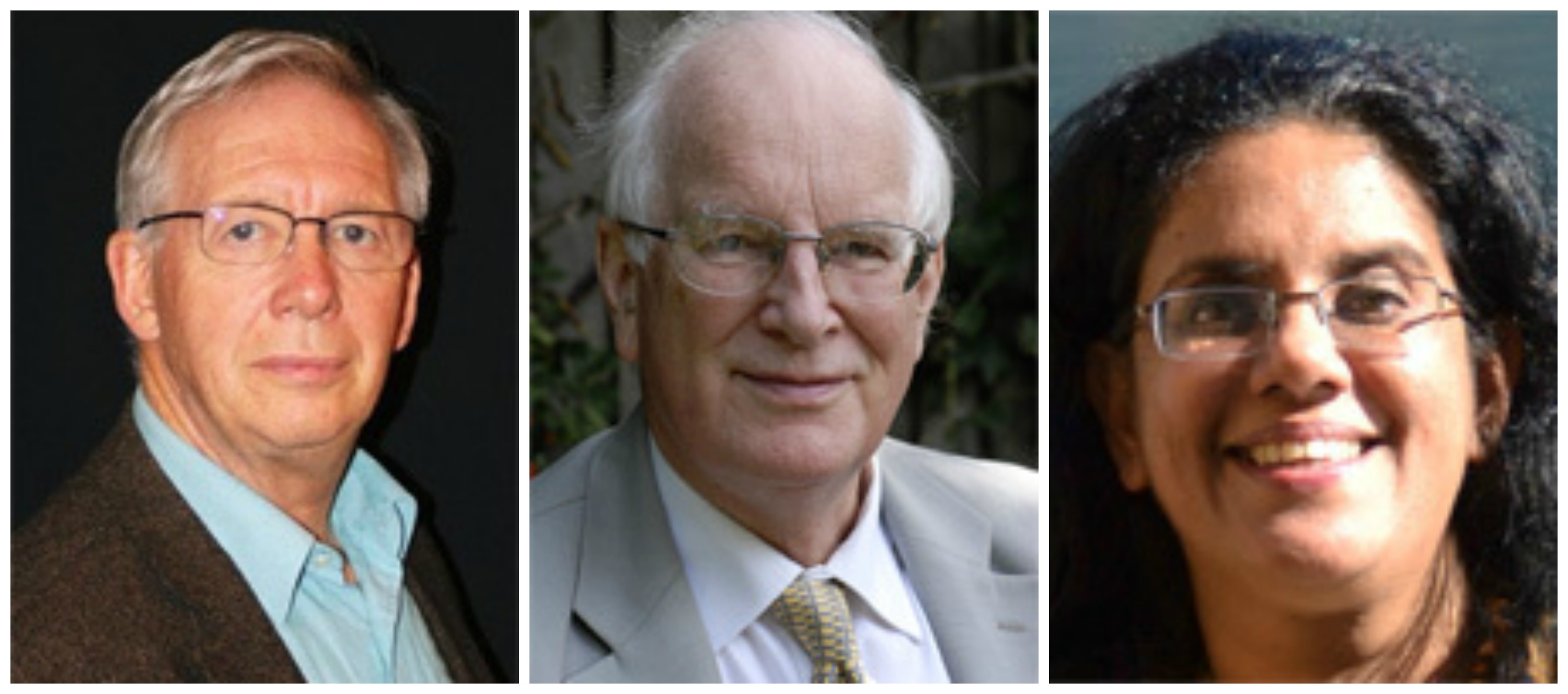
Co-editors of Embattled Media – (L to R) William Crawley, David Page and Kishali Pinto-Jayawardena (photos courtesy Sage Publications website)
The book also contains a glossary of media related terms; a bibliography and an index.




 Open Minds!