News feature published in Ceylon Today newspaper, 28 November 2012
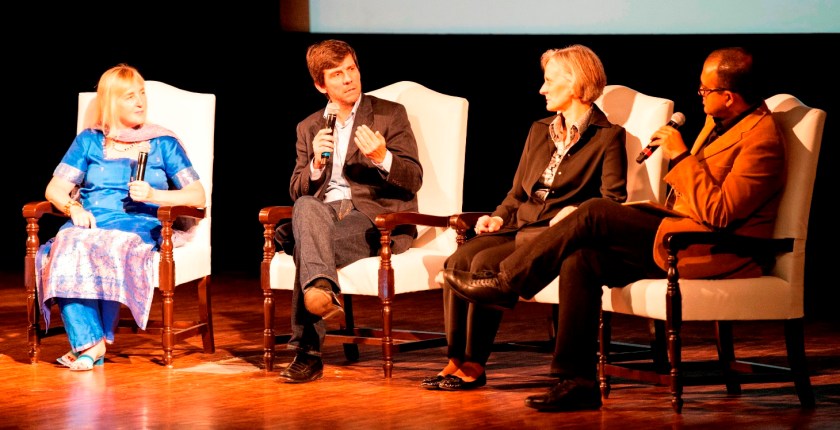
L to R – Margaret Lowman, Rodrigo Jordan, Adrienne Corboud Fumagalli & moderator R Sukumar
Social and technological entrepreneurs shaping a new world By Nalaka Gunawardene in New Delhi
A new wave of social and technological entrepreneurs is reshaping our world, blending the best of enterprise, innovation and compassion.
The old divides of for-profit and non-profit are fast blurring in this brave new world where emerging economies of Asia are taking the lead, a global gathering of change-makers heard this week.
The Rolex Leadership Forum, held at the New Delhi Municipal Council Convention Centre, was convened by the Rolex Awards for Enterprise. It heard from inspirational innovators, scientists and adventurers – all of who shared their personal journeys and passions as they discussed their views on leadership and enterprise.
The core values identifies by these remarkable individuals as guiding and sustaining themselves were passion, integrity, resilience and a sense of humour.
“Follow your passion, think outside the box and seek solutions,” was how Margaret Lowman, pioneering US canopy ecologist summed it up. “Early on, I realized that you expend the same amount of energy to complain as to exclaim. I’ve chosen to do the latter, making things better as I go along!”
She emphasised that solving problems is far more important than simply gathering and analysing data or publishing technical papers. As head of North Carolina’s new Nature Research Centre, she is heavily involved in taking children and youth back to nature, and in public engagement of science.
“I would recommend that we try not to blend in, but stand up and stand out,” said Adrienne Corboud Fumagalli, Swiss economist, media and technology transfer specialist.
Rodrigo Jordan, Chilean social entrepreneur, educationist and mountaineer, who in 1992 led the first Latin American expedition to Mount Everest, has been applying team building skills to business, education and social development. His recipe for successful teams: right proportions of passion, expertise, a sense of purpose and generosity among team members.
“It is imperative for good teams to have members with a good match of technical and personal skills,” he said. “I climb peaks not with climbers but with human beings.”
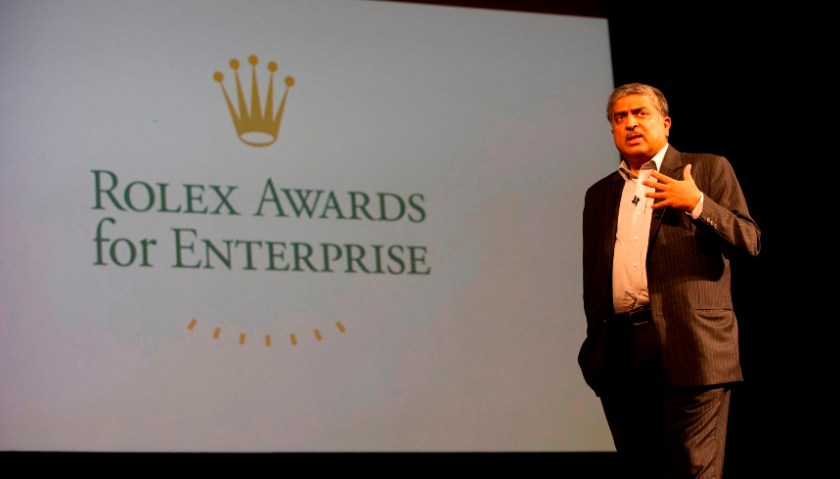
Nandan Nilekani speaks at Rolex Leadership Forum 2012
“Giving people a purpose larger than themselves usually leads to extraordinary results,” said Nandan Nilekani, the Indian techno-preneur best known for co-founding and building the IT giant Infosys Technologies.
He described challenges involved in his current public sector assignment as chairman of the Unique Identification Authority of India (UIDAI) – which is building the world’ s largest digital identification system that is web-based. When completed, it will store information on all 1.2 billion Indian residents.
Young change-makers
The forum also heard from three outstanding young Indians who have pursued their own passion for excellence, innovation and service.
Piyush Tewari, who was a Rolex Young Laureate in 2010, has left a lucrative corporate job to devote all his time to SaveLIFE Foundation that trains police officers and volunteers in roadside trauma care. His group responds to the highest road accident fatality rate in the world – an average of 15 deaths every hour. Yet, 80 per cent of victims don’t receive any emergency medical help within the first vital hour after injury.
Deepak Ravindran founded and heads Innoz, a tech company that runs SMSGYAN which serves 120 million users to access several Internet functions from simple mobile phones through text messages. By making every mobile phone smart, he aims to bring Internet within reach of more people in a country where Internet use is currently around 10 per cent.
Ishita Khanna is a social entrepreneur who runs EcoSphere that promotes community participation to achieve sustainable development in remote Himalayan communities through eco-tourism, renewable energies and indigenous wild produce.
These three mid-career professionals epitomise the new generation of Indians who are combining modern management methods and technologies with age old values of caring, sharing and taking on responsibility.
As Rebecca Irvin, director of Philanthropy at Rolex, asked: “The choice for today’s young people is: do you just want to do well in your lives, or do you also want to do good while pursuing your passions?”
The Rolex Leadership Forum 2012 in New Delhi was attended by over 300 people who came from all parts of the world and all walks of life. The distinguished gathering included past winners (laureates) of the prestigious award and its past judges along with journalists, activists and researchers.
Dr Wijaya Godakumbura, inventor of the safe bottle lamp and a Rolex Laureate (1998), was among the invitees.
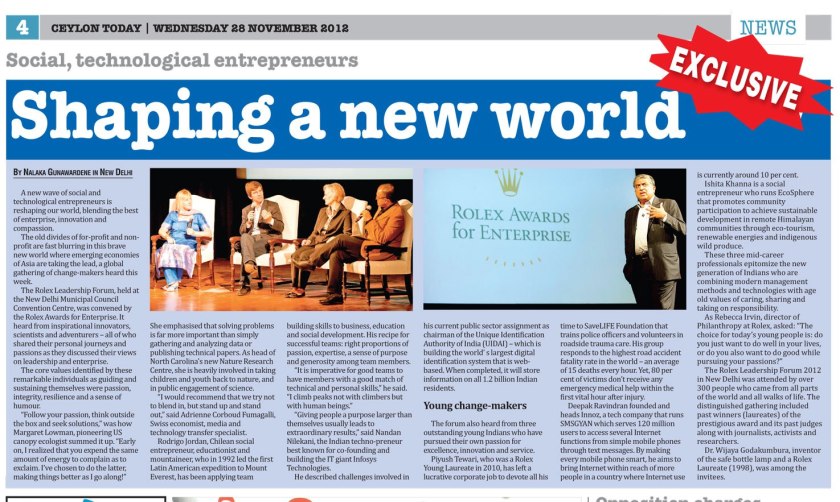
Rolex Leadership Forum in Delhi, Ceylon Today 28 Nov 2012
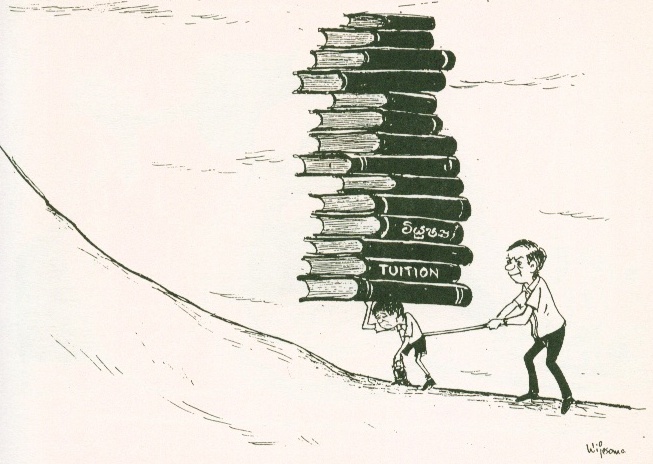
In this week’s Ravaya column (in Sinhala), I discuss the brutal, almost inhuman pressures the formal education system — schools, teachers and most parents — exert on our children.
My daughter was six at the time, and I was hoping she would be spared the worst of the Lankan educational system as she grew up. Alas, things have only become worse in that decade. I’ve tried to buffer her from the worst excesses: while she does not have parental pressure to ‘get ahead at any cost’, she is being driven by her school to ‘perform’ so as to ‘maintain the school’s glory’!
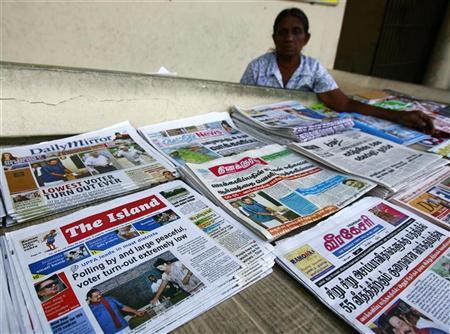
“Sri Lanka’s newspaper history dates back to Colombo Journal (1832) which apparently had a short but feisty life before it invoked the ire of the British Raj. Nearly two centuries and hundreds of titles later, the long march of printer’s ink — laced with courage and passion – continues.
“How long can this last?
Print journalism’s business models are crumbling in many parts of the world, with decades old publications closing down or going entirely online. This trend is less pronounced in Asia, which industry analysts say is enjoying history’s last newspaper boom. Yet, as I speculated three years ago when talking to a group of press barons, we’ll be lucky to have a decade to prepare for the inevitable…”
These are excerpts from a short essay I originally wrote last week to mark the first anniversary of Ceylon Today newspaper, where I’m a Sunday columnist. It was printed in their first anniversary supplement on 18 Nov 2012.
Groundviews.org has just republished it today, making it easily available to a much wider audience. Read full essay:
Another excerpt: “In the coming years, waves of technology, demographics and economics can sweep away some venerable old media along with much of the deadwood that deserves extinction. The adaptive and nimble players who win audience trust will be the ones left to write tomorrow’s first drafts of history.”
I have an interview (in Sinhala) on science communication for their 25th anniversary issue, which can be found here.
I have followed up with an expansion of some of these ideas in my Sunday column in Ravaya newspaper. My theme this week is science journalism (a subset of science communication) — why is it important for modern societies and what challenges are faced by Lankan science journalists.
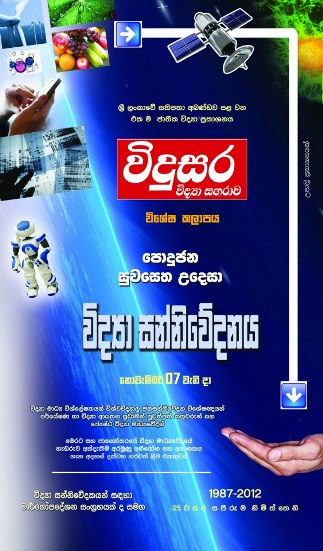
Vidusara at 25 – web banner from Facebook Group
The weekly Sinhala science magazine Vidusara, a publication of Upali Newspapers Limited of Sri Lanka, completes 25 years this week.
Sustaining any publication for that long is no mean accomplishment, so everyone involved – journalists, editors, publishers – deserve congratulations.
The current editor has done an interview with me for the 25th anniversary issue, which is out today. In it, I discuss the challenges faced by all science communicators, but especially by science journalists working in the developing world. The interview is in Sinhala. Here it is, in pdf, in parts 1 and 2.
I had a marginal involvement in Vidusara at its very inception, in late 1987, which was within a few months of my entering journalism. I take no credit for what the publication has accomplished, and am sometimes exasperated when long-standing readers associate me with it. But after clarifying such nuances for years, I now accept the inevitable association!
As reader comments warranted, I responded as follows:
Vidusara 25th anniversary issue – cover 7 Nov 2012“Vidusara was launched in 1988 [correction: it really was in Nov 1987] by Upali Newspapers Limited as an experiment in popular science communication. I was at the time working as a science correspondent for that company’s English daily, The Island, and the managing director asked me to advise and guide the new publication. I welcomed this as I was a bilingual writer (Sinhala and English). However, the founder editor of Vidusara was extremely apprehensive about my association with his project and went out of his way to exclude me. I have never tried to understand or analyse the reasons for this; such insecure and insular mindsets are far too common in Sinhala language journalism, even today.
“All in all, I must have written no more than 10 – 12 Sinhala science articles to Vidusara during its first few months of publication in 1988. When I compare that to the several hundred I’ve published in The Island (1986-1995: none of it available online) and many dozens for other English language media outlets – print, broadcast and online – over the years, my writing in Vidusara represents only a very small proportion of my combined media output. However, I must have done a few things well in those articles for discerning readers to remember and refer to it more than two decade later. I’m naturally pleased with such reader recollections.
“It also reminds me that we who work in the public space don’t get to choose how we are remembered. Our audiences will form their own impressions, and select their own memories.”
In Sri Lanka, mass kidney failure during the past two decades has been followed by what I call a mass media failure. Most of our media have failed to understand, analyse and report adequately on this public health emergency. Instead of helping affected people and policy makers to work out solutions, some journalists have become amplifiers of extreme activist positions.
I talked about this at at the International Science Communication Leadership Workshop, held as part of Association of Academies & Societies of Sciences in Asia (AASSA) General Assembly in Colombo, 16-19 October 2012. An English article based on my talk appeared in Ceylon Today a few days ago:
Mass Kidney Failure & Mass Media Failure: Go ‘Upstream’ for Remedies!
I have just written up similar views (NOT a translation!) for my weekend Sinhala language column in Ravaya broadsheet newspaper:
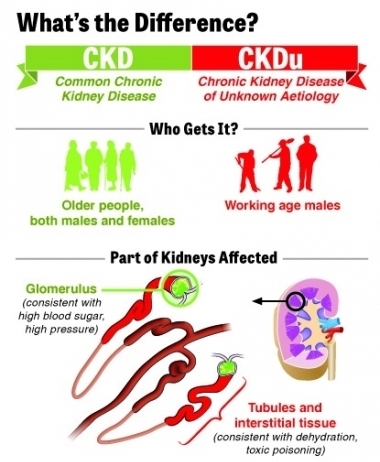
CKDu infographic courtesy Center for Public Integrity, USA
Ceylon Today newspaper has just published my article titled: Mass Kidney Failure & Mass Media Failure: Go ‘Upstream’ for Remedies!
It is adapted from a paper I presented last week at the International Science Communication Leadership Workshop, held as part of Association of Academies & Societies of Sciences in Asia (AASSA) General Assembly in Colombo, 16-19 October 2012.
In Sri Lanka, mass kidney failure during the past two decades has been followed by what I call a mass media failure. Most of our media have failed to understand, analyse and report adequately on this public health emergency. Instead of helping affected people and policy makers to work out solutions, some journalists have become amplifiers of extreme activist positions.
As health officials and policy makers struggle with the prolonged humanitarian crisis, partisan media coverage has added to public confusion, suspicion and fear. As a science writer and journalist, I have watched this with growing concern.
This is a critique of the Lankan media sector to which I have belonged, in one way or another, for a quarter century. I hope this will inspire some much-needed self-reflection among our media, which I feel over overstepped the boundaries of advocacy journalism in this issue. As I suggest, a return to first principles can help…
Full article below. Constructive engagement is welcomed.
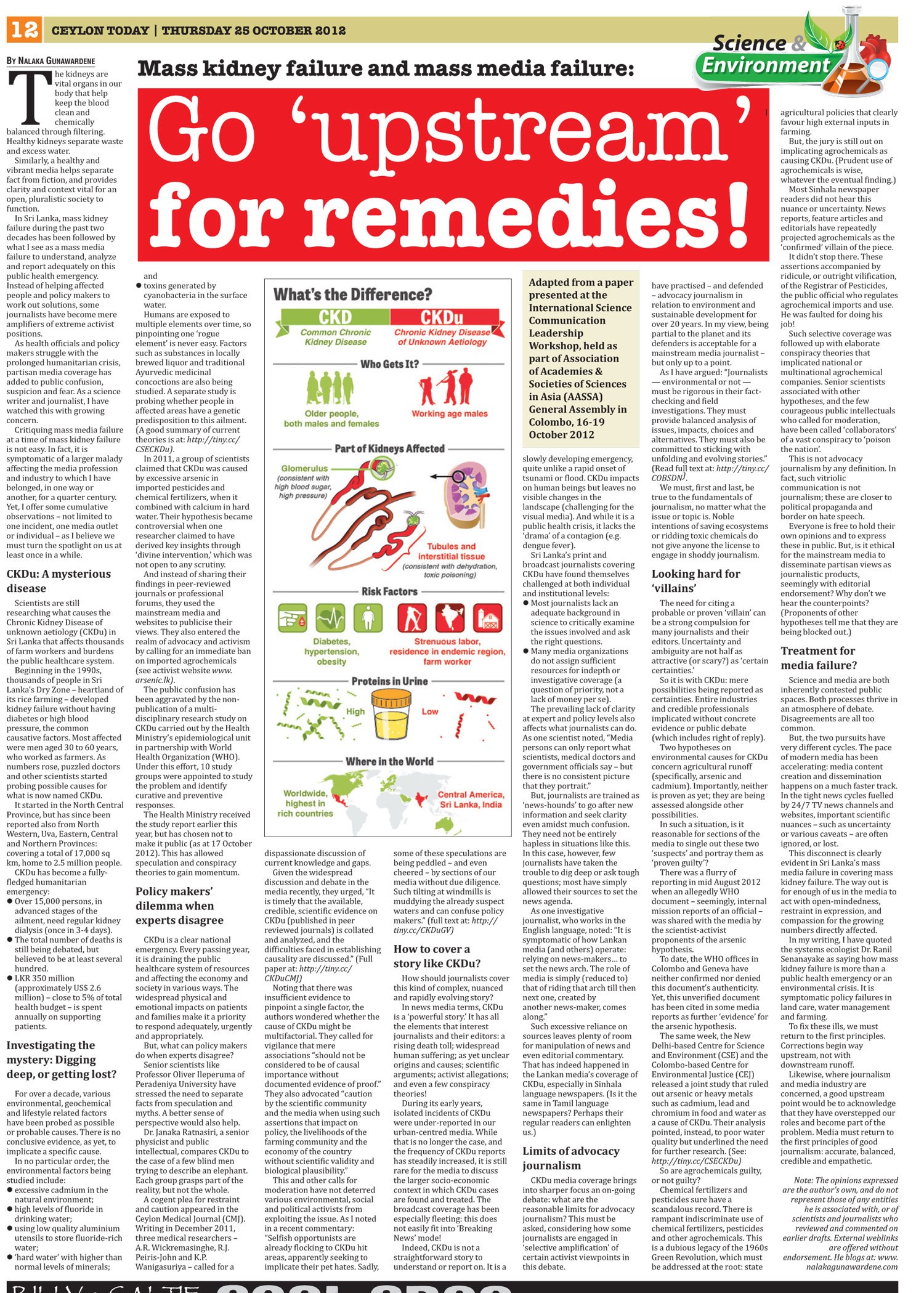
Mass Kidney Failure & Mass Media Failure – Nalaka Gunawardene – Ceylon Today 25 Oct 2012
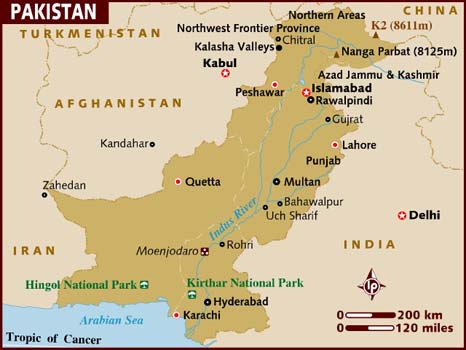
In this week’s Ravaya column (in Sinhala), I reflect on my recent visit to Pakistan, after 15 years.
When I last visited, in 1997, there were only state owned radio and TV channels. That changed in 2002 when private ownership was allowed. In a decade, private broadcasting has grown and expanded — especially in news and current affairs TV channels, which are now a dominant factor in Pakistan’s everyday life.
What does this mean for media pluralism, governance and social order in a country as complex as Pakistan? Are 24/7 news channels part of the problem or part of the solution? Since the genie cannot be sent back into the lamp, how best can its powers be harnessed for the public interest?
“ඇෆ්ගනිස්ථානයට යාබදව තිබෙන විකාර දේශය” හැටියට මගේ මිය ගිය පාකිස්ථානු මිතුරිය සනියා හුසේන් ඇගේ උපන් බිම හදුන්වා දෙන්නට පුරුදුව සිටියා. එය වඩාත් තිව්ර ලෙස දැනුනේ ඉංගී්රසියෙන් කී විටයි. ‘I live in Absurdistan, located next to Afghanistan!’
The kidneys are vital organs in our body that help keep the blood clean and chemically balanced through filtering. Healthy kidneys separate waste and excess water.
Similarly, a healthy and vibrant media helps separate fact from fiction, and provides clarity and context vital for an open, pluralistic society to function.
In Sri Lanka, mass kidney failure during the past two decades has been followed by what I see as a mass media failure to understand, analyse and report adequately on this public health emergency. Instead of helping affected people and policy makers to work out solutions, some journalists have become mere amplifiers of extreme activist positions.
As health officials and policy makers struggle with the prolonged humanitarian crisis, partisan media coverage has added to public confusion, suspicion and fear. As a science writer and journalist, I have watched this with growing concern.
I just gave a talk on this to the Science Communication Leadership Workshop which was part of the First General Assembly of Association of Academies and Societies of Sciences in Asia (AASSA) held in Colombo, Sri Lanka, on 17 October 2012.
Malima (New Directions in Innovation) is a Sinhala language TV series on science, technology and innovation. This episode was produced and first broadcast by Sri Lanka’s Rupavahini TV channel on 27 September 2012.
Produced by Suminda Thilakasena and hosted by science writer Nalaka Gunawardene, this episode features the following items:
• An interview with inventor Nalaka Chandrawansa, who has developed an energy-efficient fan that can be fitted under a mosquito net. It consumes less than 20W to operate, compared with table fans (average 45W) and ceiling fans (average 70W), accumulating power savings. And because the compact fan provides a more targeted stream of air that cools the sleeper on the bed, it also does not stir dust elsewhere in the room that sometimes causes health problems. This innovation has been grated a Sri Lanka Patent, certified by Sri Lanka Sustainable Energy Authority and won a President’s Award in 2010. It is manufactured and marketed by the inventor himself. Details at: http://www.freshnight.net
• Introducing Sri Lanka’s indigenous technology: kedella karuwa, a simple tool for sweeping outdoors, which might have inspired the rake.
• A Japanese company has recently introduced the innovative ‘Grappa’ foldable shopping bag — which also doubles as a safety helmet in the case of a disaster. It is made of mesh fabric sides, much like a standard reusable shopping bag, but the bottom consists of hard plastic and expanded polystyrene (EPS), which is often found in safety helmets to absorb impact. More about this at: http://www.springwise.com/health_wellbeing/japanese-eco-friendly-shopping-bag-doubles-safety-helmet/
• An interview with schoolboy inventor Therusha Chethana Fernando, a student of De Mazenod College, Kandana, Sri Lanka. He has developed a portable water cooler that can chill water to 5 degrees C below outside temperature without using refrigeration technology or electricity. Instead, the simple device uses a permeable clay container and a battery-powered small fan. With 3 litres of water filled, the entire unit weighs 4 kg, easy enough to carry around.



 Open Minds!