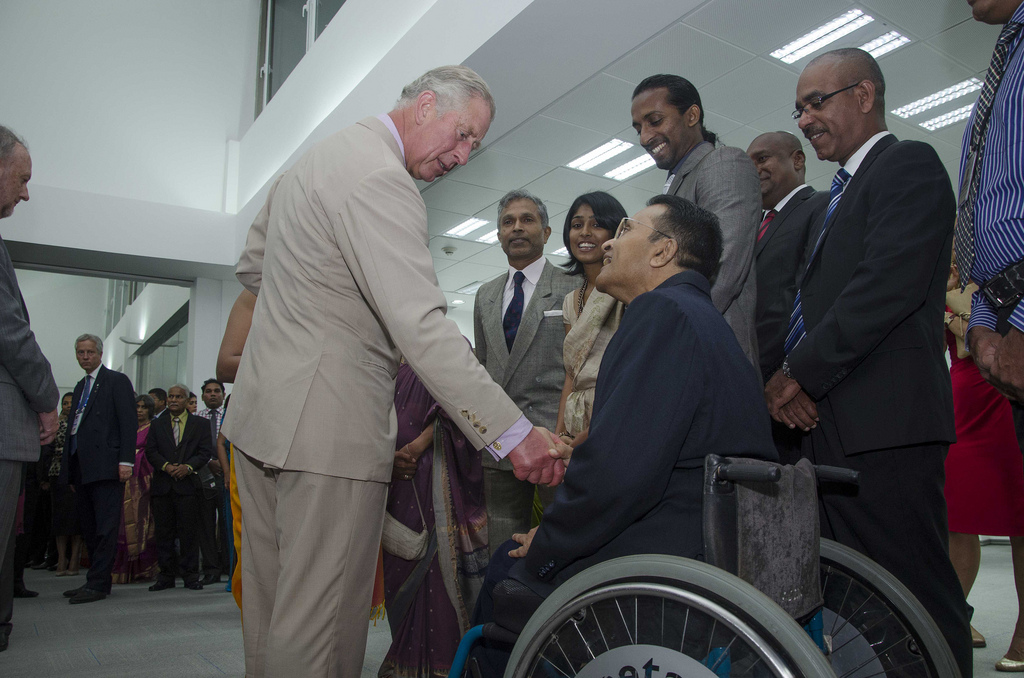
Prince Charles talks with Dr Ajith C S Perera, activist for mobility access, at the opening of British Council new building in Colombo, 16 Nov 2013 – Photo courtesy British Council Sri Lanka
Charlie is a charmer: he can be engaging, a good listener and smiles a lot.
At least these are my impressions of having watched Prince Charles at close range at a reception hosted by the Colombo British Council this evening – coupled with the opening of their new building.
The future king was ushered in without much fanfare (even his security was light touch and courteous). He spent around 40 minutes talking his way through the crowded room.
He chatted with many of the 250 or so guests — friends and partners of the British Council. It included a number of students and youth activists, as well as teachers, writers and scholars.
The Prince listened to short speeches by the British Council Sri Lanka Director and their global CEO. He then made the shortest speech of the evening: less than a minute, in which he made us laugh.
He basically thanked everyone, and expressed relief that the building he’d inaugurated on his last visit (1998) hadn’t been demolished.
Shortly afterwards, he left as quietly as he arrived. The party continued.
It was a brief encounter, but devoid of hype and pomposity that have characterised the Commonwealth Heads of Government Meeting (CHOGM) taking place in Colombo this week — the main reason why Prince Charles was in town.
I was quite tempted to take a quick photo with my mobile phone (cameras were not allowed). But our hosts had earnestly requested that we don’t take any photos. For once, I played by the rules.
In a more officious setting, I would quite likely have defied the restriction (after all, no one was watching our good conduct, as usually happens at Lanka government functions these days).
Yet the British Council has a special place in our hearts and minds. It’s a friendly oasis for artistes, learners, performers and activists. While they pursue their mission of promoting British cultural interests abroad, British Councils truly engage the community. Violating their request for taking a murky crowd photo would have been too unkind…
Part of that brand loyalty for British Council is explained in this short essay by Eranda Ginige of British Council Sri Lanka. In it, he reflects on their library in Colombo, which remains a community hub even as most readers trade paperbacks for portable devices.
Charlie produced unexpected gains, too. When I finally reached home, I had a rousing welcome from the two adorable females – a teenager and Labrador – who raise me:
Dear Charlie, You’ve boosted my approval rating among household teenagers but Digital Native puzzled I didn’t snap u! http://t.co/h0hPmBM8Ec
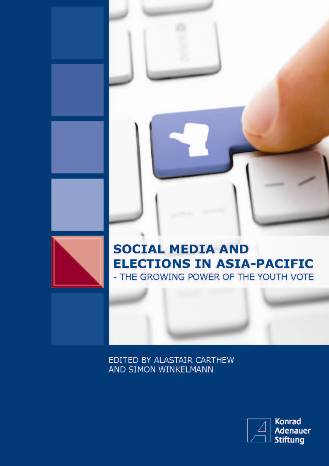
Did youth vote and social media make a difference in Colombo Municipal Council election in Sri Lanka held in October 2011?
This was the question that Chanuka Wattegama and I asked ourselves and set out to answer when invited to contribute a chapter to a regional book on how social media are influencing elections in Asia.
The book comprises 10 chapters covering 11 nations written by local contributors from Australia, Indonesia, Japan, Malaysia, New Zealand, Singapore, South Korea, Sri Lanka, the Philippines, Taiwan and Thailand.
It examines trends and outcomes surrounding recent elections in these countries — and how social media influenced election campaigning and voting, especially among young voters.
Topics include:
• Use of social media surrounding elections
• Digital electioneering
• How social media can make a difference
• How important is voting to young people?
• Detailed polling of political trends
Our summary for the Sri Lanka chapter:
The Colombo Municipal Council (CMC) is the local government body that administers Sri Lanka’s largest city and its commercial capital. Its last election, held in October 2011, saw the nationally ruling coalition losing this key municipality while winning all other municipalities as well as many of the smaller local government bodies.
What made CMC election outcome different? This election saw some apolitical activists and researchers engaging the mayoral candidates on social media, questioning and critiquing their election manifestos and trying to hold them accountable. Did these online activities influence voter behaviour? What lesson does this hold for other elections and the overall political landscape in Sri Lanka?
In this week’s Ravaya column (in Sinhala), I discuss the recent controversy surrounding food safety of imported milk powder, and how certain medical doctors and scientists conducted themselves.
In this week’s Ravaya column (in Sinhala), I pay tribute to Nelson Mandela whose 95th birthday was on 18 July 2013 — which was marked worldwide as Nelson Mandela Day.
See also my English essay published earlier this week:
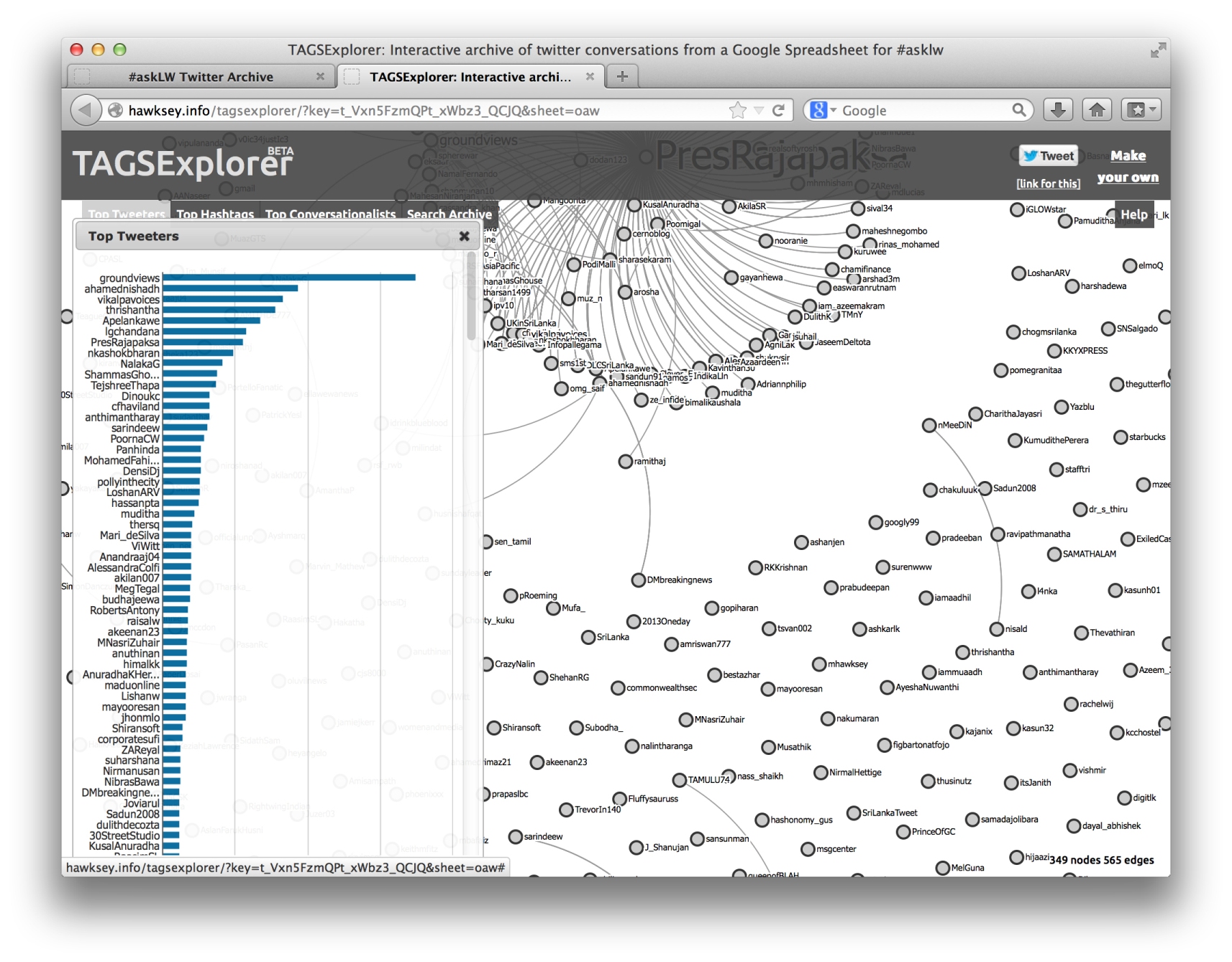
Screen Shot 2013-06-19 at 8.31.53 PM Courtesy Groundviews.org
Along with dozens of tweeps, I took part in an interesting Twitter Q&A session with Lalith Weeratunga, Secretary to the President of Sri Lanka, which unfolded from 14:30 to 16:00 Sri Lanka Time on 19 June 2013.
Our questions were posed using the hashtag #AskLW: they are all displayed on Twitter at https://twitter.com/search/realtime?q=%23askLW While most were in English, some came in the local languages of Sinhala and Tamil too.
Groundviews.org, the citizen journalism website, has archived online 2,680+ tweets related to this exchange. Of these, some 1,140 are original tweets (posted since 14 June 2013, when #askLW was first announced) while others are retweets.
As Groundviews.org noted, “There was no historical precedent for this kind of engagement over social media, especially for someone so high up in Government and in daily contact with the (Lankan) President.”
Commenting on the timing of this exchange, Groundviews editor Sanjana added: “Ironically, the announcement of the Twitter Q&A with Weeratunga came on the same day Gotabaya Rajapaksa, the President’s brother, in a spark of unrivalled genius, called social media no less than a national security threat in post-war Sri Lanka.”
Sanjana has done a quick and very good analysis of what was asked, which selected few among many were actually answered, and which topics gained traction among those participating – especially during the period the event was live.
Even more interesting is how contentious and controversial topics were completely ignored. To be sure, Weeratunga isn’t the first public official to do so, and some might even argue that he had the right to choose his questions. (That won’t have been so easy in a physical press conference.)
All the same, it is highly revealing that the top public servant in Sri Lanka chose not to respond to questions on Islamphobia, Buddhist extremism, hate speech, militarisation, human rights and other topics of great public interest in today’s Sri Lanka.
It’s remarkable that such questions were posed, in a public platform, which is more than what the mainstream media (MSM) of Sri Lanka regularly ask at official press conferences given by senior government officials. From all accounts, the monthly breakfast meetings that the President has with newspaper editors is also a lame affair where no critical questions are raised.
Yes, MSM and citizen journalists are not directly comparable. In the prevailing intolerant environment, it is telling that many social media users took cover under pseudonyms to pose questions to the top civil servant of Lanka (while the rest of us asked under our own names). There was even speculation among some tweeps about what might happen to those who ask pesky questions…
In this post, I want to collate and briefly annotate my own questions to Weeratunga – all of which he chose not to answer. I’m not surprised and certainly not sulky: these were admittedly not as easy as some others.
I posed a few questions in advance, and then some more during the live event. They were in one way or another related to the multiple positions that Weeratunga holds in the Lankan government.
One question stemmed from Weeratunga’s meaningful speech at the fifth National Conference on the Role of ICT in Reconciliation held at the Lakshman Kadirgamar Institute for International Relations and Strategic Studies (LKIIRSS) in Colombo in Nov 2012.
#AskLW: I read your speech on ICTs at LKIIRSS last Oct. How can #lka govt that doesn't tolerate any dissent really promote #reconciliation?
Commenting on the very different – sometimes contradictory – messages given out by senior elected and other public officials of the Lankan government on matters of domestic and global interest, I asked:
#AskLW#lka Govt publicly stated positions often remind us of 'Strange Case of Dr Jekyll and Mr Hyde'. Why this sharply split personality?
Weeratunga, who does not yet have his own Twitter account, gave his selected answers using the President’s official account, @PresRajapaksa. This was noted by others, and I replied to one:
Many tweeps asked him to comment on the Defence Secretary’s recent remark on social media. Having noted, only minutes earlier, that “Social Media is a powerful tool”, Weeratunga added later: “Sec/Defence has a point; since it has been used for destructive purposes elsewhere, he has said so.”
Some tweeps reacted to this observation among ourselves. My contribution:
@AmanthaP@PresRajapaksa Oh, knives, telephones, books, cars, even fists have been used 4 destructive purposes too! Intention matters #AskLW
Knowing well Lankans don’t like to be compared to Indians, who nevertheless hold many lessons for us in managing diversity and in balancing modernity with tradition, I asked:
Not answered. (Well, after all, this wasn’t Hard Talk!).
Prompted by @Groundviews, there was a brief exchange on Sri Lanka’s fully state owned budget airline Mihin, which has been losing billions of public funds from Day One. I reacted:
I’ve described myself as a hybrid journalist with ‘one foot in each grave’ — straddling the worlds of mainstream media and citizen journalism. In years of mainstream journalism — practised in Sri Lanka and across Asia — I have sharpened the art of asking pointed questions. I often ask more questions than I find answers for. So this is part of that process.
But I’m very glad all our questions are archived online — which is highly significant as part of the public record of our times. When Weeratunga next speaks about ICTs nationally or internationally, this digital record will be part of his legacy.
For now, many thanks to Weeratunga and @PresRajapaksa new media team for having organised this event. It’s a good start, and hopefully they will repeat this from time to time with improved capability at their end to cope with the info flood…
My last tweet in this exchange was a salute to the original cyber politician of Sri Lanka:
#AskLW scored around 3.5 on Moragoda Scale of #lka Cyber Engagement where @milindamoragoda set benchmark of 1 & high end is 10. Do u Agree?
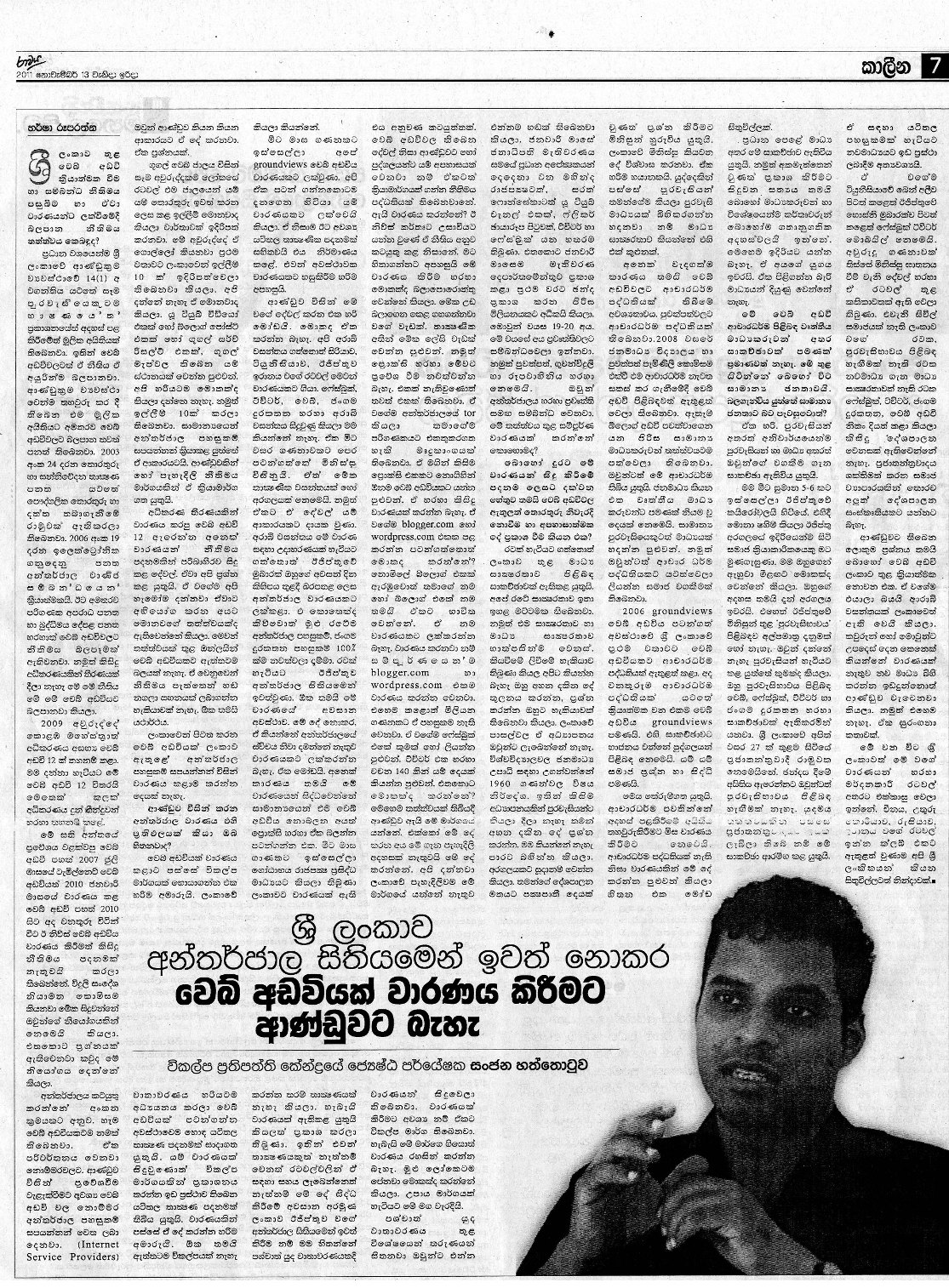
In this week’s Ravaya column (in Sinhala), I continue my discussion on challenges of modernisation for small, independent media in the world today when print media industry faces formidable challenges.
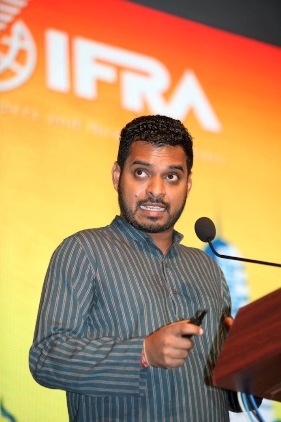
I quote Sanjana Hattotuwa, new media researcher and activist, who was a speaker at the recent 65th annual congress of the World Association of Newspapers and News Publishers (WAN-IFRA) held in Bangkok.
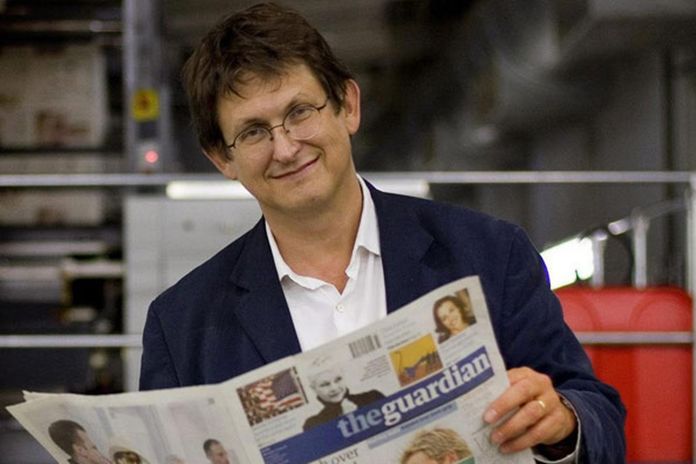
I also refer to the Guardian newspaper’s model of Open Journalism, and ask how this can be adapted to suit our own realities. The challenges are more within the minds of media organisations, I argue, than in the technology tools or platforms.
I observe how, some 18 years after commercial Internet connectivity was introduced in Sri Lanka, not a single Lankan newspaper has been able to develop a modern website: all are stuck in the 1990s first generation web, and their attempts to ‘modernise’ and enter the 21st Century have been pitiful and hilarious at the same time. Ravaya has a real opportunity, therefore, to become the first Lankan newspaper — in any language — to develop an engaging and interactive website. But first, it must make some top level decisions on how it wants to position itself in the rapidly changing world of media content creation, dissemination and consumption.
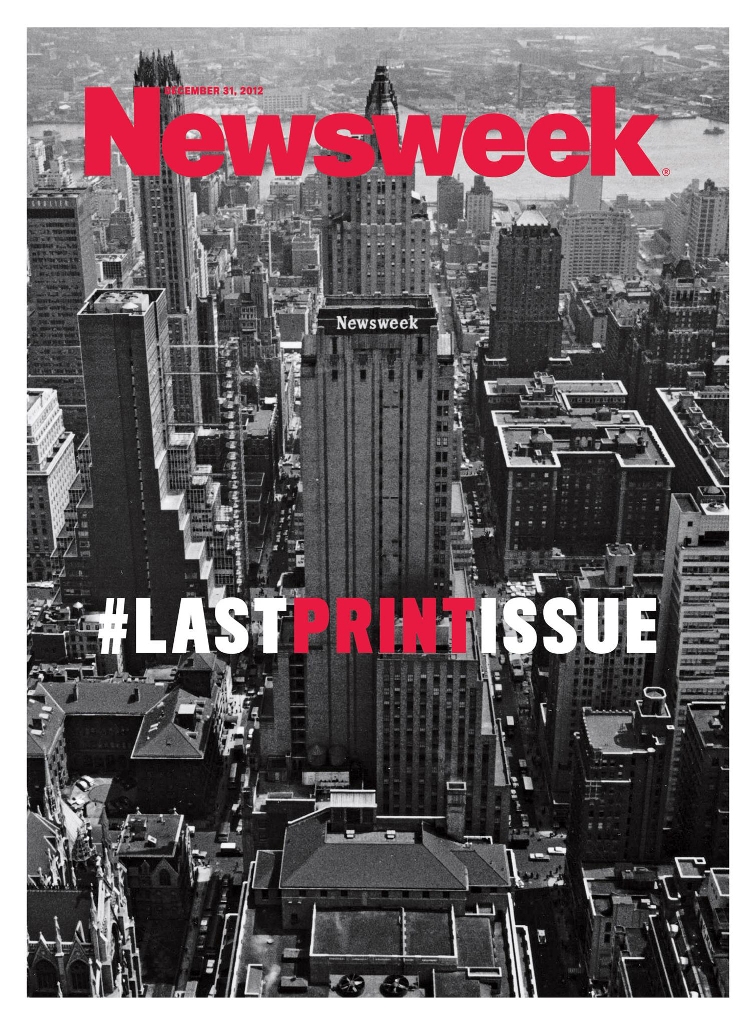
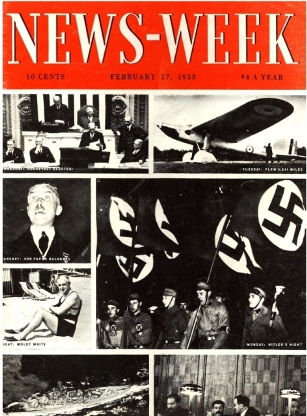
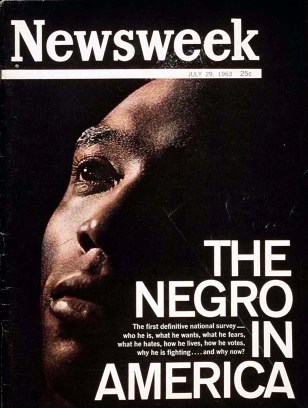
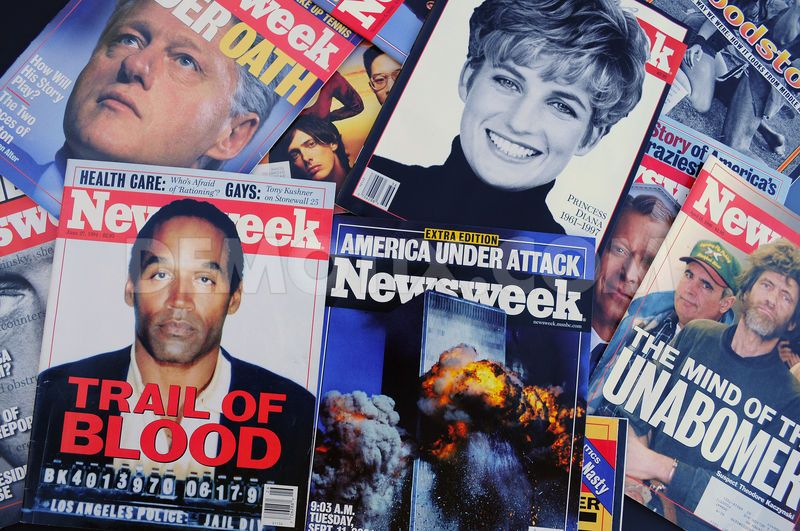
In this week’s Ravaya column (in Sinhala), I look back at the Newsweek magazine’s illustrious history of nearly 80 years, and reflect on the phenomenon of news magazines: are their days numbered, at least in print?
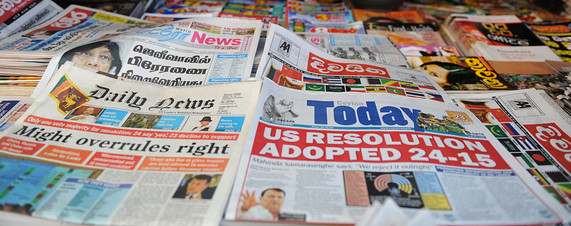
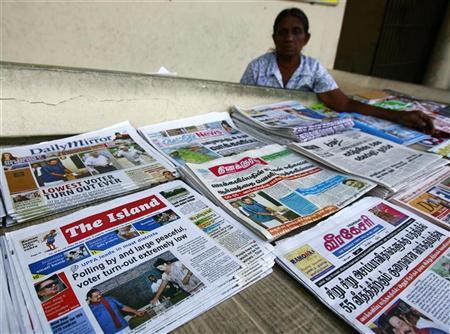
“Sri Lanka’s newspaper history dates back to Colombo Journal (1832) which apparently had a short but feisty life before it invoked the ire of the British Raj. Nearly two centuries and hundreds of titles later, the long march of printer’s ink — laced with courage and passion – continues.
“How long can this last?
Print journalism’s business models are crumbling in many parts of the world, with decades old publications closing down or going entirely online. This trend is less pronounced in Asia, which industry analysts say is enjoying history’s last newspaper boom. Yet, as I speculated three years ago when talking to a group of press barons, we’ll be lucky to have a decade to prepare for the inevitable…”
These are excerpts from a short essay I originally wrote last week to mark the first anniversary of Ceylon Today newspaper, where I’m a Sunday columnist. It was printed in their first anniversary supplement on 18 Nov 2012.
Groundviews.org has just republished it today, making it easily available to a much wider audience. Read full essay:
Another excerpt: “In the coming years, waves of technology, demographics and economics can sweep away some venerable old media along with much of the deadwood that deserves extinction. The adaptive and nimble players who win audience trust will be the ones left to write tomorrow’s first drafts of history.”





 Open Minds!