සිවුමංසල කොලූගැටයා #40: පුවත්පතේ අනාගතේ 2 – ළඟ ළඟ එන මහා මාරුතය

This is the Sinhala text of my Ravaya column published on 13 Nov 2011, where I continue my discussion on the future of newspapers. I look at the last newspaper boom currently on in Asia, and caution that good times won’t last for long: take advantage of it to prepare for the coming (and assured) turbulence in the mainstream media!
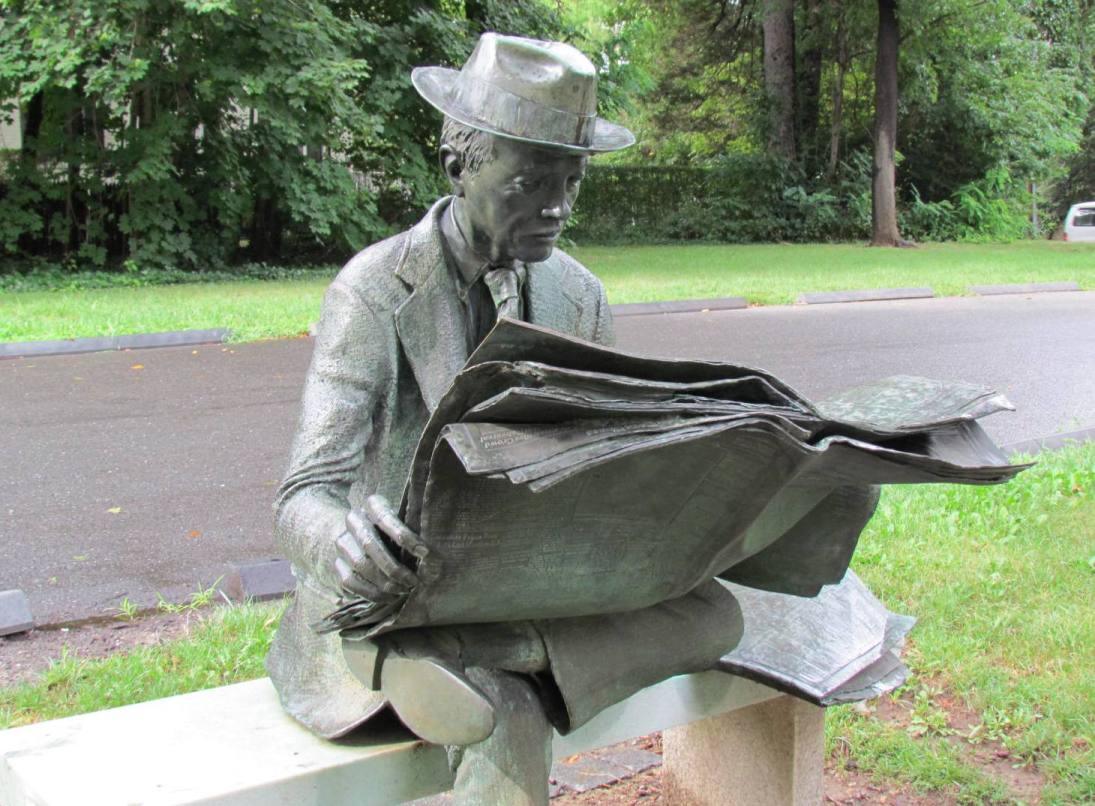
J Seward Johnson's statue of Newspaper Reader - at Princeton University garden

අප දන්නා විදියේ පුවත්පත්වලට වසර 400කට වැඩි ඉතිහාසයක් තිඛෙනවා. ලංකාවේ පුවත්පත් කලා ඉතිහාසයත් වසර 180ක් පමණ පැරණියි. තවමත් නිතිපතා ජනතාව අතරට යන පැරණිතම ජනමාධ්‍ය වන පුවත්පත්, 21 වන සියවසේ තාක‍ෂණික හා ආර්ථීක අභියෝග ජය ගනියි ද? අප විවිධ පැතිකඩවලින් විග්‍රහ කරන ප්‍රශ්නය මෙයයි.

පුවත්පත් කර්මාන්තය සසල කරමින් ලොව බොහෝ රටවල මේ දිනවල පැතිර යන මාරුතය ගැන අප ගිය සතියේ කථා කළා. බටහිර රටවල පුවත්පත් සහ සගරා මිළදී ගැනීම සැළකිය යුතු අන්දමින් අඩු වී තිඛෙනවා. එයට වෙනස් ප්‍රවණතාවක් ආසියාවේ දක්නට ඇති බවත් සදහන් කළා. කුමක් ද මේ වෙනස?

2000 දශකය අවසන් වන විට ආසියාවේ පුවත්පත් සදහා වෙළදපොල ඉල්ලූම වැඩිවෙමින් තිබුණා. ලෝක පුවත්පත් සංගමය (World Association of Newspapers, WAN) එකතු කළ දත්තවලට අනුව, ලොව වැඩිපුර ම අලෙවි වන පුවත්පත් 10න් 9ක් ම ඇත්තේ ආසියාවේ – එනම් ජපානයේ හා චීනයේ. පත්තර ලෑලි හරහා හෝ දායකත්වය හරහා හෝ විකිණෙන පුවත්පත්වල (නොමිළයේ දෙන පුවත්පත් නොවෙයි) සමස්ත අලෙවිය සළකන විට අද ලෝකයේ විශාලතම පුවත්පත් වෙළදපොලවල් ඇත්තේ චීනය, ඉන්දියාව හා ජපානය යන රටවල් තුනේයි. සිවු වැනි තැනට එන්නේ අමෙරිකාවයි. (බලන්න: http://tiny.cc/Circ)

ලෝකයේ වෙනත් කලාපවල පාඨකයන් පුවත්පත් මිළදී ගැනීම අඩු කරන අතර ආසියාවේ එය වැඩි වෙමින් පවතින බව WAN සංඛ්‍යා ලේඛන පෙන්නුම් කරනවා. උදාහරණයකට 2008 වසරේ ඉන්දියානුවන් මිලියන 11.5ක් දෙනා ප්‍රථම වතාවට පුවත්පත් කියවන්නට පටන් ගත්තා. මේ ඇයි?

ආසියාවේ ආර්ථීක වර්ධනයත් සමග මධ්‍යම ජාතිකයන් සංඛ්‍යාව සීඝ්‍රයෙන් වැඩි වෙමින් පවතිනවා. ඉහළ යන ආදායම් මට්ටම් හා සාක‍ෂරතා/අධ්‍යාපනික මට්ටම් සමග පුවත්පත් සදහා ඉල්ලූම වැඩි වනවා. එමෙන්ම පත්තරයක් දිනපතා මිළට ගැනීම යම් අන්දමකින් සමාජ තත්ත්වයක් පෙන්නුම් කරන බවට පිළිගැනීමක් ඉන්දියාව, ඉන්දුනීසියාව, තායිලන්තය වැනි රටවල තිඛෙනවා.

ජනගහනයට සාපේක‍ෂව වැඩිපුර ම පුවත්පත් මිළදී ගන්නා රට ජපානයයි. ලෝකයේ සියළුම රටවල සියළුම භාෂාවලින් පළ කැරෙන පුවත්පත් අතර වැඩිපුර ම අලෙවි වන පුවත්පත් 5 හමුවන්නේ ජපානයේ. පත්තර කියවීම ජපන් ජාතිකයන් අතර ඉතා හොදින් මුල් බැස ගත් පුරුද්දක්. ලංකාවේ පුවත්පත් අලෙවිය පිළිබද නිවැරදි හා පැහැදිලි තොරතුරු සොයා ගැනීම අසීරුයි. කිසිදු පුවත්පත් සමාගමක් තම අලෙවි සංඛ්‍යා හෙළි කරන්නේ නැහැ. ඇතැම් රටවල මෙන් අපක‍ෂපාතව මුද්‍රිත මාධ්‍ය ෙක‍ෂත්‍රයේ දත්ත විග්‍රහ කරන පර්යේෂණායතන ඇත්තේ ද නැහැ.%

අප ආසියාවේ දැන් අත් විදින්නේ පුවත්පත් ප්‍රකාශන ලෝකයේ දැකිය හැකි වන අවසාන සරු කාලය (world’s last newspaper boom) බව ඇතැම් පර්යේෂකයන්ගේ මතයයි. පුවත්පත් පමණක් නොව ජන මාධ්‍ය හැමෙකක් ම පාහේ වැඩිපුරම පරිශීලනය වන්නේ ප්‍රචලිත වී ඇත්තේ ආසියාවේයි. එයට හේතුව (නොබෝදා බිලියන් 7 ඉක්මවා ගිය) ලෝක ජනගහනයෙන් සියයට 60ක් වෙසෙන්නේ ආසියාවේ වීමයි. තවත් හේතුවක් නම් පසුගිය දශක දෙක තුළ එතෙක් සංවෘතව තිබූ මාධ්‍ය වෙළදපොලවල් විවෘත වීම නිසා දෙස් විදෙස් ආයෝජන මාධ්‍ය ෙක‍ෂත්‍රයට වැඩියෙන් ගලා ඒමයි.

මේ වත්මන් ප්‍රවණතා දෙස බලන විට අප නිගමනය කළ යුත්තේ සෙසු ලෝකයේ දැනට සිදුවන මාධ්‍ය වෙළදපොල ගරාවැටීම ආසියාවට නොඑන බව ද? වෙළදපොල පරිනාමීය ප්‍රවාහයන්ට ඔරොත්තු දිය හැකි තරම් ආසියානු මාධ්‍ය ආයතන ශක්තිමත් බව ද?

ගෝලීයකරණය වූ තොරතුරු සමාජය තුළ ලෝක ව්‍යාප්තව පැතිර යන සැඩ සුළංවලින් ආසියාවේ අපට මුළුමනින් ම ආරක‍ෂා වී සිටිය හැකි යයි සිතීම ස්වයං මුලාවක්. 2009 අගදී මෙරට පුවත්පත් හිමිකරුවන්, කතුවරුන් හා ජ්‍යෙෂ්ඨ මාධ්‍යවේදීන් සිටි සභාවක් අමතමින් මා කියා සිටියේ ලෝක මට්ටමින් සිදු වන සන්නිවේදන ප්‍රවණතා මෙරටට පැමිණෙන්නට යම් තරමක ප්‍රමාදයක් ඇති බවයි.

උදහරණයකට ලෝකයේ ටෙලිවිෂන් විකාශයන් 1929දී (අමෙරිකාවේ) ඇරඹුණත් එය ලංකාවේ පටන් ගත්තේ 1979දී – එනම් වසර 50කට පසුව. එහෙත් වාණිජ මට්ටමේ ජංගම දුරකථන සේවා මුල්වරට (ජපානයේ) 1979දී ඇරැඹි දස වසක ඇවෑමෙන් 1989දී මෙරට මුල් ම ජංගම දුරකථන ජාලය ක්‍රියාත්මක වුණා. වාණිජ මට්ටමේ ඉන්ටර්නෙට් සේවා 1980 දශකය අගදී ලොව දියුණු රටවල ඇරැඹුණු අතර 1995දී ලංකාවත් සයිබර් අවකාශයට සම්බන්ධ වුණා.

මේ කාලාන්තරය එන්න එන්න ම කෙටි වීම අද තොරතුරුක සමාජයේ ගති සොබාවයි. එය ප්‍රවණතාවක් හැටියට ගතහොත් හොදට හෝ නරකට හෝ මාධ්‍ය හා තොරතුරු තාක‍ෂණ ෙක‍ෂත්‍රයේ ලොව ඇති වන නව රැලි නොබෝ දිනකින් ම අපේ දූපතටත් ළගා වනවා.

ලොව පුරා හමා යන මාධ්‍ය වෙළදපොල සැඩ සුළංවලින් අපව සුරැකෙන්නේ නැහැ. එයට තව වසර කිහිපයක් තුළ අපට ද මුහුණ දෙන්න සිදු වනවා. එහෙත් අපට උපක්‍රමශීලීව මේ ප්‍රමාදයෙන් ප්‍රයෝජන ගත හැකියි. වෙනත් දියුණු හා දියුණු වන රටවල මාධ්‍ය ආයතන මේ අභියෝගයට මුහුණ දෙන සැටි හා හැඩ ගැසෙන සැටි අප හොදින් අධ්‍යයනය කළ යුතුයි. ළග එන මාරුතයට මුහුණදීමට අපේ මාධ්‍ය පෙළ ගැසීම අවශ්‍යයි.

පුවත්පත් යනු කර්මාන්තයක් වුවත් එය අනෙකුත් වාණිජමය ව්‍යාපාරවලට වඩා සංකල්පමය හා ප්‍රායෝගික අතින් වෙනස්. පුවත්පතක අන්තර්ගතය නිර්මාණය වන්නේ පූර්ණකාලීන හා නිදහස් මාධ්‍යවේදීන් ගණනාවකගේ දායකත්වයෙන්. ප්‍රවෘත්ති, විචිත්‍රාංග, ඡායාරූප හා විද්වත් ලිපි ආදිය පුවත්පත් කාර්යාලයක් ඇතුළතින් මෙන් ම පිටතින් ද ජනනය වනවා. මේ සියල්ල සමානුපාතික කොට, නිසි පිටු සැළසුමක් සහිතව කලට වේලාවට මුද්‍රණය කරන්නටත්, එම පිටපත් රට පුරා කාර්යක‍ෂමව ඛෙදා හරින්නටත් මනා සම්බන්ධීකරණයක් තිබිය යුතුයි. එමෙන්ම පුවත්පත් ආදායමට සම්මාදම් වන වෙළද දැන්වීම්කරුවන් සමග නිති සබදතා පවත්වා ගත යුතුයි.

වෙනත් භාණ්ඩ මෙන් නිපදවා ගබඩා කර ගැනීමේ හැකියාවක් පුවත්පත්වලට නැහැ. වඩාත්ම අළුත් පුවත් හා විග්‍රහයන් හැකි ඉක්මනින් පාඨකයන් අතට පත් කිරීමේ අභියෝගයට ලොව පුරා පුවත්පත් කාර්්‍යාලවල කර්තෘ මණ්ඩල මෙන්ම මුද්‍රණ හා ඛෙදා හැරීමේ සේවකයන්ද දිවා රෑ මුහුණ දෙනවා. කාලය සමග කරන මේ තරග දීවීමට සමාන්තරව ඔවුන් තමන්ගේ තාරගකාරී පුවත්පත් ගැන අවධානය යොමු කළ යුතුයි.

රටේ බල පවත්නා නීති, සදාචාරමය රීතිවලට ගරු කරමින් ඒ සම්මත රාමුව තුළ නැවුම් වූත්, සිත් ඇද ගන්නා වූත් පුවත්පතක් දිනපතා හෝ සතිපතා නිකුත් කළ යුතුයි. ඔබ මේ කියවන පත්තර පිටපත ඔබ අතට එන්නට බොහෝ දෙනකු නන් අයුරින් දායක වී තිඛෙනවා. බලා ගෙන ගියා ම පත්තරයක් කියන්නේ සුළුපටු ප්‍රයත්නයක් නොවෙයි!

එමෙන්ම පුවත්පත් යනු හුදෙක් මුද්‍රිත කොළ කෑලි සමූහයක් නොවෙයි. ප්‍රකාශන ඉතිහාසය මුළුල්ලේ දියුණු වී ආ සම්ප්‍රදායයන් හා ආචාරධර්ම රැසක් නූතන පුවත්පත් කලාවට තිඛෙනවා. ලෝකයේ හැම පුවත්පතක් ම එක හා සමාන අයුරින් මේවාට අනුගත වන්නේ නැහැ. එහෙත් පුළුල්ව පිළි ගැනෙන ‘පොදු සාධකයක්’ නම් පුවත්පත් නියෝජනය කරන්නේ හිමිකරුවන් හා දැන්වීම්කරුවන්ට වඩා පාඨකයන් ඇතුළු ජන සමාජය බවයි. මේ පොදු උන්නතිය (public interest) වෙනුවෙන් පෙනී සිටීම නිසා මාධ්‍ය ආයතනවලට හා ඒවාට අනුයුක්ත මාධ්‍යවේදීන්ට සමාජයේ සුවිශේෂ තැනක් ලැඛෙනවා.

මහජනයාට තොරතුරු දැන ගැනීමේ අයිතිය හා අදහස් ප්‍රකාශ කිරීමේ අයිතිය නියෝජනය කරන පුවත්පත් රැක ගැනීමට සිවිල් සමාජයේ නැඹුරුවක් තිඛෙනවා. සාමාන්‍ය මුද්‍රණාලයකට තබා පොත් මුද්‍රණය කරන ප්‍රකාශන සමාගමකටවත් නැති තරමේ ගෞරවයක් පුවත්පත් ආයතනවලට තවමත් ලැඛෙනවා. නමුත් මේ ඓතිහාසික සබැදියාව පලූදු වන ආකාරයේ බාල අන්තර්ගතයන් ඛෙදන්නට පටන් ගත් විට පාඨකයන් එබදු පුවත්පත් මිළට ගන්නට (හෝ නිකම් දුන්නත් කියවන්නට) කැමැති වන්නේ නැහැ.

අමෙරිකානු මාධ්‍ය ආයතනවල අනාගතය ගැන 1993දී ප්‍රකට ලේඛකයකු කළ අනාවැකියක් ගැන අප ගිය සතියේ සදහන් කළා. පාඨක විශ්වාසය ගරා වැටෙන බව දැන ගත් ඇතැම් මාධ්‍ය ආයතන තමන්ගේ ප්‍රකාශන කියවීමට විවිධාකාර ත්‍යාග පවා දීමට පටන්ගෙන තිඛෙනවා. මේ ආකාරයේ ‘අල්ලස්’ හා ‘සීනිබෝල’වලින් බහුතර පාඨකයන් රවටන්නට අමාරුයි. මොන උපක්‍රම යොදා ගත්තත් පාඨකයන්ගේ විශ්වාසය නොමැතිව වැඩි කල් පවතින්නට කිසිදු පුවත්පතකට බැහැ.

පත්තරයක් කියන්නේ මහජන මනාපය දිනපතා ම හෝ සති අගදී හෝ නිරතුරුව පතන හා ලබන ප්‍රකාශනයක්. මේ මනාපය දිගින් දිගට පවත්වා ගැනීමේ අභියෝගයක් තිඛෙනවා. එය තරගකාරී වෙනත් පුවත්පත් සමග පමණක් ඇති තරග දිවීමක් නොවෙයි. පත්තරවලට වඩා ඉක්මනින් ප්‍රවෘත්ති රටට දීමේ හැකියාව රේඩියෝ, ටෙලිවිෂන් හා ඉන්ටර්නෙට් මාධ්‍යයන්ට තිඛෙනවා. ඒ විද්යුත් මාධ්‍යවල ව්‍යප්තියත් සමග තමන්ගේ අන්තර්තය හා මුහුණුවර වෙනස් කරන්නට බොහෝ පුවත්පත්වලට පසුගිය දශක දෙක තුළ සිදුවුණා.

විද්යුත් මාධ්‍ය ඉක්මන් වූවත් යමක් ගැඹුරින් විග්‍රහ කිරීමේ ඉඩකඩ සීමිතයි. මේ නිසා ලොව පුරා පුවත්පත් තනිකර ප්‍රවෘත්ති ආවරණයට වඩා අද උත්සාහ කරන්නේ ප්‍රවෘත්ති විග්‍රහ කිරීමටයි. ප්‍රවෘත්ති බවට පත් වන සිදුවීම් සමාජයේ විවිධාකාර ප්‍රවාහයන්ගෙන් මතු වන නිසා පිටුපසින් ඇති සාධක හා ප්‍රවණතා මනා සේ හදුනාගැනීම සංකීර්ණ සමාජයක වෙසෙන අප කාටත් වැදගත්. මේ ප්‍රවාහයන් ගැන පර්යේෂකයන්, සමාජ සේවකයන් හා විද්වතුන් කරන විග්‍රහවලට දැන් පුවත්පත් හා පුවත් සඟරාවල වැඩි තැනක් ලැඛෙනවා. අද බටහිර ඇතැම් පුවත්පත් Newspaper යන නමට සමාන්තරව Viewspaper යන නම ද තමන් හැදින්වීමට යොදා ගන්නවා.

මෙකී නොකී සියල්ල මා දකින්නේ පරිනාමීය හැඩ ගැසීම් හැටියටයි. වඩාත් සවිමත් උචිත වූ ජීවීන් ඉතිරි කරමින් දුර්වලයන් වඳ කර දමන ජෛවීය පරිනාමය මෙන් ම තොරතුරු සමාජයේ ද පරිනාමීය බලවේග ක්‍රියාත්මක වනවා. එහෙත් ජෛව පරිනාමයට වඩා එය සියුම් හා බුද්ධිගෝචරයි. මාධ්‍ය ග්‍රාහකයන්ට හරවත්, ප්‍රයෝජනවත් දෙයක් සිත් කාවදින අයුරින් ඉදිරිපත් කරන පුවත්පතකට අද මහා තොරතුරු ප්‍රවාහයේ නොගිලී පවතින්නට ඉඩක් ඇතැයි මා විශ්වාස කරනවා.
බලන්න: http://tiny.cc/DigImi

සිවුමංසල කොලූගැටයා #37: අලි-මිනිස් සංහිදියාවේ අළුත් පිටුවක්

This is my latest Sinhala column published in Ravaya newspaper on 23 October 2011, which is about human-elephant interactions in Sri Lanka, which has the highest density of Asian elephants in the world. I have covered much of the same ground in English in another recent essay, Chandani: Riding a Jumbo Where No Woman Has Gone Before…


ඔක්තෝබර් මුල සතියේ කොළඹින් ඇරඹුණු, ගාල්ල මහනුවර හා යාපනය නගරවලට ද යන්නට නියමිත යුරෝපීය චිත්‍රපට උළෙලේ ප්‍රදර්ශනය කළ එක් චිත්‍රපටයකට මගේ විශේෂ අවධානය යොමු වුණා. ජර්මන් චිත්‍රපට කණ්ඩායමක් ලංකාවේ රූපගත කොට 2010දී නිර්මාණය කළ එය, Chandani: The Daughter of the Elephant Whisperer නම් වාර්තා චිත්‍රපටයක්. සිංහලෙන් ‘චාන්දනී – ඇත්ගොව්වාගේ දියණිය’ සේ අරුත් දිය හැකියි. අපේ රටේ ඈත අතීතයට දිව යන අලි – මිනිස් සබදතාවන්ගේ අළුත් පැතිකඩක්, කථාවක ස්වරූපයෙන් කියන නිර්මාණයක් හැටියට මේ චිත්‍රපටය මා දකිනවා.

අලි ඇතුන් ගැන චිත්‍රපට නිපදවන්නට සිනමාවේ මෙන් ම ටෙලිවිෂන් කර්මාන්තයේත් බොහෝ දෙනා කැමතියි. ගොඩබිම වෙසෙන විශාල ම ජීවීන් හැටියටත්, සමාජශීලි හා බුද්ධිමත් සත්ත්ව විශේෂයක් හැටියටත්, අලි ඇතුන්ගේ සුවිශේෂ බවක් තිඛෙනවා. බටහිර චිත්‍රපට කණ්ඩායම් වැඩි අවධානයක් යොමු කරන්නේ අප්‍රිකානු අලියාටයි. ආසියානු අලි ඇතුන් ගැන චිත්‍රපට රූපගත කරන්නට වුවත් ඔවුන් තෝරා ගන්නේ ලංකාවට වඩා ඉන්දියාව, තායිලන්තය වැනි රටවල්. මා මීට පෙර වතාවක (2011 මාර්තු 13) පෙන්වා දුන් පරිදි සොබාදහම ගැන චිත්‍රපට නිපදවන විදේශීය කණ්ඩායම් මෙරටට ඇද ගන්නට අප තවමත් එතරම් උත්සාහයක් ගන්නේ නැහැ. ඉදහිට හෝ මෙහි එන විදෙස් චිත්‍රපට නිෂ්පාදකයන්ට හසු කර ගන්නට හැකි විසිතුරු සැබෑ කථා විශාල ප්‍රමාණයක් අප සතුව තිඛෙනවා. චාන්දනී චිත්‍රපටය එයට තවත් උදාහරණයක්.

මේ චිත්‍රපටය වනජීවීන් හෝ පරිසරය හෝ ගැන කථාවක් නොවෙයි. එය අවධානය යොමු කරන්නේ හීලෑ අලි ඇතුන් හා මිනිසුන් අතර සබදතාවයටයි. වාර්තා චිත්‍රපටයකට වඩා නාට්‍යමය හා රියැලිටි ස්වරූපයෙන් නිර්මිත මෙහි මිනිස් ‘චරිත’ තුනක් හමුවනවා.

කථා නායිකාව 16 හැවිරිදි චාන්දනී රේණුකා රත්නායක. ඇය පින්නවෙල අලි අනාථාගාරයේ ප්‍රධාන ඇත්ගොව්වා වන සුමනබණ්ඩාගේ දෙටු දියුණිය. සිට පිය පරම්පරාවේ සාම්ප්‍රදායිකව කර ගෙන ආ අලි ඇතුන් හීලෑ කර රැක බලා ගැනීමේ කාරියට අත තබන්නට ඇයට ලොකු ඕනෑකමක් තිඛෙනවා. පවුලේ පිරිමි දරුවකු නැති පසුබිම තුළ සුමනබණ්ඩා එයට එක`ග වී පරම්පරාගත දැනුම හා ශිල්පක්‍රම ටිකෙන් ටික චාන්දනීට උගන් වනවා. මේ සදහා කණ්ඩුල නම් අලි පැටවකු සොයා ගෙන එන ඔහු කණ්ඩුලගේ වගකීම් සමුදාය ක්‍රම ක්‍රමයෙන් චාන්දනීට පවරනවා.

ලංකාවේ අලි ඇතුන් පිළිබදව 1995දී පොතක් ලියූ ජයන්ත ජයවර්ධන කියන හැටියට අලින් හීලෑ කිරීමේ වසර තුන් දහසකට වඩා පැරණි සම්ප්‍රදායක් අපට තිඛෙනවා. වනගත අලින් අල්ලා, මෙල්ල කොට පුහුණු කළ හැකි වූවත් බල්ලන්, පූසන් වැනි ගෘහස්ත සතුන්ගේ මට්ටමට අලින් හීලෑ නොවන බවත් ඔහු කියනවා.

“ර්‍ගොඩබිම වෙසෙන දැවැන්ත ම සත්ත්වයා වන අලියාට විශාල ශරීර ශක්තියක් තිඛෙන නිසා ඔවුන් හැසිරවීම ප්‍රවේශමෙන්, සීරුවෙන් කළ යුක්තක්. අලි පුහුණුවට ආවේනික වූ වචන දුසිමක් පමණ යොදාගෙන මේ දැවැන්තයන්ට අණ දීමේ කලාවක් අපේ ඇත්ගොව්වන්ට තිඛෙනවා. එහිදී ඇත්ගොව්වා සහ අලියා අතර ඇතිවන සබදතාවය ඉතා වැදගත්.”

එම සම්ප්‍රදාය පිළිබද ඉගි කිහිපයක් අප චාන්දනී චිත්‍රපටයේ දකිනවා. අලි හසුරු වන බස් වහර, අලියාගේ සිරුරේ මර්මස්ථාන හා අලින්ගේ ලෙඩට දුකට ප්‍රතිකාර කිරීමට කැප වූ දේශීය සත්ත්ව වෙදකම් ආදීය එයට ඇතුළත්. අලි පුහුණු කිරීම හා මෙහෙයවීම ක්‍රමවේදයන් ගණනාවක සංකලනයක්. එයට දැනුම, ශික‍ෂණය, කැපවීම යන සියල්ල අවශ්‍යයි. චාන්දනීට මේ අභියෝග ජය ගත හැකිද යන්න පිරිමි ඇත්ගොව්වන්ට මෙන් ම ඇගේ අසල්වාසීන්ට ද ප්‍රශ්නයක්. කථාව දිග හැරෙන්නේ එයට චාන්දනී හා ඇගේ පියා ඉවසිලිවන්තව හා අධිෂ්ඨානයෙන් මුහුණ දෙන ආකාරය ගැනයි.

මෙහි දී චාන්දනීගේ මග පෙන්වීමට වනජීවී ෙක‍ෂත්‍ර නිලධාරියකු වන මොහමඩ් රහීම් ඉදිරිපත් වනවා. මොහොමඩ් සමග උඩවලවේ ජාතික වනෝද්‍යානය හා ඒ අවට ගම්මානවල සංචාරය කරන චාන්දනී, වනගත අලි ඇතුන් මුහුණ දෙන ඉඩකඩ, ආහාර හා ජලය පිළිබද දැවෙන ප්‍රශ්න දැක ගන්නවා.

තදබද වූ මේ දූපතේ, සීමිත බිම් ප්‍රමාණයක් සදහා මිනිසුන් හා අලින් අතර පවතින නිරතුරු අරගලයෙන් වසරක් පාසා අලි 150ක් පමණත්, මිනිසුන් 50 දෙනකු පමණත් මිය යනවා. මේ අලි-මිනිස් ගැටුමට ඓතිහාසික, සාමාජයීය හා ආර්ථීක සාධක ගණනාවක් ඇතත් ඒවා විග්‍රහ කිරීමට මේ චිත්‍රපටය උත්සාහ කරන්නේ නැහැ. එබදු දැඩි අර්බුදයක් පසුබිමේ ඇති බව ප්‍රේක‍ෂකයාට සිහිපත් කළත් එයට සරල පැලැස්තර විසදුම් ඉදිරිපත් කරන්නේත් නැහැ.

මේ චිත්‍රපටයේ මා දකින එක් ගුණයක් නම් මිනිසුන්ට වඩා අලි ඇතුන්ගේ ජීවිත වටිනා බව තර්ක කරන අන්තවාදී පරිසරවේදීන්ට එහි කිසිදු තැනක් නොදීමයි. ඒ වෙනුවට මිනිස් සමාජයට පිවිස යම් තරමකට හීලෑ බවක් ලැබූ අලි ඇතුන් සමග සානුකම්පිකව ගනුදෙනු කරන මානවයන් ද ලක් සමාජයේ සිටින බව මේ චිත්‍රපටය හීන්සීරුවේ ලෝකයට කියනවා. අවිහිංසාවාදය හා සාංස්කෘතික සාරධර්ම ගැන දේශනා කිරීමකින් තොරව එය ප්‍රායෝගිකව මේ දූපතේ සිදු වන හැටි රූපානුසාරයෙන් හා කථානුසාරයෙන් පෙන්වා දෙනවා.

අලින් හා මිනිසුන් අතර මිතුදම වෘතාන්ත චිත්‍රපට ගණනාවක ම තේමාව ලෙස මින් පෙරත් යොදා ගෙන තිඛෙනවා. සිනමාවේ මුල් යුගයේ උදාහරණයක් නම් 1937දී නිර්මාණය වූ Elephant Boy රුඩ්යාඩ් කිප්ලිංගේ ඔදදප්ස කථාව පදනම් කරගෙන තැනූ ඒ චිත්‍රපටයෙන් කියවුණේ කැලයේ අලින් සමග මිතුරු වන දරුවකු ගැනයි. හීලෑ කළ අලි ඇතුන් හා දරුවන් ගැනත් සිනමා සිත්තම් බිහි වී තිඛෙනවා. ජපන් ජාතික චිත්‍රපට අධ්‍යක‍ෂක ෂුන්සාකු කවාකේ 2005දී නිර්මාණය කළ Hoshi ni natta shonen (Shining Boy and Little Randy) චිත්‍රපටයෙන් කියැවුණේ ඇත්ගොව්වකු වීමේ ආශාවෙන් තායිලන්තයට ගිය ජපන් දරුවකුගේ සැබෑ කථාවයි.

බොහෝ විට මෙබදු චිත්‍රපටවල ප්‍රධාන මිනිස් චරිතය වන්නේ පිරිමි ළමයෙක්. චාන්දනී වැනි දැරියක් මෙබදු කාරියකට ඉදිරිපත් වීම සැබෑ ලෝකයේ කොතැනක වූවත් අසාමාන්‍ය වීම මෙයට හේතුව විය හැකියි. ඉතිහාසය පුරා ම පිරිමින් පමණක් සිදු කළ වගකීමක් කාන්තාවකට පැවරීම හරහා සුමනබණ්ඩා සියුම් සමාජ විප්ලවයකටත් දායක වනවා. එහෙත් චාන්දනී චිත්‍රපටයේ අරමුණ එබදු මහා පණිවුඩ සන්නිවේදනය නොවෙයි. එය දැරියක හා අලි පැටවකු අතර ඇතිවන මිතුරුකම වටා ගෙතුණු විසිතුරු කථාන්තරයක්.

ලංකාවේ අලි ඇතුන් කණ්ඩායම් දෙකකට ඛෙදිය හැකියි. වනගත (වල්) අලි හා හීලෑ කළ අලි හැටියට. 2011 අගෝස්තුවේ පැවැත්වූ මුල් ම අලි ඇත් සංගණනයෙන් සොයා ගත්තේ වනගත අලි ඇතුන් 7,339ක් මෙරට සිටින බවයි. (රක‍ෂිත ප්‍රදේශවල හෝ ඒවා ආසන්නයේ 5,879කුත් අනෙකුත් ප්‍රදේශවල තවත් 1,500කුත් වශයෙන්.) ඇතැම් පරිසරවේදීන් මේ සංගණනයේ ක්‍රමවේදය විවේචනය කළා. එහෙත් පරිපූර්ණ දත්තවලට වඩා කුමන හෝ දත්ත සමුදායක් ලබාගැනීම හරහා අලි සංරක‍ෂණයට රුකුලක් ලැඛෙන බව සිතිය හැකියි.

අපේ රටේ හීලෑ අලි ඇතුන් සිය ගණනක් ද සිටිනවා. එමෙන්ම මේ දෙකොටසට අතරමැදි සංක්‍රමනීය තත්ත්වයේ අලි ඇතුන් ද සිටිනවා. ස්වාභාවික පරිසරයේ විවිධ හේතු නිසා මවු සෙනෙහස අහිමි වූ ලාබාල අලි පැටවුන්ට රැකවරණය දෙමින් ඔවුන් ලොකු මහත් කිරීමට පින්නවෙල අලි අනාථාගාරය ඇරඹුවේ 1975දී. මේ වන විට සියයකට ආසන්න අලි ඇතුන් සංඛ්‍යාවක් එහි නේවාසිකව සිටිනවා. දෙස් විදෙස් සංචාරකයන් අතර ජනප්‍රිය ආකර්ශනයක් බවට පත්ව ඇති මේ අනාථාගාරයේ, පශ= වෛද්‍යවරුන් හා සත්ත්ව විද්‍යාඥයන්ගේ අනුදැනුම ඇතිව අලි ඇතුන් බෝ කිරීමේ වැඩපිළිවෙලක් ද 1982 සිට ක්‍රියාත්මක වනවා. මීට අමතරව උඩවලවේ වනෝද්‍යානයට බද්ධිතව ඇත් අතුරු සෙවන නම් තවත් තැනක් ද පිහිටුවා තිඛෙනවා.

ලංකාවේ වෘතාන්ත චිත්‍රපටයක් නිපදවීමට සාමාන්‍යයෙන් යොද වන තරමේ මුදල් හා තාක‍ෂණික ආයෝජනයක් මේ වාර්තා චිත්‍රපටයට වැය කරන්නට ඇතැයි අනුමාන කළ හැකියි. එහෙත් මේ ආයෝජනයේ උපරිම ඵල නෙළා ගන්නට එහි සංස්කරණය (editing) මීට වඩා කල්පනාකාරී හා නිර්දය ලෙස සිදු කළා නම් හැකි වන බව චිත්‍රපට මාධ්‍යයේ ශිල්පීය ක්‍රම දත් මගේ ඇතැම් මිතුරන්ගේ අදහසයි.

ආසියානු අලි ඇතුන් වනගතව හමුවන රටවල් අතරින් වැඩි ම අලි ඝනත්වය (highest Asian elephant density) ඇත්තේ ලංකාවේයි. මේ දූපතේ බිම් හා සොබා සම්පත්, මිලියන් 20කට වැඩි ජන සංඛ්‍යාවක් හා හත් දහසකට අධික අලි ඇතුන් ගණනක් අතර තුලනය කර ගන්නේ කෙසේද යන්න අප මුහුණ දෙන ප්‍රබල සංරක‍ෂණ අභියෝගයක්. අලි ඇතුන් ගැන කථා කරන විට පරිසරවේදීන් බහුතරයක් ආවේගශීලී වනු දැකිය හැකියි. මෙරට ඉතිරිව ඇති වනාන්තර, තණබිම් හා විල්ලූ ප්‍රදේශවලට ස්වාභාවිකව දරා ගත හැකි අලි ඇතුන් සංඛ්‍යාව කොපමණ ද? ඒ සංඛ්‍යාව ඉක්මවා අලි ගහණයක් ඇති බව විද්‍යාත්මකව සොයා ගතහොත් අතිරික්තය ගැන කුමක් කළ හැකි ද – කළ යුතු ද? වනගත අලින්ට සමාන්තරව හීලෑ අලින් මනා සේ රැක බලා ගැනීම ඔස්සේ අලින් වද වී යාමේ තර්ජනය පාලනය කළ හැකි ද? මේ සියල්ල සංකීර්ණ ප්‍රශ්නයි.

ඒවාට පිළිතුරු සොයන්නට විද්‍යාත්මක ක්‍රමවේදයන් මෙන් ම අපේ සාරධර්ම ද යොදා ගත හැකියි. විසදුම් සොයා යන අතර අලි – මිනිස් සබදතාවයේ පැතිකඩ ගැන නිවැරදි, නිරවුල් සන්නිවේදනයක් දේශීයව මෙන් ම ජාත්‍යන්තරව ද කළ යුතුයි. ‘මිනී මරන අලි’ හා ‘අලි මරන මිනිසුන්’ ගැන සරල ත්‍රාසජනක වාර්තාවලින් ඔබ්බට යන තුලනාත්මක කථාබහකට අප යොමු විය යුතුයි. එමෙන් ම අලි – දිවි – වලසුන්ට සීමා නොවූ අතිශයින් විවිධ හා විචිත්‍ර ජීවි විශේෂ රාශියක් මේ දූපතේ අපත් සමග වෙසෙන බවත් අමතක නොකරන්න!

Chandani: Riding a Jumbo Where No Woman Has Gone Before…

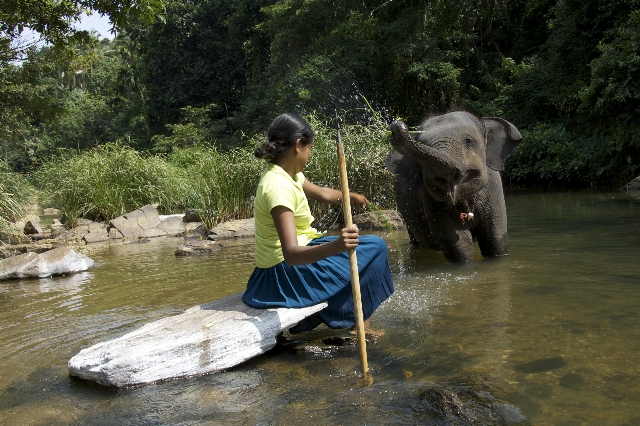
Chandani Ratnayake with Kandula: She wants to become Sri Lanka's ambassador to elephants...

This film review has just appeared in The Nation newspaper, Sri Lanka, and can be accessed online at http://www.nation.lk/2011/10/16/eyefea6.htm

Years ago, I resolved not to watch any more documentaries about elephants – I have sat through far more than my fair share of them at film festivals across Asia and Europe. I have nothing against elephants; it’s just that most films about them are so predictably formulaic. Sooner or later, they all suggest: we greedy humans have robbed these giants of their jungles, and are now driving them to extinction.

While that is undeniable, the ground reality is a bit more nuanced. But few filmmakers or film commissioners want to go there. In any case, even the most balanced conservation film would still be trapped in an anthropocentric view of the human-elephant relationship: how differently might an elephant tell the same story?

Given these misgivings, I was pleasantly surprised by Arne Birkenstock’s new film, Chandani: The Daughter of the Elephant Whisperer (88 mins, 2010). He proves that it is always possible to find a refreshingly new way of telling a very old story.

The German film, shot entirely on location in Sri Lanka, centres around a young girl who loves elephants so much that she wants to spend the rest of her life tending to them. Sixteen-year-old Chandani Renuka Ratnayake is the eldest daughter Sumanabanda, the chief mahout at the elephant orphanage in Pinnawela. They hail from a family that has tamed and looked after elephants for generations. Lacking a son, he agrees to let Chandani train as a mahout.

There is only one small problem: Chandani is going where no Lankan woman has gone before. Other mahouts and the community doubt whether the eager young lass can rise to the many challenges involved in this hitherto male-only profession.

Sumanabanda brings home an elephant calf named Kandula, and assigns it to Chandani. Under the watchful eye of her father, Chandani does all the feeding, bathing and other chores. She has to divide her time between school and her boisterous charge. Soon, the two young ones bond with each other.

She also receives guidance from a wildlife ranger named Mohammed Raheem. He takes her to the Udawalawe National Park, an important habitat for wild elephants. There, she gets glimpses of the daily skirmish between wild elephants and humans for the land claimed by both species.

Exploring the relationship between children and elephants is a recurrent theme for filmmakers across cultures and genres. An early example was Elephant Boy (1937), a British adventure film directed by documentary filmmaker Robert J. Flaherty and Zoltan Korda, based on Rudyard Kipling’s “Toomai, of the Elephants”. A few years ago I watched the Japanese film Hoshi ni natta shonen — with a goofy English name, Shining Boy and Little Randy — directed by Shunsaku Kawake in 2005. It was the bittersweet story of a young boy who goes to Thailand to become Japan’s first elephant trainer.

The child character is usually male, possibly influenced by Mowgli of Jungle Book fame. But here, Chandani is playing herself: she has grown up watching the complexities of ex-situ conservation of the largest land mammal.

The elephant orphanage, set up on a 10-hectare coconut estate in 1975 to look after young elephants whose mothers have been killed — often in violent confrontations with villagers — is now home to nearly a hundred elephants. A captive breeding programme, introduced in 1982, has resulted in several live births.

Pinnawela continues a long tradition — going back to over 3,000 years — where elephants are captured, tamed and trained in Sri Lanka. Jayantha Jayewardene, an expert on Asian elephants, says the elephant, although tamed and trained, is not quite a domesticated animal in the same sense that dogs are.

As he explains in his book, The Elephant in Sri Lanka: “It (the elephant) is an immensely powerful animal whose strength and wild nature calls for caution in handling it, especially during capture and the initial training stages. Later on, using less than a dozen words of command, the handler, called a mahout, is able to exercise control over this powerful animal. In most instances, the elephant and mahout develop a strong and lasting bond.”

After months of training, Chandani faces her moment of truth. She has to accompany Kandula in the local perahera, the procession that tours the streets with decoratively dressed elephants as star attractions. Peraheras are noisy, crowded and sometimes chaotic affairs: participating elephants and mahouts need focus and coordination.

The young girl and elephant prove their mettle. If Chandani’s family and peers are impressed by that public performance, the indifferent state is not. Sumanabanda is belatedly informed that he is not legally allowed to raise an elephant at home (even if he paid ‘good money’ for the creature). Eventually, he and his daughter agree that it is best for Kandula to return to the jungle. Their emotional attachment is strong by now, making separation painful. As Chandani watches Kandula being taken away, she reflects on her chosen future…

Relaxed Drama

The film is labeled as a documentary, but there is considerable movement, tension and other emotions that lend it a dramatic quality. Evidently, many sequences have been scripted. We don’t know how much time and effort that entailed. It probably helped that Chandani and Sumanabanda seem ease-going people. The director has managed to get even the (usually stiff) government officials to relax for the camera.

By staying tightly focused on his characters, Birkenstock avoids a common pitfall in many elephant films that either eulogise pachyderms or editorialise too heavily about their predicament. He blends striking images with an evocative soundtrack to tell a compelling story that is informed by real world issues — but not deep immersed in them.

This mix is welcome indeed. In 2000, when I served on the global jury of Wildscreen, the world’s leading wildlife and natural history film festival in Bristol, UK, we told filmmakers that simply documenting animal and plant behaviour and their habitats was no longer adequate in a world facing a multitude of environmental crises. There was an urgent need, our jury statement said, for films that explored the nexus between the natural environment and human society — both the conflict and harmony between the two.

Chandani and Kandula the elephant

Forming the backdrop to Chandani are the tough choices confronting biodiversity conservation in Sri Lanka. The wildlife ranger Mohammed, in particular, brings in both specialised knowledge and official perspective — mercifully without any activist shrill. Hard core environmentalists might not find this film ‘green enough’. For mass audiences worldwide, however, it conveys a very important message: how some ordinary Lankans are doing their bit for inter-species harmony against many odds.

That is no small accomplishment on our crowded island which has the world’s highest density of wild Asian Elephants. The first-ever nationwide elephant census in August 2011 produced a total of 7,379 jumbos across the island: 5,879 of them were spotted near parks and sanctuaries, while another 1,500 were estimated to be living in other areas. Some environmentalists were unhappy with the methodology and questioned its results. But even imperfect data can inspire more systematic conservation measures.

Sooner or later, we have to answer the hard question: how many wild elephants can the island’s remaining forests realistically sustain? This has already sparked off heated arguments. In the long-term, the survival of the Lankan Elephant might be assured only though captive breeding.

Meanwhile, every year, a few dozen elephants and humans perish in increasingly violent encounters over land and food. As we search for lasting solutions, we need more Chandanis, Mohammeds and Sumanabandas to show us the way.

Science writer Nalaka Gunawardene is far more interested in wild-life in urban jungles than wildlife in natural ones.

Chandani and Kandula pass a very public test!

සිවුමංසල කොලූගැටයා #36: ස්ටීව් ජොබ්ස් – අසම්මතය සුන්දර කළ ‘විකාරකාරයා’

We might admire – even revere – genius mavericks like Steve Jobs from afar, but few Asians have any idea where mavericks come from, or how best to deal with them. Our conformist and hierarchical societies don’t nurture mavericks. Our cultures tend to suppress odd-balls and iconoclasts. That’s probably why we don’t have enough of our own Steve Jobses.

This is the crux of my argument in my latest Sinhala column published in Ravaya newspaper on 16 Oct 2011. For a longer discussion of the same topic, see my English essay Goodbye, Steve Jobs; Long Live Mavericks!

පසුගිය වසර 35ක කාලය තුළ ඇපල් පරිගණක හා විද්යුත් උපකරණ නූතන තොරතුරු සමාජයේ ප්‍රගමනයේ පෙරගමන්කරුවන් ලෙස ක්‍රියා කළ බව ලෝකය ම පිළිගන්නවා. මේ නව ලොව තනන්නට මහත් සේ දායක වුණු ඇපල් සමාරම්භක ස්ටීවන් පෝල් ජොබ්ස් හෙවත් ස්ටීව් ජොබ්ස් (Steve Jobs) 2011 ඔක්තෝබර් 5 වනදා මිය ගිය විට ලෝකය ම කම්පාවට පත්වුණා. පිලිකාවක් සමග වසර ගණනක් පොර බැදීමෙන් ඔහු අන්තිමට පරාජය වන විට වයස අවුරුදු 56යි.

සරසවි ඉගෙනුම වෙනුවට තමන්ගේ ම නිර්මාණශීලී අදහස් ඔස්සේ දැඩි අධිෂ්ඨානයෙන් ඉදිරියට ගිය ස්ටීව් ජොබ්ස්, තොරතුරු තාක‍ෂණය, පාරිභෝගික විද්‍යුත් උපකරණ හා ජනප්‍රිය සංස්කෘතිය යන ෙක‍ෂත්‍ර තුනෙහි ම දැවැන්තයකු වූ බව ඔහුගේ ව්‍යාපාරික තර`ගකරුවන් පවා එක හෙළා පිළිගත්තා. අසම්මතය, පරිකල්පනය හා සුන්දරත්වය කැටි කළ ස්ටී්ව් ජොබ්ස් කථාවේ එක් පැතිකඩක් ගැන අපි අද කථා කරමු. එහි යටි අරමුණ අපේ රටවලත් ස්ටීව් ජොබ්ස්ලා බිහි විය හැකිද යන්න විග්‍රහ කිරීමයි.

1997දී ඇපල් සමාගම අපූරු ප්‍රචාරණ ව්‍යාපාරයක් හදුන්වා දුන්නා. තමන් තවත් එක් පරිගණක නිෂ්පාදන සමාගමක් නොවන බව හුවා දැක්වීම ඉලක්ක කර ගත් ඒ දැන්වීම් පෙළේ මුඛ්‍ය තේමාව වූයේ වෙනස් විධියට සිතන්න (Think Different) යන්නයි. එහි වඩාත් ම සිත් ඇද ගන්නා අංගය වූයේ තත්පර 30 හා 60 යන ධාවන කාලයන්ට නිර්මාණය වූ ටෙලිවිෂන් දැන්වීමක්. ඉතිහාසය පුරා විවිධ ෙක‍ෂත්‍රයන්ගේ විපර්යාස ඇති කරන්නට දායක වුණු චරිත 17ක රූප ඉතා ඉක්මනින් තිරයේ දිස් වුණා. තනිකර කළු-සුදු වර්ණයෙන් නිර්මිත එයට මහත්මා ගාන්ධි, ඇල්බට් අයින්ස්ටයින්, තෝමස් අල්වා එඩිසන් හා අමීලියා ඉයර්හාට් වැනි චරිත මෙන් ම බීට්ල්ස් ගායක ජෝන් ලෙනන්, පබ්ලෝ පිකාසෝ හා මොහමඩ් අලි වැනි විවිධ ෙක‍ෂත්‍රවල දැවැන්තයන් ද ඇතුළත් වුණා. මේ හැම දෙනා ම සම්මතයට එරෙහිව ගිය නිදහස් මතධාරීන් හෙවත් මැව්රික්ස් (mavericks) හැටියට පිළි ගැනෙනවා.

ඒ දැන්වීමේ කථනය සාරාංශයක් ලෙස කිවහොත්: ‍”මෙන්න විකාරකාරයෝ. විප්ලවවාදියෝ. කරදරකාරයෝ. හැම දෙයක් ම වෙනස් විධියට දකින මේ අය පිස්සන් කියා බොහෝ දෙනකු සිතුවා. එහෙත් අප ඔවුන් දකින්නේ මහ මොළකාරයන් හැටියටයි. ඉතිහාසය පුරා ම අපේ ලෝකය වෙනස් කළේ මෙවැනි අසම්මත විකාරකාරයන් තමයි.” ඒ දැන්වීම YouTube හරහා නරඹන්න: http://tiny.cc/ThinkD

ඒ දැන්වීමේ කිසි තැනෙක පරිගණකයක් දිස් වූයේ නැහැ. එහි අරමුණ වූයේ සංකල්පමය වශයෙන් ඇපල් සමාගම අනෙකුත් සියළු පරිගණක හා තොරතුරු තාක‍ෂණ සමාගම්වලට වඩා වෙනස් බව කියා පෑම පමණයි. එය ප්‍රචාරය වීම අරඹන කාලයේ ඇපල් සමාගමට තිබූ වෙළදපොල ඉතා සීමිතයි. එවකට අලෙවියෙන් හා ලාබයෙන් කුඩා වූවත් මේ අසම්මත සමාගම විකාරකාරයන්ගේ මගෙහි යන පෙරළිකාරයෙක් වීමේ පෙරනිමිති පළ කළා.
1997 දී ලෝකයට දුන් ඒ ප්‍රතිඥාව දශකයක් ඇතුළත ඉතා මැනවින් ක්‍රියාවට නැංවීමට ස්ටීව් ජොබ්ස් දිවා රෑ වෙහෙසී වැඩ කළා. iMac පරිගණකය (1998), iPod ජංගම සංගීත/මාධ්‍ය උපකරණය (2001), iTunes නම් වූ සයිබර් අවකාශයේ මහා සල්පිල (2003) iPhone ජංගම දුරකථනය (2007) හා iPad ජංගම ටැබ්ලටය (2010) ඔහු ආ අසම්මත මගෙහි අමතක නොවන පියසටහන්. කලක් සාපේක‍ෂව කුඩා පරිගණක හා විද්්‍යුත් උපකරණ සමාගමක් හැටියට පැවතුණු ඇපල් සමාගම 2010 වන විට Microsoft, IBM ඇතුළු අනෙකුත් සියළු තාක‍ෂණ සමාගම් අභිබවා ගියා.

ජොබ්ස්ගේ තාක‍ෂණ, සැළසුම් (design) හා අලෙවිකරණ කුසලතා ගැන පසුගිය දිනවල බොහෝ සෙයින් කථාබහ කෙරුණා. ඒ තොරතුරු යළිත් කීම මගේ අරමුණ නොවෙයි. නව නිපැයුම් සදහා පේටන්ට් 338ක් ඔහුට තිබුණා. එහෙත් ඔහුට වඩා පේටන්ට් ලබාගත් තව බොහෝ නිර්මාපකයන් සිටිනවා. (උදාහරණ: තෝමස් අල්වා එඩිසන් 1,093යි. පෝලරොයිඩ් කැමරාව තැනූ එඩ්වින් ලෑන්ඩ් 525යි.) කුඩා පරිමාණයේ නව නිපැයුම් විශාල ගණනක් බිහිකරනවා වෙනුවට ජොබ්ස් වැඩි අවධානය යොමු කළේ සමස්ත කර්මාන්තයක් හෝ ෙක‍ෂ්ත්‍රයක් ම විප්ලවයකට ලක් කරන ආකාරයේ වැඩ කරන්නයි. පුද්ගල පරිගණකය, ජංගම සංගීත/මාධ්‍ය උපකරණය, ජංගම දුරකථනය වැනි කිසිවක් මුල්වරට නිපදවූයේ ස්ටීව් ජොබ්ස් නොවේ. එහෙත් ඔහු කළේ පවත්නා තාක‍ෂණය උඩුකුරු වන මට්ටමේ ප්‍රබල දියුණු කිරීම් ඇති කිරීමයි. මේ සුවිශේෂී ගුණය නිසා ඔහු අපේ කාලයේ සිටි දක‍ෂතම තාක‍ෂණික ප්‍රතිනිර්මාපකයා (technology’s great re-inventor) හැටියට ටයිම් සගරාව හදුන්වා දෙනවා. එය ජොබ්ස්ගේ අසම්මත කථාව ගැන කළ හැකි හොද සම්පිණ්ඩනයක්.

බොහෝ නිපැයුම්කරුවන්ගේ කුසලතාවය හා දැක්ම පටු පරාසයකට සීමා වන නමුත් ජොබ්ස් පුළුල් දැක්මකින් යුක්තව ක්‍රමීය වෙනස්කම්වලට (systemic changes) යොමු වූ කෙනෙක්. එබදු වෙනස්කම් සදහා තාක‍ෂණය, සෞන්දර්යාත්මක සැළසුම (aesthetic design) අලෙවිකරණය (marketing) හා හොද සන්නිවේදනය යන සතරවිධ හැකියාවන් ඔහුට නොඅඩුව තිබුණා.

ස්ටීව් ජොබ්ස් තුළ මේ සංකල්ප බිහි වූයේ කෙලෙස ද? අමෙරිකාවේ වඩාත් ලිහිල් සමාජ පසුබිමක් පවතින බටහිර වෙරළේ කැලිෆෝනියාවේ ඉපදි හැදී වැඩීම ද? සහජ හැකියාවන් තියුණු කර ගනිමින් වෙහෙස මහන්සි වී වැඩ කිරීම තුළින් ඕනෑ ම කෙනකුට හිස එසවීමට ඉඩක් තිඛෙන සමානාත්මක :ැට්කසඒරස්බ- අමෙරිකානු සමාජ ක්‍රමය ද? 1960-70 දශකයන්වල බටහිර රටවල තරුණ තරුණියන් බොහෝ දෙනාට බලපෑමක් ඇති කළ හිපි සංස්කෘතිය ද? (තරුණ වියේ ඉන්දියාවට පැමිණ ආශ්‍රමයන්හි කල් ගත කළ ඔහු පෙරදිග දර්ශනයන් — විශේෂයෙන්ම ටිඛෙට් හා ජපන් සම්ප්‍රදායයන් — ගැන උනන්දු වූවා.) එසේ නැතිනම් මේ සියළු සාධකයන් මිශ්‍ර වීමේ අවසාන ප්‍රතිඵලය ද?

මේ ප්‍රශ්නවලට එක එල්ලේ පිළිතුරු දෙන්න අමාරුයි. නිර්මාණශීලිබව (creativity) පැන නගින්නේ මිනිස් මනසේ කොතැනින් ද, එයට රුකුල් දෙන අධ්‍යාපනික, සමාජයීය හා සාංස්කෘතික බලපෑම් මොනවා ද යන්න මානව විද්‍යාඥයන් හා සමාජ විද්‍යාඥයන් මහත් ඕනෑකමින් අධ්‍යයනය කරනවා. එවන් පර්යේෂකයන්ට ස්ටීව් ජොබ්ස් චරිතය ඉතා ප්‍රයෝජනවත්.

ඔහුගේ අසම්මත ජීවන කථාව ආසියාවේ අපට වැදගත් වන තව හේතුවක් තිඛෙනවා. ජන සමාජයන් සමස්තයක් වශයෙන් ගෙන සසදන විට ගණිතය, ඉංජිනේරු විද්‍යාව හා තාක‍ෂණයට සම්බන්ධ කි්‍රයාවලදී ආසියානුවන් ලෝකයේ වෙනත් බොහෝ ජාතීන්ට වඩා ඉදිරියෙන් සිටිනවා. 1950-2010 කාලය තුළ ලෝකයේ වැඩි ම ආර්ථීක වර්ධන වේගය පවත්වා ගන්නට ආසියානු කලාපයට හැකි වූයේ තාක‍ෂණ ෙක‍ෂත්‍රයන්හි නව නිපැයුම්, ආයෝජන හා හපන්කම් නිසායි. ජපානය, චීනය, කොරියාව හා ඉන්දියාව වැනි රටවල් අද විද්‍යාව හා තාක‍ෂණය අතින් ලෝකයේ පෙරමුණ ගෙන සිටිනවා. පර්යේෂණ නිබන්ධන, පේටන්ට් බලපත්‍ර ආදී නිර්නායක හරහා මේ ප්‍රවණතා මැනිය හැකියි.

එසේ වූවත් තාක‍ෂණ ෙක‍ෂත්‍රයේ ආසියානුවන්ගේ හපන්කම් බහුතරයක් සාමූහික ප්‍රයත්නයන්. අද ලොව සංකීර්ණ අවශ්‍යතාවලට නිපැයුම්කරුවන්ට තනිව ම මුහුණදීම අපහසු බව ඇත්ත. එහෙත් ලොව ජය ගත් පාරිභෝගික තාක‍ෂණයන් විශාල සංඛ්‍යාවකට මුල් වූ ජපානයේ Sony කොරියාවේ Samsung වැනි සමාගම් අප හදුනන්නේ වෙළද නාමයෙන් (brands) පමණයි. නිපැයුම්කරුවන්ගේ නමක් අප දන්නේ නැහැ. මේ රටවල සංචාරය කරන විට මට පෙනී ගිය දෙයක් නම් ඒ රටවල සාමාන්‍ය ජනයා පවා සිය නිපැයුම්කරුවන් ගැන දන්නේ ඉතා අඩුවෙන් බවයි. මෙයට හේතුව තොරතුරු ගලනයේ දුර්වලතා ද? නැතිනම් බටහිර රටවල තරම් තනි පුද්ගල මට්ටමේ නව නිපැයුම්කරුවන් ආසියාවේ මතු නොවීම ද?

මෙය මතු පිටින් විග්‍රහ කොට නිගමනවලට එළඹිය හැකි සරල ප්‍රශ්නයක් නොවේ. එහෙත් පෙරදිග අපේ රටවල අසම්මත මගක යන නිදහස් මතධාරීන්ට එරෙහි වන සමාජයීය හා සාංස්කෘතික සාධක තිඛෙන බව පිළි ගත යුතුයි. (මෙහිදී මා කථා කරන්නේ පොදුවේ ආසියානු ජන සමාජයන් ගැනයි.) ආසියාවේ බොහෝ සමාජයන්ගේ දරදඩු සමාජ මට්ටම් හා ධූරානුක්‍රම (hierarchies) තිඛෙනවා. ඒවා වත්කම, උගත්කම ආදී සාධකවලින් තවත් තීව්‍ර වනවා. සමාජ පසුබිමින් එක හා සමාන අය අතර වයස්ගත වූවන්ගේ මතයට වැඩි පිළිගැනීමක් ලැඛෙනවා. ගුරුකුල බිහි වීමේ අන්තරායක් තිඛෙනවා.

මේ සියල්ල නිසා අමුතු විදියට සිතන, සම්මතයට අභියෝග කරන නිදහස් මතධාරීන්ට ආසියානු සමාජවල ඇති අවකාශය ඉතා අඩුයි. හැම කෙනෙකු ම එක හා සමාන රේඛීය ජීවන මගක ගමන් ගත යුතු බවත්, එසේ නොගොස් ‘අයාලේ යන’ අය පිස්සන්, විකාරකාරයන් හෝ සමාජ විරෝධීන් වන බවත් මුල් බැස ගත් මතයක්. මෙබදු වාතාවරණයක අළුත් දෙයක් හිතන, කියන හා අත්හදා බලන දරුවන් හා තරුණ තරුණියන් ඔවුන්ගේ පවුල්වලින්, පාසලෙන්, සරසවියෙන් හා ජන සමාජයේ අන් අයගෙන් දැඩි පීඩනයකට ලක් වනවා. මෙය මගේ මතවාදයක් පමණක් නොවෙයි. ඉතා සරල උදාහරණයක් ගත හොත් උපතින් ම වමත්කරුවන් වන අයට ලාංකික සමාජය දක්වන ප්‍රතිචාරය ගැන මදක් සිතන්න!

මේ ගැන ශාස්ත්‍රීයව ගවේෂණය නොකළත්, අදාල අත්දැකීම් රාශියක් සොයා ගැනීමේ අවස්ථාවක් 2009-10 කාලයේ මට ලැබුණා. සියත TV හරහා නව නිපැයුම්කරුවන් හදුන්වා දෙන සතිපතා වැඩසටහන් මාලාවක් මා ඉදිරිපත් කළා. දෙස් විදෙස් සම්මාන ලද නව නිපැයුම්කරුවන් සැළකිය යුතු සංඛ්‍යාවක් සමග මා සම්මුඛ සාකච්ඡා කළා. එහිදී මා නිතර ඇසූ ප්‍රශ්නයක් වූයේ කුඩා කාලයේ අළුත් දෙයක් කරන්නට ලැබුණු උපකාර, උපදෙස් මෙන් ම බාධක මොනවා ද යන්නයි.

නව නිපැයුම්කරුවන්ගෙන් බහුතරයකට තම පවුලෙන්, අසල්වාසීන්ගෙන් බහුතරයකට තම පවුලෙන්, අසල්වාසීන්ගෙන් හෝ පාසලෙන් ලැබී ඇත්තේ දිරිගැන්වීම් නොවෙයි – උදාසීන හෝ අයහපත් ප්‍රතිචාරයක්. අසම්මත දේ කරන්නට ගොස් විභාග අසමත් වී අනාගතය අදුරු කර නොගන්නා ලෙස ඔවුන්ට අවවාද ලැබී තිඛෙනවා. එදිනෙදා ජීවිකාවක් සදහා ශිල්ප ඉගෙනීමෙන් ඔබ්බට ලෝකය වෙනස් කරන්නට සිතීම නිශ්චල ‘දැගලිල්ලක්’ බව වැඩිහිටියන් ඔවුන්ගේ මුහුණට ම කියා තිඛෙනවා.

නිතිපතා එල්ල වන මේ පීඩනය නොතකා ඒකායන අරමුණින් ‘දඩබ්බර’ විදියට ඉදිරියට යන ටික දෙනකු තමයි අවසානයේ නව නිපැයුම් බිහි කරන්නේ. එය ද එක් රැයකින් කළ හැක්කක් නොවෙයි. එහෙත් නොසැළුණු අය අතර තව කී දෙනෙක් තමන්ගේ සිහින අත්හැර දමන්නට ඇත් ද? › ලංකාවේ නව නිපැයුම්කරුවන් අතර කාන්තා නියෝජනය ඉතා අඩු ඇයි?

අපේ නව නිපැයුම්කරුවන් මුහුණ දෙන ආර්ථීක, තාක‍ෂණික බාධකයන් රැසක් ද තිඛෙනවා. ඒවා දැනටමත් හදුනා ගෙන ඇති අතර ඒ බාධක දුරුකිරීමට යම් පියවර ගන්නා බව නිපැයුම්කරුවන්ගේ කොමිසමේ වත්මන් ප්‍රධානියා මෑතදී මට කියා සිටියා. එහෙත් තනි රාජ්‍ය ආයතනයකට හෝ අධ්‍යාපන/පුහුණු ආයතනයකට හෝ නව නිපැයුම්කරුවන් බිහි කිරීමට නොහැකියි. එය සමාජ ප්‍රවාහයන් ගණනාවක අවසන් ප්‍රතිඵලයක්.

බොහෝ ආසියානුවන්ට මෙන්ම ලාංකිකයන්ට ද තාක‍ෂණ ෙක‍ෂත්‍රයේ සහජ හැකියාවක් තිඛෙනවා. එහෙත් ඒ විභවය දැගලිල්ලක්, දඩබ්බරකමක් හරහා අළුත් සංකල්පයක් හෝ නිපැයුමක් හෝ බවට පත් වන්නට පියවර ගණනාවක් පසු කළ යුතුයි. ස්ටීව් ජොබ්ස්ලා අපේ රටවල බිහි නොවන්නේ පහසුකම් හා ආයෝජන නැති නිසා පමණක් නොවෙයි. අසම්මතයට සිතන ‘විකාරකාරයන්ට’ අපේ සමාජවල ඉඩක් නොදෙන නිසා යයි මා තර්ක කරනවා. මා එසේ කියන්නේ අසම්මත මගක නිර්මාණශීලීව ගමන් කළ කෙනකු හැටියට මගේ අත්දැකීම් ද පාදක කර ගනිමින්.

Cooling without warming: Cool Biz for a safer future?

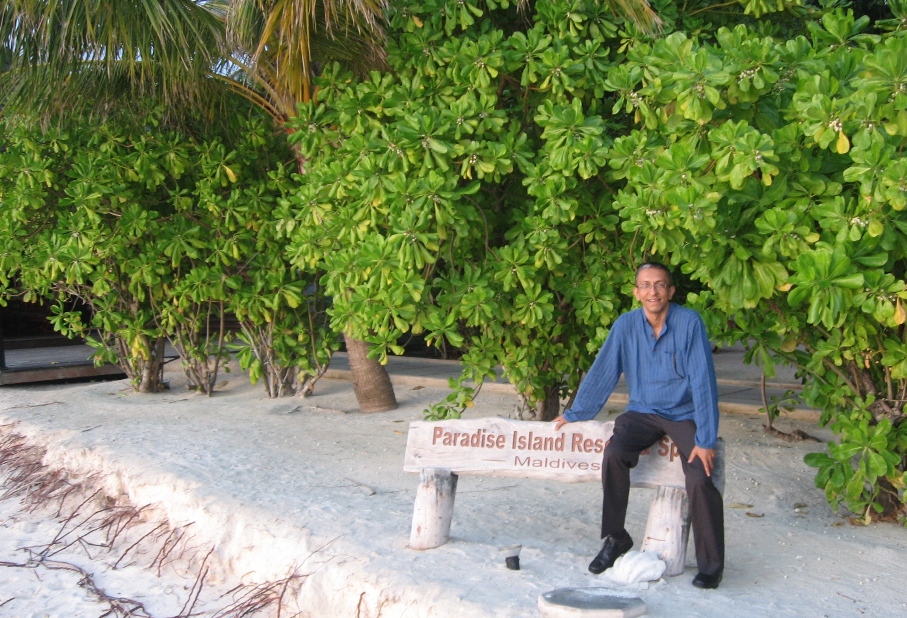
Image courtesy - Paradise Island Resort, Maldives
Paradise, The Maldives. 10 May 2011

I’m sitting in Paradise – and freezing. This isn’t quite what I imagined it to be.

Well, actually I’m attending a serious inter-governmental meeting being held at the Paradise Island Resort and Spa in the Maldives.

The setting is exotic enough – I’m near some of the finest beaches and bluest seas in the world. It’s a cloudy day outside, with tropical sunshine interrupted by occasional showers. We’re just a few hundred kilometres north of the Equator.

But it’s whole different world inside the meeting room. We have no windows and are visually cut off from the scenery. And the air conditioning is too strong. Even the 50 or so people inside the room don’t emit enough body heat to counter the chill spilling out from the ceiling.

Paradise (resort) isn’t alone. Across tropical Asia, our public offices, hotels and shopping malls just love to freeze us out.

This habit has a particular irony at this meeting. Convened by the UN Environment Programme (UNEP), it’s discussing how to stay cool without killing the planet.

To be precise, how air conditioning and refrigeration industries can continue their business – and keep cooling people and goods – without damaging the ozone layer or warming the planet.

It’s the semi-annual meeting of government officials from across Asia who help implement the Montreal Protocol to control and phase out several dozen industrial chemicals that damage the ozone layer in the upper atmosphere.

A nitpicker in Paradise? Photo by Darryl D'Monte

Adopted in 1987 and now ratified by 196 countries, it is the world’s most successful environmental treaty. It has reversed a catastrophic loss of ozone high up in the Earth’s atmosphere, and prevented tens of thousands of cases of skin cancer and cataract.

A landmark was reached at the end of 2009, when it succeeded in totally phasing out the production and use of chlorofluorocarbons (CFCs) — chemicals that had helped the cooling industries for decades. Now, a bigger challenge remains: removing two other widely used gases known as HCFCs and HFCs.

Both were originally promoted as substitutes for CFCs in the early days of the Protocol. HCFCs are less ozone-damaging than CFCs, while HFCs are fully ozone-safe. However, both have a high global warming potential — up to 1,700 times that of Carbon dioxide — and therefore contribute to climate change.

It was only a few years ago that scientists and officials realized that there was little point in fixing one atmospheric problem if it aggravated another. So in 2007, the Montreal Protocol countries agreed to address the climate impacts of their work.

The Montreal Protocol now encourages the countries to promote the selection of alternatives to HCFCs that minimize environmental impacts, in particular impacts on climate change.

The air conditioning and refrigeration industries are being encouraged to switch from HCFC to substitutes ahead of the global phase-out deadline of 2030. Alternatives — including natural refrigerants such as ammonia, carbon dioxide, hydrocarbons — are entering the market for many applications.

Parallel to this, consumers are being encouraged to opt for newer appliances that are both ozone-safe and climate friendly.

It takes time and effort for this message to spread and take hold. Many users — especially in the developing countries — only consider the purchase price of appliances and not necessarily the long-term energy savings or planetary benefits.

Events like the first Asian Ozone2Climate Roadshow, held in the Maldivian capital Malé from 8 to 12 May 2011, are pushing for this clarity and awareness. It’s still an uphill task: too many people have to be won over on too many appliances using a wide range of chemicals and processes.

And sitting here at my freezing corner of Paradise, I feel we should add another message: conserving energy includes a more rational and sensible use of air conditioning.

Perhaps we should promote and adopt the Japanese practice of Cool Biz.

Introduced by the Japanese Ministry of Environment in the summer of 2005, the idea behind Cool Biz was simple: ensure the thermostat in all air conditioners stayed fixed at 28 degrees Centigrade.

CoolBiz Logo
That’s not exactly a very cool temperature (and certainly no freezing), but not unbearable either.

The Cool Biz dress code advised office workers to starch collars “so they stand up and to wear trousers made from materials that breathe and absorb moisture”. They were encouraged to wear short-sleeved shirts without jackets or ties.

A Cool Koizumi: Leading from the front...
Then Prime Minister Junichiro Koizumi himself set the tone, wearing informal attire. But then, he was already known for his unorthodox style.

Clothes designers and retailers chipped in, with clothes offering greater comfort at higher temperatures.

Cool Biz changed the Japanese work environment – and fast. I remember walking into a meeting at a government office in Tokyo a few weeks after the idea had been introduced, and finding I was the most formally dressed.

The Japanese like to count things. When the first season of Cool Biz ended, they calculated the countrywide campaign to have saved at least 460,000 tons of Carbon dioxide emissions (by avoided electricity use). That’s about the same emissions from a million Japanese households for a month.

The following year, an even more aggressive Cool Biz campaign helped save an estimated 1.14 million tons of Carbon dioxide – or two and half times more than in the first year.

The idea also traveled beyond Japan. In 2006, the South Korean Ministry of Environment and the British Trade Union Congress both endorsed the idea.

This summer, the seventh since Cool Biz started, there is an added reason for the Japanese to conserve energy. As the Asahi Shimbun reported on 28 April 2011: “In what has been dubbed the ‘power-conserving biz’ campaign, many companies plan to conserve energy during the peak summer period in light of expected power shortages caused by the crisis at the Fukushima No. 1 nuclear power plant.”

Meanwhile, the rest of us freeze-happy tropical Asians can evolve our own Cool Biz practices – we don’t need to wait for governments and industry to launch organized campaigns.

For a start, we – as consumers or patrons – can urge those who maintain public-access buildings to observe voluntary upper limits of cooling. Sensitive thermostats can automatically adjust air conditioner operations when temperatures rise above a pre-determined comfortable level.

It all depends on how many of us pause to think. Of course, we can also continue business as usual – and freeze ourselves today for a warmer tomorrow.

The sun sets in Paradise too - photo by Nalaka Gunawardene

Wiz Quiz 10: Japan’s struggle with the four elements

Image courtesy Vision Magazine
Earth, water, fire and air.

These are the four basic elements of matter as seen in ancient Greek, Hindu and other traditions. Each had different names for them, but the concepts were similar.

And in recent days, Japan has been experiencing multiple disasters involving all these elements.

It started with the 9.0-magnitude megathrust earthquake off the coast of Japan that occurred at 2.46 pm Japan time on 11 March 2011. Its epicentre was 130 kilometres off the east coast of the Oshika Peninsula of Tohoku, near Sendai. The earthquake triggered highly destructive tsunami waves of up to 10 meters (33 ft) that struck nearby coastal areas minutes after the quake, and in some cases travelled up to 10 km (6 miles) inland. The earthquake and tsunami waves killed over 5,000 people, caused massive property damage and started fires in some affected locations. Most worrying was the damage caused to the Fukushima II nuclear power plant where reactors damaged by the quake and tsunami led to an accidental leak of radioactivity.

Japan has a long history of living and coping with disasters, but the magnitude and confluence of multiple disasters has plunged the country into the worst crisis since the Second World War. This week’s Wiz Quiz devotes several questions to the history and science of tsunamis.

As it turns out, thanks to Japan’s strict building codes and preparedness, the country could absorb much of the powerful earthquake. But the massive tsunami is what caused most of the damage — there is little defence against the mighty waves that come roaring inland, wiping out everything in their path…

Read Wiz Quiz 10: Japan’s struggle with four elements

Grace under pressure: Japan faces tough test from 3/11 disasters – quake, tsunami, meltdown…

Cartoon by Geneva-based Patrick Chappatte, who works for International Herald and Le Temps

Since Friday March 11 afternoon, I’ve been watching the unfolding humanitarian tragedy in Japan caused by multiple disasters — 8.9 earthquake, tsunami, dam burst, fires, and now the meltdown of three nuclear reactors.

Our heart-felt sympathy goes out to all Japanese people, among whom I count many friends. No nation deserves to be battered simultaneously like this by natural and (partly) man-made calamities.

Yet, few nations are better prepared and equipped to deal with such crises. Japan may be reeling right now, but things could have been far worse if not for their readiness to face emergencies both at individual and institutional levels.

Amidst scenes of utter destruction and dislocation, the Japanese people were reacting with the stoic calm for which Japan is famous. “What’s amazing is that everyone I saw — cops on their white bicycles, boys reading comics in alleys, kids walking home with their parents — appeared graceful under this unexpected disaster,” Tokyo resident Irie Otoko wrote to The New York Times.

But make no mistake: this is a big one as disasters come. The death toll is feared to exceed 10,000, and the property damage alone is likely to be tens of billions of dollars. The societal, economic and emotional costs are hard to quantify at this early stage.

It was only a couple of weeks ago that I was walking the streets of Tokyo, enjoying the calm and orderly life in the modern Roppongi and the old world charm of Kagurazaka. But once again, Planet Earth has reminded us who is in charge.

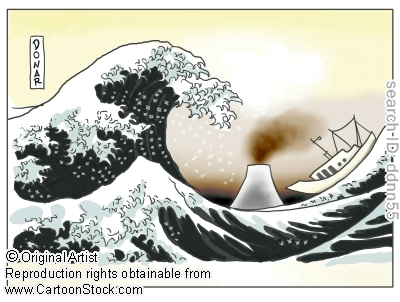
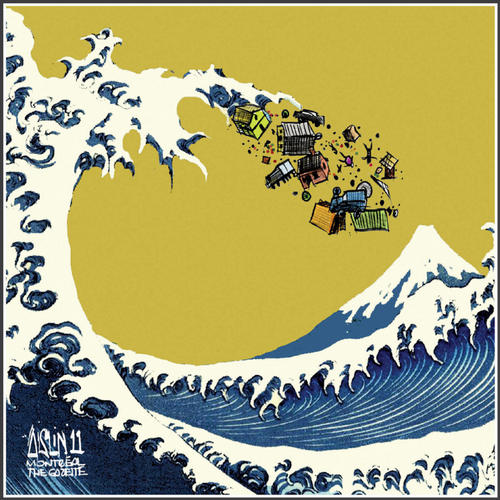
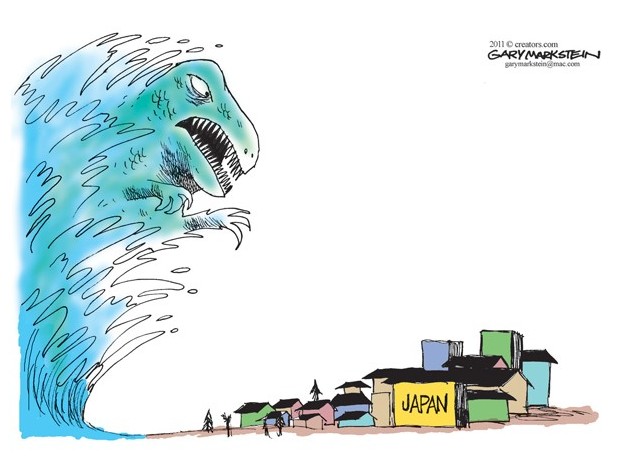
And cartoonists are capturing the planetary sentiment with their usual economy of words.

Cartoon by Terry Mosher, The Star, Toronoto, Canada
Cartoon by Gary Markstein, Copyright 2011 Creators Syndicate
Courtesy: Cartoon Movement

Imelda Abano: Asia’s Development Journalist of the Year 2009

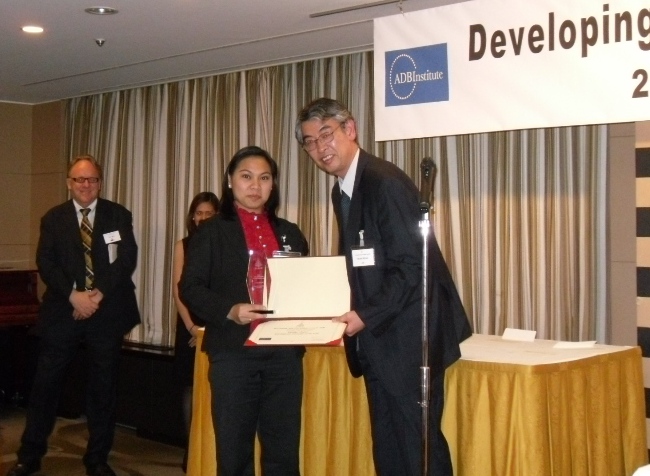
Imelda Abano receives her award in Tokyo, Oct 23

I was delighted to hear the news that Filipino science and environmental journalist Imelda Abano has just won the Developing Asia Journalism Awards (DAJA) for 2009.

“We are all winners,” said Imelda at the Awards ceremony organized by the Asian Development Bank Institute (ADBI) at the Foreign Correspondents’ Club of Japan. “We should continue writing compelling stories to make a difference.”

Imelda Abano, whom I have known and admired for several years, won one of two special awards for her story titled “Scorched Earth”, published on 19 May 2009, in the Business Mirror newspaper in the Philippines.

“Among all the articles, the judges were very impressed with the way Abaño’s article presented the
complex issues on climate change. It was a comprehensive and extra-ordinary piece that was made simple for the readers to understand,” said Monzurul Huq, one of the four judges and the president of the Foreign Correspondents’ Club of Japan.

“We judges were each very impressed by the overall high quality of entries for this year. The awards were meant to recognize the efforts made by Asian and Pacific journalists who provide high-quality coverage of issues affecting growth and development in developing countries,” said Anthony Rowley, presiding judge of the 2009 ADBI awards.

Imelda Abano was honored last year by the United Nations as the Gold Prize Winner for excellence in reporting on humanitarian and development affairs. She was also this year’s recipient of the 10 Young Leaders Award in the Philippines given out by the Philippines Graphic magazine for her reporting on development and environmental issues. In 2002, she won the Asian category of the Global Awards on Environmental Reporting organized by Reuters and IUCN.

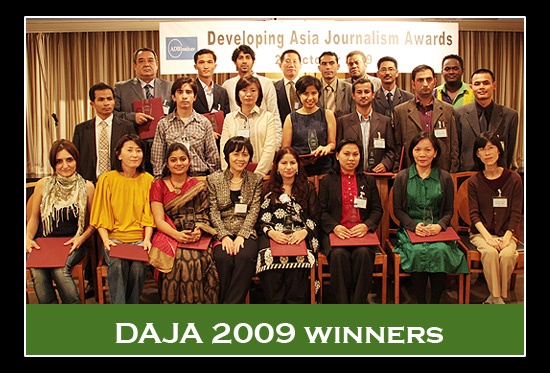
The Developing Asia Journalism Awards (DAJA) scheme was launched in 2004 by the Asian Development Bank Institute in Tokyo, for journalists covering development issues in the Asia Pacific. It received around 200 entries this year, of which 22 journalists from 17 ADB developing nations were selected as finalists.

Supriya Khandekar from India won Young Development Journalist of the Year Award. Other winners are Sithav An from Cambodia for the Poverty Impact of the Global Financial Crisis category, Raknish Wijewardene from Sri Lanka for the Government Responses to the Global Financial Crisis category, Zhu Yan from China for the Infrastructure Development category and Moffat Ghala Mamu from the Solomon Islands for the Climate Change Adaptation category. Full list of winners

DAJA 2009 winners
DAJA 2009 winners

Encounter with Anpanman: A superman made of bread!

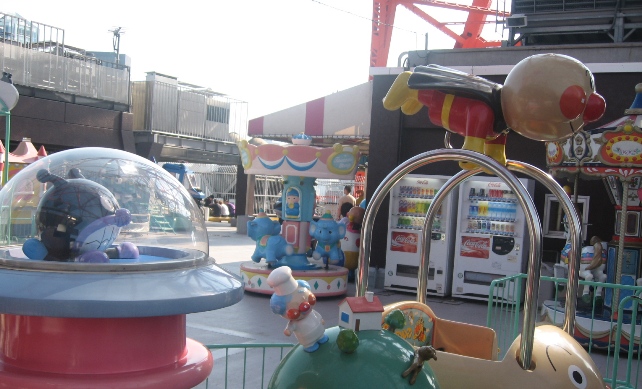
Anpanman is one of the most popular anime cartoon series in Japan

Last month, on my way to the Tokyo headquarters of NHK, Japan’s public broadcaster, I stopped at the Tokyo Tower for a bit of sight-seeing.

A communications tower located in Shiba Park, Minato, Tokyo, the Tokyo Tower is 332.6 meters (1,091 ft) tall – which makes it the tallest self-supporting steel structure in the world. Built in 1958, this Eiffel Tower-like structure supports an antenna that broadcasts television and radio signals for important Japanese media outlets including NHK, TBS and Fuji TV.

At the base of the tower, I had an unexpected encounter with an old friend. I know him as Gnana Katha Malliya, the name given to him in the Sinhalese adaptation that I watch on Sri Lankan television.

But everyone in Japan knows him by his original name: Anpanman. He is one of the most popular anime cartoon series (manga) in Japan. It is produced by Nippon Television Network Corporation.

Anpanman is the creation of Takashi Yanase, a Japanese writer of children’s stories. Each animated cartoon is approximately 24 minutes long, split into 2 episodes of approximately 12 minutes each.

Yanase has been writing Anpanman since 1968. He became inspired by the idea of Anpanman while struggling to survive as a soldier in World War II. He had frequently faced the prospect of starvation which made him dream about eating a bean-jam filled pastry called Anpan.

Anpanma is indeed a superman made by a baker. His head is a bun made by Jam Ojisan, a kind-hearted baker. He was created when a shooting star landed in Jam Ojisan’s oven while he was baking.

Anpanma’s name comes from the fact that he is a man with a head made of bread that is filled with bean jam called an anpan. His weakness is water or anything that makes his head dirty. He regains his health and strength when Jam Ojisan bakes him a new head and it is placed on his shoulders. Anpanman’s damaged head, with Xs in his eyes, flies off his shoulders once a new baked head lands.

The most endearing attribute of Anpanman is his sense of sacrifice. When he comes across a starving creature or person, he lets the unfortunate creature or person eat part of his head. Jam Ojisan has to keep baking an endless supply of heads for our hero.

And it gives a whole new meaning to the phrase ‘eat my head off’.

Baikinman is the villain in the stories. He comes from the “Germ World” and is the leader of the viruses. His name means “Germ Man”, and his ambition is to destroy Anpanman and turn the planet into another “Germ World”.

Read about other characters in Anpanma

Anpanman (R) and Baikinman at the Tokyo Tower

According to the Wikipedia, as of September 2006, Anpanman’s books had collectively sold over 50 million copies in Japan.

The Anpanman television series is called Soreike! Anpanman (meaning ‘Go! Anpanman’) – it has been on the air in Japan since 1988. More than 800 episodes have been made to date. There are also 18 cinematic films featuring the characters.

According to the Japanese toy company Bandai, Anpanma is the most popular fictional character from age 0 to 12 years in Japan.

As I found out, Anpanman is such a cultural icon in Japan that his images adorn railway carriages, and there is an Anpanman museum opened in Yokohama in 2007.

Anpanman is also popular in many countries across Asia. He has a large following in China and Korea, where the comics and TV series have been a popular Japanese cultural export for years.

And, as it turns out, I’d been enjoying his exploits on Sri Lankan television for years without even knowing his original Japanese name! This reinforces the point I made in Feb 2008, writing about another favourite character Madeline – originally French, but whom I encountered on a visit to Manila and Los Banos in January this year.

I wrote: “It’s becoming impossible to discern or define what is ‘local’ anymore in this rapidly globalising and integrating world. Sociologists and communication researchers who split hairs about preserving ‘local content’ have a romanticised notion that is hard to find in the real world.”


Read my Feb 2008 blog: What’s local in our mixed up, globalised world?


Watch a sample story: Anpanman to Hamigakiman

Thai audiences in the dark about ‘Children of the Dark’

Yami no kodomotachi (Children of the Dark) movie poster

Human trafficking – peddling and trading of human beings for slavery, sexual exploitation and servitude – has grown to alarming proportions in recent years. It’s among the top five illicit trades in the world, whose net annual worth is believed to be between 9 billion and 42 billion US dollars. The truth is, nobody knows exactly how big it is, but human rights activists and development agencies agree the problem is pervasive.

Of the estimated 2.5 million persons trafficked worldwide, more than half are in the Asia Pacific. At the UN General Assembly for Children in August 2007, it was reported that about 1.8 million children became victims of commercial sex trade in 2000. About one million children in Southeast Asia are said to be involved – Thailand is one centre of this shady trade, drawing on misery in its rural hinterlands as well as poorer neighbouring countries like Burma, Cambodia and Laos.

So what happens when someone goes to the trouble of studying the issue in depth, and then pools talent and resources to make a feature film that exposes international connections that sustain the child sex industry in Thailand? Instead of being welcomed as part of the effort to counter this scourge, the film gets banned.

Yami no kodomotachi (Children of the Dark, 138 mins, original Japanese) is a Japanese-Thai film made in 2008 about child sex slavery. It has been banned in Thailand on the grounds that it was ‘inappropriate’ and touched on a ‘sensitive’ issue.

Watch the official trailer of the film (Japanese soundtrack, Thai captions):

I haven’t seen the film, but according to one reviewer who did, Junji Sakamoto‘s film is based on a novel by Yan Sogil and scripted by Sakamoto himself, shows, with a documentary-like directness, how children caught in the web of a Thai prostitution ring are exploited, abused and, in some cases, murdered when they are no longer sexually salable.

Mark Schilling, writing in The Japan Times in August 2008, noted: “…In being so visually graphic — particularly in the sex scenes in the Thai brothel — Sakamoto treads a dangerous line between hard-hitting social drama and stomach-turning exploitation. He takes care never to show his young actors (whose average age looks to be about 10) and their adult ‘clients’ in the same explicit shot, but he films them engaged in sexual acts or their aftermath. Sakamoto may defend these scenes in the name of realism, but could he have filmed similar ones in Japan, using Japanese children? The short answer is “no.”

The Thai ban prevented ‘Children of the Dark’ from being screened at the Bangkok International Film Festival, held in the Thai capital from 23 – 30 September 2008.

“The ban puts under the spotlight the country’s – or at least its higher-ups’ – seeming unwillingness to let go of the Film Act of 1930, when Thailand was still under absolute monarchy. That law gave a Board of Censors the power to impose cuts or to ban a film it deems inappropriate,” writes my friend and colleague Lynette Lee Corporal in an article just published on Asia Media Forum.

Thailand in denial about its Children of the Dark
She quotes my Thai colleague and documentary filmmaker Pipope Panitchpakdi as saying: “Authorities always think that viewers need to be protected and shielded from real issues. They still have that kind of sentiment that the media should function as a gatekeeper. That is, let the good stories in and the bad ones out. It’s okay in certain circumstances but not when talking about real, serious issues.”

Pipope adds: “This country has no problem with hypocrisy; we don’t see anything wrong with double standards. We have sex workers in corners of the city, but we can’t watch people kissing.”

A Bangkok-based journalist who calls himself Wise Kwai, writing in his blog, asks: “When will they (Thai authorities) learn that when they ban or censor a film, the ensuing stink that’s raised causes more problems than if the film had been allowed to quietly unspool? Perhaps if people had seen it, they might criticise it, but they’d also talk about the problems in society that allow children to be exploited.”

Read the full article: Film Censorship Leaves Viewers in the Dark by Lynette Lee Corporal

My Sep 2007 post: MTV Exit: Entertainment TV takes on human trafficking