Embattled Media – Democracy, Governance and Reform in Sri Lanka (Sage, Feb 2015; 416 pages)
A new multi-author book offers valuable insights into the importance of independent media for democratic governance in the wider South Asian region.
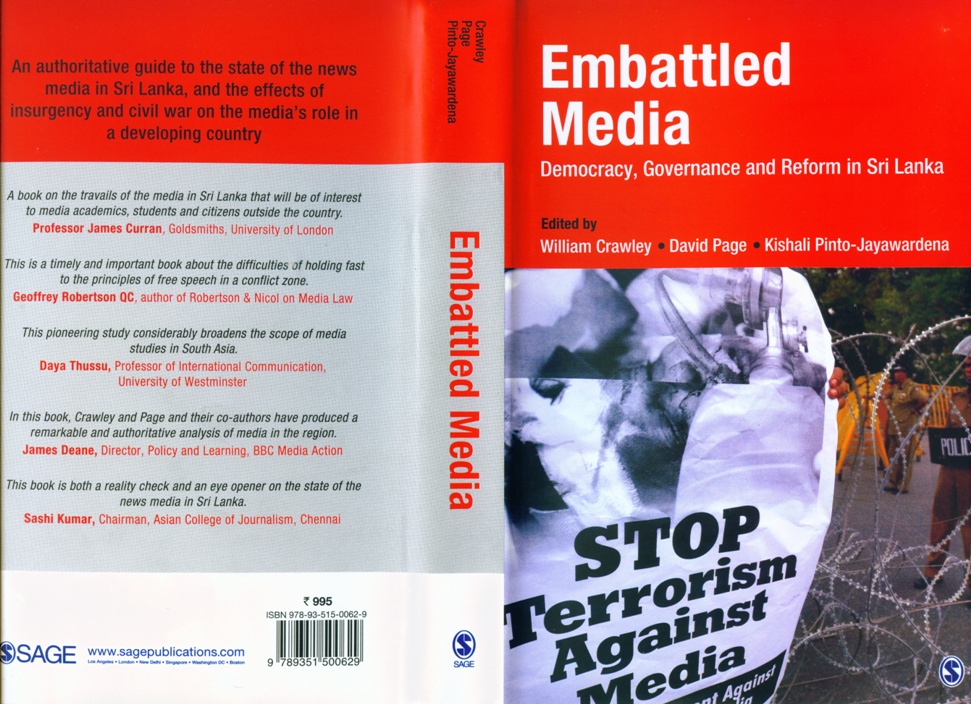
Titled Embattled Media: Democracy, Governance and Reform in Sri Lanka(Sage, Feb 2015; 416 pages), the book examines the role of the media in a state committed to democracy and the rule of law which had suffered extraordinary stresses as a result of ethnic strife, insurrection and civil war.
According to its publishers, Sage Publications in India and the UK, the book is an ‘authoritative guide to the state of the news media in Sri Lanka, and the effects of insurgency and civil war on the media’s role in a developing country’.
This is the first book to look comprehensively at the evolution of news media in post-colonial Sri Lanka, with a focus on media policy, law and education. The book reviews the role of new media platforms in widening the scope for public debate.
Further, it provides a detailed analysis of the existing media laws and policies and of campaigns to reform them. It also focuses on the role of institutions in media education by providing a comprehensive analysis of existing media curricula and underlining the importance of improved media literacy and introduction of Right to Information Act for a healthy democracy.
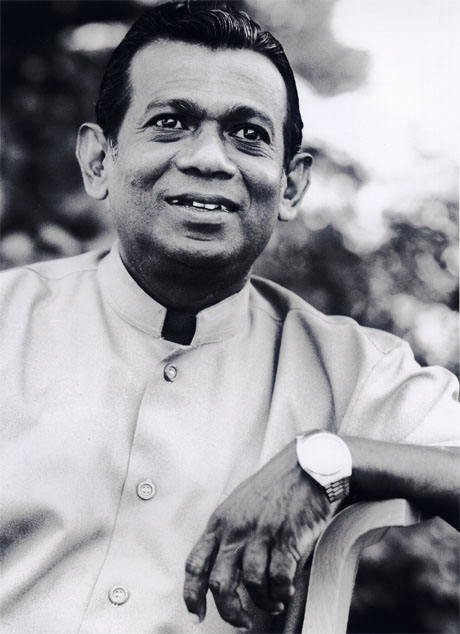
The book is dedicated to the memory of the late Tilak Jayaratne (1943-2013), who ‘ably represented a generation of honourable and committed broadcasters’. Having contributed significantly to the book, he did not live to see its publication.
Embattled Media – Publishing Information
In their preface to the book, the co-editors write: “Media liberalisation from the 1990s onwards had extended the range of choice for viewers and listeners and created a more diverse media landscape. But the war in the north and insurrections in the south had taken their toll of media freedoms. The island had lived under a permanent state of emergency for nearly three decades. The balance of power between government, judiciary, the media and the public had been put under immense strain.
“In 2009, with the end of the war in the north, all this seemed about to change, increasing the relevance of our enquiries and raising hopes of media reform and greater freedom of expression. But progress towards a different sort of normality has been slow. The war and its aftermath have continued to cast a long shadow, which has limited the scope of our research…
“Over the past few years, universities have been closed for long periods. University teachers have been engaged in disputes with the government, which has affected their teaching and their research. The NGO sector has been heavily criticised by the government for pursuing foreign-funded agendas and finds itself under fire and on the defensive. Many media proprietors and journalists have maintained their long-established habit of self-censorship, for fear of inviting reprisals of one sort or another. Though not on the same scale as previously, there have been killings and disappearances of journalists since 2009 and the memory of past abuses still affects people’s thinking. All this has made the study more challenging.”
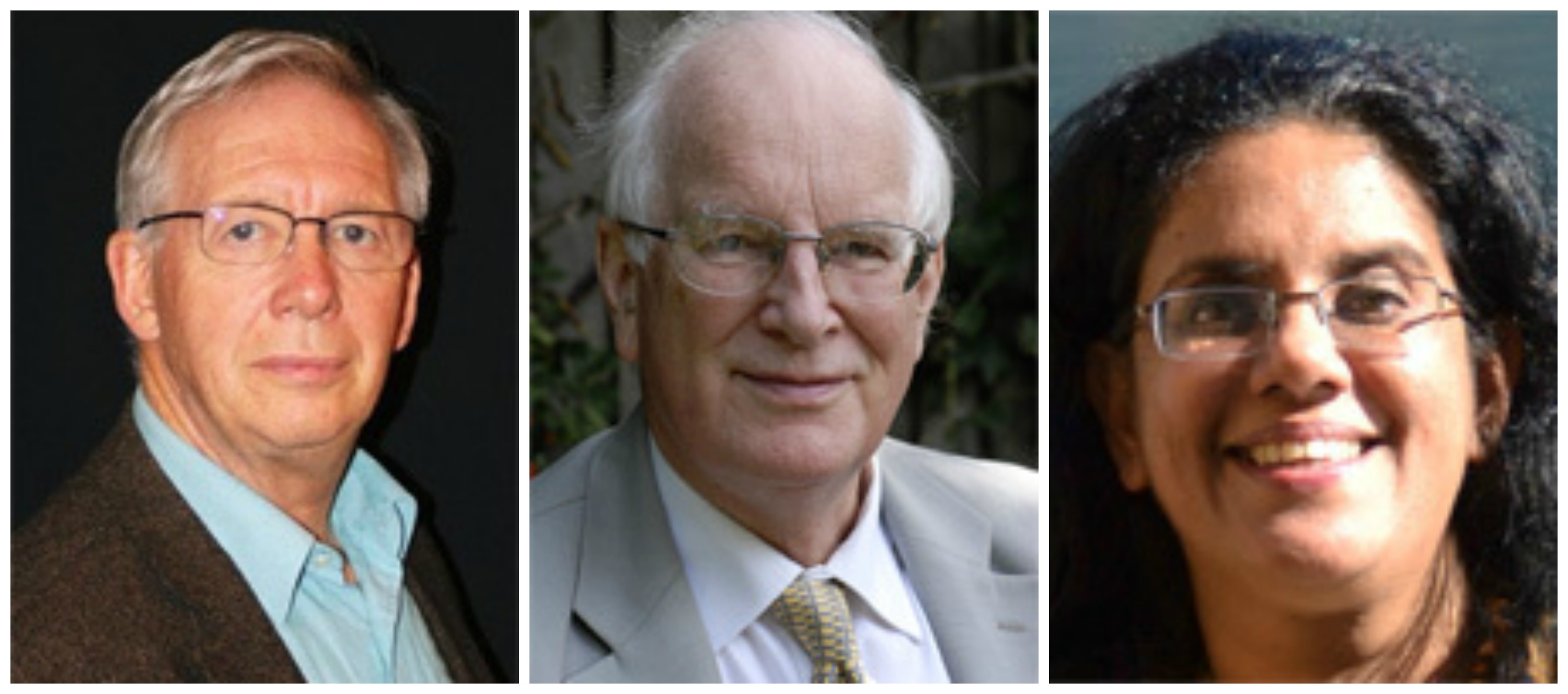
Co-editors of Embattled Media – (L to R) William Crawley, David Page and Kishali Pinto-Jayawardena (photos courtesy Sage Publications website)
The book also contains a glossary of media related terms; a bibliography and an index.
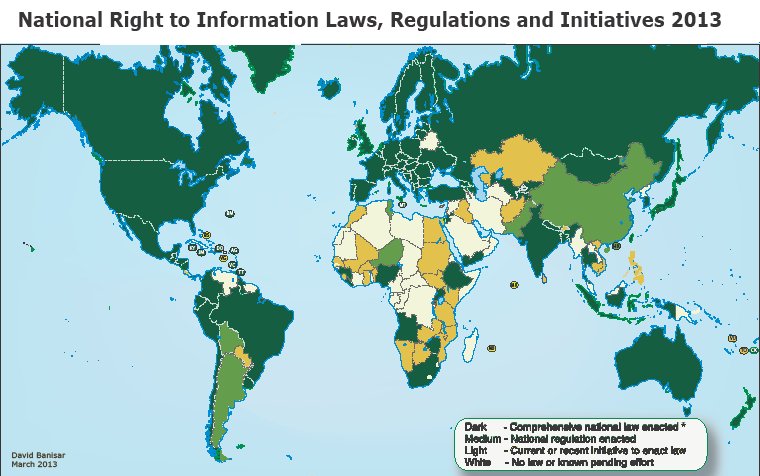
After many years of advocacy by civil society, Sri Lanka is set to adopt a law that guarantees citizens’ Right to Information (RTI). With that, we will at last catch up with nearly 100 countries that have introduced such progressive laws.
Better late than never — but passing the law is only a beginning. Institutionalising it requires effort and funds. Continued vigilance is needed on civil society’s part to guard against the process becoming mired in red tape.
RTI signifies unleashing a new potential. To draw an analogy from water management, opening a ‘sluice’ does not by itself mean much unless the downstream systems are in place. In both cases, the recipients need to know how to make the best use of what comes through.
Journey so far
Why is RTI such a big deal?
Its basis is that in democracies, the public have every right to know what is being done in their name by those entrusted with governance.
RTI is the right to access and obtain information from public officials. This right serves several purposes: improve public participation in policy making; promote transparency and accountability in government; and minimise wastage and corruption of state resources by public officials.
RTI and freedom of information are used interchangeably, but there is an important distinction between the two.
According to lawyer Gehan Gunatilleke, who recently wrote a book on the subject (published by Sri Lanka Press Institute, 2014), freedom of information implies a citizen’s freedom to access and receive public information on request. In such a situation, the government should not violate that freedom by restricting access. RTI goes further, and implies that information is an inherent right of the people. Governments are duty-bound to provide such information.
The Universal Declaration of Human Rights, adopted at the United Nations in 1948, recognised the right to seek, impart and receive information as part the fundamental right to freedom of speech and expression (Article 19).
Article 19 of Universal Declaration of Human Rights
RTI does not mean opening up everything. Sensitive information – related to national security, for example – is excluded. The challenge is to strike a healthy balance between full transparency and a few justified exemptions.
Indian experience
In Asia, India was a frontrunner in developing RTI laws. The campaign for RTI started in the 1990s with a grassroots movement driven by social activists and rural groups. They saw its clear value to counter the growing misuse of authority and public funds by local officials.
State level RTI laws were adopted in Tamil Nadu (1997), Goa (1997), Rajasthan (2000), Delhi (2001) and Maharashtra (2002). The national law came into effect in October 2005 after a decade of agitation.
Under the Indian law, citizens can request information from any ‘public authority’ within 30 days. It covers all branches of government — executive, legislature and judiciary – as well as institutions and statutory bodies set up by an act of national Parliament or a state legislature. Even non-governmental organisations, if they receive significant amounts of government funds, are covered.
The act required all public authorities to appoint a public information officer (PIO) to handle RTI requests. It also mandated computerizing of public records so that certain categories of information are proactively published online, enabling interested citizens to just look it up.
Since the RTI law was introduced, India has seen an improvement in governance, dissemination of information and involvement of civil society in the governance process, says Dr Rajesh Tandon, founder and head of the Society for Participatory Research in Asia (PRIA), a voluntary organisation providing support to grassroots initiatives.
At the same time, Tandon points out that some challenges remain at implementation level. Certain states in India have been more active in creating a culture of information sharing and open government, he told me in a television interview in mid 2014.
As Indians found out, it isn’t easy to shake off centuries of misplaced state secrecy and mistrust in the public. “Old rules and procedures continue to co-exist as new laws and methods are invented. Official Secrecy Act and Right to Information Act co-exist, just as written precedent and e-governance co-exist,” says Tandon (watch our full interview: https://vimeo.com/118544161).
New challenges
In Sri Lanka, civil society groups and journalists’ organisations were at the forefront advocating RTI. Groups like Transparency International and Sri Lanka Press Institute (SLPI) have been lobbying, training and raising awareness on the societal value of this right.
However, RTI is not only for journalists or social activists. It is a right for all citizens living in modern societies where their well-being – sometimes even survival – depends on knowing critical information. Ignorance may have been bliss once upon a time, but it is not recommended for the 21st century.
Reorienting the public institutions to a new culture of openness and sharing will be an essential step. Undoing decades of habits will take effort.
Asanga Welikala, a legal scholar now with the Edinburgh Law School, said in a tweet that we need a moratorium of ‘at least two years’ before RTI law comes into force – so as to train officials and make all government procedures compliant.
He also says the Information Commission must have a proper budget for promotion and public awareness of the new Act, rights and procedures. For example, how to ensure citizen information requests can be accommodated equally in both official languages and the link language?
As champions of RTI, media and civil society must now switch roles. While benefiting from it themselves, they can nurture the newly promised openness in every sphere, showing citizens how best to make use of it.
Public information can exist in many forms today – ranging from minutes of meetings, budget allocation and expense records, and scientifically gathered information such as census data, or trade statistics. These may be stored on paper, tape or – increasingly – in digital formats.
In recent years, with digital technologies the volume of specialised data held by governments has risen phenomenally. Both the data custodians and public today need higher levels of information literacy to navigate through this torrent.
The good news: the web makes it easier to store and share information. ‘Open Data’ means that certain data should be freely available to everyone to use and republish as they wish, without restrictions from copyright, patents or other mechanisms of control.
The open data approach is especially applied to scientific data and government data. But the debate is far from settled: while there are many strong arguments for opening up, some are concerned about potential misuses. Guidelines are still evolving.
A key attribute of open data is its usability. Each country needs to adopt information gathering and data storage standards, so as to minimize users facing problems that arise with the use of different devices, systems and measuring systems.
Some public data custodians in South Asia still release vast amounts of data in hard copy (paper-based) form. For example, India’s Marine Fisherfolk Census of 2010 had results running into thousands of pages of data tables – they were only released on paper. That made further analysis impossible. Undaunted, a fishers’ collective mobilised some tech-savvy volunteers to create computerised spreadsheet databases.
Like many other elements of good governance, RTI’s effectiveness depends on imagination, innovation and persistence on the part of citizens. Its best results will accrue in a society and political culture where evidence and analysis are trusted. Sri Lanka is not there yet.
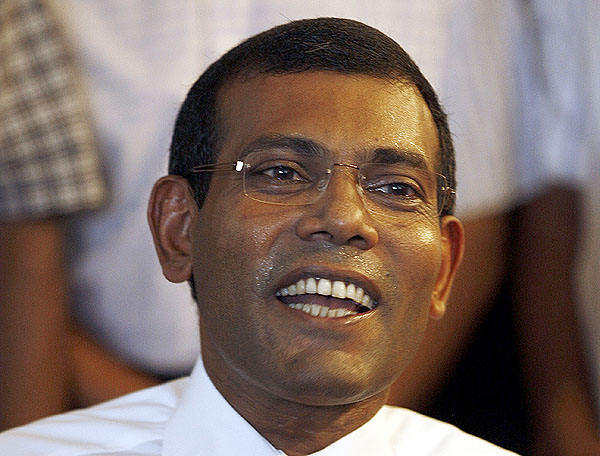
President Mohammed Nasheed (left) and President Maumoon Abdul Gayoom (right).jpg
In this week’s Ravaya column (in Sinhala), I chronicle the struggle by people of the Republic of Maldives – Asia’s smallest state by land area and population – to achieve democratic pluralism and good governance.
In October 2008, long-term autocratic ruler President Maumoon Abdul Gayoom was defeated in the country’s first multi-party elections by Mohamed Nasheed of the Maldives Democratic Party (MDP). Nasheed, who had been a political prisoner and suffered much under the previous regime, ushered in a new era for his nearly 400,000 people – for a while.
From almost the beginning, the Nasheed administration was systematically undermined and eventually he was ousted by the former autocrat’s appointees and promoters whose key public sector positions were left untouched by Nasheed despite there being many allegations of corruption.
As noted in an editorial in The Sunday Times (Sri Lanka) on 15 Jan 2015: “In February 2012, after just three and a half years in office, Nasheed was forced to resign following months of military-backed protests. Why? Largely because he was reluctant to remove dozens of Gayoom loyalists in key sections of the public service and the judiciary, who eventually helped the opposition to plot his downfall.
“In Nasheed’s own words, ‘I didn’t want to take action against them, despite public demands, as it would be tantamount to behaving like Gayoom, ruthless and abusing of power.’ As weeks and months went past with Gayoom cronies still continuing in key positions, Nasheed’s hold on power weakened and led to his resignation which he said was forced on his by the military.
“These are lessons for Sri Lanka’s new rulers who must clean up the system and take action while at the same time displaying that it is not a political witch-hunt.”
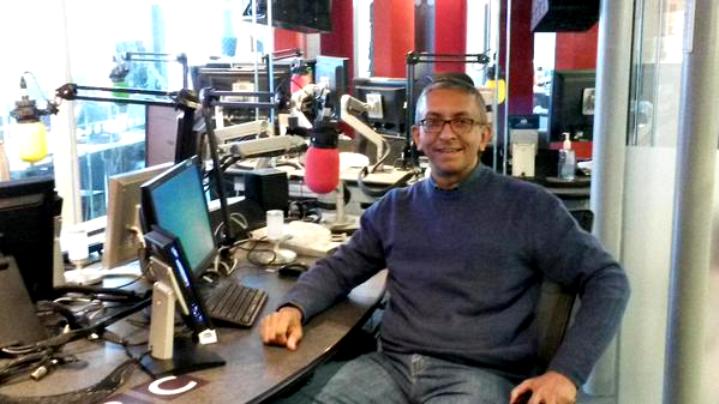
On 13 Feb 2015, while briefly in London, I visited BBC’s new Media Centre and recorded brief interviews with BBC Sinhala and BBC Tamil services (radio) on the role of social media during the Sri Lanka Presidential Election 2015 – the topic of my talk at University of London the previous day.
BBC Sinhala published the story online on 22 Feb 2015, along with an edited down audio track.
In this week’s Ravaya column (in Sinhala), I discuss the history and current state of play in relation to right to information (RTI). This is in the context of the new Lankan government planning to introduce an RTI law.
To review the work of government at all levels, citizens/voters need to access public sector information – about decisions, proceedings, budgets, expenditures, problems and performance. Close to 100 countries now have laws guaranteeing people’s RTI.
Sadly, Sri Lanka is lagging behind all other SAARC countries, five of which have already enacted RTI laws and two (Afghanistan and Bhutan) have draft bills under consideration. Attempts to introduce RTI in Sri Lanka were repeatedly thwarted by the previous government, which cited various excuses for avoding such a progressive law.
In this column, I also argue that RTI’s effectiveness depends on imagination, innovation and persistence on the part of all citizens. Its best results will accrue in a society and political culture where evidence and analysis are respected. Sri Lanka is not there yet.
RTI will be a significant milestone in a long journey that must continue.
An impressive 81.52% of registered voters turned up, and their majority choice changed the regime. A well-oiled system that has been holding elections since 1931 proved its efficacy again. And if its integrity came under threat, the formidable Commissioner of Elections stood up for the due process.
As we pat ourselves on the back, however, let us remember: an election is a necessary but not a sufficient condition for a vibrant democracy. There is much more to democracy than holding free and fair elections.
The ‘sufficient conditions’ include having public institutions that allow citizens the chance to participate in political process on an on-going basis; a guarantee that all people are equal before the law (independent and apolitical judiciary); respect for cultural, ethnic and religious diversity; and freedom of opinion without fearing any repercussions. Sri Lanka has much work to do on all these fronts.
Democracy itself, as practised for centuries, can do with some ‘upgrading’ to catch up with modern information societies.
Historically, people have responded to bad governance by changing governments at elections, or by occasionally overthrowing corrupt or despotic regimes through mass agitation.
Yet such ‘people power’ has its own limits: in country after country where one political party – or the entire political system — was replaced with another through popular vote (or revolt), people have been disappointed at how quickly the new brooms lose their bristles.
The solution must, therefore, lie in not just participating in elections (or revolutions), but in constantly engaging governments and keeping the pressure on them to govern well.
In practice, we citizens must juggle it along with our personal and professional lives. As information society advances, however, new tools and methods are becoming available to make it easier.
Social Accountability
This relatively new approach involves citizens gathering data, systematically analysing it and then engaging (or confronting, when necessary) elected and other officials in government. Citizens across the developing world are using information to improve the use of common property resources (e.g. water, state land and electromagnetic spectrum, etc.), and management of funds collected through taxation or borrowed from international sources.
Such engagement enables citizens as well as civil society organisations (CSOs) to engage with policymakers and citizen service providers. Some call it social accountability (or SAcc), and others refer to it as participatory democracy. Whatever the label, the idea is to ensure greater accountability in how the public sector manages public funds and responds to citizens’ needs.
For this to work, citizens need to access public sector information – about budgets, expenditures, problems and performance. Over 100 countries now have laws guaranteeing people’s right to information (RTI). Sadly, Sri Lanka is lagging behind all other SAARC countries, five of which have already enacted RTI laws and two (Afghanistan and Bhutan) have draft bills under consideration. Attempts to introduce RTI in Sri Lanka were repeatedly thwarted by the previous government.
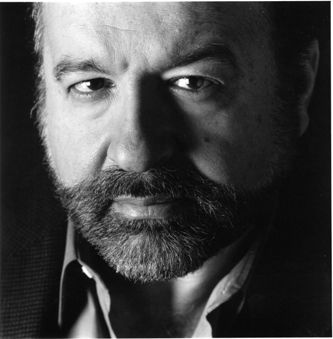
Economist Hernando de Soto (image from Wikipedia)
An early champion of social accountability was the Peruvian economist Hernando de Soto who has been researching on poverty, development and governance issues. He says: “Supposedly in a democracy, if the majority of people are poor, then they set the criteria of what is right. Yet all those mechanisms that allow [society] to decide where the money goes — and that it is appropriately allocated — are not in place throughout the Third World.”
The result? “We take turns electing authoritarian governments. The country, therefore, is left to the [whims] of big-time interests, and whoever funded the elections or parties. We have no right of review or oversight. We have no way for the people’s voice to be heard — except for eight hours on election day!”
It is this important right of review and oversight in between elections that SAcc promotes. Call it an ‘insurance’ against democracy being subverted by big money, corrupt officials or special interest groups…
A dozen years ago, concerned by development investments being undermined by pervasive corruption and excessive bureaucracy, the World Bank started advocating SAcc. Their research shows how, even in the most hopeless situations, ordinary people often come together to collect their voice and exert pressure on governments to be responsive.
“Social accountability is about affirming and operationalising direct accountability relationships between citizens and the state. It refers to the broad range of actions and mechanisms beyond voting that citizens can use to hold the state to account,” says a World Bank sourcebook on the subject. (See: http://go.worldbank.org/Y0UDF953D0)
What does that mean in plain language? Seeking to go beyond theory and jargon, the Bank funded a global documentary in 2003, which I co-produced. Titled ‘Earth Report: People Power’ and first broadcast on BBC in February 2004, it featured four inspiring SAcc examples drawn from Brazil, India, Ireland and Malawi (online: http://goo.gl/xQnr9v).
These case studies, among the best at the time, showed how SAcc concepts could be adapted in different societies and economic systems
In Porto Alegre, Brazil, community members participate annually in a series of meetings to decide on the City Budget. This material is presented to Parliament which finds it difficult to refuse the recommendations — because over 20,000 have contribute to its preparation. As many or more watch how the budget is spent.
In Rajasthan, India, an advocacy group named MKSS holds a public meeting where the affidavits of local candidates standing for the state elections are available to the people. This ‘right to information’ extends all the way down to villages where people can find out about public spending.
In Ireland, the government has partnered with trade unions, employers, training institutions and community groups on a strategy to deal with problems affecting youth (such as school drop-outs and high unemployment). Citizens set priorities for social spending.
In Malawi, villagers participate in assessing local health clinics by scoring various elements of the service. A Health Village Committee then meets the service providers who also assess themselves. Together, they work out ways to improve the service.
During the last decade, many more examples have emerged – some driven by public intellectuals, others by civil society groups or socially responsible companies. Their issues, challenges and responses vary but everyone is looking for practical ways to sustain civic engagement in between elections.
The development community has long held romanticized views on grassroots empowerment. While SAcc builds on that, it is no castle in the air: the rise of digital technologies, web and social media allows better monitoring, analysis and dissemination. And government monopolies over public information have been breached — not just by progressive policies and RTI laws but also by efforts such as WikiLeaks.
Confronted by the growing flood of often technical information, citizens need to be well organised and skilled to use in the public interest. Evidence-based advocacy is harder than rhetorical protests.
Dr Bela Bhatia, then an associate fellow at the Centre for the Study of Developing Societies in India, says on the film: “Ultimately the responsibility in a democracy is ours…and if today we have corrupt politicians, it is because we have allowed corruption to happen, to take root.”
Rather than debating endlessly on how things became so bad, SAcc promoters show a way forward – with emphasis on collaboration, not confrontation.
“It’s up to the governments to make up their mind whether they want to respect the more participatory model or invite more confrontation, to invite violence and perhaps ultimately the dismantling of the very democratic system,” says Bhatia.
How can we deepen our democracy with SAcc? Start with RTI, and see what happens.
In this week’s Ravaya column (in Sinhala), I continue the Sinhala adaptation of my June 2014 TV interview with Dr Rajesh Tandon of India, an internationally acclaimed leader and practitioner of participatory research and development.
Last week, we discussed the civil space and political space available for advocacy and activism – and how far civil society activists have been able to engage the formal political process in India.
Today, we discuss how anti-corruption movement evolved into the Aam Aadmi Party, AAP, and the relevance of India’s experiences to Sri Lanka. We also discuss India’s Right to Information Act and how that has empowered citizens to seek a more open and accountable government at national, state and local levels. Dr Tandon ends by emphasizing that democracy is a work in progress that needs constant engagement and vigilance.
තොරතුරුදැනගැනීමේඅයිතිය(Right to Information Act) නීතියෙන්තහවුරුවීඉන්දියාවේදැන්දශකයක්පමණකල්ගතවීතිබෙනවා. පුරවැසිහාසිවිල්සමාජක්රියාකාරීත්වයටහායහපාලනයටමෙයදායකවීඇත්තේකෙසේද?
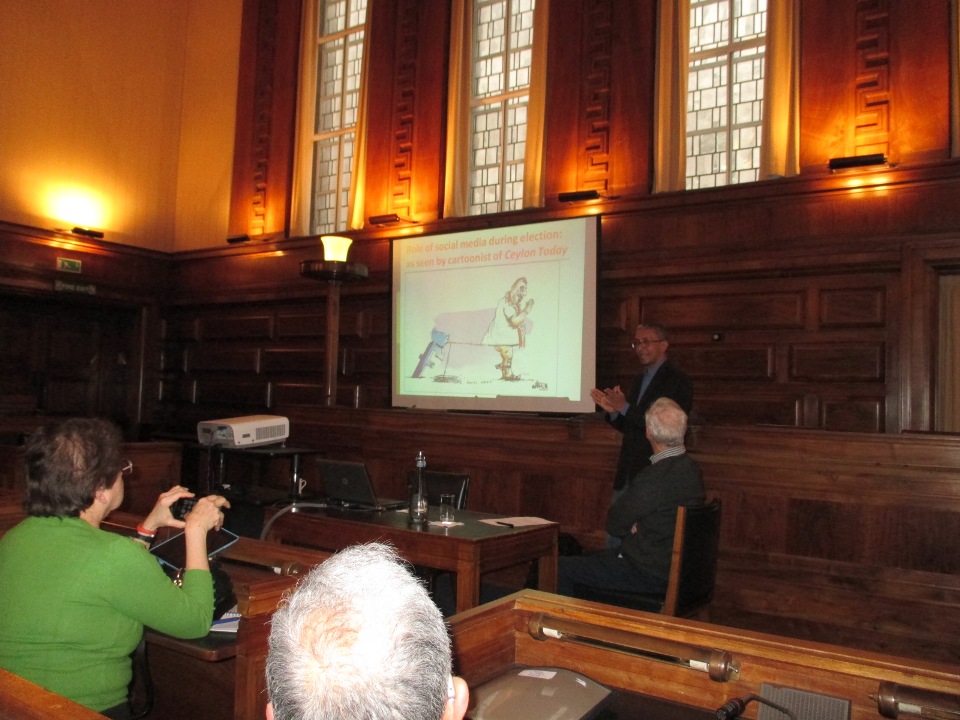
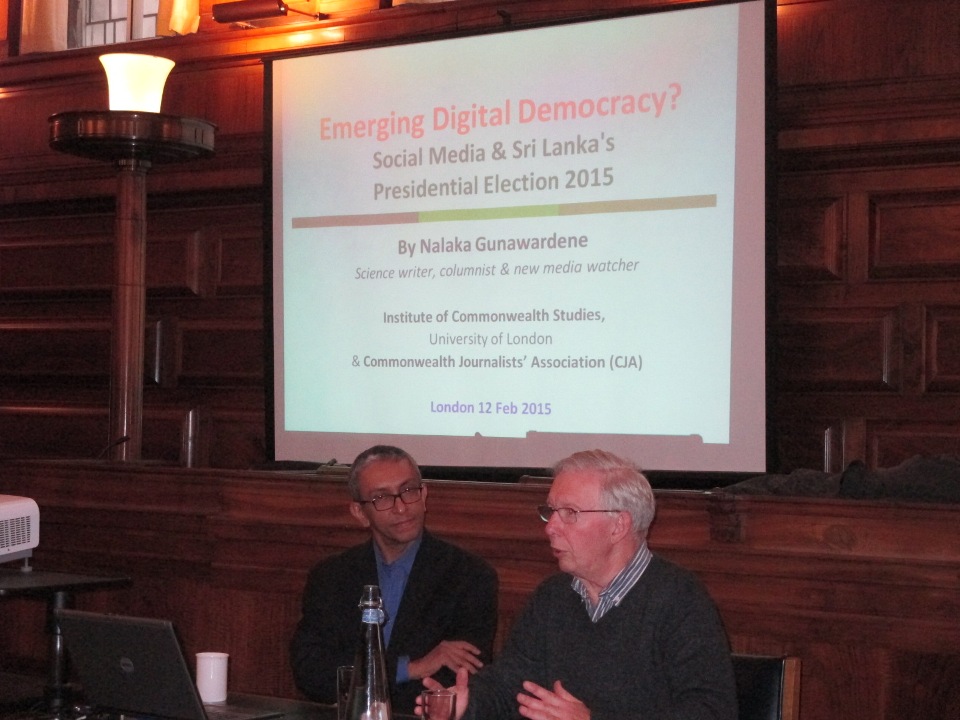
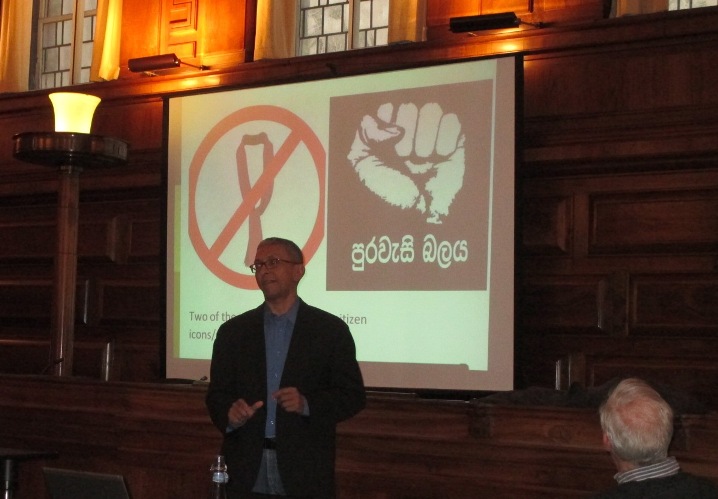
Nalaka Gunawardene talking at London University on 12 Feb 2015 on “Social Media and Sri Lanka’s Presidential Election 2015” Photo by Prasanna Ratnayake
Emerging Digital Democracy? Social Media and Sri Lanka’s Presidential Election 2015
This was the topic of a public talk I gave at the University of London on 12 Feb 2015.
It was organised and hosted by the Institute of Commonwealth Studies, University of London in collaboration with the Commonwealth Journalists’ Association (CJA).
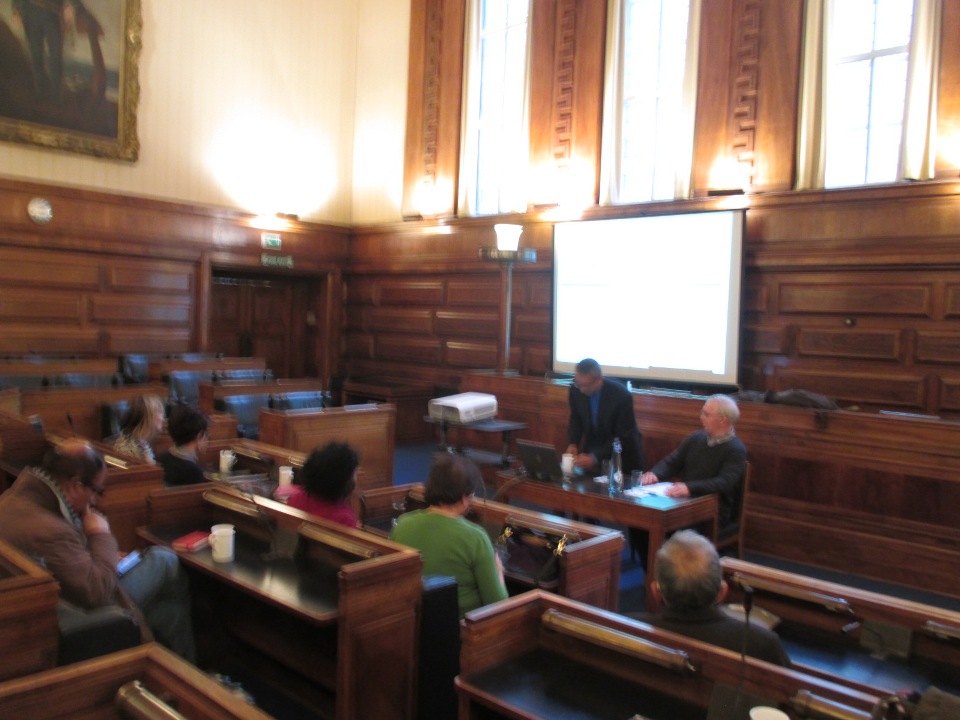
They lined up the University’s Senate Room for the talk, which was attended by a South Asian audience who engaged me in a lively discussion.
Emerging Digital Democracy? Social Media and Sri Lanka’s Presidential Election 2015
Synopsis of the talk:
A record 81.5% of registered voters took part in Sri Lanka’s presidential election on 8 January 2015 in which incumbent Mahinda Rajapaksa was defeated by his former health minister Maithripala Sirisena. The peaceful regime change has been widely acclaimed as a triumph of democracy and a mandate for political reform, improved governance and national reconciliation.
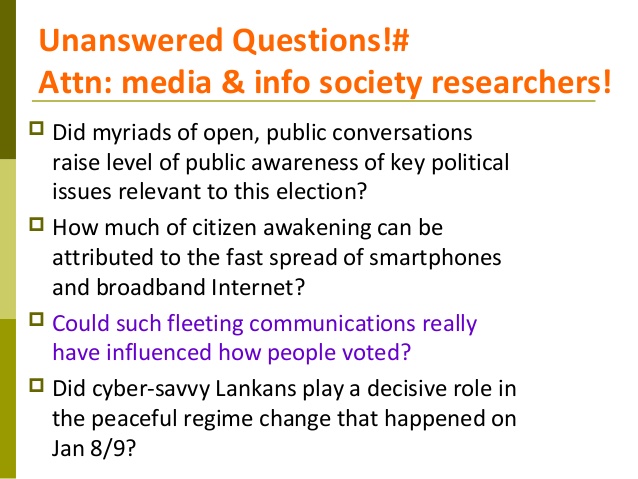
The election saw unprecedented use of social media by both candidates as well as by politically charged yet unaffiliated youth. How much of this citizen awakening can be attributed to the fast spread of smartphones and broadband? Did it really influence how people voted? What does this mean for future politics and governance in Sri Lanka?
In this illustrated talk, science journalist and new media watcher (and practitioner) Nalaka Gunawardene shares his insights and views.
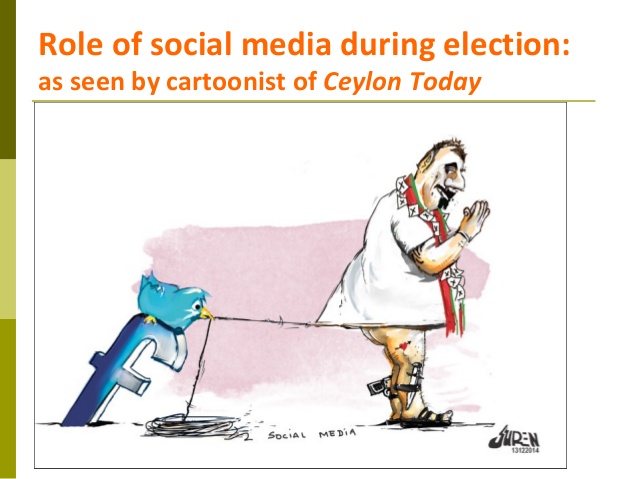
Who’s afraid of social media? Many Lankan politicians, for sure…
My PowerPoint slides:
Key questions that need more research to answer:
This is why we need better research on new media and society in Sri Lanka!
Photos by Prasanna Ratnayake
William Crawley (right), Fellow of the Institute of Commonwealth Studies, introduces Nalaka GunawardeneNalaka Gunawardene on Social Media and Sri Lanka’s Presidential Election 2015 at University of London, 12 Feb 2015A section of the audience at Senate Room, University of London, listening to Nalaka Gunawardene: 12 Feb 2015
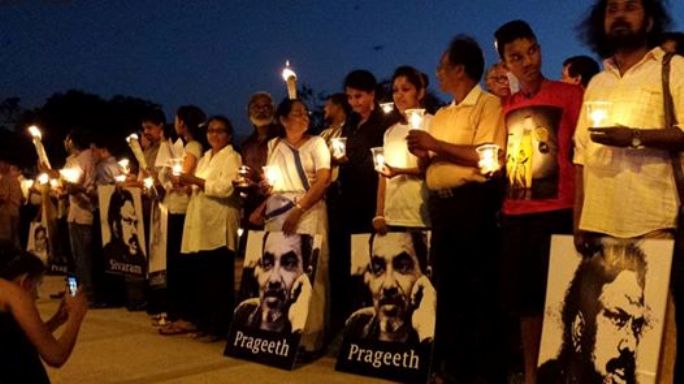
Citizens’ vigil for murdered and disappeared Lankan journalists: 5 January 2015 at Vihara Maha Devi Park, Colombo.
Civil society – in its widest sense – played a key role in the recent peaceful change of government in Sri Lanka. It was civil society advocacy – for ending corruption, ensuring independence of judiciary, and increasing democratic checks and balances on the executive presidency – that inspired a larger citizen demand for better governance. The parliamentary opposition was pushed into belated action by these citizen demands.
What is the role of civil society in the political process? How and where does the civil space intersect with the political space? How can civil society engage formal political parties without being subsumed or co-opted?
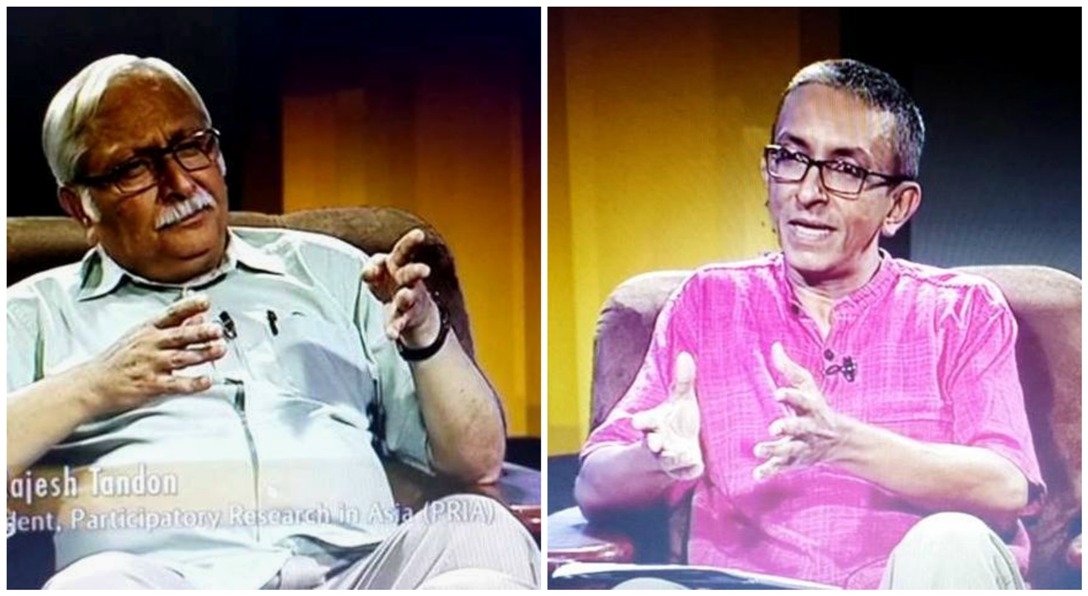
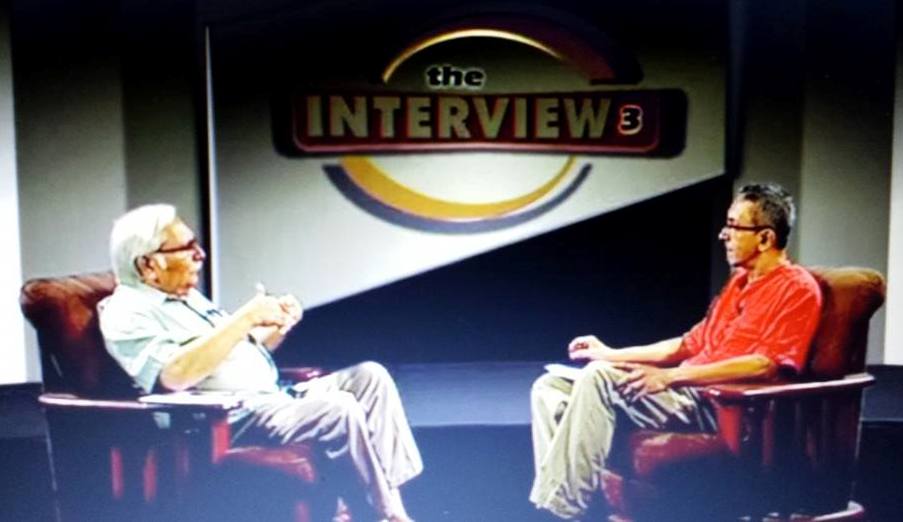
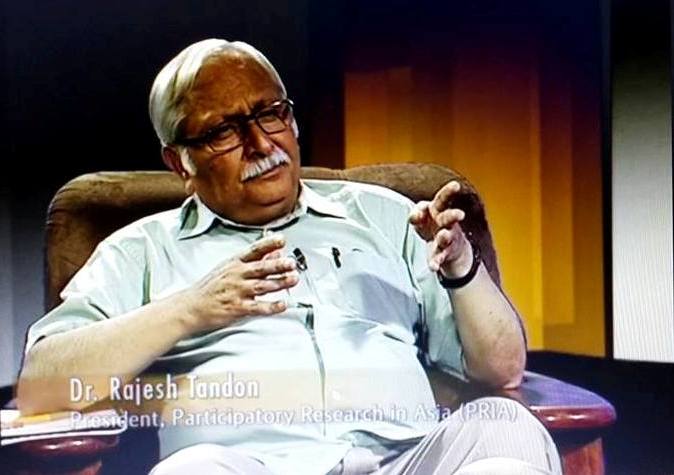
In June 2014, I posed these questions to Dr Rajesh Tandon of India, an internationally acclaimed leader and practitioner of participatory research and development, when I interviewed him for Young Asia Television (YATV) – I was just ‘standing in’ for the regular host Sanjana Hattotuwa.
That interview’s contents are now more relevant to Sri Lanka than 8 months ago. So I have just rendered it into Sinhala. In this week’s Ravaya column (in Sinhala), I share the first half of the interview. To be continued next week…
Dr Rajesh Tandon (left) in conversation with Nalaka Gunawardene: Young Asia Television – The Interview, June 2014











 Open Minds!