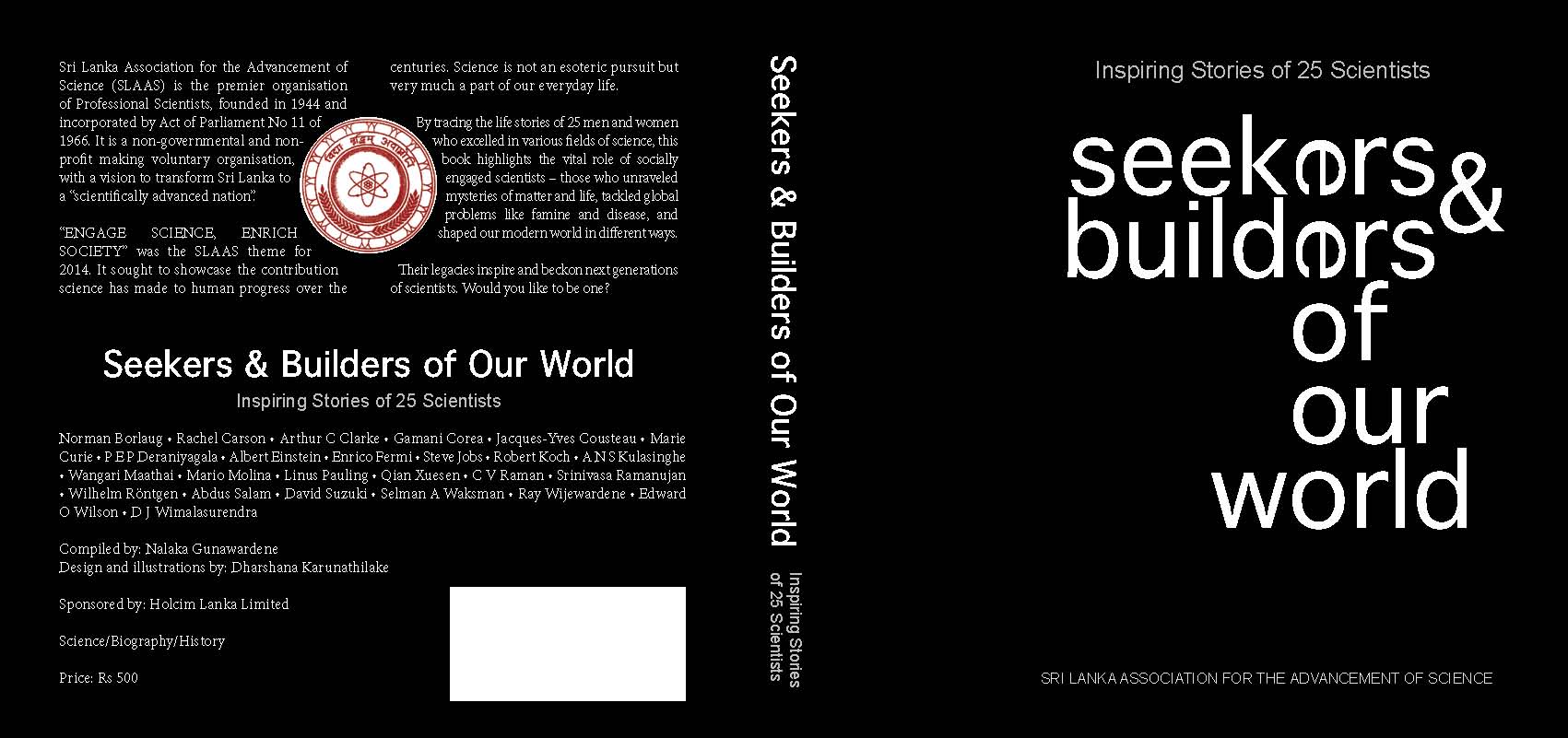
Titled ‘Seekers and Builders of Our World: Inspiring Stories of 25 Scientists’, the 350-page book highlights the vital role of socially engaged scientists – those who unraveled mysteries of matter and life, tackled global problems like famine and disease, and shaped our modern world in different ways.
The book will be launched at the opening ceremony of SLAAS Annual Sessions at BMICH Colombo on 1 December 2014.
At the invitation of SLAAS, the book was authored by the award-winning science writer Nalaka Gunawardene. It was designed and illustrated by artist and cartoonist Dharshana Karunathilake.
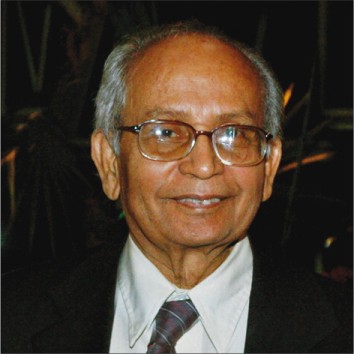
“Publication of this book hopes to ignite an interest in young minds and engage the next generation of scientists early so that they can be a part of the knowledge base that we badly need to nurture in our country,” says Dr A M Mubarak, General President of SLAAS for 2014, in his foreword to the book.
Among those profiled in the book are biologists, chemists, engineers, mathematicians, physicists and information technology pioneers. Some of them made pioneering discoveries – such as antibiotics, radioactivity and relativity – while others were responsible for pushing the limits of knowledge, design and technology.
Particular focus has been given to childhood influences that inspired them to pursue scientific careers, as well as life challenges – including poverty, societal discrimination or disability — they overcame with hard work, resolve and imagination.
The 25 personalities (in alphabetical order) are: Norman Borlaug; Rachel Carson; Arthur C Clarke; Gamani Corea; Jacques-Yves Cousteau; Marie Curie; P E P Deraniyagala; Albert Einstein; Enrico Fermi; Steve Jobs; Robert Koch; A N S Kulasinghe; Wangari Maathai, Mario Molina; Linus Pauling; Qian Xuesen; C V Raman; Srinivasa Ramanujan; WilhelmRöntgen; Abdus Salam; David Suzuki; Selman A Waksman; Ray Wijewardene; Edward O Wilson; and D J Wimalasurendra.
These names were chosen to inspire not only recent science graduates but also students in GCE Ordinary Level and Advanced Level classes and to promote a culture of research and spirit of inquiry.
“Engage Science, Enrich Society” has been the SLAAS theme for 2014. It sought to showcase the contribution science has made to human progress over the centuries. Through life stories of local and international scientists, the book reminds us that science is not an esoteric pursuit but very much a part of everyday life.
SLAAS is the premier organisation of professional scientists in Sri Lanka. Founded in 1944 and incorporated by Act of Parliament No 11 of 1966, it is a non-governmental and non-profit making voluntary organisation, with a vision to transform Sri Lanka to a “scientifically advanced nation”.
The book is being sold at a subsidised price of Rs 500. Limited copies will be available for sale from SLAAS office, “Vidya Mandiraya”, 120/10, Wijerama Road, Colombo 7, from December 5 onwards.
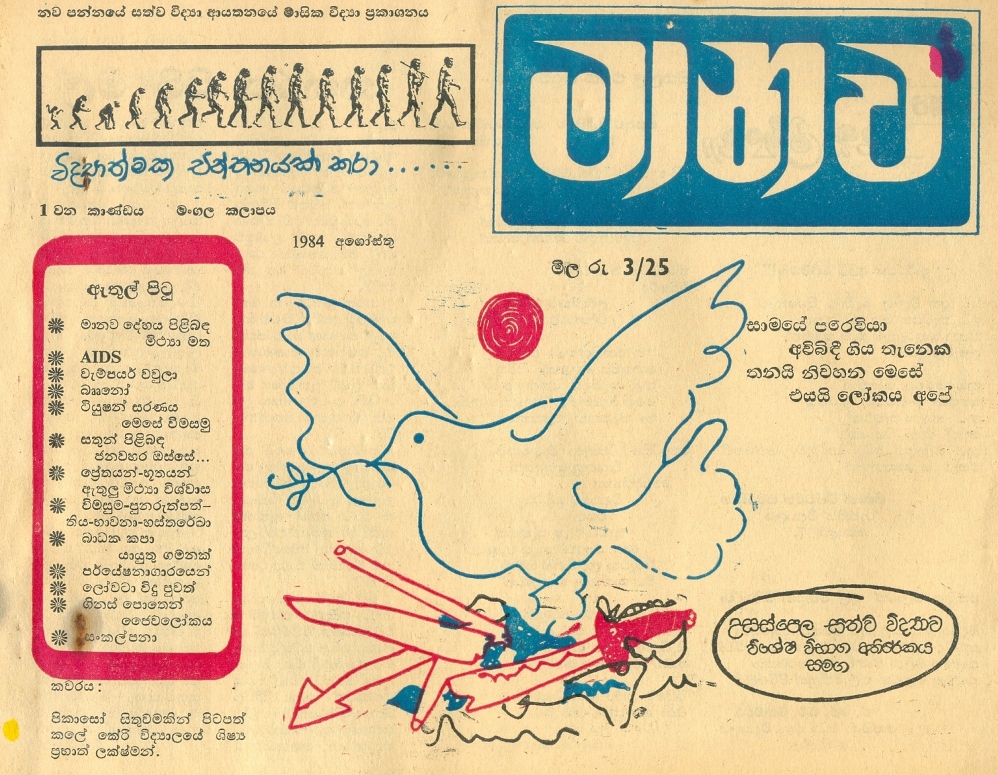
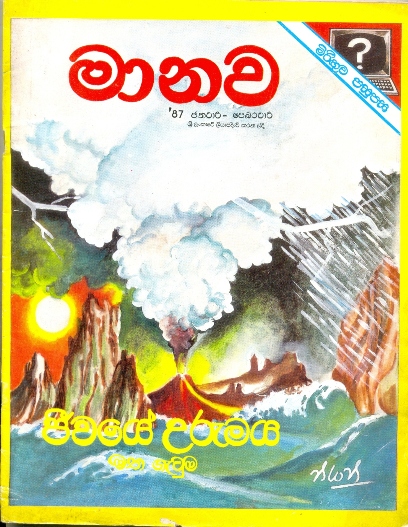
My latest book is dedicated to Asanga Abeysundara who was my zoology teacher 30 years ago, as well as my earliest editor-publisher. For several years in the 1980s, he edited and published (in properly printed form) a progressive science magazine in Sinhala named Maanawa (meaning ‘human’).
This non-profit publication, started in 1978 as a wall newspaper at the University of Colombo by its founder when he was an undergraduate there, evolved into a printed magazine in 1984 with a small circulation and loyal readership.
Maanawa Sinhala science magazine first print issue, Aug 1984
It was a platform for aspiring young writers – many of them in school or university at the time – to write about science, technology and their impact on society. As part of the editorial team, I remember we covered big issues like the origins of life, cost-benefits of space exploration, HIV/AIDS and human evolution.
Maanawa was entirely a labour of love: everybody, including the editor, worked for free. But printers and distributors charged for their services, which the limited sales couldn’t recover. So, despite passion and voluntary editorial inputs, the magazine stopped printing after sometime.
Yet, showing resilience and innovation, Maanawa became the first Sinhala publication to produce an Internet edition in 1996 — the year after commercial connectivity was introduced in Sri Lanka. The web edition, which played a pioneering role, is no longer online.
I have written this week’s Ravaya column (in Sinhala) about Maanawa.
In early August, Sri Lanka stopped the import of milk from New Zealand after discovering trace amounts of dicyanamide (DCD) a fertilizer additive, in four batches of milk sold by several firms. Concerns were also expressed on the presence of whey protein, a natural byproduct in cheese production.
After nearly a month of confusion and panic, the government now says it “probably overreacted” in its response to stories of contamination in milk powder imported from New Zealand.
Ensuring food safety is vital, and constant vigilance is needed – both on imported as well as locally produced food and beverages. What is the role of medical doctors and other scientifically trained professionals in such vital debates on public health and safety? How best can they conduct themselves in contentious policy issues with broad implications?
In this week’s Ravaya column (in Sinhala), I look at the lasting influence of Silent Spring, a popular science book that first came out 50 years ago, and is now widely regarded as a book that changed our thinking about the environment.
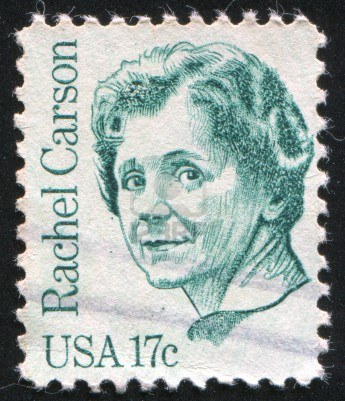
Its author, marine biologist Rachel Carson (1907 – 1964) was an early practitioner of evidence based policy advocacy. She was measured in what she wrote, and asked more questions than she could answer at the time. Yet the chemicals industry accused her of being anti-progress and scare-mongering. Smear campaigns targeted her as a single woman, and suggested that she was “probably a Communist”. How she weathered this storm holds valuable lessons for all modern day activists.
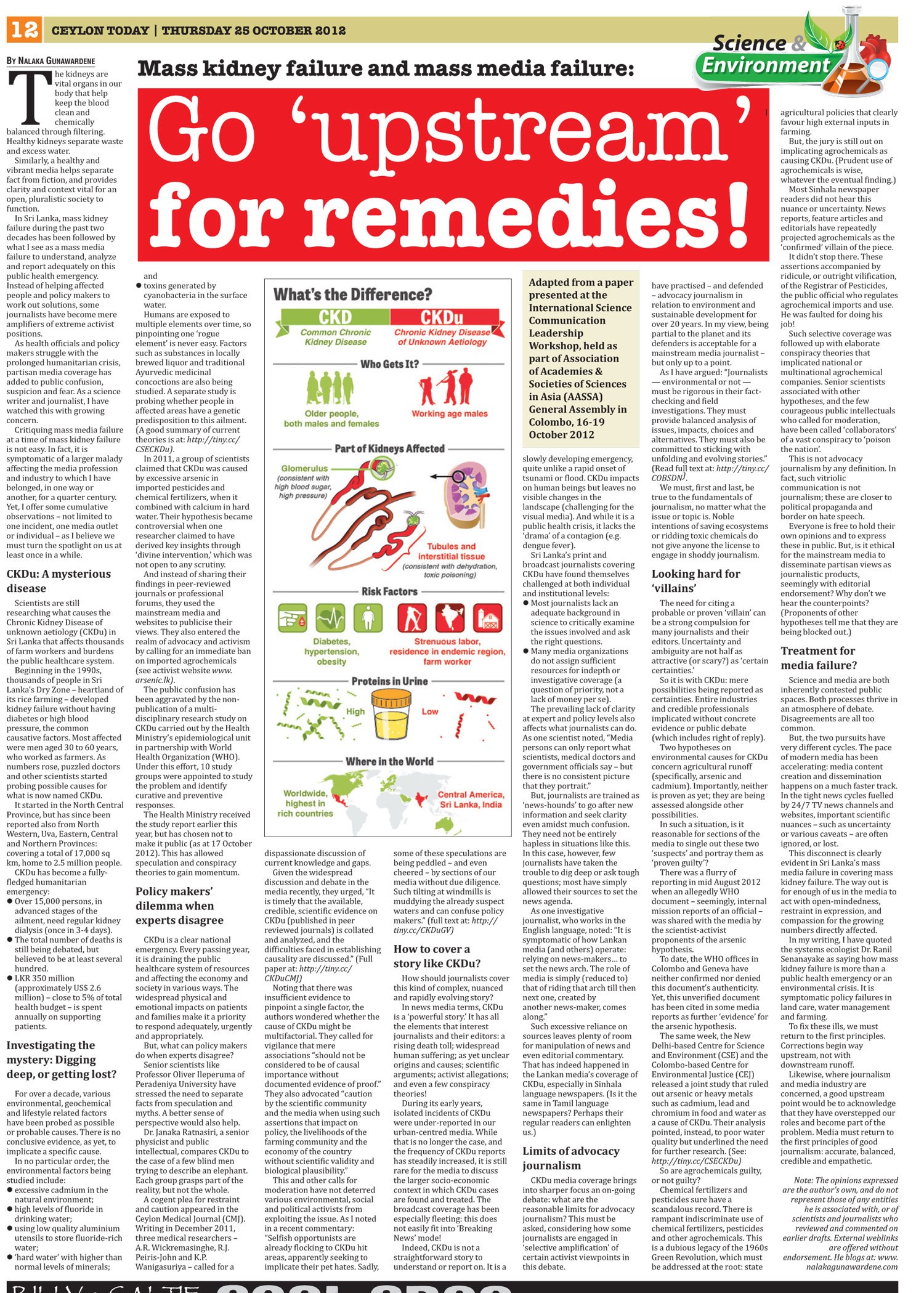
In Sri Lanka, mass kidney failure during the past two decades has been followed by what I call a mass media failure. Most of our media have failed to understand, analyse and report adequately on this public health emergency. Instead of helping affected people and policy makers to work out solutions, some journalists have become amplifiers of extreme activist positions.
I talked about this at at the International Science Communication Leadership Workshop, held as part of Association of Academies & Societies of Sciences in Asia (AASSA) General Assembly in Colombo, 16-19 October 2012. An English article based on my talk appeared in Ceylon Today a few days ago:
Mass Kidney Failure & Mass Media Failure: Go ‘Upstream’ for Remedies!
I have just written up similar views (NOT a translation!) for my weekend Sinhala language column in Ravaya broadsheet newspaper:
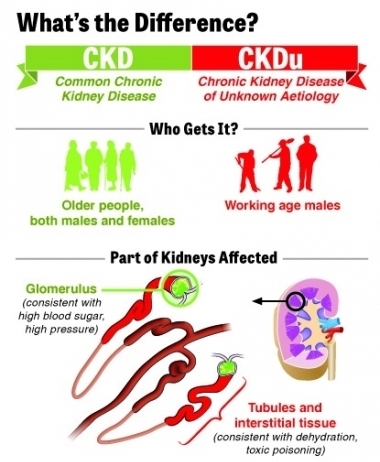
CKDu infographic courtesy Center for Public Integrity, USA
Ceylon Today newspaper has just published my article titled: Mass Kidney Failure & Mass Media Failure: Go ‘Upstream’ for Remedies!
It is adapted from a paper I presented last week at the International Science Communication Leadership Workshop, held as part of Association of Academies & Societies of Sciences in Asia (AASSA) General Assembly in Colombo, 16-19 October 2012.
In Sri Lanka, mass kidney failure during the past two decades has been followed by what I call a mass media failure. Most of our media have failed to understand, analyse and report adequately on this public health emergency. Instead of helping affected people and policy makers to work out solutions, some journalists have become amplifiers of extreme activist positions.
As health officials and policy makers struggle with the prolonged humanitarian crisis, partisan media coverage has added to public confusion, suspicion and fear. As a science writer and journalist, I have watched this with growing concern.
This is a critique of the Lankan media sector to which I have belonged, in one way or another, for a quarter century. I hope this will inspire some much-needed self-reflection among our media, which I feel over overstepped the boundaries of advocacy journalism in this issue. As I suggest, a return to first principles can help…
Full article below. Constructive engagement is welcomed.
Mass Kidney Failure & Mass Media Failure – Nalaka Gunawardene – Ceylon Today 25 Oct 2012
The kidneys are vital organs in our body that help keep the blood clean and chemically balanced through filtering. Healthy kidneys separate waste and excess water.
Similarly, a healthy and vibrant media helps separate fact from fiction, and provides clarity and context vital for an open, pluralistic society to function.
In Sri Lanka, mass kidney failure during the past two decades has been followed by what I see as a mass media failure to understand, analyse and report adequately on this public health emergency. Instead of helping affected people and policy makers to work out solutions, some journalists have become mere amplifiers of extreme activist positions.
As health officials and policy makers struggle with the prolonged humanitarian crisis, partisan media coverage has added to public confusion, suspicion and fear. As a science writer and journalist, I have watched this with growing concern.
I just gave a talk on this to the Science Communication Leadership Workshop which was part of the First General Assembly of Association of Academies and Societies of Sciences in Asia (AASSA) held in Colombo, Sri Lanka, on 17 October 2012.
I’ve been writing op-ed essays in newspapers for a decade, and features for a quarter century in mainstream, broadsheet newspapers. Do they make a difference? I often ask that myself. There are no easy ways to measure the influence or impact of what we write — except when a reader tells me how a particular piece changed his/her mind. It’s always good to have such feedback, but most people don’t reach out even when they like what they read.
In this week’s Ravaya column (in Sinhala), I ask the big question: can an op-ed article in a newspaper make a difference? I cite four specific instances where they did — leading to the founding of WWF, Amnesty International, Sri Lanka Eye Donation Society and the Suriya Mal Movement in Sri Lanka that was a peaceful defiance of British rule in early 20th century Ceylon.
AI, WWF and Sri Lanka Eye Donation Society logos: each organisation started with a newspaper op-ed
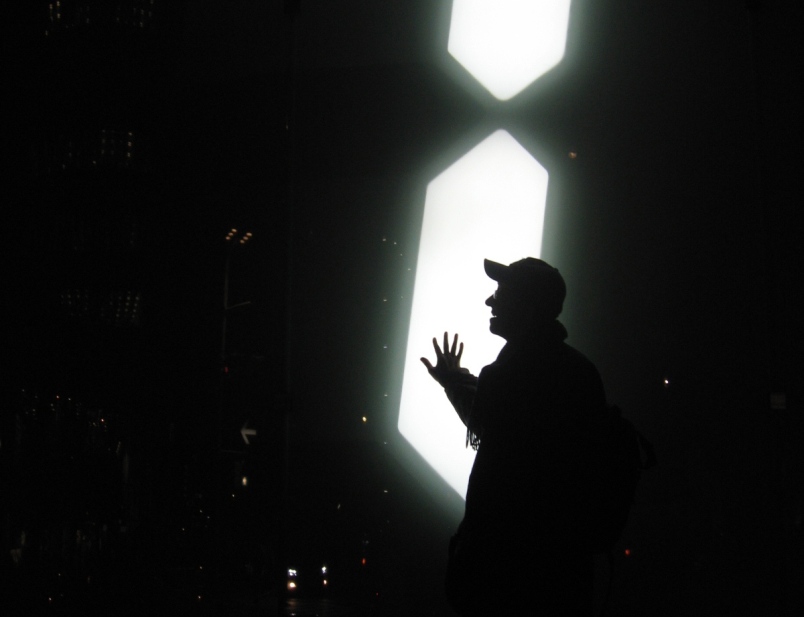
Nalaka G at a giant digital clock in Tokyo: Wandering everywhere with a sense of wonder...
This is the Sinhala text of my weekly column published in Ravaya newspaper for 5 February 2012. Here, I look back at one year of weekly columns and reflect on some reader feedback and their participation in my efforts to make sense of the world in turmoil that is all around me. I say ‘Thank You’ to the few writer friends and public intellectuals who have advised and guided me. I reaffirm my commitment to keep asking questions, connecting dots and following my own simple language style with none of the intellectual pretensions common in Sinhala newspaper writing.
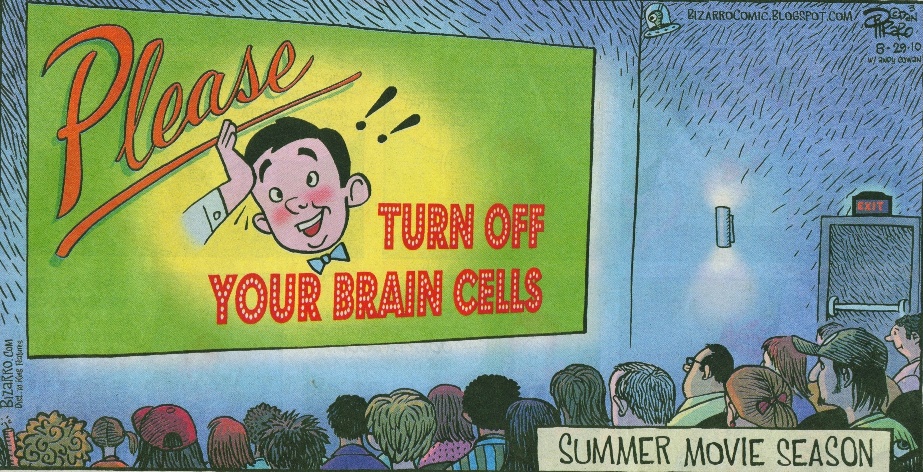
Is this the message that should be displayed at the entrance of some media and public institutions in Sri Lanka? In this latest Sunday column, appearing in Ravaya newspaper of 29 January 2012, I make a tongue-in-cheek suggestion for doing so. This is entirely justified given how much of superstition, half-baked stories and mind-rotting nonsense that a gullible public seems to lap up with little critical examination.
This week I continue what I started last week discussing challenges faced by rationalists in today’s Sri Lanka, a land under siege by dogma, charlatans and religious fanatics all of who operate with impunity, claiming ‘sacred cow’ status under various labels of religion, indigenous knowledge or national heritage.
Once again I pay tribute to the late Dr Abraham Thomas Kovoor (1898 – 1978), a Kerala-born science teacher who settled down in newly independent Ceylon and, after his retirement in 1959, took to investigating so-called supernatural phenomena and paranormal practices. Kovoor’s successors today have more communications tools and platforms than ever before, but find that charlatans have mastered many of them for hoodwinking the public…





 Open Minds!