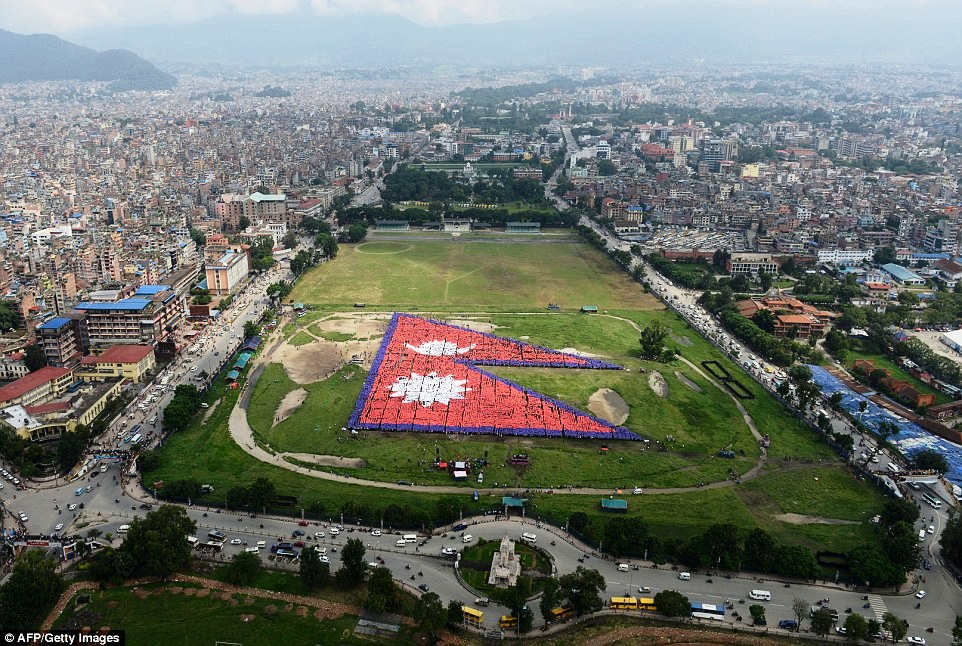
The Tudikhel open ground in central Kathmandu is transformed into a large flag holder as 35,000 Nepalese break the world record for the biggest human flag – 23 August 2014 – Photo by AFP/Getty Images
If there’s one thing (many) South Asian nations have in abundance, it’s people. Now, countries of this populous region are competing to hold the world record in an unusual phenomenon called the human national flag.
On 23 August 2014, more than 35,000 Nepalese came together in Kathmandu’s city centre to form the world’s largest “human national flag”. The feat was best seen from the air, and had a special visual significance too: the Himalayan nation has the world’s only flag which is not a quadrilateral (it’s made up of two triangles).
The exercise was billed as an effort to ‘unite the hearts of Nepal’. As seen from the Facebook page (https://www.facebook.com/events/1521476671414710/), it entailed plenty of preparation. Unless you’re in North Korea, getting thousands of people to perform an act of mass coordination isn’t easy.
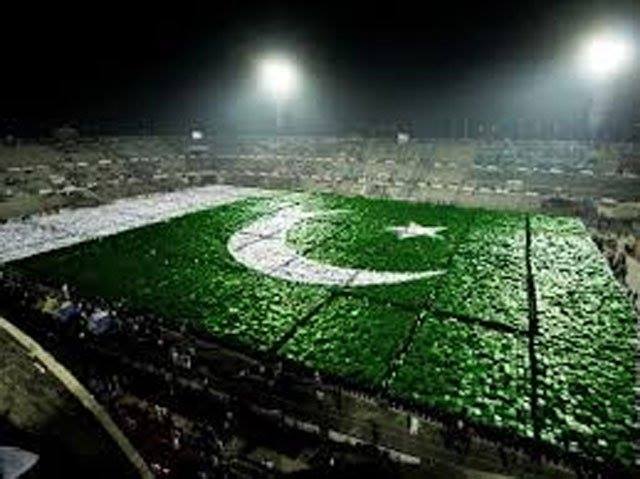
If Guinness World Records accepts this claim based on photographic and video evidence, Nepal will replace Pakistan as current record holder. On 15 February 2014, a total of 28,957 people came together at the National Hockey Stadium in Lahore to make up their flag during Punjab Youth Festival 2014. http://www.guinnessworldrecords.com/world-records/2000/largest-human-national-flag
On 5 February 2014, a total of 28,957 Pakistanis came together at the National Hockey Stadium in Lahore to create their national flag
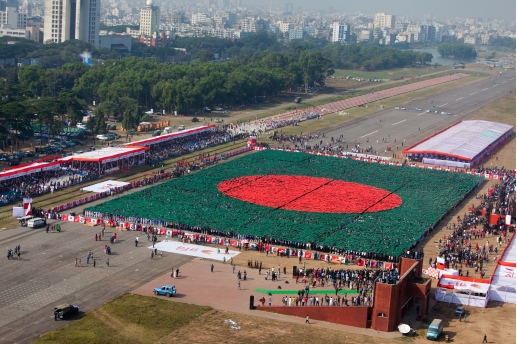
Pakistanis beat Bangladesh to this record. A total of 27,117 volunteers, mostly students, stood up with red and green blocks to form their flag at the National Parade Ground in Sher-e-Bangla Nagar in Dhaka on 16 December 2013. They stood there for 6 minutes 16 seconds, though the requirement for setting a new world record was 5 minutes.
Bangladesh human national flag created at the National Parade Ground in Sher-e-Bangla Nagar in Dhaka on 16 December 2013. Photo by Shahidul Alam/Drik News
So here’s a chance for Sri Lanka’s patriots to literally fly their flag into a world record. Of course, coordinating the creation of the Lion Flag will be more demanding (making up Pakistani and Bangladeshi flags is relatively easier than Nepal’s).
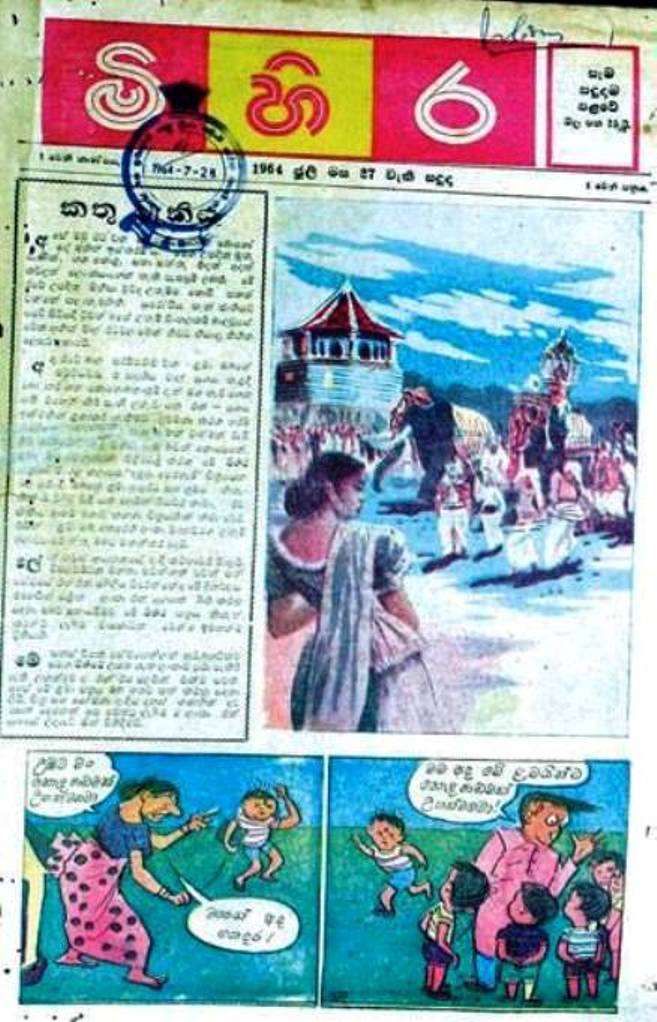
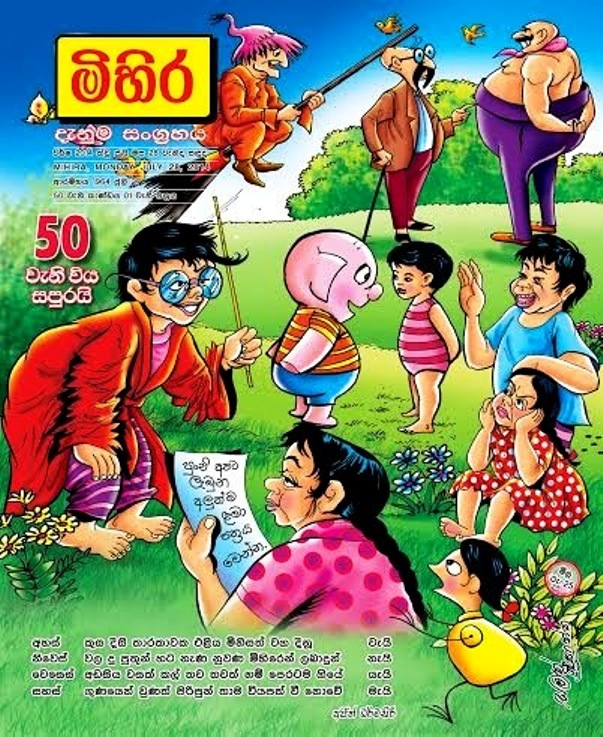
The Sinhala children’s weekly newspaper Mihira just completed 50 years of publication. The paper, launched by Associated Newspapers of Ceylon Limited (ANCL, or Lake House) on 27 July 1964, holds nostalgic memories for those of us who grew up in the 1960s and 1970s with limited access to reading material.
In this week’s Ravaya column (in Sinhala), I invoke some memories. I wrote an English blogpost along similar lines a few days ago:
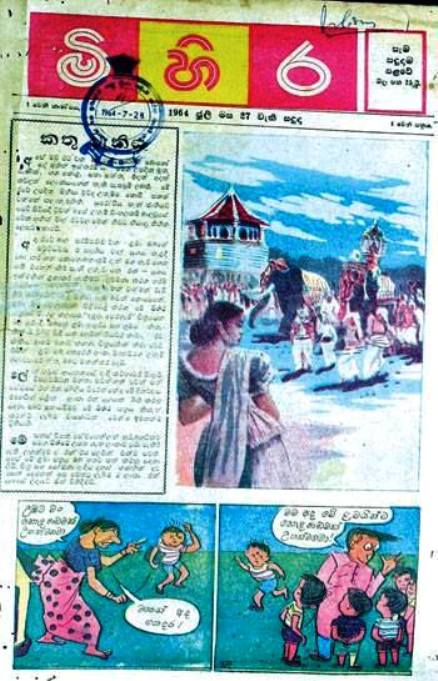
Mihira children’s newspaper first issue – 27 July 1964
Sinhala children’s weekly newspaper Mihira has just completed 50 years of publication. The paper holds nostalgic memories for those of us who grew up in the 1960s and 1970s with limited access to reading material.
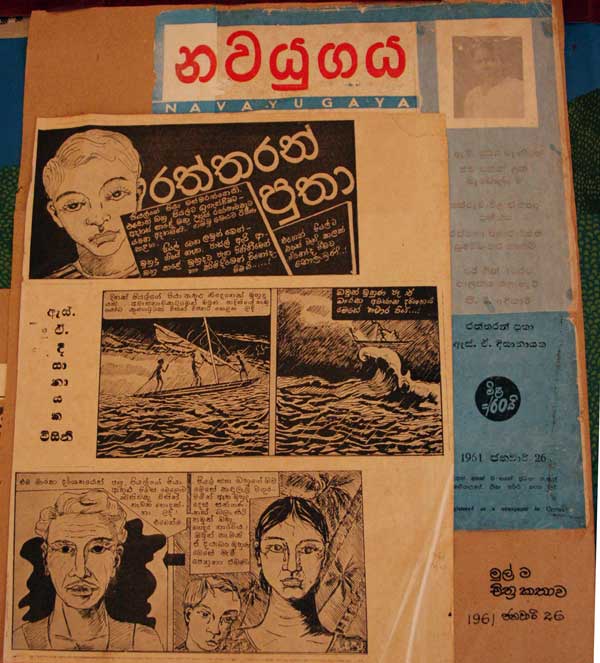
The tabloid was launched by Associated Newspapers of Ceylon Limited (ANCL, or Lake House) on 27 July 1964. Its founder editor was veteran journalist Srilal Hikkaduwa Liyanage (who was also founder editor of Tharunee women’s newspaper and Navayugaya informative newspaper from the same publishing house).
I wasn’t even born when Mihira came out. Sometime in 1969, when I was a precocious three-year-old, my father bought me my first copy. I was hooked: for the next dozen years, I eagerly awaited the arrival of each week’s issue on Mondays.
In the early years, Mihira carried a mix of stories, comics, articles and verse. While many were produced by talented writers and artists who understood the child’s mind, some were actually children’s own contributions.
In fact, Mihira is where I first got myself into print. As a school boy of 9 years, I submitted several of my (Sinhala) verses to Mihira (at the suggestion of my Grade 3 class teacher). One of them, on my perception of an animated clock, was printed in one issue of October 1975. I was thrilled to bits – that clipping is somewhere at the bottom of my personal archives…
Funnily enough, thousands of printed pieces later, I still get an enormous kick each time a newspaper publishes my writing.
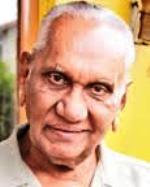
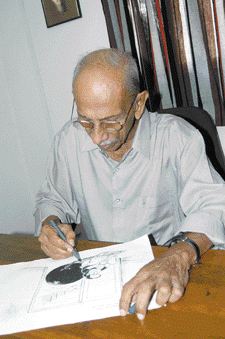
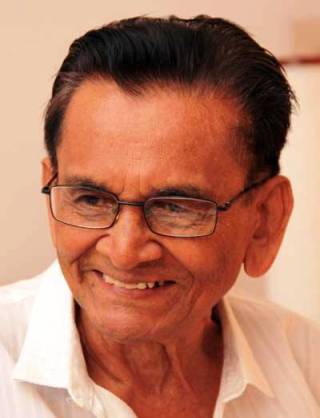
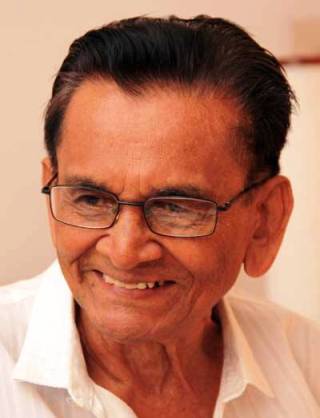
S A Dissanayake, comics artist
To me (and many others of my generation), the most memorable part of Mihira were extraordinary comics written and drawn by S A Dissanayake. He drew a long-running comic (chitra katha) called Onna Babo (‘ඔන්න බබො’), which chronicled the adventures of three intrepid kids (‘බූ – බබා’, ‘තුල්සි’) and involved a wicked witch (බටකොළ ආච්චි), wizards and other characters. For us entertainment starved kids, ඔන්න බබො was Harry Potter of the 1960s and 70s. All these years later, some sub-plots are still clearly etched in my memory…
S A Dissanayake also drew the more comical Yodaya (‘‘යෝධයා’’) about a good-hearted village giant and a learned but wicked man (‘‘යෝධයා සහ පඬිතුමා”), as well as several other popular comics.
When some teachers and parents condemn all comics as polluting children’s minds, I always remind them of the glorious exceptions created by S A Dissanayake. Some feel his stories paved the way for the enormous popularity of TinTin comics and animations in Sri Lanka later on.
I just read that Dissanayake (who was a school teacher by profession) still draws children’s comics for Mihira – a rare feat (world record?) of a comic artist drawing for the same publication for half a century.
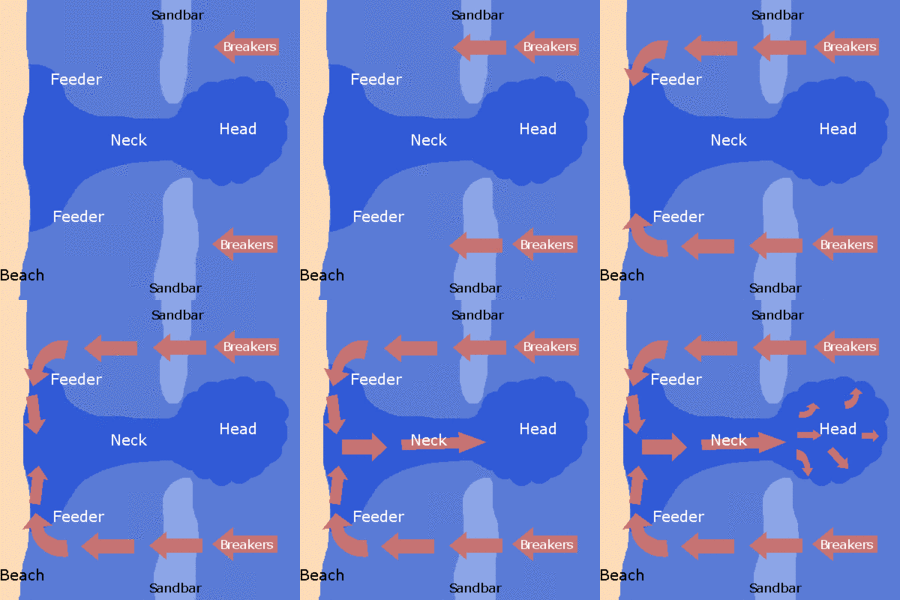
In this week’s Ravaya column (in Sinhala), I look at how to prevent death and disability caused by drowning in Sri Lanka.
Around 1,200 people die every year in Sri Lanka from drowning — several times the number of deaths from dengue fever, but this distributed tragedy gets much less public and media attention.
Most victims are children and young adults, and some die while trying to save another from drowning. Most of these deaths are preventable – if only adequate safety precautions are taken.
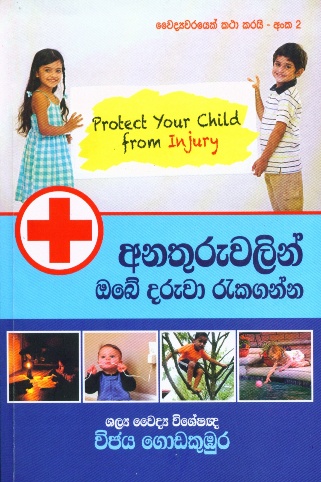
I quote extensively from a Sinhala book (Protect Your Children from Accidents) written by consultant surgeon Dr. Wijaya Godakumbura.
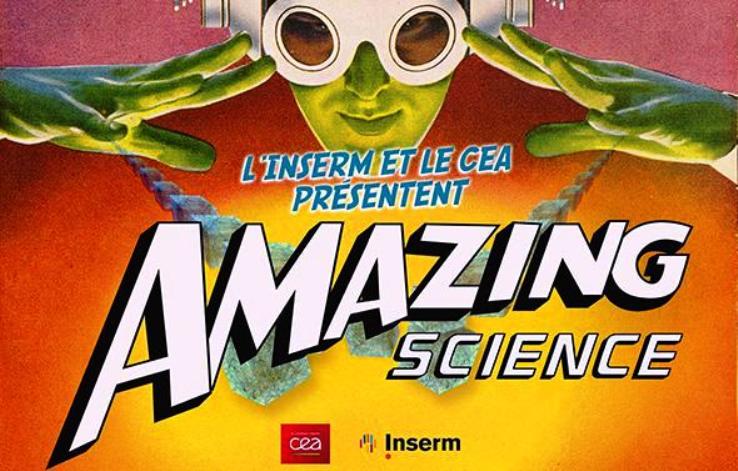
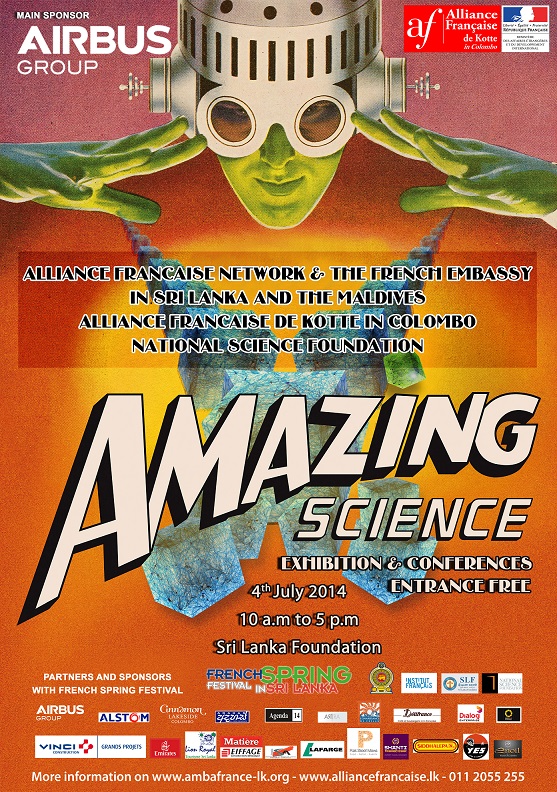
AMAZING SCIENCE comes to Colombo, Sri Lanka, on 4 July 2014 as part of the French Spring Festival organised by Alliance Française de Kotte in COLOMBO and its partners.
Here’s the day’s program, to be held at Sri Lanka Foundation Institute, Independence Avenue, Colombo. I’ll be speaking on “Long shadow of Pulp Science Fiction: Popular culture for promoting science and imagination” at 11 AM, and repeating it again at 1 PM.
Amazing Science in Colombo – Programme for 4 July 2014
Amazing Science is a travelling exhibit put together by French scientific institutes inspired by American ‘pulp’ science fiction magazines during the first half of the 20th century.
As the creators say, it “takes you on an exploratory journey into uncharted territory, on the frontiers of pulp culture, science fiction and scientific research”.
The exhibition revives the old “pulp” look through a blend of scientific research, creative writing and popular culture. From the infinitely small to the infinitely large, the most advanced areas of science are now the realm of unexpected encounters with the real and the imaginary worlds. Each of the exhibition panels features scientific visuals based on a specific research area.
Here’s the Abstract of our own talk:
Long shadow of Pulp Science Fiction: Popular culture for promoting science and imagination
by Nalaka Gunawardene, science writer
and S M Banduseela, science fiction translator
‘Pulp magazines’ is a generic term for inexpensive magazines published in the United States from 1896 to the 1950s. They provided popular entertainment, especially before broadcast television became well established, and carried illustrated short stories and serialized stories in categories like adventure, travel, detective and science fiction.
This illustrated presentation will look at the role pulp magazines played in promoting science fiction writing and reading as part of 20th century popular culture. Many who later became mainstream writers, such as Robert A Heinlein, Arthur C Clarke, Isaac Asimov and Ray Bradbury first established themselves by writing to such publications.
In this talk, we look at how pulp science fiction inspired scientific discovery and innovation in areas as diverse as space exploration, computer science, robotics, evolution and materials science.
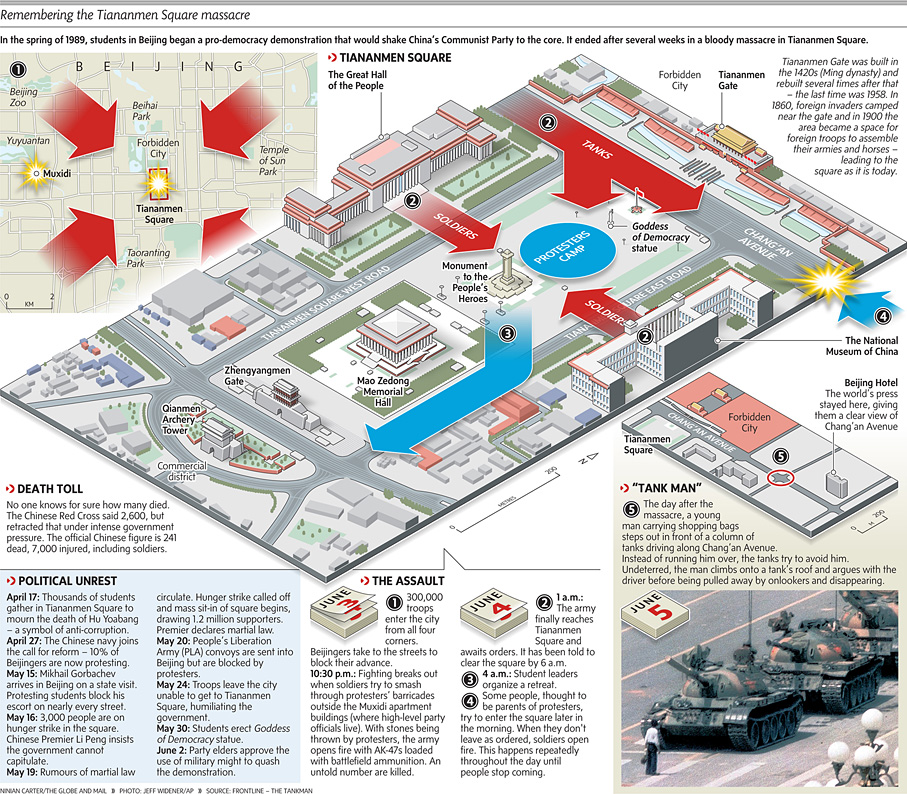
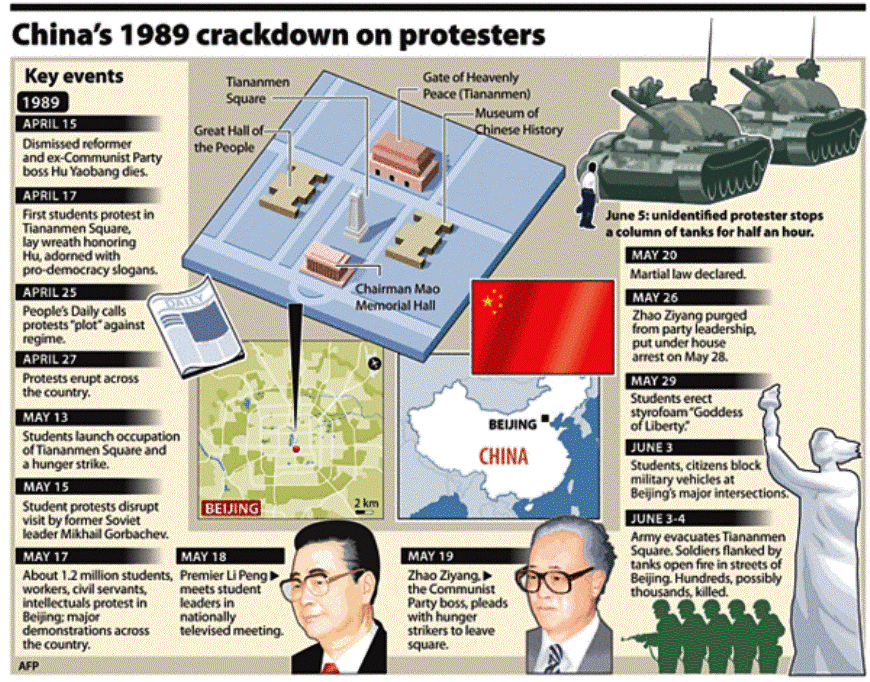
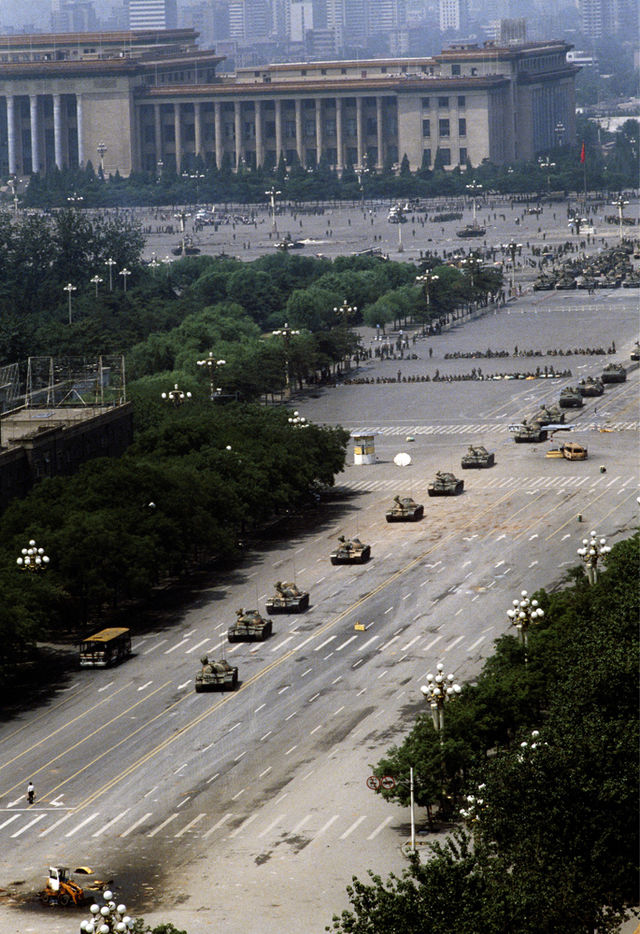
June 2014 marks the 25th anniversary of the Chinese government’s brutal crackdown on protesting students at Beijing’s Tiananmen Square.
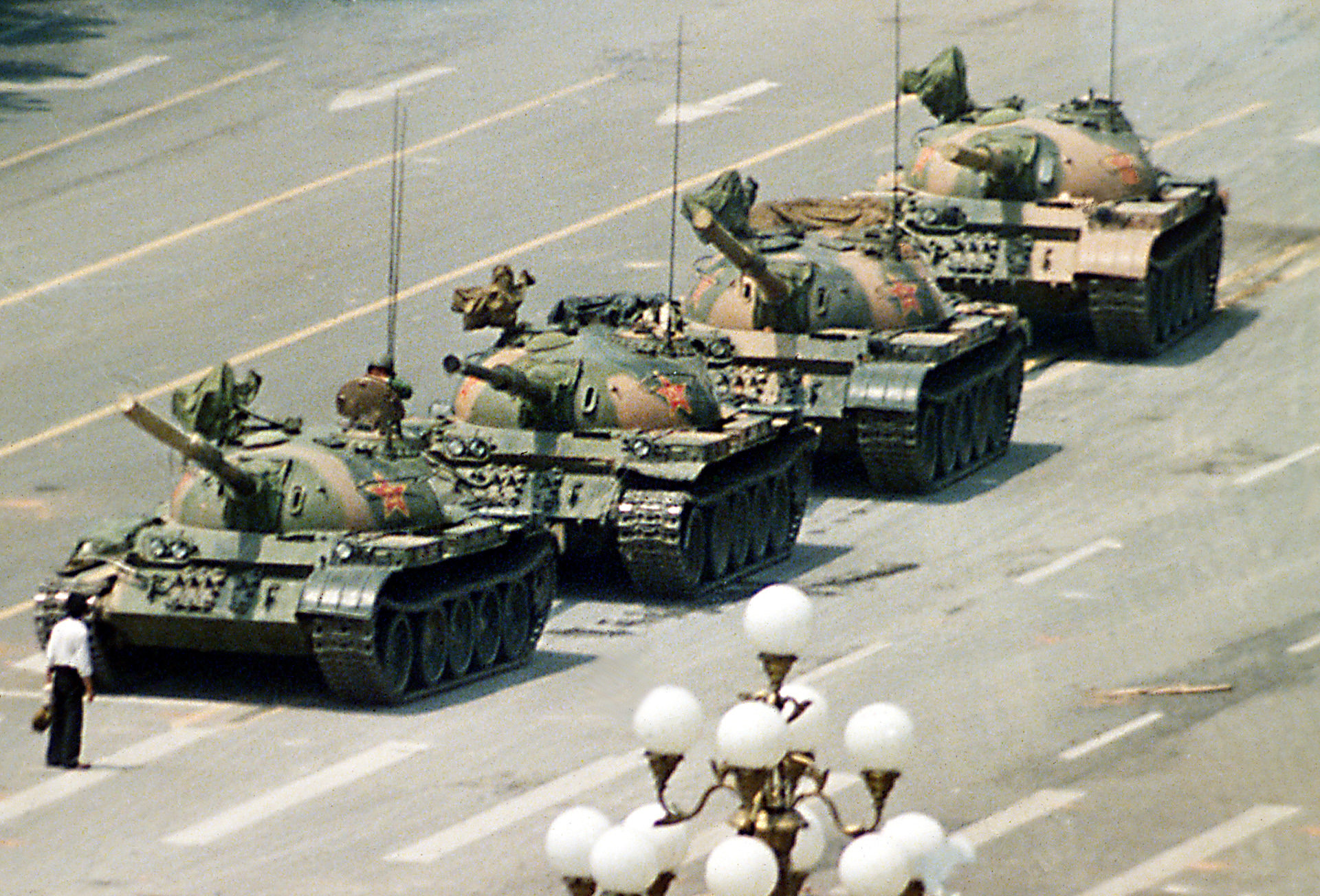
There was one iconic image from that tragedy. It shows a solitary, unarmed Chinese man standing up against a column of battle tanks rolling down a street. In this week’s Ravaya column (in Sinhala), I salute that unknown man who — momentarily, at least — stood up against the largest army in the world.
World Conference on Youth 2014: Colombo, Sri Lanka
When I was invited to speak at World Conference on Youth 2014, being held in Colombo, Sri Lanka, this week, I accepted on one condition: that I don’t have to ‘clear’ my remarks with anyone before delivering. (This precaution was necessary as the host government of Sri Lanka is not known for its capacity to accommodate divergent or dissenting points of view.)
The organisers — Ministry of Youth Affairs & Skills Development — kept their word, and I just spoke at a session on Realising Peace, Reconciliation and Ending Violence. The theme is apt, especially in view of forthcoming fifth anniversary of the end of Sri Lank‘s civil war.
Alas, we had no opportunity to discuss any of the speeches due to sessions starting late. But I was able to engage several youth delegates, both from Sri Lanka and around the world, who apparently shared my idealism.
Here then is the text of my remarks (slightly ad-libbed during delivery):
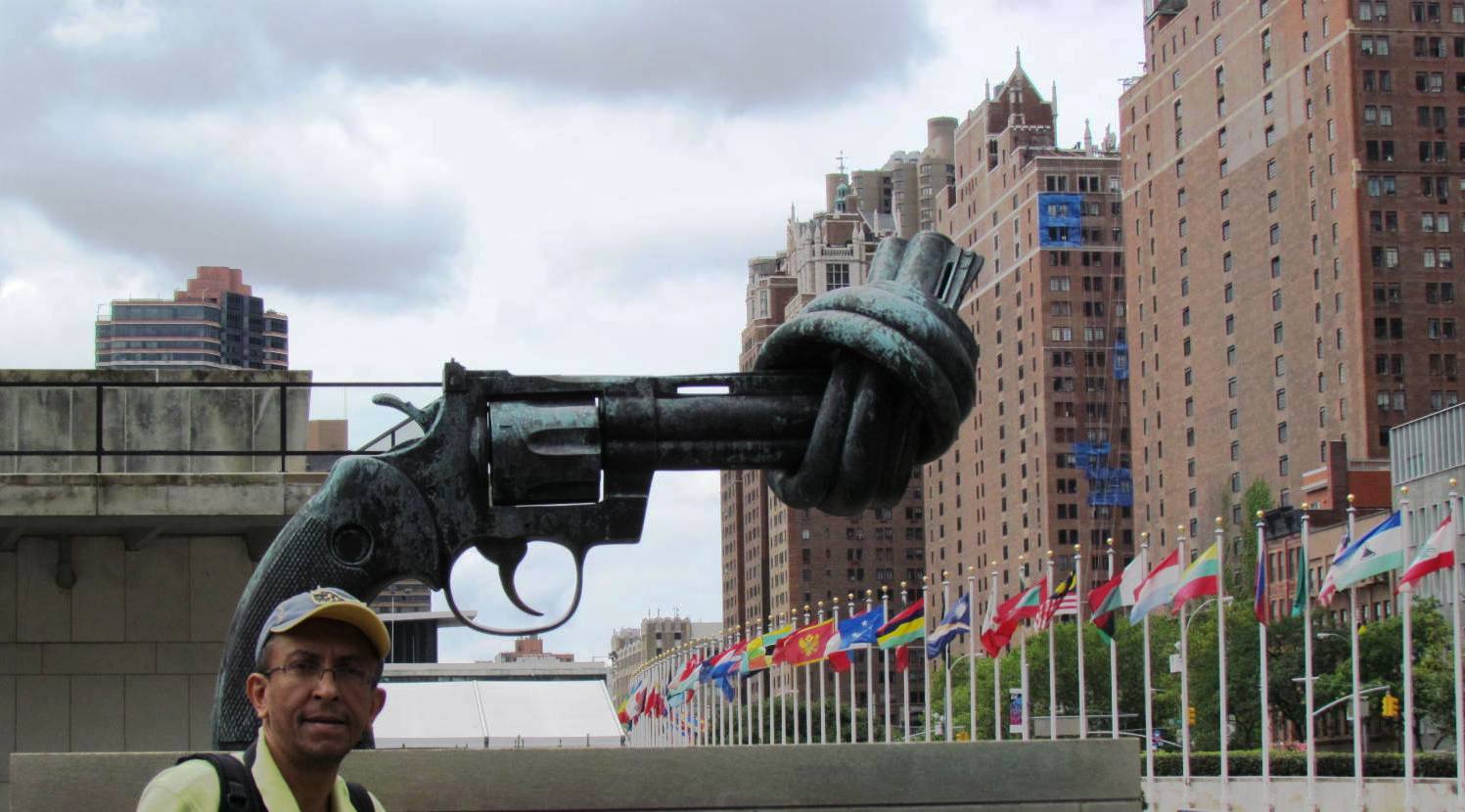
Knotted gun sculpture at UN Headquarters in New York, made by Swedish artist Carl Fredrik Reuterswärd – Photo by Dhara Gunawardene, 2011
Theme: Realising Peace, Reconciliation and Ending Violence
Remarks by Nalaka Gunawardene
Science writer, columnist and blogger
I thank the organisers for this opportunity.
Participating today reminds me of the IDEALISM, HOPE & PASSION with which I took part in similar events in my own youth – which was not that long ago!
In particular, I remember two instances:
A quarter century ago, as an undergraduate, I took part in an Asian regional Model United Nations conference held in Kuala Lumpur, Malaysia. The topic assigned to our group was VIOLENCE WITHIN AND BETWEEN SOCIETIES.
In all eagerness, we explored big questions such as:
Do we humans have an evolutionary inclination for aggression and violence?
What socio-economic factors trigger youth unrest and insurrection?
How does culture aggravate or mitigate conflicts?
For several days, a few dozen of us from across Asia discussed and debated this and other key concerns.
Five years later, as a young journalist, I had the opportunity to attend the World Youth Leadership Summit, held at the UN headquarters in New York. In the fall of 1995, around 200 of us from around the world came together to discuss the state of the world – and our role in shaping its future!
Again, a key topic that occupied our minds was the RISING VIOLENCE WITHIN OUR SOCIETIES. Not just civil wars and crime — but also INSTITUTIONALISED DISCRIMINATION and STRUCTURAL VIOLENCE.
These discussions enhanced my understanding of violence, which has become more SOPHISTICATED and INSIDIOUS in today’s world.
STRUCTURAL VIOLENCE as a concept was introduced in 1969 by the Norwegian sociologist and peace researcher Johan Galtung. He defined it as: “any form of violence where some social structure or social institution may harm people by preventing them from meeting their basic needs”.
There are many examples of STRUCTURAL VIOLENCE in our societies. Among them:
institutionalized elitism;
ethno-centrism;
racism;
sexism; and
nationalism
STRUCTURAL VIOLENCE affects people differently in various social structures, and is closely linked to SOCIAL INJUSTICE.
So, in a broad sense, campaigns for HUMAN RIGHTS & SOCIAL JUSTICE are attempts to resist – and ideally, reduce – structural violence. These mass movements include:
the CIVIL RIGHTS movement in the US;
WOMEN’S RIGHTS movement worldwide;
ANTI-APARTHEID struggles in South Africa;
current global efforts to reduce absolute POVERTY; and
the on-going struggle for recognizing rights of lesbian, gay, bisexual and transgender (LGBT) groups.
While fewer people are dying today in conflicts between nations, or even those within nations, we cannot rejoice: we still have many faces of STRUCTURAL VIOLENCE and SYSTEMIC VIOLENCE.
So did we save the world in the Fall of 1995 through all our eager and idealistic discussions at the UN Headquarters?
No, we didn’t. Our world is still an UNJUST, UNFAIR and UNSAFE place for too many human beings.
But experiences and exposure like that probably SAVED ME – from becoming an uncritical and unquestioning peddler of the dominant narrative. It opened my mind – to question rhetoric and spin, coming from governments, UN agencies and even civil society.
That is probably the greatest benefit of conferences like this:
opening of our minds;
deepening of our understanding & empathy; and
broadening of our perspectives.
I wish I could tell you that Sri Lanka offers a fine example of post-war RECONCILIATION. But our reality is actually more complex and complicated.
Five years ago this month, we witnessed the end of Sri Lanka’s CIVIL WAR which last for over 25 years. As a diverse nation and a pluralistic society, our people felt many different emotions about that defining moment.
One sentiment most of us shared was a HUGE SENSE OF RELIEF. And some of us also felt a huge sense of RESPONSIBILITY –
for HOW the war was ended; and
the enormous rebuilding and healing that had to be done.
Five Years later…
The factors that led to the violent conflict still remain largely unaddressed. These include concerns about governance, political power sharing, and economic benefit sharing – issues that youth feel strongly about.
In the past 40 years – in my lifetime – similar concerns have triggered two other youth insurrections in Sri Lanka — in 1971 and in the late 1980s. Both were suppressed violently by the state in the name of law and order. The scars of those wounds have not yet healed either.
In this sense, many of us have three layers of scars from recent violence. And we realise, belatedly, how HEALING involves more our HEARTS than our MINDS.
We know that PEACE is much more than the simple absence of hostility. Likewise, RECONCILIATION entails much more than a mere co-existence of groups who were once engaged in a conflict.
RECONCILIATION cannot be decreed by leaders……or legislated by governments. Technocratic solutions are helpful — but not sufficient — to achieve RECONCILIATION.
Progressive state policies can nurture RECONCILIATION — but in the end, TRUE HEALING must spring from all of us… individually and collectively.
It’s not EASY, and it’s not always POPULAR. But it’s a worthy goal to aspire to!
Building SUSTAINABLE PEACE requires time, effort – as well as a switch in our mindset. We must face HARD TRUTHS, acknowledge them, and hopefully, FORGIVE…
There is cultural conditioning that stands in the way. Historically, many societies have glorified war, weaponry and combat. AGGRESSION is often seen as a sign of strength…and of masculinity.
With this inertia of history and culture…can we replace confrontation and conflict with cooperation and collaboration?
The religious case for this is well known. But I hesitate to invoke religions as they have inspired so much hatred and violence.
In recent years, we have seen a growing body of scientific evidence and theories that argue that COLLABORATION HAS A GREATER SURVIVAL VALUE than aggression.
This is contrary to the long held Darwinian notion of the ‘survival of the fittest’. It now appears that virtues like KINDNESS, GENEROSITY and SHARING are more than just moral choices: they are useful EVOLUTIONARY TRAITS too!
The developmental psychologist Michael Tomasello has been studying the EVOLUTION OF TOLERANCE & TRUST among human beings and the role it plays in today’s societies. He and other researchers have drawn attention to the evolutionary benefits of COLLABORATION and ALTRUISM.
There is no consensus yet among experts. Anthropologists, evolutionary biologists and sociologists keep debating about:
individual selection vs. group selection in evolution; and
whether aggression or collaboration has key survival value.
As Harvard biologist Edward O Wilson summed it up in his recent book, The Social Conquest of Earth:
“The human condition is an endemic turmoil rooted in the evolution processes that created us. The worst in our nature coexists with the best, and so it will ever be.”
So our big challenge is: How to tame our worst evolutionary baggage, and instead bring out our best as a species?
I don’t have any quick answer. But this is among the questions we must all keep asking – and keep looking for practical, thoughtful answers.
Dear friends,
It’s easier to have abundant IDEALISM, HOPE & PASSION when you’re 18 or 25 or even 30. It’s harder to retain these values when you’re approaching 50 — as I am, now. But I keep trying!
I wish you stimulating conversations. I hope you’ll find enough common ground — while not forcing any artificial consensus!






 Open Minds!