I cry, therefore I am“If you have tears, prepare to shed them now,” urged Mark Antony to fellow Romans after Julius Caesar died.
But what if you simply don’t have any tears to shed? That’s what my eye doctor recently cautioned me, after a routine examination. The natural tearing in my eye, necessary for keeping it moist and clean, wasn’t quite working. There is nothing to worry, he hastened to add, for it sometimes happens as our bodies slowly age. He asked me to use eye drops twice a day for a while.
This set me thinking about the value and power of tears. Although most land mammals have a lacrimation system to keep their eyes moist, humans are the only mammal generally accepted to cry emotional tears.
In my circles, I’m known to be an emotional guy. I have never believed in that macho myth of men not crying. I shed tears of joy and tears of sorrow, sometimes in public. I cry when people I know, admire or love leave this world, sometimes at the most unexpected moments. Powerful movie moments of triumph or despair often move me to tears, as do simple joys of life — such as seeing my kid perform well on stage in a school concert.
Despite what my doctor says, I’ve been shedding plenty of tears this year.
I openly wept when journalist colleague Lasantha Wickrematunge was gunned down in broad daylight on a cruel January day. He was Sri Lanka’s real leader of the opposition.
My eyes were completely misty when the news of the original TV news anchorman and broadcast giant Walter Cronkite passed away on 18 July 2009 after an illustrious career spanning decades.
Have tears, will shed...Two weeks later, I joined millions of Filipinos in mourning the passage of Cory Aquino, the courageous woman who led the world’s first People Power revolution, toppling one of the worst tyrants of the 20th century.
In contrast, Michael Jackson’s death on 25 June didn’t immediately move me to tears, even though I quickly wrote a tribute. But the live broadcast of his star-studded funeral service on 6 July did. I watched it in the solitude of a hotel room in Amsterdam on a warm summer evening, and cried — as much for the tragic end of the man as what he stood for. Those tears inspired the op ed essay on the two Moonwalks.
I can add more to this list if I think long enough. The point is: my eye specialist’s clinical examination didn’t capture these highlights (lowlights?). There’s a part of our emotional lives that our doctors may never fathom. We ourselves are often barely aware of it.
A recent article in Reader’s Digest (March 2009 issue), titled Big Boys Don’t Cry — and Other Myths About Men and Their Emotions, said new research reveals that a man’s emotional life is as complex and rich as a woman’s, but often remains a mystery to him as well as to any woman who loves him. You can say that again!
Conventional wisdom doesn’t encourage or celebrate grown men crying. One of my favourite poems is ‘Solitude’ by Ella Wheeler Wilcox, which opens with these memorable lines:
“Laugh, and the world laughs with you;
Weep, and you weep alone;
For the sad old earth must borrow its mirth,
But has trouble enough of its own.
Sing, and the hills will answer;
Sigh, it is lost on the air;
The echoes bound to a joyful sound,
But shrink from voicing care.”
My close friends think I’m melancholic by nature, and long ago I came to terms with who and what I am. I don’t spend my days lamenting or weeping, for sure, but I also don’t hesitate to cry when the emotion warrants it.
It's planet saving time...and everybody is invited!
Can ordinary people help save our planet?
What does it take to change their attitudes and lifestyles to consume and waste less?
For over two years, my team at TVE Asia Pacific and I have been working on a new TV series, modestly called Saving the Planet. It will be released at a regional conference in Tokyo, Japan, on 22 August 2009.
In this Asian series, produced in partnership with Asia Pacific Cultural Centre for UNESCO (ACCU), we profile successful initiatives that combine knowledge, skills and passion to create cleaner and healthier environments.
It was filmed in six countries in South and Southeast Asia: Cambodia, India, Laos, Nepal, the Philippines and Thailand.
The groups profiled in Saving the Planet often work without external funding and beyond the media spotlight. They have persisted with clarity of vision, sincerity of purpose and sheer determination. Their stories inspire many others to pursue grassroots action for a cleaner and safer planet.
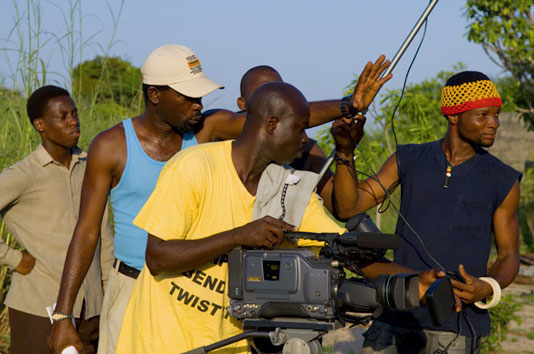
Lights, camera...budget action! Image courtesy 'This Is Nollywood'Here’s a general knowledge question: Everyone knows India’s Bollywood is the world’s largest producer of movies (by number). Which country’s movie industry comes second?
If you said Hollywood, that’s a dated answer. America’s movie industry used to be the second largest in the world — until an unlikely contender turned up from…Nigeria!
Bollywood produced 1,091 feature-length films in 2006 compared to 872 productions (in video format) from Nigeria’s film industry, commonly referred to as Nollywood. In contrast, the United States produced 485 major films.
The three heavyweights were followed by eight countries that produced more than 100 films: Japan (417), China (330), France (203), Germany (174), Spain (150), Italy (116), South Korea (110) and the United Kingdom (104).
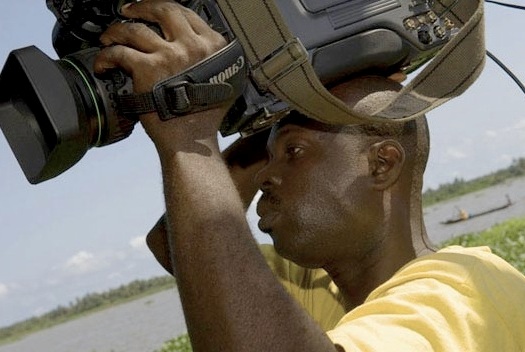
Nigerian filmmakers rely on video instead of film to reduce production costs. And as the survey points out, Nigeria has virtually no formal cinemas. About 99% of screenings occur in informal settings, such as “home theatre”.
This is NollywoodThe UNESCO survey reveals another key element of the Nigerian success story: multilingualism. About 56% of Nollywood films are produced in Nigeria’s local languages, namely Yoruba (31%), Hausa (24%) and Igbo (1%). English remains a prominent language, accounting for 44%, which may contribute to Nigeria’s success in exporting its films.
Nollywood’s rising has been chronicled in a 2007 documentary by Franco Sacchi and Robert Caputo. Called This is Nollywood, it tells the story of the Nigerian film industry – a revolution enabling Africans with few resources to tell African stories to African audiences. Despite all odds, Nigerian directors produce between 500 and 1,000 movies a year. The disks sell wildly all over the continent – Nollywood actors have become stars from Ghana to Zambia.
Says Zambia-born director Franco Sacchi: “When I first read about Nigerian directors producing hundreds of feature-length films with digital cameras, a week, and a few thousand dollars, I found the subject irresistible. Here was not only a rare positive story about Africa, but one that embodied the egalitarian promise of digital technology—anybody can make a movie. And Nollywood was virtually unknown.”
This is Nollywood takes us behind the sets and scenes in one Nigerian movie being made on the cheap — and fast. Acclaimed director Bond Emeruwa sets out to make a feature-length action film in just nine days. Armed only with a digital camera, two lights, and about $20,000, Bond faces challenges unimaginable in Hollywood and Bollywood.
Emeruwa says: “We are telling our own stories in our own way, our Nigerian way, African way. I cannot tell the white man’s story. I don’t know what his story is all about. He tells me his story in his movies. I want him to see my stories too.”
Watch This is Nollywood: Movie Trailer
I then came across this TED Talk by Franco Sacchi, where he takes us through Nollywood (at the time he gave his talk, the world’s third largest and now second only to Bollywood). He talks about ‘guerrilla film-making’ and brilliance under pressure from crews that can shoot a full-length feature in a week.
Welcome to Nollywood is another 2007 documentary film, directed by Jamie Meltzer, that looked at the Nigerian film industry. Its findings were similar to those of This is Nollywood. Traveling to the country’s chaotic capitol, Lagos, Meltzer spent ten weeks following three of Nigeria’s hottest directors, each different in personality and style, as they shot their films about love, betrayal, war, and the supernatural.
At around US$250 million per year (and rising), Nollywood’s capital outlay is far below that of Hollywood and Bollywood. For perspective, that’s a bit less than what it cost to make Spiderman 3in 2007 (budget: US$ 258 million) — the second most expensive film made. See list of most expensive Hollywood films.
Telling their own stories....But what it lacks in capital, Nollywood more than makes up in numbers and mass appeal. As the Wikipedia notes, Nigerian directors adopt new technologies as soon as they become affordable. Bulky videotape cameras gave way to their digital descendents, which are now being replaced by HD cameras. Editing, music, and other post-production work is done with common computer-based systems.
As Colin Freeman wrote in the Daily Telegraph, UK: “While the likes of Serpent in Paradise and Evil Finger may not be as slick as their Hollywood counterparts, they offer one thing that the likes of George Clooney and Brad Pitt can never provide: characters and stories with which an African audience can identify.”
And according to The Economist, it all started in 1992, when Kenneth Nnebue, a Nigerian trader based in Onitsha, was trying to sell a large stock of blank videocassettes he had bought from Taiwan. He decided that they would sell better with something recorded on them, so he shot a film called “Living in Bondage” about a man who achieves power and wealth by killing his wife in a ritualistic murder, only to repent later when she haunts him. The film sold more than 750,000 copies, and prompted legions of imitators.
Raised on popular culture, I have always been an admirer of tabloid journalism – which means using popular formats to reach out to a mass audience in newspapers or broadcasting. There’s nothing inherently wrong with this: we might even argue that the tabloid approach is the only way to achieve truly mass media (with all else being niche media reaching to smaller demographic groups).
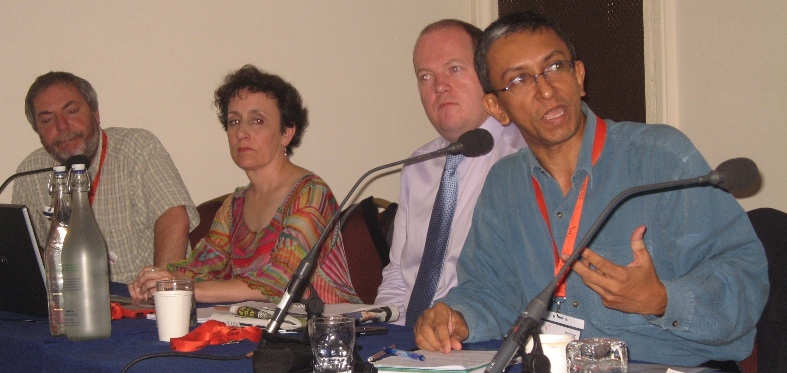
So I was delighted to be on a panel with two leading British tabloid journalists and a popular radio host from South Africa during the 6th World Conference of Science Journalists held in London from June 30 – July 2, 2009.
My own, personal answer is NO — it need not be! And I’ve spent a good part of my two decades of work in the media experimenting and showing that communicating science can be fun — both for us communicators and our audiences.
But I pointed out that science is still being covered in sections of Asian media in the more traditional, classical way, just like science itself is still an elitist pursuit in many of our societies.
L to R: Paul Sutherland, space correspondent of The Sun, UK; Christina Scott, radio and web journalist, South Africa; David Derbyshire, Environment editor, The Daily Mail, UK; Nalaka Gunawardene, Director/CEO, TVE Asia Pacific
I said: “We might call this coverage ‘broadsheet approach’ in print; or ‘bluechip documentary’ format on television. And they are both unsustainable! They are also endangered in these hard times for the mainstream media in most economies.
“So going the tabloid path is a practical and pragmatic way to deliver science stories and science information to a mass audience or readership. We’re doing it in different ways in the Asian media!”
In my remarks, I gave some examples where science is jazzed up (rather than dumbed down) for popular consumption on Asian television. For example, how solar and lunar eclipses provide fodder for endless stories on our numerous news channels. Such coverage, fleeting and superficial as it might often be, takes the wonders of science and Nature to more people than anyone else can.
I argued that the path to the mass audiences in Asia is through news, sports and entertainment programming. We have our own niche, factual channels – Discovery, National Geographic, Animal Planet and their local equivalents. They have a loyal but small audience. They do excellent work. But where numbers are concerned, they cannot – yet! – compete with the outreach and appeal of broadcast radio, TV and newspapers. Neither can the online and mobile media, even though their outreach is growing fast.
Things don’t always go right, however. Doing wall-to-wall coverage of news demands producers and reporters to tackle a variety of topics and subjects — including specialised science stories. Some handle this better than others. In their race for ratings and revenue, a few ‘dress up’ the stories a bit too much.
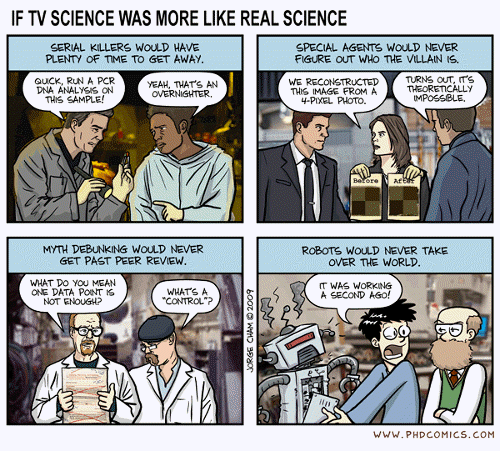
Television science: aspiration or reality?A good example was how some Indian news channels handled the so-called ‘Big Bang experiment’ in September 2008, when the Large Hadron Collider (LHC) was commissioned. The mega-science experiment was interesting in its own right, but it wasn’t apparently exciting enough for at least two channels — Aaj Tak and India TV. Their coverage running up to the event speculated about its “catastrophic effect on the world” – effectively end of the world.
Their coverage caused panic, which led to at least one attributable death. This prompted the Indian Ministry of Information and Broadcasting to caution the channels for spreading “misinformation, fear and horror” among viewers. It advised the channels to exercise restraint in presenting such issues.
I call this the ’24/7 TV Deficit’ in Asian broadcasting. The long term response to this is to invest in training and capacity building of journalists and producers already working in the media. For the most part, they learn on the job, making mistakes on the air. This is far from ideal.
Here’s how I summed up: ‘Tabloid science coverage’ – in print or broadcast – may be imperfect in some ways. But our choice is either that, or nothing. Our challenge is to make the process and product better as we go along.
We urgently need to unleash scientific knowledge and understanding in matters of public interest and public policy. We can’t afford the ALL or NOTHING approach.
One man vs. the mighty Red Army - photo by Jeff Widener for Associated Press
This is of the most famous photos of modern times. The official caption, given by Associated Press, reads: “An anti-government protester stands in front of artillery tanks in Beijing’s Tiananmen Square on June 5, 1989, at the height of the pro-democracy protests.”
It’s a moment deeply etched in the consciousness of our media-saturated world. The solitary, unarmed man was standing up against not just a brute of a tank, but the might of the entire Chinese Red Army, which had just cracked down ruthlessly on pro-democracy student protests.
It was on the morning of June 5 that the Tank Man appeared from nowhere. A line of 18 tanks were pulling out of Tiananmen Square and driving east along the Avenue of Eternal Peace. The previous day, the square had been cleared of students and much blood had been spilled. The streets were now empty except for soldiers.
Suddenly a man in a white shirt and black trousers, with a shopping bag in each hand, steps out on to the road and stands waiting as the tanks approach. The lead vehicle halts, assessing its options.
It moves right to go around him. The man waves the shopping bag in his right hand then dances a few steps to the left to block the tank again. The tank swerves back left to avoid him. The man waves the bag again and stepps to the right. Then both stop. The tank even turned off its engine.
Then more things happened.
Watch a video montage of this breathtaking standoff, captured by western journalists filming from a safe distance:
Watch first few minutes of the 2006 PBS documentary on the Tank Man incident and aftermath:
Twenty years on, the identify of the Tank Man remains a mystery. There are conflicting reports on who he was, and what happened to him after that single, defining act of defiance. Practically all we know is that he wasn’t run down by the tanks, and was instead arrested a few minutes later by the Chinese authorities. Naturally, there are few official comments on the incident or the Tank Man.
But during those few minutes, when individual soldiers hesitated and refrained from running him over, the Unknown Rebel secured his worldwide fame. He probably wasn’t doing it for any notion of posterity – in all likelihood, he was horrified bystander who’d seen the carnage in the preceding days and felt, as we do from time to time, that enough was enough.
And unlike most of us, he decided to risk his life to register his protest. In April 1998, Time magazine included the “Unknown Rebel” in its feature entitled Time 100: The Most Important People of the Century.
Charlie Cole, a Newsweek photographer who captured the moment, says: “Personally I think the government most likely executed him. It would have been in the government’s interest to produce him to silence the outcry from most of the world. But, they never could. People were executed at that time for far less than what he did.”
In early June 2009, a fifth photographer shared his own image of the incident – disclosing photos that had never before been circulated. Associated Press reporter Terril Jones revealed a photo he took showing the Tank Man from ground level, a different angle than all of the other known photos. (Tank Man is the second from left, in the background.) Jones initially didn’t realise what he had captured until a month later when printing his photos from that momentous week.
As we celebrate the memory of the Tank Man – and his defiance of brutal, oppressive use of state power to crush dissent – we must also salute the courage and resourcefulness of photojournalists and TV reporters who risked their own lives to capture this moment for posterity. Tank Man became iconic only because his act was frozen in time by those bearing witness. All too often, states – from Burma to Zimbabwe, and others in between – ensure that there is no one to bear such witness when they unleash the full force of police, armies and weapons on their own people.
There can be no doubt that Tank Man was not the first of his kind, nor would he be the last. Other ordinary men and women have found uncommon courage to stand up against injustice and state brutality wielded in the name of national security, law and order or anti-terrorist crackdown. But in the absence of witnesses – whether professional journalists or citizen journalists – the rest of the world will never know.
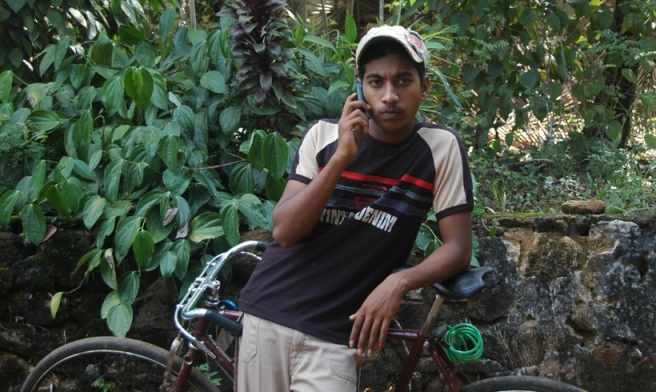
Chamara Pahalawattage: At 18, he is already using his 6th mobile (Photo by Niroshan Fernando, TVEAP)
When many able-bodied young men and women of his age were joining the armed forces in large numbers, Sri Lankan school-leaver Chamara Pahalawattage chose differently. He decided to try his luck with odd jobs at construction sites.
That, by itself, was nothing unusual. Tens of thousands of young men and women like Chamara join the labour market every year. Schools don’t equip them with attitudes or skills for self employment, so most would idle years away looking for regular jobs in Sri Lanka’s public and private sectors. Frustration would prompt some to take to political agitation, or worse.
Chamara is at such crossroads in his own life, but he is unlikely to go astray. The enterprising young man has boosted his chances of part-time work by getting himself a mobile phone.
“After buying a phone, I get calls asking me to come for work. The phone makes it so easy,” he says. “Otherwise people will have to come looking for me…or I have to go to them.”
If a skilled mason or carpenter takes him on as an assistant, Chamara gets a daily wage of LKR 700 (US$ 6 approx) plus a mid-day meal. That income augments the modest LKR 4,000 a month (US$35) his mother makes cooking meals at a nearby factory.
In February 2009, we filmed a day in the life of Chamara, a resident of Gonapola, in Sri Lanka’s western province. This was part of a profiling of telephone users at the bottom of the (income) pyramid – or BOP – in emerging Asian economies, undertaken by TVE Asia Pacific on behalf of the regional ICT research organisation LIRNEasia.
Watch our short video profile of Chamara Pahalawattage:
Going by his household income, Chamara is BOP at the moment – but his aspirations extend above and beyond. An only child raised by his widowed mother, Chamara developed an interest in mobiles while still in his mid teens. He bought his first mobile two years ago, when in Grade 11 at school.
“Almost everyone had phones, so I also wanted one,” he recalls. “From then on, I got used to having a phone!”
And has he been keeping up with technology! He buys second-hand phones for better features: he currently owns his sixth phone in just over two years. He had paid LKR 7,500 (US$ 65) for his latest phone at the beginning of 2009.
Besides voice and SMS (texting), his phone supports MP3, video recording, song downloading, voice recording and some other functions. After a hard day’s work, he unwinds listening to the radio, or swapping songs with friends — all using their mobiles.
Chamra spends an average of US$3 to 4.50 per month on phone use, and – like all other BOP telephone users we interviewed in India, Philippines and Thailand – he is thrifty with value added services that cost extra. This is something that has been confirmed by LIRNEasia’s Teleuse@BOP 2008 survey.
“Some of my friends access the internet through their phones and download songs,” he says. “I then get these songs from them. My phone has bluetooth. I use it to transfer songs from my friends’ phones.”
Chamara has every intention of moving up the labour market – someday, he wants to hold a more regular job, with an assured monthly income. Right now, in spite of being connected, he can’t predict how many days a month he’d find work.
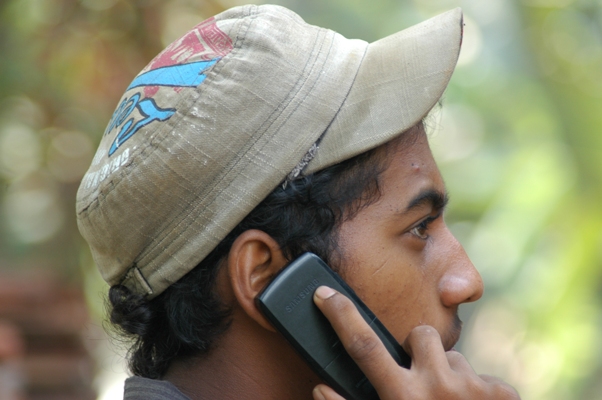
Hello, can you hear our dreams? Photo by Niroshan Fernando, TVEAP“I don’t check newspapers for jobs. Instead I ask the people I know…mostly my friends,” he says. This probably indicates another shift from a wide-spread habit among literate Sri Lankans scanning newspapers for recruitment notices.
LBO 9 March 2009: Sri Lankan low income customers can use mobiles more for business: study
The official end of the 30-year-long war should be good news for Chamara and millions of other tech-savvy, eager youth like him. Like me, they can once again start dreaming of better tomorrows.
Telecommunications would be a good place to start. For several years, it has been the fastest growing sector in the Sri Lankan economy — one that has not only connected people across distances and cultures, but also been a ‘social leveller’.
The telephone subscriber base grew by 35.5% in 2008 (and 47% in 2007). The country’s tele-density (number of telephones per 100 persons) jumped to 71.9 in 2008, from 53.4 in 2007 -– thanks largely to the phenomenal spread of mobile phones.
As I noted last year: “It is not by accident that telecom has remained the fastest growing sector in the economy for a decade. This was triggered and sustained by the far-reaching policy and regulatory reforms which ended the then fully state-owned telecom operator’s monopoly, and allowed the entry of new players, technologies and business models.”
Of course, improved telecommunications are necessary, but not sufficient by itself, for us to evolve into an inclusive information society. Building on technology and systems, we must become discerning creators and users of information. Knowledge – not paranoia or rhetoric – needs to form the basis of policy and actions that propel us to the future.
Photos courtesy Niroshan Fernando, TVE Asia Pacific
The framework, building on a dozen years of TVEAP experience in working with television broadcasters and other media outlets across the Asia Pacific region, guides individuals and institutions to get the best out of the media. One key to success is building sustained relationships with media professionals and their gatekeepers (the bosses at media organisations who decide what content to publish or broadcast).
We introduced the framework to a group of ICT researchers drawn from across Asia who came together for a two-day workshop in Hyderabad, India, on 1 – 2 December 2008. The workshop aimed to build their capacity to use different communication frameworks and tools to engage policy makers, various other stake-holders and the wider public.
Our friends at IDRC have recently edited highlights of our presentation into a short video, which mixes excerpts from an interview they filmed with me. It can be watched here:
“Development” is seen as a hard sell in the increasingly commercialised media in the Asia Pacific. Researchers, activists and educators engaged in development work often complain that they are blocked out of the print and broadcast media. Yet they fail to understand a basic truth about the media: there is no quota of print space or air time set aside for development. Information and opinions on development topics must compete with other areas of human endeavour for the limited space and time available.
It is unrealistic to expect any legally or otherwise guaranteed space or time for development content. Even if there were, that can only apply on the media owners and media professionals. There can be no guarantee that media audiences will accept such content.
I get rather weary when well-meaning development players complain about the airwaves being full of entertainment, as if that airtime is something they have been deprived of. There is nothing intrinsically wrong with entertainment. The world will be a very dull place if the broadcasters listened to development people and packed every minute of air time with ‘information and education’.
Hitch a hike, but don't expect to get in the driver's seat...
This is the big challenge to the development community — how to get that delicate balance right, and learn to co-exist with other forms of media products catering to the wide and varied human interests. Hitch-hiking with the media avoids confrontation, looks for the common ground and tries to nurture collaboration for mutual benefit.
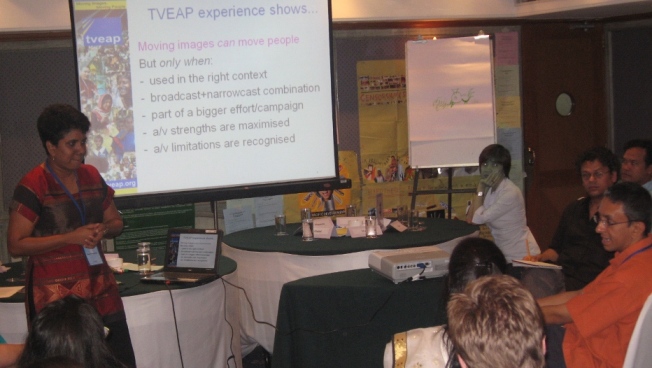
As my colleague Manori Wijesekera (presenting in the photo above) told the Hyderabad workshop: “Researchers and activists are a good source of information and opinions for the media, who need a constant supply of these. This can be a win-win situation for both parties, but we have to remember that we are hitching a ride with the media. So we can’t get into the driving seat or demand too much at once!”
So here’s our commercial: TVEAP conducts short, customised training sessions and workshops for researchers and civil society groups to enhance their media skills. These offer guidance on how to build and sustain ‘bridges’ with the media, and receive quality coverage that go well beyond publicity and public relations. If interested, get in touch with us!
Actress Whoopi Goldberg was a child of 10 when the original series of Star Trek started its first broadcast on NBC in the US in September 1966. The futuristic science fiction series – about a spaceship travelling across space and time in the 23rd century in search of new civilisations – was to leave a lasting impression on many members of her generation.
In Whoopi’s case, it went beyond just general inspiration. Something in the show seemed incredible to the African-American child growing up in a land where colour and race were still divisive factors. She recalls running around the house, screaming: “Hey mom, look! There’s a negro woman on TV — and she ain’t cooking dinner!”.
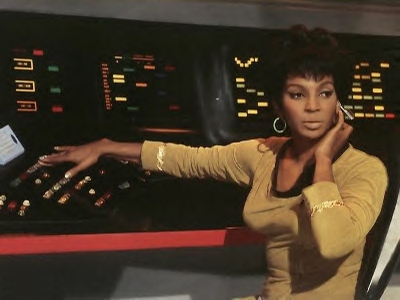
‘That woman’ was the character Nyota Uhura, played by Nichelle Nichols. This anecdote is captured in the 1997 documentary Trekkies, which explored the global fandom inspired by the show, which has gone on to become a franchise covering several TV series, 11 feature films (including the latest ‘origins’ film released on 8 May 2009), an animation series, as well as numerous books, video games and computer games. As Forbes magazine once noted, the allure is comparable only to that of Star Wars.
Sometimes, less is more!Uhura featured as the communications officer on board the USS Enterprise in Star Trek: The Original Series, Star Trek: The Animated Series, and the first six Star Trek films. She is significant as one of the first major black characters on an American television series and for engaging in a then-taboo interracial kiss with Captain James T. Kirk (William Shatner). In the 2009 film, a younger Uhura is portrayed by actress Zoë Saldana.
The inclusion of Uhura, a black woman, in a critical technical position was certainly idealistic in the mid 1960s when the American civil rights movement was still agitating for equal rights for African Americans. She one of the first black women featured in a major television series not playing a servant; her prominent supporting role as a female black bridge officer was unprecedented.
As I’ve just noted in another blog post: “At a time when there were few non-white or foreign roles in American television dramas, Gene Roddenberry created a multi-ethnic crew for the Enterprise, including an African woman, a Scotsman, a Japanese American, and—most notably—an alien, the half-Vulcan Spock. In the second season, reflecting the contemporaneous Cold War, Roddenberry added a Russian crew member.”
But was the character, donning a sexy mini skirt uniform, somewhat tokenistic? Perhaps. But it still had considerable inspirational value – which is never to be under-estimated.
In fact, after the first season of Star Trek, Nichols had become frustrated at her relative lack of lines. At one point, she considered quitting the show, but was talked out of this decision by the civil rights leader Dr Martin Luther King, Jr.. MLK told her that a show that depicted a black woman working alongside whites in a position of importance was important for the goal of racial equality.
Another version of the story has MLK telling Nichols that he was a big fan of the series, and she “could not give up” since she was playing a vital role model for black children and young women across the country. It is also often reported that Dr. King added that “Once that door is opened by someone, no one else can close it again.”
After NBC executives cancelled Star Trek in 1969, Nichols went on to star in other roles — and also worked for NASA in a campaign to encourage African Americans to join the space service. Among those she helped recruit was Dr. Mae Jemison, the first African-American woman to fly aboard the Space Shuttle, in September 1992. Jemison has cited Star Trek as an influence in her decision to pursue a career in space.
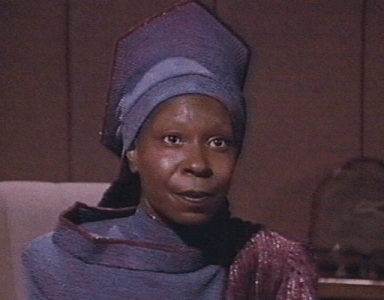
Goldberg: From inspiration to a regular roleMeanwhile, things came full circle for actress Whoopi Goldberg, who was to get her own regular role in Star Trek: The Next Generation whose original run lasted from 1987 to 1994. In this successor series, she played the recurring El-Aurian female character Guinan.
Things have also moved on in the real world, where Barack Obama is now the President of the United States, with Michelle Obama as one of the most influential – if not powerful – women in the world. On 28 April 2009, CNN ran a story titled Why Michelle Obama inspires women around the globe. It noted: “Those who focus on Michelle Obama’s impact on America are underestimating her reach. The first lady is inspiring women of color around the globe to look at themselves, and America, in fresh ways.”
There is no linear link between Nyota Uhura and Michelle Obama, and the real world has very far to go to reach the utopian ideals of Star Trek. But the very fact that we have the Obamas where they are is an assurance that things can slowly move towards Gene Roddenberry’s grand vision.
Going where no trekkie has gone before?I’m exactly as old as Star Trek: we were both born a few months apart in 1966 (I’m older by seven months). But because we grew up on opposite sides of planet Earth in the pre-Internet era, our worlds didn’t collide until we were both well into our teens. From then on, I’ve been a Trekkie/Trekker since.
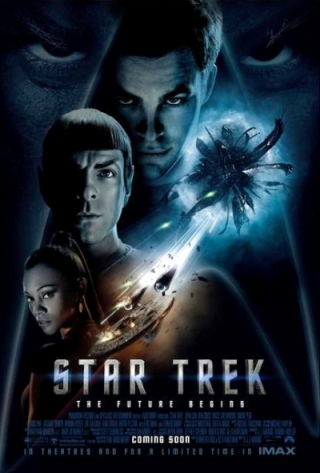
I can’t wait to see the latest (11th) Star Trek movie that opened on 8 May 2009. It’s an ‘origins’ movie – a chronicle of the early days of Captain James T. Kirk and his fellow USS Enterprise crew members. Read plot on Wikipedia.
Our world was very different when the one-time US Army pilot, screenwriter and TV producer Gene Roddenberry created Star Trek, the original series. It started airing on the US network NBC in September 1966. The Space Age was less than a decade old, and only a few men (and a couple of women) had made short trips to near Earth orbit. The great Space Race was in full swing, and NASA was spearheading the largest peace-time operation in history, aimed at landing men on the Moon and getting them safely back before the decade was out.
Star Trek, in contrast, offered ambition and hope. Every week at the appointed time, the United Star Ship Enterprise and its intrepid crew took viewers roaming around the universe. The stories appealed as much for insights into the infinite possibilities (and combinations) of life, technology, compassion and power at a cosmic scale, as for its glimpses of the near-Utopian human society in the 23rd century.
As Manohla Dargis, said this week reviewing the latest Star Trek movie (2009) in The New York Times: “Initially aired in 1966, Star Trek was a utopian fantasy of the first order, a vision of the enlightened future in which whites, blacks, Asians and one pokerfaced Vulcan are united by their exploratory mission (“to boldly go”), a prime directive (do no harm) and the occasional dust up.”
According to Dargis, the enduring appeal of Star Trek and the global cult following it inspired is “a testament to television’s power as myth-maker, as a source for some of the fundamental stories we tell about ourselves, who we are and where we came from.”
And, we might add, where we are headed. The show was unique, for its time, for its portrayal of diversity and unity among the wider cast of characters. As the Wikipedia notes: “The show was unique, for its time, for its portrayal of diversity and unity among the wider cast of characters. As the Wikipedia notes: “At a time when there were few non-white or foreign roles in American television dramas, Roddenberry created a multi-ethnic crew for the Enterprise, including an African woman, a Scotsman, a Japanese American, and—most notably—an alien, the half-Vulcan Spock. In the second season, reflecting the contemporaneous Cold War, Roddenberry added a Russian crew member. “
This utopian scenario needs to be contrasted with the prevailing reality of the American Space Programme. No American had ventured beyond near Earth orbit in 1966, and NASA was struggling to catch up with the Russians. Yet, by the time Star Trek original series finished its initial run in September 1969, Neil Armstrong and Edwin Aldrin had returned safely and triumphantly from the Moon. In the event, the Apollo programme landed a dozen astronauts on the Moon, all of who returned safely – as did the astronauts of the disaster-stricken mission, Apollo XIII. Without exception, all of them were white and male.
The journey has only just begun...It took many years for reality to catch up with Star Trek‘s vision, and then, only just. Although a Russian (Valentina Tereshkova) had become the first woman in space early on in 1963, it took the Americans another 20 years to have their first woman astronaut: Sally Ride, who traveled to Earth orbit on the Space Shuttle in June 1983. A few weeks later, in August that year, Guion “Guy” Bluford, Jr., became the first black American astronaut. Multi-cultural crews did not become commonplace until the late 1990s, when the International Space Station became operational.
It wasn’t just racial equality and harmony that Star Trek advocated in its subtext. While bringing intellectually stimulating entertainment, it also celebrated values like compassion and tolerance. In the Cold War world locked into Mutual Assured Destruction (MAD), Star Trek gently reminded viewers that mutual co-existence was a viable option…if only enough effort was invested in it.
As space visionary and science fiction grandmaster Sir Arthur C Clarke noted in a 40th anniversary tribute to the series in 2007: “Appearing at such a time in human history, Star Trek popularised much more than the vision of a space-faring civilisation. In episode after episode, it promoted the then unpopular ideals of tolerance for differing cultures and respect for life in all forms – without preaching, and always with a saving sense of humour.”
He then added, in characteristic style: “Over the years, the sophistication of storylines and special effects has certainly improved, but Star Trek retains its core values – still very much needed in our sadly divided and quarreling world.”
The Enterprise will be cruising the galaxy for centuries to come...
“All things are connected. Whatever befalls the earth befalls the sons of the earth. Man does not weave the web of life; he is merely a strand of it. Whatever he does to the web, he does to himself.
“What is man without the beasts? If all the beasts were gone, man would die from a great loneliness of the spirit. For whatever happens to the beasts, soon happens to man. All things are connected.”
These words resonate very well in the environmental community, and are in fact considered to be something like a gospel of the greens. They are part of a moving speech that native American Chief Seattle is said to have given in January 1854. Read the full text here.
So these would be just the right sentiments to invoke on another Earth Day, right? Yes — except that Chief Seattle never uttered those words. They were, in fact, written by a screen writer in 1971 for a film about pollution and the plight of the Earth, called Home.
Tell that to thousands of die-hard greens who swear by Chief Seattle. By now, a couple of generations of people have been moved by the “speech.” Chief Seattle societies have formed in Europe. The supposed remarks have been reprinted widely and authoritatively cited in serious books on environmental issues, and quoted in high level speeches. Hundreds of teachers use extracts in environmental courses.
The man was real; the speech wasn't his
There’s absolutely no doubt that the words pack a great deal of traditional wisdom, poetic expression and what researchers like to call ‘indigenous knowledge’. This is how it ends: “Continue to contaminate your bed and you will one night suffocate in your own waste. When the buffalo are all slaughtered, the wild horses all tamed, the secret corners of the forest heavy with the scent of many men, and the view of the ripe hills blotted by talking wires. Where is the thicket? Gone. Where is the eagle? Gone. And what is to say good-bye to the swift and the hunt; the end of living and the beginning of survival.”
The value, modern-day relevance and power of the speech are not in doubt. But the problem is in its attribution: the wrong man is being credited worldwide for coming up with these oh-so-quotable words. And the misconception originated with a film script, where creative liberties are allowed and often exercised!
“Yes, Chief Seattle (more correctly Seathl) did give a speech in 1854 to Isaac Stevens, Pacific Northwest Commissioner of Indian Affairs. Dr. Henry Smith translated the speech from the original Lushotseed. Smith knew it to be special and that much was lost in his first oral translation. He supposedly visited the Chief many times in the following decades to get the words right in English. He published his translation in 1887 in the Seattle Sunday Star. According to Smith, the Chief spoke of his sadness about the grave injustice being visited upon the Indians by the European invaders and the absurdity, in the Chief’s view, of claiming land as one’s own and of not respecting ancestral ground.
“It was in the Victorian oratorical style of the time, and was soon forgotten. Professor William Arrowsmith, who taught classic literature at the University of Texas, came across the Smith version and modernized it in Arion in 1969. He changed it to reflect the protest-style of the 1960s. On the first Earth Day in 1970, Arrowsmith read his modified text before a large crowd.
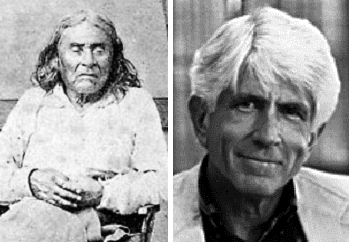
Chief Seattle (left) and actual speech writer Ted Perry
“In that crowd was Ted Perry, a professor of film, who had been retained by the Southern Baptist Television Commission to draft a script for a film about pollution and the plight of the Earth, called Home. In a third execution of literary license, Smith turned it into a speech about poisoning the planet and human indifference to it. Perry’s concept was to transport Chief Seattle into the modern world and imagine what he would say.”
The documentary film on ecology, scripted by Ted Perry, was produced by the Southern Baptist Radio and Television Commission, and later ran on network television. But not before the original script was edited for being more Christian, and some references to God were added.
John Scull, specialising in eco-psychology, has traced the evolution of the Seattle myth in an interesting essay. He notes: “The Perry speech, in spite of its Christian editing and its many historical inaccuracies, anachronisms and inconsistencies, was widely distributed and was seen as authentic by many…The text’s lack of authenticity was finally described in 1987, and documented in articles in both Omni and Newsweek in 1992.”
In April 1991, the New York Times ran a front-page expose of the Chief Seattle myth, saying: “A number of historians say Chief Seattle never said most of what he is supposed to have said.”
NYT quoted historian David Buerge as saying: “Chief Seattle is probably our greatest manufactured prophet,” and described him as ‘one of the scholars frustrated that their work has failed to stop the myth from spreading around the world.’
In his analysis, John Scull poses the query: Why are environmentalists so eager to continue to attribute these words to Chief Seattle instead of to their author, Ted Perry?
Perry, now a professor of film studies at Middlebury University, has tried repeatedly to set the record straight. Moreover, he thinks that the myth is pernicious. “Why are we so willing to accept a text like this if it’s attributed to a Native American?” he asks. “It’s another case of placing Native Americans up on a pedestal and not taking responsibility for our own actions.”
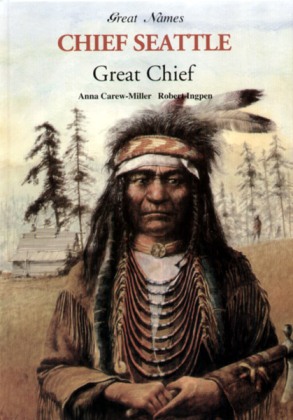
This 1991 book built on the Chief Seattle fable
The myth of Seattle’s speech has been so pervasive that the Washington State Library issued a pamphlet in 1993 stating the facts. “The most important fact to note is that there is NO VERBATIM TRANSCRIPT IN EXISTENCE. All known texts are second-hand,” Nancy Zussy, State Librarian, said in that note.
That note listed four different versions of the speech. The most widely known of all, it said, was written by Texas professor Ted Perry as part of a film script. “The makers of the film took a little literary license, further changing the speech and making it into a letter to President Franklin Pierce, which has been frequently reprinted. No such letter was ever written by or for Chief Seattle.”
So is there anything authentic left of poor Chief Seattle? There’s no doubt the man cared deeply for his people and the environment, even if he was nowhere near as eloquent as modern-day environmentalists want us to believe. Sadly, we don’t even know what the old boy really looked like.
According to a story by Malcolm Jones Jr. and Ray Sawhill, appearing in Newsweek of 4 May 1992: “Even the one known photograph of him has been doctored repeatedly. In the original, his eyes were closed. Subsequent version were retouched so that his eyes looked open. In some versions, he carries a cane, but not always. And in the most revisionist makeover, his head has been grafted onto the body of another man.”
So is it just historical accuracy at stake here, in our setting the record straight about Seattle as scripted by Perry? Does it really matter whether or not the Indian chief actually said it as long as his alleged words continue to inspire environmental commitment?
I share Dr John Scull’s views when he says: “The world is in an environmental crisis and needs help, but a mythical Indian chief from the last century is not going to ride over the hill and save it from the industrial cavalry in some reversal of the Hollywood western — all of us are going to have to work together to save it ourselves. Recognizing that at least some of the answers lie within mainstream contemporary culture might be a good place to start.”











 Open Minds!