Paper paper shining bright...but for how long? Cartoon by Mike Luckovich
My regular readers know my deep interest in political satire, and fascination with cartoons of all kinds including those political. On this blog, we’ve also discussed the worldwide decline in mainstream journalism.
“Political satire is nothing new: it has been around for as long as organised government, trying to keep the wielders of power in check. Over the centuries, it has manifested in many oral, literary or theatrical traditions, some of it more enduring — such as Gulliver’s Travels and Animal Farm. And for over a century, political cartoonists have also been doing it with such brilliant economy of words. Together, these two groups probably inspire more nightmares in tyrants than anyone or anything else.
“Today, political satire has also emerged as a genre on the airwaves and in cyberspace, and partly compensates for the worldwide decline in serious and investigative journalism. Many mainstream media outlets have become too submissive and subservient to political and corporate powers. Those who still have the guts often lack the resources and staff to pursue good journalism.
“If Nature abhors a vacuum, so does human society — and both conjure ways of quickly filling it up. Into this ‘journalism void’ have stepped two very different groups of people: citizen journalists, who take advantage of the new information and communications technologies (ICTs), and political satirists who revive the ancient arts of caricaturisation and ego-blasting…”
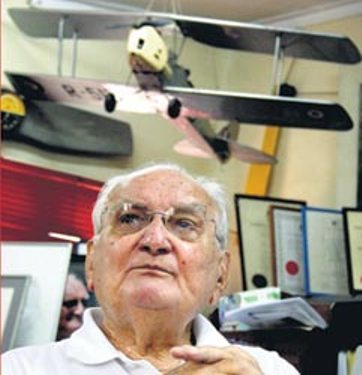
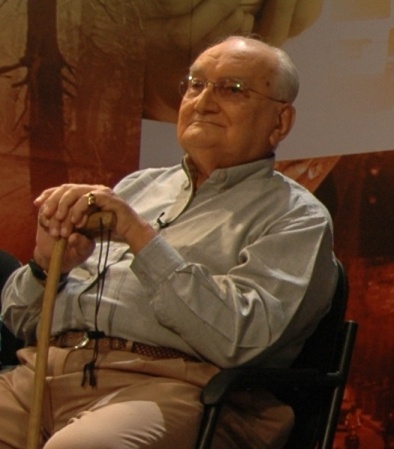
Ray Wijewardene: Freed from gravity, at last!I went straight from a paddy field, where I was filming much of the morning, to the funeral of my mentor and friend Ray Wijewardene early afternoon at the General Cemetery Colombo.
Ray would have approved: despite being a high flyer in every sense of that phrase, he had his feet firmly on the ground — and sometimes in the mud. He was fond of saying, “Agriculture is my bread and butter, while aviation is the jam on top of it”.
Dr Philip Revatha (Ray) Wijewardene, who passed away on August 18 aged 86, was an accomplished engineer, aviator, inventor, Olympian and a public intellectual of the highest calibre. He was also one of the most practical and down to earth people I’ve known.
He preferred to introduce himself as a farmer and mechanic ‘who still got his hands dirty’. Perhaps that’s how he wanted to be remembered — but each one of us will carry our own vivid memories of this colourful, jovial and altogether remarkable human being.
I’ve already written a quick introduction about Ray for Groundviews.org, which has published a long interview I did with Ray 15 years ago, originally for an Indian science magazine. That exchange is a reminder of the imaginative thinker, life-long experimenter and outspoken scientist that Ray always was.
I’ll be writing more about Ray Wijewardene in the coming weeks, exploring his many different facets. I’ve known and walked alongside him for almost a quarter century. For now, I’ll remember him for one facet that I didn’t share despite many offers and invitations: flying.
per ardua ad astra...Ray just loved to fly. Most humans share this age old dream, but Ray wasn’t contented just being flown around on commercial jets — which to him were merely large, sealed up cylinders. He far preferred the small, propeller-driven aircraft – single or twin seaters that gave their passengers a true sense flying and a real taste of the sky.
Looking back, it was quite apt that I first met Ray at the Ratmalana Airport, just south of Colombo, from where he took off and landed hundreds of times over the decades. One sunny morning in mid 1986, he took time off from his flying to talk to a group of high school leavers who were participating in the first Science for Youth programme. It exposed us to various (then) modern technologies over six consecutive weekends. Much of the knowledge we gained has long been obsolete, but its inspirational value was timeless….and continues to propel me forward.
Much of that inspiration came from Ray Wijewardene, who talked to us – with lots of practical demonstrations – about problem solving and innovations in three areas close to his heart: energy, agriculture and transport. I remember how he was experimenting with improvements to the humble bicycle at the time, so that riders could optimise performance with modest efforts.
He also talked about growing our food and energy. But it was his flying experience that most fascinated us starry-eyed youngsters. As a pilot, Ray was licensed to fly three kinds of flying machines: fixed-wing aircraft, helicopters and autogyros. But this pilot was flying not only factory-fitted, mass-manufactured units. He also experimented with building and flying his own ultra-light aircraft and helicopters – he was particularly interested in building amphibious small planes that could land on, and take off from, Sri Lanka’s numerous inland lakes and reservoirs.
All this and more made Ray a journalist’s dream, but as I soon found out, he wasn’t an easy subject to cover! In 1988, The Island newspaper asked me to interview Ray and write an article about the dream and reality of flying. He happily talked with me for two hours — yet, in the end, didn’t want his name mentioned in print. For all his accomplishments and outspoken views, Ray was completely publicity shy. He didn’t mind his views being reported, but with little or no mention of the source.
It’s the song that matters, not the singer, he said — and I heartily disagreed. I pointed out that we journalists needed to attribute wherever possible for greater credibility of what we write (I didn’t tell him that we also love good news-makers: the more informed and opinionated they are, the better!). This became a running argument that Ray and I had for two decades. Within a few years, he trusted me enough to talk to me on the record. But what he said off the record was always more interesting…
When he was approaching 75, Ray told me how nervous he was when he had to go for renewals of his pilot’s license. In the end, it wasn’t age that ended his flying career: along with everyone else, he was ‘grounded’ when private flying was first restricted and then banned during the latter years of Sri Lanka’s long-drawn war.
During the 1990s, Ray had repeatedly invited me to share a flight on one of his home-built light planes. He assured me they were perfectly safe — among satisfied customers was Prof Cyril Ponnamperuma, one time science advisor to the President of Sri Lanka and an internationally renowned biochemist. (Ray did acknowledge that he’d crash landed his various planes thrice — and each time, he lived to tell the tale. He believed that test flying one’s own aircraft designs quickly eliminated bad designers!)
I kept deferring my own tryst with the open skies and was too preoccupied with earthly matters — and suddenly, it was too late. By the time Sri Lanka’s war ended in May 2009, Ray’s flying days were over (and our skies are not yet fully free for private domestic aviation).
Gravity, bureaucracy and age may have conspired to keep Ray confined to the ground in the last few years of his life — but only just. His spirit soared even when the body wasn’t allowed to: in all my years and encounters with him, I’ve never seen him ‘down’ (concerned and reflective, yes; depressed, no).
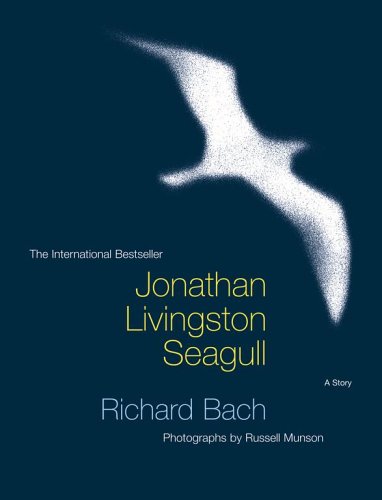
A lone spirit, on a long journey....That passion, enthusiasm and spirit of adventure characterised Ray and influenced everything he did, on the ground and in the air. Born in the 1920s and raised as part of the first generation of humans for whom private flying was available, he was infected with the ‘flying bug’ in the same way that American author and aviator Richard Bach was. In fact, Ray knew Bach and was a devoted fan of the latter’s books, especially Jonathan Livingston Seagull.
Perhaps Ray saw himself in Jonathan: a seagull tired of the monotonous life in his clan. He rather experiments with new – always more daring – flying techniques…which means he must fly solo most of the time, and confront the travails of life on his own.
Ray wasn’t a loner (to the contrary, he was very much a team player in everything he did). But sometimes he was racing ahead of us – or just flying at a higher altitude. Although I’ve never heard him say it, perhaps this unattributed quote partly explains the phenomenon: “When once you have tasted flight, you will forever walk the earth with your eyes turned skyward, for there you have been, and there you will always long to return.”
What Ray did quote, frequently, were these words of Robert Browning: “Ah, but a man’s reach should exceed his grasp, or what’s a heaven for?”
It was entirely fitting that a grand daughter would recite the poem ‘High Flight’ by John Gillespie Magee, Jr., a favourite verse among aviators and, more recently, astronauts.
High Flight
by John Gillespie Magee, Jr.
Oh! I have slipped the surly bonds of Earth
And danced the skies on laughter-silvered wings;
Sunward I’ve climbed, and joined the tumbling mirth
of sun-split clouds, — and done a hundred things
You have not dreamed of—wheeled and soared and swung
High in the sunlit silence. Hov’ring there,
I’ve chased the shouting wind along, and flung
My eager craft through footless halls of air….
Up, up the long, delirious, burning blue
I’ve topped the wind-swept heights with easy grace
Where never lark nor even eagle flew—
And, while with silent lifting mind I’ve trod
The high untrespassed sanctity of space,
Put out my hand, and touched the face of God.
On returning from the simple yet moving funeral, I tweeted: No longer a prisoner of gravity: sky-lover, pilot & light aircraft builder Ray Wijewardene blasted off heavenwards. Farewell, high flyer!
“If you’re an alien planning to invade the Earth, choose July 11. Chances are that our planet will offer little or no resistance.
“Today, most members of the Earth’s dominant species – the nearly 7 billion humans – will be preoccupied with 22 able-bodied men chasing a little hollow sphere. It’s only a game, really, but what a game: the whole world holds its breath as the ‘titans of kick’ clash in the FIFA World Cup Final.
“Played across 10 venues in South Africa, this was much more than a sporting tournament. It’s the ultimate celebration of the world’s most popular sport, held once every four years. More popular than the Olympics, it demonstrates the sheer power of sports and media to bring together – momentarily, at least – the usually fragmented and squabbling humanity.”
This is the opening of my latest op ed essay, which appears in several print and online outlets this weekend. It’s timed for the finals of the FIFA World Cup 2010 – the most widely followed sporting event in the world, which will be played in Soccer City, Johannesburg, South Africa today, 11 July 2010. The Netherlands will meet Spain in this culmination of international football that has been distracting a good part of humanity for a month.
This sporting event is tipped to be the most-watched television event in history. Hundreds of broadcasters are transmitting the World Cup to a cumulative TV audience that FIFA estimates to reach more than 26 billion people. Some TV channels offer high definition (HD) or 3-D quality images to enhance the mass viewing experience.
The essay was written a few days ago, after the FIFA World Cup 2010 had reached the semi-finals stage. To be honest, I’m not an ardent football fan. But as an observer of popular culture, I’ve gladly allowed myself to be caught up in the current football frenzy. I just love to watch people who watch the game…
It’s a light piece written to suit the current global mood, but I acknowledge that the World Cup is really more than just a ball game. The basic thrust of my essay is to comment on the powerful mix of fooball and live coverage: “For the past month, the winning formula for unifying the Global Family seemed to be: international football + live broadcasts + live coverage via the web and mobile phones.”
United Colours of Football, courtesy FIFAThe essay builds on themes that I’ve already explored on this blog – for example, how President Nelson Mandela used the 1995 World Cup Rugby championship to unite his racially divided nation, as told in the movie Invictus.
Here’s my parting thought, on which I invite reader comment: “On second thoughts, those invading aliens don’t need to worry too much about the Earth’s political leaders or their armies. Without firing a single shot, the globalised media have quietly taken over our Global Village — and now it’s too late to resist! We can argue on its merits and demerits, but the facts are indisputable.”
If one acronym has dominated the world’s media and public minds in the past month, it must be FIFA.
It stands for the International Federation of Association Football, and is derived from the original French name, Fédération Internationale de Football Association. It’s the global governing body of association football, founded in 1904 and with its headquarters in Zürich, Switzerland.
FIFA is responsible for the organisation and governance of football’s major international tournaments — most notably the FIFA World Cup, held once every four years since 1930. The current World Cup, being held in South Africa from 11 June to 11 July 2010, is the 19th edition. The next will be hosted by Brazil in 2014.
As a global body with substantial financial resources, FIFA has had its own share of controversies and been criticised for its lack of transparency and internal democracy. It’s true that FIFA controls the media rights to key international games with an iron fist (which inspired the above cartoon). They are not alone: the International Olympic Committee (IOC) has its own detractors and allegations on similar considerations.
Who's got the soft power?But there is little argument on how far and wide the influence of these global sports bodies extend. In an op ed essay being published this weekend, I contend: “FIFA, with its 208 member associations, is probably more influential — and certainly better known — than the United Nations, with its 192 member states. The difference is in media outreach. It signifies the rise of soft power in our always-connected information society.”
Indeed, the UN itself is well aware of this. In one of the most memorable op ed essays he’s written, the former UN Secretary General Kofi Annan acknowledged in 2006 (during the previous FIFA World Cup): “The World Cup makes us at the UN green with envy. As the pinnacle of the only truly global game, played in every country by every race and religion, it is one of the few phenomena as universal as the UN. But there are better reasons for our envy.”
He continued: “This is an event in which everybody knows where their team stands, and what it did to get there. They know who scored and how and in what minute of the game; they know who saved the penalty. I wish we had more of that sort of competition in the family of nations. Countries vying for the best standing in the table of respect for human rights, and trying to outdo one another in child survival rates or enrolment in secondary education. States parading their performance for all the world to see. Governments being held accountable.”
Of course, FIFA’s domination over the global public mind will wane after the FIFA World Cup 2010 ends. But how many other global bodies can claim to hold billions of people so engaged for a month? And in this era of 24/7 information society, that’s formidable soft power indeed.
What can we call the wielder of such soft power? How about Super-soft-power?
And can this kind of power also intoxicate and even corrupt its wielders? We’ve seen how power manipulations work in other centres of soft power, such as Hollywood and Bollywood. The challenge for FIFA — and all others who are connected to it through the love of football and/or media’s outreach — is to watch out that this concentration of soft power doesn’t corrupt.
The very same media that helps FIFA attain the status of a soft-super-power needs to keep an eye on how this power is being used. Perhaps that’s the ultimate game in the media-saturated 21st Century: Emperors of Eyeballs vs. Titans of Kick.
Smart but fleeting mobs?‘Smart mobs’ is an interesting term for like-minded groups that behave intelligently (or just efficiently) because of their exponentially increasing network links.
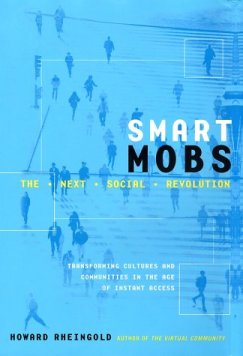
The idea was first proposed by author Howard Rheingold in his 2002 book, Smart Mobs: The Next Social Revolution. It deals with the social, economic and political changes implicated by developing information and communications technology. The topics range from text-messaging culture and wireless internet to the impact of the web on the marketplace.
In the eight years since the book first appeared, we’ve seen a proliferation and evolution of smart mobs, fuelled by the growth web 2.0 tools and, more recently, the many and varied social media. In fact, author Rheingold is credited with inventing the term virtual communities.
But the reality is that smart mobs can also be very fickle — their attention can be easily distracted. A smart mob can disperse just as fast as it forms, even while its original provocation remains.
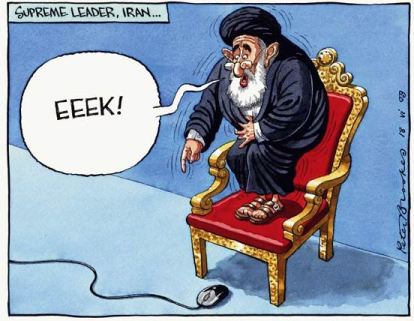
This was demonstrated in dramatic terms in June 2009. Following a hotly disputed presidential election in Iran, there was a surge of online support for pro-democracy activists there who launched a massive protest. A main point of convergence for online reporting and agitation was micro-blogging platform Twitter. Within a few days, mainstream media like TIME and Washington Post were all talking about this phenomenon in gushing terms.
As I wrote at the time: “I have no idea if the Ayatollahs are closet fans of Michael Jackson. But they must surely have thanked the King of Pop for creating a much-needed diversion in cyberspace precisely when the theocracy in Tehran needed it most.”
Other recent experiences have demonstrated how online interest can both build up and dissipate very fast. Staying with a single issue or cause seems hard in a world where news is breaking 24/7.
Here’s a current example. Following the massive oil spill in the Gulf of Mexico that started on 20 April 2010, local communities and environmental activists deployed various social media tools to track the unfolding disaster. BP, the giant oil company implicated in the disaster, has also tried to use social media to communicate its positions, but not too successfully. On Twitter, it was not BP’s official account but the satirical @BPGlobalPR that was dominating the online conversation. As one commentator wrote: “It is an object lesson in how social media can shape and control a company’s message during a crisis.”
Beyond PR?By early July 2010, however, there were already signs that online interest on the issue was already waning — even as the oil continued to leak from this largest offshore oil spill in US history. In a detailed analysis of main social media platforms’ coverage of the issue, Mashable noted last week: “An estimated 100 million gallons or more of oil have surged into the Gulf of Mexico…Yet on Twitter, Google, blogs and even YouTube, we’re already wrapping up our collective discussion of the oil spill and how to repair its damage.”
Riding the wave can be fun, but waves form and break quickly. Those who want to use social media tools for social activism still need to learn how to hitch a ride with the ocean current beneath the fickle waves.
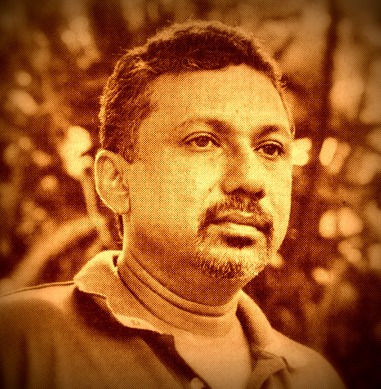
Palitha Lakshman de Silva, 1959-2010For the second time in just over three months, I went to the Colombo general cemetery to bid farewell to a fellow traveller. This is becoming a worrying habit.
Those of us who’ve opted for the path less travelled don’t expect crowds or accolades. At least we have each other for company and inspiration. Suddenly it’s getting a bit lonely: long-standing friends and colleagues are dropping dead in the prime of their lives.
First, it was environmentalist, journalist and public intellectual Piyal Parakrama who left in early March. Now, it’s Palitha Lakshman de Silva — journalist, photographer, cartoonist, puppet animator and television professional among other pursuits and talents.
Uncannily, what I wrote upon hearing Piyal’s death applies – word by word – to Palitha too. I just have to change the name and date: Palitha died so suddenly and unexpectedly on the evening of June 11 that it’s hard to believe that he is no longer among us. Another public-spirited individual has left the public space all too soon…
Both men had just passed 50, and were leading active, productive and busy lives. They had no known ailments, and were in apparent good health. Yet in the end, it was the unseen, gradual clogging of the heart’s arteries that struck them both down: the first heart attack was swift and fatal. Neither man reached the nearest hospital alive.
I had known Palitha for twice as long as I worked with him (in the past decade). Although we weren’t close friends, we shared a passionate, life-long interest in using broadcast television and narrowcast video to communicate public interest messages. Some call it non-formal education, but we avoided the e-word for it reminds some people of school that they didn’t enjoy. We believed – and demonstrated too – that the audio-visual medium can blend information with entertainment in ways that make learning effortless and painless.
Having started his career as a reporter and photojournalist at a leading newspaper, Palitha later moved on to TV, where he blazed new trails in cartoon animation, puppetry and documentary making. He was part of Sri Lanka’s first generation of television and video professionals who experimented with the medium, and found new ways of combining education, information and entertainment.
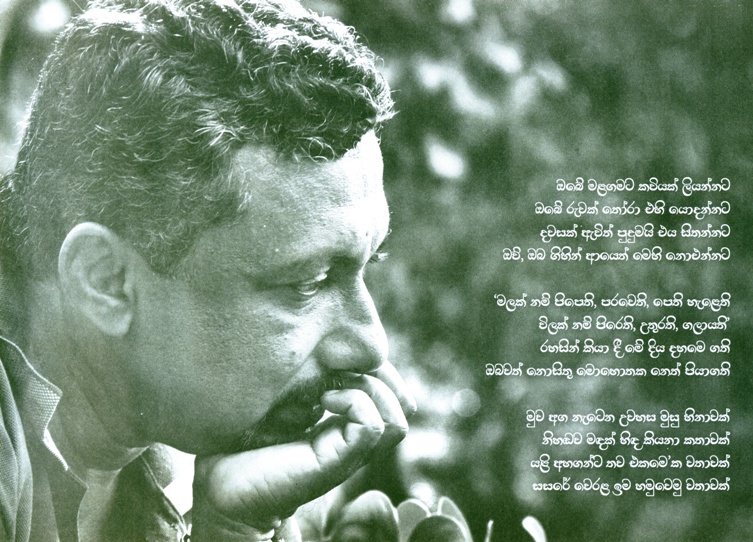
I’ll write more reflectively once I recover from the shock of another colleague signing off for good. For now, I can only echo the lyrical sentiments in this leaflet distributed at Palitha’s funeral by his artistically-inclined friends. The English approximation (below) is mine, and not particularly good (though bilingual, I’m a lousy translator). I’m glad, however, that the original verse captures one intrinsic quality of Palitha: his gentle, soft-spoken nature which often concealed the creative genius inside him.
Goodbye, Palitha Lakshman de Silva
The day has arrived
Suddenly and shockingly
When you’ve gone away
Leaving us alone
All by ourselves
To write a verse
And choose an image
In your fond memory.
Flowers bloom and wither
Lakes flourish and drain
Such is the Circle of Life
Which your hasty exit
Once again reminds us
With a soft, little whisper.
We’ll travel to the end of time
If can we see, just once more,
Your gentle and soothing smile,
And listen to your stories
That you told us so gently.
Who says environment is a ‘safe’ subject for journalists and broadcasters to cover?
Journalist colleagues who work on conflict, security and political topics often have an illusion that environmental reporting is a ‘cosy and comfortable beat’ – one that allows reporters to travel to exotic locations, see cuddly animals, relax in pristine environments and generally take things easy.
That might have been the case some years ago, in another century that’s now receding in our memories. But not any longer: there’s as much conflict, intrigue and complexity in many of today’s environmental topics, and covering them can often be hazardous to the courageous journalists who go after them.
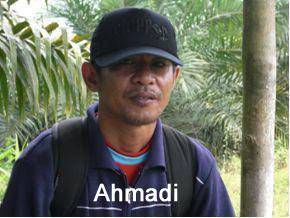
Ahmadi: Beaten up for exposeJust ask Ahmadi, a journalist working for Harian Aceh in Indonesia. Together with a fellow journalist, working for News Investigasi in Medan, he recently investigated a flood that had taken place in the Alapan district in April 2010. During their journey, they met some people cutting up logs. The journalists asked workers who owned these logs and were told that they belonged to the Alapan District Police Station and the Alapan Military Sub-District Command. Hmm…
When confronted with this information, a high ranking military officer reacted quickly and sharply: he wanted the whole story suppressed. In defiance, Harian Aceh published the story on 21 May 2010 — which resulted in Ahmadi being assaulted and threatened with death by the same officer.
“Ahmadi joins the long list of journalists who have been targeted for shedding light on deforestation, which is responsible for at least 18 per cent of the world’s greenhouse gas emissions,” says Reporters Without Borders (RSF), the international watchdog on media freedom.
It says attacks on journalists and bloggers who try to cover any kind of environmental damage are growing steadily all over the world. Among them, those who investigate industrial pollution or the destruction of forests are particularly at risk.
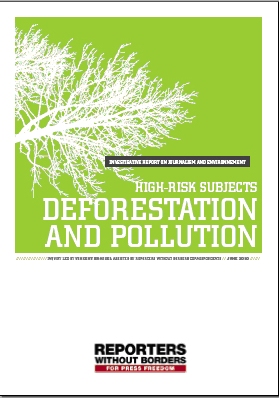
No longer a cosy beat...This week, on the eve of World Environment Day (5 June), RSF released a new report titled Deforestation and pollution: High-risk subjects. It makes grim reading for all of us who are committed to journalism as if the planet mattered.
It follows and echoes their call last year: “We must defend journalists who expose attacks on the environment”.
The new report, the second of its kind within just a few months from RSF, was prepared with the help of its worldwide network of correspondents. They gathered information about incidents in Indonesia, Argentina, El Salvador, Gabon, India, Azerbaijan, China and Morocco. Behind each of these threats and attacks, there were big corporations, criminal gangs or government officials who had been corrupted by money from mining or logging.
Asia features prominently in the report, which condemns the responsibility of the Vietnamese and Chinese governments in serious press freedom violations that deprive the public of crucial information about cases of pollution or deforestation.
The report describes, for example, the way the government in Hanoi has tried to suppress any debate about the environmental impact of bauxite mines being operated by a Chinese company. A field investigation in Argentina established that journalists are under pressure from both supporters and opponents of a mining project.
Mining companies (Aluminium Corp of China, China Metallurgical Group and the Canadian companies Yamana Gold and Pacific Rim), oil companies (Shell, Addax and Synopec), wood pulp companies (Sinar Mas and Riau Andalan Pulp and Paper) and two French multinationals (Bollor and Areva) are all identified in this report as having a direct or indirect role in cases of intimidation or censorship.
This is the second report that RSF has published on this subject. In September 2009, a report titled “The dangers for journalists who expose environmental issues.“, looked at 15 cases of journalists and bloggers who had been killed, attacked, jailed, threatened or censored for covering environmental problems in Russia, Cambodia, Bulgaria and Brazil.
RSF this week reiterated the appeal it launched during last December’s Copenhagen Summit: The media are needed to gather information and disseminate it to the public. Where climate change was concerned, it reminded everyone one, it was the media who helped to establish credible, independent diagnoses of the state of our planet. Their analyses continue to play a crucial role in helping decision-makers to adopt policies and rules that will lead to the desired changes.
On this blog, we have consistently highlighted the need for safeguarding journalists who pursue environmental stories that threaten vested interests within and across borders. For example:
In April 2007, we asked: Can journalists save the planet? Yes, they can be front-runners in the world’s attempts to save species, habitats and entire ecosystems. But only if the rest of society protects and stands by them. When our planetary house is on fire, shooting the messenger isn’t going to save anyone.
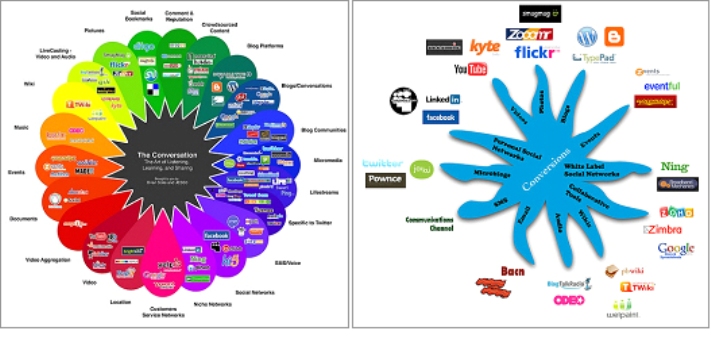
Depictions of social media: Conversations Prism (left) and Social Media Starfish
As I wrote in an earlier blog post, in the of social media, we need to be as daring and adventurous as Sinbad. Like the legendary sailor of Baghdad, we have to take our chances and venture into unknown seas. Instead of maps or GPS or other tools, we must rely on our ingenuity, intuition and imagination.
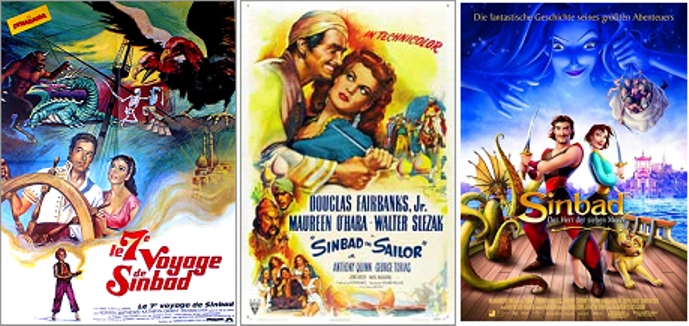
During his seven voyages in the Indian Ocean, Sinbad had fantastic adventures going to magical places, surviving assorted monsters, and encountering a host of supernatural phenomena. Armed simply with his guts, wits and wanderlust, he sailed to places where no man had gone before, and certainly none had returned alive from!
Preparing for my Beijing session last week on using social media to communicate in the public interest, I did a good deal of web browsing and online reading. I came across many attempts to map or visually depict the social media (including two shown above). I also found some interesting lists and guidelines – my favourite so far is 10 Things Your Grandmother can Teach You about Social Media.
This inspired me to come up with my own rough guide to get you started and keep you going. As a salute to Sinbad’s seven voyages, I call it the 7-‘ups’.
• Turn up. As Woody Allen famously remarked, eighty per cent of success is just…showing up. You won’t get anywhere by simply observing or critiquing from the sidelines. You have to wade in and set sail — for better or worse.
• Once we join the planetary conversation, we need to do some catch up. Find your feet – and niche – in the online world. The Internet turned 40 in 2009, and its graphical interface – the World Wide Web – is now 20. So much has happened in that time – and a lot has also been superseded. You need to know what’s on, and what’s not.
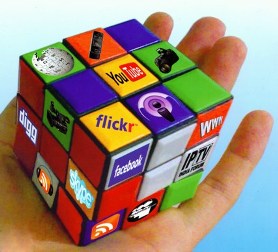
What's your winning combination?• After catching up, we also need to keep up — at least with the mega trends. Large companies like Google – as well as hundreds of individual geeks – keep releasing new applications frequently, many for free use. Popular websites (such as Wired, Mashable and their local equivalents) help us navigate through these depths and currents.
• Next one is harder. We have to give up our baggage of old habits and attitudes picked up over the years. For many Digital Immigrants, leaving the comfort zone of paper was scary enough. How can we let go of complete control over our communication products and processes? But that’s just what the social media demand. It’s not a choice, but an imperative.
• It’s also helpful – though not quite essential – if we are less glum, prim, exacting and academic in how we relate to others in social media. In short, ease up, mate! There are some basic norms for online behaviour, but crusty intellectuals or matronly bureaucrats don’t gain much traction. Keep things short, focused and simple. And hey, it’s okay to be funny, cheeky and irreverent…
• Conversations in this realm can last for weeks, months or longer. Some topics and discussions tend to have ‘long tails’. When we start something online, we have to be clear when to engage whom and how. Equally important is knowing when to shut up. (A bore is a bore, offline or online!).
• And if all this is making you feel dizzy…just cheer up: there are no real experts in this field. No one is an authority. Everything is ‘in beta’. We are all learning by doing. Neither is there a definitive road map to the social media world. In fact, in this partly Undiscovered Country, there is plenty of scope to explore, innovate and be original.
Are you a land-lubber who doesn’t trust any seas? Let me then offer you another metaphor. Think of this as hitchhiking or back-packing online. Take your chances. Be adventurous. Discover a whole new world!
We have some advantages over Sinbad. The virtual world poses no real danger to our lives. But beware: social media can be very time-consuming and even addictive.
You have been warned.
Here, for some edu-tainment, is an interesting video on social media that I found on…YouTube:
Sinbad: The legend endures, entertains...and inspires!
I have always been intrigued by the tales of Sinbad the legendary sailor. My interest is heightened by living in Serendib, destination of Sinbad’s sixth journey, which is modern-day Sri Lanka.
Being a professional story teller, I always try to connect the old world with the new. So in Beijing this week, I proposed: In the brave new world of social media, we need to be as daring and adventurous as Sinbad.
Like the legendary sailor of Baghdad, we have to take our chances and venture into unknown seas. Instead of maps or GPS or other tools, we must rely on our ingenuity, intuition and imagination.
And we have to be prepared for a potentially perilous journey where we may be lost, shipwrecked or even sunk. On the other hand, with careful planning, hard work and some luck, we may well sail into calmer seas and discover new lands and treasures – just like Sinbad did.
One thing is for sure: it’s not for the faint-hearted. There are no guarantees of success, and certainly no travel insurance…Are we ready to take the plunge?
Those of us working on development, humanitarian or social issues always have plenty of public interest messages to communicate. We are also keen to amplify grassroots voices so that policy-makers and business leaders would get a reality check.
The social media present many opportunities for all this. They offer us the potential for not just outreach, but sustained engagement. The development community has long wished for more interactive and participatory communications tools. The social media do precisely this! There’s no longer any excuse for not jumping in…
I then added the caution: It’s a big pond, and keeps getting bigger and deeper by the day. Social media is a basket that includes a lot more than (the more visible and controversial) Facebook and YouTube. According to the Wikipedia (itself an example), social media is a collective term to describe online media that is based on two key attributes: conversations, and interactions between people.
One of the many strange creatures that Sinbad encountered on his journeys was the Hydra — a many-headed serpent (or dragon). Chop one off, and two would grow instantly — a bit like how new social media applications are popping up these days!
Modern-day Sinbads have plenty of new horizons and uncharted waters to explore. Yes, it can be cacophonous, confusing, dizzy and even a bit frivolous at times. Hey, so is the real world! We need discernment in both worlds.
Social media started with the geeks, but soon spilled over to involve the rest of us. How can we — the non-geeks — come to terms with this new realm? How do we find our niche that makes us more effective communicators and agents of social change? The key to engaging this bewildering world of social media is to…just do it. And see what works.
“Reading computer manuals without the hardware is as frustrating as reading sex manuals without the software!”
This is one of the less known, but more entertaining, dicta by Arthur C Clarke – he called it ‘Clarke’s 64th Law’, and I personally know he used to bring it up when meeting with particularly crusty or glum intellectuals. (Not all were amused.)
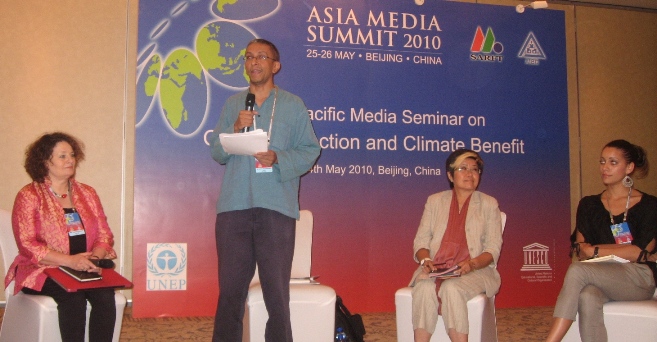
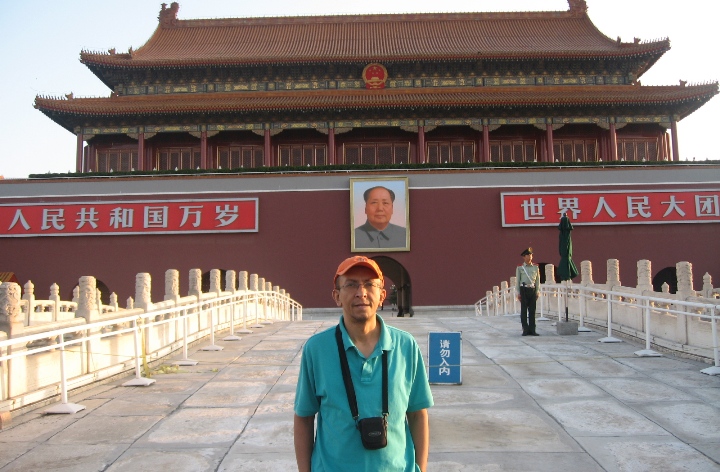
Clarke’s words kept turning in my mind as I moderated and spoke at a session on social media at Asia Media Summit 2010 held in Beijing China from 24 to 26 May 2010. The country with the world’s largest media market is not exactly the world’s most open or free – and certainly when it comes to social media, it’s a very different landscape to what we are used to…
These days, International visitors arriving in China discover quickly that access to YouTube, Twitter and Facebook is completely blocked. Apparently the brief ‘thaw’ in restrictions, seen before and during the 2008 Beijing Olympics, is now over — the current restrictions have been in place since the spring of 2009.
This doesn’t mean there is no social media in China. In fact, I heard from several Chinese friends and colleagues that there is a very large, dynamic and fast-evolving social media scene in China. For the most part, however, it’s not based on globally used and familiar platforms, and is happening in a digital universe of China’s own — under the watchful eye of the government.
Jump in...but some conditions apply!For example, I found from this March 2010 blog post by Merritt Colaizzi that:
* 221 million people have blogs, largely in a diary-style.
* 176 million Chinese connect via social networking system (SNS) with their “real” friends and online networks.
* 117 million connect anonymously via bulletin board system (BBS). These interactive online message boards are the heart of social media in China. They’re where people go to find topic-based communities and where consumers talk about products and services.
There are lots of other blogs, mainstream media reports and research commentary on social media in China — just Google and see (now that’s another thing with limited – and uneven – access in China: Google itself is available, but search results come with lots of links that simply aren’t accessible). Much or all of this interaction happens in Chinese, of course. It’s a significant part of the web and social media landscapes, but if you’re in China on a short visit and want to stay connected to your own social media networks, that’s not at all helpful.
And, of course, it undermines one of the key attributes of a globally integrated information society: the interoperability of systems and platforms.
Luckily for me, perhaps, I can survive a few days without my social media fix: I have an appalling record of updating my Facebook account: days pass without me even going there. For the moment, at least, I’m also taking a break from regular blogging (well, sort of). But I’m more regular in my micro-blogging on Twitter, and visit YouTube at least once a day, sometimes more often. I could do neither during the few days in Beijing – and that was frustrating.
So imagine having to talk about social media as a new media phenomenon in such a setting. That’s only a tiny bit better than reading computer manuals without the hardware…But this is just what I did, with all the eagerness that I typically bring into everything I do. I planned and moderated a 90-minute session on Social Media: Navigating choppy seas in search of Treasures?
With access to key global social media platforms denied, we visitors and Chinese colleagues in the audience could speak mostly generically, theoretically and aspirationally. I didn’t want to place my hosts and seminar organisers in difficulty by harping on what was missing. Instead, we focused on what is possible and happening: how development communicators are increasingly social media networks and platforms to get their messages out, and to create online communities and campaigns in the public interest.
The thrust of my own opening remarks to the session was this: In the brave new world of social media, we all have to be as daring as Sinbad. Like the legendary sailor of Baghdad, we have to take our chances and venture into unknown seas. Instead of maps or GPS or other tools, we have to rely on our ingenuity, intuition and imagination.
More about the session itself in future blog posts.
For now, I want to share this TED Talk by American watcher of the Internet Clay Shirky on how cellphones, Twitter, Facebook can make history. Shirky shows how Facebook, Twitter and TXTs help citizens in repressive regimes to report on real news, bypassing censors (however briefly). The end of top-down control of news is changing the nature of politics.





 Open Minds!