TVE Asia Pacific (TVEAP) is once again proud to be associated with CMS VATAVARAN, India’s premier Environment and Wildlife Film festival, as a co-sponsor.
The festival runs at India Habitat Centre, New Delhi, from 27 to 31 October 2009. It will showcase the best of Indian and international films on environment and wildlife. The theme of the 2009 festival is ‘Climate Change and Sustainable Technologies’ and focus area is ‘Natural Heritage Conservation’.
I’m looking forward to a week of film watching and meeting film-makers and film lovers.
Yugratna Srivastava: Lend me your ears...This week saw the UN’s invisible man hosting mostly indifferent leaders at a Summit on one of the world’s most pressing challenges: climate change.
Nearly 100 world leaders accepted UN Secretary General Ban Ki-moon’s invitation to participate in an historic Summit on Climate Change in New York on 22 September to mobilise political will and strengthen momentum for a fair, effective and ambitious climate deal in Copenhagen this December.
The call for action at the summit did not just come from world leaders – many of who simply can’t see beyond their next election – but also from the next generation who stand the most to lose if climate talks fail.
On their behalf, Yugratna Srivastava, a 13-year-old Indian girl, spoke forcefully at the podium, sending a wake-up call to those assembled. “We received a clean and healthy planet from our ancestors and we are gifting a damaged one to our successors. What sort of justice is this?,” she said.
She added: “The Himalayas are melting, polar bears are dying, 2 of every 5 people don’t have access to clean drinking water, earth’s temperature is increasing, we are losing the untapped information and potential of plant species, Pacific’s water level has risen,Is this what we are going to hand over to our future generations? Please……no!”
She said the three billion young people in the world need them to take action now to protect the planet for future generations.
All this news coverage reminded me of another passionate young girl who similarly addressed – and challenged – the world leaders 17 years ago at the Earth Summit held in Rio de Janeiro, Brazil.
Her name was Severn Cullis-Suzuki, and she was a young Canadian environmental activist. Then 12-year-old Severn closed a Plenary Session with a powerful speech that received a standing ovation.
Raised in Vancouver and Toronto, Severn Cullis-Suzuki is the daughter of writer Tara Elizabeth Cullis and environmental activist and TV personality David Suzuki. When she was 9, she started the Environmental Children’s Organization (ECO), a small group of children committed to learning and teaching other kids about environmental issues. They were successful in many projects before 1992, when they raised enough money to go to the UN’s Earth Summit in Rio. Their aim was to remind the decision-makers of who their actions or inactions would ultimately affect.
Listen to the memorable speech at the Earth Summit by Severn Cullis-Suzuki:
Severn was every bit as sincere, concerned and passionate about the global environment as Yugratna Srivastava was this week. Seventeen years later, notwithstanding the lofty pledges at the Earth Summit and later gatherings, the environmental crises have multiplied and worsened.
Very few of the world leaders who assembled in Rio are still in office — and that underlines part of the problem. Governments have far shorter time horizons than what many of today’s global challenges demand. I am constantly reminded of what the eminent Indian scientist Dr M S Swaminathan told me in my first interview with him in 1990 (yes, even before the Earth Summit): “In democracies, rulers think in terms of the next election. In dictatorships, about the next coup d’état. Nobody is thinking in terms of the next generation!”
It was no small feat for the UN’s Invisible Man to bring 100 heads of state or heads of government together on such a long-term issue. But it’s going to take many more meetings, bickering and hard bargaining before the leaders begin to think in terms of the next generation.
Biggest gap: between rhetoric and practice!It happened a decade ago, but I still remember the incident.
I was visiting London while the British Isles were having their typically limited experience with summer. My then colleague and I had gone for a business meeting, and were returning by Tube, or the London underground railway. Being the afternoon rush hour, the trains were packed to capacity.
My colleague didn’t say much on the journey, but I noticed her look of dismay. As we emerged from the tube station, she finally spoke: “Gosh, it’s another world down there, isn’t it? I didn’t know people smell so much!”
The warm and sweaty summer would surely have added to the experience, but as Londoners know well, the tube is the best mode of transport to get around quickly and inexpensively in that metropolis. It was only then that I realised my liberal, bleeding-heart colleague was not a regular user of public transport. She either uses taxis or drives around in her own Volvo car. She doesn’t normally commute with the Great Unwashed…
Yet, the same snooty ex-colleague speaks and writes so passionately on the virtues of public transport and mass transit systems as a means to better manage urban challenges in the developing world. Listening to her, one could hardly imagine her disdain for using public transport in her own city.
Practise what you preach. That’s a simple yet profound piece of advice for everyone promoting public interest causes in development, conservation or anything else. Or, as Mahatma Gandhi put it: you must be the change you wish to see in the world.
The series features outstanding efforts in education for sustainable development (ESD) in South and Southeast Asia. It goes in search of answers to these key questions:
• What can ordinary people do for our planet, now under siege from multiple environmental crises?
• How can we change attitudes and lifestyles to consume less and generate less waste?
Here’s the synopsis of the India story:
For people in Dindigul in India’s Tamil Nadu state, waste isn’t really a problem – it’s just a resource in the wrong place. School children and housewives have been at the forefront in collecting household and market waste to turn them into compost. They have not only cleaned up the streets, but also persuaded people to grow organic food. As the word spreads, more towns and villages are emulating this example set by CLEAN India project and Gandhigram Trust.
Low Carbon, High PrioritySome 100 world leaders are due to gather at the United Nations headquarters in New York this week for the highest level summit meeting on climate change ever convened.
As the New York Times reported: “In convening the meeting, the United Nations is hoping that collectively the leaders can summon the will to overcome narrow nationalinterests and give the negotiators the marching orders needed to cut at least the outline of a deal.”
Recognising climate change as one of the greatest social, economic, political and environmental challenges facing our generation, the British Council has launched the Low Carbon Futures project. It has focus on mitigating the effects of climate change in an urban environment. It is part of the British Council’s major global climate security project and India is, along with China, one of the top two priority countries for this work. Sri Lanka, with less than 2% of India’s population and correspondingly lower carbon emissions, is a lower priority.
One strand in the Low Carbon Futures project is to engage communications professionals – journalists, writers and film makers to help them better understand the issues around mitigation and get across key messages to readers/viewers more effectively.
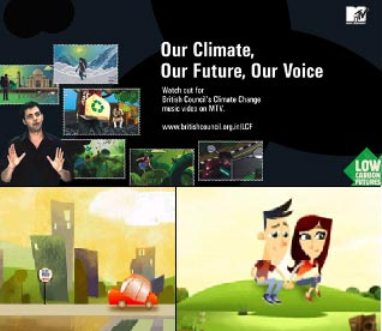
As part of this project, the British Council collaborated with Music Television (MTV) to produce a music video and two viral video animations on climate friendly, low-carbon lifestyles.
British Council’s first Music Video on Climate Change produced by MTV features VJ Cyrus Sahukar. Combining animation, lyrics and melody, the video talks about how small individual actions can help conserve natural resources and save the climate. MTV VJs have a cult following and the video ends with Cyrus Sahukar, MTV’s face in India, encouraging young people to take that first step. The video was launched in New Delhi on 1 June 2009 in the presence of 50 International Climate Champions from across India & Sri Lanka.
According to the British Council India website, “The video has created a flutter and there is growing demand to screen the video on various institutional networks across India and even outside fulfilling higher level objectives of impacting young urban aspirants. Young Indians are an emerging generation who are ambitious and internationally minded with the potential to be future leaders. The MTV video aims to influence this influential group.”
The Low Carbon Futures project has also released two short, powerful, animated messages that are ‘tongue-in-cheek’- making use of everyday events with a touch of humour. “We are hoping that the messages will be seen as creative, funny and innovative to tempt the recipient to forward it to their peer group. As the virus spreads, so will the message. The British High Commission and the The Energy and Resources Institute (TERI) are also promoting these virals to spread the message amongst the staff members and their external audiences,” says the project website.
The first viral video animation is called Green Journey, and shows a little known benefit of car pooling. Its blurb reads, simply: Meet 3 Mr Rights on the wrong side of the road!
The second viral video animation is called Play Cupid, and gives us one more reason to plant more trees! Blurb: Lets leave the young couples in peace and solitude of nature!
It's planet saving time...and everybody is invited!
Can ordinary people help save our planet?
What does it take to change their attitudes and lifestyles to consume and waste less?
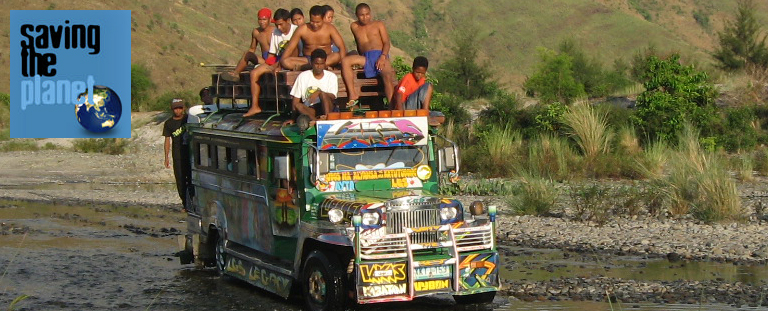
For over two years, my team at TVE Asia Pacific and I have been working on a new TV series, modestly called Saving the Planet. It will be released at a regional conference in Tokyo, Japan, on 22 August 2009.
In this Asian series, produced in partnership with Asia Pacific Cultural Centre for UNESCO (ACCU), we profile successful initiatives that combine knowledge, skills and passion to create cleaner and healthier environments.
It was filmed in six countries in South and Southeast Asia: Cambodia, India, Laos, Nepal, the Philippines and Thailand.
The groups profiled in Saving the Planet often work without external funding and beyond the media spotlight. They have persisted with clarity of vision, sincerity of purpose and sheer determination. Their stories inspire many others to pursue grassroots action for a cleaner and safer planet.
This multiple exposure image shows the various stages of the total solar eclipse in Baihata village, 30 kms from Guwahati, the capital city of the northeastern state of Assam on July 22, 2009. The longest solar eclipse of the 21st century cast a shadow over much of Asia, plunging hundreds of millions into darkness across the giant land masses of India and China. AFP PHOTO/ Biju BORO
This century’s longest solar eclipsed moved across Asia on 22 July 2009, wowing scientists and the public alike. Asia’s multifarious media covered the solar eclipse with great enthusiasm and from myriad locations across the vast continent.
The path of the eclipse’s totality –- where the sun was completely obscured by the Moon for a few astounding minutes –- started in northern India. It then crossed through Nepal, Bangladesh, Bhutan, Myanmar and China, before heading out to the Pacific Ocean. Those who were lucky enough to be at the right place at the right time saw one of Nature’s most spectacular phenomena. It was certainly a sight to behold, capture on film, and cherish for a lifetime.
But many along the path missed this chance as clouds obscured the Sun. It’s the rainy season in much of Asia, where the delayed monsoon is finally delivering much-needed rain.
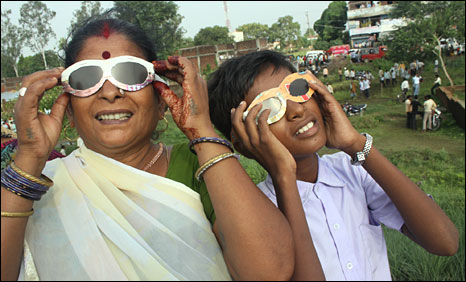
Eclipse watching in Taregna, Bihar, India - Photo: Prashant Ravi, BBC OnlineThat’s what happened in Taregna, in the eastern Indian state of Bihar. The media had dubbed it the ‘epicentre’ of the solar eclipse, and estimated totality to be visible for at least three minutes and 38 seconds. Thousands who flocked to the village were disappointed when the clouds refused to budge. Nature doesn’t follow our scripts.
That didn’t deter some affluent Indians -– if the eclipse won’t come to them, they just went after it. They chartered an airplane to fly above the rain clouds to catch the once-in-a-lifetime eclipse. Each seat cost US Dollars 1,650.
It’s rarely that totality crosses through countries with such high human numbers as China and India. This time around, millions of people and thousands of journalists took advantage.
Some travelled long distances hoping to get the best view from the 200-km wide path of totality. Others watched it one of Asia’s many and cacophonous 24/7 TV news channels. The event had all the elements of a perfect television story: mass anticipation, eager experts and enthusiasts, occasional superstitions, uncertainties of weather and, finally, a stunning display of Nature’s raw power.
‘Darkness at Dawn!’ screamed a popular headline, referring to the eclipse causing a sudden ‘nightfall’ after the day had begun. Other superlatives like ‘Spectacle of the century’ and ‘A sight never to be missed’ were also widely used.
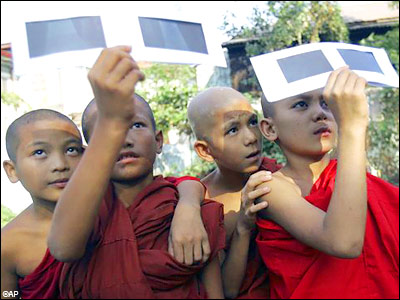
Myanmar Buddhist novices watch solar eclipse through the filters, in Yangon, MyanmarSolar eclipses are indeed a marvel of Nature, and the media’s excitement was justified. For once, it was good to see them devoting a great deal of airtime and print/web space for something that was not violent, depressing or life-threatening.
How I wish Asia’s media took as much interest in another kind of ‘eclipse’ that surrounds and engulfs us! One that does not end in minutes, but lasts for years or decades, and condemns millions to lives of misery and squalor.
Stories of poverty, social disparity and economic marginalisation are increasingly ‘eclipsed’ in Asia by stories of the region’s growing economic and geopolitical might.
The mainstream media in Asia –- as well as many outlets in the West — never seem to tire of carrying reports of Asia rising. Indeed, that is a Big Story of our times: many Asian economies have been growing for years at impressive rates. Thanks to this, over 250 million Asians have moved out of poverty during this decade alone. According to the UN’s Asian arm ESCAP, this is the fastest poverty reduction progress in history.
We see evidence of increased prosperity and higher incomes in many parts of developing Asia. Gadgets and gizmos –- from MP3 to mobile phones — sell like hot cakes. More Asians are travelling for leisure than ever before, crowding our roads, trains and skies. Lifestyle industries never had it so good. Even the current recession hasn’t fully dampened this spending spree.
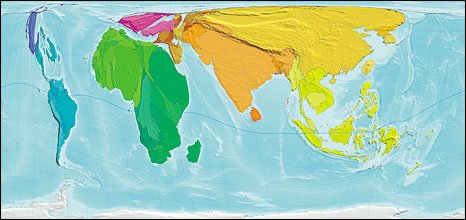
World map proportionate to number of poor people in each country/region - from Atlas of the Real World
But not everyone is invited to the party. Tens of millions of people are being left behind. Many others barely manage to keep up -– they must keep running fast just to stay in the same place.
National governments, anxious to impress their own voters and foreign investors, often gloss over these disparities. The poor don’t get more than a token nod in Davos. National statistical averages of our countries miss out on the deprivations of significant pockets of population.
On the whole, the UN cautions that the Asia Pacific region is in danger of missing out the 2015 target date for most Millennium Development Goals – the time-bound and measurable targets for socio-economic advancement that national leaders committed to in 2000.
The plight of marginalised groups is ignored or under-reported by the cheer-leading media. For the most part, these stories remain forever eclipsed. Except, that is, when frustrations accumulate and blow up as social unrest, political violence or terrorism. Even then, the media’s coverage is largely confined to reporting the symptoms rather than the underlying social maladies.
Indonesian children look up through x-ray film sheets to watch a solar eclipse in the sky in Anyer Beach, Banten province, Indonesia“Half the children in South Asia go to bed hungry every night, but the covers of our news magazines are about weight loss parlors,” says Kunda Dixit, Chief Editor of The Nepali Times.
As he noted in a recent essay: “Maternal mortality in parts of Nepal is nearly at sub-Saharan levels, but we are obsessed with politics. Hundreds of cotton farmers in India commit suicide every year because of indebtedness, but the media don’t want to cover it because depressing news puts off advertisers. Reading the region’s newspapers, you would be hard-pressed to find coverage of these slow emergencies.”
P N Vasanti, Director of the Delhi-based Centre for Media Studies which monitors the leading newspapers and news channels in India, laments how “development” issues such as health, agriculture and education are not even on the radar of popular news sources. Her conclusion is based on a content analysis of the six major Indian news channels during the run-up to the recent general election in India.
I have come across similar apathy in my travels across Asia trying to enhance television broadcasters’ coverage of development and poverty issues. As one Singaporean broadcast manager, running a news and entertainment channel in a developing country, told me: “I don’t ever want to show poor people on my channel.”
Don’t get me wrong. Trained as a science journalist, I can fully appreciate the awe and wonder of a solar eclipse. For years, I have cheered public-spirited scientists who join hands with the media to inform and educate the public on facts and fallacies surrounding these celestial events.
But there are more things in heaven and earth, than are dreamt of in our mainstream media’s breathless coverage of the march of capital. Journalists and their gate-keepers should look around harder for the many stories that stay eclipsed for too long.
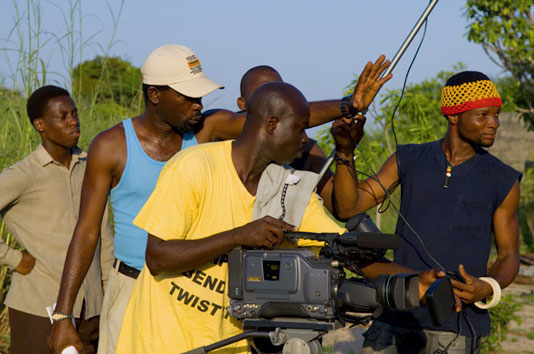
Lights, camera...budget action! Image courtesy 'This Is Nollywood'Here’s a general knowledge question: Everyone knows India’s Bollywood is the world’s largest producer of movies (by number). Which country’s movie industry comes second?
If you said Hollywood, that’s a dated answer. America’s movie industry used to be the second largest in the world — until an unlikely contender turned up from…Nigeria!
Bollywood produced 1,091 feature-length films in 2006 compared to 872 productions (in video format) from Nigeria’s film industry, commonly referred to as Nollywood. In contrast, the United States produced 485 major films.
The three heavyweights were followed by eight countries that produced more than 100 films: Japan (417), China (330), France (203), Germany (174), Spain (150), Italy (116), South Korea (110) and the United Kingdom (104).
Nigerian filmmakers rely on video instead of film to reduce production costs. And as the survey points out, Nigeria has virtually no formal cinemas. About 99% of screenings occur in informal settings, such as “home theatre”.
This is NollywoodThe UNESCO survey reveals another key element of the Nigerian success story: multilingualism. About 56% of Nollywood films are produced in Nigeria’s local languages, namely Yoruba (31%), Hausa (24%) and Igbo (1%). English remains a prominent language, accounting for 44%, which may contribute to Nigeria’s success in exporting its films.
Nollywood’s rising has been chronicled in a 2007 documentary by Franco Sacchi and Robert Caputo. Called This is Nollywood, it tells the story of the Nigerian film industry – a revolution enabling Africans with few resources to tell African stories to African audiences. Despite all odds, Nigerian directors produce between 500 and 1,000 movies a year. The disks sell wildly all over the continent – Nollywood actors have become stars from Ghana to Zambia.
Says Zambia-born director Franco Sacchi: “When I first read about Nigerian directors producing hundreds of feature-length films with digital cameras, a week, and a few thousand dollars, I found the subject irresistible. Here was not only a rare positive story about Africa, but one that embodied the egalitarian promise of digital technology—anybody can make a movie. And Nollywood was virtually unknown.”
This is Nollywood takes us behind the sets and scenes in one Nigerian movie being made on the cheap — and fast. Acclaimed director Bond Emeruwa sets out to make a feature-length action film in just nine days. Armed only with a digital camera, two lights, and about $20,000, Bond faces challenges unimaginable in Hollywood and Bollywood.
Emeruwa says: “We are telling our own stories in our own way, our Nigerian way, African way. I cannot tell the white man’s story. I don’t know what his story is all about. He tells me his story in his movies. I want him to see my stories too.”
Watch This is Nollywood: Movie Trailer
I then came across this TED Talk by Franco Sacchi, where he takes us through Nollywood (at the time he gave his talk, the world’s third largest and now second only to Bollywood). He talks about ‘guerrilla film-making’ and brilliance under pressure from crews that can shoot a full-length feature in a week.
Welcome to Nollywood is another 2007 documentary film, directed by Jamie Meltzer, that looked at the Nigerian film industry. Its findings were similar to those of This is Nollywood. Traveling to the country’s chaotic capitol, Lagos, Meltzer spent ten weeks following three of Nigeria’s hottest directors, each different in personality and style, as they shot their films about love, betrayal, war, and the supernatural.
At around US$250 million per year (and rising), Nollywood’s capital outlay is far below that of Hollywood and Bollywood. For perspective, that’s a bit less than what it cost to make Spiderman 3in 2007 (budget: US$ 258 million) — the second most expensive film made. See list of most expensive Hollywood films.
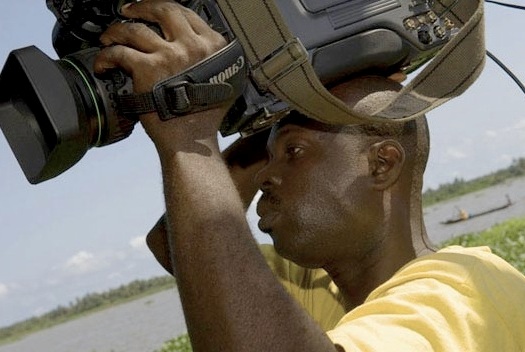
Telling their own stories....But what it lacks in capital, Nollywood more than makes up in numbers and mass appeal. As the Wikipedia notes, Nigerian directors adopt new technologies as soon as they become affordable. Bulky videotape cameras gave way to their digital descendents, which are now being replaced by HD cameras. Editing, music, and other post-production work is done with common computer-based systems.
As Colin Freeman wrote in the Daily Telegraph, UK: “While the likes of Serpent in Paradise and Evil Finger may not be as slick as their Hollywood counterparts, they offer one thing that the likes of George Clooney and Brad Pitt can never provide: characters and stories with which an African audience can identify.”
And according to The Economist, it all started in 1992, when Kenneth Nnebue, a Nigerian trader based in Onitsha, was trying to sell a large stock of blank videocassettes he had bought from Taiwan. He decided that they would sell better with something recorded on them, so he shot a film called “Living in Bondage” about a man who achieves power and wealth by killing his wife in a ritualistic murder, only to repent later when she haunts him. The film sold more than 750,000 copies, and prompted legions of imitators.
Raised on popular culture, I have always been an admirer of tabloid journalism – which means using popular formats to reach out to a mass audience in newspapers or broadcasting. There’s nothing inherently wrong with this: we might even argue that the tabloid approach is the only way to achieve truly mass media (with all else being niche media reaching to smaller demographic groups).
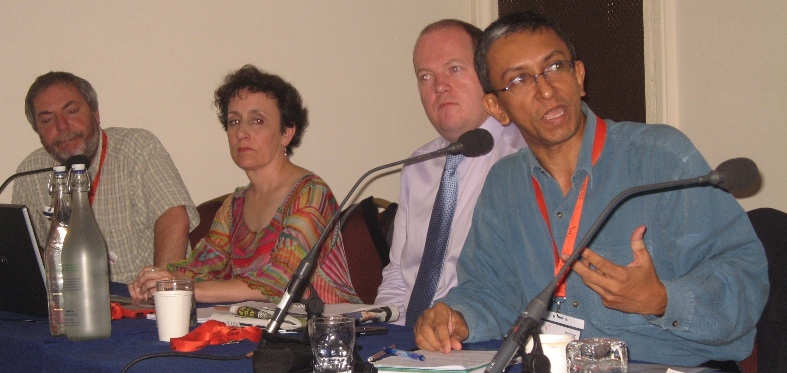
So I was delighted to be on a panel with two leading British tabloid journalists and a popular radio host from South Africa during the 6th World Conference of Science Journalists held in London from June 30 – July 2, 2009.
My own, personal answer is NO — it need not be! And I’ve spent a good part of my two decades of work in the media experimenting and showing that communicating science can be fun — both for us communicators and our audiences.
But I pointed out that science is still being covered in sections of Asian media in the more traditional, classical way, just like science itself is still an elitist pursuit in many of our societies.
L to R: Paul Sutherland, space correspondent of The Sun, UK; Christina Scott, radio and web journalist, South Africa; David Derbyshire, Environment editor, The Daily Mail, UK; Nalaka Gunawardene, Director/CEO, TVE Asia Pacific
I said: “We might call this coverage ‘broadsheet approach’ in print; or ‘bluechip documentary’ format on television. And they are both unsustainable! They are also endangered in these hard times for the mainstream media in most economies.
“So going the tabloid path is a practical and pragmatic way to deliver science stories and science information to a mass audience or readership. We’re doing it in different ways in the Asian media!”
In my remarks, I gave some examples where science is jazzed up (rather than dumbed down) for popular consumption on Asian television. For example, how solar and lunar eclipses provide fodder for endless stories on our numerous news channels. Such coverage, fleeting and superficial as it might often be, takes the wonders of science and Nature to more people than anyone else can.
I argued that the path to the mass audiences in Asia is through news, sports and entertainment programming. We have our own niche, factual channels – Discovery, National Geographic, Animal Planet and their local equivalents. They have a loyal but small audience. They do excellent work. But where numbers are concerned, they cannot – yet! – compete with the outreach and appeal of broadcast radio, TV and newspapers. Neither can the online and mobile media, even though their outreach is growing fast.
Things don’t always go right, however. Doing wall-to-wall coverage of news demands producers and reporters to tackle a variety of topics and subjects — including specialised science stories. Some handle this better than others. In their race for ratings and revenue, a few ‘dress up’ the stories a bit too much.
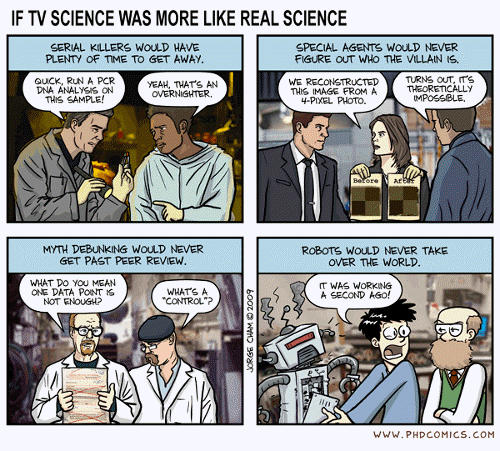
Television science: aspiration or reality?A good example was how some Indian news channels handled the so-called ‘Big Bang experiment’ in September 2008, when the Large Hadron Collider (LHC) was commissioned. The mega-science experiment was interesting in its own right, but it wasn’t apparently exciting enough for at least two channels — Aaj Tak and India TV. Their coverage running up to the event speculated about its “catastrophic effect on the world” – effectively end of the world.
Their coverage caused panic, which led to at least one attributable death. This prompted the Indian Ministry of Information and Broadcasting to caution the channels for spreading “misinformation, fear and horror” among viewers. It advised the channels to exercise restraint in presenting such issues.
I call this the ’24/7 TV Deficit’ in Asian broadcasting. The long term response to this is to invest in training and capacity building of journalists and producers already working in the media. For the most part, they learn on the job, making mistakes on the air. This is far from ideal.
Here’s how I summed up: ‘Tabloid science coverage’ – in print or broadcast – may be imperfect in some ways. But our choice is either that, or nothing. Our challenge is to make the process and product better as we go along.
We urgently need to unleash scientific knowledge and understanding in matters of public interest and public policy. We can’t afford the ALL or NOTHING approach.
When Cable News Network – or CNN – was launched in June 1980, it became the first network to provide 24-hour television news coverage, and the first all-news television network in the United States. Most people didn’t believe it would last for long, for they could hardly believe that there was enough news to fill all hours of the day and night.
They had reasons to be skeptical: at the time all major TV channels and networks in North America, Europe and elsewhere carried an hour or two of well-packaged and well-presented news bulletins per day. Viewers looked forward to these bulletins, when able and amiable anchors like Walter Cronkite – ‘the most trusted man in America’ – entered their living rooms for an update and reflection on the day’s events. A leader had to be assassinated or men had to walk on the Moon for this routine to be broken…
CNN founder Ted Turner changed all that. He proved the skeptics wrong, and blazed a new trail in broadcast journalism. In his wake, dozens and now hundreds of all-news channels have emerged, providing a cacophony of coverage and punditry as never before seen.
Saturated with news on TV? Reach out for this relief!
One of the early, unofficial expansions of CNN was ‘covering news needlessly’. This was sometimes necessary to fill 24 hours a day (or 1,440 minutes) and 7 days a week (or 168 hours). The channels say repetition is meant to give the chance for any viewer to catch up on the news whatever time she tunes in. But the question remains: is there so much news to fill not only 24/7 but hundreds of such channels?
The answer is both yes – and no. It all depends on the definition of news, and what each channel considers to be in the public interest. We won’t get into that big debate here. But the fact remains that, at least where the numerous all-news channels in Asia are concerned, they often struggle to fill their air time – and not always very successfully.
And do we have an abundance of such channels. India alone now has more than 60 all-news channels catering to a billion+ audience in dozens of languages…and more keep popping up. Elsewhere in countries such as the Philippines, Pakistan and Thailand, there have been similar channel explosions in recent years. This is partly triggered by media liberalisation which allowed local and foreign private companies to enter the broadcast sector that earlier remained a state monopoly.
Aryn Baker of TIMEBut more channels has not necessarily meant better coverage of news. There was a perceptive observation by Time magazine’s Aryn Baker in a recent essay she wrote in June 2009 about the state of Pakistan’s media. In her essay titled Casualty of War, she noted: “In 2002, the then President, General Pervez Musharraf, permitted private TV stations to broadcast news instead of just the state-owned Pakistan Television Corp. At the time, Musharraf’s deregulation was hailed as a significant step for the nascent free-press movement; indeed, today there are more than 30 nongovernment TV stations in the country. As TV stations proliferated, I argued that increased competition would force the emergence of a strong, ethical and responsible media corps. But there simply aren’t enough well-trained and -informed local journalists to supply the dramatically greater number of media outlets. I also assumed that consumers would gravitate toward truth. Instead the bulk of readers and viewers seem comfortable with sensationalism and xenophobia — as reflected by an April poll conducted by Gallup Pakistan revealing that 76% of Pakistanis “believe Pakistani media [are] unbiased to a great or somewhat extent.” In other words, Pakistanis like their media the way they are.”
Baker cites examples where the print and broadcast media in Pakistan regularly rumour and peddle conspiracy theories as news. She ends with a strong plea: “Pakistan’s press needs to take a hard look at itself and its level of professionalism. Only then will it live up to its potential, and only then will Pakistan get the media it deserves.”
Shooting the news...I couldn’t agree more. Having cheered the collapse of state broadcasting monopolies across Asia in the 1990s, I have very much felt the same way about news channels across the region (here I’m talking about the English language channels only, which are outnumbered in most markets by local language channels). While there are a few news channels that stand above the rest, a majority would come close to what Aryn Baker describes for Pakistan.
Speaking at the 6th World Conference of Science Journalists held in London in early July, I called this the ’24/7 TV Deficit’ in Asia’s broadcast media. In summary, it is this: In the developed world, all-news channels like CNN evolved over time, building capacity and experience along the way. In emerging Asia, news channel explosion hasn’t allowed time for such evolution – so skills and resources are spread too thin. There are genuine limitations of competence and capacity. Sometimes this leads to sensationalism or distortion.
I said: “The long term response to this is to invest in training and capacity building of journalists and producers already working in the media. For the most part, they learn on the job, making mistakes on the air. This is far from ideal.”
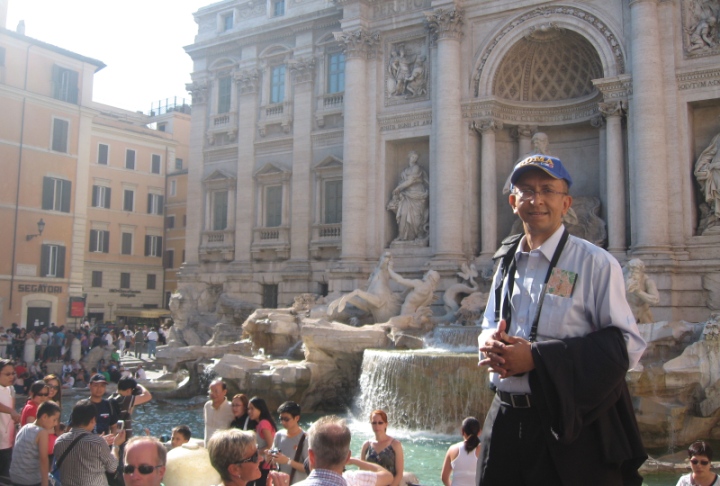
At Fontana Di Trevi: Guess which tourist escaped from a formal meeting?
I’ve just spent a week in Rome, and felt entirely at home enjoying the hot and humid summer days and clear blue skies. The latest experience has reaffirmed my impression – formed on several visits over two decades – that Italy isn’t a part of Europe at all. It’s really an extension of South Asia.
Hanuman, the super-monkey who features prominently in the Indian epic Ramayana, is said to have carried whole chunks of the Himalayas and dropping them off in far away places. Perhaps, unknown to the chroniclers, Hanuman did some freelance transplanting in the Mediterranean.
The similarities are uncanny: Italians and South Asians have too much in common. Generalisations are dangerous, I know, but then, I’m a South Asian – we do it all the time (and get it right about half the time). So here goes…
For a start, we are both expressive people, and we have no compunction in being loud in public places. Understatement is for the polite (and dull) British; we prefer to exclaim and exaggerate. We also gesticulate wildly when we speak – there is probably an extra nerve linking our mouth with our arms.
We are opinionated and argumentative, often passionately (and needlessly) so. We can rarely agree on any matters of private or public interest, yet, almost miraculously, we manage to get by without coming to blows. Well, at least most of the time…
Heirs to rich and diverse culinary traditions, we South Asians love and cherish our food – as do the Italians. We have our rice, chapatti and roti. They have their infinite array of pastas, pizzas and lasagnas. Our youngsters may fancy an occasional hamburger, but no American fast food can ever compete with our myriad aromas and flavours perfected literally over millennia. We take pride and joy in our food, and break bread with family, friends and strangers. Given a chance, we’ll spend half our waking hours eating.
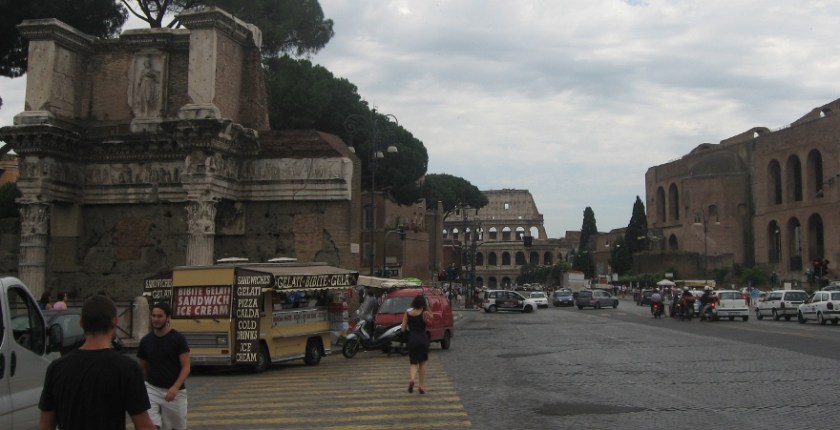
Blending old and new with ease: average Roman doesn't the burden of history
Next to food, we have an abundance of laws, rules and regulations – too many, if you ask me. But we take our laws with a pinch of salt, or more. We happily and frequently bend them that they sometimes actually snap. Then we’d say Mamma Mia or Aiyo, and just move on.
Just look at the roads, and Italy’s similarity with South Asia is immediately clear. No other western European country comes close to Italy for the sheer chaos factor. We all drive as much with our horns as with the accelerators. We curse and yell at others on the road. Our streets are crowded, noisy and messy. We ignore traffic lights, speed limits and zebra crossings. Cyclists and pedestrians move at their peril.
This completely stuns the more orderly nationals like the Japanese and Swiss, who are puzzled how we don’t have more accidents on our roads (it puzzles us too). Partly because we all try to drive like James Bond, but more because too many of us are using privately owned two, three or four wheel vehicles, we often end up going nowhere at all. Some of our big cities now have traffic almost 24/7. Ancient Romans would be impressed by how much time we spend on our roads, an invention they perfected.
Dreary babudom failed to dampen her spiritIt’s not just Fiats, Ferraris and Marutis that move ever so slowly as we march towards progress. If anything, the wheels of our governments are even slower. In Under the Tuscan Sun, Frances Mayes chronicles her frustrations with the local bureaucracy when she bought and renovated an abandoned villa in the Tuscany Valley. Any South Asian who has tried to engage their own governments – on property, taxes or anything else – can well and truly empathise with her experience. In these days of global warming, glaciers probably move (recede) faster than our bureaucracies.
No wonder, then, that we just love to hate our governments in Italy and South Asia – we never tire of complaining about our politicians and bureaucrats. Strangely, however, we do little to overhaul the sick system. We often put up with our bungling, lying and sometimes stealing public officials. Worse, we idolise some of the biggest offenders despite their staggering lapses or excesses, and keep re-electing them!
Ah yes, we love our elections too. Until recently, Italians used to change their governments with such regularity – it has had 62 governments in the 64 years since the Second World War ended. While no South Asian country can match this record, thank goodness, few elected governments in South Asia complete their full term. And we share with Italians a fondness for coalition governments in all their variations and vicissitudes.
Come to think of it, is there anything surprising that Italian-born Edvige Antonia Albina Maino, better known as Sonia Gandhi, is today the most powerful woman in South Asian politics? As head of both Indian National Congress and the ruling coalition, she manages a menagerie of political animals.
Our obsession with politics is amplified (and some say exploited) by our cacophonous media. Our newspapers, radio and TV titillate, enthrall and occasionally inform their audiences. Many follow their own peculiar definitions of the public interest — which includes gleefully venturing into private lives of public figures. If Italians originated the term paparazzi, the South Asian media have turned it into a fine art. Our modern pantheons include a motley collection of show biz and sporting personalities, a few of who fall from grace frequently enough to keep our industrial gos mills turning day and night.
This same nosy media somehow manage to miss out or actively avoid probing the conduct of many public officials controlling very large amounts of public funds. It’s perhaps too simplistic to say corruption, cronyism and nepotism have become deep rooted in our countries. We have institutionalised these processes so much that they have become part of our political and business landscapes. The correct euphamism for these practices is public-private partnerships.
If you think all this makes us a sleazy, unethical and uncaring lot, you’re sadly mistaken. Please be informed that Italians and South Asians are both very religious. In fact, we take our faiths very seriously indeed, and practise it with such passion that some spoilsports might call us fanatical.
It doesn’t matter in the least that we worship at different altars – Italians at their soccer stadiums, and we at our cricket grounds. Our faith is equally intense and unwavering. When you make fun of our history, governments, laws and mannerisms, we’ll laugh heartily with you. But if you dare to criticise the performance of our national sporting teams, you will immediately find what fundamentalists we really are.












 Open Minds!