‘Climate Challenge’ marks turning point in Vietnam’s climate concerns

Seeking local solutions for a global problem
Climate Challenge TV series: Seeking local solutions for a global problem

Many media reports and documentaries on climate change tend to be scary. Even the most balanced and scientifically informed ones caution us about dire scenarios that can rapidly change the world as we know it.

But it’s not all doom and gloom. Like every crisis, climate change too presents humanity with formidable challenges that can become opportunities to do things differently — and better.

Climate Challenge is a rare TV series that adopts this positive attitude. The 6-part series co-produced by One Planet Pictures in the UK and dev.tv in Switzerland, links the global climate crisis with location action for both mitigation (trying to reduce further aggravation) and adaptation (learning to cope with impacts).

It also makes the point: in the fight against global warming, developed and developing countries must work hand-in-hand to find viable solutions for all.

The film-makers of Climate Challenge focus on some of the most promising approaches to turning down the global thermostat. Climate Challenge goes in search for solutions that won’t put a break on economic growth.

The series had its original run on BBC World News in April – May 2007. Shortly afterwards, TVE Asia Pacific (TVEAP) started distributing it to TV channels, educational institutions and civil society groups across the Asia Pacific region. It has been one of the more popular items on our catalogue of international TV films on sustainable development and social justice.

Our deal with Asia Pacific broadcasters is a barter arrangement. TVEAP clears copyrights for developing countries in our region (more than 30 countries or territories) and offers films free of license fee that normally prevent many southern broadcasters from using this content.

We offer a new set of titles every two months to our broadcast partners – now numbering over 40 channels. They select and order what interests them, and often pay for the cost of copying on to professional tape and dispatch by courier.

When they receive the tapes, accompanied by time-coded scripts, many TV stations version the films into their local language/s using sub-titles or voice-dubbing. They do this at their expense, and then assign a good time slot for airing the films once or several times. They are free to re-run the films as often as they want. The only expectation is that they give us feedback on the broadcasts, so that we can report to the copyright owners once a year.

This arrangement works well, and bilateral relationships have developed between TVEAP’s distribution team and programme managers or acquisition staff at individual TV stations across Asia. Everything happens remotely — through an online ordering system and by email. It’s rarely that we at TVEAP get to meet and talk with our broadcast colleagues in person.
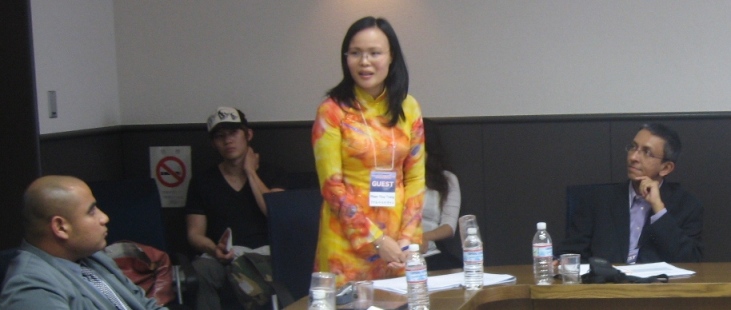
Pham Thuy Trang speaks in Tokyo

I was delighted, therefore, to meet one of our long-standing broadcast colleagues in Tokyo earlier this month when we ran a regional workshop on changing climate and moving images. Pham Thuy Trang, a reporter with news and current affairs department of Vietnam Television (VTV), was one of the participants. She turned out to be an ardent fan of our films.

She told the Tokyo workshop how the Climate Challenge series marked a turning point in Vietnam’s public discussion and understanding of climate change issues.

In mid 2007, VTV was one of many Asian broadcasters who ordered Climate Challenge. Having versioned it into Vietnamese, VTV broadcast the full series in December 2007 to coincide with the 13th UN climate change conference in Bali, Indonesia.

“This was the first time the issue received indepth coverage on TV,” Trang said. This was particularly significant because a 2007 survey had revealed low levels of interest in climate issues by the media in Vietnam.

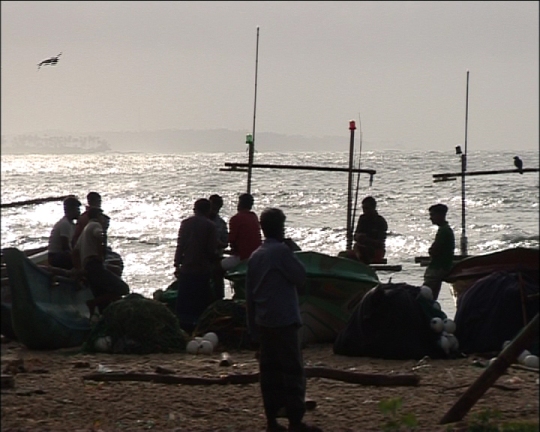
Vietnam has a 3,000km long coastline
“In fact, the World Bank has identified Vietnam, with its 3,000 km long coastline, as among the countries most vulnerable to climate change impact. Our media has been reporting some developments – such as increased coastal erosion – as purely local incidents without making the climate link,” she noted.

The series, originally broadcast in the foreign documentaries slot, was noticed by the VTV senior management who then arranged for its repeat broadcast in the long-established environmental slot. The latter slot, well established for a decade, commands a bigger audience.

“Our Director General was impressed by our receiving such a good series on an important global issue,” Trang recalled. She added: “We need more films like this – that explain the problem and help us to search for solutions.”

Trang kept on thanking TVEAP for Climate Challenge and other films that bring international environment and development concerns to millions of Vietnamese television viewers. I said we share the credit with generous producers like One Planet Pictures and dev.tv, who let go of the rights to their creations for the global South.

If only more producers of TV content on climate and other development issues think and act as they do. That was also the call we made at the end of our workshop: recognise climate change as a copyright free zone.


Related blog post: Climate in crisis and planet in peril – but we’re squabbling over copyrights!
India’s climate change NIMBYsm and middle class apathy

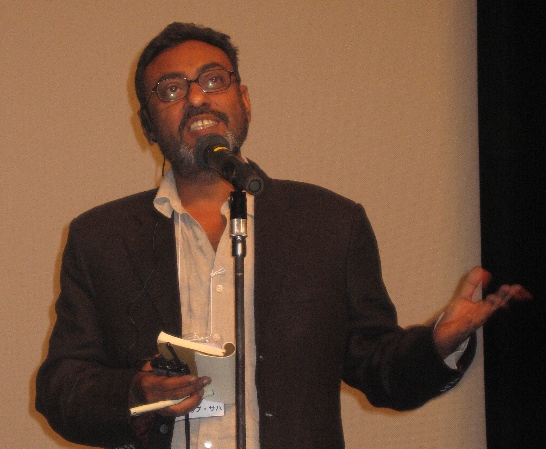
Pradip Saha in Tokyo

The global climate is indeed changing, but not everyone is equally affected by it – or bothered about it either. Take, for example, the majority of India’s 300 million+ middle class, which is roughly the size of the entire population of the United States.

According to environmental activist and independent film-maker Pradip Saha, it’s not a question of ignorance, but apathy.

“Our educated middle classes understand what’s happening, but they are also big contributors to the problem – with their frenzy to burn oil and coal. They look for any excuses for not acting on this issue,” Pradip said during a recent regional workshop in Tokyo, Japan.

The Asia Pacific workshop on ‘Changing Climate and Moving Images’, held in Tama New Town, Tokyo, was organised by TVE Japan in collaboration with TVE Asia Pacific and supported by Japan Fund for Global Environment.

Pradip, associate director of the Centre for Science and Environment – a leading research and advocacy organisation – has been tracking climate change issues for two decades. He sees this Big Issue in three ways: science of climate change, politics of climate change and feelings of climate change.

To fully understand how the complex Indian society perceives and responds to the climate crisis, all three dimensions need to be studied, he says. And particular attention must be paid to the plight of those who are already experiencing changes in their local climate.

From the Himalayan mountains to the small islands in the Bay of Bengal, millions of Indians are living and coping with climate change. “Large sections of our poor feel it, and are among the worse impacted.”

Many such affected people may never have heard of climate change. They are bewildered by rapid changes in rainfall, river flows, sunshine and other natural phenomena.

Pradip drew an example from the Sundarban delta region in the Bay of Bengal. With 10,000 square kilometres of estuarine mangrove forest and 102 islands, it is the world’s largest delta. Here, some islands are slowly being eroded and submerged by rising sea levels. Three small islands have already gone underwater. Others are experiencing problems of salt water intrusion, posing major difficulties for the local people.

Sundarban delta as seen from space

Analysis of surface data near Sagar island in the Sundarbans reveals a temperature increase of 0.9 degree celsius per year. Experts are of the opinion that this is one of the first regions bearing the brunt of climate change.

But the islanders – like most other poor people in India – don’t have enough or any voice to express their concerns to the policy makers, civil society groups and captains of industry. For these members of the middle class, the Sundarbans mean just one thing: the Royal Bengal Tiger.

And most of them probably have never heard of Sagar island. They might just shrug it off, saying: It’s Not In My Backyard (NIMBY).

During the past few months, Pradip has been filming on these islands trying to capture the unfolding human and environmental crisis. He was inspired by an investigative story that appeared in early 2008 in the Down to Earth science and environmental magazine where he is managing editor.

Pradip screened the 64-minute long film, aptly titled Mean Sea Level, at our workshop. The few of us thus became the first outsiders to see the film which I found both deeply moving and very ironic. With minimal narration, he allows the local people to tell their own story. There’s only one expert who quickly explains just what is going on in this particularly weather-prone part of the world.

Confronted with middle class apathy and indifference, activists and journalists like Pradip Saha face an uphill task. “Knowledge is not turning into action because those who know (about climate change causes and responses) are also the biggest culprits,” he says.

To make matters worse, government policies are not formulated with adequate public consultations. Sections of central and state governments in India have also started responding to individual effects of climate change without understanding the bigger picture. Such piecemeal solutions can do more harm than good.

Then there is India’s obsession with motor cars – a topic on which Pradip has already made a short film.

Pradip’s views on climate change activism in India resonates with those of the Filipino academic-activist Walden Bello. Speaking at the Greenaccord international media forum in Rome in November 2007, he called for a mass movement at the grassroots across the developing countries of the global South to deal with climate change – the biggest environmental threat faced by the planet today.

As I quoted him saying, such a movement might be unpopular not only with the Southern elite but also with sections of the urban-based middle class sectors that have been the main beneficiaries of the high-growth economic strategy that has been pursued since the early 1990s.

Read my April 2007 post: Fossil Fools in India

Climate in Crisis and planet in peril – but we’re squabbling over copyrights!

Climate in Crisis - a global documentary

On my recent visit to Tokyo for a regional workshop on changing climate and moving images, I watched a number of excellent documentary films on the subject. One of them was Crude: The Incredible Journey of Oil, the excellent Australian film that I wrote about in March.

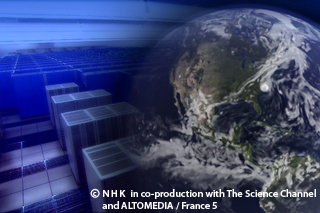
Another was Climate in Crisis, an outstanding global documentary in two parts (2 x 52 mins) co-produced in 2006 by Japan’s public broadcaster NHK together with The Science Channel and ALTOMEDIA/France 5.

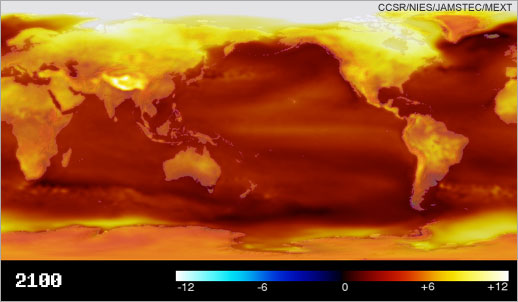
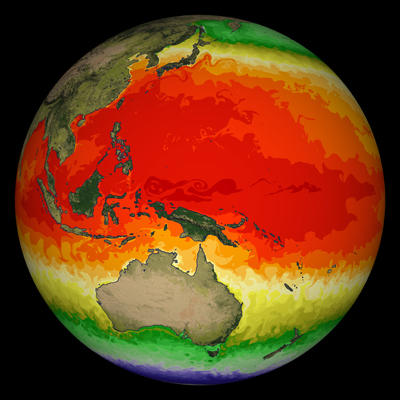
Directed by Fujikawa Masahiro, the film draws heavily on the Earth Simulator — one of the world’s most powerful supercomputers — which Japanese scientists used to project the climatic disasters in next 100 years. The system was developed in 1997 for running global climate models to evaluate the effects of global warming and problems in solid earth geophysics. It has been able to run holistic simulations of global climate in both the atmosphere and the oceans — down to a resolution of 10 km.

NEC Earth Simulator in Japan

The results, captured in this documentary, are truly mind-boggling. Atmospheric temperatures may rise by as much as 4.2 degrees Celsius, more hurricanes may attack and deserts may spread from Africa to southern Europe, and half of the Amazon rainforest may be gone. Climate in Crisis shows a severe projection on environmental destruction based on rigorous scientific data and considers whether humankind can avoid this.

This film, made in the same year as Al Gore’s Oscar-winning film An Inconvenient Truth, has won several awards including the Earth Vision Award at the 15th Earth Vision Tokyo Global Environmental Film Festival.

I was curious why this excellent film – in my view, better made than Al Gore’s one – hasn’t been more widely seen, talked about and distributed. To be honest, I’d not even heard of this one until my Japan visit — and I try to keep myself informed on what’s new in my field of endeavour.

The reasons soon became apparent: copyright restrictions! The co-producers are keeping the rights so tight that only the highest bidders will be allowed to acquire it on a license fee.

This is a standard broadcast industry practice that didn’t surprise me. But I was taken aback by how jealously the rights are guarded. All other films that were part of our event, including high budget commercial productions like Crude, were screened to the public at the Parthenon in Tama New Town in Tokyo.

Not so with Climate in Crisis, which we – the overseas participants to the workshop – had to watch at a theatre inside NHK’s Tokyo headquarters. No public screening was possible. As we later heard, NHK itself was willing to allow a public screening (after all, it draws a good part of its income from the Japanese public), but their international co-producing partners, especially the Science Channel, would simply not agree to it. Wow.

Twenty centuries ago, emperor Nero fiddled while Rome burned. Today, some people are squabbling over copyrights while the whole planet is in peril.

Earth in 2100 - as seen by Earth Simulator

Our workshop participants came from solid backgrounds in broadcasting or independent film-making, and we are not naive activists asking hard-nosed broadcasters to let go of their precious rights which generates vital income. But we would have expected them to allow films such as Climate in Crisis to circulate a bit more freely in everybody’s interest.

This reminded me of correspondence I had last year with the Canadian producers of another outstanding climate film titled The Great Warming. The initial discussions with its director were promising, but when the distribution people started talking about ‘revenue optimising’, our negotiations stalled.

It also reminded me of similar experiences of other environment and natural history film makers, such as South Africa’s Neil Curry. He had a long struggle with the BBC to clear the non-broadcast use rights of his own film that he wanted to take back to the locations in Botswana where it was filmed.

Many broadcast and production companies in the west don’t realise that TV broadcasters in developing Asia operate on a very different basis. Talking about broadcast ‘pre-sales’ or ‘commissions’ loses meaning when many stations are operating on tiny budgets — or in some cases, no budgets — for factual content. Many are struggling to survive in tough, emerging economies.

Is this our future?
Is this our future?

TVE Asia Pacific operates a regional film distribution service that brings environment and development films within reach of such broadcasters. We operate without getting mired in license fees or royalties.

Our 2-day workshop called for climate change to be recognised as a ‘copyright free zone’. This would enable audio-visual media content on the subject to move freely across borders and to be used widely for broadcast and narrowcast purposes.

Here’s the full reference from our statement of concern:

“Prevailing copyright regimes prevent the sharing and wider use of outstanding TV programmes and video films on climate and development issues. We are deeply concerned that even content developed partly or wholly with public funding (government grants, donor funds or lottery funds) remain unfairly locked into excessive copyright restrictions. Sometimes film-makers and producers themselves are willing but unable to allow their creations to be used for non-commercial purposes by educational, civil society and advocacy groups. We appreciate the media industry’s legitimate needs for intellectual property management and returns on investment. At the same time, the climate crisis challenges us to adopt extraordinary measures, one of which can and should be recognising climate change as a ‘copyright free zone’. Such agreement would encourage media organisations and independent producers to share content across borders, and with entities outside the media industry engaged in climate education, advocacy and activism.”

Here’s the simple question I raised during the workshop, which is worth being posed to all those who hesitate to even discuss this issue:

Can anyone manage their intellectual property rights on a dead planet?

This is the real question!

Sleeping easy along the shore: Going the Last Mile with hazard warnings

creating-disaster-resilience-everywhere.jpg

October 8 is the International Day for Disaster Reduction. The United Nations system observes the day ‘to raise the profile of disaster risk reduction, and encourage every citizen and government to take part in building more resilient communities and nations’.

Disaster risk reduction (abbreviated as DRR) is the common term for many and varied techniques that focus on preventing or minimising the effects of disasters. DRR measures either seek to reduce the likelihood of a disaster occurring, or strengthen the people’s ability to respond to it.

DRR is not just another lofty piece of developmentspeak. Unlike many other development measures that are full of cold statistics and/or hot air, this one directly (and quietly) saves lives, jobs and properties.

And it gives people peace of mind – we can’t put a value on that. That was the point I made in a blog post written in December 2007, on the third anniversary of the Indian Ocean Tsunami. Taking the personal example of J A Malani, an ordinary Sri Lankan woman living in Hambantota, on the island’s southern coast, I talked about how she has found peace of mind from a DRR initiative.

‘Evaluating Last Mile Hazard Information Dissemination Project’ (HazInfo project for short) was an action research project by LIRNEasia to find out how communication technology and training can be used to safeguard grassroots communities from disasters. It involved Sarvodaya, Sri Lanka’s largest development organisation, and several other partners including my own TVE Asia Pacific. It was supported by International Development Research Center (IDRC) of Canada.

Recently, IDRC’s inhouse series ‘Research that Matters’ has published an article about the project. Titled “For Easy Sleep Along the Shore: Making Hazard Warnings More Effective” its blurb reads: “In Sri Lanka, a grassroots pilot study combines advanced communication technologies with local volunteer networks to alert coastal villages to danger coming from the sea.”

The article has adapted a lot of the information and quotes I originally compiled for a project introductory note in April 2006.

The outcome of the project’s first phase, which ended in mid 2007, is well documented. My own reflective essay on this project is included as a chapter in our book Communicating Disasters: An Asia Pacific Resource Book, published by TVE Asia Pacific and UNDP in December 2007.

TVE Asia Pacific also made a short video film in late 2007. Called The Long Last Mile , it can be viewed on YouTube in two parts:

The Long Last Mile, part 1 of 2:

The Long Last Mile, part 2 of 2:

The recent IDRC article ends with this para: “A related challenge concerns the shortness of any society’s attention span. In the absence of frequent crises and alerts, how can a nation — or even a village — sustain the continuing levels of preparedness essential to ensure that, when the next big wave comes rolling in and the sirens sound, its people will have the motivation and the capacity to act? The follow-up project seeks to address this worry by preparing the hotels and villages to respond to different types of hazards, rather than only to the relatively rare tsunamis.”

Watch this space.

Download pdf of IDRC’s Research That Matters profile on Last Mile Hazard Warning Project

Financial Meltdown: Putting pieces together of a gigantic whodunnit

this says it all...
My cartoon of the year: this says it all...

This cartoon by Pulitzer prize winning Tom Toles first appeared in the Washington Post in 2007 – it brilliantly anticipated the global financial meltdown that we’re now experiencing. Coming in the wake of confirmed global warming, it is a double whammy.

America has been hit hard by the sub-prime crisis. The social and human cost of financial failure has been enormous. An epidemic of home repossessions has left thousands of houses abandoned and boarded-up: whole suburbs are falling into disrepair and dereliction.

Financial institutions in America and in Britain had poured billions into investments backed by these mortgages. As more and more people have defaulted on their mortgage repayments, financial markets have collapsed, causing a crisis that has rippled across the Atlantic, sending the City of London into turmoil and pulling the plug on one now infamous British bank.

Some call it a financial tsunami not been seen since the Great Depression in the 1930s….a crisis that has forced the US government to step in and save the financial system after trillions were wiped off global stock markets and once revered institutions were swept off the face of Wall Street. Is the US intervention too little, too late to save the economy?

In fact, just a few days ago, the People’s Daily of China warned that a “financial tsunami” was approaching, which recalled the Great Depression in the US. It said: “As the contemporary economy has been integrated globally, American consumption and currency exchange rates will directly influence countries dependent on the US as the main export destination for economic growth and employment”.

The Chinese Communist Party organ complained that the US had unleashed financial “weapons of mass destruction” on the world economy in the form of subprime debts and related financial derivatives.

The world’s media have been scrambling to cover these rapidly unfolding events. In fact, many have been caught napping, or worse, been uncritical cheerleaders of the march of capital and credit. Most of them – even the respected financial journals – just didn’t see the crisis building up…or ignored the tell-tale signs that constituted an inconvenient truth.

Danny Schechter - wasnt crying wolf!
Danny Schechter - wasn't crying wolf!
“This didn’t just happen in the course of a usual business cycle,” insists the American investigative journalist and media analyst Danny Schechter, who has been tracking this issues for many months on his influential News Dissector blog and the MediaChannel that watches and critiques the media.

In his new book, aptly titled Plunder, Danny offers an in-depth investigation into the decline of the economy that’s causing millions to lose jobs and face foreclosures and across-the-board price hikes.

He says: “You wouldn’t know it by relying on our media, but the subprime scandal masks massing looting by Wall Street firms using carefully calculated predatory lending schemes enabled by regulators who don’t regulate and a media that looked the other way. We have lost trillions and dislocated millions with no relief in sight. Every American is paying for the greed of our financiers in the grocery store, gas pump and unemployment line. Bank robberies are not new — but banks doing the robbing is.”

Read the introduction to Danny Schechter’s Plunder.

In 2007, his film IN DEBT WE TRUST was the first to expose Wall Street’s connection to subprime loans, predicting the economic crisis that this book investigates.

I have been watching various news media analysis of the current crisis and want to share two that stood out from the rest: Inside Story by Al Jazeera English, and Dispatches by UK’s Channel 4.

In a special show from New York, Inside Story looks at the financial turbulence that rocked the US last week. Will the emergency measures by the US government be enough to stabilise the markets or has the financial system in the US been changed forever? The introductory report from AJE’s Washington correspondent Reynolds is particularly illuminating – he also writes the story for their website.

Inside Story – The US financial crisis – 21 Sep 2008 – Part 1

Inside Story – The US financial crisis – 21 Sep 2008 – Part 2

From the other side of the Atlantic comes a more investigative, one-hour special that was produced and broadcast in March 2008, when the early signs of the banking crisis were beginning to show – for anybody who cared to notice.

As Channel 4 introduces it: “This is a story about the destructive power of finance: what happens when banks are driven by short-termism; when bankers are rewarded with vast bonuses, free to operate under inadequate regulatory supervision, and with the complicity of a government too in awe of big business to step in.”

Dispatches: How The Banks Bet Your Money UK & US – part 1

In this edition of Dispatches, private equity financier Jon Moulton delivers a stinging rebuke to the banks for causing this financial meltdown and explains why the British taxpayer will now pay the price.

Dispatches: How The Banks Bet Your Money UK & US – part 2

Dispatches: How The Banks Bet Your Money UK & US – part 3

Dispatches: How The Banks Bet Your Money UK & US – part 4

Dispatches: How The Banks Bet Your Money UK & US – part 5

A J Gunawardana: Remembering a lost colleague…and discovering online gaps

A J Gunawardana with film director Lester James Peries
A J Gunawardana (left) with film director Lester James Peries

I have just written a 2,000-word essay recalling my times with a senior colleague and fellow media-watcher, the late Dr A J Gunawardana.

AJ, as he was affectionately known, was an outstanding university teacher, writer/journalist, cinema personality and art critic. When he died in September 1998 at the relatively young age of 65, we lost a rare intellectual who had his feet firmly on the ground, and constantly built bridges linking media, culture and society.

We shared more than our surname and involvement in the media. In fact, when I was beginning to be noticed for my journalistic writing in late 1980s and early 1990s, people kept asking me if I was AJ’s son, or at least a relation. I had to disappoint them.

My association with him was in the last decade of his life. His junior by a generation, I related to the genial professor as a fellow writer and occasional partner in mischief in the domains of media and popular culture. These are the times I have recalled in the tribute, just published on Groundviews citizen journalism website.

AJ started his career as a journalist with the then privately owned flagship of Sri Lankan journalism, Ceylon Daily News, where he was a noted arts and culture correspondent in the 1960s. He went on to obtain a doctorate in performing arts from New York University. Upon return, he pursued a career in academia as a professor of English at the Vidyodaya University (later University of Sri Jayawardenapura) and was closely associated with film and media education. He chaired a Presidential Committee of Inquiry on the Sri Lankan film industry, which issued its report in 1985.

In the arts world, he is perhaps best remembered for the screenplays he wrote for three films by Sri Lanka’s best known director Lester James Peries: Baddegama (1980), Kaliyugaya (1982) and Yuganthaya (1985). The latter two are included among the best of Sri Lankan cinema as compiled by the British Film Institute.

At the time of his death, AJ was working on a biography of the doyen of the Sri Lankan cinema, which was posthumously published in 2005 as LJP: Lester James Peries: Life and Work.

Read my full tribute:
Remembering A J Gunawardana: A creative public intellectual

In researching for this essay, I wanted to verify some biographical and filmographical specifics about AJ. The usually reliable Encyclopaedia of sri Lanka (2006) edition, compiled by Charles Gunawardena (note how we all spell our same surname differently!) had no entry on AJ, which is a bit disappointing considering the far more obscure personalities featured in this reference.

My next step was Googling for A J, using the various spellings for his and my shared surname. (Don’t ask me how and why different clans spell it differently – which must drive foreigners crazy – but it matters to us). Considering AJ published most of his journalistic writing before commercial Internet connectivity became widely available and newspapers started publishing their web editions, I wasn’t surprised by how little I could find online. I didn’t come across a single piece of AJ’s incisive writing online, although perhaps a specialised search might yet unearth a few from some depth of an archive.

This highlights an unmet need where many Asian newspapers and magazines are concerned: their archives only go back to a decade or a dozen years. Even when publishers are willing to unlock their archives and make it available, the sheer logistics involved must daunt them. This could change in time to come, with Google’s recently announced initiative to digitise newspaper archives. The search giant has begun scanning microfilm from some newspapers’ historic archives to make them searchable online, first through Google News and eventually on the papers’ own Web sites.

An aside: I remember making the same point to assembled ITU, UNESCO and other UN worthies at the WSIS Asia Preparatory Meeting in Tokyo in January 2003. In a world where search for information and records is moving increasingly to the web, I said, the old sources of Asia’s news, information and culture need to be progressively placed online. This is a huge undertaking even if we just consider only the newspaper archives. But if not done, these valuable sources may soon begin to be ignored as references.

I then turned to the Internet Movie Database, IMDB, for some specifics and was disappointed again. AJ’s main entry on IMDB listed only one of his three films, and there was no other information about him, at least in the areas allowed for free access. It was only later that I stumbled upon another IMDB entry for AJ, where the last two letters of his surname are lopped off, which keeps it out of most searches.

When the two entries are put together, one begins to get an idea of AJ’s cinematic accomplishments, but it still completely leaves out his work as a film critic.

These gaps are not unique to AJ. In fact, even though IMDb is said to be “one of the largest accumulation of data about films, television programs, direct-to-video products, and video games, reaching back to each medium’s respective beginning”, I imagine a large number of film industry creations and professionals from outside the mainstream English language cinema is currently missing or poorly indexed on it.

Clearly, there is work to be done – by film buffs from Asia, whose want their cinematic traditions and professionals featured adequately on IMDB. Although I occasionally edit entries on the Wikipedia, I haven’t figured out how to do it on IMDB.

In this era of user-generated content, we can’t just sit back and complain that the web is biased towards the English speaking west. It’s still the case, but web 2.0 allows us the opportunity and tools to go and do something about it.

From Chris Rock to Barack Obama: Will electoral life imitate Hollywood art?

Barack Obama is finally confirmed as the Democratic Party’s candidate for President.

This week, while the Democratic Party convention was underway on the other side of the planet, I re-watched the 2003 Chris Rock movie Head of State – and realised how prescient it has been – in some respects.

For those who don’t know the movie, classified as a comedy, here’s the summary from Internet Movie Database: Mays Gilliam, a Washington D.C. neighborhood Alderman, is about to be red-lined out of his job. But after the untimely death of the party frontrunner, Gilliam is plucked from obscurity, and thrust into the limelight as his party’s nominee — for President of the United States. Read full summary and other trivia on IMDB.

Well, other men have gone from the log cabin to the White House, but there’s a significant difference: Mays Gilliam is black, socially underprivileged and broke. In the movie, he becomes the first black man to be nominated for President by a major party (the story isn’t explicit as to which party). Starting as the absolute underdog, and running against a serving, two-term vice president (middle-aged white male, a war hero and a cousin of Sharon Stone to boot), he works his way through a rocky campaign.

The odds slowly improve as Mays speaks his mind and talks truth to power — a refreshing change from the smooth-talking politicians rendering silky words written by their spin doctors. Mays goes on to become President. That wasn’t quite in the plan of Washington power brokers who nominated him – they had other, less noble, intentions. But once unleashed, there was no stopping Mays Gilliam, a self-styled young man who knows how the other half lives.

Someone has helpfully posted an extract from the movie on YouTube. This is the TV debate that Mays has with incumbent Brian Lewis:

Chris Rock, who wrote, directed and starred in the movie, says he got the idea from the 1984 Democratic presidential nominee Walter Mondale, who chose Geraldine Ferraro — a woman — as his running mate. The Democrats knew they had little chance of defeating incumbent Ronald Reagan, but Ferraro’s nomination allowed them to gain female voters, contributing to the eventual 1992 election of Bill Clinton.

This plot line becomes very intriguing with Republican contender John McCain just picking the little known Alaska governor Sarah Palin as his running mate for vice president.

The parallels between Head of State and Barack Obama can only stretch so far. Illinois Senator Obama is not exactly from an underprivileged background, and his education and credentials are much greater than Mays Gilliams’.
And there are some who never tire of reminding us that Obama is not even fully black.

But where life does imitate art is in how the Washington establishment conspires to keep a young, charismatic black man from ascending to the highest elected office. In the movie, deep rooted political party divisions are crossed as power brokers look for desperate measures to stop Mays Gilliam from marching to the White House.

Now why does that sound vaguely familiar with Obama’s own courageous and remarkable journey so far?

At one point in the movie, when things aren’t going well in his campaign, Mays is asked if he wants to quit. His answer: he can’t afford to quit. He’s not just running for himself, but for all black people. “If I quit now, there won’t be another black candidate for 50 years.”

Head of State may have been made made in 2003 as a comedy, but the US political landscape has changed much in the past five years. Suddenly, the scenario is not comic anymore…

Whatever the eventual outcome, the next few weeks in the run up to the Nov 4 US Presidential Election are going to be very interesting.

Will electoral life imitate Hollywood art? Watch this space….

Read my July 2008 post: Perhaps they don’t know that Barack means a blessing…

NPR asked in January 2008: Has Hollywood paved the way for Obama?

Free us from our addiction to oil: New PSAs from Al Gore’s climate campaign

In July 2007, we had an interesting discussion on this blog on the shrinking durations of nature and environment films and TV programmes. The moving images community is divided on this, with some purists holding out that to pack complex, nuanced messages into a few minutes is akin to dumbing everything down. Noted film-makers like Neil Curry disagreed.

But there’s no argument of the sheer power of well produced public service announcements (PSAs) to move people with a specific, short message. Nothing can beat them for the economy of time and efficacy of delivery.

During August 2008, Al Gore’s ‘We’ campaign for climate change activism released two new PSAs, both appealing to Americans to change their energy habits, especially their addiction to oil. This follows and promotes the challenge Al Gore posed to America in July 2008 “to commit to producing 100 percent of our electricity from renewable energy and truly clean carbon-free sources within 10 years”.

Make the Switch, Repower America

Real change can happen real fast. We can strengthen our economy, lower fuel costs, free ourselves from our addiction to oil, and help solve the climate crisis. We can do this by switching to clean, free energy sources like the wind and sun — and to do it within 10 years. Meeting this ambitious goal would create millions of new jobs, lead to permanently lower energy costs for families and help America lead the fight against global warming. William H. Macy narrates in this ad which premiered on network TV in the US during the 2008 Beijing Olympics coverage.

To Our Leaders: Give Us 100% Clean Electricity in 10 Years

We must save our economy, lower fuel costs, free ourselves from our addiction to oil, and solve the climate crisis. To do this, we must demand that we Repower America with 100% clean electricity within 10 years.

The We Campaign is a project of The Alliance for Climate Protection — a nonprofit, nonpartisan effort founded by Nobel laureate former Vice President Al Gore. Its ultimate aim is to halt global warming

Vulnerability Exposed: Micro films on how climate change affects YOU!

Vulnerability Exposed!

Never underestimate the power of moving images. Al Gore tipped the balance in the long-drawn climate change debate with his Oscar-winning film, An Inconvenient Truth. The rest is recent history.

Thanks to the film – and sustained advocacy of hundreds of scientists and activists – climate change is no longer a speculative scenario; it’s widely accepted. The challenge now is to understand how it impacts different people in a myriad ways.

Now the World Bank wants people to use their video cameras to capture how climate change may already be affecting their ways of living and working. The Bank’s Social Development Department has just announced the launch of a worldwide documentary competition that will highlight the social aspects of climate change as experienced and/or observed by the film-maker(s).

Called Vulnerability Exposed, the contest is open to anyone anywhere in the world who wishes to have their voice heard. The submitted films should innovatively illustrate the consequences of climate change through one of the following theme categories: conflict, migration, the urban space, rural institutions, drylands, social policy, indigenous peoples, gender, governance, forests, and/or human rights. The submission period ends on 24 October 2008.

Caroline Kende-Robb, Acting Director, Social Development Department, said, “There is a need to see climate change as an issue of global social justice. The rights, interests and needs of those affected by climate change must be acknowledged.”

Watch the Bank’s short video, where she explains further:

The contest has two award categories:
1) Social Dimensions of Climate Change Award (general category) – open to professional and amateur; and
2) Young Voices of Climate Change (youth category) – open to entries submitted by filmmakers under 24 years old.

Award winners will be chosen through a combination of public voting and a judging panel. The film with the most public votes in each theme category will receive honorable mention.

Judging process
Vulnerability Exposed film competition: Judging process

This contest indicates that the World Bank is slowly but surely opening up to the currently untapped communication potential of web 2.0 – the very point I made in a recent op ed essay.

There are several noteworthy aspects in this competition, some more positive than others. I offer this critique in the spirit of improving a commendable initiative.

Three cheers to the bank for accommodating both amateurs and professionals. It’s about time those who don’t video film for a living (some of who are no less talented in the craft) had more opportunities to showcase their products.

It’s good to see the preference for shorter films, in this contest defined between 2 and 5 mins in duration. This certainly resonates with TVE Asia Pacific’s experience with Asian broadcasters, many of who now prefer shorter films. Longer films have their place, of course, but shorter ones are clear favourites of 24/7 news channels and also online.

Most film contests are judged exclusively by an all-powerful jury (I’ve been on several over the years), but here the online public have a chance to vote for their favourite entries. Let’s hope the judges will consider the story telling power of entries as the most important deciding factor. (The examples in the YouTube film given above are misleading – they all seem extracts from expensively made documentaries.)

The big challenge for many aspiring contestants would be to relate climate change to daily realities in their societies. Despite global headlines and the development community’s current frenzy about it, climate change as a phrase and concept still isn’t clearly understood in all its ramifications. If science now knows 100 facts about the murky processes of climate change, the average public knows less than 25 and understands even less. So it will be interesting to see how entries relate the big picture to their individual small pictures.

I’m a bit disappointed that the World Bank is not offering any cash prize to the winners. Instead, “the winners will receive an all expenses paid trip to Washington, DC for a screening of their film and will have the opportunity to attend a series of networking and learning events organized by…the World Bank in December 2008.” This is all useful, but video – even at the low end – is not exactly cheap, and even labour of love creations cost money to make. We are currently running a comparable the Asia Pacific Rice Film Award – which seeks entries no longer than 10 mins on any aspect of rice – and despite being a non-profit, civil society initiative we have a prize of US$ 2,000 to the winner. And we wish we could offer more.

But my biggest concern is the unequal, unfair terms of copyrights found in the small print of the competition rules. This is where the lawyers have done their usual handiwork, and with the usually lopsided results. The World Bank wants all contestants to make absolutely sure that all material used is fully owned by the contestants, or properly licensed. That’s fine. But tucked away on page 7, under section 12 titled Entrant’s permission to the organiser, is a set of conditions which will allow all affiliated institutions of the World Bank group to use the submitted material for not just promoting this contest (a standard clause in most competitions), but for ‘climate change work program of the organiser’.

What this means, in simpler terms, is that without offering a single dollar in prize money, the World Bank is quietly appropriating the unlimited user rights for any and all the submitted material. These are the core materials in the moving images industry, and nothing is more precious to their creators.

I have long advocated a more balanced, equitable and liberal approach to managing copyrights and intellectual property by both the broadcast television industry and development community — especially where public funded creations are concerned. I have nothing but contempt for lawyers and accountants who often determine the copyrights policies in large broadcast and development organisations. They set out terms that may be justified in strict legal terms, but are totally unfair, unjust and, in the end, counterproductive to the development cause and process. It seems that while our friends in the social and communication divisions were not looking, the Bank’s lawyers have done their standard hatchet job.

While this doesn’t detract from the overall value of Vulnerability Exposed, it diminishes its appeal and potential. Many professional video film-makers who value their footage – gathered with much trouble and expense – may not want to sign future user rights away for simply entering this contest. And worse, the unsuspecting enthusiasts who don’t necessarily earn their living from making films – but are entitled to the same fair treatment of their creations – would be giving away material whose industrial value they may not even fully appreciate.

It’s certainly necessary and relevant for development organisations like the World Bank and the UN system to engage web 2.0. But they must be careful not to import or impose rigid, one-sided and outdated copyright regimes of the past on this new media.

I hope the Bank would consider revising these unfair copyright terms, and treat the submitted material with greater discretion and respect. If not, all entrants risk seeing their material popping out of bluechip films produced by top-dollar production companies in North America and Europe who have ‘mining rights’ to the Bank’s video archives.

Vulnerability Exposed can have more meanings than one. We’d rather not consider some.

Beijing 2008: So what’s a little fake for a cuter Olympics?

The world saw Lin Miaoke, right, sing at the Beijing Olympics opening ceremony - but actually heard the voice of Yang Peiyi, left.

So now it’s confirmed: the spectacular Beijing Olympics opening ceremony – watched live on television by over a billion people worldwide – had been a little more than what it seemed.

What we saw was not what we actually heard. It turns out that the little girl in a red dress, who sang “Ode to the Motherland” as China’s flag was paraded into Beijing’s National Stadium, wasn’t really singing. Clever stage management and sound mixing just made us believe she was.

Beijing games organisers have confirmed that Lin Miaoke, aged 9, whom we saw on TV, was lip-syncing to the sound of another girl, 7-year-old Yang Peiyi, who was only heard but not seen — all because she was deemed not “cute enough”. And they just forgot to tell us there were two…

To refresh memories, here’s that moment from 8 August 2008, as captured by China’s national broadcaster CCTV:

Since the story broke a couple of days later, it has been covered very widely in print, broadcast and online media. There has been particularly good coverage in the New York Times.

An extract from that story:

“The Chinese government has taken great pains to present the best possible image to the outside world during the Olympics, and perfection was the goal for the dazzling opening ceremonies. The filmmaker Zhang Yimou, who oversaw the production, has earned international praise for staging a performance that many considered one of the most spectacular in Olympic history.

“But to achieve the spectacular, not only did organizers fake the song, but they also have acknowledged that one early sequence of the stunning fireworks shown to television viewers actually included digitally enhanced computer graphics used for ‘theatrical effect.'”

And here’s how CNN covered the news of the fake incident on 12 August 2008:

The blogosphere is teeming with discussions on this — and not just in English. It sure raises a number of concerns.

The Olympic motto is made up of three Latin words: “Citius, Altius, Fortius”, which mean “Faster, Higher, Stronger”. At the rate things are moving — with media images taking precedence over accomplishment — we might soon find ‘cuter’ being annexed to it. (Somebody please find the right Latin word.)

But let’s face it: this is not the first time that the world’s greatest festival has been carefully stage-crafted for the benefit of broadcast television, nor will it be the last. The pressure on host nations is immense to show their best face to the world. Perhaps our Chinese friends took that literally, and opted to showcase the supposedly cuter Lin Miaoke to the billion plus audience. (Apparently, a party official deemed that the face of little Miss Yang Peiyi wasn’t good enough – both look perfectly adorable to me…)

Not for a moment do I condone the trickery that Beijing tried to get away with. At the same time, let this be seen as part of a growing, disturbing trend: the broadcast television ‘tail’ has been wagging the Olympics dog for quite some time.

Since the summer Olympics were first commercially broadcast in Rome in 1960, both television’s technology and industry have advanced leaps and bounds. Today, broadcast rights are a very significant source of income for the International Olympic Committee (IOC), and the host countries/cities.

As the IOC official website says: “Increases in broadcast revenue over the past two decades have provided the Olympic Movement and sport with an unprecedented financial base.” And according to the most recent data available, theat revenue accounts for a little over half of all the income that Olympic marketing generates.

That’s all well and good — much of competitive sport today relies so heavily on corporate sponsorships, and television rights are a key part of sports financing.

However, we must worry when so much time, effort, creativity and money is being invested in staging ever more spectacular opening (and to a lesser extent, closing) ceremonies. Yes, it’s a time for the world to celebrate the best and the brightest of the Global Family. And there’s absolutely no harm in having a gala party. But should that extend to rolling out all the tricks of showbiz and make belief? With such a massive global audience following the games not just on television but now also online, where do the IOC and hosts draw the line?

As the world becomes more and more media saturated, these pressures are only set to increase. This year, for the first time, the IOC also allowed online video platform YouTube (owned by Google) to carry about three hours a day of exclusive content — summaries and highlights — from Olympic Broadcasting Services on a dedicated channel.

Let’s not kid ourselves: the world of broadcast television distorts reality on a daily basis. This is an industry that prefers and promotes those whom it considers more cute, pretty, good-looking and sexy. It makes no secret of choosing style over substance. And not just in pure entertainment, but in ALL areas of coverage, including news and current affairs. I have been pointing out how this also affects the coverage of issues like poverty, disasters and development. Even in such serious, factual coverage, many television producers would go with faces that they think are tele-genic, cute or at least particularly pathetic-looking…

Television audiences, by and large, have come to terms with all these ‘adjustments and improvements’ to the murky, messy and unruly real world (yes, some pockets of resistance are fighting a brave vanguard battle, but their numbers are no match for the uncritical couch potatoes).

The challenge is when the real world of Olympic sports tries to mix with the make-belief world of broadcast television to reach out to all those billions of eyeballs. Whose values, standards and rules would then apply?

While the IOC jealously guards time-cherished Olympic principles, it has been slow to modernise and keep up with the times. It must find ways to balance the Olympics integrity with media’s obsession for manufactured reality and feel-good, look-great extravaganzas. And if IOC thinks manging broadcast rights is tricky, just wait till they have to deal with the more bewildering and multitudinous online and mobile media platforms…

What happened in Beijing once again rekindles a long simmering debate. It goes much deeper than an overzealous host nation trying to picture-perfect its proud moment. It takes us right to the heart of the Olympics, and tests if the founding ideals can survive the corporate media realities of the twenty first century.