Phoning each other during personal or shared emergencies is one of the commonest human impulses. Until recently, technology and costs stood in the way. No longer.
We now have practically all grown-ups (and some young people too) in many Asian countries carrying around phones or having easy, regular access to them. For example, Sri Lanka’s tele-density now stands at 106.1 phones 100 people (2011 figures).
What does this mean in times of crisis caused by disasters or other calamities? This is explored in a short video I just made for LIRNEasia:
Synopsis:
With the spread of affordable telecom services, most Asians now use their own phones to stay connected. Can talking on the phone help those responding to emergencies to be better organised? How can voice be used more efficiently in alerting and reporting about disasters? Where can computer technology make a difference in crisis management?
These questions were investigated in an action research project by LIRNEasia in partnership with Sarvodaya, Sri Lanka’s largest development organisation. Experimenting with Sahana disaster management software and Freedom Fone interactive voice response system, it probed how voice-based reporting can fit into globally accepted standards for sharing emergency data. It found that while the technology isn’t perfect yet, there is much potential.
But in this digital age, most scientists can use online platforms and simple digital tools to communicate directly with the public and/or policy makers. At least some scientists try to tap this potential — and we are grateful.
The World Resources Institute (WRI), a respected non-profit research and advocacy group, is currently trying to understand “how recent climate science discoveries can best be communicated via video”.
With support from Google, and with the help of three climate scientists, WRI has recently produced 3 different video types in order to test which works best. They are currently on display on their website, with a request for readers to vote and comment:
1. “A webcam talk” uses a self-recorded video of the scientist discussing his findings
2. “A conversation” uses a slideshow with a voiceover of the scientist discussing his findings
3. “A whiteboard talk” is a professionally shot video of the scientist in front of whiteboard discussing his findings
Here is the comment I submitted: the challenges WRI face are common and widely shared. And I do have some experience covering climate and other complex science and environmental stories across Asia for the visual and print media.
First, thanks for asking — and for exploring best public engagement method, which most technical experts and their organisations don’t bother to do.
Second, Andy Dessler comes across as an eager expert — not all scientists are! Some are visibly condescending and disdainful in doing ‘public’ talks that they immediately put off non-technical audiences.
Third, the options you’ve presented above are NOT mutually exclusive. For best results, you can mix them.
Webcam method is helpful, but people don’t want to see any talking head for more than a few seconds at a time. They want to see WHO is talking, and also WHAT is being talked about. The images in Conversation method come in here.
I realise webcams are usually set up inside buildings, but visually speaking the more interesting backdrops are in the open. In this case, if Andy Dessler were to record his remarks outdoors, on a clear and sunny day with some clouds in the far background sky, that would have been great!
I’m personally less convinced about Whiteboard Talk: many in your audience probably don’t want to be lectured to, or be reminded of college days. I would avoid that.
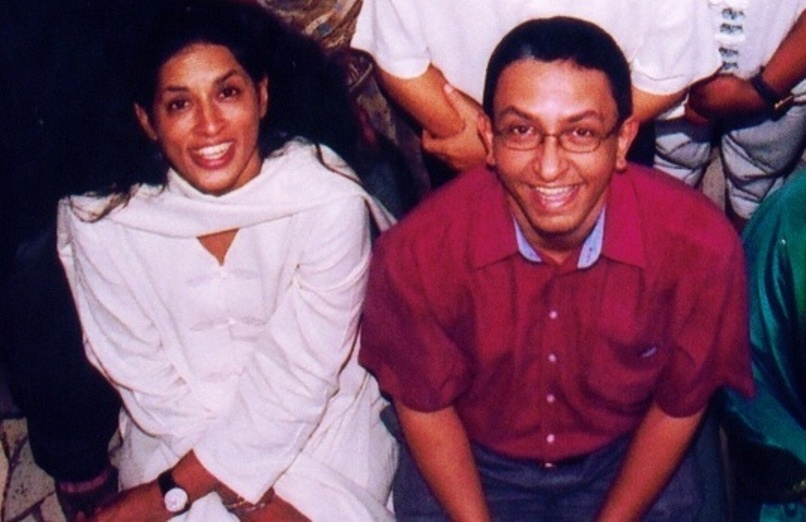
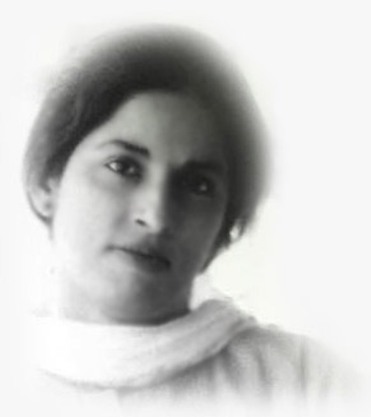
On 20 April 2012, we marked seven years since Saneeya Hussain left us. Journalist and activist Saneeya suffered a needless and tragic death at when she ran out of fresh air in South Asia and was caught up in the urban traffic congestion of Sao Paulo.
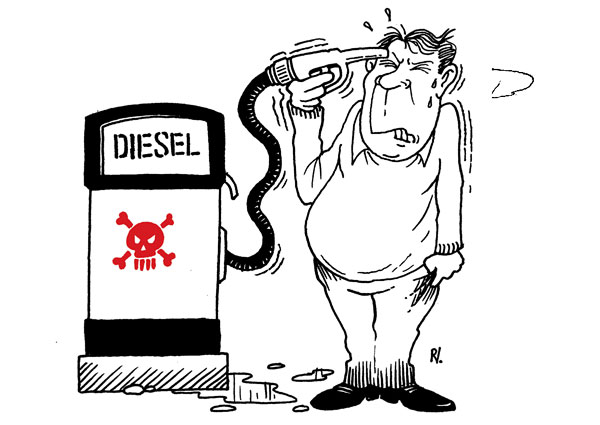
In this week’s Ravaya Sunday column, I remember Saneeya’s legacy and plight and discuss the latest dimensions of outdoor air pollution in Sri Lanka that threatens fellow asthma sufferers like myself. The same information is covered in English at: Gasping for Fresh Air, Seeking More Liveable Cities in South Asia
Saneeya Hussain & Nalaka Gunawardene: Singapore, Nov 2002
This is the Sinhala text of my Sunday column in Ravaya newspaper, 1 April 2012.
Facing an electricity generation crisis, Sri Lanka has embarked on a countrywide energy conservation drive — urging everyone to switch off all non-essential lights, and reduce other forms of power consumption.
Beyond these important yet token gestures, are there smart options that can save significant quantities of electricity, 85% of which is now generated in Sri Lanka using imported, costly fossil fuels?
Yes, there is one: advance the clock by half an hour. Faced with power crises in the past, governments did this in the 1990s — and with tangible results. This is evidence based policy and action. But a vocal minority in Lanka resented this progressive move all along, and in April 2006, they successfully lobbied the (current) government to revert Sri Lanka’s standard time to GMT+5:30 from GMT+6 which had been used since 1996.
I wrote about Sri Lanka giving up on Daylight Saving time in April 2006 in this SciDev.Net opinion essay: Science loses in Sri Lanka’s debate on standard time. As I noted: “In doing so, the government completely ignored expert views of scientists and intellectuals. It listened instead to a vocal minority of nationalists, astrologers and Buddhist monks who had lobbied the newly elected president to ‘restore the clock to original Sri Lankan time’.”
Malima (New Directions in Innovation) is a Sinhala language TV series on science, technology and innovation, broadcast on Sri Lanka’s Rupavahini TV channel.
Produced by Suminda Thilakasena and hosted by science writer Nalaka Gunawardene, this episode was first broadcast on 22 March 2012. It features three stories:
• An interview with Dr Sarath Wimalasuriya, who has invented a low-cost, portable device that provided electrical pulse to a fence protecting crops from elephants. Called Shock Defender, this 5kg unit can support a fence 1.8km long, typically 50 acres (20.2 hectares). When fully charged, it can work for 48 hrs on battery. The medical doctor turned electronic inventor sells the device at one sixth the price of comparable imported ones.
• South Korean scientists say they have developed flexible memory technology that could support bendable computer platforms for e-books and cell phones.
• An interview with child inventor K K Irushika Teran Suriyakumara, student of St Benedict’s College, Colombo, who has come up with a simple automated device to remotely feed fish in a household fish tank. He has cleverly combined discarded material and a basic mobile phone. Find out how!
Some geologists now believe that human activity has so irrevocably altered our planet that we have entered a new geological age.
A decade ago the Nobel Laureate Dutch chemist, Paul J Crutzen, coined a new term for it: the Anthropocene.
The proposed new epoch was discussed at a major conference held at the Geological Society in London in the summer of 2011.
A new short video explaining it in simple terms was released this week in connection with the Planet Under Pressure conference, London 26-29 March 2012.
As they say, it offers a “3-minute journey through the last 250 years of our history, from the start of the Industrial Revolution to the Rio+20 Summit”.
The film charts the growth of humanity into a global force on an equivalent scale to major geological processes.
The film is part of the world’s first educational webportal on the Anthropocene, commissioned by the Planet Under Pressure conference, and developed and sponsored by anthropocene.info
In this week’s Sunday column, published in Ravaya newspaper of 25 March 2012, I
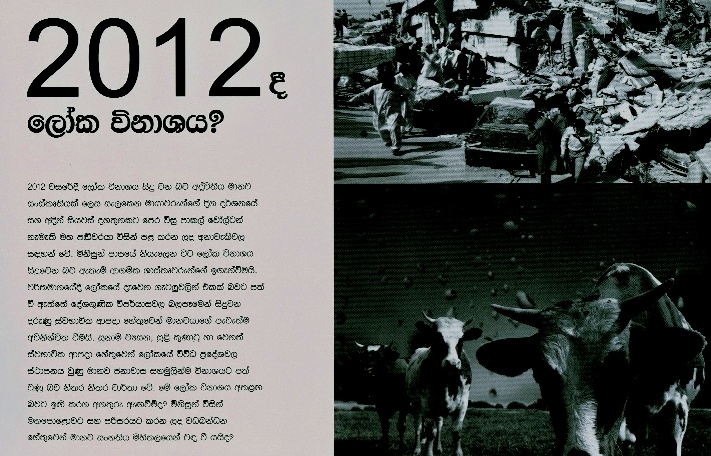
return to take another critical look at the hype and hysteria surrounding the world ‘ending’ in December 2012.
Last week’s column elicited several reader responses online and offline. While many agreed with my rational reasoning, some were miffed by my puncturing their inflated obsession! A few challenged me to provide an assurance that there won’t be any major disasters in 2012 — we were NOT talking about random disasters, but a planetary scale one which qualifies as End of the World.
This week, we look at how certain environmentalists are linking global warming and 2012 world ending myth, adding to existing public confusion about climate change. I cite as an example of this green alarmism a highly distorted article Sinhala published by Practical Action Sri Lanka, a usually moderate and sensible development organisation. Its country director admits it was an ill-advised public outreach effort.
I also refer to a recent scientific analysis that probed whether highly destructive large-scale earthquakes in the past few years, in countries bordering the Pacific and Indian oceans, indicate an increased global risk of these deadly events. Its conclusion: there is no such evidence.
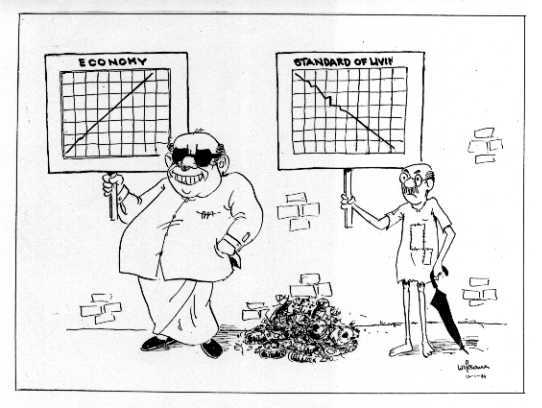
This is my weekly Sinhala language column published in Ravaya Sunday newspaper dated 26 Feb 2012. In this, I explore some of the many fascinating insights into how Lankans live and work, as revealed by the Household Income and Expenditure Survey 2009/10 conducted by the Department of Census and Statistics, Sri Lanka. It was based on a large, countrywide sample of 22,500 households and conducted over a 12-month period in 2009-2010.
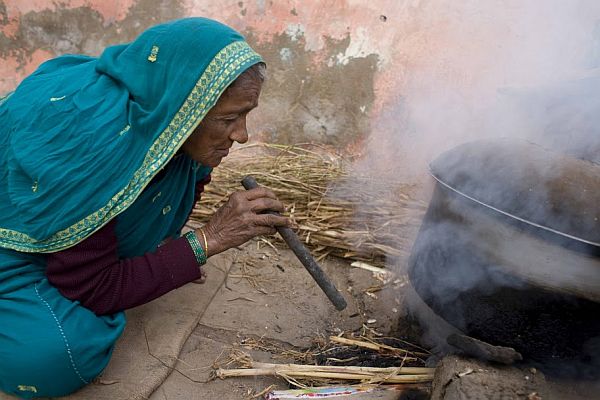
The ‘gas chamber’ in every home that rarely draws any attention!
In this week’s Ravaya column, I look at indoor air pollution. This is often a neglected environmental and health issue caused mostly by inefficient cooking stoves that burn biomass. This affects mostly housewives and children who are exposed to kitchen smoke from poor ventilation and badly designed stoves.
In India, smoke from firewood use is estimated to cause half a million premature deaths every year. Studies indicate that indoor air can have more damaging impacts that outdoor air pollution in even some of the most polluted cities. People spend as much as 90% of their time indoors.
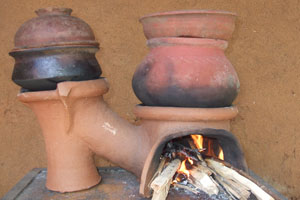
The numbers for Sri Lanka are not known, but it is wideapread. We look at not only the extent of the problem, but also attempts to reduce it — through a new fuel efficient cooking stove now on the market, and by improving kitchen ventilation. I cite the example of the rural community in Aranayake, off Mawanella, in Sri Lanka’s Kegalle district where Integrated Development Association (IDEA) has introduced a kitchen improvement project.
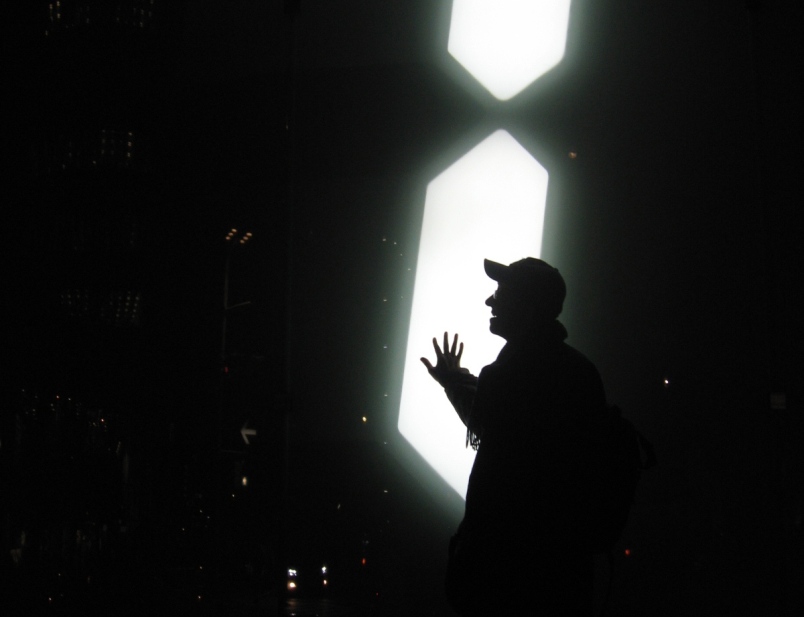
Nalaka G at a giant digital clock in Tokyo: Wandering everywhere with a sense of wonder...
This is the Sinhala text of my weekly column published in Ravaya newspaper for 5 February 2012. Here, I look back at one year of weekly columns and reflect on some reader feedback and their participation in my efforts to make sense of the world in turmoil that is all around me. I say ‘Thank You’ to the few writer friends and public intellectuals who have advised and guided me. I reaffirm my commitment to keep asking questions, connecting dots and following my own simple language style with none of the intellectual pretensions common in Sinhala newspaper writing.



 Open Minds!