National Media Summit 2012 at University of Kelaniya, 25 May 2012 New Media, Old Minds: A Bridge Too Far?
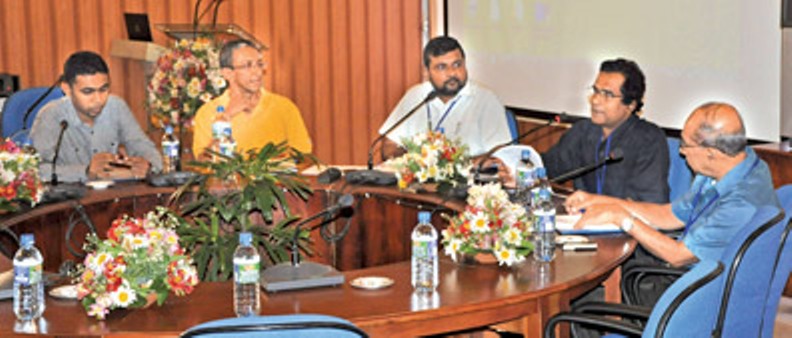
This was the title of a presentation I made at National Media Summit 2012, at University of Kelaniya, Sri Lanka, this morning. I was asked to talk about New Media and policies for Sri Lanka.
In my audience were academics and researchers on journalism and mass communication drawn from several universities of Sri Lanka. I was told the biennial event is to help frame new research frameworks and projects.
Now, I’m not a researcher in the conventional sense of that term, and am fond of saying I don’t have a single academic bone in my body. Despite this, occasionally, universities and research institutes invite me to join their events as speaker, panelist or moderator.
University of Kelaniya, a state university in Sri Lanka, has the island’s oldest mass communication department, started in the late 1960s.
Perhaps inertia and traditions weigh down such places — while I had a patient hearing, I found our ensuing discussion disappointing. The historical analogies, policy dilemmas and coping strategies I touched on in my presentation didn’t get much comment or questions.
Instead, rather predictably, the ill-moderated discussion meandered on about the adverse social and cultural impacts of Internet and mobile phones and the need to ‘control’ everything in the public interest (where have I heard that before?).
And much time was wasted on debating on what exactly was new media and how to define and categorise it (I’d argued: it all depends on who answers the question!).
Part of the confusion arose from many conflating private, closed communications online (e.g. Facebook) with the open, more public interest online content (e.g. news websites). Similarly, the critical need for common technical standards (to ensure inter-operability) was mistaken by some as the need for dull and dreary orthodoxy in content!
Concepts like Citizen Journalism, user-generated content, privacy, right to information were all bandied around — but without clarity, focus or depth. Admittedly we couldn’t cover everything under the Sun. But we didn’t even discuss what options and choices policy makers have when confronted with rapidly evolving new media types.
Half anticipating this, I had included a line in my talk that said: “Academics must research, analyse & advise (policy makers). But are Lankan academics thought-leaders in ICT?”
I was being a polite guest by not explicitly answering my own question (but as a helpful hint, I mentioned dinosaurs a few times!). In the end, my audience provided a clear (and sadly, negative) answer: far from being path-finders or thought-leaders, they are mostly laggards who don’t even realise how much they have to catch up!
And some of them are framing Lankan media policy and/or advising government on information society issues. HELP!
Don’t take my word for it. Just try to find ANY online mention of National Media Summit 2012 that just ended a few hour ago. Google indexes content pretty fast these days — but there is NONE that I can find on Google as May 25 draws to an end (except my own PPT on SlideShare!).
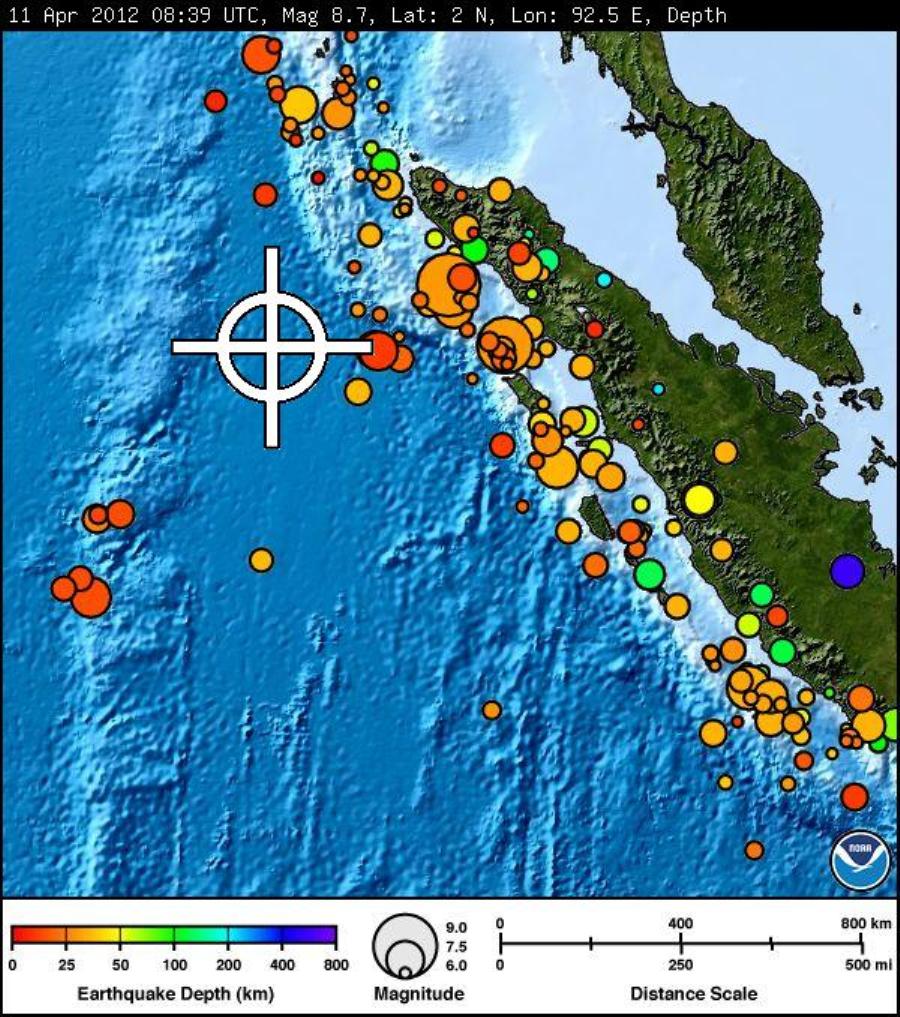
In this week’s Ravaya Sunday column (in Sinhala) appearing on 29 April 2012, I reflect on the Indian Ocean undersea quake on 11 April 2012, and the tsunami watch that followed.
Taking Sri Lanka as the example, I raise some basic concerns that go beyond the individual incident, and address fundamentals of disaster early warning and information management in the Internet age.
I ask: Was the tsunami warning and coastal evacuation on April 11 justified in Sri Lanka? I argue that this needs careful, dispassionate analysis in the coming weeks. ‘Better safe than sorry’ might work the first few times, but let us remember the cry-wolf syndrome. False alarms and evacuation orders can reduce public trust and cooperation over time.
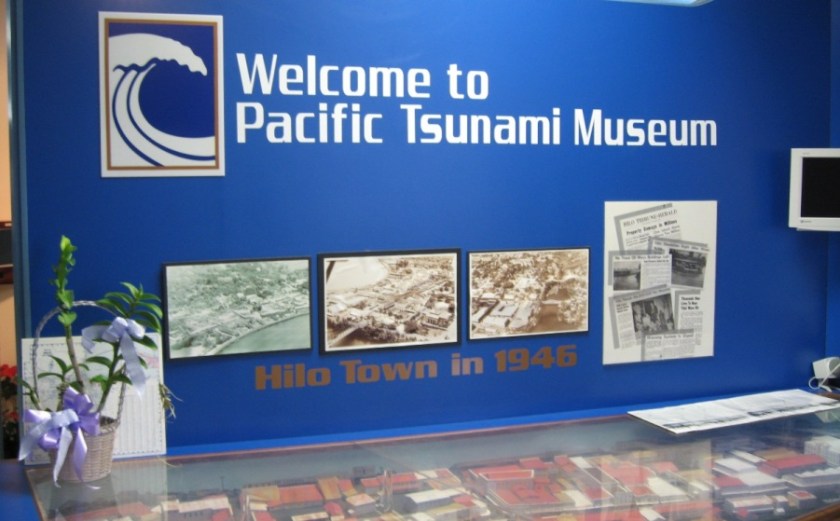
Entrance to Pacific Tsunami Museum in Hilo, Hawaii, photo by Nalaka Gunawardene, Jan 2007
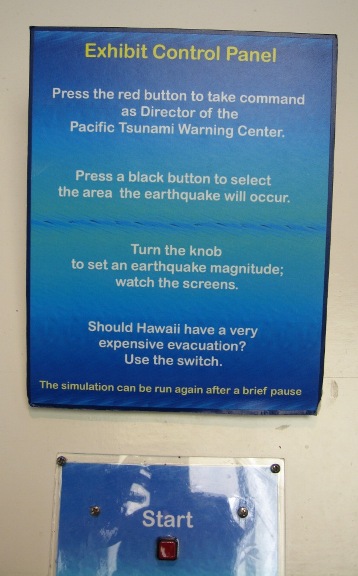
Five years ago, on a visit to the Pacific Tsunami Museum in Hilo, Hawaii, I played an interesting simulation game: setting off an undersea earthquake and deciding whether or not to issue a tsunami warning to the many countries in and around the Pacific.
The volunteer-run museum, based in ‘the tsunami capital of the world’, engages visitors on the science, history and sociology of tsunamis. The exhibits are mostly mechanical or use basic electronic displays, but the messages are carefully thought out.
The game allowed me to imagine being Director of the Pacific Tsunami Warning Centre (PTWC), a US government scientific facility in Ewa Beach, Hawaii, where geophysicists monitor seismic activity round the clock. When the magnitude exceeds 7.5, its epicentre is located and a tsunami watch is set up. Then, combining the seismic, sea level and historical data, PTWC decides if it should be upped to a warning.
Tsunami simulation game - low tech, high lessonThe museum game allows players to choose one of three locations where an earthquake happens — Alaska, Chile or Japan — and also decide on its magnitude from 6.0 to 8.5 on the Richter Scale.
This is an instance where scientists must quickly process large volumes of information and add their own judgement to the mix. With rapid onset hazards like tsunamis, every second counts. Delays or inaction can be costly — but false alarms don’t come cheap either.
I played the game thrice, and erring on the side of caution, issued a local (Hawaiian) evacuation every time. If it were for real, that would have caused chaos and cost the islanders a lot of money.
In fact, those who make decisions on tsunami alerts or warnings have to take many factors into account – including safety, economic impact and even political fall-out.
After playing the simulation game, I can better appreciate the predicament government officials who shoulder this responsibility. They walk a tight rope, balancing short-term public safety and long term public trust in the entire early warning system.
Taking Sri Lanka as the example, but sometimes referring to how other Indian Ocean rim countries reacted to the same situation, I raise some basic concerns that go beyond this individual incident, and address fundamentals of disaster early warning and information management in the Internet age.
Another except: “So was the tsunami warning and coastal evacuation on April 11 justified? This needs careful, dispassionate analysis in the coming weeks. ‘Better safe than sorry’ might work the first few times, but let us remember the cry-wolf syndrome. False alarms and evacuation orders can reduce public trust and cooperation over time.”
In particular, I focus on nurturing public trust — which I call the ‘lubricant’ that can help move the wheels of law and order, as well as public safety, in the right direction.
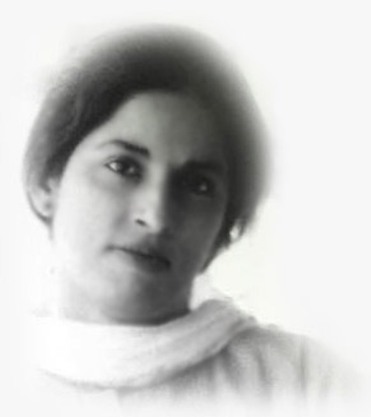
On 20 April 2012, we marked seven years since Saneeya Hussain left us. Journalist and activist Saneeya suffered a needless and tragic death at when she ran out of fresh air in South Asia and was caught up in the urban traffic congestion of Sao Paulo.
In this week’s Ravaya Sunday column, I remember Saneeya’s legacy and plight and discuss the latest dimensions of outdoor air pollution in Sri Lanka that threatens fellow asthma sufferers like myself. The same information is covered in English at: Gasping for Fresh Air, Seeking More Liveable Cities in South Asia
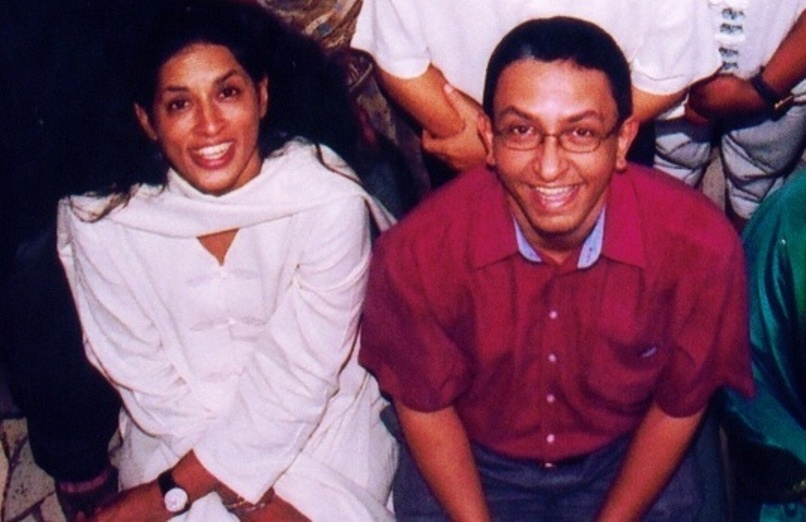
Saneeya Hussain & Nalaka Gunawardene: Singapore, Nov 2002
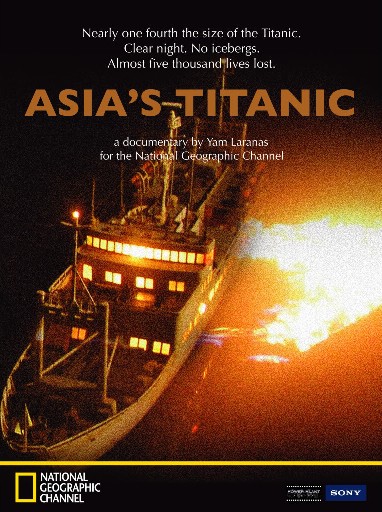
Asia's Titanic - NatGeo poster for 2009 filmHow and where do you begin to tell the story of the biggest peace-time disaster at sea in modern times — where only 24 people survived and more than 4,000 perished within an hour or two?
That was the challenge that my Filipino filmmaker friend Baby Ruth Villarama and her colleagues faced, when they made an hour-long documentary, Asia’s Titanic, which National Geographic TV broadcast in mid 2009.
Former television journalist and now an independent TV producer, Baby Ruth Villarama specialises in story research and documentary producing. Runs her own production company, Voyage Film, based in Manila but active across Asia.
Ruth was the researcher and assistant producer of Asia’s Titanic, directed by award-winning Filipino director Yam Laranas.
A few days ago, I asked Ruth for her own memories and reflections. This is what she shared with me, in her own words — the moving story behind the moving images creation:
With the Doña Paz story, sharing their memories was the most difficult part of covering it as the tragedy is something they’d rather not talk about – and, if possible, forget.
I spent a year ‘off-the-record’ understanding the holes in their memories. I felt I had to retrace the steps of these 4,000 souls and learn the relationship of man and the sea.
They’ve lost their children, parents and comrades on Christmas eve over a sea mishap – drowning and burning in the quiet water. We can only imagine the pain they went through.
The tragedy is the peak of memory they have left of their loved ones too, so every Christmas, some relatives of the dead gather together to live the lives their loved ones would have wanted to continue.
I joined that gathering for about three Christmases in between my research efforts. It was then that I began to understand the rabbit holes in each one of them — and the rabbit hole I had in me for not knowing my mother personally.
We started sharing pains and the “what-could-have-beens” of those lost memories. That was the connection they were looking for: to be able to speak of the pain to a stranger, or worst, to a group of filmmakers who would broadcast their story to millions of households around the globe.
This documentary was initiated not just to tell their story but to attempt to fill a hole of justice to the many casualties and their families.
It was through them that we were able to speak to the remaining living survivors. We became part of that annual gathering. Despite the requirements of the studio and my director to deliver deadlines, we tried my best to balance their readiness to speak. Good thing NatGeo was willing to wait 3 – 5 years in the timeline…
I remember visiting a survivor in his sleepy town in the province of Samar sometime in 2005. He owns a small sari-sari (convenient) store then. He said that it took him a year to speak again after the tragedy — and another year before he could eat properly because he couldn’t swallow soups and liquids right.
He never really set foot outside his island again – always fearing for fire and water, including the air as he vividly remembers how it added fume to the fire on that fateful night at sea.
After a while, he started talking about the details of that trip. He stopped, wept and couldn’t carry on anymore. He couldn’t breathe and seemingly battled against the air.
A huge part of me personally felt wrong seeing him again but I know that if we do not tell this story, no one will — and the world will just forget about this huge ‘mistake’ in navigational history.
I’d like to think that the impact of the story outside the Philippines is to remind the world fact that Titanic is not the worst maritime disaster — that somewhere in South East Asia, there was a small ship that killed more than 4,000 lives. It created maritime talks in international forums and the fact that accidents in this magnitude didn’t occur anymore — I think people are more careful now.
It’s a shame that Doña Paz was not as celebrated as the Titanic. One big difference between the Titanic and Doña Paz, aside from its route and technical specifications, is the status of passengers.
The Titanic carried a large number of wealthy westerners. Those who boarded the Doña Paz were mostly average Filipinos — no names, no status in society, even in their own country.
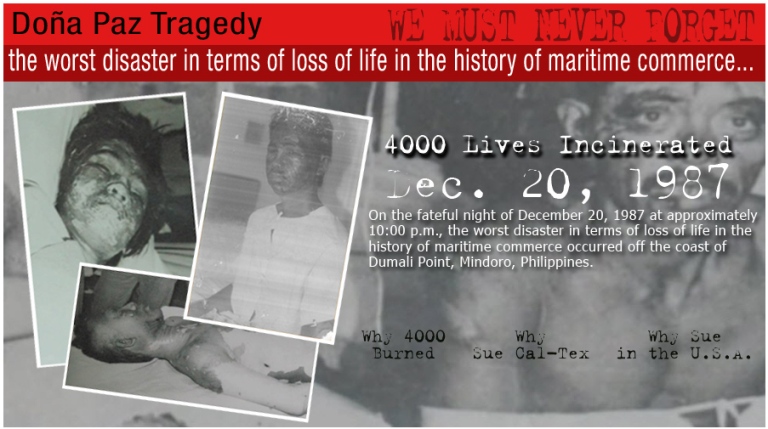
Dona Paz tragedy - image from the survivor website
What is the world’s worst peace-time maritime disaster?
No, it’s not the sinking of the Titanic. It’s a disaster that happened 75 later, on the other side of the planet – in Asia.
It is the sinking of the MV Doña Paz, off the coast of Dumali Point, Mindoro, in the Philippines on 20 December 1987. That night, the 2,215-ton passenger ferry sailed into infamy with a loss of over 4,000 lives – many of them burnt alive in an inferno at sea.
Nobody is certain exactly how many lives were lost — because many of them were not supposed to be on that overcrowded passenger ferry, sailing in clear tropical weather on an overnight journey.
Passenger ferries like the Doña Paz are widely used in the Philippines, an archipelago in Southeast Asia comprising over 7,000 islands. They are among the cheapest and most popular ways to travel.
Just 5 days before Christmas of 1987, hundreds of ordinary people boarded the Doña Paz for a 24-hour voyage from the Leyte island to Manila, the capital.
The Doña Paz – originally built and used in Japan in 1963 and bought by a Filipino ferry company in 1975 — was authorized to carry a maximum load of 1,518 passengers.
But the on the night of the accident, survivors say there may have been more than 4,000 people on board – a gross violation of safety procedures.
Only 24 of them survived the journey — and only just. The entire crew and most of its passengers perished in an accident happened due to negligence, recklessness and callous disregard for safety.
For a glimpse of what happened, watch these first few minutes from 2009 National Geographic documentary,Asia’s Titanic:
For a summary compiled from several journalistic and activist sources, read on…
The Doña Paz had an official passenger list of 1,493 with a crew of 59 on board. But later media investigations showed that the list did not include as many as 1,000 children below the age of four — and many passengers who paid their fare after boarding.
The ship was going at a steady pace. The passengers were settling in for the night. The Doña Paz was scheduled to arrive in Manila by morning. A survivor later said that the weather that night was clear, but the sea was choppy.
Around 10.30 pm local time, without any warning, the Doña Paz collided with another vessel. It was no ordinary ship: the MT Vector was en route from Bataan to Masbate, carrying 8,800 barrels of gasoline, diesel and kerosene owned by Caltex Philippines.
Immediately upon collision, the tanker’s cargo ignited, setting off a massive fire that soon engulfed both ships. Thousands of passengers were trapped inside the burning ferry.
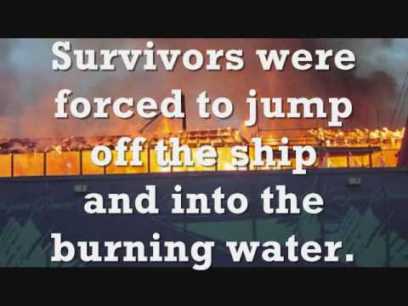
Dozens of passengers leaped into the sea without realizing that the petroleum products had also set the surrounding seas ablaze. Those in the water had to keep diving to avoid the flames spreading on the surface.
Of all the passengers and crew on board, only 24 survived. Everything known about this maritime disaster is based largely on their accounts – and investigative work done by a handful of journalists.
MV Doña Paz in 1984, three years before its tragic end - Photo courtesy Wikimedia Commons - lindsaybridge
One survivor claimed that the lights onboard went out soon after the collision: there had been no life vests on the Doña Paz, and that none of the crew was giving any orders. It was later said that the life jackets were locked up beyond emergency reach.
The few survivors were later rescued swimming among many charred bodies in the shark-infested Tablas Strait that separates Mindoro and Panay islands.
The first help arrived at the scene around one and a half hours after the collision – it was another passing ship. By this time, most passengers of the ferry were dead.
The Doña Paz sank within two hours of the collision, while the Vector sank in four hours. The sea is about 545 meters deep in the collision site.
The Philippines Coast Guard did not learn about the disaster until eight hours after it happened. An official search and rescue mission took more hours to get started.
In the days that followed, the full scale of the horrible tragedy became clear. The ferry’s owner company, Sulpicio Lines, argued that the ferry was not overcrowded. It also refused to acknowledge anyone other than those officially listed on its passenger manifest.
Manifests on Philippine inter-island vessels are notoriously inaccurate. They often record children as “half-passengers” or disregard them entirely. Corrupt officials frequently accept bribes to allow overloading.
Many victims were probably incinerated when the vessels exploded and will never be accounted for. Rescuers found only 108 bodies, many of them charred and mutilated beyond recognition. More bodies were later washed ashore to nearby islands where the local people buried them after religious rituals.
All officers on board the Doña Paz were killed in the disaster, and the two from the Vector who survived had both been asleep at the time. This left the field entirely to lawyers from all sides to endlessly argue over what went wrong, how – and who was responsible.
It was later found that, at the time of the collision, both ships had been moving slowly: the Doña Paz at 26 km per hour, and Vector at 8 km per hour. They were surrounded by 37 square km of wide open sea – plenty of time and space to avoid crashing into each other!
Experts also wondered why the two ships had not communicated with each other before the crash. It is internationally required that all ships carry VHF radio. The Vector was found to have an expired radio license. The radio license for the Doña Paz was a fake.
Survivors told investigators that the crew of the Doña Paz were having a party on board minutes before it collided with the oil tanker. Some reports suggested that the captain himself had been among the revelers.
Being ordinary people, the passenger didn’t know details of maritime rank or procedure. It is likely that a mate or apprentice was steering the Doña Paz. Not a single crew member survived to tell their version of the incident.
After a long and contentious inquiry, the investigators placed the blame on the Vector.
Independent analyses have identified multiple factors that contributed to this tragedy: lack of law enforcement arising from corruption and connivance; under-qualified and overworked crew; telecommunications failures; and inadequate search and rescue efforts in the event of accidents.
Asia's Titanic - NatGeo poster for 2009 filmIn August 2009, National Geographic Channel broadcast an investigative documentary titled Asia’s Titanic that tried to piece together the evidence and understand what happened.
Directed by award-winning Filipino director Yam Laranas, it was the first for any Filipino filmmaker to direct a full-length documentary for the global channel noted for its factual films.
Through dramatic first hand accounts from survivors and rescuers, transcripts from the Philippine congressional inquiry into the tragedy, archival footage and photos and a re-enactment of the collision, dissect the unfolding tragedy of Doña Paz.
The 10-million Filipino peso project took more than 3 years to make, but even its makers could not find all the answers.
“The truth may never be known. In the years after the Doña Paz tragedy, shipping disasters continue to plague the Philippines,” says the documentary as it ends.
This is the Sinhala text of my Sunday column in Ravaya newspaper, 1 April 2012.
Facing an electricity generation crisis, Sri Lanka has embarked on a countrywide energy conservation drive — urging everyone to switch off all non-essential lights, and reduce other forms of power consumption.
Beyond these important yet token gestures, are there smart options that can save significant quantities of electricity, 85% of which is now generated in Sri Lanka using imported, costly fossil fuels?
Yes, there is one: advance the clock by half an hour. Faced with power crises in the past, governments did this in the 1990s — and with tangible results. This is evidence based policy and action. But a vocal minority in Lanka resented this progressive move all along, and in April 2006, they successfully lobbied the (current) government to revert Sri Lanka’s standard time to GMT+5:30 from GMT+6 which had been used since 1996.
I wrote about Sri Lanka giving up on Daylight Saving time in April 2006 in this SciDev.Net opinion essay: Science loses in Sri Lanka’s debate on standard time. As I noted: “In doing so, the government completely ignored expert views of scientists and intellectuals. It listened instead to a vocal minority of nationalists, astrologers and Buddhist monks who had lobbied the newly elected president to ‘restore the clock to original Sri Lankan time’.”
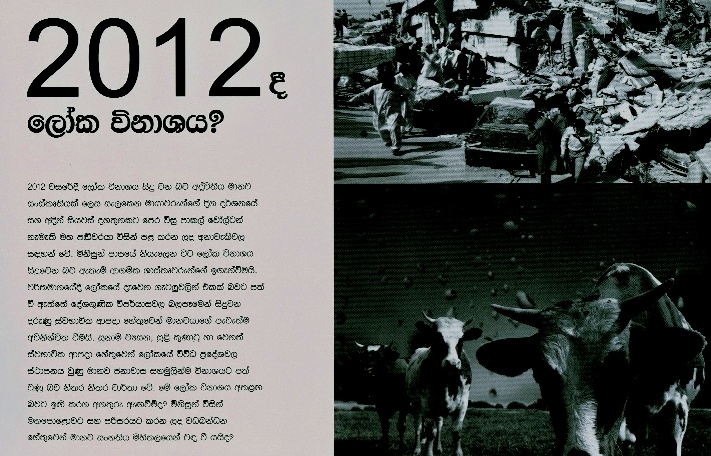
In this week’s Sunday column, published in Ravaya newspaper of 25 March 2012, I
return to take another critical look at the hype and hysteria surrounding the world ‘ending’ in December 2012.
Last week’s column elicited several reader responses online and offline. While many agreed with my rational reasoning, some were miffed by my puncturing their inflated obsession! A few challenged me to provide an assurance that there won’t be any major disasters in 2012 — we were NOT talking about random disasters, but a planetary scale one which qualifies as End of the World.
This week, we look at how certain environmentalists are linking global warming and 2012 world ending myth, adding to existing public confusion about climate change. I cite as an example of this green alarmism a highly distorted article Sinhala published by Practical Action Sri Lanka, a usually moderate and sensible development organisation. Its country director admits it was an ill-advised public outreach effort.
I also refer to a recent scientific analysis that probed whether highly destructive large-scale earthquakes in the past few years, in countries bordering the Pacific and Indian oceans, indicate an increased global risk of these deadly events. Its conclusion: there is no such evidence.
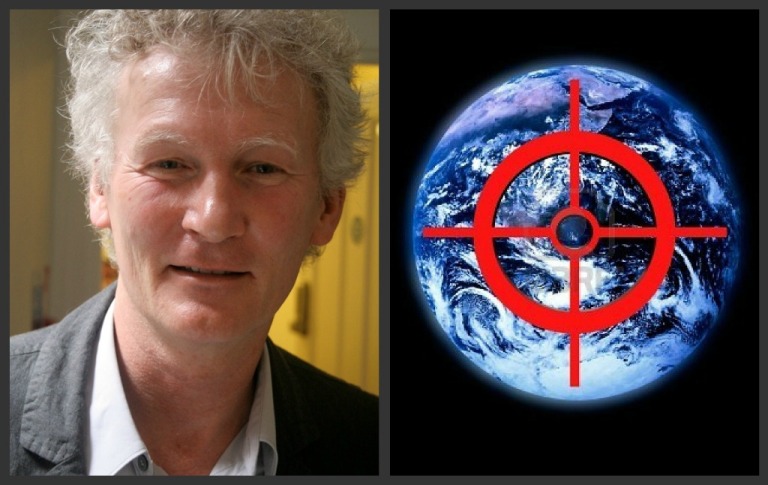
Robert Paul Lamb (1952 – 2012): The Earth’s Reporter
Robert Paul Lamb (1952 – 2012) was a planetary scale story teller. He used simple words and well chosen moving images to show us how we are abusing the only habitable planet we have.
He excelled in the world’s most pervasive mass medium, television. He effectively turned the small screen into a ‘mirror’ that showed how humans are constantly living beyond our natural means…as if we have spare planets in store.
For nearly three decades, Robert Lamb reported about the Earth to people all over the Earth. He ‘zoomed in’ to far corners of the planet to get a closer look at what was going on. He regularly ‘zoomed out’ for the bigger picture. All his life he probed why, as the Brundtland Commission had memorably noted in its 1987 report, “The Earth is one but the world is not”.
In this quest, he interviewed some of the finest minds and most passionate activists on what needs to be done, and how to do it. He also showcased the work of researchers, innovators and entrepreneurs trying out solutions to our many problems of resource and energy use. He always cheered these pathfinders who are our best hopes in overcoming the current ecological and economic quagmires.
Robert’s work was not easily pigeonholeable, which confused many. He wasn’t making wildlife or natural history films, although he sometimes touched on the subject from a human interaction angle. Perhaps the best summing up of his line of work was given by Mahatma Gandhi, who, when asked for his views on Indian wildlife decades ago, replied: “Wildlife is decreasing in the jungles — but it is increasing in the towns!”
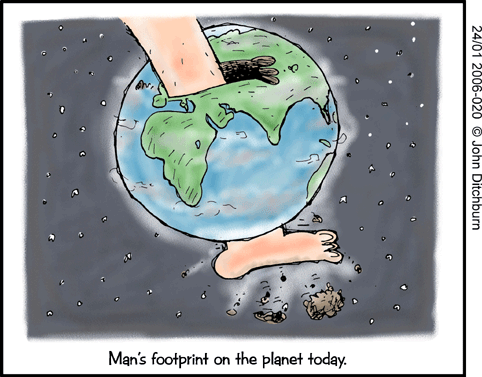
If this isn't wildlife, what is?Robert documented life going wild with far-reaching consequences. In the spectrum of factual TV programme production, he occupied a niche best described as scientifically based environmental films: those that explore the crushing ‘ecological footprint’ modern humans are having on the rest of Nature and ecosystems.
Robert was a journalist first and last. Although he later straddled the worlds of media and development, his outlook was firmly rooted in journalism where he started his career. He had a firm grasp of scientific, economic and political realities that shaped international development.
From 1984 to 2002, he was founder director of the UK-based media charity Television Trust for the Environment (TVE) from 1984 to 2002. TVE was set up to harness the potential of television and video to raise environmental awareness and catalyse sustainable development debates in the developing world.
Heading TVE for nearly two decades, Robert commissioned, produced or co-produced dozens of documentaries on a broad range of issues and topics.
Some were straightforward ones that ‘connected the dots’ for intelligent viewers. Others investigated complex — often contentious — causes and effects of environmental degradation or social exclusion.
These efforts dovetailed on-going discussions at the time on sustainable development. The Brundtland Commission had just defined it as a pattern of economic growth that “meets the needs of the present without compromising the ability of future generations to meet their own needs.”
Easier said than done in a world where many families could barely afford to think beyond their next meal while most governments chose not to see beyond the next election. Next generation thinking was rare then, as it is now. Only mavericks dare walk that path.
Besides, what exactly did that ideal mean for a subsistence farmer in Africa or a small entrepreneur in Asia? Did this long term view figure at all when politicians or bureaucrats struggled to balance their national budget or negotiate better terms of trade? How and where did women and children figure in these considerations?
Robert and his team followed the lofty intellectual debates and also tracked progress on the growing number of international treaties on specific environmental matters. They captured the essence of these through compelling moving image creations.
In doing so, this small band of individuals changed forever how environment was covered on TV. As he recalled in UNEP’s Our Planet magazine in 2000, “In the mid-1980s barely anyone had heard about the ozone layer or global warming. Natural history programming brought the wonders of plant and animal diversity into our living rooms but glossed over the complex causes of extinction.”
Robert was swimming against not one but several currents. As he wrote years later: “Television does not cope well with explaining the grey areas. Or rather it could — but the received wisdom is that it makes the viewer reach for the remote channel changer. Television prefers the black and white; the good guys versus the bad.”
He accomplished this through what I call the ‘triple-S formula’: mixing the right proportions of good Science and engaging Stories, told in Simple (but not simplistic) language.
He demystified jargon-ridden science and procedure-laden intergovernmental negotiations without losing their complexity or nuances. This is what public communication of science is all about.
We can only hope he isn’t our average TV viewer...but are we sure?Always look for what’s New, True and Interesting (the NTI Test), he used to tell us who followed the trail he blazed. All our efforts ultimately hinged on how we appealed to the viewer – and she held that all-powerful remote controller in hand!
Robert’s overarching advice: never underestimate your audience’s intelligence — or overestimate its interest levels.
“If we don’t engage our audiences in the first 60 to 90 seconds, they are gone,” Robert often told his producers. “Hook them – and make it worth their while to do so!”
Most people don’t carry good memories of school. When they sit down to watch TV – usually at the end of a long day – they just want something light and pleasant, and preferably not reminded of school…
Pervasive as TV was, the medium wasn’t a substitute for reading or a classroom. At best, we could only flag the highlights of an issue, and whet the appetite for viewers to go after more.
Sympathetic as he was to issues and concerns of the developing world, Robert applied the same rigorous editorial criteria on film makers based in the global South. He pointed out the latter’s sweeping generalizations, condescending elitist language or incoherent story telling. Some walked away grumbling, but realized years later that he was right…
Robert’s fast pace and no-nonsense demeanour probably won him as many admirers as detractors. Producers dreaded his piercing questions about evidence and coherence. Over time, staff got used to his sharp text editing, usually done with a thick-tipped pen.
He was most assertive in (video) edit rooms, where I have seen him in action only on a few occasions. While TV productions involve team work, editorial decisions have to be centralised. You can’t make films by committee. As series editor or executive editor, he was the master of all he surveyed. Conversely, he stood by his producers who’d done their homework.
A few days ago, I was deeply saddened to hear the news that my mentor and colleague Robert Lamb is no more. He lost his battle with cancer on 13 Feb 2012. He was 59.
Robert will be greatly missed. He was a visionary mentor and a strong supporter of our ideal of Asians telling their own stories using TV, video and web. This was what he set up TVE Asia Pacific (TVEAP) to do, back in 1996.
I was still in shock and grief when I wrote TVEAP’s official tribute, and a short statement of condolences. But Robert would have expected nothing less. The show must go on, he used to say, and getting the record right is very important.
Our statement opens: “Robert Lamb knew the power of moving images. For over three decades, he used them effectively to move people all over the world to reflect on how their daily actions impact their local environment and the planet.”
We also note how “Robert was very well informed, highly analytical yet kept an open mind for fresh angles and new perspectives. He inspired us without imposing his own views.”
Robert was an Englishman by birth, globalist in outlook and a planetary scale thinker and story teller. Unlike some activists and journalists, Robert practised Gandhi’s timeless advice: “Be the change you wish to see in the world”.
This is why I added this line to our statement: “He walked his talk, practising in personal life what he advocated in his films. If he breathed heavily in the edit room, he trod softly on the Earth.”
And that, more than any of his professional accomplishments in print, on TV and online, is how I shall always remember Robert Paul Lamb, on whose broad shoulders I continue to stand.





 Open Minds!