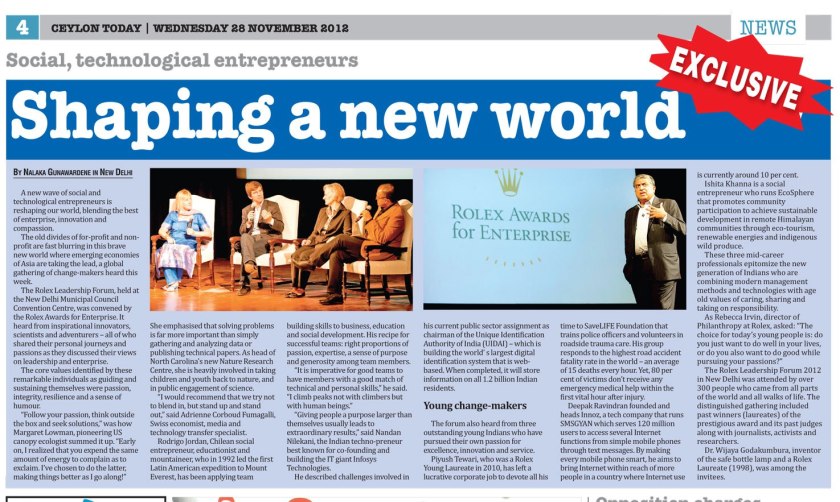
News feature published in Ceylon Today newspaper, 28 November 2012
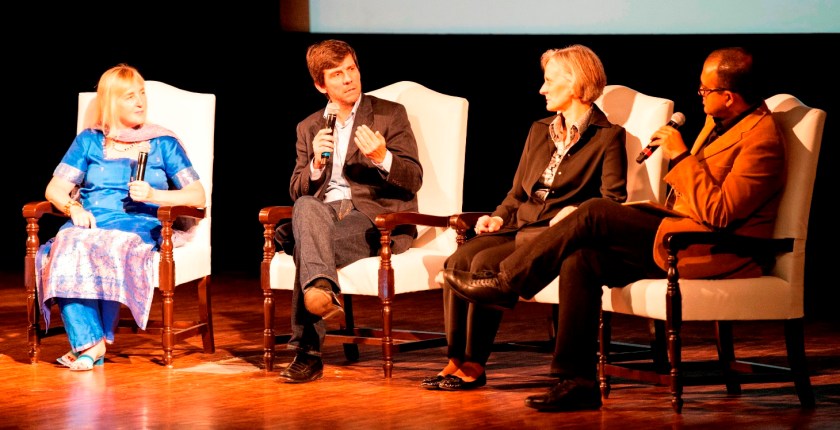
L to R – Margaret Lowman, Rodrigo Jordan, Adrienne Corboud Fumagalli & moderator R Sukumar
Social and technological entrepreneurs shaping a new world By Nalaka Gunawardene in New Delhi
A new wave of social and technological entrepreneurs is reshaping our world, blending the best of enterprise, innovation and compassion.
The old divides of for-profit and non-profit are fast blurring in this brave new world where emerging economies of Asia are taking the lead, a global gathering of change-makers heard this week.
The Rolex Leadership Forum, held at the New Delhi Municipal Council Convention Centre, was convened by the Rolex Awards for Enterprise. It heard from inspirational innovators, scientists and adventurers – all of who shared their personal journeys and passions as they discussed their views on leadership and enterprise.
The core values identifies by these remarkable individuals as guiding and sustaining themselves were passion, integrity, resilience and a sense of humour.
“Follow your passion, think outside the box and seek solutions,” was how Margaret Lowman, pioneering US canopy ecologist summed it up. “Early on, I realized that you expend the same amount of energy to complain as to exclaim. I’ve chosen to do the latter, making things better as I go along!”
She emphasised that solving problems is far more important than simply gathering and analysing data or publishing technical papers. As head of North Carolina’s new Nature Research Centre, she is heavily involved in taking children and youth back to nature, and in public engagement of science.
“I would recommend that we try not to blend in, but stand up and stand out,” said Adrienne Corboud Fumagalli, Swiss economist, media and technology transfer specialist.
Rodrigo Jordan, Chilean social entrepreneur, educationist and mountaineer, who in 1992 led the first Latin American expedition to Mount Everest, has been applying team building skills to business, education and social development. His recipe for successful teams: right proportions of passion, expertise, a sense of purpose and generosity among team members.
“It is imperative for good teams to have members with a good match of technical and personal skills,” he said. “I climb peaks not with climbers but with human beings.”
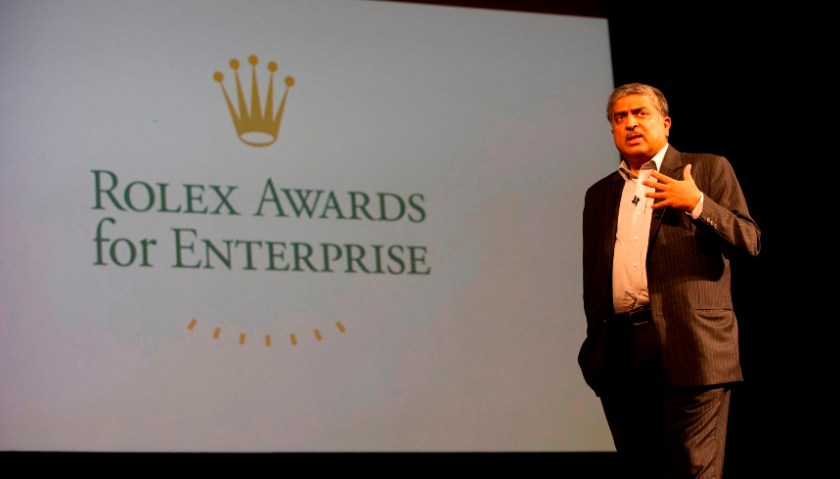
Nandan Nilekani speaks at Rolex Leadership Forum 2012
“Giving people a purpose larger than themselves usually leads to extraordinary results,” said Nandan Nilekani, the Indian techno-preneur best known for co-founding and building the IT giant Infosys Technologies.
He described challenges involved in his current public sector assignment as chairman of the Unique Identification Authority of India (UIDAI) – which is building the world’ s largest digital identification system that is web-based. When completed, it will store information on all 1.2 billion Indian residents.
Young change-makers
The forum also heard from three outstanding young Indians who have pursued their own passion for excellence, innovation and service.
Piyush Tewari, who was a Rolex Young Laureate in 2010, has left a lucrative corporate job to devote all his time to SaveLIFE Foundation that trains police officers and volunteers in roadside trauma care. His group responds to the highest road accident fatality rate in the world – an average of 15 deaths every hour. Yet, 80 per cent of victims don’t receive any emergency medical help within the first vital hour after injury.
Deepak Ravindran founded and heads Innoz, a tech company that runs SMSGYAN which serves 120 million users to access several Internet functions from simple mobile phones through text messages. By making every mobile phone smart, he aims to bring Internet within reach of more people in a country where Internet use is currently around 10 per cent.
Ishita Khanna is a social entrepreneur who runs EcoSphere that promotes community participation to achieve sustainable development in remote Himalayan communities through eco-tourism, renewable energies and indigenous wild produce.
These three mid-career professionals epitomise the new generation of Indians who are combining modern management methods and technologies with age old values of caring, sharing and taking on responsibility.
As Rebecca Irvin, director of Philanthropy at Rolex, asked: “The choice for today’s young people is: do you just want to do well in your lives, or do you also want to do good while pursuing your passions?”
The Rolex Leadership Forum 2012 in New Delhi was attended by over 300 people who came from all parts of the world and all walks of life. The distinguished gathering included past winners (laureates) of the prestigious award and its past judges along with journalists, activists and researchers.
Dr Wijaya Godakumbura, inventor of the safe bottle lamp and a Rolex Laureate (1998), was among the invitees.
Rolex Leadership Forum in Delhi, Ceylon Today 28 Nov 2012
“Sri Lanka’s newspaper history dates back to Colombo Journal (1832) which apparently had a short but feisty life before it invoked the ire of the British Raj. Nearly two centuries and hundreds of titles later, the long march of printer’s ink — laced with courage and passion – continues.
“How long can this last?
Print journalism’s business models are crumbling in many parts of the world, with decades old publications closing down or going entirely online. This trend is less pronounced in Asia, which industry analysts say is enjoying history’s last newspaper boom. Yet, as I speculated three years ago when talking to a group of press barons, we’ll be lucky to have a decade to prepare for the inevitable…”
These are excerpts from a short essay I originally wrote last week to mark the first anniversary of Ceylon Today newspaper, where I’m a Sunday columnist. It was printed in their first anniversary supplement on 18 Nov 2012.
Groundviews.org has just republished it today, making it easily available to a much wider audience. Read full essay:
Another excerpt: “In the coming years, waves of technology, demographics and economics can sweep away some venerable old media along with much of the deadwood that deserves extinction. The adaptive and nimble players who win audience trust will be the ones left to write tomorrow’s first drafts of history.”
This is the (Sinhala) text of my Sunday column in Ravaya newspaper on 5 August 2012. This week, I trace the moving images coverage of the Olympics, from the early days of cinema to the modern instantaneous live coverage that makes the whole world watch the Games as they unfold.
In this Sunday (15 July 2012) Ravaya column (in Sinhala), I briefly trace the history of comics in Sri Lanka in the Sinhala language and ask: what lessons can we derive from that experience on integrating a new media type or form to Lankan society?
Comics in Lankan newspapers started 60 years ago in October 1951 — and a vocal minority of cynics and puritans resisted it from the beginning. I argue that this misplaced resistance prevented Lankan media houses and society at large from harnessing this versatile medium for greater good – in both entertainment and educational terms.
My Sunday (Sinhala) column in Ravaya this week was on impressions of the National Media Summit 2012 held at the University of Kelaniya, Sri Lanka, on 24-25 May 2012. My own talk at the Summit, during a session New Media policies for Sri Lanka, was titled New Media, Old Minds: A Bridge Too Far?.
Text of my news feature published in Ceylon Today newspaper on 23 June 2012
The UN Kicks the Paper Habit – at last!
By Nalaka Gunawardene
In Rio de Janeiro, Brazil
The United Nations secretariat – the world’s largest bureaucracy – has long been known as a formidable ‘paper factory’. It cranks out millions of documents every year in the organisation’s six working languages. Some of it is not read even once.
A few years ago, it acknowledged producing over 700 million printed pages every year (2005 figures). The cost of printing documents in its New York and Geneva offices along was over 250 million dollars a year.
And major international conferences convened by the UN have seen a splurge of paper – both official documents and many that are simply self-promotional of various participating national delegation, development agencies or companies. When such events end, literally tons of paper are left behind convention sites.
Environmentalists have been urging the UN to go easy on paper for many years, both to save trees pulped to make paper, and to reduce chemicals use and carbon emissions in printing or copying.
The message is finally being heeded. The United Nations Conference on Sustainable Development in Rio de Janeiro is the first major UN event to reduce paper use – and it shows.
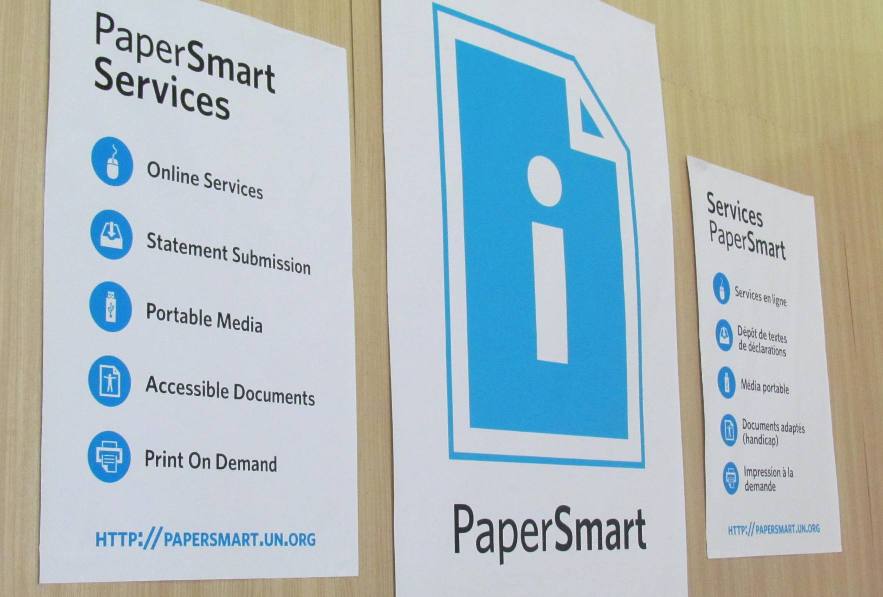
The entire meeting process is using less paper, and more electronic means for generating and sharing information. It’s the result of a new initiative called PaperSmart.
The vast Rio Centro convention centre, where the main inter-governmental meetings and major groups’ discussions are being held, is surprisingly paper-free.
So is the media centre, the operations base for hundreds of journalists from all over the world covering dozens of parallel sessions and events. In the past, this was a favourite ‘dumping ground’ for paper based materials.
At Rio+20 this week, only a handful of non-governmental organisations, academic bodies and activist groups still peddled paper. Most others had cut back on indiscriminate distribution of publications, posters, postcards and other materials.
Of course, the UN system loves to belabour the point. A dedicated website (http://papersmart.un.org) explains the underlying thinking and mechanics. PaperSmart is based on four principles: sustainability, efficiency, accessibility and knowledge management.
Switching from atoms to electrons has not been easy or smooth. Some participants – including web-savvy journalists – have been struggling with the complicated Rio+20 website and related online UN information services.
It’s still a work in progress, but PaperSmart is definitely a positive development to be cheered.
“After decades of sanctimonious preaching about the environment, the United Nations is taking a step in the right direction,” says Thalif Deen, the UN Bureau Chief of the developing world’s news agency, Inter Press Service (IPS).
Deen is a veteran of many UN conferences and processes who has seen how telexes and teleprinters gave way to instant global communications with Internet-enabled laptops and smartphones.
He recalls: “I was on the reporting staff of the first conference newspaper IPS published during the 1992 Earth Summit in Rio where the UN’s carbon foot print was all over the conference centre: reams and reams of reports and documents and thousands of UN staffers flying in from UN offices the world over.”
Deen hails Rio+20 as “a major breakthrough for a global institution long accused of extravagance and conspicuous consumption”.
A few years ago, Deen asked Shashi Tharoor, then UN under-secretary-general for public information, on when the paperless office might finally arrive at the UN Secretariat.
The digitally savvy Tharoor admitted the UN’s track record was not a good one. He then offered a comparison: “The amount of paper we use in a year to produce every single UN document, in all six official languages, is equivalent to what the New York Times consumes to print a single Sunday edition.”
Things have evolved a bit both in the newspaper industry and the UN bureaucracy since that remark was made in 2005. Newspapers in the west are now selling less, especially in paper editions.
Simply stamping out paper use can be misleading unless the total energy and resource uses are factored in. In recent years, concerns have been raised on the carbon emissions of massive internet servers.
Of course, these are dwarfed by the amount of planet-warming gases spewed out by delegates flying long distances to be in the same crowded conference with thousands of others.
As at June 20 evening, Rio+20 had close to 40,000 officially registered participants in various categories. Many unofficial events attract more.
Environmentalists, relieved by the reduced use of paper, would also be quick to point out growing problems of electronic waste.
It seems there is no such thing as an impact-free communication!
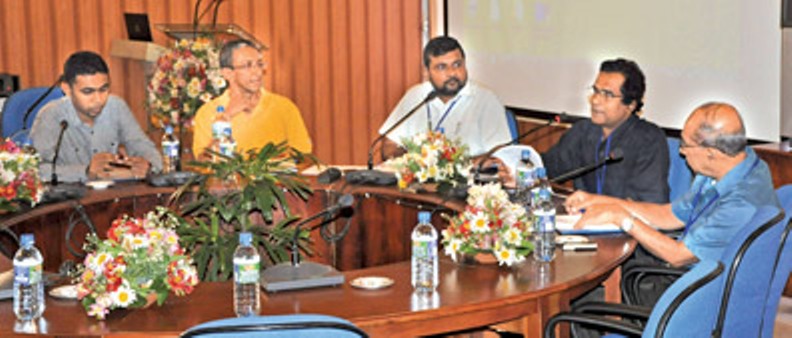
National Media Summit 2012 at University of Kelaniya, 25 May 2012 New Media, Old Minds: A Bridge Too Far?
This was the title of a presentation I made at National Media Summit 2012, at University of Kelaniya, Sri Lanka, this morning. I was asked to talk about New Media and policies for Sri Lanka.
In my audience were academics and researchers on journalism and mass communication drawn from several universities of Sri Lanka. I was told the biennial event is to help frame new research frameworks and projects.
Now, I’m not a researcher in the conventional sense of that term, and am fond of saying I don’t have a single academic bone in my body. Despite this, occasionally, universities and research institutes invite me to join their events as speaker, panelist or moderator.
University of Kelaniya, a state university in Sri Lanka, has the island’s oldest mass communication department, started in the late 1960s.
Perhaps inertia and traditions weigh down such places — while I had a patient hearing, I found our ensuing discussion disappointing. The historical analogies, policy dilemmas and coping strategies I touched on in my presentation didn’t get much comment or questions.
Instead, rather predictably, the ill-moderated discussion meandered on about the adverse social and cultural impacts of Internet and mobile phones and the need to ‘control’ everything in the public interest (where have I heard that before?).
And much time was wasted on debating on what exactly was new media and how to define and categorise it (I’d argued: it all depends on who answers the question!).
Part of the confusion arose from many conflating private, closed communications online (e.g. Facebook) with the open, more public interest online content (e.g. news websites). Similarly, the critical need for common technical standards (to ensure inter-operability) was mistaken by some as the need for dull and dreary orthodoxy in content!
Concepts like Citizen Journalism, user-generated content, privacy, right to information were all bandied around — but without clarity, focus or depth. Admittedly we couldn’t cover everything under the Sun. But we didn’t even discuss what options and choices policy makers have when confronted with rapidly evolving new media types.
Half anticipating this, I had included a line in my talk that said: “Academics must research, analyse & advise (policy makers). But are Lankan academics thought-leaders in ICT?”
I was being a polite guest by not explicitly answering my own question (but as a helpful hint, I mentioned dinosaurs a few times!). In the end, my audience provided a clear (and sadly, negative) answer: far from being path-finders or thought-leaders, they are mostly laggards who don’t even realise how much they have to catch up!
And some of them are framing Lankan media policy and/or advising government on information society issues. HELP!
Don’t take my word for it. Just try to find ANY online mention of National Media Summit 2012 that just ended a few hour ago. Google indexes content pretty fast these days — but there is NONE that I can find on Google as May 25 draws to an end (except my own PPT on SlideShare!).
Phoning each other during personal or shared emergencies is one of the commonest human impulses. Until recently, technology and costs stood in the way. No longer.
We now have practically all grown-ups (and some young people too) in many Asian countries carrying around phones or having easy, regular access to them. For example, Sri Lanka’s tele-density now stands at 106.1 phones 100 people (2011 figures).
What does this mean in times of crisis caused by disasters or other calamities? This is explored in a short video I just made for LIRNEasia:
Synopsis:
With the spread of affordable telecom services, most Asians now use their own phones to stay connected. Can talking on the phone help those responding to emergencies to be better organised? How can voice be used more efficiently in alerting and reporting about disasters? Where can computer technology make a difference in crisis management?
These questions were investigated in an action research project by LIRNEasia in partnership with Sarvodaya, Sri Lanka’s largest development organisation. Experimenting with Sahana disaster management software and Freedom Fone interactive voice response system, it probed how voice-based reporting can fit into globally accepted standards for sharing emergency data. It found that while the technology isn’t perfect yet, there is much potential.
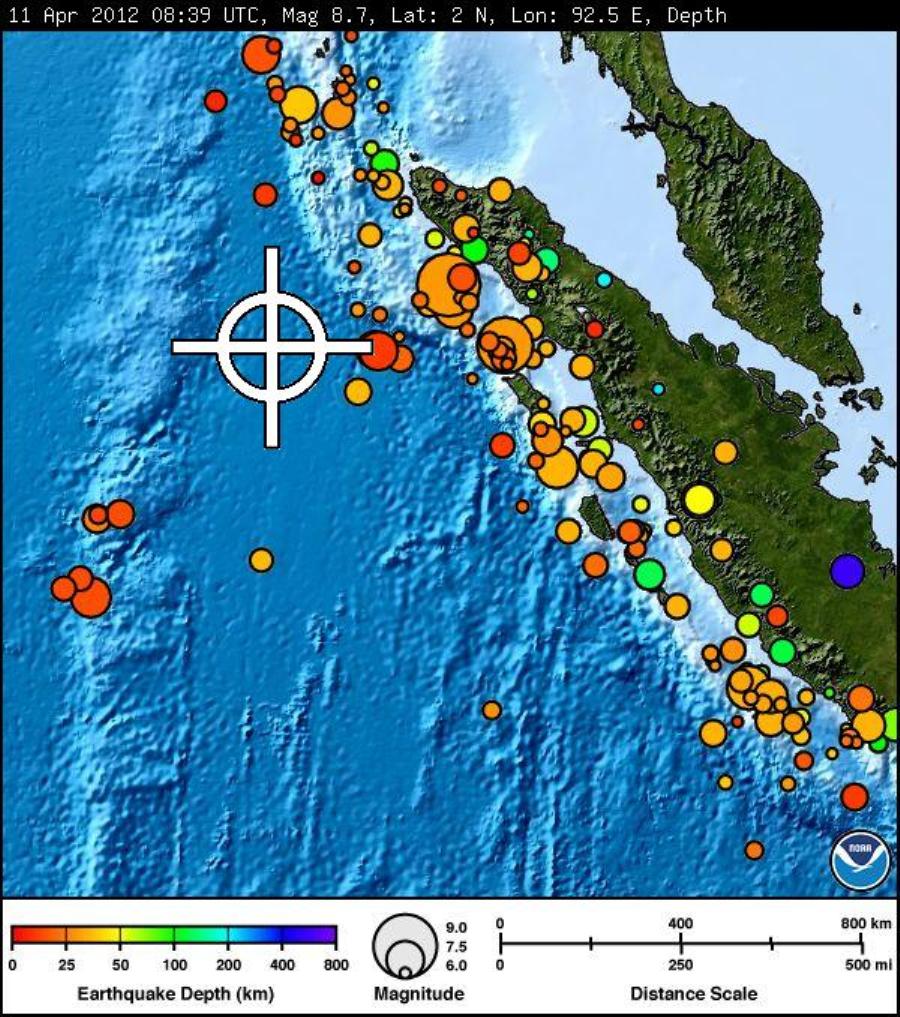
In this week’s Ravaya Sunday column (in Sinhala) appearing on 29 April 2012, I reflect on the Indian Ocean undersea quake on 11 April 2012, and the tsunami watch that followed.
Taking Sri Lanka as the example, I raise some basic concerns that go beyond the individual incident, and address fundamentals of disaster early warning and information management in the Internet age.
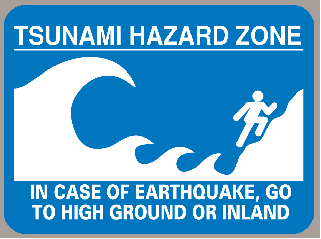
I ask: Was the tsunami warning and coastal evacuation on April 11 justified in Sri Lanka? I argue that this needs careful, dispassionate analysis in the coming weeks. ‘Better safe than sorry’ might work the first few times, but let us remember the cry-wolf syndrome. False alarms and evacuation orders can reduce public trust and cooperation over time.
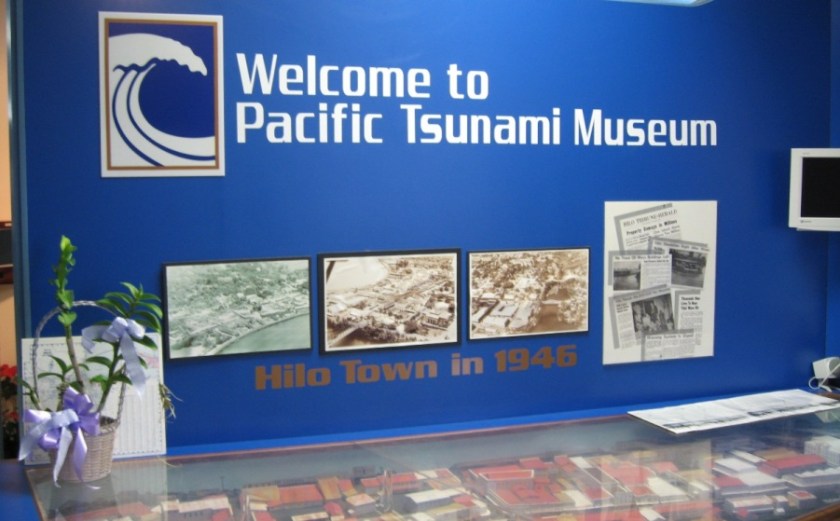
Entrance to Pacific Tsunami Museum in Hilo, Hawaii, photo by Nalaka Gunawardene, Jan 2007
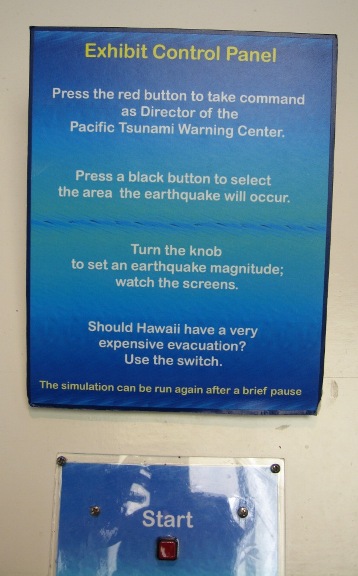
Five years ago, on a visit to the Pacific Tsunami Museum in Hilo, Hawaii, I played an interesting simulation game: setting off an undersea earthquake and deciding whether or not to issue a tsunami warning to the many countries in and around the Pacific.
The volunteer-run museum, based in ‘the tsunami capital of the world’, engages visitors on the science, history and sociology of tsunamis. The exhibits are mostly mechanical or use basic electronic displays, but the messages are carefully thought out.
The game allowed me to imagine being Director of the Pacific Tsunami Warning Centre (PTWC), a US government scientific facility in Ewa Beach, Hawaii, where geophysicists monitor seismic activity round the clock. When the magnitude exceeds 7.5, its epicentre is located and a tsunami watch is set up. Then, combining the seismic, sea level and historical data, PTWC decides if it should be upped to a warning.
Tsunami simulation game - low tech, high lessonThe museum game allows players to choose one of three locations where an earthquake happens — Alaska, Chile or Japan — and also decide on its magnitude from 6.0 to 8.5 on the Richter Scale.
This is an instance where scientists must quickly process large volumes of information and add their own judgement to the mix. With rapid onset hazards like tsunamis, every second counts. Delays or inaction can be costly — but false alarms don’t come cheap either.
I played the game thrice, and erring on the side of caution, issued a local (Hawaiian) evacuation every time. If it were for real, that would have caused chaos and cost the islanders a lot of money.
In fact, those who make decisions on tsunami alerts or warnings have to take many factors into account – including safety, economic impact and even political fall-out.
After playing the simulation game, I can better appreciate the predicament government officials who shoulder this responsibility. They walk a tight rope, balancing short-term public safety and long term public trust in the entire early warning system.
Taking Sri Lanka as the example, but sometimes referring to how other Indian Ocean rim countries reacted to the same situation, I raise some basic concerns that go beyond this individual incident, and address fundamentals of disaster early warning and information management in the Internet age.
Another except: “So was the tsunami warning and coastal evacuation on April 11 justified? This needs careful, dispassionate analysis in the coming weeks. ‘Better safe than sorry’ might work the first few times, but let us remember the cry-wolf syndrome. False alarms and evacuation orders can reduce public trust and cooperation over time.”
In particular, I focus on nurturing public trust — which I call the ‘lubricant’ that can help move the wheels of law and order, as well as public safety, in the right direction.




 Open Minds!