Why are ‘Smart Mobs’ also very fickle? Looking for an antidote to fleeting activism

Smart but fleeting mobs?
‘Smart mobs’ is an interesting term for like-minded groups that behave intelligently (or just efficiently) because of their exponentially increasing network links.

The idea was first proposed by author Howard Rheingold in his 2002 book, Smart Mobs: The Next Social Revolution. It deals with the social, economic and political changes implicated by developing information and communications technology. The topics range from text-messaging culture and wireless internet to the impact of the web on the marketplace.

In the eight years since the book first appeared, we’ve seen a proliferation and evolution of smart mobs, fuelled by the growth web 2.0 tools and, more recently, the many and varied social media. In fact, author Rheingold is credited with inventing the term virtual communities.

But the reality is that smart mobs can also be very fickle — their attention can be easily distracted. A smart mob can disperse just as fast as it forms, even while its original provocation remains.

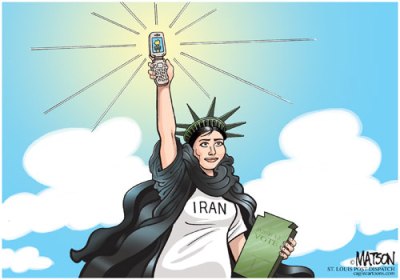
This was demonstrated in dramatic terms in June 2009. Following a hotly disputed presidential election in Iran, there was a surge of online support for pro-democracy activists there who launched a massive protest. A main point of convergence for online reporting and agitation was micro-blogging platform Twitter. Within a few days, mainstream media like TIME and Washington Post were all talking about this phenomenon in gushing terms.

'Rescued' by Michael Jackson?
Then something totally unexpected happened. On June 25, Michael Jackson’s sudden death in Los Angeles shocked the world. As the news spread around the world at the speed of light, it crashed some social networking sites and slowed down even the mighty Google. Online interest on Iran dipped — and never regained its former levels.

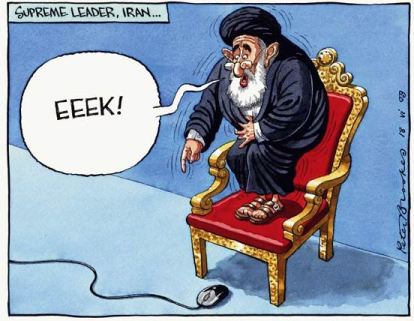
As I wrote at the time: “I have no idea if the Ayatollahs are closet fans of Michael Jackson. But they must surely have thanked the King of Pop for creating a much-needed diversion in cyberspace precisely when the theocracy in Tehran needed it most.”

Other recent experiences have demonstrated how online interest can both build up and dissipate very fast. Staying with a single issue or cause seems hard in a world where news is breaking 24/7.

Here’s a current example. Following the massive oil spill in the Gulf of Mexico that started on 20 April 2010, local communities and environmental activists deployed various social media tools to track the unfolding disaster. BP, the giant oil company implicated in the disaster, has also tried to use social media to communicate its positions, but not too successfully. On Twitter, it was not BP’s official account but the satirical @BPGlobalPR that was dominating the online conversation. As one commentator wrote: “It is an object lesson in how social media can shape and control a company’s message during a crisis.”

Beyond PR?
By early July 2010, however, there were already signs that online interest on the issue was already waning — even as the oil continued to leak from this largest offshore oil spill in US history. In a detailed analysis of main social media platforms’ coverage of the issue, Mashable noted last week: “An estimated 100 million gallons or more of oil have surged into the Gulf of Mexico…Yet on Twitter, Google, blogs and even YouTube, we’re already wrapping up our collective discussion of the oil spill and how to repair its damage.”

Riding the wave can be fun, but waves form and break quickly. Those who want to use social media tools for social activism still need to learn how to hitch a ride with the ocean current beneath the fickle waves.

How I wish I could get some practical advice on this from a certain ancient mariner named Sinbad.

Radio Sagarmatha: Voice of a Valley and Hope of a nation

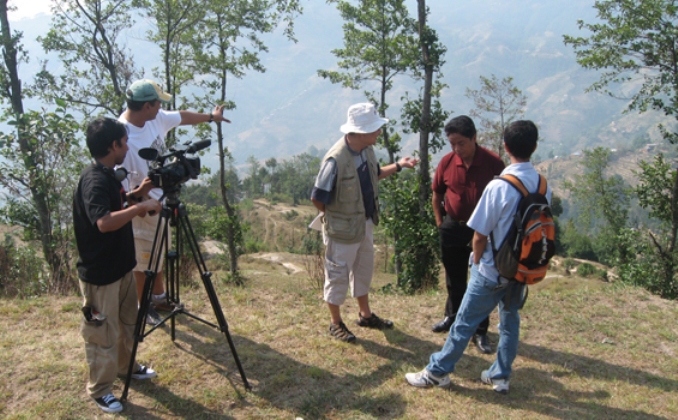
Location filming Saving the Planet in Nepal

I have written more than once in this blog about Radio Sagarmatha of Nepal, the first independent community broadcasting station in South Asia.

In May 2007, on the occasion of their 10th anniversary, I called it Kathmandu Valley’s beacon of hope. I have known and admired the Nepali friends who are running the award-winning, public-spirited radio station.

I’m delighted, therefore, to be able to make a short film about one facet of Radio Sagarmatha: their contribution to education for sustainable development, ESD for short.

Radio Sagarmatha’s path-breaking work in the resort town of Nagarkot is the story in one film of Saving the Planet, TVE Asia Pacific’s new regional TV series showcasing communities thinking globally and acting locally.

The six-episode series, which was 18 months in the making, features outstanding efforts in education for sustainable development in South and Southeast Asia.

It goes in search of answers to these key questions: Can ordinary people help save our planet under siege from multiple environmental crises? How can everyone change attitudes and lifestyles to consume less and generate less waste?

Here’s the official synopsis of the Nepal story, titled Voice of a Valley:

Tourism generates incomes, jobs and markets for the people of Nagarkot, a popular resort close to the Nepali capital Kathmandu. But it had a bumpy start when hoteliers initially bypassed local communities. These tensions were diffused by Radio Sagarmatha, the country’s first independent public radio station, which brought all interested parties together on the air. This example shows how media can do more than just report. By inspiring discussion and debate, media can help communities to find the best solutions or compromises for their development needs.

Watch Saving the Planet: Voice of a Valley

Many thanks to friends at the Nepal Forum of Environmental Journalists (NEFEJ), for their help in making this short film about one of their most outstanding efforts.

Find the full credits of the film here

Can Citizen Kane and Citizen Journalist join hands in the public interest?

Can this common ground expand?

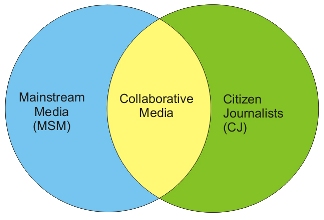
Is there common ground between the mainstream media (MSM) and citizen journalists (CJ) that can be tapped to better serve the public interest?

This is a central question that I explored in some depth during my recent presentation to an assembled group of media tycoons and senior journalists in Colombo earlier this week, at the Sri Lanka launch of Asia Media Report 2009.

MSM have gone from denial to dismissal to apprehension about this murky, distributed phenomenon called citizen journalists. But, as I asked, must MSM and CJ always compete? Must they consider each other mutually exclusive? I don’t think so.

Consider these facts: CJs are not an organised, unionised mass of people. They are a scattered, loosely connected group that is a community of practice across geographical borders and time zones. They rarely agree on anything among themselves. CJs are not out to topple MSM.

Once we get those points clarified, we can move beyond chest-thumping egotism. We can then address the fundamental values of why MSMs and CJs are both doing what they do: for the free flow of information, ideas and opinions.

Indeed, we should see how MSM and CJs can join hands more to serve the public interest. CJs today are not just frustrated poets and writers who never found a public outlet in the past. Today’s plethora of CJs include scientific experts, professionals, retirees with loads of experience and tech-savvy geeks among many others. This is a vast resource that MSM can tap into — especially in these days of leaner budgets and fewer staff.

Must everything be All-or-Nothing? No!
And why not? Many issues these days are just too complex, technical or nuanced for even the most committed full-time, paid journalists to tackle all on their own. The information is often too vast to wade through in time for deadlines. And things are changing faster too. In such situations, can MSM work collaboratively with CJs, sharing the work load, risk and eventually, the credit?

In fact, MSM have historically relied on citizens to provide part of the content – whether they are letters to the editor, or funniest home videos, or news tips from the public that reporters then pursue. Today’s CJs can take this ‘crowd-sourcing’ to a new level.

I recently came across an interesting example of crowd-sourcing in investigative journalism – a component of journalism that is particularly demanding. Over several weeks in April – May 2009, The Telegraph in the UK disclosed the scandal over many exaggerated or false expense claims made by British Members of Parliament. This left the British public furious, and brought worldwide ridicule on the Mother of all Parliaments.

The story still unfolds. Now, The Guardian has involved readers to dig through the several truckloads of MPs’ expense documents to spot claims that merit further investigation because they seem…a tad suspicious. This is more than what a small team of paid journalists can do on their own: a total of 458,832 pages of documents need be manually checked. So far, 23,262 readers had signed up by 2 August 2009. Many hands make light work for The Guardian, whose editors will then decide which claims are to be further probed and queried.

Mobile: the most subversive ICT of all?
Can we expect to see more of such collaborations in time to come? I certainly hope so. Under siege as they are, MSM should be the first one to make the move to search for this common ground – after all, they have everything to gain and little to lose. We can all think of tedious record-scanning, number-crunching tasks that are needed to unearth and/or understand complex stories of our times.

Of course, for such collaborations to work well, the rules of engagement between MSM and CJs need to be clear, transparent and based on mutual trust. That requires some work, but when it works well, everybody stands to gain.

In late 2005, I researched and worked with Sir Arthur C Clarke to write an essay on the rise of citizen journalists, which first appeared in the Indian news weekly Outlook on 17 October 2005. I’m quite proud of how we ended the essay: “There is more than just a generation gap that separates the mainstream media from the increasingly influential online media…Yet one thing is clear: the age of passive media consumption is fast drawing to an end. There will be no turning back on the road from Citizen Kane to citizen journalist.”

Emerging new models of collaboration in media and journalism indicate that this evolutionary road need not be a one-way street. So nearly four years on, I now raise the question that I first put to the media tycoons of Colombo the other day: Can Citizen Kane and Citizen Journalist join hands in the public interest?

I very much hope the answer is a resounding: Yes, We Can!

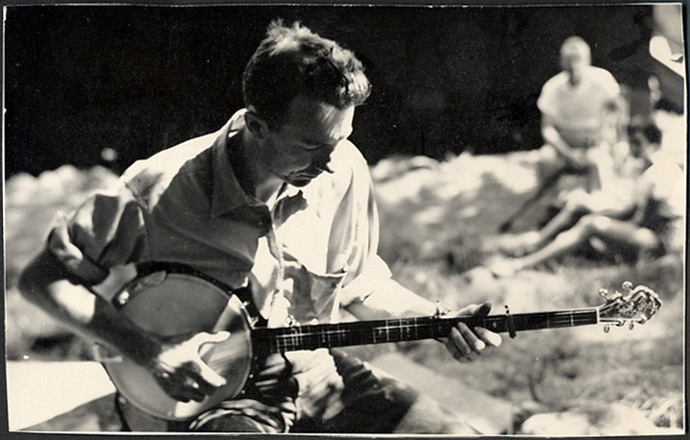
Pete Seeger turns 90 on World Press Freedom Day: Thank you for the protest music!

Pete Seeger: Still singing protest at 90...

Today, 3 May, is once again World Press Freedom Day. It is recognised by the UN, and observed by media professionals and media activists worldwide to ‘draw attention to the role of independent news and information in society, and how it is under attack’.

By happy coincidence, today also marks the 90th birthday of Pete Seeger, American folk singer and a pioneer of protest music. Since media freedom is inseparable from the democratic rights to dissent and protest, I will devote this blog post to salute Pete and his many decades of music for worthy causes — ranging from the American civil rights movement and opposing the Vietnam war to saving the environment and nuclear disarmament.

I won’t go over the basic biographical or career information, which is easily found online. Wikipedia has a good entry, and PBS shows a career timeline which has covered some of the most momentous events of the past century. There are approximately 200 songs (music and lyrics) that Pete wrote or with which he is associated – including “Guantanamera,” “Where Have All The Flowers Gone,” “If I Had A Hammer,” “Turn Turn Turn,” “Wimoweh,” “We Shall Overcome”.

Pete is a hero for at least three generations of music lovers and freedom lovers around the world who believe in human rights, human dignity and democratic freedoms. Armed with nothing more than his banjo and melodious voice, and driven by the courage of his conviction, this small, gentle man has stood up to mighty leaders, generals and officials.

Never underestimate the power of one determined man...
Pete is celebrated as much for his artistic and cultural achievements as for standing resolutely for his political beliefs and for lending his voice and music in support of causes be believed in. In 1955, he was called before the now infamous House Un-American Activities Committee, but refused to name personal and political associations on the grounds that this would violate his First Amendment rights. He said: “”I am not going to answer any questions as to my association, my philosophical or religious beliefs or my political beliefs, or how I voted in any election, or any of these private affairs. I think these are very improper questions for any American to be asked, especially under such compulsion as this.”

This defiance resulted in sustained harassment, persecution and professional isolation. As his recent PBS biography noted, “Standing strong for deeply-held beliefs, Seeger went from the top of the pop charts to the top of the blacklist and was banned from American commercial television for more than 17 years. This determined singer/songwriter made his voice heard and encouraged the people of the world to sing out along with him.”

‘If you love your country, you’ll find ways to somehow to speak out, to do what you think is right,” Pete says in this powerful documentary looking back at over half a century of activist singing and music.


Watch opening segment of PBS AMERICAN MASTERS series: Pete Seeger: The Power of Song, directed by Jim Brown and first aired in February 2008

Watch more PBS interviews with Pete Seeger and some of his archived performances from yesteryear

Having pleaded under the First Amendment during the communist witch days of the 1950s, Pete repeatedly paid tribute to the far-sighted American pioneers who introduced the First Amendment guaranteeing the freedom of speech.

“As some judge said, if there is any fixed star in our firmament, that is the First Amendment,” he says in a talk-cum-performance at the Ford Hall Forum. In this audio-only piece, he talks the privilege of living under the First Amendment. He recalls his experience being questioned by the House Unamerican Activities Committee, encounters with censorship, and his relationship with fellow singer Woody Guthrie. It runs for nearly an hour, but is worth every second.

For someone like Pete Seeger who sang alongside Dr Martin Luther King, Jr., and other civil rights movement leaders and activists, it must have been deeply moving to be able to sing at the concert to mark President Barack Obama’s inauguration on 20 January 2009 at the Lincoln Memorial.

Watch Bruce Springsteen sing along with Pete Seeger on Woody Guthrie’s “This Land Is Your Land”. As he often does, Pete invites the euphoric audience to sing along!

One of my favourite Pete Seeger songs is “Turn! Turn! Turn! (to Everything There is a Season)”, often abbreviated to “Turn! Turn! Turn!”. It’s a song adapted entirely from the the Book of Ecclesiastes in the Bible (with the exception of the last line) and composed to music by Pete Seeger in 1959. Seeger waited until 1962 to record it,

Pete Seeger tells how he came to write “Turn Turn Turn.”

I have always believed that we have to get creative and resourceful when the basic freedoms of conscience and freedom of expression are under siege from despotic rulers and fanatical extremists. When we are not allowed to express in factual prose, we must turn to creative prose. And when prose fails, we still have verse, lyrics, satire and drama — the possibilities are only limited by our imagination. This is why I celebrate activist artistes like Pete Seeger, and invoke the memory of activist-poets like Adrian Mitchell and Ken Saro-wiwa. When the barbarians are at our gates and we feel surrounded by the unrelenting forces of hatred, intolerance and tribalism, they remind us that Another World is Possible — but we have to believe in it, stay the course and find ways to sing, dance and laugh our way out of gloom.

And here’s Pete singing another one of my personal favourites, a song that powered the civil rights movement and has since inspired and sustained struggles for social justice around the world: We Shall Overcome.


New York Times editorial appreciation on 5 May 2009: Still Singing

Moji Riba and Mountain Eye: A digital time capsule

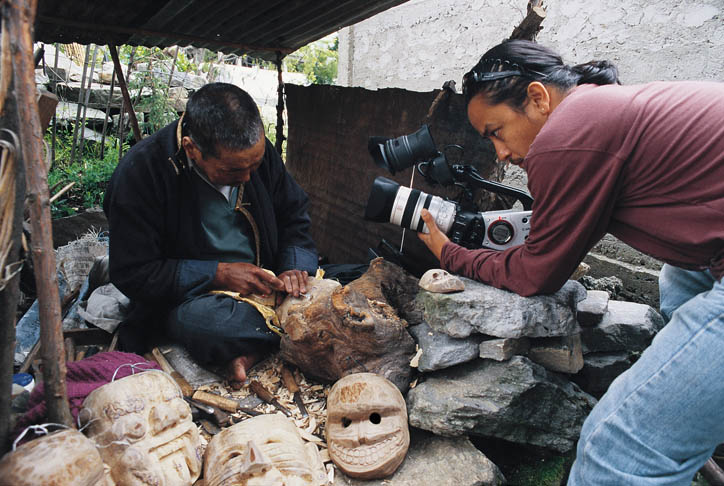
Moji Riba capturing living cultural heritage before it's too late...
A race against time: Moji Riba capturing living cultural heritage before it's too late...

When young Moji Riba started taking an interest in video cameras and filming, his father was a bit concerned.

“I don’t want my son to end up as a cameraman,” he said, reflecting on the fact that a videographer was considered to be no more than a skilled worker in some sections of Indian society.

He need not have worried. Moji went on to become both a well respected film maker and a teacher of mass communications. But more importantly, he has turned his skill into capturing and preserving the highly diverse cultures and traditions of his home state of Arunachal Pradesh in India’s north-east.

Working below the mainstream media’s radar and improvising with available resources, Moji has been engaged in this pursuit passionately and diligently for nearly a dozen years. These efforts finally came into global spotlight in November 2008 when he was selected for a prestigious Rolex Award for Enterprise.

Rolex recognised Moji for ‘helping to preserve and document the rich cultural heritage of India’s Arunachal Pradesh tribes’. He was among the 10 winners of the 2008 Rolex Awards, which for more than 30 years have supported pioneering work in science and medicine, technology and innovation, exploration and discovery, the environment and cultural heritage.

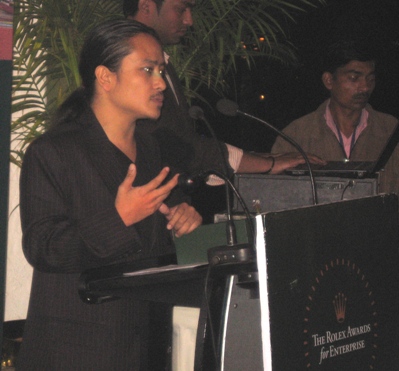
Moji Riba accepting Rolex Award 2008 in Delhi
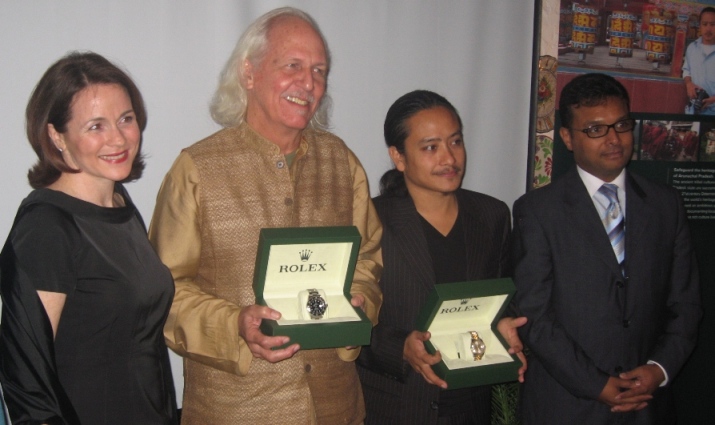
The award was presented to him at a simple ceremony held in New Delhi on 22 January 2009. I was glad to be a ‘fly on the wall’ on that joyous occasion, when Moji and fellow winner Romulus Whitaker were felicitated.

Accepting his award certificate and Rolex chronometer, Moji said: “In the end, this award is not about material rewards. Our most important gain was the process of the application and evaluation which were so intense and demanding that we have had to go through a lot of introspection.”

He added: “That process made us pause and ask ourselves: why are we doing our work, are we doing it right and what results are we going to achieve. That was worth a great deal for us.”

In his short and witty acceptance speech, Moji thanked everyone who has believed and supported his team’s work. His wife Purnima and two young children were there, along with several friends some of who had especially flown in for the occasion. Moji acknowledged his father, who, alas, didn’t live to share this proud moment.

Through a rigorous and discerning selection process, Rolex Awards support path-breaking work in progress, giving laureates new momentum and recognition. In the 2008 award cycle, Moji was one of 10 enterprising individuals chosen from among nearly 1,500 applicants in 127 countries by an independent panel of scientists, educators, economists and other experts.

Barbara Geary of Rolex Awards secretariat, Romulus Whitaker, Moji Riba & Yogesh Shah, CEO of Rolex India
L to R: Barbara Geary of Rolex Awards secretariat, Romulus Whitaker, Moji Riba & Yogesh Shah, CEO of Rolex India

Enthused by the Rolex Award, Moji will return to pursue his most ambitious project yet to preserve the living cultural heritage of Arunachal Pradesh, home to 26 major tribal communities. Each one has its own distinctive dialect, lifestyle, faith, traditional practices and social mores. They live side by side with about 30 smaller communities. Moji sees this richness “like a wonderful shawl woven in a myriad of colours and patterns”.

In recent years, this heritage has come under pressure from economic development, improved means of communication, the exodus of the young and the gradual renunciation of animist beliefs for mainstream religions. Instead of challenging these larger processes beyond anybody’s control, Moji is trying to harness digital technology to capture at least the essence of it for posterity.

That’s the basic idea behind the Mountain Eye Project, an unconventional initiative of his Centre for Cultural Research and Documentation (CCRD) based in Naharlagun. Magic Eye aims to create a ‘cinematic time capsule’ documenting a year in the life of 15 different ethnic groups.

Moji will train young people from each community to do the filming. This gives him access to enough film-makers as well as access to people with an intimate understanding of village life. Beginning in early 2009, these novice film-makers will capture a broad range of the tribes’ oral histories, as well as the rituals, ceremonies and festivals that take place over a year in their villages.

Moji expects to collect about 300 hours of film per village, all of which will be recorded and archived in their native languages. He believes that the resulting 4,000+ hours of video will provide an invaluable record of life as it has been lived in his state for centuries. The project will also engage scholars belonging to the 15 tribes from the Rajiv Gandhi University at Itanagar to analyse and translate this vast amount of data and organize it in a publicly accessible database.

This innovative work epitomises the spirit of Rolex Awards, which nurture excellence in individuals who often work against many odds — determined women and men lighting a few candles on their own, instead of just cursing the darkness…

As I enjoyed the company of Moji, Romulus and their many admirers well into Delhi’s chilly evening, these words the Malaysian social and environmental activist Anwar Fazal kept turning in my mind: “In a world that is increasingly violent, wasteful and manipulative, every effort at developing islands of integrity, wells of hope and sparks of action must be welcomed, multiplied and linked…”

L to R - Yogesh Shah, Moji Riba, Nalaka Gunawardene
One more shot: L to R - Yogesh Shah, Moji Riba, Nalaka Gunawardene

Danny Schechter: Moving Images Person of the Year 2008

Moving Images Person of the Year 2008
Danny Schechter: Moving Images Person of the Year 2008

As 2008 – clearly an Annus horribilis for tens of millions around the world – draws to an end, we announce the Moving Images Person of the Year 2008: Danny Schechter.

Nicknamed “The News Dissector,” Danny is a television producer, independent filmmaker, blogger and media critic who writes and lectures frequently about the media in the United States and worldwide.

He has worked in print, radio, local news, cable news (CNN and CNBC), network news magazines (ABC) and as an independent filmmaker and TV producer with the award-winning independent company Globalvision. He is a blogger and editor of Mediachannel.org, a web and blog site that watches and critiques the print and broadcast media.

Another way to introduce Danny is to recall the scary headlines and TV news images that have dominated 2008 – of reputed banks going bust, leading stock markets crashing and these events triggering a global financial meltdown that, for now, has been slowed but not completely averted by unprecedented governmental intervention…by the very governments of the industrialised countries who should have kept a sharper eye on what was going on in their free market economies.

As the carnage on Wall Street and other global financial centres continued, some hard questions were asked: Did anyone see this coming? If so, why weren’t they listened to? What is the real cause of all this chaos? Where was the news media and why weren’t they doing their job of sounding the alarm?

Well, one man who saw it coming and tried very hard to raise the alarm was Danny Schechter. In 2006, as part of this effort, he made a documentary film called In Debt We Trust. In this, he was the first to expose Wall Street’s connection to subprime loans and predicted the global economic crisis.

This hard-hitting documentary investigated why so many Americans – college and high school students in particular – were being strangled by debt. Zeroing in on how the mall has replaced the factory as America’s dominant economic engine, Emmy Award-winning former ABC News and CNN producer Danny Schechter showed how college students were being forced to pay higher interest on loans while graduating, on average, with more than $20,000 in consumer debt.

An inconvenient truth that America ignored for too long...

The film empowers as it enrages, delivering an accessible and fascinating introduction to what former Reagan advisor Kevin Phillips has called “Financialization” — or the “powerful emergence of a debt-and-credit industrial complex.”

Danny and his film have done for global financial meltdown what Al Gore did for global warming with his own film: investigate rigorously, gather and present the evidence of a gathering storm, sound the alarm — and keep badgering until the warnings were heard. In both cases, the inconvenient truths they presented were ignored for too long — and we are paying the massive price for such indifference.

Watch the Trailer of In Debt We Trust:

Deborah Emin, writing in OpEdNews in October 2008, noted: “In Debt We Trust…brought Schechter a lot of grief. Rather than being seen as a prophet of doom, which in and of itself was not so terrible, he should have been lauded for sounding the alarm when it would have been in time. It is truly an amazing fact of American life that the powers that be can so disastrously determine what information we are able to see based on their subjective judgment of what is too negative or too harsh a view of a specific topic. From this perspective, we should judge all these gatekeepers as those on the Titanic who did not want to alarm the passengers that the ship was going down.”

Watch an extract from In Debt We Trust: How did we get into this mess?


Watch In Debt We Trust in full on Google Video

So here’s the trillion-dollar question: if this film was made in 2006, and has since been running to packed houses scaring a lot of thinking and caring people, why was its message not heard in the corridors of power in Washington DC — and elsewhere in the G8 countries’ capitals?

The short answer could be that there have been no thinking and caring people running the American government for the past eight years.

Read all about it!
Read all about it!
The long answer is found in a book that Danny published in mid 2008. Titled Plunder: Investigating Our Economic Calamity and the Subprime Scandal, it’s an outgrowth of – and update on – his 2006 film. It documents with shocking evidence how debt has restructured the American economy and put Americans under a burden that many will never overcome.

Plunder also offers an analysis based on current events, going behind the scenes, identifying the key players and culprits, challenging the financial industry, government deregulation — and the financial and most sections of the mainstream media who have been cheer-leading the financiers as the latter took ever larger risks. Danny also argues that this has been a criminal enterprise — a point only touched on in most media coverage — and of global significance, given the globalization of markets.

Read my Sep 2008 blog post: Financial Meltdown: Putting pieces together of a gigantic whodunnit


On a personal note, I have been a great admirer of Danny Schechter and his work since I first met him 13 years ago. In the Fall of 1995, he gave an inspiring and provocative talk to a group of journalists and producers from the developing world who were on a UN-organised media fellowship in New York. As part of our tour of media and development agencies in the US East Coast, we visited Danny’s GlobalVision productions.

Danny introduced himself as a ‘network refugee’ — one who had worked for the mainstream network television in the US and had left in disgust. From outside, he was trying to find alternative ways of speaking truth to power — the original mandate of the mass media which many corporatised media companies had abandoned, knowingly or otherwise.

In that pre-Internet era, Danny engaged in his media activism through independent filmmaking, through which he supported and often participated in struggles for social justice in his native United States as well as in places like apartheid-ridden South Africa and strife-torn Palestine.

www.newsdissector.com
http://www.newsdissector.com
Danny was one of the early media activists to take advantage of the web. In 2000, he co-founded with Rory O’Connor MediaChannel.org, the first media and democracy supersite on web. Operating on shoe-string budgets, it has sustained critical spotlight on the mainstream media (MSM) for 8 years in which the MSM landscape has been completely transformed. While its scrutiny and chronicling of the political economy of the media is more crucial than ever, and veterans like Walter Cronkite whole-heartedly endorse the effort, the non-profit effort struggles for survival.

Now in his 60s, Danny is simply indefatigable. Besides running MediaChannel and GlobalVision, he blogs every few hours, writes a regular column on Huffington Post, lectures on media, writes books and still has time to make investigative films. He is extremely well informed, witty, funny and completely irreverent. He writes and speaks with justified outrage but no malice. That’s a tough balance to maintain.

Danny visits Wall Street on 20 September 2007 – typical of his funny, incisive reporting:

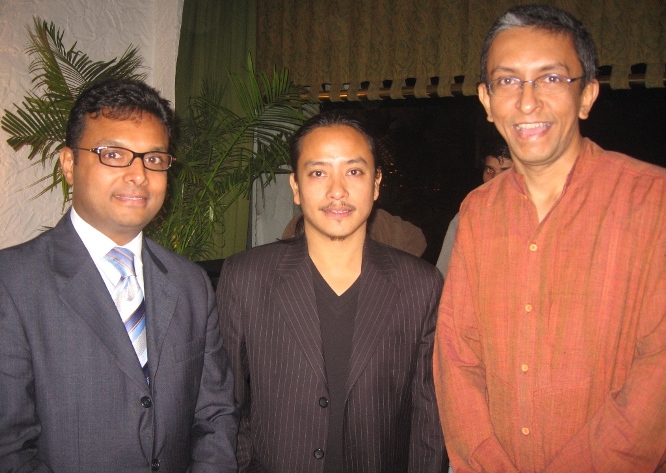
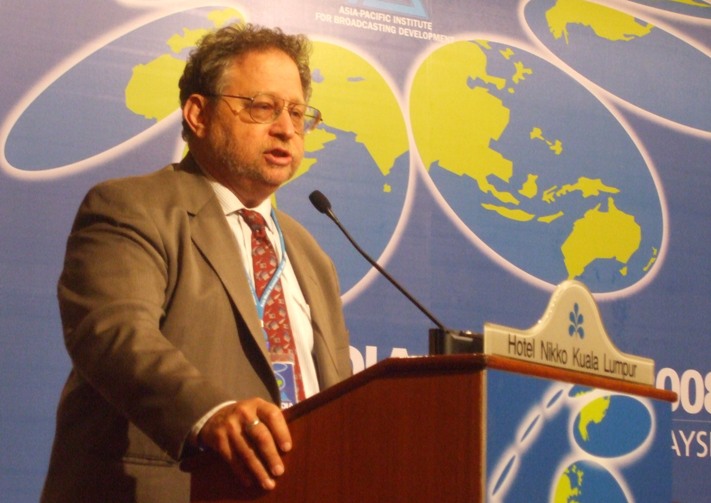
I was delighted to catch up with Danny in May 2008 when we both participated in Asia Media Summit in Kuala Lumpur. He and I were in a small minority of participants who were familiar with the inner works of the mainstream media and transformational potential of the new media. In characteristic style, Danny stirred things up, livening the usually staid proceedings, and I did my best to back him up from the audience. We both enjoyed asking irritating – if not outright annoying – questions from the 400+ media mandarins and press barons who’d come together for the Summit.

One evening, Danny and I had a drink with Malaysiakini’s CEO and leading new media activist Prem Chandran where we talked about the slow but inevitable decline of the mainstream media dinosaurs — or what Michael Crichton called Mediasaurus. The trouble with mediasaurus, we agreed, was that they are taking a long time going extinct and for now, they still command significant numbers of eyeballs and the dollars that follow.

After Prem left, Danny and I continued our chat into the evening. Over a spicy Indian meal, Danny gave me a crash course on subprime crisis (or sub-crime as he calls it) and how that was going to have a domino effect on markets everywhere. I listened with growing comprehension — and deep admiration for the man’s ability to communicate complexities without oversimplification.

Events in the weeks and months that followed have shown how remarkably prescient Danny Schechter was. And what a monumental, global scale mistake it was not to have heeded this man’s cautions in his blogs, films, columns and elsewhere.

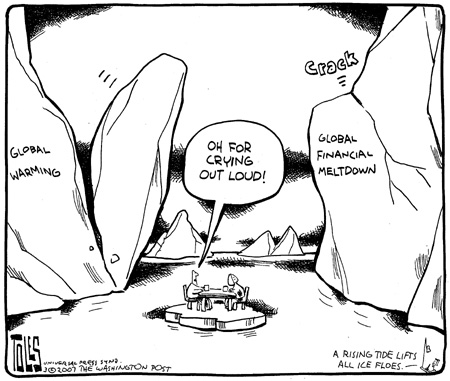
We end 2008 with my cartoon of the year. As I said in a blog post in September 2008: “This cartoon by Pulitzer prize winning Tom Toles first appeared in the Washington Post in 2007 – it brilliantly anticipated the global financial meltdown that we’re now experiencing. Coming in the wake of confirmed global warming, it is a double whammy.

Meltdown 2
Meltdown 2

Anyone can make video film, right? Why do we need professionals?

Anyone can cook, right?

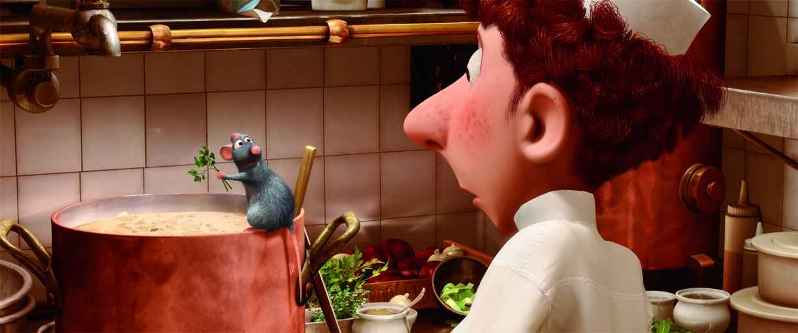
I really enjoyed the Disney/Pixar film Ratatouille (2007), which won the year’s best animated feature film Oscar award and deserved it.

Here’s the plot summary from IMDB: Remy is a young rat in the French countryside who arrives in Paris, only to find out that his cooking idol is dead. When he makes an unusual alliance with a restaurant’s new garbage boy, the culinary and personal adventures begin despite Remy’s family’s skepticism and the rat-hating world of humans. Read full synopsis on IMDB

The movie opens with a TV show featuring Chef Auguste Gusteau, owner of the best restaurant in Paris, talking about his bestselling cookbook, which proudly bears his mantra “Anyone Can Cook!”

Well, that’s heretical to the fine artistes of gourmet. But it’s revived the age old debate between fully-trained professionals and new-entrant amateurs, and inspired some interesting discussions online. One blogger thought: “Remy the rat is a perfect metaphor for the non-expert Web 2.0 knowledge maker. He has no credentials and must prove himself through his actual knowledge and application of knowledge rather than through credentials.”

He added: “What’s the moral of the story? Even without being an acknowledged expert on a topic, if you work hard to express your ideas in clever ways, you too can be respected for what you know.”

I’ve only just read these views, but they resonate with what I felt when I watched the movie in late 2007. The story certainly reminded me of a heated debate in my own field of moving images: can anybody and everybody make video, now that the tech barriers and costs have come down? If this is the case, what’s the point of having highly trained, better paid professionals who do it for a living?

I shan’t try to resolve that debate here. But here’s an interesting take on the debate from the Onion News Network. They report: YouTube is offering a cash prize to the first user to upload a video with a shred of originality or artistic merit.

Sleeping easy along the shore: Going the Last Mile with hazard warnings

creating-disaster-resilience-everywhere.jpg

October 8 is the International Day for Disaster Reduction. The United Nations system observes the day ‘to raise the profile of disaster risk reduction, and encourage every citizen and government to take part in building more resilient communities and nations’.

Disaster risk reduction (abbreviated as DRR) is the common term for many and varied techniques that focus on preventing or minimising the effects of disasters. DRR measures either seek to reduce the likelihood of a disaster occurring, or strengthen the people’s ability to respond to it.

DRR is not just another lofty piece of developmentspeak. Unlike many other development measures that are full of cold statistics and/or hot air, this one directly (and quietly) saves lives, jobs and properties.

And it gives people peace of mind – we can’t put a value on that. That was the point I made in a blog post written in December 2007, on the third anniversary of the Indian Ocean Tsunami. Taking the personal example of J A Malani, an ordinary Sri Lankan woman living in Hambantota, on the island’s southern coast, I talked about how she has found peace of mind from a DRR initiative.

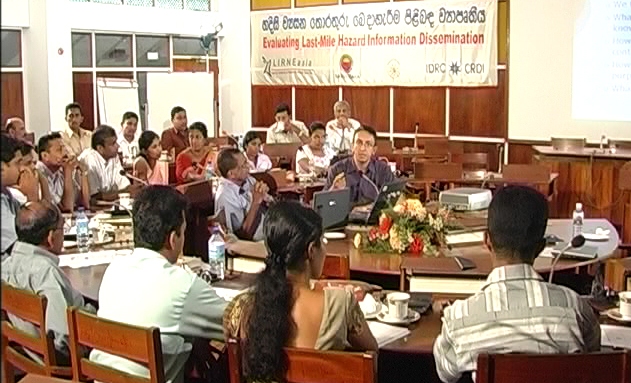
‘Evaluating Last Mile Hazard Information Dissemination Project’ (HazInfo project for short) was an action research project by LIRNEasia to find out how communication technology and training can be used to safeguard grassroots communities from disasters. It involved Sarvodaya, Sri Lanka’s largest development organisation, and several other partners including my own TVE Asia Pacific. It was supported by International Development Research Center (IDRC) of Canada.

Recently, IDRC’s inhouse series ‘Research that Matters’ has published an article about the project. Titled “For Easy Sleep Along the Shore: Making Hazard Warnings More Effective” its blurb reads: “In Sri Lanka, a grassroots pilot study combines advanced communication technologies with local volunteer networks to alert coastal villages to danger coming from the sea.”

The article has adapted a lot of the information and quotes I originally compiled for a project introductory note in April 2006.

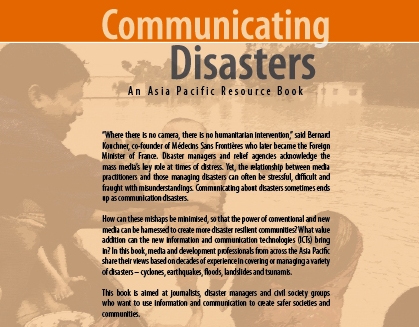
The outcome of the project’s first phase, which ended in mid 2007, is well documented. My own reflective essay on this project is included as a chapter in our book Communicating Disasters: An Asia Pacific Resource Book, published by TVE Asia Pacific and UNDP in December 2007.

TVE Asia Pacific also made a short video film in late 2007. Called The Long Last Mile , it can be viewed on YouTube in two parts:

The Long Last Mile, part 1 of 2:

The Long Last Mile, part 2 of 2:

The recent IDRC article ends with this para: “A related challenge concerns the shortness of any society’s attention span. In the absence of frequent crises and alerts, how can a nation — or even a village — sustain the continuing levels of preparedness essential to ensure that, when the next big wave comes rolling in and the sirens sound, its people will have the motivation and the capacity to act? The follow-up project seeks to address this worry by preparing the hotels and villages to respond to different types of hazards, rather than only to the relatively rare tsunamis.”

Watch this space.

Download pdf of IDRC’s Research That Matters profile on Last Mile Hazard Warning Project

Go ahead, just say the word: Condom! Now say it again…

not an easy task...
Acting out condoms in broad daylight in India: not an easy task...

Condom!

No one is certain how or where the word originated, but it has become one of those ubiquitous items in modern society.

It’s a two syllable word, fairly easy to pronounce. Then how come so many people – at least in South Asia, home to a fifth of humanity – get their tongues tied or twisted in saying it?

That’s because it’s to do with sex! That’s not a subject that many South Asians still feel comfortable in talking about, in public or even private.

Sex may be a very private matter, but individuals’ sexual behaviour has direct and serious public health implications. Especially today when the world is still struggling to contain and overcome the spread of HIV that causes AIDS.

Condoms originally came into wide use to help prevent unwanted pregnancies and the spread of sexually transmitted diseases (STDs). In the past quarter century, condoms have become a major weapon against HIV.

Despite this, condoms still remain a hush-hush topic among many grown ups, even as the younger generation warms up to them. Across South Asia, we still have some hurdles to clear in normalising condoms – or making it socially and culturally acceptable for people to talk about condom use, and to go out and buy them without fear or shame.

They come in all colours and shapes!

This is the challenge that various communication groups have taken up, especially in India. According to a 2007 survey by UNAIDS and India’s National AIDS Control Organisation (NACO), at least 2.5 million people live with the HIV virus in India, placing the country third in the world after South Africa and Nigeria. However, AIDS prevention in the country is not an easy job. Many people, especially in rural areas, cling on to preconceived taboos about sex — and are often hesitant to use condoms.

In recent weeks, I’ve heard from two campaigns that are trying to change this. One is the BBC World Service Trust working with Indian broadcasters and other partners to normalise condom use through a campaign. I’ll be writing a separate blog post on that effort.

Last month, I received en email from someone called ‘Spread Word for a Better World’, who shared with me web links on a socio-cultural group based in Hyderabad, who are using the performing arts to promote condom awareness.

For over a decade, the Nrityanjali Academy has been singing and dancing their way to the glorification of condom use. They see it as a crucial fight in their central region, where 2 per cent of the population is HIV positive.

P Narsingh Rao, director of Nrityanjali, recently told France 24 online: “Our main target groups are people vulnerable to the HIV virus like sex workers, transsexuals or truck drivers. We tour villages in mobile video vans to show the film. The screening is followed by a question and answer session about condom use and sexually transmitted diseases.”

He added: “We also encourage the use of female condoms, a relatively new concept. We tell the women to negotiate the use of female condoms with their male partners: for men with little sex education, the insertion of the female condom in the vagina can in itself be an erotic act.”

Here are some YouTube videos showcasing their work:

This is an entertaining and educational video in Telugu language on Condom usage, to prevent from sexually transmitted infections and HIV:

A more instructional video on how to use condoms properly:

And finally, an HIV/AIDS song in Telugu – with all the fast-beat music, gyrating and riot of colours we typically associate Bollywood movies and songs with:

The videos speak for themselves. They are matter of fact, engaging and presented by ordinary people (trained entertainers) rather than by jargon-totting medical doctors or health workers. There is none of the awkwardness typically associated with conversations of this subject. No one is tip-toeing around perceived or real cultural taboos. They just get on with it.

Importantly, they involve both men and women, both in performances and in their audiences.

Training young men on just how to do it right...

Related blog posts:

July 2007: The Three Amigos: Funny condoms with a serious mission

April 2007: Beware of Vatican Condoms – and global warming!

Images courtesy France 24’s The Observers.

Governments, disasters and communication: Lead, follow or get out of the way!

The Association for Progressive Communications (APC) has just published a good review of the book I recently co-edited titled Communicating Disasters: An Asia Pacific Resource Book.

The review is written by two academics. Dr Malathi Subramanian is Former Principal, Daulat Ram College, University of Delhi, India, while Dr. Anupama Saxena is Head, Department of Political Science, Guru Ghasidas University, Bilaspur, Chhattisgarh, India.

As they remark: “The book has articles contributed by authors who do not engage in mere theoretical discussions. They draw on their rich and varied experiences working in either preparing disaster resilient communities or responding to humanitarian emergencies triggered by specific disasters in different parts of the globe.”

They add: “The eminently readable book provides first hand information about the real life situations of disaster, richly illustrated with case studies and use of professional images….The book is written in a manner that successfully sensitises the reader to the complexity of the issue of disaster management and its various nuances. After reading the book one is sure to echo the spirit of one of the contributors, Sanjana Hattotuwa: ‘We cannot prevent or predict all disasters. However, we can plan for, react to and learn from disasters when they do occur’.

In preparation of this review, Malathi and Anupama did an email interview with me where they posed half a dozen questions on some key issues we have addressed in the book. Here is the full interview, which brings out my personal views interspersed with those of some other contributors to our multi-author book.

Question: In developing countries the governments are considered to be the nodal agencies for disaster management. In this context do you think that there is a need to advocate the integration of the National disaster management policy with the national ICT Policy to exploit the potential of ICTs before, during and after a disaster?

Yes, that certainly is the ideal, desirable scenario. But I’m not sure how soon this can become a reality, given how many of our governments think of these sectors as separate compartments – or ‘silos’ – with little or no integration. In the real world, however, these are all mixed up: people who use ICTs are affected by various disasters and the first responders – including relief workers and journalists – use various ICT tools in their work. Increasingly, we are seeing disaster affected people themselves using ICTs, especially mobile phones, to communicate with family, friends, aid officials and others from the scenes of disaster. We have documented specific instances of all this in our book and pointed out that the typical hapless, uninformed affected person is being replaced by a digitally empowered one. So the integration of disaster management and ICTs has been happening on the ground for some time, whether or not policy-makers acknowledge it!

At policy and regulatory level, governments can play an enabling role by easing the various bottlenecks that currently hold back optimum use of ICTs in disaster preparedness, early warning or response. This is so lacking and badly needed in my own country Sri Lanka. One example: amateur radio enthusiasts played a key role in establishing emergency communication with some coastal areas badly hit by the 2004 tsunami. When everything was dead, short wave was alive. Yet, barely months later, the government blocked any new amateur radio equipment being brought into the country as someone felt it was a threat to national security!

But in my view, misguided policies are worse than no policies at all. That’s when I feel like quoting Rabindranath Tagore’s words which every southern government should heed: ‘If you can lead, lead. If you cannot, follow. If you can do neither, then get out of the way’.
tveap-image-archive.jpg

Question: Participatory Modes of communications form a very important part of a comprehensive strategy aiming at creating disaster resilient communities. What type of policies and frameworks the national governments should adopt to facilitate this?

Living with disasters – or developing resilience to disasters – is fast becoming a necessary strategy of day-to-day survival. Communication plays a role in this. In our book, we have an entire chapter on this written by Chin Saik Yoon, who has been researching and documenting participatory communication processes in development. He identifies communication as one of four necessary steps towards recovery from a disaster. Survivors need to maintain communication with family, friends, and counsellors in order to share their experiences. They need to tell their stories about the disaster, and listen to others as they tell theirs. This helps survivors to collectively release their stress.

To continue in his own words: “Participatory communication processes work best here. This is where survivors assume the role of both the ‘initiator’ as well as the ‘receiver’ of communication. No expert or government official should be there to decide what is to be discussed by the survivors. They need only facilitate the process. The participatory processes ensure that communication occurs at the pace that communities are comfortable with and address issues only when survivors are ready to deal with them.”

This makes eminent sense, but it is precisely this kind of thoughtful, sensitive approach that many governments are unable or unwilling to adopt. For too long, governments have been seen as the sole decider, provider and protector – and governments do have a responsibility in all these. But in today’s world, the role of government has to be reviewed and redefined. As Chin says, government officials may facilitate, but governments must get out of the historical habit and temptation of playing Big Mama (or worse, Big Brother!) by doing such communication themselves.

For our quest for disaster resilience to succeed, we need a transformation in governmental policies, attitudes and practices. In a world experiencing a growing number and intensity of multiple hazards, no government – however powerful or well intended – can reach out and protect every citizen. That illusion was shattered forever by hurricane Katrina. There is no need for such governmental omnipresence either! The smart option is to allow, encourage and empower individuals and communities to do part of it on their own. Governments, researchers, aid agencies and charities still have to be part of this – but first they have to break free from the ‘Let’s-Do-It-All-Ourselves’ mentality.

Question: It is evident from the many case studies in the book that participatory non-media modes of communications have been quite useful in dealing with disasters. Such efforts however, need constant involvement of a wider group of people on voluntary basis over a long period of time for creating resilience for disasters. How to develop this spirit and, more important, sustain it.

Yes, participatory communication efforts have to sustain the community engagement over weeks, months and sometimes years. As one of our contributing authors, Buddhi Weerasinghe, has written in the book: “The big challenge is to sustain disaster preparedness interventions over time. This is helped by the creation of informal leadership within the community through participatory action.”

Since no two communities are alike, it’s very hard to generalise on how to develop the necessary conditions and ‘spirit’, but some generic lessons can be drawn from documented examples. The right kind of community leadership helps, as does external help that is neither over-bearing nor fleeting. Assistance from aid agencies needs to be delivered at a pace the communities can absorb, integrate and use.

Disasters are often the latest (and highly disruptive) layer over existing multiple layers in a community. Even if a shared plight and grief temporarily unite a community, that alone cannot hold people together for too long, especially if there are deep divides in that community. So community cohesion and unity become very important factors in the success of participatory communication. There is no single formula that can work for everyone.

cartoon-noahs-doubters.gif

Question: The book describes many successful interventions based on non-media participatory mode of communications for disaster management. Which of these interventions do you think can be cited for the most optimal use of non media participatory mode of communications?

In our introduction to the book, Frederick Noronha and I wrote: “Media-based communication is vitally necessary, but not sufficient, in meeting the multiple information needs of disaster risk reduction and disaster management. Other forms of participatory, non-media communications are needed to create communities that are better prepared and more disaster resilient.”

These non-media communication methods range from basic inter-personal communication and small group discussions to participatory rural appraisal techniques. The methods are not new or unique; they are being customised to meet disaster preparedness and/or response needs.

It’s more than mere talk. Some methods involve experiential learning – or learning by doing. An example is participatory hazard mapping. First, community members are divided into a few groups and asked to map their neighbourhoods – they have to capture the roads, footpaths, rivers, hillocks, houses, schools, temples and other key landmarks. Then they mark the areas that have been affected historically with different disasters such as tsunami, floods or cyclones. This helps identify relatively safer areas as well as safety routes in case a new disaster demands quick evacuation. Admittedly this is communication plus social mobilisation, but that’s what it takes in the real world – communication is only part of the solution.

As Buddhi Weerasinghe has written in his chapter, “This exercise allows informal leaderships to emerge. Encouraging this leadership and recognizing their inputs can motivate them and enable sustainability of interventions. The process of hazard mapping also imparts a sense of ownership.”

Question: To what extent is it really practicable to achieve the ‘disaster resilience’ in communities?

Disasters are all about resilience – how we pick ourselves up after a tragedy and slowly return to normalcy. And also how we take repeated battering from a multitude of disasters and still carry on with living. There is no single recipe for success in building disaster resilient communities. Everyone needs to approach this with open and flexible minds, and see what works for whom under which conditions. Disaster resilience is not a slogan like halving poverty by 2015 or writing off majority world’s debt. It’s a long-drawn, incremental process and will always remain a work in progress because both community dynamics and the nature of hazards change over time.

In many cases, the community has information and insights that help achieve resilience, but it needs to be brought out – that’s where participatory communication helps. But let’s not romanticise matters too much – some communities need external guidance, and most can benefit from external facilitation in their quest for resilience.

In a chapter called ‘Bridging the Long Last Mile’, I have described the experience of a community-based disaster preparedness and early warning dissemination effort undertaken by Sarvodaya, LIRNEasia and other partners in Sri Lanka. The project studied which ICTs and community mobilisation methods could work effectively in disseminating information on hazards faced by selected coastal communities all of which were battered by the Indian Ocean tsunami of December 2004.
hazinfo-project-meeting-at-sarvodaya.jpg

Sri Lanka – Last Mile Hazard Info project planning meeting: Photo courtesy Sarvodaya

I would refer you to the chapter for details, but the key lessons may be summed up as follows:
• Trusted technology: Use ICTs that are reliable in performance, accessible at the local levels and trusted by the people.
• Complementary redundancy: Always have at least two different ICTs delivering information, to minimise transmission failures.
• Credible information: Tap only the most authentic sources of information at national and international level, reducing room for misinformation and rumour.
• Right mix: Achieve the appropriate combination of technology, training and institutional arrangements at the grassroots.
• Be prepared: Raise localised awareness and provide experiential training so community know what to do when crisis occurs.
book-cover-final.jpg