Op-ed essay originally published by the Communications Initiative (CI) on 12 Dec 2013 and reprinted in Ceylon Today newspaper on 17 Dec 2013.
Image courtesy – ICTD Cape Town 2013 website
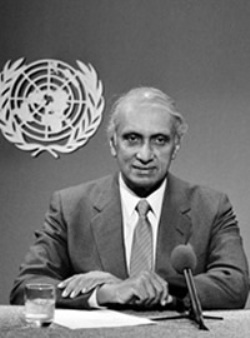
Nelson Mandela was not only an effective communicator, but also a champion of communication for development.
He spoke and wrote with conviction and empathy, which in turn enhanced his credibility and appeal. He changed history with his careful choice of words and images delivered with the right degree of passion. Social communicators can learn much from him.
However, his communications prowess extended beyond thoughtful prose and skillful oratory. He also understood the power of mass media in today’s information society — and used it well for nation building.
When they are in office, many political leaders of the majority world tend to overuse or misuse the media, for example by forcing public broadcasters to peddle ruling party propaganda. During his term as South Africa’s president, Mandela carefully avoided such excesses.
Instead, he strategically tapped the country’s pluralistic broadcast media to unify the divided nation. Clint Eastwood’s 2009 movie Invictus re-enacted a highlight of that approach.
As a policy maker, Mandela grasped the role of communication in development – both the concepts and delivery tools.
The International Telecommunications Union (ITU), the UN agency promoting and tracking the progress of information society, recently saluted Mandela for having been a firm supporter of ICTs as a catalyst for social change and economic development.
At the same time, Mandela’s vision went beyond mere gadgets and telecom networks. Speaking at the ITU Telecom World in Geneva in 1995, he underlined the importance of communication and access to information to human beings. He called for eliminating the divide between information-rich and information-poor countries.
Three years later, while hosting ITU Telecom Africa in Johannesburg, President Mandela said: “As the information revolution gathers yet more pace and strikes deeper roots, it is already redefining our understanding of the world. Indeed, the speed of technological innovation could bring the ideal of the global village sooner than we thought possible. For the developing world, this brings both opportunity and challenge.”
Lofty statements like these are common at policy gatherings. But Mandela went further – and believed that communication should be seen as a basic human need. That set him apart from many members in the development community who have long considered it a secondary need.
Although it has been discussed for centuries, there is no universally accepted definition of basic human needs. During the 1970s, basic needs emerged as a key topic in development debates. Various studies — catalysed by UN agencies and the Club of Rome – tried to define it.
In 1976, the International Labour Organisation (ILO) prepared a report that identified basic needs as food, clothing, housing, education and public transportation. It partially drew on ILO’s country reports on Columbia, Kenya and Sri Lanka.
Since then, different development agencies have adopted variations of the original ILO list. National planners have used the concept to benchmark economic growth.
The ground reality has changed drastically since those heady days. About a year ago, I asked Frank La Rue, the UN Special Rapporteur on Freedom of Opinion and Expression, if communication should be considered a basic human need. He welcomed the idea, especially in view of rapid evolution of information society.
I soon found that Mandela had thought of it years earlier. Perhaps because he had such limited access to communication during his long years in prison, he appreciated its central value to all human beings.
That remark, made while opening a mobile telecom network, was rather perceptive. At the time, less than 1 per cent of all Africans had access to a fixed phone, and there were only around one million mobile phones on the continent of 800 million.
Since then, mobile phones and other low-cost digital tools have spread phenomenally, transforming lives and livelihoods across the majority world. Sullivan calls it an external combustion engine: “a combination of forces that is sparking economic growth and lifting people out of poverty in countries long dominated by aid-dependent governments.”
While the market and society have marched ahead, many development professionals are still stuck in obsolete development paradigms. That is probably why some worry that there are more mobile phones than toilets in India. (So what? Mobiles are personal devices; toilets are a shared household amenity. Comparing their numbers is meaningless.)
It’s high time we revisited basic human needs and redefined them to suit current realities. The development community must finally catch up with Nelson Mandela.
Science journalist and development communicator Nalaka Gunawardene has been following social and cultural impacts of ICTs for over 20 years.
Can Development Community Catch up with Nelson Mandela – Ceylon Today, 17 Dec 2013
Text of my ‘When Worlds Collide’ column published in Ceylon Today Sunday broadsheet newspaper on 8 December 2013
Nelson Mandela is no more. The world is exceptionally united in saluting the iconic fighter for democracy, freedom and equality for all humans.
The man who famously chronicled his ‘long walk to freedom’ also had a ‘long goodbye’ that stretched for several months. So his death did not come as a shock. Nevertheless, his departure provides an opportunity to reflect on what he accomplished — and, more importantly, how.
The news from South Africa on the evening of December 5 sparked off a global ‘mediathon’. In this frenzy, it is easy to overlook that Mandela was a complex personality who had his strengths and weaknesses. And that he headed a political struggle that involved many others.
American journalist and activist Danny Schechter, who made six documentary films with and…
In this week’s Ravaya column (in Sinhala), I explore another facet of the scholar and free thinker Dr E W Adikaram (1905-1985). On 10 Nov 2013, I discussed his contributions as a pioneer in public communication of science in Sinhala. Today, I discuss his uncompromising stand on non-violence (ahimsa) and his debunking of racial segregation of humanity for which there is no biological basis.
Nelson Mandela (1918 – 2013) – Thank you & Goodbye!
Nelson Mandela is no more. The world is exceptionally united in saluting the iconic fighter for democracy, freedom and equality for all humans.
The man who famously chronicled his ‘long walk to freedom’ also had a ‘long goodbye’ that stretched for several months. So his death did not come as a shock. Nevertheless, his departure provides an opportunity to reflect on what he accomplished — and, more importantly, how.
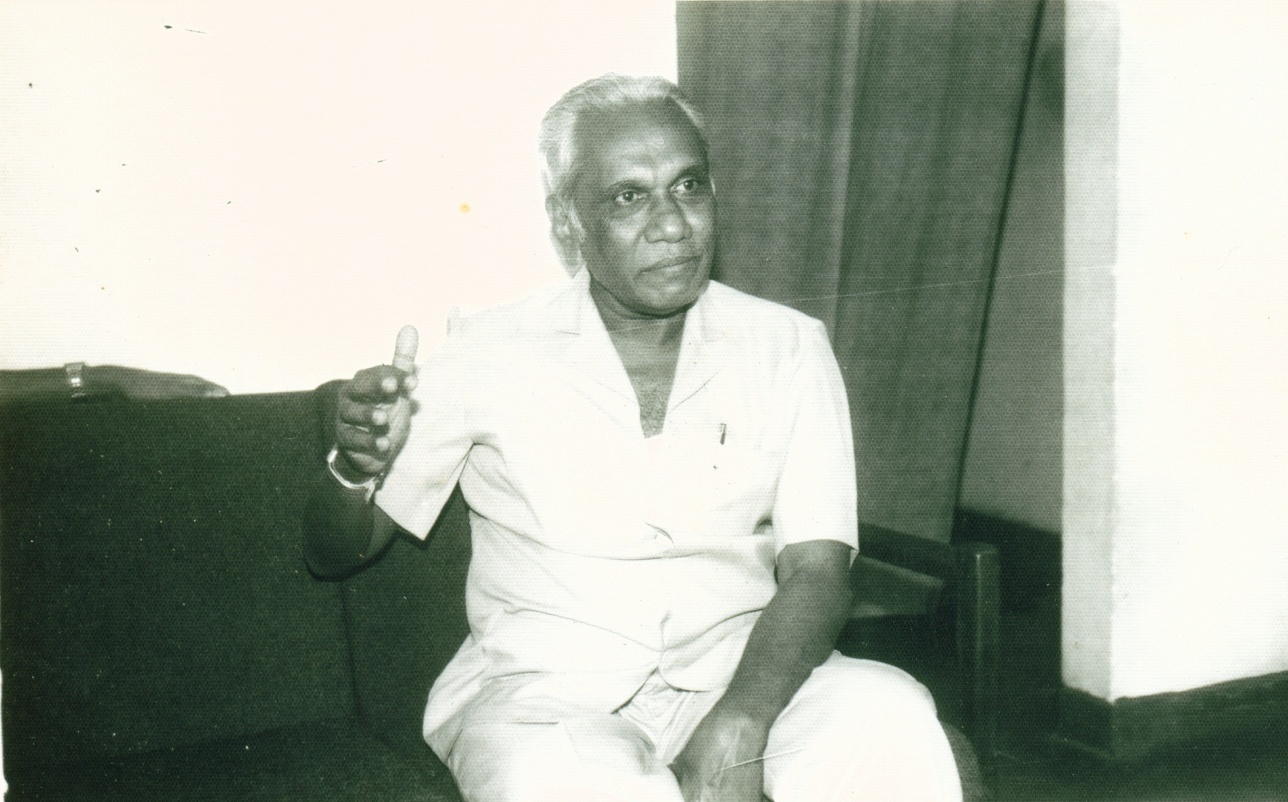
Edwin Ariyadasa photographed by Nalaka Gunawardene in 1986 during their first interview
Edwin Ariyadasa, who completed 91 years on 3 December 2013, is one of two grand old men of Lankan journalism still practising their craft (the other being D F Kariyakarawana, also 91).
The veteran journalist has been active in his profession for nearly all of Sri Lanka’s post-independence years. During that time, he has played a variety of complementary roles: feature writer, newspaper editor, columnist, radio and TV host, journalist trainer, author and translator among others. He continues to juggle many of these and has no retirement plans.
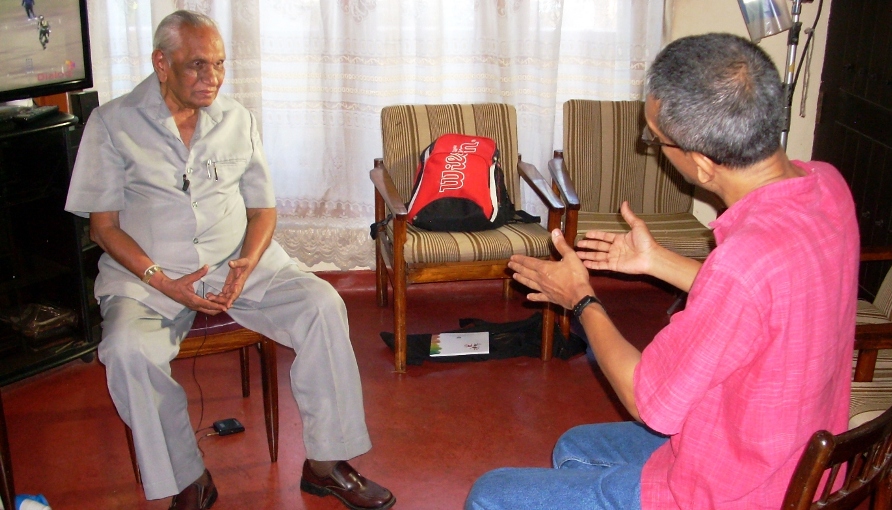
In October 2012, I filmed a wide ranging interview with Ariyadasa as he was heading to his 90th birthday. Having grown up reading his output in Lankan newspapers in Sinhala and English, and then having collaborated with him in various public media activities for much of my own media career, I was keen to capture his memories and reflections.
It took me over a year to get the long interview edited into three video segments, and also to have it transcribed, but it’s finally done. Groundviews.org has just published it:
Nalaka Gunawardene in conversation with Edwin Ariyadasa
As I note in my introduction:
In this interview, the nonagenarian looks back at journalism and broadcasting in Sri Lanka for over half a century. His reminiscences are significant for several reasons. He recalls a time, only a generation ago, when newspapers produced by highly committed editors and journalists commanded readers’ respect as a trusted source of public information and commentary. Having played a central role in pioneering mass media education and television broadcasting in Sri Lanka, he wonders what went wrong along the way to arrive at the banality and superficiality that dominates much of the Lankan media today despite advanced technologies for production and distribution.
In that sense, this is more than mere nostalgia of an individual or the simple bewilderment of an earlier generation. Introspection from a media guru like Ariyadasa can provide the impetus for much-needed reflection for the media industry which often hesitates to turn the spotlight upon itself.
Text of my ‘When Worlds Collide’ column published in Ceylon Today Sunday broadsheet newspaper on 1 December 2013
I felt a sense of Déjà vu as I spent the past week in the Philippines witnessing how the archipelago nation is struggling with the trail of destruction left by super typhoon Haiyan (local name: Yolanda). The aftermath is uncannily similar to what we in Sri Lanka went through following the Indian Ocean tsunami of December 2004.
The atmospheric disturbance that hit them on 8 November 2013, which was accompanied by tsunami-type sea waves, is their deadliest natural disaster on record. By November 25, the official death toll exceeded 5,600 with another 1,700 missing. Nearly 26,000 people were injured, and over a million homes destroyed or damaged.
In all, more than 11 million Filipinos have been affected in one way or another. The total economic cost, still being assessed, is likely…
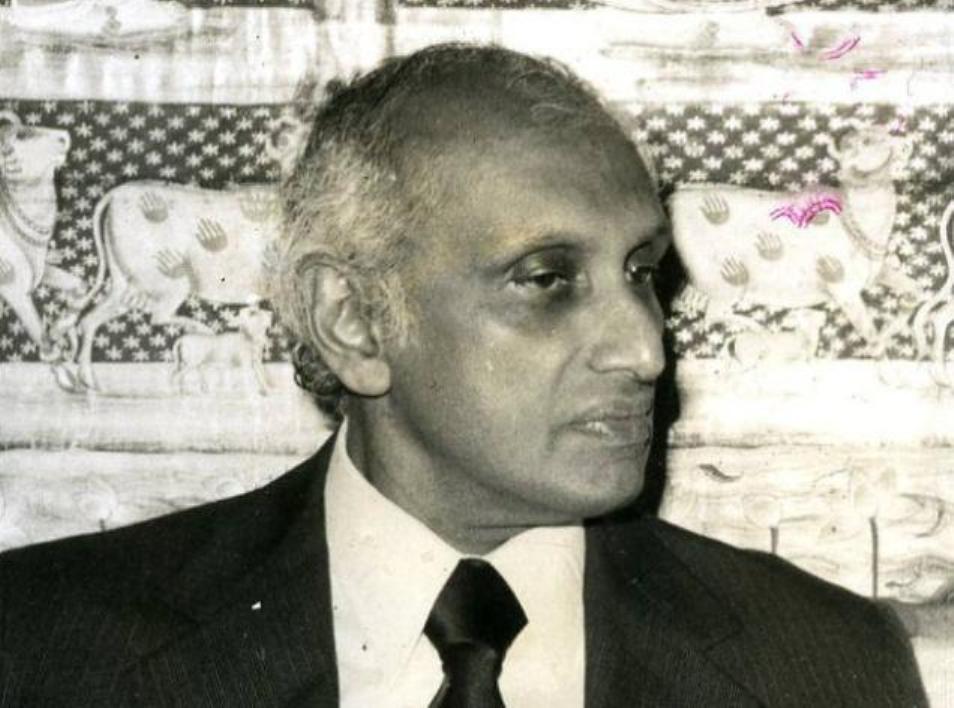
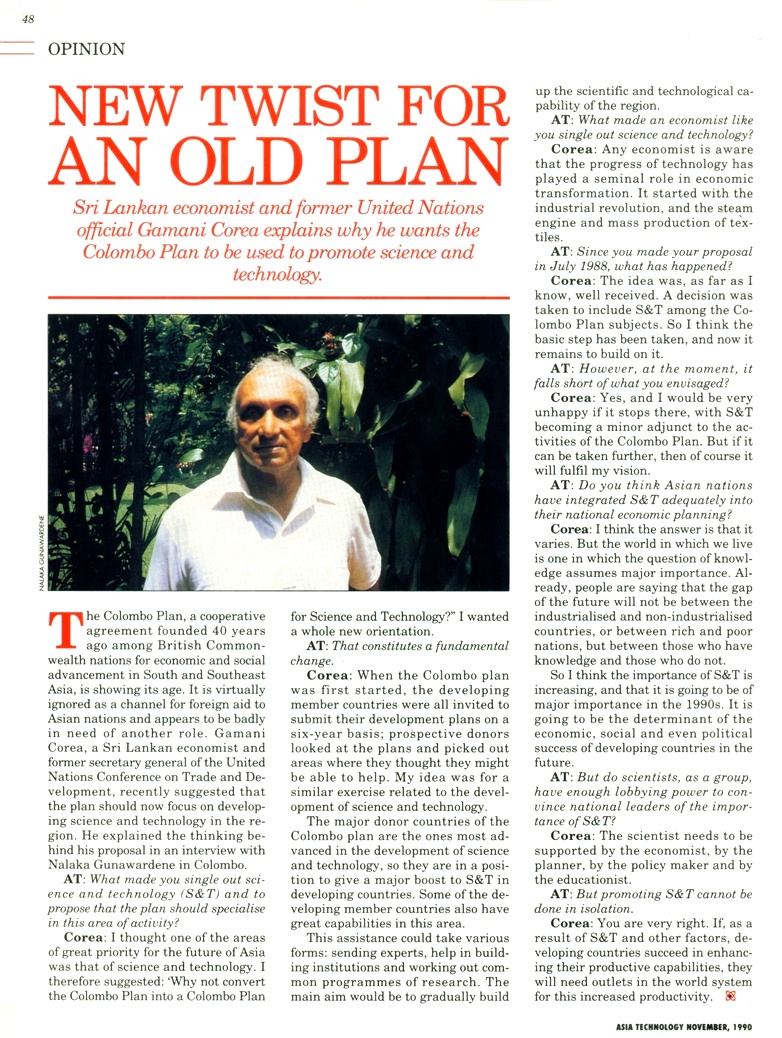
In this week’s Ravaya column (in Sinhala), I pay tribute to Dr Gamani Corea (1925 – 2013), Lankan economist, diplomat, international civil servant and public intellectual.
Arriving in the Philippines just two weeks after the super typhoon Haiyan (local name Yolanda) hit the archipelago nation on 8 November 2013, I’ve been following many unfolding debates on disaster recovery and resilience.
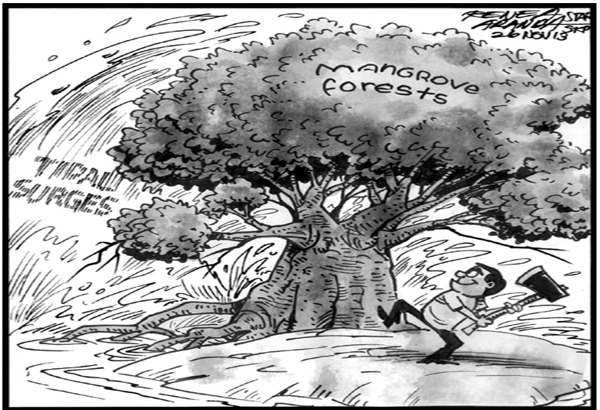
The Filipino media have been full of post-disaster stories. Among them, I came across an editorial in the Philippine Star on 26 Nov 2013, titled Stopping the Waves, which touched on the role of protecting natural barriers that can guard coastal areas from storm surges.
A key excerpt: “Nothing can stop a storm surge, but there are ways of minimizing the impact of powerful waves. Levees have been built in some countries, although the ones in New Orleans were breached by the storm surge during Hurricane Katrina. Another option is to develop mangrove forests, which can also function as bird sanctuaries and breeding grounds for marine life.”
It added: “Yolanda has revived the debate over the proposed destruction of the coastal lagoon to make way for commercial development. That mangrove forest must be protected and expanded rather than destroyed, and more mangrove areas must be propagated throughout the archipelago. You can’t roll back deadly waves, but their punch can be blunted. Natural barriers should help do the job.”
This is just what TVE Asia Pacific’s regional TV series The Greenbelt Reports highlighted. Filmed at 12 locations in four Asian countries (India, Indonesia, Sri Lanka and Thailand) which were hardest hit by the Indian Ocean tsunami of December 2004, the series showcased Nature’s protection against disasters and climate change.
It covered three coastal ecosystems or ‘greenbelts’ — coral reefs, mangroves and sand reefs. Reporters and producers from TVE Asia Pacific journalistically investigated the state of greenbelts in South Asia and Southeast Asia by talking to researchers, activists and government officials. They also looked at efforts to balance conservation needs with socio-economic needs of coastal communities.
Here’s the overview documentary (additionally, there were 12 stand-alone short videos as well):
The Greenbelt Reports: Armed by Nature: Part 1 of 3
The Greenbelt Reports: Armed by Nature: Part 2 of 3
The Greenbelt Reports: Armed by Nature: Part 3 of 3
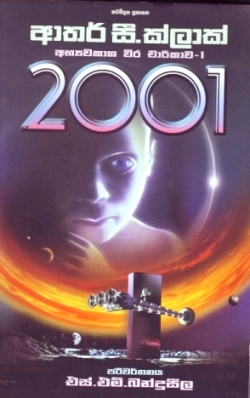
S M Banduseela is widely recognised as Sri Lanka’s foremost translator of science and science fiction. Beginning in 1970, when he translated into Sinhala language The Naked Ape by zoologist and ethologist Desmond Morris, Banduseela has introduced Sinhala readers to over two dozen world acclaimed titles.
He is best known as Arthur C Clarke’s Lankan translator. In the mid 1970s, he translated Clarke’s landmark 1962 volume Profiles of the Future, which was well received. Encouraged, Banduseela took to translating Clarke’s key science fiction novels beginning with 2001: A Space Odyssey. Over the years, he rendered into Sinhala all four Odyssey novels, as well as other works like The Fountains of Paradise, Rendezvous with Rama and The Hammer of God.
In this wide ranging interview, published in the Sinhala Sunday newspaper Ravaya (24 Nov 2013), I discuss with Banduseela various aspects of science fiction in the Lankan context: the niche readership for this literary genre; its enduring appeal among Sinhala readers; and prospects of original science fiction in Sinhala. He also recalls the challenges he faced translating Clarke’s technically complex and philosophically perceptive novels. I ask him why Sinhala readers have yet to discover the rich worlds of science fiction written in countries like Russia, Japan, China and India.
Text of my ‘When Worlds Collide’ column published in Ceylon Today Sunday broadsheet newspaper on 24 November 2013
Twenty years ago, Italian police and Customs officials going after narcotics were considered ‘heroic’ while those investigating any environmental crimes were seen as ‘boy scouts’. After all, what could be so criminal about waste and pollution?
Plenty, as it turned out. In the early 1990s, Italy’s notorious organised crime syndicates – or the mafia – discovered that they could make lots of money fast by helping industries to get rid of their toxic waste.
So mafia groups decided to ‘go green’ – and ecomafias emerged.
The Italian environmental advocacy group Legambiente started investigating this in 1993, when a pile of toxic waste was discovered near a NATO military base in Italy. In fact, they coined the term ‘ecomafie’ (ecomafia), which soon entered popular vocabulary.
Legambiente has been researching on ecomafia practices…

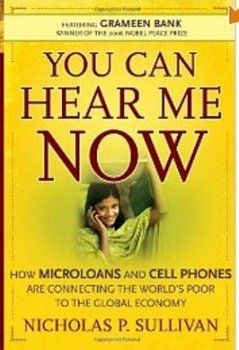 In a 2007 book titled You Can Hear Me Now: How Microloans and Cell Phones are Connecting the World’s Poor to the Global Economy, US writer Nicholas Sullivan quotes Mandela saying in a 1995 speech: “The desire to be in touch lies deep within us. It is a basic need.”