Michael Crichton (1942-2008): Foresaw the fate of ‘Mediasaurus’

Death has no sense of timing, but it sometimes leaves traces of irony. The day Americans were electing an energetic and articulate senator from Chicago as their next president, one of Chicago’s most celebrated citizens lost his battle with cancer.

Michael Crichton
, who died on 4 November 2008, was trained as a medical doctor but played several roles in the creative arts world. He was a prolific author of science fiction and medical fiction, whose books have sold over 150 million copies worldwide. He also produced and directed techno-thriller movies, and was the creator of the highly successful medical drama series on television, ER (Emergency Room), now in its 15th season.

In the domain of popular culture, Crichton was best known for writing Jurassic Park (1990). This cautionary tale on unrestrained biological tinkering was turned into a blockbuster movie by Steven Spielberg in 1993. It became the highest earning film up until that time.

Before and since, Crichton used his technical training, vivid imagination and mastery of English to spin some of the most enjoyable – and scary – stories that often depicted scientific advancements going awry, resulting in the worst-case scenarios. A notable recurring theme in Crichton’s plots is the pathological failure of complex systems and their safeguards, whether biological (Jurassic Park), military/organizational (The Andromeda Strain), technical (Airframe) or cybernetic (Westworld).

Crichton was also a talented essayist who wrote perceptive pieces of non-fiction about science, society and culture – including the role of media. It is one such essay that I would like to recall in his memory.

The media world was very different when, in 1993, Crichton riled the news business with an essay titled “Mediasaurus“. In this essay, written for the newly launched Wired magazine, he prophesied the death of the mass media — specifically the New York Times and the American commercial TV networks.

“To my mind, it is likely that what we now understand as the mass media will be gone within ten years. Vanished, without a trace,” he wrote.

Building on his credentials as the author of a best-seller on dinosaurs, Crichton called this endangered beast ‘mediasaurus’.

Mediasaurus - courtesy Slate
He added: “There has been evidence of impending extinction for a long time. We all know statistics about the decline in newspaper readers and network television viewers. The polls show increasingly negative public attitudes toward the press – and with good reason.”

He talked about technological advances — “artificial intelligence agents roaming the databases, downloading stuff I am interested in, and assembling for me a front page” — that would drive the mediasaurus to their inevitable doom.

Only those nimble, adaptable media products would survive, he said, noting that CNN and C-SPAN were steps in the right direction, giving viewers direct access to events as they happen.

But he had no sympathy for the media. “The media are an industry, and their product is information. And along with many other American industries, the American media produce a product of very poor quality. Its information is not reliable, it has too much chrome and glitz, its doors rattle, it breaks down almost immediately, and it’s sold without warranty. It’s flashy but it’s basically junk. So people have begun to stop buying it.”

Read the full essay: Mediasaurus by Michael Crichton, Wired Oct/Nov 1993

Like most people who dabble in the imperfect art of foreseeing the future, Crichton got the trend right but the timing somewhat wrong. The mainstream media (MSM) were indeed on the decline but not at the dramatic rate that he envisaged.

In February 2002, Jack Shafer wrote a piece in the online magazine Slate titled “Who You Calling Mediasaurus?” Its subtitle was: “The New York Times dodges Michael Crichton’s death sentence”. It asked and tried an answer the question: Where did Crichton go wrong?

Shafer wrote: “Fables of the near future have a way of never materializing, whether they be fevered dreams of nuclear energy too cheap to meter or fossil fuels too expensive to burn. To be fair, Crichton wasn’t the only one to get puking drunk on the new media moonshine. Many of us spent a lost weekend—sometimes months—in a stupor after reading early issues of Wired. But instead of blotting out conventional media, the emerging Infotopia seems only to have made the conventional media more ubiquitous.”

Shafer asked: “Who would have predicted in 1993 that America’s great dailies (minus the Wall Street Journal) and the news networks would dodge both extinction and irrelevance by erecting Web sites overnight and giving their content away? That they would use their Web sites to keep us informed 24-hours-a-day in a way that we take for granted today but that would have astonished us nine years ago?”

In an email interview with Shafer at the time, Crichton acknowledged his own limitations: “I don’t have a lot invested in whether my predictions are right or wrong; I assume that nobody can predict the future well. But in this particular case, I doubt I’m wrong, it’s just too early.”

In that interview, Crichton said he wished he had foreseen “the effect of big media conglomerates combined with the universal decision to make news into entertainment. It’s all headlines and chat now. Factual content is way down, accuracy has vanished (it’s not even a goal any longer), and public confidence in media is at an astonishing low. Not surprisingly, audiences are shrinking.”

Crichton admitted at the time that the personalized ‘infotopia’ he envisioned in 1993 had yet to arrive. He scoffed at the Web for being too slow. “Its page metaphor, too limiting. Design, awful. Excessive hypertexting, too distracting. Noise-to-signal ratio, too high.”
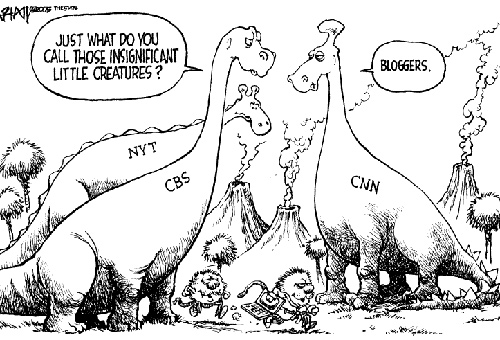
Who succeeds mediasaurus?
Now fast-forward to May 2008. The same Jack Shafer, once again writing in Slate, published a piece titled “Michael Crichton, Vindicated”. It was introduced as: “His 1993 prediction of mass-media extinction now looks on target”.

In this essay, Shafer wrote: “As we pass his prediction’s 15-year anniversary, I’ve got to declare advantage Crichton. Rot afflicts the newspaper industry, which is shedding staff, circulation, and revenues. It’s gotten so bad in newspaperville that some people want Google to buy the Times and run it as a charity! Evening news viewership continues to evaporate, and while the mass media aren’t going extinct tomorrow, Crichton’s original observations about the media future now ring more true than false. Ask any journalist.”

Read Jack Shafer’s full interview with Michael Crichton in Slate, May 2008
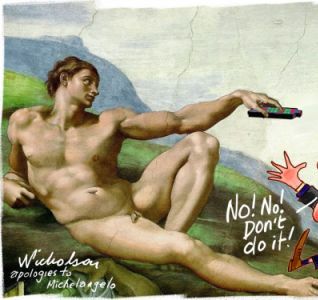
the weapon that killed Mediasaurus
Revealed: the weapon that killed Mediasaurus
By this time, Crichton was more positive about the web. He noted that the Web has “made it far easier for the inquisitive to find unmediated information, such as congressional hearings.” It’s much faster than it used to be, and more of its pages are professionally assembled.

Crichton suggested that readers and viewers could more objectively measure the quality of the news they consume by pulling themselves “out of the narcotizing flow of what passes for daily news.” Look at a newspaper from last month or a news broadcast.

“Look at how many stories are unsourced or have unnamed sources. Look at how many stories are about what ‘may’ or ‘might’ or ‘could’ happen,” he said. “Might and could means the story is speculation. Framing as I described means the story is opinion. And opinion is not factual content.”

He summed it up with something we already know: “The biggest change is that contemporary media has shifted from fact to opinion and speculation.”

It was interesting to note how mainstream media outlets paid tributes to Crichton this week. He was remembered for the entertaining story teller he truly was, and some even questioned his mixed legacy, for example being an ardent skeptic of global warming – thus batting for the fossil fuel cartels even if only inadvertently.
But I could find few references to his perceptive critique of the mass media.

Who says media likes to turn the spotlight on itself?

PS: I was intrigued to see The New York Times’ reasonably benign obit on the author who predicted their demise. Here’s a collection of Times commentary on him – and some op eds he wrote for them.
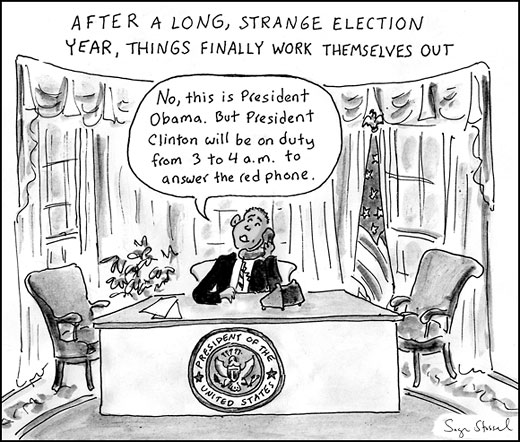
Barack Obama: Just elected President of the New Media world

President Obama and the call at 3 am...

“Congratulations for restoring sanity and intelligence to Washington…and giving the world its first President. Real hard work begins now. Look after him!”

This was my brief message to American friends soon after they elected Barack Obama as the 44th President of the United States of America.

It was entirely appropriate that I sent this message via mobile phone text (SMS). For Obama’s trail-blazing campaign to the White House used the new media innovatively while also using the old media (such as broadcast television) in a complementary manner.

Obama’s rise has epitomised change in many ways. Among other things, he is the first elected leader of a major democracy who shows understanding and mastery over the New Media World, which is radically different from the old media order.

As AFP reported in a story titled ‘Obama surfs the web to the White House‘: “Social networks and Twitter messages may have helped but analysts agree it was the Democrat’s impressive online organization and Internet fund-raising that fueled his victory over Republican John McCain in Tuesday’s election.”

It quoted Julie Germany, director of George Washington University’s Institute for Politics Democracy & the Internet, as saying: “No one’s going to say Obama won the election because of the Internet but he wouldn’t have been able to win without it. From the very beginning the Obama campaign used the Internet as a tool to organize all of its efforts online and offline. It was like the central nervous system of the campaign.”

Both Obama and McCain campaigns had slick websites and TV campaigns. But additionally, Obama inspired thousands of web-savvy volunteers to extend his message way beyond the official outreach. Doing so risked diluting the campaign or losing tight control, but that gamble paid off.

Al Gore, US vice president from 1992 to 2000, also understood the potential of new media, especially the transformative nature of the Internet. But at the time he was in office, the new media tools were not being used by sufficiently large numbers of people for it to make a difference in political campaigning or citizen engagement.

Both the timing and technologies favoured Obama, who successfully tapped into Digital Natives — those relatively younger people who have grown up with digital technology such as computers, the Internet, mobile phones and MP3. (In contrast, Digital Immigrants are those individual who grew up without digital technology and adopted it later.)

But as many commentators are pointing out, the real fight has just begun. It remains to be seen how Obama and his team use New Media tools, platforms and potential to deliver the promise of change.

Meanwhile, my own favourite cartoon of Obama election is the one above – and funnily enough, it concerns a piece of old technology: the good old fixed phone. If you recall, in long-drawn campaign for Obama to secure Democratic Party nomination, his rival Hillary Clinton ran this TV commercial which peddled her credentials for being familiar with the corridors of power.

It’s 3 AM and your children are safe and asleep. But there’s a phone in the White House and it’s ringing.
Something’s happening in the world. Your vote will decide who answers that call…


Hillary’s original ad:

Obama’s official response:

There were various unofficial spoofs created by Digital Natives who love to play with new media tools. Just run a search for ‘3 am’ or ‘red phone’ on YouTube and you can watch many of these online!

By the way, isn’t it time that the old-fashioned Red Phone in the White House – the American President’s Hotline to save the world – was replaced with a more modern looking instrument? One more thing for the New Media President Obama…

Climate change and copyrights: What intellectual property on a dead planet?

Twenty centuries ago, Emperor Nero fiddled while Rome burned. Today, some media companies are squabbling over copyrights while the planet is warming.

This is the main thrust of my latest op ed essay, just published by the Science and Development Network (SciDev.Net) anchored in London, UK. It’s titled: Planet before profit for climate change films.

I have adapted for this commentary some of my ideas initially expressed on this blog – especially the post on 12 Oct 2008: Climate in Crisis and planet in peril – but we’re squabbling over copyrights!

Broadcasting on a warming planet

In writing this essay, I’ve also drawn on the excellent discussions we had last month during the Asia Pacific workshop on Changing Climate and Moving Images in Tokyo.

I’m challenging broadcasters to put their money where their mouth is.

Here’s an excerpt:

“Broadcast mandarins routinely support global struggles against poverty, HIV, corruption and climate change by offering free airtime to carry public interest messages. But few let go of their own products on these very subjects for non-broadcast uses.

“Making climate change a ‘copyright free zone’ for media products would increase the resource materials available to thousands of educators, social activists and trainers struggling to communicate this complex topic to audiences across the world. Moving images would make their task easier.

“The climate crisis challenges everyone to adopt extraordinary measures. Broadcasters and film-makers need to balance their financial interests with planetary survival.

“What use is intellectual property on a dead planet?”

Read my full essay on SciDev.Net: Planet before profit for climate change films.

In September 2006, speaking at the United Nations headquarters (photo below), I called for poverty to be recognised as a copyright free zone. The idea was to have broadcasters and other electronic publishers release copyrights on TV, video and online content relating to poverty and development issues -– at least until (MDG target year of) 2015.

The TV broadcast and film communities have reacted to this proposal with disdain or indifference, but I keep badgering on. If poverty didn’t motivate broadcasters to change business as usual, I hope, the planetary threat posed by climate change would.

Meet the new Pied Pipers of our Global Village: the Media!

In the well known legend, the pied pier of Hamelin played his musical pipe to lure all the rats into the nearby Weser river. When the town reneged on the promised fee, he played a different tune to entice all its children away from the town.

Modern-day pied pipers use smooth talk and convincing images instead of hypnotic musical tunes to lead people astray. And they achieve much greater coverage today — thanks to the modern media.

When the media amplify pied piper tunes, how responsible are they for the resulting damage?

Then and now, we like to follow a tune...

This is the question I raise – and try to answer – in an op ed essay published this week by the Asian website Eye on Ethics.

‘When media amplify pied piper tunes…’ was inspired by a current experience in my native Sri Lanka. For the past few weeks, Sri Lankans have been shocked and dismayed to learn how thousands of middle-class adults have been hoodwinked by a confidence trickster who used paid advertisements in newspapers and on television to boost his image.

Sakvithi Ranasinghe, a populist tutor of English turned businessman, fled the country in mid-September 2008 after duping thousands of unsuspecting people to deposit money in an Ponzi-style investment scheme that offered abnormally high returns.

After the scandal broke, the media have been giving it a great deal of coverage. But most of it falls into follow-the-victim, blame-the-authorities style of journalism.

The main point of my essay: “Amidst the finger-pointing, arm-waving and name-calling, few have noticed the role of the media in promoting Ponzi schemes in the first place. Wittingly or otherwise, the media have helped amplify the mesmerizing tunes of pied pipers, and quietly collected substantial advertising revenue from such racketeers.”

Sakvithi's investment victims protest in Colombo - photo courtesy Daily Mirror

I also comment in this essay the blurring of what used to be a sacred divide in the media – between editorial content and paid advertising. Here’s an excerpt:

“Many people experience media products as a whole, and lack the media literacy to separate news, commentary and paid commercials. Besides, the once clear demarcations have blurred in recent years.

“Television’s seamless blending of news, entertainment and commercials can leave even the most media-literate people somewhat perplexed. News bulletins are sponsored variously by sellers of insurance, milk food or detergents, while current affairs shows are branded by various commercial products or services.

“In newspapers, the steady rise of ‘advertorials’—product promotions neatly dressed up as editorial content—makes it harder to discern where one ends and the other begins.”

Read and comment on my full essay at Eye on Ethics website

Encounter with Anpanman: A superman made of bread!

Anpanman is one of the most popular anime cartoon series in Japan

Last month, on my way to the Tokyo headquarters of NHK, Japan’s public broadcaster, I stopped at the Tokyo Tower for a bit of sight-seeing.

A communications tower located in Shiba Park, Minato, Tokyo, the Tokyo Tower is 332.6 meters (1,091 ft) tall – which makes it the tallest self-supporting steel structure in the world. Built in 1958, this Eiffel Tower-like structure supports an antenna that broadcasts television and radio signals for important Japanese media outlets including NHK, TBS and Fuji TV.

At the base of the tower, I had an unexpected encounter with an old friend. I know him as Gnana Katha Malliya, the name given to him in the Sinhalese adaptation that I watch on Sri Lankan television.

But everyone in Japan knows him by his original name: Anpanman. He is one of the most popular anime cartoon series (manga) in Japan. It is produced by Nippon Television Network Corporation.

Anpanman is the creation of Takashi Yanase, a Japanese writer of children’s stories. Each animated cartoon is approximately 24 minutes long, split into 2 episodes of approximately 12 minutes each.

Yanase has been writing Anpanman since 1968. He became inspired by the idea of Anpanman while struggling to survive as a soldier in World War II. He had frequently faced the prospect of starvation which made him dream about eating a bean-jam filled pastry called Anpan.

Anpanma is indeed a superman made by a baker. His head is a bun made by Jam Ojisan, a kind-hearted baker. He was created when a shooting star landed in Jam Ojisan’s oven while he was baking.

Anpanma’s name comes from the fact that he is a man with a head made of bread that is filled with bean jam called an anpan. His weakness is water or anything that makes his head dirty. He regains his health and strength when Jam Ojisan bakes him a new head and it is placed on his shoulders. Anpanman’s damaged head, with Xs in his eyes, flies off his shoulders once a new baked head lands.

The most endearing attribute of Anpanman is his sense of sacrifice. When he comes across a starving creature or person, he lets the unfortunate creature or person eat part of his head. Jam Ojisan has to keep baking an endless supply of heads for our hero.

And it gives a whole new meaning to the phrase ‘eat my head off’.

Baikinman is the villain in the stories. He comes from the “Germ World” and is the leader of the viruses. His name means “Germ Man”, and his ambition is to destroy Anpanman and turn the planet into another “Germ World”.

Read about other characters in Anpanma

Anpanman (R) and Baikinman at the Tokyo Tower

According to the Wikipedia, as of September 2006, Anpanman’s books had collectively sold over 50 million copies in Japan.

The Anpanman television series is called Soreike! Anpanman (meaning ‘Go! Anpanman’) – it has been on the air in Japan since 1988. More than 800 episodes have been made to date. There are also 18 cinematic films featuring the characters.

According to the Japanese toy company Bandai, Anpanma is the most popular fictional character from age 0 to 12 years in Japan.

As I found out, Anpanman is such a cultural icon in Japan that his images adorn railway carriages, and there is an Anpanman museum opened in Yokohama in 2007.

Anpanman is also popular in many countries across Asia. He has a large following in China and Korea, where the comics and TV series have been a popular Japanese cultural export for years.

And, as it turns out, I’d been enjoying his exploits on Sri Lankan television for years without even knowing his original Japanese name! This reinforces the point I made in Feb 2008, writing about another favourite character Madeline – originally French, but whom I encountered on a visit to Manila and Los Banos in January this year.

I wrote: “It’s becoming impossible to discern or define what is ‘local’ anymore in this rapidly globalising and integrating world. Sociologists and communication researchers who split hairs about preserving ‘local content’ have a romanticised notion that is hard to find in the real world.”


Read my Feb 2008 blog: What’s local in our mixed up, globalised world?


Watch a sample story: Anpanman to Hamigakiman

2008: A Halloween Year – Prepare to get really scared…

Be scared...very scared!

Today, October 31, Halloween would be observed in several countries of the western world.

One Halloween custom is Trick-or-treating where children move from house to house in costumes, asking for treats such as sweets with the question: “Trick or treat?” The “trick” part of “trick or treat” is an idle threat to play a trick on the homeowners or their property if no treat is given.

2008 has been a highly turbulent year for most parts of the world. Oil and food prices went through the roof (and while oil has come down in recent weeks, food scarcities still loom large). Then came the global economic crisis, triggered by greedy bankers lending recklessly.

In such a year, what would it take to scare people on Halloween night? Or would Halloween be mild compared to the shocks and jolts we’ve been living through for much of the year?

Just when you think it can’t get any worse, it does. My favourite cartoon character Calvin had it figured out years ago:

Aren't you scared yet?

According to some analysts, the global economic crisis that we are living through at the moment just a harbinger of a much more dramatic global ecological collapse to come.

One of them is Patrik Etschmayer, who recently wrote an essay in Nachrichten, Switzerland, titled:
The Wall Street Crisis and the Coming Ecological Disaster”. His main point: the same people that got the world into the present crisis are driving the world over an ecological cliff.

Here’s an extract in translation: “What if this crisis was just a prelude – a precursor to a much greater threat – one that could possibly cost millions of lives? The current economic crises was based on the idea that we can live and consume based on credit – and the belief that we can continue to do so unabated as long as we steadfastly ignore the facts and spread the risks widely enough. That idea didn’t fly. Yet its seems that humanity still seems to believe that the things that have failed in the monetary economy, will, in the long run, still apply to the material reality of our world. Quite simply, because nature will not present us with a bill for the resources upon which we depend for our very survival.”

British journalist George Monbiot made the same point in his weekly environmental column. Writing in The Guardian on 14 Oct 2008, he said:

“As we goggle at the fluttering financial figures, a different set of numbers passes us by. On Friday, Pavan Sukhdev, the Deutsche Bank economist leading a European study on ecosystems, reported that we are losing natural capital worth between $2 trillion and $5 trillion every year, as a result of deforestation alone. The losses incurred so far by the financial sector amount to between $1 trillion and $1.5 trillion. Sukhdev arrived at his figure by estimating the value of the services – such as locking up carbon and providing freshwater – that forests perform, and calculating the cost of either replacing them or living without them. The credit crunch is petty when compared to the nature crunch.

“The two crises have the same cause. In both cases, those who exploit the resource have demanded impossible rates of return and invoked debts that can never be repaid. In both cases we denied the likely consequences. I used to believe that collective denial was peculiar to climate change. Now I know that it’s the first response to every impending dislocation.”

So the Halloween scares could be pretty mild compared to the scares of the real world. As the Hollywood copy writers used to say, we might as well: Get ready to be scared…really scared.

Thai audiences in the dark about ‘Children of the Dark’

Yami no kodomotachi (Children of the Dark) movie poster

Human trafficking – peddling and trading of human beings for slavery, sexual exploitation and servitude – has grown to alarming proportions in recent years. It’s among the top five illicit trades in the world, whose net annual worth is believed to be between 9 billion and 42 billion US dollars. The truth is, nobody knows exactly how big it is, but human rights activists and development agencies agree the problem is pervasive.

Of the estimated 2.5 million persons trafficked worldwide, more than half are in the Asia Pacific. At the UN General Assembly for Children in August 2007, it was reported that about 1.8 million children became victims of commercial sex trade in 2000. About one million children in Southeast Asia are said to be involved – Thailand is one centre of this shady trade, drawing on misery in its rural hinterlands as well as poorer neighbouring countries like Burma, Cambodia and Laos.

So what happens when someone goes to the trouble of studying the issue in depth, and then pools talent and resources to make a feature film that exposes international connections that sustain the child sex industry in Thailand? Instead of being welcomed as part of the effort to counter this scourge, the film gets banned.

Yami no kodomotachi (Children of the Dark, 138 mins, original Japanese) is a Japanese-Thai film made in 2008 about child sex slavery. It has been banned in Thailand on the grounds that it was ‘inappropriate’ and touched on a ‘sensitive’ issue.

Watch the official trailer of the film (Japanese soundtrack, Thai captions):

I haven’t seen the film, but according to one reviewer who did, Junji Sakamoto‘s film is based on a novel by Yan Sogil and scripted by Sakamoto himself, shows, with a documentary-like directness, how children caught in the web of a Thai prostitution ring are exploited, abused and, in some cases, murdered when they are no longer sexually salable.

Mark Schilling, writing in The Japan Times in August 2008, noted: “…In being so visually graphic — particularly in the sex scenes in the Thai brothel — Sakamoto treads a dangerous line between hard-hitting social drama and stomach-turning exploitation. He takes care never to show his young actors (whose average age looks to be about 10) and their adult ‘clients’ in the same explicit shot, but he films them engaged in sexual acts or their aftermath. Sakamoto may defend these scenes in the name of realism, but could he have filmed similar ones in Japan, using Japanese children? The short answer is “no.”

The Thai ban prevented ‘Children of the Dark’ from being screened at the Bangkok International Film Festival, held in the Thai capital from 23 – 30 September 2008.

“The ban puts under the spotlight the country’s – or at least its higher-ups’ – seeming unwillingness to let go of the Film Act of 1930, when Thailand was still under absolute monarchy. That law gave a Board of Censors the power to impose cuts or to ban a film it deems inappropriate,” writes my friend and colleague Lynette Lee Corporal in an article just published on Asia Media Forum.

Thailand in denial about its Children of the Dark
She quotes my Thai colleague and documentary filmmaker Pipope Panitchpakdi as saying: “Authorities always think that viewers need to be protected and shielded from real issues. They still have that kind of sentiment that the media should function as a gatekeeper. That is, let the good stories in and the bad ones out. It’s okay in certain circumstances but not when talking about real, serious issues.”

Pipope adds: “This country has no problem with hypocrisy; we don’t see anything wrong with double standards. We have sex workers in corners of the city, but we can’t watch people kissing.”

A Bangkok-based journalist who calls himself Wise Kwai, writing in his blog, asks: “When will they (Thai authorities) learn that when they ban or censor a film, the ensuing stink that’s raised causes more problems than if the film had been allowed to quietly unspool? Perhaps if people had seen it, they might criticise it, but they’d also talk about the problems in society that allow children to be exploited.”

Read the full article: Film Censorship Leaves Viewers in the Dark by Lynette Lee Corporal

My Sep 2007 post: MTV Exit: Entertainment TV takes on human trafficking

‘War for the Whitehouse’: Obama, McCain and The Onion

Onion News Network - for news you can't afford to miss

The American presidential election race is entering its last lap. And the world watches the campaign trail with baited breath.

Democratic presidential candidate Barack Obama enjoys more international support than his Republican rival John McCain, as most people outside the US prefer the Democrat leader to become next US president, according to a BBC poll in September 2008. Most of the people questioned in the global poll conducted by international polling institute GlobeScan believe that US relations with the rest of the world would improve under the presidentship of Obama.

While so much of American and international news media time is being spent on covering the campaign and various opinion polls, some comic relief comes from The Onion – that wickedly funny and innovative website which now produces a steady stream of videos spoofing the news media’s worse excesses.

The Onion calls it the ‘War for the White House’ and has set up its ‘election analysis bunker’ from where its intrepid reporters are bringing us news that you – and major news organisations – have somehow managed to miss. They call is Onion News Network, ONN for short.

They’ve been doing it for the better part of a year, and here are some of my favourites from The Onion YouTube channel:

Caution: There’s a slight bias towards Senator Obama in some of these news reports, but then, he’s been the liberal media’s darling for much of this campaign year.

October 2008: McCain Left On Campaign Bus Overnight
Campaign officials downplayed the incident, saying the senator was fine as soon as he was fed and taken to the bathroom.

October 2008: Gifted Youngster Sells Cookies To Buy Attack Ad
In this installment of Beyond The Facts, a precocious 8-year-old girl participates in grown-up politics by spreading smears and lies.

September 2008: McCains Economic Plan: ‘Everyone Marry A Beer Heiress’
McCain pointed to his personal success in marrying a wealthy beer heiress to prove how the plan could benefit every American.

September 2008: Obama Runs Constructive Criticism Ad On McCain
In response to Republican attacks, Barack Obama unleashed a series of slightly negative ads that gently point out how McCain could be doing a better job.

August 2008: Portrayal Of Obama As Snob Hailed As Step Forward For Blacks
Overjoyed civil rights leaders say that Barack Obama has paved the way for future black politicians to be smeared as country club snobs.

March 2008: Poll: Bullshit Is Most Important Issue For 2008 Voters
For a majority of likely voters, meaningless bullshit will be the most important factor in deciding who they will vote for in 2008.

January 2008: The Onion: More Candidates Court Fat Vote
Presidential candidates are reaching out to fat voters on the campaign trail by eating large amounts of fattening food.

See all election videos of ONN

ONN’s self-introduction says its “style of hard-hitting, on-the-ground coverage of live news events has become a standard in the news industry. The network can be viewed in 92.2 million U.S. households and more than 500,000 American prison cells, making it the most-watched cable network in the world. It can currently be seen in 312 countries, with broadcasts in 52 different languages“.

Wow!

The Onion - The Nation's finest news source...

Wash Your Hands – yes, UNICEF, but only if you ask us nicely!

Global Handwashing Day logo

October 15 was marked as the first Global Handwashing Day (GHD). It’s simple yet important mission was to promote the practice of handwashing with soap.

Washing hands can save lives. Washing hands with soap can save more lives. This is the simple message reinforced on this day with public campaigns focusing on schools and school children.

In this UN-declared International Year of Sanitation 2008, the GHD will echo and reinforce its call for improved hygiene practices.

GHD is a Unicef-led initiative involving governments, civil society, volunteers and others around the world.

“Turning handwashing with soap before eating and after using the toilet into an ingrained habit could save more lives than any single vaccine or medical intervention, cutting deaths from diarrhea by almost half and deaths from acute respiratory infections by one-quarter,” says the GHD official website, explaining the background.

IYS 2008 logo
IYS 2008 logo
Trying saying that aloud in one breath – I can’t. Evidently, the crusty technocrat who wrote that text wanted to pack all the rationale into one long, clumsy sentence.

But this message is too important to be spoilt by an inarticulate official. Washing hands with soap can prevent diahrroeal diseases and pneumonia, which together kill more than 3.5 million children under five every year. That’s 400 needless deaths every hour, round the clock.

Fortunately, the campaigning material that went out using moving images were better produced. Here are two good examples (and a bad one).

The popular Australian children’s musical entertainers, The Wiggles, produced and donated a song to mark the Global Handwashing Day. This simple and catchy tune “seeks to motivate millions of children around the world, to transform the simple act of handwashing with soap from an abstract and seldom practiced behaviour into an automatic and enjoyable habit”.

Meanwhile, in India, cricket star Sachin Tendulkar joined forces with UNICEF to get Indian children to improve their health and hygiene as part of GHD. Tendulkar features in a public service announcement (PSA) being broadcast this month in 14 languages across India. It will target students in more than 6 million schools.

And finally, here’s Unicef’s own news story posted this week on its YouTube channel telling us more on GHD. It’s technically well made, but absolutely lacks passion. The narrator delivers her script in such an indifferent, detached tone, and UNICEF Senior Adviser for Sanitation and Hygiene pontificates also in a tone that will not win her many followers. Scenes of senior UN officials washing their hands in a demonstration are laughable. The only saving grace in this story is when we see Hayley Westenra, the well known singer from New Zealand and youngest UNICEF Goodwill Ambassador, visiting water and sanitation projects in Ghana.

If only the rest of GHD promoters had the enthusiasm and passion that Hayley Westenra exudes! Passion used to be the hallmark of UNICEF during the time of its legendary executive director James Grant, who strongly believed in communicating messages of child survival and well-being. He gave UNICEF a head start in working with the media, especially television.

Alas, large UN agencies like UNICEF have little or no institutional memory for more than just a few years. Because if they did, GHD campaigns could have effectively used, at least in South Asia (where nearly half of all people lack access to toilets) an episode of the hugely popular Meena cartoon animation series.

Meena is the enchanting heroine of an animated film series produced by UNICEF in South Asia. The films are part of a package of communication materials promoting the status of the girl child in this region. UNICEF co-produced the series a decade ago with leading animators in the US and South Asia.

Meena's Three Wishes
In Meena’s Three Wishes, Meena dreams of a magic genie that will grant her three wishes so that everyone would be healthy and never again get sick from poor sanitation and unsafe water. When Meena wakes up, she realizes that she must make her dream come true. With the help of her brother Raju, other children in the village, and Mithu, her pet parrot, Meena convinces people to build and use latrines, to use safe water and to wash their hands to stop the spread of germs and disease.

I don’t particularly enjoy it when UN agencies try to play nanny to the whole world, especially if they talk to us in such jargon-ridden, dispassionate terms. Their messages are tremendously important, and deserve wider dissemination — they can literally save lives.

That’s why public campaigns should be left in the hands of communication professionals who know how to reach out beyond the charmed development circle. For the rest of UNICEF, they should perhaps take a lesson or two in passionate communication from Hayley Westenra, The Wiggles – and their own little Meena!

Standing on Al Gore’s Shoulders: Moving images in the climate debate

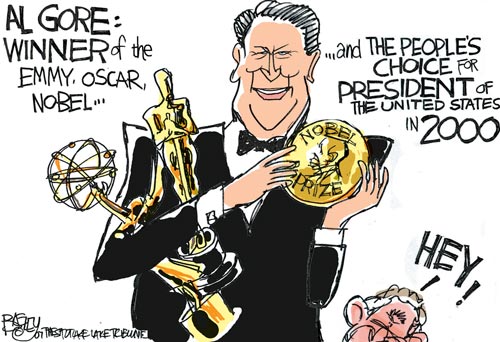
And the winner is...

Al Gore used to have a reputation as a very smart man who was very stiff and aloof especially in his public speaking.

I didn’t notice this the only time I listened to him in person, at an environmental journalists conference at MIT in Boston, Massachusetts, in the Fall of 1995. Perhaps because he was speaking to a group of over 200 journalists, Gore was especially charming. He delivered a well prepared speech passionately, and then took a dozen questions.

I still remember one incident during question time. A Bangladeshi participant lined up to ask him something and started addressing him as ‘Mr President’. Gore smilingly interjected: ‘Not yet!’. The journalist, not the least shaken by his slip of the tongue, said: ‘Well, I hope you will be one day!’.

Well, that day came…and it was not to be. Gore won the popular vote in the 2000 presidential election but lost the presidency in a bizarre series of events that had the rest of the world gasping.

All that sounds so long ago, now that Gore has emerged as the world’s best known climate crusader. There are many who feel that he is more effective in his current role than as a politician.

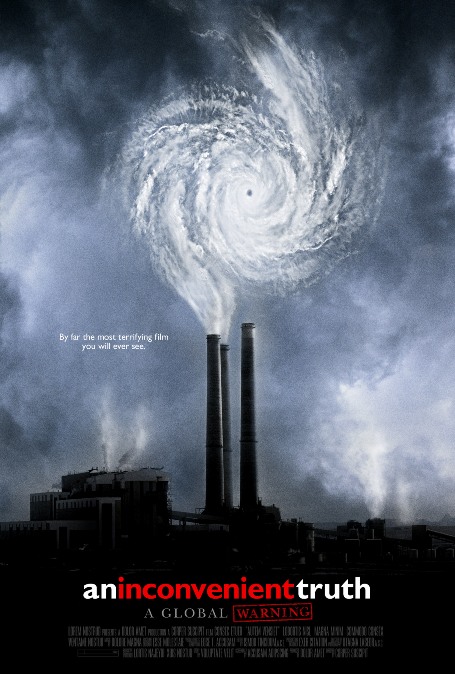
His 2006 film, An Inconvenient Truth, helped move the climate change debate forward in a decisive manner.

Whatever we might think about the film’s artistic and technical merits, I’m glad it has settled one question: can a single film make a difference in tipping public opinion about a matter of global importance?

The answer, where climate change is concerned, is a resounding yes!

For sure, the film arrived at a time when the climate change debate had been going on for nearly two decades. Scientific evidence was mounting for human responsibility for accelerated changes in our climate. Political and business leaders, in denial for years, were finally beginning to take note — perhaps sensing votes or dollars.

Official film poster
Coming in at the time it did — in the Summer of 2006 –- Al Gore’s film tipped the public opinion to agree that climate change was for real and responses were urgently needed.

“It is now clear that we face a deepening global climate crisis that requires us to act boldly, quickly and wisely,” says the former US Vice President introducing his film.

An Inconvenient Truth focuses on Al Gore and his travels in support of his efforts to educate the public about the severity of the climate crisis. Gore says, “I’ve been trying to tell this story for a long time and I feel as if I’ve failed to get the message across.”

The film closely follows a Keynote presentation (dubbed “the slide show”) that Gore presented throughout the world. It intersperses Gore’s exploration of data and predictions regarding climate change and its potential for disaster with Gore’s life story.

An Inconvenient Truth is not a particularly stunning or dramatic documentary. Some have called it a ‘dramatised PowerPoint presentation’ (although Gore actually uses Apple’s Keynote presentation software). There aren’t cuddly animals, deadly chemicals, forest infernos or gory animal hunts that make environmental films appeal to a mass audience.

In fact, it hangs together — and sustains for nearly an hour and a half — due to the sheer star power of Al Gore. And when we take a closer look, we see how hard Gore and his team at Participant Productions have tried to engage audiences.

The film, made on a budget of around US$1 million (modest by Hollywood standards) went on to earn US$49 million at the box office worldwide. As at late 2008, it ranks as the fourth-highest-grossing documentary film in the United States, after Fahrenheit 9/11, March of the Penguins and Sicko.

I first saw An Inconvenient Truth at a cinema in Virginia, USA, while it was still on its initial theatrical release in the Fall of 2006. I reviewed it in early 2007, and recently returned to discussing the film during a presentation I made to our Asia Pacific regional workshop on changing climate and moving images, held in Tokyo in early October 2008.

My thrust was: now that Al Gore and his film have helped turn the climate debate, how can we continue to use moving images in search of solutions? In other words, how do we stand on the shoulders of Al Gore?

Another excellent film on climate change
The Great Warming: Another excellent film on climate change

I looked back at Gore’s film and another excellent Canadian film that came out the same year, The Great Warming. Discussing their merits, I noted how both films appeal as much to our emotions as they do to our rational intellect. “Facts, figures and analysis alone cannot engage a diverse, sometimes sceptical or indifferent audience. That’s why they try a different approach: appealing to the emotions.”

Here are some excerpts from my remarks:

We often see environmental documentaries failing to engage audiences because they pack too much information, or worse, preach too heavily and directly. Some film-makers feel strongly that they must ‘inform and educate’ their viewers at all costs.

To engage people, both are needed
It’s story telling that works best with moving images –- and what better stories to tell than the personalised ones of real people dealing with real world problems and challenges?

With ‘moving images, moving people’ as our slogan, we at TVE Asia Pacific believe in the power of well-made films to reach out to people’s hearts and minds.

Our experience shows that moving images can indeed move people, but only when:
• They are used in the right context;
• They form part of a bigger effort or campaign;
• Audio-visual’s strengths are maximised; and
• Audio-visuals limitations are properly recognised.

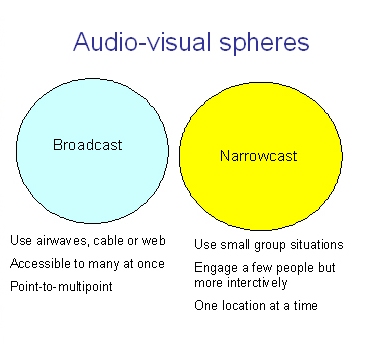
It’s the combination of broadcast and narrowcast spheres that has a better chance of changing people’s attitudes and, ultimately, their behaviour.

Read the full presentation here:
standing-on-al-gores-shoulders-nalaka-gunawardene-speech-in-tokyo-4-oct-20081