Pete Seeger turns 90 on World Press Freedom Day: Thank you for the protest music!

Pete Seeger: Still singing protest at 90...

Today, 3 May, is once again World Press Freedom Day. It is recognised by the UN, and observed by media professionals and media activists worldwide to ‘draw attention to the role of independent news and information in society, and how it is under attack’.

By happy coincidence, today also marks the 90th birthday of Pete Seeger, American folk singer and a pioneer of protest music. Since media freedom is inseparable from the democratic rights to dissent and protest, I will devote this blog post to salute Pete and his many decades of music for worthy causes — ranging from the American civil rights movement and opposing the Vietnam war to saving the environment and nuclear disarmament.

I won’t go over the basic biographical or career information, which is easily found online. Wikipedia has a good entry, and PBS shows a career timeline which has covered some of the most momentous events of the past century. There are approximately 200 songs (music and lyrics) that Pete wrote or with which he is associated – including “Guantanamera,” “Where Have All The Flowers Gone,” “If I Had A Hammer,” “Turn Turn Turn,” “Wimoweh,” “We Shall Overcome”.

Pete is a hero for at least three generations of music lovers and freedom lovers around the world who believe in human rights, human dignity and democratic freedoms. Armed with nothing more than his banjo and melodious voice, and driven by the courage of his conviction, this small, gentle man has stood up to mighty leaders, generals and officials.

Never underestimate the power of one determined man...
Pete is celebrated as much for his artistic and cultural achievements as for standing resolutely for his political beliefs and for lending his voice and music in support of causes be believed in. In 1955, he was called before the now infamous House Un-American Activities Committee, but refused to name personal and political associations on the grounds that this would violate his First Amendment rights. He said: “”I am not going to answer any questions as to my association, my philosophical or religious beliefs or my political beliefs, or how I voted in any election, or any of these private affairs. I think these are very improper questions for any American to be asked, especially under such compulsion as this.”

This defiance resulted in sustained harassment, persecution and professional isolation. As his recent PBS biography noted, “Standing strong for deeply-held beliefs, Seeger went from the top of the pop charts to the top of the blacklist and was banned from American commercial television for more than 17 years. This determined singer/songwriter made his voice heard and encouraged the people of the world to sing out along with him.”

‘If you love your country, you’ll find ways to somehow to speak out, to do what you think is right,” Pete says in this powerful documentary looking back at over half a century of activist singing and music.


Watch opening segment of PBS AMERICAN MASTERS series: Pete Seeger: The Power of Song, directed by Jim Brown and first aired in February 2008

Watch more PBS interviews with Pete Seeger and some of his archived performances from yesteryear

Having pleaded under the First Amendment during the communist witch days of the 1950s, Pete repeatedly paid tribute to the far-sighted American pioneers who introduced the First Amendment guaranteeing the freedom of speech.

“As some judge said, if there is any fixed star in our firmament, that is the First Amendment,” he says in a talk-cum-performance at the Ford Hall Forum. In this audio-only piece, he talks the privilege of living under the First Amendment. He recalls his experience being questioned by the House Unamerican Activities Committee, encounters with censorship, and his relationship with fellow singer Woody Guthrie. It runs for nearly an hour, but is worth every second.

For someone like Pete Seeger who sang alongside Dr Martin Luther King, Jr., and other civil rights movement leaders and activists, it must have been deeply moving to be able to sing at the concert to mark President Barack Obama’s inauguration on 20 January 2009 at the Lincoln Memorial.

Watch Bruce Springsteen sing along with Pete Seeger on Woody Guthrie’s “This Land Is Your Land”. As he often does, Pete invites the euphoric audience to sing along!

One of my favourite Pete Seeger songs is “Turn! Turn! Turn! (to Everything There is a Season)”, often abbreviated to “Turn! Turn! Turn!”. It’s a song adapted entirely from the the Book of Ecclesiastes in the Bible (with the exception of the last line) and composed to music by Pete Seeger in 1959. Seeger waited until 1962 to record it,

Pete Seeger tells how he came to write “Turn Turn Turn.”

I have always believed that we have to get creative and resourceful when the basic freedoms of conscience and freedom of expression are under siege from despotic rulers and fanatical extremists. When we are not allowed to express in factual prose, we must turn to creative prose. And when prose fails, we still have verse, lyrics, satire and drama — the possibilities are only limited by our imagination. This is why I celebrate activist artistes like Pete Seeger, and invoke the memory of activist-poets like Adrian Mitchell and Ken Saro-wiwa. When the barbarians are at our gates and we feel surrounded by the unrelenting forces of hatred, intolerance and tribalism, they remind us that Another World is Possible — but we have to believe in it, stay the course and find ways to sing, dance and laugh our way out of gloom.

And here’s Pete singing another one of my personal favourites, a song that powered the civil rights movement and has since inspired and sustained struggles for social justice around the world: We Shall Overcome.


New York Times editorial appreciation on 5 May 2009: Still Singing

TV playing nanny: How Asian broadcasters helped fight SARS

Media joined the public awareness campaign
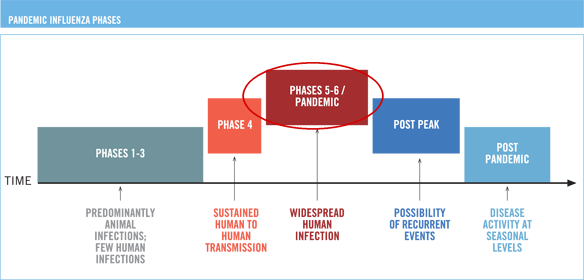
Now that the World Health Organisation (WHO) has raised the swine flu level to Phase 5, the next to highest level in the worldwide alert system, everyone is talking about a global pandemic. On 30 April 2009, the UN’s top health agency referring to it as Influenza A(H1N1).

As I just wrote in another blog post, “While medical doctors and researchers spearhead the public health response, we need the mass media and all communications professionals to support the public awareness response. Flu shots and hospitals alone cannot win this battle.”

This is where Asian mass media – especially broadcast television – have some relevant and useful experiences. When Severe Acute Respiratory Syndrome (SARS) spread across much of East Asia and Southeast Asia, it wasn’t just the public health systems that took on the epidemic. The local, national and regional media joined the effort in the true spirit of public interest. There was no division between state-owned and privately-owned media. The airwaves were mobilised for preventing, containing and eventually beating the disease that wreaked havoc for several months.

The role played by Asian media during the SARS crisis has been studied and analysed in considerable detail. Lessons from that experience are worth recalling at this moment when the world is looking for ways to contain swine flu.

When SARS forced Chinese schools, universities and public offices to be closed for several weeks in the Spring and Summer of 2003, the country’s television broadcasters rose to the occasion. They started beaming a combination of entertainment and educational programming round the clock to over 400 million households across the country — now the largest national television audience in the world. The idea was to use the media to encourage more people to stay inside homes and minimise the spread of the virus through contact. China Educational Television (CETV) — the satellite distributed educational network — took on the role of substitute teacher by increasing its broadcasts.

Crisis? What crisis?
Of course, as the most likely place of origin of the SARS virus, China’s initial response to the epidemic was denial. Researchers have established how the slow or muted media reporting within China triggered more rapid disease transmission of the virus both within and beyond China. As the noted Asia watcher, columnist and journalism professor Tom Plate, wrote in 2008: “All the serious Chinese journalists were left holding their heads in shame. In effect, the institution of the mass-communication of news, because it was not allowed to do its job, contributed to the enormity of the SARS toll.”

Many researchers agree that it was the island republic of Singapore that best handled the SARS crisis. Dr Stewart Auyash, an Associate Professor in Health Promotion and Physical Education at Ithaca College in New York says: “Of the countries affected, the actions of Singapore’s government stand out as an example of how to deal not only with the biological elements of the disease but with the methods, style, tone, timing and breadth of its communicated messages.”

The Auyash study was titled ‘Communications as a Treatment for SARS in Singapore and its Lessons for Infectious Epidemics in Asia’, and appeared in Media Asia (Vol 32, No 4). Although the journal’s publishers restrict online access to subscribers, a copy can be freely downloaded from here.

Here’s how Tom Plate summarised its findings: “At the outset of the 2003 crisis, Singapore’s government and media authorities hammered out a clear plan to limit the syndrome’s spread among the populace. It adopted a containment policy that offered a major role for news media institutions. The media was asked to promote the idea of positive participation by all citizens to avoid furthering transmission.

Practising what we preach...
“Model citizens who followed World Health Organization guidelines with exceptional care were made proud subjects of newspaper feature stories. Top government officials, including high-profile members of the cabinet, were photographed or televised as submitting to the same mandatory preventive procedures as everyone else (for example, regular temperature checks). But citizens who fought the program by either resistance or even tepid nonchalance were portrayed scornfully, with the media publicly castigating them as ‘free riders’ who benefited from a safer health environment solely through the sacrifices of others.

“To make the media policy work, the government had to play things absolutely straight. When officials knew the answer to a scary question about SARS, they answered it quickly and completely; but when they had no answer, rather than making one up and putting their credibility at risk when this was later discovered, they flat out stated that they simply did not know but would try to find out.

“In Singapore, compliance with all kinds of government policies, not just health measures, is viewed as a personal and community responsibility. It is in the small city-state’s civic ethic that ‘individual rights and inconvenience may be infringed upon to protect the greater good of the public’s health,’ as Prof. Auyash put it. Even so, what seems both notable and possibly transportable to other countries is the cooperative role of the news media in a serious health crisis. Auyash points out that the role of the media is to emphasize symbols of positive compliance. Gestures and symbols, he says, ‘can galvanize a nation’s citizens to act. In short, symbols matter.'”

At the height of the crisis, Singapore even launched a dedicated SARS TV channel. The public service channel, which began in May 2003, was run jointly by Singapore’s three main broadcasters — Singapore Press Holdings, Media Corporation of Singapore and StarHub — and aimed to raise awareness about how to identify symptoms and prevent the spread of the disease.

Everyone was roped in, from educators to entertainers, in the all-out campaign against the invisible but formidable virus. The popular local sit-com Phua Chu Kang, which airs on Singapore’s Channel 5, came up with this hilarious rap video advising viewers the dos and don’ts of SARS.

As Prof Auyash concludes: “Singapore’s communication management around SARS can serve as a guide for future infectious disease control measure…There are major principles learned from SARS in Singapore from which other countries can learn…”

The US Centers for Disease Control (CDC) offered a similarly positive post-crisis judgment. This global defender against infectious diseases has praised Singapore’s aggressive and expansive policy of contact tracing and home quarantine during SARS.

“The bleakest projections about bird flu suggest that more than 300 million people could die from a global pandemic,” says Tom Plate. He adds: “Let us hope that such a number will never be realized simply because nations refuse to learn from the successes of others, simply out of pride, parochialism, ignorance or stubbornness. A pandemic of stupidity can kill people, too.”

A message from our...tormentors

Digital Defenders: How 24/7 media can help fight swine flu worldwide

So this is how it REALLY started...
The World Health Organization (WHO) said this week that the global spread of swine flu was highly likely, and raised its alert level to Phase 5 — the next-to-highest level in the worldwide warning system. It also offered advice on prevention, caring for persons with the flu and how to seek medical help.

A pandemic is not something to be taken lightly. The New Media President Barack Obama has termed the outbreak “cause for deep concern but not panic”. On 29 April 2009, he took the unusual step of using a prime-time televised news conference, convened to mark his 100th day in office, to deliver a public health message to the American people.

“Wash your hands when you shake hands, cover your mouth when you cough,” he said. “It sounds trivial, but it makes a huge difference. If you are sick, stay home. If your child is sick, take them out of school. If you are feeling certain flu symptoms, don’t get on an airplane.”

That’s the basic preventive message that needs amplification and repetition all over the world. While medical doctors and researchers spearhead the public health response, we need the mass media and all communications professionals to support the public awareness response. Flu shots and hospitals alone cannot win this battle.

For the first time in history, we have the means of rapid access to most of humanity. What we now need is clarity of message, credible messengers and sustained delivery.

I see this as an interesting – even if very risky – social experiment on the preventive powers of our 24/7 media and information devices. More than four billion mobile phones are in use, most of them in the developing world. Over one billion people connect to the web. We also have hundreds of radio and TV channels saturating the airwaves. Can these media peddle the right kind of awareness and inspire preventive action faster than the flu virus propagates itself? This is the classic race between education and catastrophe that H G Wells wrote about many decades ago!

We in Asia have some useful experiences from 2003 when the Severe Acute Respiratory Syndrome (SARS) affected much of the region. On that occasion, the media led a parallel front against the pandemic, delivering both preventive messages and helping care for those already infected.

TV playing nanny: How Asian broadcasters helped fight SARS

Precisely because rapid response is vital in a situation like SARS and swine flu, it’s the broadcast and online media that can provide timely and up-to-date coverage. It’s too early and too soon to compare media’s role in this crisis with SARS and other rapid-spread public health crisis of the past. Print media can also play a part in spreading general awareness, but they don’t have the speed and 24/7 outreach that we need for covering a crisis like this. Besides, in many parts of the world, newspapers and magazines are struggling to stay in business, coping with a terminal malady affecting their industry.

WHO's phases of a pandemic alert

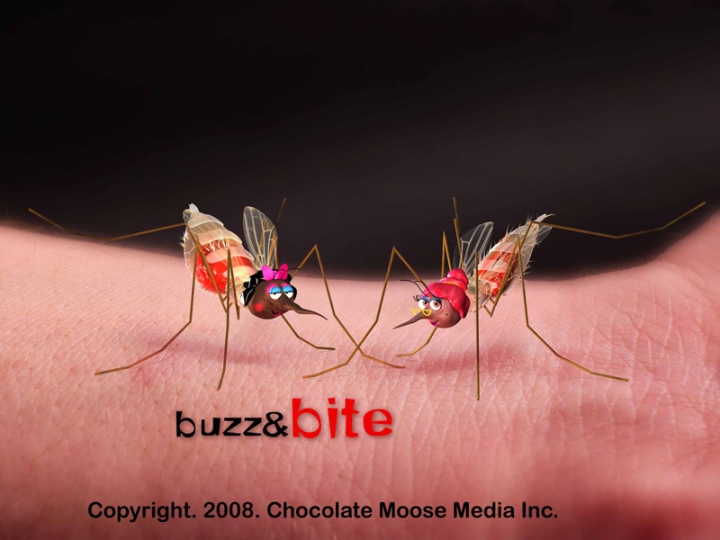
Buzz and Bite: PSA campaign against relentless malaria

We tried DDT for half a century. Now try PSA...

Today is World Malaria Day. It’s a day to reflect on an ancient disease that continues to kill and sicken so many people in the majority (developing) world.

Malaria accounts for one death every 30 seconds. Malaria kills more than 1 million people every year. Each year, between 350 million and 500 million people are infected with malaria.

Malaria plagued Europe and North America as recently as 60 years ago. Simple public health measures were crucial to eliminating the disease and helping those regions achieve growth, prosperity and stability. Many countries in Africa, Asia and Latin America have yet to achieve this level of control.

Public health officials have been trying to contain and control malaria for decades, most measures targeting the malaria vector mosquitoes. In recent years, educators have joined hands — for stopping malaria begins with awareness on how it spreads and what simple measures can be taken to prevent it.

The Buzz and Bite Campaign is one such awareness tool launched a year ago on World Malaria Day 2008. It consists of a series of 30 animated shorts and 5 audio shorts called Public Service Announcements (PSAs).

The Buzz and Bite Campaign is the creation of Canadian animation producer and director Firdaus Kharas, working with a team of skilled professionals. Firdaus earlier took on another public health challenge, HIV/AIDS, through his highly popular animation series The Three Amigos.

Watch a sample Buzz and Bite Spot (in English, British Accent)

According to the Buzz and Bite website, PSAs have so far been produced in 22 languages, and are being adapted into more. “The goal is to enable a potential reach of 80% of the world’s malaria at-risk population or over 5 billion people in their own language.”

See all language versions on Buzz and Bite channel on YouTube

The PSAs are available to any television broadcaster, radio station, NGO, hospital, doctor, community group, university, school, educator or other user, free of charge, anywhere in the world.

The campaign is strongly supported by Nobel Laureate Archbishop Desmond M. Tutu.

Malaria has been eradicated in many parts of the world but continues to thrive and even grow in other parts, especially in tropical areas. “This anti-malaria campaign focuses on sub-Saharan Africa (where up to 90 per cent of all malaria fatalities occur), on South America, and on South and South-East Asia, where the rates of malaria are alarmingly high,” says the website, adding: “Malaria is preventable. The easiest and cheapest way to prevent malaria infection is through the use of long-lasting insecticide-treated bed-nets (LLINs) which can last up to 5 years. This campaign promotes the use of nets.”

You heard the buzz...Now get ready for bite!

Images and video courtesy Buzz and Bite campaign

Somali pirates: Part of the story mainstream media hasn’t told us!

Do they have a story to tell? Who is listening?
Piracy has a chequered history, and even the Wikipedia offers a carefully qualified definition. One person’s pirate can be another person’s defender. There’s an argument that the European colonial powers rode on the backs of their pirates or buccaneers. And I’m writing this in English language possibly because the English were more successful in their overseas piracy than other nations!

Piracy is all over the news again, due to increased activity off Somalia. But in the past few weeks, we’ve started hearing another side of the Somali piracy story — one that the mainstream media didn’t tell us.

Johann Hari, a columnist for the London Independent, posted an op ed in Huffington Post on 13 April 2009 that took a different look at Somali pirates. His main argument: “In 1991, the government of Somalia – in the Horn of Africa – collapsed. Its nine million people have been teetering on starvation ever since – and many of the ugliest forces in the Western world have seen this as a great opportunity to steal the country’s food supply and dump our nuclear waste in their seas.”

In recent days, two interesting short videos have been posted by two activist groups to support the same point of view. I haven’t investigated this story myself, but am intrigued by their take on a widely reported topic…especially because it’s an angle that we don’t read or see in the mainstream media!

The Media Is Lying to You About Pirates

The IFC Media Project’s “News Junkie” deconstructs the mainstream media’s half-baked coverage of Somali Pirates.


Are They Really “Pirates”?

This film from Awareness Unfolds highlights the fact that the media is lying about the so called “pirates” of Somolia. According to the blurb: “They (media) choose not to tell you about the toxic waste dumping going on by American, European, and Asian countries that have lead to the death of many Somolian citizens.”

As Johann Hari says at the end of his article: “The story of the 2009 war on piracy was best summarised by another pirate, who lived and died in the fourth century BC. He was captured and brought to Alexander the Great, who demanded to know “what he meant by keeping possession of the sea.” The pirate smiled, and responded: “What you mean by seizing the whole earth; but because I do it with a petty ship, I am called a robber, while you, who do it with a great fleet, are called emperor.” Once again, our great imperial fleets sail in today – but who is the robber?”

Johann Hari has reported from Iraq, Israel/Palestine, the Congo, the Central African Republic, Venezuela, Peru and the US, and his journalism has appeared in publications all over the world. In 2007 Amnesty International named him Newspaper Journalist of the Year. In 2008 he became the youngest person ever to win Britain’s leading award for political writing, the Orwell Prize.

‘Chief Seattle speech’: Global environmental legend, or pervasive myth?

Our thought for Earth Day 2009

“All things are connected. Whatever befalls the earth befalls the sons of the earth. Man does not weave the web of life; he is merely a strand of it. Whatever he does to the web, he does to himself.


“What is man without the beasts? If all the beasts were gone, man would die from a great loneliness of the spirit. For whatever happens to the beasts, soon happens to man. All things are connected.”

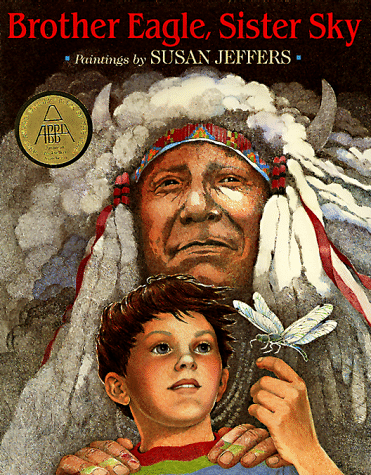
These words resonate very well in the environmental community, and are in fact considered to be something like a gospel of the greens. They are part of a moving speech that native American Chief Seattle is said to have given in January 1854. Read the full text here.

So these would be just the right sentiments to invoke on another Earth Day, right? Yes — except that Chief Seattle never uttered those words. They were, in fact, written by a screen writer in 1971 for a film about pollution and the plight of the Earth, called Home.

Tell that to thousands of die-hard greens who swear by Chief Seattle. By now, a couple of generations of people have been moved by the “speech.” Chief Seattle societies have formed in Europe. The supposed remarks have been reprinted widely and authoritatively cited in serious books on environmental issues, and quoted in high level speeches. Hundreds of teachers use extracts in environmental courses.

The man was real; the speech wasn't his

There’s absolutely no doubt that the words pack a great deal of traditional wisdom, poetic expression and what researchers like to call ‘indigenous knowledge’. This is how it ends: “Continue to contaminate your bed and you will one night suffocate in your own waste. When the buffalo are all slaughtered, the wild horses all tamed, the secret corners of the forest heavy with the scent of many men, and the view of the ripe hills blotted by talking wires. Where is the thicket? Gone. Where is the eagle? Gone. And what is to say good-bye to the swift and the hunt; the end of living and the beginning of survival.

The value, modern-day relevance and power of the speech are not in doubt. But the problem is in its attribution: the wrong man is being credited worldwide for coming up with these oh-so-quotable words. And the misconception originated with a film script, where creative liberties are allowed and often exercised!

Conservationist, writer and analyst Andy Kerr has traced the evolution of a modern myth in his column:

“Yes, Chief Seattle (more correctly Seathl) did give a speech in 1854 to Isaac Stevens, Pacific Northwest Commissioner of Indian Affairs. Dr. Henry Smith translated the speech from the original Lushotseed. Smith knew it to be special and that much was lost in his first oral translation. He supposedly visited the Chief many times in the following decades to get the words right in English. He published his translation in 1887 in the Seattle Sunday Star. According to Smith, the Chief spoke of his sadness about the grave injustice being visited upon the Indians by the European invaders and the absurdity, in the Chief’s view, of claiming land as one’s own and of not respecting ancestral ground.

“It was in the Victorian oratorical style of the time, and was soon forgotten. Professor William Arrowsmith, who taught classic literature at the University of Texas, came across the Smith version and modernized it in Arion in 1969. He changed it to reflect the protest-style of the 1960s. On the first Earth Day in 1970, Arrowsmith read his modified text before a large crowd.

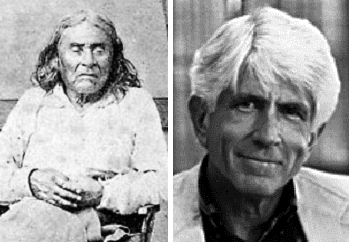
Chief Seattle (left) and actual speech writer Ted Perry

“In that crowd was Ted Perry, a professor of film, who had been retained by the Southern Baptist Television Commission to draft a script for a film about pollution and the plight of the Earth, called Home. In a third execution of literary license, Smith turned it into a speech about poisoning the planet and human indifference to it. Perry’s concept was to transport Chief Seattle into the modern world and imagine what he would say.”

The documentary film on ecology, scripted by Ted Perry, was produced by the Southern Baptist Radio and Television Commission, and later ran on network television. But not before the original script was edited for being more Christian, and some references to God were added.

John Scull, specialising in eco-psychology, has traced the evolution of the Seattle myth in an interesting essay. He notes: “The Perry speech, in spite of its Christian editing and its many historical inaccuracies, anachronisms and inconsistencies, was widely distributed and was seen as authentic by many…The text’s lack of authenticity was finally described in 1987, and documented in articles in both Omni and Newsweek in 1992.”

In April 1991, the New York Times ran a front-page expose of the Chief Seattle myth, saying: “A number of historians say Chief Seattle never said most of what he is supposed to have said.”

NYT quoted historian David Buerge as saying: “Chief Seattle is probably our greatest manufactured prophet,” and described him as ‘one of the scholars frustrated that their work has failed to stop the myth from spreading around the world.’

In his analysis, John Scull poses the query: Why are environmentalists so eager to continue to attribute these words to Chief Seattle instead of to their author, Ted Perry?

Perry, now a professor of film studies at Middlebury University, has tried repeatedly to set the record straight. Moreover, he thinks that the myth is pernicious. “Why are we so willing to accept a text like this if it’s attributed to a Native American?” he asks. “It’s another case of placing Native Americans up on a pedestal and not taking responsibility for our own actions.”

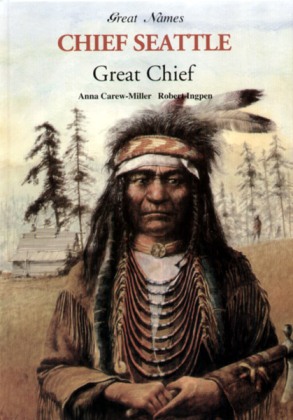
This 1991 book built on the Chief Seattle fable

The myth of Seattle’s speech has been so pervasive that the Washington State Library issued a pamphlet in 1993 stating the facts. “The most important fact to note is that there is NO VERBATIM TRANSCRIPT IN EXISTENCE. All known texts are second-hand,” Nancy Zussy, State Librarian, said in that note.

That note listed four different versions of the speech. The most widely known of all, it said, was written by Texas professor Ted Perry as part of a film script. “The makers of the film took a little literary license, further changing the speech and making it into a letter to President Franklin Pierce, which has been frequently reprinted. No such letter was ever written by or for Chief Seattle.”

So is there anything authentic left of poor Chief Seattle? There’s no doubt the man cared deeply for his people and the environment, even if he was nowhere near as eloquent as modern-day environmentalists want us to believe. Sadly, we don’t even know what the old boy really looked like.

According to a story by Malcolm Jones Jr. and Ray Sawhill, appearing in Newsweek of 4 May 1992: “Even the one known photograph of him has been doctored repeatedly. In the original, his eyes were closed. Subsequent version were retouched so that his eyes looked open. In some versions, he carries a cane, but not always. And in the most revisionist makeover, his head has been grafted onto the body of another man.”

So is it just historical accuracy at stake here, in our setting the record straight about Seattle as scripted by Perry? Does it really matter whether or not the Indian chief actually said it as long as his alleged words continue to inspire environmental commitment?

I share Dr John Scull’s views when he says: “The world is in an environmental crisis and needs help, but a mythical Indian chief from the last century is not going to ride over the hill and save it from the industrial cavalry in some reversal of the Hollywood western — all of us are going to have to work together to save it ourselves. Recognizing that at least some of the answers lie within mainstream contemporary culture might be a good place to start.”

Read The Little Green Lie, by Mary Murray, Reader’s Digest, May 1994

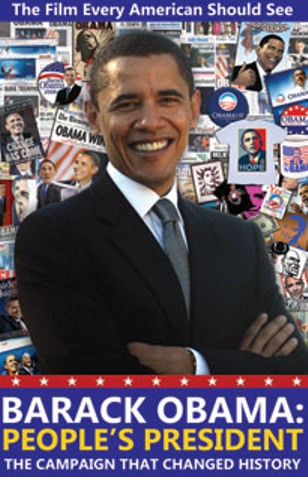
Untold story behind the story: “Barack Obama: People’s President”

A film to reveal what the old media didn't show...
When Barack Obama and his running made Joe Biden won the US Presidential Election held on 4 November 2008, they not only beat the Republican duo McCain-Palin but also a host of other also-rans. It’s too soon to tell, but that date might also mark the beginning of the end for the old media, also called the mediasaurus, who have been dominating the public’s access to news, information and commentary for over a century.

But how did it all happen? Who can tell us the real story as it happened, and why, without filters and biases so rampant among the mediasaurus?

On this blog, we have watched with deep interest and some fascination the rise of Barack Obama from relative obscurity to become the President of the United States. On 6 November 2008, soon after the election results were confirmed, we noted how Obama had just been elected ‘President of the New Media world’. I explained: “Obama’s rise has epitomised change in many ways. Among other things, he is the first elected leader of a major democracy who shows understanding and mastery over the New Media World, which is radically different from the old media order.”

On 20 January 2009, when he was inaugurated, we wrote: “For four or eight years, Obama’s every move, word and gesture will be captured, dissected and debated to exhaustion by admirers and detractors alike. And his administration will be under scrutiny by thousands of citizen journalists who don’t share much except the digital platforms and social networks on which they post their impressions. Welcome to the New Media Presidency. The hard work – and real fun – begin now!”

And now, one of the world’s leading new media activists, Danny Schechter, is about to release a new documentary on how the Obama campaign rode the new media wave to the White House — and more importantly, how the same new media can help the American public to keep Obama Administration accountable.

The film “Barack Obama, People’s President”, (slated for DVD release later this month by ChoiceMedia.net), documents the online and on the ground techniques that were used to win the highest office in the land.

As the film’s advance promo blurb says: The one story that most TV outlets didn’t tell in the 2008 election was the most important one -how did a young and relatively unknown candidate become President? If you voted for Barack Obama or not, this is a story you will want to know because it shows how the face of presidential politics changed forever. Barack Obama used techniques never seen before in a nationwide election — his grassroots mobilization and use of the internet was unprecedented, inspiring and effective. You have seen the rest of the coverage — now see the real story.

The film goes inside the official and unofficial campaign to show how Barack Obama was turned into a political brand to appeal to young first time voters. It shows how social networking on the internet — blogs, Facebook, texting and other techniques — were used carry the message to the masses and to raise tens of millions of dollars for the campaign. Popular online videos such as “Obama Girl”, along with those created by regular yet passionate supporters to engage their own communities, became one of the most important tools in the campaign’s success.

Watch the trailer of “Barack Obama, People’s President” directed by Danny Schechter:

Emmy award winning film-maker Danny Schechter, who is also blogger-in-chief at MediaChannel.org that keeps a critical eye on the media, just wrote this explaining why he made this film:

“It is hard to remember that two years earlier Obama was barely known, registering on the radar screen for just 10% of voters. He was also hardly a brand name as a first term Senator who spent more time in state politics in Illinois than on the national stage. Moreover, he was young and a man of color — not qualities that usually prevail in a presidential arena which tends to draw far older, far whiter, and far more centrist candidates. The thought that he would beat frontrunner Hillary Clinton in the primaries was, quite frankly, unthinkable to most of the elite.

“And yet he prevailed, as he used a phrase appropriated from labor organizer and Latino legend Caesar Chavez. Obama turned the farm workers Spanish language slogan “Si Se Puede” into “Yes We Can.” Rather than focus on specific political issues, he built a campaign on the promise of “Hope.” Rather than just rely on traditional fundraising — although by the end, he was plush with it — he reached out over the internet for smaller donations from millions of donors.

Perils of the New Media Generation...
“Few in the major media gave him a chance, but he was not discouraged because he had created his own grassroots media operation using sophisticated organizing and social networking techniques to build a bottom-up movement, not the usual top-down apparatus. While his campaign ran the show, he encouraged independent initiatives including citizen-generated media, music videos, personalized websites, twittering and texting, etc..

“This is the new direction our politics has taken. It is a story that may be somewhat threatening to old media – and older activists – who prefer a one to many approach to communication, as opposed to forging a more interactive empowering platform. There is no question that young people — especially those mobilized by Obama — prefer online media and that choice is making it harder and harder for traditional outlets to sustain their influence and, in some cases, even their organizations. Old media may be on the way out.

“This is why our film is, in my mind, so important, not just as a record of how Obama won and what happened in 2008, but in what will happen, can happen, and is happening in the future. This is why I believe its critical for Americans to see it — and others in the world as well — to recognize how Obama represents more than just another politician, but a whole new approach to politics. That old adage is worth remembering: “It’s not the ship that makes the wave, it’s the motion of the ocean.”

“Obama, for all his shortcomings, which are becoming more obvious by the day, has pioneered the way change must be won — not by people on the top, but by all of us. It remains for “us” to hold him accountable. We live in a culture of amnesia – it is important to learn the lessons of the recent past.”

Read the full comment: New Film Tells Unreported Story of Obama’s Election on MediaChannel.org

Message placement: Gates Foundation discovers TV soaps are good for health!

There's still time for TV to redeem itself...
In the developing (or majority) world, we have been doing it for years: embedding subtle messages on health, environment, family planning or civic behaviour in popular, highly-rated entertainment shows on television.

In parts of Asia, Africa and Latin America, there is a long history of collaboration among non-formal educators, advocacy groups and broadcast companies to mix entertainment with public education — a difficult balance to achieve without putting off viewers who tune in for entertainment. See, for example, my coverage of the BBC World Service Trust’s work in India.

Now, it seems, this ‘edu-tainment‘ approach is also being tried out seriously in the home of ‘soap operas’ or television drama: the United States.

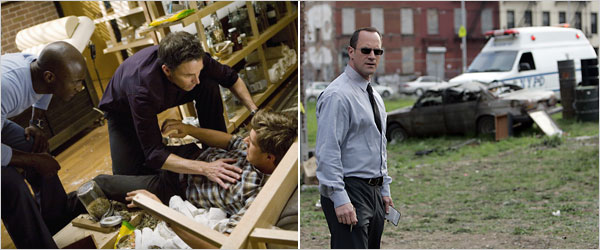
A recent report in the New York Times describes how the Bill and Melinda Gates Foundation is working with video production companies and broadcast networks to shape story lines and insert health-related messages into popular entertainment like the television shows “ER,” “Law & Order: SVU” and “Private Practice.”

Already, the foundation’s messages on HIV prevention, surgical safety and the spread of infectious diseases have found their way into these shows.

The report, written by Tim Arango and Brian Stelter, said: “Now the Gates Foundation is set to expand its involvement and spend more money on influencing popular culture through a deal with Viacom, the parent company of MTV and its sister networks VH1, Nickelodeon and BET.”

They called it “message placement”: the social or philanthropic corollary to product placement deals in which marketers pay to feature products in shows and movies. Instead of selling Coca-Cola or G.M. cars, they promote education and healthy living.

Some viewers in television-saturated US might say: it’s about time! In the past, many American companies producing entertainment content have resisted approaches from social activists to use the mass medium for public good.

In the late 1980s, when I shared some Asian experiences of mixing television drama and public education at an international science communication conference in Spain, American academics and journalists in the audience were intrigued. “But this can never happen in the United States…we keep our education and entertainment separate, and with good reason!” one of them said during question time.

Clearly, those hard attitudes have been changing slowly. As the NYT article says: “The efforts of philanthropies to influence entertainment programming is not new…. The Kaiser Family Foundation, which focuses on health issues, has been doing such work for a dozen years. It has worked story lines about H.I.V. and AIDS into programs on CBS and UPN (now known as the CWnetwork), including the reality show “America’s Next Top Model.”

Left, ABC’s “Private Practice,” and NBC’s “Law & Order: SVU.” The story lines of both shows have spread the health-related messages of the Gates Foundation. Images courtesy ABC & NBC

The Norman Lear Center at the University of Southern California’s Annenberg School for Communication is at the forefront of blending entertainment with public education. “There’s a lot of research that shows that when a character in a series says, ‘I’m going to be an organ donor,’ it’s effective, more effective than giving out a pamphlet,” said Martin Kaplan, director of the Centre.

The Centre has a Hollywood, Health & Society programme that provides entertainment industry professionals with accurate and timely information for health storylines. It organises meetings between health specialists and script writers for entertainment shows – not just drama, but also reality and variety shows.

“Our view is you don’t have to sacrifice entertainment value to be accurate,” Kaplan is quoted as saying in the NYT article.

That’s a view – and experience – shared by TV writers, producers and programme managers from Mexico to South Africa, and from India to the Philippines. In fact, this is an approach the Gates Foundation should consider rolling out in the majority world countries where they are already a key player in selected areas of health and development. Despite the recent spread of broadband internet, broadcast television is still the dominant mass medium – and primary source of news and entertainment – for most people in much of the developing world. That’s billions of eyeballs we’re talking about – and the cost of producing quality entertainment (even with education subtly embedded in some places) is significantly less than in the west.

In short, Gates can get a bigger bang for its bucks on the airwaves in the global South. And there’s really no need to convince TV industry gate-keepers and producers on how edu-tainment works: they’ve been at it for years, using whatever resources they can find.

Read full article: Messages With a Mission, Embedded in TV Shows, NYT 2 April 2009

Channel News Asia at 10: Making of a pan-Asian news channel

Asian voice in a global village
“We’re the messenger for all the stories that might not have been told…that’s our job,” says Glenda Chong, the Shanghai-based China correspondent (and former anchor) of Channel NewsAsia (CNA), the Singapore-based Asian regional news broadcaster that just turned 10.

For a decade, CNA has covered Asia for Asians and the rest of the world. It has uncovered stories missed – or ignored – by other, global news channels. Just as important, it has also found the Asian voices and angles in mega stories originating from Asia that gripped the world’s attention — such as the outbreak of SARS, Indian Ocean tsunami, earthquakes in Sichuan and Kashmir.

Started on 1 March 1999 and owned by Singapore’s MediaCorp, CNA is now a major Asian news broadcaster with programmes telecast to more than 20 Asian countries and territories. Visit CNA’s 10th anniversary website for a look back…and forward.

“In the early days, when we talked about a news channel from Singapore, you could cut the cynicism with a knife,” said Woon Tai Ho, managing director of MediaCorp News.

That was inevitable for any media venture anchored in Singapore, ranked currently at 144 out of 173 countries in the World Press Freedom Index. But CNA has shown that geography need not be destiny.

Asians telling their own story
In 10 years, it has emerged as a primary source of news in Asia, and along the way, has picked up a plethora of high-profile awards — including two silver medals at the New York Festivals 2009 and three awards at Asia Television Awards 2008.

Channel News Asia turns 10 – article in Today newspaper, Singapore: 2 March 2009

Started as a business news channel at the tail end of the Asian financial crisis of 1997, CNA later evolved into a fully-fledged news and current affairs channel covering all facets, aspects and territories of Asia – the world’s largest region, home to half of humanity. Map showing CNA geographical coverage

Ironically, CNA enters double-digits chronicling the region once again in the midst of a financial crisis, this time of global proportions and repercussions.

Unlike Al Jazeera English (AJE), the global news channel launched from Qatar in November 2006, CNA has relied on Asian talent for anchoring and reporting. While AJE has shamelessly and desperately tried to ape the BBC, CNA has forged its own identity in offering a world class product.

Whereas AJE tries so hard to please its audiences in Europe and North America (is it so anxious for western acceptance?), CNA has focused its energies in telling the myriad stories of emerging Asia primarily for Asia’s upwardly mobile, burgeoning middle classes.

For example, when an interviewee gives his/her views in a language other than English, Channel NewsAsia does not voice-over the original audio with an anglo-saxon voice like other major news channels do. Instead, an English subtitle appears, preserving and complementing the original audio.

At TVE Asia Pacific, we have had a positive experience of engaging this regional broadcaster. In late 2005, we were looking for a broadcast partner to co-produce a documentary looking back at the first year after the Indian Ocean tsunami through the eyes of eight survivor families – in India, Indonesia, Sri Lanka and Thailand – that we had tracked on video under the Children of Tsunami project. We had a mass of professionally and ethically filmed material, and a unique collection of stories we were keen to be amplified to the world.

When we approached Channel NewsAsia through a friend, they immediately welcomed the collaboration. They invested their time, resources and talent to edit Children of Tsunami: No More Tears, a half hour that distilled some of the stories that we had painstakingly captured for a year. No money changed hands. Legalities were kept to a minimum. CNA saw we had a story that was relevant and important for their viewers. They found the story authentic, as captured by local crews who spoke the language in each country and who lived through the traumas of the tsunami themselves (no ‘parachute film crews’ were involved). So CNA just did it — with none of the airs of pomposity and self importance that so characterise the BBC in any collaboration.

CNA producer Joanne Teoh Kheng Yau shared her experience in telling this story at a regional event we organised in December 2006. The full experience is now documented in a chapter in our book, Communicating Disasters: An Asia Pacific Resource Book.

Children of Tsunami: No More Tears was first broadcast globally on Channel NewsAsia in the last week of December 2005 to mark the tsunami’s first anniversary with this intro: “Young survivors of the Asian tsunami let us into their lives to personalise the mass of statistics, aid pledges and recovery plans. ‘Children of Tsunami’ is a tapestry of intimate stories, woven by voices of individual and collective resilience, heroism and recovery.”

Children of Tsunami: No More Tears Part 1:

‘The Final Inch’: Real ‘Oscar’ would be polio’s global eradication!

Not longer just a drop in the ocean...
No longer just a drop in the ocean..?
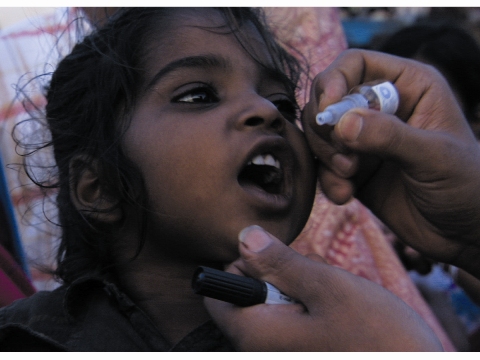
The Final Inch didn’t win the Oscar for the best short documentary film made in 2008. But the nomination has given a boost to the film and its cause: even before its official release in April 2009, it is already raising global awareness on the major public health challenge of banishing polio from the planet.

The Final Inch is a testament of the health workers around the world laboring to make polio the second globally eliminated disease behind small pox, says director Irene Taylor Brodsky.

The 37-minute film, due to air on HBO on 1 April 2009, looks at the “the final stages of a 20 year initiative” to eradicate polio. It focuses the polio vaccine efforts in India and Pakistan, which are among the last four countries where polio is still endemic (the other two being Afghanistan and Nigeria).

Watch the trailer for The Final Inch:

The campaign to eradicate polio is now 21 years old. World Health Organisation (WHO), UNICEF and Rotary Foundation embarked on this campaign in earnest in 1988, and as a young (and equally earnest) science journalist, I remember writing about its early strategies, goals and targets. But the virus has proven to be a lot more stubborn than originally expected.

Well, the campaign has scored remarkable victories, and a little over 1,600 people in the world were stricken by polio in 2008. (AIDS and malaria, in contrast, killed more than three million people.) Compare that with 350,000 cases per year when the global onslaught started, and we see there has indeed been progress.

But the virus – and the crippling disease it causes – persists in several poor, densely populated countries in Asia and Africa. Updates are available from Global Polio Eradication Initiative.

Thus it’s the ‘last inch’ – or last mile, if you like – that’s proving the hardest to traverse. In a perceptive essay published in Newsweek in January 2009, Fred Guterl noted: “It’s not easy to wipe a disease off the face of the planet—especially one like polio, which spreads easily and quickly through contact and occasionally through contaminated food and water. Only one in 200 children who contract the virus shows symptoms (usually paralysis), which makes the other 199 silent carriers.”

It’s not just biology that polio eradicators are up against. Indeed, human superstition and religious dogma have made the final inch particularly contentious and treacherous for public health workers.

In 2005, TVE Asia Pacific started distributing a global documentary on immunisation called Fragile Lives: Immunization at Risk. It showed how at least 2 million children die every year from diseases that that vaccination could easily prevent.

Foot soldiers of the largest non-military army in history engaged in its final battle
At one point, the film takes us to Uttar Pradesh, in northern India, to show how polio, eradicated in most of the world, stubbornly persists in a few countries. This very poor state with its 272 million inhabitants had two thirds of the world’s polio. We talk to the glamorous young cricketer, Mohamed Kaif, who helps publicise a massive campaign to get every single child to the vaccination booths. The film discovers the strange reason behind why so many Muslim parents refuse to have their children vaccinated.

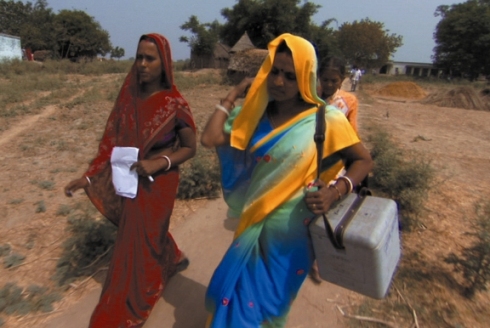
The Final Inch features the heroic efforts of Munzareen Fatima, a field worker in Meerut, Uttar Pradesh, who is a part of UNICEF’s Social Mobilisation Network for ensuring vaccination coverage. She reaches out to her target group through personal and public intervention programmes.

As she told IANS: “It has been a tough journey for me over the last five years to convince 470 families at Dufferin block in Khairnagar to administer polio drops to their children. I met with resistance from the families, who initially refused to immunise their children. The conservative community also belittled me for stepping out of home to campaign against polio.”

India is not alone. If anything, misplaced resistance to polio vaccination has been stronger in Pakistan. As IPS reported in August 2006, the country’s drive against polio was hit by both rumours and litigation.

The news story, filed by Ashfaq Yusufzai in Peshawar, noted: “The reliability and safety of oral polio vaccine (OPV) has been put under scrutiny in Pakistan after wild rumours that it causes impotency snowballed into a writ petition in a high court.”

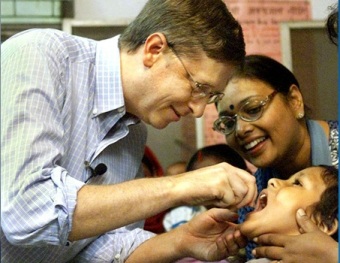
Bill Gates: geek power and bucks to battle polio...
Religion-inspired superstitions have often stood in the way of achieving sufficient vaccination coverage, leaving room for viruses to spread again. Religious leaders sometimes strengthen the hand of those making pseudoscientific claims, says South African science writer George Claassen. Writing in SciDev.Net in April 2008, he noted: “Attempts to eliminate polio in Nigeria, for example, ran into problems when Datti Ahmed, the chair of the Supreme Council for Sharia in Kano state, referred to the Global Polio Eradication Initiative as ‘modern-day Hitlers… who have deliberately adulterated the oral polio vaccines with antifertility drugs and contaminated them with certain viruses which are known to cause HIV and AIDS.'”

This brings up an interesting scenario of virus vs. virus. Richard Dawkins, the well known British evolutionary biologist and writer, has called religion the most malevolent form of a ‘mind virus’. According to Dawkins, faith − belief that is not based on evidence − is one of the world’s great evils. He claims it to be analogous to the smallpox virus, though more difficult to eradicate.

Of course, the mistrust of vaccines is not just limited to the developing world, nor is it always inspired by religion or superstition. Sometimes over-protective moms can be just as irrational. Fragile Lives, for example, took us to Dublin, Ireland, where there have been two serious outbreaks of measles – largely due to mothers rejecting vaccination because of the MMR controversy. In some parts of Ireland only 60% instead of the necessary 95%, have been vaccinated.