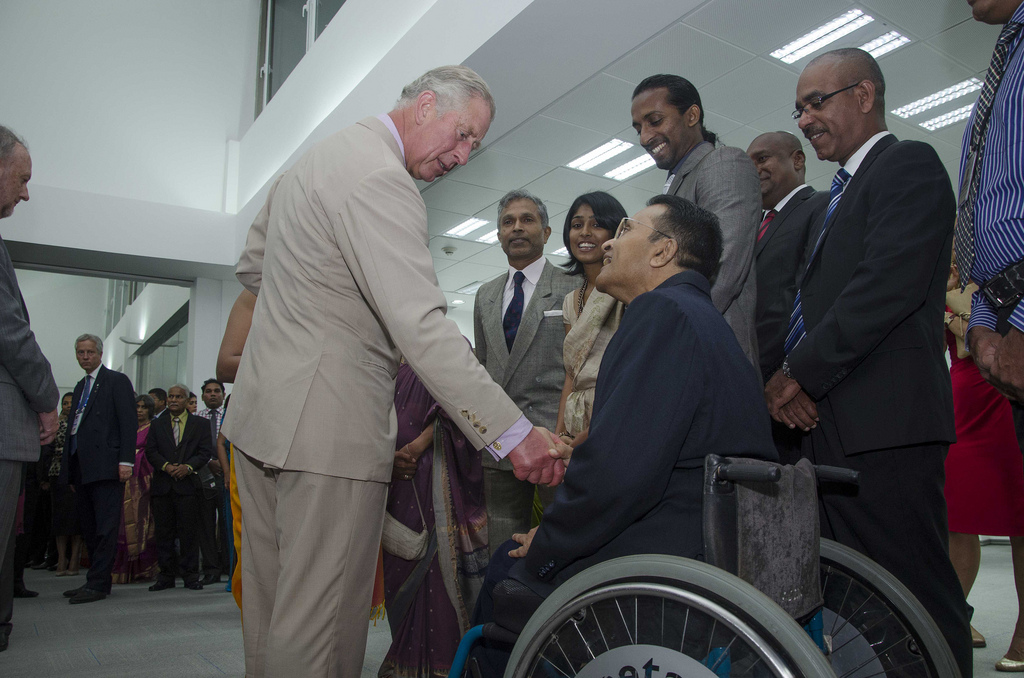
Prince Charles talks with Dr Ajith C S Perera, activist for mobility access, at the opening of British Council new building in Colombo, 16 Nov 2013 – Photo courtesy British Council Sri Lanka
Charlie is a charmer: he can be engaging, a good listener and smiles a lot.
At least these are my impressions of having watched Prince Charles at close range at a reception hosted by the Colombo British Council this evening – coupled with the opening of their new building.
The future king was ushered in without much fanfare (even his security was light touch and courteous). He spent around 40 minutes talking his way through the crowded room.
He chatted with many of the 250 or so guests — friends and partners of the British Council. It included a number of students and youth activists, as well as teachers, writers and scholars.
The Prince listened to short speeches by the British Council Sri Lanka Director and their global CEO. He then made the shortest speech of the evening: less than a minute, in which he made us laugh.
He basically thanked everyone, and expressed relief that the building he’d inaugurated on his last visit (1998) hadn’t been demolished.
Shortly afterwards, he left as quietly as he arrived. The party continued.
It was a brief encounter, but devoid of hype and pomposity that have characterised the Commonwealth Heads of Government Meeting (CHOGM) taking place in Colombo this week — the main reason why Prince Charles was in town.
I was quite tempted to take a quick photo with my mobile phone (cameras were not allowed). But our hosts had earnestly requested that we don’t take any photos. For once, I played by the rules.
In a more officious setting, I would quite likely have defied the restriction (after all, no one was watching our good conduct, as usually happens at Lanka government functions these days).
Yet the British Council has a special place in our hearts and minds. It’s a friendly oasis for artistes, learners, performers and activists. While they pursue their mission of promoting British cultural interests abroad, British Councils truly engage the community. Violating their request for taking a murky crowd photo would have been too unkind…
Part of that brand loyalty for British Council is explained in this short essay by Eranda Ginige of British Council Sri Lanka. In it, he reflects on their library in Colombo, which remains a community hub even as most readers trade paperbacks for portable devices.
Charlie produced unexpected gains, too. When I finally reached home, I had a rousing welcome from the two adorable females – a teenager and Labrador – who raise me:
Dear Charlie, You’ve boosted my approval rating among household teenagers but Digital Native puzzled I didn’t snap u! http://t.co/h0hPmBM8Ec
Did youth vote and social media make a difference in Colombo Municipal Council election in Sri Lanka held in October 2011?
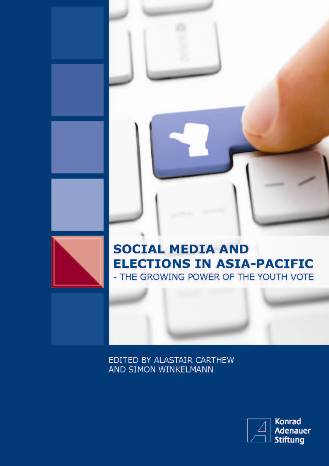
This was the question that Chanuka Wattegama and I asked ourselves and set out to answer when invited to contribute a chapter to a regional book on how social media are influencing elections in Asia.
The book comprises 10 chapters covering 11 nations written by local contributors from Australia, Indonesia, Japan, Malaysia, New Zealand, Singapore, South Korea, Sri Lanka, the Philippines, Taiwan and Thailand.
It examines trends and outcomes surrounding recent elections in these countries — and how social media influenced election campaigning and voting, especially among young voters.
Topics include:
• Use of social media surrounding elections
• Digital electioneering
• How social media can make a difference
• How important is voting to young people?
• Detailed polling of political trends
Our summary for the Sri Lanka chapter:
The Colombo Municipal Council (CMC) is the local government body that administers Sri Lanka’s largest city and its commercial capital. Its last election, held in October 2011, saw the nationally ruling coalition losing this key municipality while winning all other municipalities as well as many of the smaller local government bodies.
What made CMC election outcome different? This election saw some apolitical activists and researchers engaging the mayoral candidates on social media, questioning and critiquing their election manifestos and trying to hold them accountable. Did these online activities influence voter behaviour? What lesson does this hold for other elections and the overall political landscape in Sri Lanka?
India’s Down to Earth magazine was presented with the first Greenaccord International Media Award at an international conference held in Naples, Italy, last week.
The award, newly established by the Rome-based non-profit group Greenaccord, recognises outstanding media contributions to covering issues of environment and sustainable development.
Tommaso Sodano, deputy mayor of the City of Naples, presented the award at the conclusion of the 10th Greenaccord International Media Forum held from 6 to 9 November 2013.
Darryl D’Monte (centre) receives Greenaccord International Media Award on behalf of Down to Earth magazine, India – Naples, 9 Nov 2013 – Photo courtesy Greenaccord Press Office
“We asked all our Asian colleagues for nominations for this inaugural award, and many of them recommended Down to Earth magazine that has covered sustainability issues from a developing country perspective for 21 years,” said Alfonso Cauteruccio, President of Greenaccord.
Down to Earth is a fortnightly magazine focusing on issues of science and environment. It is published by the Centre for Science and Environment (CSE), a leading research and advocacy group in India. Founded by leading journalist and activist Anil Agarwal in May 1992, it provides reportage, analysis and commentary on a broad range of issues related to environment and development.
From the beginning, the magazine has challenged its readers to think about sustainable development. It inspires and encourages its readers to become more environment-friendly.
Darryl D’Monte, senior Indian journalist and a former editor of the Times of India, accepted the award on behalf of Down to Earth editors and publishers.
“Anil Agarwal was a trail-blazing journalist who combined knowledge and advocacy. Down to Earth, launched just before the Earth Summit in Rio in mid 1992, reflects that vision,” D’Monte said in his acceptance speech.
D’Monte recalled how Agarwal and CSE played a key role in the early days of global climate negotiations, especially in focusing global attention on per capita emissions of global warming greenhouse gases.
“Climate change is as much politics as it is science, and Anil was well aware of that. He approached all debates well armed with statistics, analysis and a southern perspective, which is also the Down to Earth magazine’s approach to issues,” he added.
Darryl D’Monte talks about Down to Earth magazine at Greenaccord Forum in Naples – Photo courtesy Greenaccord Press Office
Down to Earth presents accessible content intended for interested non-specialists including policy makers. Articles are often investigative, in-depth, all presented in well edited and designed form. In recent years, it has developed an extensive website at www.downtoearth.org.in.
The magazine has been an important vehicle for many CSE campaigns in the public interest, including its exposes on pesticide residues in popular soft drinks and bottled water brands, and agitation for cleaner air in Delhi and other metropolitan areas in India.
CSE’s right to clean air campaign resulted in New Delhi becoming the world’s first city to introduce compressed natural gas (CNG) for all public transport vehicles, D’Monte said.
Greenaccord is a non-profit association, headquartered in Rome, and founded to be of service to the world of information and training that deals with environmental issues. The association is made up of journalists and professionals who volunteer their time to provide training to their colleagues.
Since 2003, Greenaccord organises an annual gathering of journalists and scientists concerned about sustainability – which has become one of the largest such gatherings taking place on a regular basis.
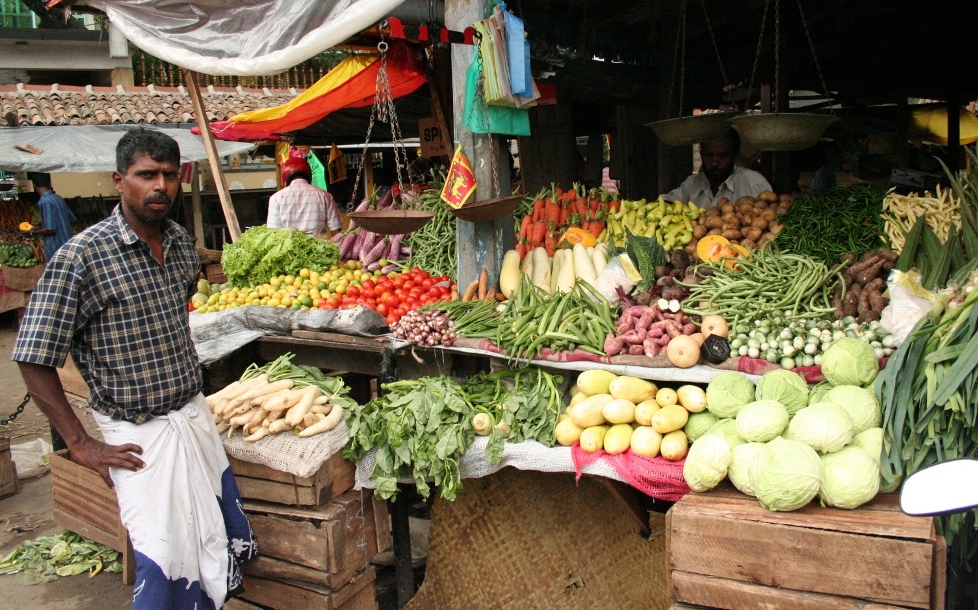
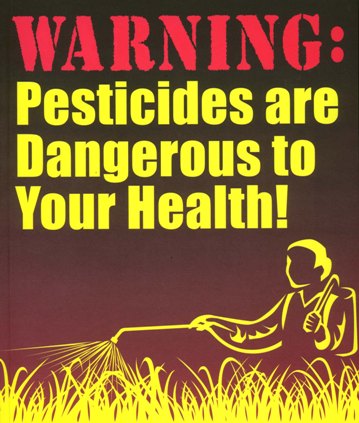
How can we protect ourselves from slow poisoning by agrochemical residues in our food? In this week’s Ravaya column, I discuss two options for Sri Lanka: organic farming, and the in-situ testing of farm produce for residues (after determining maximum residue levels).
In this week’s Ravaya column (in Sinhala), I discuss the public health implications of rising levels of pesticide residues in our food. I cite research by the Hector Kobbekaduwa Agrarian Research and Training Institute (HARTI) on pesticide use habits of upcountry vegetable and potato farmers, which makes alarming reading.
Among other things, researchers found that up to a quarter of surveyed farmers grow some chemicals-free vegetables their own use! So this is not a matter of ignorance, but willful poisoning of the unsuspecting consumer.
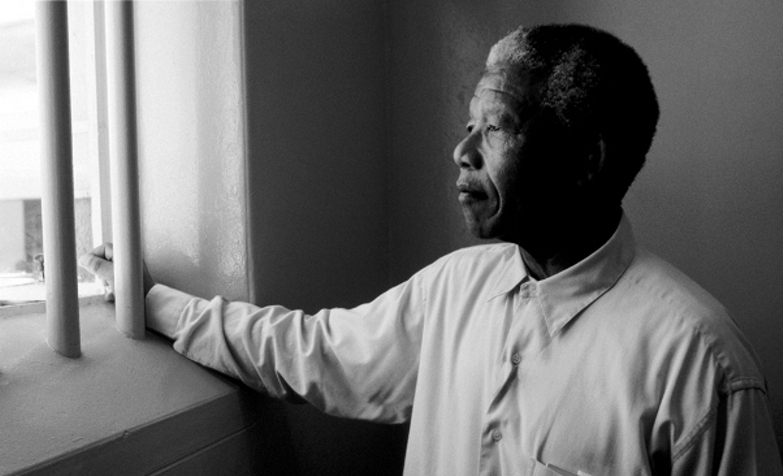
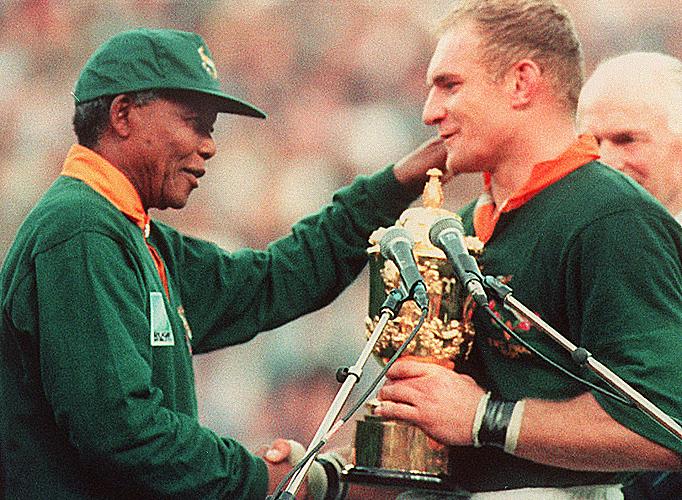
In this week’s Ravaya column (in Sinhala), I discuss how Nelson Mandela was a master communicator in terms of public speaking skills, media relations and strategy.
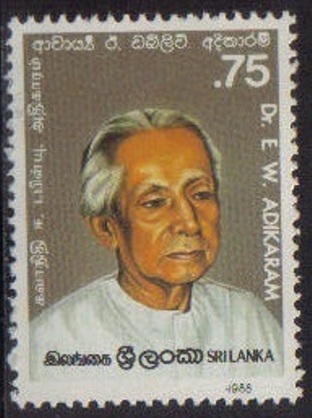
I met the Lankan scholar, science writer and social activist Dr E W Adikaram (1905-1985) only twice, during the last few weeks of his life, but those encounters left a lasting impression.
Trained in both sciences and the humanities, he was a rare public intellectual with the courage of his convictions to speak out on matters of public interest — even when such views challenged widely held dogmas or went against populist trends. As a sceptical inquirer as well as a spiritualist, he always ‘walked his talk’.
A versatile communicator in Sinhala and English, Adikaram conducted regular radio programmes, delivered thousands of talks across the island, and wrote dozens of pamphlets and booklets on practical as well as spiritual topics – all delivered in simple and lucid language.
As a pioneering science writer in Sinhala, he edited and published popular science magazines. In all this, his hallmark was the spirit of inquiry and courteous engagement.
Among his most memorable pieces was an essay titled “Isn’t the Nationalist a Mental Patient?” Its original Sinhala version was published in the Sunday newspaper Silumina in 1958. As he recalled many years later, “It was a strange coincidence that this article first appeared in print just a couple of days before the outbreak of the sad conflict between the Sinhalese and the Tamils in 1958.”
I have just shared this important essay online, with a new annotation.
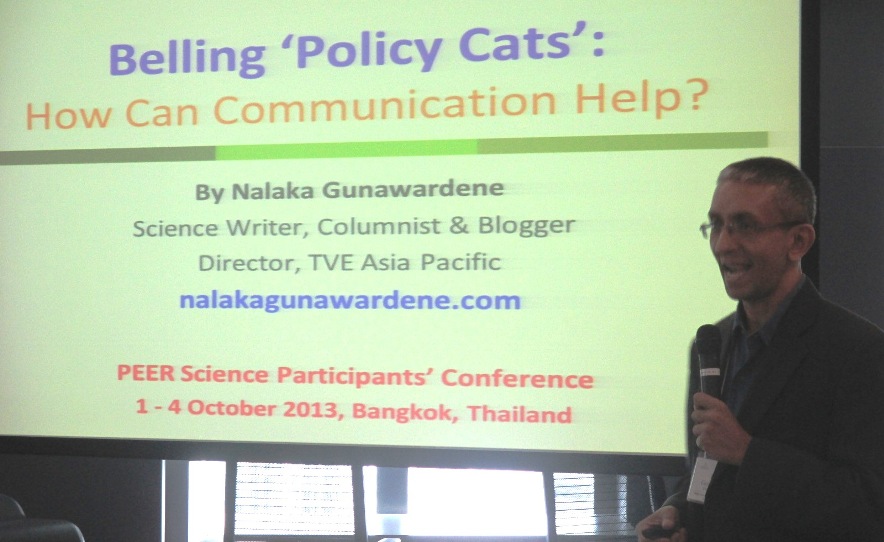
Nalaka Gunawardene speaks at PEER Science Conference 2013 in Bangkok, 3 Oct 2013
How to ‘Bell’ the policy ‘cats’?
This question is often asked by researchers and activists who would like to influence various public policies. Everyone is looking for strategies and engagement methods.
The truth is, there is no one sure-fire way — it’s highly situation specific. Policy makers come in many forms and types, and gaining their attention depends on many variables such as a country’s political system, governance processes, level of bureaucracy and also timing.
Perfecting the finest ‘bells’ and coming across the most amiable and receptive ‘cats’ is an ideal rarely achieved. The rest of the time we have to improvise — and hope for the best.
Good research, credible analysis and their sound communication certainly increase chances of policy engagement and eventual influence.
How Can Communications Help in this process? This was the aspect I explored briefly in a presentation to the PEER Science Participants’ Conference 2013 held in Bangkok, Thailand, from 1 to 4 Oct 2013.
It brought together over 40 principal investigators and other senior researchers from over a dozen Asian countries who are participating in Partnerships for Enhanced Engagement in Research (PEER) Science program. PEER Science is a grant program implemented by the (US) National Academies of Science on behalf of the U.S. Agency for International Development (USAID) and in cooperation with the National Science Foundation (NSF).
I flagged some key findings of a global study by SciDev.Net (where I am an honorary trustee) which looked at the different contextual settings within which policymakers, the private sector, NGOs, media organisations and the research community operate to better understand how to mainstream more science and technology evidence for development and poverty reduction purposes.
I like show and tell. To illustrate many formats and approaches available, I shared some of my work with LIRNEasia and IWMI, two internationally active research organisations for which I have produced several short videos (through TVE Asia Pacific) communicating their research findings and policy recommendations.
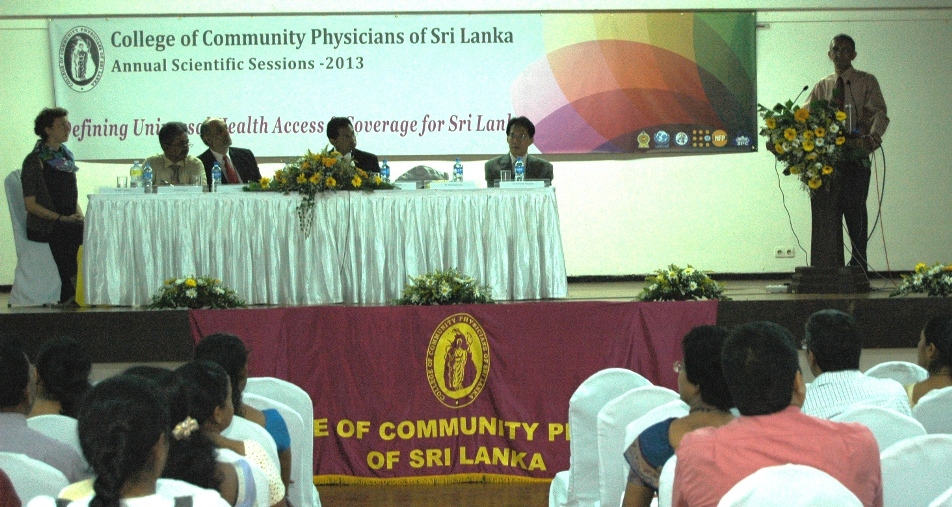
In this week’s Ravaya column (in Sinhala), I explore the nexus between public perceptions and public health – a topic I discussed in a recent talk to the College of Community Physicians Sri Lanka held in Colombo on 23 – 24 September 2013.
Nalaka Gunawardene speaks at Annual Scientific Sessions of College of Community Physicians Sri Lanka, 24 Sep 2013 Colombo – Photo by Janaka Sri Jayalath
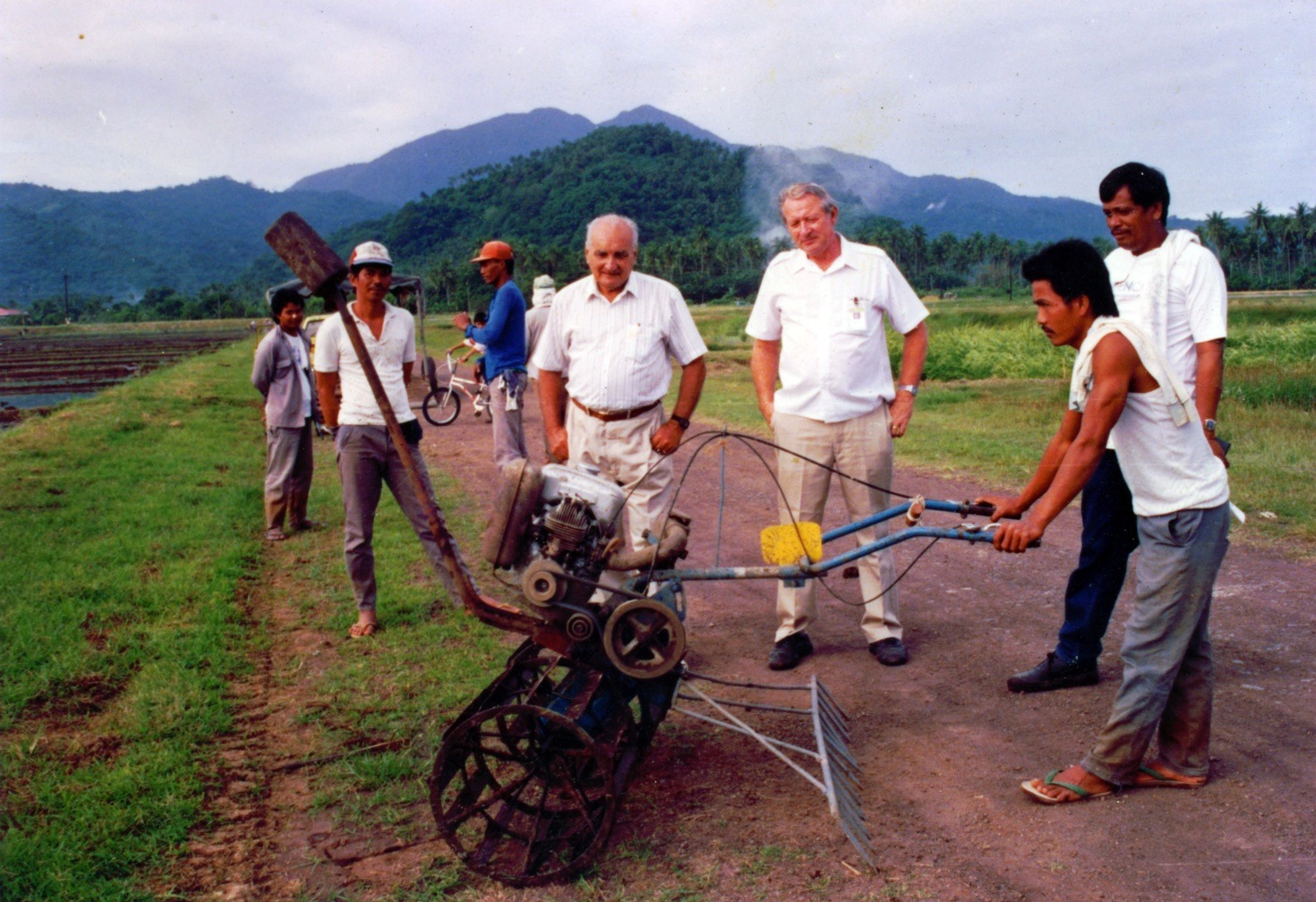
This week, my Ravaya Sunday column (in Sinhala) carries the third and concluding part of my long exchange with the late Dr Ray Wijewardene, agro-engineer turned farmer and a leading practitioner in conservation farming in the humid tropics. Today, we discuss soil conservation in Sri Lanka’s hill country, restoring shifting (chena) cultivation to its original method, and how small farmers can become more resilient to market forces.





 Open Minds!