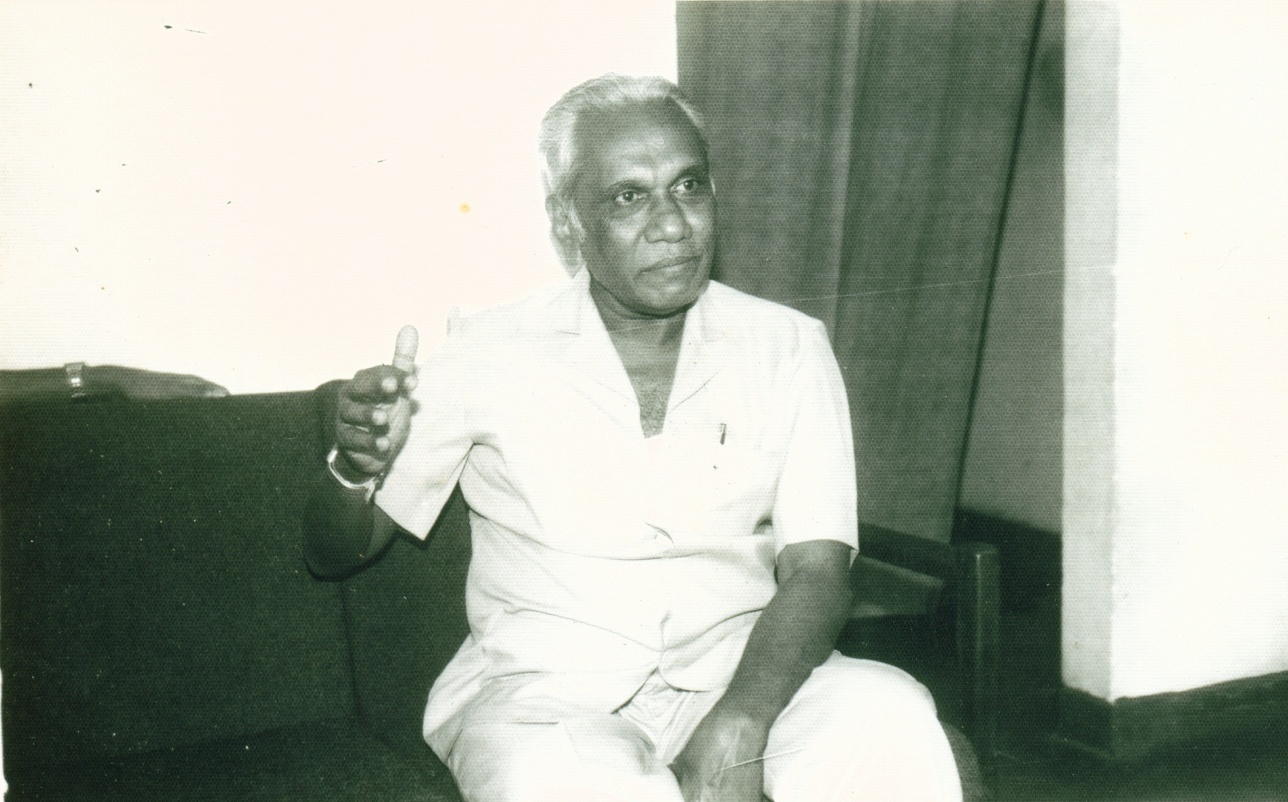
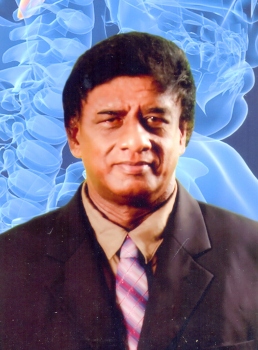
Edwin Ariyadasa photographed by Nalaka Gunawardene in 1986 during their first interview
Edwin Ariyadasa, who completed 91 years on 3 December 2013, is one of two grand old men of Lankan journalism still practising their craft (the other being D F Kariyakarawana, also 91).
The veteran journalist has been active in his profession for nearly all of Sri Lanka’s post-independence years. During that time, he has played a variety of complementary roles: feature writer, newspaper editor, columnist, radio and TV host, journalist trainer, author and translator among others. He continues to juggle many of these and has no retirement plans.
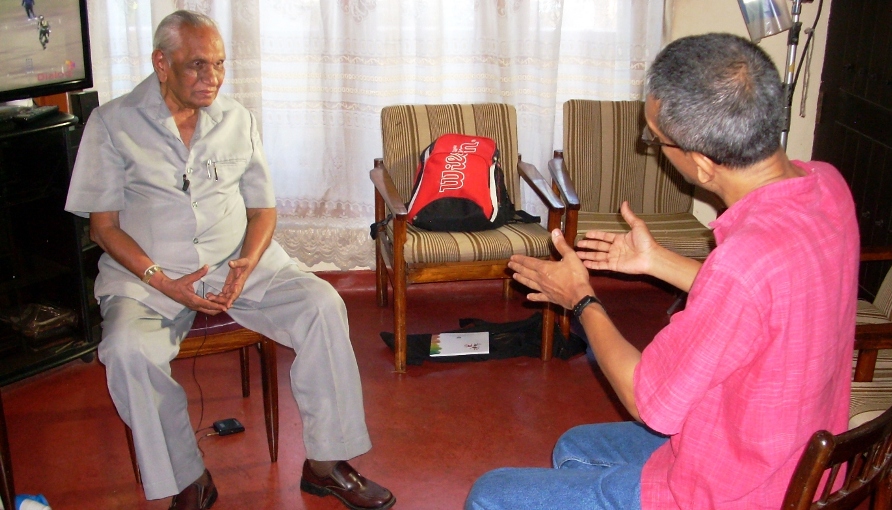
In October 2012, I filmed a wide ranging interview with Ariyadasa as he was heading to his 90th birthday. Having grown up reading his output in Lankan newspapers in Sinhala and English, and then having collaborated with him in various public media activities for much of my own media career, I was keen to capture his memories and reflections.
It took me over a year to get the long interview edited into three video segments, and also to have it transcribed, but it’s finally done. Groundviews.org has just published it:
Nalaka Gunawardene in conversation with Edwin Ariyadasa
As I note in my introduction:
In this interview, the nonagenarian looks back at journalism and broadcasting in Sri Lanka for over half a century. His reminiscences are significant for several reasons. He recalls a time, only a generation ago, when newspapers produced by highly committed editors and journalists commanded readers’ respect as a trusted source of public information and commentary. Having played a central role in pioneering mass media education and television broadcasting in Sri Lanka, he wonders what went wrong along the way to arrive at the banality and superficiality that dominates much of the Lankan media today despite advanced technologies for production and distribution.
In that sense, this is more than mere nostalgia of an individual or the simple bewilderment of an earlier generation. Introspection from a media guru like Ariyadasa can provide the impetus for much-needed reflection for the media industry which often hesitates to turn the spotlight upon itself.
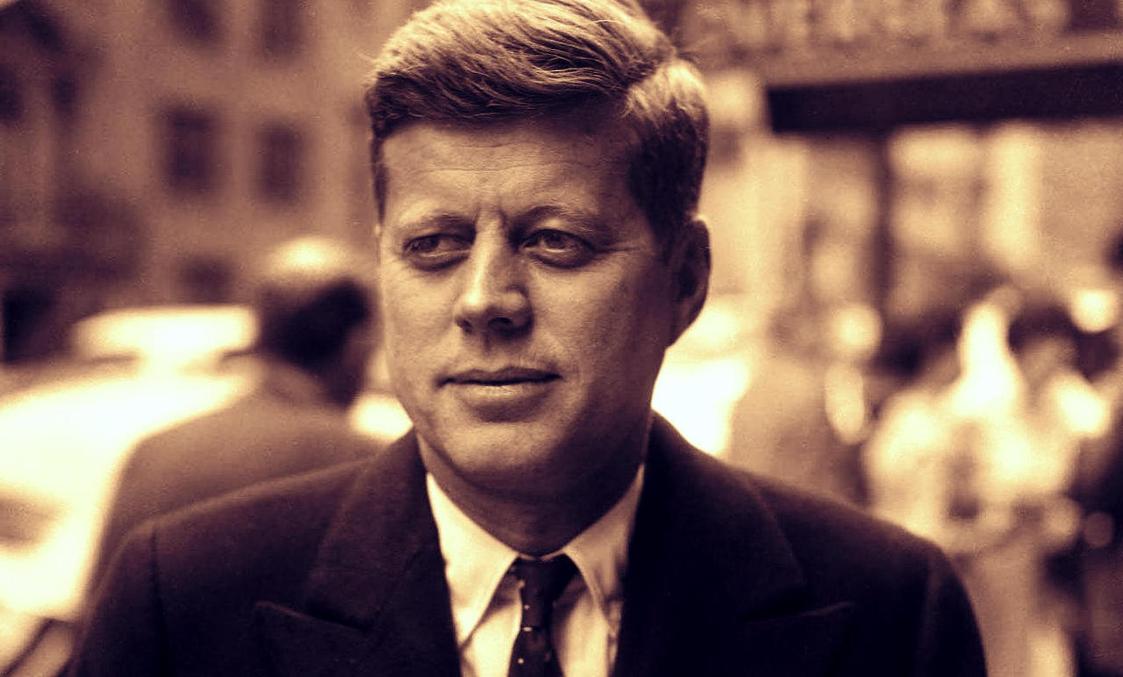
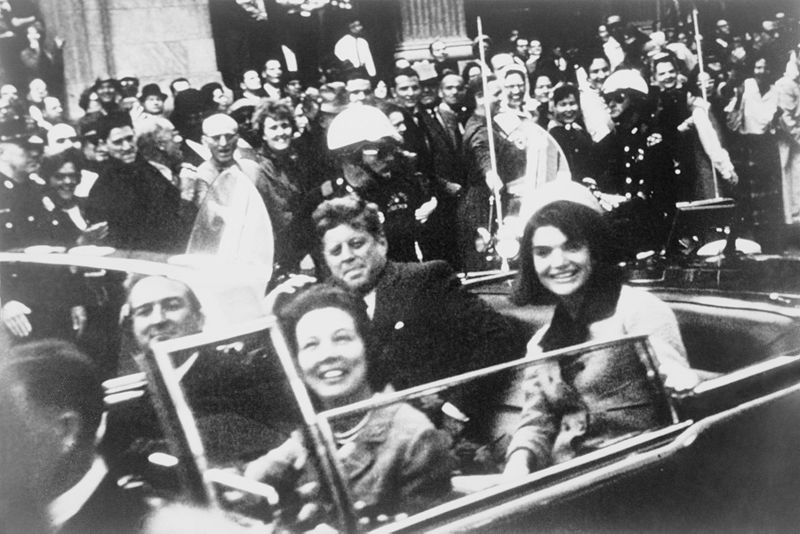
In this week’s Ravaya column (in Sinhala), I look back at the world’s first President of the Television Age – John F Kennedy. How did he ride the airwaves to the hearts and minds of American voters? What combination of wits, looks and charisma made him an ideal icon for the Television Age in its Golden Age? And what lessons JFK holds for all image-conscious politicians who want to appear on television?
John F. Kennedy motorcade, Dallas, Texas, Nov. 22, 1963. Partially restored version of original file with some artifacts removed – original photo by Victor Hugo King, via Wikipedia
Did youth vote and social media make a difference in Colombo Municipal Council election in Sri Lanka held in October 2011?
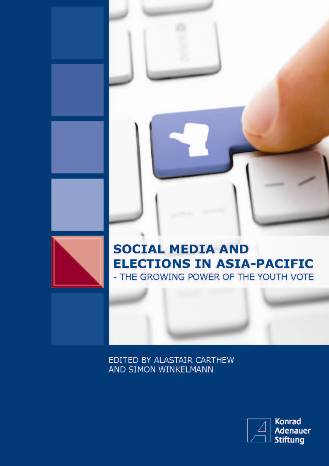
This was the question that Chanuka Wattegama and I asked ourselves and set out to answer when invited to contribute a chapter to a regional book on how social media are influencing elections in Asia.
The book comprises 10 chapters covering 11 nations written by local contributors from Australia, Indonesia, Japan, Malaysia, New Zealand, Singapore, South Korea, Sri Lanka, the Philippines, Taiwan and Thailand.
It examines trends and outcomes surrounding recent elections in these countries — and how social media influenced election campaigning and voting, especially among young voters.
Topics include:
• Use of social media surrounding elections
• Digital electioneering
• How social media can make a difference
• How important is voting to young people?
• Detailed polling of political trends
Our summary for the Sri Lanka chapter:
The Colombo Municipal Council (CMC) is the local government body that administers Sri Lanka’s largest city and its commercial capital. Its last election, held in October 2011, saw the nationally ruling coalition losing this key municipality while winning all other municipalities as well as many of the smaller local government bodies.
What made CMC election outcome different? This election saw some apolitical activists and researchers engaging the mayoral candidates on social media, questioning and critiquing their election manifestos and trying to hold them accountable. Did these online activities influence voter behaviour? What lesson does this hold for other elections and the overall political landscape in Sri Lanka?
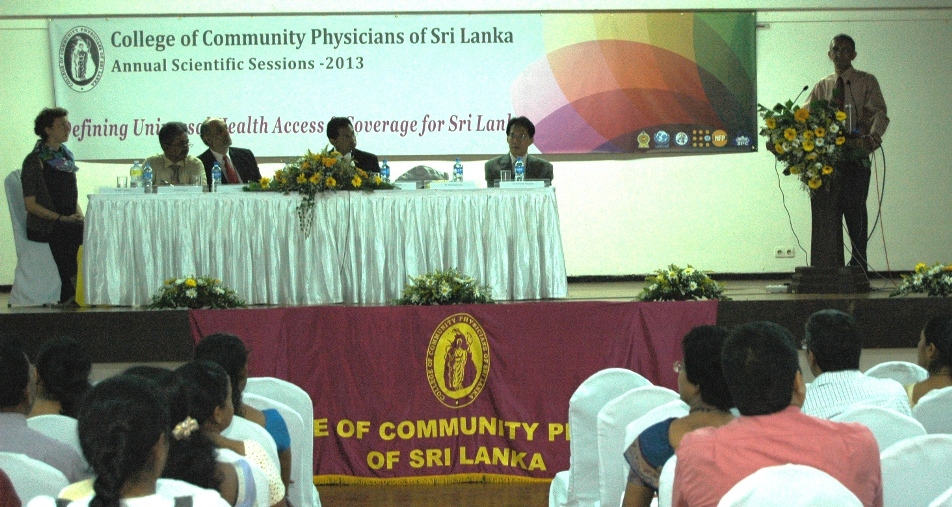
Nalaka Gunawardene speaks at Annual Scientific Sessions of College of Community Physicians Sri Lanka, 24 Sep 2013 Colombo – Photo by Janaka Sri Jayalath
Speaking to an audience of medical practitioners, researchers and academics focusing on community medicine, I explored how public perceptions influence private choices and, ultimately, public health trends and progress.
I was part of a plenary session titled ‘Multi-sectoral approaches for universal health access’, co-chaired by the Director General of Health Services (Dr Palitha Maheepala) and WHO Country Representative in Sri Lanka (Dr F R Mehta).
Achieving universal health access and a robust public healthcare system requires not only medical and para-medical systems but also paying attention to sociological, anthropological and psychological aspects of wellness and illness in the Lankan context, I argued.
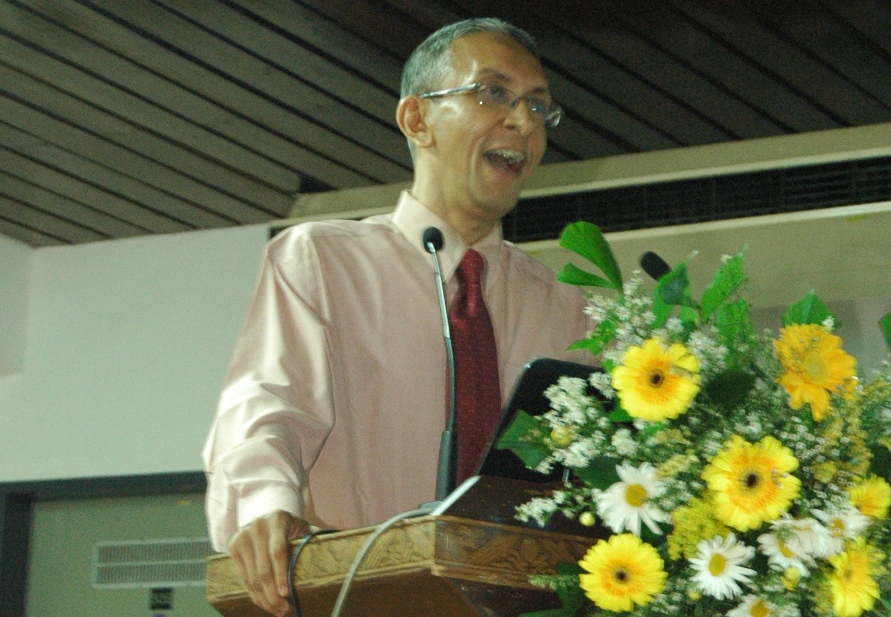
Nalaka Gunawardene speaking at Annual Scientific Sessions of College of Community Physicians Sri Lanka, 24 Sep 2013 Colombo – Photo by Janaka Sri Jayalath
I have long been interested in the nexus between public perceptions and environmental conservation. The same principles apply in public health: it’s not just facts, figures and technocratic analysis but people’s impressions, apprehensions, suspicions and fears that shape the public mind. These, in turn, influence public policies (which in democracies try to respond to public opinion — for better or worse!).
Investing LKR billions of public funds in the health sector is necessary, but not sufficient. Such public funds are at risk of being undermined if the public mind is occupied by assorted demons old and new. The new demons come dressed in the clothes of pseudo-science!
The media can either amplify ill-founded public perceptions, or help clarify matters. For the latter, medical professionals need to collaborate with sympathetic media editors and practitioners. This is a long-haul task.
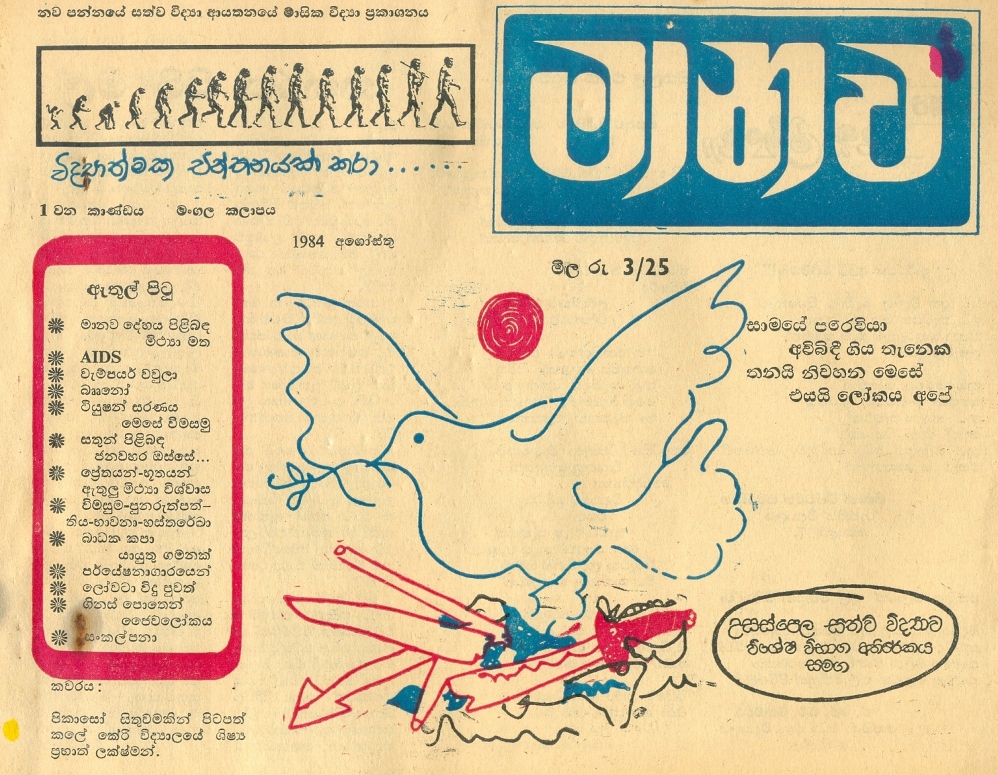
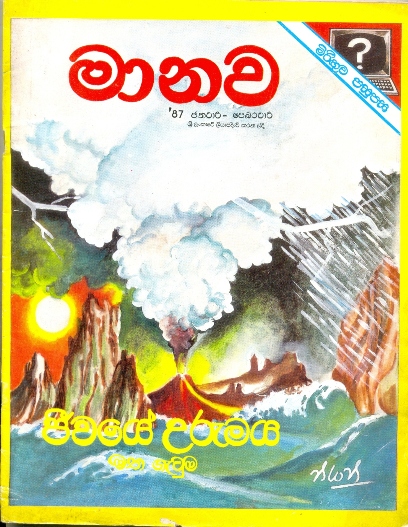
My latest book is dedicated to Asanga Abeysundara who was my zoology teacher 30 years ago, as well as my earliest editor-publisher. For several years in the 1980s, he edited and published (in properly printed form) a progressive science magazine in Sinhala named Maanawa (meaning ‘human’).
This non-profit publication, started in 1978 as a wall newspaper at the University of Colombo by its founder when he was an undergraduate there, evolved into a printed magazine in 1984 with a small circulation and loyal readership.
Maanawa Sinhala science magazine first print issue, Aug 1984
It was a platform for aspiring young writers – many of them in school or university at the time – to write about science, technology and their impact on society. As part of the editorial team, I remember we covered big issues like the origins of life, cost-benefits of space exploration, HIV/AIDS and human evolution.
Maanawa was entirely a labour of love: everybody, including the editor, worked for free. But printers and distributors charged for their services, which the limited sales couldn’t recover. So, despite passion and voluntary editorial inputs, the magazine stopped printing after sometime.
Yet, showing resilience and innovation, Maanawa became the first Sinhala publication to produce an Internet edition in 1996 — the year after commercial connectivity was introduced in Sri Lanka. The web edition, which played a pioneering role, is no longer online.
I have written this week’s Ravaya column (in Sinhala) about Maanawa.
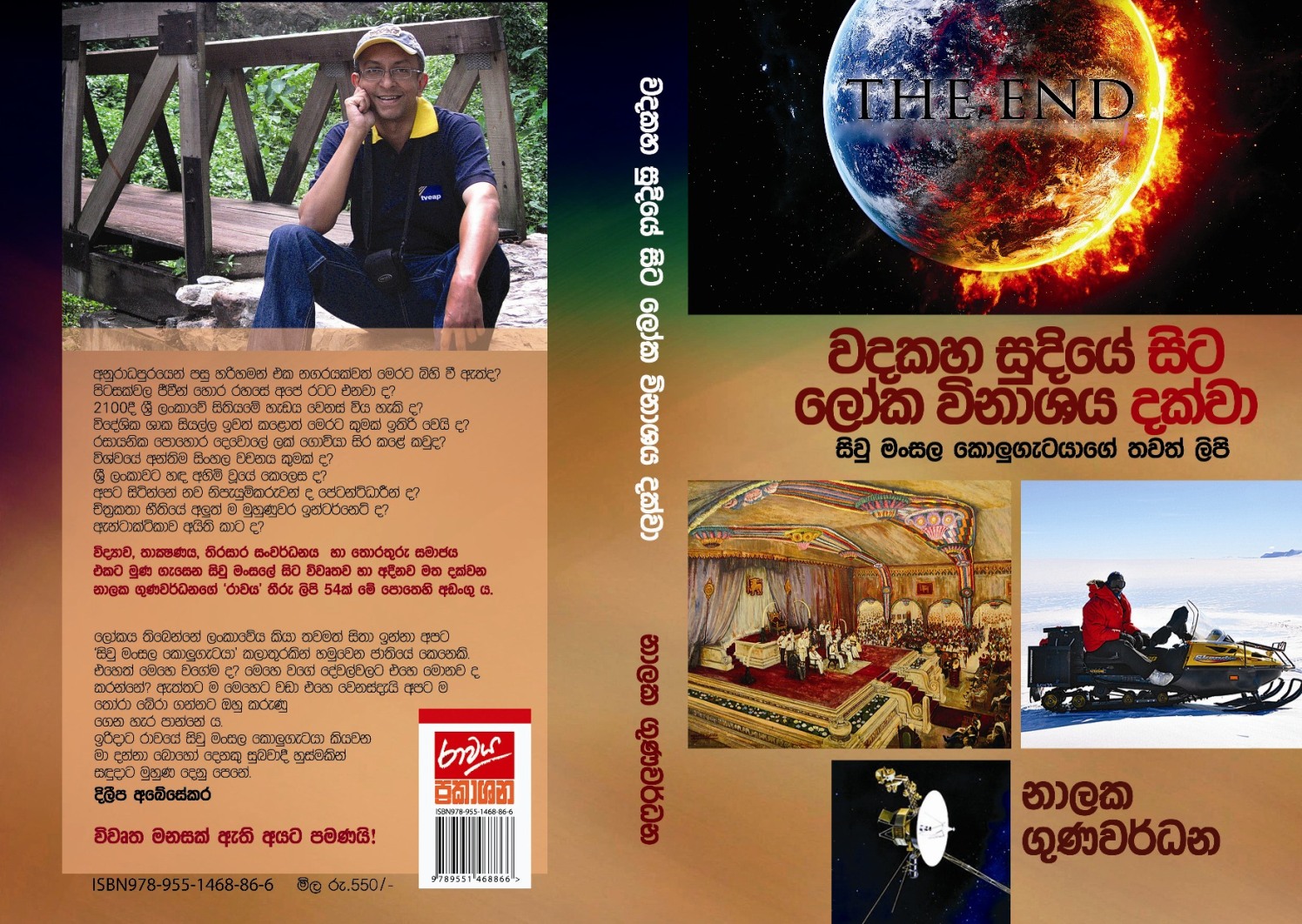
Cover of Sivu Mansala Kolu Getaya Book 2 by Nalaka Gunawardene, pub Sep 2013
PROMO NOTE FOR MY LATEST BOOK:
Science writer Nalaka Gunawardene’s latest Sinhala book, Wada Kaha Sudiye Sita Loka Winashaya Dakwa, will be released at the Colombo International Book Fair that starts on 14 September 2013.
Through 54 columns, the book offers personalised insights and non-technical analysis related many current issues and topics in science, technology, sustainable development and information society in the Lankan context. It is written in an easy, conversational Sinhala style rich in metaphor and analogy.
In particular, this collection probes how and why Lankan society is increasingly prone to peddling conspiracy theories without critical examination or rational discussion. From astrological hype linked to end of the world in 2012 to claims of mass poisoning via agrochemicals, Nalaka seeks to separate facts from hype, conjecture and myth.
The book defies easy categorisation, as it covers topics as diverse as alternative histories, agrochemical misuse, disaster management, Internet censorship, Antarctic exploration, asteroid impacts, cricket history and road safety.
“I seem to have outgrown the neat label of science writer,” says Nalaka. “Indeed, the very title of my column suggests how I sit at the intersection (or confluence) of science, development, mass media and information society. From that point, I explore tensions between modernity and tradition — and ask more questions than I can easily answer!”
In his quest for clarity and reason, Nalaka talks to researchers, activists and officials. He also draws on his many experiences and global travels as a journalist, TV producer and development communicator.
The 340-page book is priced at Rs. 550. It will be available from leading bookstores, and at special discounts from the Ravaya booth during the Colombo Book Fair.
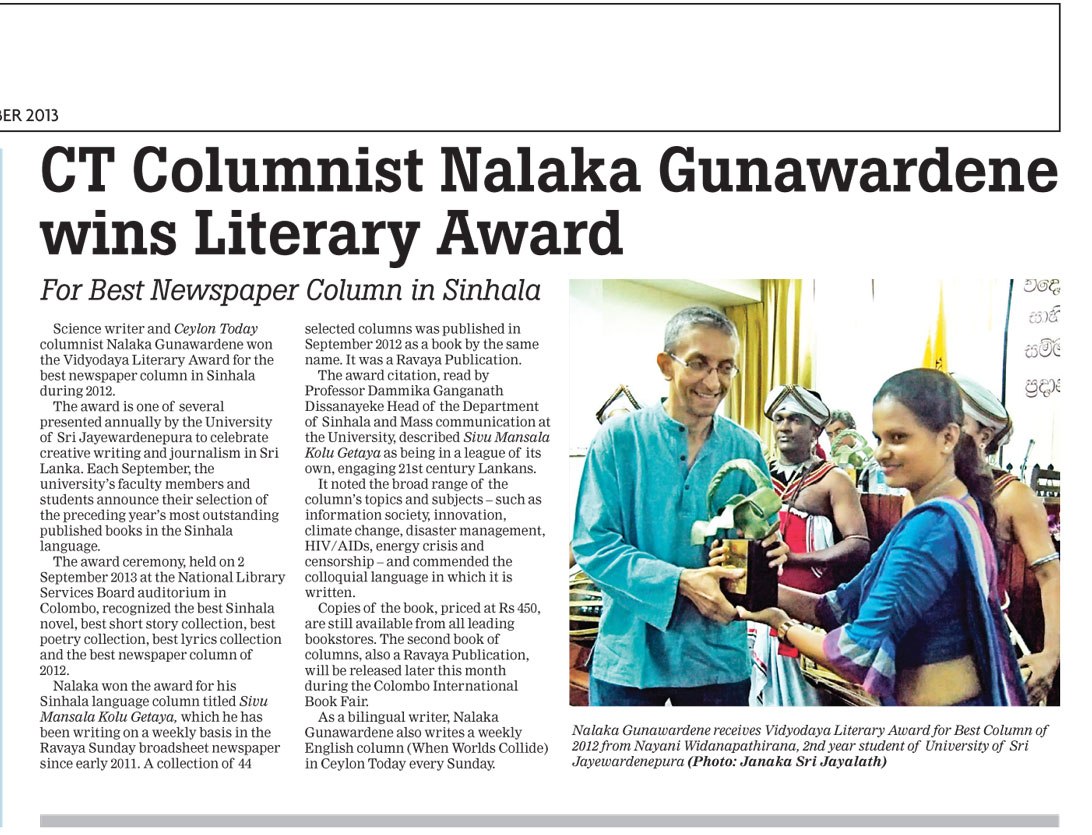
Science writer Nalaka Gunawardene won the Vidyodaya Literary Award for the best newspaper column in Sinhala during 2012.
The award is one of several presented annually by the University of Sri Jayawardenapura to celebrate creative writing and journalism in Sri Lanka. Each September, the University’s faculty members and students announce their selection of the preceding year’s most outstanding published books in the Sinhala language.
The award ceremony, held on 2 September 2013 at the National Library Services Board auditorium in Colombo, recognized the best Sinhala novel, best short story collection, best poetry collection, best lyrics collection and the best newspaper column of 2012.
Nalaka won the award for his Sinhala language column titled Sivu Mansala Kolu Getaya (සිවුමංසල කොලූ ගැටයා), which he has been writing on a weekly basis in the Ravaya Sunday broadsheet newspaper since early 2011. A collection of 44 selected columns was published in September 2012 as a book by the same name. It was a Ravaya Publication.
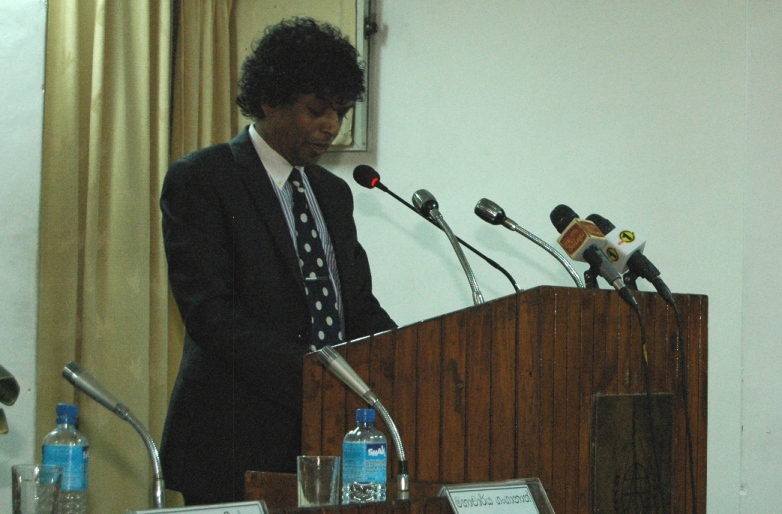
The award citation, read by Professor Dammika Ganganath Dissanayeke, Head of the Department of Sinhala and Mass communication at the University, described Sivu Mansala Kolu Getaya as being in a league of its own, engaging twenty first century Lankans.
It noted the broad range of the column’s topics and subjects – such as information society, innovation, climate change, disaster management, HIV/AIDs, energy crisis and censorship – and commended the colloquial language in which it is written.
Copies of the book, priced at Rs 450, are still available from all leading bookstores. The second book of columns, also a Ravaya Publication, will be released later this month during Colombo International Book Fair.
Professor Dammika Ganganath Dissanayeke reads award citation for best newspaper column 2012 at Vidyodaya Lit Award ceremony, 2 Sep 2013. Photo by Janaka Sri Jayalath
This is the relevant extract from the award citation, read by Professor Dammika Ganganath Dissanayeke, Head of the Department of Sinhala and Mass communication at the University of Sri Jayawardenapura:
In this week’s Ravaya column (in Sinhala), I pay tribute to Nelson Mandela whose 95th birthday was on 18 July 2013 — which was marked worldwide as Nelson Mandela Day.
See also my English essay published earlier this week:



 Open Minds!