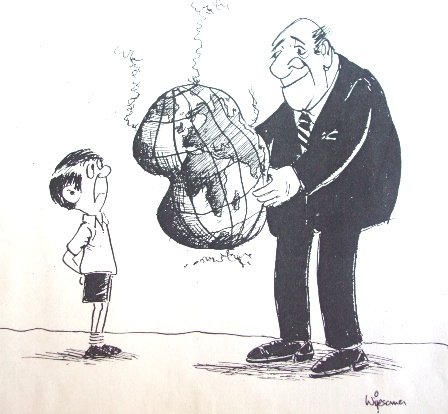
Passing the buck? Cartoon by W R WijesomaThis was one of the most memorable cartoons drawn by W.R. Wijesoma, Sri Lanka’s pre-eminent political cartoonist (and my one-time colleague). If I remember right, it first appeared sometime in the late 1980s in ‘Mihikatha’, Sri Lanka’s first all-environmental newspaper.
Alas, both Mihikatha and Wijesoma are no more among us. But the message in this cartoon is more timely than ever before.
“Is this what we are going to hand over to our future generations? Please……no!” was the emphatic message from Yugratna Srivastava, a 13-year-old Indian girl who addressed over 100 world leaders gathered at the United Nations headquarters on 22 September 2009 for the historic Summit on Climate Change.
Passing the ball – or buck – is something that governments are good at. Most governments are so narrowly focused on the now and here, and sometimes rightfully so, that they have neither the time nor interest for medium to long term scenarios. As I wrote earlier this week, “it’s going to take many more meetings, bickering and hard bargaining before the leaders begin to think in terms of the next generation.”
This is where citizen action comes in. Governments are not going to save this planet from environmental catastrophes; if at all, it would be the ordinary people. This is the premise of TVE Asia Pacific’s latest Asian TV series, Saving the Planet.
Where does the buck stop?
Governments, experts and big corporations alone cannot solve all these problems. Real change requires changing how each and every human being lives and works. Education becomes the biggest key to achieving environmentally sustainable development at local and global levels.
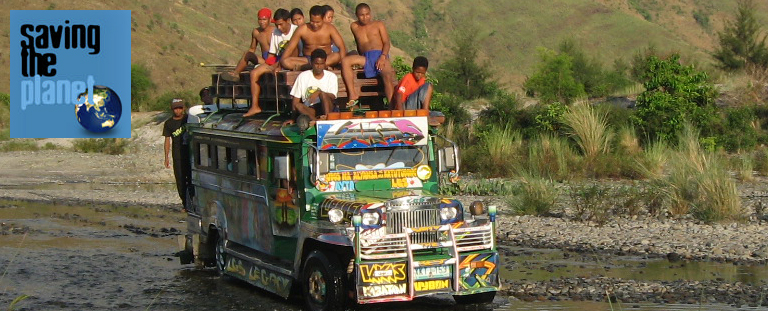
Filmed in six countries in South and Southeast Asia, Saving the Planet profiles groups working quietly and relentlessly to spread knowledge, understanding and attitudes that inspire action that will help humans to live in harmony with the planet. They often work without external funding and beyond the media spotlight. They have persisted with clarity of vision, sincerity of purpose and sheer determination. Their stories inspire many others to pursue grassroots action for a cleaner and safer planet.
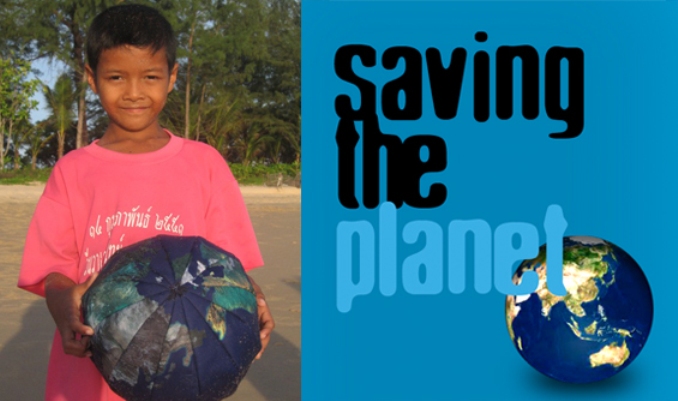
We tried out a creative idea for the series opening sequence (20 seconds), an extended version of which became the series trailer (see below). It was planned and filmed in all the six countries where the stories came from — Cambodia, India, Laos, Nepal, the Philippines and Thailand. In each country, our roving director-producers filmed different individuals – young and old, men and women, in all their Asian diversity – passing around an inflated ball made to look like planet Earth.
I know my colleagues had fun filming these sequences, and back in our studio, it was also great fun to mix and match these various shots to create the apparently seamless passing around of our planet in peril. (Who said planet saving cannot be fun?)
Watch Saving the Planet trailer (1 minute):
Now it can be revealed: our original inspiration came from an unexpected source: the world’s largest media corporation, Google! In one brainstorming, our then production coordinator Buddhini Ekanayake remembered an open challenge that Google had made online just before introducing their email service, GMail. Google asked people to “imagine how an email message travels around the world” using a video camera.
In all, Google received over 1,100 clips from fans in more than 65 countries around the world — each one of them a different creative idea, playing with the iconic Gmail M-velope.
“The clips you submitted were amazing and it was hard to choose selections for the final video,” Google said when releasing the outcome of this collaborative video project.
It's planet saving time...and everybody is invited!
Can ordinary people help save our planet?
What does it take to change their attitudes and lifestyles to consume and waste less?
For over two years, my team at TVE Asia Pacific and I have been working on a new TV series, modestly called Saving the Planet. It will be released at a regional conference in Tokyo, Japan, on 22 August 2009.
In this Asian series, produced in partnership with Asia Pacific Cultural Centre for UNESCO (ACCU), we profile successful initiatives that combine knowledge, skills and passion to create cleaner and healthier environments.
It was filmed in six countries in South and Southeast Asia: Cambodia, India, Laos, Nepal, the Philippines and Thailand.
The groups profiled in Saving the Planet often work without external funding and beyond the media spotlight. They have persisted with clarity of vision, sincerity of purpose and sheer determination. Their stories inspire many others to pursue grassroots action for a cleaner and safer planet.
The remains of former Philippine president Corazon Aquino passes through the historical EDSA road with some 300,000 supporters waving to pay their last respect. The road is remembered in 1986 as then anonymous Cory and some 2 million people rallied out the streets to fight a 20-year government dictatorship through peaceful people power revolution. Photo by Arwin Doloricon/ Voyage Film
I know this post appears rather late, but I couldn’t let Cory Aquino’s death on 1 August 2009 pass without comment. The original inspiration for People Power that toppled one of the worst tyrants of the 20th Century, she would now turn the Patron Saint of peaceful democratic struggles everywhere.
Last week, I was reduced to tears reading two links that my Filipino friend Ruth Villarama, who runs Voyage Films in Manila, sent me of new comments posted on their website.
In the first post, A housewife, a leader, an angel in yellow (3 August 2009), Joan Rae Ramirez wrote: “Her death at 3 AM on August 1 has stopped a nation from its apathetic works to once again remember what was once fought by this ordinary housewife. It is on these rarest moments where the oligarchs came down from their kingdoms to pay their respect and mingle with the people who truly represent the real state of the Philippine nation.”
Karen Lim, who works with Voyage Films as a producer and project coordinator, wrote a more personalised piece titled The Famous Anonymous.
It opened with these words: “I see her on TV. In some instances I even covered her for a story. Our relationship did not go deeper than the reporter-subject, or the audience and the watched. Yet I feel a certain affinity to the most revered President. And when she died I got sad, a strange feeling of sadness where the source is unknown.”
Karen was too young to have remembered much of those heady days of the People Power Revolution of February 1986 — a series of nonviolent and prayerful mass street demonstrations in the Philippines that eventually toppled the 20-year autocracy of Ferdinand Marcos. Indeed, a whole generation of Filipinos has been born since. But that doesn’t stop them from relating to the monumental events that unfolded at at Epifanio de los Santos Avenue, known more commonly by its acronym EDSA, in Quezon City, Metropolitan Manila and involved over 2 million ordinary Filipinos as well as several political, military and religious figures.
As Karen wrote in her tribute: “Cory’s life became ours too. We watched her, sometimes we joined her. We experienced her highs and lows. We are her “Mga minamahal kong kababayan”(my beloved fellowman). She did what no stranger did in my family – unite us in prayer for the country, unite us in laughter amidst the uncertainties of those times. I had no personal connection to this lady, but I have now every reason to mourn her passing.”
Woman of the Year 1986I can only echo her Karen’s words. As a politically curious 19-year-old, I had followed with much interest the daring gamble and eventual triumph of People Power unfolding thousands of kilometres away from my Colombo home. In the pre-Internet era, and before satellite TV channels provided 24/7 coverage across Asia, my sources were daily newspapers, evening news bulletins on local TV and, once every few weeks, the second-hand copies of Time magazine passed on to me by an uncle. The housewife in yellow ended up becoming Time Woman of the Year for 1986, with Pico Iyer writing a suitably reflective piece.
In the years since the return of democracy – with all its imperfections and idiosyncrasies – I have stood at EDSA more than once, and wondered what it must have been like to mobilise millions of ordinary, concerned people in the days before email, Internet and mobile phones — communication tools that today’s political activists, and indeed everyone else, take for granted. There is a thin line between a non-violent struggle and a passionate yet violent mob that, ultimately, works against their own interests. I am amazed that Cory and her activists didn’t cross the line, despite provocations and 20 years of repression.
Of course, it wasn’t just the human numbers that turned the tide in EDSA. Cory Aquino’s charismatic leadership and moral authority persuaded other centres of power – including the Catholic church and sections of the military – to align with the struggle to restore democracy. It was this combination, and the sudden change of mind by the Americans who had backed Marcos all along, that enabled People Power to triumph.
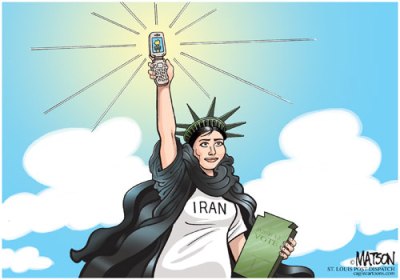
Elsewhere in Asia, where these elements didn’t align as forcefully and resolutely in the years that followed, the outcome was not as dramatic or positive. We’ve seen that, for example, in places as diverse as Tiananmen Square in China (1989), Burma (2007) and most recently, in the streets of Tehran, Iran. In contrast, it did indeed work and ushered in regime change in places like Nepal, even though it entailed more protracted struggles.
What interests me, in particular, is the role played by information and communication technologies (ICTs) in such People Power movements. Alex Magno, a political analyst and professor of sociology in Manila, sees clear links between new communications technologies and political agitation. Interviewed on the Canadian documentary Seeing Is Believing: Handicams, Human Rights and the News (2002), he said: “In the last two decades or so, most of the political upheavals had some distinct link to communications technology. The (1979) Iranian Revolution was closely linked to the audio cassette. The first EDSA uprising in the Philippines was very closely linked to the photocopying machine and so we called it the ‘Xerox Revolution’. Tiananmen, the uprising that failed in China, was called the ‘Fax Revolution’, because the rest of the world was better informed than the rest of the neighbourhood because of the fax machine. The January (2002) uprising in the Philippines represents a convergence between electronic mail and text messaging. And that gave that uprising its specific characteristics.”
Mobile phones' role in People Power II acknowledged in a Manila mural But it was People Power II in the Philippines that is perhaps the best known example of ICTs fuelling and sustaining a revolution. The ability to send short text messages on cell phones helped spawn that political revolution in early 2001, a full decade and a half after the original wave that swept Cory Aquino into office.
President Estrada was on trial facing charges of bribery, corruption and breach of the public trust. Despite mounting evidence against him, the President was let off the hook. That was the turning point. According to Ramon Isberto, a vice-president at Smart Telecom in the Philippines: “People saw it on television, and a lot of people were revolted. They started text messaging each other, sending each other messages over the Internet, and that thing created a combustion.”
Because of texting and email, within two hours over 200,000 people converged in the main street of Manila demanding the president’s resignation. The vigil lasted for four days and four nights, until President Estrada finally got the message and stepped down. It ended with Gloria Macapagal-Arroyo taking her oath of office in the presence of the crowd at EDSA, becoming the 14th president of the Philippines.
Those events have been documented, analysed and interpreted by many people from various angles. The Cold War had ended and the geopolitical map of the world had been redrawn. By this time, 24/7 satellite television was commonplace in Asia and the mobile phone was already within ordinary people’s reach. Gloria was no Cory, and Estrada wasn’t Marcos. But the forces and elements once again aligned on EDSA, and with history-making results. The role that the humble mobile phone played is acknowledged, among other places, in a mural in Manila.
Unthinkable? Not any more...What is to be done? The innocuous question has probably been asked by so many individuals throughout history. Lenin famously asked it in 1901, and then spent the next few years cooking up a revolution that changed history (for better or worse, depends on where you come from).
The context was not sparking revolution, but coping with evolution: how to survive and adapt at a time when mainstream media (MSM) is under siege from technological change, loss of public confidence and economic recession.
Why do I care? Unlike my new media activist friends, who cannot wait to see the MSM ‘mediasaurus’ die, I see value and utility in this ‘species’ that has evolved for over 500 years. Yes, there is much that is not right with them – including greed, arrogance and narcissism. But MSM’s outreach still remains unmatched in many parts of developing Asia, where we simply cannot wait until the online/mobile media to evolve, scale up and establish themselves to completely serve the public interest. I will thus engage the dinosaurs as long as they remain useful…
Besides, not all members of the mediasaurus clan are ferocious and carnivorous; there are also many gentle, ‘vegetarian’ ones among them who have always been empathetic and caring. I see merit in the adaptation of these better MSM, if only so that we don’t have to put all our eggs in the online/mobile media basket…
So I spent part of my talk asking aloud how the MSM – under siege – can adapt fast and increase their survival chances. The overall suggestion was that they move out of denial or resistance, and instead try to ‘exploit the inevitable’ (a pragmatic policy if ever there was one!).
Here are some initial thoughts I offered:
• Prepare for coming calamity, by taking advantage of the likely delay in its arrival in our region and our island.
• Consider it a ‘cleansing’ process, a new beginning to do things better.
• Decide what’s really worth saving, and let go of everything else that is no longer useful or relevant.
Let’s remember, too, that the very term ‘media’ is a plural. That means:
• One size doesn’t fit all; one solution won’t help/save everyone.
• Different ‘lifeboats’ can be found for different media outlets.
• You will only find out what works by trying out a few alternatives.
• No solution is fail-proof or ‘unsinkable’.
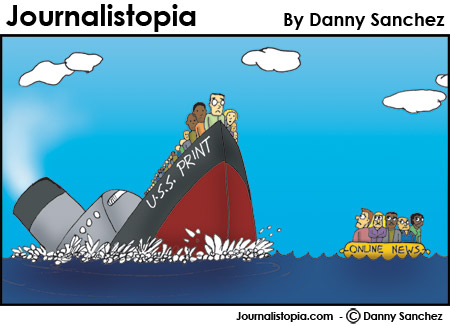
In some ways, mainstream media has behaved with the same kind of arrogance of those who built and operated RMS Titanic, and in this instance, the iceberg has already been spotted. At this stage, should MSM be re-arranging furniture on the ship’s deck — or discussing rescue plans?
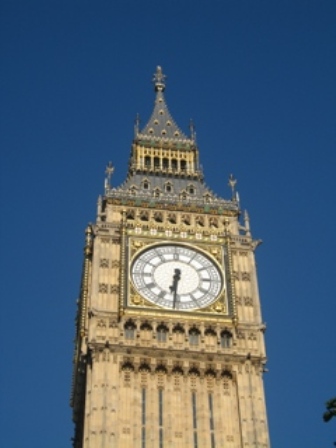
Big Ben at 150: Who'd build one like this today?When the maritime tragedy happened nearly a century ago, on 14 April 1912, it dominated headlines around the world for many days. But MSM was in such nascent stages at the time, newspapers being the sole dominant mass medium. Radio communication had just been discovered, but radio broadcasting still lay a few years in the future.
To adapt and survive, MSM can also learn from how other industries faced vast challenges. For example, take the time-keeper industry:
• A century ago: people had to go to a post office, railway station or another public place to find the time. Clock Towers and public clocks announced time for all.
• Then came personal clocks (elaborate time pieces) that the wealthy people carried around in pockets or handbags.
• This was followed by wrist watches – personalised, affordable and portable.
• Now, mobile phones tell us the date, time and lot else!
Clock tower makers went out of business, and no one misses them now. Watch makers have adapted with the times, and are still competing with mobile makers. The parallels with the media industry are clear enough.
Somebody writing as ‘Global1’ has commented about how the Titanic‘s Band played on to the very end (and went down playing). S/he asks: Could This Be Analogy To The Modern Day MSM? In this analogy, MSM is the band, and their ‘music’ is the news…
Incidentally, the centenary of the Titanic‘s sinking is coming up shortly, in 2012. It would be interesting to see how the MSM/Titanic analogy plays out in the next few years…
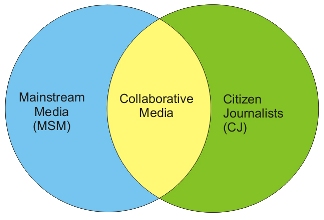
Can this common ground expand? Is there common ground between the mainstream media (MSM) and citizen journalists (CJ) that can be tapped to better serve the public interest?
MSM have gone from denial to dismissal to apprehension about this murky, distributed phenomenon called citizen journalists. But, as I asked, must MSM and CJ always compete? Must they consider each other mutually exclusive? I don’t think so.
Consider these facts: CJs are not an organised, unionised mass of people. They are a scattered, loosely connected group that is a community of practice across geographical borders and time zones. They rarely agree on anything among themselves. CJs are not out to topple MSM.
Once we get those points clarified, we can move beyond chest-thumping egotism. We can then address the fundamental values of why MSMs and CJs are both doing what they do: for the free flow of information, ideas and opinions.
Indeed, we should see how MSM and CJs can join hands more to serve the public interest. CJs today are not just frustrated poets and writers who never found a public outlet in the past. Today’s plethora of CJs include scientific experts, professionals, retirees with loads of experience and tech-savvy geeks among many others. This is a vast resource that MSM can tap into — especially in these days of leaner budgets and fewer staff.
Must everything be All-or-Nothing? No!And why not? Many issues these days are just too complex, technical or nuanced for even the most committed full-time, paid journalists to tackle all on their own. The information is often too vast to wade through in time for deadlines. And things are changing faster too. In such situations, can MSM work collaboratively with CJs, sharing the work load, risk and eventually, the credit?
In fact, MSM have historically relied on citizens to provide part of the content – whether they are letters to the editor, or funniest home videos, or news tips from the public that reporters then pursue. Today’s CJs can take this ‘crowd-sourcing’ to a new level.
I recently came across an interesting example of crowd-sourcing in investigative journalism – a component of journalism that is particularly demanding. Over several weeks in April – May 2009, The Telegraph in the UK disclosed the scandal over many exaggerated or false expense claims made by British Members of Parliament. This left the British public furious, and brought worldwide ridicule on the Mother of all Parliaments.
The story still unfolds. Now, The Guardian has involved readers to dig through the several truckloads of MPs’ expense documents to spot claims that merit further investigation because they seem…a tad suspicious. This is more than what a small team of paid journalists can do on their own: a total of 458,832 pages of documents need be manually checked. So far, 23,262 readers had signed up by 2 August 2009. Many hands make light work for The Guardian, whose editors will then decide which claims are to be further probed and queried.
Mobile: the most subversive ICT of all?Can we expect to see more of such collaborations in time to come? I certainly hope so. Under siege as they are, MSM should be the first one to make the move to search for this common ground – after all, they have everything to gain and little to lose. We can all think of tedious record-scanning, number-crunching tasks that are needed to unearth and/or understand complex stories of our times.
Of course, for such collaborations to work well, the rules of engagement between MSM and CJs need to be clear, transparent and based on mutual trust. That requires some work, but when it works well, everybody stands to gain.
In late 2005, I researched and worked with Sir Arthur C Clarke to write an essay on the rise of citizen journalists, which first appeared in the Indian news weekly Outlook on 17 October 2005. I’m quite proud of how we ended the essay: “There is more than just a generation gap that separates the mainstream media from the increasingly influential online media…Yet one thing is clear: the age of passive media consumption is fast drawing to an end. There will be no turning back on the road from Citizen Kane to citizen journalist.”
Emerging new models of collaboration in media and journalism indicate that this evolutionary road need not be a one-way street. So nearly four years on, I now raise the question that I first put to the media tycoons of Colombo the other day: Can Citizen Kane and Citizen Journalist join hands in the public interest?
I very much hope the answer is a resounding: Yes, We Can!
Who can crack this web 2.0 challenge? Image courtesy i4d magazineAs the 19th Century was drawing to a close, the newspaper publisher William Randolph Hearst (later immortalised in Citizen Kane) cabled a leading astronomer of the day: ‘Is there life on Mars? Please cable one thousand words’.
The scientist replied: ”Nobody knows” – written 500 times.
This would be my answer today, if a modern-day media tycoon were to ask me a different, yet equally compelling question: where are we headed with the bewildering developments in information and communication technologies, in which the mainstream media are a part?
So, with the Indian Ocean lashing gently on the rocky beach only a few feet away, and under the slightly bemused gaze of Sir Arthur, I took my audience on a quick and rough tour of the near future — the one no one about which nobody is an expert!
Here are some excerpts:
Two waves that started separately have combined to radically change how people generate, access, store and share information: the rolling out of broadband internet, and the phenomenal spread of mobile phones.
The headline figures are impressive. For the first time in history, we now have the technological means to quickly reach out to most of humanity:
• More than 4.1 billion mobile phones were in use by end 2008, a majority of them in the developing world.
• Nearly a quarter of the world population (over 1.5 billion people) has access to the web, at varying levels of bandwidth.
• Thousands of radio and TV channels saturate the airwaves – these still are the primary source of news and information for billions.
Where this growth in processing power and proliferation of devices might lead us, we can only guess — no one really knows. This can be both exhilarating for some — and very disconcerting for entities that were previously in control of the free flow of information, such as governments, academics – and dare I say it – the mainstream media!
Is that your final answer? Surely not...?They may not accept this, individual governments, and their collective known as the United Nations, don’t have full control over what is going on. But the ‘information genie’ is now firmly out of the bottle, and evolving by the day that it’s impossible to put it back inside. This is both fascinating and frightening.
If it offers any comfort, even big corporations like Microsoft, Apple or Google are all learning by doing. Everything seems to be permanently in experimental — or beta — mode…
What would emerge from the current chaos? The best brains on the planet are trying to come up with plausible answers.
There is talk about the ‘post-media age’. In the broadcast circles that I move in, they now acknowledge, quietly, that the post-broadcasting age is already dawning.
Is what we hear the death cry of the Old Order…or birth pangs of a new Information Society? Or perhaps both?
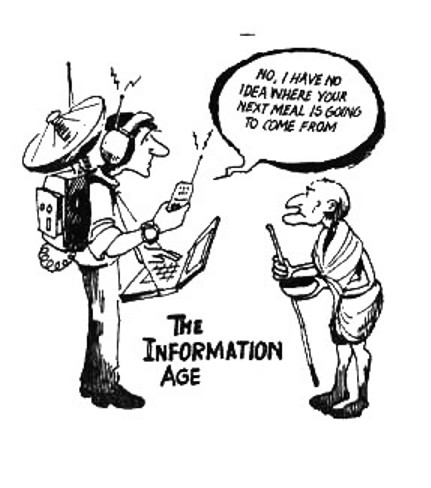
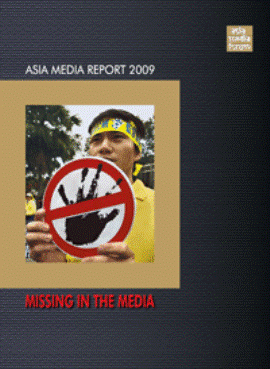
And how inclusive is that information society? As Asia Media Report 2009 reminds us, not everyone is invited to the party. Large sections of Asian society are left out.
But don’t expect such people to remain excluded for too long. Armed with mobile phones and other ICT tools, they are going to crash the party, whether we like it or not.
I have just been very lucky. I addressed a select gathering of media owners, publishers, editors and senior journalists — almost all of them working in the mainstream print or broadcast media in Sri Lanka — and virtually called them dinosaurs, and compared their industry to the supposedly unsinkable Titanic.
The nice people they all were, they actually let me get away with it! The occasion was the Sri Lanka launch of Asia Media Report 2009, held at the now-renovated Galle Face Hotel in Colombo.
Shining a light at a spot rarely probed...Coordinated, produced and published by the Asia Media Forum with the assistance of Actionaid, the report is a quick survey of the state of media in 20 Asian countries, written mostly by working journalists and broadcasters. It focuses on how the media throughout Asia reports on marginalised people and communities in their respective societies, from the very poorest countries to the richest.
‘Missing in the Media’ is the theme of Asia Media Report 2009, and I used this as the point of departure for my talk, illustrated with many cartoons some of which have appeared on this blog. I fully agreed with the editor and contributors of the report – six of whom I know – that there are many elements missing or lacking in Asia’s mainstream media today. But instead of adding to that list, I asked a more fundamental question: at a time when the mass media as we know it is under threat of mass extinction, how do we save and nurture at least a few good things that we hold dear?
In that process, I had to do some plain speaking and tell my audience that they cannot continue business as usual and expect to remain relevant, or even solvent for too long. I referred to the famous mediasaurus essay by Michael Crichton, and traced what happened since its appearance in 1993. I also compared the media’s arrogance to that of the Titanic‘s builders, who believed the ship was unsinkable.
I don’t do this kind of big picture talk too often, and mind my own business most of the time (which is a hands full these days). In fact, the last two occasions I spoke my mind to assorted worthies of the Sri Lankan media, the reaction was much harsher.
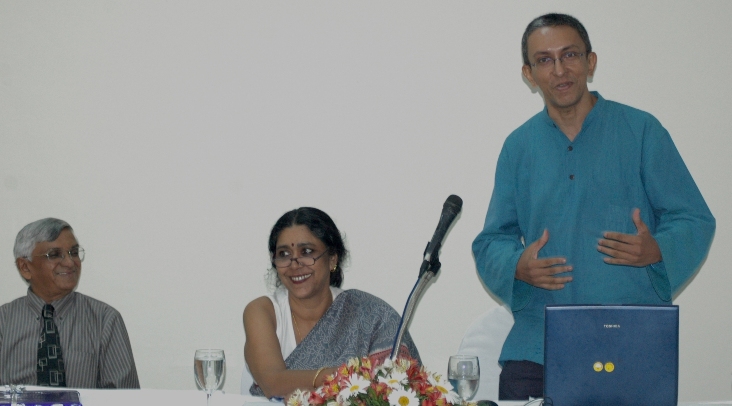
The Coming Ka-Boom? L to R: Vijitha Yapa and Sharmini Boyle seem to be amused as Nalaka Gunawardene speaksFirst was when I talked about the press freedom in the digital age to large gathering of Sri Lankan journalists and editors was the World Press Freedom Day Colombo observance in 2001. When I referred to the potential of new communications technologies – especially the (then still emergent) Internet and mobile phones – for safeguarding media freedoms, I was practically shouted down by a section of the audience. They felt I was talking about ‘western trends’ and ‘concerns too far removed from their bread-and-butter issues and survival issues’. Yet, the past few years have amply proved that if anything, I was too conservative in what I anticipated as technology’s role in promoting media freedom.
The second occasion was in mid 2004, when I was asked to speak at a Colombo meeting to mark the launch of a scholarly volume (in Sinhala) looking back at the first 25 years of television broadcasting in Sri Lanka. I was one of two dozen contributors, from diverse backgrounds of culture, science and journalism, who were brought together by the Catholic Media Centre of Sri Lanka which has a (secular) media monitoring programme. Having expressed my reflective views in the book chapter, in my speech I discussed my aspirations for the next 25 years — hoping there would be greater innovation and experimentation in an industry that seemed to be running short of both. This irked a certain local pioneer of television, who spoke after me and spent half of his given time attacking me personally and ideologically. Talk about pioneer’s syndrome. That definitely was a mediasaurus breathing fire, and I don’t want to meet one of these beasts on a dark night…
On both occasions, the event organisers apologised to me for the hostile reactions, but I was cool. By now, I’m used to reactions of all kinds in the public sphere. Given this history, yesterday’s encounter was far more reassuring that there still are good people even in an industry that is under siege in more ways than one.
I’m so fortunate to be welcomed by both media practitioners and media researchers across Asia. I’m no longer a card-carrying member of either group (if I ever was!), but I have great fun hobnobbing with both, occasionally telling them some home truths. This is what Irish journalist-cum-academic Conor Cruise O’Brien once called ‘having a foot in both graves’!
This multiple exposure image shows the various stages of the total solar eclipse in Baihata village, 30 kms from Guwahati, the capital city of the northeastern state of Assam on July 22, 2009. The longest solar eclipse of the 21st century cast a shadow over much of Asia, plunging hundreds of millions into darkness across the giant land masses of India and China. AFP PHOTO/ Biju BORO
This century’s longest solar eclipsed moved across Asia on 22 July 2009, wowing scientists and the public alike. Asia’s multifarious media covered the solar eclipse with great enthusiasm and from myriad locations across the vast continent.
The path of the eclipse’s totality –- where the sun was completely obscured by the Moon for a few astounding minutes –- started in northern India. It then crossed through Nepal, Bangladesh, Bhutan, Myanmar and China, before heading out to the Pacific Ocean. Those who were lucky enough to be at the right place at the right time saw one of Nature’s most spectacular phenomena. It was certainly a sight to behold, capture on film, and cherish for a lifetime.
But many along the path missed this chance as clouds obscured the Sun. It’s the rainy season in much of Asia, where the delayed monsoon is finally delivering much-needed rain.
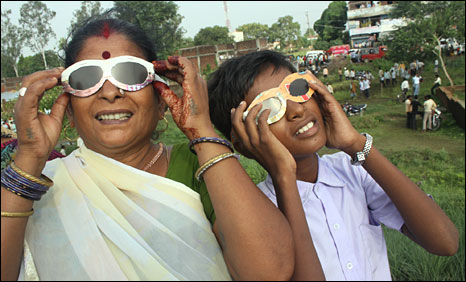
Eclipse watching in Taregna, Bihar, India - Photo: Prashant Ravi, BBC OnlineThat’s what happened in Taregna, in the eastern Indian state of Bihar. The media had dubbed it the ‘epicentre’ of the solar eclipse, and estimated totality to be visible for at least three minutes and 38 seconds. Thousands who flocked to the village were disappointed when the clouds refused to budge. Nature doesn’t follow our scripts.
That didn’t deter some affluent Indians -– if the eclipse won’t come to them, they just went after it. They chartered an airplane to fly above the rain clouds to catch the once-in-a-lifetime eclipse. Each seat cost US Dollars 1,650.
It’s rarely that totality crosses through countries with such high human numbers as China and India. This time around, millions of people and thousands of journalists took advantage.
Some travelled long distances hoping to get the best view from the 200-km wide path of totality. Others watched it one of Asia’s many and cacophonous 24/7 TV news channels. The event had all the elements of a perfect television story: mass anticipation, eager experts and enthusiasts, occasional superstitions, uncertainties of weather and, finally, a stunning display of Nature’s raw power.
‘Darkness at Dawn!’ screamed a popular headline, referring to the eclipse causing a sudden ‘nightfall’ after the day had begun. Other superlatives like ‘Spectacle of the century’ and ‘A sight never to be missed’ were also widely used.
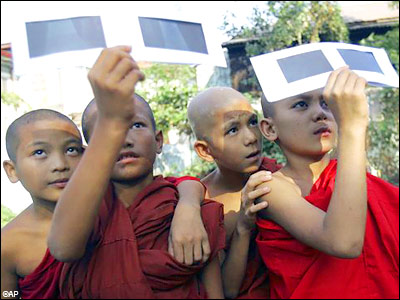
Myanmar Buddhist novices watch solar eclipse through the filters, in Yangon, MyanmarSolar eclipses are indeed a marvel of Nature, and the media’s excitement was justified. For once, it was good to see them devoting a great deal of airtime and print/web space for something that was not violent, depressing or life-threatening.
How I wish Asia’s media took as much interest in another kind of ‘eclipse’ that surrounds and engulfs us! One that does not end in minutes, but lasts for years or decades, and condemns millions to lives of misery and squalor.
Stories of poverty, social disparity and economic marginalisation are increasingly ‘eclipsed’ in Asia by stories of the region’s growing economic and geopolitical might.
The mainstream media in Asia –- as well as many outlets in the West — never seem to tire of carrying reports of Asia rising. Indeed, that is a Big Story of our times: many Asian economies have been growing for years at impressive rates. Thanks to this, over 250 million Asians have moved out of poverty during this decade alone. According to the UN’s Asian arm ESCAP, this is the fastest poverty reduction progress in history.
We see evidence of increased prosperity and higher incomes in many parts of developing Asia. Gadgets and gizmos –- from MP3 to mobile phones — sell like hot cakes. More Asians are travelling for leisure than ever before, crowding our roads, trains and skies. Lifestyle industries never had it so good. Even the current recession hasn’t fully dampened this spending spree.
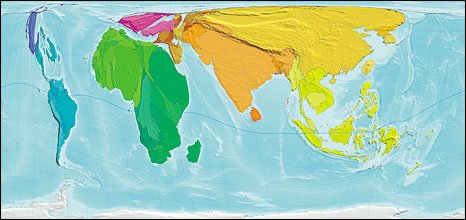
World map proportionate to number of poor people in each country/region - from Atlas of the Real World
But not everyone is invited to the party. Tens of millions of people are being left behind. Many others barely manage to keep up -– they must keep running fast just to stay in the same place.
National governments, anxious to impress their own voters and foreign investors, often gloss over these disparities. The poor don’t get more than a token nod in Davos. National statistical averages of our countries miss out on the deprivations of significant pockets of population.
On the whole, the UN cautions that the Asia Pacific region is in danger of missing out the 2015 target date for most Millennium Development Goals – the time-bound and measurable targets for socio-economic advancement that national leaders committed to in 2000.
The plight of marginalised groups is ignored or under-reported by the cheer-leading media. For the most part, these stories remain forever eclipsed. Except, that is, when frustrations accumulate and blow up as social unrest, political violence or terrorism. Even then, the media’s coverage is largely confined to reporting the symptoms rather than the underlying social maladies.
Indonesian children look up through x-ray film sheets to watch a solar eclipse in the sky in Anyer Beach, Banten province, Indonesia“Half the children in South Asia go to bed hungry every night, but the covers of our news magazines are about weight loss parlors,” says Kunda Dixit, Chief Editor of The Nepali Times.
As he noted in a recent essay: “Maternal mortality in parts of Nepal is nearly at sub-Saharan levels, but we are obsessed with politics. Hundreds of cotton farmers in India commit suicide every year because of indebtedness, but the media don’t want to cover it because depressing news puts off advertisers. Reading the region’s newspapers, you would be hard-pressed to find coverage of these slow emergencies.”
P N Vasanti, Director of the Delhi-based Centre for Media Studies which monitors the leading newspapers and news channels in India, laments how “development” issues such as health, agriculture and education are not even on the radar of popular news sources. Her conclusion is based on a content analysis of the six major Indian news channels during the run-up to the recent general election in India.
I have come across similar apathy in my travels across Asia trying to enhance television broadcasters’ coverage of development and poverty issues. As one Singaporean broadcast manager, running a news and entertainment channel in a developing country, told me: “I don’t ever want to show poor people on my channel.”
Don’t get me wrong. Trained as a science journalist, I can fully appreciate the awe and wonder of a solar eclipse. For years, I have cheered public-spirited scientists who join hands with the media to inform and educate the public on facts and fallacies surrounding these celestial events.
But there are more things in heaven and earth, than are dreamt of in our mainstream media’s breathless coverage of the march of capital. Journalists and their gate-keepers should look around harder for the many stories that stay eclipsed for too long.
News by definition looks for the exception. What goes right, and according to plan, is hardly news. Deviations, aberrations and accidents hit the news.
It’s the same with disasters. Reducing a hazard or averting a disaster does not make the news; when that hazard turns into a disaster, that typically tops the news. Yet, as we discussed during a session at the 6th World Conference of Science Journalists held in London from June 30 – July 2, 2009, both aspects are important — and both present many challenges to journalists and the media.
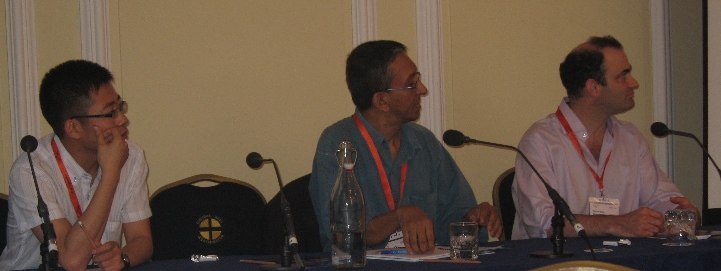
The session, titled Covering a disaster from Sichuan to Sri Lanka, saw three science journalists share their own experiences and insights in covering two major disasters in Asia. Richard Stone (Asia News Editor, Science) and Hujun Li (senior science writer with Caijing magazine, China) both spoke about covering the Sichuan earthquake that occurred on 12 May 2008. I spoke on my experiences in covering the Indian Ocean tsunami of 26 December 2004. The session was chaired by the veteran (and affable) British journalist Tim Radford, who has been The Guardian‘s arts editor, literary editor and science editor.
Covering a disaster from Sichuan to Sri Lanka: L to R: Hujun Li, Nalaka Gunawardene and Richard StoneI recalled the post-tsunami media coverage in two phases — breaking news phase (first 7 – 10 days) and the aftermath, which lasted for months. When the news broke on a lazy Sunday morning, ‘Tsunami’ was a completely alien term for most media professionals in Sri Lanka. In newspaper offices, as well as radio and TV studios, journalists suddenly had to explain to their audiences what had happened, where and how. This required journalists to quickly educate themselves, and track down geologists and oceanographers to obtain expert interpretation of the unfolding events. We than had to distill it in non-technical terms for our audiences.
My involvement in this phase was as a regular ‘TV pundit’ and commentator on live TV broadcasts of MTV Channels, Sri Lanka’s largest and most popular broadcast network. Night after night on live TV, we talked about the basics of tsunami and earthquakes, and summed up the latest information on what had taken place. We also acknowledged the limits of science -– for example, despite advances in science and technology, there still was no way of predicting earthquakes in advance.
One question we simply couldn’t answer was frequently raised by thousands of people who lost their loved ones or homes: why did it happen now, here — and to us? Was it an act of God? Was it mass scale karma? As science journalists, we didn’t want to get into these debates — we had to be sensitive when public emotions were running high.
There were enough topics during the breaking news phase that had a scientific angle. Clinically cold as it sounded, the mass deaths required the safe, proper and fast burial of bodies with identities established. The survivors had to be provided shelter, food, safe drinking water and counselling. And when rumours were spreading on the possibility of further tsunamis, both officials and public needed credible information from trusted, competent sources.
Tsunami waves lashing Kalutara beach on western Sri Lanka on 26 December 2004: satellite image courtesy DigitalGlobe Quickbird satellite, http://www.digitalglobe.com
After the breaking news phase passed, we had more time to pursue specific stories and angles related to the tsunami. As an environmentally sensitive journalist, I was naturally interested in how the killer waves had impacted coastal ecosystems. Then I heard some interesting news reports – on how some elements of Nature had buffered certain locations from Nature’s own fury.
Within days, such news emerged from almost all Tsunami-affected countries. They talked about how coral reefs, mangroves and sand dunes had helped protect some communities or resorts by acting as ‘natural barriers’ against the Tsunami waves. These had not only saved many lives but, in some cases, also reduced property damage. Scientists already knew about this phenomenon, called the ‘greenbelt effect’. Mangroves, coral reefs and sand dunes may not fully block out tsunamis or cyclones, but they can often reduce their impact.
Researching this led to the production of TVE Asia Pacific‘s regional TV series called The Greenbelt Reports, which was filmed at a dozen tsunami impacted locations in South and Southeast Asia. By the time we released the series in December 2006, sufficient time had passed for the affected countries to derive environmental lessons of the tsunami.
The other big story I closely followed was on early warnings for rapid on-set disasters like tsunamis. Some believed that the tsunami caught Indian Ocean rim countries entirely by surprise, but that wasn’t quite true. While the countries of South and Southeast Asia were largely unprepared to act on the tsunami, the Pacific Tsunami Warning Centre (PTWC) in Hawaii, who had detected the extraordinary seismic activity, did issued a tsunami warning one hour after the undersea quake off western Sumatra. This was received at Sri Lanka’s government-run seismological centre in good time, but went unheeded: no one reacted with the swiftness such information warranted. Had a local warning been issued, timely coastal evacuation could have saved thousands.
All this shows the many and varied science or development stories that journalists can find in the aftermath of disasters. Some of these are obvious and widely covered. Others need to be unearthed and researched involving months of hard work and considerable resources. Revisiting the scenes of disasters, and talking to the affected people weeks or months after the event, often brings up new dimensions and insights.
My own advice to science journalists was that they should leave the strictly political stories to general news reporters, and instead concentrate on the more technical or less self-evident facets in a disaster. During discussion, senior journalist Daniel Nelson suggested that all disaster stories are inherently political as they deal with social disparities and inequalities. I fully agreed that a strict separation of such social issues and science stories wasn’t possible or desirable. However, science journalists are well equipped to sniff out stories that aren’t obviously covered by all members of the media pack that descends on Ground Zero. Someone needs to go beyond body counts and aid appeals to ask the hard questions.
As Hujun Li said recalling the post-Sichuan quake experience, “Politics and science are like twins – we can’t separate the two. What we as science journalists can do is to gather scientific evidence and opinion before we critique official policies or practices.”
Another question we were asked was how journalists can deal with emotions when they are surrounded by so much death and destruction in disaster scenes. Reference was made to trauma that some reporters experience in such situations.
I said: “We are human beings first and journalists next, so it’s entirely normal for us to be affected by what is happening all around us. On more than one occasion in the days following the tsunami, I spoke on live television with a lump in my throat; I know of presenters who broke down on the air when emotions overwhelmed them.”
And now...the sequelsSumming up, Tim Radford emphasized the need for the media to take more interest in Disaster Risk Reduction (DRR), which basically means preventing disasters or minimising the effects of disasters.
“DRR is perhaps less ‘sexy’ for the media, as it involves lots of policies and practices sustained over time,” he said. “But the potential to do public good through these interventions is enormous.”
As Tim reminded us, disasters already exact a terrible and enduring toll on the poorest countries. This is set to get worse as human numbers increase and climate change causes extreme weather and creates other adverse impacts. Living with climate change would require sustained investments in DRR at every level.
The stories are out there to be captured, analysed and communicated. In the coming years, the best stories may well turn out to be on disasters averted or minimised
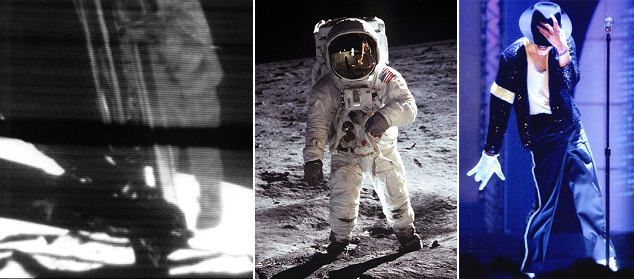
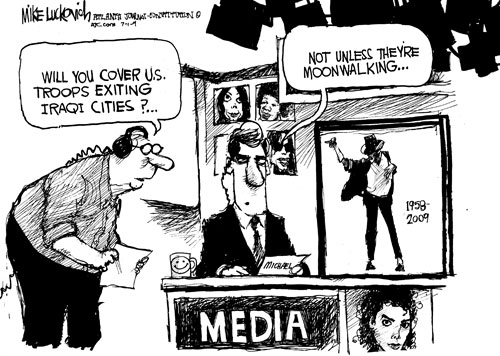
While Apollo astronauts conquered the Moon, Michael Jackson took over the Earth...
What a pity that Michael Jackson missed the 40th anniversary of the first Apollo moonwalk by only a few weeks.
He was only 10 when Apollo 11’s Neil Armstrong took that historic first lunar step on July 20, 1969 and was probably among the 500 million people — the largest TV audience the world had known at that time — who watched it live. Fourteen years later, Jackson would invent his own kind of ‘moonwalk’.
First performed for his song ‘Billie Jean’ on a U.S. TV show in March 1983, Jackson’s dance technique that gives the illusion of the dancer stepping forward while actually moving backward gained worldwide popularity and became his signature move.
Like that historic ‘moonwalk’ 40 years ago, Jackson’s untimely death on June 25, 2009 created ripples that was felt worldwide. News of his sudden death crashed some news or social networking websites, and stalled others. Even the mighty Google, now the world’s largest media operation, slowed down; Google News was inaccessible for a while.
This is the opening of my latest op ed essay, inspired by the media and public reactions to Michael Jackson’s sudden death. Titled ‘King of Pop Moonwalks to Online Immortality’, it has just been published by the Asian Media Forum website.
I must admit that I’m more a fan of the original Apollo moonwalk than Michael’s version. I was three and a half years when the first Moon landing happened, which remains my earliest childhood memory that can be traced to a specific date.
I look back at how these twin technologies transformed far-away Jackson into a local icon across Asia. I also recall a 2001 documentary named Michael Jackson Comes to Manikganj. Directed by Indian journalist Nupur Basu, it probed how far and wide satellite television was influencing and impacting culture, society and even politics of South Asia. (Full disclosure: I was interviewed on the film, along with nearly two dozen other South Asians.)
The essay ends noting how Jackson could not quite ride the Internet wave the way he did the satellite TV wave. I share my thoughts on how the world’s online population — now over 1.5 billion people according to one estimate — reacted to the news that King of Pop was no more.
The news created a data tsunami of its own on the web, which incidentally – and half the world away – provided a much need respite for the Ayatollahs of Iran…Read the full essay and find out why!








 Open Minds!