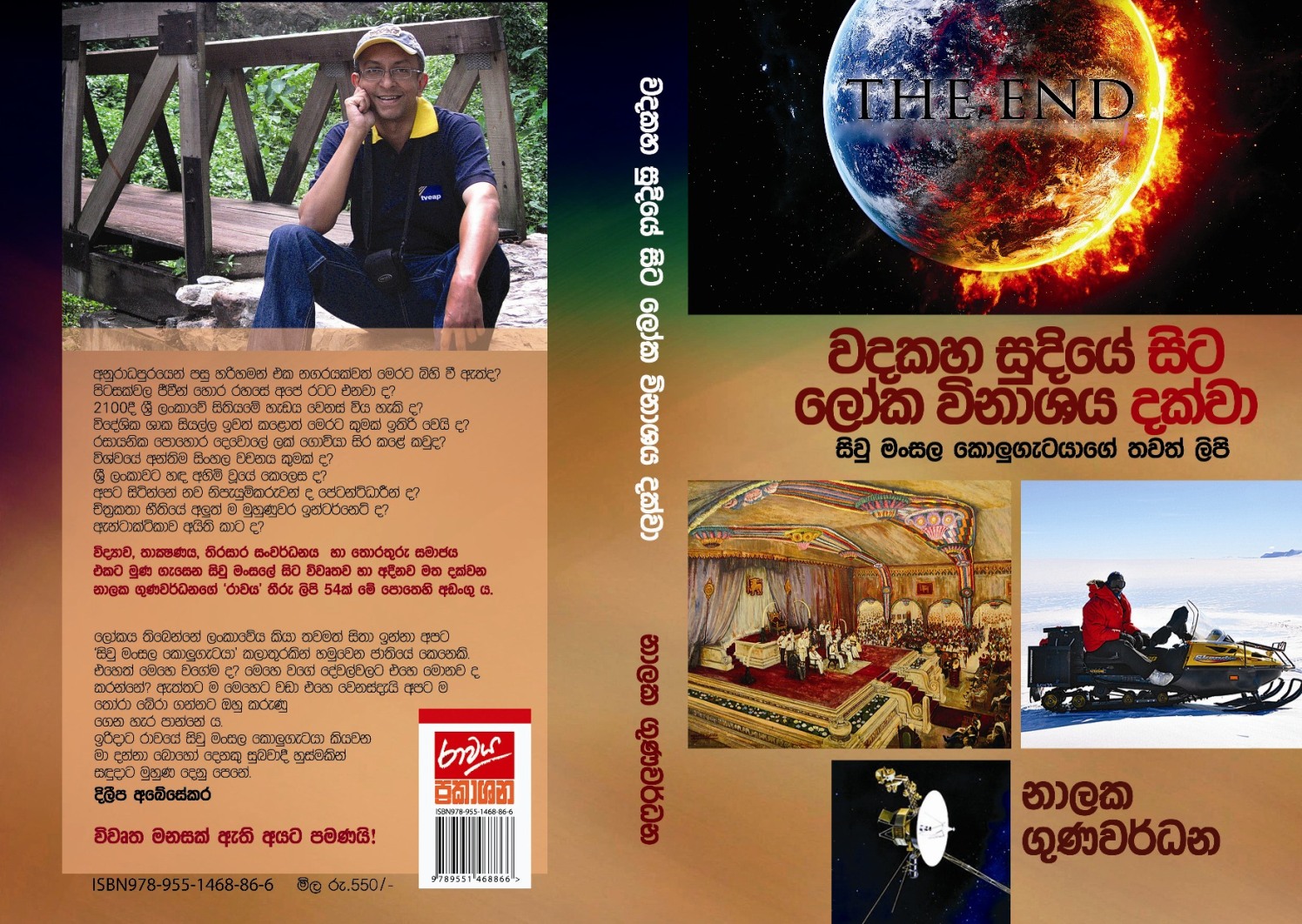
Cover of Sivu Mansala Kolu Getaya Book 2 by Nalaka Gunawardene, pub Sep 2013
PROMO NOTE FOR MY LATEST BOOK:
Science writer Nalaka Gunawardene’s latest Sinhala book, Wada Kaha Sudiye Sita Loka Winashaya Dakwa, will be released at the Colombo International Book Fair that starts on 14 September 2013.
Through 54 columns, the book offers personalised insights and non-technical analysis related many current issues and topics in science, technology, sustainable development and information society in the Lankan context. It is written in an easy, conversational Sinhala style rich in metaphor and analogy.
In particular, this collection probes how and why Lankan society is increasingly prone to peddling conspiracy theories without critical examination or rational discussion. From astrological hype linked to end of the world in 2012 to claims of mass poisoning via agrochemicals, Nalaka seeks to separate facts from hype, conjecture and myth.
The book defies easy categorisation, as it covers topics as diverse as alternative histories, agrochemical misuse, disaster management, Internet censorship, Antarctic exploration, asteroid impacts, cricket history and road safety.
“I seem to have outgrown the neat label of science writer,” says Nalaka. “Indeed, the very title of my column suggests how I sit at the intersection (or confluence) of science, development, mass media and information society. From that point, I explore tensions between modernity and tradition — and ask more questions than I can easily answer!”
In his quest for clarity and reason, Nalaka talks to researchers, activists and officials. He also draws on his many experiences and global travels as a journalist, TV producer and development communicator.
The 340-page book is priced at Rs. 550. It will be available from leading bookstores, and at special discounts from the Ravaya booth during the Colombo Book Fair.
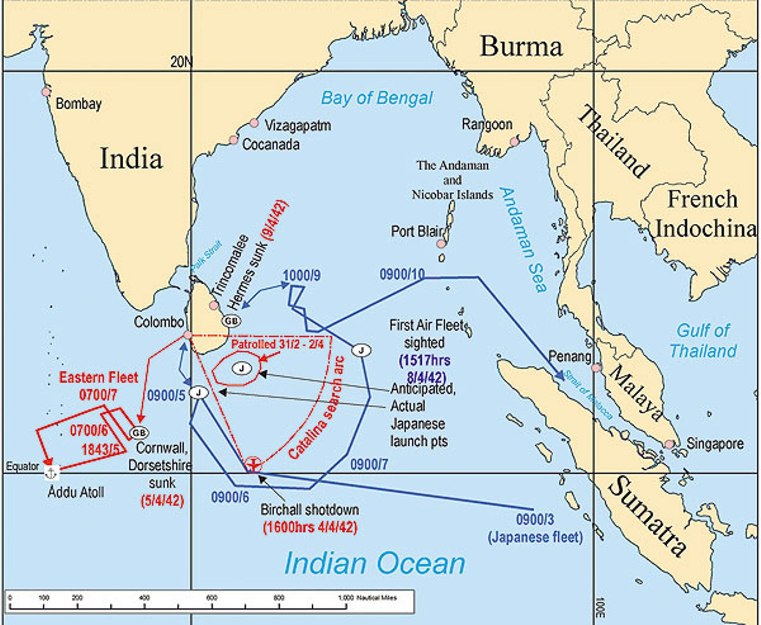
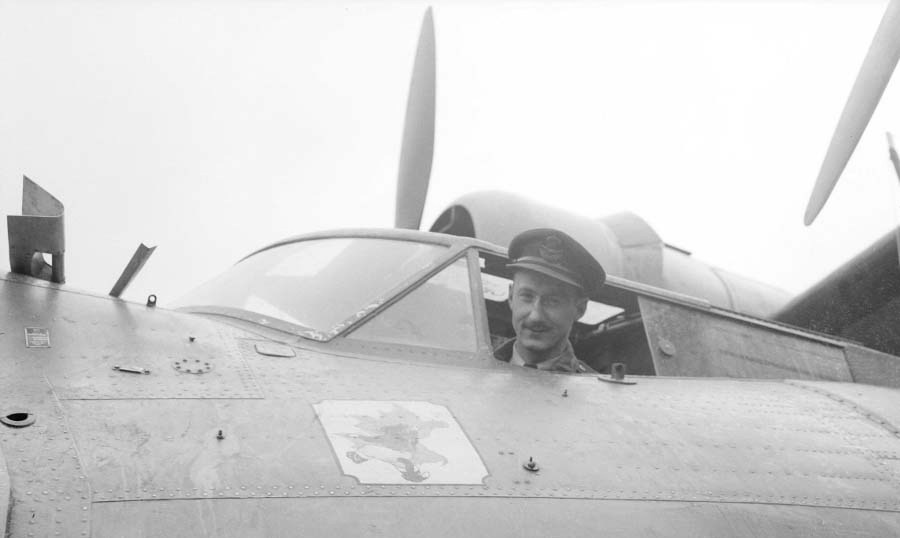
I speculate WHAT IF there was a different outcome of the Battle of Ceylon, or the Easter Sunday Japanese air raid of Ceylon on 5 April 1942, exactly 119 days after the Pearl Harbour attack in Hawaii?
What if Ceylon fell to Japanese rule, just like Burma, Malaya and Singapore did? How might that have changed the course of World War Two, and the future of the then British colony of Ceylon?
This is the Sinhala text of my Ravaya Sunday column published in their issue for 8 April 2012. My theme this week is the Battle of Ceylon, or the Easter Sunday Japanese air raid of Ceylon that took place 70 years ago this week.
End note: While researching for my Sunday column, I stumbled upon two other interesting short video clips on this aspect of the Second World War. They are both computer-generated scenarios, but well made. Despite some minor historical inaccuracies, they illustrate the rich story-telling potential of this vignette of history, largely overlooked by mainstream movie makers.
This is the Sinhala text of my Sunday column in Ravaya newspaper, 1 April 2012.
Facing an electricity generation crisis, Sri Lanka has embarked on a countrywide energy conservation drive — urging everyone to switch off all non-essential lights, and reduce other forms of power consumption.
Beyond these important yet token gestures, are there smart options that can save significant quantities of electricity, 85% of which is now generated in Sri Lanka using imported, costly fossil fuels?
Yes, there is one: advance the clock by half an hour. Faced with power crises in the past, governments did this in the 1990s — and with tangible results. This is evidence based policy and action. But a vocal minority in Lanka resented this progressive move all along, and in April 2006, they successfully lobbied the (current) government to revert Sri Lanka’s standard time to GMT+5:30 from GMT+6 which had been used since 1996.
I wrote about Sri Lanka giving up on Daylight Saving time in April 2006 in this SciDev.Net opinion essay: Science loses in Sri Lanka’s debate on standard time. As I noted: “In doing so, the government completely ignored expert views of scientists and intellectuals. It listened instead to a vocal minority of nationalists, astrologers and Buddhist monks who had lobbied the newly elected president to ‘restore the clock to original Sri Lankan time’.”
In this week’s Sunday column, published in Ravaya newspaper of 18 March 2012, I take a critical look at the mounting hype and hysteria about the world ending in December 2012.
The Wikipedia describes the ‘2012 phenomenon’ as comprising a range of eschatological beliefs according to which cataclysmic or transformative events will occur on 21 December 2012. In reality, it’s a blockbuster Hollywood movie, rather than any ancient prophecy, that triggered this wave of public concern!
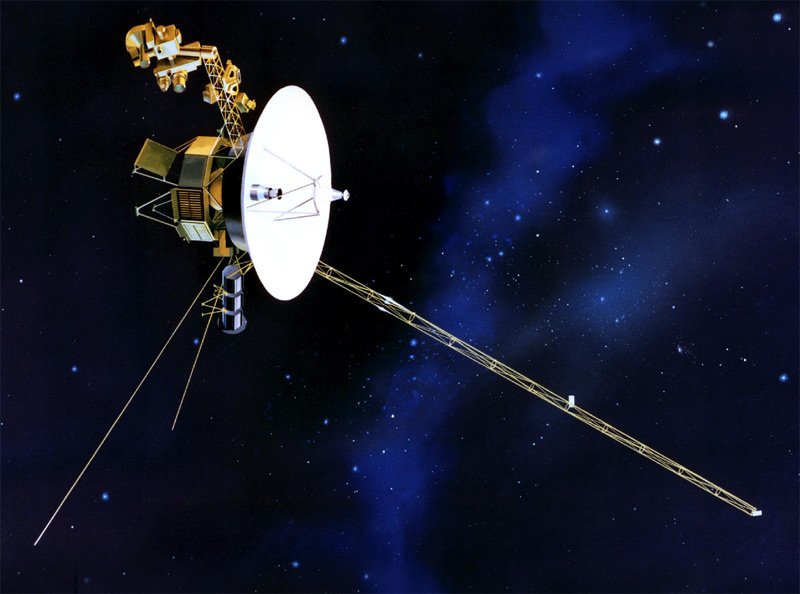
This is the Sinhala text of my Ravaya newspaper column published on 4 March 2012. Today, I talk about the gold-plated disk containing sounds and images of our Earth that was sent to the universe with Voyager 1 and 2 spacecraft launched by NASA in mid 1977.
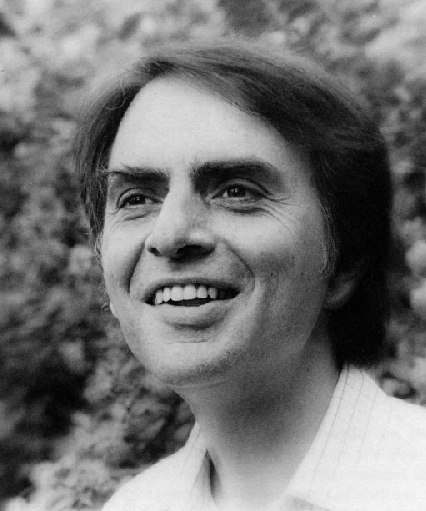
In particular, I look at how a Sinhala language greeting was included on it, and thank Cornell University and project leader astronomer Carl Sagan for keeping it entirely a scholarly effort with nothing official about it. Thank you, Carl, for keeping the babus out of humanity’s ‘message in a bottle’ sent adrift to the depths of space.
This is my weekly Sinhala language column published in Ravaya Sunday newspaper dated 26 Feb 2012. In this, I explore some of the many fascinating insights into how Lankans live and work, as revealed by the Household Income and Expenditure Survey 2009/10 conducted by the Department of Census and Statistics, Sri Lanka. It was based on a large, countrywide sample of 22,500 households and conducted over a 12-month period in 2009-2010.
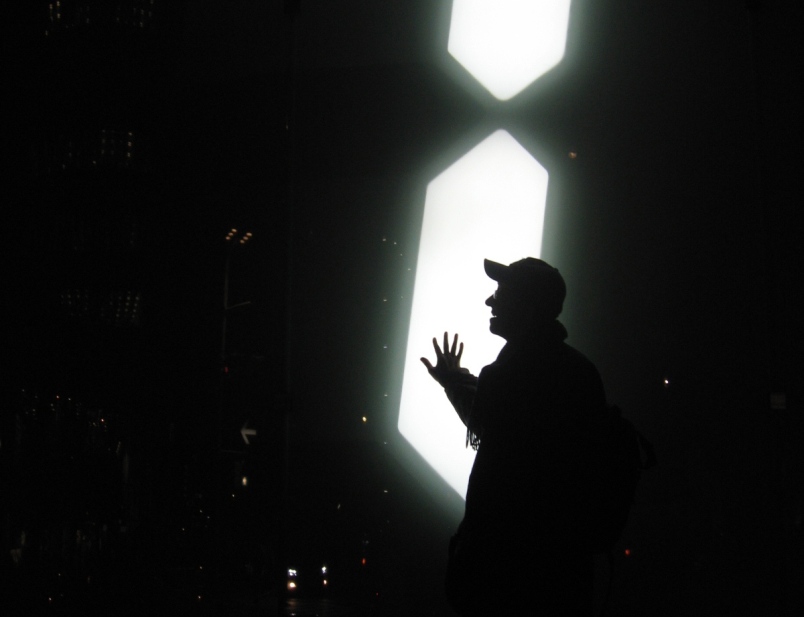
Nalaka G at a giant digital clock in Tokyo: Wandering everywhere with a sense of wonder...
This is the Sinhala text of my weekly column published in Ravaya newspaper for 5 February 2012. Here, I look back at one year of weekly columns and reflect on some reader feedback and their participation in my efforts to make sense of the world in turmoil that is all around me. I say ‘Thank You’ to the few writer friends and public intellectuals who have advised and guided me. I reaffirm my commitment to keep asking questions, connecting dots and following my own simple language style with none of the intellectual pretensions common in Sinhala newspaper writing.
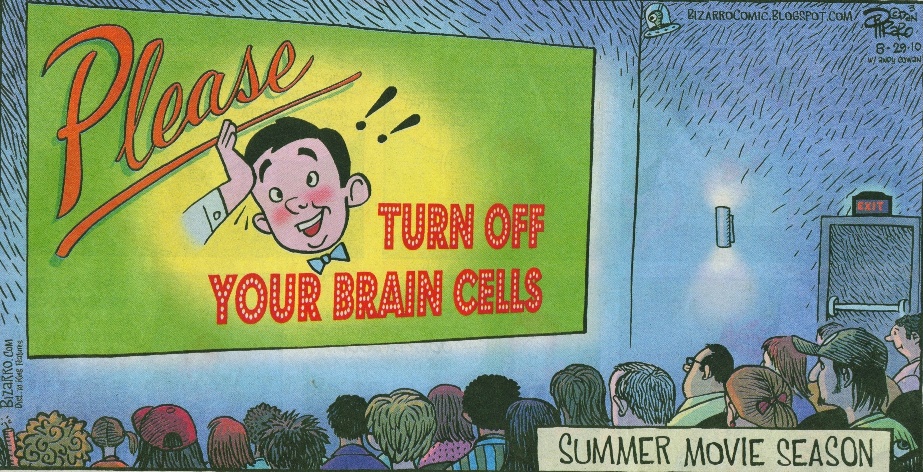
Is this the message that should be displayed at the entrance of some media and public institutions in Sri Lanka? In this latest Sunday column, appearing in Ravaya newspaper of 29 January 2012, I make a tongue-in-cheek suggestion for doing so. This is entirely justified given how much of superstition, half-baked stories and mind-rotting nonsense that a gullible public seems to lap up with little critical examination.
This week I continue what I started last week discussing challenges faced by rationalists in today’s Sri Lanka, a land under siege by dogma, charlatans and religious fanatics all of who operate with impunity, claiming ‘sacred cow’ status under various labels of religion, indigenous knowledge or national heritage.
Once again I pay tribute to the late Dr Abraham Thomas Kovoor (1898 – 1978), a Kerala-born science teacher who settled down in newly independent Ceylon and, after his retirement in 1959, took to investigating so-called supernatural phenomena and paranormal practices. Kovoor’s successors today have more communications tools and platforms than ever before, but find that charlatans have mastered many of them for hoodwinking the public…
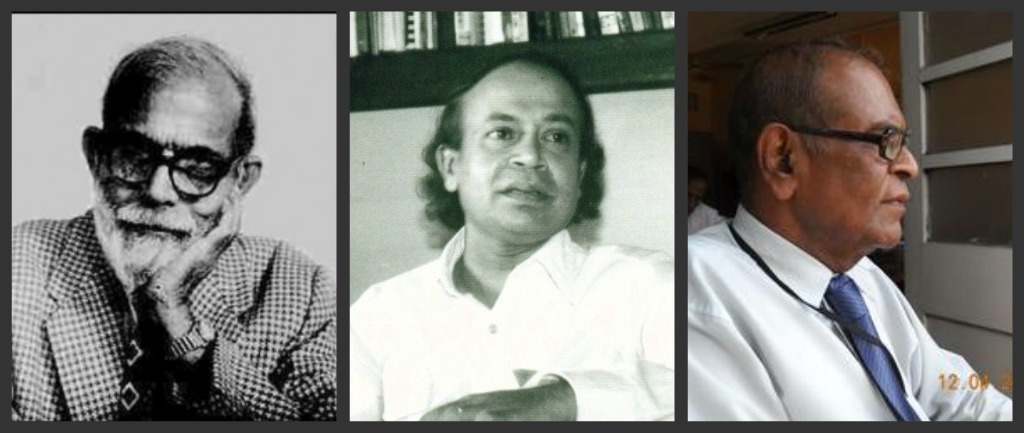
Keepers of Rationalist Flame L to R - Abraham Kovoor, Carlo Fonseka, Dharmapala Senaratne
Assorted charlatans and religious zealots across the island of Sri Lanka must have heaved a collective sigh of relief when they heard that Dharmapala Senaratne was no more. He had made it his business to make life difficult for those preying on the gullible public. Dharmapala was President of the Sri Lanka Rationalist Association (SLRA), a small group of earnestly sceptical enquirers who won’t take anyone’s word about anything. They want to investigate and debate.
The voluntary group was originally set up in 1960 by the late Dr Abraham Thomas Kovoor (1898 – 1978), a Kerala-born science teacher who settled down in newly independent Ceylon and, after his retirement in 1959, took to investigating so-called supernatural phenomena and paranormal practices. He found adequate physical or psychological explanations for almost all of them. In that process, he exposed many so-called ‘god men’ and black magicians who thrive on people’s misery and superstitions.
My column (in Sinhala) for Ravaya newspaper on 22 Jan 2012 is an exploration of the many challenges that rationalists and free thinkers face in today’s Sri Lanka. It’s also a critique of our mainstream media, where space/time for open discussion and debate today is LESS than what it was a generation ago — despite the channel explosion and proliferation of print publications.




 Open Minds!