Malima (New Directions in Innovation) is a Sinhala language TV series on science, technology and innovation. This episode was produced and first broadcast by Sri Lanka’s Rupavahini TV channel on 26 July 2012.
Produced by Suminda Thilakasena and hosted by science writer Nalaka Gunawardene, this episode features the following items:
• An interview with K M Wijepala, proprietor of Wijaya Agro Products in Nuwara Eliya, Sri Lanka, who has developed an entirely organic, liquid fertilizer as a substitute for imported, costly chemical fertilizers. Named GOLF (Gold Organic Lanka Fertilizer), it provides all required nutrients for all kinds of crops according to the innovator. Already patented in Sri Lanka, GOLF’s efficacy has been tested and confirmed by the state’s Tea Research Institute (TRI) and Industrial Technology Institute (ITI). Wijepala, a former field officer of the Department of Agriculture, is giving the recipe away to his fellow farmers as his contribution to a chemicals-free future for agriculture. In his view, the only ‘obstacle’ standing in the way of popularising this indigenous, low-cost fertilizer is the huge state subsidy given to imported chemical fertilizers. GOLF sells at one fifth of the real cost of chemical fertilizers but the 90% subsidy distorts the market. As long as the subsidy continues, farmers will have no interest or incentive in looking at any alternatives.
• An interview with young inventor Samali Gunasekera, a Grade 13 student at Bomiriya Central College, Kaduwala, Sri Lanka, who has designed a multipurpose helping handle for the kitchen. It helps raise cooking vessels, kettles and other utensils; it is also fitted with a spoon. This handle can make life easier for everyone including those with disabilities.
Text of my ‘When Worlds Collide’ column published in Ceylon Today Sunday newspaper on 19 August 2012
Much of Sri Lanka’s Dry Zone is currently grappling with a drought caused by the delayed Monsoon. This is a double whammy for residents in several districts who have been engulfed by another ‘slow emergency’ for nearly two decades: mass scale kidney failure affecting large numbers.
Diabetes or high blood pressure can lead to kidney failure. But beginning in the 1990s, thousands of people in the North Central Province (NCP) developed the condition without having either factor – mostly farmer men.
In this week’s Ravaya column (in Sinhala), I look back at the scientific, legal and policy struggles in Sri Lanka that finally god rid of lead additives in petrol (gasoline) in 2002. It is a success story in safeguarding public health and combating environmental pollution that holds valuable lessons in a new challenge that confronts us: how to reduce sulphur content in the diesel distributed in Sri Lanka that currently contains one of the highest sulphur levels in Asia. This is now urgent and important with WHO confirming diesel fumes cause lung causer.
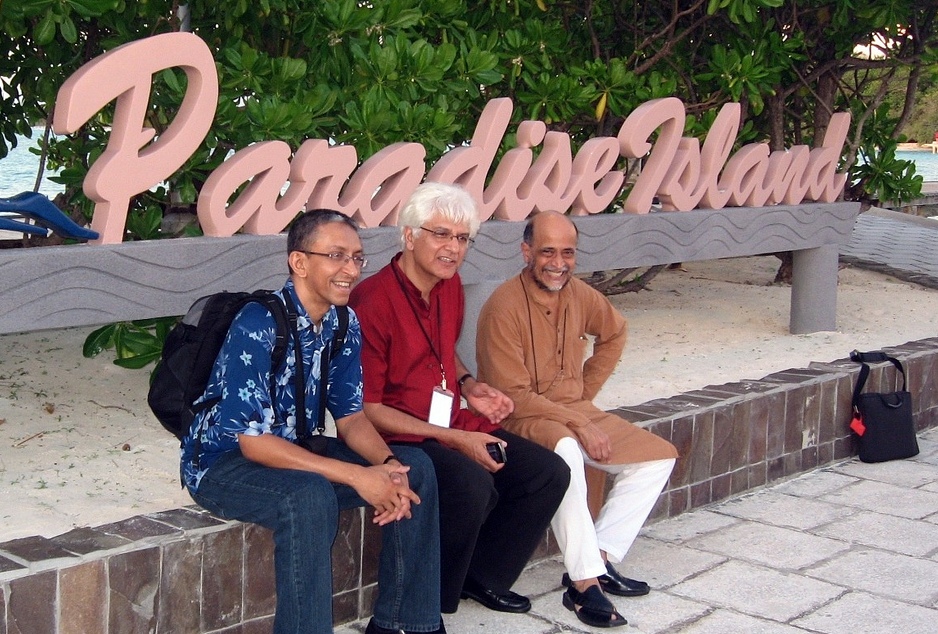
To keep up with the silly season, here’s another photo taken in July 2011 in…well, read the sign behind us.
Waiting to be let in – surely they know our bylines? L to R – Nalaka Gunawardene, Kunda Dixit, Darryl D’Monte – Maldives, May 2011
PS: It’s actually in the Maldives, where fellow journalists Kunda Dixit, Darryl D’Monte and I were working hard to earn an honest living at a regional meeting on ozone and climate. Yes, we were let in — and we liked the salubrious settings…
L to R – Nalaka Gunawardene, Darryl D’Monte & Kunda Dixit in Paradise, May 2011
Text of my ‘When Worlds Collide’ column published in Ceylon Today Sunday newspaper on 12 August 2012
Ran Muthu Duwa (Island of Treasures), the first colour Sinhala feature film made in Sri Lanka, was released exactly 50 years ago this week, on 10 August 1962.
Ran Muthu Duwa was a trail-blazer in the Lankan cinema industry in many respects. It not only introduced colour to our movies, but also showed for the first time the underwater wonders of the seas around the island.
It was different from many formulaic Sinhala films made since 1947, and included elements of underwater treasure, ancient legends, human treachery and, predictably, some romance. It may not have been great art but was a box office hit. An estimated one million people saw it during the first release: a tenth of the island’s then population.
But the cultural influence of the film went well beyond…
This is the (Sinhala) text of my Sunday column in Ravaya newspaper on 5 August 2012. This week, I trace the moving images coverage of the Olympics, from the early days of cinema to the modern instantaneous live coverage that makes the whole world watch the Games as they unfold.
Text of my ‘When Worlds Collide’ column published in Ceylon Today Sunday newspaper on 5 August 2012
“All the world is a quiz, and all the men and women merely players.”
That’s how the late Magnús Magnússon, host of BBC television’s long-running quiz Mastermind, once summed up his line of work. He believed that everything in the world was matter for a quiz. As a quizmaster for over two decades, I heartily agree!
Quizzing, also known as general knowledge (GK), is an established mind sport where players engage in a friendly tussle using quick wits and sharp memories. In recent years, it has evolved its own world body and global rankings.
The origins of quizzing go back to ‘pub quizzes’ – the impromptu testing of trivial (mostly sporting) knowledge over a drink in that quintessentially British setting for socialising. Bar tenders often had to arbitrate…
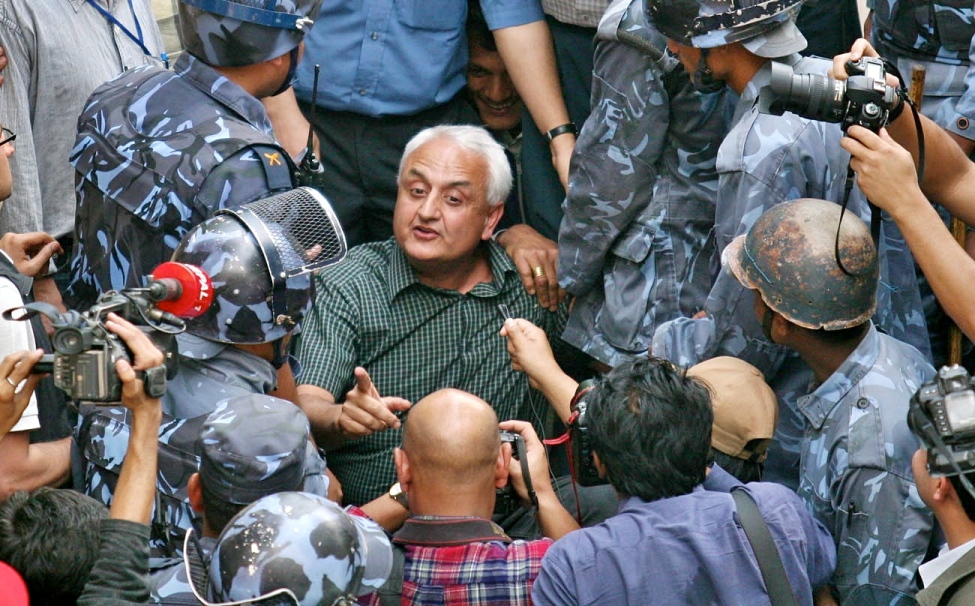
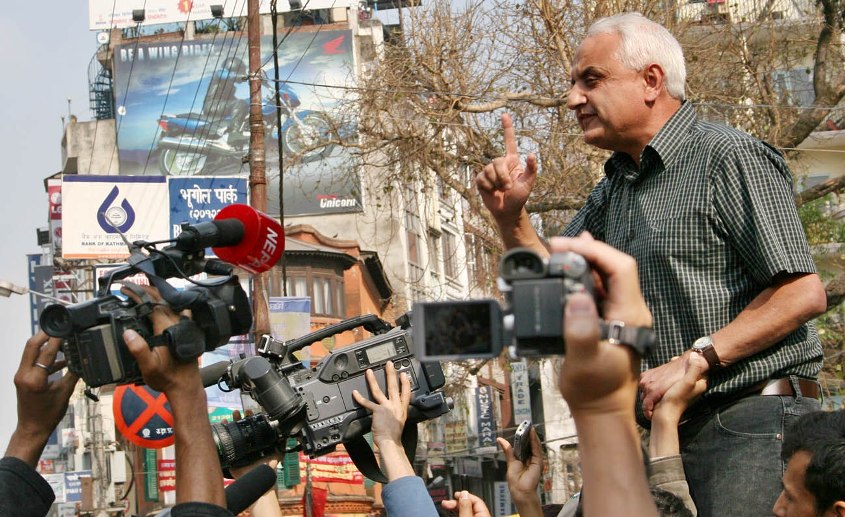
Journalist Kanak Dixit in a protesting rally in Kathmandu on 5 April 2006, Kathmandu. Photo by Shehab Uddin
Expanded from introductory remarks at Ceylon Newspapers Limited office in Colombo, Sri Lanka, on 2 Aug 2012:
There are many ways to introduce my good friend and partner in crime, Kanak Mani Dixit.
Aunty Google, as well as his own website (www.kanakmanidixit.com) can tell you the basic info about his education and career path, which I won’t repeat here. Instead, let me personalise what I know about this courageous man I’ve known and worked with for over 15 years.
Kanak is a journalist, editor and activist – all rolled into one. And if you think that journalists cannot become effective social or democracy activists, just watch him balance these seemingly daunting roles. Study how he juggles reporting, commentary writing, editing and social intervention.
Kanak came from a privileged family background, and could easily have spent his life in leisurely scholarship and endlessly doing the cocktail and conference circuits in South Asia and beyond. He CHOSE to be different.
Kanak spent a few years with the UN Department of Public Information in New York, and yet chucked up a promising international career to return to South Asia – a chaotic, unpredictable but also exhilarating part of the world that we call home. Another conscious choice.
Back home, Kanak could have watched over his beloved Kathmandu Valley and simply commented or satirised about the politics, economy and society of his impoverished land, one of 49 least developed countries in the world. He does that, too, but when needed he takes to the streets. As he did back in 2005/2006 when Nepalis rose against a tyrannical king…
He paid a price for his frontline activism. He was arrested – along with thousands of others – for defying a curfew and demanding democratic reform. He spent 19 days in a Kathmandu jail that he once pointed out to me from afar. As an influential publisher, he could have worked out some deal for a quicker release, but again, chose not to.
How many other South Asia editors or publishers do you know who won’t peddle influence for their personal gain or safety?
Some editors and publishers think of themselves as ‘king-makers’ in the political arena. This editor-publisher was literally a ‘king-dumper’: Nepal’s People Power forced autocratic King Gyanendra to restore Parliament in April 2006. Two years later, the whole monarchy was phased out.
Kanak has spoken truth to power, stared authority in the eye, and yet he has not allowed himself to be corrupted by the temptations of political, diplomatic or other positions. He continues to critique and needle those in public and elected office.
In fact, the very revolutionaries he too helped to bring into office – through elections – now don’t seem to like him much: he was recently dubbed ‘an Enemy of the People’.
He must be doing a few things right to be reviled by both monarchists and republicans!
But Kanak is much more than a media and political activist. He has too many involvements and interests to keep track of.
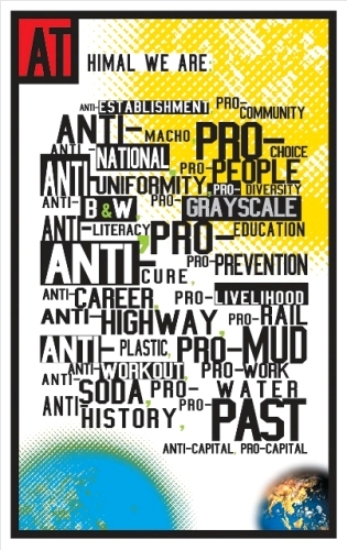
To cite but a few: What Himal is all about…• He is a great believer in the idea of South Asian integration, going well beyond the bureaucratic trappings of SAARC. (His Southasia, which he insists on spelling as one word, includes Tibet and Burma.)
• He founded Himal Southasian magazine in 1987, and sustained it for 25 years with great effort and dedication. It is the first and only regional news and analysis magazine in our region of 1.4 billion people.
• He promotes documentaries as a means of cultural self expression and exchange, and in 1997 founded Film South Asia, a biennial festival that brings the best of South Asian films.
• He nurtures social science research and scholarly exchange, and is endlessly incubating new ventures or institutions in the public interest.
• He supports spinal injury rehabilitation in Nepal, having realised the pitiful state of such care when he suffered serious spinal injury himself a few years ago after a mountain hiking accident.
Amidst all this, he finds time to write regular columns and op-eds – in both English AND Nepali – as well as occasional books.
For these and many other reasons, Kanak Dixit is one of my role models, and a constant source of inspiration. He is one of the few human beings that I’d like to CLONE if and when that becomes a real prospect.
We need many more Media Typhoons like him to drive change in South Asia.
In fact, I sometimes wonder if there is more than one Kanak Dixit already! But that’s only speculation. For now, my friends, meet the one and only Kanak Mani Dixit confirmed to exist…
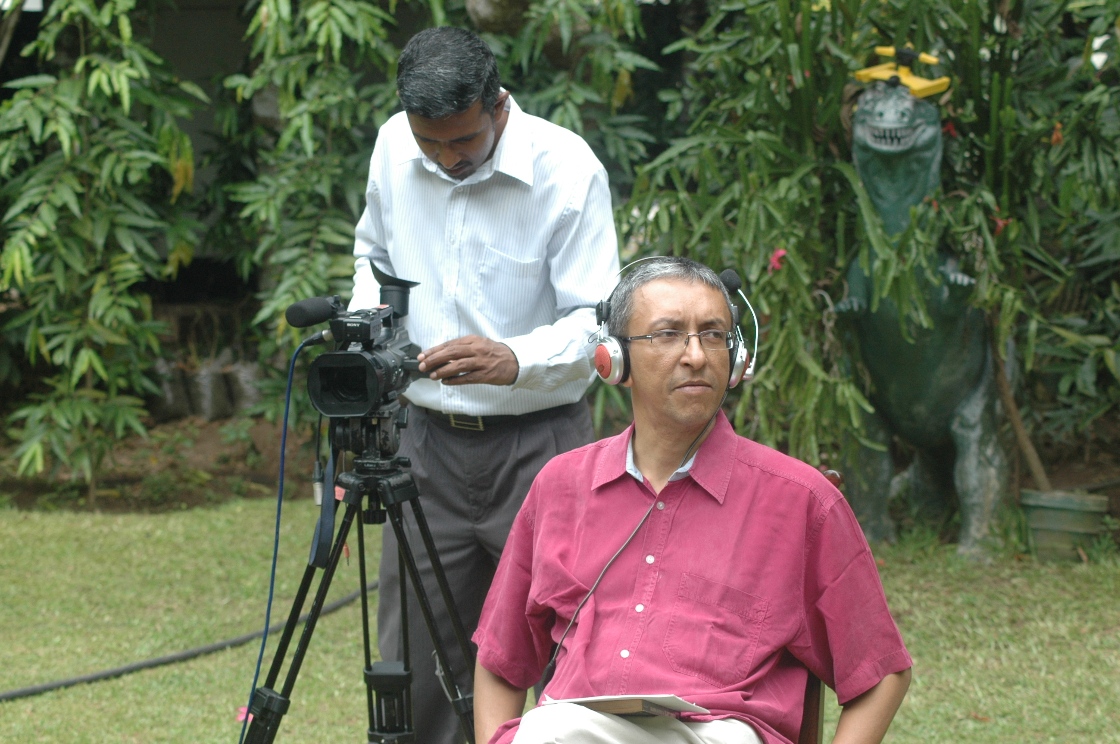
Location: Garden of Leslie’s House, Barnes Place, Colombo 7, Sri Lanka — where Sir Arthur C Clarke lived for 35 years until his death in March 2008
My colleague Janaka Sri Jayalath had taken this photo more than a year ago while we were filming an interview. But I’ve only just taken a closer look, and realised just what he’d captured…:)
The Last Filming – Preoccupied with their work, neither man had any idea what fate was about to befall them…
Caption says it all. Thanks, Gary Larson, for inspiration…