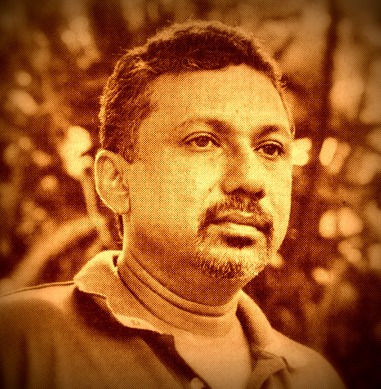
Palitha Lakshman de Silva (1959 – 2010): Animator, stilled.

Palitha Lakshman de Silva, 1959-2010
For the second time in just over three months, I went to the Colombo general cemetery to bid farewell to a fellow traveller. This is becoming a worrying habit.

Those of us who’ve opted for the path less travelled don’t expect crowds or accolades. At least we have each other for company and inspiration. Suddenly it’s getting a bit lonely: long-standing friends and colleagues are dropping dead in the prime of their lives.

First, it was environmentalist, journalist and public intellectual Piyal Parakrama who left in early March. Now, it’s Palitha Lakshman de Silva — journalist, photographer, cartoonist, puppet animator and television professional among other pursuits and talents.

Uncannily, what I wrote upon hearing Piyal’s death applies – word by word – to Palitha too. I just have to change the name and date: Palitha died so suddenly and unexpectedly on the evening of June 11 that it’s hard to believe that he is no longer among us. Another public-spirited individual has left the public space all too soon…

Both men had just passed 50, and were leading active, productive and busy lives. They had no known ailments, and were in apparent good health. Yet in the end, it was the unseen, gradual clogging of the heart’s arteries that struck them both down: the first heart attack was swift and fatal. Neither man reached the nearest hospital alive.

I had known Palitha for twice as long as I worked with him (in the past decade). Although we weren’t close friends, we shared a passionate, life-long interest in using broadcast television and narrowcast video to communicate public interest messages. Some call it non-formal education, but we avoided the e-word for it reminds some people of school that they didn’t enjoy. We believed – and demonstrated too – that the audio-visual medium can blend information with entertainment in ways that make learning effortless and painless.

Having started his career as a reporter and photojournalist at a leading newspaper, Palitha later moved on to TV, where he blazed new trails in cartoon animation, puppetry and documentary making. He was part of Sri Lanka’s first generation of television and video professionals who experimented with the medium, and found new ways of combining education, information and entertainment.

All this made Palitha a natural ally and partner in my work at TVE Asia Pacific. I just wrote a more official tribute tracing our collaborations over a decade, which the TVEAP website published: Tribute to Palitha Lakshman de Silva (1959 – 2010): Photojournalist and cartoon animator

I’ll write more reflectively once I recover from the shock of another colleague signing off for good. For now, I can only echo the lyrical sentiments in this leaflet distributed at Palitha’s funeral by his artistically-inclined friends. The English approximation (below) is mine, and not particularly good (though bilingual, I’m a lousy translator). I’m glad, however, that the original verse captures one intrinsic quality of Palitha: his gentle, soft-spoken nature which often concealed the creative genius inside him.
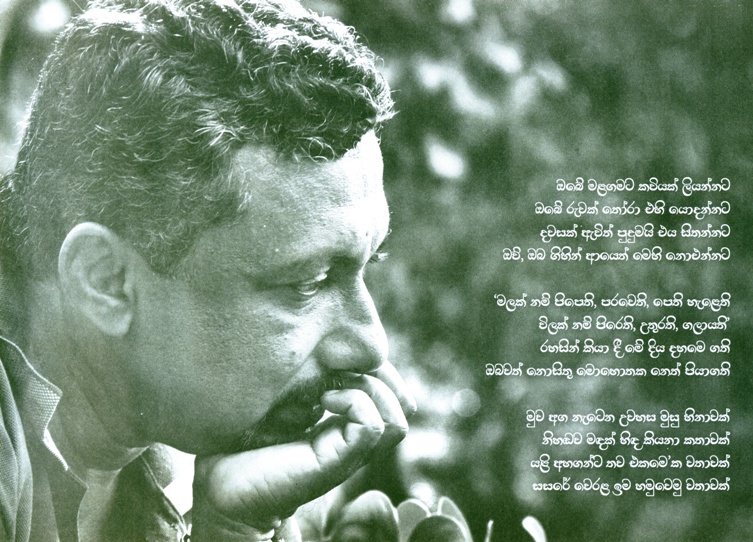
Goodbye, Palitha Lakshman de Silva

The day has arrived
Suddenly and shockingly
When you’ve gone away
Leaving us alone
All by ourselves
To write a verse
And choose an image
In your fond memory.

Flowers bloom and wither
Lakes flourish and drain
Such is the Circle of Life
Which your hasty exit
Once again reminds us
With a soft, little whisper.

We’ll travel to the end of time
If can we see, just once more,
Your gentle and soothing smile,
And listen to your stories
That you told us so gently.

Just once more…
Sinbad in Beijing: How to tame the many-headed hydra called Social Media

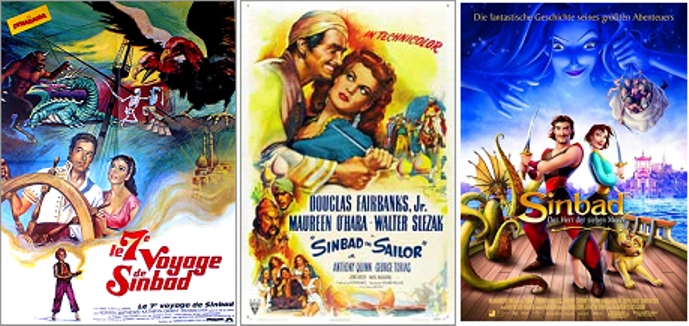
Sinbad: The legend endures, entertains...and inspires!

I have always been intrigued by the tales of Sinbad the legendary sailor. My interest is heightened by living in Serendib, destination of Sinbad’s sixth journey, which is modern-day Sri Lanka.

Being a professional story teller, I always try to connect the old world with the new. So in Beijing this week, I proposed: In the brave new world of social media, we need to be as daring and adventurous as Sinbad.

Like the legendary sailor of Baghdad, we have to take our chances and venture into unknown seas. Instead of maps or GPS or other tools, we must rely on our ingenuity, intuition and imagination.

And we have to be prepared for a potentially perilous journey where we may be lost, shipwrecked or even sunk. On the other hand, with careful planning, hard work and some luck, we may well sail into calmer seas and discover new lands and treasures – just like Sinbad did.

One thing is for sure: it’s not for the faint-hearted. There are no guarantees of success, and certainly no travel insurance…Are we ready to take the plunge?

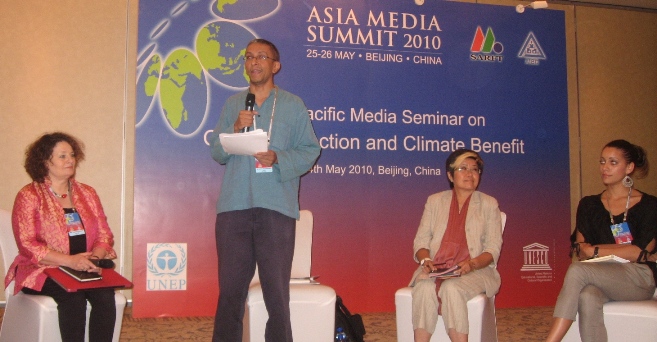
This was the thrust of my opening remarks to a panel on social media that I moderated at the Asia Media Summit 2010 in Beijing, China, this week. The panel was part of the Asia-Pacific Media Seminar on Ozone Protection and Climate Benefit, one of several pre-Summit events held on 24 May 2010.

L to R: Pauline Couture, Nalaka Gunawardene (speaking), Chutharat Thanapaisarnkit and Minna Epps

My enthusiasm for social media was not dampened by the fact that some key social media platforms were not accessible from the Chinese capital because they are officially blocked. Ah, if we aren’t allowed to walk the talk, we story tellers can still talk the talk, right?

In my opening remarks, I added:

Those of us working on development, humanitarian or social issues always have plenty of public interest messages to communicate. We are also keen to amplify grassroots voices so that policy-makers and business leaders would get a reality check.

The social media present many opportunities for all this. They offer us the potential for not just outreach, but sustained engagement. The development community has long wished for more interactive and participatory communications tools. The social media do precisely this! There’s no longer any excuse for not jumping in…

I then added the caution: It’s a big pond, and keeps getting bigger and deeper by the day. Social media is a basket that includes a lot more than (the more visible and controversial) Facebook and YouTube. According to the Wikipedia (itself an example), social media is a collective term to describe online media that is based on two key attributes: conversations, and interactions between people.

One of the many strange creatures that Sinbad encountered on his journeys was the Hydra — a many-headed serpent (or dragon). Chop one off, and two would grow instantly — a bit like how new social media applications are popping up these days!

Modern-day Sinbads have plenty of new horizons and uncharted waters to explore. Yes, it can be cacophonous, confusing, dizzy and even a bit frivolous at times. Hey, so is the real world! We need discernment in both worlds.

Social media started with the geeks, but soon spilled over to involve the rest of us. How can we — the non-geeks — come to terms with this new realm? How do we find our niche that makes us more effective communicators and agents of social change? The key to engaging this bewildering world of social media is to…just do it. And see what works.

I also introduced my own rough guide to get started and keep going in using social media for communicating public interest content. As a salute to Sinbad’s seven voyages, I call it the 7-‘ups’.

MediaHelpingMedia has just published my 7-Ups Rough Guide to using social media.

Remembering Saneeya Hussain of Absurdistan, five years on…

Saneeya Hussain (1954 - 2005)
Exactly five years ago today, journalist and activist Saneeya Hussain left us. Hers was a needless death that left a deep impression in numerous friends she had around the world. We still remember.

We remember Saneeya as a journalist who took a special interest in environment and human rights issues. All her working life, she campaigned tirelessly for a cleaner, safer and more equitable society for everyone, everywhere.

We remember Saneeya as one who supported pluralism – not just in her own country Pakistan, but everywhere. She hated autocrats and military dictators. She spoke out and wrote against unfair domination and agenda setting by a handful of (usually graying) men. She had the courage to suggest re-naming her country as Absurdistan!

We remember Saneeya as a fun-loving, easy-going if slightly absent-minded friend. She wasn’t the most organised person, but was diligent and relentless on causes and issues that she passionately believed in.

Saneeya’s worldwide network of friends have keep her flame alive, and this blog post is as much a tribute to them as it is for Saneeya. Officially, the Saneeya Hussain Trustcontinues her vision and mission.

In fact, the chairperson of the trust (and Saneeya’s mother) Najma Hussain just wrote us a group email, saying: “Let’s share happy memories of Saneeya and celebrate her life.”

She asked: “If you have any anecdotes to share with us please write back. We will love to hear from you.” Saneeya Hussain Trust can be contacted here.

Read my blog post written on Saneeya’s second death anniversary, 20 April 2007, for more of my own memories

Our mutual friend Beena Sarwar has made a 14-minute documentary called Celebrating Saneeya. Here’s the shorter version available on YouTube:

Celebrating Saneeya (August 2005; 14 mins; language: English; Filmed in Karachi, Pakistan, with archives and footage from Brazil, South Africa and Nepal)

Synopsis: Saneeya, with her joyful laugh, lightness of spirit, striking height and long hair, embodied “feminism” and “women’s rights” in the most un-dogmatic way. Living life on her own terms, she countered the trends that militate against women’s individual freedoms in Pakistan. During the repressive years of military dictator General Ziaul Haq she worked as a journalist and was active in the women’s movement that defied the military rule. She also pioneered environmental journalism in Pakistan. Later, while working with the World Commission on Dams in South Africa she met a Brazilian geographer eleven years her junior. Their love story transcended age, culture, religion and nationalities.

In 2004, a severe allergic reaction stopped Saneeya’s breathing and her breathing stopped during a traffic jam in Sao Paulo, preventing her from reaching the hospital in time and sending her into a coma. This documentary is a celebration of her life and all that she stood for, through interviews with her husband, family and friends, and archive material. Sticker on Saneeya’s fridge: “Life is uncertain, eat dessert first”.

Read more about Saneeya Hussain on the trust website

TV Will Save the World, says Charles Kenny in TIME’s ’10 ideas for next 10 years’

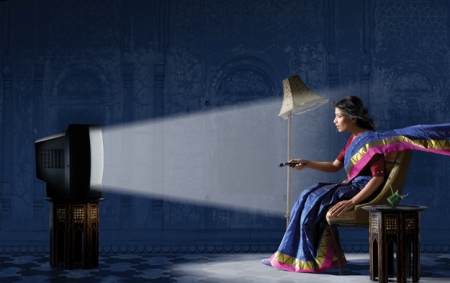
Photo by Reza Deghati

This is one of my favourite photos in media and development. It was taken by Reza Deghati, the renowned Iranian-French photojournalist (who works under the name Reza). I don’t know the story behind this photo, but even without a single word of annotation, it says a great deal.

I like this photo partly because it symobolises the enduring appeal of broadcast television in much of the developing world. For long years, the old-fashioned, boxy TV set used to be the top-selling consumer electronic item in the world — until the mobile phone came along. But even now, the much-maligned idiot box hasn’t lost its appeal to a significant section of humanity, never mind what the jaded academics and geeks might say.

So I was intrigued to read, in the latest issue of TIME Magazine, development economist Charles Kenny, reminding us that television is still the most influential medium around. In this gizmo-ridden new media age, it takes much courage to say so in public.

In a powerful short essay titled ‘TV Will Save the World’, he writes: “Forget Twitter and Facebook, Google and the Kindle. Forget the latest sleek iGadget. Television is still the most influential medium around. Indeed, for many of the poorest regions of the world, it remains the next big thing — poised, finally, to attain truly global ubiquity. And that is a good thing, because the TV revolution is changing lives for the better.”

Across the developing world, he says, some 60% of the households had their own TV set in 2005 — up from 45% in 1995. He adds: “Five million more households in sub-Saharan Africa will get a TV over the next five years. In 2005, after the fall of the Taliban, which had outlawed TV, 1 in 5 Afghans had one. The global total is another 150 million by 2013 — pushing the numbers to well beyond two-thirds of households.”

He ends his essay with these words that strongly resonate with me: “Too much TV has been associated with violence, obesity and social isolation. But TV is having a positive impact on the lives of billions worldwide, and as the spread of mobile TV, video cameras and YouTube democratize both access and content, it will become an even greater force for humbling tyrannical governments and tyrannical husbands alike.”

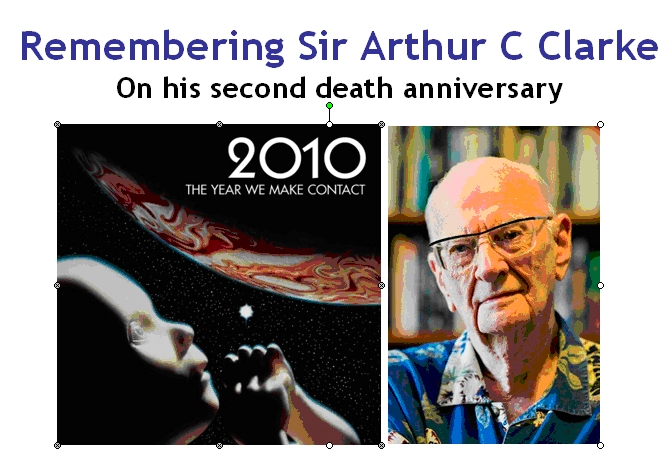
As Sir Arthur C Clarke, inventor of the communications satellie whose second death anniversary we mark this week, told me in a 2003 interview: “I’m not impressed by the attacks on television because of some truly dreadful programmes. I believe that every TV programme has some educational content. The cathode ray tube – and now the plasma screen – is a window to the world. Often it may be a very murky window, but I’ve slowly come to the conclusion that, on balance, even bad TV is preferable to no TV at all.”

Kenny’s essay is one of 10 ideas for the next 10 years that TIME has put together for its annual innovation issue.

Image courtesy Foreign Policy
The TIME essay is a much compacted version of what he wrote in November 2009 issue of Foreign Policy magazine, titled Revolution in a Box. That article noted the continuing global spread of television sets and an explosion of viewer choice driven by cable, satellite and digital technologies. It suggested this is a good thing, pointing to evidence that access to competitive television can improve womens’ standing in the home, increase girls schooling, reduce fertility rates, lower drug use, improve governance and (possibly) help foster global peace.

The editors of Foreign Policy ran the following blurb: “It’s not Twitter or Facebook that’s reinventing the planet. Eighty years after the first commercial broadcast crackled to life, television still rules our world. And let’s hear it for the growing legions of couch potatoes: All those soap operas might be the ticket to a better future after all.”

The full essay is well worth a careful read. At a time when I have been questioning many of the founding premises of my own work at TVE Asia Pacific, he has provided conceptual clarity and sharper focus.

Remembering Sir Arthur Clarke on his second death anniversary

It’s exactly two years since Sir Arthur C Clarke abandoned his 91st orbit around the Sun and headed to the stars. That was on 19 March 2008.

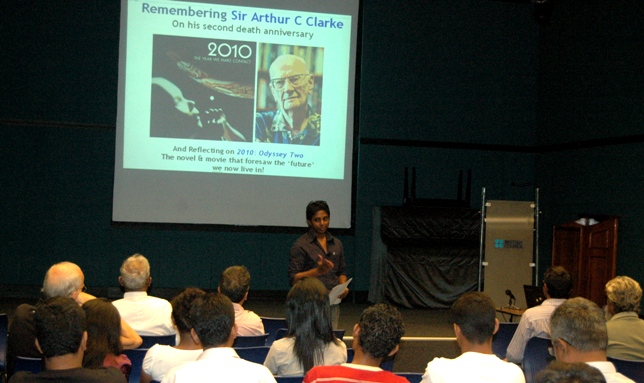
A public meeting to commemorate Sir Arthur was held on 17 March 2010 afternoon at the British Council Colombo. The event was jointly organised by the Sri Lanka Astronomical Association (SLAA) and the Arthur C Clarke Estate in partnership with the British Council.

I gave an illustrated talk titled ‘Sir Arthur C Clarke: Man Who Lived in the Future’. We had an eager audience of 65 – 70 persons. Here are some photos from the occasion – a more detailed blog post will follow.

Nalaka Gunawardene giving Sir Arthur C Clarke memorial talk (photos above & below), 17 Marc 2010, British Councl Colombo

Thilina Heeatigala, General Secretary of SLAA, introducing the programme
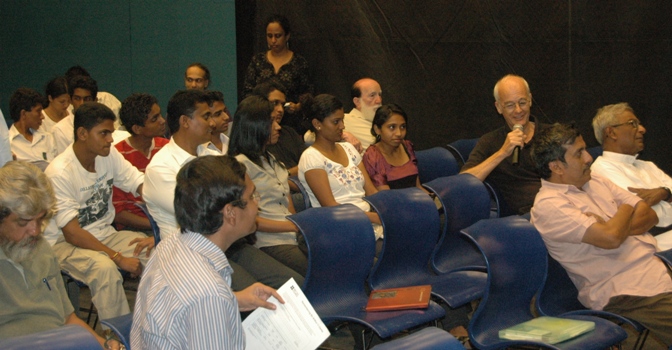
Michael Snowden asking a question

The talk will be followed by the screening of feature film 2010: The Year We Make Contact (116 mins, 1984). Directed by Peter Hyams on a screenplay co-written by Peter Hyams and Arthur C Clarke, the film starred Roy Scheider, John Lithgow, Helen Mirren and Keir Dullea. This is the movie adaptation of the best selling science fiction novel 2010: Odyssey Two that Arthur C Clarke wrote in 1982.

All photos by Amal Samaraweera, TVE Asia Pacific

Where are all the women cartoonists hiding?

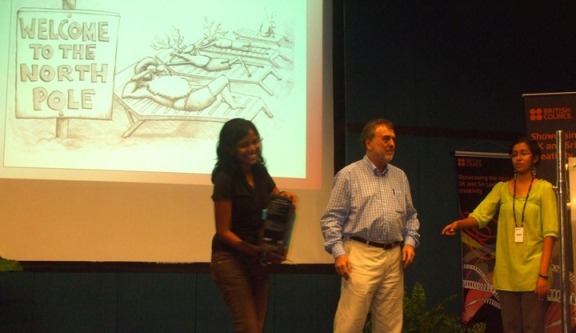
Shamanthi Rajasingham receiving her first prize in climate cartoon contest Sri Lanka

“So how many women cartoonists are working in our newspapers?”

My daughter Dhara, 13, asked me this simple question earlier this month when I was involved in judging Sri Lanka’s first contest of cartoons on climate change, organised by the British Council and the Ken Sprague Fund of UK.

I tried to come up with an answer, and couldn’t think of a single woman cartoonist who works for a print or online media outlet in Sri Lanka. That, despite my long association with the media and also being a great admirer (and collector) of good cartoons.

Later that day, at the awards ceremony for winning and commended climate cartoonists, I posed the same question to leading Lankan cartoonists Wasantha Siriwardena, Winnie Hettigoda and Dharshana Karunatilleke. They too couldn’t name one immediately; later, a single name was mentioned but it’s not one I recognised.

Clearly, cartooning is still a very male dominated profession — but that might soon change, going by the active participation of young women in the climate change cartoon contest.

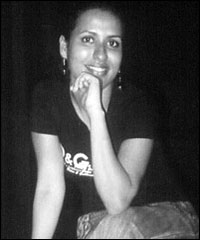
Shamanthi Rajasingham
In fact, the first and third prize winners were both women — respectively Shamanthi Rajasingham and W M D Nishani. They beat close to 200 other contestants to get there.

Additionally, there were 6 women among the 22 commended cartoonists, and one woman among those 11 who were highly commended — judged on four criteria. See all winning and commended entries.

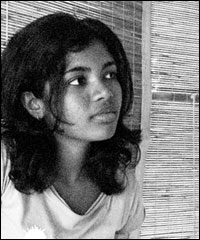
W M D Nishani
Okay, the four judges were all male (among us, two professional cartoonists). But during this entire judging process, the identity of artists was withheld and we only knew each entry by a number. In fact, we discovered the names (and gender) of artists only at the awards ceremony.

This would be encouraging news to Dhara and all other aspiring young girls and women who want to pursue careers in media. Let’s hope at least some of the women contestants in the climate cartoons contest would end up being more than just hobby cartoonists…

Meanwhile, it’s not just Sri Lanka that has a shortage of women engaged in cartooning, and awareness of their contribution is lacking. A quick Google search brought up a book titled “The Great Women Cartoonists” by Trina Robbins (Watson-Guptill Publications, 2001). Reviewing it in TIME, Andrew D Arnold wrote: “Name three women cartoonists who worked from 1900 to 1950. Okay, just name one. Couldn’t do it? Neither could I until reading a new, invaluable book…”

SOS from the Next Generation: “We need Good Parents!”

Market forces suspended here?

“Good parents are sooo hard to find these days!” exclaimed my teen-aged daughter Dhara recently. She was talking with her tongue firmly in her cheek — I hope!

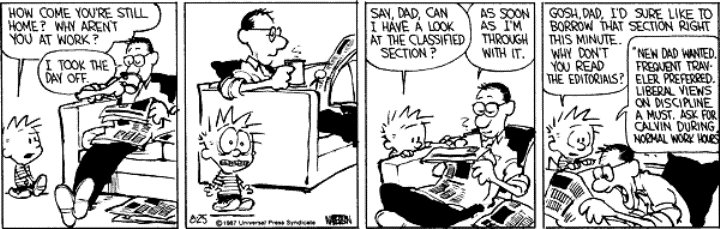
In recent days, she’s been re-reading our collection of Calvin and Hobbes books, where the world’s most cheeky six-year-old keeps making wisecracks about his own mom and dad (‘Your approval ratings among household six-year-olds are way down’, ‘When are you standing for re-election, dad?’, etc.).

But Dhara’s light comment rang true, generally speaking. As every parent discovers sooner or later, parenting is a 24/7 job that lasts for two decades or longer. There’s no help desk or emergency number we can call. It’s more an art than a science, for which there is no comprehensive, fail-proof guide — even though plenty of advice is available on TV and online (some of it better than others).

Generic advice is helpful but not sufficient. Every parent-child situation is unique, and every parent has to find what works for him or her…ideally, the two parents working in tandem.

Does parenting come naturally? If only it did! I don’t believe in this grandma-knew-best kinda romanticising. For sure, some in our grandparents’ generation got it right, but there were also many who never did.

For something so consequential for the future of our species, there’s no minimum age or entry level or qualification. (As Dhara occasionally asks me, “You didn’t have to take any exam for this job, did you, dad?”. Come to think of it, I didn’t — although, in my case, I did give it a lot of thought first. Honest!)

Dhara with her dad-for-life, Jan 2010
Geeks express it a bit differently. “A human being is the best computer available to place in a spacecraft. . . It is also the only one that can be mass produced with unskilled labour,” said the German-American rocket scientist Wernher von Braun, the brains behind the Apollo project that landed men on the Moon.

Although I can’t vouch for its authenticity, a similar quote from the mid 1960s is attributed to the US space agency NASA: “Man is the lowest-cost, 150-pound, nonlinear, all-purpose computer system which can be mass-produced by unskilled labour.”

I don’t like their cynical analysis of something far more nuanced than their usual hardware and software. But they got a point there. Biomedical sciences have advanced much since the Moon landings, and today some medi-geeks are trying to ‘play God’ in creating life in a lab. I’d like to see how they can get a machine to mimic the 20+ year parenting process…

Making babies may be accomplished by unskilled humans in the right age, but raising babies is most decidedly a high skill, high intensity and highly demanding job. Especially in this day and age, when many kids are more tech savvy than their parents: the Digital Natives can easily run virtual rings around their Digital Immigrant parents.

We have to watch out, though, to listen carefully to what our children are saying to us — and also about us!

By the way, as one of my favourite authors, Roald Dahl, reminded us, “To children, all grown ups are like giants — who tell them what to do all the blooming time!”. (The worst parents in my mind are also created by Roald Dahl’s imagination: Mr and Mrs Wormwood, in his 1988 novel Matilda, which was adapted into a movie in 1996. In the movie, Papa Wormwood tells the precocious little Matilda: “Listen, you little wiseacre: I’m smart, you’re dumb; I’m big, you’re little; I’m right, you’re wrong; and there’s nothing you can do about it!”).

The bottomline: am I a good parent? It’s not for me to judge — but I try hard being one. It isn’t an easy act for anyone, and especially for a single parent that I now am.

Someday, I hope, the one-woman jury won’t be too harsh on me…and may she never need to advertise for a replacement.

Afghan boy with a plant: Reza Deghati on nurturing a culture of peace

Capturing the hopes of a nation...

Every photograph has a story behind it, if only we care to ask – or dig deep enough. In October 2007, I wrote about a now iconic photo showing an old Nepali man (Ram Bahadur Tamang) holding a video camera. That image is the logo of Film South Asia festival.

From Reza Deghati, the renowned Iranian-French photojournalist (who works under the name Reza) comes another story – this time from Afghanistan, where the above photo was taken in 1990.

Reza recalls how the photo was taken: “In 1990, the United Nations asked me to put aside my cameras in order to run a humanitarian program in an Afghanistan recently freed from Russian occupation. I had to open a route for wheat shipments needed to feed the population in the Northern Provinces. Eleven years of war against the Soviet Army had devastated the country. Fields lay fallow, roads were impassable, mined or destroyed, and buildings like hospitals and schools were nothing but ruins. I could have given away the wheat. Instead, I decided to barter it for work so as to avoid one of the unfortunate consequences of some humanitarian programs that foster dependence rather than offer new ways to live. Throughout the Province, a new army took shape. This time, men did not carry rifles but shovels.”

“I remember seeing a young Afghan boy coming out of school one day, holding a plant in his hand. He had been watering it carefully. A shoot had sprouted out. I took a picture of him, and asked: ‘What are you going to do with this plant?’ His answer….’I am going to make a tree with it’.

Reza Deghati, photo by Ali Khaligh
Looking back, Reza thinks this may have provided part of the inspiration for setting up Aina, a third-generation humanitarian association that he founded in 2001 in Taliban-free Afghanistan.

Aina now works in Afghanistan, “contributing to the emergence of civil society through actions in the area of education (particularly focusing on women and children), information and communication.” It promotes independent media development and cultural expression as a foundation of democracy.

Reflecting further on the power of images, Reza says on Aina website: “In the early 80s, I discovered wars and the harshest moments of the world as a young photojournalist. I could not just stay there as a mere witness. I was led into thinking over conflicts, repressions, exodus and their burden of known pain, answers as well. As canon roars fade, urgency requires tangible reconstruction. An army of shovel-carrying men starts marching, determined to erase any remaining sign of ruin. Others take care of suffering bodies. Yet, there is an invisible destruction, only known to wounded dignities, that can ruin physical rebuilding efforts in a country and keep it from recovering.

“Those who are not given any intellectual and cultural weapons will go back to their unique reference. The culture of war fosters war. That is how Aina was founded. A third-generation association, Aina has been working on independent media development and culture, everywhere freedom of speech has remained a fragile value. It provides logistical support, state-of-the art technology access and local media and cultural actor training.”

Reza adds, optimistrically: “Today, Aina is like that plant. I hope that it will become a tree of culture, peace and freedom in Afghanistan…”

Cartooning on climate change: Young artists rise to the challenge

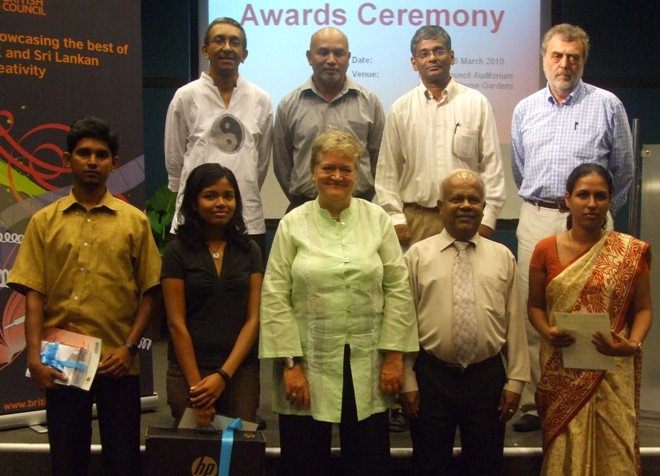
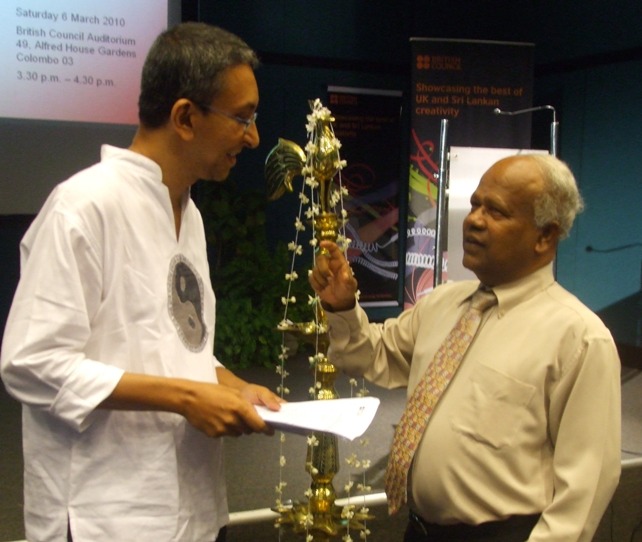
Cartoon contest top prize winners with British Council director and chief guest (all front row) and four judges (all back row) at awards ceremony, Colombo 6 March 2010

Man-made climate change is a complex planetary phenomenon. It has multiple causes and effects – not all of it immediately evident. Different areas of the world are going to be impacted differently and unevenly. Human response to the climate challenge has been patchy, and is mired in so much denial, rhetoric and political posturing.

So how do we capture this multiplicity in visual forms? Photographers go for the evidence and authenticity. Film makers work on both current impacts and future scenarios. What about cartoonists – who have to do their visual metaphors in a limited space that is static and two-dimensional? How much of climate change’s nuance and complexity can they really grasp and convey?

The short answer is: a great deal. On this blog, I’ve written that when it comes to cartoons, less is definitely more. Take, for example, many millions of printed words and probably thousands of minutes of airtime generated around the (over-hyped and under-performing) Copenhagen climate conference in Dec 2009. As I noted in blog posts on 17 Dec, 18 Dec and 21 Dec 2009, it was assorted cartoonists from around the world who summed it all up in a few perceptive strokes. This is why I keep saying that when it comes to commenting on our topsy-turvy times, no one can beat cartoonists for their economy of words.

In late 2009, the British Council and the Ken Sprague Fund of UK organised a cartoon contest on climate change which was open to all Lankan citizens from 18 to 35 years. They offered attractive prizes for anyone who could be ‘seriously funny’ about this global crisis. The participants could submit entries under 6 themes: drought and water shortage; deforestation and rain forest destruction; melting of the ice caps; role of industry in polluting the atmosphere; devastation of our seas and disappearance of marine life; and climate change in an urban environment.

Some 400 entries were received from 175 contestants (each person could submit up to 5 entries) – which surprised and delighted the organisers. During the past few weeks, I have been involved in judging these cartoons to select the top winners and commended entries. Joining me in this enjoyable task were nationally recognised professional cartoonist Wasantha Siriwardena and environmentalist Nimal Perera. We worked with a British counterpart, top cartoonist Michal Boncza Ozdowski.

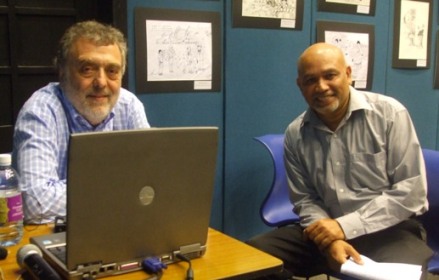
Michal Boncza Ozdowski (L) and Wasantha Siriwardena conducting cartoon workshop
The winners were announced, with awards and certificates, on 6 March 2010. It coincided with a half-day workshop on cartooning conducted by Michal and Wasantha. The chief guest at the ceremony was Camillus Perera, the seniormost Lankan cartoonist still professionally active.

As national judges, we looked at close to 200 cartoon entries that conformed with the contest’s published rules for eligibility. Since comparative ranking of creative works is never easy, we first agreed on four criteria for assessing the very diverse entries: cartoon value and humour; subject relevance to climate change (defined broadly); how effectively the climate related message was being communicated; and clarity and artistic merit of the entry.

Our initial judging coincided with the climate circus in Copenhagen, when we narrowed it down to a shortlist of 40 entries. We then individually scored these cartoons for each of our four criteria. We sometimes had to discuss and demarcate how far the scope of the contest could stretch. For example, when is an entry a good work of art but not a cartoon (more like a poster)? And what are the acceptable limits in the thematic or subject coverage of a vast topic like climate change?

The British Council later shared the full shortlist with Michal Ozdowski, who provided his own rankings and comments. We met again in February 2010 to discuss and reconcile our rankings — and found that our separately done rankings broadly agreed! (Note: During this entire judging process, the identity of artists was withheld and we only knew each entry by a number. In fact, we judges discovered the names only on the day of the awards ceremony, to which all shortlisted contestants were invited.)

Additionally, Michal kindly offered crisp comments about the top three winners, which became citations at the awards ceremony. So here are the winners of climate change cartoon contest 2009:

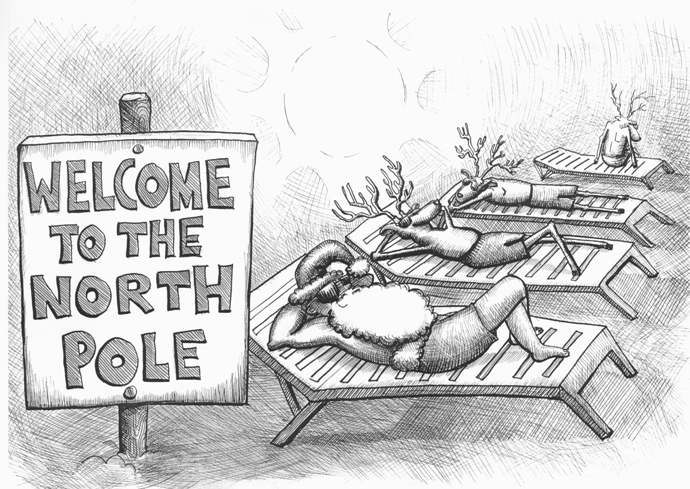
First prize: Welcome to the North Pole! By by Shamanthi Rajasingham

First prize winning climate cartoon - by Shamanthi Rajasingham

Citation for first prize: It is uncomplicated – a great advantage when satirising. Its composition is strong and imaginative, the draughtsmanship confident.

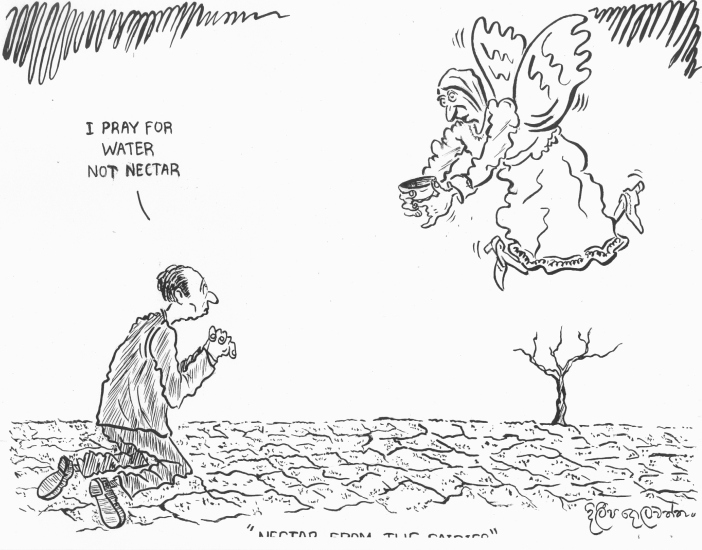
Second Prize: “I pray for water, not nectar” by Dileepa Dolawatte

Second prize winning climate cartoon by Dileepa Dolawatte

Citation for second prize: Apart from the vibrant and highly accomplished draughtsmanship, it lampoons brilliantly the fairy’s naivety – a funny eye-opener. Incorporates very cleverly traditional beliefs and myths. Here we are truly past the dodgy miracles stage in the climate change battles…

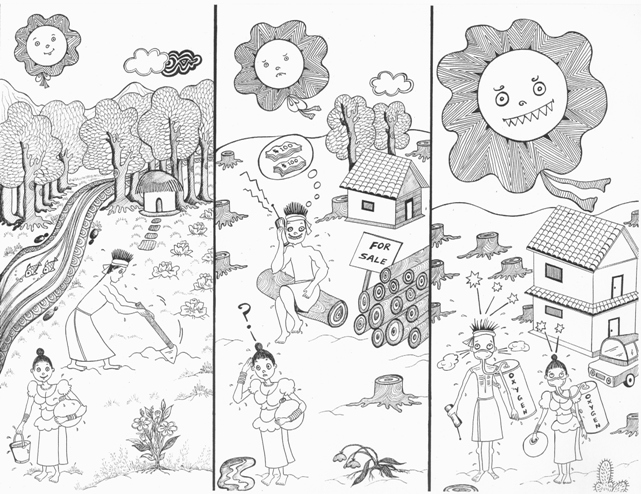
Third Prize: Theme – Drought and water shortage, by W M D Nishani

Third prize winning climate cartoon by W M D Nishani

Citation for third prize: An eloquent, if over-didactic, strip cartoon – could be quite effective in women’s publications. Coherent draughtsmanship catalogues effectively the woes of a ‘get-rich-quick’ development.

See all the highly commended and commended entries on the British Council website.

Long Live Siribiris – and his creator Camillus Perera!

Nalaka Gunawardene (L) with cartoonist Camillus Perera - photo by Malaka Rodrigo

In January 2009, writing a tearful farewell to the slain newspaper editor and investigative journalist Lasantha Wickrematunga, I invoked the memory of Siribiris. I wrote: Goodbye, Lasantha – and long live Siribiris!

Last weekend, I finally met the ‘father of Siribiris’ and was delighted to salute him in public.

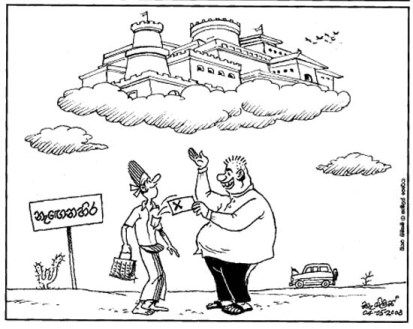
Let me explain. Siribiris is an iconic cartoon character well known to two generations of Lankan newspaper readers. He is a creation of Camillus Perera, a veteran Lankan political cartoonist who has been in this uncommon profession for nearly 45 years.

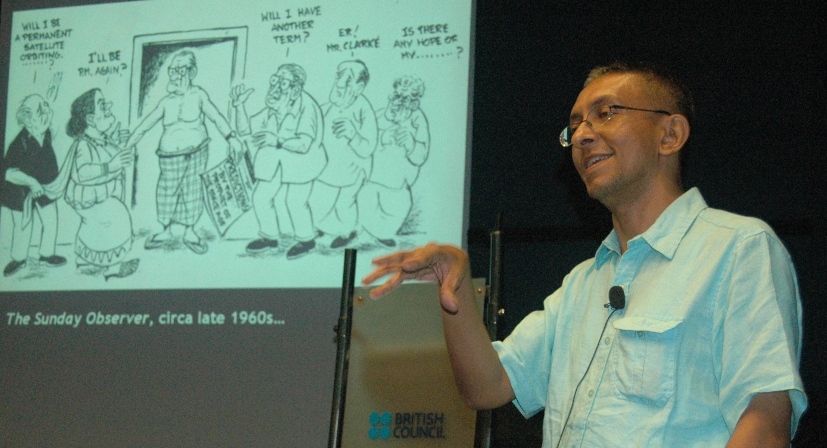
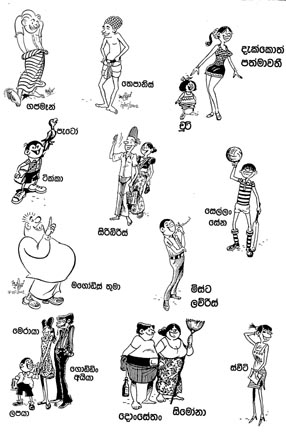
Camillus started drawing cartoons in newspapers in 1966 with the Observer newspaper and the film magazine of the same publishing group, Lake House (then privately owned and under state control since 1973). He draws pocket cartoons, political cartoons as well as satirical comic strips. His most enduring accomplishment has been the creation of a set of regular characters who have developed a loyal following over the years. Among them are the wily Siribiris, prankster Gajaman, fashionable young lady Dekkoth Pathmawathie, smart alec kid Tikka and sporty Sellan Sena.

These and other characters are very ordinary and very real, and they inhabit an undefined yet familiar place in the cartoon universe that most Lankan newspaper readers can easily relate to — it’s a bit like R K Narayan’s fictitious village of Malgudi.

puncturing egos for 40 years
Siribiris (left): puncturing egos for 40 years
My own favourite, Siribiris, is really Everyman personified: long-suffering, taken for granted by politicians, exploited by businessmen, hoodwinked by corrupt officials, and always struggling to simply stay alive. He is down but not yet out. The only way that poor, unempowered Siribiris can get back at all those who take advantage of him is to puncture their inflated egos and ridicule them at every turn. And boy, does he excel in that!

I grew up enjoying Camillus cartoons in various newspapers meant for children, youth and general readers. I had occasionally seen him being interviewed on TV. But I’d never seen or met him in person — until now. It happened when the British Council Sri Lanka invited Camillus as chief guest at their awards ceremony in the climate change cartoon contest they organised, which I helped judge with three others.

As the master of ceremonies, I announced: “It’s a great pleasure and honour for me to introduce Camillus Perera, the senior-most cartoonist in Sri Lanka who is still professionally active. Indeed, he has been drawing cartoons for as long as I have been alive — for he started his long innings in the same year I was born!”

Cartoon universe of Camillus Perera
Camillus, a small made and pleasant man, spoke briefly and thoughtfully. (As I keep saying, we writers just can’t beat cartoonists in the economy of words!). He recalled how he’d used the British Council Library for visual references for years before the web made it much easier to search. He congratulated all those who won prizes or commendations in the contest.

Many years ago, I privileged to count senior cartoonist W R Wijesoma as a senior colleague when we both worked for The Island newspaper. Now I have finally met Camillus Perera, another hero of mine still practising his craft and drawing regularly for Rivira Sunday newspaper, as well as The Catholic Messenger and Gnanartha Pradeepaya. My only regret is that I don’t follow any of these newspapers on a regular basis, even though I try hard to keep up with Siribiris on the web…

There is a bit more than childhood idol worship involved here. Satire is one of the last domains we are left with when freedom of expression comes under siege.

As I wrote in July 2009in a blog post on news wrapped up in laughter: “There is another dimension to satirising the news in immature democracies as well as in outright autocracies where media freedoms are suppressed or denied. When open dissent is akin to signing your own death warrant, and investigative journalists risk their lives on a daily basis, satire and comedy becomes an important, creative – and often the only – way to comment on matters of public interest. It’s how public-spirited journalists and their courageous publishers get around draconian laws, stifling regulations and trigger-happy goon squads. This is precisely what is happening right now in countries like Kenya and Sri Lanka, and it’s certainly no laughing matter.“

Taken in that light, Camillus Perera is not just a popular and entertaining cartoonist adorning Sri Lanka’s newspaper industry. He is a gentle giant in the world of journalism — a man of few words whose sharp wit and keystrokes are more piercing than any number of words that we writers and journalists can churn out. He is a living cultural treasure.

So long live both Siribiris — and Camillus Perera!