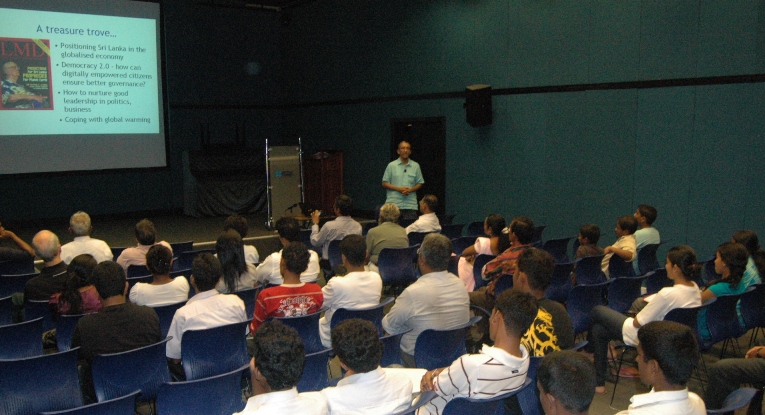
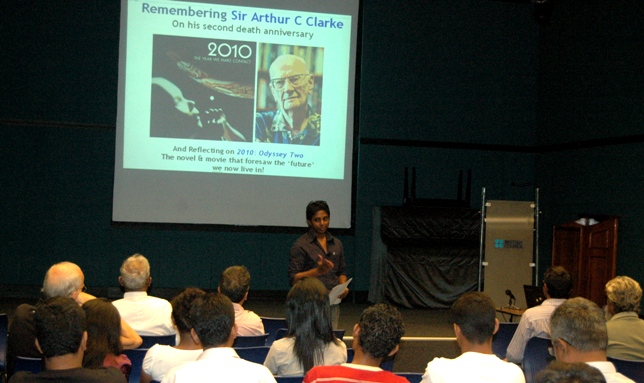
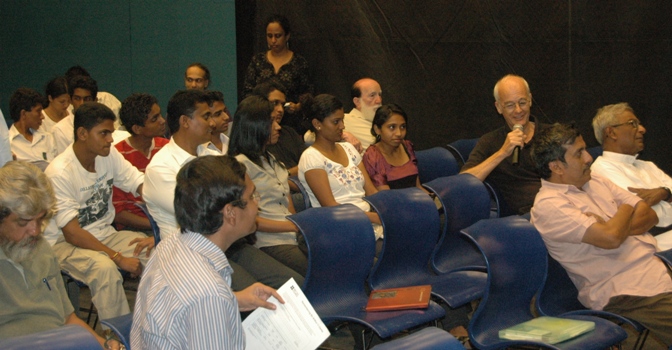
I gave an illustrated talk titled ‘Sir Arthur C Clarke: Man Who Lived in the Future’. We had an eager audience of 65 – 70 persons. Here are some photos from the occasion – a more detailed blog post will follow.
Nalaka Gunawardene giving Sir Arthur C Clarke memorial talk (photos above & below), 17 Marc 2010, British Councl Colombo
Thilina Heeatigala, General Secretary of SLAA, introducing the programmeMichael Snowden asking a question
The talk will be followed by the screening of feature film 2010: The Year We Make Contact(116 mins, 1984). Directed by Peter Hyams on a screenplay co-written by Peter Hyams and Arthur C Clarke, the film starred Roy Scheider, John Lithgow, Helen Mirren and Keir Dullea. This is the movie adaptation of the best selling science fiction novel 2010: Odyssey Two that Arthur C Clarke wrote in 1982.
I tried to come up with an answer, and couldn’t think of a single woman cartoonist who works for a print or online media outlet in Sri Lanka. That, despite my long association with the media and also being a great admirer (and collector) of good cartoons.
Later that day, at the awards ceremony for winning and commended climate cartoonists, I posed the same question to leading Lankan cartoonists Wasantha Siriwardena, Winnie Hettigoda and Dharshana Karunatilleke. They too couldn’t name one immediately; later, a single name was mentioned but it’s not one I recognised.
Clearly, cartooning is still a very male dominated profession — but that might soon change, going by the active participation of young women in the climate change cartoon contest.
Shamanthi RajasinghamIn fact, the first and third prize winners were both women — respectively Shamanthi Rajasingham and W M D Nishani. They beat close to 200 other contestants to get there.
Additionally, there were 6 women among the 22 commended cartoonists, and one woman among those 11 who were highly commended — judged on four criteria. See all winning and commended entries.
W M D NishaniOkay, the four judges were all male (among us, two professional cartoonists). But during this entire judging process, the identity of artists was withheld and we only knew each entry by a number. In fact, we discovered the names (and gender) of artists only at the awards ceremony.
This would be encouraging news to Dhara and all other aspiring young girls and women who want to pursue careers in media. Let’s hope at least some of the women contestants in the climate cartoons contest would end up being more than just hobby cartoonists…
Meanwhile, it’s not just Sri Lanka that has a shortage of women engaged in cartooning, and awareness of their contribution is lacking. A quick Google search brought up a book titled “The Great Women Cartoonists” by Trina Robbins (Watson-Guptill Publications, 2001). Reviewing it in TIME, Andrew D Arnold wrote: “Name three women cartoonists who worked from 1900 to 1950. Okay, just name one. Couldn’t do it? Neither could I until reading a new, invaluable book…”
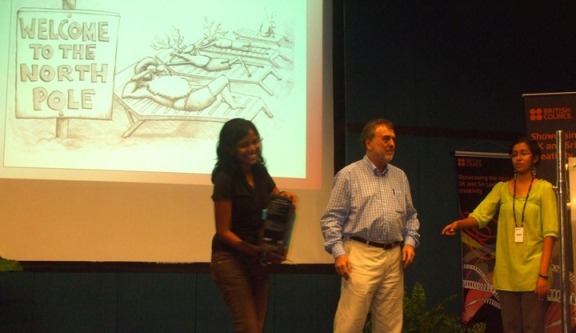
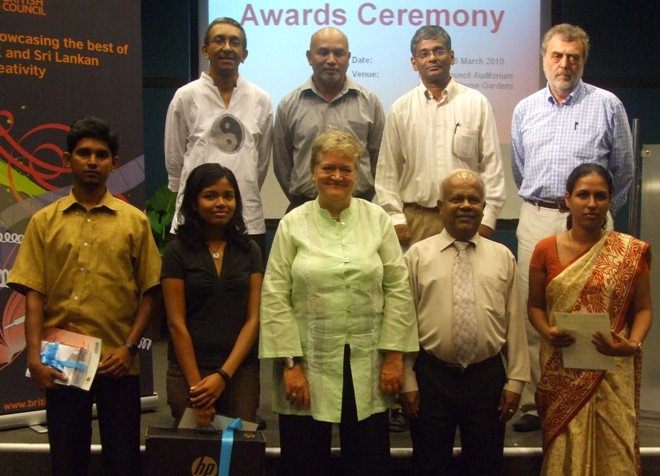
Cartoon contest top prize winners with British Council director and chief guest (all front row) and four judges (all back row) at awards ceremony, Colombo 6 March 2010
Man-made climate change is a complex planetary phenomenon. It has multiple causes and effects – not all of it immediately evident. Different areas of the world are going to be impacted differently and unevenly. Human response to the climate challenge has been patchy, and is mired in so much denial, rhetoric and political posturing.
So how do we capture this multiplicity in visual forms? Photographers go for the evidence and authenticity. Film makers work on both current impacts and future scenarios. What about cartoonists – who have to do their visual metaphors in a limited space that is static and two-dimensional? How much of climate change’s nuance and complexity can they really grasp and convey?
The short answer is: a great deal. On this blog, I’ve written that when it comes to cartoons, less is definitely more. Take, for example, many millions of printed words and probably thousands of minutes of airtime generated around the (over-hyped and under-performing) Copenhagen climate conference in Dec 2009. As I noted in blog posts on 17 Dec, 18 Dec and 21 Dec 2009, it was assorted cartoonists from around the world who summed it all up in a few perceptive strokes. This is why I keep saying that when it comes to commenting on our topsy-turvy times, no one can beat cartoonists for their economy of words.
In late 2009, the British Council and the Ken Sprague Fund of UK organised a cartoon contest on climate change which was open to all Lankan citizens from 18 to 35 years. They offered attractive prizes for anyone who could be ‘seriously funny’ about this global crisis. The participants could submit entries under 6 themes: drought and water shortage; deforestation and rain forest destruction; melting of the ice caps; role of industry in polluting the atmosphere; devastation of our seas and disappearance of marine life; and climate change in an urban environment.
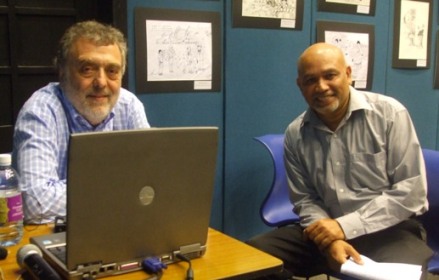
Some 400 entries were received from 175 contestants (each person could submit up to 5 entries) – which surprised and delighted the organisers. During the past few weeks, I have been involved in judging these cartoons to select the top winners and commended entries. Joining me in this enjoyable task were nationally recognised professional cartoonist Wasantha Siriwardena and environmentalist Nimal Perera. We worked with a British counterpart, top cartoonist Michal Boncza Ozdowski.
Michal Boncza Ozdowski (L) and Wasantha Siriwardena conducting cartoon workshopThe winners were announced, with awards and certificates, on 6 March 2010. It coincided with a half-day workshop on cartooning conducted by Michal and Wasantha. The chief guest at the ceremony was Camillus Perera, the seniormost Lankan cartoonist still professionally active.
As national judges, we looked at close to 200 cartoon entries that conformed with the contest’s published rules for eligibility. Since comparative ranking of creative works is never easy, we first agreed on four criteria for assessing the very diverse entries: cartoon value and humour; subject relevance to climate change (defined broadly); how effectively the climate related message was being communicated; and clarity and artistic merit of the entry.
Our initial judging coincided with the climate circus in Copenhagen, when we narrowed it down to a shortlist of 40 entries. We then individually scored these cartoons for each of our four criteria. We sometimes had to discuss and demarcate how far the scope of the contest could stretch. For example, when is an entry a good work of art but not a cartoon (more like a poster)? And what are the acceptable limits in the thematic or subject coverage of a vast topic like climate change?
The British Council later shared the full shortlist with Michal Ozdowski, who provided his own rankings and comments. We met again in February 2010 to discuss and reconcile our rankings — and found that our separately done rankings broadly agreed! (Note: During this entire judging process, the identity of artists was withheld and we only knew each entry by a number. In fact, we judges discovered the names only on the day of the awards ceremony, to which all shortlisted contestants were invited.)
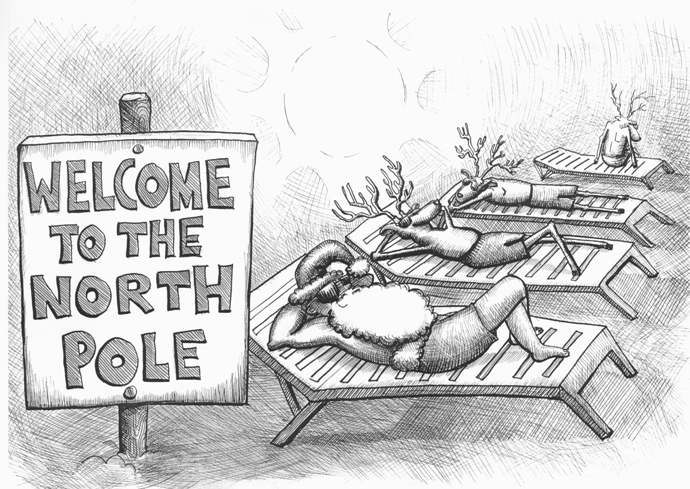
First prize: Welcome to the North Pole! By by Shamanthi Rajasingham First prize winning climate cartoon - by Shamanthi Rajasingham
Citation for first prize: It is uncomplicated – a great advantage when satirising. Its composition is strong and imaginative, the draughtsmanship confident.
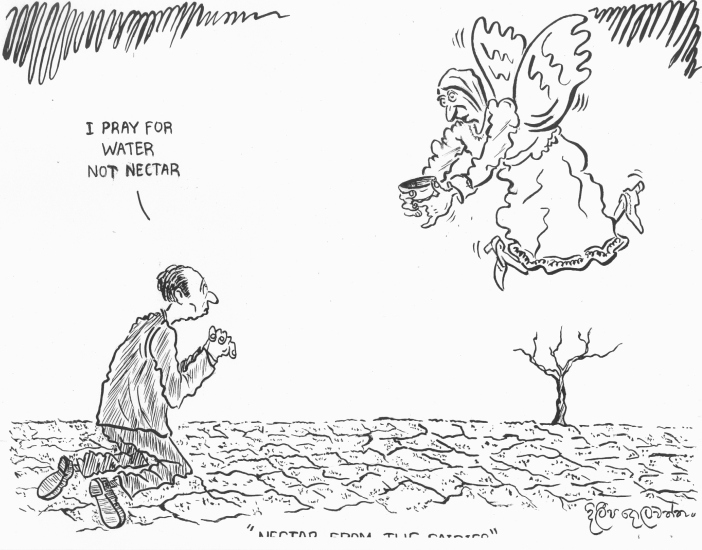
Second Prize: “I pray for water, not nectar” by Dileepa Dolawatte Second prize winning climate cartoon by Dileepa Dolawatte
Citation for second prize: Apart from the vibrant and highly accomplished draughtsmanship, it lampoons brilliantly the fairy’s naivety – a funny eye-opener. Incorporates very cleverly traditional beliefs and myths. Here we are truly past the dodgy miracles stage in the climate change battles…
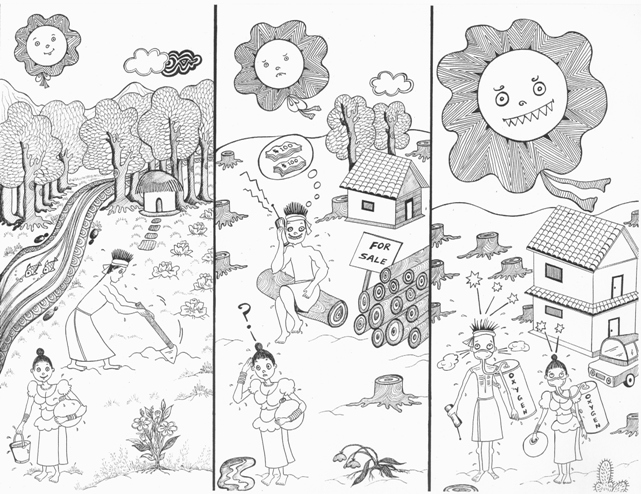
Third Prize: Theme – Drought and water shortage, by W M D Nishani Third prize winning climate cartoon by W M D Nishani
Citation for third prize: An eloquent, if over-didactic, strip cartoon – could be quite effective in women’s publications. Coherent draughtsmanship catalogues effectively the woes of a ‘get-rich-quick’ development.
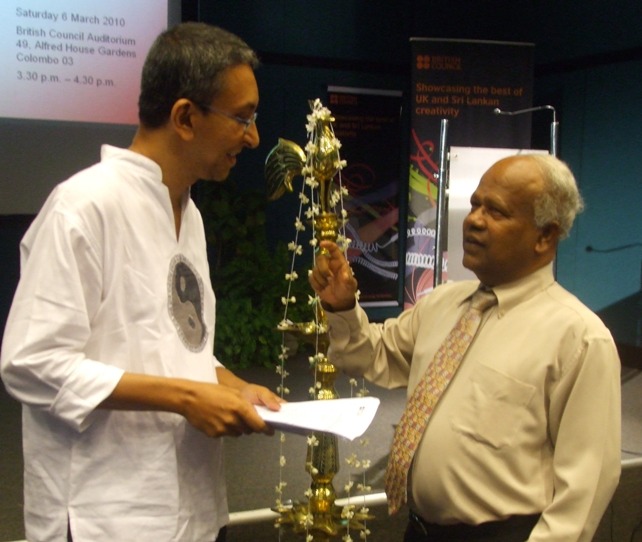
Nalaka Gunawardene (L) with cartoonist Camillus Perera - photo by Malaka Rodrigo
In January 2009, writing a tearful farewell to the slain newspaper editor and investigative journalist Lasantha Wickrematunga, I invoked the memory of Siribiris. I wrote: Goodbye, Lasantha – and long live Siribiris!
Last weekend, I finally met the ‘father of Siribiris’ and was delighted to salute him in public.
Let me explain. Siribiris is an iconic cartoon character well known to two generations of Lankan newspaper readers. He is a creation of Camillus Perera, a veteran Lankan political cartoonist who has been in this uncommon profession for nearly 45 years.
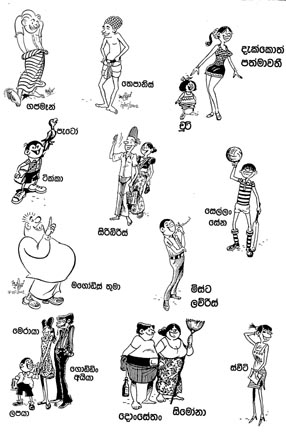
Camillus started drawing cartoons in newspapers in 1966 with the Observer newspaper and the film magazine of the same publishing group, Lake House (then privately owned and under state control since 1973). He draws pocket cartoons, political cartoons as well as satirical comic strips. His most enduring accomplishment has been the creation of a set of regular characters who have developed a loyal following over the years. Among them are the wily Siribiris, prankster Gajaman, fashionable young lady Dekkoth Pathmawathie, smart alec kid Tikka and sporty Sellan Sena.
These and other characters are very ordinary and very real, and they inhabit an undefined yet familiar place in the cartoon universe that most Lankan newspaper readers can easily relate to — it’s a bit like R K Narayan’s fictitious village of Malgudi.
Siribiris (left): puncturing egos for 40 yearsMy own favourite, Siribiris, is really Everyman personified: long-suffering, taken for granted by politicians, exploited by businessmen, hoodwinked by corrupt officials, and always struggling to simply stay alive. He is down but not yet out. The only way that poor, unempowered Siribiris can get back at all those who take advantage of him is to puncture their inflated egos and ridicule them at every turn. And boy, does he excel in that!
I grew up enjoying Camillus cartoons in various newspapers meant for children, youth and general readers. I had occasionally seen him being interviewed on TV. But I’d never seen or met him in person — until now. It happened when the British Council Sri Lanka invited Camillus as chief guest at their awards ceremony in the climate change cartoon contest they organised, which I helped judge with three others.
As the master of ceremonies, I announced: “It’s a great pleasure and honour for me to introduce Camillus Perera, the senior-most cartoonist in Sri Lanka who is still professionally active. Indeed, he has been drawing cartoons for as long as I have been alive — for he started his long innings in the same year I was born!”
Cartoon universe of Camillus PereraCamillus, a small made and pleasant man, spoke briefly and thoughtfully. (As I keep saying, we writers just can’t beat cartoonists in the economy of words!). He recalled how he’d used the British Council Library for visual references for years before the web made it much easier to search. He congratulated all those who won prizes or commendations in the contest.
Many years ago, I privileged to count senior cartoonist W R Wijesoma as a senior colleague when we both worked for The Island newspaper. Now I have finally met Camillus Perera, another hero of mine still practising his craft and drawing regularly for Rivira Sunday newspaper, as well as The Catholic Messenger and Gnanartha Pradeepaya. My only regret is that I don’t follow any of these newspapers on a regular basis, even though I try hard to keep up with Siribiris on the web…
There is a bit more than childhood idol worship involved here. Satire is one of the last domains we are left with when freedom of expression comes under siege.
As I wrote in July 2009in a blog post on news wrapped up in laughter: “There is another dimension to satirising the news in immature democracies as well as in outright autocracies where media freedoms are suppressed or denied. When open dissent is akin to signing your own death warrant, and investigative journalists risk their lives on a daily basis, satire and comedy becomes an important, creative – and often the only – way to comment on matters of public interest. It’s how public-spirited journalists and their courageous publishers get around draconian laws, stifling regulations and trigger-happy goon squads. This is precisely what is happening right now in countries like Kenya and Sri Lanka, and it’s certainly no laughing matter.“
Taken in that light, Camillus Perera is not just a popular and entertaining cartoonist adorning Sri Lanka’s newspaper industry. He is a gentle giant in the world of journalism — a man of few words whose sharp wit and keystrokes are more piercing than any number of words that we writers and journalists can churn out. He is a living cultural treasure.
So long live both Siribiris — and Camillus Perera!
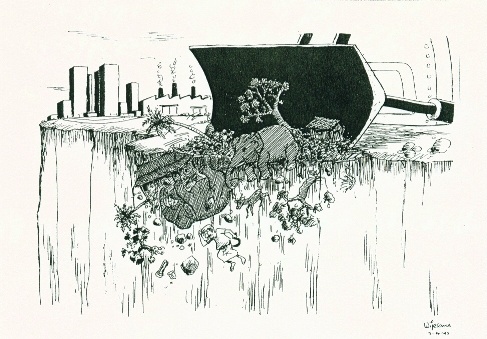
Price of Development, as seen by Cartoonist W R Wijesoma, 1993
Environmental activist and communicator Piyal Parakrama’s sudden death last week, of a heart attack, jolted Sri Lanka’s closely-knit green community. The activist community may bicker and argue endlessly among themselves, but there is also strong kinship among its cacophonous members. Many of them are still trying to come to terms with the loss.
As indeed am I – even if I’m not quite a certified member of the activist community, I consider myself a fellow traveler. I turn to words – either reflective prose or verse – when I want to make sense of something, and over the last weekend I wrote a new essay. It runs into 1,800 words and, as with all my tributes to public figures, this one is also social commentary laced in anecdotal reminiscence. It expands on initial thoughts that first appeared on this blog .
Here’s an excerpt where I talk about challenges faced by Sri Lanka’s environmental activists:
Piyal Parakrama on Sri Lanka 2048 TV showDuring the past three decades, Piyal and fellow activists have taken up the formidable challenges of conserving Sri Lanka’s biodiversity, long under multiple pressures such as growing human numbers, rising human aspirations, and gaps in law enforcement. Adding to the sense of urgency was the 1999 designation of Sri Lanka as one of the world’s biodiversity hotspots, where high levels of endemic species (found nowhere else in the wild) were threatened with extinction. Public and media attention is disproportionately focused on a few charismatic mega-fauna like elephants and leopards; in reality, dozens of other animal and plant species are being edged out.
In search of viable solutions for entrenched conservation problems, Piyal collaborated with scientists, educators, journalists and grassroots activists. Some industrialists and investors hated his guts, but he was much sought after by schools, universities and community groups across the country. Concerned researchers and government officials sometimes gave him sensitive information which he could make public in ways they couldn’t.
Some eco-protests grew into sustained campaigns. Among them were the call to save the Buona-Vista reef at Rumassala and struggles against large scale sugarcane plantations in Bibile. A current campaign focuses on the Iran-funded Uma Oya multipurpose project, which involves damming a river for irrigation and power generation purposes.
While environmentalists ultimately haven’t block development projects, their agitations helped increase environmental and public health safeguards. Occasionally, projects were moved to less damaging locations – as happened in mid 2008, when Sri Lanka’s second international airport was moved away from Weerawila, next to the Bundala National Park.
The hard truth, however, is that our green activists have lost more struggles than they have won since the economy was liberalized in 1977. They have not been able to stand up to the all-powerful executive presidency, ruling the country since 1978 — most of that time under Emergency regulations. In that period, we have had ‘green’ and ‘blue’ parties in office, sometimes in coalitions with the ‘reds’. But their environmental record is, at best, patchy. In many cases, local or foreign investors — acting with the backing of local politicians and officials — have bulldozed their way on promises of more jobs and incomes. Environmentalists have sometimes been maligned as anti-development or anti-people. In contemporary Sri Lanka, that’s just one step away from being labeled anti-national or anti-government.
At the end of the essay, I try to sum up the multiple challenges faced by ALL activists in Sri Lanka today:
“Activism is not an easy path anywhere, anytime, and especially so in modern day Sri Lanka. All activists – whether working on democracy, governance, social justice or environment – are struggling to reorient themselves in the post-conflict, middle-income country they suddenly find themselves in. Their old rhetoric and strategies no longer seem to motivate the people or influence either the polity or policy. Many of them haven’t yet crossed the Other Digital Divide, and risk being left behind by the march of technology.”
After all, I want our activists to be effective and successful as society’s conscience. My suggested author intro for this latest essay, somehow now included in the published version, read: “Science writer Nalaka Gunawardene dreams of becoming an activist one day, but for now, he remains a ‘critical cheer-leader’ of those who are more courageous.”
Piyal Parakrama died so suddenly and unexpectedly on the night of March 3 that it’s hard to believe that he is no longer among us. Another public-spirited individual has left the public space all too soon.
Piyal combined the roles of environmentalist, educator, researcher and media personality. He was also a colleague who became a friend, and a fellow traveller for many years.
In a public career spanning 30 years, he wore multiple hats, among them: Executive Director of the Centre for Environmental and Nature Studies, founder President of the Nature Conservation Group (NatCog), President of the Green Party of Sri Lanka, and consultant to various state and academic institutions. He also worked for the now-defunct Sri Lanka Environmental Congress (SLEC) and now dormant Sri Lanka Environmental Television Project (SLETP).
But Piyal Parakrama was more than an amalgamation of these parts: he was his own distinctive brand — admired, trusted or feared by different sections of society. Even his ardent detractors (and he had a few) would readily agree that he gave far more to the public good than he took back personally.
Piyal’s forte was biodiversity. His interest and knowledge were nurtured first at the Young Zoologists Association (YZA) – where he remained a volunteer for 30 years – and later at the Lumumba Friendship University in Russia, where he studied biology from 1983 to 1986.
In searching for viable solutions for entrenched conservation problems, Piyal collaborated with scientists, educators, journalists, school children and local activists. Some industrialists and investors simply hated his guts, while concerned researchers and government officials sometimes gave him sensitive information which he could make public in ways they couldn’t.
Given our common interests in development issues and the media, Piyal and I moved in partly overlapping circles. Our paths crossed frequently, and we shared public platforms, newspaper space and broadcast airtime. We even worked together for a few months in the late 1990s at the SLETP. His communications skills were invaluable in rendering a number of international environmental films into Sinhala.
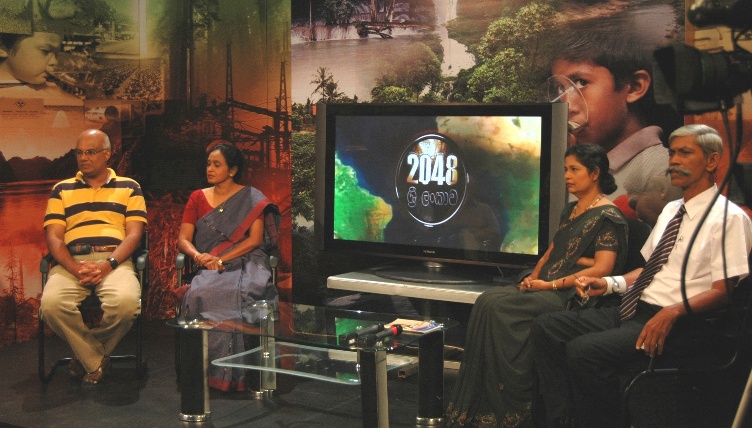
Piyal Parakrama (left) on the set of Sri Lanka 2048 - debate on Water Management
The last time we collaborated was in such a media venture. In mid 2008, Piyal joined an hour-long TV debate we produced as part of the Sri Lanka 2048 series. The show discussed the various choices and trade-offs that had to be made today to create a more sustainable Sri Lanka over the next 40 years. Taking such a long term view is rare in our professional and media spheres preoccupied with the challenges of now and here (or restricted in vision by short-termism).
Piyal could speak authoritatively on several topics we covered in the 10-part series, but I invited him to the one on managing freshwater, one of Sri Lanka’s once abundant but now threatened natural resources. With his deep knowledge and understanding of traditional water and soil conservation systems, he was truly in his element in that debate. He was also the ‘star’ among the diverse panel and studio audience we had carefully assembled.
I’m working on a longer tribute where I try to position Piyal’s role in Sri Lanka’s conservation movement. Watch this space…
Two years ago, in a moment of panic, I rushed my young daughter to Colombo’s only children’s hospital. To be honest, I don’t normally turn to our overcrowded government hospitals for healthcare. But a doctor friend had recommended the Lady Ridgeway Hospital as the best place for administering the anti-rabies vaccine.
As with all government hospitals, they first wanted to record the patient’s basic bio data. Fair enough. I provided the child’s name, age and street address. For some reason, the form also asked for the patient’s religion. Before I could say anything, the nurse in charge wrote ‘Buddhist’.
Now, this was both incorrect and highly presumptuous. But when I objected, it sparked off an argument. The formidable woman insisted that with a ‘good Sinhalese surname’ like ours, we simply had to be Buddhists!
When I said her assumption was wrong, she asked me with some disdain: are you then a Christian? No again. Now she was beginning to be get really irritated: who is this man who speaks fluent Sinhala, but is neither Buddhist nor Christian?
I was not about to declare in public a matter I consider to be intensely private: my religious faith. With the fellow public behind me becoming impatient, and the public servant in front of me taking a dogged stand, I retreated with a heavy heart. (I later paid a few thousand rupees for the same course of vaccines at a private clinic, where my religious faith or ethnicity was never questioned.)
I thought this was an isolated incident, and didn’t think further. But a few months later, I ran into a similar situation at my area police station. I’d gone to make a formal complaint about a serious matter concerning personal safety, and once again, the process started with my bio data. When it came to fixing labels, the woman constable recording my statement categorised me as ‘Sinhalese Buddhist’ — without even raising her head from the big book of complaints.
In case you are wondering, I bear absolutely no tell-tale signs of belonging any faith: I don’t wear a religious symbol as jewellery, or wrap pirith nool (pieces of thread blessed by monks) on my wrist. I also carefully avoid sprinkling my everyday speech with any religious phrases. Even my occasional swearing is devoid of religious references. (An observant friend once likened my colloquial speech to that of my favourite cartoon charter Tintin’s: no harsh swear words, and only secular references.)
Must biology be destiny in the 21st Century? Blind chance of birth placed me in a family of ethnic Sinhala parents who also happened to be Buddhists. But these cosmic accidents don’t make me a Buddhist any more than, say, I become a believing and practising Aquarian simply because I was born in February. My brand loyalty to the randomly assigned religion and star sign are about the same: zero.
Just so that I put all my cards on the table, I have not practised any religion or belonged to any religious faith (with their trappings of scripture, priests and places of worship) from my teen years. That’s 30 years of uninterrupted secular humanism.
Indeed, ‘secular humanist’ is the only label that I proudly wear in both public and private. But in the Sinhala Buddhist Republic of Sri Lanka that my land of birth is turning into, various public agencies find this ‘aberration’ either unsettling or unacceptable. My self-exclusion on matters of faith makes me an instant misfit in many state procedures. And yet, we are supposedly an open and democratic society……and in theory at least, not a religious state.
But that matters little in practice. For example, I recently gave evidence under oath in a court of law in a civil case. All along, my lawyer advised me to just ‘pretend’ to be a Buddhist for that solemn occasion. Apparently the system can’t handle ‘spiritually neutral’ — my preferred (and very honest) answer when asked about my faith.
I don’t see how and why a citizen’s religious affiliation – or its complete absence – should matter in the least when dispensing vaccines or justice in the modern world. Is this not a residual habit from colonial times that no longer serves a purpose? Actually, I find it worse than redundant; it’s plain insulting.
Religion is not the only private matter that our governments love to poke its clumsy and unwelcome noses into. Also falling into this category: everyone’s sanitary habits, and sexual relations between consenting adults.
For sure, what private individuals do in the privacy of their homes can have some implications for the community, economy and national statistics. In today’s highly inter-dependent and interlinked world, no man or woman or nation is an island.
Despite this, there are at least three aspects of modern living where choices must remain strictly and entirely personal: what we do in our bed rooms, wash rooms and (metaphorical) shrine rooms. I, for one, will resist all arms of the state and government, as well as self-appointed guardians of our morals and values, from intruding into any of these hallowed spaces of my free will and choice.
Especially when it comes to matters of faith – or its complete avoidance – the Jackboot of government means absolutely nothing.
Explanation for non-Lankan readers:
The ethnic mix and religious mix in Sri Lanka don’t coincide, making it (at least for me!) a delightfully chaotic melting pot. While some Sinhalese are Buddhist and some Tamils are Hindu in their choice of faith, that is not to be assumed. Indeed, there are statistically significant numbers of both Sinhalese and Tamils who are Christians (of various denominations). While all our muslim friends are Islamic, there are also some ethnic Sinhalese and Tamils who have converted to Islam. So one has to be very careful in making generalisations, and it’s altogether better to avoid them….
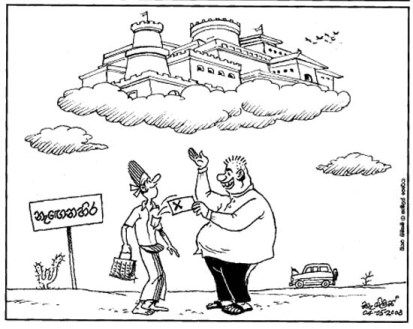
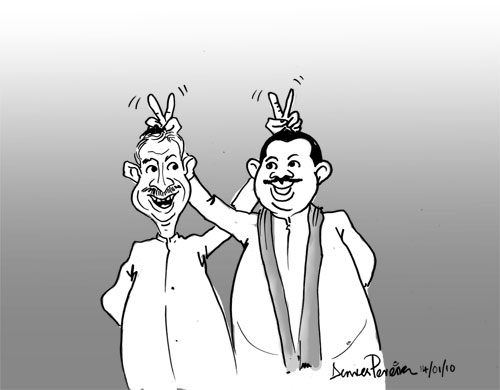
Heads you lose, tails we win...?With over 10 million others, I voted in Sri Lanka’s sixth Presidential Election yesterday. Today, after the votes were counted and tallied, we were informed that the incumbent President Mahinda Rajapaksa has been re-elected for another six year term. He has won 57.9% of the valid votes.
Nearly 11,000 polling stations had been set up for this purpose, mostly at temples or schools. A quarter of a million public servants were mobilised to handle this massive operation, while close to 100,000 policemen and soldiers were tasked to maintain law and order. And the whole business of choosing the next leader is costing the war-impoverished nation several billion rupees.
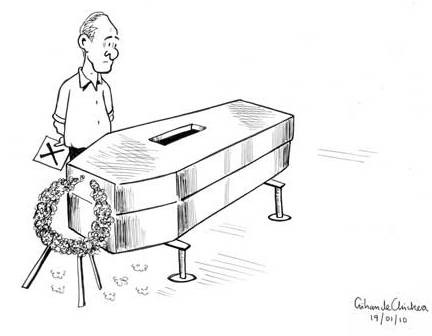
So do the results — basically, more of the same — justify all this cost and effort? Was there real choice for us the hopeful little men (and women) who walked into little booths with little pencils in hand to make a little cross on a (not so) little bit of paper?
Opinion is highly polarised on that last question. The two main candidates not only tried to outpromise each other without coherence or focus, but also made a mockery out of the whole campaign process.
In fact, as I noted in my essay last week titled Open Moment, Closed Minds: “Party politics has always polarised Lankans, but no other election in recent memory has been as divisive…The two main contenders both claim to hold a mutually exclusive key to a better future for our land and people. Their dizzy campaigns bombard us with lofty claims and counter-claims 24/7 delivered through broadcast, broadband, mobile and other media.”
With pre-election violence escalating, the choice before voters looked like this a week before election day.The election results will be analysed and debated for weeks to come. At first glance, it looks as if the voters used this election to express gratitude to Rajapaksa for having provided the political leadership to end Sri Lanka’s long-drawn civil war.
We can argue whether presidential elections should be turned into referendums on individual performance of candidates – or instead, decided on the vision and policies offered by them. I grant this is a bit more serious than American Idol – or its local variations – where we text our preference for the candidate with the best looks or talent.
In fact, I’m still not convinced whether it’s such a good idea to mix personal gratitude with voting for a head of state.
I’ve voted in four presidential and three general elections (I missed some due to overseas travel). With one exception (1994), all have been ‘protest votes’ – I was voting against an incumbent more than in favour of an aspirant.
But there are more things in heaven and on Earth, dear reader, than are dreamt in our messy politics. Albert Einstein said it so well many decades ago: “Everything that can be counted does not necessarily count; everything that counts cannot necessarily be counted.”
We can only hope that our votes were properly counted — and that they count and matter to the leader whom we have collectively chosen today. That is, if he can see and hear beyond the cacophony of sycophants who surround him 24/7.
And as I tweeted earlier today: As Sri Lanka re-elects the President, we hope ALL 20 million Lankans can share the promise of a Better Future on which he campaigned and won…
In a new op ed essay — titled ‘Open Moment’, Closed Minds! — just published on Groundviews.org, I look back and ask some hard questions.
Here’s an excerpt:
“We all knew the hard-won peace had to be nurtured and consolidated. We also realised just how formidable the challenges of healing and rebuilding were. But could anyone have imagined the dramatic turn of political events since?
“Who would have thought that the victors of the war would soon be engaged in a nasty battle for personal glory and power? Who expected the historical feud between ‘lions’ and ‘tigers’ to be replaced so swiftly by a showdown between self-proclaimed ‘patriots’ and ‘traitors’?”
I raise these questions in the context of a fiercely contested presidential election scheduled for 26 January 2010. I note: “The two main contenders both claim to hold a mutually exclusive key to a better future for our land and people. Their dizzy campaigns bombard us with lofty claims and counter-claims 24/7 delivered through broadcast, broadband, mobile and other media.”
I ask whether either of the leading candidates has the open mind needed to seize the historic ‘open moment’ since the war ended. I recall how we completely missed the last such open moment created by the tsunami of December 2004.
I write: “Having missed the tsunami’s open moment, we cannot afford to bungle again. Rebuilding a nation of lasting peace, pluralism and prosperity will require many sections of society to change their mindset. This is especially and urgently needed in our media, much of which has become uncritical cheerleaders for patriotism and tribalism in recent years.”
Despite the many disappointments of the past 250 days, I still remain cautiously optimistic. But for how long?
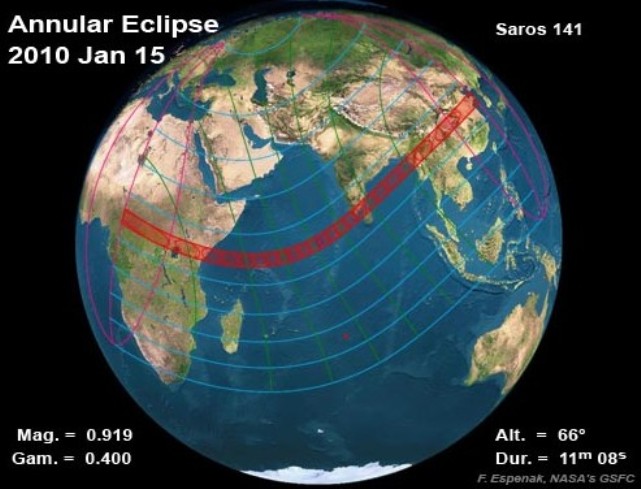
Where the island of Sri Lanka was concerned, it was the first solar eclipse of the broadband internet era — and that showed.
The last solar eclipse seen in Sri Lanka was two generations ago, on 20 June 1955. That was almost pre-historic in mass media terms. The newly independent Ceylon had a single, state-owned radio station and a handful of newspapers. There was no television, and the internet was not even conceived.
Yet, paradoxically, the media’s influence over the 8 million people then living on the island seem to have been greater at the time. As astronomer Dr Kavan Ratnatunga recalled: “A quack physician cum astrologer, recommended that women wanting to become fair and lovely should drink a decoction of which the main ingredient was “Vada Kaha” (Sweet Flag or Acorus Calamus) at the time of the total eclipse, preferably unseen by others. Many who took his advice ended up in hospital.”
Solar eclipse on 15 Jan 2010 seen in Anuradhapura, north-central Sri Lanka - photos by ReutersIn contrast, in 21st Century Sri Lanka, the January 15 eclipse was not much of a news story. I don’t claim to have done a systematic analysis, but my impressions are drawn from scanning the major newspaper websites in English and Sinhala, and surfing the dozen or more terrestrial (free-to-air, not cable) TV channels that were on the air during the three hours or so of the eclipse. (Sorry: I missed out radio, and I’m not proficient in Tamil.)
Broadcast television was my biggest disappointment. Solar eclipses are a visual spectacular, and literally heaven-sent for live television. Yet, not a single Lankan TV channel carried a live broadcast of the event, either from northern Sri Lanka where it was best seen (in its annular form, with ‘ring of fire’ effect), or from elsewhere on the island as a partial eclipse.
It seemed as if the Colombo-based media were completely preoccupied with the intense build-up to the presidential election scheduled for 26 January 2010 — a case of politics eclipsing the solar eclipse?
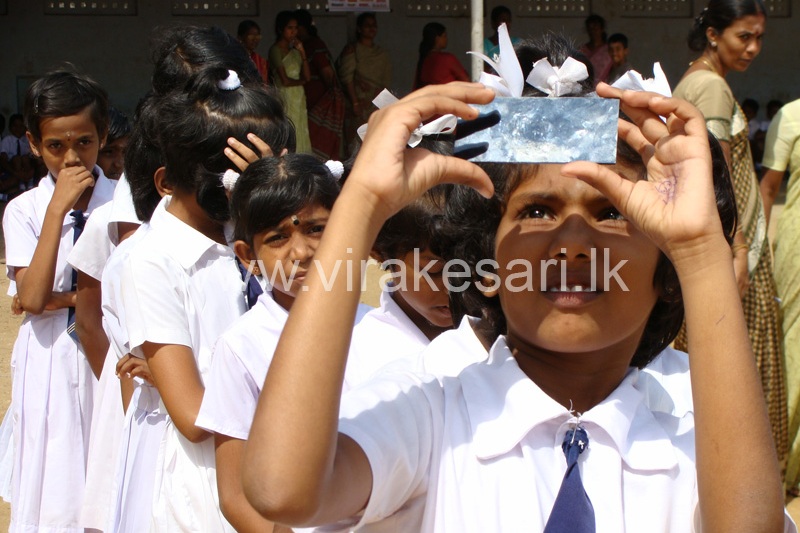
Jaffna school children view the solar eclipse - Photo courtesy Virakesari
But there were a couple of honourable exceptions – and thank heavens for that! One was the leading Tamil daily Virakesari, which sponsored an expedition to Jaffna, in northern Sri Lanka, by a group of professional and amateur astronomers from SkyLk.com. According to one member of this expedition, Thilina Heenatigala, this newspaper provided the widest and most uptodate coverage of the annular eclipse from Jaffna.
SkyLk.com collaborated with the Hindu College in Jaffna, whose playground was converted into an open air observation camp. Thilina says over 2,000 people – including school children and adults – had converged to witness the event. A large screen was set up on to which the live image from a telescope was projected.
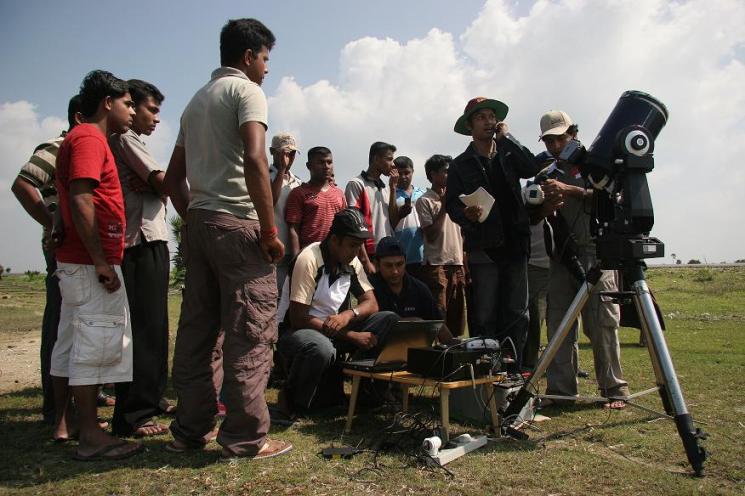
Not far from there, a group of engineering students and teachers from the University of Moratuwa was doing a more scientific observation. Later that day, team leader Dr Rohan Munasinghe reported in an email: “We have recorded the solar eclipse from Kayts (lat 9d,37m N, Long 79d,58 E), the biggest island off Jaffna Sri Lanka. We have timestamped the video with GPS (Garmin 18) accuracy.”
University of Moratuwa team observing the clipse - photo courtesy Dr Rohan Munasinghe
Elsewhere across the island of Sri Lanka, there was plenty of interest among the people from all walks of life — as seen from the thousands who stepped out during mid-day to take a peek at the celestial phenomenon. Not all of them followed the safety precautions to prevent eye damage, disseminating which the media had done a good job in the preceding days.
Clearly, this high level of public interest was not reflected in how the rest of Lankan mainstream media covered the eclipse. But if the mainstream media’s gaze was firmly fixed on the gathering election storm on the ground, the new media created opportunities for others to step into that void. Citizen scientists joined hands with citizen journalists to capture and share the eclipse with each other — and the world. These unpaid enthusiasts used commonly available digital tools and online platforms for this purpose.
Some of them uploaded dozens of photos for public viewing on image sharing sites like Flickr. A good example is what Shehal Joseph and Romayne Anthony did. There were many others.
SkyLk.com group was more ambitious: they actually webcast the eclipse live online from their public observation camp at Hindu College grounds. Stuck in Colombo with its sub-optimal viewing conditions for this eclipse, this was the best chance for people like myself to catch the annular part of the phenomenon.
“We were struggling with bandwidth limitations most of the time,” Thilina Heenatigala says. “We used a Dialog HSPA modem to connect to the web, and line speeds kept fluctuating. We were not the only ones uploading still photos or video to the web from different locations in northern Sri Lanka — and apparently all of us were slowing down each other.”
Being the tech-savvy planner he is, Thilina had alerted Dialog telecom company about the likely peaking of bandwidth demand. But he is not sure if any temporary enhancing was done, even though Dialog currently claims to be the ‘first and best’ to offer telecom coverage in the north. Certainly, the live eclipse webcast was not of uniform quality — it’s a small miracle it happened at all: until a few months ago, this was part of the theatre of war in northern Sri Lanka.
In fact, SkyLk.com had used the web to build up public awareness and interest using video trailers on YouTube. Here is one of several simulations they had up from December, thus one for Anuradhapura, Sri Lanka (simulation):
In the end, however, SkyLk.com became a victim of its own success. The live webcast was followed by hundreds, and then thousands of online visitors from different parts of the world. This apparently overshot the usual allocations provided by the offshore hosting company (in the US), which suspended the account. Right now SkyLk.com website is not accessible (as at 16 January 2010, 15:00 UTC/GMT).
Within hours of the eclipse, several individuals and groups also uploaded highlights of their eclipse videos on to the YouTube. Here are the most striking ones I came across in a quick search:
Solar Eclipse 2010 Sri Lanka Scientific Record – by University of Moratuwa
Scientific recording of the annular solar eclipse on 15 January 2010 was carried out from the Island Kayts (Lat +09d 37m North and Long +79d 58m East) of Sri Lanka.
Orion Video’s coverage from Nallur, Jaffna:
Not in the same league as the above two videos, this was Nishan Perera’s personal observations from Ratnapura, south-western Sri Lanka:
It’s too early to draw firm conclusions from this random evidence, but in all likelihood, we passed thresholds in both citizen journalism and citizen science with this eclipse. Clearly, the mainstream media’s monopoly/domination over reporting of such an event has been shattered: their indifference will no longer stand in the way of information and images being disseminated.
Perhaps just as important, it is no longer possible for a couple of self-appointed ‘public astronomers’ to dominate the public information channels on an occasion like this, mostly for shameless self-promotion. As Dr Kavan Ratnatunga, President of the Sri Lanka Astronomical Association, noted in an article: “I am amazed as to how many who have never even seen a Solar Eclipse, will gladly talk about it to an equally ignorant journalist, resulting in some totally misleading and sometimes hilarious information being published in both the English and Sinhala media. In a nation which believes in pseudo astrology, I am sure it is just a matter of time before quacks start using it to predict influence on local events and politics. However, there is absolutely no influence on any person by any of these celestial events.”
At the end of the day, however, astronomy aficionados are emphatic that no amount of media coverage can really substitute the experience of being there and experiencing it ourselves. As Kavan says: “A solar Eclipse is event which must be experience and observed. No video can do justice to that experience. It can also become addictive. In the modern age when the Internet and TV can bring events to your home, one may wonder why some Eclipse chasers travel round the world to see an Eclipse of the Sun.”
The next solar eclipse visible from Sri Lanka will be on 26 December 2019. I wonder what kind of media and ICT landscape would cover that event…
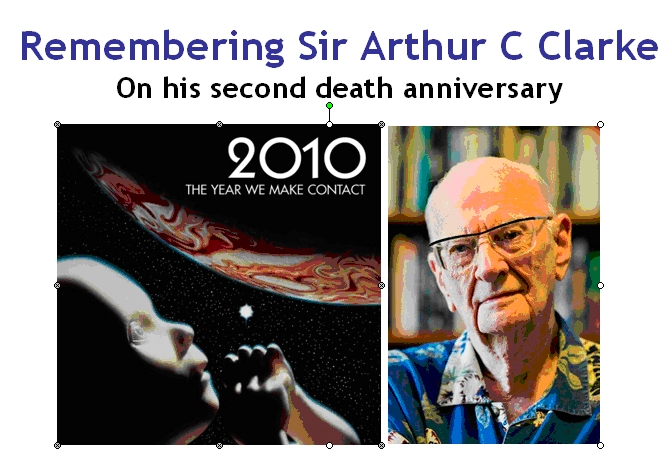 It’s exactly two years since Sir Arthur C Clarke abandoned his 91st orbit around the Sun and headed to the stars. That was on 19 March 2008.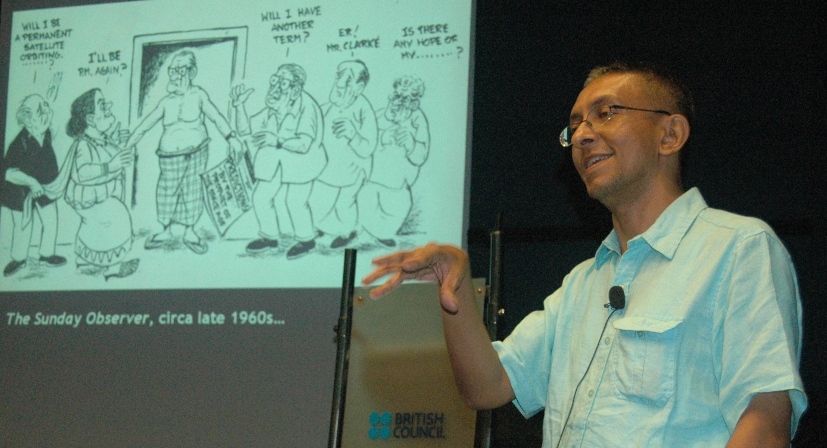






 Open Minds!