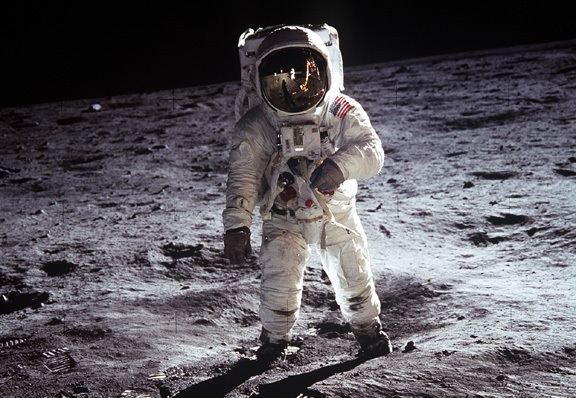
Apollo still photos were much better than broadcast images: how come?
In theory, it can happen to anyone recording moving images on tape or digital media: absent-mindedly or carelessly re-use the recording media, and thus lose the original content. If no copy exists, such an accident means an irrevocable loss.
But if the images were the most expensively shot in the whole of human history — literally costing billions of dollars and involving the genius and labour of half a million people over several years — we would expect these to be archived and preserved with great care, right?
Well, not necessarily — if the custodian is a government agency. On eve of the 40th anniversary of the first Moon landing by Apollo 11, the US space agency NASA dropped a bombshell: it admitted that the original recordings of that historic moment were accidentally erased years later.
One British newspaper called it “the scientific equivalent of recording an old episode of EastEnders over the prized video of your daughter’s wedding day”.
Can you see the Moon on the Moon? Well, only just...The loss became public when the Sydney Morning Herald broke the story in August 2096. “A desperate search has begun amid concerns the tapes will disintegrate to dust before they can be found,” it said.
While the media rushed with oops-style headlines like ‘One giant blunder for mankind’, NASA quietly investigated what really happened. Last week, they revealed the hard truth: the tapes were part of a batch of 200,000 that were degaussed – or magnetically erased — and re-used. It was a standard money-saving measure at NASA in those pre-digital days to reuse the 14-inch tape reels after several years in storage. Agency officials fear that the original Apollo 11 tapes were buried among an estimated 350,000 that were recycled in the 1970s and 1980s and the data was lost for ever.
But the historic visuals are not entirely lost: luckily, broadcasters who used NASA’s expensively obtained footage had archived their transmissions for posterity. For many months, NASA has worked with a leading digital imaging company in Hollywood to restore good copies of the Apollo 11 broadcast found in the archives of CBS News and some recordings called kinescopes found in film vaults at Johnson Space Center.
On 16 July 2009, NASA released the first glimpses of a complete digital make-over of the original landing footage that looked decidedly sharper and clearer than the blurry and grainy images of Neil Armstrong and Buzz Aldrin walking on the Moon.
And we have to admit, the new video is definitely better than the ones we’ve seen for 40 years!
Raw Video: Restored Video of Apollo 11 Moonwalk
Another montage of digitally restored Apollo 11 mission highlights:
The full set of recordings, being cleaned up by Burbank, California-based Lowry Digital, are to be released in September 2009.
I had often wondered why the original images from the Moon were so grainy: it wasn’t typical even for that time. And if NASA spent between US$ 22 to 25 billion on landing men on the Moon, surely they’d have harnessed the best available technology to capture and share their moments of triumph, I assumed.
Actually, the video coverage that was broadcast around the world — to an estimated audience of 500 to 750 million people — and has since been endlessly redistributed was not quite what came from the Moon. It was a diluted version. Stanley Lebar, the NASA engineer in charge of developing the lunar camera, now calls a “bastardized” version of the actual footage.
Here is the “as-it-happened” broadcast from CBS News that day, with the legendary Walter Cronkite anchoring to the biggest TV audience the world had known. (Footnote: You’ll see the first electronic “character generators” in use.)
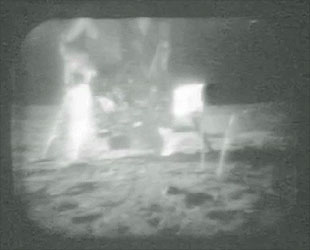
The story is technically complex, but here’s the essence: live images from the Moon couldn’t be fed directly to the American TV networks using the NTSC broadcast standard. Audiences worldwide would be holding their breath that a delayed broadcast, even by a few minutes, would not have been as effective as ‘live from the Moon’. Under such time pressures, no conversions could be attempted. So a regular TV camera was pointed at the huge wall monitor at mission control in Houston.
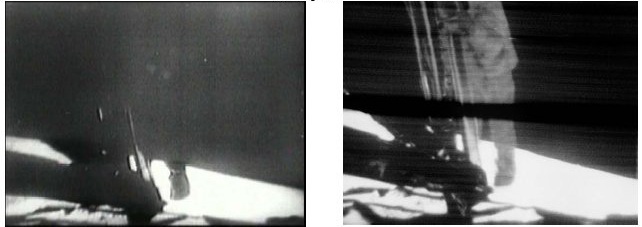
This is known as kinescope, or telerecording: a recording of a television program made by filming the picture from a video monitor. That resulted in the grayish, blotchy images that everyone saw on their home TV sets. In other words, It was a copy of a copy, with significant quality losses in that process!
Scan-converted broadcast image of Armstrong descending the lunar module ladder taken at Goldstone tracking station. This was the image the world saw of the first human on the Moon. But a Polaroid picture of the Slow-Scan television image of Armstrong coming down the ladder reveals far greater detail. Image Courtesy: John Sarkissian/CSIRO Parkes Radio Observatory
A new documentary, released in January 2009, offers new insights into one of the most challenging feats in international live broadcasting – how those images from the Moon were delivered to TV audiences around the world. Produced by Spacecraft Films and directed by Mark Gray Live from the Moon: The Story of Apollo Television
It tells how for the first time in history millions of people could share, in real time, the experience of frontier exploration.
The story behind the camera...finally!“Placing a man on the moon and returning him safely to the Earth was hard enough in 1969,” says Gray. “‘Live From The Moon’ tells the story of how television, still a technological toddler, was developed for space flight, and examines the impact of the iconic passages that were returned.”
To tell that story, Gray literally circled the Earth, shooting interviews at the deep space communication stations in California and Australia, as well as at space facilities and museums in Houston, Baltimore, Los Angeles, Princeton, Kennedy Space Center, Huntsville, Ala., Washington, DC and Weatherford, Oklahoma.
Along the way, he interviewed astronauts, flight directors, mission controllers, tracking station operators, historians and those who built the television cameras for the space program…. “Live from the Moon” is told with the insight of moonwalker Alan Bean; Apollo 10 commander Tom Stafford; flight director Chris Kraft; Neil Mason, who drove the Parkes Telescope; Westinghouse camera team leader Stan Lebar; and the voice of mission control Jack King, among others.
“Every single one of them believed that the TV was one of the most important legacies of Apollo. And many of them admitted candidly that they didn’t give the TV much thought during the actual missions,” recalled Gray.
News by definition looks for the exception. What goes right, and according to plan, is hardly news. Deviations, aberrations and accidents hit the news.
It’s the same with disasters. Reducing a hazard or averting a disaster does not make the news; when that hazard turns into a disaster, that typically tops the news. Yet, as we discussed during a session at the 6th World Conference of Science Journalists held in London from June 30 – July 2, 2009, both aspects are important — and both present many challenges to journalists and the media.
The session, titled Covering a disaster from Sichuan to Sri Lanka, saw three science journalists share their own experiences and insights in covering two major disasters in Asia. Richard Stone (Asia News Editor, Science) and Hujun Li (senior science writer with Caijing magazine, China) both spoke about covering the Sichuan earthquake that occurred on 12 May 2008. I spoke on my experiences in covering the Indian Ocean tsunami of 26 December 2004. The session was chaired by the veteran (and affable) British journalist Tim Radford, who has been The Guardian‘s arts editor, literary editor and science editor.
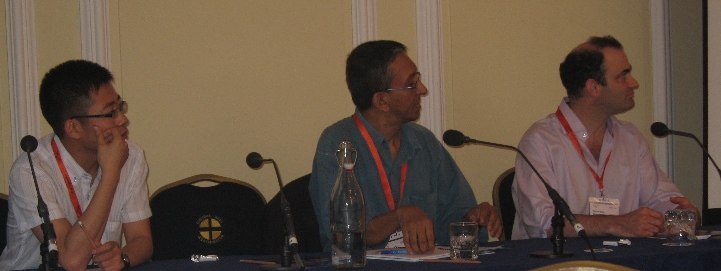
Covering a disaster from Sichuan to Sri Lanka: L to R: Hujun Li, Nalaka Gunawardene and Richard StoneI recalled the post-tsunami media coverage in two phases — breaking news phase (first 7 – 10 days) and the aftermath, which lasted for months. When the news broke on a lazy Sunday morning, ‘Tsunami’ was a completely alien term for most media professionals in Sri Lanka. In newspaper offices, as well as radio and TV studios, journalists suddenly had to explain to their audiences what had happened, where and how. This required journalists to quickly educate themselves, and track down geologists and oceanographers to obtain expert interpretation of the unfolding events. We than had to distill it in non-technical terms for our audiences.
My involvement in this phase was as a regular ‘TV pundit’ and commentator on live TV broadcasts of MTV Channels, Sri Lanka’s largest and most popular broadcast network. Night after night on live TV, we talked about the basics of tsunami and earthquakes, and summed up the latest information on what had taken place. We also acknowledged the limits of science -– for example, despite advances in science and technology, there still was no way of predicting earthquakes in advance.
One question we simply couldn’t answer was frequently raised by thousands of people who lost their loved ones or homes: why did it happen now, here — and to us? Was it an act of God? Was it mass scale karma? As science journalists, we didn’t want to get into these debates — we had to be sensitive when public emotions were running high.
There were enough topics during the breaking news phase that had a scientific angle. Clinically cold as it sounded, the mass deaths required the safe, proper and fast burial of bodies with identities established. The survivors had to be provided shelter, food, safe drinking water and counselling. And when rumours were spreading on the possibility of further tsunamis, both officials and public needed credible information from trusted, competent sources.
Tsunami waves lashing Kalutara beach on western Sri Lanka on 26 December 2004: satellite image courtesy DigitalGlobe Quickbird satellite, http://www.digitalglobe.com
After the breaking news phase passed, we had more time to pursue specific stories and angles related to the tsunami. As an environmentally sensitive journalist, I was naturally interested in how the killer waves had impacted coastal ecosystems. Then I heard some interesting news reports – on how some elements of Nature had buffered certain locations from Nature’s own fury.
Within days, such news emerged from almost all Tsunami-affected countries. They talked about how coral reefs, mangroves and sand dunes had helped protect some communities or resorts by acting as ‘natural barriers’ against the Tsunami waves. These had not only saved many lives but, in some cases, also reduced property damage. Scientists already knew about this phenomenon, called the ‘greenbelt effect’. Mangroves, coral reefs and sand dunes may not fully block out tsunamis or cyclones, but they can often reduce their impact.
Researching this led to the production of TVE Asia Pacific‘s regional TV series called The Greenbelt Reports, which was filmed at a dozen tsunami impacted locations in South and Southeast Asia. By the time we released the series in December 2006, sufficient time had passed for the affected countries to derive environmental lessons of the tsunami.
The other big story I closely followed was on early warnings for rapid on-set disasters like tsunamis. Some believed that the tsunami caught Indian Ocean rim countries entirely by surprise, but that wasn’t quite true. While the countries of South and Southeast Asia were largely unprepared to act on the tsunami, the Pacific Tsunami Warning Centre (PTWC) in Hawaii, who had detected the extraordinary seismic activity, did issued a tsunami warning one hour after the undersea quake off western Sumatra. This was received at Sri Lanka’s government-run seismological centre in good time, but went unheeded: no one reacted with the swiftness such information warranted. Had a local warning been issued, timely coastal evacuation could have saved thousands.
All this shows the many and varied science or development stories that journalists can find in the aftermath of disasters. Some of these are obvious and widely covered. Others need to be unearthed and researched involving months of hard work and considerable resources. Revisiting the scenes of disasters, and talking to the affected people weeks or months after the event, often brings up new dimensions and insights.
My own advice to science journalists was that they should leave the strictly political stories to general news reporters, and instead concentrate on the more technical or less self-evident facets in a disaster. During discussion, senior journalist Daniel Nelson suggested that all disaster stories are inherently political as they deal with social disparities and inequalities. I fully agreed that a strict separation of such social issues and science stories wasn’t possible or desirable. However, science journalists are well equipped to sniff out stories that aren’t obviously covered by all members of the media pack that descends on Ground Zero. Someone needs to go beyond body counts and aid appeals to ask the hard questions.
As Hujun Li said recalling the post-Sichuan quake experience, “Politics and science are like twins – we can’t separate the two. What we as science journalists can do is to gather scientific evidence and opinion before we critique official policies or practices.”
Another question we were asked was how journalists can deal with emotions when they are surrounded by so much death and destruction in disaster scenes. Reference was made to trauma that some reporters experience in such situations.
I said: “We are human beings first and journalists next, so it’s entirely normal for us to be affected by what is happening all around us. On more than one occasion in the days following the tsunami, I spoke on live television with a lump in my throat; I know of presenters who broke down on the air when emotions overwhelmed them.”
And now...the sequelsSumming up, Tim Radford emphasized the need for the media to take more interest in Disaster Risk Reduction (DRR), which basically means preventing disasters or minimising the effects of disasters.
“DRR is perhaps less ‘sexy’ for the media, as it involves lots of policies and practices sustained over time,” he said. “But the potential to do public good through these interventions is enormous.”
As Tim reminded us, disasters already exact a terrible and enduring toll on the poorest countries. This is set to get worse as human numbers increase and climate change causes extreme weather and creates other adverse impacts. Living with climate change would require sustained investments in DRR at every level.
The stories are out there to be captured, analysed and communicated. In the coming years, the best stories may well turn out to be on disasters averted or minimised
Raised on popular culture, I have always been an admirer of tabloid journalism – which means using popular formats to reach out to a mass audience in newspapers or broadcasting. There’s nothing inherently wrong with this: we might even argue that the tabloid approach is the only way to achieve truly mass media (with all else being niche media reaching to smaller demographic groups).
So I was delighted to be on a panel with two leading British tabloid journalists and a popular radio host from South Africa during the 6th World Conference of Science Journalists held in London from June 30 – July 2, 2009.
My own, personal answer is NO — it need not be! And I’ve spent a good part of my two decades of work in the media experimenting and showing that communicating science can be fun — both for us communicators and our audiences.
But I pointed out that science is still being covered in sections of Asian media in the more traditional, classical way, just like science itself is still an elitist pursuit in many of our societies.
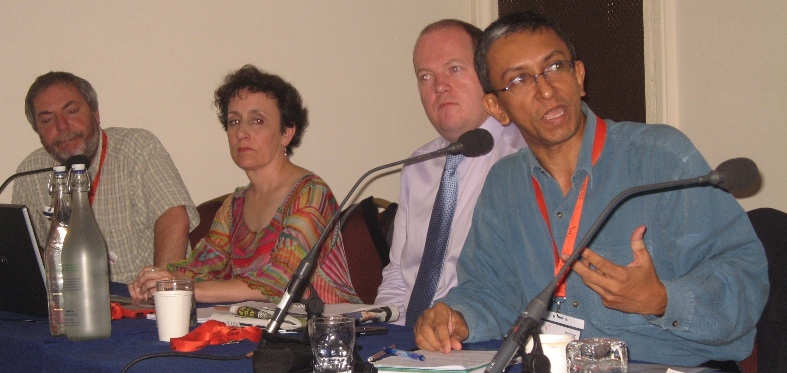
L to R: Paul Sutherland, space correspondent of The Sun, UK; Christina Scott, radio and web journalist, South Africa; David Derbyshire, Environment editor, The Daily Mail, UK; Nalaka Gunawardene, Director/CEO, TVE Asia Pacific
I said: “We might call this coverage ‘broadsheet approach’ in print; or ‘bluechip documentary’ format on television. And they are both unsustainable! They are also endangered in these hard times for the mainstream media in most economies.
“So going the tabloid path is a practical and pragmatic way to deliver science stories and science information to a mass audience or readership. We’re doing it in different ways in the Asian media!”
In my remarks, I gave some examples where science is jazzed up (rather than dumbed down) for popular consumption on Asian television. For example, how solar and lunar eclipses provide fodder for endless stories on our numerous news channels. Such coverage, fleeting and superficial as it might often be, takes the wonders of science and Nature to more people than anyone else can.
I argued that the path to the mass audiences in Asia is through news, sports and entertainment programming. We have our own niche, factual channels – Discovery, National Geographic, Animal Planet and their local equivalents. They have a loyal but small audience. They do excellent work. But where numbers are concerned, they cannot – yet! – compete with the outreach and appeal of broadcast radio, TV and newspapers. Neither can the online and mobile media, even though their outreach is growing fast.
Things don’t always go right, however. Doing wall-to-wall coverage of news demands producers and reporters to tackle a variety of topics and subjects — including specialised science stories. Some handle this better than others. In their race for ratings and revenue, a few ‘dress up’ the stories a bit too much.
Television science: aspiration or reality?A good example was how some Indian news channels handled the so-called ‘Big Bang experiment’ in September 2008, when the Large Hadron Collider (LHC) was commissioned. The mega-science experiment was interesting in its own right, but it wasn’t apparently exciting enough for at least two channels — Aaj Tak and India TV. Their coverage running up to the event speculated about its “catastrophic effect on the world” – effectively end of the world.
Their coverage caused panic, which led to at least one attributable death. This prompted the Indian Ministry of Information and Broadcasting to caution the channels for spreading “misinformation, fear and horror” among viewers. It advised the channels to exercise restraint in presenting such issues.
I call this the ’24/7 TV Deficit’ in Asian broadcasting. The long term response to this is to invest in training and capacity building of journalists and producers already working in the media. For the most part, they learn on the job, making mistakes on the air. This is far from ideal.
Here’s how I summed up: ‘Tabloid science coverage’ – in print or broadcast – may be imperfect in some ways. But our choice is either that, or nothing. Our challenge is to make the process and product better as we go along.
We urgently need to unleash scientific knowledge and understanding in matters of public interest and public policy. We can’t afford the ALL or NOTHING approach.
Journalists always love a crisis for its news value. But they’d prefer such crises to be happening to someone else, and not to themselves. Right now, however, mainstream media (MSM) are hit by their own crisis – one that threatens their very survival. Their old business models are crumbling in the face of online media, and their advertisers are moving away as fast as their audiences do.
The crisis is real, no doubt — but it’s not evenly spread across the media or around the world. Despite being a world conference, what we heard most frequently and emphatically was the version of the western, mainly English language media. So when I had a chance to talk — during a session on Does science need to be highbrow? — I spent a couple of minutes giving the other side of the news.
Here’s part of what I said:
All news is not doom and gloom...We’ve heard a lot of doom and gloom at this conference about the state of mainstream media. We empathise with our journalist colleagues affected by both economic downturn and audience migration to online media. The situation is somewhat different in many parts of Asia, where there is still vibrancy in newspapers, radio and television industries. I realise this is a sweeping generalisation, but the media industry’s statistics suggest this.
According to the World Association of Newspapers (WAN):
• 8 of the world’s 10 largest circulating, paid-for daily newspapers are in Asia.
• The largest national newspaper markets are in China, India and Japan — the United States is a distant fourth.
• While readers are abandoning newspapers in North America and Europe, paid-subscriptions in Asia’s grew by nearly 5% in 2008.
• In India alone, 11.5 million new newspaper readers were added in 2008.
Some say Asia is enjoying what may be the world’s last great newspaper boom. This is fuelled by a confluence of factors – among them:
• growing literacy rates and rising educational levels;
• rising middle classes many of who consider buying a daily newspaper at home as a sign of prosperity; and
• media reforms in some countries which have liberalised the sector, allowing local and foreign companies to enter the media market.
Similar trends are seen in radio and television broadcasting, where there has been an explosion of channel numbers in the past two decades. All this presents challenges AND opportunities for covering science.
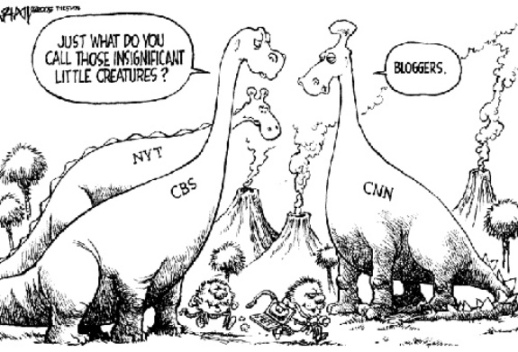
What does all this mean? Is the Asian media boom the exception that does not prove the rule? Or is the mass extinction of mainstream media going to hit Asia just a bit later? In that case, are we now seeing the last hurrah of the mediasaurus — to use a term that was first coined by the American writer Michael Crichton, best known for his novel Jurassic Park? He anticipated the current crisis in the media back in 1993, in an essay he wrote in Wired magazine, titled “Mediasaurus“.
Adapting to survive?Naturally, the industry does not like to acknowledge it is doomed. Predicting the death of newspapers “seems to have reached the level of a new sport,” says Gavin O’Reilly, President of the World Association of Newspapers. He told the ‘Power of Print’ Conference in Barcelona, Spain, in May 2009: “That this doom and gloom about our industry has largely gone unanswered is, to me, the most bizarre case of willful self-mutilation ever in the annals of industry. And it continues apace, with commentators failing to look beyond their simple rhetoric and merely joining the chorus that the future is online, online, online, almost to the exclusion of everything else. This is a mistake. This oversimplifies a rather complex issue.”
It’s complex alright, and what happens to the larger media industry would determine how and where science can be covered in the media. In our session, I went on to discuss the prospects for covering science and technology in the currently numerous – and very cacophonous! – media in South and Southeast Asia. A separate blog post covers that part of my remarks.
“There is soon going to be a mass extinction event for the media (as we know it) – it’s triggered by the spreading of online media, and accelerated by the economic recession. Very few media organisations will survive…”
John Rennie (photo courtesy Yale University)He added: “Only some very large media organisations and a few really small ones will be able to withstand this mass extinction.”
He then posed the critical question to the several hundred journalists, editors and broadcasters from all over the world: does the rest of us deserve to survive?
He wasn’t so sure – no media organisation, however large or prestigious it may be, and how deep its pockets are, can carry on business as usual amidst this transformative event. In other words, adapt fast – or go the way of the dinosaurs…
It’s probably time for editors to redefine what constitutes science news, he said. “We should move away from the current model of reporting the ‘big paper of the week’.”
Calling such news the ‘low-hanging fruit’, he challenged his peers: “We need to be better than that. Good bloggers can now match us in most of our routine work. So how and where do professional journalists add value?”
We can always depend on Rennie to sum up complex issues in an interesting soundbite or two. My blog post from the previous WCSJ in Melbourne, where he talked (joked) about Vatican condoms and global warming, has drawn consistently high levels of visitor interest since.
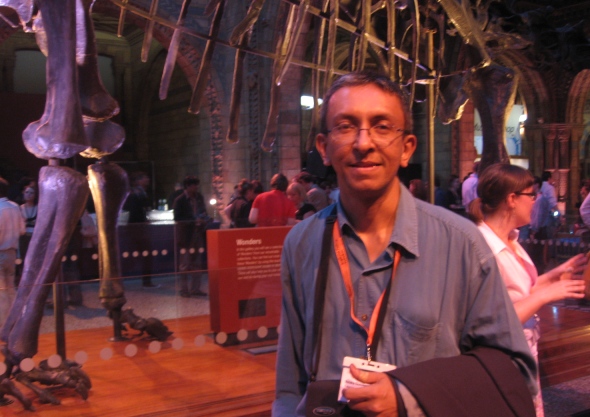
Strangely symbolic? WCSJ 2009 delegates were entertained at London's Natural History Museum...around the skeleton of a Diplodocus!
He didn’t actually use the term ‘mediasaurus’, but clearly his remarks tally with what the American writer Michael Crichton had anticipated as far back as 1993, in a landmark essay titled “Mediasaurus“. In this essay, written for the then newly launched Wired magazine, he prophesied the death of the mass media — specifically the New York Times and the American commercial TV networks.
“To my mind, it is likely that what we now understand as the mass media will be gone within ten years. Vanished, without a trace,” he wrote. Building on his credentials as the author of a best-seller on dinosaurs, Crichton called this endangered beast ‘mediasaurus’.
As later events showed, Crichton foresaw the trend ahead of most people, but didn’t get the timeline right. He was off by a few years — but only a few.
John Rennie is only the seventh editor in chief in the 164-year history of Scientific American magazine. Since his appointment in late 1994, he has been the executive force behind the modernization and reinvigoration of this great publishing institution. So it seems that he is at least trying to prepare his own publication for the coming mass extinction event…
The question was asked in apparent sincerity and seriousness. Since media space/time is limited, and different groups and interests are competing to get in, he reasoned, why can’t research budgets include a legitimate allocation for buying newspaper space or radio/TV air time.
Luckily, good sense prevailed and the suggestion was gently cast aside by the moderator. Participants felt such a practice, if allowed, could seriously distort both the news values of media organisations and their public service brief. Listening to this exchange in the audience, I heaved a sigh of relief.
It’s true that many mainstream media organisations are struggling these days to stay in business. But resorting to selling their column inches or air time to the highest bidder would take them a whole different realm where advertising and public relations set the agenda.
This can cast a long and dubious shadow...This is the reverse of cheque-book journalism, where some media organisations pay celebrity or other sources for exclusive access to their stories. When development agencies are paying sections of the media to get promotional or favourable stories aired, we must call it ‘cheque-book development’.
In August 2007, I wrote an op ed essay on this concern, titled ‘Cheque-book Development’ Corrupting the Media?. It appeared in several websites, and was later reprinted in newspapers such as Nepali Times. I was reacting to a disturbing trend where development agencies were simply throwing money at the media to gain access for their (supposedly public interest) messages.
I wrote: “As development organisations compete more intensely for external funding, they are increasingly adopting desperate strategies to gain higher media visibility for their names, logos and bosses.
“Communication officers in some leading development and humanitarian organisations have been reduced to publicists. When certain UN agency chiefs tour disaster or conflict zones, their spin doctors precede or follow them. Some top honchos now travel with their own ’embedded journalists’ — all at agency expense.
“In this publicity frenzy, these agencies’ communication products are less and less on the issues they stand for or reforms they passionately advocate. Instead, the printed material, online offerings and video films have become ‘logo delivery mechanisms’.”
I have long argued, and shown with results, that there is really no need for productive researchers to pay anything to have their work covered in the media. If all they want is to bring the essence of their analysis, findings and recommendations to the attention of public and policy makers, there are ways they can engage the media without paying. I’ve called this Hitch-hiking with the media.
If on the other hand, researchers or their institutions want ego-massaging, vanity-promoting kind of coverage, the media will be far less likely to provide that for free. Throwing money is then the only way forward, but beware: it’s a slippery slope…
When Cable News Network – or CNN – was launched in June 1980, it became the first network to provide 24-hour television news coverage, and the first all-news television network in the United States. Most people didn’t believe it would last for long, for they could hardly believe that there was enough news to fill all hours of the day and night.
They had reasons to be skeptical: at the time all major TV channels and networks in North America, Europe and elsewhere carried an hour or two of well-packaged and well-presented news bulletins per day. Viewers looked forward to these bulletins, when able and amiable anchors like Walter Cronkite – ‘the most trusted man in America’ – entered their living rooms for an update and reflection on the day’s events. A leader had to be assassinated or men had to walk on the Moon for this routine to be broken…
CNN founder Ted Turner changed all that. He proved the skeptics wrong, and blazed a new trail in broadcast journalism. In his wake, dozens and now hundreds of all-news channels have emerged, providing a cacophony of coverage and punditry as never before seen.
Saturated with news on TV? Reach out for this relief!
One of the early, unofficial expansions of CNN was ‘covering news needlessly’. This was sometimes necessary to fill 24 hours a day (or 1,440 minutes) and 7 days a week (or 168 hours). The channels say repetition is meant to give the chance for any viewer to catch up on the news whatever time she tunes in. But the question remains: is there so much news to fill not only 24/7 but hundreds of such channels?
The answer is both yes – and no. It all depends on the definition of news, and what each channel considers to be in the public interest. We won’t get into that big debate here. But the fact remains that, at least where the numerous all-news channels in Asia are concerned, they often struggle to fill their air time – and not always very successfully.
And do we have an abundance of such channels. India alone now has more than 60 all-news channels catering to a billion+ audience in dozens of languages…and more keep popping up. Elsewhere in countries such as the Philippines, Pakistan and Thailand, there have been similar channel explosions in recent years. This is partly triggered by media liberalisation which allowed local and foreign private companies to enter the broadcast sector that earlier remained a state monopoly.
Aryn Baker of TIMEBut more channels has not necessarily meant better coverage of news. There was a perceptive observation by Time magazine’s Aryn Baker in a recent essay she wrote in June 2009 about the state of Pakistan’s media. In her essay titled Casualty of War, she noted: “In 2002, the then President, General Pervez Musharraf, permitted private TV stations to broadcast news instead of just the state-owned Pakistan Television Corp. At the time, Musharraf’s deregulation was hailed as a significant step for the nascent free-press movement; indeed, today there are more than 30 nongovernment TV stations in the country. As TV stations proliferated, I argued that increased competition would force the emergence of a strong, ethical and responsible media corps. But there simply aren’t enough well-trained and -informed local journalists to supply the dramatically greater number of media outlets. I also assumed that consumers would gravitate toward truth. Instead the bulk of readers and viewers seem comfortable with sensationalism and xenophobia — as reflected by an April poll conducted by Gallup Pakistan revealing that 76% of Pakistanis “believe Pakistani media [are] unbiased to a great or somewhat extent.” In other words, Pakistanis like their media the way they are.”
Baker cites examples where the print and broadcast media in Pakistan regularly rumour and peddle conspiracy theories as news. She ends with a strong plea: “Pakistan’s press needs to take a hard look at itself and its level of professionalism. Only then will it live up to its potential, and only then will Pakistan get the media it deserves.”
Shooting the news...I couldn’t agree more. Having cheered the collapse of state broadcasting monopolies across Asia in the 1990s, I have very much felt the same way about news channels across the region (here I’m talking about the English language channels only, which are outnumbered in most markets by local language channels). While there are a few news channels that stand above the rest, a majority would come close to what Aryn Baker describes for Pakistan.
Speaking at the 6th World Conference of Science Journalists held in London in early July, I called this the ’24/7 TV Deficit’ in Asia’s broadcast media. In summary, it is this: In the developed world, all-news channels like CNN evolved over time, building capacity and experience along the way. In emerging Asia, news channel explosion hasn’t allowed time for such evolution – so skills and resources are spread too thin. There are genuine limitations of competence and capacity. Sometimes this leads to sensationalism or distortion.
I said: “The long term response to this is to invest in training and capacity building of journalists and producers already working in the media. For the most part, they learn on the job, making mistakes on the air. This is far from ideal.”
Blogs put ME back into MEdia...The Moving Images blog completes two years today. So we pause briefly to look back – and forward.
I launched the blog with two posts from near-freezing Washington DC on 17 March 2007, while participating in the DC Environmental Film Festival. Both concerned my own offering to the festival: Children of Tsunami: The Journey Continues, product of monthly filming with 8 survivor families in 4 countries for nearly one year after the Asian tsunami.
Since then, this blog’s own journey has continued: in 24 months, we have produced 342 posts in 134 categories and with 562 tags. These elicited a total of 622 comments from readers who came from all walks of life, and all parts of the world. To the end of 16 March 2009, I received a cumulative total of slightly over 246,900 page visits. I now average 500 – 600 visits a day.
I share my blogging journey with these readers who have enriched it in various ways. Some commented under their own names; others used pseudonyms. Some left email details; others none. A few have actually suggested stories that I later wrote up as blog posts. I don’t know most of my readers in person, and have only met them online. As this blog enters its 25th month, I thank them all. You’ve kept me going in a particularly tough time in the world…and in my personal life.
When I started Moving Images, I was driven by a simple motive: to discuss and reflect on the many and varied topics and subjects that interest me professionally. In one way or another, these fall into the area of communicating science, development and environment to the non-specialist public. Because my work at TVE Asia Pacific involves using television and video for this purpose, there is a bias on moving images in many things I do.
But by design, this is not an official blog of TVE Asia Pacific, or any other organisation that I am associated with. In fact, I regularly express here views that I cannot say wearing any of these hats — because we live in a world where most people still react not just to the song, but also the singer (and can’t separate the two).
Are we there yet? No!So this blog is unashamedly, intentionally self-centred: it puts ME back in Media. I make no apologies for speaking my mind on a variety of topics, and for returning to some issues that I’m passionate about.
After 22 years in journalism, broadcasting or communicating development, I find I have sufficient perspective in which to anchor my thoughts, and to express my views in a way, I hope, interests and engages readers. Like the ancient Greeks, I try to ask the right questions – even when I don’t always know or get the right answers. And I have more than a few stories to spice up the narrative.
I’m well aware of the inherent danger of combining writer-editor-publisher all in one: personal blogs don’t always operate under the usual checks and balances that we expect and presume in the more structured media outlets (whether they are in the mainstream or new media spheres). On more than one occasion, I’ve written impulsively – in frustration, anger or elation, and sometimes on the run. Thanks to the training in my news reporter days, I can still churn out readable prose fast. And only once in all these 24 months and 342 posts have I regretted rushing to publish (so, using my absolute discretion as the media tycoon of this blog, I pulled it down).
Do I see myself as a citizen journalist? Yes and no. I don’t report news, and only very occasionally write on latest developments (or breaking news, as it’s now called). I see myself more as a citizen commentator – the op ed equivalent in the new media domain. Yes, I do occasionally report from large conferences that I attend as a speaker or panelist. But I have found how demanding it is to blog from events while keeping up with everything that is going on.
Do I see myself as a Sri Lankan blogger? Not really. Scanning the 342 blog posts I’ve written, I can count only a two dozen that have an appreciable reference to Sri Lanka. This is not because I’m aloof or disengaged; I have simply set a framework for myself that goes well beyond the country of my residence and social/cultural anchor.
Another reason for this intentional lack of geographical focus is that besides this blog, I regularly write op ed essays for other online outlets like Groundviews, MediaChannel.org and MediaHelpingMedia, and print news magazines like Montage. I use these platforms for commenting on Sri Lankan issues that interest or concern me.
I find it a bit incongruous that we who use the new media tools of web 2.0 – which signify the end of old geography – must contain ourselves to geographical or cultural cocoons. Thus, while I sometimes join gatherings of bloggers based in Sri Lanka, and share concerns for freedom of expression, I have consciously avoided joining Kottu, the leading aggregator of Sri Lankan blogs.
And I get more than a little miffed when the excellent aggregation service Global Voices constantly labels me as a Sri Lankan voice (with a map of Lanka to boot!) whenever they helpfully flag my blog posts for wider attention. I have privately discussed this with GV’s South Asia coordinator who says their current tagging and categorisation do not allow anything else. Is this an example a new media platforms being trapped in an old media mindset?
If you really must pin me down to some place, call me a South Asian (or, as my friends at Himal would like to write it, Southasian).
Do I see myself as a new media activist? I’m not sure. I’m not a geek, and have no great knowledge or insights on the back-end technologies that make all this possible. My interest is in how the new media tools shapes societies, cultures and politics in emerging Asia. Those braver and smarter than me are actually innovating and improvising new media tools for social activism. I just watch — and occasionally blog to critically cheerlead them. Mine is definitely the easy part…
Mainstream media...and bloggersOn this blog, I place a higher premium on still and moving images. Regular readers know my fondness for cartoons, which I avidly search for and collect on a wide range of topics. In fact, I believe cartoonists are the best social and cultural commentators of our times – they say so much with such economy of words!
Similarly, I try to embed relevant online videos that I can find. Sometimes it takes me longer to scan YouTube and other platforms than to write the accompanying text for a blog post. And I get frustrated when WordPress does not allow embedding from certain online platforms like EngageMedia, a new Asia-based service that we have recently started to collaborate with.
As I travel around in Asia and Europe, and move across the sometimes overlapping circles of development, media and communications technology, I keep meeting readers who read and follow this blog. Some have never commented on any post; a few have chosen to write emails to me on specific matters.
This means some of the conversations inspired by this blog happen bilaterally — for example, film festival organisers have written asking me for contacts of specific film-makers whose work I have reviewed. Students often write to me seeking additional information or my own views. Long lost friends or associates have revived contact after stumbling upon this blog. I have no illusions of being famous, but it’s nice to stay engaged.
My policy on visitors’ comments is clearly stated in my intro page: “This is a moderated blog where I approve/disapprove the publication of readers’ comments to individual posts. I do allow all reasonable comments left by readers — including those that radically disagree with my own views. The basic rules of my moderation: I don’t publish comments that are outright libelous of individuals, or are so explicitly self-promotional bordering on spam.”
Only once in the short history of this blog have I been threatened by someone whose conduct I questioned in the public interest. In late 2007, I wrote a hard-hitting comment on how certain media organisations are exploiting concerns surrounding climate change to their institutional advantage. I was standing by to publish their response, for the institution I named claims to promote public discussion and debate. None came my way, although some peer pressure was used, unsuccessfully, to make me remove the blog post. In mid 2008, when our paths accidentally crossed in a European capital, the individual concerned confronted me. I gave him a patient hearing, and reiterated my offer to publish his response in full. He insisted on my deleting the post (gosh, it must have hit a raw nerve!). He ended our unpleasant encounter saying: “If you lived in my jurisdiction, I would have sued you!”
There has never been a denial or rebuttal from this person or his institution on the substantive points in my blog post. But I was repeatedly told that my candid remarks are ‘not helpful’. Perhaps. But anyone who remotely believes in ‘illuminating debate’ would have engaged me on this blog, or theirs, or in a neutral forum (plenty exist).
Luckily, I've rarely faced this situationEncouragingly, many others have done just that. This includes the reader who thinks I have an axe to grind with the BBC (I don’t, but I’m also not a fan of the ageing Auntie), and a few who feel I’ve been unkind to the fledgling global newscaster Al Jazeera English.
Then there are those who assume that I hate state-owned, so-called public broadcasters (again, I don’t, although I question their conduct more rigorously because they are public-funded). In fact, I have sung praise of Burmese TV as a model public broadcaster, and maintained excellent relations with NHK and other public broadcasters in Asia. I’m regularly invited as a speaker or panelist at gatherings of mainstream broadcasters – where I express pretty much the same views as I do on this blog.
Some think I’m too harsh on the United Nations, especially UNICEF. Again, I’m a great believer and supporter of the UN’s ideals, but never hesitate to critique the public communication policies and practices of individual UN agencies. I like to think that the United Nations is bigger (and deeper) than the inflated egos of its senior officials. In fact, middle level officials and experts working in various UN agencies have privately commended me for keeping the spotlight on their agencies. During the two years of this blog, I have worked closely with UN-OCHA, UNEP and UNAIDS, and they have been pluralistic enough to engage me in the greater public interest.
I believe that it’s not just the UN, but the entire development sector, that needs to get its act together when it comes to communicating policies, practices and choices. Having occasionally (and luckily, only briefly) forayed into the charmed development circles, I realise how detached from reality, self-referential and inward looking many development professionals and their institutions are. Communication is often no more than self-promotional publicity for overambitious agency heads. I have watched how the sector has struggled to adjust to the new realities in media and communications technology. Sometimes I have ridiculed their worse attempts on this blog; more often than not, I have quietly worked with them in small groups or bilateral meetings trying to build their capacity to do things better with greater focus and impact.
I survived mediasaurus - and lived to tell the tale!Precisely because I have access to various policy, development and research circles in Asia while (or despite?) being a blogger critiquing the same players, I exercise caution in quoting people or citing examples. Some meetings I attend discuss matters too sensitive for immediate publication; others operate on the Chatham House rule (generic points may be communicated, but without attribution). As a journalist, I’ve been trained to clarify what is on the record and what isn’t; in sourcing content for this blog, I follow the same principles.
Every writer, editor and publisher has her own agenda. Mine is fairly easy to discern, for example from the recurrent themes on this blog. These include: * humanising development communication (going beyond mere facts, figures, analysis and jargon); * demystifying and debunking self-serving development myths (for example, about community radio, or rural poverty); * practising what we preach (broadcasters addressing their own carbon emissions); * evolving more inclusive copyright policies (poverty and climate change as copyright free zones); and * engaging in simple, clear and effective communicating of science and technology in society.
For those who occasionally look for a hidden agenda, my only advice is: get a life. I write this blog for fun. I don’t set out to kick anyone – although I often get a kick out of receiving online or offline feedback.
And that’s my wish for the coming months and years: while I work hard to earn some honest bucks else where, may I continue to derive my kicks here. And if some of you also get a mental kick out of reading or commenting on this blog, that’s my bonus.
Since I remain open-minded and eager for new knowledge, my views on some topics and issues keep evolving over time. Although it’s tempting to go back and edit some of my earlier blog posts in the light of new knowledge or understanding, I refrain from doing so. And if that sometimes presents (minor) inconsistencies, I can only quote Walt Whitman in my defence: Do I contradict myself?
Very well then I contradict myself,
(I am large, I contain multitudes.)
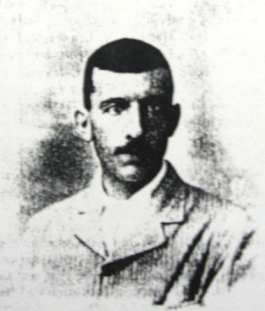
Percy B MolesworthIt was Sir Arthur C Clarke who first told me, nearly a quarter of a century ago, about a forgotten Ceylonese astronomer who has a Martian crater named after him. His name was Percy Molesworth, and I was fascinated by the story of this man who lived and died in a world so different from ours…and the trails he blazed.
Christmas Day 2008 marks the hundredth death anniversary of this remarkable man who pioneered astronomical observations in colonial Ceylon (now Sri Lanka). Most people in the land of his birth have never heard of him, and therein hangs a sad tale of how the country neglects its intellectual and scientific heritage.
By profession, Percy Braybrooke Molesworth (1867 – 1908) was a major in corps of Royal Engineers, but he is better remembered as one of the world’s leading amateur astronomers at the beginning of the Twentieth Century. From his personal observatory in Trincomalee, on Ceylon’s east coast, Molesworth both observed the night sky and photographed celestial bodies, the results of which he shared with leading astronomical groups in the west. Armed only with a basic telescope, a sharp eye and good drawing skills, he made significant contributions to advancing our knowledge of the heavens at the time.
In these articles, I weave together material gleaned from a dozen different sources, including obituaries of Molesworth published by the British Astronomical Association (BAA) and Royal Astronomical Society (RAS), and later papers and reviews of the formidable body of work that Molesworth left behind after a short but highly productive life of 41 years.
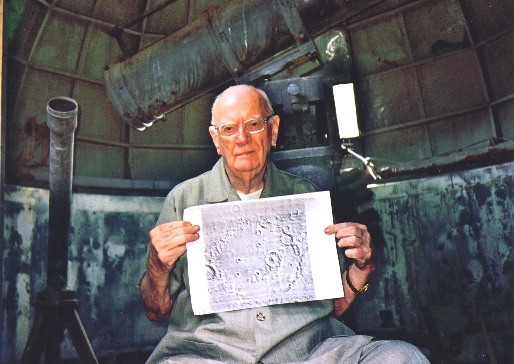
Sir Arthur Clarke, sitting next to the historic telescope, shows a photo of Crater MolesworthOne of my principal sources is Sir Arthur C Clarke, another astronomically-inclined Englishman who was to settle down in Ceylon decades later, and with whom I worked for over 20 years as a research assistant. Molesworth combined in him several elements that resonated with Sir Arthur -– Ceylon, Trincomalee, night sky observations and Mars. In the years that followed my introduction to Molesworth, Sir Arthur allowed me unrestricted access to his library and archives where I read more about Molesworth, principally from BAA and RAS journals and newsletters.
I also had the privilege of associating the late Herschel Gunawardena, who co-founded the Ceylon Astronomical Association (CAA) with Arthur Clarke in 1959, and served as its first secretary and later president. Herschel told me details of his personal quest for Molesworth, which he had chronicled in an article he wrote in the CAA journal, Equatorial, in 1971.
Others who gave me information or insights into this story include the late Dr V K Samaranayake, who played a part in restoring the telescope in the 1960s, and Fr Dr Mervyn Fernando, a keen amateur astronomer who continues to promote the subject in the local languages through the Subodhi Astronomy and Space Study Centre.
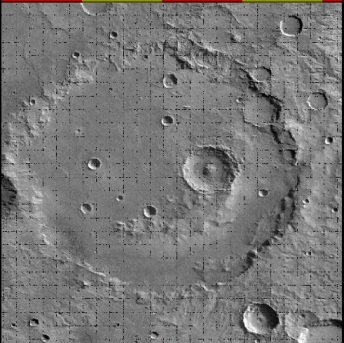
Crater MolesworthMy own connection with Molesworth happened over 20 years ago. In early 1988, while Sri Lanka was engulfed in a brutal southern insurgency, vandals looted the Colombo University dome – by then housing the Molesworth telescope – and removed several parts purely for their metallic value. I covered that incident as a young science journalist working for The Island newspaper, and later wrote a feature article titled ‘The death of an observatory’ (published on 26 March 1988).
Given the political turmoil at the time, it barely made any ripples. I still remember being ridiculed by some for reviving the memory of a long dead man at a time when hundreds of innocent, non-combatant lives were being lost every week due to extra-judicial killings.
Indeed, for much of the past 30 years, Trincomalee has been affected by Sri Lanka’s long-drawn civil war in the country’s north and east. I had planned to visit Trincomalee this year to personally find out the current status of the Molesworth bungalow and tombstone. But that didn’t happen due to the pressure of work and other distractions. I might well do that in 2009, now designated the International Year of Astronomy.
Naming celestial objects is a serious business, carried out by the International Astronomical Union (IAU) through a careful process. There are hundreds of thousands of craters on Mars, but only some of them have names. The Wikipedia has a list of Martian craters which are by convention named after famous scientists and science fiction authors, or if less than 60 km in diameter, after towns on Earth.
A miracle substance to get smarter?One of the earliest video films I helped distribute at TVE Asia Pacific, soon after it was set up in 1996, was called Ending Hidden Hunger.
This 20 minute film, made in 1992 by Bedford Films of UK and narrated by Sir Peter Ustinov, described how the UN children’s agency UNICEF was working toward eliminating micronutrient deficiencies from iron, vitamin A and iodine in different parts of the developing world. Examples are taken from Africa and Asia to both illustrate the extent of the problem as well as steps being taken to reduce these deficiencies that cause mass-scale disability and death.
The main premise of the film was simple: those lacking micro-nutrients in their regular diet often don’t show immediate signs of starvation. This deprivation builds up over time and causes slow – sometimes irreparable – damage.
Nicholas KristofI was reminded of this film — and its still very relevant message — when reading an excellent essay by Nicholas Kristof in International Herald Tribune a few days ago. He is a columnist for the New York Times who travels the world reporting from the various frontlines of survival and struggle.
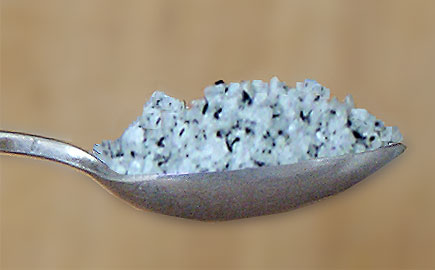
In Raising the World’s I.Q., dispatched from Rawalpindi, Pakistan, Kristof was talking about ‘a miracle substance that is cheap and actually makes people smarter’: iodised salt.
Here’s the context, as he put it:
“Almost one-third of the world’s people don’t get enough iodine from food and water. The result in extreme cases is large goiters that swell their necks, or other obvious impairments such as dwarfism or cretinism. But far more common is mental slowness.
“When a pregnant woman doesn’t have enough iodine in her body, her child may suffer irreversible brain damage and could have an I.Q. that is 10 to 15 points lower than it would otherwise be. An educated guess is that iodine deficiency results in a needless loss of more than 1 billion I.Q. points around the world.”
In nearly all countries, the best strategy to control iodine deficiency is iodisation of salt — one of the most cost-effective ways to contribute to economic and social development. Especially in these hard times, development professionals are looking for smart ways to get the biggest bang for their limited (and still shrinking) bucks. Investing in micronutrients – such as iodine – can provide some of the biggest bangs possible.
UNICEF Report 2008In June 2008, UNICEF published Sustainable elimination of iodine deficiency, a new report on progress since 1990 when the world’s governments set the target to eliminate iodine-deficiency disorders worldwide.
In October 2008, The Lancet, one of the world’s leading medical journals, published a report that noted: “Iodine deficiency is the most common cause of preventable mental impairment worldwide.”
The medical, public health and development communities have known and talked about iodine and other micronutrients for over 30 years. Significant progress has been made – for example, UNICEF says by 2006, more than 120 countries were implementing salt iodisation programmes, and 34 countries had managed to get rid of iodine deficiency among their people through this smart strategy.
But there still are major gaps — which continue to cause preventable damage to tens of millions of people including children.
Nicholas Kristof navigates through the heavy, jargon-ridden developmentspeak and churns out an eminently readable, accessible piece. It’s written in first person narrative from a part of the world where illiteracy, superstition – and their erstwhile companion, religious fanaticism – are trying to prevent people at risk from using iodised salt. This is science writing at its finest: anecdotal, personalised and purposeful.
And he’s absolutely right when he says iodised salt lacks glamour, doesn’t have too many stars or starlets singing its praise and (almost) no one writing about it despite its potential to improve lives for so many people.
I should know: one of the earliest topics I tackled as a young science reporter – getting started in the late 1980s – was salt iodisation. I struggled to put together a readable, engaging piece — which I then had to push through jaded editors who wondered what all this fuss was about.
I have only one (minor) bone to pick with Kristof. He pokes fun at Canada for hosting and supporting the Micronutrient Initiative, “an independent, not-for-profit organization committed to promoting simple cost-effective solutions for hidden hunger and developing innovative new solutions where needed.”
He calls Canada “earnest and dull, just like micronutrients themselves”. It’s a personal view – perhaps expressed with his tongue firmly in his cheek. Having travelled a fair amount in North America, and having good friends in both countries, I think that the nation north of the US-Canada border is a tad more civilised, certainly more caring and better engaged with the rest of the world.
But then, that too is a personal view. I’m darn lucky that I get enough iodine in my diet so that I can think for myself, keep asking lots of annoying questions…and occasionally even get some answers right.











 Open Minds!