FIFA: Empire of Football or a global super-soft power?

The Empire of kicking around

If one acronym has dominated the world’s media and public minds in the past month, it must be FIFA.

It stands for the International Federation of Association Football, and is derived from the original French name, Fédération Internationale de Football Association. It’s the global governing body of association football, founded in 1904 and with its headquarters in Zürich, Switzerland.

FIFA is responsible for the organisation and governance of football’s major international tournaments — most notably the FIFA World Cup, held once every four years since 1930. The current World Cup, being held in South Africa from 11 June to 11 July 2010, is the 19th edition. The next will be hosted by Brazil in 2014.

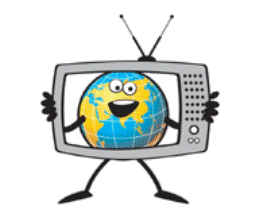
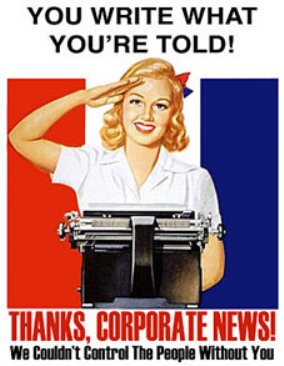
As a global body with substantial financial resources, FIFA has had its own share of controversies and been criticised for its lack of transparency and internal democracy. It’s true that FIFA controls the media rights to key international games with an iron fist (which inspired the above cartoon). They are not alone: the International Olympic Committee (IOC) has its own detractors and allegations on similar considerations.

Who's got the soft power?
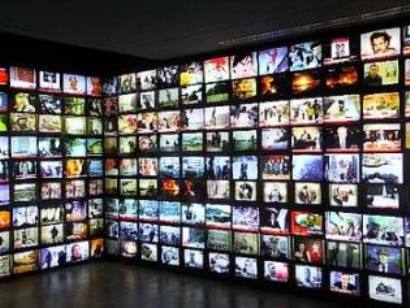
But there is little argument on how far and wide the influence of these global sports bodies extend. In an op ed essay being published this weekend, I contend: “FIFA, with its 208 member associations, is probably more influential — and certainly better known — than the United Nations, with its 192 member states. The difference is in media outreach. It signifies the rise of soft power in our always-connected information society.”

Indeed, the UN itself is well aware of this. In one of the most memorable op ed essays he’s written, the former UN Secretary General Kofi Annan acknowledged in 2006 (during the previous FIFA World Cup): “The World Cup makes us at the UN green with envy. As the pinnacle of the only truly global game, played in every country by every race and religion, it is one of the few phenomena as universal as the UN. But there are better reasons for our envy.”

He continued: “This is an event in which everybody knows where their team stands, and what it did to get there. They know who scored and how and in what minute of the game; they know who saved the penalty. I wish we had more of that sort of competition in the family of nations. Countries vying for the best standing in the table of respect for human rights, and trying to outdo one another in child survival rates or enrolment in secondary education. States parading their performance for all the world to see. Governments being held accountable.”

Of course, FIFA’s domination over the global public mind will wane after the FIFA World Cup 2010 ends. But how many other global bodies can claim to hold billions of people so engaged for a month? And in this era of 24/7 information society, that’s formidable soft power indeed.

What can we call the wielder of such soft power? How about Super-soft-power?

And can this kind of power also intoxicate and even corrupt its wielders? We’ve seen how power manipulations work in other centres of soft power, such as Hollywood and Bollywood. The challenge for FIFA — and all others who are connected to it through the love of football and/or media’s outreach — is to watch out that this concentration of soft power doesn’t corrupt.

The very same media that helps FIFA attain the status of a soft-super-power needs to keep an eye on how this power is being used. Perhaps that’s the ultimate game in the media-saturated 21st Century: Emperors of Eyeballs vs. Titans of Kick.

Remember, you read it here first.
From Michael Jackson to K’naan: Anthems for the Global Family?

A song that will outlive the games?

FIFA World Cup Football enters its final few days this week, culminating a month of international football at the highest level.

Played across 10 venues in South Africa, this is much more than a sporting tournament. It’s the ultimate celebration of the world’s most popular sport, held once every four years. More popular than the Olympics, it demonstrates the sheer power of sports and media to bring together – momentarily, at least – the usually fragmented and squabbling humanity.

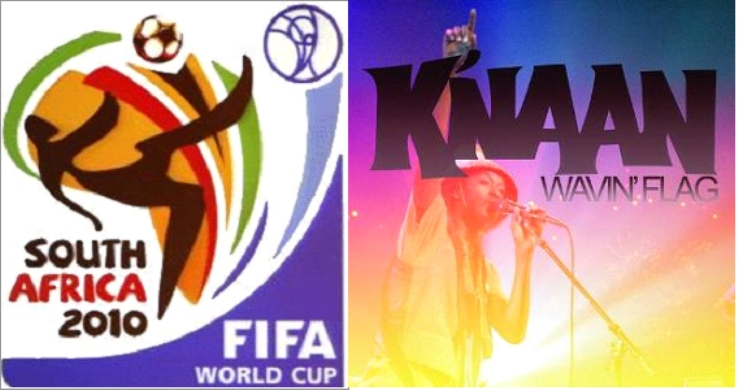
And one upbeat song has characterised this World Cup more than any other: the FIFA World Cup Anthem, “Wavin’ Flag” (The Celebration Mix). Sung by K’naan (born Keinan Abdi Warsame) a Somali-Canadian poet, rapper, singer, songwriter, and instrumentalist.

It opens with these now famous words:

…Singing forever young, singing songs underneath that sun
Lets rejoice in the beautiful game,
And together at the end of the day.
We all say
When I get older I will be stronger
They’ll call me freedom, just like a wavin’ flag…

“Wavin’ Flag” is the third official single (eighth single overall) from K’naan’s Troubadour album. He specially recorded a version of the song for the tournament, hosted by South Africa. The remix of “Wavin’ Flag” is part of Coca-Cola’s global integrated marketing campaign “inspired by the joyous dance celebrations familiar to Africa.”

The song is popping up and pouring out from billions of radio and TV sets, mobile phones, websites and other devices. So much so that I wonder if it might as well be our planetary anthem — an idea that some social activists and artistes have dreamed about for decades?

Last year, shortly after Michael Jackson’s sudden death, I wrote a blog post that looked back at his songs that celebrated social and environmental themes. Referring to one, I said: “…the Earth Song had much wider and more lasting appeal, almost becoming an anthem for the global environmental movement in the past decade. But its real impact was not among the converted – with this song, Jackson took the green message to the heartland of the Facebook generation.”

We can argue about that (please do!). For now, here’s the celebrated song, currently the most popular on the planet:

FIFA Wold Cup Anthem “Wavin’ Flag” (The Celebration Mix) by K’naan

Wavin’ Flag lyrics (Celebration Mix) by K’naan

Ooooooh Wooooooh Ooooooh Wooooooh

Give me freedom, give me fire, give me reason, take me higher
See the champions, take the field now, unify us, make us feel proud
In the streets are, hands are liftin’, as we lose our inhibition
Celebration, its around us, every nations, all around us

Singin’ forever young, singin’ songs underneath that sun
Lets rejoice in the beautiful game
And together at the end of the day

WE ALL SAY

When I get older, I will be stronger
They’ll call me freedom
Just like a wavin’ flag

And then it goes back…And then it goes back…
And then it goes back…And then it goes…

When I get older, I will be stronger
They’ll call me freedom
Just like a wavin’ flag

And then it goes back…And then it goes back…
And then it goes back…And then it goes…

Ooooooh Wooooooh Ooooooh Wooooooh

Give you freedom, give you fire, give you reason, take you higher
See the champions, take the field now, unify us, make us feel proud
In the streets are, hands are lifting, every loser inhibition
Celebration, its around us, every nations, all around us

Singin’ forever young, singin’ songs underneath that sun
Lets rejoice in the beautiful game
And together at the end of the day

WE ALL SAY

When I get older, I will be stronger
They’ll call me freedom
Just like a wavin’ flag

And then it goes back…And then it goes back…
And then it goes back…And then it goes…

When I get older, I will be stronger
They’ll call me freedom
Just like a wavin’ flag

And then it goes back…And then it goes back…
And then it goes back…And then it goes….

Ooooooh Wooooooh Ooooooh Wooooooh

WE ALL SAY

When I get older, I will be stronger
They’ll call me freedom
Just like a wavin’ flag

And then it goes back…And then it goes back…
And then it goes back…And then it goes…

When I get older, I will be stronger
They’ll call me freedom
Just like a wavin’ flag

And then it goes back…And then it goes back…
And then it goes back…And then it goes…

Ooooooh Wooooooh Ooooooh Wooooooh

And everybody will be singin’ it

Ooooooh Wooooooh Ooooooh Wooooooh

And we are all singin’ it

TV Will Save the World, says Charles Kenny in TIME’s ’10 ideas for next 10 years’

Photo by Reza Deghati

This is one of my favourite photos in media and development. It was taken by Reza Deghati, the renowned Iranian-French photojournalist (who works under the name Reza). I don’t know the story behind this photo, but even without a single word of annotation, it says a great deal.

I like this photo partly because it symobolises the enduring appeal of broadcast television in much of the developing world. For long years, the old-fashioned, boxy TV set used to be the top-selling consumer electronic item in the world — until the mobile phone came along. But even now, the much-maligned idiot box hasn’t lost its appeal to a significant section of humanity, never mind what the jaded academics and geeks might say.

So I was intrigued to read, in the latest issue of TIME Magazine, development economist Charles Kenny, reminding us that television is still the most influential medium around. In this gizmo-ridden new media age, it takes much courage to say so in public.

In a powerful short essay titled ‘TV Will Save the World’, he writes: “Forget Twitter and Facebook, Google and the Kindle. Forget the latest sleek iGadget. Television is still the most influential medium around. Indeed, for many of the poorest regions of the world, it remains the next big thing — poised, finally, to attain truly global ubiquity. And that is a good thing, because the TV revolution is changing lives for the better.”

Across the developing world, he says, some 60% of the households had their own TV set in 2005 — up from 45% in 1995. He adds: “Five million more households in sub-Saharan Africa will get a TV over the next five years. In 2005, after the fall of the Taliban, which had outlawed TV, 1 in 5 Afghans had one. The global total is another 150 million by 2013 — pushing the numbers to well beyond two-thirds of households.”

He ends his essay with these words that strongly resonate with me: “Too much TV has been associated with violence, obesity and social isolation. But TV is having a positive impact on the lives of billions worldwide, and as the spread of mobile TV, video cameras and YouTube democratize both access and content, it will become an even greater force for humbling tyrannical governments and tyrannical husbands alike.”

As Sir Arthur C Clarke, inventor of the communications satellie whose second death anniversary we mark this week, told me in a 2003 interview: “I’m not impressed by the attacks on television because of some truly dreadful programmes. I believe that every TV programme has some educational content. The cathode ray tube – and now the plasma screen – is a window to the world. Often it may be a very murky window, but I’ve slowly come to the conclusion that, on balance, even bad TV is preferable to no TV at all.”

Kenny’s essay is one of 10 ideas for the next 10 years that TIME has put together for its annual innovation issue.

Image courtesy Foreign Policy
The TIME essay is a much compacted version of what he wrote in November 2009 issue of Foreign Policy magazine, titled Revolution in a Box. That article noted the continuing global spread of television sets and an explosion of viewer choice driven by cable, satellite and digital technologies. It suggested this is a good thing, pointing to evidence that access to competitive television can improve womens’ standing in the home, increase girls schooling, reduce fertility rates, lower drug use, improve governance and (possibly) help foster global peace.

The editors of Foreign Policy ran the following blurb: “It’s not Twitter or Facebook that’s reinventing the planet. Eighty years after the first commercial broadcast crackled to life, television still rules our world. And let’s hear it for the growing legions of couch potatoes: All those soap operas might be the ticket to a better future after all.”

The full essay is well worth a careful read. At a time when I have been questioning many of the founding premises of my own work at TVE Asia Pacific, he has provided conceptual clarity and sharper focus.

Afghan boy with a plant: Reza Deghati on nurturing a culture of peace

Capturing the hopes of a nation...

Every photograph has a story behind it, if only we care to ask – or dig deep enough. In October 2007, I wrote about a now iconic photo showing an old Nepali man (Ram Bahadur Tamang) holding a video camera. That image is the logo of Film South Asia festival.

From Reza Deghati, the renowned Iranian-French photojournalist (who works under the name Reza) comes another story – this time from Afghanistan, where the above photo was taken in 1990.

Reza recalls how the photo was taken: “In 1990, the United Nations asked me to put aside my cameras in order to run a humanitarian program in an Afghanistan recently freed from Russian occupation. I had to open a route for wheat shipments needed to feed the population in the Northern Provinces. Eleven years of war against the Soviet Army had devastated the country. Fields lay fallow, roads were impassable, mined or destroyed, and buildings like hospitals and schools were nothing but ruins. I could have given away the wheat. Instead, I decided to barter it for work so as to avoid one of the unfortunate consequences of some humanitarian programs that foster dependence rather than offer new ways to live. Throughout the Province, a new army took shape. This time, men did not carry rifles but shovels.”

“I remember seeing a young Afghan boy coming out of school one day, holding a plant in his hand. He had been watering it carefully. A shoot had sprouted out. I took a picture of him, and asked: ‘What are you going to do with this plant?’ His answer….’I am going to make a tree with it’.

Reza Deghati, photo by Ali Khaligh
Looking back, Reza thinks this may have provided part of the inspiration for setting up Aina, a third-generation humanitarian association that he founded in 2001 in Taliban-free Afghanistan.

Aina now works in Afghanistan, “contributing to the emergence of civil society through actions in the area of education (particularly focusing on women and children), information and communication.” It promotes independent media development and cultural expression as a foundation of democracy.

Reflecting further on the power of images, Reza says on Aina website: “In the early 80s, I discovered wars and the harshest moments of the world as a young photojournalist. I could not just stay there as a mere witness. I was led into thinking over conflicts, repressions, exodus and their burden of known pain, answers as well. As canon roars fade, urgency requires tangible reconstruction. An army of shovel-carrying men starts marching, determined to erase any remaining sign of ruin. Others take care of suffering bodies. Yet, there is an invisible destruction, only known to wounded dignities, that can ruin physical rebuilding efforts in a country and keep it from recovering.

“Those who are not given any intellectual and cultural weapons will go back to their unique reference. The culture of war fosters war. That is how Aina was founded. A third-generation association, Aina has been working on independent media development and culture, everywhere freedom of speech has remained a fragile value. It provides logistical support, state-of-the art technology access and local media and cultural actor training.”

Reza adds, optimistrically: “Today, Aina is like that plant. I hope that it will become a tree of culture, peace and freedom in Afghanistan…”

So you want to help develop the media? Read this first!

Some weeks ago, I wrote a post about How to become a global publisher or broadcaster in just 100 minutes! That was compiled by my British media activist friend David Brewer , who showed how it could be done using free tools that can be downloaded and activated in minutes.

This week, David has brought out another handy guide — this time aimed at those involved in media development. UNESCO defines it in lofty, technocratic terms, but it basically means strengthening the media institutions, media people (practitioners and managers) and media consumers so that the media can best serve the public interest.

Everyone seems to have their own recipe for media development, and that’s part of the media’s huge diversity. Media Helping Media asked a number of people who have benefited from media development projects what they felt needs to change in the year ahead. The replies have so far come from The Russian Federation, Indonesia, Azerbaijan, Sri Lanka, Lebanon, Macedonia, Ukraine, Bhutan and Nepal. They make up a challenging list of tips for those who try to help media in need.

Its introduction says: “You have as much to learn as you have to give. That’s the message to those offering media assistance in transition and post-conflict countries from some of those on the receiving end.”

Here’s my own contribution to this interestingly crowd-sourced distillation. David had asked for three key points, but you can see below why I was never very good in arithmetic…

Media operate as a business, not charity: All media have a social responsibility, but that must be balanced with commercial viability. This is so with state, corporate or community owned media. Bankrupt media can’t serve any public interest.

‘Media’ is a plural: Media is a basket term for entities with enormous diversity and variability. One size does not fit all, no matter how well intended. It’s crucial to understand before engaging any media.

Follow the eyeballs: If you want the biggest bang for your limited buck, start with the mass market end of media such as FM radio, tabloid newspapers and music TV channels. Leave your broadsheet/classical prejudices out of investment decisions.

Take it easy: Audiences need entertainment as much as information and education. Supporting quality entertainment in the media is just as important for the public good as nurturing investigative journalism or advocating media freedom.

Sparks of hope: Real world is not an all-or-nothing game. Find oases of innovation and resilience, and nurture them to survive and grow in turbulent times. Back media underdogs of today who can become fierce watchdogs of tomorrow.

In responding to David’s request last month, I’d added this covering sentence which sums up my thinking: “All this is common sense that is often uncommon. I really wish media development organisations would listen and reflect more, and also step beyond their comfort zones and romanticised little bubbles.”

The entire collection is well worth reading, for it distills decades of ground level experience and insight. This guide will help many well-meaning organisations (UN agencies, philanthropic foundations, CSR arms of media companies and others) to be more focused, sensitive and ultimately more effective in developing the media.

Read the related 12 tips for international media trainers

Hans Rosling and Gapminder: Unraveling the Joy of Stats!

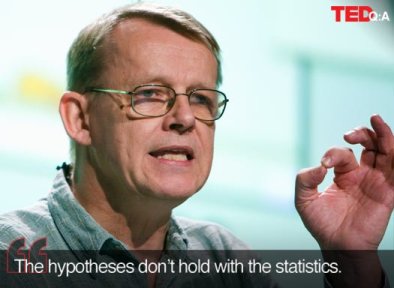
Hans Rosling: Information Wizard
If you thought Al Gore was a data-happy geek, you should see Hans Rosling in action.

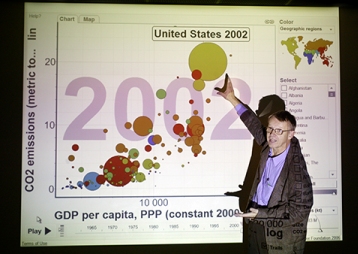
The Swedish medical researcher has a way with numbers. He brings heavy and dreary statistics into life using a combination of animated graphics and equally animated presentations. With the drama and urgency of a sportscaster, he uses a new presentation tool called Gapminder to debunk various myths about world – economic development, disparities and how well (or poorly) we share our planet’s resources.

Hans Rosling is Professor of International Health at Karolinska Institutet (which awards the Nobel Prize in medicine), but it’s his other role – as Director of the Gapminder Foundation – that he plays ‘statistics guru’ to the whole world. If you’re perplexed by lots of numbers, he’s the man who can make sense of it all.

In some ways, Rosling and Gapminder present in live action – and on video – what the Atlas of the Real World attempted to do in 2D maps: show the world as it is, with little or no distortion or misconceptions. That effort, published in late 2008, uses software to depict the nations of the world, not by their physical size, but by their demographic importance on a range of subjects.

I’ve watched a number of Rosling talks on video online. He makes no attempt to conceal his Scandinavian accent, and his English grammar is not always perfect. But it doesn’t matter: the guy has such mastery over his ideas and statistics, and a great stage presence too. He’s profound and funny at the same time, without being condescending that most experts and especially professors are.

Here’s an example of Rosling at his best: recorded in February 2006 in Monterrey, California:

No more boring data: TEDTalks

Rosling’s quest to use numbers to shatter stereotypes of rich and poor countries has brought him global prominence. He was one of the world’s “100 most important global thinkers” of 2009, according to Foreign Policy Magazine.

Look, no magic here!
Rosling was honored at #96 on the list for “boggling our minds with paradigm-shattering data“. The list is topped by (1) Ben Bernanke, the chairman of US Federal Reserve for his actions to turn the US depression and (2) President Barack Obama for “for reimagining America’s role in the world.”

Foreign Policy noted: “Rosling is well known for his energetic lectures, in which he narrates mind-blowing statistics on development and public health — as they literally move across a screen. Imagine x-y axes filled with data points, each representing a country. As time passes, the dots move, realigning to show changes in child mortality, percentage of paved roads, unemployment rates, or pretty much any other metric you can imagine.”

Here are some more examples of Rosling magic:

200 years that changed the world (with Hans Rosling)

For the first time, Gapminder can now visualize change in life expectancy and income per person over the last two centuries. In this Gapminder video, Hans Rosling shows you how all the countries of the world have developed since 1809 – 200 years ago.

Hans Rosling on HIV: New facts and stunning data visuals

Hans Rosling unveils new data visuals that untangle the complex risk factors of one of the world’s deadliest (and most misunderstood) diseases: HIV. He argues that preventing transmissions — not drug treatments — is the key to ending the epidemic.

Hans Rosling: Asia’s rise — how and when

This is one of the funniest Rosling talks I’ve watched online so far. Speaking at TEDIndia in November 2009, Rosling recalled how he was a young guest student in India when he first realized that Asia had all the capacities to reclaim its place as the world’s dominant economic force. He graphs global economic growth since 1858 and predicts the exact date that India and China will outstrip the US.

Note:
Rosling and Gapminder developed the Trendalyzer software that converts international statistics into moving, interactive and enjoyable graphics. The aim is to promote a fact-based world view through increased use and understanding of freely accessible public statistics. His lectures using Gapminder graphics to visualise world development have won awards by being humorous yet deadly serious. The interactive animations are freely available from the Foundation’s website. In March 2007 Google acquired the Trendalyzer software with the intention to scale it up and make it freely available for public statistics. Google has since made available as Motion Chart, a Google Gadget.

‘Avatar’ unfolds in the Amazon: Find out the Real Price of Oil!

This is no Avatar: It's Real!
A few days ago, reviewing the blockbuster movie Avatar, I wrote: “Film critics and social commentators around the world have noticed the many layers of allegory in the film. Interestingly, depending on where you come from, the movie’s underlying ‘message’ can be different: anti-war, pro-environment, anti-Big Oil, anti-mining, pro-indigenous people, and finally, anti-colonial or anti-American. Or All of the Above…”

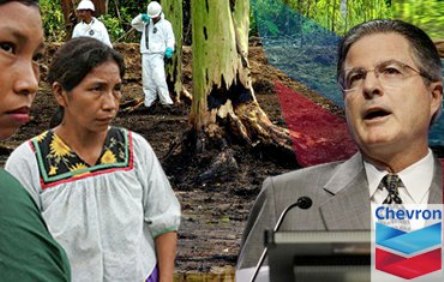
Indeed, an Avatar-like struggle is unfolding in the Amazon forest right now. The online campaigning group Avaaz have called it a ‘Chernobyl in the Amazon’. According to them: “Oil giant Chevron is facing defeat in a lawsuit by the people of the Ecuadorian Amazon, seeking redress for its dumping billions of gallons of poisonous waste in the rainforest.”

From 1964 to 1990, Avaaz claims, Chevron-owned Texaco deliberately dumped billions of gallons of toxic waste from their oil fields in Ecuador’s Amazon — then pulled out without properly cleaning up the pollution they caused.

In their call to action, they go on to say: “But the oil multinational has launched a last-ditch, dirty lobbying effort to derail the people’s case for holding polluters to account. Chevron’s new chief executive John Watson knows his brand is under fire – let’s turn up the global heat.”

Avaaz have an online petition urging Chevron to clean up their toxic legacy, which is to be delivered directly to the company´s headquarters, their shareholders and the US media. I have just signed it.

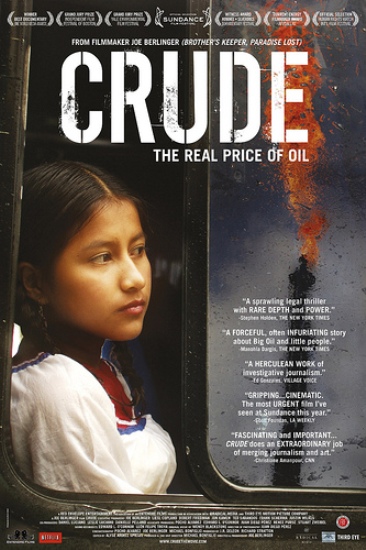
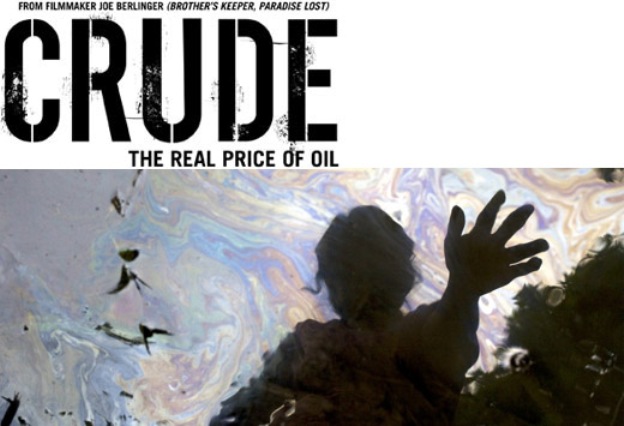
Others have been highlighting this real life struggle for many months. Chief among them is the documentary CRUDE: The Real Price of Oil, made by Joe Berlinger.

The award-winning film, which had its World Premiere at the 2009 Sundance Film Festival, chronicles the epic battle to hold oil giant Chevron (formerly Texaco) accountable for its systematic contamination of the Ecuadorian Amazon – an environmental tragedy that experts call “the Rainforest Chernobyl.”

Here’s the official blurb: Three years in the making, this cinéma-vérité feature from acclaimed filmmaker Joe Berlinger is the epic story of one of the largest and most controversial legal cases on the planet. An inside look at the infamous $27 billion Amazon Chernobyl case, CRUDE is a real-life high stakes legal drama set against a backdrop of the environmental movement, global politics, celebrity activism, human rights advocacy, the media, multinational corporate power, and rapidly-disappearing indigenous cultures. Presenting a complex situation from multiple viewpoints, the film subverts the conventions of advocacy filmmaking as it examines a complicated situation from all angles while bringing an important story of environmental peril and human suffering into focus.

Watch the official trailer of Crude: The Real Price of Oil

According to Amazon Watch website: “With key support from Amazon Watch and our Clean Up Ecuador campaign, people are coming together to promote (and see) this incredible film, and then provide ways for viewers to support the struggle highlighted so powerfully by the film.”

They go on to say: “A victory for the Ecuadorian plaintiffs in the lawsuit will send shock waves through corporate boardrooms around the world, invigorating communities fighting against injustice by oil companies. The success of our campaign can change how the oil industry operates by sending a clear signal that they will be held financially liable for their abuses.”

While Avatar‘s story unfolds in imaginary planet Pandora — conjured up by James Cameron’s imagination and created, to a large part, with astonishing special effects, the story of Crude is every bit real and right here on Earth. If one tenth of those who go to see Avatar end up also watching Crude, that should build up much awareness on the equally brutal and reckless conduct of Big Oil companies.

Civilisation's ultimate addiction?

Others have been making the same point. One of them is Erik Assadourian, a Senior Researcher at Worldwatch Institute, whom I met at the Greenaccord Forum in Viterbo, Italy, in November 2009.

He recently blogged: “The Ecuadorians aren’t 10-feet tall or blue, and cannot literally connect with the spirit of the Earth (Pachamama as Ecuadorians call this or Eywa as the Na’vi call the spirit that stems from their planet’s life) but they are as utterly dependent—both culturally and physically—on the forest ecosystem in which they live and are just as exploited by those that see the forest as only being valuable as a container for the resources stored beneath it.”

Erik continues: “Both movies were fantastic reminders of human short-sightedness, one as an epic myth in which one of the invading warriors awakens to his power, becomes champion of the exploited tribe and saves the planet from the oppressors; the other as a less exciting but highly detailed chronicle of the reality of modern battles—organizers, lawyers, and celebrities today have become the warriors, shamans, and chieftains of earlier times.”

Invictus: Clint Eastwood and Morgan Freeman serve more Mandela magic

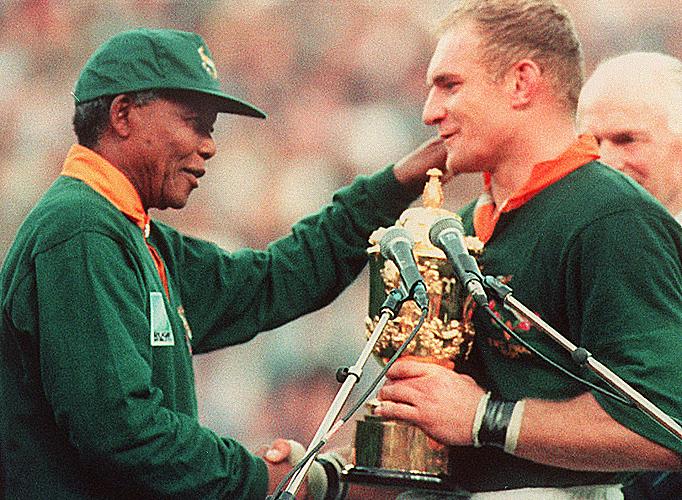
Nelson Mandela hands the World Cup to Francois Pienaar in 1995 (Photo courtesy The Sun, UK)

Updated: 6 Dec 2013 Nelson Rolihlahla Mandela (1918 – 2013): Thank You and Goodbye!

If a run-away genie granted me a wish to clone any single living human being, I’ll have no hesitation with my choice: Nelson Mandela — undoubtedly the greatest living statesman on the planet.

One might argue that Mandelas are not born; they are made. A combination of personality and historical circumstances create the rare phenomena like him.

In July 2008, when Mandela turned 90, I quoted the American film-maker, social activist and blogger Danny Schechter — who filmed Mandela’s struggle to end apartheid and restore democracy in South Africa — as saying: He (Mandela) is one of those leaders who not only helped free his own country and people but became an icon and symbol for freedom in the world. At a time when darkness seems to be descending again, with the economy on the edge amidst protracted wars and pervasive abuses of powers, he is the one person that people the world over look to as a symbol of that saying that ‘another world is possible.’ He is not perfect – who is? He has taken great risks, and made his share of mistakes, but the love and adoration he inspires speaks to how special he is – even as he sees himself as part of a collective, a movement…

The Mandela story has been told many times by many film-makers, writers and journalists. Few other leaders have engaged the popular culture and media’s attention — while both in and out of office — as Mandela has, and with good reason.

One poem + two men = Rainbow Nation

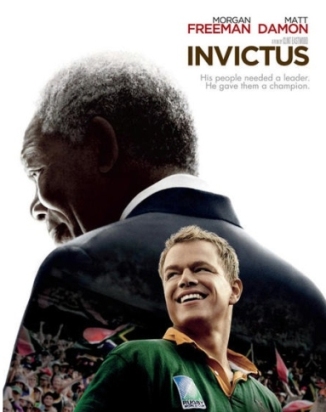
The latest film inspired by Mandela is Invictus directed by Clint Eastwood, starring Morgan Freeman and Matt Damon. Both actors have just been nominated for Oscar awards – for best actor and best supporting actor respectively. But the film’s exclusion from the 10 nominees for best picture has surprised and disappointed some.

Invictus reconstructs the events in the life of Nelson Mandela at a crucial time for himself and country: after the fall of apartheid in South Africa, during his term as the rainbow nation’s first black president. The film revolves around how he campaigned to host the 1995 Rugby World Cup event as an opportunity to unite his rainbow nation. (South Africa’s team eventually won the championship.)

Here’s the plot summary from IMDB:
The film tells the inspiring true story of how Nelson Mandela joined forces with the captain of South Africa’s rugby team to help unite their country. Newly elected President Mandela knows his nation remains racially and economically divided in the wake of apartheid. Believing he can bring his people together through the universal language of sport, Mandela rallies South Africa’s rugby team as they make their historic run to the 1995 Rugby World Cup Championship match.

Read Wikipedia’s plot summary

Watch official trailer of Invictus the movie:

The film’s title comes from the fact that Mandela had the poem Invictus, by English poet William Ernest Henley, written on a scrap of paper on his prison cell while he was incarcerated. The story is based on the John Carlin book Playing the Enemy: Nelson Mandela and the Game That Changed a Nation.

A legend plays another legend

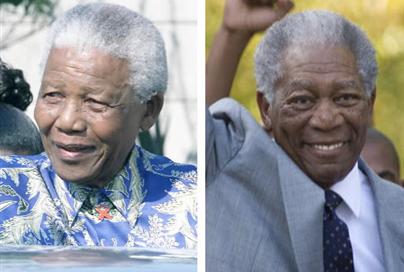
I can’t wait to see Invictus, for it has one of my favourite actors playing one of my greatest heroes. Morgan Freeman is such a versatile and accomplished actor. Having played the US President and God in past movies, this is clearly cut out for him.

As Clint Eastwood explains: “As an actor, Morgan has the same presence when he walks in the room that Mandela has as a politician. Morgan has a certain bearing and charisma. He was built to play this role.”

The Guardian (UK) preview noted: “So convinced by Freeman’s performance was Mandela’s personal assistant that when she stepped on set, she wondered how her boss had made it to the shoot without her. Freeman plays Mandela with all the expected wisdom and fortitude, but it’s the twinkle of mischief in his eye that makes you feel you’re not just watching the man, rather than a virtuoso impression.”

The Guardian calls Invictus “a startlingly powerful film: a clear-eyed look a recent history, an awe-inspiring tale of prejudice overcome, a study of power – and a rousing sports movie.”

Note: In the movie, Mandela gives the “Invictus” poem to his national rugby team’s captain Francois Pienaar before the start of the 1995 Rugby World Cup. In reality, Mandela provided Pienaar with an extract from Theodore Roosevelt’s “The Man in the Arena” speech from 1910.

Making of ‘The Greenbelt Reports’ recalled in ‘The Green Pen’

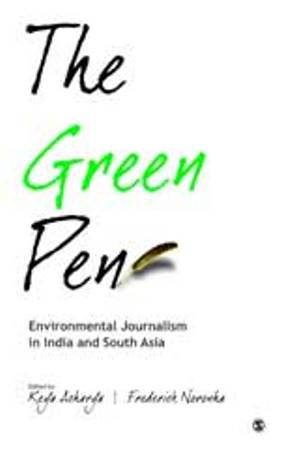
The process of producing and distributing TVE Asia Pacific’s educational TV series, The Greenbelt Reports, is showcased in a new book on environmental journalism in South Asia, just published by Sage, a globally operating company that specialises in bringing out academic and professional books.

The book, titled The Green Pen: Environmental Journalism in India and South Asia, is edited by two senior Indian journalists, both good friends – Keya Acharya of Bangalore, and Frederick Noronha based in Goa. (In 2007, Fred and I co-edited Communicating Disasters: An Asia Pacific Resource Book.)

Arranged in 10 sections, the book brings together contributions from three dozen journalists, broadcasters and film makers in South Asia. It opens with a foreword by Darryl D’Monte, one time editor of The Times of India and Chair, Forum of Environmental Journalists of India (FEJI).

I co-wrote the chapter titled ‘Dispatches from the Frontline: Making of The Greenbelt Reports’ with my colleague Manori Wijesekera, TVEAP’s Regional Programme Manager. I was researcher and script writer of the 12-part, 4-country series that we made in 2006, in which Manori was series producer. The series looked at the environmental lessons of the 2004 Indian Ocean tsunami.

The title reflects the lingering print bias in media related discussions: in our case, the content we produced was disseminated on broadcast television, narrowcast DVD and online. We wielded cameras rather than pens, but are still very glad to share our experience in this book.

Keya Acharya (left) and Fred Noronha
The publisher’s blurb says: “This collection of essays by some of the most prominent environmental journalists in Indian and South Asia gives deep insights into their profession and its need and relevance in society. It looks at this ‘specialisation’ of journalism both in the past and the present. Underlying almost all the essays is the changing nature of media in the region and the dilemmas facing environmental journalists. The varied background of the writers ensures the showcasing of a wide range of realities and experiences from the field. Contributions include essays by Darryl D’Monte, the late Anil Agarwal and Sunita Narain, among others.”

“This is the first book of its kind on environmental journalism, which would be an excellent resource to aid the future evolution of the enterprise in the region. Apart from essays from India, there are contributions from Pakistan, Bangladesh, Sri Lanka, Nepal and the Maldives. The book will interest a wide readership, any informed reader, besides journalists and environmentalists.”

It’s an honour to be part of a book which features the work of respected seniors like Anil, Darryl and Sunita – all of who have influenced my own career and I’m privileged to count among my friends (alas, Anil is no longer with us). In fact, I have either met, worked with or am friends with more than half the three dozen contributing authors of this book.

Who says South Asia is large?

More in TVEAP news story: The Greenbelt Reports featured in new book on environmental journalism in South Asia

Wanted: ‘Magic Mirrors’ for a Land of the Blind…

Last chance...?
Here’s a winning idea for a new business venture in these lean times: make an always-agreeable ‘magic’ mirror — and the vane and wicked will beat a path to your door.

Well, at least half the politicians in Sri Lanka would. They’d rather not see their true selves on any mirror.

The magic mirror idea was popularised many years ago by Snow White and the Seven Dwarfs, whose wicked and vain queen had an unusual mirror that talked back, each time she asked: ‘Mirror, mirror, on the wall. Who’s the fairest of them all?’.

The queen wasn’t looking for honest answers; she just wanted to hear she was always the prettiest and fairest in the land. (All competition – real and imagined – was dealt with brutally.)

Little has changed, even in this 21st Century. We may not have too many monarchs left in the world, but our uncrowned rulers can be equally vain and ruthless. They are obsessed with self-aggrandizing sycophancy – they’d only tolerate magic mirrors that totally boost their egos.

If I seem to be preoccupied with mirrors, that’s nothing to do with my own vanity. In this digital age, the mirror is still a pretty good metaphor for the media industry that I have been part of, in one way or another, for over 20 years. At its very basic, the media are expected to reflect our society and our times.

But some people don’t like what they see on a true mirror. In 2009, we saw a spate of mirror smashing or media bashing in Sri Lanka. It started on 6 January, when the studio of the Maharaja Television/Broadcasting Network (MTV/MBC, popularly known as Sirasa Group) was attacked by armed gunmen who almost blew up the country’s most popular private broadcast organisation. On 8 January, exactly a year ago today, Lasantha Wickrematunga, editor of The Sunday Leader, was shot dead by two men on a motorcycle as he drove to work in suburban Colombo.

Sirasa & Lasantha: Refused to be magic mirrors
One year later, both crimes remain unsolved. They have joined a long list of crimes against journalists and media organisations in Sri Lanka, most of which have never led to any prosecution of the perpetrators.

As Reporters Without Borders noted in a statement this week: “The emotion and anger have not gone away in the year since this famous Sri Lankan journalist’s death. The anger is being sustained by the government’s flagrant obstruction of the investigation. Lasantha Wickrematunge’s name and memory will not disappear and, in that sense, those who were behind his murder made a mistake.”

Commenting on the MTV/MBC (Sirasa) attack, I described the typical reaction of the mirror-bashers: “…if you don’t like what you see in the mirror – which is what media is to society – just kick it, shatter it and hammer it into dust so that it won’t reflect anymore. Destroy all the mirrors of the land, and we’ll finally be the fairest and prettiest in the whole world. That seems to be the perverse logic that fuels attacks of this nature.”

Rex de Silva, the first editor that Lasantha worked for in the late 1970s cautioned that Lasantha’s murder was the beginning of ‘the sound of silence’ for the press in Sri Lanka. As I asked on the day of Lasantha’s emotionally-charged funeral: “Can this sound of silence be shattered by the silent, unarmed majority of liberal, peace-loving Lankans who were represented at the funeral service and the Colombo cemetery today?”

Owing to these and other threats, pressures and intimidation during the year, Sri Lanka was ranked 162nd out of 175 countries in the 2009 Reporters Without Borders press freedom index. This was the worst ranking of any democratic country. See RSF website section on Sri Lanka.

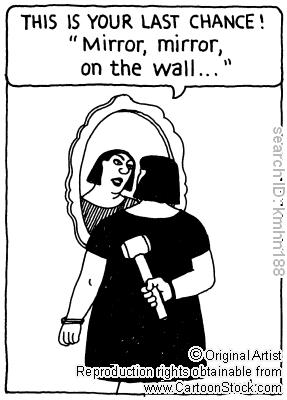
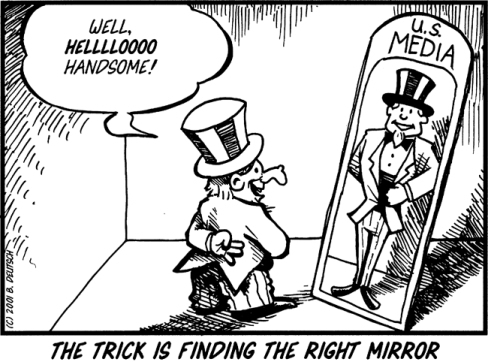
Back to mirrors. While the true mirrors were getting bashed, those who played being ‘magic mirrors’ have done well for themselves (and are probably laughing all the way to their banks). But that’s not a phenomenon confined to the little island of Sri Lanka. A good part of the US Media did the same under the hawkish Bush Administration, which prompted the cartoon below.

It’s not just ‘Dubya’ who is addicted to such agreeable mirrors. Indeed, for many modern-day rulers, an essential trapping of power involves surrounding themselves with spin doctors, press commissioners and other manipulators or manufacturers of image. In mature democracies, there are certain checks and balances which usually guard against the worst excesses (but there are notable exceptions – look at Italy!).

In immature, fragile or pseudo democracies, mirrors obey the laws of physics (optics) at grave risk to themselves. If you want proof, just talk to the staff of Sirasa or The Sunday Leader in Sri Lanka…

Groundviews.org: One year later: A murder unresolved, a government unashamed

Nov 2009 blog post: We need more reflective mirrors in the media!