I discuss Facebook’s Community Standards and the complaints mechanism currently in place, and the difficulties that non-English language content poses for Facebook’s designated monitors looking out for violations of these standards. Hate speech and other objectionable content produced in local languages like Sinhala sometimes pass through FB’s scrutiny. This indicates more needs to be done both by the platform’s administrators, as well as by concerned FB users who spot such content.
But I sound a caution about introducing new Sri Lankan laws to regulate social media, as that can easily stifle citizens’ right to freedom of expression to question, challenge and criticise politicians and officials. Of course, FoE can have reasonable and proportionate limits, and our challenge is to have a public dialogue on what these limits are for online speech and self-expression that social media enables.
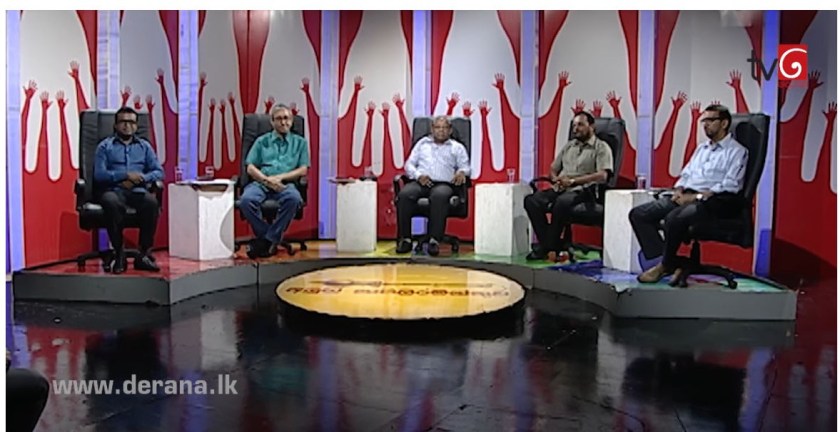
Aluth Parlimenthuwa live talk show on Social Media Blocking in Sri Lanka – TV Derana, 14 March 2018
Sri Lanka’s first ever social media blocking lasted from 7 to 15 March 2018. During that time, Facebook and Instagram were completely blocked while chat apps WhatsApp and Viber were restricted (no images, audio or video, but text allowed).
On 7 March 2018, the country’s telecom regulator, Telecommunications Regulatory Commission (TRCSL), ordered all telecom operators to impose this blocking across the country for three days, Reuters reported. This was “to prevent the spread of communal violence”, the news agency quoted an unnamed government official as saying. In the end, the blocking lasted 8 days.
Both actions are unprecedented. In the 23 years Sri Lanka has had commercial Internet services, it has never imposed complete network shutdowns (although during the last phase of the civil war between 2005 and 2009, the government periodically shut down telephone services in the Northern and Eastern Provinces). Nor has any social media or messaging platforms been blocked before.
I protested this course of action from the very outset. Restricting public communications networks is ill-advised at any time — and especially bad during an emergency when people are frantically seeking reliable situation updates and/or sharing information about the safety of loved ones.
Blocking selected websites or platforms is a self-defeating exercise in any case, since those who are more digitally savvy – many hate peddlers among them –can and will use proxy servers to get around. It is the average web user who will be deprived of news, views and updates.
While the blocking was on, I gave many media interviews to local and international media. I urged the government “to Police the streets, not the web!”.
At the same time, I acknowledged and explained how a few political and religious extremist groups have systematically ‘weaponised’ social media in Sri Lanka during recent years. These groups have been peddling racially charged hate speech online and offline. A law to deal with hate speech has been in the country’s law books for over a decade. The International Covenant on Civil and Political Rights (ICCPR) Act No 56 of 2007 prohibits the advocacy of ‘religious hatred that constitutes incitement to discrimination, hostility or violence’. This law, fully compliant with international human rights standards, has not been enforced.
On 14 March 2018, I took part in the ‘Aluth Parlimenthuwa’ TV talk show of TV Derana on this topic, where I articulated the above and related views. The other panelists were Deputy Minister Karu Paranawithana, presidential advisor Shiral Lakthilaka, Bar Association of Sri Lanka chairman U R de Silva, and media commentator Mohan Samaranayake.
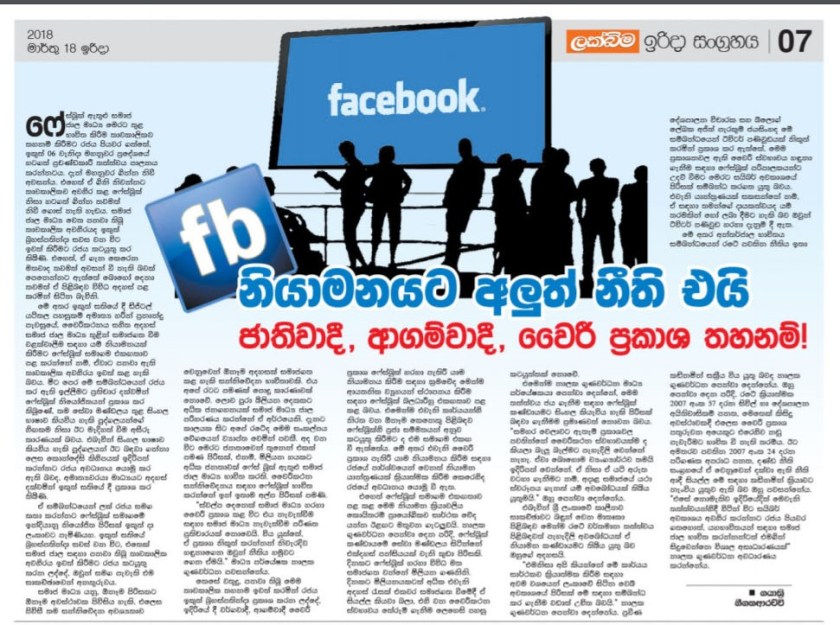
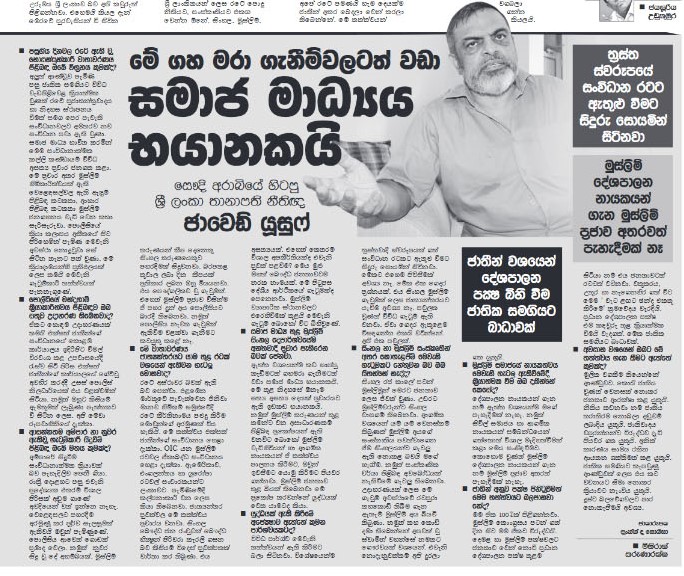
This comment on Sri Lanka’s social media blocking that commenced on 7 March 2018, was written on 8 March 2018 at the request of Irida Lakbima Sunday broadsheet newspaper, which carried excerpts from it in their issue of 11 March 2018. The full text is shared here, for the record.
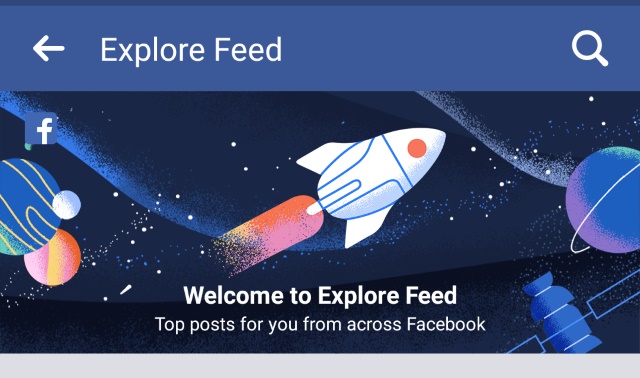
On 1 March 2018, Facebook announced that it was ending its six-nation experiment known as ‘Explore Feed’. The idea was to create a version of Facebook with two different News Feeds: one as a dedicated place with posts from friends and family and another as a dedicated place for posts from Pages.
Adam Mosseri, Head of News Feed at Facebook wrote: “People don’t want two separate feeds. In surveys, people told us they were less satisfied with the posts they were seeing, and having two separate feeds didn’t actually help them connect more with friends and family.”
An international news agency asked me to write a comment on this from Sri Lanka, one of the six countries where the Explore feed was tried out from October 2017 to February 2018. Here is my full text, for the record:
Did Facebook’s “Explore” experiment increase
our exposure to fake news?
Comment by Nalaka Gunawardene, researcher and commentator on online and digital media; Fellow, Internet Governance Academy in Germany
Despite its mammoth size and reach, Facebook is still a young company only 14 years old this year. As it evolves, it keeps experimenting – mistakes and missteps are all part of that learning process.
But given how large the company’s reach is – with over 2 billion users worldwide – there can be far reaching and unintended consequences.
Last October, Facebook split its News Feed into two automatically sorted streams: one for non-promoted posts from FB Pages and publishers (which was called “Explore”), and the other for contents posted by each user’s friends and family.
Sri Lanka was one of six countries where this trial was conducted, without much notice to users. (The other countries were Bolivia, Cambodia, Guatemala, Serbia, Slovakia.)
Five months on, Facebook company has found that such a separation did not increase connections with friends and family as it had hoped. So the separation will end — in my view, not a moment too soon!
What can we make of this experiment and its outcome?
Humans are complex creatures when it comes to how we consume information and how we relate to online content. While many among us like to look up what our social media ‘friends’ have recommended or shared, we remain curious of, and open to, content coming from other sources too.
I personally found it tiresome to keep switching back and forth between my main news feed and what FB’s algorithms sorted under the ‘Explore’ feed. Especially on mobile devices – through which 80% of Lankan web users go online – most people simply overlooked or forgot to look up Explore feed. As a result, they missed out a great deal of interesting and diverse content.
For me as an individual user, a key part of the social media user experience is what is known as Serendipity – accidentally making happy discoveries. The Explore feed reduced my chances of Serendipity on Facebook, and as a result, in recent months I found myself using Facebook less often and for shorter periods of time.
For publishers of online newspapers, magazines and blogs, Facebook’s unilateral decision to cluster their content in the Explore feed meant significantly less visibility and click-through traffic. Fewer Facebook users were looking at Explore feed and then going on to such publishers’ content.
I am aware of mainstream media houses as well as bloggers in Sri Lanka who suffered as a result. Publishers in the other five countries reported similar experiences.
For the overall information landscape too, the Explore feed separation was bad news. When updates or posts from mainstream news media and socially engaged organisations were coming through on a single, consolidated news feed, our eyes and ears were kept more open. We were less prone to being confined to the chatter of our friends or family, or being trapped in ‘eco chambers’ of the likeminded.
Content from reputed news media outlets and bloggers sometimes comes with their own biases, for sure, but these act as a useful ‘bulwark’ against fake news and mind-rotting nonsense that is increasing in Sri Lanka’s social media.
It was thus ill-advised of Facebook to have taken such content away and tucked it in a place called Explore that few of us bothered to visit regularly.
The Explore experiment may have failed, but I hope Facebook administrators learn from it to fine-tune their platform to be a more responsive and responsible place for global cacophony to evolve.
Indeed, the entire Facebook is an on-going, planetary level experiment in which all its 2 billion plus members are participating. Our common challenge is to balance our urge for self-expression and sharing with responsibility and restraint. The justified limitations on free speech continue to apply on new media too.
Some are urging national governments to ‘regulate’ social media in ways similar to how newspapers, television and radio are regulated. This is easier said than done where globalized social media platforms like Facebook, Twitter and Instagram are concerned, because national governments don’t have jurisdiction over them.
But does this mean that globalized media companies are above the law? Short of blocking entire platforms from being accessed within their territories, what other options do governments have? Do ‘user community standards’ that some social media platforms have adopted offer a sufficient defence against hate speech, cyber bullying and other excesses?
In this conversation, Lankan science writer Nalaka Gunawardene discusses these and related issues with Toby Mendel, a human rights lawyer specialising in freedom of expression, the right to information and democracy rights.
Mendel is the executive director of the Center for Law and Democracy (CLD) in Canada. Prior to founding CLD in 2010, Mendel was for over 12 years Senior Director for Law at ARTICLE 19, a human rights NGO focusing on freedom of expression and the right to information.
The interview was recorded in Colombo, Sri Lanka, on 5 July 2017.
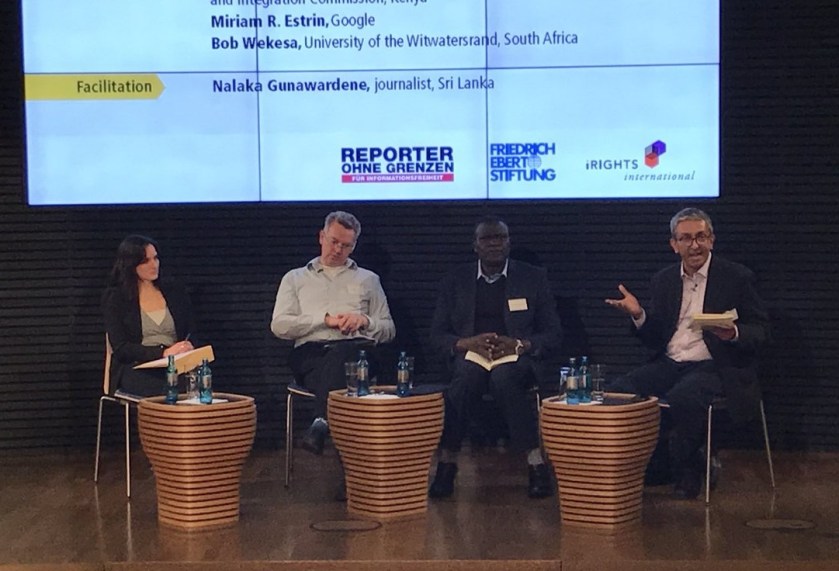
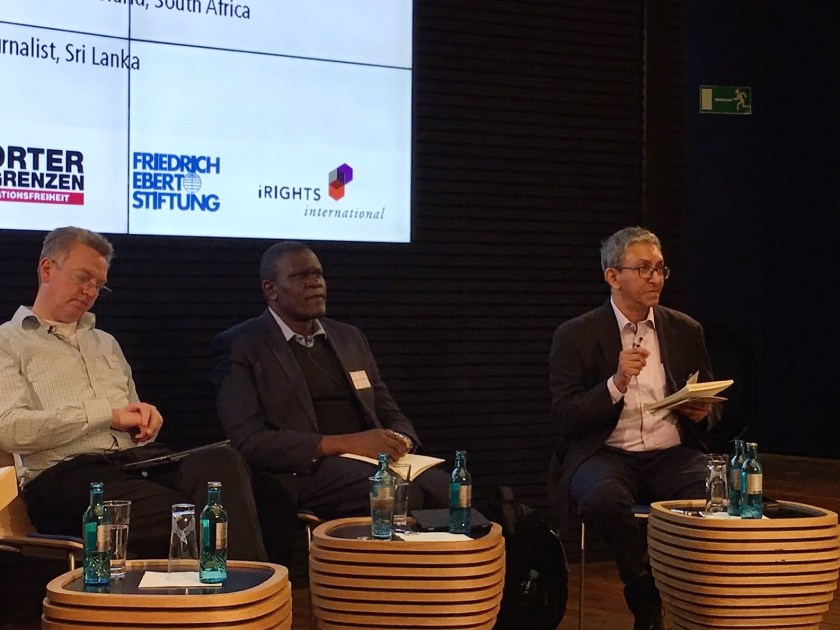
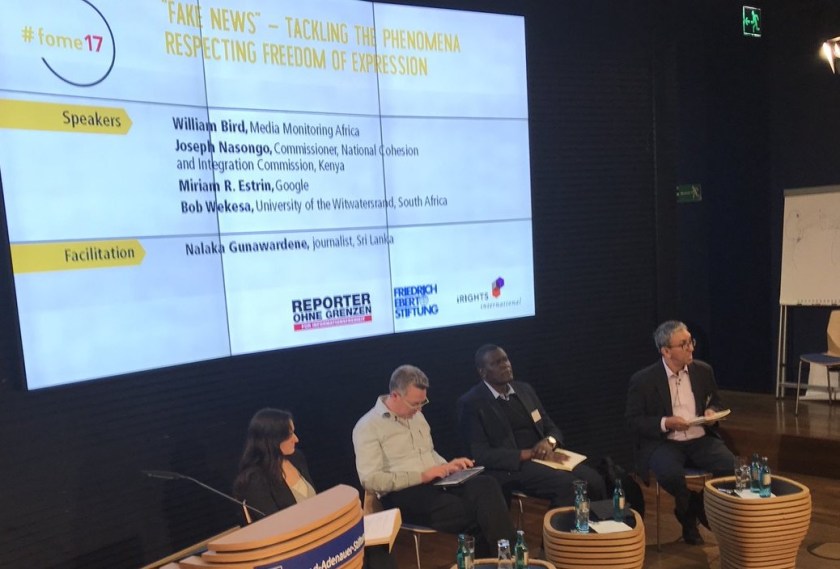
Nalaka Gunawardene (extreme right) moderates FoME 2017 session on “Fake News: Tackling the phenomenon while respecting freedom of expression”, Berlin, 17 Nov 2017
The German “Forum on Media and Development” (Forum Medien und Entwicklung, FOME) is a network of institutions and individuals active in the field of media development cooperation. I was invited to participate in, and moderate a panel at FoME Symposium 2017 held in Berlin on 16 – 17 November 2017.
This year’s symposium theme was Power Shifts – Media Freedom and the Internet. It explored how Internet governance issues are becoming more and more important for those who want to develop media (both mainstream media and social media) as democratic platforms.
On 17 November 2017, I moderated an international panel on Fake News: Tackling the phenomena respecting freedom of expression. It brought together representatives from government, civil society and a global media platform to discuss their roles and how they can interact to tackle the issue – all within the framework of Freedom of Expression (FOE).
Miriam Estrin, Public Policy Manager for Europe, Middle East and Africa, Google
Nalaka Gunawardene speaks on Fake News and Freedom of Expression at FoME 2017 Symposium in Berlin, 17 Nov 2017 – Photo courtesy Helani Galpaya
Here are my opening remarks that set the context for our discussion:
Just as there are many definitions of Fake News, there can also be many perspectives on the topic. We all recognise Fake News as a problem, so let’s focus on how it can be countered. What are the local, national and global level strategies? What alliances, tools and resources are needed for such countering? What cautions and alarms can we raise?
To respond to any problem, we need to understand its contours.
Fake News is not new. The phenomenon has been around, in one form or another, for decades! Many of us in the global South have grown up amidst intentionally fake news stories in our media, some of it coming from governments, no less. And the developing world governments don’t have a monopoly over Fake News either: for over half a century, the erstwhile Soviet Union and Eastern Bloc countries manufactured a vast amount of disinformation (i.e. deliberately wrong information) that was fed to their own citizens and spread overseas in sustained propaganda efforts.
Sitting here, within a few kilometres from where the Berlin Wall once stood, we need to acknowledge that veritable factory of lies that operated on the other side!
So what’s new? During the past decade, as broadband Internet spread worldwide, fake news peddlers found an easy and fast medium online. From websites to social media accounts (many hiding behind pseudonyms), the web has provided a globalised playing field where dubious content could go ‘viral’.
Yesterday at this Symposium, Mark Nelson from CIMA said “We live in a world where lies are very cheap, and much easier to disseminate than the truth.”
Which reminded me of one of my favourite quotes: ““A lie can travel halfway around the world while the truth is putting on its shoes!”
Variations of this quote have been attributed to several persons including Jonathan Swift and Mark Twain. Whoever said it first, these words neatly sum up a long standing challenge to modern societies: how to cope with the spread of deliberate falsehoods.
As Mark Nelson asked us yesterday, how can we “make the Internet a place where truth is valued and spread – instead of disinformation?” This is the crux of our challenge.
So what is to be done? Among the options available, which ones are most desirable?
In searching for solutions to the Fake News crisis, we must recognise it is a nuanced, complex and variable phenomenon. There cannot be one global solution or quick fix.
Indeed, any ‘medicine’ prescribed for the malady of Fake News should not be worse than the ailment itself! We must proceed with caution, safeguarding the principles of Freedom of Expression and applying its reasonable limitations.
As human rights defenders caution, there is a danger that governments in their zeal to counter fake news could impose direct or indirect censorships, suppress critical thinking, or take other steps that violate international human rights law. This is NOT the way to deal with Fake News.
In my view, Fake News is a symptom of a wider and deeper crisis. It is a crisis of public trust in journalism and the media that has been building up over the years in many countries. Some call this a ‘Journalism Deficit’, or a gulf between what journalism ought be, and what it has (mostly) become today.
In my view, a free press is not an automatic guarantee against Fake News. In other words, media freedom is necessary — but not sufficient — to ensure that media content is trusted by the public. We need to better measure public trust in media and what the current trust levels mean for those producing media content professionally.
I would argue that the medium to long term response to Fake News is to narrow and bridge the Journalism Deficit by nurturing quality journalism and critical consumption of media. If you agree with this premise, what specific measures can we recommend and advocate?
Let us explore how media development can counter Fake News by exposing it, undermining it, and equipping media consumers with the knowledge and skills to spot it – and not spread it inadvertently.
For this, we need everyone’s cooperation.
We need global social media platforms and digital gatekeepers like Google to join with all their might (and what might!).
We need governments to be thoughtfully, carefully evaluate the optimum responses.
We need civil society to go beyond mere hand waving and finger pointing to help enhance media and information literacy.
We need researchers to keep studying and discerning trends that can influence policy and regulation (where appropriate).
We are not going to solve the problem in an hour. But we can at least ask the right questions, and clarify the issues in our minds. Onward!
From time to time, certain Lankan academics make unsupported claims that the Sinhala language – spoken as native tongue by about 70% of Sri Lanka’s 21 million people – is in danger of ‘going extinct’. These claims are peddled without question by some journalists and on social media. I have been countering this for some time, going to authoritative global references that track the status of languages worldwide.
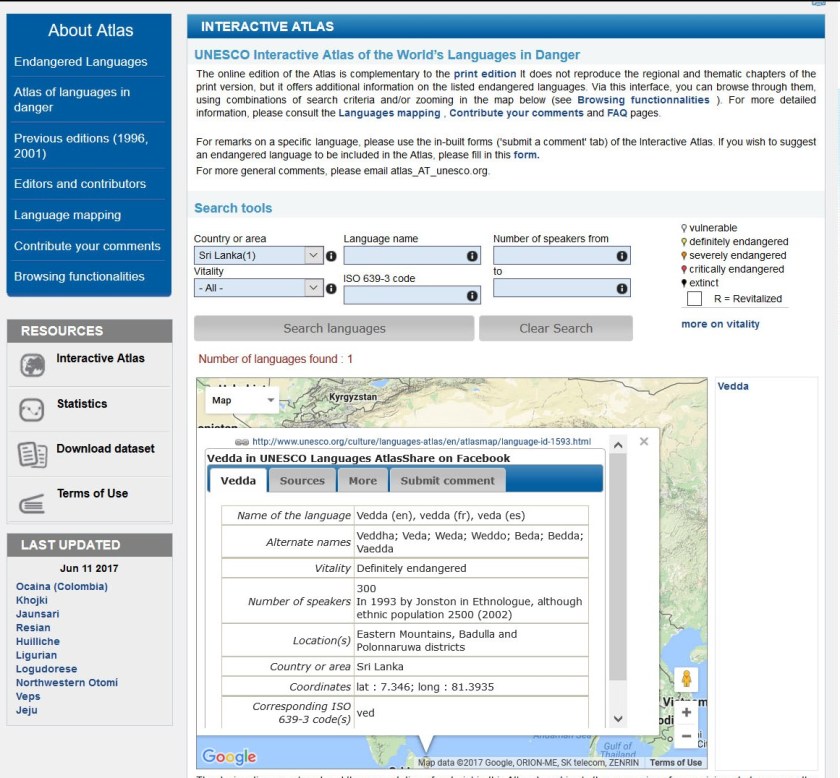
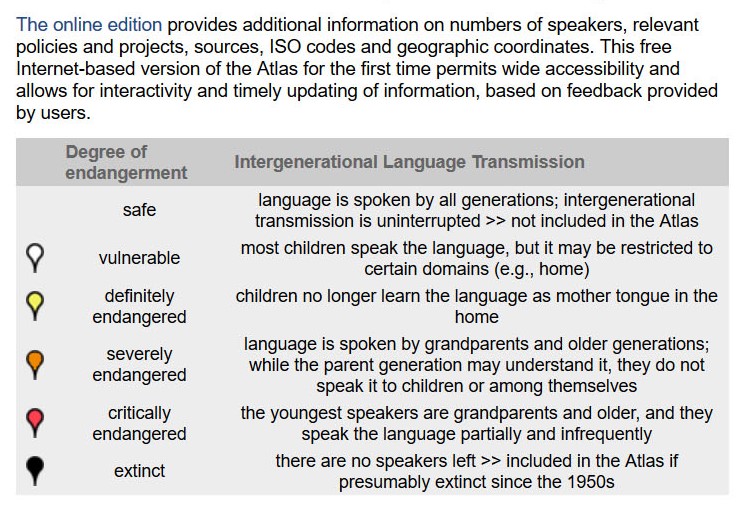
Key among them is the UNESCO Atlas of the World’s Languages in Danger. The latest edition of the Atlas (2010) lists about 2,500 languages (among which 230 languages extinct since 1950), approaching the generally-accepted estimate of some 3,000 endangered languages worldwide. Sinhala language is NOT among them. However, Sri Lanka does have one endangered language: spoken by the indigenous Veddah people, whose numbers are dwindling (below 500) due to cultural assimilation.
World Atlas of Languages in Danger, image captured on 11 June 2017
I have written about disaster early warnings on many occasions during the past decade (see 2014 example). I have likened it to running a relay race. In a relay, several runners have to carry the baton and the last runner needs to complete the course. Likewise, in disaster early warnings, several entities – ranging from scientific to administrative ones – need to be involved and the message needs to be identified, clarified and disseminated fast.
Good communications form the life blood of this kind of ‘relay’. Warnings require rapid evaluation of disaster situation, quick decision making upon assessing the risks involved, followed by rapid dissemination of the decision made. Disaster warning is both a science and an art: those involved have to work with imperfect information, many variables and yet use their best judgement. Mistakes can and do happen at times, leading to occasional false alarms.
In the aftermath of the heavy monsoonal rains in late May 2017, southern Sri Lanka experienced the worst floods in 14 years. The floods and landslides affected 15 districts (out of 25), killed at least 208 and left a further 78 people missing. As of 3 June 2017, some 698,289 people were affected, 2,093 houses completely destroyed, and 11,056 houses were partially damaged.
Did the Department of Meteorology and Disaster Management Centre (DMC) fail to give adequate warnings of the impending hydro-meteorological hazard? There has been much public discussion about this. Lankadeepa daily newspaper asked me for a comment, which they published in their issue of 7 June 2017.
I was asked to focus on the use of ICTs in delivering disaster early warnings.
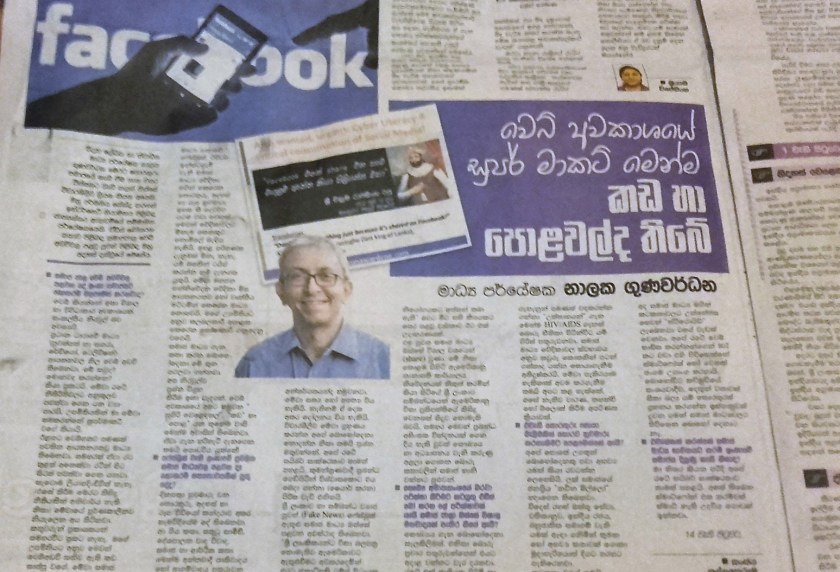
I have just given an interview to Sunday Lakbima, a broadsheet newspaper in Sri Lanka (in Sinhala) on social media in Sri Lanka – what should be the optimum regulatory and societal responses. The interviewer, young and digitally savvy journalist Sanjaya Nallaperuma, asked intelligent questions which enabled me to explore the topic well.
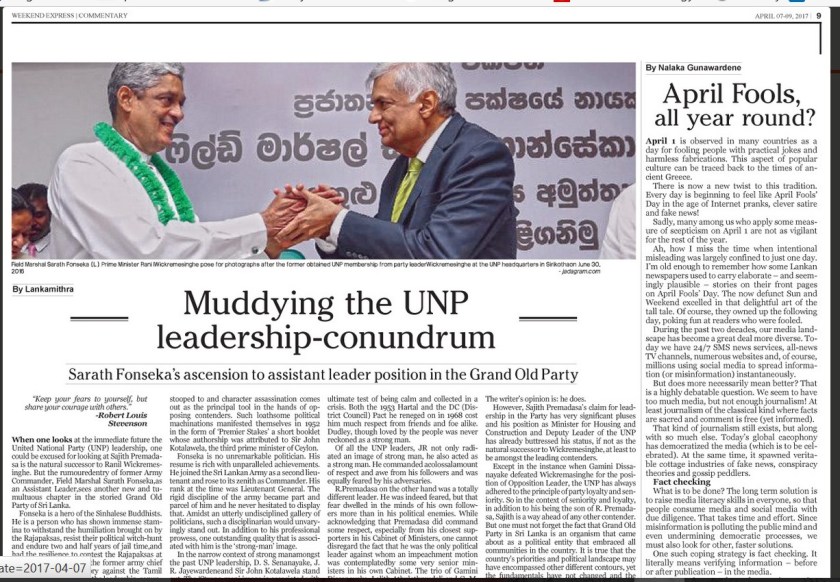
April Fools All Year Round? Op-ed by Nalaka Gunawardene, Weekend Express, 7 April 2017
April Fools, All Year Round?
By Nalaka Gunawardene
April 1 is observed in many countries as a day for fooling people with practical jokes and harmless fabrications. This aspect of popular culture can be traced back to the times of ancient Greece.
There is now a new twist to this tradition. Every day is beginning to feel like April Fools’ Day in the age of Internet pranks, clever satire and fake news!
Sadly, many among us who apply some measure of skepticism on April 1 are not as vigilant for the rest of the year.
Ah, how I miss the time when intentional misleading was largely confined to just one day. I’m old enough to remember how some Lankan newspapers used to carry elaborate – and seemingly plausible – stories on their front pages on April Fools’ day. The now defunct Sun and Weekend excelled in that delightful art of the tall tale. Of course, they owned up the following day, poking fun at readers who were fooled.
During the past two decades, our media landscape has become a great deal more diverse. Today we have 24/7 SMS news services, all-news TV channels, numerous websites and, of course, millions using social media to spread information (or misinformation) instantaneously.
But does more necessarily mean better? That is a highly debatable question. We seem to have too much media, but not enough journalism! At least journalism of the classical kind where facts are sacred and comment is free (yet informed).
That kind of journalism still exists, but along with so much else. Today’s global cacophony has democratized the media (which is to be celebrated). At the same time, it spawned veritable cottage industries of fake news, conspiracy theories and gossip peddlers.
Image source – American Journalism Review, 21 April 2015
Fact checking
What is to be done? The long term solution is to raise media literacy skills in everyone, so that people consume media and social media with due diligence.
That takes time and effort. Since misinformation is polluting the public mind and even undermining democratic processes, we must also look for other, faster solutions.
One such coping strategy is fact checking. It literally means verifying information – before or after publication – in the media.
In a growing number of countries, mainstream media outlets practise fact checking as an integral part of their commitment to professionalism. They seek to balance accuracy with speed, which has been made more challenging by the never-ending news cycle.
In other cases, independent researchers or civil society groups are keeping track of news media content after publication. In the United States, where the practice is well developed, several groups are devoted to such post-hoc fact checking. These include FactCheck, PolitiFact, and NewsTrust’s Truth Squad. They fact check the media as well as statements by politicians and other public figures.
In 2015, fact checking organisations formed a world network and this year, they observed the inaugural International Fact Checking Day.
The initiative is a collaboration by fact checkers and journalism organisations from around the world, “with a goal to enlist the public in the fight against misinformation in all its forms.”
“International Fact Checking Day is not a single event but a rallying cry for more facts — and fact checking — in politics, journalism and everyday life,” says Alexios Mantzarlis, director of the International Fact-Checking Network at the Poynter Institute for Media Studies in the US.
Oops!
Pinocchios
One visual icon for the Fact-Checking Day is Pinocchio, the fictional puppet character whose nose grew long each time he uttered a lie.
We in Sri Lanka urgently need a professional, non-partisan fact checking service to save us from the alarming proliferation of Pinocchios in public life. Not just our politicians, but also many academics and activists who peddle outdated statistics, outlandish claims or outright conspiracy theories.
Take, for example, the recent claim by a retired professor of political science that 94 Members of Parliament had not even passed the GCE Ordinary Level exam. Apparently no one asked for his source at the press conference (maybe because it fed a preconceived notion). Later, when a (rare?) skeptical journalist checked with him, he said he’d “read it in a newspaper some time ago” — and couldn’t name the publication.
A simple Google search shows that an MP (Buddhika Pathirana) had cited this exact number in September 2014 – about the last Parliament!
Given the state of our media, which often takes down dictation rather than asks hard questions, fact checking is best done by a research group outside the media industry.
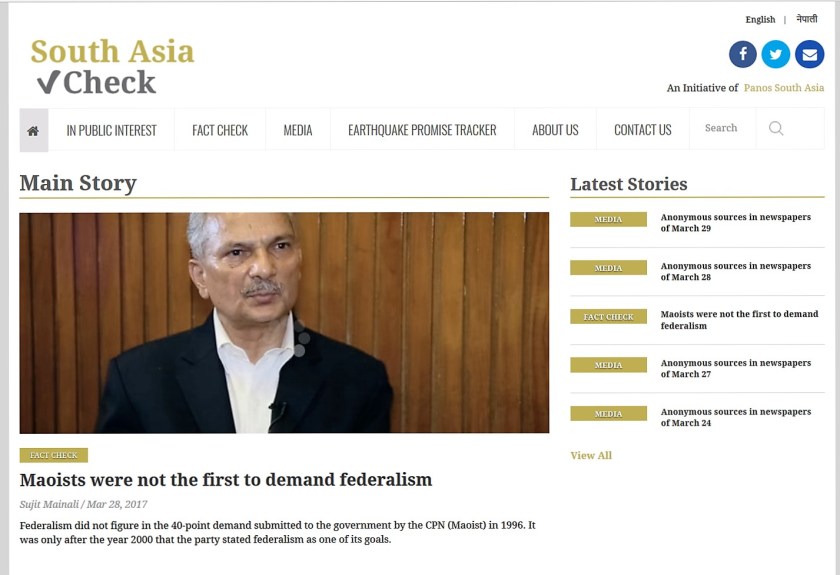
A useful model could be South Asia Check, an independent, non-partisan initiative by Panos South Asia anchored in Kathmandu. It “aims to promote accuracy and accountability in public debate” by examining statements and claims made by public figures in Nepal and occasionally, across South Asia (http://southasiacheck.org).