Warning: Is climate change the new HIV of our times?

From www.sprattiart.com
From http://www.sprattiart.com


Is climate change the new HIV of our times?

I asked this question when addressing a group of television journalists and film-makers from the Asia Pacific last week. I was making introductory remarks to an Asia Pacific Workshop and Open Film Screening on ‘Changing Climate and Moving Pictures‘ held on 3 – 4 October 2008 in Tokyo, Japan. It was organised by TVE Japan in collaboration with TVE Asia Pacific, and supported by the Japan Fund for Global Environment.

I acknowledged that climate change was not just another environmental issue or even the latest planetary scare. “This time we’re in deep trouble – and still finding out how deep,” I said.

Climate change has brought into sharp focus the crisis in:
• how we grow economically;
• how we share natural resources and energy; and
• how we relate to each other in different parts of the world.

In that sense, I noted, climate change is acting like a prism — helping to split our worldly experience into individual issues, concerns and problems that combine to create it. Just like an ordinary prism splits sunlight into the seven colours (of the rainbow) that it’s made of.

“Climate shows up the enormous development disparities within our individual societies and also between them. When this happens, we realise that climate is not just a scientific or environmental problem, but one that also has social, political, security, ethical and human rights dimensions,” I added.
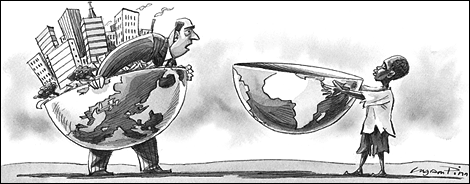
Climate change in an uneven world

I then outlined some parallels between the current climate crisis and the HIV/AIDS pandemic that emerged some 25 years ago.

Consider these similarities:
• When HIV was first detected, it was considered a medical issue affecting specific sections of society.
• It took years for the wider societal, development and human rights aspects of HIV to be understood and then accepted.
• Some countries and cultures wasted precious years in HIV denial; a few are still in this mode.
• It took overwhelming impact evidence and mounting pressure from affected persons for states and international community to respond.
• Then…everybody jumped the bandwagon and HIV became a fundable, profitable enterprise.

I have been commenting in this blog about this ugly side of HIV/AIDS in my own country Sri Lanka, where some NGOs and charities have turned HIV activism into a self-serving, lucrative industry. There are fierce ‘turf wars’ to claim persons living with HIV as their institutional ‘property’. Some have appropriated HIV as their own virus, and would rather not allow others to work in this area.

And it’s not just NGOs who are riding the HIV gravy train. The United Nations programme for AIDS, or UNAIDS, created by the UN system in response to the global crisis, has evolved into a behemoth whose efficacy and relevance are now being widely questioned.

UNAIDS “is obsolete and an obstacle to improving healthcare in developing countries” claims Roger England, an international health expert. Writing in the British Medical Journal in May 2008, England pointed out that HIV causes 3.7 per cent of mortality and kills fewer people than pneumonia or diabetes, yet it received 25 per cent of all international healthcare aid and a big chunk of domestic expenditure. This has resulted in wasting vast sums of funding on esoteric disciplines instead of beefing up public health capacity. Despite this criticism, UNAIDS is calling for huge increases in its funding — from its current US$9 billion to US$54 billion by 2015.

All this makes me wonder: is climate the new HIV of our times? This is the question I raised in Tokyo.

I added: “If so, I sincerely hope it does not evolve in the same manner that HIV crisis did. There are worrying signs that the drive towards a low carbon economy is being exploited by various groups – including some in civil society – for self gain.”

Certain development agencies and ‘think tanks’ are clearly exploiting climate change to make money. Suddenly, everybody is ‘climate-proofing’ their activities — meaning they are talking about climate change no matter what they do, whether it is teacher training or micro-credit.

In the run up to the Bali climate conference in late 2007, I wrote a blog post titled ‘Beware of bad weather friends’ about a London-based NGO engaging in some media training on climate issues, but deriving its legitimacy from a dubious survey. This post apparently irked the party concerned a great deal.

In Tokyo, a workshop participant confirmed that this was already happening in his country.

“Every crisis today is being turned into a business opportunity – and not just by the corporate sector,” said Pradip Saha, associate director of the Centre for Science and Environment in India.

He added: “Consultancy companies and some NGOs have realised there is big money to be made in climate related areas like carbon offsets and the Clean Development Mechanism. They are already riding the climate bandwagon!”.

Read the full text of my introductory remarks to the Tokyo workshop.changing-climate-moving-images-nalaka-gunawardene-intro-3-oct-2008

Go ahead, just say the word: Condom! Now say it again…

not an easy task...
Acting out condoms in broad daylight in India: not an easy task...

Condom!

No one is certain how or where the word originated, but it has become one of those ubiquitous items in modern society.

It’s a two syllable word, fairly easy to pronounce. Then how come so many people – at least in South Asia, home to a fifth of humanity – get their tongues tied or twisted in saying it?

That’s because it’s to do with sex! That’s not a subject that many South Asians still feel comfortable in talking about, in public or even private.

Sex may be a very private matter, but individuals’ sexual behaviour has direct and serious public health implications. Especially today when the world is still struggling to contain and overcome the spread of HIV that causes AIDS.

Condoms originally came into wide use to help prevent unwanted pregnancies and the spread of sexually transmitted diseases (STDs). In the past quarter century, condoms have become a major weapon against HIV.

Despite this, condoms still remain a hush-hush topic among many grown ups, even as the younger generation warms up to them. Across South Asia, we still have some hurdles to clear in normalising condoms – or making it socially and culturally acceptable for people to talk about condom use, and to go out and buy them without fear or shame.

They come in all colours and shapes!

This is the challenge that various communication groups have taken up, especially in India. According to a 2007 survey by UNAIDS and India’s National AIDS Control Organisation (NACO), at least 2.5 million people live with the HIV virus in India, placing the country third in the world after South Africa and Nigeria. However, AIDS prevention in the country is not an easy job. Many people, especially in rural areas, cling on to preconceived taboos about sex — and are often hesitant to use condoms.

In recent weeks, I’ve heard from two campaigns that are trying to change this. One is the BBC World Service Trust working with Indian broadcasters and other partners to normalise condom use through a campaign. I’ll be writing a separate blog post on that effort.

Last month, I received en email from someone called ‘Spread Word for a Better World’, who shared with me web links on a socio-cultural group based in Hyderabad, who are using the performing arts to promote condom awareness.

For over a decade, the Nrityanjali Academy has been singing and dancing their way to the glorification of condom use. They see it as a crucial fight in their central region, where 2 per cent of the population is HIV positive.

P Narsingh Rao, director of Nrityanjali, recently told France 24 online: “Our main target groups are people vulnerable to the HIV virus like sex workers, transsexuals or truck drivers. We tour villages in mobile video vans to show the film. The screening is followed by a question and answer session about condom use and sexually transmitted diseases.”

He added: “We also encourage the use of female condoms, a relatively new concept. We tell the women to negotiate the use of female condoms with their male partners: for men with little sex education, the insertion of the female condom in the vagina can in itself be an erotic act.”

Here are some YouTube videos showcasing their work:

This is an entertaining and educational video in Telugu language on Condom usage, to prevent from sexually transmitted infections and HIV:

A more instructional video on how to use condoms properly:

And finally, an HIV/AIDS song in Telugu – with all the fast-beat music, gyrating and riot of colours we typically associate Bollywood movies and songs with:

The videos speak for themselves. They are matter of fact, engaging and presented by ordinary people (trained entertainers) rather than by jargon-totting medical doctors or health workers. There is none of the awkwardness typically associated with conversations of this subject. No one is tip-toeing around perceived or real cultural taboos. They just get on with it.

Importantly, they involve both men and women, both in performances and in their audiences.

Training young men on just how to do it right...

Related blog posts:

July 2007: The Three Amigos: Funny condoms with a serious mission

April 2007: Beware of Vatican Condoms – and global warming!

Images courtesy France 24’s The Observers.

TV Southasia: Nothing official about this, yipee!

TV South Asia

Nearly one year ago, I wrote a blog post titled: Channel South Asia? Yes and No!

My closing words at the time were:
“I, for one, am relieved that South Asian governments are unlikely to come together in such a venture – we’ve suffered long enough and hard enough with our state-owned, government-controlled, ruling party mouthpieces (both radio and TV) that pollute our airwaves (a public commons) every day and night. Euphemistically called ‘national television’, these conduits of governmental propaganda have progressively lost audience share — and influence — since private channels started operating in the early 1990s. They are today reduced to vanity channels for vane politicians and bureaucrats. The mass audience has long ago abandoned them. I’d rather take chances with a South Asian Murdoch, than with our unaccountable, selfish governments.”

Chevaan Daniel, head of Sri Lanka’s enterprising Channel One MTV, posted a comment soon afterwards, on 27 July 2007, saying: “Maharaja Channels have pioneered this for Sri Lanka, by joining together in an initiative involving media companies from India, Pakistan, Nepal and Bangladesh to launch ‘The SouthAsian’. This collaboration includes a weekly programme produced in Calcutta, aired at the same time in the region. The next step is indeed a SouthAsian Channel, which we are working towards.

Well, I’m delighted to find that over the past 12 months, they have indeed been investing time, creative effort and money in this venture. TV Southasia is now a reality!

It’s a collaborative venture of commercial broadcasters in five countries of South Asia, who have joined hands to produce and share content across their national borders. Mercifully, no governments are involved and certainly none of the state-owned broadcasters (Babu TVs) whose lack of vision and creativity is only matched by their depleting audiences these days.

TV Southasia

Indeed, there’s nothing official about TV Southasia (TVSA), and that’s to be celebrated on its own merit. And if they get it right, TVSA founders — Rtv of Bangladesh, TARANEWS of India, Image Channel of Nepal, Aaj TV of Pakistan and News 1st of Sri Lanka — can tap into an enviably large audience. Between them, their countries have more than 1.5 billion people, most of who have access to television.

TVSA founders are taking one step at a time, perhaps knowing very well that cross-border ventures in South Asia need to be nursed slowly and incrementally, while dealing with assorted historical hang-ups and tonnes of red tape (or these days the colour could well be saffron or khaki, depending on where you live!).

It all started when a group of broadcasters and activists from across South Asia came together in Kolkata in December 2006 and agreed to forge the Southasian initiative. They swapped content to start producing a half-hour magazine programme (containing news analysis, music, features and interviews) from April 2007. Called Southasian, it was produced by Taranewz drawing on content from the participating channels, who then broadcast it weekly and also made it available online.

Taking the next logical step, the five broadcasters decided in August 2007 to form a channel, branded as TV Southasia. It started being previewed on 19 April 2008.
Read more about TV Southasia on its own website

The channel is being distributed by Thailand’s ThaiCom5 satellite, and would be available through cable operators across South Asia. It’s an English language channel, based on the reality that English is the only link language shared and understood by all countries of South Asia.

TVSA says it’s concentrating on talk shows, interviews, lifestyle, music, short films, sports, cuisine and quiz — most of this content is already available through many national channels and occasionally from global channels too. But TVSA can bring in a trans-boundary, pan South Asian outlook which is largely missing in these channels. In fact, it would be refreshing to see a TV channel covering South Asia as a whole, without giving into the frequent pressures or temptations of national tribalism and geopolitical posturing that we see all the time on both BabuTVs and many commercial channels.

Click here for programme lineup on TV Southasia

I have so far only caught glimpses of their offering, when Channel One MTV shows the Southasian magazine show. Going by this limited exposure, I can confirm that the products of this collaboration are superior to what BabuTVs have been struggling to do for two decades through the very official (read: officious and unimaginative) framework of SAARC Audio-Visual Exchange, or SAVE.

Started in 1987, just two years after the South Asian governments formed the regional grouping called South Asian Association for Regional Cooperation or SAARC, SAVE brought together the so-called national broadcasters in radio and TV. Trapped in inter-governmental bureaucracies, they tried to share and carry each other’s broadcast content. The officially sanctioned programmes, often made by committees, completely failed to capture the diversity and vibrancy of what’s going on in each South Asian country that interests the rest of the sub-region. I have no idea if SAVE still exists, because I don’t watch BabuTV anymore (does anybody?). Even in its formative days, I could tell that SAVE was beyond saving…

TV Southasia

Enter TV Southasia – and not a moment too soon. As its website says: “It is for the first time in history that the private electronic media channels have come together and have formed a collaborative channel sharing the same view points on diversity, heritage, bondage and possibilities.”

Unlike many broadcast ventures, TVSA declares its agenda – and it’s a lofty one. It wants to promote highly desirable values like liberalism, scientific temperament, education, heritage and cultural diversity. Rather courageously, it also declares what it is explicitly opposed to, which includes superstition, fundamentalism, corruption, violence, cultural hegemony and communalism — the long and depressing list of evils that keeps hundreds of millions of South Asians in misery, fear and trapped at the bottom of the development ladder. Read TVSA’s vision, mission and ideals

This agenda resonates with the equally passionate, secular idealism of Ujala TV, another satellite broadcast venture aimed at beaming to South Asia since mid 2006. I have been cheering them from the beginning, while my organisation TVE Asia Pacific has been a regular supplier of factual programming for them. Read my July 2007 blog post on Ujala TV – Enriching South Asian airwaves

Well, we need as many idealists as we can find in South Asia. Encouragingly, TV Southasia has already involved Himal Southasian founder and editor Kanak Mani Dixit, a great champion of people-to-people collaboration in South Asia. Perhaps it’s due to Kanak’s influence that the brave new channel is spelling Southasia as one word, as Himal Southasian has been doing for some years now. It might seem an aberration in spelling to some, but in fact, it separates these entirely unofficial, people’s ventures from the many committees and initiatives of the official SAARC, which are endlessly meeting yet constantly failing to forge regional trust, cooperation and cohesion.

The official, officious and unproductive SAARC will be on parade once again at the next Summit due in late July 2008. My SAARCasm is shared by many journalists, intellectuals and activists across South Asia who have tracked the origins and evolution of this grouping since its founding in Dhaka in 1985. To put it charitably, at 23 years of age, SAARC has the mental development of a 3-year-old (if that). We only need to take a look at the People’s SAARC Declaration, adopted in Kathmandu in March 2007, to realise how much the official SAARC has failed to accomplish.

That’s in spite of its frequent and highly expensive meetings. Alas, this time they have chosen to meet in my city of Colombo, which means – after footing a massive Summit bill of LKR 2.8 billion (over USD 27 million) – we ordinary citizens will very likely be kept under virtual house arrest for its duration. All in the name of security, of course.

I hope I can catch a bit more of TV Southasia when the visiting SAARC-babus drive us off our own streets.

Photos and images all courtesy TV Southasia

Below – photos from TV Southasia launch

Telecom Without Tears: Book Review

My review of the book, ICT Infrastructure in Emerging Asia: Policy and Regulatory Roadblocks, was printed in Financial Times on Sunday, Sri Lanka, on 18 May 2008.

The book, co-edited by Rohan Samarajiva (in photo, below) and Ayesha Zainudeen, is published jointly by Sage Books and Canada’s IDRC. It is based largely on the work of my friends and colleagues at LIRNEasia.

Although the book showcases recent telecom and ICT reform experiences in five economies in South and Southeast Asia (Bangladesh, India, Indonesia, Nepal and Sri Lanka), my review takes a closer look at the Sri Lankan situation partly because I live and work there, and because the review was intended more at a Sri Lankan readership.

Here’s my opening:

“In the early 1990s, I had to wait for nearly six years for my first (fixed) telephone – I refused to pay bribes or use ‘connections’ to bypass thousands of others on the notorious waiting list. Earlier this year, when I bought an extra mobile phone SIM from Dialog GSM, it took six hours for the company to connect it. I found that a bit too long.

“How things have changed! Connectivity without (social) connections, and practically off-the-shelf, is now possible in most parts of Sri Lanka. Telecommunications is the fastest growing sector in the economy, recording 47 per cent growth in 2007 (and 58 per cent in 2006). The country’s tele-density (number of telephones per 100 persons) jumped to 54 in 2007, from 36 at the end of 2006 -– thanks largely to the phenomenal spread of mobile phones, which now outnumber fixed phones by three to one.”

One quick – albeit a bit unfortunate – way to introduce this book is that it apparently scared some sections of Sri Lanka’s state bureaucracy. When copies arrived from the Indian publisher earlier this year, they were held up at Customs for over three months for no logical or coherent reason. The editors speculated whether it had something to do with one chapter (among 13) looking at telephone use in war-ravaged Jaffna during the ceasefire (which lasted from 2002 to 2008), but this was neither confirmed nor denied.

In my review, I make the point: “It was a stark reminder, if any were needed, of the turbulent settings and often paranoid times in which telecom liberalisation has been taking place in many parts of emerging Asia.”

And I return to the larger political reality in my conclusion, as follows:
“Now that the ICT genie has been set loose, it’s impossible to push it back into the dusty lamp of the monopolist past, even under that much-abused bogey of ‘national security’ (or its new, freshly squeezed version, ‘war against terror’). Despite this, the officialdom and its ultra-nationalist cohorts don’t give up easily. While this book was in ‘state custody’, Sri Lankans experienced the first government-sanctioned blocking of mobile phone SMS – ironically on the day marking 60 years of political independence.

Photo below shows several contributing authors at the book’s launch in Chennai in December 2007


Read the review online

Download the review as a pdf document (47kb)
telecom-without-tears-by-nalaka-gunawardene-may-2008

Read or download the book electronically from IDRC website

Amitav Ghosh on Cyclone Nargis: High tech alone can’t save us!

Whenever Burma hits the international news headlines, I think of author Amitav Ghosh. His 2002 historical novel, The Glass Palace, was my introduction to Burma’s recent history. It describes – with historical accuracy and detail – how the British colonised a land of prosperity in 1824 and left it an impoverished nation in 1948.

I was intrigued, therefore, to read an excellent op ed essay by Amitav Ghosh in The New York Times of 10 May 2008. Titled When Death Comes Ashore, it is a commentary on the aftermath of Cyclone Nargis that particularly hit Burma in recent days. Ghosh offers both comfort and worry.

The bad news, as he puts it, is that “for the rapidly growing countries that surround the Bay of Bengal there is an increasing urgency to find a way to protect themselves. They have experienced some of the world’s most devastating storms.”

Courtesy Wikipedia

He makes a strong call for cooperation among the countries who surround the Bay of Bengal, which means Bangladesh, Burma, India, (part of) Indonesia and Thailand.

As he says: “Nation-states tend to see their interests as being confined within their own borders. But the reality is that the people who live around the Bay of Bengal have a vital interest in common that they do not share with their compatriots in the hinterlands: they are joined by the furies (and let it be said also, the blessings) of that body of water.”

To me, the most important point he makes is about disaster preparedness, a topic we covered in some depth and detail in Communicating Disasters: An Asia Pacific Resource Book that I co-edited last year.

“Recent experience has demonstrated in spectacular ways that rich, technologically advanced nations are not invulnerable to extreme weather. What has also been demonstrated, but more quietly, is that a nation need not be wealthy or technologically advanced to be well prepared for natural disasters.”

Ghosh talks about Mauritius, a small Indian Ocean island that meteorologists call a ‘cyclone factory’, which has “evolved a sophisticated system of precautions, combining a network of cyclone shelters with education (including regular drills), a good early warning system and mandatory closings of businesses and schools when a storm threatens.

He adds: Mauritius is a country that has learned, through trial and experience, that early warnings are not enough — preparation also demands public education and political will. In an age when extreme weather events are clearly increasing in frequency, the world would do well to learn from it.”

Let’s hope the Indian Ocean rim countries – especially those that share the Bay of Bengal’s blessings and lashings – would heed the celebrated Indian author’s call. After the 2004 tsunami, we saw a flurry of activity to set up high-tech and high cost early warning systems for future tsunamis. The United Nations and development donors huddled together in various exotic locations of our region to work out the details.

But I wrote in a SciDev.Net opinion piece in December 2005: “Setting up a state-of-the-art, high tech and high cost system is not a solution by itself. Because the most advanced early warning system in the world can only do half the job: alert governments and other centres of power (e.g. military) of an impending disaster. The far bigger challenge is to disseminate that warning to large numbers of people spread across vast areas in the shortest possible time“.

I called it the Long Last Mile (sorry, metric fans, it just doesn’t read right to say the last kilometre!), a phrase that I also used in the book chapter and the short film that I scripted for TVE Asia Pacific in 2007.

LIRNEasia’s National early warning system for Sri Lanka

LIRNEasia’s 2006-2007 project to Evaluate the Last Mile Hazard Information Dissemination

Read the full essay: Death Comes Ashore, By AMITAV GHOSH, in The New York Times, 10 May 2008
(requires free registration to read online)

Arthur C Clarke on the Future of Food: We need a smarter and kinder world

The leading Indian newspaper The Hindu has just published (on 4 May 2008) my article on the future of food, based on the views of Sir Arthur C Clarke. It can be found here.

I originally wrote this article in mid 2000, based on an interview with the late Sir Arthur Clarke. It was produced at the request of the UN Food and Agriculture Organisation (FAO), which included it in an information pack to mark World Food Day in October that year. No doubt they circulated it among the charmed development circle, but as far as I know (or Google can find), it never appeared in a public media outlet – until now.

I came across this in the weeks following Sir Arthur’s death on March 19, when I was going through manuscripts of our collaborative essays and my interviews with him over the years. The Hindu‘s Sunday Magazine, which earlier printed my essay on Sir Arthur’s views on nuclear weapons in South Asia, agreed to publish it, which they did on 4 May 2008.

The essay, written in Sir Arthur’s first person narrative, makes a number of points that are very relevant to discussions on today’s global food crisis. In fact, these points are more valid today than when they were first made eight years ago.

An extract:

“Meeting everybody’s basic nutritional needs requires a combined approach of the mind and heart – of intellect and compassion. How can we explain the fact that one sixth of humanity goes to bed hungry every night, when the world already produces enough food for all?

“The short answer is that there are serious anomalies in the distribution of food. Capricious and uncaring market forces prevent millions of people from having at least one decent meal a day, while others have an abundance. For the first time in history, the number of severely malnourished persons now equals the number suffering from over-consumption: about a billion each!

“To adapt a remark that my late friend Buckminster Fuller once made about energy: there is no shortage of food on this planet; there is, however, a serious shortage of intelligence. And, I might add, compassion.

Sir Arthur then runs up his famous ‘crystal ball’ to gaze at the near and far future on how humanity can feed itself without damaging the planet. He offers some useful lateral thinking and suggests some unlikely new sources of food.

But all these are short term solutions, he says, because “eventually, the matter will be resolved when we are able to synthesise all the food we ever need, thus no longer depending on other animals to satisfy our hunger.”

Towards the end of the essay, he takes the big picture view:

“Improved communications and the free flow of information will not, by themselves, eradicate either hunger or poverty — but they can be instrumental in the struggle to create a world without these. And when the world’s collective conscience finally succeeds in mobilising sufficient political will and resources to banish those twin scourges, we will be left with another, far more insatiable but far less destructive substitute — the hunger for knowledge and wisdom.”

Read the full essay: The future of food – Arthur C Clarke talks to Nalaka Gunawardene

Arthur C Clarke: The Dangerous Dreamer of Colombo

Image by Reuters, courtesy Down to Earth

Arthur C Clarke: The Dangerous Dreamer of Colombo.

That’s the title I gave to an 800-word obituary/tribute on Sir Arthur C Clarke that I wrote for India’s leading science and environment fortnightly, Down to Earth.

In this essay, I took a quick look at Sir Arthur’s legendary dream power. While there are no independent dream ratings as in television broadcasting, I always felt that he had one of the most active and imaginative dream machines east of Suez (millions of his satisfied readers might agree). When I turn up at his office two mornings a week, he would often relate a fantastic dream he’d just had — a few of these eventually found their way into his stories or even non-fiction writing.

I pegged this tribute on one of my favourite quotes by another British writer, T E Lawrence: “All men dream, but not equally…the dreamers of the day are dangerous men, for they may act their dream with open eyes, to make it possible.”

The tribute has just been published, in the latest issue of Down to Earth datelined 15 April 2008. But the sub editors have chosen a less vivid title, which is of course their prerogative.

This essay was written during the weekend of March 22-23, within hours of Sir Arthur’s funeral. Pradip Saha, the magazine’s editor, contacted me soon after Sir Arthur’s demise and asked if I could do 800 words in 48 hours. He knew I’d worked closely with the late author, and years ago, I had done a Clarke interview for Down to Earth.

Talk about catching me at a busy moment. At the time, as Sir Arthur’s spokesman, I was coping with a deluge of media requests and queries from all over the world (and a few from other worlds – just kidding). But my own newsroom experience had trained me to keep a cool head and remain focused amidst turbulence. So I agreed, and wrote this on 23 March 2008 while still recovering from the sheer exhaustion of a 4-day media-marathon (mediathon?).

This is how I start off the essay:

“In his 1992 book How the World Was One, Sir Arthur C Clarke described a dream he once had: one day, CNN founder (and then owner) Ted Turner is offered the post of the President of the world, but he turns it down politely—because he didn’t want to give up power.

“The trouble with Clarke’s dreams was that many kept coming true, often faster than his own vivid imagination envisaged. Like Albert Einstein, Clarke believed that imagination was more important than knowledge—he called himself an extrapolator, one who expanded from current knowledge to what was scientifically plausible.”

Read my Down to Earth tribute to Arthur C Clarke: The Dangerous Dreamer of Colombo

TVE Asia Pacific says Thank You to Sir Arthur C Clarke

In his 1992 book How the World Was One, Sir Arthur C Clarke described a dream: one day in the near future, CNN founder (and then owner) Ted Turner is offered the post of World President, but he politely turns it down – because he didn’t want to give up power!

Just three years later, the then Secretary General of the UN suggested that CNN should be the 16th member of the Security Council. Sir Arthur was fond of quoting this, and once famously told Turner: “You owe me 10 per cent of your income”.

These references – illustrating the power of globalised satellite television – are recalled in TVE Asia Pacific‘s official tribute to Sir Arthur C Clarke, who passed away on March 19 aged 90.

“With the death of Sir Arthur C Clarke, TVE Asia Pacific has lost a long-standing friend and supporter,” the tribute says.

It adds: “Since our establishment in 1996, Television for Education Asia Pacific – to use our full name – has been engaged in pursuing Sir Arthur’s vision of using the potential of moving images to inform and educate the public. Our founders chose to focus on covering development and social issues, with emphasis on the Asia Pacific region – home to half of humanity and where Sir Arthur spent the last half century of his life.”

Although he never held a formal position at TVEAP, Sir Arthur was an informal adviser and mentor to the regional media organisation whose work across Asia Pacific is only possible thanks to the comsat that invented and the web that he inspired.

By the time TVEAP was created in the mid 1990s, the satellite TV revolution was well underway in the Asia Pacific region, and the internet revolution was just taking off. In informal discussions, Sir Arthur advised us to always keep our eyes open on what’s coming up. In the ICT sector, he cautioned, being too closely wedded to one technology or system could lead to rapid obsolescence.

The tribute mentions Sir Arthur’s specific support for the Children of Tsunami media project, and the Communicating Disasters publication.

We also talk about Sir Arthur’s concerns about using information and communication technologies (ICTs) to benefit the poor and other disadvantaged groups – a process that he aptly described as ‘geek to meek’.

We end by recalling how TVEAP recorded and uploaded to YouTube Sir Arthur’s last public video address – his 90th birthday reflections in December 2007.

Read TVEAP’s tribute to Sir Arthur C Clarke, 1917-2008

sir-arthur-clarke-reflecting-on-90-orbits.jpg

Arthur C Clarke: Of Nukes and ‘Impotent Nations’

The past few days have been particularly hectic for me as I was Sir Arthur Clarke’s spokesman for the past decade, and remain so for the time being. While handling literally dozens of media queries and requests from all over the world, I somehow managed to find the time to write an op ed essay on Sir Arthur’s life-long crusade against nuclear weapons.

This essay is based on a feature I wrote in 2002 for the now defunct (and sorely missed) Gemini News and Feature Service, but I rewrote it completely before sending it off to my newspaper editor and senior journalist friends across South Asia. It has so far appeared in full in:
Daily News (Sri Lanka), 22 March 2008
New Age (Bangladesh), 23 March 2008
The Hindu (India), on 30 March 2008
The News (Pakistan), 30 March 2008
Excerpts have been carried on the website of Himal Southasian (Kathmandu).

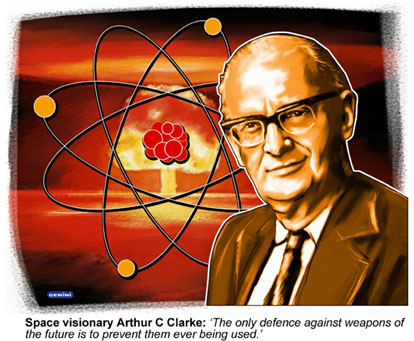
Here’s the 900-word essay in full with the Gemini illustration that accompanied my original article.

Arthur C Clarke: Of Nukes and Impotent Nations
by Nalaka Gunawardene
Colombo, Sri Lanka: 22 March 2008

arthur-c-clarke-and-nuclear-weapons-pix-by-gemini-news-2002.jpg

“Do you know about the only man to light a cigarette from a nuclear explosion?” Sir Arthur C Clarke was fond of asking his visitors a few years ago.

Clarke, the celebrated science fiction writer and space visionary who died on March 19 aged 90, loved to ask such baffling questions.

In this instance, the answer was Theodore (Ted) Taylor, a leading American nuclear scientist who designed atomic weapons in the 1950s and 1960s. Apparently he just held up a small parabolic mirror during a nuclear test — the giant fireball was 12 miles away – and turned light into heat.

“The moment I heard this, I wrote to Taylor, saying ‘Don’t you know smoking is bad for your health?'” Clarke added with a chuckle.

In fact, he took an extremely dim view of both smoking and nuclear weapons, and wanted to see them outlawed. But he was aware that both tobacco and nukes formed strong addictions that individuals and nations found hard to kick.

Years ago, Clarke had coined the slogan ‘Guns are the crutches of the impotent’. In later years, he added a corollary: “High tech weapons are the crutches of impotent nations; nukes are just the decorative chromium plating.”

Living in the Sri Lankan capital Colombo, the author of 2001: A Space Odyssey was acutely aware of tensions between neighbouring India and Pakistan – both nuclear weapon states.

British-born and calling himself an “ethnic human”, Clarke offered a unique perspective on nuclear disarmament. His interest in the subject could be traced back to his youth, when he served in the Royal Air Force during Second World War. As a radar officer, he was never engaged in combat, but had a ringside view of Allied action in Europe.

Shortly after the nuclear bombs in Hiroshima and Nagasaki ended the War, he wrote an essay “The Rocket and the Future of Warfare”. In that essay, first published in the RAF Journal in 1946, he said: “The only defence against the weapons of the future is to prevent them ever being used. In other words, the problem is political and not military at all. A country’s armed forces can no longer defend it; the most they can promise is the destruction of the attacker….”

Arthur Clarke’s continued his advocacy against the weapons of mass destruction to the very end. The lure and folly of nuke addiction is a key theme in his last science fiction novel, The Last Theorem, to be published later this year. He completed working on the manuscript, co-written with the American author Frederik Pohl, only three days before his demise.

From his island home for over half a century, Clarke was a keen observer of the subcontinent’s advances in science and technology. He personally knew some of the region’s top scientists – among them Indian space pioneers Vikram Sarabhai and Yash Pal, and Pakistan’s Nobel Laureate Abdus Salam.

When India carried out nuclear weapons test in May 1998, Clarke issued a brief statement saying: “Hindustan should be proud of its scientists – but ashamed of its politicians.”

He chided the mass euphoria that seemed, for a while at least, to sweep across parts of the subcontinent. He signed the statement as “Arthur C Clarke, Vikram Sarabhai Professor, 1980”.

That was a reference to three months he spent at the Physical Research Laboratory (PRL) in Ahmedabd, in western India, lecturing about peaceful uses of outer space. It was the only time he held the title ‘professor’.

Clarke’s direct associations with India went back further. In the early 1970s, he advised the Indian Space Research Organisation on the world’s first use of communications satellites for direct television broadcasting to rural audiences. Preparations for the Satellite Instructional Television Experiment (SITE) Project were underway when India carried out its first “peaceful explosion” of an atom bomb in 1974.

“I can still remember Vikram telling me how Indian politicians pleaded with him to ‘build a teeny weeny (nuclear) bomb’,” Clarke recalled in an interview in 2002.

india-pakistan-nuclear-rivalry-as-seen-by-himal-magazine.jpg
Cartoon: Indo-Pak nuclear and missile rivalry as seen by Himal Southasian

He returned to the subject when delivering the 13th Nehru Memorial Address in New Delhi in November 1986, which he titled ‘Star Wars and Star Peace’. He critiqued the Strategic Defence Initiative (which President Reagan called ‘Star Wars’) – a nuclear ‘umbrella’ over the United States against missile attacks. Clarke argued that SDI was conceptually and technologically flawed, and that its pursuit could hurt America’s lead in other areas of space exploration.

Prime Minister Rajiv Gandhi rejoined from the chair: “Forty years ago, Dr Clarke said that the only defence against the weapons of the future is to prevent them from being used…. Perhaps we could add to that, we should prevent them from being built. It’s time that we all heed his warning….I just hope people in other world capitals also are listening…”

While campaigning against nuclear weapons, Clarke was equally concerned about all offensive weapons. “Let’s not forget the conventional weapons, which have been perfected over the years to inflict maximum collateral damage,” he said in a video address to the 50th anniversary celebrations of the Pugwash Movement in October 2007. “If you are at the receiving end, it doesn’t matter if such weapons are ‘smart’ or stupid…”

As tributes to Arthur C Clarke from all corners of the planet confirm, he commanded the world’s attention and respect. His rational yet passionate arguments against warfare were heard, though not always heeded in the corridors of power and geopolitics.

For such people, he had the perfect last words from his own hero, H G Wells: “You damn fools – I told you so!”

Pugwash Movement on the death of Sir Arthur C Clarke

From footprints to handprints: Treading lightly on Earth…

Nalaka Gunawardene

This is me making an impression at the Global Knowledge 3rd Conference held in Kuala Lumpur, Malaysia, in December 2007. Everyone was asked to dip a hand in a saucer of paint and then press it on a large sheet of paper. In the end it created a montage of hand prints from people all over the world.

The idea was a neatly symbolic one, but as with everything else at the GK3 conference (and with its organiser, the GKP), it didn’t go any further. Good intentions, poor implementation.

But the same concept of hand print was used far more cleverly and innovatively at another large international conference I attended in November 2007. The 4th International Conference on Environment Education , hosted by the Government of India and co-sponsored by the UNESCO and UNEP, was held at the Centre for Environment Education (CEE), Ahmedabad. That multi-faceted event saw the launch of several initiatives, including Handprint – action towards sustainability.

The concept of Handprint is to decrease our ecological footprints by taking more actions towards Education for Sustainable Development (ESD).

Ecological Footprint (EF) as a concept has been around for over 15 years. The term and concept of Ecological Footprint were proposed in 1992 by William Rees, a Canadian professor at the University of British Columbia. In 1995, Rees and coauthor Mathis Wackernagel published Our Ecological Footprint: Reducing Human Impact on the Earth.

EF quantifies our demand on Nature and natural systems. It measures the amount of biologically productive land and water required to meet our demands (for food, timber, shelter), and to absorb the pollution we generate. Using this assessment, it is possible to estimate how many planet Earths it would take to support all of humanity if everybody lived a given lifestyle.

For example, if everyone aspires to European lifestyles, we are going to need three planets. And for American way of life, four.

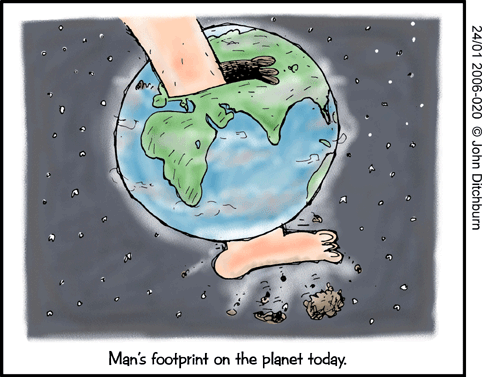
As of now, the Earth is the only naturally habitable planet that we know and have — which drives home the point that we have to contain, and eventually reduce, our ecological footprint. Some, like this cartoonist, fear that it’s already too late…

Read Sep 2007 blog post: Talking Big Foot in Yetiland

2006-020-footprint-on-the-planet.gif

Ecological footprint is a useful – in fact, revealing – measure of our species living beyond its ecological means. But it’s an inherently negative one. This is what promoted our colleagues at CEE – an internationally acknowledged centre for excellence in education for sustainable development – to come up with the related, but wholly more positive, concept of Handprint.

Whereas footprint measures our impact on the planet and its resources, Handprint will help quantify what we do to tread lightly on Earth — reducing our consumption of energy and resources, and being more considerate about the waste we generate.

As CEE says, there are many drivers of change to lessen the footprint. ESD is one of the important ones. Others include technology, policy, legal measures, systems and financial incentives.

Handprint is specifically a measure of ESD action. In the presence of over 1,000 officials, educators, activists and youth, Handprint was launched with the call: Increase your handprint; decrease your footprint!

A new website will soon be online at http://www.handsforchange.org, expanding on this concept.

While CEE is taking the concept to a whole new level and to millions who need to know and heed this message, the idea itself has been talked about by others for sometime.

For example, in May 2006, Alex Steffen wrote about it in the highly informative and inspirational website Worldchanging.

Steffen, who is executive editor of Worldchanging, wrote: “If we can imagine going climate negative, why can’t we imagine shrinking our ecological footprint until we zip past having any negative net ecological impact at all, until the operation of our daily lives heals the planet instead of hurts it? Until we transform, as I’ve said before, our ecological footprints into ecological handprints?”

TVE Asia Pacific‘s Saving the Planet TV series, currently in production, will feature a number of initiatives that will have a positive Handprint on the environment in selected countries in the Asia Pacific.

Clearly, Handprint is an area where interest and action will grow in the coming months and years.

Watch this space.

Related: Sep 2007: Way to blow our nose without blowing the planet

Photo courtesy Sasa Kralj