Why isn’t school very cool? Have we asked our kids yet?

Look what education is doing to me!
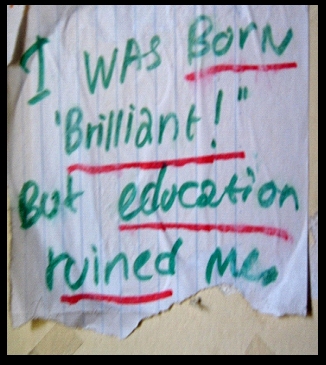
A few days ago, while cleaning the spare room in our home, I came across a piece of paper stuck on to the wall. These words were scribbled on it: “I was born brilliant – but education ruined me!” (see photo).

My daughter Dhara, 14, admitted authorship without any hesitation. It’s not her original line, of course — but a clear reflection of how she feels about schooling and formal education. When we think about it, these few innocent words become a severe indictment of a mass-scale system in which families, societies and countries invest so much money, time and hope.

She’s certainly not alone in her misgivings about the value of institutionalised education. As George Bernard Shaw once declared, “The only time I interrupted my education was in school.”

Although I had a happy school life, I can well appreciate how and why many people feel like this about school. Don’t take my word for it – do a quick, random sampling of those around you. How many of them will admit to having happy memories of their school days?

Let’s face it: the whole concept of a school is flawed. Education may be a great leveller among human beings, but schooling in most parts of the world operates at the lowest common denominator level. How can you group together 30 or 40 children at random, expose them to the same curriculum, imparted at the same pace, and expect all to thrive? Some will keep up; others will lag behind; and a few will be completely bored out of their minds – like I was, for a good part of my primary and secondary schooling.

Yet there is not much that even the most dedicated teacher could do under such trying circumstances. Oddly enough, no one in any self-respecting healthcare system would want to prescribe the same medicine for patients with very different ailments. Yet the one-size-fits-all approach is never questioned when it comes to education. Why?
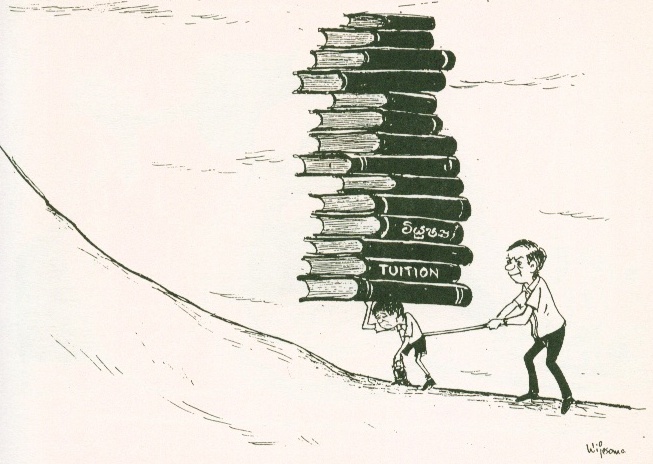
A hapless school kid being primed for the Great Rat Race - cartoon by W R Wijesoma, 1994

One reason why this abuse has thrived is because no one listens to the most important voice in this debate: the average schoolgirl and schoolboy. The learner’s perspective is largely missing in most educational policies and plans. There is so much emphasis on teaching, infrastructure, performance and resources. The handful of men and women who decide what should be taught in our schools hardly ever pause to think how their decisions affect the last link in the chain: the hapless, overburdened, over-driven student. Over 4 million of them — like the one in the cartoon above.

Must things remain like this forever? Is there any hope that our much-tinkered (and much-maligned) education system could one day be more student friendly, more learning oriented and more responsive to the different needs of different students? Will those in charge of the system begin to treat students and teachers as something more than movable statistics? And most importantly, can we restore the joy of learning, the sense of wonder and fun of schooling?

I don’t have easy answers to these – nobody does. But these are worth asking, even if they are uncomfortable and unpopular questions to pose. For too long, the formal education sector has carried on with its business-as-usual with the typical self-righteousness and arrogance of a matronly school principal.

It’s time for us to storm the citadels of learning and make them more caring, accommodating and sensitive to the needs of the most important people in the system: the learners.

Nothing less than our children’s individual and collective futures are at stake.

Note: The views in this blog post are adapted from a longer essay I wrote in 2002, titled Let’s Restore the Joy of Learning.

Related blog post, March 2010: SOS from the Next Generation: “We need Good Parents!”
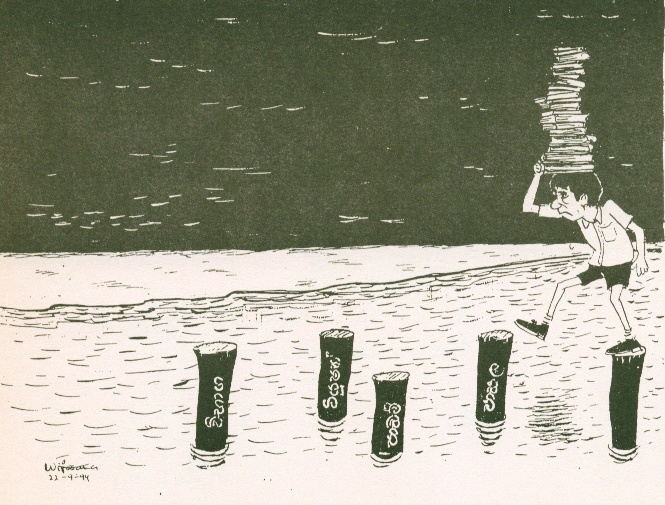
A perilous journey covering school, lessons, tuition classes, exams...Cartoon by W R Wijesoma, 1994

Remembering Saneeya Hussain of Absurdistan, five years on…

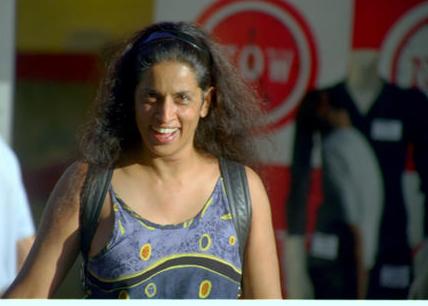
Saneeya Hussain (1954 - 2005)
Exactly five years ago today, journalist and activist Saneeya Hussain left us. Hers was a needless death that left a deep impression in numerous friends she had around the world. We still remember.

We remember Saneeya as a journalist who took a special interest in environment and human rights issues. All her working life, she campaigned tirelessly for a cleaner, safer and more equitable society for everyone, everywhere.

We remember Saneeya as one who supported pluralism – not just in her own country Pakistan, but everywhere. She hated autocrats and military dictators. She spoke out and wrote against unfair domination and agenda setting by a handful of (usually graying) men. She had the courage to suggest re-naming her country as Absurdistan!

We remember Saneeya as a fun-loving, easy-going if slightly absent-minded friend. She wasn’t the most organised person, but was diligent and relentless on causes and issues that she passionately believed in.

Saneeya’s worldwide network of friends have keep her flame alive, and this blog post is as much a tribute to them as it is for Saneeya. Officially, the Saneeya Hussain Trustcontinues her vision and mission.

In fact, the chairperson of the trust (and Saneeya’s mother) Najma Hussain just wrote us a group email, saying: “Let’s share happy memories of Saneeya and celebrate her life.”

She asked: “If you have any anecdotes to share with us please write back. We will love to hear from you.” Saneeya Hussain Trust can be contacted here.

Read my blog post written on Saneeya’s second death anniversary, 20 April 2007, for more of my own memories

Our mutual friend Beena Sarwar has made a 14-minute documentary called Celebrating Saneeya. Here’s the shorter version available on YouTube:

Celebrating Saneeya (August 2005; 14 mins; language: English; Filmed in Karachi, Pakistan, with archives and footage from Brazil, South Africa and Nepal)

Synopsis: Saneeya, with her joyful laugh, lightness of spirit, striking height and long hair, embodied “feminism” and “women’s rights” in the most un-dogmatic way. Living life on her own terms, she countered the trends that militate against women’s individual freedoms in Pakistan. During the repressive years of military dictator General Ziaul Haq she worked as a journalist and was active in the women’s movement that defied the military rule. She also pioneered environmental journalism in Pakistan. Later, while working with the World Commission on Dams in South Africa she met a Brazilian geographer eleven years her junior. Their love story transcended age, culture, religion and nationalities.

In 2004, a severe allergic reaction stopped Saneeya’s breathing and her breathing stopped during a traffic jam in Sao Paulo, preventing her from reaching the hospital in time and sending her into a coma. This documentary is a celebration of her life and all that she stood for, through interviews with her husband, family and friends, and archive material. Sticker on Saneeya’s fridge: “Life is uncertain, eat dessert first”.

Read more about Saneeya Hussain on the trust website

When Avatar (creator) meets Amazon (tribes)…

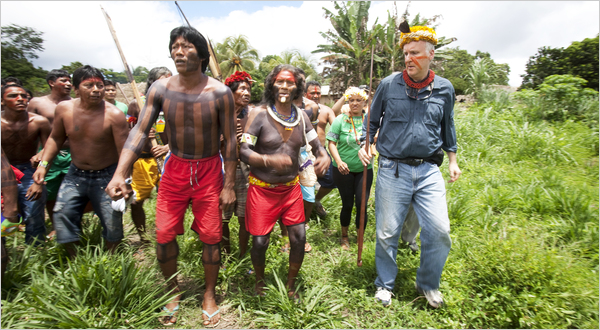
James Cameron in the Amazon - Photo by André Vieira for The New York Times

This encounter was bound to happen: Hollywood movie director James Cameron, creator of the blockbuster movie Avatar, meets a group of indigenous tribes in the Brazilian Amazon.

But this wasn’t part of a movie plot or promotional stunt: Cameron took time off to make his first ever visit to the Amazon because of a real world environmental cause.

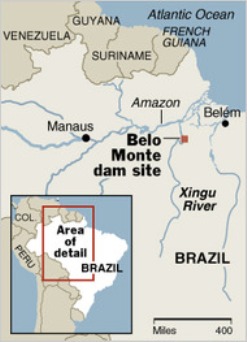
He was visiting Volta Grande Do Xingu last week to discuss the Belo Monte dam being planned by the Brazilian government. According to The New York times: “It would be the third largest in the world, and environmentalists say it would flood hundreds of square miles of the Amazon and dry up a 60-mile stretch of the Xingu River, devastating the indigenous communities that live along it. For years the project was on the shelf, but the government now plans to hold an April 20 auction to award contracts for its construction.”

Map courtesy The New York Times
The dam is a “quintessential example of the type of thing we are showing in ‘Avatar’ — the collision of a technological civilization’s vision for progress at the expense of the natural world and the cultures of the indigenous people that live there,” the newspaper quotes Cameron as saying.

Cameron had derived inspiration from decades long struggles to save the Amazon, but he didn’t know of this specific project until recently. Apparently he first became aware of the issue in February 2010, when he was presented with a letter from advocacy organizations and Native American groups saying they wanted Mr. Cameron to highlight “the real Pandoras in the world”.

Read the full story in The New York Times, 10 April 2010: Tribes of Amazon Find an Ally Out of ‘Avatar’

As I noted in my first comments on Avatar in January 2010: “It looks as if Cameron has made the ultimate DIY allegory movie: he gives us the template into which any one of us can add our favourite injustice or underdog tale — and stir well. Then sit back and enjoy while good triumphs over evil, and the military-industrial complex is beaten by ten-foot-tall, blue-skinned natives brandishing little more than bows and arrows (and with a little help from Ma Nature). If only it works that way in real life…”

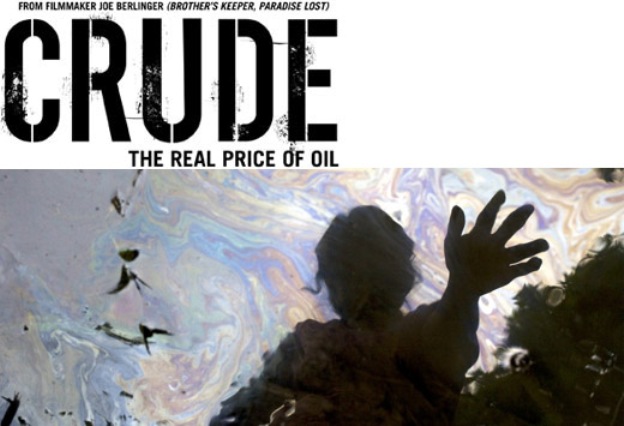
A few days later, I followed up with another post I titled Avatar unfolds in the Amazon – a comparison with an investigative documentary, Crude: The Real Price of Oil, made by Joe Berlinger, which chronicles the epic battle to hold oil giant Chevron (formerly Texaco) accountable for its systematic contamination of the Ecuadorian Amazon – an environmental tragedy that experts call “the Rainforest Chernobyl.”

And now, within weeks, the Avatar-maker and Amazon-savers have joined hands!

Watch this space…

See also October 2009 blog post: Adrian Cowell and ‘The Decade of Destruction’: A film can make a difference!

Waiting for Mandela: Film maker recalls momentous week in Feb 1990

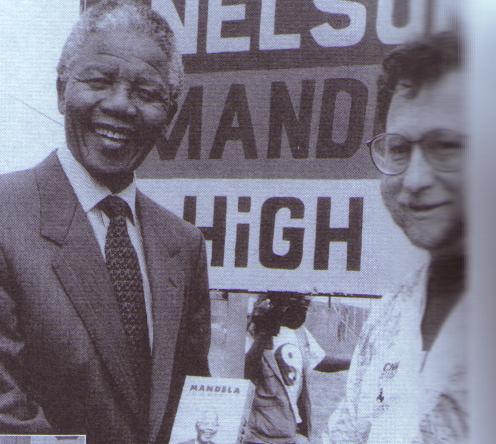
Updated: 6 Dec 2013 Nelson Rolihlahla Mandela (1918 – 2013): Thank You and Goodbye!

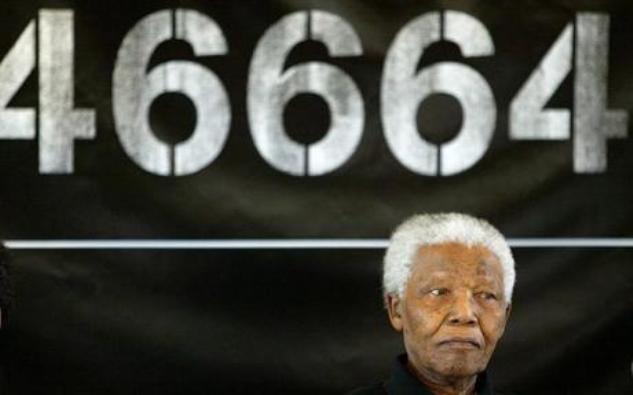
Nelson Mandela at a 2005 charity concert branded after his prison number, 46664.

This week marks the 20th anniversary of Nelson Mandela’s release after 27 years in prison.

Ending his long walk to freedom on 11 February 1990, he gave a speech which ended with these words from the defence statement he’d made during his trial for treason 27 years previously: “I have fought against white domination, and I have fought against black domination. I have cherished the ideal of a democratic and free society in which all persons will live together in harmony with equal opportunities. It is an ideal which I hope to live for, and to see realised. But my Lord, if needs be, it is an ideal for which I am prepared to die.”

My friend and inspiration Danny Schechter wrote an interesting piece recalling the week 20 years ago when his hero (and mine) finally walked free after being the world’s most celebrated political prisoner for over a quarter century.

American journalist and film maker Danny was a long and persistent supporter of the struggle against Apartheid: in all, he has made six films with and about Mandela. Here are his reminiscences in full, borrowed from his News Dissector blog:

WAITING FOR MANDELA, by Danny Schechter

Danny Schechter with Nelson Mandela

Twenty years ago during this very week, I was leading the production team of Globalvision’s inaugural TV series, South Africa Now. We were all consumed by the rumors that best known political prisoner in the world, Nelson Mandela, the leader and symbol of the African National Congress, was about to be released from prison in South Africa after 27 years.

It was exciting and nerve-wracking to contemplate what would come next—but with all the joy and anticipation, there was a fear too, fear that Mandela would be freed into an unfree society with power still in white hands dominated by their pro-apartheid Generals and securocrats. No one was sure what would happen. Would he be going from one jail to another? Would he be assassinated? Would it even happen?

Back then, we were rushing to finish a South Africa Now PBS special slated to air in prime time on Sunday February 11th. PBS correspondent Charlayne Hunter Gault, later to become first NPR’s and then CNN’s bureau chief in South Africa, had agreed to anchor it, and we were busy putting the final touches on the show which we had titled WAITING FOR MANDELA.

It was all rush, rush. We wanted to be timely but we were covering all bases because we weren’t sure if he would be freed or not. On Friday, February 9th, we went into the studio at the old WNET–Channel 13 in New York to record our studio introductions. We finished our graphics. Charlayne prercorded her open. She was great, We were ready to go. All that remained was for the special to be packaged and aired.

But then, late on Friday Night or was it Saturday Morning, we heard that South African President DeKlerk was going to make a special announcement, a key speech to mark the opening of their Parliament. He was considered a liberal Afrikaner and had been part of a process or internal coup that ousted hardline pro-apartheid president. P.W. Botha known there as “the crocodile.”

What would he say? What would he do?

The next day, were glued to our TV sets and saw DeKlerk shock the world. He announced that Mandela would be freed the next day, on Sunday. He was then in Victor Verster prison in South Africa’s wine country north of Capetown. It was happening!

Not only that. DeKlerk announced that the ANC and the South African Communist Party and all other banned organizations would be, after decades, unbanned and allowed to participate in South African politics. This meant that the ANC leaders and their MK guerrilla fighters would be able to come home from so many years in the pain of exile.

The world was upside down. ANC people worldwide had to pinch themselves to see if they really heard what he said.

It was mind-blowing. We screamed. We cried. And then, we panicked. Our TV special was now out of date. The Waiting for Mandela was over. We had a little more that 24 hours to come up with a new TV hour with virtually no budget. We had won a hour of prime time TV. We couldn’t allow it to go to waste.

The world media was rushing to the scene. They had satellites, crews, reporters galore. What could we do that was different? We had been covering the situation there on a weekly basis and had all sorts of footage the networks didn’t. We had contacts and context. But we couldn’t go there because there wasn’t enough time. And besides, we were, in effect, banned there working with South Africans. (The ANC would be unbanned before us!)

We went to work, re-editing, tapping into a South African broadcasting company feed, and setting up the first televised exchange between the ANC and a government that refused to recognize the liberation movement.

We worked around the clock. Two editors collapsed in reworking the material under pressure. We just made air, as TV people say, by minutes. We believe our special was the best on TV.

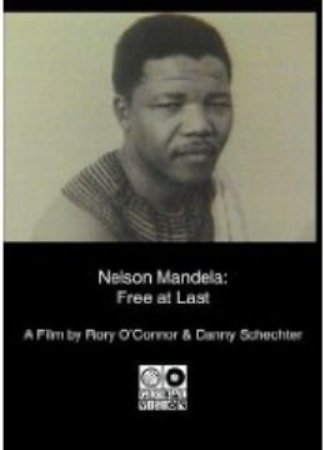
The program was now called MANDELA: Free At Last. And we have tapes for anyone interested!

Read more memories and reflections by Danny Schechter on the News Dissector blog

Huffington Post, June 2008: Danny Schechter’s 90th birthday tribute to Nelson Mandela

‘Avatar’ unfolds in the Amazon: Find out the Real Price of Oil!

This is no Avatar: It's Real!
A few days ago, reviewing the blockbuster movie Avatar, I wrote: “Film critics and social commentators around the world have noticed the many layers of allegory in the film. Interestingly, depending on where you come from, the movie’s underlying ‘message’ can be different: anti-war, pro-environment, anti-Big Oil, anti-mining, pro-indigenous people, and finally, anti-colonial or anti-American. Or All of the Above…”

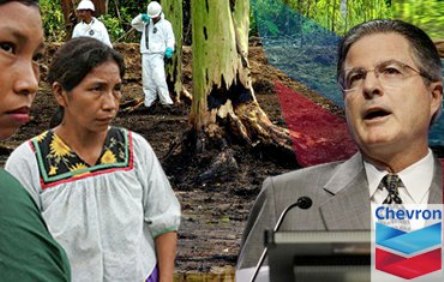
Indeed, an Avatar-like struggle is unfolding in the Amazon forest right now. The online campaigning group Avaaz have called it a ‘Chernobyl in the Amazon’. According to them: “Oil giant Chevron is facing defeat in a lawsuit by the people of the Ecuadorian Amazon, seeking redress for its dumping billions of gallons of poisonous waste in the rainforest.”

From 1964 to 1990, Avaaz claims, Chevron-owned Texaco deliberately dumped billions of gallons of toxic waste from their oil fields in Ecuador’s Amazon — then pulled out without properly cleaning up the pollution they caused.

In their call to action, they go on to say: “But the oil multinational has launched a last-ditch, dirty lobbying effort to derail the people’s case for holding polluters to account. Chevron’s new chief executive John Watson knows his brand is under fire – let’s turn up the global heat.”

Avaaz have an online petition urging Chevron to clean up their toxic legacy, which is to be delivered directly to the company´s headquarters, their shareholders and the US media. I have just signed it.

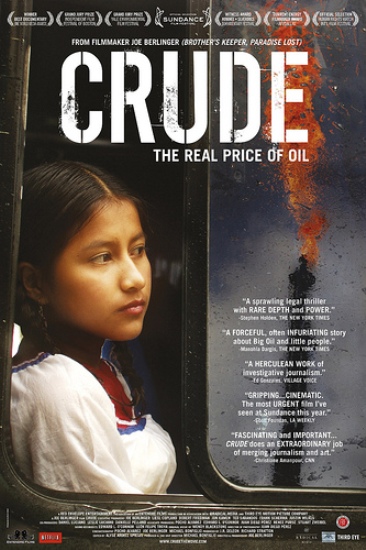
Others have been highlighting this real life struggle for many months. Chief among them is the documentary CRUDE: The Real Price of Oil, made by Joe Berlinger.

The award-winning film, which had its World Premiere at the 2009 Sundance Film Festival, chronicles the epic battle to hold oil giant Chevron (formerly Texaco) accountable for its systematic contamination of the Ecuadorian Amazon – an environmental tragedy that experts call “the Rainforest Chernobyl.”

Here’s the official blurb: Three years in the making, this cinéma-vérité feature from acclaimed filmmaker Joe Berlinger is the epic story of one of the largest and most controversial legal cases on the planet. An inside look at the infamous $27 billion Amazon Chernobyl case, CRUDE is a real-life high stakes legal drama set against a backdrop of the environmental movement, global politics, celebrity activism, human rights advocacy, the media, multinational corporate power, and rapidly-disappearing indigenous cultures. Presenting a complex situation from multiple viewpoints, the film subverts the conventions of advocacy filmmaking as it examines a complicated situation from all angles while bringing an important story of environmental peril and human suffering into focus.

Watch the official trailer of Crude: The Real Price of Oil

According to Amazon Watch website: “With key support from Amazon Watch and our Clean Up Ecuador campaign, people are coming together to promote (and see) this incredible film, and then provide ways for viewers to support the struggle highlighted so powerfully by the film.”

They go on to say: “A victory for the Ecuadorian plaintiffs in the lawsuit will send shock waves through corporate boardrooms around the world, invigorating communities fighting against injustice by oil companies. The success of our campaign can change how the oil industry operates by sending a clear signal that they will be held financially liable for their abuses.”

While Avatar‘s story unfolds in imaginary planet Pandora — conjured up by James Cameron’s imagination and created, to a large part, with astonishing special effects, the story of Crude is every bit real and right here on Earth. If one tenth of those who go to see Avatar end up also watching Crude, that should build up much awareness on the equally brutal and reckless conduct of Big Oil companies.

Civilisation's ultimate addiction?

Others have been making the same point. One of them is Erik Assadourian, a Senior Researcher at Worldwatch Institute, whom I met at the Greenaccord Forum in Viterbo, Italy, in November 2009.

He recently blogged: “The Ecuadorians aren’t 10-feet tall or blue, and cannot literally connect with the spirit of the Earth (Pachamama as Ecuadorians call this or Eywa as the Na’vi call the spirit that stems from their planet’s life) but they are as utterly dependent—both culturally and physically—on the forest ecosystem in which they live and are just as exploited by those that see the forest as only being valuable as a container for the resources stored beneath it.”

Erik continues: “Both movies were fantastic reminders of human short-sightedness, one as an epic myth in which one of the invading warriors awakens to his power, becomes champion of the exploited tribe and saves the planet from the oppressors; the other as a less exciting but highly detailed chronicle of the reality of modern battles—organizers, lawyers, and celebrities today have become the warriors, shamans, and chieftains of earlier times.”

Wanted: ‘Magic Mirrors’ for a Land of the Blind…

Last chance...?
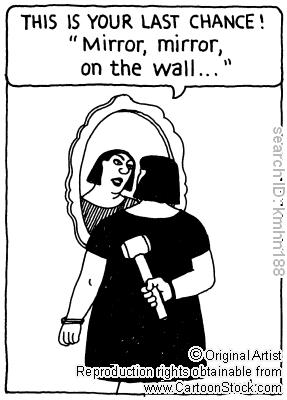
Here’s a winning idea for a new business venture in these lean times: make an always-agreeable ‘magic’ mirror — and the vane and wicked will beat a path to your door.

Well, at least half the politicians in Sri Lanka would. They’d rather not see their true selves on any mirror.

The magic mirror idea was popularised many years ago by Snow White and the Seven Dwarfs, whose wicked and vain queen had an unusual mirror that talked back, each time she asked: ‘Mirror, mirror, on the wall. Who’s the fairest of them all?’.

The queen wasn’t looking for honest answers; she just wanted to hear she was always the prettiest and fairest in the land. (All competition – real and imagined – was dealt with brutally.)

Little has changed, even in this 21st Century. We may not have too many monarchs left in the world, but our uncrowned rulers can be equally vain and ruthless. They are obsessed with self-aggrandizing sycophancy – they’d only tolerate magic mirrors that totally boost their egos.

If I seem to be preoccupied with mirrors, that’s nothing to do with my own vanity. In this digital age, the mirror is still a pretty good metaphor for the media industry that I have been part of, in one way or another, for over 20 years. At its very basic, the media are expected to reflect our society and our times.

But some people don’t like what they see on a true mirror. In 2009, we saw a spate of mirror smashing or media bashing in Sri Lanka. It started on 6 January, when the studio of the Maharaja Television/Broadcasting Network (MTV/MBC, popularly known as Sirasa Group) was attacked by armed gunmen who almost blew up the country’s most popular private broadcast organisation. On 8 January, exactly a year ago today, Lasantha Wickrematunga, editor of The Sunday Leader, was shot dead by two men on a motorcycle as he drove to work in suburban Colombo.

Sirasa & Lasantha: Refused to be magic mirrors
One year later, both crimes remain unsolved. They have joined a long list of crimes against journalists and media organisations in Sri Lanka, most of which have never led to any prosecution of the perpetrators.

As Reporters Without Borders noted in a statement this week: “The emotion and anger have not gone away in the year since this famous Sri Lankan journalist’s death. The anger is being sustained by the government’s flagrant obstruction of the investigation. Lasantha Wickrematunge’s name and memory will not disappear and, in that sense, those who were behind his murder made a mistake.”

Commenting on the MTV/MBC (Sirasa) attack, I described the typical reaction of the mirror-bashers: “…if you don’t like what you see in the mirror – which is what media is to society – just kick it, shatter it and hammer it into dust so that it won’t reflect anymore. Destroy all the mirrors of the land, and we’ll finally be the fairest and prettiest in the whole world. That seems to be the perverse logic that fuels attacks of this nature.”

Rex de Silva, the first editor that Lasantha worked for in the late 1970s cautioned that Lasantha’s murder was the beginning of ‘the sound of silence’ for the press in Sri Lanka. As I asked on the day of Lasantha’s emotionally-charged funeral: “Can this sound of silence be shattered by the silent, unarmed majority of liberal, peace-loving Lankans who were represented at the funeral service and the Colombo cemetery today?”

Owing to these and other threats, pressures and intimidation during the year, Sri Lanka was ranked 162nd out of 175 countries in the 2009 Reporters Without Borders press freedom index. This was the worst ranking of any democratic country. See RSF website section on Sri Lanka.

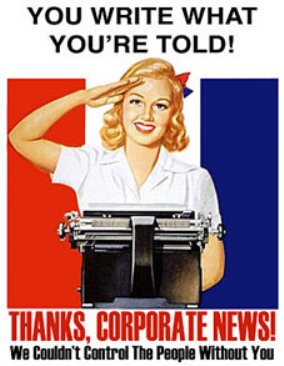
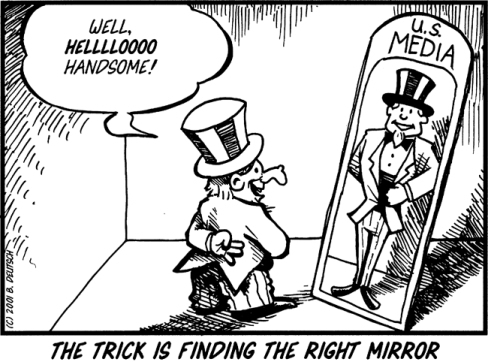
Back to mirrors. While the true mirrors were getting bashed, those who played being ‘magic mirrors’ have done well for themselves (and are probably laughing all the way to their banks). But that’s not a phenomenon confined to the little island of Sri Lanka. A good part of the US Media did the same under the hawkish Bush Administration, which prompted the cartoon below.

It’s not just ‘Dubya’ who is addicted to such agreeable mirrors. Indeed, for many modern-day rulers, an essential trapping of power involves surrounding themselves with spin doctors, press commissioners and other manipulators or manufacturers of image. In mature democracies, there are certain checks and balances which usually guard against the worst excesses (but there are notable exceptions – look at Italy!).

In immature, fragile or pseudo democracies, mirrors obey the laws of physics (optics) at grave risk to themselves. If you want proof, just talk to the staff of Sirasa or The Sunday Leader in Sri Lanka…

Groundviews.org: One year later: A murder unresolved, a government unashamed

Nov 2009 blog post: We need more reflective mirrors in the media!

‘Small Islands – Big Impact’ film making waves in the world’s Biggest Polluter…

Dilrukshi Handunnetti
Dilrukshi Handunnetti: Making waves
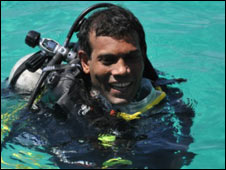
My good friend Dilrukshi Handunnetti, a leading investigative journalist in Sri Lanka, is currently on a Jefferson Fellowship traveling in the United States. She is one of a dozen journalists from the Asia Pacific who have been competitively chosen to participate in this prestigious programme, which in 2009 is focusing on the theme, The Right Climate for Confronting Climate Change?

I finished my latest climate film, Small Islands – Big Impact, only the day before Dilrukshi left for Hawaii, her first stop in the multi-destination, intensive programme. Given her long standing coverage of the Maldivian political affairs as well as Asian/global environmental issues, I gave her a DVD of the film to take along.

I’m delighted to hear that she has been showing Small Islands – Big Impact in various presentations, often producing a…big impact wherever it was shared. It’s always good to have such feedback — here’s an excerpt from an email she has just sent me from Boulder, Colorado:

“I liked presenting your short film and the response it generated. The film generated a discussion on promoting the concept of (climate) adaptation as a human right – just as I felt it would be such a catch phrase here. I also had the (media coverage of) the underwater Cabinet meeting with me. So Maldives got a lot of attention despite not having a Maldivian here.

“Several wanted to know about the actual risk level of the Maldives and the possibility of the islands being submerged. They also asked about purchasing land elsewhere and whether the Maldives had the financial capability to do that. Others wanted to know about depleting fish catch President Nasheed spoke about as this was a common concern to Indonesia, Southern India and Vietnam.

President Nasheed
President Nasheed: Stop pointing fingers, extend a helping hand...
“Some queried whether President Nasheed was going to Copenhagen to state his case. Two others asked whether lobby groups were behind his thinking. Several found, including American, Chinese and Indian participants, that President Nasheed’s call to end the blame game should be heeded by all. There was collective agreement that others’ behaviour impacted on the likes of President Nasheed and vulnerable communities.

“Interestingly, everyone found his interview a STORY. Something that they would want to report on in their respective media. We continue to discuss the same on our tours and walkathons from venue to venue for various meetings. In fact, I had the American participant asking our resource persons (IPCC types, no less!) whether they were willing to acknowledge the concept of climate refugees directly in relation to the Maldives.

“I think the movie served a great purpose of awakening the minds of many to the threat level faced by some communities on low lying coastal nations – like the pacific Islands and the Maldives. A senior broadcaster from the Tonga Broadcasting Corporation personally thanked me for wanting to highlight their plight as a small island nation.”

You can watch Small Islands – Big Impact online here:

Read the full text of my interview with President Nasheed on TVEAP website

As with all TVEAP films, this one too is available free of license fees and copyright restrictions to broadcast, civil society and educational users anywhere in the world. It’s now a year since I wrote a widely reproduced op ed essay on Planet before profit for climate change films — I practise what I preach!

A journalist for over 17 years, Dilrukshi Handunnetti has extensively covered politics, the environment, culture, and history and gender issues. In her current role, she writes the parliamentary column for the newspaper in addition to writing and editing investigative stories carried in her publication. Dilrukshi has also covered the ethnic conflict from a non-military perspective and written extensively on issues of good governance, graft and corruption. Dilrukshi is the recipient of many national journalism awards in Sri Lanka, including: the Young Reporter of the Year 2001, Best Environment Reporter of the year 2002, Best Environment Reporter of the year 2003, Best English Journalist of the Year 2004 (Merit) Award and D B Dhanapala Award for the Best English Journalist of the Year 2005, all presented by the Editors’ Guild of Sri Lanka.

In this extract from our 2005 film Deep Divide, Dilrukshi talks about Sri Lanka’s coastal resource development challenges before and after the 2004 Asian Tsunami:

Tiananmen + 20: Tribute to Tank Man, or the Unknown Rebel

One man vs. the mighty Red Army
One man vs. the mighty Red Army - photo by Jeff Widener for Associated Press

This is of the most famous photos of modern times. The official caption, given by Associated Press, reads: “An anti-government protester stands in front of artillery tanks in Beijing’s Tiananmen Square on June 5, 1989, at the height of the pro-democracy protests.”

It’s a moment deeply etched in the consciousness of our media-saturated world. The solitary, unarmed man was standing up against not just a brute of a tank, but the might of the entire Chinese Red Army, which had just cracked down ruthlessly on pro-democracy student protests.

It was on the morning of June 5 that the Tank Man appeared from nowhere. A line of 18 tanks were pulling out of Tiananmen Square and driving east along the Avenue of Eternal Peace. The previous day, the square had been cleared of students and much blood had been spilled. The streets were now empty except for soldiers.

Suddenly a man in a white shirt and black trousers, with a shopping bag in each hand, steps out on to the road and stands waiting as the tanks approach. The lead vehicle halts, assessing its options.

It moves right to go around him. The man waves the shopping bag in his right hand then dances a few steps to the left to block the tank again. The tank swerves back left to avoid him. The man waves the bag again and stepps to the right. Then both stop. The tank even turned off its engine.

Then more things happened.
Watch a video montage of this breathtaking standoff, captured by western journalists filming from a safe distance:

Watch first few minutes of the 2006 PBS documentary on the Tank Man incident and aftermath:

Twenty years on, the identify of the Tank Man remains a mystery. There are conflicting reports on who he was, and what happened to him after that single, defining act of defiance. Practically all we know is that he wasn’t run down by the tanks, and was instead arrested a few minutes later by the Chinese authorities. Naturally, there are few official comments on the incident or the Tank Man.

But during those few minutes, when individual soldiers hesitated and refrained from running him over, the Unknown Rebel secured his worldwide fame. He probably wasn’t doing it for any notion of posterity – in all likelihood, he was horrified bystander who’d seen the carnage in the preceding days and felt, as we do from time to time, that enough was enough.

And unlike most of us, he decided to risk his life to register his protest. In April 1998, Time magazine included the “Unknown Rebel” in its feature entitled Time 100: The Most Important People of the Century.

Charlie Cole, a Newsweek photographer who captured the moment, says: “Personally I think the government most likely executed him. It would have been in the government’s interest to produce him to silence the outcry from most of the world. But, they never could. People were executed at that time for far less than what he did.”

He adds: “I think his action captured people’s hearts everywhere, and when the moment came his character defined the moment rather than the moment defining him. He made the image, I just took the picture. I felt honoured to be there.” Read the full account by Charlie Cole

Read the recollections of the four photojournalists who captured this historic moment

A ground level view of Tank Man preparing for his showdown with tanks - photo by Terril Jones In early June 2009, a fifth photographer shared his own image of the incident – disclosing photos that had never before been circulated. Associated Press reporter Terril Jones revealed a photo he took showing the Tank Man from ground level, a different angle than all of the other known photos. (Tank Man is the second from left, in the background.) Jones initially didn’t realise what he had captured until a month later when printing his photos from that momentous week.

As we celebrate the memory of the Tank Man – and his defiance of brutal, oppressive use of state power to crush dissent – we must also salute the courage and resourcefulness of photojournalists and TV reporters who risked their own lives to capture this moment for posterity. Tank Man became iconic only because his act was frozen in time by those bearing witness. All too often, states – from Burma to Zimbabwe, and others in between – ensure that there is no one to bear such witness when they unleash the full force of police, armies and weapons on their own people.

There can be no doubt that Tank Man was not the first of his kind, nor would he be the last. Other ordinary men and women have found uncommon courage to stand up against injustice and state brutality wielded in the name of national security, law and order or anti-terrorist crackdown. But in the absence of witnesses – whether professional journalists or citizen journalists – the rest of the world will never know.

Missing Mothers: How acronyms and jargon can kill innocent women

iwd_5“This year alone, more than 500,000 women will die during pregnancy or childbirth. That’s one woman missing every minute of every day. We call these women ‘missing’ because their deaths could have been avoided. In fact, 80 per cent of maternal deaths could be averted if women had access to essential maternal health services.

“We know where and how these women are dying, and we have the resources to prevent these deaths. Yet, maternal mortality is still one of the most neglected problems internationally.”

This sobering message from Unicef is worth reflecting upon as we mark another International Women’s Day.

Unfortunately, critical issues like these often don’t make the news – or worse, are relegated to the background as inevitable. As Joseph Stalin said in a different context, one death is a tragedy; a million deaths a mere statistic.

The challenge to the development community is to go beyond simply counting deaths in cold, clinical terms. UNICEF has recently released a two minute video, “Missing Mothers” as a tool for international development professionals to use in raising awareness of the issue of mothers dying needlessly.

Having a baby is both a very natural process and a joyous occasion for the parents and extended family concerned. Yet having a baby still remains one of the biggest health risks for millions of women worldwide.

Time to make missing women count...
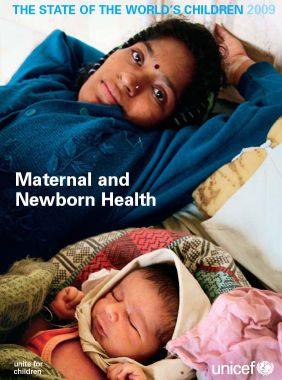
As Unicef’s 2009 State of the World’s Children report reminded us recently, 1,500 women die every day in the world due to complications arising during pregnancy and childbirth. The chances of a woman in developing countries dying before or during childbirth are 300 times greater than for a woman in an industrialised country like the United States. Such a gap does not exist in any other social indicator.

The largest number of maternal deaths in the world is in South Asia. In India alone, an estimated 141,000 women die each year during pregnancy or childbirth. Recently, my Indian journalist friend Kalpana Sharma wrote a perceptive column on this topic in The Hindu newspaper.

She noted: “The solution has been known for years. The problem is the will to make it work. We also know that the solution would benefit everyone, not just women. Yet, affordable and accessible health care, for instance, has not received the thrust that is needed.”

The Missing Women video suggests to activists and campaigners that action can start with five steps: 1. Educate girls, young women and yourself; 2. Respect their rights; 3. Empower them to participate; 4. Invest in maternal health; 5. Protect against violence and abuse. The Unicef website, meanwhile, lists 10 ways in which concerned individuals can make a difference.

All very commendable and necessary — but not sufficient. With all the good intentions in the world, Unicef’s experts and officials come across as, well, detached and geeky. They don’t connect well enough to the real world people whose needs and interests they are genuinely trying to serve. Their messages are lost somewhere in their precise terms, jargon and endless acronyms.

Just take, for example, the very phrase of maternal mortality itself. Precise but also very stiff and dry. Who outside the medical and development circles uses such terms in conversation? When I write or make films about the issue, I prefer to call it ‘mothers dying needlessly while having babies’. Yes, it’s more wordy and perhaps less exacting. But most ordinary people would get what I’m talking about.

If the jargon-ridden language reads dry in text, it completely puts off people when they watch such words being spoken on video. Such films may pander to the Narcissism of Unicef mandarins, but they completely flop in terms of public communication and engagement.

This is the same point I made in October 2008 when commenting on the Unicef-inspired first Global Handwashing Day: “Passion used to be the hallmark of UNICEF during the time of its legendary executive director James Grant, who strongly believed in communicating messages of child survival and well-being. He gave UNICEF a head start in working with the media, especially television.”

Jim Grant’s deputy, journalist Tarzie Vittachi, who came over to the UN children’s agency after a stint at the UN population fund, used to say: “Governments don’t have babies; people do”. We might extend that to: inter-governmental agencies don’t have babies; real women do. That may be why Unicef insists on delivering its life-saving messages so riddled in politically and scientifically correct, but so sterile language.

Unicef’s YouTube channel has a number of short videos related to what they insist on calling maternal mortality. Here’s an example where Unicef’s Chief of Health Dr. Peter Salama says it’s really an unconscionable number of deaths, and a human tragedy on a massive scale:


MDG5: Save Our Moms!
Reducing by three quarters the number of mothers dying needlessly while having babies is one of the Millennium Development Goals or MDGs, the holy grail in international development since the United Nations adopted these in 2000, setting 2015 as the target date.

We have now passed the half way mark, but progress has been patchy and unimpressive. And it will remain so as long as the UN agencies and other development players insist on peddling jargon and acronyms. Considering the issues of life and death involved here, we must view bad communication as a killer — joining the ranks of unsafe drinking water and violence against women and girls.

Writing an editorial for SciDev.Net in September 2005, I noted: “All development workers and UN officials should take a simple test: explain to the least technical person in your office the core message and relevance of your work. Many jargon-using, data-wielding, acronym-loving development workers would probably fail this test. But unless development-speak is translated into simpler language, the MDGs will remain a buzzword confined to development experts and activists.”

I don’t believe in ghosts, but it’s time to bring back the spirits of Jim Grant and Tarzie Vittachi to Unicef to again humanise the agency so mired in its own ‘geekspeak’. The intellectual rigours of evidence-based, scientific analysis must be balanced with clarity and accessibility. It’s fine to be informed by science, but learn to say it simply, clearly and concisely.

The lives of half a million women and millions of children depend on it.

“It’s an immensely exciting time for people working with video!” – Sam Gregory

Sam Gregory
Sam Gregory
“It’s an immensely exciting time for people working with video. More and more people creating and using video, more places to share it, more ways to place it in front of people who can make a difference.

“It raises challenges too: saturation of images and compassion-fatigue, finding your place to be heard, and the safety and security and consent issues that arise when many more people are filming each other.

“But overall I think we’re seeing a really powerful moment for individual expression but also collective accountability being supported via image-making.”

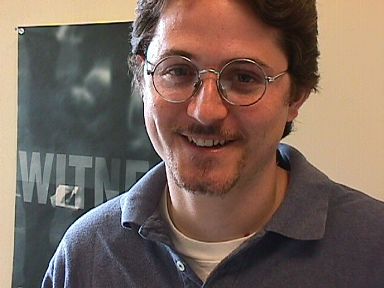
So says Sam Gregory programme director of Witness, a human rights organisation which uses video and online technologies to open the eyes of the world to human rights violations. The New York-anchored organisation works around the world to ’empower people to transform personal stories of abuse into powerful tools for justice, promoting public engagement and policy change’.

Sam is a video producer, trainer and human rights advocate who knows and taps into the power of moving images to move people. He was speaking with Indian journalist and cyber activist Frederick Noronha in an interview just published at the Info Activism website.

www.witness.org
http://www.witness.org
Sam recalls how he was once making films and also involved in activism, and ‘frustrated at how the two didn’t fit together’.

He adds: “In the traditional TV documentary world, the advocacy purpose of film was under-utilized. The fact that you got 500,000 viewers for a TV broadcast told you nothing about whether that turned into action. So I started looking for ways to really make the video fit as a tool for real advocacy and change-making, and came upon WITNESS.”

Read full interview on InfoActivism website

We at TVE Asia Pacific worked closely with Sam in 2002-2004, when we implemented a collaborative Asian regional project called Truth Talking where Witness was a partner. It was through Witness that I met courageous info activists like Joey R B Lozano.