Drawing from my recent interactions with the IGF Academy, as well as several academic and civil society groups, I position the current public debates on web’s socio-cultural impacts in the context of freedom of expression.
With 30 per cent of our population now using the Internet, it is no longer a peripheral pursuit. Neither is it limited to cities or rich people. So we urgently need more accurate insights into how society and economy are being transformed by these modern tools.
My basic premise: many well-meaning persons who urge for greater regulation of the web and social media overlook that governments in Sri Lanka have a terrible track record in stifling dissent in the name of safeguarding the public.
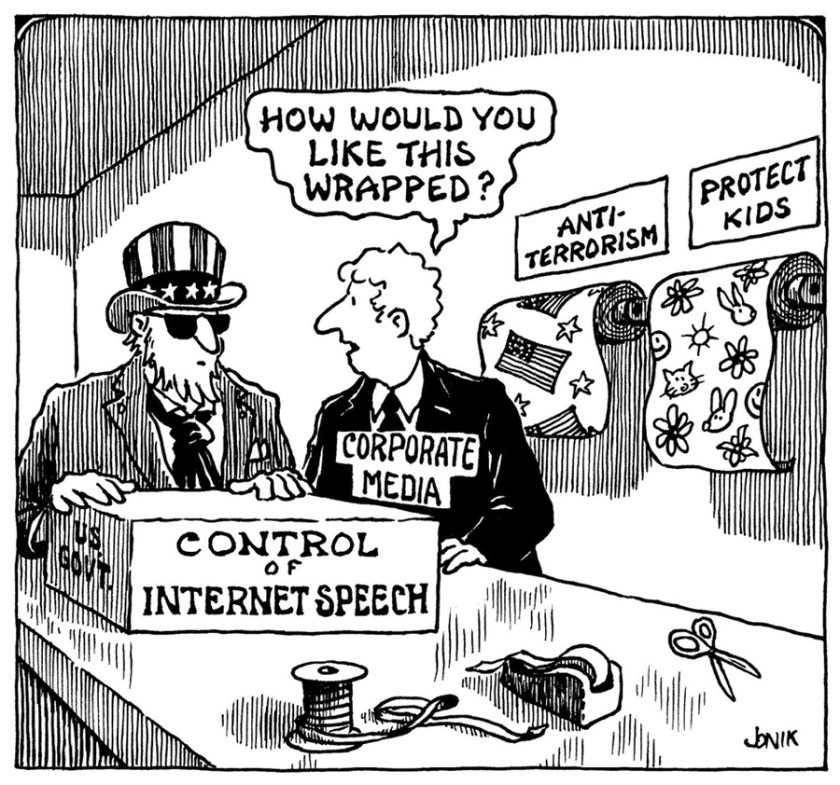
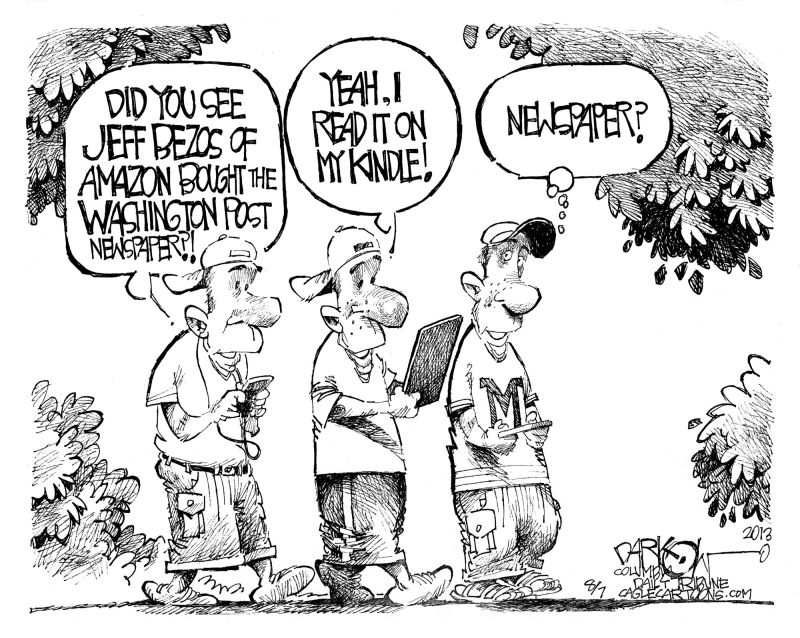
Cartoon by John Jonik
I argue: “As a democracy recovering from a decade of authoritarianism, we need to be especially careful how public sentiments based on fear or populism can push policymakers to restrict freedom of expression online. The web has become the last frontier for free speech when it is under pressure elsewhere.
“When our politicians look up to academics and researchers for policy guidance, the advice they often get is control or block these new media. Instead, what we need is more study, deeper reflection and – after that, if really required – some light-touch regulation.”
I acknowledge that there indeed are problems arising from these new technologies – some predictable, and others not. They include cyber-bullying, hate speech, identity theft through account hijacking, trolling (deliberately offensive or provocative online postings) and sexting (sending and receiving sexually explicit messages, primarily via mobile phones).
I cite some research findings from the work done by non-profit groups or media activists. These findings are not pretty, and some of them outright damning. But bans, blocks and penalties alone cannot deal with these or other abuses, I argue.
I end with these words: “We can and must shape the new cyber frontier to be safer and more inclusive. But a safer web experience would lose its meaning if the heavy hand of government or social orthodoxy tries to make it a sanitized, lame or sycophantic environment at the same time. We sure don’t need a cyber nanny state.”
This column originally appeared in Echelon business magazine, March 2014 issue. It is being republished here (without change) as part of a process to archive all my recent writing in one place – on this blog.
Image courtesy Echelon magazine
Balancing Broadband and Narrow Minds
By Nalaka Gunawardene
Are we cyber-stunted?
I posed this question some weeks ago at Sri Lanka Innovation Summit 2013 organised by Echelon and News 1st. We were talking about how to harness the web’s potential for spurring innovation.
We cannot innovate much as a society when our broadband is stymied by narrow minds. How many among the (at least) 3.5 million Lankans who regularly access the web have the right mindset for making the best use of the medium, I asked.
We didn’t get to discuss it much there, but this bothers me. Sri Lanka has now had 19 years of commercial Internet connectivity (the first ISP, Lanka Internet Services, started in April 1995). That’s a long time online: we have gone past toddler years and childhood (remember dial-up, anyone?) and been through turbulent ‘teen years’ as well.
Technology and regulation have moved on, imperfect though the latter maybe. But psychologically, as a nation we have yet to find our comfort level with the not-so-new medium.
There are various indicators for this. Consider, for example, the widespread societal apprehensions about social media, frequent web-bashing by editorialists in the mainstream media, and the apparent lack of public trust in e-commerce services. These and other trends are worth further study by social scientists and anthropologists.
Another barometer of cyber maturity is how we engage each other online, i.e. the tone of comments and interactions. This phenomenon is increasingly common on news and commentary websites; it forms the very basis of social media.
Agree to disagree?
‘Facts are sacred, comment is free’ is a cherished tenet in journalism and public debates. But expressing unfashionable opinions or questioning the status quo in Lankan cyber discussions can attract unpleasant reactions. Agreeing to disagree rarely seems an option.
Over the years, I have had my share of online engagement – some rewarding, others neutral and a few decidedly depressing. These have come mostly at the multi-author opinion platforms where I contribute, but sometimes also through my own blogs and twitterfeed.
One trend seems clear. In many discussions, the ‘singer’ is probed more than the ‘song’. I have been called unkind names, my credentials and patriotism questioned, my publishers’ bona fides doubted, and my (usually moderate) positions attributed to personality disorders or genetic defects! There have been a few threats too (“You just wait – we’ll deal with traitors soon!”).
I know those who comment on mainstream political issues receive far more invective. Most of this is done under the cover of anonymity or pseudonymity. These useful web facilities – which protect those criticising the state or other powerful interests – are widely abused in Lankan cyberspace to malign individuals expressing uncommon views.
There are some practical reasons, too, why our readers may misunderstand what we write, or take offence needlessly.
Poor English comprehension must account for a good share of web arguments. Many fail to grasp (or appreciate) subtlety, intentional rhetoric and certain metaphors. Increasingly, readers react to a few key words or phrases in longer piece — without absorbing its totality.
A recent example is my reflective essay ‘Who Really Killed Mel Gunasekera?’. I wrote it in early February shortly after a highly respected journalist friend was murdered in her suburban home by a burglar.
I argued that we were all responsible, collectively, for this and other rising incidents of violence. I saw it as the residual product of Lankan society’s brutalisation during war years, made worse by economic marginalisation. Rather than barricading ourselves and living in constant fear, we should tackle the root causes of this decay, I urged.
The plea resonated well beyond Mel’s many friends and admirers. But some readers were more than miffed. They (wrongly) reduced my 1,100 words to a mere comparison of crime statistics among nations.
I aim to write clearly, and also probe beyond headlines and statistics. But is such nuance a lost art when many online readers merely scan or speed-read what we labour on? In today’s fast-tracked world, can reflective writing draw discerning readers and thoughtful engagement any longer? I wonder.
Too serious
Then there is the humour factor – or the lack of it. Many among us don’t get textual satire, as Groundviews.org discovered with its sub-brand called Banyan News Reporters (BNR). Their mock news items and spoofs were frequently taken literally – and roundly condemned.
The web is a noisy place, but some stand out in that cacophony because of their one-tracked minds. They are those who perceive and react to everything through a pet topic or peeve. That ‘lens’ may be girls vs boys, or lions vs tigers, or capitalism vs socialism or something else. No matter what the topic, such people will always sing same old tune!
Tribal divisions are among the most entrenched positions, and questioning matters of faith assures a backlash. It seems impossible to discuss secularism in Sri Lanka without seemingly offending all competing brands of salvation! (The last time I tried, they were bickering among themselves long after I quietly left the platform…)
Oh sure, everybody is entitled to a bee or two in her bonnet. But what to do with those harbouring an entire bee colony — which they unleash at the slightest provocation?
I just let them be (well, most of the time). I used to get affected by online abuse from cloaked detractors but have learnt to take it with equanimity. This is what economist and public intellectual W A Wijewardena also recommends.
“You must treat commentators as your own teachers; some make even the most stupid comment in the eyes of an intelligent person, but that comment teaches us more than anything else,” he wrote in a recent Facebook discussion.
He added: “Individual wisdom and opinions are varied and one cannot expect the same type of intervention by all. I always respect even the most damaging comment made by some on what I have written!”
Moderating extreme comments is a thankless and challenging job for those operating opinion platforms. If they are too strict or cautious, they risk diluting worthwhile public debates for which space is shrinking in the mainstream media. At the same time, hate speech peddlers cannot be allowed free license in the name of free speech.
Where to draw the line? Each publisher must evolve own guidelines.
Groundviews.org, whose vision is to “enable civil, progressive and inclusive discussions on democracy, rights, governance and peace in Sri Lanka” encourages “a collegial, non-insulting tone” in all contributors. It also reminds readers that “comments containing hate speech, obscenity and personal attacks will not be approved.”
Colombo Telegraph, another popular opinion and reporting website, “offers a right to reply for any individual or organisation who feels they have been misreported”. Sadly, this courtesy is not available in many online news and commentary websites carrying Lankan content.
In the end, even the most discerning publishers and editors can do only so much. As more Lankans get online and cyber chatter increases, we have to evolve more tolerant and pluralistic ways of engagement.
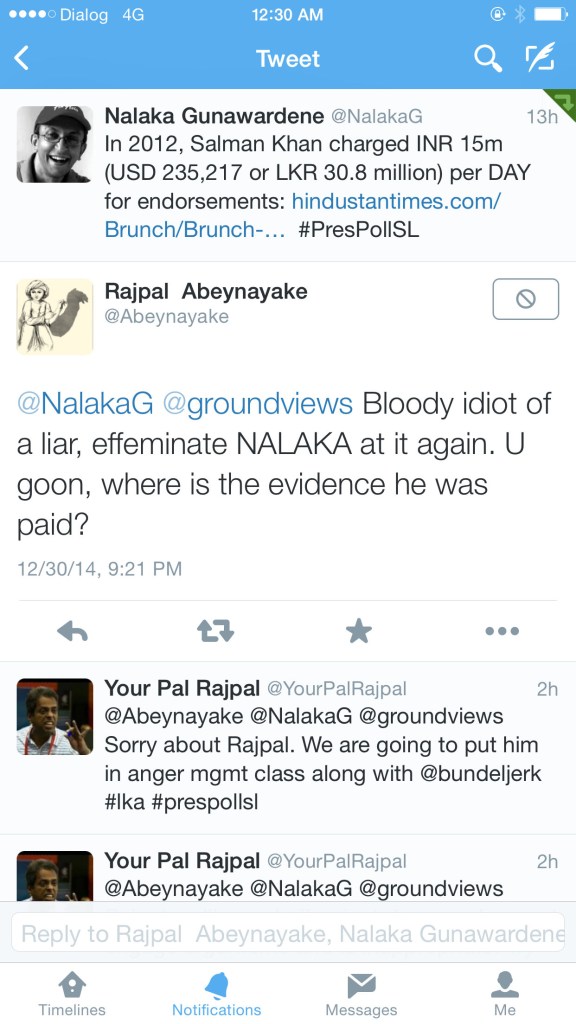
An example of cyber intolerance and name-calling from December 2014, during the campaign for Sri Lanka’s Presidential Election (when Bollywood’s Salman Khan was brought to Sri Lanka to promote then incumbent Mahinda Rajapalksa’s election campaign)
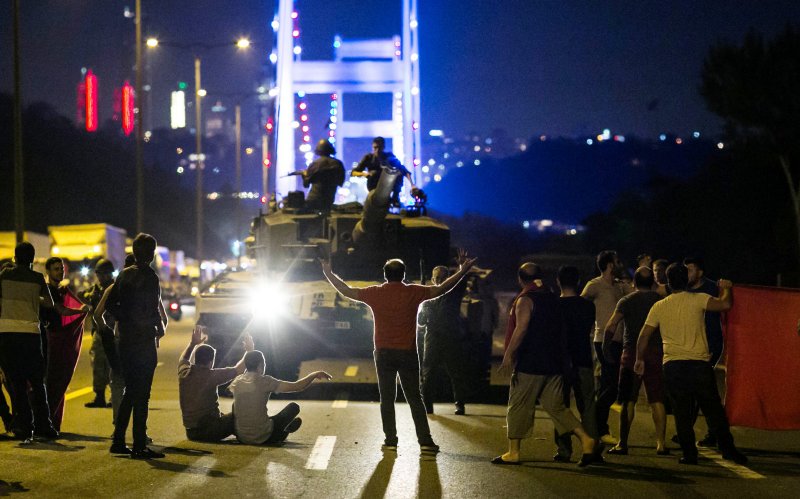
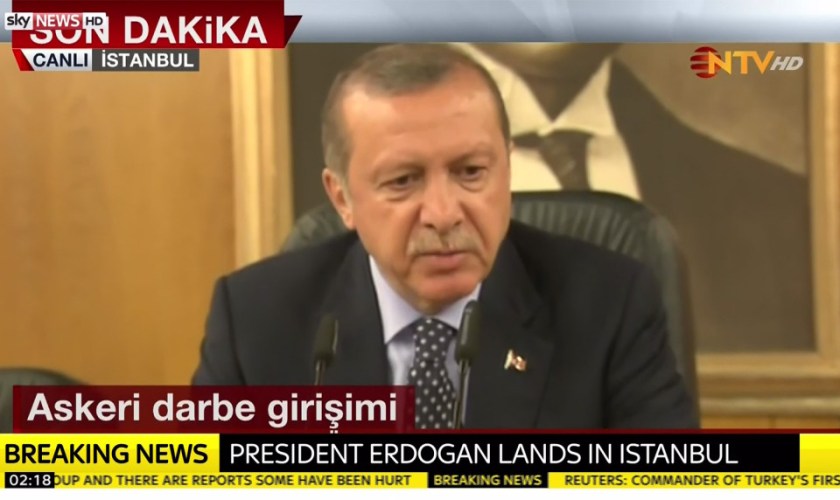
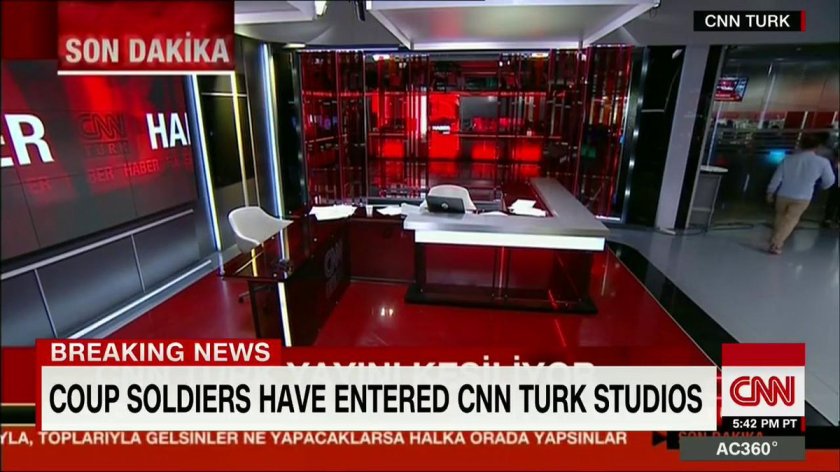
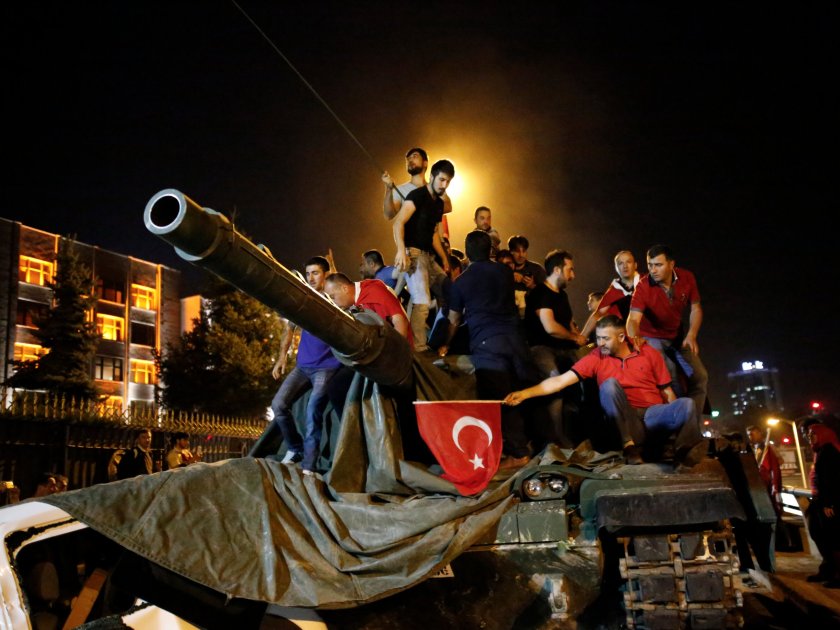
Citizen resistance to Turkey coup on 16 July 2016 – wire service photos
As Zeynep Tufekci, an assistant professor at the University of North Carolina School of Information and Library Science, described in a New York Times op-ed on 20 July 2016: “In the confusing hours after the coup attempt began, the country had heard from President Recep Tayyip Erdogan — and even learned that he was alive — when he called a television station via FaceTime, an easy-to-use video chat app. As the camera focused on the iPhone in the anchor’s hand, the president called on the people of Turkey to take to the streets and guard the airports. But this couldn’t happen by itself. People would need WhatsApp, Twitter and other tools on their phones to mobilize. The president also tweeted out the call to his more than eight million followers to resist the coup.”
She added: “The journalist Erhan Celik later tweeted that the public’s response had deterred potential coup supporters, especially within the military, from taking a side…Meanwhile, the immediacy of the president’s on-air appeal via FaceTime was an impetus for people to take to the streets. The video link protected the government from charges that it was using fraud or doctoring — both common in the Turkish news media — to assure the public that the president was safe. A phone call would not have worked the same way.”
I discuss the irony of a leader like Erdogan, who has been cracking down on independent media practitioners and social media users, had to rely on these very outlets in his crucial hour of need.
I echo the views of Zeynep Tufekci for not just Turkey but other countries where autocratic rulers are trying to censor the web and control the media: “The role of internet and press freedoms in defeating the coup presents a significant opportunity. Rather than further polarization and painting of all dissent as illegitimate, the government should embrace real reforms and reverse its censorship policies.”
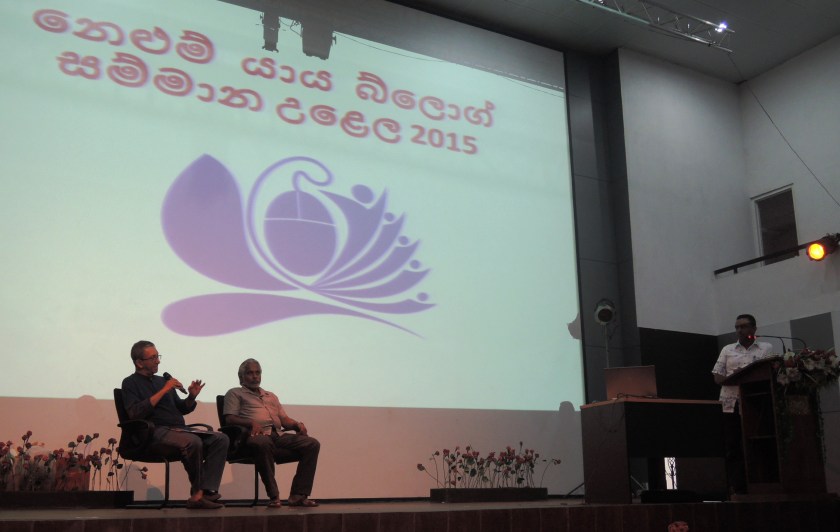
Nalaka Gunawardene (left) & Ajith Perakum Jayasinghe at Nelum Yaya Blog awards for 2015, held on 26 March 2016
In this week’s Ravaya column (appearing in the print issue of 3 April 2016), I probe why the blogosphere and other social media platforms are vital for public discourse in the Lankan context.
Sri Lanka’s mainstream media does not serve as an adequate platform for wide-ranging public discussion and debate. Besides being divided along ethnic and political lines, the media is also burdened by self-imposed restrictions where most don’t critique certain social institutions. Among the top-ranked ‘sacred cows’ are the armed forces and clergy (especially Buddhist clergy).
No such “no-go areas” for bloggers, tweeps and Facebookers. New media platforms have provided a space where irreverence can thrive: a healthy democracy badly needs such expression. I base this column partly on my remarks at the second Nelum Yaya Blog Awards ceremony held on 26 March 2016.
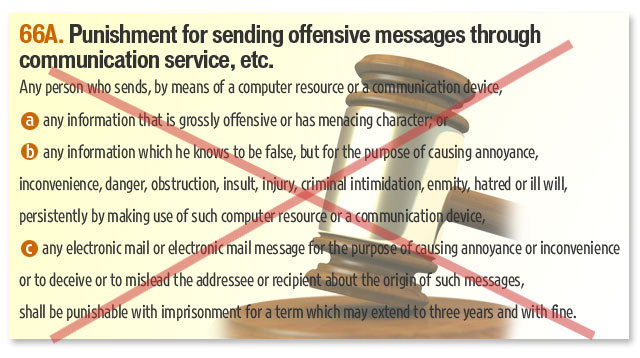
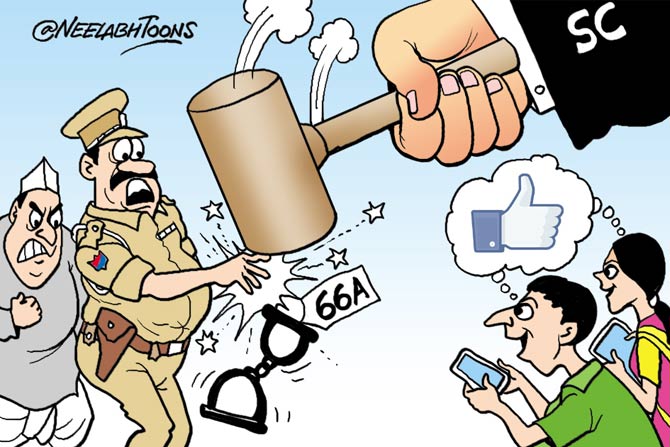
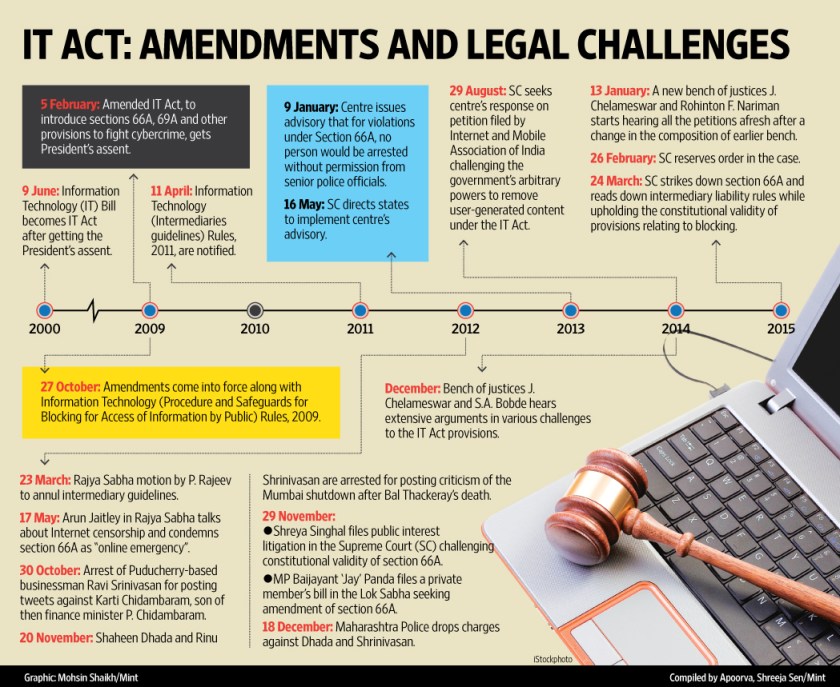
I also refer to a landmark ruling in March 2015, where the Supreme Court of India struck down a “draconian” law that allowed police to arrest people for comments on social media networks and other websites.
India’s apex court ruled that Section 66A of the Information Technology Act was unconstitutional in its entirety, and the definition of offences under the provision was “open-ended and undefined”.
The provision carried a punishment of up to three years in jail. Since its adoption in 2008, several people have been arrested for their comments on Facebook or Twitter. The law was challenged in a public interest litigation case by a law student after two young women were arrested in November 2012 in Mumbai for comments on Facebook following the death of a politician.
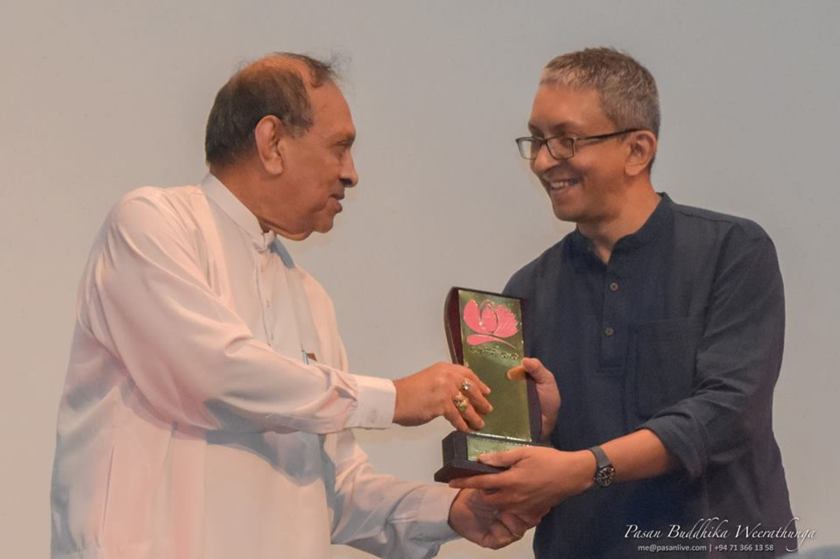
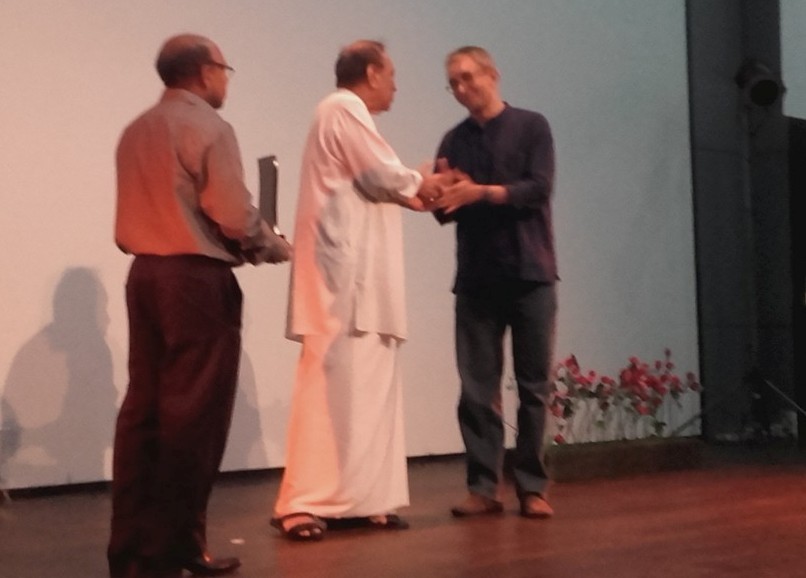
Speaker Karu Janasuriya presents Lifetime Award to Nalaka Gunawardene at Nelum Yaya Blog Awards on 26 March 2016 – Photo by Pasan B Weerasinghe
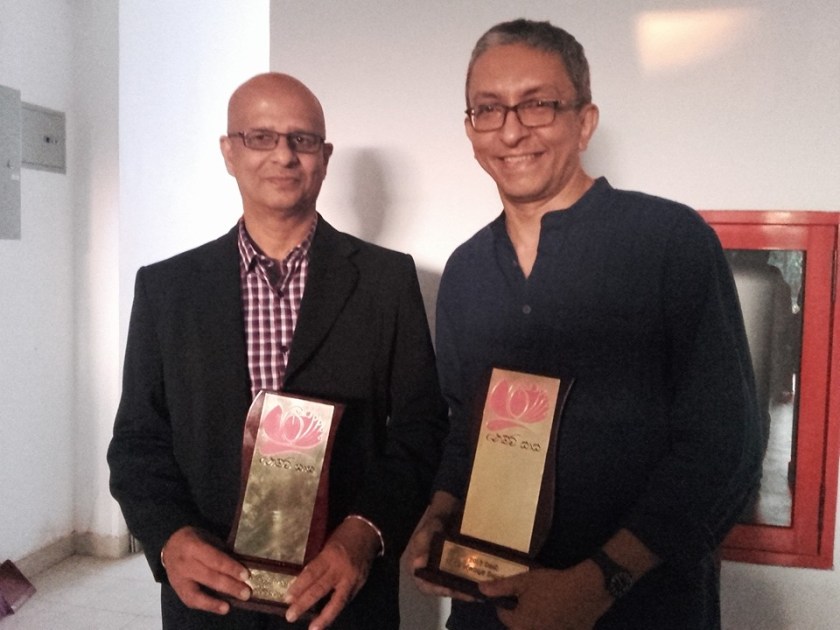
Nalaka Gunawardene (extreme right) received Lifetime Achievement Award for Blogging and New Media Promotion in Sri Lanka from Karu Jayasuriya, Speaker of Parliament, in Colombo 26 March 2016. Nelum Yaya Blog Awards organiser Ajith Dharmakeerthi looks on. Photo by Manori Wijesekera
At the second Nelum Yaya Blogger Awards ceremony held at the Media Ministry Hall last afternoon, the organisers presented me with a Lifetime Achievement Award in New Media.
The award was presented by Karu Jayasuriya, Speaker of the Lankan Parliament and a champion of the right to information. As he presented the trophy, he told me that he is a regular reader of mine!
The citation (in Sinhala, trying to obtain exact text) said that it was to recognise and salute my long-standing efforts to promote blogging and social media use in Sri Lanka.
I didn’t get to say any words of acceptance, so this is what I would like to have said…
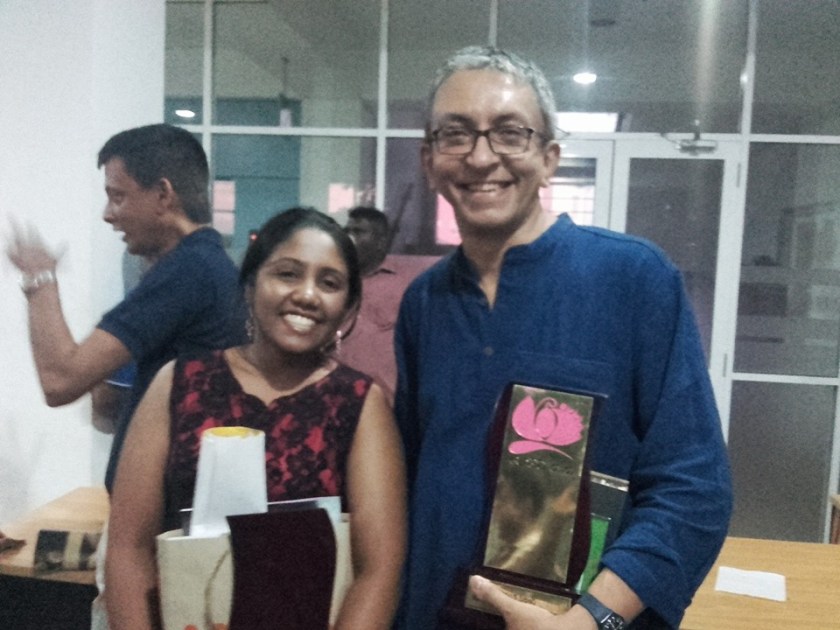
Yashoda Sammani Premaratne (left), Sri Lanka’s Blogger of the Year 2015, with Nalaka Gunawardene who received a Lifetime Award at Nelum Yaya Blog Awards ceremony held in Colombo on 26 March 2016. Photo by Manori Wijesekera
It’s always nice to be recognised by peers — and I do count myself as part Sri Lanka’s diverse and informal blogging community.
However, to use a cricketing metaphor, I am more like a cricket commentator than a star cricketer. I do know the craft but my most useful contributions have been as a cheerleader and populariser of blogging and social media in Sri Lanka.
My own blogging, started in early 2007, was entirely in English for the first few years until I started republishing my weekly Sinhala columns (Sivu Mansala Kolu Getaya) written for Ravaya newspaper from 2011. That made my blog bilingual, albeit a low intensity one: I don’t get the kind of visitors or comments like leading Lankan bloggers do. But I’m contented with that.
Where I have contributed more, I believe, is in documenting, trend-spotting and demystifying the Lankan blogosphere in Sinhala and English (sadly, I don’t have Tamil proficiency to do the same). Over the years I’ve addressed many and varied audiences – from university dons/students and govt officials to civil society groups and journalists – on the public interest potential of social media including (but not limited to) blogging.
Parallel to this, and sometimes in collaboration with my friend Chanuka Wattegama, I’ve been a chronicler and commentator on the social, cultural and political impacts of new media in Sri Lanka. A simple Google search would bring up many of my op-ed articles, book chapters and speeches on Sri Lanka’s emerging information society.
I’m encouraged and honoured by this award, but I have no intention of quitting. Using my blog as well as Twitter and Facebook social media platforms, I will continue to ask inconvenient questions, express unpopular opinions and kick-ass when I need to.
One day, I hope, I’ll finally be able to figure out the demarcation between playing and working in this realm. Does it matter?
Nalaka Gunawardene (left) with Ajith Dharmakeerthi, chief organiser of Nelum Yaya Blog Awards Sri Lanka
* * * * *
One other Lifetime Award was presented at yesterday’s event – to Rasika Suriyaarachchi, engineer turned blogger who has been a pioneering and popular personality in the Sinhala language blogosphere for many years.
Creative and perceptive young writer Yashoda Sammani Premaratne, who blogs as Bassi, was honoured as the Blogger of the Year 2015.
Over three dozen other category winners and commended bloggers were also saluted at the informal, privately organised blogging awards ceremony.
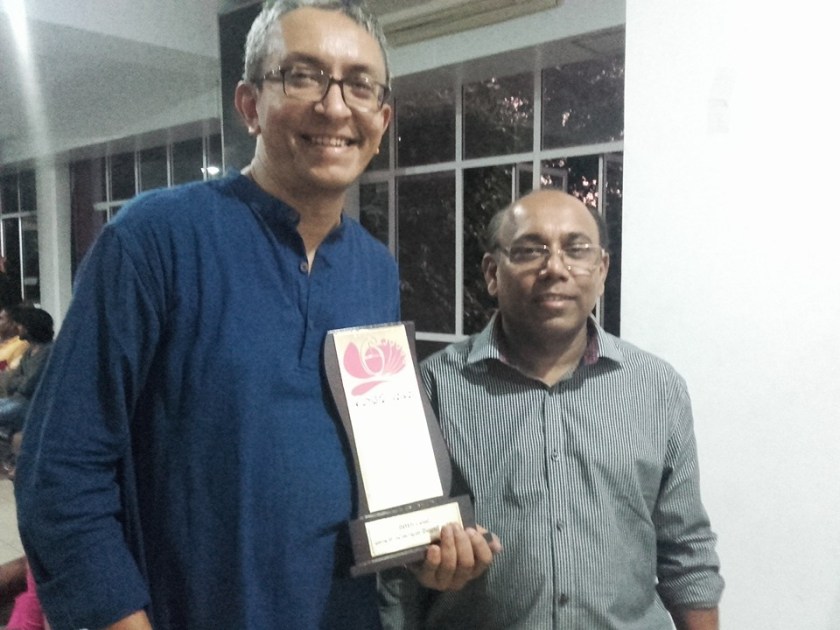
Rasika Suriyaarachchi (left) and Nalaka Gunawardene with their Lifetime Awards presented at Nelum Yaya Sri Lanka Blogging Awards ceremony in Colombo, 26 March 2016. Photo by Manori Wijesekera
Can newspapers survive the challenge from digital and online media?
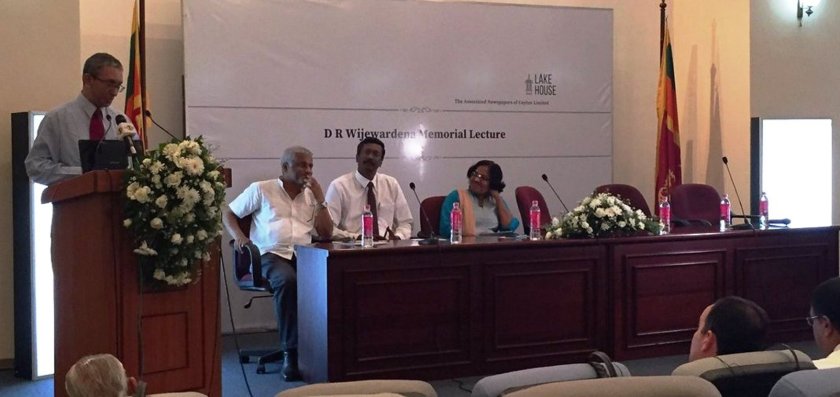
Plenty of printer’s ink has been spent reflecting on this question. I once again addressed it when moderating a panel at the D R Wijewardene commemorative event held on 26 February 2016 at Lakshman Kadirgamar Institute, Colombo.
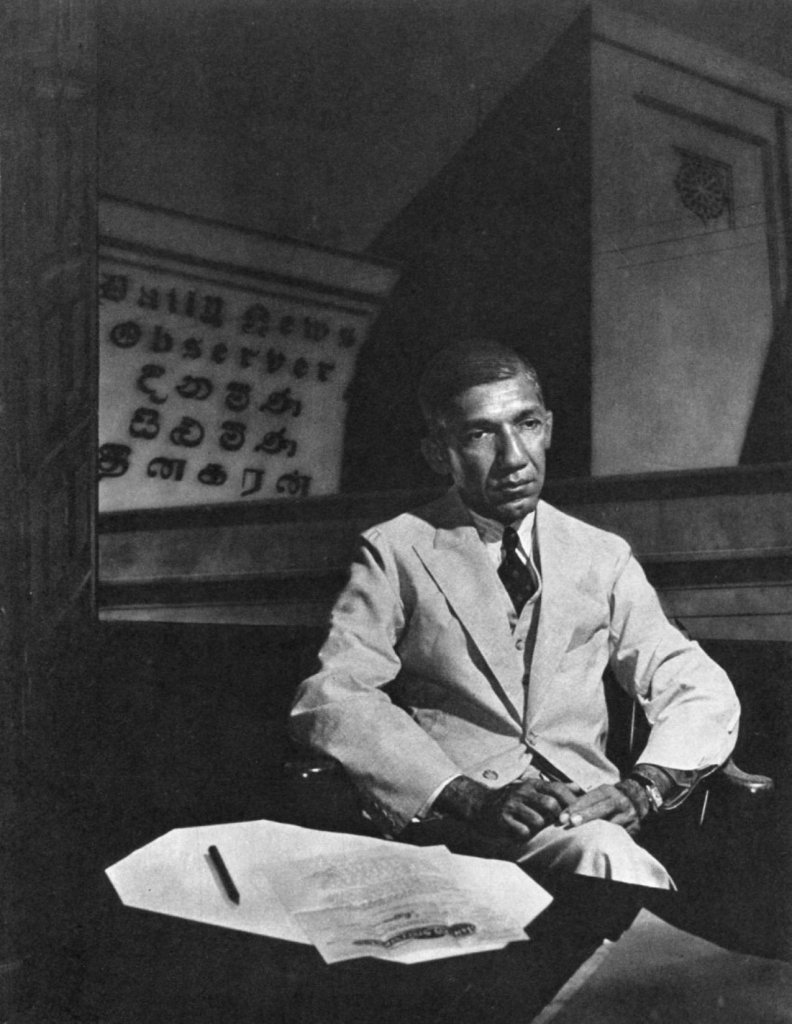
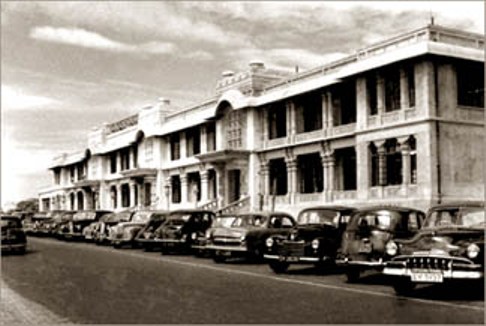
Wijewardene was Sri Lanka’s first Press Baron. About a century ago, he laid the foundation for his publishing house, Associated Newspapers of Ceylon Limited, which still remains a dominant player.
Many like me, of a certain age and above, seem to have a nostalgic attachment to newspapers. One key question for the print industry: beyond tapping such sentimental appeal (which diminishes over time), can newspapers stay relevant and viable? How can they adapt and evolve to keep serving the public interest?
Perhaps the more pertinent question to ask is: where are the budding D R Wijewardenes of the 21st Century? What are their start-ups and how are their dreams unfolding? Are they trying to balance reasonable profits with public interest journalism?
I discuss these in my Ravaya column (appearing in the print issue of 13 March 2016).
Nalaka Gunawardene speaks at D R Wijewardene memorial event on 26 February 2016 – Photo by Sam de Silva
This week, I was asked by Sri Lanka’s oldest newspaper publishing house — Associated Newspapers of Ceylon Limited, or Lake House — to chair a panel discussion on ‘Survival and Evolution of Newspapers in the Digital Age’.
The event marked the 130th birth anniversary of Lake House founder and Sri Lanka’s first press baron, D R Wijewardene (1886 – 1950). It was held at the Lakshman Kadirgamar Institute in Colombo.
My panel comprised: communications scholar and former telecom regulator Prof Rohan Samarajiva; senior journalist Hana Ibrahim; Sri Lanka Press Institute’s CEO Kumar Lopez, and political scientist Sumith Chaaminda of Verite Research.
We had a lively discussion exploring the challenges faced by print publishers everywhere, and what solutions are relevant, viable and affordable for a majority of small scale publishers without deep pockets.
Here is an excerpt from my opening remarks (full text to be published soon as an op-ed article):
In the absence of independently audited circulation figures, we cannot be certain how well – or poorly – our newspapers are selling today. But indications are not promising. I have been involved in a state of the media study for the past year (due to be released in May 2016), and there is evidence that market survival is a big struggle for many smaller publishers.
More and more Lankan newspapers are being kept alive not to make any profit, but for influence peddling and political purposes. And in at least one case, the co-operatively owned Ravaya, reader donations were actively solicited recently to keep the paper alive.
Worldwide, print journalism’s established business models are crumbling, with decades-old publications closing down or going entirely online (The Independent newspaper in the UK is the latest to do the latter). Advertisers usually follow where the eyeballs are moving.
So what would D R Wijewardene do if he confronted today’s realities of gradually declining print advertising share and readers migrating to online media consumption? How might he respond by going back to his founding goals of political action and social change through the 3 Ps – the Press, Parliament and Platform – as important instruments of political action?
My guess is that he would invest in radio and/or television, with a strong digital integration. He might even find a viable income stream from digital and online publishing without locking up public interest content behind pay-walls.
We can only speculate, of course. Perhaps the more pertinent question to ask is: where are the budding D R Wijewardenes of the 21st Century? What are their start-ups and how are their dreams unfolding? Are they trying to balance reasonable profits with public interest journalism?
In my view, the biggest decider of success or failure – today, as it was a century ago – is not the medium, but the message. To put it more bluntly, it’s credibility, stupid!
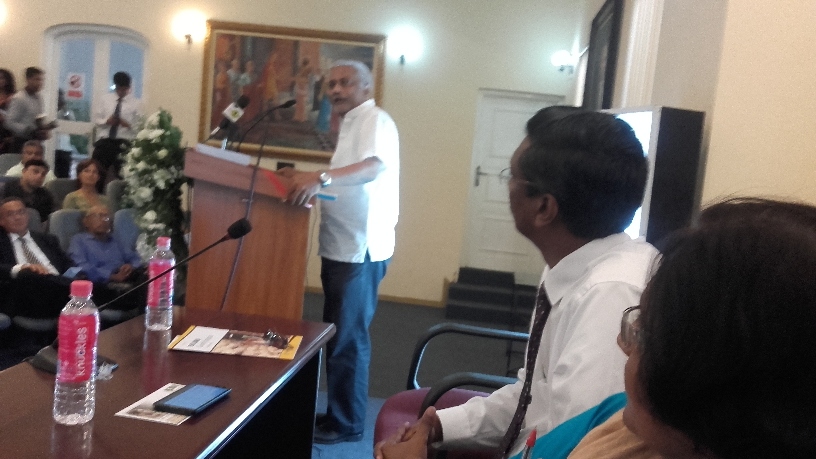
Prof Rohan Samarajiva speaks at D R Wijewardene memorial event, 26 Feb 2016
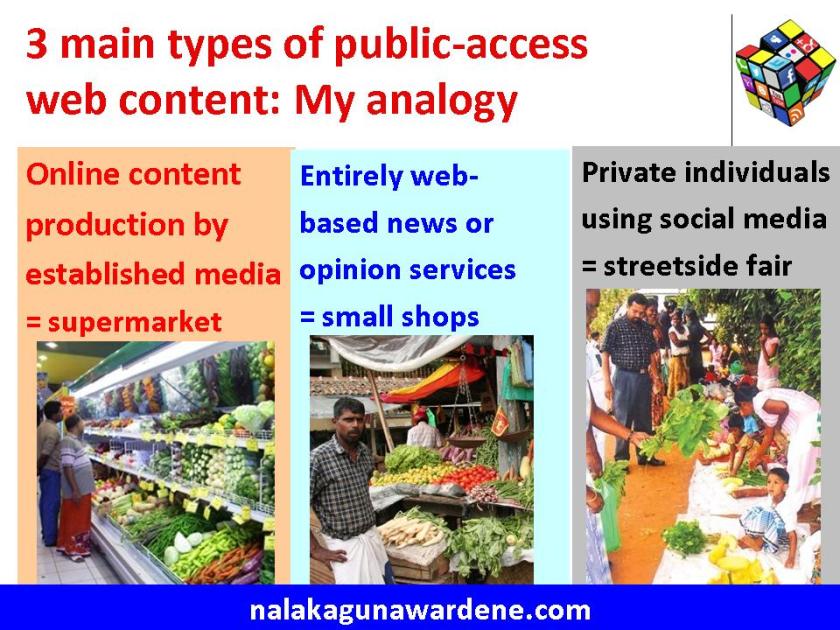
Social media bashing is a popular sport among media critics and others in Sri Lanka. Sadly, some have no clear idea what social media is (and isn’t), thus conflating this category of web content with others like news websitea and gossip websites.
In this week’s Ravaya column (appearing in issue of 21 February 2016), I try to explain this basic categorization along with a brief history of the web and web 2.0. I also reiterate the basic user precautions for social media users where the motto us: user beware!
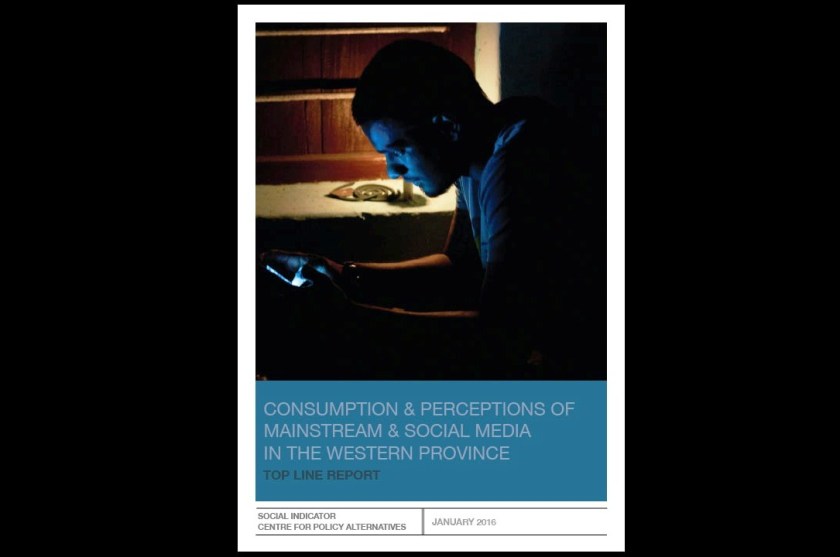
The report draws on a survey of 1,743 randomly selected men and women, interviewed in Sinhala or Tamil language during June-July 2015. They were asked about mobile phone use and web access. The survey was conducted by Social Indicator, CPA’s survey research unit.
As the launch media release noted, “From the use of Facebook to smartphones, from news on TV to news via SMS, from how information read digitally is spread to others who are offline, the report offers insights into how content is produced, disseminated and discussed in Sri Lanka’s most densely populated province and home to the country’s administrative and business hubs.”
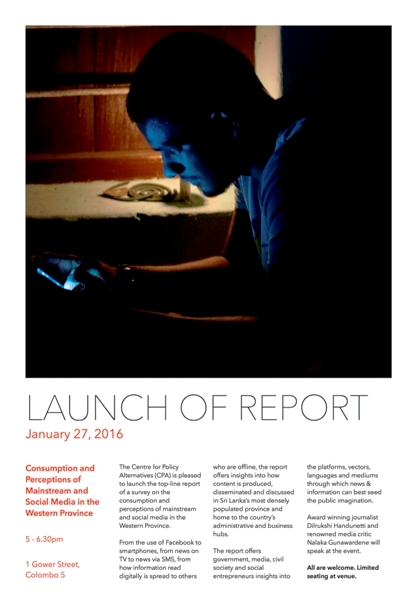
Launch of the top-line report of a survey on the consumption and perceptions of mainstream and social media in the Western Province of Sri Lanka, 27 Jan 2016
On 27 January 2016, the Centre for Policy Alternatives (CPA) launched the top-line report of a survey on the consumption and perceptions of mainstream and social media in the Western Province of Sri Lanka.
I was one of the launch speakers, and my presentation was titled: Information Society is Rising in Sri Lanka: ARE YOU READY?
The report draws on a survey of 1,743 randomly selected men and women, interviewed in Sinhala or Tamil language during June-July 2015. They were asked about mobile phone use and web access. The survey was conducted by Social Indicator, CPA’s survey research unit.
As the launch media release noted, “From the use of Facebook to smartphones, from news on TV to news via SMS, from how information read digitally is spread to others who are offline, the report offers insights into how content is produced, disseminated and discussed in Sri Lanka’s most densely populated province and home to the country’s administrative and business hubs.
It added: “The report offers government, media, civil society and social entrepreneurs insights into the platforms, vectors, languages and mediums through which news & information can best seed the public imagination.”
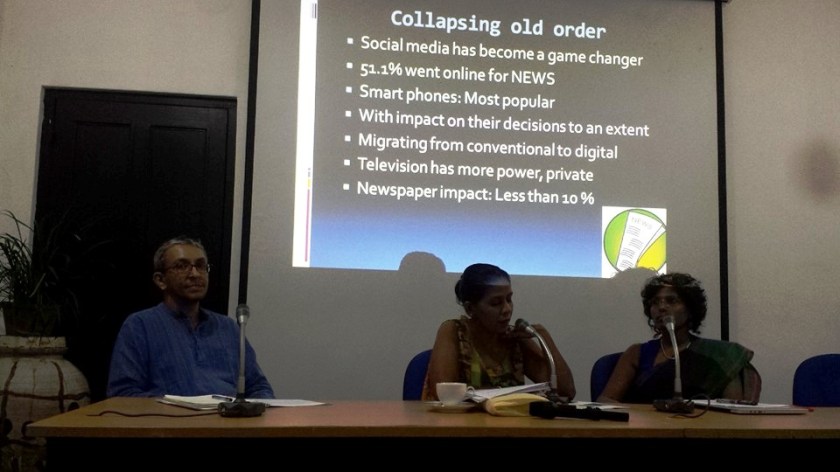
Dilrukshi Handunnetti (centre) speaks as Nalaka Gunawardene (left) and Iromi Perera listen at the launch on 27 Jan 2016 in Colombo – Photo by Sampath Samarakoon
In my remarks, I said it was vital to draw more insights on what I saw as ‘demand-side’ of media. But at the same time, I noted how a growing number of media consumers are no longer passively receiving, but also critiquing, repackaging and generating related (or new) content on their own.
I applauded the fact that this survey’s findings are shared in the public domain – in fact, Iromi Perera, head of Social Indicator, offered to share the full dataset with any interested person. This contrasts with similar surveys conducted by market research companies that are, by their very nature, not going to be made public.
Why do demand-side insights being available in the public domain matter so much? I cited four key reasons:
The new government is keen on media sector reforms at policy and regulatory levels: these should be based on evidence and sound analysis, not conjecture.
Media, telecom and digital industries are converging: everyone looking for ‘killer apps’ and biz opps (but only some find it).
Media companies are competing for a finite advertising budget: knowing more about media consumption can help improve production and delivery.
Advertisers want the biggest bang for their buck: Where are eyeballs? How to get to them? Independent studies can inform sound decision-making.
On this last point, I noted how Sri Lanka’s total ad spend up to and including 2014 does not show any significant money going into digital advertising. According to Neilsen Sri Lanka, ad-spending is dominated by broadcast TV, followed by radio an print. Experience elsewhere suggests this is going to change – but how soon, and what can guide new digital ad spending? Studies like this can help.
I also highlighted some interesting findings of this new study, such as:
Private TV is most popular source of news, followed by Facebook/web.
Across different age groups, smartphone is the device most used to access web
Online culture of sharing engenders TRUST: peer influence is becoming a key determinant in how fast and widely a given piece of content is consumed
None of this surprises me, and in fact confirms my own observations as a long-standing observer and commentator of the spread of ICTs in Sri Lanka.
Everyone – from government and political parties to civil society groups and corporates – who want to engage the Lankan public must take note of the changing media consumption and creation patterns indicated by this study, I argued.
I identified these big challenges particularly for civil society and others engaged in public interest communication (including mainstream and citizen journalists):
Acknowledge that we live in a media-rich information society (Get used to it!)
Appreciate that younger Lankans consume and process media content markedly differently from their elders and previous generations
Understand these differences (stop living in denial)
Leverage the emerging digital pathways and channels for social advocacy & public interest work
In my view, rising to this challenge is not a CHOICE, but an IMPERATIVE!
I ended reiterating my call for more research on information society issues, and with particular focus on mobile web content access which trend dominates user behaviour in Sri Lanka.
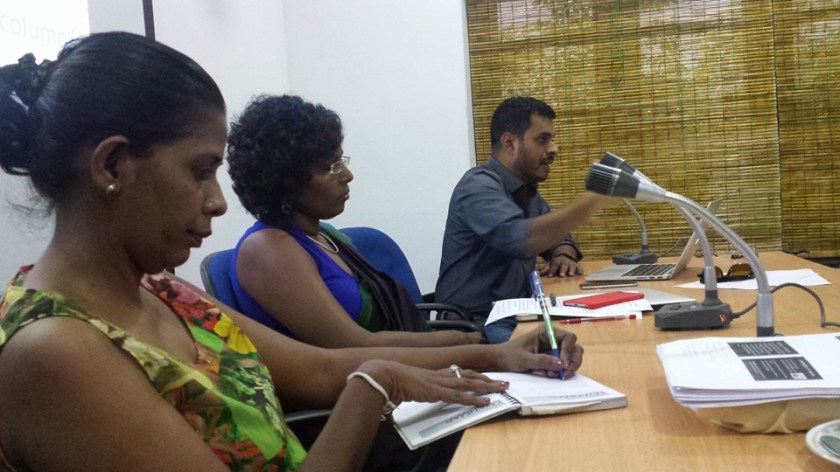
Award winning journalist Dilrukshi Handunnetti, and head of Social Indicator Iromi Perera were my fellow panelists at the launch, which was moderated by the study’s co-author and CPA senior researcher Sanjana Hattotuwa.
L to R – Dilrukshi Handunnetti, Iromi Perera, Sanjana Hattotuwa at CPA report launch, Colombo, 27 Jan 2016







 Open Minds!