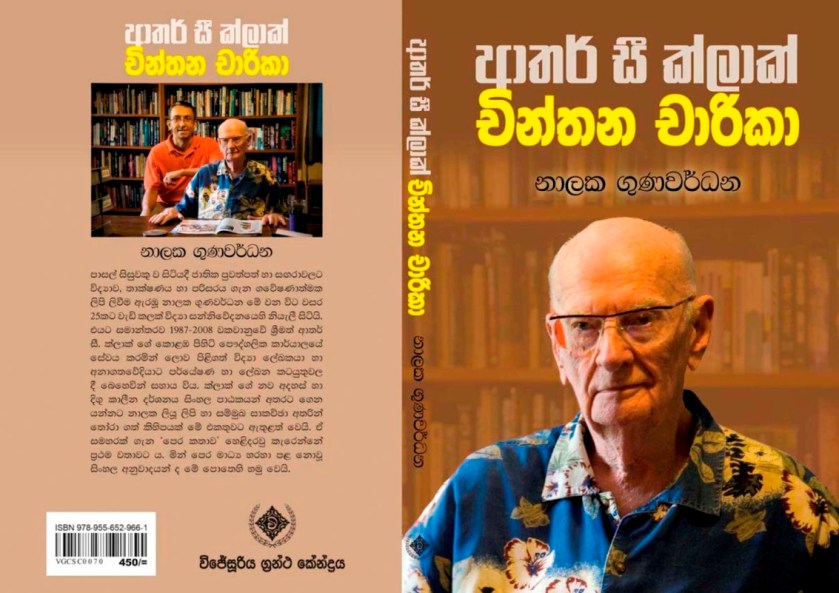
Arthur C Clarke Chintana Charika – Sinhala Book of essays and interviews by Nalaka Gunawardene (Wijesooriya Book Centre, Colombo, 2012). Cover photos by Shahidul Alam, Drik
In a literary career spanning over six decades, Sir Arthur C Clarke (1917 – 2008) wrote 100 books and more than 1,000 short stories and essays. He was the first to propose geostationary communications satellites, and inspired the World Wide Web.
To mark his 95th birth anniversary which falls this month, science writer Nalaka Gunawardene is releasing a new Sinhala book offering a quick tour of Clarke’s imagination, analyses and extrapolations on the world’s current challenges and our choice of futures.
Titled ‘Arthur C Clarke Chintana Charika’ (Mind Journeys with Arthur C Clarke), the book is a collection of Nalaka’s articles, media columns and interviews based on the late author and visionary’s formidable intellectual output. Some have appeared in Lankan newspapers or magazines during the past 25 years, while others are coming out in print for the first time.
“These are not translations, and most are not even adaptations. Instead, I have distilled Sir Arthur’s ideas and imagination and presented them in simple Sinhala,” says Nalaka, who worked with Clarke for 21 years as research associate at his personal office in Colombo.
Indicative of Clarke’s diverse career and interests, the book is divided into five sections: highlights of his illustrious life; astronomy and space travel; information and communications technology; futuristic visions; and his long association with Sri Lanka.
“Sir Arthur cheered and promoted Sri Lanka for half a century – in both good times and bad. The section on Sri Lanka captures his visions and hopes for his adopted homeland: on how we may overcome the burdens of evolution and history to create a truly peaceful and prosperous island for all,” says Nalaka.
The book contains Clarke’s advice on rebuilding Sri Lanka after the 2004 tsunami, the story of the first Sinhala feature film in colour (Ran Muthu Duwa, 1962) that Clarke financed, and the text of his 90th birthday video, which eventually became his public farewell.
Other essays focus on Clarke’s cautious optimism for information society and the future of artificial intelligence, his hopes of developing clean energy sources to end humanity’s addiction to fossil fuels, and his advocacy of a world free of nuclear weapons.
Nalaka reiterates that the best way to celebrate the legacy of Arthur C Clarke is to adapt his ideas for a better world based on knowledge, ethics, compassion and imagination.
The 280-page book, published by Wijesooriya Grantha Kendraya (Wijesooriya Book Centre), will be launched at 3 pm on Tuesday, 18 December 2012 at the National Library Services and Documentation Board, 14, Independence Avenue, Colombo 7. The main speaker will be Prof Rohan Samarajiva, Chair and CEO of LIRNEasia. Copies will be sold on discount at the launch.
I have an interview (in Sinhala) on science communication for their 25th anniversary issue, which can be found here.
I have followed up with an expansion of some of these ideas in my Sunday column in Ravaya newspaper. My theme this week is science journalism (a subset of science communication) — why is it important for modern societies and what challenges are faced by Lankan science journalists.
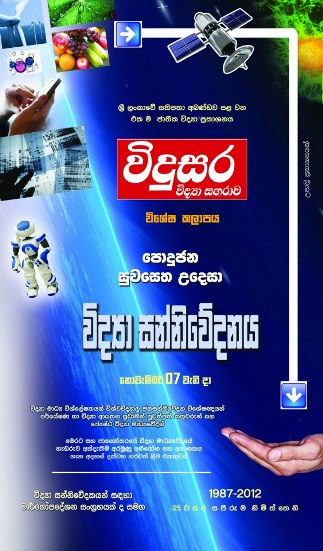
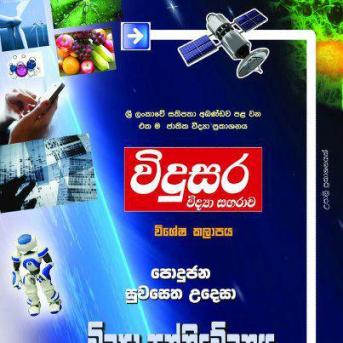
Vidusara at 25 – web banner from Facebook Group
The weekly Sinhala science magazine Vidusara, a publication of Upali Newspapers Limited of Sri Lanka, completes 25 years this week.
Sustaining any publication for that long is no mean accomplishment, so everyone involved – journalists, editors, publishers – deserve congratulations.
The current editor has done an interview with me for the 25th anniversary issue, which is out today. In it, I discuss the challenges faced by all science communicators, but especially by science journalists working in the developing world. The interview is in Sinhala. Here it is, in pdf, in parts 1 and 2.
I had a marginal involvement in Vidusara at its very inception, in late 1987, which was within a few months of my entering journalism. I take no credit for what the publication has accomplished, and am sometimes exasperated when long-standing readers associate me with it. But after clarifying such nuances for years, I now accept the inevitable association!
As reader comments warranted, I responded as follows:
Vidusara 25th anniversary issue – cover 7 Nov 2012“Vidusara was launched in 1988 [correction: it really was in Nov 1987] by Upali Newspapers Limited as an experiment in popular science communication. I was at the time working as a science correspondent for that company’s English daily, The Island, and the managing director asked me to advise and guide the new publication. I welcomed this as I was a bilingual writer (Sinhala and English). However, the founder editor of Vidusara was extremely apprehensive about my association with his project and went out of his way to exclude me. I have never tried to understand or analyse the reasons for this; such insecure and insular mindsets are far too common in Sinhala language journalism, even today.
“All in all, I must have written no more than 10 – 12 Sinhala science articles to Vidusara during its first few months of publication in 1988. When I compare that to the several hundred I’ve published in The Island (1986-1995: none of it available online) and many dozens for other English language media outlets – print, broadcast and online – over the years, my writing in Vidusara represents only a very small proportion of my combined media output. However, I must have done a few things well in those articles for discerning readers to remember and refer to it more than two decade later. I’m naturally pleased with such reader recollections.
“It also reminds me that we who work in the public space don’t get to choose how we are remembered. Our audiences will form their own impressions, and select their own memories.”
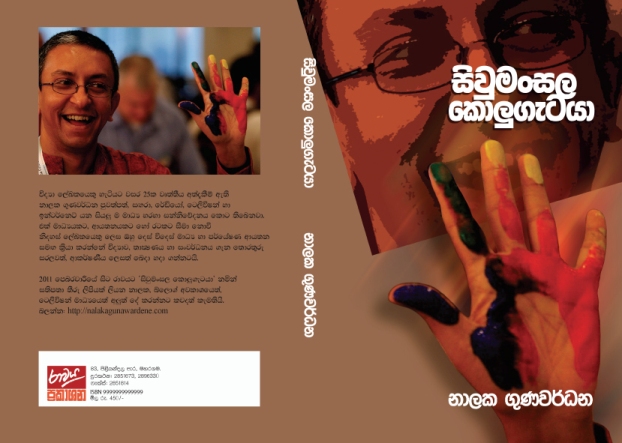
Sivu Mansala Kolu Getaya book cover: A Ravaya Publication
PROMOTIONAL NOTE FOR MY NEW BOOK IN SINHALA:
Colombo, Sri Lanka; 18 September 2012:
Science writer Nalaka Gunawardene’s new Sinhala book, Sivu Mansala Kolu Getaya (සිවුමංසල කොලූ ගැටයා), is being launched at the Colombo International Book Fair that runs from 18 to 26 September 2012.
A Ravaya Publication, the book is an edited collection of his weekly Sinhala columns by the same name, contributed to the Ravaya Sunday broadsheet newspaper in Sri Lanka during 2011.
Beginning in February 2011, Nalaka has sustained a column that touches on many and varied topics related to popular science, human development, mass media and information society. The book compiles 44 of these columns.
“The title is of my column is derived from its particular scope and angle. I stand at the intersection (or confluence) of science, development, media and culture. Once there, I often play the role of that cheeky lad who asked difficult questions, and once pointed out the Emperor(s) had nothing on when all others were either too polite or too scared to say so,” Nalaka says.
He calls the book a personalised exploration of how Sri Lanka can cope with many challenges of globalisation and modernisation. Nalaka writes in conversational Sinhala, rich in metaphor and analogy, and drawing on his own wide experiences as a journalist, filmmaker and development communicator. He often mixes the big picture level analysis (bird’s eye view) with ground level reality checks (toad’s eye view).
“I like to ‘zoom in’ and ‘zoom out’ when discussing topics as diverse as coping with HIV/AIDS, nurturing innovation, regulating the Internet, tackling climate change or farming without costing the Earth,” he says. “I do so with an open mind and sense of wonder. I have no particular ideology to promote and no sacred cows to protect!”
He adds: “As a journalist, I was trained to look for what’s New, True and Interesting (‘NTI Test’). Early on in my career, I went beyond simply reporting events, and probed the underlying causes and processes. With those insights, I can now offer my readers perspectives and seasoned opinion. These are much needed today as we swim through massive volumes of information, trying to stay afloat and make sense of it all.”
The book marks Nalaka’s return to Sinhala writing after an absence of two decades during which he communicated mostly in English to various international audiences. “In a sense, with this column I have come back home. The last time I wrote in Sinhala was in another century, and in what now feels like another country!” he says.
Ari is also our elder statesman of inclusive development. For over half a century, he and Sarvodaya have advocated a nuanced approach to overcoming poverty, illiteracy and various social exclusions. Unlike some die-hard activists, Ari doesn’t ask us to denounce materialism or revert to pre-industrial lifestyles. Instead, he seeks a world without extreme poverty or extreme affluence.
Suddenly, his quest for social justice and equality is resonating all over the world. In fact, Ari has been speaking out for the 99 per cent of less privileged people decades before a movement by that name emerged in the West. In a sense, those occupying Wall Street and other centres of affluence are all children of Sarvodaya.
While Ari shares their moral outrage, his own strategy has been quite different. He didn’t occupy physical spaces in his struggle; he went straight to the fount of all injustice – our minds.
In this 2,400-word essay, I salute a hero of mine who continues to speak truth to power, and makes a difference to millions of people in his land and elsewhere. For doing this, he has been ridiculed, harassed and vilified by small minds and the state. He continues undaunted, and shows no sign of slowing down after turning 80.
Here’s another excerpt:
“In Ari, we find elements of Mahatma Gandhi (non-violent pursuit of the greater good); the Dalai Lama (interpreting Buddhist philosophy for the modern world); Martin Luther King, Jr. (struggling for the rights and dignity of marginalised people); Nelson Mandela (nurturing democracy and healing society); and Jimmy Carter (globalism with a humanitarian agenda).
“Yet Ari is more than the sum of these noble parts; he is his own unique visionary. And an adroit ‘remixer’ who constantly blends the best of East and West. He adapts our civilisational heritage to tackle the Twenty First Century’s anxieties and uncertainties. Thankfully, though, he doesn’t peddle simplistic solutions to today’s complex problems.”
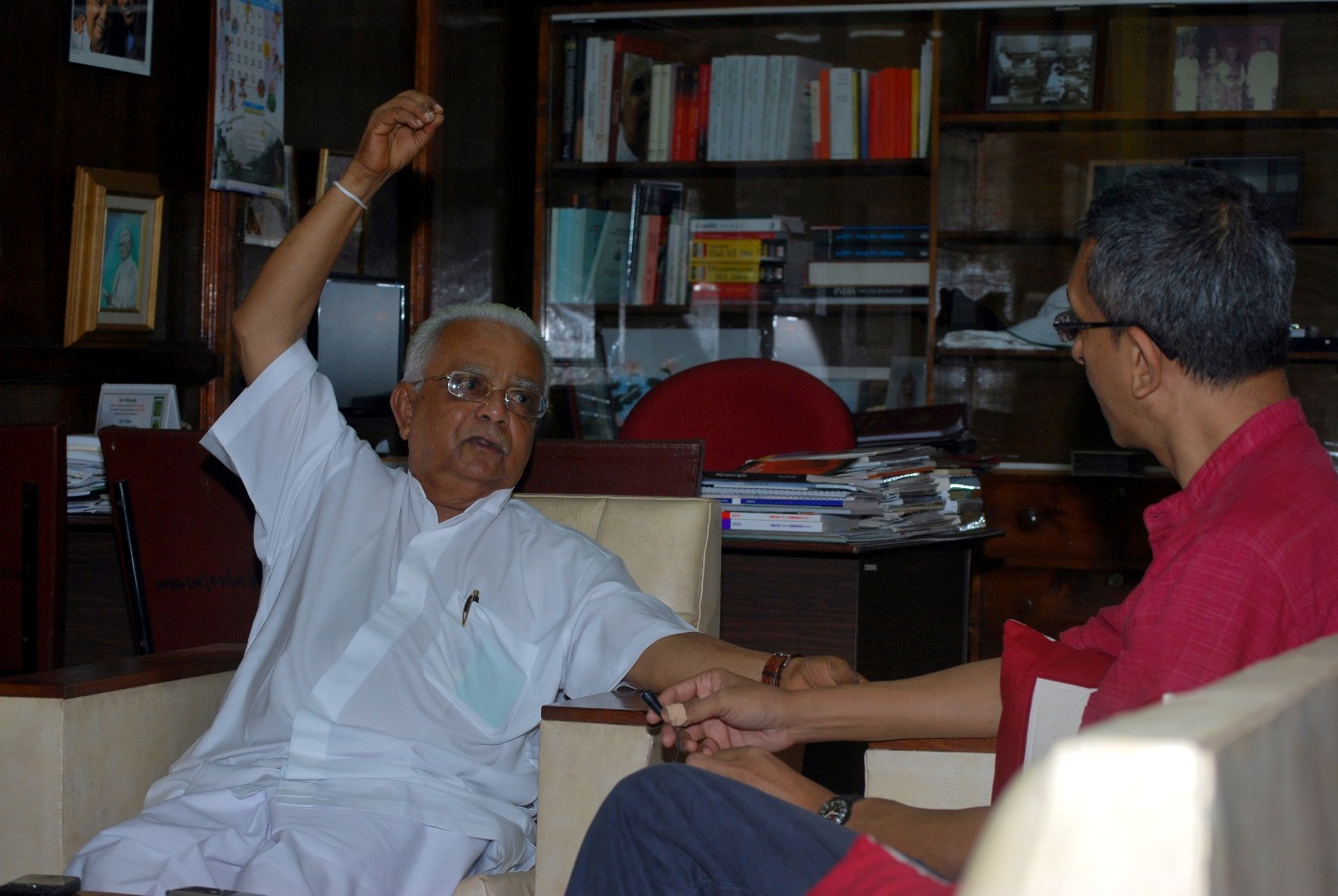
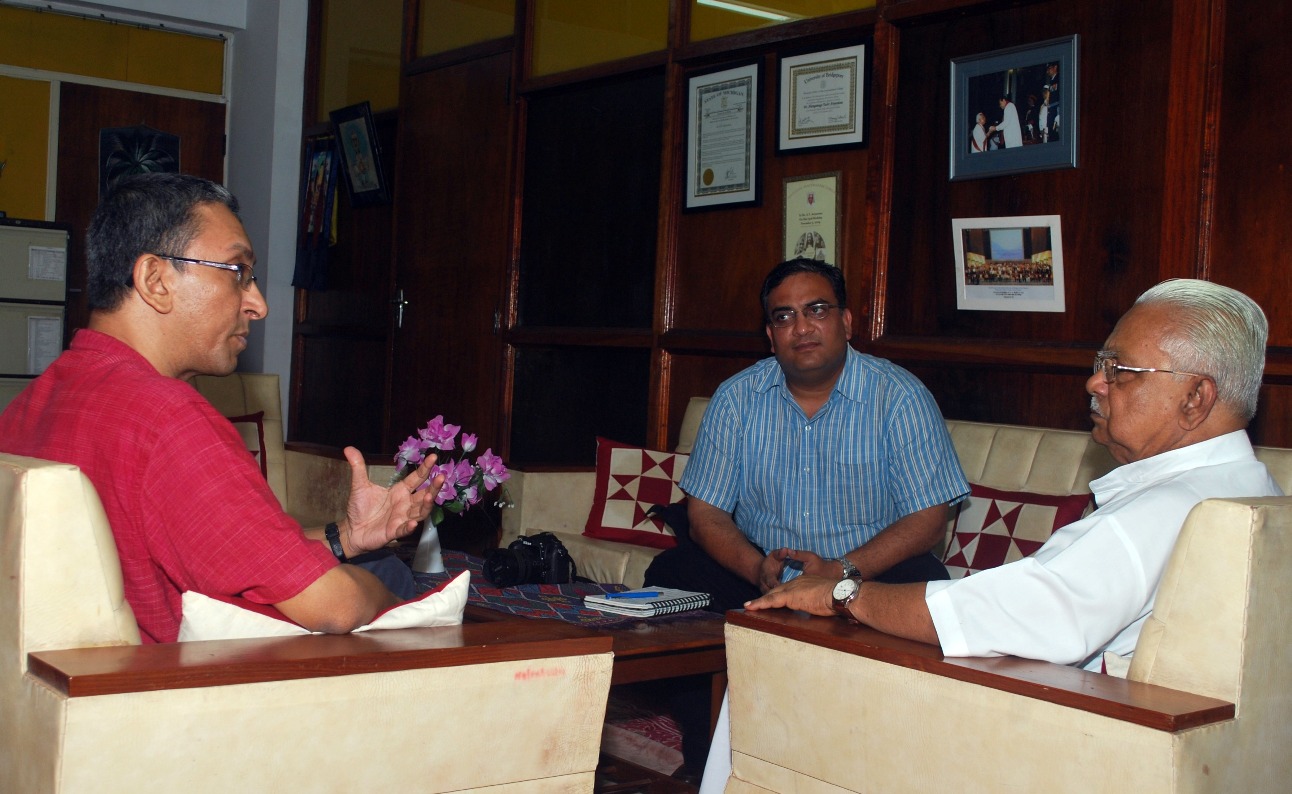
I also recall my first encounter with Ari, in early 1991, when a tyrant leader of Sri Lanka had virtually declared ‘war’ on this unarmed, non-violent small man. I have interviewed him several times since then – the most recent was in March 2011, when I accompanied my journalist friend Aditya Batra from India to talk to Ari (photo, below).
In my own tribute to Steve Jobs, just published on Groundviews.org, I raise some pertinent questions about nurturing discovery and innovation in Asian societies.
Here’s an excerpt:
We might admire – even revere – mavericks like Steve Jobs from afar, but few Asians have any idea where mavericks come from, or how best to deal with them. Our conformist and hierarchical societies don’t nurture mavericks. Our cultures tend to suppress odd-balls and iconoclasts. That’s probably why we don’t have enough of our own Steve Jobses, Richard Bransons and Anita Roddicks.
Mark Twin said: “The man with a new idea is a crank – until the idea succeeds”. The question is: do we Asians hush down our home-grown cranks even before they have a sporting chance? Are we culturally too biased against individualism that propels useful – and potentially transformative mavericks?
As a ‘maverick spotter’ and cheerleader for all types of innovation, I often worry that we are. I have come across bright young men and women who were ridiculed in the classroom (‘freaks!’) or scorned at home (‘losers!’) for not wanting to be doctors, engineers or lawyers.
This is the central argument in my latest op-ed, a tribute to Steve Jobs and a reflection on individualistic tech innovation in our own Asian societies.
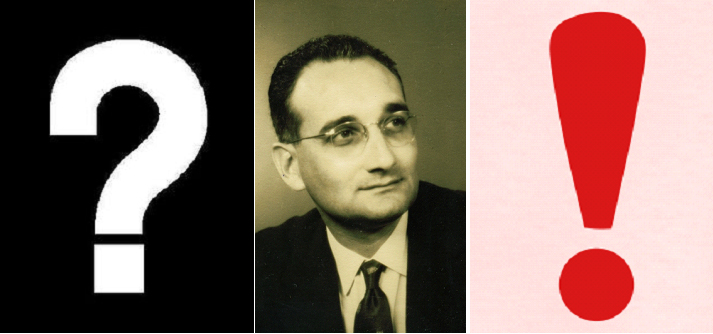
The story goes like this. Victor Hugo was travelling out of town and wanted to know how his latest book was selling. He messaged (telegraphed?) his agent: ?
The agent, not to be outdone, replied: !
Enough said. How I wish I could beat that economy of words…
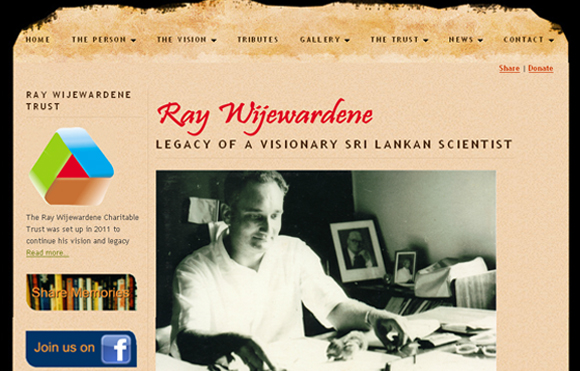
I have a fondness for both question marks and exclamation marks — I used a good deal of both in my own speaking and writing. I use these as a metaphor in a tribute I just wrote about one of my mentors: Ray Wijewardene.
“If I had to condense the multi-faceted and fascinating life of Ray Wijewardene, I would reduce it to a whole lot of question marks and exclamation marks. In his 86 years, Ray generated more than his fair share of both.
“He was unpigeonholeable: engineer, farmer, inventor, aviator and sportsman all rolled into one. Whether at work or play, he was an innovative thinker who rose above his culture and training to grasp the bigger picture.”


 Open Minds!