It’s a two syllable word, fairly easy to pronounce. Then how come so many people – at least in South Asia, home to a fifth of humanity – get their tongues tied or twisted in saying it?
That’s because it’s to do with sex! That’s not a subject that many South Asians still feel comfortable in talking about, in public or even private.
Sex may be a very private matter, but individuals’ sexual behaviour has direct and serious public health implications. Especially today when the world is still struggling to contain and overcome the spread of HIV that causes AIDS.
Condoms originally came into wide use to help prevent unwanted pregnancies and the spread of sexually transmitted diseases (STDs). In the past quarter century, condoms have become a major weapon against HIV.
Despite this, condoms still remain a hush-hush topic among many grown ups, even as the younger generation warms up to them. Across South Asia, we still have some hurdles to clear in normalising condoms – or making it socially and culturally acceptable for people to talk about condom use, and to go out and buy them without fear or shame.
They come in all colours and shapes!
This is the challenge that various communication groups have taken up, especially in India. According to a 2007 survey by UNAIDS and India’s National AIDS Control Organisation (NACO), at least 2.5 million people live with the HIV virus in India, placing the country third in the world after South Africa and Nigeria. However, AIDS prevention in the country is not an easy job. Many people, especially in rural areas, cling on to preconceived taboos about sex — and are often hesitant to use condoms.
Last month, I received en email from someone called ‘Spread Word for a Better World’, who shared with me web links on a socio-cultural group based in Hyderabad, who are using the performing arts to promote condom awareness.
For over a decade, the Nrityanjali Academy has been singing and dancing their way to the glorification of condom use. They see it as a crucial fight in their central region, where 2 per cent of the population is HIV positive.
P Narsingh Rao, director of Nrityanjali, recently told France 24 online: “Our main target groups are people vulnerable to the HIV virus like sex workers, transsexuals or truck drivers. We tour villages in mobile video vans to show the film. The screening is followed by a question and answer session about condom use and sexually transmitted diseases.”
He added: “We also encourage the use of female condoms, a relatively new concept. We tell the women to negotiate the use of female condoms with their male partners: for men with little sex education, the insertion of the female condom in the vagina can in itself be an erotic act.”
Here are some YouTube videos showcasing their work:
This is an entertaining and educational video in Telugu language on Condom usage, to prevent from sexually transmitted infections and HIV:
A more instructional video on how to use condoms properly:
And finally, an HIV/AIDS song in Telugu – with all the fast-beat music, gyrating and riot of colours we typically associate Bollywood movies and songs with:
The videos speak for themselves. They are matter of fact, engaging and presented by ordinary people (trained entertainers) rather than by jargon-totting medical doctors or health workers. There is none of the awkwardness typically associated with conversations of this subject. No one is tip-toeing around perceived or real cultural taboos. They just get on with it.
Importantly, they involve both men and women, both in performances and in their audiences.
Thailand, which had built up a reputation as a relatively stable country, has been under siege for much of this year. Confrontations between the coalition government, elected in December 2007, and the anti-government People’s Alliance for Democracy (PAD) have affected civil administration, law enforcement and economy, especially tourism.
On 10 September 2008, Thai prime minister Samak Sundaravej was forced to step down when a court found him guilty of accepting money from a TV station to host a popular cooking show. Bizarre as this reason was for his ouster, it has only added to the confusion that currently dominates Thai life.
Although I have been visiting Thailand regularly for the past 20 years, I don’t claim to understand the murky world of Thai politics. But until recently, Thais had somehow managed to keep their politics and business separate, allowing the latter to continue largely unaffected.
Pro-democracy struggles are not new to Thai people. But this time around, there is a new player involved: Asia Satellite Television (ASTV) a relatively new entrant into Thailand’s TV world which is dominated by commercial TV stations that offer a staple of light talk shows, soap operas and gossip programmes.
ASTV’s programmes, since May 2008, has consisted of speeches beamed from a stage set up at the site of a Bangkok protest rally, led by the PAD.
In early September 2008, around 200 PAD supporters banded together to guard the ASTV station and Manager newspaper offices on Phra Athit road amid rumours Prime Minister Samak Sundaravej was going to take the cable TV channel off the air.
In an interesting news analysis filed from Bangkok, Inter Press Service (IPS) noted on 5 September: “ASTV makes little effort to hide its political mission as the principle broadcaster of the PAD. After all, its founder, Sondhi Limthongkul, a fiery speaker, is one of the PAD’s leaders. His sustained attacks on the government and Thai democracy — that the prevailing elections system does not work, and the country needs a largely appointed parliament — have resonated with the thousands drawn to the PAD rallies after first hearing them on ASTV.”
Much of the PAD’s mass mobilisation has been possible due to ASTV’s reach, which is currently estimated at 20 million viewers. ‘’Our audience has doubled since 2006, when we had 10 million viewers, because we present the political side of the news that is not available on national TV,” the article quoted Chadaporn Lin, managing editor of the station’s English-language channel, as saying.
The Manager owns ASTVViewers who cannot access the station through a satellite dish or a provincial cable company turn to the website of ‘Manager,’ the newspaper produced by ASTV’s parent company. The site has seen the number of regular visitors rise and is now placed third among the top 10 Thai-language websites.
To make sense of what’s going on, I turned to Pipope Panitchpakdi, a Thai friend who has worked in the broadcast media industry for many years: Pipope Panitchpakdi, independent Thai journalist
He says: “It’s just too bad that the ideology behind the ASTV movement is identified by many as right-winged and nationalistic. For me, the movement itself is quite progressive in its post-modernistic use of everything that works to topple the existing government. In a way, it’s going back to the muckraking days of partisan journalism, which may be in need when mainstream media are no longer functioning during Thaksin/Samuk’s administration (with his equally keen media strategist team).”
Pipope adds: “Few mentioned that ASTV is self sponsoring through viewers’ subscriptions. That’s, to me, says a lot about the station. In my opinion what is unacceptable is when NBT (National Broadcasting Television) starts to give air time to government politician to bash the ASTV and to report heavily distorted news on the anti-government movement. They said it is the counter measure to what the ASTV is doing.”
He continues: “NBT, which is a free to air TV, funded by tax money and has a nation wide coverage, now becomes the state propaganda in the true sense of the word and by being such, there is no telling what kind of political fervor the NBT can stir.”
The argument of using NBT to project government view is a familiar one in other fragile or immature democracies across Asia. To understand it, we need to recall how rapidly broadcasting has changed in the past two decades.
In 1990, most Asian viewers had access to an average of 2.4 TV channels, all of them state owned. This has changed dramatically — first with the advent of satellite television over Asia in 1991, and then through the gradual (albeit partial) broadcast liberalisation during the 1990s. Asian audiences, at last freed from the unimaginative, propaganda-laden state channels, exercised their new-found choice and quickly migrated to privately owned, commercially operated channels. Soon, state owned TVs and radios found themselves with ever-shrinking audiences and declining revenue. For the past decade, most have survived only because governments infused them with massive amounts of tax payer money. Their public service remit is long forgotten.
In recent years, some governments have taken the view that since a growing number of private channels provide an outlet to political opposition and other dissenting views, the state channels are justified in peddling the ruling party (or ruling military junta) view – often exclusively. This convenient argument overlooks the fact that Pipope points out: state channels are funded mostly or wholly by tax payer money (as many lack the entrepreneurial skill to compete in a market environment). They have a moral and legal obligation to serve the public interest — and that does not coincide with the ruling party’s or junta’s self interest.
There are some who accuse ASTV of Thailand, and its equivalents such as courageous Geo TV of Pakistan (which stood up to the once mighty, now fallen general Musharaf), of being partisan. Perhaps they are, and in ASTV’s case it unashamedly and openly is. But in my view, they offer a much-needed counter balance to the disgusting excesses of state TV that prostitute the airwaves.
Supinya Klangnarong
Supinya Klangnarong, deputy head of the Campaign for Popular Media Reform (CPMR), an independent local group lobbying for media rights, told IPS: “ASTV is offering knowledge and political information and new ideas that have never been seen on Thai TV. They have opened a new space for TV. There is 100 percent media freedom. You can say anything against the elected government and get away.’’
But she warned that while such a media agenda has tapped into an older audience that has felt left out by the dominant trends on the existing commercial stations, where youth is the focus, it is also creating a following that could become increasingly intolerant. “They are creating a culture of hate by the one-sided opinions being broadcast. They are promoting very conservative and very nationalistic ideas.’’
She added: “And if it attracts more people, ASTV may take over the role that has always been played by Thai newspapers of setting the political agenda for the country. That will be a win for those who say that Thailand has become too liberal, open and globalised… like my mother’s generation.’’
PAD protests hold Thai capital under siege - image from DayLife
Elected political leaders are driven out of office by various factors – ranging from military coup de’tat and popular revolt to corruption or sex scandals. But it’s not common for a head of government to lose his job for appearing on television.
But that’s just what happened on 9 September 2008 to Thailand’s prime minister…and the headline writers worldwide couldn’t resist every imaginable cooking cliche at his expense: “Cooking show lands Thai PM in hot water”, “Thai PM grilled over cooking show”, “Thai PM in a soup”, etc.
Samak Sundaravej has hosted "Tasting and Complaining" cooking show for years on Thai TV
The court judgment, broadcast live on television and radio, was greeted with loud cheers and claps from Samak’s opponents who have occupied his office compound since Aug. 26 to demand his resignation. Some protesters wept with emotion.
The 73-year-old Samak, who has cooked for visiting leaders, hosted a popular television cooking show — “Tasting and Complaining” — for seven years before becoming prime minister in early 2008 after his his People Power Party (PPP) and five others won a general election. He returned Thailand to civilian rule after the army had captured power in September 2006, ousting the former populist prime minister Thaksin Shinawatra.
Some say this is the first time a professional chef has become prime minister anywhere. Samak had made several TV appearances after taking office, which the court held was breaking a constitutional prohibition on private employment while in office.
As of this writing, the ruling coalition is trying to find a political leader who can form a government. The street demonstrators, one of whose main demands was the resignation of PM Samak, are watching developments with a sharp eye.
In recent weeks Samak’s government, though duly elected, has been under siege from PAD which draws its strength from among city dwellers and the elite. Although I have been visiting Thailand for 20 years, I don’t claim to understand the murky world of Thai politics. But until recently, Thais had somehow managed to keep their politics and business separate, allowing the latter to continue largely unaffected.
In the end, Samak lost his job not for any substantive lapses of governance – his opponents had lined up a long list of these – but on a legal technicality.
Samak's TV show brandingSamak has been involved in Thai politics for over 30 years, and since the 1990s has been promoting the art of Thai cooking on both radio and television. He started cooking at the age of 7, and his popular cookbook Chimpai Bonpai (“Tasting, Complaining”) is now in it’s 9th edition. One innovative Samak recipe: he makes pork leg stew with coca-cola.
Surely, Samak is not the first or last politician to sustain a parallel second career on television – the most dominant mass medium in most parts of Asia. Serving and aspiring leaders across Asia have deals with popular television networks that help boost their image and help their approval ratings. And in immature democracies, state-owned TV networks are grossly abused by politicians of ruling parties for outright propaganda.
Samak’s mistake was not so much continuing his TV career, but getting paid for it while holding public office. He should have just stuck to the publicity value. After all, with Thai cuisine among the most popular in the world, he could have gone far combining his culinary talents with hosting TV shows. Instead, he cooked up an avoidable storm…
Here’s the bright side: if Samak leaves politics, he has a choice of at least two lucrative careers.
Celebrity Thai chefs, anyone?
Watch the ousted Thai PM cooking in this news report on ITN News (UK):
She remains one of the most remarkable people I have met. Especially in the past year, which has been eventful and tumultuous for me, I have often thought of Anita’s long and colourful journey from working class mom to one of the most successful entrepreneurs of our time….and onward to become an outspoken and passionate activist for social justice, human rights and the environment.
As she has written, it was not an easy ride to do well in the male-dominated world of business, nor was it any easier to do good in the greed-dominated world at large. But she not only did it, but had great fun doing so.
What would Anita do? I find myself asking this question every now and then when I seem to be struggling against enormous odds (which is increasingly often). I don’t always find the answers I’m looking for, but it’s always a useful reflection.
I now find that others have been asking this question. Visiting Anita Roddick’s official website this week, I read a moving post by Brooke Shelby Biggs, who worked with Anita for 8 years. She writes: “I’ve lived most of this past year having conversations with Anita in my mind. What would she say when I told her about considering a move back to magazine journalism? How should I handle my role in the Free the Angola 3 movement? How would she get on with my new romantic interest? Should I move back to my parents’ home town to help care for my ailing mother? I’ve tried to spend this time living according to the philosophy of What Would Anita Do (WWAD?). It was a lot easier when I could ask her myself. But some part of me knows she gave me a lot of tools to figure the hard stuff out on my own. Sometimes I just wish I had her courage.”
I am an activist: website inspired by Anita Roddick
Brooke links to a website called I am an Activist that draws information and inspiration from Anita’s many and varied struggles in support of various local and global causes. Prominently displayed on the home page are Anita’s now famous words: “This is no dress rehearsal. You’ve got one life, so just lead it and try and be remarkable.”
Well, we can honestly say that she’s one person who practised what she preached.
‘I am an Activist’ is also the sub-title of a DVD that celebrates the life of Dame Anita Roddick, which is available for sale and/or download from Anita Roddick.com. It compiles footage gathered on 23 October 2007, when thousands of thinkers, artists, activists, and other heroic saboteurs of the status quo gathered to celebrate the remarkable life and legacy of Anita Roddick. According to the blurb, it features key people from groups like Amnesty International, Greenpeace, Reprieve, The Body Shop, as well as family and close friends, as they laugh and cry and ultimately take to the streets to launch.
Anita’s daughter Sam is quoted as saying in her tribute: “My mother treated life like each day was her last, and this gave her the permission for incredible bravery. … Tonight I am personally pledging that I Am An Activist, and within that, I also will have a lot of fun, and I also will be silly. I will not be polite and I will never, ever, ask for permission.”
In the weeks and months since Anita’s death, more video material featuring her public talks and interviews have been shared on YouTube by individuals and organisations. I have this week watched several of them, and felt there still isn’t sufficiently good moving images about her. In her time she must have done hundreds or thousands of interviews for broadcast television, corporate audiences as well as community groups. At least some of these must have been recorded and archived. But we still don’t see enough out there, at least in easily accessible public video platforms like YouTube.
Here are two that I did find which are interesting:
Anita speaks on the lessons she learnt from running her own home business, which she started in 1976 to augment her family income. She talks about how she had absolutely no business training, faced many odds and put up with male sarcasm:
From University of California Television comes this video of Anita delivering the Nuclear Peace Age’s third annual Frank K. Kelly Lecture on Humanity’s Future in Feb 2004.
Can five unknown Norwegians achieve the worthy goal that has eluded so many leaders and activists – peace within and among nations of our world?
Well, if the individuals happen to be selectors of the world’s most prestigious prize – the Nobel Peace Prize – they stand a better chance than most people. The Norwegian Nobel Committee, appointed by the country’s parliament for six-year terms, may not be very well known beyond their country but their annual selection reverberates around the world and has changed the course of history in the past century.
“It’s the laureates who work tirelessly and sometimes at great personal risk to pursue peace and harmony in their societies or throughout the world,” he told the international advisory council meeting of Fredskorpset, the Norwegian peace corp, held in Oslo on 4 – 5 September 2008. “With the Nobel Peace Prize, we try to recognise, honour and support the most deserving among them.”
Where high profile laureates are concerned, the prize becomes an additional accolade in their already well known credentials. But for those who are less known in the international media or outside their home countries, being awarded the Nobel Peace Prize is akin to being handed over a ‘loud speaker’ — it helps to amplify their causes, struggles and voices, he said.
In today’s media-saturated information society, the value of such an amplifier cannot be overestimated, says Lundestad, who also serves as Secretary to the Nobel Peace Prize selection committee. It allows laureates to rise above the cacophony and babble of the Global Village.
Geir Lundestad, Director, Norwegian Nobel Institute (photo from NRK)
Every year in October, Lundestad makes one of the most eagerly awaited announcements to the world media: the winner of that year’s Nobel Peace Prize. He would typically give a 45 minute advance warning to the laureate – this is the famous ‘call from Oslo’ (and ‘call from Stockholm’ for laureates of other Nobel prizes).
Lundestad, who has held his position since 1990, has had interesting experiences in making this call. For example, the 1995 prize was equally divided between the Pugwash Conferences on Science and World Affairs and Englishman Joseph Rotblat, its founding secretary general, for their efforts to diminish the part played by nuclear arms in international politics. But when he received the call, Rotblat had insisted that it was some sort of mistake; the media had hyped the prospect of then British prime minister John Major winning the prize for his work on Northern Ireland peace process. He went for a long walk and wasn’t home when the world’s media beat a path to his door a short while later.
Such early warning to the laureate does not always happen, especially if the media keeps a vigil at the favourite contender’s home or office. When Al Gore and the UN-IPCC were jointly awarded the 2007 prize, Lundestad rang the New Delhi office of IPCC chairman Dr Rajendra Pachauri shortly before the decision was announced in Oslo. Pretending to be a Norwegian journalist, he asked Pachauri’s secretary whether any media representatives were present. Being told yes, he just hung up.
The Nobel Peace Prize has been awarded to 95 individuals and 20 organizations since it was established in 1901. During this time, the Norwegian Nobel Committee has tried to honour the will of Swedish engineer, chemist and inventor Alfred Nobel. Where the peace prize was concerned, he wrote that it should go “to the person who shall have done the most or the best work for fraternity between nations, for the abolition of standing armies and for the holding and promotion of peace congresses”.
To decide who has done the most to promote peace is a highly political matter, and scarcely a matter of cool scholarly judgement, said Prof Lundestad, who is also one of Norway’s best known historians. He described the thorough selection process and the various checks and balances in place so that the prize does not become, even indirectly, an instrument of Norwegian foreign policy.
Notwithstanding these, the peace prize does not have a perfect record in whom it has selected as well as those it has failed to honour. The most glaring omission of all, he said, was Mahatma Gandhi.
Gandhi was nominated five times – in 1937, 1938, 1939, 1947 and, finally, a few days before he was assassinated in January 1948. The rules of the prize at the time allowed posthumous presentation, but the then committee decided not to (although UN secretary general Dag Hammarskjöld did receive the 1961 prize posthumously after he died in a plane crash). Gandhi’s omission has been publicly regretted by later members of the Nobel Committee; when the Dalai Lama was awarded the Peace Prize in 1989, the chairman of the committee said that this was “in part a tribute to the memory of Mahatma Gandhi”. Read Nobel website’s essay: Mahatma Gandhi: The Missing Laureate
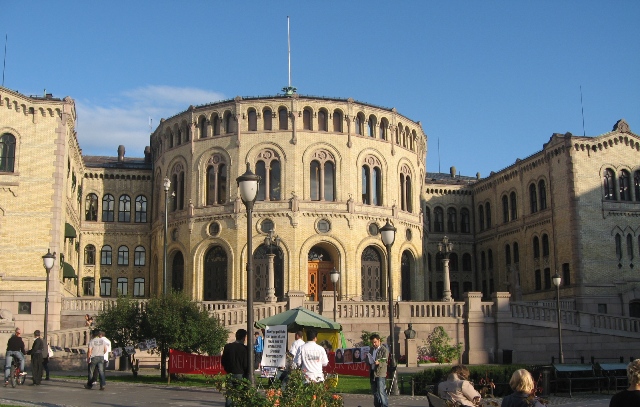
Norwegian Parliament that appoints Nobel Peace Prize Committee
And a few laureates may not have deserved to be so honoured – but Lundestad won’t name any for now (he likes his job and wants to keep it). Perhaps one day, after retirement, he might write a book where this particular insight could be shared.
Controversy has been a regular feature of the prize – both over its selections and exclusions. This is only to be expected when thousands of nominations are received every year, and given the high level political message the selection sends out to the world.
Despite its flaws, there is little argument that the Nobel Peace Prize is the most prestigious of all awards and prizes in the world. At Swedish Krona 10 million, or a little over 1.5 million US Dollars, it isn’t the most lavish prize – but much richer prizes lack the brand recognition this one has achieved over the decades. And it is the best known among over 100 peace prizes in the world.
In recent years, the committee has steadily expanded the scope of the prize to recognise the nexus between peace, human security and environmental degradation (Wangaari Mathaai in 2004; Al Gore and IPCC in 2007) and the link between poverty and peace (Mohammud Yunus, 2006).
The most important question, to many historians and scholars of peace, is the political and social impact of the Nobel Peace Prize. Lundestad is being too modest when he says that it’s the laureates, not the prize itself, that has achieved progress in various spheres ranging from nuclear disarmament and humanitarian intervention to safeguarding human rights and poverty reduction.
“We may have contributed — and that is quite enough,” he says. “We don’t claim to have ended the Cold War, or apartheid in South Africa.”
But the prize’s influence and catalytic effect are indisputable. When the 1983 prize was given to Polish trade union leader Lech Walesa, it triggered a whole series of events that eventually led to the crumbling of the Iron Curtain, collapse of the Berlin Wall and the eventual disintegration of the once mighty Soviet Union. The process culminated when Mikhail Gorbachev became the 1990 laureate. Read Nobel Peace Prize: Revelations from the Soviet Past
In another example, over the years there have been four South African laureates – Albert Lutuli (1960), Bishop Desmond Tutu (1984), Nelson Mandela and F W de Klerk (sharing 1993 prize). Lundestad says: “But we would never claim that the prize was a major factor in ending apartheid in South Africa. The prize was part of the wider international support that built up and sustained pressure on the white minority government. In some respects, the 1960 prize to Lutuli may have been the most significant – for it triggered a process that culminated in the early 1990s.”
He acknowledges, however, that in hot spots like Burma, East Timor and South Africa, the Nobel Peace Prize has enhanced the profile of key political activists and helped maintain the international community’s and media’s interest in these long drawn struggles.
And as Lundestad and the Nobel Peace Prize Committee of five unknown Norwegians know all too well, there is much unfinished business in our troubled and quarrelsome world seeking an elusive peace.
Watch a 2005 interview by University of California television, where host Harry Kreisler talks with Geir Lundestad. They discuss the Nobel Peace Prize, its history, impact and the controversy surrounding some of the awardees (December 2005):
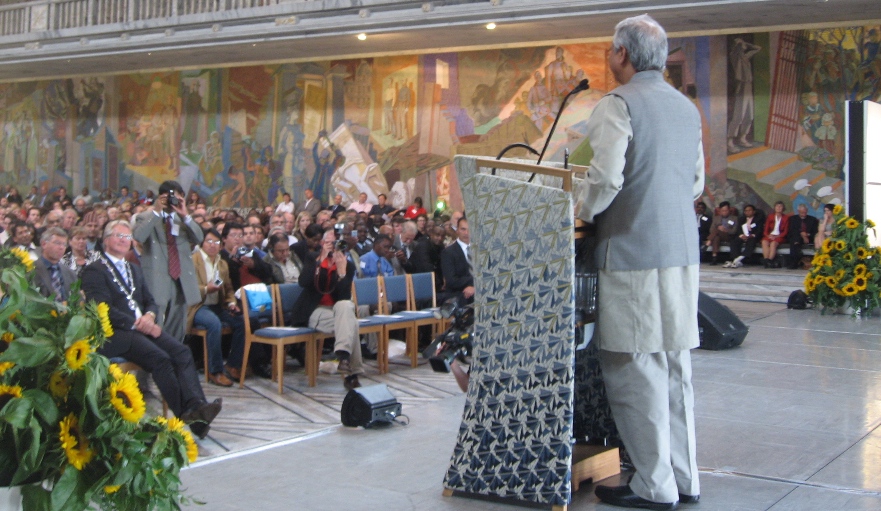
Muhammad Yunus speaking at Oslo City Hall on 4 Sep 2008
The celebrated Bangladeshi economist and anti-poverty activist Muhammad Yunus returned to Oslo’s City Hall today, more than one and a half years after he accepted the 2006 Nobel Peace Prize there. In a passionate, insightful talk to a full house of over 900 people, he revisited his favourite topic: how to banish poverty from our planet.
The occasion was 2008 North-South Forum, convened and hosted by Fredskorpset, the Norwegian peace corp, together with the city council of Oslo. I was among the 350 international participants who have come from 50 countries to participate in this event.
“We can and must chip away at poverty, and get rid of it – just like what they did to the Berlin Wall,” he said. “I’m dreaming of the day when there is no more poverty on this planet…the day when our future generations would have to visit a museum to see what it was like to live in poverty.”
Wistfully, he added: “I would then want to offer a million dollar prize to anyone who can find a poor person.”
He tempered this idealistic vision with the economist’s strong realism: to overcome poverty, we first need to understand and come to terms with factors that cause and sustain it.
“There is nothing intrinsically wrong with poor people,” Yunus said. “They are ordinary people like you and me – many of them talented and capable. But they have never had the opportunity to do well in life. Poverty is not created by poor people, but by the (social and economic) system we have created around us.”
Banishing poverty is not just a matter of social justice – it is also an ‘insurance’ against social disintegration and other major problems of our times like crime and terrorism.
Prof Yunus made the same points in this interview with the Nobel Prize website:
For several years, Yunus has been voicing concerns about the so-called war on terror diverting much needed attention and resources away from the war on poverty. In his Nobel Prize lecture delivered in the same hall on 10 December 2006, he said: “I believe terrorism cannot be won over by military action. Terrorism must be condemned in the strongest language. We must stand solidly against it, and find all the means to end it. We must address the root causes of terrorism to end it for all time to come. I believe that putting resources into improving the lives of the poor people is a better strategy than spending it on guns.”
When Yunus speaks, he sounds far more like an amiable story teller than the professor of economics that he once was. He appeals to the heart and mind of his listeners, in that order. He did not dazzle his audience with endless facts and figures. There were no fancy Power Points or endless charts – the essential tools of poverty researchers. And, mercifully, he never once referred to the dubious millennium development goals or MDGs, the favourite mantra of assorted UN types. (They started off as a well-intended set of targets, but have become self-limiting, self-serving distractions for the development community.)
Instead, he drew from the practical, real life experiences of the Grameen Bank that he founded in 1976, when working as a professor at the University of Chittagong in Bangladesh. Grameen’s three decades of work providing small loans to the poorest of the poor is ample evidence, he said, that the vicious cycles of poverty, debt and misery can be broken by ‘tiny interventions, sustained over time’. Grameen started with 27 poor people in a single village. Today, it has over 7 million participating in its micro credit programes, 97 per cent of them women.
Yunus offers a grand vision without grandiose claims or pomposity. He is fond of the word ‘tiny’ – using it to describe the various initiatives he and his team have been taking to attack poverty from many different fronts. The results are anything but tiny.
In his new book, Professor Yunus describes the role of business in promoting social reform and his vision for an innovative business model that would combine the power of free markets with a quest for a more humane, egalitarian world that could help alleviate world poverty, inequality, and other social problems. He calls it ‘social business’ – a hybrid of the profit-maximising corporate sector and charitable non-profit sector.
Listen to Muhammad Yunus speak at Google New York City campus on 10 January 2008 about ideas captured in his new book:
In 2006, the Nobel Peace Prize was awarded to Muhammad Yunus and Grameen Bank for their efforts to create economic and social development from below. In doing so, the Norwegian Nobel Committee noted: “Lasting peace can not be achieved unless large population groups find ways in which to break out of poverty. Micro-credit is one such means. Development from below also serves to advance democracy and human rights.” Read full statement
Watch an indepth interview with Yunus by the US journalist and doyen of TV interviewers, Charlie Rose:
Alexandr Solzhenitsyn: image courtesy New York Times
“For a country to have a great writer … is like having a second government. That’s why no régime has ever loved great writers, only minor ones.”
The great Russian writer Aleksandr Solzhenitsyn, who died 3 August 2008 aged 89, made this remark 40 years ago, in The First Circle(written in the early 1960s, and first published in the West in 1968).
The mighty man, who stood up to one of the most tyrannical states in history – and outlived it by almost 20 years – was buried this week at the Donskoy Monastery, Moscow, as he had wished. That was a far more dignified and respectable departure than what the late, unlamented Soviet Union received when it disintegrated in 1989-90.
From the time his death was reported, post-Soviet Russia, and the rest of the reading and caring world, stood in solemn, grateful silence in awe of the living legend that Solzhenitsyn had become in his own life time. As a small-time writer of no consequence, I join them in my own personal salute.
As every writer – major and minor – who has ever heeded his or her conscience knows, standing up to governments is an extremely hazardous business, especially in a world where might often emerges as right, at least in the short term. In the twenty first century, governments may adopt more subtle methods of suppressing dissent, but their final effect is no less sinister than those brutal ones that Soviet Union followed at the height of the Cold War in the 1950s and 1960s.
I must admit here and now that I haven’t read any of Solzhenitsyn’s celebrated works. But that doesn’t diminish my admiration for him as one of the world’s best known writer-dissidents. Any man who stands up to Big Bad Governments defies all odds, and a man who employs only ideas and words in such a struggle is a greater hero in my mind than anyone else.
A high school teacher of mine, who was a great fan of Solzhenitsyn, once told us: “Never underestimate the power of well written and sincere words.” That was in the mid 1980s, when the writer was living in exile in the United States and the Soviet Union still seemed unshakable. But subsequent events have proved how prophetic those words were.
In a sense, many of us will never quite discover the true Solzhenitsyn. Unless we learn Russian at this stage in life, we can only read Solzhenitsyn through English translations — and as I have discovered this week by browsing widely online for writing by and about him, the quality of these translations vary considerably.
“During all the years until 1961, not only was I convinced that I should never see a single line of mine in print in my lifetime, but, also, I scarcely dared allow any of my close acquaintances to read anything I had written because I feared that this would become known. Finally, at the age of 42, this secret authorship began to wear me down. The most difficult thing of all to bear was that I could not get my works judged by people with literary training. In 1961, after the 22nd Congress of the U.S.S.R. Communist Party and Tvardovsky’s speech at this, I decided to emerge and to offer One Day in the Life of Ivan Denisovich.
“Such an emergence seemed, then, to me, and not without reason, to be very risky because it might lead to the loss of my manuscripts, and to my own destruction. But, on that occasion, things turned out successfully, and after protracted efforts, A.T. Tvardovsky was able to print my novel one year later. The printing of my work was, however, stopped almost immediately and the authorities stopped both my plays and (in 1964) the novel, The First Circle, which, in 1965, was seized together with my papers from the past years. During these months it seemed to me that I had committed an unpardonable mistake by revealing my work prematurely and that because of this I should not be able to carry it to a conclusion.”
Thus, the 1960s was the turning point when hitherto obscure Solzhenitsyn burst into the literary landscape of his native country, and his uncompromising stand against the suffering of his people brought him worldwide attention.
Solzhenitsyn’s open letter to the Fourth Soviet Writers’ Congress, on 16 May 1967, was particularly outspoken and expressive of his views of the social responsibility of writers and artistes: “Literature that is not the breath of contemporary society, that dares not transmit the pains and fears of that society, that does not warn in time against threatening moral and social dangers — such literature does not deserve the name of literature; it is only a façade. Such literature loses the confidence of its own people, and its published works are used as wastepaper instead of being read.”
By then under siege by the entire might of the USSR, and having only his formidable guts and wits as his defence, he already had a strong sense of destiny. In the same open letter, he added: “I am of course confident that I will fulfill my tasks as a writer in all circumstances — from my grave even more successfully and more irrefutably than in my lifetime. No one can bar the road to truth, and to advance its cause I am prepared to accept even death. But may it be that repeated lessons will finally teach us not to stop the writer’s pen during his lifetime? At no time has this ennobled our history.”
Solzhenitsyn’s global stature in the world of letters was reaffirmed in 1970 when he was awarded the Nobel Prize in Literature. But he could not receive the prize personally in Stockholm – he was afraid he would not be allowed back into the Soviet Union. He finally collected his prize only at the 1974 Nobel ceremony after he had been deported from the Soviet Union.
In his Nobel Prize Lecture (delivered to the Swedish Academy but never actually given as a lecture), I came across these words which epitomise the man and his views: “Woe to that nation whose literature is disturbed by the intervention of power. Because that is not just a violation against ‘freedom of print’, it is the closing down of the heart of the nation, a slashing to pieces of its memory. The nation ceases to be mindful of itself, it is deprived of its spiritual unity, and despite a supposedly common language, compatriots suddenly cease to understand one another. Silent generations grow old and die without ever having talked about themselves, either to each other or to their descendants. When writers such as Achmatova and Zamjatin – interred alive throughout their lives – are condemned to create in silence until they die, never hearing the echo of their written words, then that is not only their personal tragedy, but a sorrow to the whole nation, a danger to the whole nation.”
Solzhenitsyn’s writing is studded with such gems that I’ve resolved to discover even if belatedly. After all, I’m now at the exact age (42) when he finally decided to start publishing his work — a monumental personal decision that has left its mark on history.
For now, my favourite Solzhenitsyn quote is one that resonates so well with my own current turmoils in life: “If one is forever cautious, can one remain a human being?”
“Watching the current SAARC jamboree unfold over television news, my young daughter asked why none of the officials were smiling. The SAARC Secretary General, Dr. Sheel Khant Sharma, was always scowling. Others didn’t have smiles on their faces either, even insincere ones. They all looked stressed out, wearing glum, miserable faces.
“I could only hazard a guess. Perhaps the assorted babus have too much to worry about, as they get through their very serious and grim business of fostering regional cooperation. On the other hand, after all these years of endless meetings and declarations, they might have forgotten the simple joys of smiling and enjoying each other’s company.”
The essay is my personal response to the meetings of the South Asian Association for Regional Cooperation or SAARC, taking place in my home city of Colombo this week. Assorted babus (a derogatory South Asian term for pompous officials) from all over South Asia have invaded the city, displacing its people and severely disrupting normal life and work.
And all for what? So that the unsmiling babus can congratulate each other on how little they have accomplished since the last such gathering in New Delhi in April 2007!
As I note in my essay: “Make no mistake: SAARC is a good idea hijacked by unimaginative and pompous, unsmiling babus of South Asia and run to the ground. The self-congratulatory rhetoric of the inter-governmental merry-go-round is once again deafening us as the 15th SAARC takes place in Colombo. In reality, SAARC at 23 has the mental development of a 3-year-old (if that). There isn’t, in fact, much to smile about.“
The SAARC Sec Gen is always scowling, with never a smile on his face...
I go on to note:
“The proof of the SAARC pudding is not in over-hyped Summits or crusty declarations, but in the free flow of people, ideas, creativity and culture across the political boundaries jealously guarded by governments and their militaries. Most SAARC initiatives miserably fail this test. Typical of this arrested development is the SAARC Audio-Visual Exchange, SAVE.”
The rest of my essay is a critique of SAVE, and how it has failed to foster greater regional understanding among the people of South Asia through the airwaves. This is because SAVE brought together only the state-owned radio and television stations of South Asia which are no more than propaganda organs for ruling parties and/or militaries that are running our countries.
I go on to cheer the recent initiative called TV South Asia, a collaboration involving 5 private TV broadcasters in South Asia. Without any of the pomposity of SAVE or SAARC, TV South Asia is quietly doing what SAVE has failed for nearly a quarter of a century.
When our Sri Lanka 2048 TV debate series started a few weeks ago, I had no idea that I’d be hosting some programmes. But through an interesting turn of events, I’ve ended up doing just that.
The series, which TVE Asia Pacific is co-producing with IUCN and MTV Channel (Pvt) Limited — Sri Lanka’s ratings leading TV broadcaster — has been going out once every week from 22 May 2008. As I wrote at the time the series started, most programmes (8 out of 10) were hosted by Sirasa TV’s versatile and dynamic presenter Kingsly Rathnayaka.
Our plan was to do two shows in English, exploring the topics living with climate change and the nexus between business and the environment. We were still searching for a presenter for these two even as we produced and aired the Sinhala programmes.
In the end, the channel management as well as our production team all suggested for me to take it on. I’ve been hosting quiz shows on TV since 1990, and have been a regular ‘TV pundit’ on a broad range of development, science and technology issues for at least a decade. I’ve also been doing a fair amount of moderating sessions and panels at international conferences. Hosting Sri Lanka 2048 challenged me to combine all these skills — and to be informed, interested and curious about our topics under discussion.
I enjoyed being the ‘skeptical inquirer’, a role I’ve had fun playing for long years as a development journalist. Our viewers can judge how well I fared. My aim was to keep the panel and audience focused, engaged and moving ahead. My style is slower and more reflective than Kingsly’s fast-paced, chatty one. Direct comparisons would be unfair and unrealistic since we are very different personalities.
But I’m enormously grateful to the younger, more experienced Kingsly for his advice and guidance in preparing for my new role. The TV camera is ruthless in capturing and sometimes magnifying even minor idiosyncrasies in presenters. It has as much to do with style as with substance. Hope I made the grade…
Sri Lanka 2048 series branding
Here’s the promotional blurb for this weekend’s show, titled Business As Unusual (yes, I borrowed the apt title from our sorely missed inspiration Anita Roddick). It was broadcast on Channel One MTV, the English language channel of Sri Lanka’s Maharaja broadcasting group.
Sri Lanka 2048 looks at Business As Unusual: How can companies do well while doing good?
The private sector is acknowledged as the engine of our economic growth. But how long can this ‘engine’ keep running without addressing its many impacts on society and the natural environment? With public concerns rising everywhere for a cleaner and safer environment, how best can businesses respond to the environmental challenges — and find new opportunities to grow and innovate?
These and related questions will be raised in this week’s Sri Lanka 2048, the series of TV debates exploring Sri Lanka’s prospects for a sustainable future in the Twenty First Century. The one-hour debate, this time in English, will be shown on Channel One MTV from 8 to 9 pm on Saturday, 19 July 2008.
Titled Business As Unusual, this week’s debate brings together concerned Sri Lankans from academic, corporate, civil society and government backgrounds to discuss what choices, decisions and tradeoffs need to be made for businesses to become environmentally responsible — and still remain profitable. Increasingly, there are examples of smart companies achieving this balance.
Sri Lanka 2048 panel on business and environment broadcast on 19 July 2008
The wide ranging discussion — looking at both domestic and international markets, and covering a range of industries — notes that many companies already address not just financial but also social and environmental bottomlines. Adopting cleaner production practices have helped increase profits through being thrifty with resources and careful with waste.
The debate also looks at the findings of a survey that IUCN and the Ceylon Chamber of Commerce carried out last year of 45 companies on their corporate social responsibility (CSR) policies and practices. It revealed that a significant number of companies are actively applying CSR principles, with slightly over half (53%) already having environmental components in their CSR (known as CSER). The survey also found that local companies were stronger on CSR/CSER than the local operations of multinational companies.
As some panelists and audience members argue, embracing sound environmental practices goes well beyond CSR. With rising consumer awareness and greater scrutiny of how companies source materials and energy, ‘going green’ has become an integral part of responsible corporate citizens.
Sri Lanka 2048 debates are co-produced by TVE Asia Pacific, an educational media foundation, and IUCN, the International Union for Conservation of Nature, in partnership with MTV Channel (Private) Limited. This editorially independent TV series is supported under the Raising Environmental Consciousness in Society (RECS) project, sponsored by the Government of the Netherlands.
Sri Lanka 2048 - Nalaka briefing audience just before recording starts...
Wherever you are, Anita, I hope you were watching our show tonight — and hopefully nodding… When you insisted that businesses must care for community and the environment, you were so ahead of the pack. We’re still struggling to catch up.
On the set of Sri Lanka 2048: Nalaka with panelist Jeevani Siriwardena
“There are times in the history of our nation when our very way of life depends upon dispelling illusions and awakening to the challenge of a present danger. In such moments, we are called upon to move quickly and boldly to shake off complacency, throw aside old habits and rise, clear-eyed and alert, to the necessity of big changes. Those who, for whatever reason, refuse to do their part must either be persuaded to join the effort or asked to step aside. This is such a moment. The survival of the United States of America as we know it is at risk. And even more – if more should be required – the future of human civilization is at stake.”
With these words, climate crusader Al Gore opened a powerful speech delivered in Washington DC on 17 July 2008, in which he issued what he called ‘A Generational Challenge to Repower America’ to take bold steps towards solving the climate crisis.
At one point he told fellow Americans:“We’re borrowing money from China to buy oil from the Persian Gulf to burn it in ways that destroy the planet. Every bit of that’s got to change.”
Having outlined the environmental, security and economic implications of America’s addiction to oil, Gore challenged his nation “to commit to producing 100 percent of our electricity from renewable energy and truly clean carbon-free sources within 10 years”.
I was immediately reminded of President Kennedy’s pledge to Congress on 25 May 1961 where he said:
“I believe that this nation should commit itself to achieving the goal, before this decade is out, of landing a man on the Moon and returning him back safely to the earth.”
In fact, later on in his speech Gore referred to this saying: “When President John F. Kennedy challenged our nation to land a man on the moon and bring him back safely in 10 years, many people doubted we could accomplish that goal. But 8 years and 2 months later, Neil Armstrong and Buzz Aldrin walked on the surface of the moon.”
Al Gore’s full speech, according to a video recording posted on YouTube, lasted 27 minutes — but the We Campaign has released the highlights of the speech running for 5 minutes:
The We Campaign is a project of The Alliance for Climate Protection — a nonprofit, nonpartisan effort founded by Nobel laureate and former Vice President Al Gore. Our ultimate aim is to halt global warming. Specifically we are educating people in the US and around the world that the climate crisis is both urgent and solvable.



 Instead, he drew from the practical, real life experiences of the


 Open Minds!