The undersea quake that triggered the Indian Ocean tsunami on 26 December 2004 was so powerful that it was felt around the globe, as far away as Alaska. Likewise, the killer waves that hammered the coasts of South and Southeast Asia left such a trail of destruction that it was like a lasting, unceasing wave.
On the eve of the mega-disaster’s fifth anniversary, I’ve been busy writing, talking and reflecting on what it meant for me personally, and my media profession and fellow Asians in general. I recently filmed an interview for Thai Public Television (TPBS), where my friend Pipope Panitchpakdi is doing a tsunami+5 documentary.
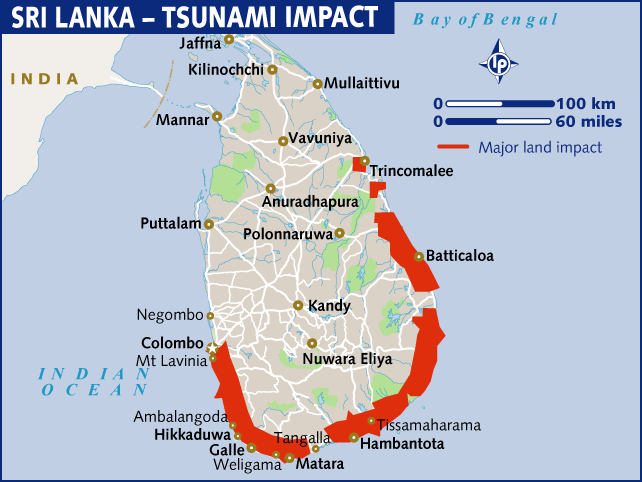
He was in Sri Lanka at the time of the tsunami, and spent two weeks working as a freelance reporter covering the aftermath for the western media. His piece sums up the mixed bag of lessons and recovery efforts that Sri Lanka, one of the hardest hit countries, has accomplished in the half decade this that momentous day.
An excerpt: “Five years later, life in the affected countries has resumed, and the world has learned immensely valuable lessons about responding to catastrophe. But as with any human endeavor, some opportunities have also been lost.”
As I later heard, some in my audience had mistakenly believed that I was advocating everything going entirely online. Actually, I wasn’t. I like to think that both the physical and virtual media experiences enrich us in their own ways. Real world is never black and white; it’s always a mix or hybrid of multiple processes or influences.
So I’ve just revisited the topic. I adapted part of the talk, and included more personalised insights, and wrote an essay titled ‘Confessions of a Digital Immigrant‘, which has just been published on Groundviews, the path-breaking citizen journalism initiative.
It opens with these words:
“My daughter Dhara, 13, finds it incredible that I had never seen a working television until I had reached her current age — that’s when broadcast television was finally introduced in Sri Lanka, in April 1979. It is also totally inconceivable to her that my entire pre-teen media experience was limited to newspapers and a single, state-owned radio station.
“And she simply doesn’t believe me when I say — in all honesty and humility — that I was already 20 when I first used a personal computer, 29 when I bought my first mobile phone, and 30 when I finally got wired. In fact, my first home Internet connectivity — using a 33kbps dial-up modem — and our daughter arrived just a few weeks apart in mid 1996. I have never been able to decide which was more disruptive…
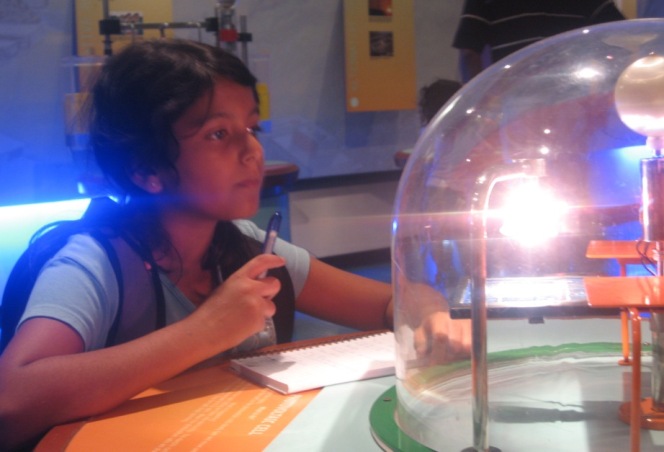
“Dhara (photographed above, in mid 2007) is growing up taking completely for granted the digital media and tools of our time. My Christmas presents to her in the past three years have been a basic digital camera, an i-pod and a mobile phone, each of which she mastered with such dexterity and speed. It amazes me how she keeps up with her Facebook, chats with friends overseas on Skype and maintains various online accounts for images, designs and interactive games. Yet she is a very ordinary child, not a female Jimmy Neutron.
“Despite my own long and varied association with information and communication technologies (ICTs), I know I can never be the digital native that Dhara so effortlessly is. No matter how well I mimic the native ‘accent’ or how much I fit into the bewildering new world that I now find myself in, I shall forever be a digital immigrant.”
News by definition looks for the exception. What goes right, and according to plan, is hardly news. Deviations, aberrations and accidents hit the news.
It’s the same with disasters. Reducing a hazard or averting a disaster does not make the news; when that hazard turns into a disaster, that typically tops the news. Yet, as we discussed during a session at the 6th World Conference of Science Journalists held in London from June 30 – July 2, 2009, both aspects are important — and both present many challenges to journalists and the media.
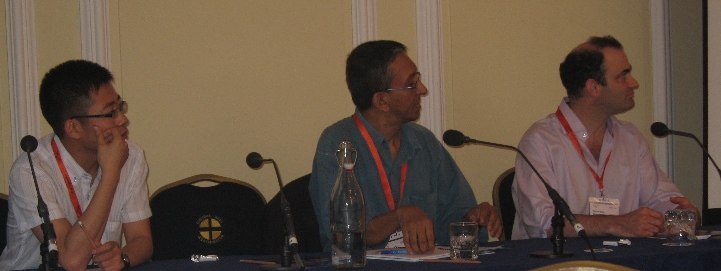
The session, titled Covering a disaster from Sichuan to Sri Lanka, saw three science journalists share their own experiences and insights in covering two major disasters in Asia. Richard Stone (Asia News Editor, Science) and Hujun Li (senior science writer with Caijing magazine, China) both spoke about covering the Sichuan earthquake that occurred on 12 May 2008. I spoke on my experiences in covering the Indian Ocean tsunami of 26 December 2004. The session was chaired by the veteran (and affable) British journalist Tim Radford, who has been The Guardian‘s arts editor, literary editor and science editor.
Covering a disaster from Sichuan to Sri Lanka: L to R: Hujun Li, Nalaka Gunawardene and Richard StoneI recalled the post-tsunami media coverage in two phases — breaking news phase (first 7 – 10 days) and the aftermath, which lasted for months. When the news broke on a lazy Sunday morning, ‘Tsunami’ was a completely alien term for most media professionals in Sri Lanka. In newspaper offices, as well as radio and TV studios, journalists suddenly had to explain to their audiences what had happened, where and how. This required journalists to quickly educate themselves, and track down geologists and oceanographers to obtain expert interpretation of the unfolding events. We than had to distill it in non-technical terms for our audiences.
My involvement in this phase was as a regular ‘TV pundit’ and commentator on live TV broadcasts of MTV Channels, Sri Lanka’s largest and most popular broadcast network. Night after night on live TV, we talked about the basics of tsunami and earthquakes, and summed up the latest information on what had taken place. We also acknowledged the limits of science -– for example, despite advances in science and technology, there still was no way of predicting earthquakes in advance.
One question we simply couldn’t answer was frequently raised by thousands of people who lost their loved ones or homes: why did it happen now, here — and to us? Was it an act of God? Was it mass scale karma? As science journalists, we didn’t want to get into these debates — we had to be sensitive when public emotions were running high.
There were enough topics during the breaking news phase that had a scientific angle. Clinically cold as it sounded, the mass deaths required the safe, proper and fast burial of bodies with identities established. The survivors had to be provided shelter, food, safe drinking water and counselling. And when rumours were spreading on the possibility of further tsunamis, both officials and public needed credible information from trusted, competent sources.
Tsunami waves lashing Kalutara beach on western Sri Lanka on 26 December 2004: satellite image courtesy DigitalGlobe Quickbird satellite, http://www.digitalglobe.com
After the breaking news phase passed, we had more time to pursue specific stories and angles related to the tsunami. As an environmentally sensitive journalist, I was naturally interested in how the killer waves had impacted coastal ecosystems. Then I heard some interesting news reports – on how some elements of Nature had buffered certain locations from Nature’s own fury.
Within days, such news emerged from almost all Tsunami-affected countries. They talked about how coral reefs, mangroves and sand dunes had helped protect some communities or resorts by acting as ‘natural barriers’ against the Tsunami waves. These had not only saved many lives but, in some cases, also reduced property damage. Scientists already knew about this phenomenon, called the ‘greenbelt effect’. Mangroves, coral reefs and sand dunes may not fully block out tsunamis or cyclones, but they can often reduce their impact.
Researching this led to the production of TVE Asia Pacific‘s regional TV series called The Greenbelt Reports, which was filmed at a dozen tsunami impacted locations in South and Southeast Asia. By the time we released the series in December 2006, sufficient time had passed for the affected countries to derive environmental lessons of the tsunami.
The other big story I closely followed was on early warnings for rapid on-set disasters like tsunamis. Some believed that the tsunami caught Indian Ocean rim countries entirely by surprise, but that wasn’t quite true. While the countries of South and Southeast Asia were largely unprepared to act on the tsunami, the Pacific Tsunami Warning Centre (PTWC) in Hawaii, who had detected the extraordinary seismic activity, did issued a tsunami warning one hour after the undersea quake off western Sumatra. This was received at Sri Lanka’s government-run seismological centre in good time, but went unheeded: no one reacted with the swiftness such information warranted. Had a local warning been issued, timely coastal evacuation could have saved thousands.
All this shows the many and varied science or development stories that journalists can find in the aftermath of disasters. Some of these are obvious and widely covered. Others need to be unearthed and researched involving months of hard work and considerable resources. Revisiting the scenes of disasters, and talking to the affected people weeks or months after the event, often brings up new dimensions and insights.
My own advice to science journalists was that they should leave the strictly political stories to general news reporters, and instead concentrate on the more technical or less self-evident facets in a disaster. During discussion, senior journalist Daniel Nelson suggested that all disaster stories are inherently political as they deal with social disparities and inequalities. I fully agreed that a strict separation of such social issues and science stories wasn’t possible or desirable. However, science journalists are well equipped to sniff out stories that aren’t obviously covered by all members of the media pack that descends on Ground Zero. Someone needs to go beyond body counts and aid appeals to ask the hard questions.
As Hujun Li said recalling the post-Sichuan quake experience, “Politics and science are like twins – we can’t separate the two. What we as science journalists can do is to gather scientific evidence and opinion before we critique official policies or practices.”
Another question we were asked was how journalists can deal with emotions when they are surrounded by so much death and destruction in disaster scenes. Reference was made to trauma that some reporters experience in such situations.
I said: “We are human beings first and journalists next, so it’s entirely normal for us to be affected by what is happening all around us. On more than one occasion in the days following the tsunami, I spoke on live television with a lump in my throat; I know of presenters who broke down on the air when emotions overwhelmed them.”
And now...the sequelsSumming up, Tim Radford emphasized the need for the media to take more interest in Disaster Risk Reduction (DRR), which basically means preventing disasters or minimising the effects of disasters.
“DRR is perhaps less ‘sexy’ for the media, as it involves lots of policies and practices sustained over time,” he said. “But the potential to do public good through these interventions is enormous.”
As Tim reminded us, disasters already exact a terrible and enduring toll on the poorest countries. This is set to get worse as human numbers increase and climate change causes extreme weather and creates other adverse impacts. Living with climate change would require sustained investments in DRR at every level.
The stories are out there to be captured, analysed and communicated. In the coming years, the best stories may well turn out to be on disasters averted or minimised
Asian voice in a global village“We’re the messenger for all the stories that might not have been told…that’s our job,” says Glenda Chong, the Shanghai-based China correspondent (and former anchor) of Channel NewsAsia (CNA), the Singapore-based Asian regional news broadcaster that just turned 10.
For a decade, CNA has covered Asia for Asians and the rest of the world. It has uncovered stories missed – or ignored – by other, global news channels. Just as important, it has also found the Asian voices and angles in mega stories originating from Asia that gripped the world’s attention — such as the outbreak of SARS, Indian Ocean tsunami, earthquakes in Sichuan and Kashmir.
Started on 1 March 1999 and owned by Singapore’s MediaCorp, CNA is now a major Asian news broadcaster with programmes telecast to more than 20 Asian countries and territories. Visit CNA’s 10th anniversary website for a look back…and forward.
“In the early days, when we talked about a news channel from Singapore, you could cut the cynicism with a knife,” said Woon Tai Ho, managing director of MediaCorp News.
That was inevitable for any media venture anchored in Singapore, ranked currently at 144 out of 173 countries in the World Press Freedom Index. But CNA has shown that geography need not be destiny.
Asians telling their own storyIn 10 years, it has emerged as a primary source of news in Asia, and along the way, has picked up a plethora of high-profile awards — including two silver medals at the New York Festivals 2009 and three awards at Asia Television Awards 2008.
Started as a business news channel at the tail end of the Asian financial crisis of 1997, CNA later evolved into a fully-fledged news and current affairs channel covering all facets, aspects and territories of Asia – the world’s largest region, home to half of humanity. Map showing CNA geographical coverage
Ironically, CNA enters double-digits chronicling the region once again in the midst of a financial crisis, this time of global proportions and repercussions.
Unlike Al Jazeera English (AJE), the global news channel launched from Qatar in November 2006, CNA has relied on Asian talent for anchoring and reporting. While AJE has shamelessly and desperately tried to ape the BBC, CNA has forged its own identity in offering a world class product.
Whereas AJE tries so hard to please its audiences in Europe and North America (is it so anxious for western acceptance?), CNA has focused its energies in telling the myriad stories of emerging Asia primarily for Asia’s upwardly mobile, burgeoning middle classes.
For example, when an interviewee gives his/her views in a language other than English, Channel NewsAsia does not voice-over the original audio with an anglo-saxon voice like other major news channels do. Instead, an English subtitle appears, preserving and complementing the original audio.
At TVE Asia Pacific, we have had a positive experience of engaging this regional broadcaster. In late 2005, we were looking for a broadcast partner to co-produce a documentary looking back at the first year after the Indian Ocean tsunami through the eyes of eight survivor families – in India, Indonesia, Sri Lanka and Thailand – that we had tracked on video under the Children of Tsunami project. We had a mass of professionally and ethically filmed material, and a unique collection of stories we were keen to be amplified to the world.
When we approached Channel NewsAsia through a friend, they immediately welcomed the collaboration. They invested their time, resources and talent to edit Children of Tsunami: No More Tears, a half hour that distilled some of the stories that we had painstakingly captured for a year. No money changed hands. Legalities were kept to a minimum. CNA saw we had a story that was relevant and important for their viewers. They found the story authentic, as captured by local crews who spoke the language in each country and who lived through the traumas of the tsunami themselves (no ‘parachute film crews’ were involved). So CNA just did it — with none of the airs of pomposity and self importance that so characterise the BBC in any collaboration.
Children of Tsunami: No More Tears was first broadcast globally on Channel NewsAsia in the last week of December 2005 to mark the tsunami’s first anniversary with this intro: “Young survivors of the Asian tsunami let us into their lives to personalise the mass of statistics, aid pledges and recovery plans. ‘Children of Tsunami’ is a tapestry of intimate stories, woven by voices of individual and collective resilience, heroism and recovery.”
Jantakarn Thep-Chuay, known as Beam
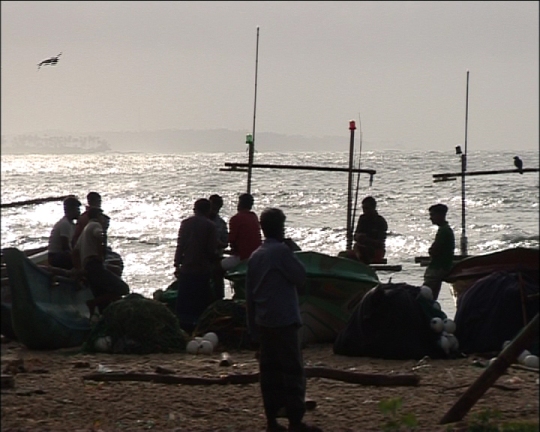
For many weeks, Jantakarn Thep-Chuay — nicknamed Beam -– did not understand why her father was not coming home. The eight-year-old girl, in Takuapa in Thailand’s southern district of Phang Nga, had last seen him go to work on the morning of 26 December 2004.
“On that Sunday, the day there was a wave, my dad wore his tennis shoes,” she recalls as she gets into his pair of sandals. “My dad didn’t have to do much work — he just walked around looking after workers.”
Beam’s father Sukaroak –- a construction supervisor at a new beach resort in Khao Lak –- was one of thousands of Thais and foreign tourists killed when the Asian Tsunami hit without warning. His body was never found.
For months, Beam would draw pictures of her family. These, and family photos of happier times, helped her to slowly come to terms with what happened.
The first year was long and hard for the family Sukaroak left behind: Beam, her two-year-old brother Boom, and mother Sumontha, 28. The determined young widow struggled to keep home fires burning -– and to keep her troublesome in-laws at bay.
As if that were not enough, she also had to engage assorted bureaucracies: even obtaining an official death certificate for her late husband entailed much effort.
Just a few weeks after the disaster, the local authorities approached Sumontha suggesting that she gives away one or both her children for adoption. Apparently a foreigner was interested. She said a firm ‘No’.
“Her dad wanted Beam to become an architect. He was hoping for a day when he could build something she draws,” says Sumontha. “If I am still alive, I want to raise my own children. I am their mother. For better or worse, I want to raise them myself.”
The Tsunami destroyed Beam’s school, but she continued to attend a temporary school set up with local and foreign help. Before the year ended, she moved to a brand new ‘Tsunami School’ that the King of Thailand built to guarantee education for all children affected by the disaster.
Sumontha, Beam and Boom are three ordinary Asians who have shown extraordinary courage, resilience and resourcefulness as they coped with multiple challenges of rebuilding their lives after the Tsunami. Theirs is one of eight families that we followed throughout 2005, under our empathetic communication initiative called Children of Tsunami: Rebuilding the Future.
It was a multi-country, multi-media project that tracked how ordinary Asians rebuilt their lives, livelihoods and futures after one of the biggest disasters in recent years. We at TVE Asia Pacific documented on TV, video and web the personal recovery stories of eight affected families in India, Indonesia, Sri Lanka and Thailand for a year after the disaster. Our many media products — distributed on broadcast, narrowcast and online platforms -– inspired wide ranging public discussion on disaster relief, recovery and rehabilitation. In that process, we were also able to demonstrate that a more engaged, respectful kind of journalism was possible when covering post-disaster situations.
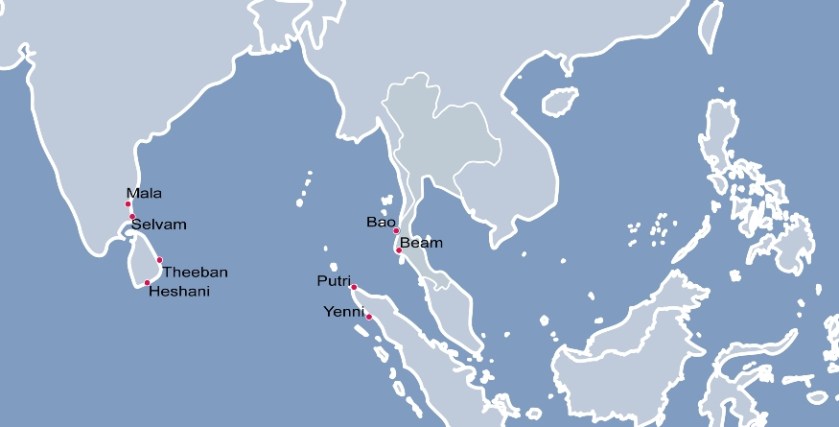
Four countries, eight locations: where Children of Tsunami stories were filmed for much of 2005
Meet the Children of Tsunami…
They have never met each other. Yet they were united first in grief, then in survival. Five girls and three boys, between 8 to 16 years of age, living in eight coastal locations in four countries. Their families were impacted by the Asian Tsunami in different ways. Some lost one or both parents -– or other family members. Some had their homes or schools destroyed. Others found their parents thrown out of a job. During the year, these families faced many hardships and challenges in rebuilding their futures.
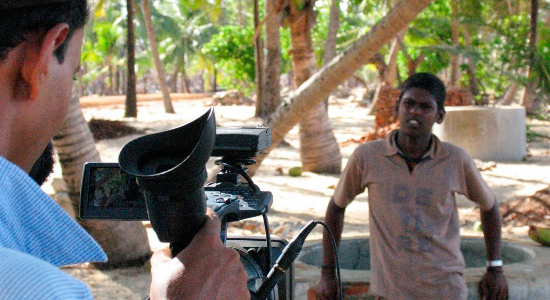
Filming with Theeban in eastern Sri Lanka...now only a memory
As I recalled in early 2007, when we tragically lost one of eight survivor children – Theeban – to Sri Lanka’s civil war: “As journalists, we have been trained not to get too attached to the people or subjects we cover, lest they affect our judgment and dilute our objectivity. The four production teams involved in Children of Tsunami initially agreed to follow this norm when we met in Bangkok in early 2005 for our first (and only) planning meeting. We also resolved not to reward our participating families in cash or kind, as they were all participating voluntarily with informed consent.
“But the ground reality was different. 2005, Asia’s longest year, wore on. As survivors slowly patched their lives together again, our film teams found themselves becoming friends of families or playing Good Samaritan. Sometimes our teams would find a survivor family close to starvation and — acting purely as human beings, not journalists — they would buy dry rations or a cooked meal. At other times, finding the children restless or aimless, they would buy them a football, kite or some other inexpensive toy that would produce hours of joy and cheer.
“As commissioners and publishers of Children of Tsunami stories, we didn’t object to these acts of kindness. Journalism with empathy was far preferable to the cold detachment that textbooks recommend.”
Children of Tsunami: No More Tears (25 mins) was the shorter version of the end-of-year film that captured the highlights and ‘lowlights’ of our families’ first year following the disaster. We co-produced it with the Singapore-based regional broadcaster Channel News Asia.
The tsunami was triggered by a massive quake that erupted off the coast of Sumatra, and 6 miles deep under the Indian Ocean’s seabed. The estimated 9.1 to 9.3 magnitude earthquake was the strongest in 40 years and the fourth largest in a century. The U.S. Geological Survey later estimated that the amount of energy released was equivalent to the energy of 23,000 Hiroshima-type atomic bombs.
Despite a lag of up to several hours between the earthquake and the impact of the tsunami, nearly all affected people were taken completely by surprise. There were no tsunami warning systems in the Indian Ocean to detect tsunamis or to warn those living on the Indian Ocean rim areas. This cost the lives of over 225,000 people in 11 countries — many of who could have lived if only they had a timely warning to rush inland.
In the past four years, there have been various efforts to set up such early warning systems – as well as effective ways to deliver credible warnings to large numbers of people quickly. These are meant to provide 24/7 coverage to Indian Ocean countries in the same way the Pacific Tsunami Warning Centre has been covering Pacific Ocean countries for many years.
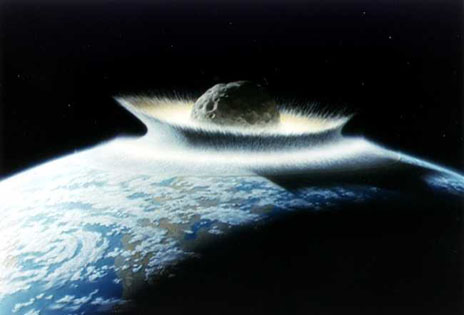
All this is necessary – but not sufficient – to guard ourselves against future tsunamis. For it’s not just earthquakes undersea that can trigger tsunamis. An asteroid impact could trigger the mother of all tsunamis that can impact coastal areas all over the planet.
An asteroid that struck the Earth 65 million years ago wiped out the dinosaurs and 70 per cent of the species then living on the planet. The destruction of the Tunguska region of Siberia in June 1908 – whose centenary was marked this year – is known to have been caused by the impact of a large extraterrestrial object.
Space artist David Hardy's vision...When discussing the possible consequences of asteroid impacts on Earth, more attention has been given to the destruction it can cause by such a falling piece of the sky hitting inhabited areas of land. Some people seem to be comforted by the fact that two thirds of the planet’s surface is ocean — thus increasing changes that an impact would likely happen at sea.
In fact, we should worry more. Duncan Steel, an authority on the subject, has done some terrifying calculations. He took a modest sized space rock, 200 metres in diameter, colliding with Earth at a typical speed of 19 kilometres per second. As it is brought to a halt, it releases kinetic energy in an explosion equal to 600 megatons of TNT — 10 times the yield of the most powerful nuclear weapon tested (underground). Even though only about 10 per cent of this energy would be transferred to the tsunami, such waves will carry this massive energy over long distances to coasts far away. They can therefore cause much more diffused destruction than would have resulted from a land impact. In the latter, the interaction between the blast wave and the irregularities of the ground (hills, buildings, trees) limits the area damaged. On the ocean, the wave propagates until it runs into land.
Scientists have been talking about asteroid impact danger for decades. Arthur C Clarke suggested – in his 1973 science fiction novel Rendezvous with Rama – that as soon as the technology permitted, we should set up powerful radar and optical search systems to detect Earth-threatening objects. The name he suggested was Spaceguard, which, together with Spacewatch, has now been widely accepted.
In November 2008, a group of the world’s leading scientists urged the United Nations to establish an international network to search the skies for asteroids on a collision course with Earth. The spaceguard system would also be responsible for deploying spacecraft that could destroy or deflect incoming objects.
The group – which includes the Royal Society president Sir Martin Rees and environmentalist Sir Crispin Tickell – said that the UN needed to act as a matter of urgency. Although an asteroid collision with the planet is a relatively remote risk, the consequences of a strike would be devastating.
Not if, but when...The International Panel on Asteroid Threat Mitigation, chaired by former American astronaut Russell Schweickart, urged: “The international community must begin work now on forging three impact prevention elements – warning, deflection technology and a decision-making process – into an effective defence against a future collision.”
This is exactly the message in an excellent documentary called Planetary Defence made by Canadian filmmaker M Moidel, who runs the Space Viz production company. Over the past many months, the film has been screened at the United Nations, on various TV channels and at high level meetings of people who share this concern.
Its main thrust: Scientists and the military have only recently awakened to the notion that asteroid impacts with Earth do happen. Planetary Defense meets with both the scientific and military communities to study our options to mitigate an impact. It makes the pivotal point: “Civilization is ill prepared for the inevitable. It’s not if an impact will happen with the Earth, it’s when!”
In such an event, the film asks, who will save Earth? The 48 minute documentary explores the efforts underway to detect and mitigate an impact with Earth from asteroids and comets, collectively known as NEO’s (Near Earth Objects).
Watch the trailer of Planetary Defence on YouTube:
Neil deGrasse Tyson, Astrophysicist and Director, American Museum of Natural History, in New York, says: “Planetary Defense, the film, is a documentary that explores how ill-prepared we are to prevent our own extinction from asteroid and comet impacts. Filmmaker M Moidel interviewed all the right people, asked them all the right questions, and leaves the viewer scared for our future, but empowered to do something about it.”
Although we have never met, I have been in email contact with M Moidel for several years. I know how deeply committed he is to each of his documentary projects. Working on incredibly tight budgets and performing multiple tasks on his own, this brilliant Canadian has made some eminently accessible, timely and captivating documentaries on ‘big picture’ topics such as the search for intelligent life in the universe, the future of space exploration and, of course, coping with asteroid impacts.
Sir Arthur, whose Sri Lankan diving school was destroyed by the 2004 tsunami, wrote a few days after the disaster: “Contrary to popular belief, we science fiction writers don’t predict the future — we try to prevent undesirable futures. In the wake of the Asian tsunami, scientists and governments are scrambling to set up systems to monitor and warn us of future hazards from the sea.
“Let’s keep an eye on the skies even as we worry about the next hazard from the depths of the sea.”
October 8 is the International Day for Disaster Reduction. The United Nations system observes the day ‘to raise the profile of disaster risk reduction, and encourage every citizen and government to take part in building more resilient communities and nations’.
Disaster risk reduction (abbreviated as DRR) is the common term for many and varied techniques that focus on preventing or minimising the effects of disasters. DRR measures either seek to reduce the likelihood of a disaster occurring, or strengthen the people’s ability to respond to it.
DRR is not just another lofty piece of developmentspeak. Unlike many other development measures that are full of cold statistics and/or hot air, this one directly (and quietly) saves lives, jobs and properties.
And it gives people peace of mind – we can’t put a value on that. That was the point I made in a blog post written in December 2007, on the third anniversary of the Indian Ocean Tsunami. Taking the personal example of J A Malani, an ordinary Sri Lankan woman living in Hambantota, on the island’s southern coast, I talked about how she has found peace of mind from a DRR initiative.
Recently, IDRC’s inhouse series ‘Research that Matters’ has published an article about the project. Titled “For Easy Sleep Along the Shore: Making Hazard Warnings More Effective” its blurb reads: “In Sri Lanka, a grassroots pilot study combines advanced communication technologies with local volunteer networks to alert coastal villages to danger coming from the sea.”
TVE Asia Pacific also made a short video film in late 2007. Called The Long Last Mile, it can be viewed on YouTube in two parts:
The Long Last Mile, part 1 of 2:
The Long Last Mile, part 2 of 2:
The recent IDRC article ends with this para: “A related challenge concerns the shortness of any society’s attention span. In the absence of frequent crises and alerts, how can a nation — or even a village — sustain the continuing levels of preparedness essential to ensure that, when the next big wave comes rolling in and the sirens sound, its people will have the motivation and the capacity to act? The follow-up project seeks to address this worry by preparing the hotels and villages to respond to different types of hazards, rather than only to the relatively rare tsunamis.”
This cartoon by Pulitzer prize winning Tom Toles first appeared in the Washington Post in 2007 – it brilliantly anticipated the global financial meltdown that we’re now experiencing. Coming in the wake of confirmed global warming, it is a double whammy.
America has been hit hard by the sub-prime crisis. The social and human cost of financial failure has been enormous. An epidemic of home repossessions has left thousands of houses abandoned and boarded-up: whole suburbs are falling into disrepair and dereliction.
Financial institutions in America and in Britain had poured billions into investments backed by these mortgages. As more and more people have defaulted on their mortgage repayments, financial markets have collapsed, causing a crisis that has rippled across the Atlantic, sending the City of London into turmoil and pulling the plug on one now infamous British bank.
Some call it a financial tsunami not been seen since the Great Depression in the 1930s….a crisis that has forced the US government to step in and save the financial system after trillions were wiped off global stock markets and once revered institutions were swept off the face of Wall Street. Is the US intervention too little, too late to save the economy?
In fact, just a few days ago, the People’s Daily of China warned that a “financial tsunami” was approaching, which recalled the Great Depression in the US. It said: “As the contemporary economy has been integrated globally, American consumption and currency exchange rates will directly influence countries dependent on the US as the main export destination for economic growth and employment”.
The Chinese Communist Party organ complained that the US had unleashed financial “weapons of mass destruction” on the world economy in the form of subprime debts and related financial derivatives.
The world’s media have been scrambling to cover these rapidly unfolding events. In fact, many have been caught napping, or worse, been uncritical cheerleaders of the march of capital and credit. Most of them – even the respected financial journals – just didn’t see the crisis building up…or ignored the tell-tale signs that constituted an inconvenient truth.
Danny Schechter - wasn't crying wolf!“This didn’t just happen in the course of a usual business cycle,” insists the American investigative journalist and media analyst Danny Schechter, who has been tracking this issues for many months on his influential News Dissector blog and the MediaChannel that watches and critiques the media.
In his new book, aptly titled Plunder, Danny offers an in-depth investigation into the decline of the economy that’s causing millions to lose jobs and face foreclosures and across-the-board price hikes.
He says: “You wouldn’t know it by relying on our media, but the subprime scandal masks massing looting by Wall Street firms using carefully calculated predatory lending schemes enabled by regulators who don’t regulate and a media that looked the other way. We have lost trillions and dislocated millions with no relief in sight. Every American is paying for the greed of our financiers in the grocery store, gas pump and unemployment line. Bank robberies are not new — but banks doing the robbing is.”
In 2007, his film IN DEBT WE TRUST was the first to expose Wall Street’s connection to subprime loans, predicting the economic crisis that this book investigates.
I have been watching various news media analysis of the current crisis and want to share two that stood out from the rest: Inside Story by Al Jazeera English, and Dispatches by UK’s Channel 4.
In a special show from New York, Inside Story looks at the financial turbulence that rocked the US last week. Will the emergency measures by the US government be enough to stabilise the markets or has the financial system in the US been changed forever? The introductory report from AJE’s Washington correspondent Reynolds is particularly illuminating – he also writes the story for their website.
Inside Story – The US financial crisis – 21 Sep 2008 – Part 1
Inside Story – The US financial crisis – 21 Sep 2008 – Part 2
From the other side of the Atlantic comes a more investigative, one-hour special that was produced and broadcast in March 2008, when the early signs of the banking crisis were beginning to show – for anybody who cared to notice.
As Channel 4 introduces it: “This is a story about the destructive power of finance: what happens when banks are driven by short-termism; when bankers are rewarded with vast bonuses, free to operate under inadequate regulatory supervision, and with the complicity of a government too in awe of big business to step in.”
Dispatches: How The Banks Bet Your Money UK & US – part 1
In this edition of Dispatches, private equity financier Jon Moulton delivers a stinging rebuke to the banks for causing this financial meltdown and explains why the British taxpayer will now pay the price.
Dispatches: How The Banks Bet Your Money UK & US – part 2
Dispatches: How The Banks Bet Your Money UK & US – part 3
Dispatches: How The Banks Bet Your Money UK & US – part 4
Dispatches: How The Banks Bet Your Money UK & US – part 5
Whenever Burma hits the international news headlines, I think of author Amitav Ghosh. His 2002 historical novel, The Glass Palace, was my introduction to Burma’s recent history. It describes – with historical accuracy and detail – how the British colonised a land of prosperity in 1824 and left it an impoverished nation in 1948.
I was intrigued, therefore, to read an excellent op ed essay by Amitav Ghosh in The New York Times of 10 May 2008. Titled When Death Comes Ashore, it is a commentary on the aftermath of Cyclone Nargis that particularly hit Burma in recent days. Ghosh offers both comfort and worry.
The bad news, as he puts it, is that “for the rapidly growing countries that surround the Bay of Bengal there is an increasing urgency to find a way to protect themselves. They have experienced some of the world’s most devastating storms.”
He makes a strong call for cooperation among the countries who surround the Bay of Bengal, which means Bangladesh, Burma, India, (part of) Indonesia and Thailand.
As he says: “Nation-states tend to see their interests as being confined within their own borders. But the reality is that the people who live around the Bay of Bengal have a vital interest in common that they do not share with their compatriots in the hinterlands: they are joined by the furies (and let it be said also, the blessings) of that body of water.”
“Recent experience has demonstrated in spectacular ways that rich, technologically advanced nations are not invulnerable to extreme weather. What has also been demonstrated, but more quietly, is that a nation need not be wealthy or technologically advanced to be well prepared for natural disasters.”
Ghosh talks about Mauritius, a small Indian Ocean island that meteorologists call a ‘cyclone factory’, which has “evolved a sophisticated system of precautions, combining a network of cyclone shelters with education (including regular drills), a good early warning system and mandatory closings of businesses and schools when a storm threatens.”
He adds: “Mauritius is a country that has learned, through trial and experience, that early warnings are not enough — preparation also demands public education and political will. In an age when extreme weather events are clearly increasing in frequency, the world would do well to learn from it.”
Let’s hope the Indian Ocean rim countries – especially those that share the Bay of Bengal’s blessings and lashings – would heed the celebrated Indian author’s call. After the 2004 tsunami, we saw a flurry of activity to set up high-tech and high cost early warning systems for future tsunamis. The United Nations and development donors huddled together in various exotic locations of our region to work out the details.
But I wrote in a SciDev.Net opinion piece in December 2005: “Setting up a state-of-the-art, high tech and high cost system is not a solution by itself. Because the most advanced early warning system in the world can only do half the job: alert governments and other centres of power (e.g. military) of an impending disaster. The far bigger challenge is to disseminate that warning to large numbers of people spread across vast areas in the shortest possible time“.
I called it the Long Last Mile (sorry, metric fans, it just doesn’t read right to say the last kilometre!), a phrase that I also used in the book chapter and the short film that I scripted for TVE Asia Pacific in 2007.
In his 1992 book How the World Was One, Sir Arthur C Clarke described a dream: one day in the near future, CNN founder (and then owner) Ted Turner is offered the post of World President, but he politely turns it down – because he didn’t want to give up power!
Just three years later, the then Secretary General of the UN suggested that CNN should be the 16th member of the Security Council. Sir Arthur was fond of quoting this, and once famously told Turner: “You owe me 10 per cent of your income”.
“With the death of Sir Arthur C Clarke, TVE Asia Pacific has lost a long-standing friend and supporter,” the tribute says.
It adds: “Since our establishment in 1996, Television for Education Asia Pacific – to use our full name – has been engaged in pursuing Sir Arthur’s vision of using the potential of moving images to inform and educate the public. Our founders chose to focus on covering development and social issues, with emphasis on the Asia Pacific region – home to half of humanity and where Sir Arthur spent the last half century of his life.”
Although he never held a formal position at TVEAP, Sir Arthur was an informal adviser and mentor to the regional media organisation whose work across Asia Pacific is only possible thanks to the comsat that invented and the web that he inspired.
By the time TVEAP was created in the mid 1990s, the satellite TV revolution was well underway in the Asia Pacific region, and the internet revolution was just taking off. In informal discussions, Sir Arthur advised us to always keep our eyes open on what’s coming up. In the ICT sector, he cautioned, being too closely wedded to one technology or system could lead to rapid obsolescence.
We also talk about Sir Arthur’s concerns about using information and communication technologies (ICTs) to benefit the poor and other disadvantaged groups – a process that he aptly described as ‘geek to meek’.











 In his new book, aptly titled


 Open Minds!