Wanted: More courageous little ‘Mack’s to unsettle Yertle Kings of our times!

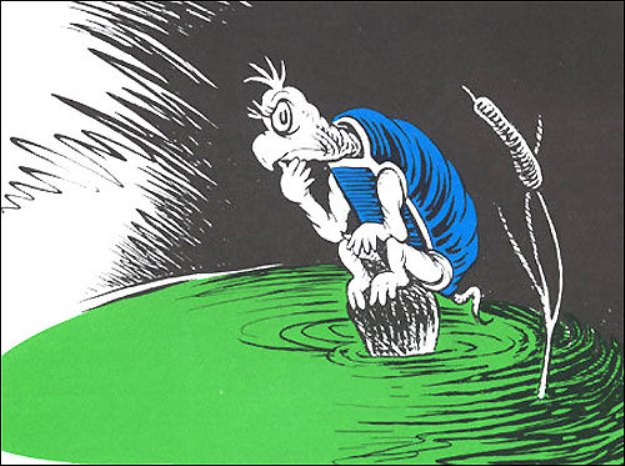
Yertle the Turtle King: My mental image of a despotic ruler!

Related blog post on 7 Feb 2011: Of Dictators and Terrible Cockroaches: A Russian children’s story…from 1925!

January 2011 has been an eventful month for democratic reform in the Middle East. As People Power successfully toppled the deeply entrenched dictator Ben Ali in Tunisia, and the ordinary Egyptians intensified their pressure on own 30-year-long regime of Hosni Mubarak, commentators around the world have been trying to make sense of the rapidly unfolding developments. One of them, David Kravets, writing in Wired linked to a blog post of mine that talked about the experience of one of the earliest successful demonstrations of people power — in the Philippines, when they toppled a long-misruling dictator in 1986.

Amidst all this, and while following the developments on the web, I have been re-reading my Dr Seuss. In particular, the delightfully inspiring tale of Yertle the Turtle King. To me, that is the perfect example of People Power in action — cleverly disguised as children’s verse!

The story was first published in April 1958, in a picture book collection by Theodor Geisel, published under his more commonly-known pseudonym, Dr. Seuss. In 2001, Publishers Weekly listed it at No 125 on a list of the best-selling children’s books of all time.

For those poor Seuss-deprived readers, here’s a helpful summary I have adapted from Wikipedia:

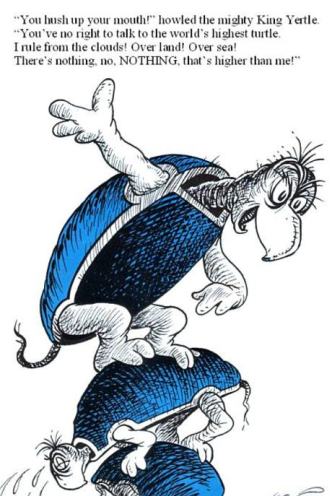
The story is about Yertle the Turtle, the king of the pond in the far-away island of Sala-ma-Sond. Unsatisfied with the stone that serves as his throne, he commands the other turtles to stack themselves beneath him so that he can see further and expand his kingdom (he considers himself the master of all he can see). However, the stacked turtles are in pain. Mack, a very ordinary little turtle at the very bottom of the pile, asks Yertle for a respite, but Yertle just tells him to shut up. Dissent is suppressed.

King Yertle is still not happy: he wants ‘to expand his kingdom’. So he commands more and more turtles to add to his throne. Mack again asks for a respite because the increased weight is now causing extreme pain to the turtles at the bottom. Again Yertle yells at Mack to shut up. At this point, little Mack decides he has had enough and decides to do something to vent his anger and frustration: he just burps. That simple action shakes up the entire stack of turtles, and the mighty king comes crashing down into the pond — and all turtles are freed at last!

Required reading for all despots?Years ago, when I first read the story to my then very young daughter, I could immediately see strong parallels between the vain, merciless Yertle the turtle king and the equally egotistic megalomaniacs in the world of human politics and governance. I would later learn that Dr Seuss meant Yertle to be Adolf Hitler: the turtle’s rule of the pond and takeover of the surrounding areas signified Hitler’s regime in Germany and invasion of surrounding Europe.

The ordinary but courageous Mack epitomises long-suffering Everyman and Everywoman in all countries where autocratic or dictatorial regimes rule, piling ever more burdens on their people. Like the turtles in the stack, the people can go on for years taking a great deal of suffering and sacrifice while the despots plunder and make merry. But there comes a day when a ‘Mack’ says enough is enough…and emits a humble ‘burp’ that shakes up everyone.

As Dr Seuss wrote (and this is my favourite part!):

But, as Yertle, the Turtle King, lifted his hand
And started to order and give the command,
That plain little turtle below in the stack,
That plain little turtle whose name was just Mack,
Decided he’d taken enough. And he had.
And that plain little lad got a bit mad.
And that plain little Mack did a plain little thing.
He burped!
And his burp shook the throne of the king!

And Yertle the Turtle, the king of the trees,
The king of the air and the birds and the bees,
The king of a house and a cow and a mule…
Well, that was the end of the Turtle King’s rule!
For Yertle, the King of all Sala-ma-Sond,
Fell off his high throne and fell Plunk! in the pond!

And today the great Yertle, that Marvelous he,
Is King of the Mud. That is all he can see.
And the turtles, of course… all the turtles are free
As turtles and, maybe, all creatures should be.

Read the text of Yertle the Turtle King

I don’t mean to oversimplify or belittle the enormous courage and resolve it takes for ordinary people to take on a brutal regime, but as pop-culture metaphors go, it’s hard to find a better one than Mack and his defiant burp. That little burp by a tiny turtle brought a vain king down, and its real-world equivalent is called people power: when long-oppressed ordinary people take to the streets to protest against the accumulated excesses of their rulers, demanding reform or regime change.

Not all such ‘burps’ bring all ‘Yertles’ down in the real world. The mighty Soviet Union crumbled in the late 1980s thanks to the courage and persistence of ordinary people who stood up and stepped out. It also worked twice in the Philippines: first against an outright dictator (Marcos) in 1986, and then against a renegade elected president (Estrada) in 2001. A variation of it happened in Nepal against the brutal King Gyanendra, who was dumped into the dustbin of history with the entire monarchy in 2006. Each case had its own history, dynamics and outcomes but shared the common feat of people power.
Sounds familiar? That's because it's all too common!
But elsewhere, as in Tiananmen Square of China (1989) Burma (2007) and Thailand (2010), people power failed to change regimes and led to much violence and bloodshed. What particular combination of social, political and technological factors make people power work is currently the subject of intense study and debate among scholars, diplomats and activists.

But there’s no doubt that recent history has been shaped and made by Macks who broke the silence and, figuratively speaking, burped. Some such burps were heard around the world, and some Macks went on to lead prolonged revolutions that ended with them becoming rulers themselves: Lech Walesa, Cory Aquino and Valclav Havel come to mind.

For every ‘Mack’ who succeeds, though, there are many who go unsung —or much worse. We still have no idea what happened to that much photographed and celebrated ‘Tank Man’ who stood up against the Red Army’s tanks on Tiananman Square one fateful day in June 1989. We don’t even know his name, but his defiance against such enormous odds still inspires assorted Macks all over the world.

For sure, our world is a tiny bit larger — and more complex — than that muddy pond in far away Sala-ma-Sond. And we have an abundance of Yertles, of various colours and hues, riding literally on the backs of their fellow people.

At least some of these tyrants must be following the recent developments in Tunisia and Egypt with growing anxiety. We can only hope that there will be a steady stream of courageous little ‘Macks’ in all such countries who will finally speak up and say: ‘Oi, Enough is enough!’

And then…BURP!

PS: Interesting footnote: Dr Seuss was the first to use the word “burp” in print. That apparently was cause for some concern before publication. According to him, the publishers at Random House, including the president, had to meet to decide whether or not they could use “burp” because “nobody had ever burped before on the pages of a children’s book”.


See also this interesting poem The Vain King, by American poet Henry Van Dyke (1852 – 1933)
‘Avatar’ unfolds in the Amazon: Find out the Real Price of Oil!

This is no Avatar: It's Real!
A few days ago, reviewing the blockbuster movie Avatar, I wrote: “Film critics and social commentators around the world have noticed the many layers of allegory in the film. Interestingly, depending on where you come from, the movie’s underlying ‘message’ can be different: anti-war, pro-environment, anti-Big Oil, anti-mining, pro-indigenous people, and finally, anti-colonial or anti-American. Or All of the Above…”

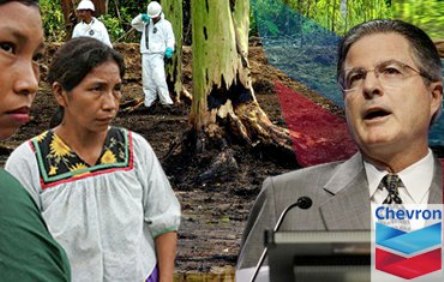
Indeed, an Avatar-like struggle is unfolding in the Amazon forest right now. The online campaigning group Avaaz have called it a ‘Chernobyl in the Amazon’. According to them: “Oil giant Chevron is facing defeat in a lawsuit by the people of the Ecuadorian Amazon, seeking redress for its dumping billions of gallons of poisonous waste in the rainforest.”

From 1964 to 1990, Avaaz claims, Chevron-owned Texaco deliberately dumped billions of gallons of toxic waste from their oil fields in Ecuador’s Amazon — then pulled out without properly cleaning up the pollution they caused.

In their call to action, they go on to say: “But the oil multinational has launched a last-ditch, dirty lobbying effort to derail the people’s case for holding polluters to account. Chevron’s new chief executive John Watson knows his brand is under fire – let’s turn up the global heat.”

Avaaz have an online petition urging Chevron to clean up their toxic legacy, which is to be delivered directly to the company´s headquarters, their shareholders and the US media. I have just signed it.

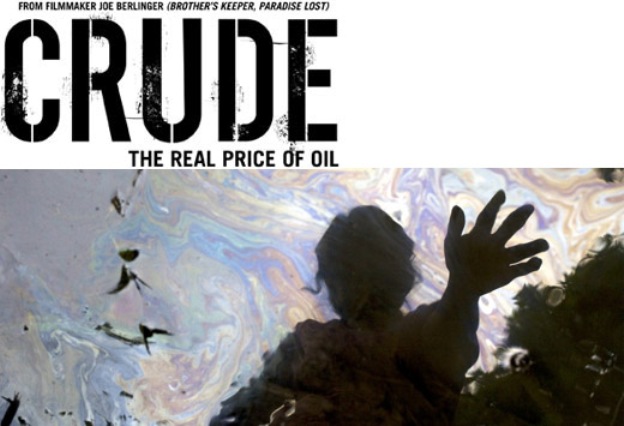
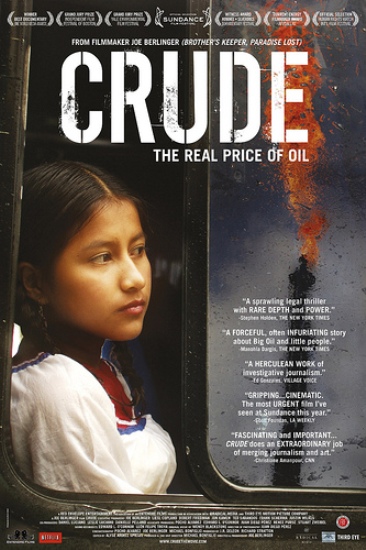
Others have been highlighting this real life struggle for many months. Chief among them is the documentary CRUDE: The Real Price of Oil, made by Joe Berlinger.

The award-winning film, which had its World Premiere at the 2009 Sundance Film Festival, chronicles the epic battle to hold oil giant Chevron (formerly Texaco) accountable for its systematic contamination of the Ecuadorian Amazon – an environmental tragedy that experts call “the Rainforest Chernobyl.”

Here’s the official blurb: Three years in the making, this cinéma-vérité feature from acclaimed filmmaker Joe Berlinger is the epic story of one of the largest and most controversial legal cases on the planet. An inside look at the infamous $27 billion Amazon Chernobyl case, CRUDE is a real-life high stakes legal drama set against a backdrop of the environmental movement, global politics, celebrity activism, human rights advocacy, the media, multinational corporate power, and rapidly-disappearing indigenous cultures. Presenting a complex situation from multiple viewpoints, the film subverts the conventions of advocacy filmmaking as it examines a complicated situation from all angles while bringing an important story of environmental peril and human suffering into focus.

Watch the official trailer of Crude: The Real Price of Oil

According to Amazon Watch website: “With key support from Amazon Watch and our Clean Up Ecuador campaign, people are coming together to promote (and see) this incredible film, and then provide ways for viewers to support the struggle highlighted so powerfully by the film.”

They go on to say: “A victory for the Ecuadorian plaintiffs in the lawsuit will send shock waves through corporate boardrooms around the world, invigorating communities fighting against injustice by oil companies. The success of our campaign can change how the oil industry operates by sending a clear signal that they will be held financially liable for their abuses.”

While Avatar‘s story unfolds in imaginary planet Pandora — conjured up by James Cameron’s imagination and created, to a large part, with astonishing special effects, the story of Crude is every bit real and right here on Earth. If one tenth of those who go to see Avatar end up also watching Crude, that should build up much awareness on the equally brutal and reckless conduct of Big Oil companies.

Civilisation's ultimate addiction?

Others have been making the same point. One of them is Erik Assadourian, a Senior Researcher at Worldwatch Institute, whom I met at the Greenaccord Forum in Viterbo, Italy, in November 2009.

He recently blogged: “The Ecuadorians aren’t 10-feet tall or blue, and cannot literally connect with the spirit of the Earth (Pachamama as Ecuadorians call this or Eywa as the Na’vi call the spirit that stems from their planet’s life) but they are as utterly dependent—both culturally and physically—on the forest ecosystem in which they live and are just as exploited by those that see the forest as only being valuable as a container for the resources stored beneath it.”

Erik continues: “Both movies were fantastic reminders of human short-sightedness, one as an epic myth in which one of the invading warriors awakens to his power, becomes champion of the exploited tribe and saves the planet from the oppressors; the other as a less exciting but highly detailed chronicle of the reality of modern battles—organizers, lawyers, and celebrities today have become the warriors, shamans, and chieftains of earlier times.”

Avatar: Blockbuster film as socio-political and green allegory?


“Pictures are for entertainment, messages should be delivered by Western Union.”

Those words by American film producer and studio founder Sam Goldwyn (1879-1974) sum up Hollywood’s attitude to movie-making for the past many decades.

As I watched James Cameron’s latest blockbuster movie Avatar, I kept wondering how the master film maker managed to subvert this so completely. Beneath the 3D, special effects and riot of other worldly colours, the movie is one long (2 hrs 40 mins) and powerful commentary on why might is not right when it comes to exploiting resources — belonging to other countries, people, or as in this case, other worlds.

This is not just another worthy indie movie made by an idealistic movie maker defiant of Hollywood traditions and big money. James Cameron is one of the most commercially successful directors in the mainstream film industry – and perhaps one of the very few who can get away with this kind of stunt. At a budget of over US$ 300 million , Avatar is one of the most expensive films ever made, and the costliest ever for 20th Century Fox.

The big gamble is certainly paying off. On 26 January 2010 came the news that Avatar has surpassed Titanic as the highest-grossing movie worldwide. According to the studio, worldwide box office total for Avatar at that point stood at US$1.859 billion, beating the US$1.843 billion racked up by Cameron’s romantic drama in 1997-98. Avatar broke that record in a little over six weeks.

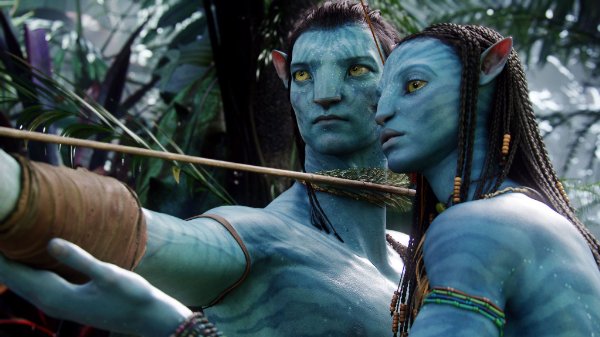
Part of the reason for such appeal is the extraordinary special effects: it’s an action-packed thriller where good and evil battle it out on another planet. The strange landscapes give it a video game like feel, but no small screen can match the theatrical experience, especially if you watch it in IMAX 3D (I didn’t). And for a change, this time the aliens inhabiting planet Pandora are benign, while it’s the humans who are ruthless invaders and brutal killers. Well, at least most of the time…

Here’s the official blurb: “Avatar takes us to a spectacular world beyond imagination, where a reluctant hero embarks on an epic adventure, ultimately fighting to save the alien world he has learned to call home. James Cameron, the Oscar-winning director of Titanic, first conceived the film 15 years ago, when the means to realize his vision did not exist yet. Now, after four years of production, AVATAR, a live action film with a new generation of special effects, delivers a fully immersive cinematic experience of a new kind, where the revolutionary technology invented to make the film disappears into the emotion of the characters and the sweep of the story.”

And here’s AVATAR – Official International Launch Trailer (HD)

Film critics and social commentators around the world have noticed the many layers of allegory in the film. Interestingly, depending on where you come from, the movie’s underlying ‘message’ can be different: anti-war, pro-environment, anti-Big Oil, anti-mining, pro-indigenous people, and finally, anti-colonial or anti-American. Or All of the Above…

It looks as if Cameron has made the ultimate DIY allegory movie: he gives us the template into which any one of us can add our favourite injustice or underdog tale — and stir well. Then sit back and enjoy while good triumphs over evil, and the military-industrial complex is beaten by ten-foot-tall, blue-skinned natives brandishing little more than bows and arrows (and with a little help from Ma Nature). If only it works that way in real life…

But the multi-purpose allegory is apparently working well. Take these two from opposite sides of the planet:

Thomas Eddlem wrote in The New American: “Avatar, is a visually stunning epic that is a perfect allegory for any of a dozen or more Indian wars in American history. From King Philip’s War in New England to Tippecanoe in Indiana to Horseshoe Bend in Alabama — and all the way across the American continent, for that matter — the story was the same. Colonists simply take land from the natives, as the Sully explains: ‘This is how it’s done. When people are sitting on something that you want, you make them your enemy so that you can drive them out.’

Mayank Shekhar wrote in The Hindustan Times newspaper: “Between a green worldview and the globe’s war over a natural resource, James Cameron’s twin analogies of present-day politics are fairly complete. They lend his science fiction ‘event picture’ a certain soul, even if not much of a story line.”

So did Cameron set out trying to send a message? Or was it all an incidental byproduct? Listen to the director himself in these two online video stories:

James Cameron’s Vision Featurette

CBS Interview with James Cameron: From Titanic to Avatar

The most compelling social commentary on Avatar I have so far read comes from Naomi Wolf, the American political activist, author and social critic. In an op ed essay written for Project Syndicate, she sees two revealing themes in Avatar: “the raw, guilty template of the American unconscious in the context of the ‘war on terror’ and late-stage corporate imperialism, and a critical portrayal of America – for the first time ever in a Hollywood blockbuster – from the point of view of the rest of the world.”

She adds: “In the Hollywood tradition, of course, the American hero fighting an indigenous enemy is innocent and moral, a reluctant warrior bringing democracy, or at least justice, to feral savages. In Avatar , the core themes highlight everything that has gone wrong with Americans’ view of themselves in relation to their country’s foreign policy.”

Does the box office triumph of Avatar make James Cameron one of the most effective campaigners for social justice on the planet (comparable, in some ways, to Michael Jackson having been one of the biggest environmental communicators of his time)?

And is Avatar the most expensive piece of info-tainment or edu-tainment ever made, just like the Lord of the Rings trilogy was one long (even if unintended) commercial for the breathtaking sights and sounds of New Zealand?

Certainly, mixing messages with entertainment is such a difficult and delicate art that most people who dabble in it fall between the two stools. The entertainment value of Cameron’s latest flick is not in question. Granted, it’s not as heart-breaking as Titanic, and the storyline is oh-so-predictable. But 3D and SFX magic alone can’t hold today’s audiences gripped for 160 long minutes. And if the underlying story starts movie-goers thinking and talking about many parallels between the fictional world of Pandora and our own Earth, he’s certainly getting somewhere.

As Naomi Wolf says: “Ironically, Avatar will probably do more to exhume Americans’ suppressed knowledge about the shallowness of their national mythology in the face of their oppressive presence in the rest of the world than any amount of editorializing, college courses, or even protest from outside America’s borders. But I am not complaining about this. Hollywood is that powerful. But, in the case of Avatar , the power of American filmmaking has for once been directed toward American self-knowledge rather than American escapism.”

Perhaps this wasn’t part of the script, but would the executives at 20th Century Fox care as they laugh all the way to their bank?

Wanted: ‘Magic Mirrors’ for a Land of the Blind…

Last chance...?
Here’s a winning idea for a new business venture in these lean times: make an always-agreeable ‘magic’ mirror — and the vane and wicked will beat a path to your door.

Well, at least half the politicians in Sri Lanka would. They’d rather not see their true selves on any mirror.

The magic mirror idea was popularised many years ago by Snow White and the Seven Dwarfs, whose wicked and vain queen had an unusual mirror that talked back, each time she asked: ‘Mirror, mirror, on the wall. Who’s the fairest of them all?’.

The queen wasn’t looking for honest answers; she just wanted to hear she was always the prettiest and fairest in the land. (All competition – real and imagined – was dealt with brutally.)

Little has changed, even in this 21st Century. We may not have too many monarchs left in the world, but our uncrowned rulers can be equally vain and ruthless. They are obsessed with self-aggrandizing sycophancy – they’d only tolerate magic mirrors that totally boost their egos.

If I seem to be preoccupied with mirrors, that’s nothing to do with my own vanity. In this digital age, the mirror is still a pretty good metaphor for the media industry that I have been part of, in one way or another, for over 20 years. At its very basic, the media are expected to reflect our society and our times.

But some people don’t like what they see on a true mirror. In 2009, we saw a spate of mirror smashing or media bashing in Sri Lanka. It started on 6 January, when the studio of the Maharaja Television/Broadcasting Network (MTV/MBC, popularly known as Sirasa Group) was attacked by armed gunmen who almost blew up the country’s most popular private broadcast organisation. On 8 January, exactly a year ago today, Lasantha Wickrematunga, editor of The Sunday Leader, was shot dead by two men on a motorcycle as he drove to work in suburban Colombo.

Sirasa & Lasantha: Refused to be magic mirrors
One year later, both crimes remain unsolved. They have joined a long list of crimes against journalists and media organisations in Sri Lanka, most of which have never led to any prosecution of the perpetrators.

As Reporters Without Borders noted in a statement this week: “The emotion and anger have not gone away in the year since this famous Sri Lankan journalist’s death. The anger is being sustained by the government’s flagrant obstruction of the investigation. Lasantha Wickrematunge’s name and memory will not disappear and, in that sense, those who were behind his murder made a mistake.”

Commenting on the MTV/MBC (Sirasa) attack, I described the typical reaction of the mirror-bashers: “…if you don’t like what you see in the mirror – which is what media is to society – just kick it, shatter it and hammer it into dust so that it won’t reflect anymore. Destroy all the mirrors of the land, and we’ll finally be the fairest and prettiest in the whole world. That seems to be the perverse logic that fuels attacks of this nature.”

Rex de Silva, the first editor that Lasantha worked for in the late 1970s cautioned that Lasantha’s murder was the beginning of ‘the sound of silence’ for the press in Sri Lanka. As I asked on the day of Lasantha’s emotionally-charged funeral: “Can this sound of silence be shattered by the silent, unarmed majority of liberal, peace-loving Lankans who were represented at the funeral service and the Colombo cemetery today?”

Owing to these and other threats, pressures and intimidation during the year, Sri Lanka was ranked 162nd out of 175 countries in the 2009 Reporters Without Borders press freedom index. This was the worst ranking of any democratic country. See RSF website section on Sri Lanka.

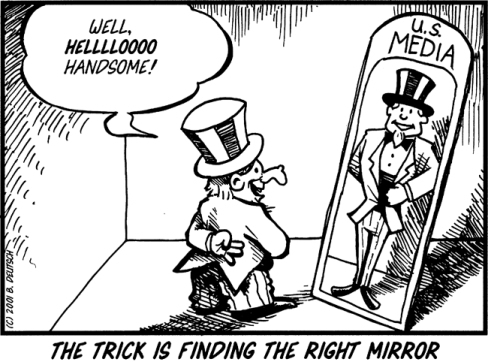
Back to mirrors. While the true mirrors were getting bashed, those who played being ‘magic mirrors’ have done well for themselves (and are probably laughing all the way to their banks). But that’s not a phenomenon confined to the little island of Sri Lanka. A good part of the US Media did the same under the hawkish Bush Administration, which prompted the cartoon below.

It’s not just ‘Dubya’ who is addicted to such agreeable mirrors. Indeed, for many modern-day rulers, an essential trapping of power involves surrounding themselves with spin doctors, press commissioners and other manipulators or manufacturers of image. In mature democracies, there are certain checks and balances which usually guard against the worst excesses (but there are notable exceptions – look at Italy!).

In immature, fragile or pseudo democracies, mirrors obey the laws of physics (optics) at grave risk to themselves. If you want proof, just talk to the staff of Sirasa or The Sunday Leader in Sri Lanka…

Groundviews.org: One year later: A murder unresolved, a government unashamed

Nov 2009 blog post: We need more reflective mirrors in the media!

Looking back at Asian Tsunami of 2004…and media response

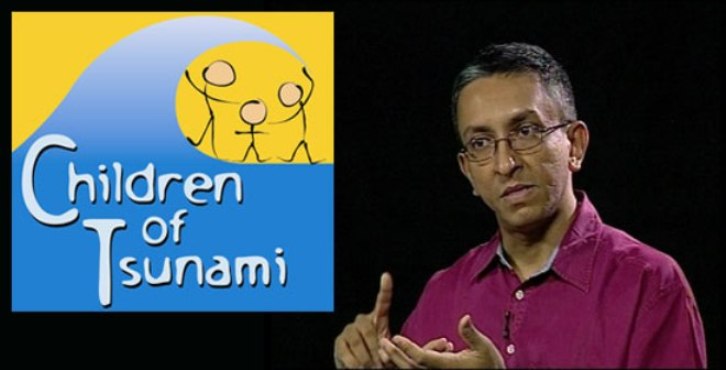
Nalaka Gunawardene talking about 2004 Asian Tsunami

To mark the fifth anniversary of the Indian Ocean Tsunami of December 2004, TVE Asia Pacific has just released excerpts from an in-depth TV interview I recorded four years ago.

The wide-ranging interview was originally filmed in November 2005 in Bangkok, Thailand, by Thai journalist and film maker friend Pipope Panitchpakdi. He used excerpts at the time for a Thai documentary to mark the first anniversary of the tsunami. It remains one of the best media interviews I have given, for which all credit goes to Pipope.

Selected segments of that interview, in its original English, can now be viewed on TVEAP’s YouTube channel, while the transcript is published on the TVEAP website.

To give a flavour of this belated release of archival material, here are the first two extracts:

Nalaka Gunawardene recalls Asian Tsunami of Dec 2004 Part 1 of 6

Part 2 of 6:


Watch all extracts on TVEAP’s YouTube channel

All You Need is Love: When the world sang one song for HIV…

We must love one another or die...

Our planet is one, but our world speaks and sings in a myriad tongues — and that’s part of our cherished cultural diversity. Once in a while, however, it’s good to see that cacophony morph into a symphony when the world shares a few moments — in awe, horror, love or happiness.

It happened last week when the world sang for an extremely good cause. On 7 December 2009 at 1:30pm GMT, Starbucks invited musicians from all over the world to sing together at the same time to raise awareness for HIV/AIDS in Africa. In one breathtaking moment, musicians from 156 countries played “All You Need is Love” together. The live participation of most nations together to sing this song became a Guinness world record.

Watch now, as musicians from all around the world come together and share a song.

My former colleague Buddhini Ekanayake joined this global production by coordinating the input from Sri Lanka. “Personally, I am really glad to take part in this event together with my team, on behalf of Watermelon Creatives,” she says on her blog, where she shares some info and images.

You can still join in by lending your own voice to the Starbucks Love Project.. Watch streaming video from countries around the world and then join in by singing All You Need is Love yourself. For each video submitted, Starbucks will make a contribution to the Global Fund to help fight against AIDS in Africa. You can also help increase the Starbucks contribution to the Global Fund by submitting a drawing to the Love Gallery.

The global sing-along is part of our continuing efforts to help fight AIDS in Africa. In just one year in partnership with (RED), Starbucks has generated money equivalent to more than 7 million days of medicine to help those living with HIV in Africa.

“All You Need Is Love” is a song written by John Lennon and credited to Lennon/McCartney. It has been associated with path-breaking initiatives before. It was first performed by The Beatles on Our World, the first live global television link. Watched by 400 million in 26 countries, the programme was broadcast via satellite on 25 June 1967.

RSF: Who will protect journalists fighting for a better planet?

RSF: We must defend journalists who fight for the planet
In November 2007, I wrote a blog post calling for greater protection for local journalists who cover social and environmental justice issues risking their life and limbs.

I quoted the Filipino academic and social activist Professor Walden Bello, as saying: “Things are pretty savage at the grassroots level in some of our countries. Journalists who investigate and uncover the truth take enormous personal risks – the vested interests hire killers to eliminate such journalists.”

Bello, executive director of the Focus on the Global South, further said: “Journalists living in the provinces and reporting from the grassroots are more vulnerable than those based in the cities. This is precisely why local journalists need greater support and protection to continue their good work.”

Last week, Reporters Without Borders echoed this call, saying: “We must defend journalists who expose attacks on the environment”.

The press freedom activist group released a new report titled “The dangers for journalists who expose environmental issues.” It highlights the indifference – and even complicity – of some governments and local authorities that make little attempt to protect journalists who take risks to investigate attacks on the environment.

The report looks at 13 cases of journalists and bloggers who have been killed, physically attacked, jailed, threatened or censored for reporting on the environment, and highlights the need for a free press to tackle ecological challenges.

In countries such as Russia, Cambodia, Brazil or even Bulgaria, in Europe, journalists run considerable risks when they try to alert the world about the misdeeds of those who prey on the environment.

Read the full report online

Read my June 2007 tribute to Joey Lozano, a courageous Filipino journalist who risked his life to fight for environmental and social justice issues

Pete Seeger turns 90 on World Press Freedom Day: Thank you for the protest music!

Pete Seeger: Still singing protest at 90...

Today, 3 May, is once again World Press Freedom Day. It is recognised by the UN, and observed by media professionals and media activists worldwide to ‘draw attention to the role of independent news and information in society, and how it is under attack’.

By happy coincidence, today also marks the 90th birthday of Pete Seeger, American folk singer and a pioneer of protest music. Since media freedom is inseparable from the democratic rights to dissent and protest, I will devote this blog post to salute Pete and his many decades of music for worthy causes — ranging from the American civil rights movement and opposing the Vietnam war to saving the environment and nuclear disarmament.

I won’t go over the basic biographical or career information, which is easily found online. Wikipedia has a good entry, and PBS shows a career timeline which has covered some of the most momentous events of the past century. There are approximately 200 songs (music and lyrics) that Pete wrote or with which he is associated – including “Guantanamera,” “Where Have All The Flowers Gone,” “If I Had A Hammer,” “Turn Turn Turn,” “Wimoweh,” “We Shall Overcome”.

Pete is a hero for at least three generations of music lovers and freedom lovers around the world who believe in human rights, human dignity and democratic freedoms. Armed with nothing more than his banjo and melodious voice, and driven by the courage of his conviction, this small, gentle man has stood up to mighty leaders, generals and officials.

Never underestimate the power of one determined man...
Pete is celebrated as much for his artistic and cultural achievements as for standing resolutely for his political beliefs and for lending his voice and music in support of causes be believed in. In 1955, he was called before the now infamous House Un-American Activities Committee, but refused to name personal and political associations on the grounds that this would violate his First Amendment rights. He said: “”I am not going to answer any questions as to my association, my philosophical or religious beliefs or my political beliefs, or how I voted in any election, or any of these private affairs. I think these are very improper questions for any American to be asked, especially under such compulsion as this.”

This defiance resulted in sustained harassment, persecution and professional isolation. As his recent PBS biography noted, “Standing strong for deeply-held beliefs, Seeger went from the top of the pop charts to the top of the blacklist and was banned from American commercial television for more than 17 years. This determined singer/songwriter made his voice heard and encouraged the people of the world to sing out along with him.”

‘If you love your country, you’ll find ways to somehow to speak out, to do what you think is right,” Pete says in this powerful documentary looking back at over half a century of activist singing and music.


Watch opening segment of PBS AMERICAN MASTERS series: Pete Seeger: The Power of Song, directed by Jim Brown and first aired in February 2008

Watch more PBS interviews with Pete Seeger and some of his archived performances from yesteryear

Having pleaded under the First Amendment during the communist witch days of the 1950s, Pete repeatedly paid tribute to the far-sighted American pioneers who introduced the First Amendment guaranteeing the freedom of speech.

“As some judge said, if there is any fixed star in our firmament, that is the First Amendment,” he says in a talk-cum-performance at the Ford Hall Forum. In this audio-only piece, he talks the privilege of living under the First Amendment. He recalls his experience being questioned by the House Unamerican Activities Committee, encounters with censorship, and his relationship with fellow singer Woody Guthrie. It runs for nearly an hour, but is worth every second.

For someone like Pete Seeger who sang alongside Dr Martin Luther King, Jr., and other civil rights movement leaders and activists, it must have been deeply moving to be able to sing at the concert to mark President Barack Obama’s inauguration on 20 January 2009 at the Lincoln Memorial.

Watch Bruce Springsteen sing along with Pete Seeger on Woody Guthrie’s “This Land Is Your Land”. As he often does, Pete invites the euphoric audience to sing along!

One of my favourite Pete Seeger songs is “Turn! Turn! Turn! (to Everything There is a Season)”, often abbreviated to “Turn! Turn! Turn!”. It’s a song adapted entirely from the the Book of Ecclesiastes in the Bible (with the exception of the last line) and composed to music by Pete Seeger in 1959. Seeger waited until 1962 to record it,

Pete Seeger tells how he came to write “Turn Turn Turn.”

I have always believed that we have to get creative and resourceful when the basic freedoms of conscience and freedom of expression are under siege from despotic rulers and fanatical extremists. When we are not allowed to express in factual prose, we must turn to creative prose. And when prose fails, we still have verse, lyrics, satire and drama — the possibilities are only limited by our imagination. This is why I celebrate activist artistes like Pete Seeger, and invoke the memory of activist-poets like Adrian Mitchell and Ken Saro-wiwa. When the barbarians are at our gates and we feel surrounded by the unrelenting forces of hatred, intolerance and tribalism, they remind us that Another World is Possible — but we have to believe in it, stay the course and find ways to sing, dance and laugh our way out of gloom.

And here’s Pete singing another one of my personal favourites, a song that powered the civil rights movement and has since inspired and sustained struggles for social justice around the world: We Shall Overcome.


New York Times editorial appreciation on 5 May 2009: Still Singing

Syeda Rizwana Hasan: Keeping a sharp eye when ships come to die…

Syeda Rizwana Hasan: Goldman Prize winner 2009
In Greek legend, Helen of Troy was the ‘face that launched a thousand ships’. Now meet Syeda Rizwana Hasan, a determined environmental activist who keeps dozens of ships from coming to die on the beaches of her native Bangladesh.

Rizwina is an environmental lawyer who is working hard to reduce the impact of Bangladesh’s exploitative and environmentally-devastating ship breaking industry. She has spearheaded a legal battle resulting in increased government regulation and heightened public awareness about the dangers of ship breaking. For this, she has just been honoured as the Asia winner of the prestigious Goldman Environmental Prize 2009.

Ship breaking is a lucrative yet highly hazardous business. Decommissioned ships from around the world are sent to Bangladesh, where they are dismantled by hand on the beaches by unskilled workers who are often paid less than one dollar per day. Lacking in sufficient mineral deposits for metal mining, Bangladesh relies on the iron and other materials from the ships for some of its metal. The scrap metal, along with other parts of the ships — including sinks, toilets, beds, appliances, and light bulbs — are resold in huge open markets lining the roads of Chittagong, the main ship breaking region.

Ship-breaking is done by around 20,000 workers – mostly young men, some as young as 14, who come from the northern parts of Bangladesh. They are paid very little, housed in the most basic of shelters, and provided with little or no medical care. It is estimated that, on average, one ship breaking worker dies at the yards in Bangladesh every week and every day one worker is injured.

Read the full profile on Rizwana Hasan on the Goldman Prize website

Watch short video film on Rizwana Hasan:

Rizwana Hasan, 40, is a lawyer and Executive Director of the Bangladesh Environmental Lawyers Association (BELA), a public interest law firm. Growing up in a politically-engaged family, Hasan committed herself to public service and, after receiving her master’s degree in law at age 24, joined BELA. She soon became one of the country’s leading voices for the environment. Today, she manages six offices with nearly 60 staff and is one of the leading young lawyers enrolled with the Supreme Court of Bangladesh.

The Goldman Environmental Prize, now in its 20th year, is awarded annually to grassroots environmental heroes from each of the world’s six inhabited continental regions and is the largest award of its kind with an individual cash prize of $150,000. This year’s prizes were awarded in San Francisco on 20 April 2009.

The 2009 Goldman Environmental Prize recipients are a group of fearless grassroots leaders taking on government and corporate interests and working to improve the environment for people in their communities. Other winners this year came from Gabon, Indonesia, Russia, Suriname and USA.

Watch all prize winners profiled on video

Photo and video courtesy of the Goldman Environmental Prize

Teenage Affluenza: A viral video to stir our minds

I’m a bit anxious about impending teenhood. No, not my own, thank you, but my kid’s.

As a single parent raising a 12-year-old who will soon turn 13, I keep reading and hearing all kinds of advice these days on how best to cope with a teenager in the house — that phase in growing up that everyone predicts will involve some turbulence.

On top of all else that comes with hormones-on-legs, there’s now the worry of Teenage Affluenza. It’s a condition that affects millions of teenagers around the world. Most of them live in the developed countries, but in this topsy-turvey, globalised world, there’s no stopping the rapid spread of such conditions all over the majority world.

Look closely, and you can see the symptoms of TA
Look carefully, and you can see the symptoms of TA - image courtesy WorldVision Australia

I belatedly came across this campaign video called Teenage Affluenza, made by the charity WorldVision Australia in mid 2007. It was first made for a promotion kit for the 40 Hour Famine, to be used in Australian schools. World Vision media staff worked with Rohan Zerna Films, Melbourne, who had worked on previous spots for World Vision. The team decided to take the route of irony, providing a spoof feel. The budget wasn’t high. A family friend of the producer starred as the Melbourne teenager. The voice-over was donated by a regular with World Vision promotions. Overseas footage, already held by World Vision Australia, was spliced into the story.

Read news story in The Age newspaper, Australia, on 2 July 2007

Erin is a fifteen year old girl living deep in the South Eastern suburbs of Melbourne, Australia. She is at risk from teenage affluenza, like five million children and teenagers in her country. She still sleeps in the wooden colonial bed her parents bought her when she was ten. Although meals, travel and education are readily available to girls like Erin, many are forced to live on less than $40 pocket money each week. Erin’s iPod only holds 1 GB.

And so the satirical commentary continues. Juxtaposed with Erin’s ‘tragic life’ is the reality faced by children and teenagers in Vietnam, Sudan and other countries affected by famine and the long term impact of civil war. The video ends with the message “Do something else. Do something real. Do something.”

Teenage Affluenza is Spreading Fast: From WorldVision Australia

The video has attracted thousands of responses on YouTube’s online-comments section, including some honest self-analysis from teenagers, while others started a discussion about who is to blame – corrupt governments or first-world greed.

Meanwhile, WorldVision US has released another version of the video, slightly shorter and featuring American teeangers. If anything, the condition is more prevalent there.

Teenage Affluenza: from WorldVision United States


The message to parents is clear: we’re the ones who can prevent our teenagers from contracting Affluenza. All it takes is thoughtful and sustained action. When teens say gimme-gimme-gimme, we have to known when it’s really needed and when it’s wanted. Easier said than done. I know, because teenages seem to arrive in pre-teens these days.

We the parents would certainly welcome reinforcements from any sensible source. WorldVision Australia runs an interesting website called Stir, which tries to engage youth on issues of development and global justice. As a direct intervention charity, WorldVision doesn’t leave it to governments, but urges people to get involved — and do something.