But in this digital age, most scientists can use online platforms and simple digital tools to communicate directly with the public and/or policy makers. At least some scientists try to tap this potential — and we are grateful.
The World Resources Institute (WRI), a respected non-profit research and advocacy group, is currently trying to understand “how recent climate science discoveries can best be communicated via video”.
With support from Google, and with the help of three climate scientists, WRI has recently produced 3 different video types in order to test which works best. They are currently on display on their website, with a request for readers to vote and comment:
1. “A webcam talk” uses a self-recorded video of the scientist discussing his findings
2. “A conversation” uses a slideshow with a voiceover of the scientist discussing his findings
3. “A whiteboard talk” is a professionally shot video of the scientist in front of whiteboard discussing his findings
Here is the comment I submitted: the challenges WRI face are common and widely shared. And I do have some experience covering climate and other complex science and environmental stories across Asia for the visual and print media.
First, thanks for asking — and for exploring best public engagement method, which most technical experts and their organisations don’t bother to do.
Second, Andy Dessler comes across as an eager expert — not all scientists are! Some are visibly condescending and disdainful in doing ‘public’ talks that they immediately put off non-technical audiences.
Third, the options you’ve presented above are NOT mutually exclusive. For best results, you can mix them.
Webcam method is helpful, but people don’t want to see any talking head for more than a few seconds at a time. They want to see WHO is talking, and also WHAT is being talked about. The images in Conversation method come in here.
I realise webcams are usually set up inside buildings, but visually speaking the more interesting backdrops are in the open. In this case, if Andy Dessler were to record his remarks outdoors, on a clear and sunny day with some clouds in the far background sky, that would have been great!
I’m personally less convinced about Whiteboard Talk: many in your audience probably don’t want to be lectured to, or be reminded of college days. I would avoid that.
In this week’s Ravaya Sunday column (in Sinhala) appearing on 29 April 2012, I reflect on the Indian Ocean undersea quake on 11 April 2012, and the tsunami watch that followed.
Taking Sri Lanka as the example, I raise some basic concerns that go beyond the individual incident, and address fundamentals of disaster early warning and information management in the Internet age.
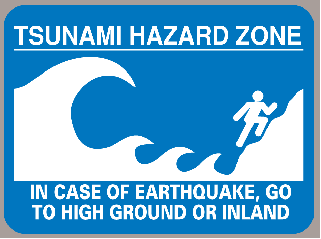
I ask: Was the tsunami warning and coastal evacuation on April 11 justified in Sri Lanka? I argue that this needs careful, dispassionate analysis in the coming weeks. ‘Better safe than sorry’ might work the first few times, but let us remember the cry-wolf syndrome. False alarms and evacuation orders can reduce public trust and cooperation over time.
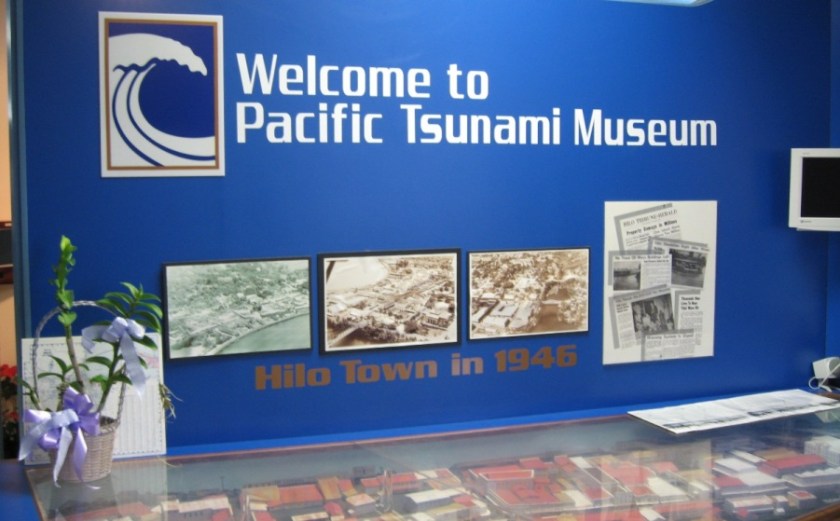
Entrance to Pacific Tsunami Museum in Hilo, Hawaii, photo by Nalaka Gunawardene, Jan 2007
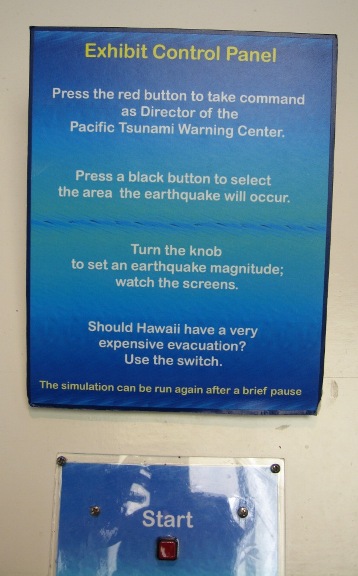
Five years ago, on a visit to the Pacific Tsunami Museum in Hilo, Hawaii, I played an interesting simulation game: setting off an undersea earthquake and deciding whether or not to issue a tsunami warning to the many countries in and around the Pacific.
The volunteer-run museum, based in ‘the tsunami capital of the world’, engages visitors on the science, history and sociology of tsunamis. The exhibits are mostly mechanical or use basic electronic displays, but the messages are carefully thought out.
The game allowed me to imagine being Director of the Pacific Tsunami Warning Centre (PTWC), a US government scientific facility in Ewa Beach, Hawaii, where geophysicists monitor seismic activity round the clock. When the magnitude exceeds 7.5, its epicentre is located and a tsunami watch is set up. Then, combining the seismic, sea level and historical data, PTWC decides if it should be upped to a warning.
Tsunami simulation game - low tech, high lessonThe museum game allows players to choose one of three locations where an earthquake happens — Alaska, Chile or Japan — and also decide on its magnitude from 6.0 to 8.5 on the Richter Scale.
This is an instance where scientists must quickly process large volumes of information and add their own judgement to the mix. With rapid onset hazards like tsunamis, every second counts. Delays or inaction can be costly — but false alarms don’t come cheap either.
I played the game thrice, and erring on the side of caution, issued a local (Hawaiian) evacuation every time. If it were for real, that would have caused chaos and cost the islanders a lot of money.
In fact, those who make decisions on tsunami alerts or warnings have to take many factors into account – including safety, economic impact and even political fall-out.
After playing the simulation game, I can better appreciate the predicament government officials who shoulder this responsibility. They walk a tight rope, balancing short-term public safety and long term public trust in the entire early warning system.
Taking Sri Lanka as the example, but sometimes referring to how other Indian Ocean rim countries reacted to the same situation, I raise some basic concerns that go beyond this individual incident, and address fundamentals of disaster early warning and information management in the Internet age.
Another except: “So was the tsunami warning and coastal evacuation on April 11 justified? This needs careful, dispassionate analysis in the coming weeks. ‘Better safe than sorry’ might work the first few times, but let us remember the cry-wolf syndrome. False alarms and evacuation orders can reduce public trust and cooperation over time.”
In particular, I focus on nurturing public trust — which I call the ‘lubricant’ that can help move the wheels of law and order, as well as public safety, in the right direction.
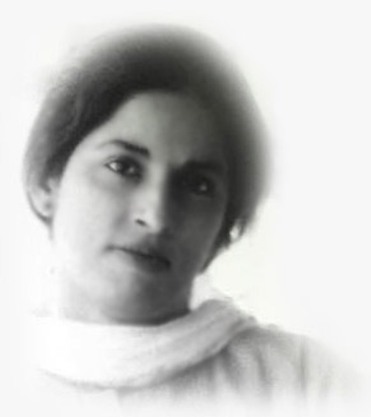
On 20 April 2012, we marked seven years since Saneeya Hussain left us. Journalist and activist Saneeya suffered a needless and tragic death at when she ran out of fresh air in South Asia and was caught up in the urban traffic congestion of Sao Paulo.
In this week’s Ravaya Sunday column, I remember Saneeya’s legacy and plight and discuss the latest dimensions of outdoor air pollution in Sri Lanka that threatens fellow asthma sufferers like myself. The same information is covered in English at: Gasping for Fresh Air, Seeking More Liveable Cities in South Asia
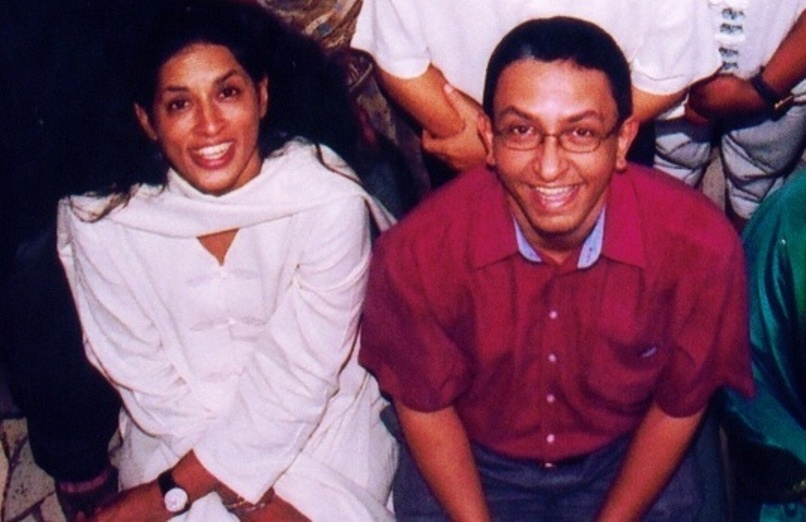
Saneeya Hussain & Nalaka Gunawardene: Singapore, Nov 2002
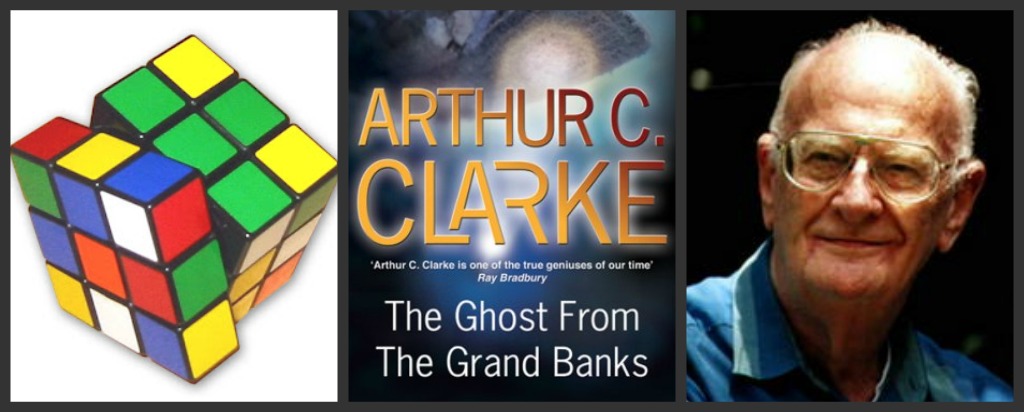
Science fiction writer and futurist Sir Arthur C Clarke knew how closed economies and restrictive cultures stifled innovation. He once said the only memorable invention to emerge from Soviet-dominated Eastern Europe was the Rubik’s Cube!
Rubik’s Cube is a 3D mechanical puzzle invented in 1974 by Hungarian sculptor and professor of architecture, Ernő Rubik. Since then, its huge worldwide success has led to several variations.
I just came across an interesting suggestion for an enhanced Rubik’s Cube, by Arthur Clarke himself, while re-reading his 1990 novel The Ghost from the Grand Banks.
It was an ocean-based thriller set in the (then) near future. It revolved around British-American and Japanese teams competing to raise the Titanic‘s wreck in time for the centenary in April 2012.
In the novel, Sir Arthur talks about the Rubik’s Cube making a comeback 30 years after its first appearance — and in a far more deadly mutation.
As he describes: “Because it was a purely mechanical device, the original Cube had one weakness, for which its addicts were sincerely thankful. Unlike all their neighbours, the six centre squares on each face was fixed. The other forty-eight squares could orbit around them, to create a possible 43,252,003,274,489,856,000 distinct patterns.
“The Mark II had no such limitations; all the fifty-four squares were capable of movement, so there were no fixed centres to give reference to its maddened manipulators. Only the development of microchips and liquid crystal displays had made such a prodigy possible; nothing really moved, but the multicoloured squares could be dragged around the face of the Cube merely by touching them with a fingertip”.
A quick check on the official Rubik website, and a Google search, shows no such device being on the market.
This is the Sinhala text of my Sunday column in Ravaya newspaper, 1 April 2012.
Facing an electricity generation crisis, Sri Lanka has embarked on a countrywide energy conservation drive — urging everyone to switch off all non-essential lights, and reduce other forms of power consumption.
Beyond these important yet token gestures, are there smart options that can save significant quantities of electricity, 85% of which is now generated in Sri Lanka using imported, costly fossil fuels?
Yes, there is one: advance the clock by half an hour. Faced with power crises in the past, governments did this in the 1990s — and with tangible results. This is evidence based policy and action. But a vocal minority in Lanka resented this progressive move all along, and in April 2006, they successfully lobbied the (current) government to revert Sri Lanka’s standard time to GMT+5:30 from GMT+6 which had been used since 1996.
I wrote about Sri Lanka giving up on Daylight Saving time in April 2006 in this SciDev.Net opinion essay: Science loses in Sri Lanka’s debate on standard time. As I noted: “In doing so, the government completely ignored expert views of scientists and intellectuals. It listened instead to a vocal minority of nationalists, astrologers and Buddhist monks who had lobbied the newly elected president to ‘restore the clock to original Sri Lankan time’.”
Malima (New Directions in Innovation) is a Sinhala language TV series on science, technology and innovation, broadcast on Sri Lanka’s Rupavahini TV channel.
Produced by Suminda Thilakasena and hosted by science writer Nalaka Gunawardene, this episode was first broadcast on 22 March 2012. It features three stories:
• An interview with Dr Sarath Wimalasuriya, who has invented a low-cost, portable device that provided electrical pulse to a fence protecting crops from elephants. Called Shock Defender, this 5kg unit can support a fence 1.8km long, typically 50 acres (20.2 hectares). When fully charged, it can work for 48 hrs on battery. The medical doctor turned electronic inventor sells the device at one sixth the price of comparable imported ones.
• South Korean scientists say they have developed flexible memory technology that could support bendable computer platforms for e-books and cell phones.
• An interview with child inventor K K Irushika Teran Suriyakumara, student of St Benedict’s College, Colombo, who has come up with a simple automated device to remotely feed fish in a household fish tank. He has cleverly combined discarded material and a basic mobile phone. Find out how!
Some geologists now believe that human activity has so irrevocably altered our planet that we have entered a new geological age.
A decade ago the Nobel Laureate Dutch chemist, Paul J Crutzen, coined a new term for it: the Anthropocene.
The proposed new epoch was discussed at a major conference held at the Geological Society in London in the summer of 2011.
A new short video explaining it in simple terms was released this week in connection with the Planet Under Pressure conference, London 26-29 March 2012.
As they say, it offers a “3-minute journey through the last 250 years of our history, from the start of the Industrial Revolution to the Rio+20 Summit”.
The film charts the growth of humanity into a global force on an equivalent scale to major geological processes.
The film is part of the world’s first educational webportal on the Anthropocene, commissioned by the Planet Under Pressure conference, and developed and sponsored by anthropocene.info
In this week’s Sunday column, published in Ravaya newspaper of 25 March 2012, I
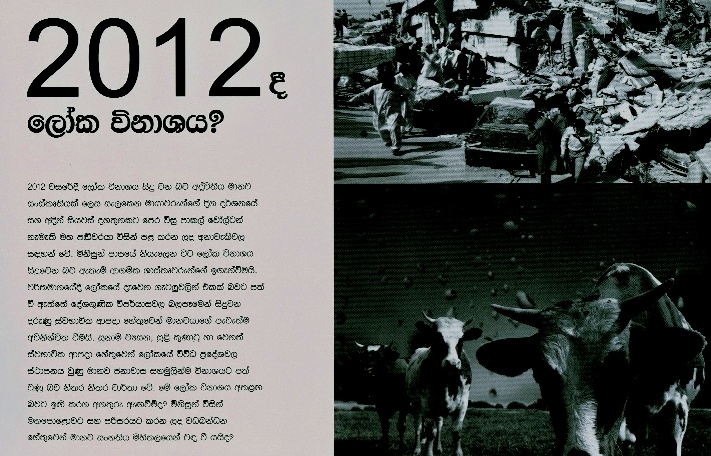
return to take another critical look at the hype and hysteria surrounding the world ‘ending’ in December 2012.
Last week’s column elicited several reader responses online and offline. While many agreed with my rational reasoning, some were miffed by my puncturing their inflated obsession! A few challenged me to provide an assurance that there won’t be any major disasters in 2012 — we were NOT talking about random disasters, but a planetary scale one which qualifies as End of the World.
This week, we look at how certain environmentalists are linking global warming and 2012 world ending myth, adding to existing public confusion about climate change. I cite as an example of this green alarmism a highly distorted article Sinhala published by Practical Action Sri Lanka, a usually moderate and sensible development organisation. Its country director admits it was an ill-advised public outreach effort.
I also refer to a recent scientific analysis that probed whether highly destructive large-scale earthquakes in the past few years, in countries bordering the Pacific and Indian oceans, indicate an increased global risk of these deadly events. Its conclusion: there is no such evidence.
In this week’s Sunday column, published in Ravaya newspaper of 18 March 2012, I take a critical look at the mounting hype and hysteria about the world ending in December 2012.
The Wikipedia describes the ‘2012 phenomenon’ as comprising a range of eschatological beliefs according to which cataclysmic or transformative events will occur on 21 December 2012. In reality, it’s a blockbuster Hollywood movie, rather than any ancient prophecy, that triggered this wave of public concern!
 The World Resources Institute (WRI), a respected non-profit research and advocacy group, is currently trying to understand “how recent climate science discoveries can best be communicated via video”.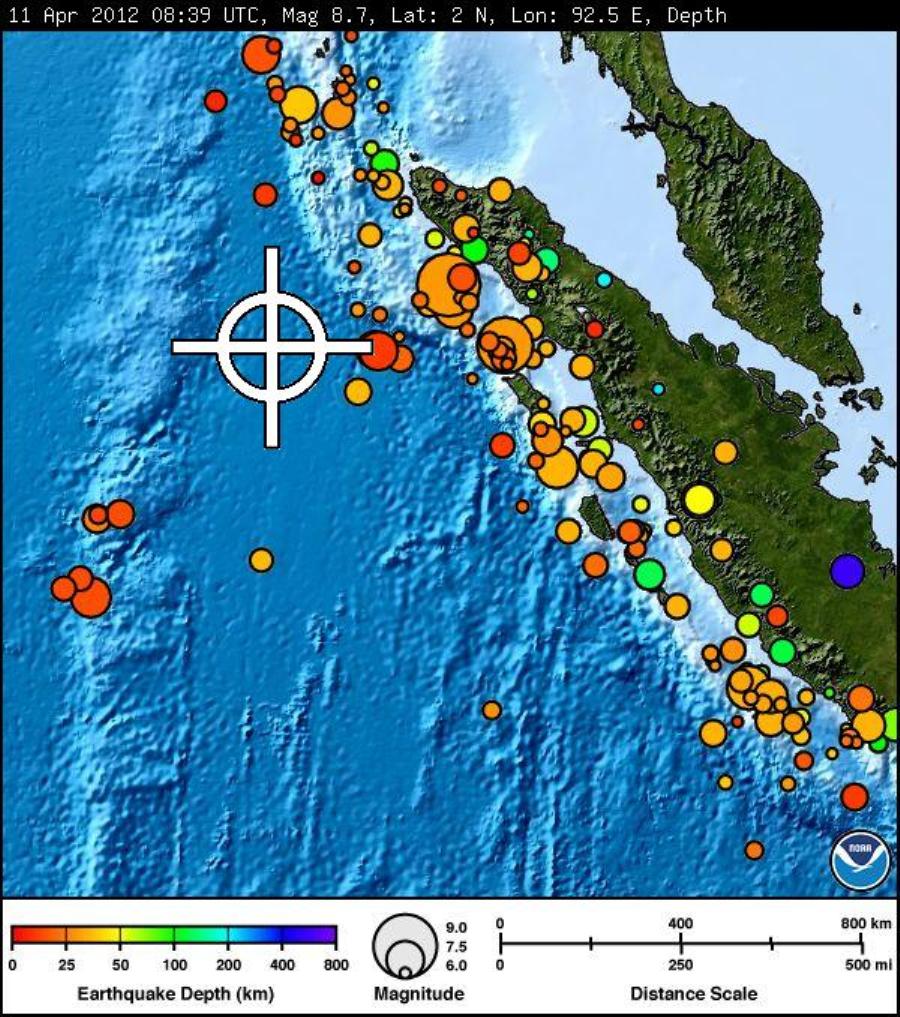




 Open Minds!