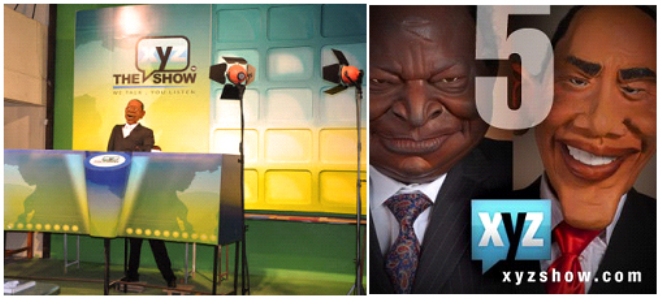
It’s a show called the XYZ Show, broadcast weekly on Kenya’s Citizen TV. Started in mid May 2009, the first season introduced Kenyan viewers to a new form of satire television, with life-sized puppets made to resemble famous persons, mostly politicians.
Now comes the report that the show has riled some Kenyan politicians – surprise, surprise! I have only just come across this Citizen TV news report, broadcast a couple of weeks ago:
Controversy Over The XYZ Show
The satirical puppet show XYZ on Citizen Television every Sunday night, has attracted the attention of non other than the Public Service Minister Dalmas Otieno. The Minister says the caricature show is depicting politicians in bad light. The Director of Communication Ezekiel Mutua avers that, the show is representative of just how free the media is, in Kenya.
Well, what can we say? We thought politicians in general had thicker skins. Perhaps some Kenyan politicians are in danger of forgetting that timeless piece of Swahilian advice: Hakuna matata!
Hakuna matata is a Swahili phrase that is literally translated as “There are no worries”. It is sometimes translated as “no worries”, although is more commonly used similarly to the English phrase “no problem”.
I ended a recent blog post, News wrapped in laughter, with this thought: “There is another dimension to satirising the news in immature democracies as well as in outright autocracies where media freedoms are suppressed or denied. When open dissent is akin to signing your own death warrant, and investigative journalists risk their lives on a daily basis, satire and comedy becomes an important, creative – and often the only – way to comment on matters of public interest. It’s how public-spirited journalists and their courageous publishers get around draconian laws, stifling regulations and trigger-happy goon squads. This is precisely what is happening right now in countries like Kenya and Sri Lanka, and it’s certainly no laughing matter.”
An interesting experiment in political satire on Kenyan television has just ended its first season on 9 August 2009. It’s a show called the XYZ Show, which was broadcast weekly on Kenya’s Citizen TV. Started in mid May 2009, the first season introduced Kenyan viewers to a new form of satire television, with life-sized puppets made to resemble famous persons, mostly politicians.
Gado the CreatorThe XYZ Show was inspired by famous puppet satire series like the British “Spitting Image” and the French “Les Guignols de l’Info” shows. In the XYZ Show, the puppets commented on news and current events from both Kenya and overseas.
The XYZ Show was developed by a team led by Kenyan cartoonist Godfrey Mwampembwa, alias Gado. He is the most widely syndicated cartoonist in East and Central Africa. He publishes a daily cartoon in The Nation, the largest newspaper in Kenya, and his work has been published in Le Monde (France), Washington Times (US), De Standaard (Belgium) and The Japan Times.
According to its creators, the XYZ Show challenged famous figures from Kenyan high society and politics using humour and satire. It aimed to become a new forum for social and political debate, one that provides room for open discussion.
Watch XYZ Show’s first episode trailer, produced one year ago:
Says the Prince Claus Fund of the Netherlands, which supported the show’s production: “Although freedom of the press is a constitutional right in Kenya, it is difficult for many journalists to practice their profession without interference. Gado and his team hope that the XYZ Show will contribute positively to strengthening freedom of the press and increasing political and social awareness among the people of Kenya. The show provides commentary on current social and political developments and aims to use humour and artistry to reinforce freedom of speech in Kenya.”
From what I’ve been able to watch online, on the show’s YouTube channel and elsewhere, the production values are at a high standard, comparable to such shows made in Europe and East Asia. The puppets are attractive, movements convincing and the pace quick and slick.
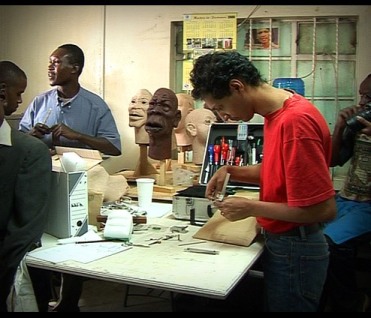
Who pulls his strings?The producers have also tried hard to make XYZ more than just a TV show. The website, in English, shows how the content is being adapted for the web (as webisodes) and mobile phones (as mobisodes). The show’s official blog takes us on to the set and shares with us the story behind the story, and introduces us to the artists and technical geniuses involved. Full marks for trying to engage the audience.
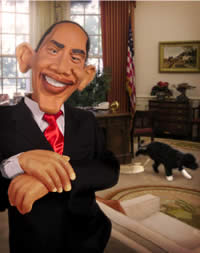
Then there is Barack Obama. Using his Kenyan connections, the show casts him (really, a puppet in his image) in a ‘supporting actor’ role. This has clearly inspired some interest in the show beyond Kenya.
So far, so good. But how does it work with the audience? The show is directed mainly at local audiences, and even if it’s presented in a mix of English and local language, it’s not something a complete outsider like myself can appreciate.
So I ‘crowd-sourced’ by asking a Kenyan reader of my blog, Marion N N, for her opinion. Marion is part of Sojourner, which her blog introduces as “a social enterprise that exists to promote the origination, production and distribution of African viewpoints through visual media. We are passionate about African film-making and seek its viable promotion globally”.
Marion wrote a comment in her blog after watching one episode a few weeks ago. She lives and works in Kenya, and her views are far more valid than my own.
Behind the screen, creators at work...She wrote: “My first off impression was fascination about the quality of the show in terms of animation which is very new to the local TV production scene in Kenya. Once past the fascination of the animation, I found that the content failed to hold my interest, connect with me or engage me as an audience. As a socio-political spoof show, humor ideally should be the hook that captures audience but in this case, humor comes across as mindless, illogical or simply stupid action on the screen. As if in evidence to this fact, at some point my husband in between laughter remarked ‘This show is really stupid’. I would imagine this would be a compliment to the Production becuase it provoked laughter in a viewer. However beyond that moment, it seemed only natural for us to flick over to more substantial entertainment having enjoyed that brief flight of fancy that failed to arouse an appetite for more.”
Marion also wondered what the show’s intended audience was, and highlighted the many challenges in getting the levels and balances right in doing political satire: “That politicians sometimes (nay, most times) behave ridiculously is not new or fresh. But the treatment, underlying themes, ideas communicated to audiences should be. Why do I suggest this? Because political satire by its nature speaks to an audience that is fairly mature, and exposed. To use childish humor that is poorly developed will not hold the audience’s attention. Infact at some point the content may become a tad irritating to watch. Political satire needs to be treated with a peppering of fact, wit, fresh perspective or take -out: The achievement of some underlying objective and not just mindless visual gimmicks that lead to the feeling of ‘stooping to idiocy; by audiences. This seeming insult of intelligence causes us as an audience to switch off.”
In my own view, The XYZ Show had at least three major challenges. Doing any puppet show is hard enough, and these days the on-air competition is neither local nor fair: it comes from global entertainment corporations like MTV and their regional variations, usually with deep pockets. Doing political satire is even harder, especially if the political culture is intolerant or repressive. To get the look, feel and balances right in a country where such a show is being done locally for the first time is a formidable challenge by itself.
But I’ll let Marion have the last word. In spite of the various concerns, she feels that the XYZ Show has ‘room to grow and conquer the airwaves’. But, as she notes, “The production team have their work cut out for them in pre-production. It’s back to the drawing board and ask who is my audience? What appeals to them? How do I connect with them, define an objective for the show and its audiences? Research facts and opinions about national sentiment on issues then develop scripts and sequences…”
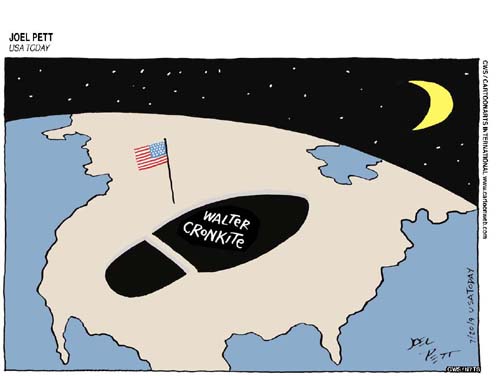
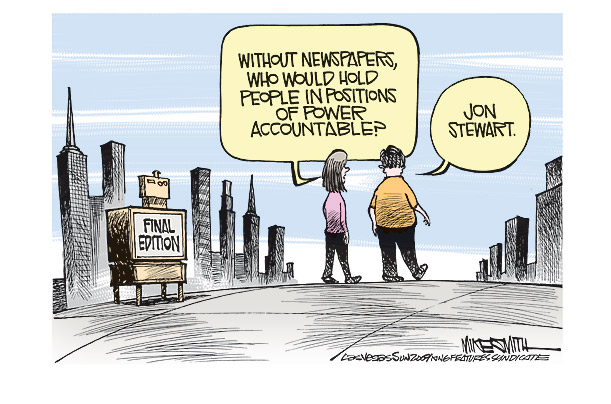
“What matters about Cronkite is that he knew when to stop being reassuring Uncle Walter and to challenge those who betrayed his audience’s trust. He had the guts to confront not only those in power but his own bosses. Given the American press’s catastrophe of our own day — its failure to unmask and often even to question the White House propaganda campaign that plunged us into Iraq — these attributes are as timely as ever.
“That’s why the past week’s debate about whether there could ever again be a father-figure anchor with Cronkite’s everyman looks and sonorous delivery is an escapist parlor game. What matters is content, not style. The real question is this: How many of those with similarly exalted perches in the news media today — and those perches, however diminished, still do exist in the multichannel digital age — will speak truth to power when the country is on the line? This journalistic responsibility cannot be outsourced to Comedy Central and Jon Stewart.”
I cannot agree more with the premise and arguments in this essay, which is well worth a careful, slow read by everyone, everywhere who cares for good journalism — either as practitioners or consumers (and in this media saturated age, don’t we all fall into one or both categories?).
At the same time, without detracting from the value of — and the crying need for — investigative, reflective and ‘serious’ journalism, I believe comedy and especially political satire play a key role today in analysing and critiquing politicians, businessmen and others whose decisions and actions impact public policy and public life.
Anchor, anchor, burning bright...Political satire is nothing new: it’s been around for as long as organised government. Over the centuries, it has manifested in many oral, literary or theatrical traditions, some more memorable and enduring – such as Gulliver’s Travels and Animal Farm. And for over a century, political cartoonists have been doing it with brilliant economy of words – as I have said more than once on this blog, they are among the finest social philosophers of our times.
In the age of electronic media, it’s only natural that the tradition of satire thrives on the airwaves and online. In fact, there is a rich and diverse offering of politically sensitive and/or active satire in the mainstream and online media that we can consider it a genre of its own. Some of it is so clever, authentic and appealing that we might momentarily forget that we are experiencing a work of satire.
Purists might decry this blurring of traditional demarcations between information, commentary and entertainment — but does that really matter?
When we survey the media and cultural scenes in our globalised world, we see things getting hopelessly entangled and mixed up everywhere. Nothing is quite what they seem – or claim – to be anymore. Content that is explicitly labelled as pure news and current affairs is looking more and more like entertainment. My friend Kunda Dixit, who edits the Nepali Times, says this is inevitable when the same mega corporations own both cartoon networks and news channels.
No news is good news -- for whom?If the mainstream news organisations don’t quite live up to our expectations to gather, analyse and reflect on the current affairs of the day, we should at least be grateful that some comedians are stepping into that void. We must welcome, celebrate and wish their tribe would increase!
The rise and rise of political satire is also being chronicled and analysed. A new book tells us why we now have to take satire TV seriously — it turns out to be the bearer of the democratic spirit for the post-broadcast age. Titled Satire TV: Politics and Comedy in the Post-Network Era, the book is co-edited by Jonathan Gray, Jeffrey Jones and Ethan Thompson (NYU Press, April 2009).
Here’s the blurb introducing the book: “Satirical TV has become mandatory viewing for citizens wishing to make sense of the bizarre contemporary state of political life. Shifts in industry economics and audience tastes have re-made television comedy, once considered a wasteland of escapist humor, into what is arguably the most popular source of political critique. From fake news and pundit shows to animated sitcoms and mash-up videos, satire has become an important avenue for processing politics in informative and entertaining ways, and satire TV is now its own thriving, viable television genre. Satire TV examines what happens when comedy becomes political, and politics become funny.”
The book contains a series of original essays focus on a range of popular shows, from The Daily Show to South Park, Da Ali G Show to The Colbert Report, The Boondocks to Saturday Night Live, Lil’ Bush to Chappelle’s Show, along with Internet D.I.Y. satire and essays on British and Canadian satire. “They all offer insights into what today’s class of satire tells us about the current state of politics, of television, of citizenship, all the while suggesting what satire adds to the political realm that news and documentaries cannot.”
Let me summarise the news so far. Intentionally or otherwise, some news anchors and politicians are increasingly behaving like comedians. Meanwhile, a few professional comedians are talking serious politics and current affairs in a genre of media that is growing in popularity by the day.
Are you confused yet? Well, get used to it. This is the shape of things to come.
In such topsy-turvy times, we need more Jon Stewarts to puncture the bloated egos and images of not only elected and other public officials, but also of our larger-than-life news anchors, editors and media tycoons. I would any day have conscientious comedians doubling as social and political commentators than suffer shallow, glib newscasters trying to be entertainers. That’s what you call laughing for a good cause.
Parting thought: There is another dimension to satirising the news in immature democracies as well as in outright autocracies where media freedoms are suppressed or denied. When open dissent is akin to signing your own death warrant, and investigative journalists risk their lives on a daily basis, satire and comedy becomes an important, creative – and often the only – way to comment on matters of public interest. It’s how public-spirited journalists and their courageous publishers get around draconian laws, stifling regulations and trigger-happy goon squads. This is precisely what is happening right now in countries like Kenya and Sri Lanka, and it’s certainly no laughing matter. More about this soon.
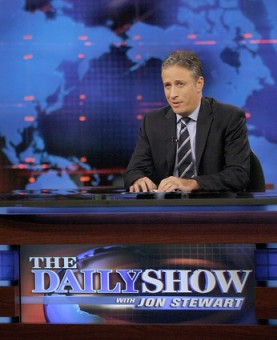
Backgrounder: The news as you never saw it before...The Daily Show with Jon Stewart, is an American late night satirical television programme, airing on Comedy Central, a cable/satellite channel. The half-hour long show is presented as a (fake) newscast. In their own words, the Daily Show team “bring you the news like you’ve never seen it before — unburdened by objectivity, journalistic integrity or even accuracy.” It “takes a reality-based look at news, trends, pop culture, current events, politics, sports and entertainment with an alternative point of view.”
The show premiered in July 1996, and was initially hosted by Craig Kilborn. Jon Stewart took over as host in January 1999, and made it more strongly focused on politics. In each show, anchorman Jon Stewart and his team of correspondents, comment on the day’s stories, employing actual news footage, taped field pieces, in-studio guests and on-the-spot coverage of important news events.
This is what the Wikipedia says: “The program has grown in popularity since Jon Stewart took over hosting, with organizations such as the Pew Research Center claiming that it has become a primary source of news for many young people, an assertion the show’s staff have repeatedly rejected. Critics, including series co-creator Lizz Winstead, have chastised Stewart for not conducting hard-hitting enough interviews with his political guests, some of whom he may have previously lampooned in other segments; while others have criticized the show as having a liberal bias. Stewart and other Daily Show writers have responded to both criticisms by saying that they do not have any journalistic responsibility and that as comedians their only duty is to provide entertainment.”
OK, The Daily Show may not be intentionally serious journalism, anymore than mainstream news channels are intentionally funny. But a significant number of American TV viewers and TV critics, as well as media researchers, have found the analysis and commentary to be highly insightful and incisive. It has won many awards including an Emmy and Peabody Award. It’s been on the cover of Newsweek for its outstanding elections coverage and serious journalism. It’s not to be laughed off easily. After the Last Newspaper...
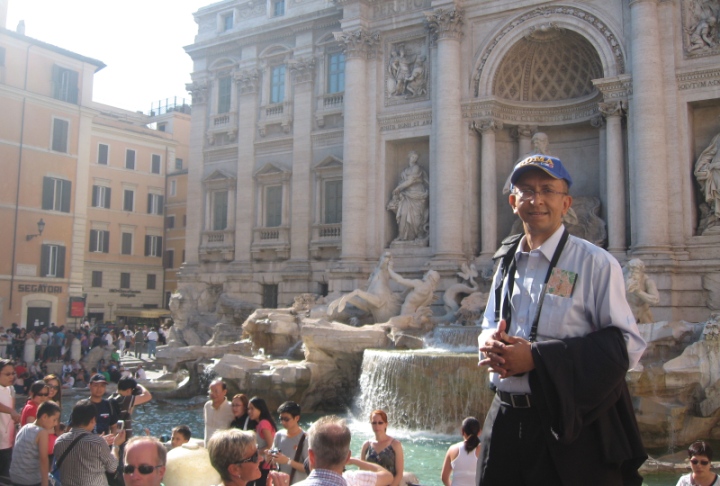
At Fontana Di Trevi: Guess which tourist escaped from a formal meeting?
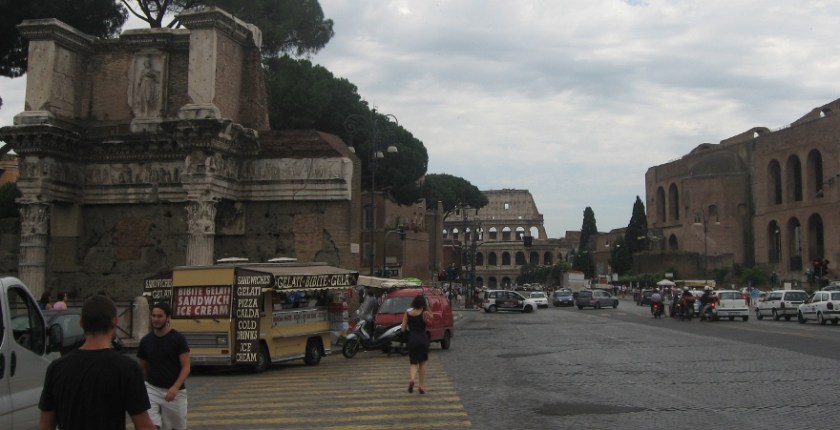
I’ve just spent a week in Rome, and felt entirely at home enjoying the hot and humid summer days and clear blue skies. The latest experience has reaffirmed my impression – formed on several visits over two decades – that Italy isn’t a part of Europe at all. It’s really an extension of South Asia.
Hanuman, the super-monkey who features prominently in the Indian epic Ramayana, is said to have carried whole chunks of the Himalayas and dropping them off in far away places. Perhaps, unknown to the chroniclers, Hanuman did some freelance transplanting in the Mediterranean.
The similarities are uncanny: Italians and South Asians have too much in common. Generalisations are dangerous, I know, but then, I’m a South Asian – we do it all the time (and get it right about half the time). So here goes…
For a start, we are both expressive people, and we have no compunction in being loud in public places. Understatement is for the polite (and dull) British; we prefer to exclaim and exaggerate. We also gesticulate wildly when we speak – there is probably an extra nerve linking our mouth with our arms.
We are opinionated and argumentative, often passionately (and needlessly) so. We can rarely agree on any matters of private or public interest, yet, almost miraculously, we manage to get by without coming to blows. Well, at least most of the time…
Heirs to rich and diverse culinary traditions, we South Asians love and cherish our food – as do the Italians. We have our rice, chapatti and roti. They have their infinite array of pastas, pizzas and lasagnas. Our youngsters may fancy an occasional hamburger, but no American fast food can ever compete with our myriad aromas and flavours perfected literally over millennia. We take pride and joy in our food, and break bread with family, friends and strangers. Given a chance, we’ll spend half our waking hours eating.
Blending old and new with ease: average Roman doesn't the burden of history
Next to food, we have an abundance of laws, rules and regulations – too many, if you ask me. But we take our laws with a pinch of salt, or more. We happily and frequently bend them that they sometimes actually snap. Then we’d say Mamma Mia or Aiyo, and just move on.
Just look at the roads, and Italy’s similarity with South Asia is immediately clear. No other western European country comes close to Italy for the sheer chaos factor. We all drive as much with our horns as with the accelerators. We curse and yell at others on the road. Our streets are crowded, noisy and messy. We ignore traffic lights, speed limits and zebra crossings. Cyclists and pedestrians move at their peril.
This completely stuns the more orderly nationals like the Japanese and Swiss, who are puzzled how we don’t have more accidents on our roads (it puzzles us too). Partly because we all try to drive like James Bond, but more because too many of us are using privately owned two, three or four wheel vehicles, we often end up going nowhere at all. Some of our big cities now have traffic almost 24/7. Ancient Romans would be impressed by how much time we spend on our roads, an invention they perfected.
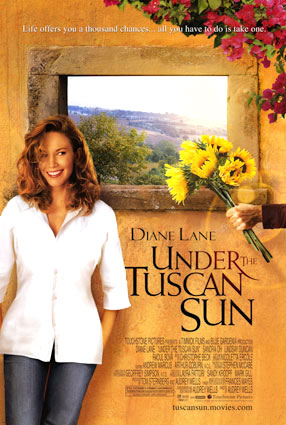
Dreary babudom failed to dampen her spiritIt’s not just Fiats, Ferraris and Marutis that move ever so slowly as we march towards progress. If anything, the wheels of our governments are even slower. In Under the Tuscan Sun, Frances Mayes chronicles her frustrations with the local bureaucracy when she bought and renovated an abandoned villa in the Tuscany Valley. Any South Asian who has tried to engage their own governments – on property, taxes or anything else – can well and truly empathise with her experience. In these days of global warming, glaciers probably move (recede) faster than our bureaucracies.
No wonder, then, that we just love to hate our governments in Italy and South Asia – we never tire of complaining about our politicians and bureaucrats. Strangely, however, we do little to overhaul the sick system. We often put up with our bungling, lying and sometimes stealing public officials. Worse, we idolise some of the biggest offenders despite their staggering lapses or excesses, and keep re-electing them!
Ah yes, we love our elections too. Until recently, Italians used to change their governments with such regularity – it has had 62 governments in the 64 years since the Second World War ended. While no South Asian country can match this record, thank goodness, few elected governments in South Asia complete their full term. And we share with Italians a fondness for coalition governments in all their variations and vicissitudes.
Come to think of it, is there anything surprising that Italian-born Edvige Antonia Albina Maino, better known as Sonia Gandhi, is today the most powerful woman in South Asian politics? As head of both Indian National Congress and the ruling coalition, she manages a menagerie of political animals.
Our obsession with politics is amplified (and some say exploited) by our cacophonous media. Our newspapers, radio and TV titillate, enthrall and occasionally inform their audiences. Many follow their own peculiar definitions of the public interest — which includes gleefully venturing into private lives of public figures. If Italians originated the term paparazzi, the South Asian media have turned it into a fine art. Our modern pantheons include a motley collection of show biz and sporting personalities, a few of who fall from grace frequently enough to keep our industrial gos mills turning day and night.
This same nosy media somehow manage to miss out or actively avoid probing the conduct of many public officials controlling very large amounts of public funds. It’s perhaps too simplistic to say corruption, cronyism and nepotism have become deep rooted in our countries. We have institutionalised these processes so much that they have become part of our political and business landscapes. The correct euphamism for these practices is public-private partnerships.
If you think all this makes us a sleazy, unethical and uncaring lot, you’re sadly mistaken. Please be informed that Italians and South Asians are both very religious. In fact, we take our faiths very seriously indeed, and practise it with such passion that some spoilsports might call us fanatical.
It doesn’t matter in the least that we worship at different altars – Italians at their soccer stadiums, and we at our cricket grounds. Our faith is equally intense and unwavering. When you make fun of our history, governments, laws and mannerisms, we’ll laugh heartily with you. But if you dare to criticise the performance of our national sporting teams, you will immediately find what fundamentalists we really are.
Today, 3 May, is once again World Press Freedom Day. It is recognised by the UN, and observed by media professionals and media activists worldwide to ‘draw attention to the role of independent news and information in society, and how it is under attack’.
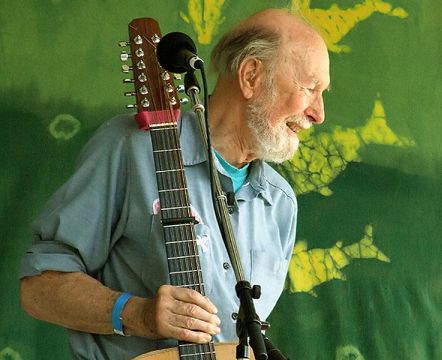
By happy coincidence, today also marks the 90th birthday of Pete Seeger, American folk singer and a pioneer of protest music. Since media freedom is inseparable from the democratic rights to dissent and protest, I will devote this blog post to salute Pete and his many decades of music for worthy causes — ranging from the American civil rights movement and opposing the Vietnam war to saving the environment and nuclear disarmament.
Pete is a hero for at least three generations of music lovers and freedom lovers around the world who believe in human rights, human dignity and democratic freedoms. Armed with nothing more than his banjo and melodious voice, and driven by the courage of his conviction, this small, gentle man has stood up to mighty leaders, generals and officials.
Never underestimate the power of one determined man...Pete is celebrated as much for his artistic and cultural achievements as for standing resolutely for his political beliefs and for lending his voice and music in support of causes be believed in. In 1955, he was called before the now infamous House Un-American Activities Committee, but refused to name personal and political associations on the grounds that this would violate his First Amendment rights. He said: “”I am not going to answer any questions as to my association, my philosophical or religious beliefs or my political beliefs, or how I voted in any election, or any of these private affairs. I think these are very improper questions for any American to be asked, especially under such compulsion as this.”
This defiance resulted in sustained harassment, persecution and professional isolation. As his recent PBS biography noted, “Standing strong for deeply-held beliefs, Seeger went from the top of the pop charts to the top of the blacklist and was banned from American commercial television for more than 17 years. This determined singer/songwriter made his voice heard and encouraged the people of the world to sing out along with him.”
‘If you love your country, you’ll find ways to somehow to speak out, to do what you think is right,” Pete says in this powerful documentary looking back at over half a century of activist singing and music.
Watch opening segment of PBS AMERICAN MASTERS series: Pete Seeger: The Power of Song, directed by Jim Brown and first aired in February 2008
Having pleaded under the First Amendment during the communist witch days of the 1950s, Pete repeatedly paid tribute to the far-sighted American pioneers who introduced the First Amendment guaranteeing the freedom of speech.
“As some judge said, if there is any fixed star in our firmament, that is the First Amendment,” he says in a talk-cum-performance at the Ford Hall Forum. In this audio-only piece, he talks the privilege of living under the First Amendment. He recalls his experience being questioned by the House Unamerican Activities Committee, encounters with censorship, and his relationship with fellow singer Woody Guthrie. It runs for nearly an hour, but is worth every second.
For someone like Pete Seeger who sang alongside Dr Martin Luther King, Jr., and other civil rights movement leaders and activists, it must have been deeply moving to be able to sing at the concert to mark President Barack Obama’s inauguration on 20 January 2009 at the Lincoln Memorial.
Watch Bruce Springsteen sing along with Pete Seeger on Woody Guthrie’s “This Land Is Your Land”. As he often does, Pete invites the euphoric audience to sing along!
One of my favourite Pete Seeger songs is “Turn! Turn! Turn! (to Everything There is a Season)”, often abbreviated to “Turn! Turn! Turn!”. It’s a song adapted entirely from the the Book of Ecclesiastes in the Bible (with the exception of the last line) and composed to music by Pete Seeger in 1959. Seeger waited until 1962 to record it,
Pete Seeger tells how he came to write “Turn Turn Turn.”
I have always believed that we have to get creative and resourceful when the basic freedoms of conscience and freedom of expression are under siege from despotic rulers and fanatical extremists. When we are not allowed to express in factual prose, we must turn to creative prose. And when prose fails, we still have verse, lyrics, satire and drama — the possibilities are only limited by our imagination. This is why I celebrate activist artistes like Pete Seeger, and invoke the memory of activist-poets like Adrian Mitchell and Ken Saro-wiwa. When the barbarians are at our gates and we feel surrounded by the unrelenting forces of hatred, intolerance and tribalism, they remind us that Another World is Possible — but we have to believe in it, stay the course and find ways to sing, dance and laugh our way out of gloom.
And here’s Pete singing another one of my personal favourites, a song that powered the civil rights movement and has since inspired and sustained struggles for social justice around the world: We Shall Overcome.
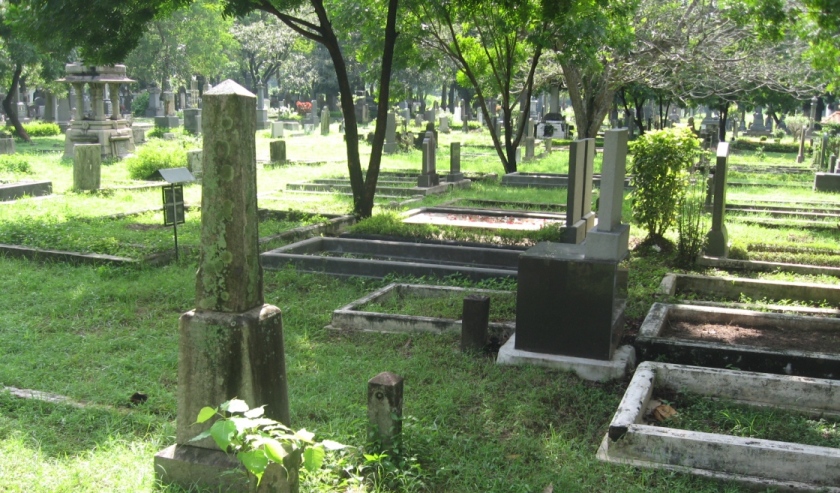
Colombo General Cemetery: No discussion or debate...
This is a view of Colombo’s main cemetery, the final resting place for many residents of Sri Lanka’s capital and its suburbs. I took this photo less than a month ago, when I visited a grave on a quiet morning.
The late Bernard Soysa, a leading leftist politician and one time Minister of Science and Technology, once called it ‘the only place in Colombo where there is no discussion or debate’.
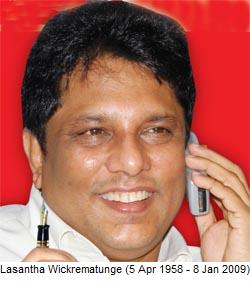
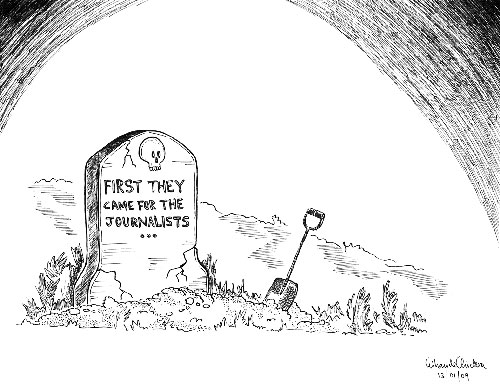
This afternoon, family, friends and many sorrowful admirers of Lasantha Wickramatunga, the courageous Sri Lankan newspaper editor who was brutally slain last week in broad daylight, took him there — and left him behind amidst the quiet company.
But not before making a solemn pledge. All thinking and freedom-loving people would continue to resist sinister attempts to turn the rest of Sri Lanka into a sterile zombieland where there is no discussion and debate. In other words, rolling out the cemetery to cover the rest of the island.
The last laugh?Silencing Lasantha was the clear aim of cowardly gunmen who intercepted him on his way to work and shot him at pointblank. Tarzie Vittachi, the first Lankan newspaper editor to be forced into exile 50 years ago for freely expressing his views on politically sensitive issues, once called such attacks ‘censorship by murder’. (Alas, since Tarzie uttered those words in 1990, shooting the messenger has become increasingly common in Sri Lanka.)
Rex de Silva, the first editor that Lasantha worked for (at the now defunct Sun newspaper) in the late 1970s, has just cautioned that Lasantha’s murder is the beginning of ‘the sound of silence’ for the press in Sri Lanka. Can this sound of silence be shattered by the silent, unarmed majority of liberal, peace-loving Lankans who were represented at the funeral service and the Colombo cemetery today?
And would they remember for all time Edmund Burke’s timeless words: “All that is necessary for the triumph of evil is that good men do nothing”?
How many would actually read, absorb and heed the deeply moving words of Lasantha’s one last editorial, copies of which were distributed at the cemetery and the religious service before that?
That editorial, which appeared in The Sunday Leader on 11 January 2009, embodies the best of Lasantha Wickrematunga’s liberal, secular and democratic views.
As I wrote in another tribute published today by Himal Southasian and Media Helping Media: “I have no idea which one – or several – of his team members actually penned this ‘Last Editorial’, but it reads authentic Lasantha all over: passionate and accommodating, liberal yet uncompromising on what he held dear. I can’t discern the slightest difference in style.”
“And there lies our hope: while Lasantha at 51 lies fallen by bullets, his spirit and passion are out there, continuing his life’s mission. That seems a good measure of the institutional legacy he leaves behind. If investigative journalism were a bug, the man has already infected at least a few of his team members…”
Much has been written and broadcast in the past 100 or so hours since Lasantha’s journey was brutally cut short by as-yet-unidentified goons who have no respect for the public interest or have no clue how democracies sustain public discussion and debate. I’m sure more will be written – some in outrage and others in reflection – in the coming days and weeks.
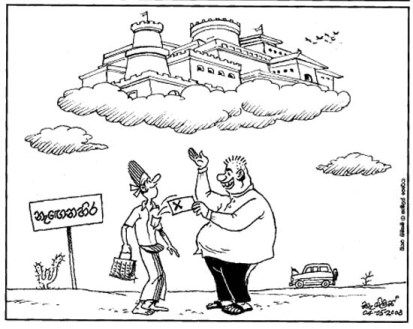
Siribiris (left): puncturing egos for 40 yearsAs we leave Lasantha to his rest, I remember Siribiris. For those unfamiliar with the name, Siribiris is an iconic cartoon character created by Camillus Perera, a veteran Sri Lankan political cartoonist who has been in the business as long as I have been alive.
Siribiris represents Everyman, who is repeatedly hoodwinked and taken for granted by assorted politicians and businessmen who prosper at the common man’s expense. The only way poor, unempowered Siribiris can get back at them is to puncture their egos and ridicule them at every turn. And boy, does he excel in that!
It’s no surprise that Lasantha – the bête noire of shady politicians and crooked tycoons – was very fond of Siribiris. Perhaps he saw his own life’s work as extending that of Siribiris in the complex world of the 21st century. That he did it with aplomb and gusto – and had great fun doing it, sometimes tongue stuck out at his adversaries – will be part of Lasantha’s enduring legacy. (As his last editorial reminded us, in 15 years of investigative journalism on a weekly basis, no one has successfully sued the newspaper for defamation or damages.)
So Goodbye, Lasantha. And Long live Siribiris!
Cartoon by Gihan de Chickera, Courtesy: Daily Mirror, Sri Lanka
I was run over by the truth one day.
Ever since the accident I’ve walked this way
So stick my legs in plaster
Tell me lies about Vietnam…
With these lines opened the bitterly sarcastic reaction to the televised horrors of the Vietnam War by British poet, playwright and performer Adrian Mitchell.
He first read his best-known poem, called To Whom It May Concern (also known as Tell Me Lies), to thousands of anti-war protesters who flocked into London’s Trafalgar Square on the afternoon of Easter Monday 1964. As Mitchell delivered his lines from the pavement above in front of the National Gallery, angry demonstrators in the square below scuffled with police.
Adrian Mitchell (1932 - 2008)Mitchell, who died on 20 December 2008 aged 76, occasionally updated the poem to take into account the subsequent wars and resulting tragedies in places as far apart as Iraq, Burma, Afghanistan and Israel/Palestine.
“It is about Vietnam, But it is still relevant,” Mitchell said in 2001. “It’s about sitting faithfully in England while thousands of miles away terrible atrocities are being committed in our name.”
As Michael Kustow wrote in an obituary in The Guardian: “Mitchell’s original plays and stage adaptations, performed on mainstream national stages and fringe venues, on boats and in nature, add up to a musical, epic and comic form of theatre, a poet’s drama worthy of Aristophanes and Lorca. Across the spectrum of his prolific output, through wars, oppressions and deceptive victories, he remained a beacon of hope in darkening times. He was a natural pacifist, a playful, deeply serious peacemonger and an instinctive democrat.”
The one time journalist and television critic was fired by The Sunday Times (UK) for reviewing Peter Watkins’ 1965 anti-nuclear TV film The War Game. Its depiction of the impact of Soviet nuclear attack on Britain had caused such dismay within the BBC and British government that the public broadcaster cancelled its scheduled transmission on 6 August 1966 (the 21 anniversary of the Hiroshima attack). It was finally broadcast in 1985, with the corporation stating that “the effect of the film has been judged by the BBC to be too horrifying for the medium of broadcasting”.
But Auntie Beeb and the rest of the Establishment couldn’t stop Mitchell, whose satirical poems continued to demolish myths emanating from the propaganda mills of the military-industrial complex and their allies in the mainstream media.
As Kustow recalled: “To Whom It May Concern, a riveting poem against bombs and cenotaphs and the Vietnam war, with which he stirred a capacity audience in Mike Horovitz’s pioneering Poetry Olympics at the Albert Hall in 1965, has lasted through the too many wars since: a durable counting-rhyme to a rhythm and blues beat.”
Watch Adrian Mitchell recite/sing his poem in 1965 (black and white film):
As Jan Woolf wrote in another tribute: “To watch Adrian Mitchell…prepare his body for a performance of To Whom It May Concern – chin cupped in hand, eyes focused, back tense, ‘I got run over by the truth one day…’ – was to see a great poet steadying himself with all the focus and tension of a warrior. When those blue suede shoes got moving, the poem came alive. He breathed it, lived it, became it. It was as if he were dancing with language to get at the truth.”
Woolf recalls that Mitchell’s reading of Tell Me Lies at a City Hall benefit just before the 2003 invasion of Iraq was electrifying. “Of course, he couldn’t stop that war, but he performed as if he could.”
The 21st century re-mix ends with these words:
“You put your bombers in, you put your conscience out
You take the human being, and you twist it all about
So scrub my skin with women
So chain my tongue with whisky
Stuff my nose with garlic
Coat my eyes with butter
Fill my ears with silver
Stick my legs in plaster
Tell me lies about –
Iraq
Burma
Afghanistan
BAE Systems
Israel
Iran
Tell me lies Mr Bush
Tell me lies Mr Blairbrowncameron
Tell me lies about Vietnam”
For some strange reason that has nothing to do with Adrian Mitchell’s recent departure, these words and the whole poem keep turning in my mind over and over again.
Onion News Network - for news you can't afford to miss
The American presidential election race is entering its last lap. And the world watches the campaign trail with baited breath.
Democratic presidential candidate Barack Obama enjoys more international support than his Republican rival John McCain, as most people outside the US prefer the Democrat leader to become next US president, according to a BBC poll in September 2008. Most of the people questioned in the global poll conducted by international polling institute GlobeScan believe that US relations with the rest of the world would improve under the presidentship of Obama.
While so much of American and international news media time is being spent on covering the campaign and various opinion polls, some comic relief comes from The Onion – that wickedly funny and innovative website which now produces a steady stream of videos spoofing the news media’s worse excesses.
The Onion calls it the ‘War for the White House’ and has set up its ‘election analysis bunker’ from where its intrepid reporters are bringing us news that you – and major news organisations – have somehow managed to miss. They call is Onion News Network, ONN for short.
They’ve been doing it for the better part of a year, and here are some of my favourites from The Onion YouTube channel:
Caution: There’s a slight bias towards Senator Obama in some of these news reports, but then, he’s been the liberal media’s darling for much of this campaign year.
October 2008: McCain Left On Campaign Bus Overnight
Campaign officials downplayed the incident, saying the senator was fine as soon as he was fed and taken to the bathroom.
October 2008: Gifted Youngster Sells Cookies To Buy Attack Ad
In this installment of Beyond The Facts, a precocious 8-year-old girl participates in grown-up politics by spreading smears and lies.
September 2008: McCains Economic Plan: ‘Everyone Marry A Beer Heiress’
McCain pointed to his personal success in marrying a wealthy beer heiress to prove how the plan could benefit every American.
September 2008: Obama Runs Constructive Criticism Ad On McCain
In response to Republican attacks, Barack Obama unleashed a series of slightly negative ads that gently point out how McCain could be doing a better job.
August 2008: Portrayal Of Obama As Snob Hailed As Step Forward For Blacks
Overjoyed civil rights leaders say that Barack Obama has paved the way for future black politicians to be smeared as country club snobs.
March 2008: Poll: Bullshit Is Most Important Issue For 2008 Voters
For a majority of likely voters, meaningless bullshit will be the most important factor in deciding who they will vote for in 2008.
January 2008: The Onion: More Candidates Court Fat Vote
Presidential candidates are reaching out to fat voters on the campaign trail by eating large amounts of fattening food.
ONN’s self-introduction says its “style of hard-hitting, on-the-ground coverage of live news events has become a standard in the news industry. The network can be viewed in 92.2 million U.S. households and more than 500,000 American prison cells, making it the most-watched cable network in the world. It can currently be seen in 312 countries, with broadcasts in 52 different languages“.
“The U.S. Presidential election may be the most undemocratic in the world. Only some 126 million Americans vote, yet the result is felt by 6.6 billion people. Indeed, in some ways it matters even more to non-Americans. The president is constrained domestically by many constitutional checks and balances, but this is far less true in foreign affairs.”
Noting that the world is not unanimous in its choice, he went on to say: “It is clear, however, whose election would have the most dramatic effect: Barack Obama’s. In one fell swoop, an Obama victory would eliminate at least half the massive anti-Americanism now felt around the world.”
With a dozen more weeks left before the early November election, we won’t hazard a guess on its outcome — but I sure hope Obama wins! Meanwhile, I want to share a very funny, short video that JibJab released last week looking at the whole presidential election campaigning that has gripped Americans this year.
Here’s their own blurb for it:
In our first election satire since 2004’s “This Land” and “Good to be in DC”, we bid farewell to Bush and give Obama and Mccain a proper JibJab hazing! And, of course, who could forget about Hillary and Bill? This rip-roaring musical romp gives the election process the proper spanking it deserves!
Over the weekend, I shared this link with a dozen friends. One of them, an American friend Tedson J Meyers, is an apparent Democratic sympathiser and certainly an Obama fan. He just sent me this rejoinder to JibJab:
I am deeply disturbed by jibjab’s condescension
It is clear that they need some parental attention
Campaigning you see is our way of life
It keeps us keen as the edge of a knife
That’s why I believe jibjab need addressing
Perhaps they don’t know that “Barack” means “a blessing”?
Who are these guys? Here’s a self intro from their YouTube channel:
Brothers Gregg and Evan Spiridellis founded JibJab in 1999 with a few thousand dollars worth of computer equipment, a dial-up Internet connection and a dream of building a global entertainment brand. In 2004, their election parody “This Land” spark an international sensation and was viewed more than 80 million times online. NASA even contacted the brothers to send a copy to the International Space Station! Since then, JibJab has premiered ten original productions on The Tonight Show with Jay Leno and received coverage on every major news outlet. In 2004, Peter Jennings named the brothers “People of the Year.”
When I gave up eating all meat nearly 15 years ago, I had some explaining to do.
Breaking away from the pack is never that easy. Friends and colleagues wanted to know if I had suddenly gone religious (most certainly not: I practise no religion and frown upon all); or become an animal-hugger (well, not quite); or if I was too sick to eat a ‘normal diet’ anymore.
That last one was closer to the truth. I became a partial vegetarian because I wanted to stay healthy. I realised how unhygienic meat production and distribution were in my part of the world, and yes, I was also sensitive about the excessive cruelty to animals who end up on dining tables.
And it’s not just in Asia that organised meat production is increasingly hazardous to human health (not to mention the untold suffering by farm animals and the growing power of big agri-business companies). Animal rights and environmental activists have been pointing these out for years. And as powerful documentaries like Fast Food Nation(2006) documented, it is not only meat that’s crushed in the powerful mincing machine, but the whole of society.
I was delighted, therefore, to belatedly discover the innovative and insightful series called The Meatrix. Funnily, I heard about it from two sources almost at the same time. A Malaysian activist I was visiting in Georgetown, Penang, last week highly recommended it. Two days later, my colleague Manori Wijesekera returned from having screened one of our own films at the 16th Earth Vision Film Festival in Tokyo – where The Meatrix was a finalist in the children’s environmental film category.
The Meatrix is an animated spoof on The Matrix trilogy (1999 – 2003). It uses humor and thinly veiled characters and situations from the original Matrix films to educate the uninitiated about factory farms.
Evidently, it was made with the blessings of the Wachowski brothers who created the science fiction thriller series. The first animation, The Meatrix, starts when Moopheus the Cow finds Leo the Pig at a family farm and informs him that corporations are taking over the way farms used to be. By taking the blue pill, Leo can remain at ease in his current situation, or by taking the red pill, Leo can see just how far the rabbit hole goes. (Of course, the good Leo takes the red one.)
Watch the first animation on YouTube:
In this case, the Meatrix is the illusion created by big time agricultural corporations who have taken over most family-run farms in the west, and turned them into ruthless factories producing meat and dairy products. Those who take on the Meatrix – at grave risk to their life and limbs – reveal how these factory farms are pumping steroids, antibiotics and growth hormones to maximise production, exposing unsuspecting consumers to major health risks like mad cow disease and antiobiotic resistance.
There are two short sequels to the original Meatrix: The Meatrix II: Revolting, and The Meatrix II½. They all pack action, suspense and even a bit of romance….just like the Matrix films did. And all the Meatrix animations are under five minutes in duration – just right for the fast media generation!
The Meatrix is collaboration between GRACE (Global Resource Action Center for the Environment) and Free Range, a cutting-edge design company with a social conscience. It’s the mission of GRACE to eliminate factory farming and to preach the message that sustainable agriculture is both a better environmental and economic choice for rural communities.
In February of 2003, Free Range developed the Free Range Flash Activism Grant, offering the prize of a flash movie production to forward the work of a worthy nonprofit. GRACE was the first recipient, in recognition of its important work on farm reform.
When The Meatrix I launched in November 2003, the viral grassroots film broke new ground in online advocacy, creating a unique vehicle in which to educate, entertain and motivate people to create change. The Meatrix movies have been translated into more than 30 languages and are now the most successful online advocacy films ever with over 15 million viewers worldwide.
It’s time some of our development friends took a red pill to see what lies outside their charmed and illusory circles.
PS: By the way, I still eat fish and other seafood, largely because on my frequent travels in Asia I turn up in places where being a complete vegetarian is simply not realistic (try Korea, for example). I now say I eat only those creatures that swim, but none that walks on land. One of these days, I will give up temptations for all flesh…











 Open Minds!