Sri Lanka: Island of suspended dreams has a second chance...
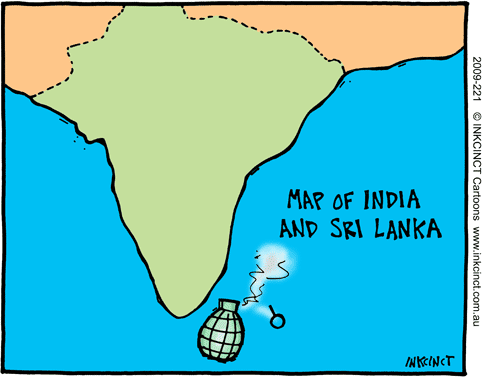
This is one of my favourite images. Showing southern part of India and my native Sri Lanka, it was captured by one of the early US space missions, nearly four decades ago.
Much has happened on the tear-drop shaped island since this image was taken: among other things, we’ve been through a civil war that lasted a generation, and robbed the dreams of at least two generations. That war officially ended on 18 May 2009.
The Day After, on 19 May 2009, I wrote a 1,500-word essay titled Memories of War, Dreams of Peace. The editor of Groundviews, Sri Lanka’s leading citizen journalism website, published it in full, and within minutes of my emailing the text to him.
I look back briefly on the brutal and tragic war – not in anger, but in great sadness. I then look forward in a wistful, dreamy mode. My premise was: “Now that the war is officially over, will this mark the beginning of real peace? I want to believe so. I want to audaciously dream of peace. The alternative is too dreadful to consider.”
This is not exactly what I’ve been trained to do. As a science writer and film-maker, I gather and analyse information, which I try to present in logical, coherent and accessible ways. In recent years, I’ve also been writing op ed essays in areas where I have some competence and experience. In writing this essay, I consciously departed from all that. I’m neither political scientist nor activist to engage in ideological or technocratic discussions, which others have already started in earnest. I wrote this at an emotional level, looking back and looking forward.
But my training did come in handy in framing the timely and necessary questions. My chosen ‘author intro’ for this essay thus reads: “Writer Nalaka Gunawardene has been a dreamer for all his 43 years. He asks more questions than he can answer.”
We've doused the flames of war, but much more needs to be done...If my views come across as naive or idealistic, I shall plead guilty as charged. My emotions this week are best described as cautiously optimistic, but as some readers on Groundviews pointed out in their comments, our high hopes have been betrayed before. But can we afford not to dream privately and publicly at this juncture? I don’t think so. We have suspended our dreams for too long, and it’s time to start dreaming again.
There are as many kinds of dreamers as there are dreams. One of my favourite quotes comes from the British soldier and writer T E Lawrence (of Lawrence of Arabia fame): “All men dream, but not equally…the dreamers of the day are dangerous men, for they may act their dream with open eyes, to make it possible.”
The framework, building on a dozen years of TVEAP experience in working with television broadcasters and other media outlets across the Asia Pacific region, guides individuals and institutions to get the best out of the media. One key to success is building sustained relationships with media professionals and their gatekeepers (the bosses at media organisations who decide what content to publish or broadcast).
We introduced the framework to a group of ICT researchers drawn from across Asia who came together for a two-day workshop in Hyderabad, India, on 1 – 2 December 2008. The workshop aimed to build their capacity to use different communication frameworks and tools to engage policy makers, various other stake-holders and the wider public.
Our friends at IDRC have recently edited highlights of our presentation into a short video, which mixes excerpts from an interview they filmed with me. It can be watched here:
“Development” is seen as a hard sell in the increasingly commercialised media in the Asia Pacific. Researchers, activists and educators engaged in development work often complain that they are blocked out of the print and broadcast media. Yet they fail to understand a basic truth about the media: there is no quota of print space or air time set aside for development. Information and opinions on development topics must compete with other areas of human endeavour for the limited space and time available.
It is unrealistic to expect any legally or otherwise guaranteed space or time for development content. Even if there were, that can only apply on the media owners and media professionals. There can be no guarantee that media audiences will accept such content.
I get rather weary when well-meaning development players complain about the airwaves being full of entertainment, as if that airtime is something they have been deprived of. There is nothing intrinsically wrong with entertainment. The world will be a very dull place if the broadcasters listened to development people and packed every minute of air time with ‘information and education’.
Hitch a hike, but don't expect to get in the driver's seat...
This is the big challenge to the development community — how to get that delicate balance right, and learn to co-exist with other forms of media products catering to the wide and varied human interests. Hitch-hiking with the media avoids confrontation, looks for the common ground and tries to nurture collaboration for mutual benefit.
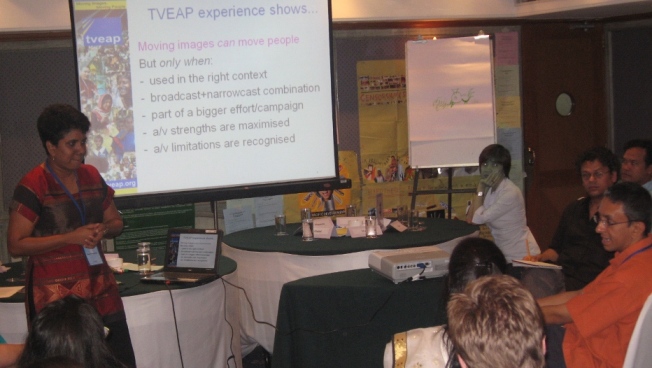
As my colleague Manori Wijesekera (presenting in the photo above) told the Hyderabad workshop: “Researchers and activists are a good source of information and opinions for the media, who need a constant supply of these. This can be a win-win situation for both parties, but we have to remember that we are hitching a ride with the media. So we can’t get into the driving seat or demand too much at once!”
So here’s our commercial: TVEAP conducts short, customised training sessions and workshops for researchers and civil society groups to enhance their media skills. These offer guidance on how to build and sustain ‘bridges’ with the media, and receive quality coverage that go well beyond publicity and public relations. If interested, get in touch with us!
In this essay, I have expanded some points originally made in two recent blog posts, on 30 April and 1 May 2009.
Here’s an excerpt:
“Flu shots, quarantine measures and hospital care alone cannot counter the current flu outbreak. While medical doctors and researchers spearhead the public health response, we need the mass media and other communicators to mount the public awareness response. Ideally, they should reinforce each other.
“For the first time in history, we now have the technological means to quickly reach out to most of humanity. More than four billion mobile phones are in use, a majority of them in the developing world. Nearly a quarter of the world population (over 1.5 billion people) have access to the web, even if at varying levels of bandwidth. Thousands of radio and TV channels saturate the airwaves – these still are the primary source of news and information for billions.
“Can these information and communication technologies (ICTs) help disseminate the right kind of flu awareness? How fast can we mobilise 24/7 media outlets and telecom networks to inspire preventive and curative action? What can the blogging, texting and twittering new media activists do in such efforts?”
I then return to one of my favourite points about communicating disasters and crises: the need for credible messages and credible messengers. This was a core theme in the Asian book on Communicating Disasters that I co-edited in 2007. I also highlighted it in this interview given to APC in early 2008.
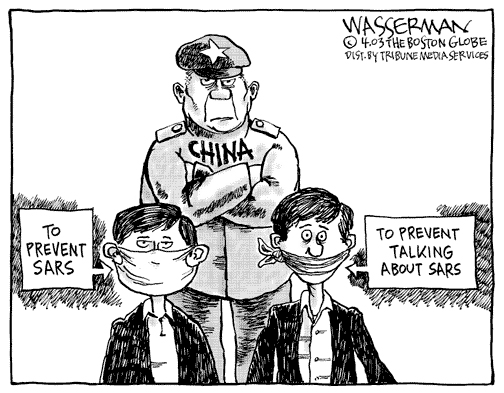
Here’s how my essay ends: “Whether it is SARS, HIV or tsunami, many Asian governments have suffered from a credibility gap in managing information about emergencies. For example, the initially slow and guarded media reporting on SARS allowed the virus to spread quickly in China, with devastating results. We cannot afford to repeat these mistakes with the latest flu pandemic.
“Nearly a century ago, British author H G Wells talked about human history being a race between education and catastrophe. In the coming weeks, we would find out if humanity has what it takes to outrun and outsmart a stubborn virus.”
Read the full essay at MediaChannel.org
My latest essay is a humble birthday present to MediaChannel.org as it completes 10 years. Unique among websites, MediaChannel.org holds the rest of the media accountable with the best of the world’s media criticism and analysis — offering news, diverse global perspectives, and commentaries tracking international news flows. They cover breaking controversies, showcase change-makers, trends and cutting edge issues that you need to know about – produced by journalists for journalists and citizens.
“Our survival alone is a cause for celebration – a decade of growth and impact is impressive in ‘Internet years’,” wrote the website’s founders in a special 10th anniversary message. They added: “Over the past 10 years, we have survived financial crises and organized hack attacks. We have managed to remain relevant and on the cutting edge in a quickly evolving online landscape when many other sites and organizations have come… and gone.”
The team is making an urgent appeal for donations to keep this excellent service going. I’m very happy to amplify this – few services can deliver better value for money, and our troubled times and troubled media sure need the soul-searching constantly provided by MediaChannel.org
Today, 3 May, is once again World Press Freedom Day. It is recognised by the UN, and observed by media professionals and media activists worldwide to ‘draw attention to the role of independent news and information in society, and how it is under attack’.
By happy coincidence, today also marks the 90th birthday of Pete Seeger, American folk singer and a pioneer of protest music. Since media freedom is inseparable from the democratic rights to dissent and protest, I will devote this blog post to salute Pete and his many decades of music for worthy causes — ranging from the American civil rights movement and opposing the Vietnam war to saving the environment and nuclear disarmament.
Pete is a hero for at least three generations of music lovers and freedom lovers around the world who believe in human rights, human dignity and democratic freedoms. Armed with nothing more than his banjo and melodious voice, and driven by the courage of his conviction, this small, gentle man has stood up to mighty leaders, generals and officials.
Never underestimate the power of one determined man...Pete is celebrated as much for his artistic and cultural achievements as for standing resolutely for his political beliefs and for lending his voice and music in support of causes be believed in. In 1955, he was called before the now infamous House Un-American Activities Committee, but refused to name personal and political associations on the grounds that this would violate his First Amendment rights. He said: “”I am not going to answer any questions as to my association, my philosophical or religious beliefs or my political beliefs, or how I voted in any election, or any of these private affairs. I think these are very improper questions for any American to be asked, especially under such compulsion as this.”
This defiance resulted in sustained harassment, persecution and professional isolation. As his recent PBS biography noted, “Standing strong for deeply-held beliefs, Seeger went from the top of the pop charts to the top of the blacklist and was banned from American commercial television for more than 17 years. This determined singer/songwriter made his voice heard and encouraged the people of the world to sing out along with him.”
‘If you love your country, you’ll find ways to somehow to speak out, to do what you think is right,” Pete says in this powerful documentary looking back at over half a century of activist singing and music.
Watch opening segment of PBS AMERICAN MASTERS series: Pete Seeger: The Power of Song, directed by Jim Brown and first aired in February 2008
Having pleaded under the First Amendment during the communist witch days of the 1950s, Pete repeatedly paid tribute to the far-sighted American pioneers who introduced the First Amendment guaranteeing the freedom of speech.
“As some judge said, if there is any fixed star in our firmament, that is the First Amendment,” he says in a talk-cum-performance at the Ford Hall Forum. In this audio-only piece, he talks the privilege of living under the First Amendment. He recalls his experience being questioned by the House Unamerican Activities Committee, encounters with censorship, and his relationship with fellow singer Woody Guthrie. It runs for nearly an hour, but is worth every second.
For someone like Pete Seeger who sang alongside Dr Martin Luther King, Jr., and other civil rights movement leaders and activists, it must have been deeply moving to be able to sing at the concert to mark President Barack Obama’s inauguration on 20 January 2009 at the Lincoln Memorial.
Watch Bruce Springsteen sing along with Pete Seeger on Woody Guthrie’s “This Land Is Your Land”. As he often does, Pete invites the euphoric audience to sing along!
One of my favourite Pete Seeger songs is “Turn! Turn! Turn! (to Everything There is a Season)”, often abbreviated to “Turn! Turn! Turn!”. It’s a song adapted entirely from the the Book of Ecclesiastes in the Bible (with the exception of the last line) and composed to music by Pete Seeger in 1959. Seeger waited until 1962 to record it,
Pete Seeger tells how he came to write “Turn Turn Turn.”
I have always believed that we have to get creative and resourceful when the basic freedoms of conscience and freedom of expression are under siege from despotic rulers and fanatical extremists. When we are not allowed to express in factual prose, we must turn to creative prose. And when prose fails, we still have verse, lyrics, satire and drama — the possibilities are only limited by our imagination. This is why I celebrate activist artistes like Pete Seeger, and invoke the memory of activist-poets like Adrian Mitchell and Ken Saro-wiwa. When the barbarians are at our gates and we feel surrounded by the unrelenting forces of hatred, intolerance and tribalism, they remind us that Another World is Possible — but we have to believe in it, stay the course and find ways to sing, dance and laugh our way out of gloom.
And here’s Pete singing another one of my personal favourites, a song that powered the civil rights movement and has since inspired and sustained struggles for social justice around the world: We Shall Overcome.
Media joined the public awareness campaign Now that the World Health Organisation (WHO) has raised the swine flu level to Phase 5, the next to highest level in the worldwide alert system, everyone is talking about a global pandemic. On 30 April 2009, the UN’s top health agency referring to it as Influenza A(H1N1).
As I just wrote in another blog post, “While medical doctors and researchers spearhead the public health response, we need the mass media and all communications professionals to support the public awareness response. Flu shots and hospitals alone cannot win this battle.”
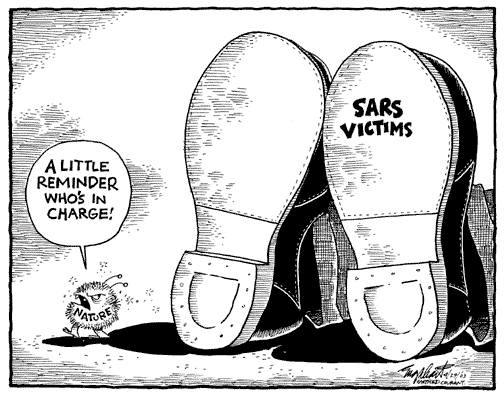
This is where Asian mass media – especially broadcast television – have some relevant and useful experiences. When Severe Acute Respiratory Syndrome (SARS) spread across much of East Asia and Southeast Asia, it wasn’t just the public health systems that took on the epidemic. The local, national and regional media joined the effort in the true spirit of public interest. There was no division between state-owned and privately-owned media. The airwaves were mobilised for preventing, containing and eventually beating the disease that wreaked havoc for several months.
The role played by Asian media during the SARS crisis has been studied and analysed in considerable detail. Lessons from that experience are worth recalling at this moment when the world is looking for ways to contain swine flu.
When SARS forced Chinese schools, universities and public offices to be closed for several weeks in the Spring and Summer of 2003, the country’s television broadcasters rose to the occasion. They started beaming a combination of entertainment and educational programming round the clock to over 400 million households across the country — now the largest national television audience in the world. The idea was to use the media to encourage more people to stay inside homes and minimise the spread of the virus through contact. China Educational Television (CETV) — the satellite distributed educational network — took on the role of substitute teacher by increasing its broadcasts.
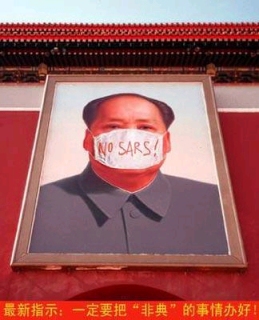
Crisis? What crisis?Of course, as the most likely place of origin of the SARS virus, China’s initial response to the epidemic was denial. Researchers have established how the slow or muted media reporting within China triggered more rapid disease transmission of the virus both within and beyond China. As the noted Asia watcher, columnist and journalism professor Tom Plate, wrote in 2008: “All the serious Chinese journalists were left holding their heads in shame. In effect, the institution of the mass-communication of news, because it was not allowed to do its job, contributed to the enormity of the SARS toll.”
Many researchers agree that it was the island republic of Singapore that best handled the SARS crisis. Dr Stewart Auyash, an Associate Professor in Health Promotion and Physical Education at Ithaca College in New York says: “Of the countries affected, the actions of Singapore’s government stand out as an example of how to deal not only with the biological elements of the disease but with the methods, style, tone, timing and breadth of its communicated messages.”
The Auyash study was titled ‘Communications as a Treatment for SARS in Singapore and its Lessons for Infectious Epidemics in Asia’, and appeared in Media Asia (Vol 32, No 4). Although the journal’s publishers restrict online access to subscribers, a copy can be freely downloaded from here.
Here’s how Tom Plate summarised its findings: “At the outset of the 2003 crisis, Singapore’s government and media authorities hammered out a clear plan to limit the syndrome’s spread among the populace. It adopted a containment policy that offered a major role for news media institutions. The media was asked to promote the idea of positive participation by all citizens to avoid furthering transmission.
Practising what we preach...“Model citizens who followed World Health Organization guidelines with exceptional care were made proud subjects of newspaper feature stories. Top government officials, including high-profile members of the cabinet, were photographed or televised as submitting to the same mandatory preventive procedures as everyone else (for example, regular temperature checks). But citizens who fought the program by either resistance or even tepid nonchalance were portrayed scornfully, with the media publicly castigating them as ‘free riders’ who benefited from a safer health environment solely through the sacrifices of others.
“To make the media policy work, the government had to play things absolutely straight. When officials knew the answer to a scary question about SARS, they answered it quickly and completely; but when they had no answer, rather than making one up and putting their credibility at risk when this was later discovered, they flat out stated that they simply did not know but would try to find out.
“In Singapore, compliance with all kinds of government policies, not just health measures, is viewed as a personal and community responsibility. It is in the small city-state’s civic ethic that ‘individual rights and inconvenience may be infringed upon to protect the greater good of the public’s health,’ as Prof. Auyash put it. Even so, what seems both notable and possibly transportable to other countries is the cooperative role of the news media in a serious health crisis. Auyash points out that the role of the media is to emphasize symbols of positive compliance. Gestures and symbols, he says, ‘can galvanize a nation’s citizens to act. In short, symbols matter.'”
At the height of the crisis, Singapore even launched a dedicated SARS TV channel. The public service channel, which began in May 2003, was run jointly by Singapore’s three main broadcasters — Singapore Press Holdings, Media Corporation of Singapore and StarHub — and aimed to raise awareness about how to identify symptoms and prevent the spread of the disease.
Everyone was roped in, from educators to entertainers, in the all-out campaign against the invisible but formidable virus. The popular local sit-com Phua Chu Kang, which airs on Singapore’s Channel 5, came up with this hilarious rap video advising viewers the dos and don’ts of SARS.
As Prof Auyash concludes: “Singapore’s communication management around SARS can serve as a guide for future infectious disease control measure…There are major principles learned from SARS in Singapore from which other countries can learn…”
The US Centers for Disease Control (CDC) offered a similarly positive post-crisis judgment. This global defender against infectious diseases has praised Singapore’s aggressive and expansive policy of contact tracing and home quarantine during SARS.
“The bleakest projections about bird flu suggest that more than 300 million people could die from a global pandemic,” says Tom Plate. He adds: “Let us hope that such a number will never be realized simply because nations refuse to learn from the successes of others, simply out of pride, parochialism, ignorance or stubbornness. A pandemic of stupidity can kill people, too.”
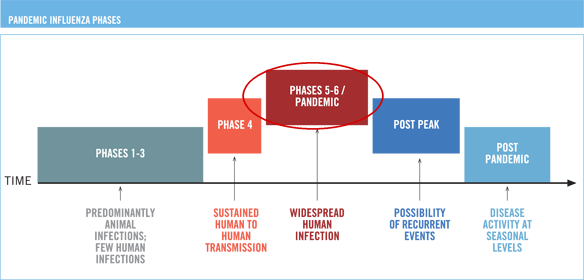
So this is how it REALLY started...The World Health Organization (WHO) said this week that the global spread of swine flu was highly likely, and raised its alert level to Phase 5 — the next-to-highest level in the worldwide warning system. It also offered advice on prevention, caring for persons with the flu and how to seek medical help.
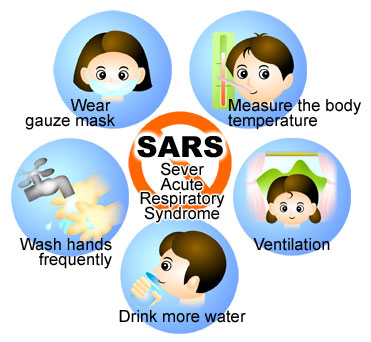
“Wash your hands when you shake hands, cover your mouth when you cough,” he said. “It sounds trivial, but it makes a huge difference. If you are sick, stay home. If your child is sick, take them out of school. If you are feeling certain flu symptoms, don’t get on an airplane.”
That’s the basic preventive message that needs amplification and repetition all over the world. While medical doctors and researchers spearhead the public health response, we need the mass media and all communications professionals to support the public awareness response. Flu shots and hospitals alone cannot win this battle.
For the first time in history, we have the means of rapid access to most of humanity. What we now need is clarity of message, credible messengers and sustained delivery.
I see this as an interesting – even if very risky – social experiment on the preventive powers of our 24/7 media and information devices. More than four billion mobile phones are in use, most of them in the developing world. Over one billion people connect to the web. We also have hundreds of radio and TV channels saturating the airwaves. Can these media peddle the right kind of awareness and inspire preventive action faster than the flu virus propagates itself? This is the classic race between education and catastrophe that H G Wells wrote about many decades ago!
We in Asia have some useful experiences from 2003 when the Severe Acute Respiratory Syndrome (SARS) affected much of the region. On that occasion, the media led a parallel front against the pandemic, delivering both preventive messages and helping care for those already infected.
Precisely because rapid response is vital in a situation like SARS and swine flu, it’s the broadcast and online media that can provide timely and up-to-date coverage. It’s too early and too soon to compare media’s role in this crisis with SARS and other rapid-spread public health crisis of the past. Print media can also play a part in spreading general awareness, but they don’t have the speed and 24/7 outreach that we need for covering a crisis like this. Besides, in many parts of the world, newspapers and magazines are struggling to stay in business, coping with a terminal malady affecting their industry.
I just killed a few dozen ‘girls’ before breakfast. It wasn’t always easy or pleasant, and after a while there was blood all over the place. But I feel good about getting them – and I saved an innocent baby in the process, and even helped a researcher doing good work!
Now online: a game we have played over millennia against 'em blood suckers...
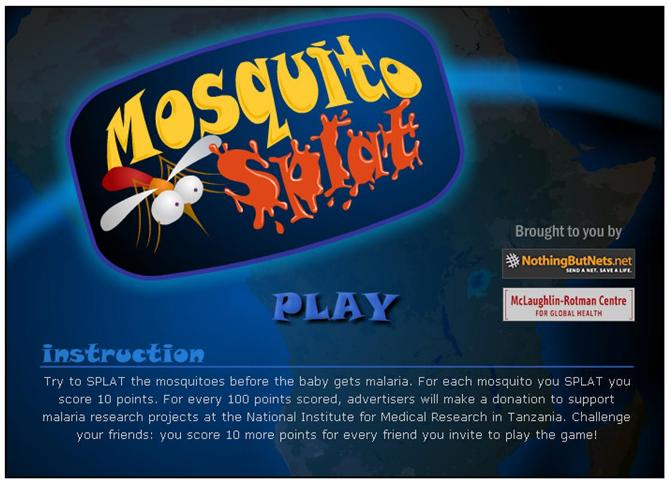
The aim of the game is to use the fly squatter to SPLAT mosquitoes before the baby gets malaria. For each mosquito you SPLAT, you score 10 points. For every 100 points scored, advertisers will make a donation to support malaria research projects at the National Institute for Medical Research in Tanzania. We also score 10 points for everyone we invite to play the game – plus there’s a link taking us to an online donation page in case we want to support the research directly.
“It’s quick, easy and fun, and a great way to do your part for one of the most serious global health problems in the developing world,” say the game’s promoters.
Indeed. Nearly 500 million cases of malaria occur each year, resulting in over one to three million deaths (figures online vary enormously on this). Malaria is particularly devastating in Africa where it is a leading killer of children. Every 30 seconds a child in Africa dies from malaria.
The fact is, malaria deaths are entirely preventable with modest investment and spread of knowledge that mosquitoes spread malaria (not everyone knows this, and as I wrote in another blog post, that’s a challenge that educators and broadcasters are now working on).
McLaughlin-Rotman Center for Global Health: Taking anti-malaria campaign onlineBut more needs to be done to engage the Digital Natives in this global public health challenge. It’s not just the exposed people in malaria-prevalent parts of Africa, Asia and Latin America who are at risk. As development economist Jeffrey Sachs has been reminding us eloquently, malaria reduces productivity, increases poverty, weakens people’s bodies and makes them vulnerable to other diseases. In a globalised world, such massive suffering in some parts of the world would quickly manifest in different ways all over the planet.
Little biology lesson: Usually, people get malaria by being bitten by an infective female Anopheles mosquito. Only Anopheles mosquitoes can transmit malaria, and they must have been infected through a previous blood meal taken on an infected person. When a mosquito bites an infected person, a small amount of blood is taken, which contains microscopic malaria parasites. About one week later, when the mosquito takes its next blood meal, these parasites mix with the mosquito’s saliva and are injected into the person being bitten.
Syeda Rizwana Hasan: Goldman Prize winner 2009In Greek legend, Helen of Troy was the ‘face that launched a thousand ships’. Now meet Syeda Rizwana Hasan, a determined environmental activist who keeps dozens of ships from coming to die on the beaches of her native Bangladesh.
Rizwina is an environmental lawyer who is working hard to reduce the impact of Bangladesh’s exploitative and environmentally-devastating ship breaking industry. She has spearheaded a legal battle resulting in increased government regulation and heightened public awareness about the dangers of ship breaking. For this, she has just been honoured as the Asia winner of the prestigious Goldman Environmental Prize 2009.
Ship breaking is a lucrative yet highly hazardous business. Decommissioned ships from around the world are sent to Bangladesh, where they are dismantled by hand on the beaches by unskilled workers who are often paid less than one dollar per day. Lacking in sufficient mineral deposits for metal mining, Bangladesh relies on the iron and other materials from the ships for some of its metal. The scrap metal, along with other parts of the ships — including sinks, toilets, beds, appliances, and light bulbs — are resold in huge open markets lining the roads of Chittagong, the main ship breaking region.
Ship-breaking is done by around 20,000 workers – mostly young men, some as young as 14, who come from the northern parts of Bangladesh. They are paid very little, housed in the most basic of shelters, and provided with little or no medical care. It is estimated that, on average, one ship breaking worker dies at the yards in Bangladesh every week and every day one worker is injured.
Rizwana Hasan, 40, is a lawyer and Executive Director of the Bangladesh Environmental Lawyers Association (BELA), a public interest law firm. Growing up in a politically-engaged family, Hasan committed herself to public service and, after receiving her master’s degree in law at age 24, joined BELA. She soon became one of the country’s leading voices for the environment. Today, she manages six offices with nearly 60 staff and is one of the leading young lawyers enrolled with the Supreme Court of Bangladesh.
The Goldman Environmental Prize, now in its 20th year, is awarded annually to grassroots environmental heroes from each of the world’s six inhabited continental regions and is the largest award of its kind with an individual cash prize of $150,000. This year’s prizes were awarded in San Francisco on 20 April 2009.
The 2009 Goldman Environmental Prize recipients are a group of fearless grassroots leaders taking on government and corporate interests and working to improve the environment for people in their communities. Other winners this year came from Gabon, Indonesia, Russia, Suriname and USA.
The power of three...to do good!Just imagine…
You do a favour that really helps someone, and tell him/her not to pay it back…
Instead, you ask that it be paid FORWARD to three other people who, in turn, must each pay it forward to three more…and so on.
Impossible? Well, not quite – if you believe (as I do) in the essential goodness of human beings, no matter what their class, race and other divisive factors are.
This idea is known as ‘Pay it forward’. It is really simple: it asks that a good turn be ‘repaid’ by having it done to others instead. Paying it forward has been around as a concept for more than two millennia, from the time of ancient Greece. It was rediscovered in modern times by Benjamin Franklin and later, by Ralph Waldo Emerson, one of my favourite essayists.
In his 1841 essay titled ‘Compensation’, Emerson wrote: “In the order of nature we cannot render benefits to those from whom we receive them, or only seldom. But the benefit we receive must be rendered again, line for line, deed for deed, cent for cent, to somebody.”
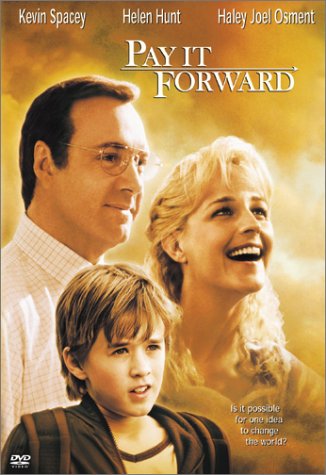
During the Twentieth Century, science fiction author Robert A Heinlein popularised the concept in his book Between Planets (1951). It formed the central theme of Pay It Forward (2000), a novel by Catherine Ryan Hyde, which was soon turned into a movie by the same name.
In that story, a thoughtful teacher challenges his seventh grade students with ‘an assignment to save the world’. One perceptive student devices a scheme where one has to carry out three good deeds for others as repayment of a good deed received. Such good deeds should be things that the beneficiaries cannot accomplish on their own.
It was through Pay It Forward the movie, made in 2000 and directed by Mimi Leder, that I first came cross the idea. It’s one of those simple and elegant ideas that packs so much power to change people and the world. Its implementation requires trust, honour and imagination, which most human beings can muster in sufficient quantity when challenged.
Then I realised that, without a conscious plan and not labelling it as such, I was already ‘paying it forward’ myself — and not just to three new people, but many. That was the least I could do for the many breaks, blessings and opportunities I had received in my professional life.
More about that in a minute. First, take a look at the official trailer for Pay it Forward:
And this is how it all started in the movie, with one thoughtful class teacher challenging his seventh grade pupils with ‘an assignment to save the world’:
Here’s an extended, unofficial trailer remixed by a fan using the official trailer, some scenes from the movie and a few interviews with the key stars:
Journalism – especially the industrialised, mainstream version of it – is by definition a highly collaborative business: newspapers, magazines, as well as TV/radio broadcasts are produced by several or many people working together, each playing a specified part.
And because the media are a mirror on our society and our times, the stories we journalists produce just won’t be possible unless our sources share their information, experiences and insights. This is why Bill Moyers, one of the most respected and credible voices in American broadcasting (a land where such professionals are endangered), says: “We journalists are simply beachcombers on the shores of other people’s knowledge, other people’s experience, and other people’s wisdom. We tell their stories.”
During the early years of my career as a science writer and journalist, I was enormously lucky in both respects. I had kind, indulgent, nurturing senior colleagues who showed me the ropes, expecting nothing in return except good stories. And I benefited much from the kindness and thoughtfulness of many accomplished men and women – mostly in the worlds of science, environment and development – who took the time and trouble to talk to me, clarify even basics to a rookie like myself, and allow me to attribute information or quotes them. I was a complete stranger to many of them, yet they cared enough in spite of busy schedules (there were also a few didn’t, but that’s only to be expected).
Then there were opportunities, some competitively earned, others bestowed on me. In those formative years, the opportunities for training, mentoring and other influences sharpened my skills and shaped my worldview. It was easy to grow up angry with the world and seeing conspiracies everywhere; it was much harder to acquire a balanced view of the world and to become a skeptical enquirer without turning into an incurable cynic.
Among those early influences were:
• Working with the Centre for Science and Environment (CSE) in India, under the late Anil Agarwal and his worthy successor Sunita Narain
• Regional and international training programmes, organised by various UN agencies and other entities such as the Abdus Salam International Centre for Theoretical Physics in Trieste, Italy
• Invaluable support from the International Science Writing Association (ISWA), which leverages far more benefits than its modest resources would indicate at first glance (again, the power of networking!)
• Editorial training and global syndication from Panos, which provided my first outlet to publish internationally through Panos Features (sadly, no more).
Then there was my mentor Sir Arthur C Clarke, who gave me the rare privilege of spending 21 years as his research assistant — a long and unique apprenticeship that enriched me so much.
These and others helped fill gaps in my formal training in science journalism. And such exposure was worth so much more in the days before commercial internet connectivity. There was no Google or YouTube, and early versions of email were just beginning to roll out.
Just do it, and hope others will keep doing it too...And now it’s my turn to ‘pay it forward’. It’s plain and simple; there’s no grand pledge or plan. No one asked me to sign up to any binding agreement. There is no spiritual or intellectual compulsion. I just do it, because that’s a good thing to do.
This is also why I spent a good part of my recent Easter/New Year holidays putting together a detailed response to a young script writer who is passionately promoting a film project related to climate change. I have never met him in person, and until a few weeks ago, I’d never heard of him. A cynical British colleague used to caution me that any crazy nut sitting under a banyan tree can write a letter (or more likely an email these days) claiming to be anything he wasn’t. There’s always that risk. But I’m taking my chances.
Years ago I stopped counting the favours I paid forward, and I no longer even keep track of the people that I give little nudges along the way. Being a secular rationalist with no absolutely religious belief of any kind, I don’t collect brownie points for any ‘next world account’. I just do these little good deeds to make this world a little better place.
If further justification were needed, I cannot say it better than Steven Grellet, a prominent French Quaker missionary who once said (and I quote him for its secular essence): “I expect to pass through this world but once; any good thing therefore that I can do, or any kindness that I can show to any fellow creature, let me do it now; let me not defer or neglect it, for I shall not pass this way again.”
I’m a bit anxious about impending teenhood. No, not my own, thank you, but my kid’s.
As a single parent raising a 12-year-old who will soon turn 13, I keep reading and hearing all kinds of advice these days on how best to cope with a teenager in the house — that phase in growing up that everyone predicts will involve some turbulence.
On top of all else that comes with hormones-on-legs, there’s now the worry of Teenage Affluenza. It’s a condition that affects millions of teenagers around the world. Most of them live in the developed countries, but in this topsy-turvey, globalised world, there’s no stopping the rapid spread of such conditions all over the majority world.
Look carefully, and you can see the symptoms of TA - image courtesy WorldVision Australia
I belatedly came across this campaign video called Teenage Affluenza, made by the charity WorldVision Australia in mid 2007. It was first made for a promotion kit for the 40 Hour Famine, to be used in Australian schools. World Vision media staff worked with Rohan Zerna Films, Melbourne, who had worked on previous spots for World Vision. The team decided to take the route of irony, providing a spoof feel. The budget wasn’t high. A family friend of the producer starred as the Melbourne teenager. The voice-over was donated by a regular with World Vision promotions. Overseas footage, already held by World Vision Australia, was spliced into the story.
Read news story in The Age newspaper, Australia, on 2 July 2007
Erin is a fifteen year old girl living deep in the South Eastern suburbs of Melbourne, Australia. She is at risk from teenage affluenza, like five million children and teenagers in her country. She still sleeps in the wooden colonial bed her parents bought her when she was ten. Although meals, travel and education are readily available to girls like Erin, many are forced to live on less than $40 pocket money each week. Erin’s iPod only holds 1 GB.
And so the satirical commentary continues. Juxtaposed with Erin’s ‘tragic life’ is the reality faced by children and teenagers in Vietnam, Sudan and other countries affected by famine and the long term impact of civil war. The video ends with the message “Do something else. Do something real. Do something.”
Teenage Affluenza is Spreading Fast: From WorldVision Australia
The video has attracted thousands of responses on YouTube’s online-comments section, including some honest self-analysis from teenagers, while others started a discussion about who is to blame – corrupt governments or first-world greed.
Meanwhile, WorldVision US has released another version of the video, slightly shorter and featuring American teeangers. If anything, the condition is more prevalent there.
Teenage Affluenza: from WorldVision United States
The message to parents is clear: we’re the ones who can prevent our teenagers from contracting Affluenza. All it takes is thoughtful and sustained action. When teens say gimme-gimme-gimme, we have to known when it’s really needed and when it’s wanted. Easier said than done. I know, because teenages seem to arrive in pre-teens these days.
We the parents would certainly welcome reinforcements from any sensible source. WorldVision Australia runs an interesting website called Stir, which tries to engage youth on issues of development and global justice. As a direct intervention charity, WorldVision doesn’t leave it to governments, but urges people to get involved — and do something.











 Open Minds!