Sri Lanka General Election 2010: Voting for the ‘Undiscovered Country’?

Keeping an eye on his beloved island...?

To melancholic Hamlet, death was an undiscovered country. In Shakespeare’s most famous soliloquy, the Prince of Denmark hesitates in his consideration of suicide not because of an absolute Christian belief in divine retribution, but because he is afraid of an afterlife of which he cannot be sure.

For the more cheerful among us, the Future is the great Undiscovered Country. It’s a notion that has been used widely by science fiction writers, and in 1991, it was popularised by Star Trek VI: The Undiscovered Country is the sixth feature film in the Star Trek science fiction franchise.

In the movie, Klingon Chancellor Gorkon – talking peace with the Earth Federation – gives a toast to “the undiscovered country — the future”. Spock recognizes the line from Hamlet, and Gorkon tells Spock that one has never read Shakespeare properly until reading the text in “the original Klingon”…

All this forms the backdrop (well, sort of!) to my latest op ed essay, just published by Groundviews citizen journalism website. Titled Voting for the ‘Undiscovered Country’?, and timed for Sri Lanka’s general election 2010, it takes a look at the most important common element discussed and debated during the election campaigns by all parties: Sri Lanka’s future prosperity.

As I note: “Our endlessly bickering political parties rarely agree on anything, so it’s refreshing to see a broad consensus on what this election is fundamentally about: future prosperity.

“That’s no coincidence. This is the first time we elect our law makers since the long drawn and brutal civil war ended in May 2009. We have been looking back — or nervously looking around — for much of the past three decades. It’s about time we finally looked forward.”

I go on to say: “How we wish Sir Arthur C Clarke was still with us at this crucial juncture in our history! For half a century up to his death in March 2008, the author, explorer and visionary was Sri Lanka’s amiable ‘tour guide’ to that ‘Undiscovered Country’ called the Future.

“Whoever wins this week’s election, shaping a better future will need clarity of purpose, hard work and persistence. Those looking for long term vision can start with the substantial volume of essays, interviews and speeches that Clarke has left behind…”

The rest of the essay is a concise exploration of Sir Arthur Clarke’s advice offered to his adopted homeland over several decades, and covering different areas of public policy and public interest such as education, technology, environmental conservation and managing human diversity.

Read the full essay on Groundviews, and join the online discussion.

Note: This essay is partly based on the Arthur C Clarke memorial address I gave at the British Council Colombo on 17 March 2010.

Earth Hour 2010: Feels good, but how about tackling ‘vampire power’?

This year’s Earth Hour was observed around the globe this weekend. On Saturday 27 March 2010, millions of businesses and households switched off some or most night lights from 8:30 to 9:30 pm local time.

An estimated one billion people, along with thousands of cities and hundreds of globally famous monuments, switched off their lights according to the organisers, WWF (World Wide Fund for Nature). I couldn’t participate personally, as I was flying through that night from Amsterdam to Singapore.

Originating in Australia in 2007, Earth Hour has become a global event held on the last Saturday of March every year. It asks households and businesses everywhere to voluntarily turn off their non-essential lights and other electrical appliances for one hour (60 minutes) as a way to raise awareness on the need to act on climate change.

For sure, Earth Hour is mostly symbolic – we can’t save enough electricity in just an hour to make any dent in our planetary energy consumption. But it reminds us of the need to conserve energy whenever and wherever we can — and reinforces the fact that the climate crisis is very closely linked to how we generate and use energy.

Indeed, night lights are one of the most visible indicators of energy use. In my writing and talks, I keep using this composite NASA image of the Earth at night shows, energy use is also proportionate to the level of economic activity and social development. Asia accounts for a good deal of the world’s lights at night.

Earth at night - NASA composite image

There is a better way to involve everyone, everywhere in an on-going way to save significant amounts of electricity: tackle the growing concern about Standby power.

A large number of electronic and electrical products — from TVs and microwave ovens to air-conditioners — cannot be switched off completely without being unplugged. These consume power 24 hours a day, often without the knowledge of the consumer. This is called ‘standby power’, also known variously as vampire power, vampire draw, phantom load, or leaking electricity. (These vampires draw electricity!).

Standing by, costing us -- and warming the planet...
A very common “electricity vampire” is a power adapter which has no power-off switch. Some such devices offer remote controls and digital clock features to the user, while other devices, such as power adapters for laptop computers and other electronic devices, consume power without offering any features.

Another example is the typical microwave oven. Over its lifespan, it consumes more electricity powering its digital clock than it does heating food. Yes, heating food requires more than 100 times as much power as running the clock, but then, most microwave ovens stand idle —in “standby” mode – more than 99% of the time.

It’s the cumulative effect that matters here. The wasted standby power (vampire energy loss) of an individual household is typically very small, but the sum of all such devices within the household becomes significant. When we add up millions of such households, it suddenly becomes a whopping number.

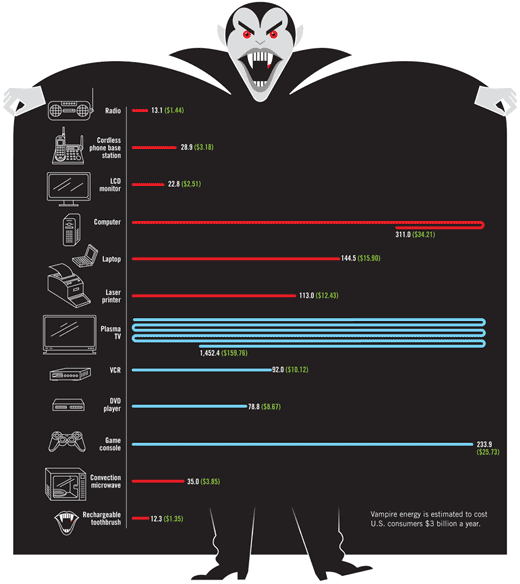
Here’s a short video made by Good Magazine, in association with Nigel Holmes, explaining everything about standby power:

In fact, the International Energy Agency (IEA) estimates that standby power accounts for 1% of the world’s total carbon dioxide emissions. For context, all the world’s air travel contributes around 2.5% of global CO2 emissions. But airlines, airports and flights have drawn much more attention – and considerable flak – than this widely distributed energy leakage happening right under most of our roofs…

Standby power consumed by different devices - courtesy Geeks Are Sexy website

Industrialised countries are now more aware of this situation. “An individual product draws relatively little standby power (see here for examples), but a typical American home has forty products constantly drawing power. Together these amount to almost 10% of residential electricity use,” says an entire website dedicated to this topicby the US government’s top-ranked Lawrence Berkeley National Laboratory (LBNL).

Across the Atlantic, the British Government’s 2006 Energy Review found that standby modes on electronic devices account for 8% of all British domestic power consumption.

A similar study in France in 2000 found that standby power accounted for 7% of total residential consumption. Further studies have since come to similar conclusions in other developed countries, including the Netherlands, Australia and Japan. Some estimates put the proportion of consumption due to standby power as high as 13%.

In helpful tips to consumers on saving electricity, the US Department of Energy says: “Many appliances continue to draw a small amount of power when they are switched off. These ‘phantom’ loads occur in most appliances that use electricity, such as VCRs, televisions, stereos, computers and kitchen appliances. These phantom loads can be avoided by unplugging the appliance or using a power strip and using the switch on the power strip to cut all power to the appliance.”

It also advises consumers to unplug battery chargers when the batteries are fully charged or the chargers are not in use. Technical solutions to the problem of standby power exist in the form of a new generation of power transformers that use only 100 milliwatts in standby mode and thus can reduce standby consumption by up to 90%. Another solution is the ‘smart’ electronic switch that cuts power when there is no load and restores it immediately when required.

LBNL also offers advice on how to reduce standby power consumption in our households and offices.

Standby power is receiving more attention at the supply end too, with manufacturers and regulators getting into the act. The One Watt Initiative is an energy saving proposal by the IEA to reduce standby power use in all appliances to just one watt.

The initiative, launched in 1999, aimed to ensure that by 2010 all new appliances sold in the world only use one watt of electricity in their standby mode. The IEA estimates that this can help reduce CO2 emissions by 50 million tons in the OECD countries alone by 2010 — the equivalent to removing 18 million cars from the roads.

IEA fact sheet on reducing standby power

IEA/OECD policy paper (2001): Things that go blip in the night: Standby power and how to limit it

Related June 2008 blog post: Broadcasters and climate change: Turn off your lights, but not your minds!

Where are all the women cartoonists hiding?

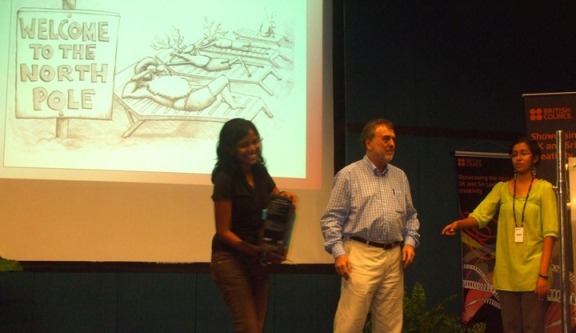
Shamanthi Rajasingham receiving her first prize in climate cartoon contest Sri Lanka

“So how many women cartoonists are working in our newspapers?”

My daughter Dhara, 13, asked me this simple question earlier this month when I was involved in judging Sri Lanka’s first contest of cartoons on climate change, organised by the British Council and the Ken Sprague Fund of UK.

I tried to come up with an answer, and couldn’t think of a single woman cartoonist who works for a print or online media outlet in Sri Lanka. That, despite my long association with the media and also being a great admirer (and collector) of good cartoons.

Later that day, at the awards ceremony for winning and commended climate cartoonists, I posed the same question to leading Lankan cartoonists Wasantha Siriwardena, Winnie Hettigoda and Dharshana Karunatilleke. They too couldn’t name one immediately; later, a single name was mentioned but it’s not one I recognised.

Clearly, cartooning is still a very male dominated profession — but that might soon change, going by the active participation of young women in the climate change cartoon contest.

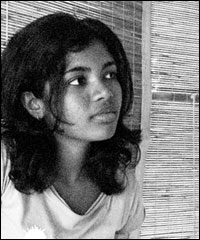
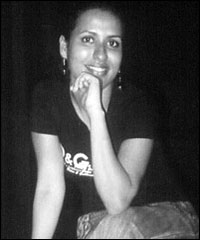
Shamanthi Rajasingham
In fact, the first and third prize winners were both women — respectively Shamanthi Rajasingham and W M D Nishani. They beat close to 200 other contestants to get there.

Additionally, there were 6 women among the 22 commended cartoonists, and one woman among those 11 who were highly commended — judged on four criteria. See all winning and commended entries.

W M D Nishani
Okay, the four judges were all male (among us, two professional cartoonists). But during this entire judging process, the identity of artists was withheld and we only knew each entry by a number. In fact, we discovered the names (and gender) of artists only at the awards ceremony.

This would be encouraging news to Dhara and all other aspiring young girls and women who want to pursue careers in media. Let’s hope at least some of the women contestants in the climate cartoons contest would end up being more than just hobby cartoonists…

Meanwhile, it’s not just Sri Lanka that has a shortage of women engaged in cartooning, and awareness of their contribution is lacking. A quick Google search brought up a book titled “The Great Women Cartoonists” by Trina Robbins (Watson-Guptill Publications, 2001). Reviewing it in TIME, Andrew D Arnold wrote: “Name three women cartoonists who worked from 1900 to 1950. Okay, just name one. Couldn’t do it? Neither could I until reading a new, invaluable book…”

Long Live Siribiris – and his creator Camillus Perera!

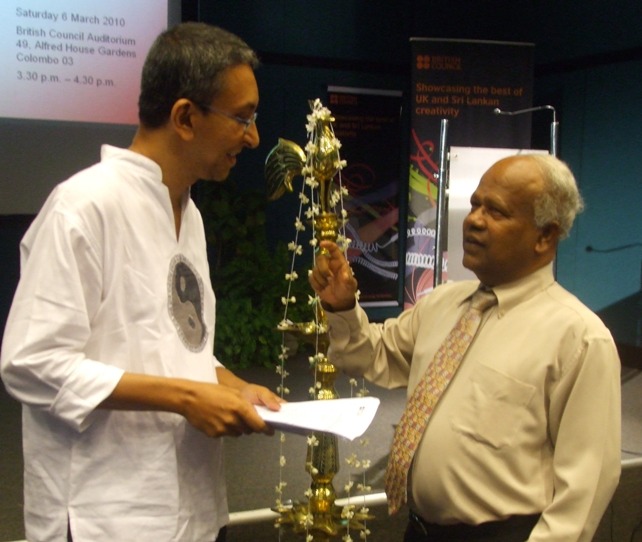
Nalaka Gunawardene (L) with cartoonist Camillus Perera - photo by Malaka Rodrigo

In January 2009, writing a tearful farewell to the slain newspaper editor and investigative journalist Lasantha Wickrematunga, I invoked the memory of Siribiris. I wrote: Goodbye, Lasantha – and long live Siribiris!

Last weekend, I finally met the ‘father of Siribiris’ and was delighted to salute him in public.

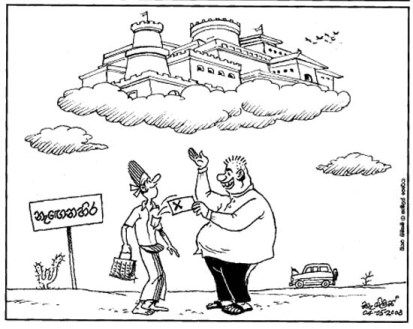
Let me explain. Siribiris is an iconic cartoon character well known to two generations of Lankan newspaper readers. He is a creation of Camillus Perera, a veteran Lankan political cartoonist who has been in this uncommon profession for nearly 45 years.

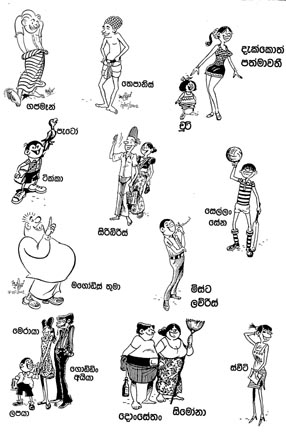
Camillus started drawing cartoons in newspapers in 1966 with the Observer newspaper and the film magazine of the same publishing group, Lake House (then privately owned and under state control since 1973). He draws pocket cartoons, political cartoons as well as satirical comic strips. His most enduring accomplishment has been the creation of a set of regular characters who have developed a loyal following over the years. Among them are the wily Siribiris, prankster Gajaman, fashionable young lady Dekkoth Pathmawathie, smart alec kid Tikka and sporty Sellan Sena.

These and other characters are very ordinary and very real, and they inhabit an undefined yet familiar place in the cartoon universe that most Lankan newspaper readers can easily relate to — it’s a bit like R K Narayan’s fictitious village of Malgudi.

puncturing egos for 40 years
Siribiris (left): puncturing egos for 40 years
My own favourite, Siribiris, is really Everyman personified: long-suffering, taken for granted by politicians, exploited by businessmen, hoodwinked by corrupt officials, and always struggling to simply stay alive. He is down but not yet out. The only way that poor, unempowered Siribiris can get back at all those who take advantage of him is to puncture their inflated egos and ridicule them at every turn. And boy, does he excel in that!

I grew up enjoying Camillus cartoons in various newspapers meant for children, youth and general readers. I had occasionally seen him being interviewed on TV. But I’d never seen or met him in person — until now. It happened when the British Council Sri Lanka invited Camillus as chief guest at their awards ceremony in the climate change cartoon contest they organised, which I helped judge with three others.

As the master of ceremonies, I announced: “It’s a great pleasure and honour for me to introduce Camillus Perera, the senior-most cartoonist in Sri Lanka who is still professionally active. Indeed, he has been drawing cartoons for as long as I have been alive — for he started his long innings in the same year I was born!”

Cartoon universe of Camillus Perera
Camillus, a small made and pleasant man, spoke briefly and thoughtfully. (As I keep saying, we writers just can’t beat cartoonists in the economy of words!). He recalled how he’d used the British Council Library for visual references for years before the web made it much easier to search. He congratulated all those who won prizes or commendations in the contest.

Many years ago, I privileged to count senior cartoonist W R Wijesoma as a senior colleague when we both worked for The Island newspaper. Now I have finally met Camillus Perera, another hero of mine still practising his craft and drawing regularly for Rivira Sunday newspaper, as well as The Catholic Messenger and Gnanartha Pradeepaya. My only regret is that I don’t follow any of these newspapers on a regular basis, even though I try hard to keep up with Siribiris on the web…

There is a bit more than childhood idol worship involved here. Satire is one of the last domains we are left with when freedom of expression comes under siege.

As I wrote in July 2009in a blog post on news wrapped up in laughter: “There is another dimension to satirising the news in immature democracies as well as in outright autocracies where media freedoms are suppressed or denied. When open dissent is akin to signing your own death warrant, and investigative journalists risk their lives on a daily basis, satire and comedy becomes an important, creative – and often the only – way to comment on matters of public interest. It’s how public-spirited journalists and their courageous publishers get around draconian laws, stifling regulations and trigger-happy goon squads. This is precisely what is happening right now in countries like Kenya and Sri Lanka, and it’s certainly no laughing matter.“

Taken in that light, Camillus Perera is not just a popular and entertaining cartoonist adorning Sri Lanka’s newspaper industry. He is a gentle giant in the world of journalism — a man of few words whose sharp wit and keystrokes are more piercing than any number of words that we writers and journalists can churn out. He is a living cultural treasure.

So long live both Siribiris — and Camillus Perera!

Green activism at crossroads in Sri Lanka? Assessing Piyal Parakrama’s role in conservation movement

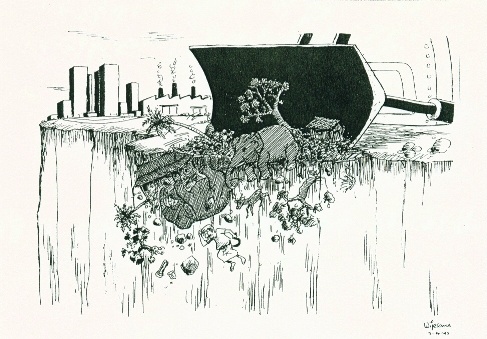
Price of Development, as seen by Cartoonist W R Wijesoma, 1993

Environmental activist and communicator Piyal Parakrama’s sudden death last week, of a heart attack, jolted Sri Lanka’s closely-knit green community. The activist community may bicker and argue endlessly among themselves, but there is also strong kinship among its cacophonous members. Many of them are still trying to come to terms with the loss.

As indeed am I – even if I’m not quite a certified member of the activist community, I consider myself a fellow traveler. I turn to words – either reflective prose or verse – when I want to make sense of something, and over the last weekend I wrote a new essay. It runs into 1,800 words and, as with all my tributes to public figures, this one is also social commentary laced in anecdotal reminiscence. It expands on initial thoughts that first appeared on this blog .

The full essay has just been published by Groundviews, and is titled: Death of a Green Activist: Tribute to Piyal Parakrama (1960 – 2010).

Here’s an excerpt where I talk about challenges faced by Sri Lanka’s environmental activists:

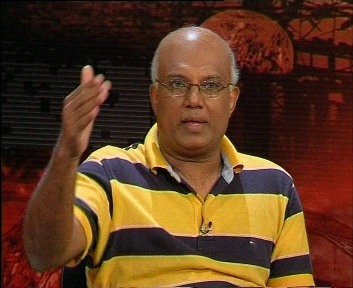
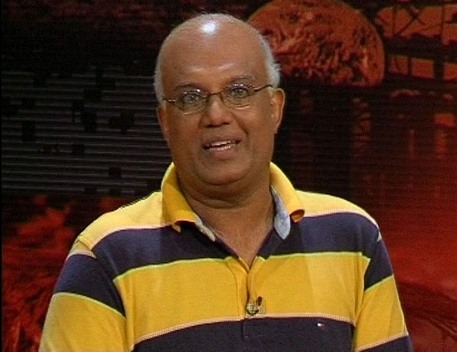
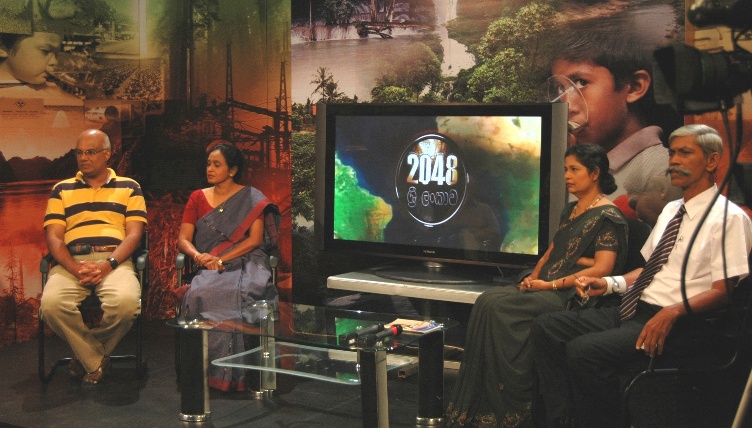
Piyal Parakrama on Sri Lanka 2048 TV show
During the past three decades, Piyal and fellow activists have taken up the formidable challenges of conserving Sri Lanka’s biodiversity, long under multiple pressures such as growing human numbers, rising human aspirations, and gaps in law enforcement. Adding to the sense of urgency was the 1999 designation of Sri Lanka as one of the world’s biodiversity hotspots, where high levels of endemic species (found nowhere else in the wild) were threatened with extinction. Public and media attention is disproportionately focused on a few charismatic mega-fauna like elephants and leopards; in reality, dozens of other animal and plant species are being edged out.

In search of viable solutions for entrenched conservation problems, Piyal collaborated with scientists, educators, journalists and grassroots activists. Some industrialists and investors hated his guts, but he was much sought after by schools, universities and community groups across the country. Concerned researchers and government officials sometimes gave him sensitive information which he could make public in ways they couldn’t.

Some eco-protests grew into sustained campaigns. Among them were the call to save the Buona-Vista reef at Rumassala and struggles against large scale sugarcane plantations in Bibile. A current campaign focuses on the Iran-funded Uma Oya multipurpose project, which involves damming a river for irrigation and power generation purposes.

While environmentalists ultimately haven’t block development projects, their agitations helped increase environmental and public health safeguards. Occasionally, projects were moved to less damaging locations – as happened in mid 2008, when Sri Lanka’s second international airport was moved away from Weerawila, next to the Bundala National Park.

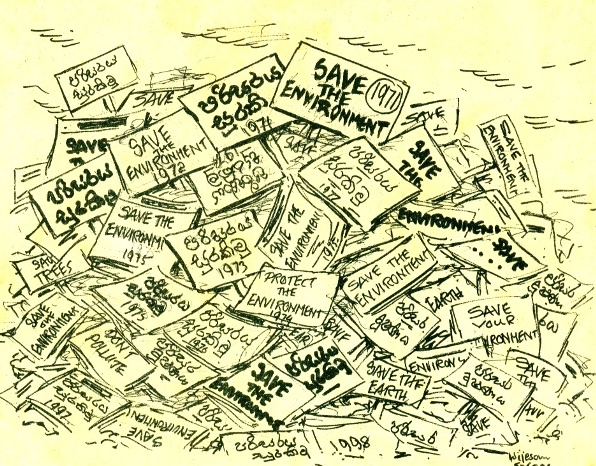
The hard truth, however, is that our green activists have lost more struggles than they have won since the economy was liberalized in 1977. They have not been able to stand up to the all-powerful executive presidency, ruling the country since 1978 — most of that time under Emergency regulations. In that period, we have had ‘green’ and ‘blue’ parties in office, sometimes in coalitions with the ‘reds’. But their environmental record is, at best, patchy. In many cases, local or foreign investors — acting with the backing of local politicians and officials — have bulldozed their way on promises of more jobs and incomes. Environmentalists have sometimes been maligned as anti-development or anti-people. In contemporary Sri Lanka, that’s just one step away from being labeled anti-national or anti-government.

At the end of the essay, I try to sum up the multiple challenges faced by ALL activists in Sri Lanka today:

“Activism is not an easy path anywhere, anytime, and especially so in modern day Sri Lanka. All activists – whether working on democracy, governance, social justice or environment – are struggling to reorient themselves in the post-conflict, middle-income country they suddenly find themselves in. Their old rhetoric and strategies no longer seem to motivate the people or influence either the polity or policy. Many of them haven’t yet crossed the Other Digital Divide, and risk being left behind by the march of technology.”

I had earlier touched on these concerns in a January 2009 blog post titled Vigil for Lasantha: Challenges of keeping the flame alive. If I was harsh in that commentary, I have tried to be more considerate in the latest essay.

After all, I want our activists to be effective and successful as society’s conscience. My suggested author intro for this latest essay, somehow now included in the published version, read: “Science writer Nalaka Gunawardene dreams of becoming an activist one day, but for now, he remains a ‘critical cheer-leader’ of those who are more courageous.”

Read the full essay on Groundviews: Death of a Green Activist: Tribute to Piyal Parakrama (1960 – 2010).

Is this how it all ends? Green activism - a cynical view by Wijesoma

Piyal Parakrama (1960 – 2010): Another hasty departure…

Piyal Parakkrama in Sri Lanka 2048 TV show

Piyal Parakrama died so suddenly and unexpectedly on the night of March 3 that it’s hard to believe that he is no longer among us. Another public-spirited individual has left the public space all too soon.

Piyal combined the roles of environmentalist, educator, researcher and media personality. He was also a colleague who became a friend, and a fellow traveller for many years.

In a public career spanning 30 years, he wore multiple hats, among them: Executive Director of the Centre for Environmental and Nature Studies, founder President of the Nature Conservation Group (NatCog), President of the Green Party of Sri Lanka, and consultant to various state and academic institutions. He also worked for the now-defunct Sri Lanka Environmental Congress (SLEC) and now dormant Sri Lanka Environmental Television Project (SLETP).

But Piyal Parakrama was more than an amalgamation of these parts: he was his own distinctive brand — admired, trusted or feared by different sections of society. Even his ardent detractors (and he had a few) would readily agree that he gave far more to the public good than he took back personally.

Piyal’s forte was biodiversity. His interest and knowledge were nurtured first at the Young Zoologists Association (YZA) – where he remained a volunteer for 30 years – and later at the Lumumba Friendship University in Russia, where he studied biology from 1983 to 1986.

In searching for viable solutions for entrenched conservation problems, Piyal collaborated with scientists, educators, journalists, school children and local activists. Some industrialists and investors simply hated his guts, while concerned researchers and government officials sometimes gave him sensitive information which he could make public in ways they couldn’t.

Given our common interests in development issues and the media, Piyal and I moved in partly overlapping circles. Our paths crossed frequently, and we shared public platforms, newspaper space and broadcast airtime. We even worked together for a few months in the late 1990s at the SLETP. His communications skills were invaluable in rendering a number of international environmental films into Sinhala.

Piyal Parakrama (left) on the set of Sri Lanka 2048 - debate on Water Management

The last time we collaborated was in such a media venture. In mid 2008, Piyal joined an hour-long TV debate we produced as part of the Sri Lanka 2048 series. The show discussed the various choices and trade-offs that had to be made today to create a more sustainable Sri Lanka over the next 40 years. Taking such a long term view is rare in our professional and media spheres preoccupied with the challenges of now and here (or restricted in vision by short-termism).

Piyal could speak authoritatively on several topics we covered in the 10-part series, but I invited him to the one on managing freshwater, one of Sri Lanka’s once abundant but now threatened natural resources. With his deep knowledge and understanding of traditional water and soil conservation systems, he was truly in his element in that debate. He was also the ‘star’ among the diverse panel and studio audience we had carefully assembled.

I’m working on a longer tribute where I try to position Piyal’s role in Sri Lanka’s conservation movement. Watch this space…

Living secular in the ‘Sinhala Buddhist Republic’ of Sri Lanka

Two years ago, in a moment of panic, I rushed my young daughter to Colombo’s only children’s hospital. To be honest, I don’t normally turn to our overcrowded government hospitals for healthcare. But a doctor friend had recommended the Lady Ridgeway Hospital as the best place for administering the anti-rabies vaccine.

As with all government hospitals, they first wanted to record the patient’s basic bio data. Fair enough. I provided the child’s name, age and street address. For some reason, the form also asked for the patient’s religion. Before I could say anything, the nurse in charge wrote ‘Buddhist’.

Now, this was both incorrect and highly presumptuous. But when I objected, it sparked off an argument. The formidable woman insisted that with a ‘good Sinhalese surname’ like ours, we simply had to be Buddhists!

When I said her assumption was wrong, she asked me with some disdain: are you then a Christian? No again. Now she was beginning to be get really irritated: who is this man who speaks fluent Sinhala, but is neither Buddhist nor Christian?

I was not about to declare in public a matter I consider to be intensely private: my religious faith. With the fellow public behind me becoming impatient, and the public servant in front of me taking a dogged stand, I retreated with a heavy heart. (I later paid a few thousand rupees for the same course of vaccines at a private clinic, where my religious faith or ethnicity was never questioned.)

I thought this was an isolated incident, and didn’t think further. But a few months later, I ran into a similar situation at my area police station. I’d gone to make a formal complaint about a serious matter concerning personal safety, and once again, the process started with my bio data. When it came to fixing labels, the woman constable recording my statement categorised me as ‘Sinhalese Buddhist’ — without even raising her head from the big book of complaints.
In case you are wondering, I bear absolutely no tell-tale signs of belonging any faith: I don’t wear a religious symbol as jewellery, or wrap pirith nool (pieces of thread blessed by monks) on my wrist. I also carefully avoid sprinkling my everyday speech with any religious phrases. Even my occasional swearing is devoid of religious references. (An observant friend once likened my colloquial speech to that of my favourite cartoon charter Tintin’s: no harsh swear words, and only secular references.)

Must biology be destiny in the 21st Century? Blind chance of birth placed me in a family of ethnic Sinhala parents who also happened to be Buddhists. But these cosmic accidents don’t make me a Buddhist any more than, say, I become a believing and practising Aquarian simply because I was born in February. My brand loyalty to the randomly assigned religion and star sign are about the same: zero.

Just so that I put all my cards on the table, I have not practised any religion or belonged to any religious faith (with their trappings of scripture, priests and places of worship) from my teen years. That’s 30 years of uninterrupted secular humanism.

Indeed, ‘secular humanist’ is the only label that I proudly wear in both public and private. But in the Sinhala Buddhist Republic of Sri Lanka that my land of birth is turning into, various public agencies find this ‘aberration’ either unsettling or unacceptable. My self-exclusion on matters of faith makes me an instant misfit in many state procedures. And yet, we are supposedly an open and democratic society……and in theory at least, not a religious state.

But that matters little in practice. For example, I recently gave evidence under oath in a court of law in a civil case. All along, my lawyer advised me to just ‘pretend’ to be a Buddhist for that solemn occasion. Apparently the system can’t handle ‘spiritually neutral’ — my preferred (and very honest) answer when asked about my faith.
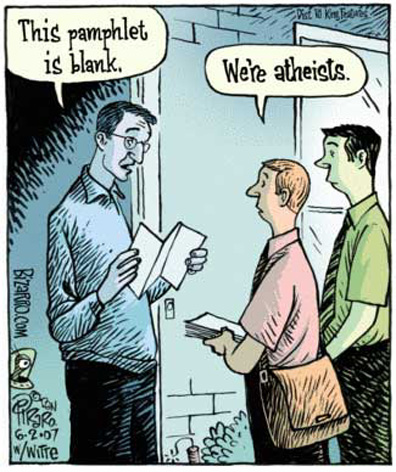
I don’t see how and why a citizen’s religious affiliation – or its complete absence – should matter in the least when dispensing vaccines or justice in the modern world. Is this not a residual habit from colonial times that no longer serves a purpose? Actually, I find it worse than redundant; it’s plain insulting.

Religion is not the only private matter that our governments love to poke its clumsy and unwelcome noses into. Also falling into this category: everyone’s sanitary habits, and sexual relations between consenting adults.

For sure, what private individuals do in the privacy of their homes can have some implications for the community, economy and national statistics. In today’s highly inter-dependent and interlinked world, no man or woman or nation is an island.

Despite this, there are at least three aspects of modern living where choices must remain strictly and entirely personal: what we do in our bed rooms, wash rooms and (metaphorical) shrine rooms. I, for one, will resist all arms of the state and government, as well as self-appointed guardians of our morals and values, from intruding into any of these hallowed spaces of my free will and choice.

Especially when it comes to matters of faith – or its complete avoidance – the Jackboot of government means absolutely nothing.

Well, at least until they perfect the Thought Police

* * * * *

Explanation for non-Lankan readers:
The ethnic mix and religious mix in Sri Lanka don’t coincide, making it (at least for me!) a delightfully chaotic melting pot. While some Sinhalese are Buddhist and some Tamils are Hindu in their choice of faith, that is not to be assumed. Indeed, there are statistically significant numbers of both Sinhalese and Tamils who are Christians (of various denominations). While all our muslim friends are Islamic, there are also some ethnic Sinhalese and Tamils who have converted to Islam. So one has to be very careful in making generalisations, and it’s altogether better to avoid them….
So you want to help develop the media? Read this first!

Some weeks ago, I wrote a post about How to become a global publisher or broadcaster in just 100 minutes! That was compiled by my British media activist friend David Brewer , who showed how it could be done using free tools that can be downloaded and activated in minutes.

This week, David has brought out another handy guide — this time aimed at those involved in media development. UNESCO defines it in lofty, technocratic terms, but it basically means strengthening the media institutions, media people (practitioners and managers) and media consumers so that the media can best serve the public interest.

Everyone seems to have their own recipe for media development, and that’s part of the media’s huge diversity. Media Helping Media asked a number of people who have benefited from media development projects what they felt needs to change in the year ahead. The replies have so far come from The Russian Federation, Indonesia, Azerbaijan, Sri Lanka, Lebanon, Macedonia, Ukraine, Bhutan and Nepal. They make up a challenging list of tips for those who try to help media in need.

Its introduction says: “You have as much to learn as you have to give. That’s the message to those offering media assistance in transition and post-conflict countries from some of those on the receiving end.”

Here’s my own contribution to this interestingly crowd-sourced distillation. David had asked for three key points, but you can see below why I was never very good in arithmetic…

Media operate as a business, not charity: All media have a social responsibility, but that must be balanced with commercial viability. This is so with state, corporate or community owned media. Bankrupt media can’t serve any public interest.

‘Media’ is a plural: Media is a basket term for entities with enormous diversity and variability. One size does not fit all, no matter how well intended. It’s crucial to understand before engaging any media.

Follow the eyeballs: If you want the biggest bang for your limited buck, start with the mass market end of media such as FM radio, tabloid newspapers and music TV channels. Leave your broadsheet/classical prejudices out of investment decisions.

Take it easy: Audiences need entertainment as much as information and education. Supporting quality entertainment in the media is just as important for the public good as nurturing investigative journalism or advocating media freedom.

Sparks of hope: Real world is not an all-or-nothing game. Find oases of innovation and resilience, and nurture them to survive and grow in turbulent times. Back media underdogs of today who can become fierce watchdogs of tomorrow.

In responding to David’s request last month, I’d added this covering sentence which sums up my thinking: “All this is common sense that is often uncommon. I really wish media development organisations would listen and reflect more, and also step beyond their comfort zones and romanticised little bubbles.”

The entire collection is well worth reading, for it distills decades of ground level experience and insight. This guide will help many well-meaning organisations (UN agencies, philanthropic foundations, CSR arms of media companies and others) to be more focused, sensitive and ultimately more effective in developing the media.

Read the related 12 tips for international media trainers

Hans Rosling and Gapminder: Unraveling the Joy of Stats!

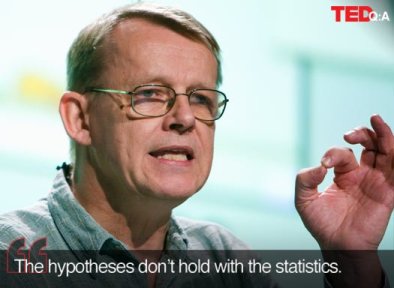
Hans Rosling: Information Wizard
If you thought Al Gore was a data-happy geek, you should see Hans Rosling in action.

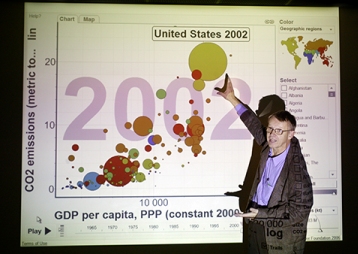
The Swedish medical researcher has a way with numbers. He brings heavy and dreary statistics into life using a combination of animated graphics and equally animated presentations. With the drama and urgency of a sportscaster, he uses a new presentation tool called Gapminder to debunk various myths about world – economic development, disparities and how well (or poorly) we share our planet’s resources.

Hans Rosling is Professor of International Health at Karolinska Institutet (which awards the Nobel Prize in medicine), but it’s his other role – as Director of the Gapminder Foundation – that he plays ‘statistics guru’ to the whole world. If you’re perplexed by lots of numbers, he’s the man who can make sense of it all.

In some ways, Rosling and Gapminder present in live action – and on video – what the Atlas of the Real World attempted to do in 2D maps: show the world as it is, with little or no distortion or misconceptions. That effort, published in late 2008, uses software to depict the nations of the world, not by their physical size, but by their demographic importance on a range of subjects.

I’ve watched a number of Rosling talks on video online. He makes no attempt to conceal his Scandinavian accent, and his English grammar is not always perfect. But it doesn’t matter: the guy has such mastery over his ideas and statistics, and a great stage presence too. He’s profound and funny at the same time, without being condescending that most experts and especially professors are.

Here’s an example of Rosling at his best: recorded in February 2006 in Monterrey, California:

No more boring data: TEDTalks

Rosling’s quest to use numbers to shatter stereotypes of rich and poor countries has brought him global prominence. He was one of the world’s “100 most important global thinkers” of 2009, according to Foreign Policy Magazine.

Look, no magic here!
Rosling was honored at #96 on the list for “boggling our minds with paradigm-shattering data“. The list is topped by (1) Ben Bernanke, the chairman of US Federal Reserve for his actions to turn the US depression and (2) President Barack Obama for “for reimagining America’s role in the world.”

Foreign Policy noted: “Rosling is well known for his energetic lectures, in which he narrates mind-blowing statistics on development and public health — as they literally move across a screen. Imagine x-y axes filled with data points, each representing a country. As time passes, the dots move, realigning to show changes in child mortality, percentage of paved roads, unemployment rates, or pretty much any other metric you can imagine.”

Here are some more examples of Rosling magic:

200 years that changed the world (with Hans Rosling)

For the first time, Gapminder can now visualize change in life expectancy and income per person over the last two centuries. In this Gapminder video, Hans Rosling shows you how all the countries of the world have developed since 1809 – 200 years ago.

Hans Rosling on HIV: New facts and stunning data visuals

Hans Rosling unveils new data visuals that untangle the complex risk factors of one of the world’s deadliest (and most misunderstood) diseases: HIV. He argues that preventing transmissions — not drug treatments — is the key to ending the epidemic.

Hans Rosling: Asia’s rise — how and when

This is one of the funniest Rosling talks I’ve watched online so far. Speaking at TEDIndia in November 2009, Rosling recalled how he was a young guest student in India when he first realized that Asia had all the capacities to reclaim its place as the world’s dominant economic force. He graphs global economic growth since 1858 and predicts the exact date that India and China will outstrip the US.

Note:
Rosling and Gapminder developed the Trendalyzer software that converts international statistics into moving, interactive and enjoyable graphics. The aim is to promote a fact-based world view through increased use and understanding of freely accessible public statistics. His lectures using Gapminder graphics to visualise world development have won awards by being humorous yet deadly serious. The interactive animations are freely available from the Foundation’s website. In March 2007 Google acquired the Trendalyzer software with the intention to scale it up and make it freely available for public statistics. Google has since made available as Motion Chart, a Google Gadget.

Waiting for Mandela: Film maker recalls momentous week in Feb 1990

Updated: 6 Dec 2013 Nelson Rolihlahla Mandela (1918 – 2013): Thank You and Goodbye!

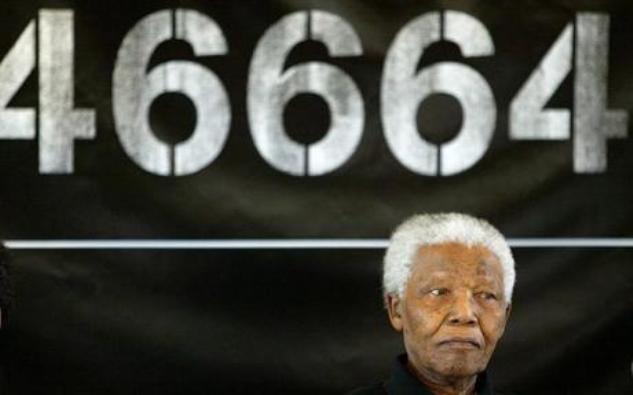
Nelson Mandela at a 2005 charity concert branded after his prison number, 46664.

This week marks the 20th anniversary of Nelson Mandela’s release after 27 years in prison.

Ending his long walk to freedom on 11 February 1990, he gave a speech which ended with these words from the defence statement he’d made during his trial for treason 27 years previously: “I have fought against white domination, and I have fought against black domination. I have cherished the ideal of a democratic and free society in which all persons will live together in harmony with equal opportunities. It is an ideal which I hope to live for, and to see realised. But my Lord, if needs be, it is an ideal for which I am prepared to die.”

My friend and inspiration Danny Schechter wrote an interesting piece recalling the week 20 years ago when his hero (and mine) finally walked free after being the world’s most celebrated political prisoner for over a quarter century.

American journalist and film maker Danny was a long and persistent supporter of the struggle against Apartheid: in all, he has made six films with and about Mandela. Here are his reminiscences in full, borrowed from his News Dissector blog:

WAITING FOR MANDELA, by Danny Schechter

Danny Schechter with Nelson Mandela

Twenty years ago during this very week, I was leading the production team of Globalvision’s inaugural TV series, South Africa Now. We were all consumed by the rumors that best known political prisoner in the world, Nelson Mandela, the leader and symbol of the African National Congress, was about to be released from prison in South Africa after 27 years.

It was exciting and nerve-wracking to contemplate what would come next—but with all the joy and anticipation, there was a fear too, fear that Mandela would be freed into an unfree society with power still in white hands dominated by their pro-apartheid Generals and securocrats. No one was sure what would happen. Would he be going from one jail to another? Would he be assassinated? Would it even happen?

Back then, we were rushing to finish a South Africa Now PBS special slated to air in prime time on Sunday February 11th. PBS correspondent Charlayne Hunter Gault, later to become first NPR’s and then CNN’s bureau chief in South Africa, had agreed to anchor it, and we were busy putting the final touches on the show which we had titled WAITING FOR MANDELA.

It was all rush, rush. We wanted to be timely but we were covering all bases because we weren’t sure if he would be freed or not. On Friday, February 9th, we went into the studio at the old WNET–Channel 13 in New York to record our studio introductions. We finished our graphics. Charlayne prercorded her open. She was great, We were ready to go. All that remained was for the special to be packaged and aired.

But then, late on Friday Night or was it Saturday Morning, we heard that South African President DeKlerk was going to make a special announcement, a key speech to mark the opening of their Parliament. He was considered a liberal Afrikaner and had been part of a process or internal coup that ousted hardline pro-apartheid president. P.W. Botha known there as “the crocodile.”

What would he say? What would he do?

The next day, were glued to our TV sets and saw DeKlerk shock the world. He announced that Mandela would be freed the next day, on Sunday. He was then in Victor Verster prison in South Africa’s wine country north of Capetown. It was happening!

Not only that. DeKlerk announced that the ANC and the South African Communist Party and all other banned organizations would be, after decades, unbanned and allowed to participate in South African politics. This meant that the ANC leaders and their MK guerrilla fighters would be able to come home from so many years in the pain of exile.

The world was upside down. ANC people worldwide had to pinch themselves to see if they really heard what he said.

It was mind-blowing. We screamed. We cried. And then, we panicked. Our TV special was now out of date. The Waiting for Mandela was over. We had a little more that 24 hours to come up with a new TV hour with virtually no budget. We had won a hour of prime time TV. We couldn’t allow it to go to waste.

The world media was rushing to the scene. They had satellites, crews, reporters galore. What could we do that was different? We had been covering the situation there on a weekly basis and had all sorts of footage the networks didn’t. We had contacts and context. But we couldn’t go there because there wasn’t enough time. And besides, we were, in effect, banned there working with South Africans. (The ANC would be unbanned before us!)

We went to work, re-editing, tapping into a South African broadcasting company feed, and setting up the first televised exchange between the ANC and a government that refused to recognize the liberation movement.

We worked around the clock. Two editors collapsed in reworking the material under pressure. We just made air, as TV people say, by minutes. We believe our special was the best on TV.

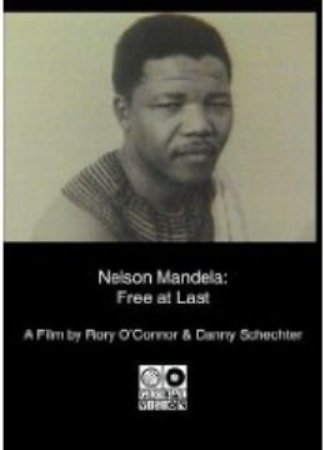
The program was now called MANDELA: Free At Last. And we have tapes for anyone interested!

Read more memories and reflections by Danny Schechter on the News Dissector blog

Huffington Post, June 2008: Danny Schechter’s 90th birthday tribute to Nelson Mandela