RTI in Sri Lanka – Nalaka Gunawardene op-ed published in IFJ South Asia blog, 14 July 2016
RTI in Sri Lanka:
It took 22 years, and journey continues
By Nalaka Gunawardene
Sri Lanka’s Parliament debated the Right to Information (RTI) bill for two days (23 – 24 June 2016) before adopting it into law. No member opposed it, although some amendments were done during the debate.
If that sounds like an easy passage, it was preceded by over two decades of advocacy with various false starts and setbacks. A large number of Lankans and a few supportive foreigners share the credit for Sri Lanka becoming the 108th country in the world to have its own RTI (or freedom of information) law.
How we reached this point is a case study of campaigning for policy change and law reform in a developing country with an imperfect democracy. The journey deserves greater documentation and analysis, but here I want to look at the key strategies, promoters and enablers.
The story began with the change of government in Parliamentary elections of August 1994. The newly elected People’s Alliance (PA) government formulated a media policy that included a commitment to people’s right to know.
But the first clear articulation of RTI came in May 1996, from an expert committee appointed by the media minister to advise on reforming laws affecting media freedom and freedom of expression. The committee, headed by eminent lawyer R K W Goonesekere (and thus known as the Goonesekere Committee) recommended many reforms – including a constitutional guarantee of RTI.
Sadly, that government soon lost its zeal for reforms, but some ideas in that report caught on. Chief among them was RTI, which soon attracted the advocacy of some journalists, academics and lawyers. And even a few progressive politicians.
Different players approached the RTI advocacy challenge in their own ways — there was no single campaign or coordinated action. Some spread the idea through media and civil society networks, inspiring the ‘demand side’ of RTI. Others lobbied legislators and helped draft laws — hoping to trigger the ‘supply side’. A few public intellectuals helpfully cheered from the sidelines.
Typical policy development in Sri Lanka is neither consultative nor transparent. In such a setting, all that RTI promoters could do was to keep raising it at every available opportunity, so it slowly gathered momentum.
For example, the Colombo Declaration on Media Freedom and Social Responsibility – issued by the country’s leading media organisations in 1998 – made a clear and strong case for RTI. It said, “The Official Secrets Act which defines official secrets vaguely and broadly should be repealed and a Freedom of Information Act be enacted where disclosure of information will be the norm and secrecy the exception.”
That almost happened in 2002-3, when a collaboratively drafted RTI law received Cabinet approval. But an expedient President dissolved Parliament prematurely, and the pro-RTI government did not win the ensuing election.
RTI had no chance whatsoever during the authoritarian rule of Mahinda Rajapaksa from 2005 to 2014. Separate attempts to introduce RTI laws by a Minister of Justice and an opposition Parliamentarian (now Speaker of Parliament) were shot down. If anyone wanted information, the former President once told newspaper editors, they could just ask him…
His unexpected election defeat in January 2015 finally paved the way for RTI, which was an election pledge of the common opposition. Four months later, the new government added RTI to the Constitution’s fundamental rights. The new RTI Act now creates a mechanism for citizens to exercise that right.
Meanwhile, there is a convergence of related ideas like open government (Sri Lanka became first South Asian country to join Open Government Partnership in 2015) and open data – the proactive disclosure of public data in digital formats.
These new advocacy fronts can learn from how a few dozen public spirited individuals kept the RTI flames alive, sometimes through bleak periods. Some pioneers did not live to see their aspiration become reality.
Our RTI challenges are far from over. We now face the daunting task of implementing the new law. RTI calls for a complete reorientation of government. Proper implementation requires political will, administrative support and sufficient funds. We also need vigilance by civil society and the media to guard against the whole process becoming mired in too much red tape.
RTI is a continuing journey. We have just passed a key milestone.
Science writer and columnist Nalaka Gunawardene has long chronicled Sri Lanka’s information society and media development issues. He tweets at @NalakaG.
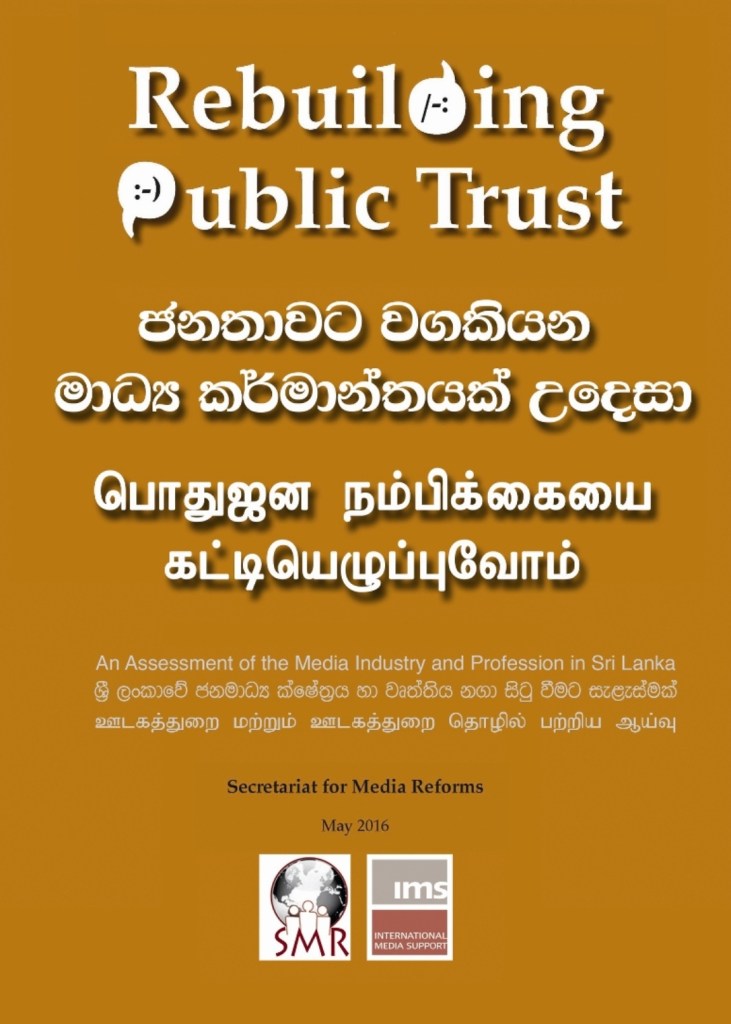
Sri Lanka’s government and its media industry need to embark on wide-ranging media sector reforms, says a major new study released recently.
Such reforms are needed at different levels – in government policies, laws and regulations, as well as within the media industry and profession. Media educators and trainers also have a key role to play in raising professional standards in our media, the study says.
The report is the outcome of a 14-month-long research and consultative process. Facilitated by the Secretariat for Media Reforms, it engaged over 500 media professionals, owners, managers, academics, relevant government officials and members of various media associations and trade unions. It offers a timely analysis, accompanied by policy directions and practical recommendations. I served as is overall editor.
“The country stands at a crossroads where political change has paved the way for strengthening safeguards for freedom of expression (FOE) and media freedom while enhancing the media’s own professionalism and accountability,” the report notes.
Politicians present at the launch could only agree.
“The government is willing to do its part for media freedom and media reforms. But are you going to do yours?” he asked the dozens of editors, journalists and media managers present. There were no immediate answers.
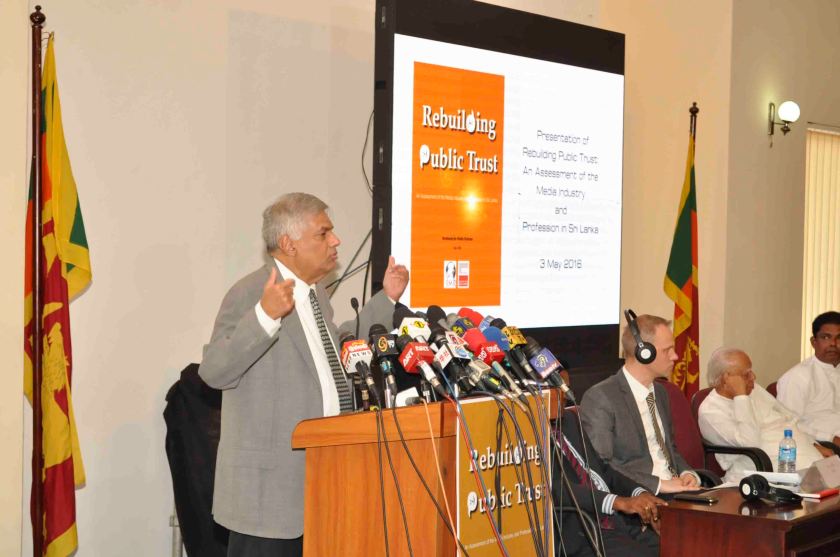
Prime Minister Ranil Wickremesinghe speaks at the launch of ‘Rebuilding Public Trust’ report in Colombo, 3 May 2016 (Photo courtesy SLPI)
Whither Media Professionalism?
The report acknowledges how, since January 2015, the new government has taken several positive steps. These include: reopening investigations into some past attacks on journalists; ending the arbitrary and illegal blocking of political websites done by the previous regime; and recognising access to information as a fundamental right in the 19th Amendment to the Constitution (after the report was released, the Right to Information Act has been passed by Parliament, which enables citizens to exercise this right).
These and other measures have helped improve Sri Lanka’s global ranking by 24 points in the World Press Freedom Index (https://rsf.org/en/ranking). It went up from a dismal 165 in 2015 index (which reflected conditions that prevailed in 2014) to a slightly better 141 in the latest index.
Compiled annually by Reporters Without Borders (RSF), a global media rights advocacy group, the Index reflects the degree of freedom that journalists, news organisations and netizens (citizens using the web) enjoy in a country, and the efforts made by its government to respect and nurture this freedom.
Sri Lanka, with a score of 44.96, has now become 141st out of 180 countries assessed. While we have moved a bit further away from the bottom, we are still in the company of Burma (143), Bangladesh (144) and South Sudan (140) – not exactly models of media freedom.
Clearly, much more needs be done to improve FOE and media freedom in Sri Lanka – and not just by the government. Media owners and managers also bear a major responsibility to create better working conditions for journalists and other media workers. For example, by paying better wages to journalists, and allowing trade union rights (currently denied in many private media groups, though enjoyed in all state media institutions).
Rebuilding Public Trust acknowledges these complexities and nuances: freedom from state interference is necessary, but not sufficient, for a better and pluralistic media.
It also points out that gradual improvement in media freedom must now to be matched by an overall upping of media’s standards and ethical conduct.
By saying so, the report turns the spotlight on the media itself — an uncommon practice in our media. It says that only a concerted effort by the entire media industry and all its personnel can raise professional standards and ethical conduct of Sri Lanka’s media.
A similar sentiment is expressed by Dr Ranga Kalansooriya, an experienced journalist turned media trainer who was part of the report’s editorial team (and has since become the Director General of the Department of Information). “Sri Lanka’s media freedom has gone up since January 2015, but can we honestly say there has been much (or any) improvement in our media’s level of professionalism?” he asks.
Media in Crisis
Tackling the dismally low professionalism on a priority basis is decisive for the survival of our media which points fingers at all other sections of society but rarely engages in self reflection.
Rebuilding Public Trust comes out at a time when Sri Lanka’s media industry and profession face many crises stemming from an overbearing state, unpredictable market forces and rapid technological advancements. Balancing the public interest and commercial viability is one of the media sector’s biggest challenges today.
The report says: “As the existing business models no longer generate sufficient income, some media have turned to peddling gossip and excessive sensationalism in the place of quality journalism. At another level, most journalists and other media workers are paid low wages which leaves them open to coercion and manipulation by persons of authority or power with an interest in swaying media coverage.”
Notwithstanding these negative trends, the report notes that there still are editors and journalists who produce professional content in the public interest while also abiding by media ethics.
Unfortunately, their good work is eclipsed by media content that is politically partisan and/or ethnically divisive.
For example, much of what passes for political commentary in national newspapers is nothing more than gossip. Indeed, some newspapers now openly brand content as such!
Similarly, research for this study found how most Sinhala and Tamil language newspapers cater to the nationalism of their respective readerships instead of promoting national integrity.
Such drum beating and peddling of cheap thrills might temporarily boost market share, but these practices ultimately erode public trust in the media as a whole. Surveys show fewer media consumers actually believing that they read, hear or watch.
One result: younger Lankans are increasingly turning to entirely web-based media products and social media platforms for obtaining their information as well as for speaking their minds. Newspaper circulations are known to be in decline, even though there are no independently audited figures.
If the mainstream media is to reverse these trends and salvage itself, a major overhaul of media’s professional standards and ethics is needed, and fast. Newspaper, radio and TV companies also need clarity and a sense of purpose on how to integrate digital platforms into their operations (and not as mere add-ons).
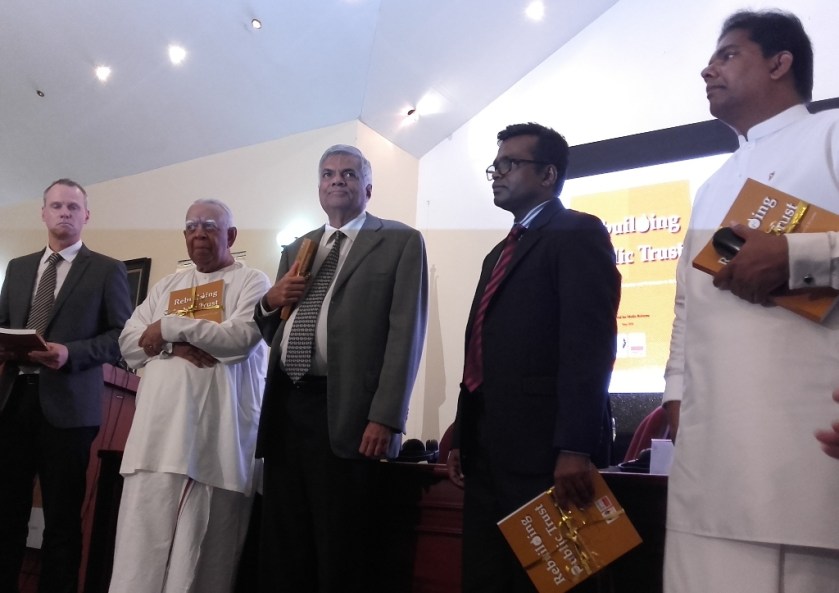
L to R – Lars Bestle of IMS, R Sampanthan, Ranil Wickremesinghe, Karu Paranawithana, Gayantha Karunathilake with copies of new study report on media reforms – Photo by Nalaka Gunawardene
Recommendations for Reforms
The report offers a total of 101 specific recommendations, which are sorted under five categories. While many are meant for the government, a number of important recommendations are directed at media companies, journalists’ and publishers’ associations, universities, media training institutions, and development funding agencies.
“We need the full engagement of all stakeholders in building a truly free, independent and public interest minded pluralistic media system as a guarantor of a vibrant democracy in Sri Lanka,” says Wijayananda Jayaweera, a former director of UNESCO’s Communication Development Division, who served as overall advisor for our research and editorial process.
In fact, this assessment has used an internationally accepted framework developed by UNESCO, the United Nations Educational, Scientific and Cultural Organisation. Known as the Media Development Indicators (MDIs), this helps identify strengths and weaknesses, and propose evidence-based recommendations on how to enhance media freedom and media pluralism in a country. Already, two dozen countries have used this methodology.
The Sri Lanka study was coordinated by the Secretariat for Media Reforms, a multistakeholder alliance comprising the Ministry of Parliamentary Reforms and Mass Media; Department of Mass Media at University of Colombo; Sri Lanka Press Institute (SLPI); Strategic Alliance for Research and Development (SARD); and International Media Support (IMS) of Denmark.
We carried out a consultative process that began in March 2015. Activities included a rapid assessment discussed at the National Summit for Media Reforms in May 2015 (attended by over 200), interviews with over 40 key media stakeholders, a large sample survey, brainstorming sessions, and a peer review process that involved over 250 national stakeholders and several international experts.
Nalaka Gunawardene, Editor of Rebuilding Public Trust in Media Report, presents key findings at launch event in Colombo, 3 May 2016 – (Photo courtesy SLPI)
Here is the summary of key recommendations:
Law review and revision: The government should review all existing laws which impose restrictions on freedom of expression with a view to amending them as necessary to ensure that they are fully consistent with international human rights laws and norms.
Right to Information (RTI): The RTI law should be implemented effectively, leading to greater transparency and openness in the public sector and reorienting how government works.
Media ownership: Adopt new regulations making it mandatory for media ownership details to be open, transparent and regularly disclosed to the public.
Media regulation: Repeal the Press Council Act 5 of 1973, and abolish the state’s Press Council. Instead, effective self-regulatory arrangements should be made ideally by the industry and covering both print and broadcast media.
Broadcast regulation: New laws are needed to ensure transparent broadcast licensing; more rational allocation of frequencies; a three-tier system of public, commercial and community broadcasters; and obligations on all broadcasters to be balanced and impartial in covering politics and elections. An independent Broadcasting Authority should be set up.
Digital broadcasting: The government should develop a clear plan and timeline for transitioning from analogue to digital broadcasting in television as soon as possible.
Restructuring state media: The three state broadcasters should be transformed into independent public service broadcasters with guaranteed editorial independence. State-owned Associated Newspapers of Ceylon Limited (Lake House) should be operated independently with editorial freedom.
Censorship: No prior censorship should be imposed on any media. Where necessary, courts may review media content for legality after publication. Laws and regulations that permit censorship should be reviewed and amended.
Blocking of websites: The state should not limit online content or social media activities in ways that contravene freedoms guaranteed by the Constitution and international conventions.
Privacy and surveillance: Privacy of all citizens and others should be respected by the state and the media. There should be strict limits to the state surveillance of private individuals and entities’ phone and other electronic communications.
Media education and literacy: Journalism and mass media education courses at tertiary level should be reviewed and updated to meet current industry needs and consumption patterns. A national policy is needed for improving media literacy and cyber literacy.
Sinhala and Tamil versions are under preparation and will be released shortly.
Science writer and media researcher Nalaka Gunawardene served as overall editor of the new study, and also headed one of the four working groups that guided the process. He tweets as: @NalakaG
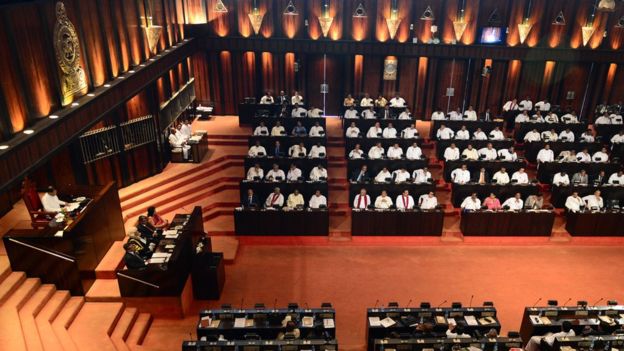
Parliament of Sri Lanka – Photo by Kolitha de Silva, from Wikimedia Commons
Sri Lanka’s Parliament debated the Right to Information (RTI) bill for two days (23 – 24 June 2016) before adopting it into law. No member opposed it, although some amendments were done during the debate.
How we reached this point is a case study of campaigning for policy change and law reform in a developing country with an imperfect democracy.
In this week’s Ravaya column (appearing in the print issue of 3 July 2016), I recall the key pioneers, promoters and enablers. The long journey deserves greater documentation and analysis, but I hope this quick tribute initiates such chronicling.
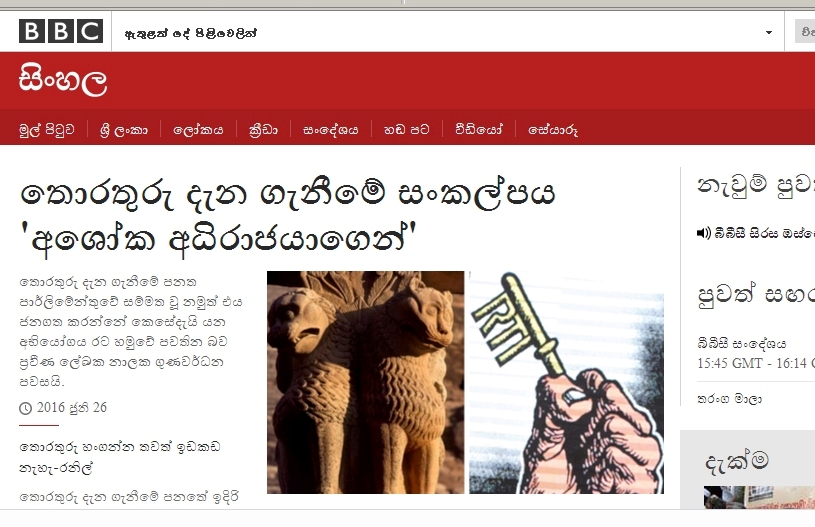
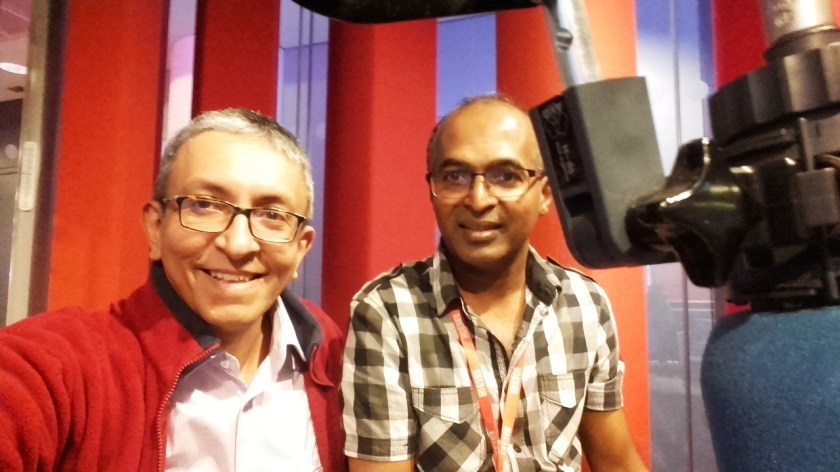
I was interviewed by BBC Sinhala in London on 21 June 2016, on the eve of Sri Lanka’s Parliament passing the long-waited Right to Information law. In this interview with BBC’s Saroj Pathirana, I look at the journey so far (it took over 2o years to get this law adopted) and challenges than remain.
Chief among the challenges from now on: reorienting all state structures to be open and info-sharing rather than closed and secretive (default mode until now); raising public awareness on the provisions and benefits of RTI law (including debunking of myths and misconceptions); and learning to be a more information-literate society as a whole.
BBC Sinhala home page on 27 June 2016, featuring Nalaka Gunawardene interview on Right to Information in Sri Lanka
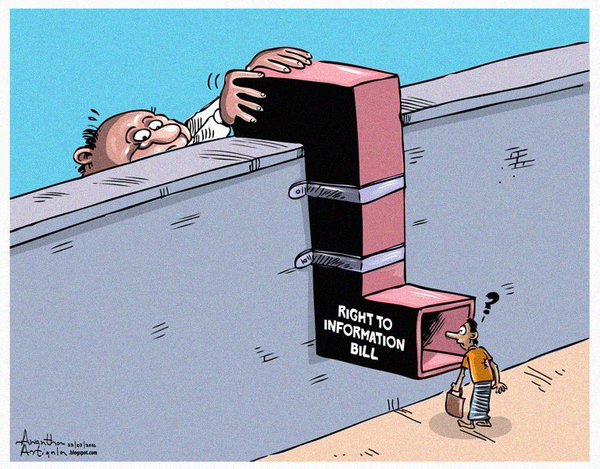
Cartoon by Awantha Artigala, Daily Mirror newspaper Sri Lanka
Right to Information: A New Journey Begins Now!
By Nalaka Gunawardene
On 24 June 2016, Sri Lanka’s Parliament unanimously adopted the Right to Information (RTI) law.
This marks the culmination of over two decades of advocacy by civil society groups and journalists. It also fulfills a key promise of the yahapalana government.
Passing the law has been no easy task, as it went through a year of drafting, judicial review by Supreme Court, and considerable political scrutiny. The government and other political parties in Parliament – who rarely agree on anything – came together to pass the law without a vote.
However, our challenges are far from over. Now begins the daunting task of implementing the new law. RTI calls for a complete reorientation of government in how it handles information and promotes openness. This is unfamiliar ground.
As one skeptical citizen, Harindra Dassanayake (@HarindraBD) said on Twitter within hours of the law passing: “Lanka as many good laws, with hopeless or zero impact. Hope RTI [would] be different. It’s time to act and not celebrate.”
Indeed, there is much to do. The law’s adoption is only a fresh start. Proper implementation requires political will, administrative support and sufficient public funds.
We would also need on-going monitoring by civil society groups and the media to guard against the whole process becoming mired in too much red tape.
Late comers, quick learners?
With the new law, Sri Lanka becomes the 108th country in the world to have introduced RTI laws, also known as freedom of information laws.
That leaves only Bhutan in South Asia without a national RTI law, according to Venkatesh Nayak, Programme Coordinator with the Commonwealth Human Rights Initiative (CHRI) in New Delhi.
Nayak, a noted RTI expert and activist, says that countries without RTI laws are becoming a smaller and smaller minority on the planet.
He adds: “But for the long drawn ethnic conflict, Sri Lanka would have been the second country in South Asia to enact a national RTI law if efforts made in 2003-4 had reached fruition.”
In the event, Sri Lanka took the belated first step in April 2015, when the 19th Amendment to the Constitution made the right to information a fundamental right. The RTI Act puts in place the administrative arrangement to enable citizens can exercise that right.
Sri Lanka is certainly a late comer to the global RTI community, but we can exploit this to our advantage. Our neighbours and others countries have so much experience in this respect that can help us in implementation.
For example, RTI has emerged such a powerful tool in the hands of Indian citizens since the national law came into effect in 2005. So much so that it is now become a verb (as in “We will RTI this information” when confronted with a problem).
Across India, young schoolchildren and grandmothers with no formal education are using RTI requests to solve local level problems – from overdue scholarship payments to restoring suspended rural bus services.
Meanwhile in Bangladesh, which adopted its RTI law in 2009, citizens and NGOs are creatively using public information to combat poverty and counter corruption.
RTI has transformed Indian society within a decade
RTI needs imagination
What transformative impacts can the RTI law have on Lankan society, politics and governance? The answer is in everybody’s hands.
Unlike most other laws, RTI is one for citizens to seize and use. That, in turn, requires a commitment to the public interest, plus plenty of imagination and tenacity.
When the new Act comes into effect six months from now, any citizen of any age should be able to seek and receive information held with a public authority at central, provincial or local levels.
The law covers all organs of the State – Parliament, Executive (President and Cabinet) and the Judiciary. This includes the police and public sector corporations, local government bodies, as well as private entities carrying out public functions or providing public services under contract or license from local authorities (to the extent such work is concerned).
To be sure, the law has some exemptions when the right of access to information may be denied on legitimate grounds such as protecting the privacy of individuals, safeguarding national security and preventing the premature release of vital economic data (e.g. exchange rates, regulation of banking and taxation). These are common to RTI laws the world over.
Some are not happy with the extent of exemptions. But in my view, we should focus on so much information that now becomes our right to ask for — and receive within 21 days or less.
On the part of public authorities, they will no longer be allowed to release information as and when they wish. RTI law defines how it must be done and failure to do so has consequences for public officials.
Citizens, on their part, must find sufficient purpose and focus in information they can demand and receive. RTI is not a mere political slogan, but a practical tool for solving problems.
Problem solving
For example, how does our local body spend our tax money? On what basis are Samurdhi beneficiaries selected? Or how are government jobs given to some and not others?
RTI will prise open the hitherto closely guarded ‘reservoirs’ of information.
A five member RTI Commission appointed by the President — on the recommendations of the Constitutional Council — will monitor and process and investigate citizen complaints and appeals. The Commission’s decisions can also be challenged before the Court of Appeal.
All this concerns the ‘supply side’ of public information, which is surely going to be enhanced. But what about the demand side? Are we ready for active citizenship armed with more information?
To draw an analogy from water management, opening sluice gates of a water reservoir can benefit only if the downstream systems are in place and the users are ready. With both water and information, recipients need to know how to make the best use of what comes through.
In the coming weeks and months, much needs to be done to ensure RTI readiness among public officials, and RTI awareness among the public.
Finally, citizens can look back at govt…do we know how?
Bigger Picture
As we get busy with the nitty-gritty operational details, let us not lose sight of the bigger picture. RTI signifies unleashing a new potential, and a major change in the status quo.
First, we must shake off a historical legacy of governments not being open or accountable to citizens. For over 2,000 years of monarchy, over 400 years of colonial rule and 67 years of self-rule since independence, all our governments have restricted public information – even mundane ones unrelated to any security or sensitive issues.
The ‘default setting’ in most government agencies is to deny and restrict information. To change this, both public servants and citizens will need a paradigm shift in their minds.
As long-standing champions of RTI, Lankan media and civil society must now switch roles. While benefiting from RTI themselves, they can nurture the newly promised openness in every sphere of public life. They can show, inspire and equip other citizens how best to make use of it.
However, RTI is not just a piece of law or changing how governments share public information. At its most basic, RTI is a collective state of mind. With its adoption, our society can start moving along a more open, informed and inquisitive pathway.
Science writer and columnist Nalaka Gunawardene has long chronicled the rise of Sri Lanka’s information society. He tweets at @NalakaG
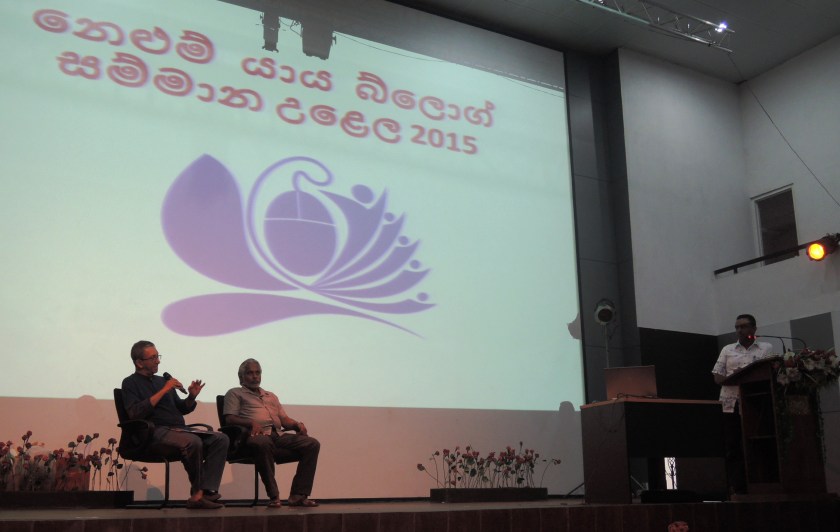
Nalaka Gunawardene (left) & Ajith Perakum Jayasinghe at Nelum Yaya Blog awards for 2015, held on 26 March 2016
In this week’s Ravaya column (appearing in the print issue of 3 April 2016), I probe why the blogosphere and other social media platforms are vital for public discourse in the Lankan context.
Sri Lanka’s mainstream media does not serve as an adequate platform for wide-ranging public discussion and debate. Besides being divided along ethnic and political lines, the media is also burdened by self-imposed restrictions where most don’t critique certain social institutions. Among the top-ranked ‘sacred cows’ are the armed forces and clergy (especially Buddhist clergy).
No such “no-go areas” for bloggers, tweeps and Facebookers. New media platforms have provided a space where irreverence can thrive: a healthy democracy badly needs such expression. I base this column partly on my remarks at the second Nelum Yaya Blog Awards ceremony held on 26 March 2016.
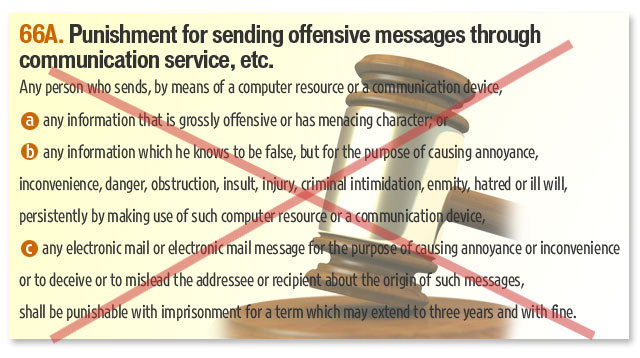
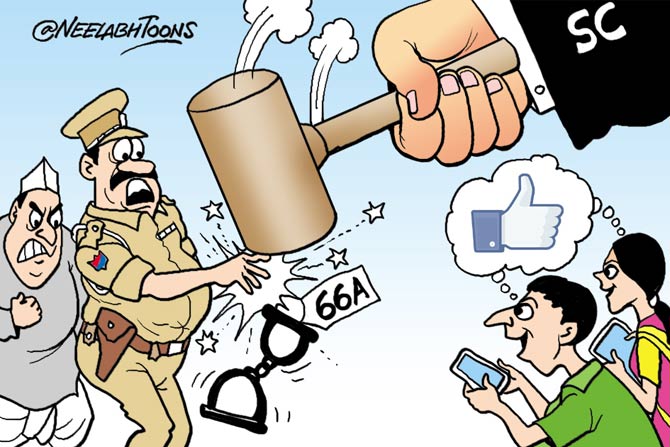
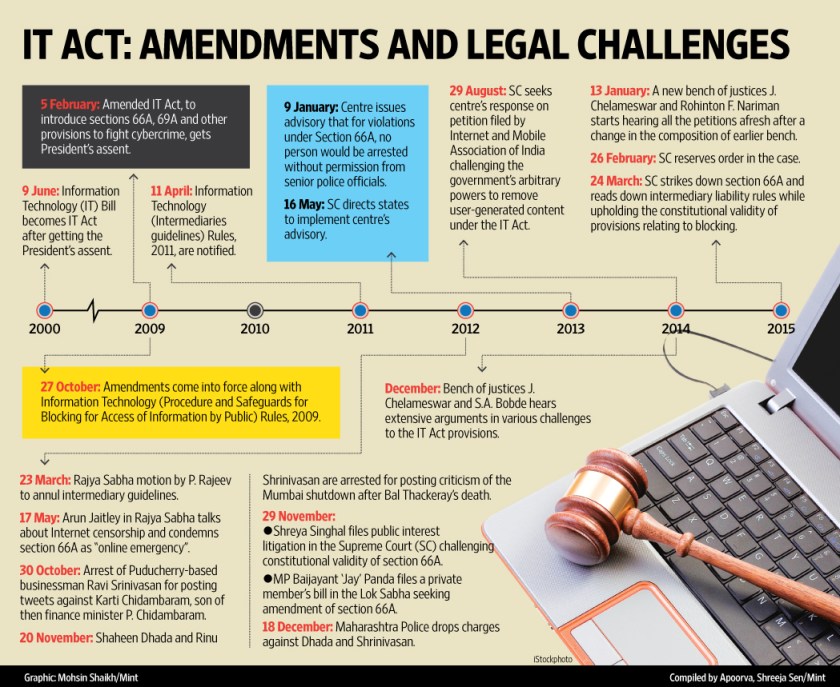
I also refer to a landmark ruling in March 2015, where the Supreme Court of India struck down a “draconian” law that allowed police to arrest people for comments on social media networks and other websites.
India’s apex court ruled that Section 66A of the Information Technology Act was unconstitutional in its entirety, and the definition of offences under the provision was “open-ended and undefined”.
The provision carried a punishment of up to three years in jail. Since its adoption in 2008, several people have been arrested for their comments on Facebook or Twitter. The law was challenged in a public interest litigation case by a law student after two young women were arrested in November 2012 in Mumbai for comments on Facebook following the death of a politician.
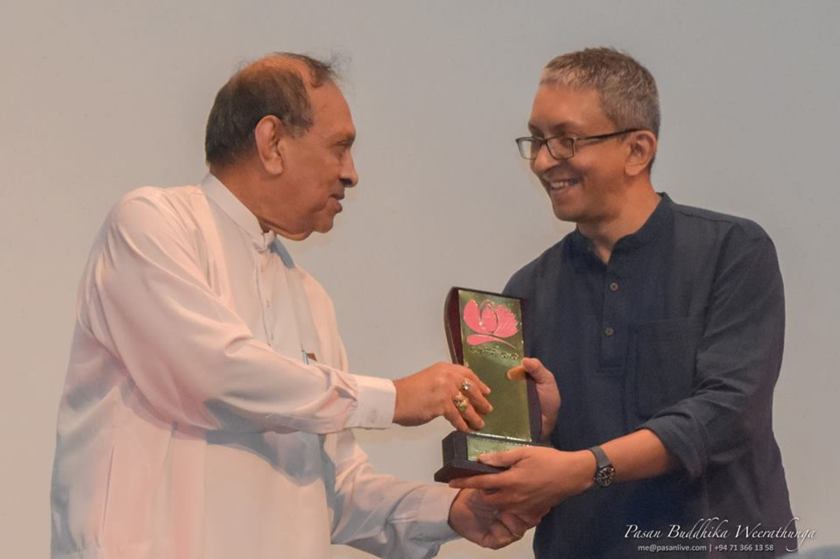
Speaker Karu Janasuriya presents Lifetime Award to Nalaka Gunawardene at Nelum Yaya Blog Awards on 26 March 2016 – Photo by Pasan B Weerasinghe
Sri Lanka’s broadcast sector, which was a state monopoly for decades, was finally opened up for private sector participation in 1992. However, it has been an ad hoc process ever since – with no clear rules nor any independent enforcement or regulatory mechanism. The broadcast licensing process remains undefined, opaque and discretionary on the part of politicians and officials in charge of media.
This has led to a squandering of the electromagnetic spectrum, a public property: private sector participation in broadcasting has been open only to business confidantes of various ruling parties that have been in office since 1990.
In this Ravaya column (appearing in issue of 6 March 2016), I further discuss the highly problematic broadcast ‘liberalisation’ in Sri Lanka and the resulting complications. I quote from an expert analysis titled Political economy of the electronic media in Sri Lanka by Tilak Jayaratne and Sarath Kellapotha (2012). I also discuss potential ways of resolving the current chaos by regularizing the broadcast licensing process, setting up an independent broadcast regulator, and belatedly bringing transparency and accountability to the sector.
Finally, I clarify that media regulation is not the control of media content or messages, but merely creating a level playing field for all participant companies including the state broadcasters in ways that would best serve the interest of audiences who are the public.
Broadcasting uses the electro-magnetic spectrum, a public resource. It is also a finite resource: there is only so much of the spectrum available for broadcasting and other uses such as telecommunications, emergency communications and military uses. And because it is a scarce resource, it is valuable.
In a landmark 1995 judgment, the Supreme Court of India held that the airwaves or frequencies in the electro-magnetic spectrum are a public property. Thus, their use had to be controlled and regulated by a public authority in the interests of the public and to prevent the invasion of their rights. Since the broadcast media involves the use of the airwaves, this factor creates an inbuilt restriction on its use, as in the case of any other public property.
Sri Lanka’s broadcast sector, which was a state monopoly for decades, was finally opened up for private sector participation in 1992. However, this decision was not accompanied by any specific laws or regulations; it has been an ad hoc process ever since. There are no clear rules nor any independent enforcement or regulatory mechanism. The broadcast licensing process remains undefined, opaque and discretionary on the part of the minister and officials in charge of media.
There are no published guidelines or criteria. In their absence, there is no legal provision to support public service media or community media through licensing. Licence issuing practices so far do not indicate any such interest. The private sector participation in broadcasting has been open only to business confidantes of various ruling parties that have been in office since 1990.
In this week’s Ravaya column (appearing in issue of 28 February 2016), I discuss the plundering of the electromagnetic spectrum in Sri Lanka and the resulting chaos in the broadcast sector. I quote former Media Ministry secretary Dr Charitha Herath and Colombo University mass media academic Dr Pradeep Nishantha Weerasinghe whose masters degree thesis analysed the early years of broadcast sector ‘liberalization’ in Sri Lanka during the 1990s.
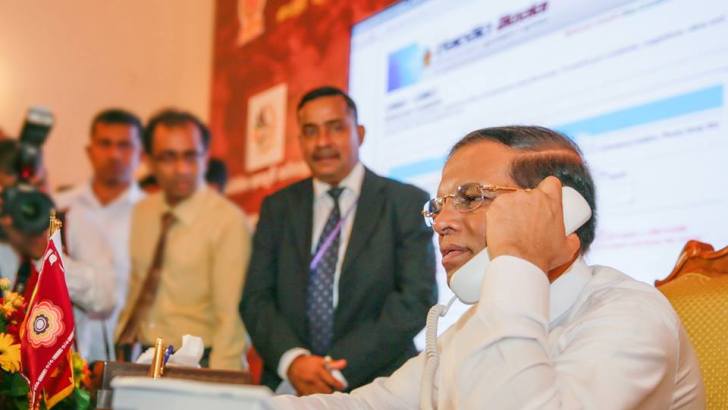
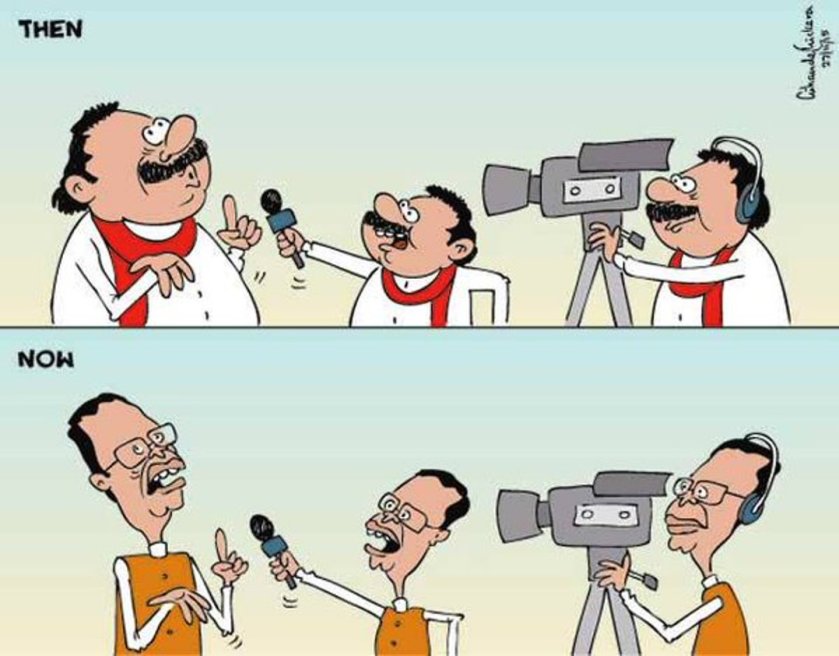
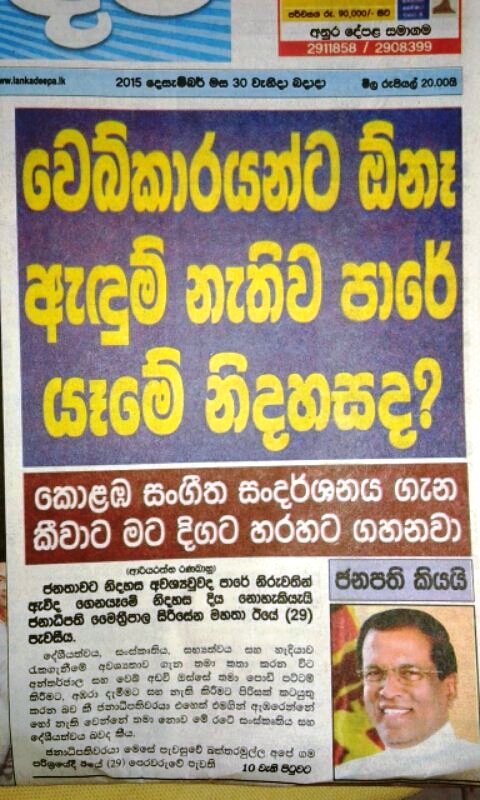
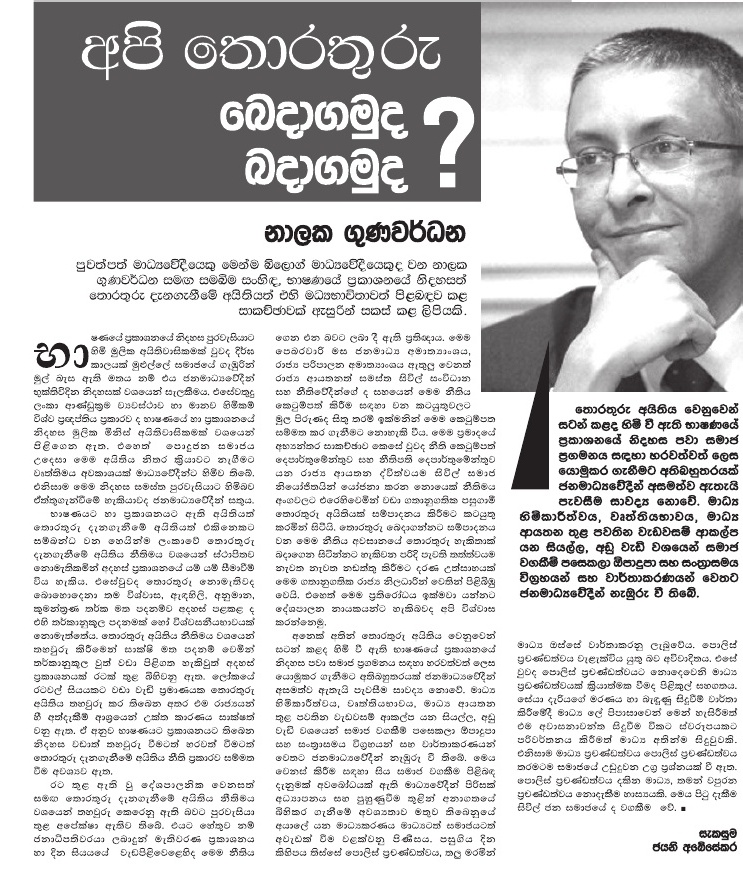
In this week’s Ravaya column (appearing in issue of 17 January 2016), I critique the public communications practices President Maithripala Sirisena of Sri Lanka – and call for better listening and more engagement by the head of state.
I point out that Sirisena is in danger of overexposure in the mainstream media, which I call the ‘Premadasa Syndrome’ (as this bad practice was started by President R Premadasa who was in office from 1988 to May 1993). I argue that citizens don’t need to be force-fed a daily dose of presidential activities on prime time news or in the next day’s newspapers. If public documentation is needed, use the official website.
Like other politicians in Sri Lanka, Sirisena uses key social media platforms like Facebook and Twitter to simply disseminate his speeches, messages and photos. But his official website has no space for citizens to comment. That is old school broadcasting, not engaging.
This apparent aloofness, and the fact that he has not done a single Twitter/Facebook Q&A session before or after the election, detracts from his image as a consultative political leader.
On the whole, I would far prefer to see a more engaged (yet far less preachy!) presidency. It would be great to have our First Citizen using mainstream media as well as new media platforms to have regular conversations with the rest of us citizens on matters of public interest. A growing number of modern democratic rulers prefer informal citizen engagement without protocol or pomposity. President Sirisena is not yet among them.
Samabima monthly magazine, published by Rights Now human rights advocacy group in Sri Lanka, has carried an interview with me in its December 2015 issue.
In this, I discuss the societal implications of a Right to Information law, which is to be adopted by Sri Lanka’s Parliament in early 2016. I reiterate that we need to see the new law as only the beginning of a long journey. Proper implementation will require adequate political will, administrative support and sufficient public funds. We would also need sustained monitoring by civil society groups and media to guard against the whole process becoming mired in too much red tape.
I also touch on serious inadequacies in our mainstream media that often fail to serve the public interest because of incompetence, arrogance or indifference. In this interview, I coin a phrase ‘Mass Media Brutality’ meted out to victims of crime or discrimination in Sri Lanka — when the media pack descends on an individual or family and unethical, sensational coverage follows.
Nalaka Gunawardene interview in Samabima magazine, Dec 2015 issue











 Open Minds!